| |
|

| |
| |
| |
|
Our selection of the top business news sources on the web. |
| |
| |
| |
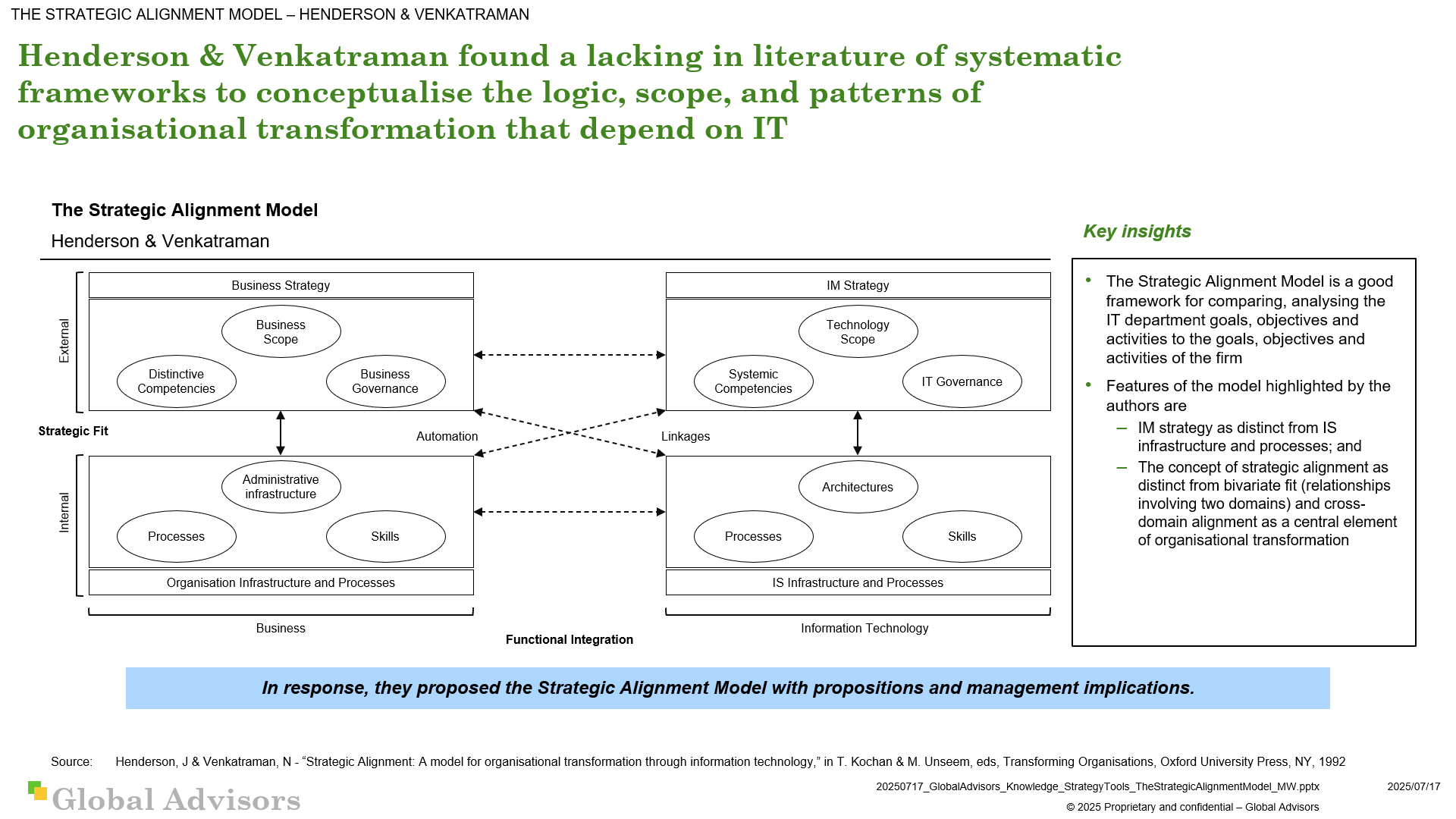
Term: Strategic Alignment ModelThe Strategic Alignment Model (SAM), as defined by Venkatraman and Henderson in the IBM Systems Journal, is a foundational framework for aligning an organization's business strategy and IM strategy to maximize value and achieve sustainable success.
The Strategic Alignment Model (SAM), as defined by Venkatraman and Henderson in the IBM Systems Journal, is a foundational framework for aligning an organization's business strategy and IT strategy to maximize value and achieve sustainable success. Core Components of the Strategic Alignment ModelThe model is structured around four domains—two external and two internal—each representing critical organizational dimensions:
Alignment occurs through two key linkages:
SAM proposes that achieving alignment requires choices across all four domains to be made in parallel, with consistent logic and rationale supporting both strategic formulation and execution. Perspectives on AlignmentVenkatraman and colleagues identify four dominant alignment perspectives for analytic alignment between Business and IT:
Each perspective highlights a different way in which business and IM strategies interact and shape organizational success. Key Theorists: N. Venkatraman and John C. HendersonN. Venkatraman is widely recognized as the principal architect behind the Strategic Alignment Model. His research in information technology, strategy, and organizational transformation helped establish the foundational link between IT investments and business value through effective alignment.
John C. Henderson collaborated extensively with Venkatraman and co-authored the original foundational work presenting the Strategic Alignment Model in the IBM Systems Journal.
Their relationship to the Strategic Alignment Model is that of co-originators. Their joint efforts have made SAM the dominant paradigm for addressing the alignment of business strategies and IT capabilities, profoundly influencing both theory and best practices in corporate strategy and digital transformation. In essence: The Strategic Alignment Model by Venkatraman and Henderson is the pivotal framework guiding organizations in aligning business and IT realms—represented and continuously refined by the scholarly work and deep expertise of these two leading theorists.
|
| |

| |
Quote: Fyodor Dostoevsky - Russian novelist, essayist and journalist"A man who lies to himself, and believes his own lies becomes unable to recognize truth, either in himself or in anyone else, and he ends up losing respect for himself and for others. When he has no respect for anyone, he can no longer love, and, in order to divert himself, having no love in him, he yields to his impulses, indulges in the lowest forms of pleasure, and behaves in the end like an animal. And it all comes from lying - lying to others and to yourself." - Fyodor Dostoevsky - Russian novelist, essayist and journalistFyodor Mikhailovich Dostoevsky (November 11, 1821 – February 9, 1881) was a Russian novelist, essayist, and journalist who explored the depths of the human psyche with unflinching honesty. Born in Moscow to a family of modest means, Dostoevsky’s early life was marked by the emotional distance of his parents and an eventual tragedy when his father was murdered. He trained as a military engineer but pursued literature with relentless ambition, achieving early success with novels such as Poor Folk and The Double. Dostoevsky’s life took a dramatic turn in 1849 when he was arrested for participating in a radical intellectual group. Sentenced to death, he faced a mock execution before his sentence was commuted to four years of hard labor in Siberia followed by military service. This harrowing experience, combined with his life among Russia’s poor, profoundly shaped his worldview and writing. His later years were marked by personal loss—the deaths of his first wife and his brother—and financial hardship, yet he produced some of literature’s greatest works during this time, including Crime and Punishment, The Idiot, Devils, and The Brothers Karamazov. Dostoevsky’s writings are celebrated for their psychological insight and existential depth. He scrutinized themes of morality, free will, faith, and the consequences of self-deception—topics that continue to resonate in philosophy, theology, and modern psychology. His funeral drew thousands, reflecting his status as a national hero and one of Russia’s most influential thinkers. Context of the QuoteThe quoted passage is widely attributed to Dostoevsky, most notably appearing in The Brothers Karamazov, his final and perhaps most philosophically ambitious novel. The novel, published in serial form shortly before his death, wrestles with questions of faith, doubt, and the consequences of living a lie. The quote is spoken by the Elder Zosima, a wise and compassionate monk in the novel. Zosima’s teachings in The Brothers Karamazov frequently address the dangers of self-deception and the importance of spiritual and moral honesty. In this passage, Dostoevsky is warning that lying to oneself is not merely a moral failing, but a fundamental corruption of perception and being. The progression—from dishonesty to self-deception, to the loss of respect for oneself and others, and ultimately to the decay of love and humanity—paints a stark picture of spiritual decline. This theme is central to Dostoevsky’s work: characters who deceive themselves often spiral into psychological and moral crises. Dostoevsky saw truth—even when painful—as a prerequisite for authentic living. His novels repeatedly show how lies, whether to oneself or others, lead to alienation, suffering, and a loss of authentic connection. Leading Theorists on Self-DeceptionWhile Dostoevsky is renowned in literature for his treatment of self-deception, the theme has also been explored by philosophers, psychologists, and sociologists. Below is a brief overview of leading theorists and their contributions: Philosophers
Psychologists
Modern Thinkers
Legacy and InsightDostoevsky’s insights into the dangers of self-deception remain remarkably relevant today. His work, together with that of philosophers and psychologists, invites reflection on the necessity of honesty—not just to others, but to oneself—for psychological health and authentic living. The consequences of failing this honesty, as Dostoevsky depicts, are not merely moral, but existential: they impact our ability to respect, love, and ultimately, to live fully human lives. By placing this quote in context, we see not only the literary brilliance of Dostoevsky but also the enduring wisdom of his diagnosis of the human condition—a call to self-awareness that echoes through generations and disciplines.
|
| |
| |
Term: Balanced ScorecardThe Balanced Scorecard is a strategic planning and management system that provides organizations with a comprehensive framework to drive performance and implement strategy. Unlike traditional performance metrics that focus solely on financial outcomes, the Balanced Scorecard emphasizes a balanced view by integrating both financial and non-financial measures. At its core, the Balanced Scorecard helps organizations:
The framework divides performance measurement into four key perspectives:
Within each perspective, organizations define:
The Balanced Scorecard has become a widely adopted tool across sectors—including corporate, government, and non-profit—due to its ability to offer a holistic approach to performance management and strategic alignment. Leading Theorists: Robert S. Kaplan & David P. NortonThe Balanced Scorecard concept was developed in the early 1990s by Dr. Robert S. Kaplan and Dr. David P. Norton. Their work stemmed from a Harvard Business Review article published in 1992, which addressed the limitations of relying solely on financial metrics for organizational performance. Robert S. Kaplan:Dr. Kaplan is an American academic, Emeritus Professor of Leadership Development at the Harvard Business School, and a leading authority on management accounting and performance measurement. After earning degrees from M.I.T. and Cornell, Kaplan spent much of his career researching managerial accounting innovations and co-introduced Activity-Based Costing before collaborating on the Balanced Scorecard. David P. Norton:Dr. Norton earned an engineering undergraduate degree from Worcester Polytechnic Institute and later an MBA from Florida Institute of Technology. He built his career as a business executive, management consultant, and co-founder of several performance management firms. Norton partnered with Kaplan to combine academic rigor and practical consultancy experience, shaping the Balanced Scorecard into a methodology that organizations worldwide could implement. Kaplan and Norton’s joint research into strategy execution revealed that organizations often struggled to operationalize their strategies and link performance measures with long-term objectives. With the Balanced Scorecard, they provided a solution that bridges the gap between strategic planning and operational execution, establishing a system that empowers organizations to continually review and refine their path to success. Their legacy includes not only the Balanced Scorecard but also later contributions on strategy maps and organizational alignment, setting global standards in performance management theory and practice.
|
| |

| |
Quote: Brené Brown - researcher, storyteller and professor“Today I choose courage over comfort.” - Brené Brown - researcher, storyteller and professorBrené Brown, a research professor, author, and renowned speaker, is celebrated worldwide for her groundbreaking work on vulnerability, courage, shame, and empathy. This quote encapsulates her core philosophy: that true growth—whether personal, relational, or professional—comes not from staying safe within our comfort zones, but from making the conscious decision to face discomfort and uncertainty with bravery. Brown’s landmark research revealed that vulnerability is not a weakness, but the greatest measure of courage. She explored these ideas in bestsellers like Daring Greatly, The Gifts of Imperfection, and Rising Strong, inspiring millions across the globe to lead more authentic, whole-hearted lives. Her now-famous TED Talk, “The Power of Vulnerability,” has become a touchstone in conversations about human connection and resilience. The context for “Today I choose courage over comfort” can be found throughout Brown’s writings and lectures. For Brown, integrity is defined by the willingness to act with courage even when it's uncomfortable, choosing what is right over what is easy. In her book Rising Strong, she writes:
Brown consistently emphasizes that vulnerability and courage are inextricably linked—there is no courage without uncertainty and emotional risk. Whether addressing leaders, entrepreneurs, or anyone striving for meaningful change, she challenges us to “show up, be seen, and live brave” even when endurance is hard. About Brené Brown: Pioneers in the Field of Courage and Vulnerability Brown’s work builds upon and amplifies insights from earlier theorists who explored courage, authenticity, and human flourishing:
Together, these theorists shaped the understanding that thriving requires more than talent or intelligence—it demands the willingness to be vulnerable, to stumble, and to rise stronger. Resonance of the Quote “Today I choose courage over comfort” stands as a daily reminder to honour our values, even when ease and avoidance tempt us. Brown’s legacy is the call to action: Lead with heart. Embrace discomfort. Make the brave choice—not just once, but day after day, in ways that transform lives, organizations, and communities.
|
| |

| |
Term: CongruenceCongruence, as defined by Carl Rogers, is a state of alignment or harmony between an individual’s self-concept (their real self) and their ideal self (who they wish to be). Rogers developed this term within his humanistic approach to psychology in the 1950s, making it a central tenet of person-centered therapy. Congruence means that our feelings, thoughts, and outward behaviours consistently reflect our true values and beliefs. When we are congruent, we accept and recognize our emotional experiences without distortion or denial. This internal unity leads to authenticity and a sense of well-being, as our actions and communications transparently match our internal state.
Rogers was clear that perfect congruence is rare; most people fluctuate between states of congruence and incongruence. Striving towards greater congruence, however, supports mental health, self-esteem, resilience, and deeper relationships. Rogers emphasized that congruence is enabled by experiences of unconditional positive regard: being valued by others without conditions leads people to accept themselves and, over time, align their ideal and real selves.
Related Strategy Theorist: Abraham Maslow Backstory and Theoretical Relationship Abraham Maslow is the most significant related theorist when it comes to congruence, particularly through his concept of self-actualization. Maslow, like Rogers, was a founder of humanistic psychology. Self-actualization refers to the fulfilment of one’s unique potential and the desire to become everything one is capable of becoming. Maslow placed this at the pinnacle of his Hierarchy of Needs, suggesting that after basic physiological and psychological needs are met, individuals are driven to realize their true selves—a state highly congruent with Rogers’ congruence. Maslow’s work on authenticity, growth, and inner motivation provided a broader societal and organizational context for Rogers’ ideas. While Rogers delved into therapy and the individual’s emotional life, Maslow examined what congruent living looks like in leadership, creativity, and strategic action. His studies of exemplary individuals (like Abraham Lincoln and Eleanor Roosevelt) showcased that the most successful people are deeply congruent: they live by deeply held principles, are comfortable with themselves, and integrate their personal and professional actions around their genuine values. Biography: In summary, both Rogers and Maslow emphasized that living congruently—not just knowing our values but embodying them in action—is essential for authentic growth, psychological health, and strategic clarity.
|
| |
| |
Quote: Brené Brown - researcher, storyteller and professor“Blame is simply the discharging of discomfort and pain. It has an inverse relationship with accountability. Blaming is a way that we discharge anger.” - Brené Brown - researcher, storyteller, and professorThe quote emerges from Brené Brown’s extensive research into vulnerability, emotional intelligence, and the social dynamics of blame and accountability. As a renowned research professor, author, and speaker, Brown has spent decades exploring how people respond to adversity, shame, and imperfection, particularly in contexts that demand courage and connection. This particular insight derives from Brown’s exploration of why people instinctively assign blame when confronted with pain or anger. Rather than solving problems or fostering growth, blame offers a false sense of relief—it shifts discomfort outward and temporarily soothes our own emotional turmoil. However, as Brown’s research demonstrates, blame is ultimately counterproductive; it consumes energy that could be spent on honest self-reflection and constructive dialogue, undermining the very possibility of real change or learning. Brown shares candid, sometimes humorous stories about her own “blamer” tendencies, illuminating the universal nature of these behaviours and the courage required to break the cycle. She emphasizes that accountability—facing our role in situations, admitting mistakes, and communicating openly—demands vulnerability and resilience. True accountability opens the door to empathy, growth, and trust, while habitual blame keeps us defensive and disconnected. Brown’s work on this subject has become foundational for leaders, educators, and organizations that prioritize psychological safety and high-functioning teams. Her call is not simply to reduce blame, but to build cultures where compassionate responsibility and honest conversations replace finger-pointing and shame. The Person Behind the Quote: Brené BrownBrené Brown is a research professor at the University of Houston and a visiting professor at the University of Texas at Austin McCombs School of Business. She is the author of multiple New York Times bestsellers, including Daring Greatly, The Gifts of Imperfection, and Dare to Lead, and is widely recognized for her TED talk, “The Power of Vulnerability,” which has been viewed by millions worldwide. Brown’s career is distinguished by her focus on vulnerability, courage, authenticity, and shame. Her work bridges rigorous academic research with practical guidance, helping individuals and organizations harness the power of difficult emotions to foster deeper connection and greater innovation. Her thoughtful insights into the dynamics of blame and accountability have reshaped conversations in business, education, healthcare, and public service. Leading Theorists Related to Blame and AccountabilityThe study of blame, accountability, and emotional process has roots in multiple fields, from psychology to conflict resolution. Notable contributors include:
Together, these theorists—along with Brown’s own influential voice—have illuminated the traps of reflexive blame and the transformative potential of compassionate accountability. Their collective work speaks to a universal truth: To create lasting change and connection, we must be willing to move beyond blame, confront vulnerability, and embrace responsibility.
|
| |
| |
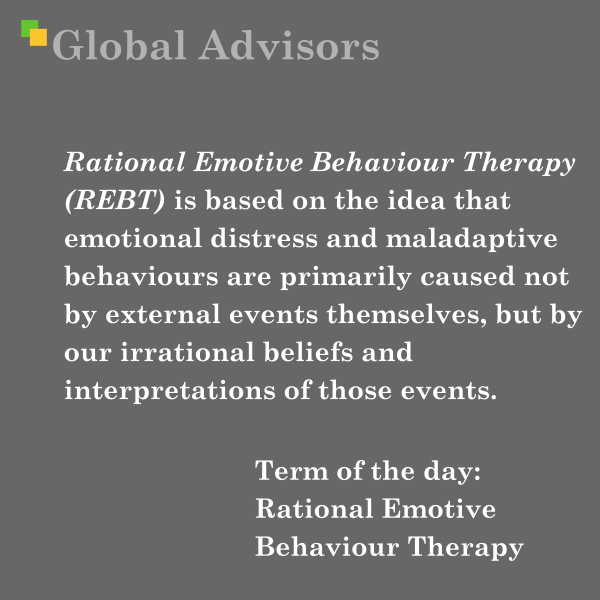
Term: Rational Emotive Behaviour Therapy (REBT)Rational Emotive Behaviour Therapy (REBT) is a pioneering, action-oriented form of Cognitive Behavioral Therapy (CBT) developed by psychologist Albert Ellis in the 1950s. At its core, REBT is based on the idea that emotional distress and maladaptive behaviors are primarily caused not by external events themselves, but by our irrational beliefs and interpretations of those events. REBT aims to help individuals identify, challenge, and replace irrational beliefs with more realistic, flexible, and rational ones, leading to healthier emotions and behaviours. The therapy centers around the ABC model, which illustrates this process:
For example, a person who does not receive a response to a message may irrationally believe, “They must not like me; I’ll always be alone” (B), leading to feelings of anxiety or depression (C). REBT works to dismantle such irrational beliefs and replace them, for instance, with, “Maybe they’re busy; one unanswered message does not define my worth.” Key principles of REBT include:
REBT is particularly valuable for those dealing with anxiety, depression, anger, guilt, shame, perfectionism, and relationship or performance issues. The therapy is active, directive, and pragmatic, focusing on present thoughts and behaviors to produce meaningful, lasting change. Albert Ellis: The Leading Theorist and His Relationship to REBT Albert Ellis (1913–2007) was an American psychologist and one of the most influential figures in modern psychotherapy. Dissatisfied with the slower pace and interpretative nature of psychoanalysis—which he originally practiced—Ellis developed REBT as a more practical and empirically grounded approach to psychological well-being. Driven by the insight that patients’ suffering was more often rooted in dysfunctional thinking rather than external circumstances, Ellis began systematically teaching clients how to recognize, dispute, and replace their irrational beliefs. His approach was revolutionary in that it placed the responsibility for emotion and behavior squarely on the individual's beliefs, empowering clients to take control of their internal narratives and emotional responses. Ellis's impact extends far beyond the therapy room. His work provided the foundational principles for the broader family of cognitive-behavioral therapies (CBT)—including Aaron T. Beck’s cognitive therapy—transforming how psychological disorders are understood and treated worldwide. Over his career, Ellis published more than 75 books and authored hundreds of articles, becoming known for his direct style, wit, and unwavering commitment to helping people confront their self-defeating beliefs. He famously stated:
Ellis’s legacy lives on in the tens of thousands of clinicians and millions of clients who continue to benefit from the clear, rational, and compassionate principles of REBT.
|
| |
| |
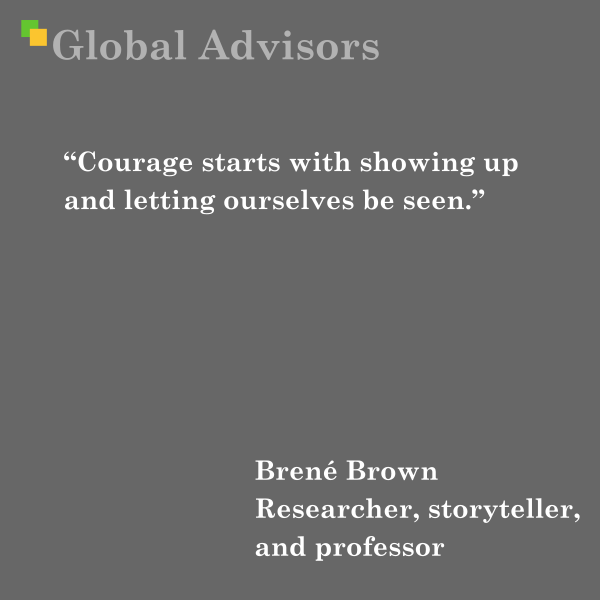
Quote: Brené Brown - researcher, storyteller, and professor“Courage starts with showing up and letting ourselves be seen.” - Brené Brown - researcher, storyteller, and professorThis quote from Brené Brown distills the essence of her two decades of research into a simple yet profound truth: True courage is rooted in vulnerability—the willingness to show up authentically and allow ourselves to be seen, despite uncertainty or risk. When Brown speaks of "showing up," she refers to the act of engaging fully in life, relationships, workplaces, and communities, even when outcomes are uncertain or we fear judgment. The second half, "letting ourselves be seen," invites individuals to move beyond façades, embrace their authentic selves, and risk openness in order to foster genuine connection and growth. Brown’s work has illuminated how authentic leadership and meaningful relationships depend not on perfection or bravado, but on the willingness to be vulnerable. Her research demonstrates that courageous leadership, innovation, and resilient cultures emerge when people are supported in being seen as they are, imperfections and all. Brown first brought this perspective into the public consciousness with her widely viewed TEDx talk, “The Power of Vulnerability,” where she explored the intersection of courage, vulnerability, and shame. Since then, she has expanded on these themes through bestsellers such as Daring Greatly, Dare to Lead, and The Gifts of Imperfection. The quote epitomizes her belief that vulnerability is not a weakness but the birthplace of innovation, creativity, and change. About Brené Brown Brené Brown is a research professor at the University of Houston, where she holds the Huffington Foundation Endowed Chair at the Graduate College of Social Work. She is also a visiting professor of management at the University of Texas at Austin McCombs School of Business. Brown’s work is grounded in qualitative research, focusing on the complex human experiences of courage, vulnerability, shame, and empathy. She is the author of six #1 New York Times bestsellers and the host of the acclaimed podcasts Unlocking Us and Dare to Lead. Brown’s influence extends from academia into popular culture and organizations worldwide. Her TED talk, “The Power of Vulnerability,” ranks among the most viewed globally, reflecting her skill as a storyteller who marries in-depth research with accessible, relatable insights. She has also produced content for major platforms such as Netflix and HBO Max, further advancing conversations on leadership and emotional intelligence. Leading Theorists Related to the Subject Matter The study of courage, vulnerability, and personal growth is informed by a rich tapestry of psychological and sociological thought. In addition to Brown, several theorists have shaped the contemporary understanding of these topics:
Brown’s scholarship is uniquely influential because she bridges the academic and practical realms, showing how research-backed principles of courage and connection are essential not just for personal transformation, but for healthy organizations and communities. Her insight—that courage begins with the simple but costly act of showing up and being seen—speaks to a universal need and a timeless call to leadership and humanity.
|
| |
| |
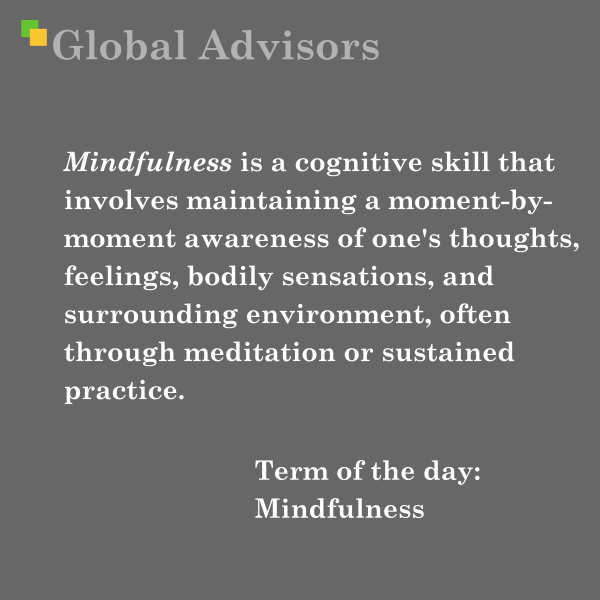
Term: MindfulnessMindfulness is a cognitive skill that involves maintaining a moment-by-moment awareness of one's thoughts, feelings, bodily sensations, and surrounding environment, often through meditation or sustained practice. It is characterized by a non-judgmental acceptance of the present moment, allowing individuals to observe their internal states and emotions without becoming entangled in them. This practice has roots in Buddhist meditation but has evolved into a secular tool for enhancing mental and physical well-being in the Western world. Mindfulness has been widely adopted in various therapeutic interventions, including mindfulness-based cognitive behaviour therapy (MBCT), mindfulness-based stress reduction (MBSR), and acceptance and commitment therapy (ACT). These practices help individuals manage stress, anxiety, and depression by cultivating a mindful approach to their experiences. Related Strategy Theorist: Jon Kabat-ZinnBackstory and Relationship to MindfulnessJon Kabat-Zinn is a pivotal figure in the modern Western adaptation of mindfulness. Born on June 5, 1944, in New York City, Kabat-Zinn is an American scientist, writer, and meditation teacher. He is most renowned for founding the Mindfulness-Based Stress Reduction (MBSR) program at the University of Massachusetts Medical School in 1979. This program has been instrumental in popularizing mindfulness as a therapeutic tool worldwide. Kabat-Zinn's journey into mindfulness began during his Ph.D. studies in molecular biology. He became interested in Buddhism and meditation, seeing them as a way to apply mindfulness to everyday life. His work seeks to integrate mindfulness with Western psychology and medicine, making it accessible for people from diverse backgrounds. Through his research and teaching, Kabat-Zinn has shown how mindfulness can improve physical and mental health, reduce stress, and enhance overall well-being. BiographyKabat-Zinn holds a Ph.D. in molecular biology from MIT and is a long-time practitioner of meditation and yoga. He is the author of several books, including Full Catastrophe Living and Wherever You Go, There You Are, which have contributed significantly to the popular understanding of mindfulness. His work has inspired numerous mindfulness programs across the globe, transforming the way healthcare providers approach mental health and stress management. Today, Kabat-Zinn continues to advocate for mindfulness as a powerful tool for personal growth and societal transformation. His legacy in developing MBSR has made mindfulness a cornerstone of modern psychological practice, demonstrating its potential to foster resilience and well-being in individuals and communities. Additional Key Figures:
|
| |
| |
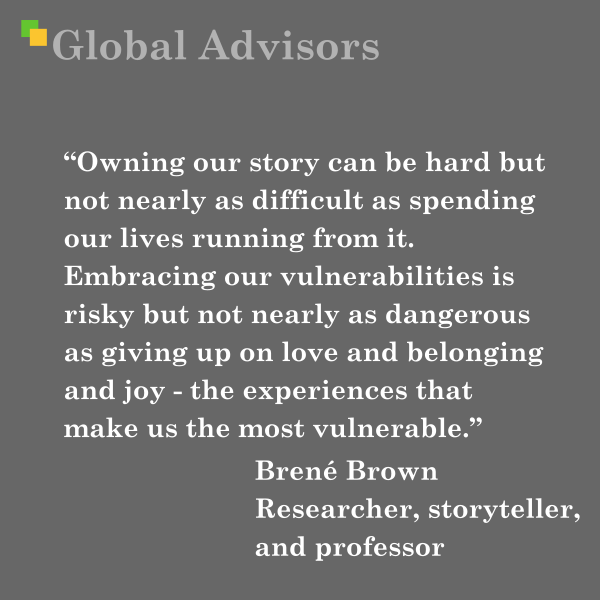
Quote: Brené Brown - researcher, storyteller, and professor““Owning our story can be hard but not nearly as difficult as spending our lives running from it. Embracing our vulnerabilities is risky but not nearly as dangerous as giving up on love and belonging and joy - the experiences that make us the most vulnerable. Only when we are brave enough to explore the darkness will we discover the infinite power of our light.” - Brené Brown - researcher, storyteller, and professorBrené Brown is a renowned researcher, storyteller, and professor whose work has fundamentally reshaped how we understand and engage with concepts such as vulnerability, courage, shame, and empathy. As a research professor at the University of Houston and the director of the Center for Daring Leadership at BetterUp, Brown has spent more than two decades delving into how these attributes shape our sense of connection, leadership, and psychological well-being. The quote in question comes from Brown’s deep exploration into the “power of vulnerability.” Her seminal TEDx talk in 2010, The Power of Vulnerability, distilled a decade of academic research into a message that resonated around the world. Brown’s research revealed that embracing our vulnerabilities—not hiding from them—is essential for experiencing the fullness of love, belonging, and joy. She argues that running from our stories, especially those parts we hide out of shame, actually distances us from meaning, connection, and authenticity. True courage, she asserts, is found not in avoiding darkness or risk but in stepping into it, trusting that doing so reveals our deepest strengths. Brown’s work is grounded in her use of qualitative research methods, particularly Grounded Theory, to analyse interviews and narratives across hundreds of individuals. This rigorous approach uncovered that resilience in the face of shame and the willingness to be open—rather than closed off—directly correlates with living a more fulfilling, wholehearted life. Context of the Quote“Owning our story can be hard but not nearly as difficult as spending our lives running from it…” encapsulates Brown’s thesis: the real danger lies not in being vulnerable but in refusing vulnerability altogether. In a world where self-presentation—magnified by social media and societal pressures—often feels safer than honesty, Brown’s research champions a countercultural embrace of openness. Her ideas have rapidly gained influence, particularly among younger generations striving for authenticity in both personal and professional spheres. Influential Theorists and Roots of Brown’s WorkBrown’s scholarship is deeply interwoven with and builds upon major figures in psychology and human development:
In the contemporary era, Kristin Neff—a psychologist and leading researcher on self-compassion—has also contributed to our understanding of the imperative for kindness towards oneself, a concept that complements Brown’s prescriptions for overcoming shame. Brown’s Impact and LegacyBy fusing rigorous academic research with relatable storytelling, Brené Brown has made vulnerability, honesty, and emotional courage central tenets of modern leadership, organizational culture, and personal development. Her books, podcasts, and talks are credited with igniting global conversations about mental and emotional health—a legacy that continues to resonate through businesses, educational institutions, and social movements. Often described as offering “data with soul”, Brown’s work is both a call and a roadmap for embracing the fullness of our humanity, trusting that only by facing our darkness can we unlock the infinite power of our own light.
|
| |
| |
|


| |
| |