| |
|

| |
| |
| |
|
Our selection of the top business news sources on the web. |
| |
| |
| |
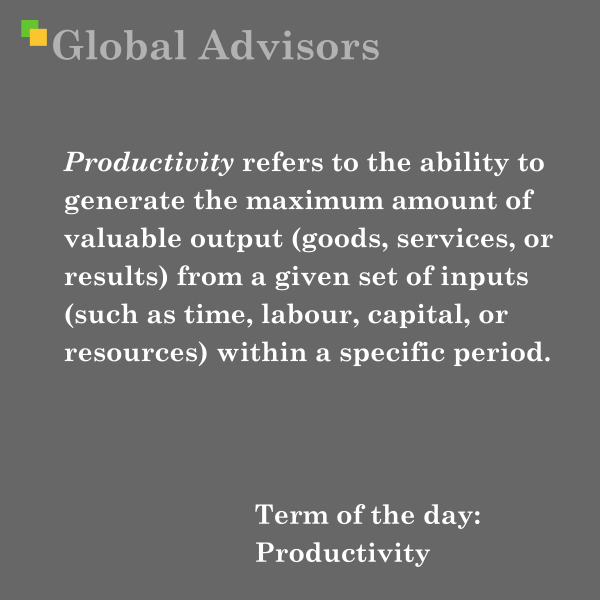
Term: ProductivityProductivity refers to the ability to generate the maximum amount of valuable output (goods, services, or results) from a given set of inputs (such as time, labour, capital, or resources) within a specific period. In a business or economic context, productivity is usually quantified by the formula: Productivity = Output / Input This calculation allows organisations and economies to assess how well they convert resources into desired outcomes, such as products, services, or completed tasks. Productivity is a central indicator of organisational performance, economic growth, and competitiveness because improvements in productivity drive higher living standards and create more value from the same or fewer resources. Relationship to Efficiency and Effectiveness
For example, a business may be efficient at manufacturing a product, using minimal input to create many units; however, if the product does not meet customer needs (e.g., is obsolete or unwanted), productivity in terms of business value remains low. Best Related Strategy Theorist: Peter F. DruckerPeter Ferdinand Drucker (1909–2005) is widely recognised as the most influential theorist linking productivity with both efficiency and effectiveness, especially in the context of modern management. Drucker's Backstory and Relationship to ProductivityDrucker, born in Austria, became a preeminent management consultant, educator, and author after emigrating to the United States prior to World War II. He taught at New York University and later at Claremont Graduate School, fundamentally shaping the field of management for over half a century. Drucker introduced the pivotal distinction between efficiency (“doing things right”) and effectiveness (“doing the right things”), arguing that true productivity results from combining both—particularly for “knowledge workers” whose roles involve decision-making more than repetitive physical tasks. He believed that in both industry and society, productivity growth is the primary lever for improving living standards and economic growth. His classic works, such as "The Practice of Management" (1954) and "Management: Tasks, Responsibilities, Practices" (1973), emphasise the responsibility of managers to maximise productivity, not just by streamlining processes, but by ensuring the right goals are set and pursued. Drucker advocated for continuous improvement, innovation, and aligning organisational purpose with productivity metrics—principles that underpin modern strategies for sustained productivity. In summary:
|
| |
| |
Quote: Charles Duhigg - Writer, journalist - The Power of Habit“Typically, people who exercise, start eating better and becoming more productive at work. They smoke less and show more patience with colleagues and family. They use their credit cards less frequently and say they feel less stressed. Exercise is a keystone habit that triggers widespread change.” — Charles Duhigg - Writer, journalist - The Power of HabitThis quote comes from Charles Duhigg’s acclaimed book, The Power of Habit, where he introduces the transformational concept of keystone habits. Unlike ordinary habits that shape a single behaviour, keystone habits are foundational routines that, when established, set off a cascade of positive changes across many areas of an individual’s or organization’s life. Duhigg uses the example of exercise as a typical keystone habit: people who start exercising regularly not only become fitter but also tend to adopt other healthy habits spontaneously. They may eat better, become more productive, reduce risky financial behaviours, and handle social situations with greater patience and resilience. The compounding impact of a single empowering habit triggers a broader pattern of improvement, creating lasting transformation far beyond its original intent. Duhigg’s research, informed by neuroscience and behavioural psychology, demonstrates that understanding and strategically targeting keystone habits offers a powerful strategy for sustainable change, whether at the personal or organizational level. About Charles DuhiggCharles Duhigg is a Pulitzer Prize-winning journalist and best-selling author renowned for his work on the science of habit formation and behaviour change. Educated at Yale University and Harvard Business School, Duhigg began his career as a reporter at The New York Times, where he led investigative projects and specialized in business and science topics. Duhigg’s passion for understanding human behaviour crystallized in his breakthrough book, The Power of Habit (2012). The book rapidly became a global bestseller, praised for demystifying the neuroscience of habits and translating it into actionable insights. Duhigg’s vivid storytelling—drawing on case studies from Olympic athletes, business leaders, and ordinary people—brought academic theories into real-world relevance. Leading Theorists Related to Habits and Transformational ChangeThe study of habits and behavioural transformation has deep roots in psychology and management. Several theorists and practitioners have significantly influenced the field:
Charles Duhigg’s research and storytelling on keystone habits reveal the disproportionate power of foundational routines—such as exercise—to unlock positive change throughout all aspects of life, providing a practical roadmap for anyone seeking meaningful transformation through the science of habit.
|
| |

| |
Term: Six SigmaSix Sigma is a data-driven methodology and management philosophy focused on improving business processes by systematically reducing defects, minimising variation, and enhancing quality to achieve near-perfect performance. The ultimate objective is to deliver products and services that consistently meet or exceed customer expectations, thereby enhancing customer satisfaction and improving the organisation’s bottom line. Comprehensive DefinitionAt its core, Six Sigma seeks to bring processes under tight control so that the likelihood of producing defects is exceedingly rare (specifically, no more than 3.4 defects per million opportunities). The methodology emphasises:
Six Sigma employs two primary project methodologies:
Organizations pursuing Six Sigma often certify employees in roles such as Green Belt, Black Belt, and Master Black Belt, denoting increasing expertise in Six Sigma techniques and leadership of improvement projects. Leading Strategy Theorist: Bill SmithBill Smith is widely regarded as the originator of Six Sigma. Biography and Relationship to Six Sigma
Six Sigma continues to set the global standard for disciplined quality improvement and operational excellence—anchored by Bill Smith’s vision of systematic, data-driven change, employee empowerment, and relentless focus on customer-defined quality.
|
| |
| |
Quote: James Clear - Writer, speaker and researcher - Atomic Habits“If you get one percent better each day for one year, you’ll end up thirty-seven times better by the time you’re done.” — James Clear - Writer, speaker and researcher - Atomic HabitsThis quote encapsulates the power of compounding small improvements—a central theme in modern performance psychology and organisational behaviour. The phrase illustrates how seemingly minor, daily advances in habit or process can result in transformation far beyond what most imagine. Mathematically, a 1% daily improvement, when compounded over 365 days, leads to results nearly 38 times better than the starting point. James Clear uses this insight to shift focus away from sudden, dramatic changes and towards the sustainable, incremental shifts that yield exponential growth over time. This idea forms the core philosophy of his best-selling book, Atomic Habits, which demonstrates that meaningful progress is achieved not through isolated breakthroughs, but through the relentless accumulation of tiny gains—a process available to anyone, every day. About James ClearJames Clear is a leading writer, speaker, and researcher on the science of habits, decision-making, and continuous improvement. Born in Hamilton, Ohio, Clear crafted his own major in biomechanics at Denison University and was a standout student-athlete, experiences that grounded his fascination with performance optimization. After graduating in 2008, Clear turned his attention to writing, launching jamesclear.com to share research-driven insights on behaviour, productivity, and change. His 2018 book, Atomic Habits, rapidly became an international phenomenon:
Clear's work is grounded in synthesis—he draws on biology, neuroscience, psychology, philosophy, and personal experience to offer practical strategies for lasting improvement. Through speaking engagements, workshops, and his widely followed "3-2-1" newsletter, Clear has equipped millions with techniques to make small, actionable shifts that enable compounding, lifelong change. Leading Theorists Related to Small Improvements and CompoundingThe science and strategy of continuous improvement is deeply rooted in both psychology and operational theory. Several key thinkers underpin the philosophy embodied by Clear’s quote:
James Clear’s message thus stands not only on popular intuition but on an interlocking foundation of behavioural science, Eastern and Western management theory, and real-world sports and business excellence. His quote distils the timeless truth: small choices, if compounded, drive extraordinary change.
|
| |
| |
Term: KaizenKaizen is a foundational philosophy and practice in operations and management, defined as a system of continuous improvement through small, incremental changes. The term is derived from two Japanese words: “kai” (change) and “zen” (good), meaning “good change” or improvement—but in global business, it has become synonymous with ongoing, never-ending progress. Kaizen is a strategy and cultural approach in which all employees—at every level of an organization—work proactively and collaboratively to improve processes, systems, and activities on an ongoing basis. Contrasting with top-down or radical reforms, Kaizen emphasizes bottom-up engagement: improvements are often suggested, tested, and refined by the frontline workers and teams who know their processes best. Core principles of Kaizen include:
Kaizen gained worldwide prominence through its systematic application at Toyota in the 1950s, where it became core to the company's lean manufacturing philosophy, emphasizing the reduction of waste, boosting productivity, and engaging employees to continuously improve quality and value. Over time, Kaizen has expanded beyond manufacturing into healthcare, software, services, and even individual productivity, demonstrating its universal relevance and adaptability. Leading Theorist: Masaaki ImaiMasaaki Imai is universally recognized as the leading theorist and ambassador of Kaizen to the world outside Japan. Biography and Relationship to Kaizen:
Other Influences: Kaizen remains a universal methodology for achieving sustained excellence—anchored by participative improvement, rigorous problem solving, and an unwavering focus on developing people and processes together. Its spread beyond Japan owes much to Masaaki Imai’s role as its theorist, teacher, and global champion.
|
| |
| |
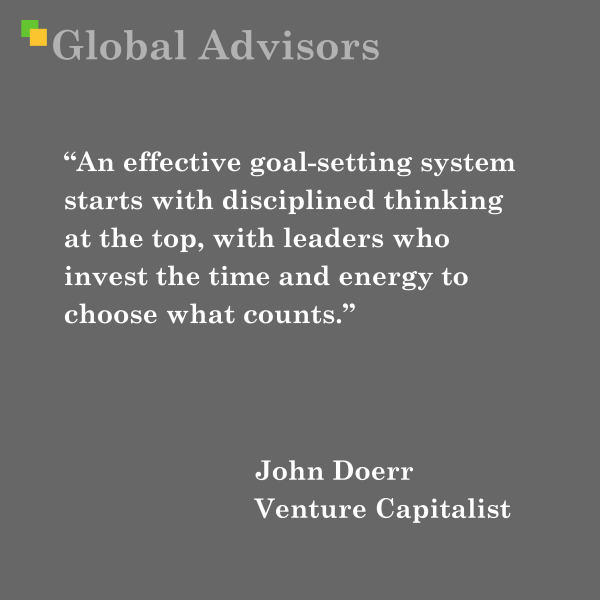
Quote: John Doerr - Venture Capitalist“An effective goal-setting system starts with disciplined thinking at the top, with leaders who invest the time and energy to choose what counts.” — John Doerr, Measure What MattersThis insight from John Doerr encapsulates the transformative power of Objectives and Key Results (OKRs) as a leadership discipline. Doerr emphasizes that meaningful organizational progress doesn’t begin with broad intentions or scattered efforts but with top leadership committing to carefully define, prioritize, and communicate the few goals that truly matter. Doerr’s central message to Google was: Strategy requires ruthless clarity—leaders must devote “time and energy to choose what counts,” setting focused objectives and quantifiable results. This disciplined approach allowed Google, and countless organizations since, to achieve sustained alignment, transparency, and execution at scale. About John DoerrJohn Doerr (b. 1951) is one of Silicon Valley’s most influential venture capitalists and thought leaders. Early in his career, he joined Intel, where he learned directly from Andy Grove’s culture of rigorous, measurable management. At Kleiner Perkins, Doerr helped fund and build some of the world’s most consequential technology companies, including Google, Amazon, and Sun Microsystems. Beyond capital, Doerr contributed operational insight—most notably by importing Intel’s OKR system to Google just after its founding. His book, Measure What Matters, distils decades of experience, showing how OKRs drive performance, accountability, and innovation in organizations ranging from start-ups to global giants. Doerr continues to advocate for mission-driven leadership and data-driven management, focusing on climate and societal impact alongside business achievement. Leading Theorists on Goal Setting and MeasurementThe intellectual roots of Doerr's philosophy are grounded in the science and practice of management by objectives and the broader theory of performance measurement:
John Doerr’s conviction is clear: Organizational greatness hinges not just on vision but on the discipline of leaders to set, prioritize, and measure what truly matters. The OKR framework, built on the shoulders of the world’s leading management theorists, remains a catalyst for clarity, focus, and transformative achievement.
|
| |
| |
Stay up to date with the Global Advisors Whatsapp channel!Follow our Global Advisors Whatsapp channel to get updates and news! |
| |
| |
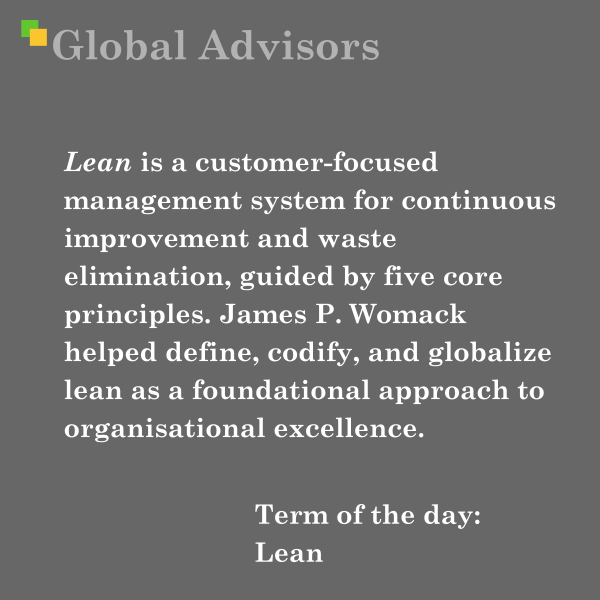
Term: LeanLean is a management philosophy and set of practices aimed at maximizing value for customers by systematically identifying and eliminating waste in organizational processes, particularly in manufacturing but now widely applied across many sectors. The lean approach is rooted in five core principles:
Waste in lean (known as muda in Japanese) refers to any activity that consumes resources but does not add value to the customer. Classic categories of waste include overproduction, waiting, transportation, excess processing, inventory, unnecessary motion, and defects. Beyond process efficiency, lean is also about empowering workers, fostering cross-functional collaboration, and embedding continuous improvement (kaizen) into the company culture. Key Theorist: James P. Womack The leading contemporary advocate and theorist of lean as a strategic management system is James P. Womack. Womack transformed the field by articulating and popularizing lean concepts globally. He is best known for co-authoring the seminal book The Machine That Changed the World (1990) and, with Daniel T. Jones, codifying the five lean principles that underpin modern lean practices. Biography and Relationship to Lean: Womack’s framework distilled the essence of lean into the five principles described above and provided a strategic roadmap for their application in manufacturing, services, healthcare, and beyond. His continued research, writing, and global education efforts have made him the most influential figure in the dissemination and application of lean management worldwide. Summary: Lean is a customer-focused management system for continuous improvement and waste elimination, guided by five core principles. James P. Womack is the most prominent lean theorist, whose research and advocacy helped define, codify, and globalize lean as a foundational approach to organizational excellence.
|
| |
| |
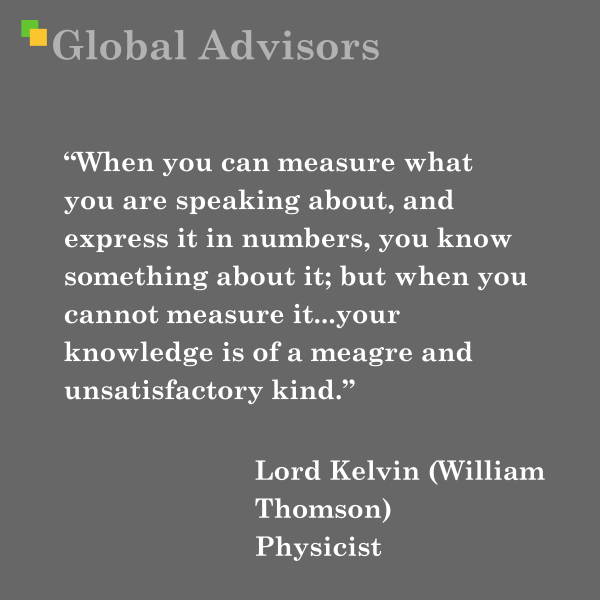
Quote: Lord Kelvin (William Thomson) - Physicist“When you can measure what you are speaking about, and express it in numbers, you know something about it; but when you cannot measure it...your knowledge is of a meagre and unsatisfactory kind.” - Lord Kelvin (William Thomson)This iconic statement, voiced by Lord Kelvin in the late 19th century during a lecture, elegantly captures the spirit of scientific inquiry in the industrial age. Its context lies at the intersection of theory and practice: scientists and engineers were wrestling with how to systematize knowledge and drive real technological progress. The British Empire, amid the Industrial Revolution, thrived on advances in physics, engineering, and telegraphy, demanding both rigorous theory and practical, measurable outcomes. Kelvin’s philosophy was revolutionary for his time. He argued that true understanding comes not simply from speculation or qualitative insight but must be backed by quantitative measurement. This perspective helped establish the foundation for modern scientific method and engineering practice, where empirical data and precision are paramount. About Lord KelvinWilliam Thomson, 1st Baron Kelvin (1824–1907) was a towering figure in science and engineering. Born in Belfast and educated at Cambridge, Kelvin held the chair of Natural Philosophy at the University of Glasgow for over half a century. His scholarship ranged from mathematical physics to practical engineering, and the breadth of his impact was remarkable:
In 1892, he was elevated to the peerage as Lord Kelvin, the first scientist to be so honoured, choosing his title after the River Kelvin that flows by the University of Glasgow. Leading Theorists and the Science of MeasurementLord Kelvin’s dictum on measurement shaped the work of generations of physicists, engineers, and organizational theorists. Measurement became the keystone of operational science, influencing leading minds far beyond physics:
Together, these theorists built on Kelvin’s insight that measurement is not mere accounting—it is the bedrock of progress in science, engineering, and organizational strategy. The enduring impact of this idea is visible in everything from physics and engineering to business analytics and modern performance management.
|
| |
| |
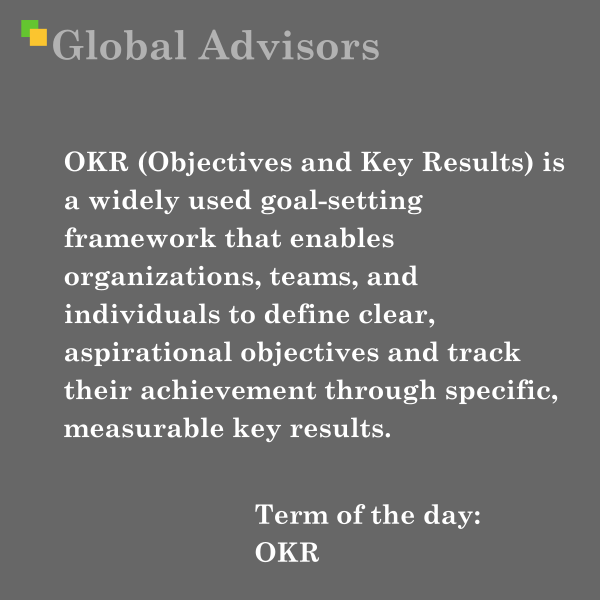
Term: OKRs - Objectives and Key ResultsOKR (Objectives and Key Results) is a widely used goal-setting framework that enables organizations, teams, and individuals to define clear, aspirational objectives and track their achievement through specific, measurable key results. This approach is designed to bridge the gap between strategy and execution, ensuring that high-level organizational vision gets translated into actionable, quantifiable outcomes. An OKR consists of two main components:
Initiatives often supplement OKRs but are not required; these are the projects and actions taken to influence the achievement of the Key Results. OKRs promote transparency, alignment, and accountability across organizations. They are generally set at the company, team, or individual level and are revisited quarterly or monthly for review and scoring. OKRs vs. KPIs and the Balanced Scorecard
Leading Strategy Theorist Behind OKRs: Andy GroveAndrew S. Grove (1936–2016) is credited as the originator of the OKR framework. Born in Budapest, Hungary, Grove survived Nazi occupation and the Soviet invasion before fleeing to the United States in 1956. He earned a Ph.D. in chemical engineering from the University of California, Berkeley. At Intel, where he was one of the earliest employees and later served as CEO (1987–1998) and Chairman, Grove revolutionized both the company and wider management thinking. In his 1983 classic High Output Management, he documented the use of "iMBO" (Intel Management by Objectives), which provided the foundation for OKRs as they are practiced today. Grove believed that combining ambitious, qualitative objectives with specific, quantitative key results was critical for driving focus, alignment, and acceleration of progress within highly competitive, fast-changing industries. Grove’s methods directly influenced pioneers such as John Doerr, who brought OKRs to Google and played a key role in their widespread adoption in Silicon Valley and beyond. OKRs offer a flexible, transparent alternative or complement to KPIs and tools like the Balanced Scorecard, driving organizational alignment, agility, and focus—an approach rooted in Andy Grove’s philosophy of high performance through clear, measurable ambition.
|
| |
| |
|


| |
| |