| |
|

| |
| |
| |
|
Our selection of the top business news sources on the web. |
| |
| |
| |
Term: Theory of Constraints (TOC)The Theory of Constraints (TOC) is a management methodology developed by Dr Eliyahu M. Goldratt, first articulated in his influential 1984 book The Goal. The central premise is that every organisation, process, or system is limited in achieving its highest performance by at least one constraint—often referred to as a bottleneck. Improving or managing this constraint is crucial for increasing the overall productivity and effectiveness of the whole system. TOC operates on several key principles:
Goldratt formalised the TOC improvement process through the Five Focusing Steps:
Broader relevance and applicationTOC was initially applied to manufacturing and production, but its principles are now used across industries—including project management, healthcare, supply chains, and services. It has also influenced methodologies such as Lean and Six Sigma by reinforcing the importance of system-wide optimisation and bottleneck management. Theorist backgroundDr Eliyahu M. Goldratt was an Israeli business management guru with a doctorate in physics. His scientific background informed his systems-based, analytical approach to organisational improvement. Besides The Goal, Goldratt authored Critical Chain (1997), adapting TOC to project management. While Goldratt is credited with popularising the term and the methodology, similar ideas were developed by earlier thinkers such as Wolfgang Mewes in Germany, but it is Goldratt’s TOC that is now widely acknowledged and adopted in modern management practice. TOC's strength lies in its focus: rather than trying to optimise every part of a process, it teaches leaders to concentrate their energy on breaking the system's biggest barrier, yielding disproportionate returns in efficiency, throughput, and profitability.
|
| |
| |
Quote: Tadej Pogacar, 2025 Tour de France Winner’s Press Conference“You never know what is coming the next day. You always have some doubts but I think it helps to have such a strong team around you… the atmosphere around you can clear away these doubts and you can go to race motivated… energized and want to give it all.” - Tadej Pogacar, 2025 Tour de France Winner’s Press ConferenceBackstory and ContextOn 27 July 2025, Tadej Pogacar crossed the line in Paris as the four-time winner of the Tour de France, elevating himself to the ranks of the sport’s all-time greats—equal with Chris Froome, and just one short of the fabled five Tour victories achieved by Merckx, Hinault, Indurain and Anquetil. The final stage—a rain-lashed, dramatic circuit finishing atop Montmartre—saw Pogacar both animated and tested, actively attacking in the closing kilometres, embodying the resilience, dynamism, and intelligence that have come to define his racing style. But under the celebratory headlines of dominance lies a subtler truth, captured by Pogacar in his post-race reflection: doubt. His candid admission—“you always have some doubts but I think it helps to have such a strong team around you”—offered a rare insight into the psychology of a champion. Rather than distancing himself behind the veneer of certainty, Pogacar articulated a universal theme: at the highest levels of performance, uncertainty is omnipresent. The difference lies in how such uncertainty is navigated. Throughout the 2025 Tour, Pogacar's UAE Team Emirates proved instrumental. Facing formidable rivals and unpredictable conditions, the synergy within the squad became a defining factor. This support network—technical, tactical, and emotional—helped transform private doubts into public triumph. Pogacar's willingness to credit his team for “clearing away these doubts” underscores a leadership model where vulnerability is not a weakness but a source of collective power. His journey since his first Tour title has been marked by consistent adaptation: training innovation, tactical evolution, and psychological growth. After a dramatic and public defeat in 2023, Pogacar's response was not just physical preparedness, but a more open embrace of teamwork and trust—qualities which, in 2025, elevated him above elite contemporaries such as Jonas Vingegaard and Wout van Aert. The Person Being QuotedTadej Pogacar is more than a prodigy from Slovenia; he is the defining rider of his generation, blending technical mastery with an emotional intelligence rarely witnessed in elite sport. Known for his explosive riding and composed demeanour, he has become an emblem of modern cycling—where resilience, adaptability, and team cohesion underpin personal glory. Pogacar's career is built not merely on raw talent, but on the psychological fortitude to meet uncertainty head-on, forging confidence from honest doubt and shared effort. His humility in victory and openness in discussing the mental rigours of competition mark him as both a leader and a relatable figure in the unforgiving world of Grand Tour cycling. Theoretical Foundations: Team Dynamics, Doubt, and High PerformanceThe themes articulated by Pogacar sit at the core of several influential academic frameworks:
Enduring SignificancePogacar's 2025 statement is compelling because it bridges the gap between vulnerability and performance. It demonstrates that in sport, as in business and leadership, uncertainty is inevitable, but its impact depends on the strength of collective purpose and trust. In this interplay between individual doubt and team strength, extraordinary outcomes are made possible.
|
| |

| |
Quote: Tadej Pogacar 2025 Tour de France winner in 2023“I'm gone. I'm dead.” - Tadej PogacarIn the unforgiving theatre of the Tour de France, Tadej Pogacar’s words—“I'm gone. I'm dead.”—once echoed not as a mark of defeat, but as a candid portrait of human limits amidst extraordinary ambition. These words, uttered into UAE Team Emirates’ radio on stage 17 of the 2023 Tour, immortalised a moment where a champion appeared broken. The day marked a decisive shift: Jonas Vingegaard seized control in the Alps, Pogacar cracked on the Col de la Loze, and his challenge for a third Tour title crumbled in public view. Exhausted, outgunned, and emotionally transparent, he admitted to his team and the world that his reserves were spent. Yet, from that moment of searing honesty, a new narrative was forged—one that would ultimately define Pogacar's ascent to greatness. In July 2025, Tadej Pogacar crossed the Champs-Élysées for a fourth Tour de France victory. Now, his journey stands as both a study in resilience and a modern case in peak performance under pressure. The Anatomy of Collapse: 2023’s Pivotal MomentOn that July day in 2023, as the gradients of the Col de la Loze took their toll, Pogacar's challenge unravelled. His simple phrase, stripped of bravado, revealed the psychological intensity of elite sport: the intersection where preparation, expectation, and adversity collide. This transparency was rare at cycling’s top table; it resonated far beyond fans, reaching anyone familiar with striving, failing, and rebuilding. This defeat could have marked a plateau, or even decline. Instead, it became an inflection point. Dominance Forged from Defeat: The 2025 TriumphEach subsequent season, Pogacar returned more resilient, his approach enriched by the raw lessons of that collapse. By 2025, he had transformed vulnerability into dominance: four Tour wins, relentless aggression in the high mountains, and an expanding place in cycling’s pantheon. No longer defined by that moment of apparent surrender, Pogacar now outpaces all but a handful of legends—Merckx, Hinault, Indurain, and Anquetil—each with five titles, while he stands at four at only 26. His 2025 campaign was a masterclass in consistency and mental agility, conquering challenges old and new, and defeating Jonas Vingegaard (again runner-up) by over four minutes. On the flooded streets of Paris, Pogacar animated the final stage, attacking on Montmartre and fighting to the end. Where once “I’m dead” spelled defeat, it now formed part of a complex narrative of sustainable winning. The Person Behind the QuoteTadej Pogacar is emblematic of the modern champion: emotionally open, tactically fluid, and unrelenting in competition. Emerging from Slovenia, a nation without deep cycling tradition, he redefined what a Grand Tour contender could be—fearless, creative in attack, but also humble in adversity. His candour in defeat, and his exuberance in victory, has earned admiration far beyond cycling. Theoretical Foundations: Mindset in Elite PerformancePogacar’s journey draws on the work of leading theorists:
Within sport psychology, these concepts converge: the ability to face a nadir openly, absorb its lessons, and emerge enhanced. Poga?ar’s vulnerability in 2023 did not foreshadow decline—it proved necessary for his enduring dominance. Enduring InfluenceToday, “I'm gone. I'm dead.” is not a footnote to defeat but an icon of perseverance. On the eve of his fourth Tour triumph, it symbolises a truth central to both athletics and leadership: greatness is built on the willingness to confront limits—and to redefine them.
|
| |

| |
Quote: Richard Koch - Consultant, investor and author“80% of the results come from 20% of the effort. The key is knowing which 20%.” - Richard Koch - Consultant, investor and authorThis quote summarises the essence of the 80/20 Principle, a core concept in business strategy and personal effectiveness that has revolutionised how individuals and organisations approach efficiency and results. The insight traces its roots to the Pareto Principle, originally observed by Italian economist Vilfredo Pareto in the late 19th century, who noticed that 80% of Italy’s land was owned by 20% of its population. Richard Koch, a British management consultant, entrepreneur, and renowned author, reinterpreted and greatly expanded this principle, framing it as a universal law underpinning the distribution of effort and reward in almost every domain. In his bestselling book The 80/20 Principle, Koch shows that a small minority of actions, resources, or inputs nearly always yield the vast majority of desirable outcomes—whether profit, value, or progress. Koch’s central insight, as expressed in this quote, is the competitive advantage gained not simply from working harder, but from consistently identifying and focusing on the few efforts that drive the greatest impact. For leaders, strategists, and achievers alike, the practical challenge is “knowing which 20%,” requiring careful analysis, experimentation, and a willingness to question assumptions about where value is truly created. In his career, Koch has demonstrated the application of his principles through venture capital investments and business advisory, targeting the vital few opportunities with outsized potential and helping businesses focus on their most profitable products, customers, or ideas. This philosophy is deeply relevant in an age of information overload and resource constraints, offering a way to cut through complexity and direct energy for maximum effect. About Richard KochBorn in London in 1950, Richard John Koch is a British management consultant, business investor, and prolific author whose work has had a global influence on management and strategy thinking. Educated at Wadham College, Oxford (M.A.) and The Wharton School of the University of Pennsylvania (MBA), Koch began his career at the Boston Consulting Group before becoming a partner at Bain & Company. In 1983, he co-founded L.E.K. Consulting. Koch’s investment career is as notable as his advisory work; he has backed and helped grow companies such as Filofax, Plymouth Gin, Betfair, and FanDuel. His hallmark book, The 80/20 Principle, published in 1997 and substantially updated since, has sold over a million copies worldwide, been translated into dozens of languages, and is recognised as a business classic. Beyond The 80/20 Principle, Koch has authored or co-authored more than 19 books on management, value creation, and lifestyle efficiency. Koch’s legacy is rooted in translating an elegant statistical reality into an actionable mindset for business leaders, entrepreneurs, and individuals seeking to achieve more by doing less—focusing always on the “vital few” over the “trivial many”. Leading Theorists Related to the Subject MatterVilfredo ParetoThe intellectual foundation for the 80/20 Principle originates with Vilfredo Pareto (1848–1923), an Italian economist and sociologist. Pareto’s original observation of uneven distribution patterns—first in wealth and later in broader social and natural phenomena—gave rise to what became known as the Pareto Principle or Pareto Law. His insights provided the mathematical and empirical groundwork for the efficiency-focused approaches that Koch and others would later popularise. Joseph M. JuranBuilding on Pareto, Joseph M. Juran (1904–2008) was a pioneering quality management theorist who championed the 80/20 Principle in operational and quality improvement contexts. He coined the terms “vital few and trivial many,” urging managers to focus quality-improvement efforts on the small subset of causes generating most defects—a direct precursor to Koch’s broader strategic applications. Peter F. DruckerPeter F. Drucker (1909–2005), known as the father of modern management, extended related themes throughout his career, emphasising the necessity of concentrating on the few activities that contribute most to organisational and individual performance. Drucker’s advocacy for focus, effectiveness, and the elimination of low-value work dovetails with the spirit of the 80/20 Principle, even if he did not formalise it as such. Richard Koch’s quote is a reminder—backed by deep analytical rigour and hard-won experience—that efficiency is not just about working harder or faster, but about systematically uncovering and amplifying the small fraction of efforts, decisions, and resources that will yield extraordinary returns.
|
| |
| |
Term: EfficiencyEfficiency is the capability to achieve maximum output with minimal input, optimising the use of resources such as time, money, labour, and materials to generate goods or services. In business, efficiency is measured by how well an organisation streamlines operations, reduces waste, and utilises its assets to accomplish objectives with the least amount of wasted effort or expense. This often involves refining processes, leveraging technology, and minimising redundancies, so the same or greater value is delivered with fewer resources and at lower cost. Mathematically, efficiency can be described as: Efficiency = Useful Output / Total Input Efficient organisations maximise output relative to the resources invested, reducing overhead and allowing for greater profitability and competitiveness. For example, a company that uses up-to-date inventory management systems or automates workflows can produce more with less time and capital, directly translating to an improved bottom line. Efficiency differs from effectiveness: while effectiveness is about doing the right things to achieve desired outcomes, efficiency is about doing things right by minimising resource use for a given outcome. Both are essential for organisational success, but efficiency specifically concerns resource optimisation and waste reduction. Best Related Strategy Theorist: Frederick Winslow TaylorFrederick Winslow Taylor (1856–1915), often called the “father of scientific management,” is the most significant theorist in relation to efficiency. Taylor was an American mechanical engineer whose work in the early 20th century fundamentally changed how organisations approached efficiency. Taylor’s Relationship to EfficiencyTaylor introduced the concept of “scientific management,” which aimed to analyse and synthesise workflows to improve labour productivity and organisational efficiency. He believed that work could be studied scientifically to identify the most efficient ways of performing tasks. Taylor’s approach included:
Taylor’s most famous work, The Principles of Scientific Management (1911), laid out these methods and demonstrated dramatic improvements in manufacturing output and cost reduction. His methods directly addressed inefficiencies caused by guesswork, tradition, or lack of structured processes. While Taylor’s focus was originally on industrial labour, the principles of efficiency he promoted have been extended to service industries and knowledge work. Taylor’s BiographyBorn in Pennsylvania in 1856, Taylor started as an apprentice patternmaker and rose to become chief engineer at Midvale Steel Works. He observed significant inefficiencies in industrial operations and began developing time-and-motion studies to scientifically analyse tasks. His innovations won him widespread attention, but also controversy—some praised the productivity gains, while others criticised the sometimes mechanical treatment of workers. Taylor’s influence persists in modern management, process engineering, lean manufacturing, and business process optimisation, all of which prioritise efficiency as a core organisational objective. In summary:
|
| |
| |
Quote: Rich Roll - author, ultra-endurance athlete and podcaster“Good things take time. Great things take longer. Most people underestimate what they can accomplish in a year, let alone a decade.” - Rich Roll - author, ultra-endurance athlete and podcasterThis quote is a testament to the power of long-term commitment and patience in pursuing high achievement—delivered by Rich Roll, whose life embodies the message. Rich Roll’s journey offers a real-world case study in the compounding effects of sustained, purpose-driven effort over time. A standout swimmer from a young age, Roll competed nationally and studied at Stanford, where his relentless drive helped him excel in athletics and academics. However, the same perfectionism and pressure to succeed became his undoing; by his late twenties, he was battling alcoholism and career disenchantment as an entertainment lawyer. Faced with a personal and physical crisis on the eve of his 40th birthday, Roll realised how far he had drifted from his potential. Overweight and unhealthy, he decided to overhaul his life. This was not an overnight transformation: years of discipline went into recovery, embracing a plant-based diet, and gradually building the stamina for ultra-endurance sports. Roll’s journey was marked by periods of doubt, financial difficulty, and personal struggle, yet he persisted through incremental improvement. Roll became the first vegan to finish the gruelling Ultraman World Championships in the top ten, authored the bestselling memoir Finding Ultra, and built one of the world’s most successful wellness podcasts. His story illustrates that exceptional success is rarely the result of a brief sprint, but of a sustained marathon, where daily effort accumulates in ways most fail to anticipate. This quote, therefore, is a distillation of his lived philosophy: enduring greatness is the product of patience, discipline, and the compounding results of long-term vision. About Rich RollRich Roll, born in 1966, now stands as a globally recognised wellness advocate, bestselling author, renowned ultra-endurance athlete, and influential podcaster. His transformation from a struggling alcoholic and unfulfilled professional into one of Men’s Fitness’ “25 Fittest Men in the World” has inspired millions to reconsider the boundaries of personal change. With academic roots at Stanford University and Cornell Law, Roll exemplifies intellectual and physical achievement. His raw honesty about past struggles and perseverance has established him as a leading voice in personal development and plant-based living. Through books, podcasts, and public speaking, he continues to motivate audiences worldwide to set greater goals, trust the process, and let ambition unfold over years—not merely weeks or months. Leading Theorists Related to Enduring Productivity and AchievementThe significance of sustained, compounding effort—and the mindset that drives it—is a foundational subject in strategy and organisational theory. Two of the most influential theorists related to the deep themes of this quote are Peter F. Drucker and Jim Collins. Peter F. DruckerOften described as the "father of modern management," Drucker’s work shaped how leaders understand productivity and long-term effectiveness. His career placed a premium on systematic effort, ongoing improvement, and the distinction between short-term efficiency and long-term value creation. Drucker’s concept of “doing the right things” underpins the notion that greatness derives from deliberately pursuing the most meaningful objectives over time—not from chasing shortcuts or short-term wins. His theories have guided countless organisations in developing the rigorous discipline needed for enduring, compounding success. Jim CollinsJim Collins, best known for Good to Great, distilled the lessons of sustained achievement into his concept of the “flywheel effect.” His research demonstrates that exceptional companies and individuals rarely leap to greatness in a single bold move—instead, they achieve it through the relentless, accumulative effect of many small initiatives acted on over time. This directly echoes Rich Roll’s lived experience; as Collins observes, “the process resembles relentlessly pushing a giant, heavy flywheel, turn upon turn, building momentum until a point of breakthrough, and beyond.” Both Drucker’s and Collins’s frameworks clarify why most people underestimate what can be achieved in the long view, reinforcing the necessity of patience, perseverance, and continuous improvement in any pursuit of greatness. In essence, Rich Roll’s quote is not mere encouragement—it is a strategic insight, reinforcing what the most respected thinkers and the highest achievers have always known: greatness is built patiently, deliberately, and cumulatively, over a far longer horizon than most imagine.
|
| |
| |
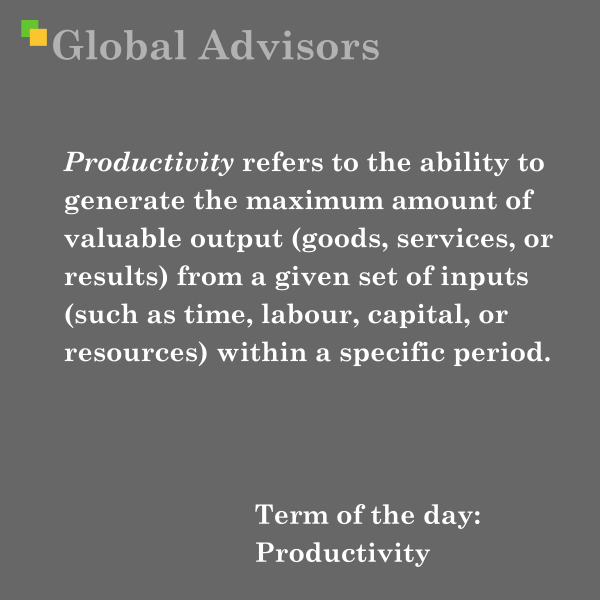
Term: ProductivityProductivity refers to the ability to generate the maximum amount of valuable output (goods, services, or results) from a given set of inputs (such as time, labour, capital, or resources) within a specific period. In a business or economic context, productivity is usually quantified by the formula: Productivity = Output / Input This calculation allows organisations and economies to assess how well they convert resources into desired outcomes, such as products, services, or completed tasks. Productivity is a central indicator of organisational performance, economic growth, and competitiveness because improvements in productivity drive higher living standards and create more value from the same or fewer resources. Relationship to Efficiency and Effectiveness
For example, a business may be efficient at manufacturing a product, using minimal input to create many units; however, if the product does not meet customer needs (e.g., is obsolete or unwanted), productivity in terms of business value remains low. Best Related Strategy Theorist: Peter F. DruckerPeter Ferdinand Drucker (1909–2005) is widely recognised as the most influential theorist linking productivity with both efficiency and effectiveness, especially in the context of modern management. Drucker's Backstory and Relationship to ProductivityDrucker, born in Austria, became a preeminent management consultant, educator, and author after emigrating to the United States prior to World War II. He taught at New York University and later at Claremont Graduate School, fundamentally shaping the field of management for over half a century. Drucker introduced the pivotal distinction between efficiency (“doing things right”) and effectiveness (“doing the right things”), arguing that true productivity results from combining both—particularly for “knowledge workers” whose roles involve decision-making more than repetitive physical tasks. He believed that in both industry and society, productivity growth is the primary lever for improving living standards and economic growth. His classic works, such as "The Practice of Management" (1954) and "Management: Tasks, Responsibilities, Practices" (1973), emphasise the responsibility of managers to maximise productivity, not just by streamlining processes, but by ensuring the right goals are set and pursued. Drucker advocated for continuous improvement, innovation, and aligning organisational purpose with productivity metrics—principles that underpin modern strategies for sustained productivity. In summary:
|
| |
| |
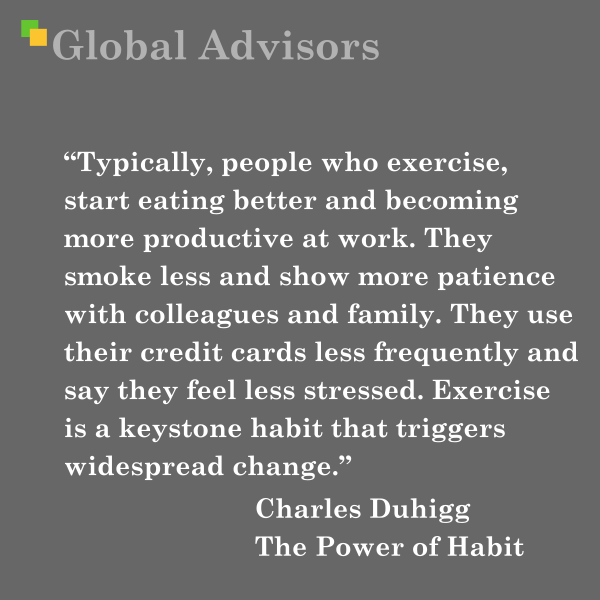
Quote: Charles Duhigg - Writer, journalist - The Power of Habit“Typically, people who exercise, start eating better and becoming more productive at work. They smoke less and show more patience with colleagues and family. They use their credit cards less frequently and say they feel less stressed. Exercise is a keystone habit that triggers widespread change.” — Charles Duhigg - Writer, journalist - The Power of HabitThis quote comes from Charles Duhigg’s acclaimed book, The Power of Habit, where he introduces the transformational concept of keystone habits. Unlike ordinary habits that shape a single behaviour, keystone habits are foundational routines that, when established, set off a cascade of positive changes across many areas of an individual’s or organization’s life. Duhigg uses the example of exercise as a typical keystone habit: people who start exercising regularly not only become fitter but also tend to adopt other healthy habits spontaneously. They may eat better, become more productive, reduce risky financial behaviours, and handle social situations with greater patience and resilience. The compounding impact of a single empowering habit triggers a broader pattern of improvement, creating lasting transformation far beyond its original intent. Duhigg’s research, informed by neuroscience and behavioural psychology, demonstrates that understanding and strategically targeting keystone habits offers a powerful strategy for sustainable change, whether at the personal or organizational level. About Charles DuhiggCharles Duhigg is a Pulitzer Prize-winning journalist and best-selling author renowned for his work on the science of habit formation and behaviour change. Educated at Yale University and Harvard Business School, Duhigg began his career as a reporter at The New York Times, where he led investigative projects and specialized in business and science topics. Duhigg’s passion for understanding human behaviour crystallized in his breakthrough book, The Power of Habit (2012). The book rapidly became a global bestseller, praised for demystifying the neuroscience of habits and translating it into actionable insights. Duhigg’s vivid storytelling—drawing on case studies from Olympic athletes, business leaders, and ordinary people—brought academic theories into real-world relevance. Leading Theorists Related to Habits and Transformational ChangeThe study of habits and behavioural transformation has deep roots in psychology and management. Several theorists and practitioners have significantly influenced the field:
Charles Duhigg’s research and storytelling on keystone habits reveal the disproportionate power of foundational routines—such as exercise—to unlock positive change throughout all aspects of life, providing a practical roadmap for anyone seeking meaningful transformation through the science of habit.
|
| |
| |
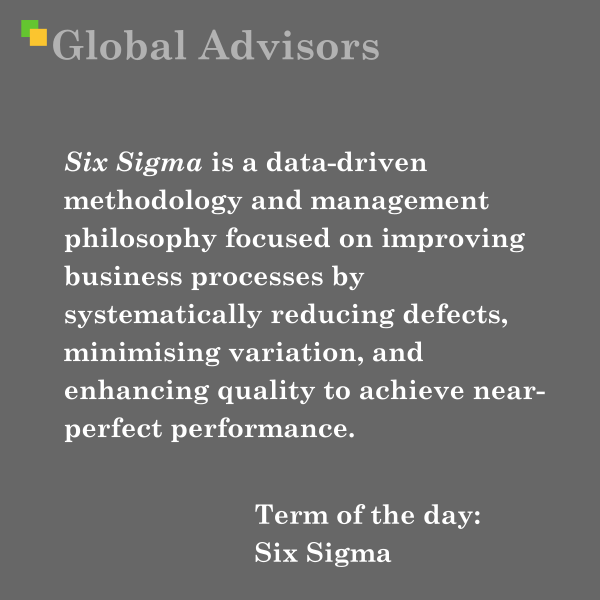
Term: Six SigmaSix Sigma is a data-driven methodology and management philosophy focused on improving business processes by systematically reducing defects, minimising variation, and enhancing quality to achieve near-perfect performance. The ultimate objective is to deliver products and services that consistently meet or exceed customer expectations, thereby enhancing customer satisfaction and improving the organisation’s bottom line. Comprehensive DefinitionAt its core, Six Sigma seeks to bring processes under tight control so that the likelihood of producing defects is exceedingly rare (specifically, no more than 3.4 defects per million opportunities). The methodology emphasises:
Six Sigma employs two primary project methodologies:
Organizations pursuing Six Sigma often certify employees in roles such as Green Belt, Black Belt, and Master Black Belt, denoting increasing expertise in Six Sigma techniques and leadership of improvement projects. Leading Strategy Theorist: Bill SmithBill Smith is widely regarded as the originator of Six Sigma. Biography and Relationship to Six Sigma
Six Sigma continues to set the global standard for disciplined quality improvement and operational excellence—anchored by Bill Smith’s vision of systematic, data-driven change, employee empowerment, and relentless focus on customer-defined quality.
|
| |
| |
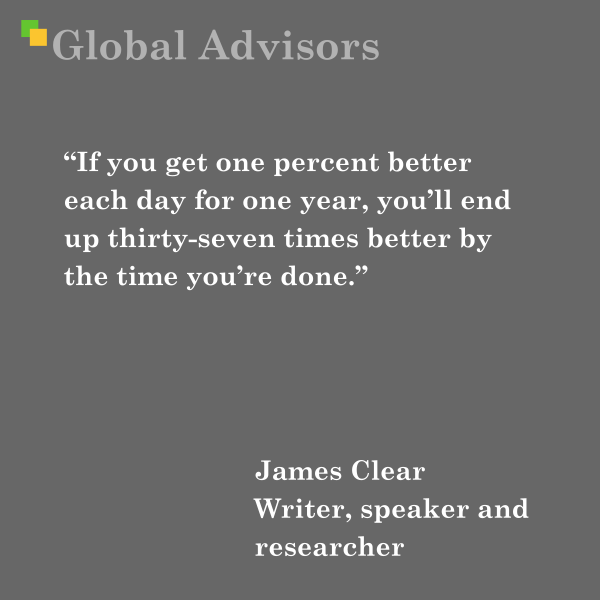
Quote: James Clear - Writer, speaker and researcher - Atomic Habits“If you get one percent better each day for one year, you’ll end up thirty-seven times better by the time you’re done.” — James Clear - Writer, speaker and researcher - Atomic HabitsThis quote encapsulates the power of compounding small improvements—a central theme in modern performance psychology and organisational behaviour. The phrase illustrates how seemingly minor, daily advances in habit or process can result in transformation far beyond what most imagine. Mathematically, a 1% daily improvement, when compounded over 365 days, leads to results nearly 38 times better than the starting point. James Clear uses this insight to shift focus away from sudden, dramatic changes and towards the sustainable, incremental shifts that yield exponential growth over time. This idea forms the core philosophy of his best-selling book, Atomic Habits, which demonstrates that meaningful progress is achieved not through isolated breakthroughs, but through the relentless accumulation of tiny gains—a process available to anyone, every day. About James ClearJames Clear is a leading writer, speaker, and researcher on the science of habits, decision-making, and continuous improvement. Born in Hamilton, Ohio, Clear crafted his own major in biomechanics at Denison University and was a standout student-athlete, experiences that grounded his fascination with performance optimization. After graduating in 2008, Clear turned his attention to writing, launching jamesclear.com to share research-driven insights on behaviour, productivity, and change. His 2018 book, Atomic Habits, rapidly became an international phenomenon:
Clear's work is grounded in synthesis—he draws on biology, neuroscience, psychology, philosophy, and personal experience to offer practical strategies for lasting improvement. Through speaking engagements, workshops, and his widely followed "3-2-1" newsletter, Clear has equipped millions with techniques to make small, actionable shifts that enable compounding, lifelong change. Leading Theorists Related to Small Improvements and CompoundingThe science and strategy of continuous improvement is deeply rooted in both psychology and operational theory. Several key thinkers underpin the philosophy embodied by Clear’s quote:
James Clear’s message thus stands not only on popular intuition but on an interlocking foundation of behavioural science, Eastern and Western management theory, and real-world sports and business excellence. His quote distils the timeless truth: small choices, if compounded, drive extraordinary change.
|
| |
| |
|


| |
| |