| |
|

| |
| |
| |
|
Our selection of the top business news sources on the web. |
| |
| |
| |
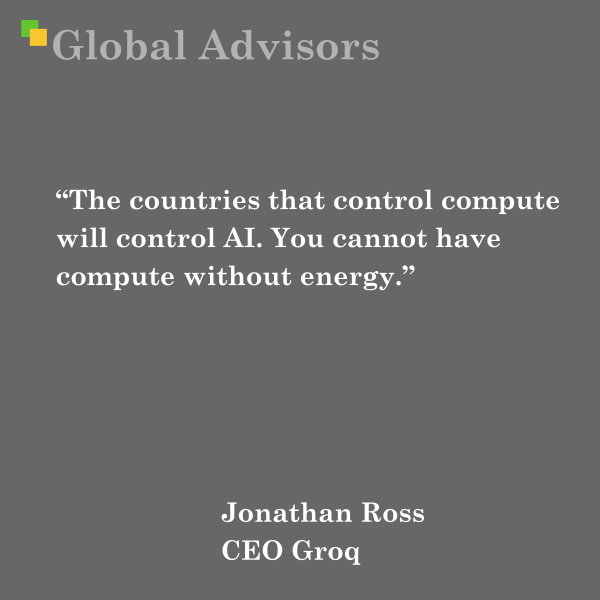
Quote: Jonathan Ross - CEO Groq“The countries that control compute will control AI. You cannot have compute without energy.” - Jonathan Ross - CEO GroqJonathan Ross stands at the intersection of geopolitics, energy economics, and technological determinism. As founder and CEO of Groq, the Silicon Valley firm challenging Nvidia's dominance in AI infrastructure, Ross articulated a proposition of stark clarity during his September 2025 appearance on Harry Stebbings' 20VC podcast: "The countries that control compute will control AI. You cannot have compute without energy." This observation transcends technical architecture. Ross is describing the emergence of a new geopolitical currency—one where computational capacity, rather than traditional measures of industrial might, determines economic sovereignty and strategic advantage in the 21st century. His thesis rests on an uncomfortable reality: artificial intelligence, regardless of algorithmic sophistication or model architecture, cannot function without the physical substrate of compute. And compute, in turn, cannot exist without abundant, reliable energy. The Architecture of AdvantageRoss's perspective derives from direct experience building the infrastructure that powers modern AI. At Google, he initiated what became the Tensor Processing Unit (TPU) project—custom silicon that allowed the company to train and deploy machine learning models at scale. This wasn't academic research; it was the foundation upon which Google's AI capabilities were built. When Amazon and Microsoft attempted to recruit him in 2016 to develop similar capabilities, Ross recognised a pattern: the concentration of advanced AI compute in too few hands represented a strategic vulnerability. His response was to establish Groq in 2016, developing Language Processing Units optimised for inference—the phase where trained models actually perform useful work. The company has since raised over $3 billion and achieved a valuation approaching $7 billion, positioning itself as one of Nvidia's most credible challengers in the AI hardware market. But Ross's ambitions extend beyond corporate competition. He views Groq's mission as democratising access to compute—creating abundant supply where artificial scarcity might otherwise concentrate power. The quote itself emerged during a discussion about global AI competitiveness. Ross had been explaining why European nations, despite possessing strong research talent and model development capabilities (Mistral being a prominent example), risk strategic irrelevance without corresponding investment in computational infrastructure and energy capacity. A brilliant model without compute to run it, he argued, will lose to a mediocre model backed by ten times the computational resources. This isn't theoretical—it's the lived reality of the current AI landscape, where rate limits and inference capacity constraints determine what services can scale and which markets can be served. The Energy CalculusThe energy dimension of Ross's statement carries particular weight. Modern AI training and inference require extraordinary amounts of electrical power. The hyperscalers—Google, Microsoft, Amazon, Meta—are each committing tens of billions of dollars annually to AI infrastructure, with significant portions dedicated to data centre construction and energy provision. Microsoft recently announced it wouldn't make certain GPU clusters available through Azure because the company generated higher returns using that compute internally rather than renting it to customers. This decision, more than any strategic presentation, reveals the economic value density of AI compute. Ross draws explicit parallels to the early petroleum industry: a period of chaotic exploration where a few "gushers" delivered extraordinary returns whilst most ventures yielded nothing. In this analogy, compute is the new oil—a fundamental input that determines economic output and strategic positioning. But unlike oil, compute demand doesn't saturate. Ross describes AI demand as "insatiable": if OpenAI or Anthropic received twice their current inference capacity, their revenue would nearly double within a month. The bottleneck isn't customer appetite; it's supply. This creates a concerning dynamic for nations without indigenous energy abundance or the political will to develop it. Ross specifically highlighted Europe's predicament: impressive AI research capabilities undermined by insufficient energy infrastructure and regulatory hesitance around nuclear power. He contrasted this with Norway's renewable capacity (80% wind utilisation) or Japan's pragmatic reactivation of nuclear facilities—examples of countries aligning energy policy with computational ambition. The message is uncomfortable but clear: technical sophistication in model development cannot compensate for material disadvantage in energy and compute capacity. Strategic ImplicationsThe geopolitical dimension becomes more acute when considering China's position. Ross noted that whilst Chinese models like DeepSeek may be cheaper to train (through various optimisations and potential subsidies), they remain more expensive to run at inference—approximately ten times more costly per token generated. This matters because inference, not training, determines scalability and market viability. China can subsidise AI deployment domestically, but globally—what Ross terms the "away game"—cost structure determines competitiveness. Countries cannot simply construct nuclear plants at will; energy infrastructure takes decades to build. This asymmetry creates opportunity for nations with existing energy advantages. The United States, despite higher nominal costs, benefits from established infrastructure and diverse energy sources. However, Ross's framework suggests this advantage is neither permanent nor guaranteed. Control over compute requires continuous investment in both silicon capability and energy generation. Nations that fail to maintain pace risk dependency—importing not just technology, but the capacity for economic and strategic autonomy. The corporate analogy proves instructive. Ross predicts that every major AI company—OpenAI, Anthropic, Google, and others—will eventually develop proprietary chips, not necessarily to outperform Nvidia technically, but to ensure supply security and strategic control. Nvidia currently dominates not purely through superior GPU architecture, but through control of high-bandwidth memory (HBM) supply chains. Building custom silicon allows organisations to diversify supply and avoid allocation constraints that might limit their operational capacity. What applies to corporations applies equally to nations: vertical integration in compute infrastructure is increasingly a prerequisite for strategic autonomy. The Theorists and PrecedentsRoss's thesis echoes several established frameworks in economic and technological thought, though he synthesises them into a distinctly contemporary proposition. Harold Innis, the Canadian economic historian, developed the concept of "staples theory" in the 1930s and 1940s—the idea that economies organised around the extraction and export of key commodities (fur, fish, timber, oil) develop institutional structures, trade relationships, and power dynamics shaped by those materials. Innis later extended this thinking to communication technologies in works like Empire and Communications (1950) and The Bias of Communication (1951), arguing that the dominant medium of a society shapes its political and social organisation. Ross's formulation applies Innisian logic to computational infrastructure: the nations that control the "staples" of the AI economy—energy and compute—will shape the institutional and economic order that emerges. Carlota Perez, the Venezuelan-British economist, provided a framework for understanding technological revolutions in Technological Revolutions and Financial Capital (2002). Perez identified how major technological shifts (steam power, railways, electricity, mass production, information technology) follow predictable patterns: installation phases characterised by financial speculation and infrastructure building, followed by deployment phases where the technology becomes economically productive. Ross's observation about current AI investment—massive capital expenditure by hyperscalers, uncertain returns, experimental deployment—maps cleanly onto Perez's installation phase. The question, implicit in his quote, is which nations will control the infrastructure when the deployment phase arrives and returns become tangible. W. Brian Arthur, economist and complexity theorist, articulated the concept of "increasing returns" in technology markets through works like Increasing Returns and Path Dependence in the Economy (1994). Arthur demonstrated how early advantages in technology sectors compound through network effects, learning curves, and complementary ecosystems—creating winner-take-most dynamics rather than the diminishing returns assumed in classical economics. Ross's emphasis on compute abundance follows this logic: early investment in computational infrastructure creates compounding advantages in AI capability, which drives economic returns, which fund further compute investment. Nations entering this cycle late face escalating barriers to entry. Joseph Schumpeter, the Austrian-American economist, introduced the concept of "creative destruction" in Capitalism, Socialism and Democracy (1942)—the idea that economic development proceeds through radical innovation that renders existing capital obsolete. Ross explicitly invokes Schumpeterian dynamics when discussing the risk that next-generation AI chips might render current hardware unprofitable before it amortises. This uncertainty amplifies the strategic calculus: nations must invest in compute infrastructure knowing that technological obsolescence might arrive before economic returns materialise. Yet failing to invest guarantees strategic irrelevance. William Stanley Jevons, the 19th-century English economist, observed what became known as Jevons Paradox in The Coal Question (1865): as technology makes resource use more efficient, total consumption typically increases rather than decreases because efficiency makes the resource more economically viable for new applications. Ross applies this directly to AI compute, noting that as inference becomes cheaper (through better chips or more efficient models), demand expands faster than costs decline. This means the total addressable market for compute grows continuously—making control over production capacity increasingly valuable. Nicholas Georgescu-Roegen, the Romanian-American economist, pioneered bioeconomics and introduced entropy concepts to economic analysis in The Entropy Law and the Economic Process (1971). Georgescu-Roegen argued that economic activity is fundamentally constrained by thermodynamic laws—specifically, that all economic processes dissipate energy and cannot be sustained without continuous energy inputs. Ross's insistence that "you cannot have compute without energy" is pure Georgescu-Roegen: AI systems, regardless of algorithmic elegance, are bound by physical laws. Compute is thermodynamically expensive—training large models requires megawatts, inference at scale requires sustained power generation. Nations without access to abundant energy cannot sustain AI economies, regardless of their talent or capital. Mancur Olson, the American economist and political scientist, explored collective action problems and the relationship between institutional quality and economic outcomes in works like The Rise and Decline of Nations (1982). Olson demonstrated how established interest groups can create institutional sclerosis that prevents necessary adaptation. Ross's observations about European regulatory hesitance and infrastructure underinvestment reflect Olsonian dynamics: incumbent energy interests, environmental lobbies, and risk-averse political structures prevent the aggressive nuclear or renewable expansion required for AI competitiveness. Meanwhile, nations with different institutional arrangements (or greater perceived strategic urgency) act more decisively. Paul Romer, the American economist and Nobel laureate, developed endogenous growth theory, arguing in works like "Endogenous Technological Change" (1990) that economic growth derives from deliberate investment in knowledge and technology rather than external factors. Romer's framework emphasises the non-rivalry of ideas (knowledge can be used by multiple actors simultaneously) but the rivalry of physical inputs required to implement them. Ross's thesis fits perfectly: AI algorithms can be copied and disseminated, but the computational infrastructure to deploy them at scale cannot. This creates a fundamental asymmetry that determines economic power. The Historical PatternHistory provides sobering precedents for resource-driven geopolitical competition. Britain's dominance in the 19th century rested substantially on coal abundance that powered industrial machinery and naval supremacy. The United States' 20th-century ascendance correlated with petroleum access and the industrial capacity to refine and deploy it. Oil-dependent economies in the Middle East gained geopolitical leverage disproportionate to their population or industrial capacity purely through energy reserves. Ross suggests we are witnessing the emergence of a similar dynamic, but with a critical difference: AI compute is both resource-intensive (requiring enormous energy) and productivity-amplifying (making other economic activity more efficient). This creates a multiplicative effect where compute advantages compound through both direct application (better AI services) and indirect effects (more efficient production of goods and services across the economy). A nation with abundant compute doesn't just have better chatbots—it has more efficient logistics, agricultural systems, manufacturing processes, and financial services. The "away game" concept Ross introduced during the podcast discussion adds a critical dimension. China, despite substantial domestic AI investment and capabilities, faces structural disadvantages in global competition because international customers cannot simply replicate China's energy subsidies or infrastructure. This creates opportunities for nations with more favourable cost structures or energy profiles, but only if they invest in both compute capacity and energy generation. The Future Ross EnvisionsThroughout the podcast, Ross painted a vision of AI-driven abundance that challenges conventional fears of technological unemployment. He predicts labour shortages, not mass unemployment, driven by three mechanisms: deflationary pressure (AI makes goods and services cheaper), workforce opt-out (people work less as living costs decline), and new industry creation (entirely new job categories emerge, like "vibe coding"—programming through natural language rather than formal syntax). This optimistic scenario depends entirely on computational abundance. If compute remains scarce and concentrated, AI benefits accrue primarily to those controlling the infrastructure. Ross's mission with Groq—creating faster deployment cycles (six months versus two years for GPUs), operating globally distributed data centres, optimising for cost efficiency rather than margin maximisation—aims to prevent that concentration. But the same logic applies at the national level. Countries without indigenous compute capacity will import AI services, capturing some productivity benefits but remaining dependent on external providers for the infrastructure that increasingly underpins economic activity. The comparison Ross offers—LLMs as "telescopes of the mind"—is deliberately chosen. Galileo's telescope revolutionised human understanding but required specific material capabilities to construct and use. Nations without optical manufacturing capacity could not participate in astronomical discovery. Similarly, nations without computational and energy infrastructure cannot participate fully in the AI economy, regardless of their algorithmic sophistication or research talent. ConclusionRoss's statement—"The countries that control compute will control AI. You cannot have compute without energy"—distils a complex geopolitical and economic reality into stark clarity. It combines Innisian materialism (infrastructure determines power), Schumpeterian dynamism (innovation renders existing capital obsolete), Jevonsian counterintuition (efficiency increases total consumption), and Georgescu-Roegen's thermodynamic constraints (economic activity requires energy dissipation). The implications are uncomfortable for nations unprepared to make the necessary investments. Technical prowess in model development provides no strategic moat if the computational infrastructure to deploy those models remains controlled elsewhere. Energy abundance, or the political will to develop it, becomes a prerequisite for AI sovereignty. And AI sovereignty increasingly determines economic competitiveness across sectors. Ross occupies a unique vantage point—neither pure academic nor disinterested observer, but an operator building the infrastructure that will determine whether his prediction proves correct. Groq's valuation and customer demand suggest the market validates his thesis. Whether nations respond with corresponding urgency remains an open question. But the framework Ross articulates will likely define strategic competition for the remainder of the decade: compute as currency, energy as prerequisite, and algorithmic sophistication as necessary but insufficient for competitive advantage.
|
| |
| |
Quote: J.W. Stephens - Author“Be the person your dog thinks you are!” - J.W. Stephens - AuthorThe quote "Be the person your dog thinks you are!" represents a profound philosophical challenge wrapped in disarming simplicity. It invites us to examine the gap between our idealised selves and our everyday reality through the lens of unconditional canine devotion. This seemingly light-hearted exhortation carries surprising depth when examined within the broader context of authenticity, aspiration and the moral psychology of personal development. The Author and the Quote's OriginsJ.W. Stephens, a seventh-generation native Texan, has spent considerable time travelling and living across various locations in Texas and internationally. Whilst the search results provide limited biographical detail about this particular author, the quote itself reveals a distinctively American sensibility—one that combines practical wisdom with accessible moral instruction. The invocation of dogs as moral exemplars reflects a cultural tradition deeply embedded in American life, where the human-canine bond serves as both comfort and conscience. The brilliance of Stephens' formulation lies in its rhetorical structure. By positioning the dog's perception as the aspirational standard, the quote accomplishes several objectives simultaneously: it acknowledges our frequent moral shortcomings, suggests that we already possess knowledge of higher standards, and implies that achieving those standards is within reach. The dog becomes both witness and ideal reader—uncritical yet somehow capable of perceiving our better nature. The quote functions as what philosophers might term a "regulative ideal"—not a description of what we are, but a vision of what we might become. Dogs, in their apparent inability to recognise human duplicity or moral inconsistency, treat their owners as wholly trustworthy, infinitely capable, and fundamentally good. This perception, whether accurate or illusory, creates a moral challenge: can we rise to meet it? Philosophical Foundations: Authenticity and the Divided SelfThe intellectual lineage underpinning this seemingly simple maxim extends deep into Western philosophical tradition, touching upon questions of authenticity, self-knowledge, and moral psychology that have preoccupied thinkers for millennia. Søren Kierkegaard (1813-1855) stands as perhaps the most important theorist of authenticity in Western philosophy. The Danish philosopher argued that modern life creates a condition he termed "despair"—not necessarily experienced as anguish, but as a fundamental disconnection from one's true self. Kierkegaard distinguished between the aesthetic, ethical, and religious stages of existence, arguing that most people remain trapped in the aesthetic stage, living according to immediate gratification and social conformity rather than choosing themselves authentically. His concept of "becoming who you are" anticipates Stephens' formulation, though Kierkegaard's vision is considerably darker and more demanding. For Kierkegaard, authentic selfhood requires a "leap of faith" and acceptance of radical responsibility for one's choices. The dog's unwavering faith in its owner might serve, in Kierkegaardian terms, as a model of the absolute commitment required for authentic existence. Jean-Paul Sartre (1905-1980) developed Kierkegaard's insights in a secular, existentialist direction. Sartre's notion of "bad faith" (mauvaise foi) describes the human tendency to deceive ourselves about our freedom and responsibility. We pretend we are determined by circumstances, social roles, or past choices when we remain fundamentally free. Sartre argued that consciousness is "condemned to be free"—we cannot escape the burden of defining ourselves through our choices. The gap between who we are and who we claim to be constitutes a form of self-deception Sartre found both universal and contemptible. Stephens' quote addresses precisely this gap: the dog sees us as we might be, whilst we often live as something less. Sartre would likely appreciate the quote's implicit demand that we accept responsibility for closing that distance. Martin Heidegger (1889-1976) approached similar territory through his concept of "authenticity" (Eigentlichkeit) versus "inauthenticity" (Uneigentlichkeit). For Heidegger, most human existence is characterised by "fallenness"—an absorption in the everyday world of "das Man" (the "They" or anonymous public). We live according to what "one does" rather than choosing our own path. Authentic existence requires confronting our own mortality and finitude, accepting that we are "beings-toward-death" who must take ownership of our existence. The dog's perspective, unburdened by social conformity and living entirely in the present, might represent what Heidegger termed "dwelling"—a mode of being that is at home in the world without falling into inauthenticity. The Psychology of Self-Perception and Moral DevelopmentMoving from continental philosophy to empirical psychology, several theorists have explored the mechanisms by which we maintain multiple versions of ourselves and how we might reconcile them. Carl Rogers (1902-1987), the founder of person-centred therapy, developed a comprehensive theory of the self that illuminates Stephens' insight. Rogers distinguished between the "real self" (who we actually are) and the "ideal self" (who we think we should be). Psychological health, for Rogers, requires "congruence"—alignment between these different self-concepts. When the gap between real and ideal becomes too wide, we experience anxiety and employ defence mechanisms to protect our self-image. Rogers believed that unconditional positive regard—accepting someone fully without judgment—was essential for psychological growth. The dog's perception of its owner represents precisely this unconditional acceptance, creating what Rogers termed "conditions of worth" that are entirely positive. Paradoxically, this complete acceptance might free us to change precisely because we feel safe enough to acknowledge our shortcomings. Albert Bandura (born 1925) developed social learning theory and the concept of self-efficacy, which bears directly on Stephens' formulation. Bandura argued that our beliefs about our capabilities significantly influence what we attempt and accomplish. When we believe others see us as capable (as dogs manifestly do), we are more likely to attempt difficult tasks and persist through obstacles. The dog's unwavering confidence in its owner might serve as what Bandura termed "vicarious experience"—seeing ourselves succeed through another's eyes increases our own self-efficacy beliefs. Moreover, Bandura's later work on moral disengagement explains how we rationalise behaviour that conflicts with our moral standards. The dog's perspective, by refusing such disengagement, might serve as a corrective to self-justification. Carol Dweck (born 1946) has explored how our beliefs about human qualities affect achievement and personal development. Her distinction between "fixed" and "growth" mindsets illuminates an important dimension of Stephens' quote. A fixed mindset assumes that qualities like character, intelligence, and moral worth are static; a growth mindset sees them as developable through effort. The dog's perception suggests a growth-oriented view: it sees potential rather than limitation, possibility rather than fixed character. The quote implies that we can become what the dog already believes us to be—a quintessentially growth-minded position. Moral Philosophy and the Ethics of CharacterThe quote also engages fundamental questions in moral philosophy about the nature of virtue and how character develops. Aristotle (384-322 BCE) provides the foundational framework for understanding character development in Western thought. His concept of eudaimonia (often translated as "flourishing" or "the good life") centres on the cultivation of virtues through habituation. For Aristotle, we become virtuous by practising virtuous actions until they become second nature. The dog's perception might serve as what Aristotle termed the "great-souled man's" self-regard—not arrogance but appropriate recognition of one's potential for excellence. However, Aristotle would likely caution that merely aspiring to virtue is insufficient; one must cultivate the practical wisdom (phronesis) to know what virtue requires in specific circumstances and the habituated character to act accordingly. Immanuel Kant (1724-1804) approached moral philosophy from a radically different angle, yet his thought illuminates Stephens' insight in unexpected ways. Kant argued that morality stems from rational duty rather than inclination or consequence. The famous categorical imperative demands that we act only according to maxims we could will to be universal laws. Kant's moral agent acts from duty, not because they feel like it or because they fear consequences. The gap between our behaviour and the dog's perception might be understood in Kantian terms as the difference between acting from inclination (doing good when convenient) and acting from duty (doing good because it is right). The dog, in its innocence, cannot distinguish these motivations—it simply expects consistent goodness. Rising to meet that expectation would require developing what Kant termed a "good will"—the disposition to do right regardless of inclination. Lawrence Kohlberg (1927-1987) developed a stage theory of moral development that explains how moral reasoning evolves from childhood through adulthood. Kohlberg identified six stages across three levels: pre-conventional (focused on rewards and punishment), conventional (focused on social approval and law), and post-conventional (focused on universal ethical principles). The dog's expectation might be understood as operating at a pre-conventional level—it assumes goodness without complex reasoning. Yet meeting that expectation could require post-conventional thinking: choosing to be good not because others are watching but because we have internalised principles of integrity and compassion. The quote thus invites us to use a simple, pre-moral faith as leverage for developing genuine moral sophistication. Contemporary Perspectives: Positive Psychology and Virtue EthicsRecent decades have seen renewed interest in character and human flourishing, providing additional context for understanding Stephens' insight. Martin Seligman (born 1942), founder of positive psychology, has shifted psychological focus from pathology to wellbeing. His PERMA model identifies five elements of flourishing: Positive emotion, Engagement, Relationships, Meaning, and Accomplishment. The human-dog relationship exemplifies several of these elements, particularly the relationship component. Seligman's research on "learned optimism" suggests that how we explain events to ourselves affects our wellbeing and achievement. The dog's relentlessly optimistic view of its owner might serve as a model of the explanatory style Seligman advocates—one that sees setbacks as temporary and successes as reflective of stable, positive qualities. Christopher Peterson (1950-2012) and Martin Seligman collaborated to identify character strengths and virtues across cultures, resulting in the Values in Action (VIA) classification. Their research identified 24 character strengths organised under six core virtues: wisdom, courage, humanity, justice, temperance, and transcendence. The quote implicitly challenges us to develop these strengths not because doing so maximises utility or fulfils duty, but because integrity demands that our actions align with our self-understanding. The dog sees us as possessing these virtues; the challenge is to deserve that vision. Alasdair MacIntyre (born 1929) has argued for recovering Aristotelian virtue ethics in modern life. MacIntyre contends that the Enlightenment project of grounding morality in reason alone has failed, leaving us with emotivism—the view that moral judgments merely express feelings. He advocates returning to virtue ethics situated within narrative traditions and communities of practice. The dog-owner relationship might be understood as one such practice—a context with implicit standards and goods internal to it (loyalty, care, companionship) that shape character over time. Becoming worthy of the dog's trust requires participating authentically in this practice rather than merely going through the motions. The Human-Animal Bond as Moral MirrorThe specific invocation of dogs, rather than humans, as moral arbiters merits examination. This choice reflects both cultural realities and deeper philosophical insights about the nature of moral perception. Dogs occupy a unique position in human society. Unlike wild animals, they have co-evolved with humans for thousands of years, developing sophisticated abilities to read human gestures, expressions, and intentions. Yet unlike humans, they appear incapable of the complex social calculations that govern human relationships—judgement tempered by self-interest, conditional approval based on social status, or critical evaluation moderated by personal advantage. Emmanuel Levinas (1906-1995) developed an ethics based on the "face-to-face" encounter with the Other, arguing that the face of the other person makes an ethical demand on us that precedes rational calculation. Whilst Levinas focused on human faces, his insight extends to our relationships with dogs. The dog's upturned face, its evident trust and expectation, creates an ethical demand: we are called to respond to its vulnerability and faith. The dog cannot protect itself from our betrayal; it depends entirely on our goodness. This radical vulnerability and trust creates what Levinas termed the "infinite responsibility" we bear toward the Other. The dog's perception is powerful precisely because it is not strategic. Dogs do not love us because they have calculated that doing so serves their interests (though it does). They do not withhold affection to manipulate behaviour (though behavioural conditioning certainly plays a role in the relationship). From the human perspective, the dog's devotion appears absolute and uncalculating. This creates a moral asymmetry: the dog trusts completely, whilst we retain the capacity for betrayal or manipulation. Stephens' quote leverages this asymmetry, suggesting that we should honour such trust by becoming worthy of it. Practical Implications: From Aspiration to ActionThe quote's enduring appeal lies partly in its practical accessibility. Unlike philosophical treatises on authenticity or virtue that can seem abstract and demanding, Stephens offers a concrete, imaginable standard. Most dog owners have experienced the moment of returning home to exuberant welcome, seeing themselves reflected in their dog's unconditional joy. The gap between that reflection and one's self-knowledge of moral compromise or character weakness becomes tangible. Yet the quote's simplicity risks trivialising genuine moral development. Becoming "the person your dog thinks you are" is not achieved through positive thinking or simple willpower. It requires sustained effort, honest self-examination, and often painful acknowledgment of failure. The philosophical traditions outlined above suggest several pathways: The existentialist approach demands radical honesty about our freedom and responsibility. We must acknowledge that we choose ourselves moment by moment, that no external circumstance determines our character, and that self-deception about this freedom represents moral failure. The dog's trust becomes a call to authentic choice. The Aristotelian approach emphasises habituation and practice. We must identify the virtues we lack, create situations that require practising them, and persist until virtuous behaviour becomes natural. The dog's expectation provides motivation for this long-term character development. The psychological approach focuses on congruence and self-efficacy. We must reduce the gap between real and ideal self through honest self-assessment and incremental change, using the dog's confidence as a source of belief in our capacity to change. The virtue ethics approach situates character development within practices and traditions. The dog-owner relationship itself becomes a site for developing virtues like responsibility, patience, and compassion through daily engagement. The Quote in Contemporary ContextStephens' formulation resonates particularly in an era characterised by anxiety about authenticity. Social media creates pressure to curate idealised self-presentations whilst simultaneously exposing the gap between image and reality. Political and institutional leaders frequently fail to live up to professed values, creating cynicism about whether integrity is possible or even desirable. In this context, the dog's uncomplicated faith offers both comfort and challenge—comfort that somewhere we are seen as fundamentally good, challenge that we might actually become so. The quote also speaks to contemporary concerns about meaning and purpose. In a secular age lacking consensus on ultimate values, the question "How should I live?" lacks obvious answers. Stephens bypasses theological and philosophical complexities by offering an existentially grounded response: live up to the best version of yourself as reflected in uncritical devotion. This moves the question from abstract principle to lived relationship, from theoretical ethics to embodied practice. Moreover, the invocation of dogs rather than humans as moral mirrors acknowledges a therapeutic insight: sometimes we need non-judgmental acceptance before we can change. The dog provides that acceptance automatically, creating psychological safety within which development becomes possible. In an achievement-oriented culture that often ties worth to productivity and success, the dog's valuation based simply on existence—you are wonderful because you are you—offers profound relief and, paradoxically, motivation for growth. The quote ultimately works because it short-circuits our elaborate mechanisms of self-justification. We know we are not as good as our dogs think we are. We know this immediately and intuitively, without needing philosophical argument. The quote simply asks: what if you were? What if you closed that gap? The question haunts precisely because the answer seems simultaneously impossible and within reach—because we have glimpsed that better self in our dog's eyes and cannot quite forget it.
|
| |

| |
Quote: Jensen Huang - CEO Nvidia“Oftentimes, if you reason about things from first principles, what's working today incredibly well — if you could reason about it from first principles and ask yourself on what foundation that first principle is built and how that would change over time — it allows you to hopefully see around corners.” - Jensen Huang - CEO NvidiaJensen Huang’s quote was delivered in the context of an in-depth dialogue with institutional investors on the trajectory of Nvidia, the evolution of artificial intelligence, and strategies for anticipating and shaping the technological future. Context of the Quote The quote was made during an interview at a Citadel Securities event in October 2025, hosted by Konstantine Buhler, a partner at Sequoia Capital. The dialogue’s audience consisted of leading institutional investors, all seeking avenues for sustainable advantage or 'edge'. The conversation explored the founding moments of Nvidia in the early 1990s, through the reinvention of the graphics processing unit (GPU), the creation of new computing markets, and the subsequent rise of Nvidia as the platform underpinning the global AI boom. The question of how to ‘see around corners’ — to anticipate technology and industry shifts before they crystallise for others — was at the core of the discussion. Huang’s answer, invoking first-principles reasoning, linked Nvidia’s success to its ability to continually revisit and challenge foundational assumptions, and to methodically project how they will be redefined by progress in science and technology. Jensen Huang: Profile and Approach Jensen Huang, born in Tainan, Taiwan in 1963, immigrated to the United States as a child, experiencing the formative challenges of cultural dislocation, financial hardship, and adversity. He obtained his undergraduate degree in electrical engineering from Oregon State University and a master’s from Stanford University. After working at AMD and LSI Logic, he co-founded Nvidia in 1993 at 30, reportedly at a Denny’s restaurant. From the outset, the company faced daunting odds — neither established market nor assured funding, and frequent existential risk in the initial years. Huang is distinguished not only by technical fluency — he is deeply involved in hardware and software architecture — but also by an ability to translate complexity for diverse audiences. He eschews corporate formality in favour of trademark leather jackets and a focus on product. His leadership style is marked by humility, a willingness to bet on emerging ideas, and what he describes as “urgent innovation” born of early near-failure. This disposition has been integral to Nvidia's progress, especially as the company repeatedly “invented markets” and defined entirely new categories, such as accelerated computing and AI infrastructure. By 2024, Nvidia became the world’s most valuable public company, with its GPUs foundational to gaming, scientific computing, and, critically, the rise of AI. Huang’s awards — from the IEEE Founder’s Medal to listing among Time Magazine’s 100 most influential — underscore his reputation as a technologist and strategic thinker. He is widely recognised for being able to establish technical direction well before it becomes market consensus, an approach reflected in the quote. First-Principles Thinking: Theoretical Foundations Huang’s endorsement of “first principles” echoes a method of problem-solving and innovation associated with thinkers as diverse as Aristotle, Isaac Newton, and, in the modern era, entrepreneurs and strategists such as Elon Musk. The essence of first-principles thinking is to break down complex systems to their most fundamental truths — concepts that cannot be deduced from anything simpler — and to reason forward from those axioms, unconstrained by traditional assumptions, analogies, or received wisdom.
Application in Technology and AI First-principles thinking is particularly powerful in periods of technological transition:
Backstory of the Leading Theorists The ecosystem that enabled Nvidia’s transformation is shaped by a series of foundational theorists:
Implications Jensen Huang’s quote is neither idle philosophy nor abstract advice — it is a methodology proven repeatedly by his own journey and by the history of technology. It is a call to scrutinise assumptions, break complex structures to their most elemental truths, and reconstruct strategy consciously from the bedrock of what is not likely to change, but also to ask: on what foundation do these principles rest, and how will these foundations themselves evolve. Organisations and individuals who internalise this approach are equipped not only to compete in current markets, but to invent new ones — to anticipate and shape the next paradigm, rather than reacting to it.
|
| |

| |
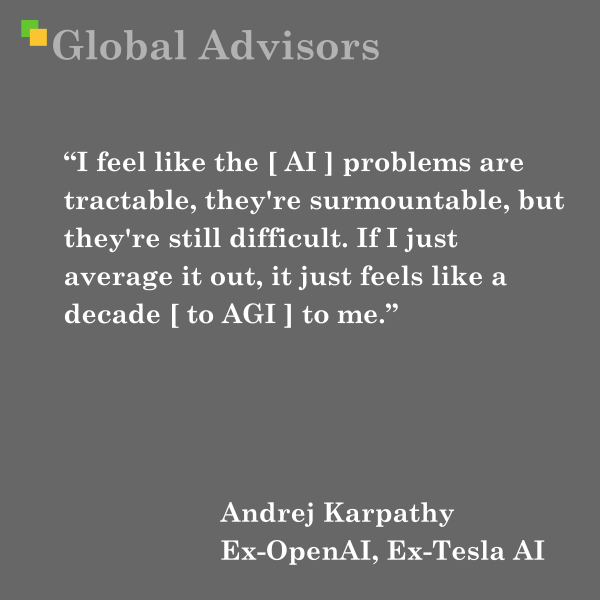
Quote: Andrej Karpathy - Ex-OpenAI, Ex-Tesla AI“What I think we have to do going forward...is figure out ways to remove some of the knowledge and to keep what I call this cognitive core. It's this intelligent entity that is stripped from knowledge but contains the algorithms and contains the magic of intelligence and problem-solving and the strategies of it and all this stuff.” - Andrej Karpathy - Ex-OpenAI, Ex-Tesla AIAndrej Karpathy's observation about the need to "strip away knowledge whilst retaining the cognitive core" represents one of the most penetrating insights into contemporary artificial intelligence development. Speaking on Dwarkesh Patel's podcast in October 2025, Karpathy—formerly a leading figure at both OpenAI and Tesla's Autopilot programme—articulated a fundamental tension at the heart of modern AI: the current generation of large language models have become prodigious memorisers, yet this very capability may be constraining their potential for genuine intelligence. The Paradox of Pre-trainingTo comprehend Karpathy's thesis, one must first understand the architecture of contemporary AI systems. Large language models are trained on vast corpora—often 15 trillion tokens or more—through a process called pre-training. During this phase, models learn to predict the next token in a sequence, effectively compressing the entire internet into their neural networks. Karpathy describes this compressed representation as only "0.07 bits per token" for a model like Llama 3 70B, highlighting the extraordinary degree of compression occurring. This compression serves two distinct functions, which Karpathy carefully delineates. First, models accumulate factual knowledge—the content of Wikipedia articles, the specifics of historical events, the details of scientific papers. Second, and more crucially, they develop what Karpathy terms "algorithmic patterns"—the capacity for in-context learning, the ability to recognise and complete patterns, the fundamental mechanisms of reasoning itself. The problem, as Karpathy sees it, is that contemporary models have become too adept at the former whilst the latter remains the true seat of intelligence. When a model can regurgitate passages verbatim or recite obscure facts, it demonstrates remarkable memory. But this same capability creates what he calls a "distraction"—the model becomes reliant on its hazy recollections of training data rather than developing robust reasoning algorithms that could operate independently of specific factual knowledge. The Cognitive Core ConceptKarpathy's proposed solution is to isolate and preserve what he terms the "cognitive core"—an intelligent entity stripped of encyclopaedic knowledge but retaining the fundamental algorithms of problem-solving, the strategies of thought, and what he describes as "the magic of intelligence." This concept represents a profound shift in how we conceptualise artificial intelligence. Consider the analogy to human cognition. Humans are remarkably poor memorisers compared to AI systems. Present a human with a random sequence of numbers, and they'll struggle after seven or eight digits. Yet this apparent limitation forces humans to develop robust pattern-recognition capabilities and abstract reasoning skills. We're compelled to "see the forest for the trees" precisely because we cannot memorise every individual tree. Karpathy suggests that AI systems would benefit from similar constraints. A model with less memory but stronger reasoning capabilities would be forced to look up factual information whilst maintaining sophisticated algorithms for processing that information. Such a system would more closely resemble human intelligence—not in its limitations, but in the way those limitations drive the development of generalisable cognitive strategies. The implications extend beyond mere technical architecture. Karpathy envisions cognitive cores as compact as one billion parameters—potentially even smaller—that could operate as genuine reasoning engines rather than glorified databases. These systems would "know that they don't know" when confronted with factual questions, prompting them to retrieve information whilst applying sophisticated analysis. The result would be AI that thinks more than it remembers, that reasons rather than recites. From Evolution to Engineering: The Path Not TakenKarpathy's perspective on AI development diverges sharply from what he calls the "Richard Sutton viewpoint"—the notion that we should build AI systems analogous to biological intelligence, learning from scratch through reinforcement learning in the manner of animals. Instead, Karpathy argues we're building what he evocatively describes as "ghosts" or "spirit entities"—ethereal intelligences that emerge from imitating human-generated text rather than evolving through environmental interaction. This distinction illuminates a crucial divergence in AI philosophy. Biological intelligence, as embodied in animals, emerges from evolution operating over millions of years, with vast amounts of capability "baked in" to neural circuitry. A zebra foal runs within minutes of birth not through reinforcement learning but through evolutionary encoding. Humans similarly arrive with substantial cognitive machinery pre-installed, with lifetime learning representing maturation and refinement rather than learning from first principles. By contrast, contemporary AI systems learn through what Karpathy terms "crappy evolution"—pre-training on internet documents serves as a compressed, accelerated alternative to evolutionary optimisation. This process creates entities fundamentally different from biological intelligence, optimised for different tasks through different mechanisms. The current approach imitates the products of human intelligence (text, code, conversations) rather than replicating the developmental process that creates intelligence. The Limits of Current Learning ParadigmsKarpathy's critique extends to reinforcement learning, which he describes with characteristic bluntness as "terrible." His concerns illuminate deep problems in how AI systems currently learn from experience. In reinforcement learning, a model generates hundreds of solution attempts, and those that arrive at correct answers have every intermediate step up-weighted, whilst failed attempts are down-weighted. Karpathy calls this "sucking supervision through a straw"—extracting minimal learning signal from vast amounts of computational work. The fundamental issue is noise. When a solution works, not every step along the way was necessarily correct or optimal. The model may have taken wrong turns, pursued dead ends, or stumbled upon the answer despite flawed reasoning. Yet reinforcement learning broadcasts the final reward across the entire trajectory, reinforcing both good and bad reasoning indiscriminately. Karpathy notes that "you may have gone down the wrong alleys until you arrived at the right solution," yet every mistaken step gets marked as something to do more of. Humans, by contrast, engage in sophisticated post-hoc analysis. After solving a problem, we reflect on which approaches worked, which didn't, and why. We don't simply label an entire problem-solving session as "good" or "bad"—we dissect our reasoning, identify productive and unproductive strategies, and refine our approach. Current AI systems lack this reflective capacity entirely. This limitation connects to broader questions about how AI systems might achieve continual learning—the ability to genuinely learn from ongoing experience rather than requiring massive retraining. Karpathy suggests that humans engage in a nightly "distillation phase" during sleep, processing the day's experiences and integrating insights into long-term knowledge. AI systems have no equivalent mechanism. They simply restart from the same state each time, unable to evolve based on individual experiences. Model Collapse and the Entropy ProblemA subtle but critical concern in Karpathy's analysis is what he terms "model collapse"—the tendency of AI systems to produce outputs that occupy "a very tiny manifold of the possible space of thoughts." Ask ChatGPT to tell a joke repeatedly, and you'll receive the same three jokes. Request reflection on a topic multiple times, and you'll observe striking similarity across responses. The models are "silently collapsed," lacking the entropy and diversity that characterises human thought. This phenomenon creates profound challenges for synthetic data generation, a technique labs use to create additional training material. If models generate training data for themselves or subsequent models, this collapsed distribution gradually dominates the training corpus. Training on one's own outputs creates a dangerous feedback loop—each generation becomes less diverse, more stereotyped, more "collapsed" than the last. Karpathy suggests this may not even be a solvable problem, noting that humans similarly "collapse over time," becoming more rigid and less creative as they age, revisiting the same thoughts and patterns with decreasing learning rates. The contrast with children is illuminating. Young minds, not yet "overfitted" to the world, produce shocking, creative, unexpected responses precisely because they haven't collapsed into standard patterns of thought. This freshness, this maintenance of high entropy in cognitive processes, may be essential to genuine intelligence. Yet our current training paradigms actively work against it, rewarding convergence towards common patterns and penalising deviation. The Decade of Agents: Why Progress Takes TimeWhen Karpathy states this will be "the decade of agents" rather than "the year of agents," he draws on hard-won experience from five years leading Tesla's Autopilot programme. His insights into why artificial intelligence deployment takes far longer than demonstrations suggest carry particular weight given this background. The central concept is what Karpathy calls "the march of nines." Getting something to work 90% of the time—the level typically showcased in demonstrations—represents merely the first nine in "99.9%." Each additional nine requires equivalent effort. During his tenure at Tesla, the team progressed through perhaps two or three nines over five years. More crucially, numerous nines remain before self-driving cars achieve true autonomy at scale. This pattern isn't unique to autonomous vehicles. Karpathy argues it applies across safety-critical domains, including software engineering. When code errors can leak millions of Social Security numbers or create critical security vulnerabilities, the cost of failure becomes prohibitively high. The demo-to-product gap widens dramatically. What works impressively in controlled conditions fails in countless edge cases when confronting reality's full complexity. Waymo's experience illustrates this challenge. Despite providing "perfect drives" as early as 2014, the company still operates limited deployments requiring elaborate teleoperation infrastructure and supervision. Humans haven't been removed; they've been rendered invisible, beaming in remotely to handle edge cases. The technology lives in a "pulled-back future"—functional but not yet economical, capable but not yet scalable. Contemporary AI agents face analogous challenges. Whilst Claude and GPT-5 Pro demonstrate remarkable capabilities, they remain what Karpathy characterises as "elementary school students"—savants with perfect memory but lacking robust reasoning across all necessary dimensions. They're "cognitively deficient" in ways users intuitively recognise even if they can't articulate precisely what's missing. The Software Engineering PuzzlePerhaps no domain better illustrates the puzzling contours of current AI capabilities than software engineering. Karpathy notes, somewhat ruefully, that whilst these systems were meant to enable "any economically valuable task," API revenue remains "dominated by coding." This supposedly general intelligence overwhelmingly excels at one specific domain. This concentration isn't accidental. Code enjoys unique properties that make it ideal for current AI architectures. Software development has always operated through text—terminals, editors, version control systems all manipulate textual representations. LLMs, trained on internet text, encounter code as a native format. Moreover, decades of infrastructure exist for handling code textually: diff tools for showing changes, IDEs for navigation, testing frameworks for verification. Contrast this with domains lacking such infrastructure. Creating presentations involves spatial arrangement and visual design—there's no "diff" for slides that elegantly shows modifications. Many knowledge work tasks involve physical documents, in-person interactions, or tacit knowledge that resists textual representation. These domains haven't been pre-optimised for AI interaction in the way software development has. Yet even in coding, Karpathy remains sceptical of current capabilities for cutting-edge work. When building nanoChat, a repository implementing a complete ChatGPT clone in simplified form, he found AI tools valuable for autocomplete and handling familiar patterns but inadequate for novel architectural decisions. The models kept trying to impose standard approaches when he deliberately chose non-standard implementations. They couldn't comprehend his custom solutions, constantly suggesting deprecated APIs and bloating code with unnecessary defensive programming. This points to a deeper truth: current models excel at reproducing common patterns from their training data but struggle with code "that has never been written before"—precisely the domain of frontier AI research itself. The recursive self-improvement that some forecast, where AI systems rapidly enhance their own capabilities, founders on this limitation. Models can accelerate work within established paradigms but cannot yet pioneer truly novel approaches. The Trajectory of Intelligence ExplosionKarpathy's perspective on potential intelligence explosions diverges sharply from both pessimistic and optimistic extremes. He sees AI not as a discrete, alien technology but as a continuation of computing's evolution—part of an ongoing automation trend stretching back through compilers, high-level programming languages, and computer-aided design tools. From this view, the "intelligence explosion" has already been occurring for decades, visible in the exponential GDP growth curve that represents accumulated automation across countless domains. This framing leads to counterintuitive predictions. Rather than expecting AI to suddenly accelerate economic growth from 2% annually to 20%, Karpathy suggests it will enable continued progress along the existing exponential trajectory. Just as computers, the internet, and mobile phones transformed society without producing visible discontinuities in aggregate growth statistics, AI will diffuse gradually across industries, maintaining rather than disrupting established growth patterns. This gradualism doesn't imply insignificance. The compounding effects of sustained exponential growth produce extraordinary transformation over time. But it does suggest that simple extrapolations from impressive demonstrations to imminent superintelligence misunderstand how technology integrates into society. There will be no discrete moment when "AGI" arrives and everything changes. Instead, we'll experience continuous advancement in capabilities, continuous expansion of automation, and continuous adaptation of society to new technological possibilities. The analogy to the Industrial Revolution proves instructive. That transformation didn't occur through a single breakthrough but through cascading improvements across multiple technologies and practices, gradually shifting society from 0.2% annual growth to 2%. Similarly, AI's impact will emerge through countless incremental deployments, each automating specific tasks, enabling new workflows, and creating feedback loops that accelerate subsequent progress. The Human Element: Education in an AI FutureKarpathy's work on Eureka, his educational initiative, reveals his deepest concerns about AI's trajectory. He fears not that AI will fail but that "humanity gets disempowered by it," relegated to the sidelines like the portly, passive citizens of WALL-E. His solution lies in radically reimagining education around the principle that "pre-AGI education is useful; post-AGI education is fun." The analogy to fitness culture illuminates this vision. Nobody needs physical strength to manipulate heavy objects—we have machines for that. Yet gyms proliferate because exercise serves intrinsic human needs: health, aesthetics, the satisfaction of physical mastery. Similarly, even in a world where AI handles most cognitive labour, humans will pursue learning for its inherent rewards: the pleasure of understanding, the status of expertise, the deep satisfaction of mental cultivation. But achieving this vision requires solving a technical problem: making learning genuinely easy and rewarding. Currently, most people abandon learning because they encounter material that's too difficult or too trivial, bouncing between frustration and boredom. Karpathy describes the experience of working with an expert language tutor who maintained a perfect calibration—always presenting challenges at the edge of current capability, never boring, never overwhelming. This created a state where "I was the only constraint to learning," with knowledge delivery perfectly optimised. Replicating this experience at scale represents what Karpathy sees as education's great technical challenge. Current AI tutors, despite their sophistication, remain far from this standard. They can answer questions but cannot probe understanding, identify gaps, or sequence material to create optimal learning trajectories. The capability exists in exceptional human tutors; the challenge lies in encoding it algorithmically. Yet Karpathy sees this challenge as tractable. Just as AI has transformed coding through autocomplete and code generation, it will eventually transform education through personalised, responsive tutoring. When learning becomes "trivial"—not in the sense of requiring no effort but in the sense of encountering no artificial obstacles—humans will pursue it enthusiastically. Not everyone will become an expert in everything, but the ceiling on human capability will rise dramatically as the floor on accessibility descends. The Physics of Understanding: Karpathy's Pedagogical PhilosophyKarpathy's approach to teaching reveals principles applicable far beyond AI. His background in physics instilled what he describes as finding "first-order terms"—identifying the essential, dominant factors in any system whilst recognising that second and third-order effects exist but matter less. This habit of abstraction, of seeing spherical cows where others see only messy complexity, enables the creation of minimal, illustrative examples that capture phenomena's essence. MicroGrad exemplifies this approach perfectly. In 100 lines of Python, Karpathy implements backpropagation—the fundamental algorithm underlying all neural network training. Everything else in modern deep learning frameworks, he notes, is "just efficiency"—optimisations for speed, memory management, numerical stability. But the intellectual core, the actual mechanism by which networks learn, fits in 100 comprehensible lines. This distillation makes the previously arcane accessible. The broader principle involves "untangling knowledge"—reorganising understanding so each concept depends only on what precedes it. This creates "ramps to knowledge" where learners never encounter gaps or leaps that would require them to take claims on faith. The famous transformer tutorial embodies this, beginning with a simple bigram model (literally a lookup table) and progressively adding components, each motivated by solving a specific limitation of what came before. This approach contrasts sharply with the standard academic practice of presenting solutions before establishing problems, or introducing abstractions before concrete examples. Karpathy sees such approaches as, in his words, "a dick move"—they rob learners of the opportunity to grapple with challenges themselves, to develop intuition about what solutions might work, and to appreciate why particular approaches succeed where alternatives fail. The pedagogical crime isn't challenging students; it's presenting answers without first establishing questions. Leading Theorists: The Intellectual LineageRichard Sutton and the Bitter LessonRichard Sutton, a pioneering reinforcement learning researcher, articulated what became known as "the bitter lesson"—the observation that simple, scalable methods leveraging computation consistently outperform approaches incorporating human knowledge or structural assumptions. His perspective suggests that the path to artificial general intelligence lies through learning algorithms powerful enough to discover structure from experience, much as evolution discovered biological intelligence. Sutton's famous assertion that "if you got to the squirrel, you'd be most of the way to AGI" reflects this view. Animal intelligence, in his framework, represents the core achievement—the fundamental learning algorithms that enable organisms to navigate environments, solve problems, and adapt to challenges. Human language and culture, whilst impressive, represent relatively minor additions to this foundation. Karpathy respectfully dissents. His "we're building ghosts, not animals" formulation captures the divergence: current AI systems don't replicate the learning processes that create biological intelligence. They imitate the products of human intelligence (text, code, reasoning traces) rather than replicating its developmental origins. This distinction matters profoundly for predicting AI's trajectory and understanding its capabilities and limitations. Geoffrey Hinton and the Neural Network RenaissanceGeoffrey Hinton, often termed the "godfather of AI," pioneered the neural network approaches that underpin contemporary systems. His persistence through decades when neural networks were unfashionable, his development of backpropagation techniques, and his later work on capsule networks and other architectures established the foundation for today's large language models. Karpathy studied directly under Hinton at the University of Toronto, experiencing firsthand the intellectual ferment as deep learning began its ascent to dominance. Hinton's influence appears throughout Karpathy's thinking—the emphasis on learning from data rather than hand-crafted rules, the focus on representation learning, the conviction that scale and simplicity often trump elaborate architectural innovations. Yet Karpathy's view extends beyond his mentor's. Where Hinton focused primarily on perception (particularly computer vision), Karpathy grapples with the full scope of intelligence—reasoning, planning, continual learning, multi-agent interaction. His work synthesises Hinton's foundational insights with broader questions about cognitive architecture and the nature of understanding itself. Yann LeCun and Convolutional NetworksYann LeCun's development of convolutional neural networks in 1989 represented the first successful application of gradient descent to real-world pattern recognition. His work on handwritten digit recognition established core principles: the power of hierarchical feature learning, the importance of translation invariance, the value of specialised architectures for specific domains. Karpathy's reconstruction of LeCun's 1989 network, time-travelling 33 years of algorithmic improvements, reveals his appreciation for this lineage. He found that pure algorithmic advances—modern optimisers, better architectures, regularisation techniques—could halve error rates. But achieving further gains required more data and more computation. This trinity—algorithms, data, compute—advances in lockstep, with no single factor dominating. This lesson shapes Karpathy's predictions about AI's future. He expects continued progress across all three dimensions, with the next decade bringing better algorithms, vaster datasets, more powerful hardware, and more efficient software. But no breakthrough in any single dimension will produce discontinuous acceleration. Progress emerges from the intersection of many incremental improvements. The Broader Intellectual ContextThe debate Karpathy engages extends beyond specific individuals to fundamental questions about intelligence itself. Does intelligence arise primarily from general learning algorithms (the Sutton view) or from accumulated structure and innate mechanisms (the evolutionary perspective)? Can we build intelligence by imitating its products (the current LLM approach) or must we replicate its developmental processes? Will artificial intelligence remain fundamentally tool-like, augmenting human capability, or evolve into genuinely autonomous agents pursuing their own goals? These questions connect to century-old debates in psychology and cognitive science between behaviourists emphasising learning and nativists emphasising innate structure. They echo discussions in evolutionary biology about the relative roles of genetic determination and developmental plasticity. They parallel arguments in philosophy of mind about whether intelligence requires embodiment or can exist as pure information processing. Karpathy's position threads between extremes. He acknowledges both the power of learning from data and the necessity of architectural structure. He recognises both the distinctiveness of AI systems and their illuminating analogies to biological intelligence. He balances optimism about AI's potential with realism about current limitations and the difficulty of translating demonstrations into robust, deployed systems. The Cognitive Core in Context: A New Paradigm for IntelligenceThe concept of a cognitive core stripped of factual knowledge represents more than a technical proposal—it's a reconceptualisation of what intelligence fundamentally is. Rather than viewing intelligence as encompassing both reasoning algorithms and accumulated knowledge, Karpathy proposes treating these as separate, with reasoning capability as the essence and factual knowledge as external resources to be accessed rather than internalised. This separation mirrors certain aspects of human cognition whilst diverging in others. Humans do maintain a distinction between knowing how to think and knowing specific facts—we can reason about novel situations without direct experience, applying general problem-solving strategies learned in one domain to challenges in another. Yet our factual knowledge isn't purely external; it shapes the very structure of our reasoning, creating rich semantic networks that enable rapid, intuitive judgement. The proposal to strip AI systems down to cognitive cores involves accepting tradeoffs. Such systems would need to perform external lookups for factual information, introducing latency and dependency on knowledge bases. They would lack the pattern-matching capabilities that arise from vast memorisation, potentially missing connections between superficially unrelated domains. They might struggle with tasks requiring seamless integration of many small facts, where lookup costs would dominate processing time. Yet the gains could prove transformative. A genuine cognitive core—compact, efficient, focused on algorithmic reasoning rather than fact retrieval—could operate in settings where current models fail. Edge deployment becomes feasible when models don't require storing terabytes of parameters. Personalisation becomes practical when core reasoning engines can be fine-tuned or adapted without retraining on entire knowledge corpora. Interpretability improves when reasoning processes aren't obscured by retrieval of memorised patterns. Most profoundly, genuine cognitive cores might avoid the collapse and loss of entropy that plagues current models. Freed from the burden of maintaining consistency with vast memorised datasets, such systems could explore more diverse solution spaces, generate more varied outputs, and maintain the creative flexibility that characterises human cognition at its best. Implications for the Decade AheadKarpathy's decade-long timeline for agentic AI reflects hard-earned wisdom about technology deployment. His experience with autonomous vehicles taught him that impressive demonstrations represent merely the beginning of a long productisation journey. Each additional "nine" of reliability—moving from 90% to 99% to 99.9% accuracy—requires comparable effort. Safety-critical domains demand many nines before deployment becomes acceptable. This reality shapes expectations for AI's economic impact. Rather than sudden disruption, we'll witness gradual diffusion across domains with varying characteristics. Tasks that are repetitive, well-defined, purely digital, and allowing high error rates will automate first. Call centre work exemplifies this profile—short interaction horizons, clear success criteria, limited context requirements, tolerance for occasional failures that human supervisors can catch. More complex knowledge work will resist automation longer. Radiologists, consultants, accountants—professionals whose work involves lengthy timescales, subtle judgements, extensive context, and high costs of error—will see AI augmentation before replacement. The pattern will resemble Waymo's current state: AI handling routine cases whilst humans supervise, intervene in edge cases, and maintain ultimate responsibility. This graduated deployment creates an "autonomy slider"—a continuous spectrum from pure human operation through various degrees of AI assistance to eventual full automation. Most jobs won't flip discretely from human to machine. Instead, they'll slide along this spectrum as AI capabilities improve and organisations develop confidence in delegation. This process will unfold over years or decades, not months. The economic implications differ from both optimistic and pessimistic extremes. We won't see overnight mass unemployment—the gradual nature of deployment, the persistence of edge cases requiring human judgement, and society's adaptation through creating new roles all mitigate disruption. But neither will we see disappointing underutilisation—the compound effect of many small automations across countless tasks will produce genuine transformation. The Path Forward: Research PrioritiesKarpathy's analysis suggests several critical research directions for developing robust, capable AI systems. First, developing methods to isolate cognitive cores from memorised knowledge whilst maintaining reasoning capability. This might involve novel training objectives that penalise rote memorisation whilst rewarding generalisation, or architectural innovations that separate knowledge storage from reasoning mechanisms. Second, creating effective continual learning systems that can distil experience into lasting improvements without catastrophic forgetting or model collapse. This requires moving beyond simple fine-tuning toward something more akin to the reflection and consolidation humans perform during sleep—identifying patterns in experience, extracting lessons, and integrating insights whilst maintaining diversity. Third, advancing beyond current reinforcement learning to richer forms of learning from experience. Rather than broadcasting sparse reward signals across entire trajectories, systems need sophisticated credit assignment that identifies which reasoning steps contributed to success and which didn't. This might involve explicit review processes where models analyse their own problem-solving attempts, or meta-learning approaches that learn how to learn from experience. Fourth, developing multi-agent systems with genuine culture—shared knowledge bases that agents collectively maintain and evolve, self-play mechanisms that drive capability improvement through competition, and organisational structures that enable collaboration without centralized control. Current systems remain fundamentally solitary; genuine agent economies will require breakthroughs in coordination and communication. Fifth, and perhaps most ambitiously, maintaining entropy in AI systems—preventing the collapse toward stereotyped outputs that currently plagues even frontier models. This might involve explicit diversity penalties, adversarial training to prevent convergence, or inspiration from biological systems that maintain variation through mechanisms like mutation and recombination. Conclusion: Intelligence as Engineering ChallengeAndrej Karpathy's vision of the cognitive core represents a mature perspective on artificial intelligence—neither breathlessly optimistic about imminent superintelligence nor dismissively pessimistic about current limitations. He sees AI as an engineering challenge rather than a mystical threshold, requiring patient work across multiple dimensions rather than awaiting a single breakthrough. This perspective derives from direct experience with the messy reality of deploying AI systems at scale. Self-driving cars that work perfectly in demonstrations still require years of refinement before handling edge cases reliably. Coding agents that generate impressive solutions for common problems still struggle with novel architectural challenges. Educational AI that answers questions adequately still falls far short of expert human tutors' adaptive responsiveness. Yet within these limitations lies genuine progress. Models continue improving along multiple dimensions simultaneously. Infrastructure for deploying and managing AI systems grows more sophisticated. Understanding of these systems' capabilities and constraints becomes more nuanced. The path forward is visible, even if it stretches further than optimists anticipated. The concept of stripping knowledge to reveal the cognitive core captures this mature vision perfectly. Rather than pursuing ever-larger models memorising ever-more data, we might achieve more capable intelligence through subtraction—removing the crutch of memorisation to force development of robust reasoning algorithms. Like humans compelled to abstract and generalise because we cannot remember everything, AI systems might benefit from similar constraints. This vision offers hope not for sudden transformation but for steady progress—the kind that compounds over decades into revolutionary change. It suggests that the hard technical problems of intelligence remain tractable whilst acknowledging their genuine difficulty. Most importantly, it positions humans not as passive observers of AI's ascent but as active participants in shaping its development and ensuring its integration enhances rather than diminishes human flourishing. The decade ahead will test these ideas. We'll discover whether cognitive cores can be effectively isolated, whether continual learning mechanisms can be made robust, whether the demo-to-product gap can be bridged across diverse domains. The answers will shape not just the trajectory of AI technology but the future of human society in an increasingly automated world. Karpathy's contribution lies in framing these questions with clarity, drawing on hard-won experience to guide expectations, and reminding us that the most profound challenges often yield to patient, disciplined engineering rather than waiting for miraculous breakthroughs.
|
| |
| |
Quote: Andrej Karpathy - Ex-OpenAI, Ex-Tesla AI“I feel like the [ AI ] problems are tractable, they're surmountable, but they're still difficult. If I just average it out, it just feels like a decade [ to AGI ] to me.” - Andrej Karpathy - Ex-OpenAI, Ex-Tesla AIAndrej Karpathy’s reflection—“I feel like the [ AI ] problems are tractable, they're surmountable, but they're still difficult. If I just average it out, it just feels like a decade [ to AGI ] to me.”—encapsulates both a grounded optimism and a caution honed through years at the forefront of artificial intelligence research. Understanding this statement requires context about the speaker, the evolution of the field, and the intellectual landscape that shapes contemporary thinking on artificial general intelligence (AGI). Andrej Karpathy: Technical Leadership and Shaping AI’s Trajectory Karpathy is recognised as one of the most influential figures in modern AI. With a doctorate under Geoffrey Hinton, the so-called “godfather” of deep learning, Karpathy’s early career put him at the confluence of academic breakthroughs and industrial deployment. At Stanford, he helped launch the seminal CS231n course, which became a training ground for a generation of practitioners. He subsequently led critical efforts at OpenAI and Tesla, where he served as Director of AI, architecting large-scale deep learning systems for both language and autonomous driving. From the earliest days of deep learning, Karpathy has witnessed—and helped drive—several “seismic shifts” that have periodically redefined the field. He recalls, for example, the transition from neural networks being considered a niche topic to their explosive relevance with the advent of AlexNet. At OpenAI, he observed the limitations of reinforcement learning when applied too soon to general agent-building and became an early proponent of focusing on practical, useful systems rather than chasing abstract analogies with biological evolution. Karpathy’s approach is self-consciously pragmatic. He discounts analogies between AI and animal evolution, preferring to frame current efforts as “summoning ghosts,” i.e., building digital entities trained by imitation, not evolved intelligence. His career has taught him to discount industry hype cycles and focus on the “march of nines”—the painstaking work required to close the gap between impressive demos and robust, trustworthy products. This stance runs through his entire philosophy on AI progress. Context for the Quote: Realism amidst Exponential Hype The statement about AGI’s timeline emerges from Karpathy’s nuanced position between the extremes of utopian accelerationism and excessive scepticism. Against a backdrop of industry figures claiming near-term transformative breakthroughs, Karpathy advocates for a middle path: current models represent significant progress, but numerous “cognitive deficits” persist. Key limitations include the lack of robust continual learning, difficulties generalising out-of-distribution, and the absence of key memory and reasoning capabilities seen in human intelligence. Karpathy classifies present-day AI systems as “competent, but not yet capable agents”—useful in narrow domains, such as code generation, but unable to function autonomously in open-ended, real-world contexts. He highlights how models exhibit an uncanny ability to memorise, yet often lack the generalisation skills required for truly adaptive behaviour; they’re powerful, but brittle. The hard problems left are not insurmountable, but solving them—including integrating richer memory, developing agency, and building reliable, context-sensitive learning—will take sustained, multi-year effort. AGI and the Broader Field: Dialogue with Leading Theorists Karpathy’s thinking exists in dialogue with several foundational theorists:
Karpathy sees the arc of AI progress as analogous to general trends in automation and computing: exponential in aggregate, but marked by periods of over-prediction, gradual integration, and non-linear deployment. He draws lessons from the slow maturation of self-driving cars—a field he led at Tesla—where early demos quickly gave way to years of incremental improvement, ironing out “the last nines” to reach real-world reliability. He also foregrounds the human side of the equation: as AI’s technical capability increases, the question becomes as much about organisational integration, legal and social adaptation, as it does about raw model performance. In Summary: Surmountable Yet Difficult Karpathy’s “decade to AGI” estimate is anchored in a sober appreciation of both technical tractability and practical difficulty. He is neither pessimistic nor a hype-driven optimist. Instead, he projects that AGI—defined as machines able to deliver the full spectrum of knowledge work at human levels—will require another decade of systematic progress spanning model architecture, algorithmic innovation, memory, continual learning, and above all, integration with the complex realities of the real world. His perspective stands out for its blend of technical rigour, historical awareness, and humility in the face of both engineering constraints and the unpredictability of broader socio-technical systems. In this, Karpathy situates himself in conversation with a lineage of thinkers who have repeatedly recalibrated the AI field’s ambitions—and whose own varied predictions continue to shape the ongoing march toward general intelligence.
|
| |
| |
Quote: Roelof Botha - Senior Steward, Sequoia“I don’t think venture is an 'asset class' in the sense many LPs think... You need dozens of Figma-sized outcomes every year to make that math work; I don't see that many. So the only thing that breaks is the return assumption. Venture is return-free risk, not a risk-free return.” - Roelof Botha - Senior Steward, SequoiaBotha's mathematical argument is straightforward and devastating. With approximately $250 billion flowing annually into US venture capital and limited partners expecting net IRRs in the 12% range, the implied arithmetic requires roughly $1 trillion in annual exit value over typical fund horizons. Yet historical data reveals only about 20 companies per year achieve realised exits worth $1 billion or more. Even if we generously assume that frontier AI companies will produce larger outcomes than historical norms, the gulf between required and probable returns remains vast. The statement "you need dozens of Figma-sized outcomes every year to make that math work" underscores the sheer improbability of meeting aggregate return expectations. This is not merely academic scepticism. Botha speaks from the vantage point of having navigated multiple market cycles whilst maintaining Sequoia's position at the apex of venture performance. His perspective is informed by personal experience across technology's most significant transitions: he took PayPal public as CFO at 28 in 2002—the first "dotcom" to go public after the crash—advocated for YouTube's acquisition two years before Google bought it for $1.65 billion, and has since been instrumental in investments spanning Instagram, Square, MongoDB, Unity and DoorDash. When someone with this track record states that venture doesn't function as an asset class in the conventional sense, it merits serious attention. The Institutional Memory ProblemBotha's critique exposes a fundamental tension in how institutional capital thinks about venture. The asset class framework assumes diversification, scalability and predictable return distributions—characteristics that venture capital demonstrably lacks. The data consistently show extreme power law dynamics: top-decile and top-quartile performance diverge dramatically from median outcomes, and the gap has widened as more capital has entered the market. Limited partners treating venture as they would bonds or equities—allocating based on target portfolio weights and rebalancing mechanically—are applying frameworks designed for normally distributed returns to a domain where outcomes follow profoundly skewed distributions. The historical precedent supports Botha's scepticism. When one examines the roster of leading Silicon Valley venture firms from 1990, most have ceased to exist or have faded into irrelevance. Even amongst firms that survived, maintaining top-tier performance across multiple decades and generational transitions remains vanishingly rare. Sequoia itself has institutionalised "healthy paranoia" through daily rituals—including wall-to-wall printing of "we are only as good as our next investment" in each partner's handwriting—precisely because sustained excellence is so improbable. Cost Structure and Margin DynamicsBotha's broader investment philosophy, evident throughout the conversation, provides essential context for understanding why he believes current capital deployment is fundamentally misaligned with probable outcomes. His emphasis on cost structure and unit economics—"cost is an advantage, not price"—reflects a disciplined focus on companies that can achieve sustainable margins rather than those burning capital to chase topline growth. This stands in sharp contrast to the behaviour incentivised when excessive capital seeks deployment: founders are encouraged to prioritise scale over efficiency, and investors compete on valuation rather than value-add partnership. The contemporary challenge in AI applications illustrates this tension. Many AI-enabled software companies currently exhibit compressed gross margins—perhaps 40% rather than the 80% typical of pre-AI SaaS businesses—due to inference costs. Botha's view is that these margins will improve materially over time as algorithms become more efficient, open-source models compete with proprietary offerings, and founders deploy model ensembles that match use cases to cost-value ratios. However, this requires patient capital willing to underwrite margin expansion paths rather than demanding immediate profitability or hyper-growth at any cost. The current abundance of venture capital undermines this discipline. Decision-Making Architecture and Team CompositionSequoia's internal governance mechanisms reveal how a firm can maintain investment discipline amidst market exuberance. The partnership employs anonymous preliminary voting across approximately 12 participants per fund meeting, premortems that explicitly name cognitive biases in investment memoranda, and a culture of "front-stabbing" where dissent must be voiced directly and substantively. This architecture is designed to surface honest disagreement whilst preserving the conviction necessary for outlier bets. Critically, Sequoia has deliberately kept its investment team small—roughly 25 investors total—to maintain the trust required for candid debate. This stands in stark contrast to firms that have scaled headcount aggressively to deploy larger funds. The personnel profile Botha describes—"pirates, not people who want to join the navy"—reflects a specific cultural DNA: competitive, irreverent, non-conformist individuals who nonetheless possess high integrity and play as a team. This is not window dressing; it's a functional requirement for maintaining the dissonance between institutional humility ("we are only as good as our next investment") and individual conviction (the willingness to champion contrarian positions). The challenge for most organisations is that these traits—competitive individualism and collaborative teamwork, paranoia and boldness—create inherent tensions that require active cultural management. Implications for Founders and Emerging ManagersFor founders, Botha's analysis suggests that the current abundance of venture capital may be more liability than asset. Excess funding often undermines the discipline required to build durable businesses with strong unit economics and sustainable margins. The historical pattern he references—spreading talent thin, similar to 1999—implies that many startups are overstaffed, over-capitalised and under-focused on the cost structures that ultimately determine competitive advantage. Founders who resist the temptation to raise at inflated valuations and instead prioritise capital efficiency may find themselves better positioned when market conditions normalise. For emerging fund managers, the message is equally stark: network development, relationship cultivation and demonstrable value-add matter far more than deploying large pools of capital. Botha's advice to "build the network and the tributaries" reflects a business model predicated on access and partnership rather than balance sheet scale. Managers who attempt to compete by raising ever-larger funds are swimming against the arithmetic Botha outlines—there simply aren't enough outsized outcomes to justify the capital deployed. Theoretical Foundations: Power Laws and Portfolio ConstructionBotha's argument intersects with longstanding academic debates about venture capital portfolio construction and return dynamics. The seminal work by Korteweg and Sorensen (2010) on risk adjustment in venture returns demonstrated that much of venture's apparent outperformance disappears when properly accounting for risk and selection bias. Subsequent research by Ewens, Jones and Rhodes-Kropf (2013) on the price of diversification showed that venture returns exhibit extreme skewness, with top-decile funds capturing disproportionate value. Harris, Jenkinson and Kaplan (2014) found that whilst top-quartile venture funds consistently outperform public markets, median and below-median funds underperform even after adjusting for leverage and illiquidity. The theoretical challenge is that venture capital has always been characterised by power law dynamics—Chris Dixon and others have popularised Nassim Taleb's observation that venture returns follow a power law distribution where a small number of investments generate the majority of returns. What Botha is arguing is that current capital inflows have pushed the industry beyond the point where even sophisticated portfolio construction can reliably generate attractive risk-adjusted returns for the typical investor. This is distinct from claiming that no attractive opportunities exist; rather, he's asserting that the quantum of attractive opportunities relative to deployed capital has reached unsustainable levels. Historical Analogues and Market CyclesThe 1999 parallel Botha invokes is instructive. During the dotcom bubble, venture capital fundraising surged from roughly $35 billion in 1998 to $106 billion in 2000. The subsequent crash saw fundraising collapse to $10 billion by 2003. What's often forgotten is that the best-performing funds from that era—those that generated genuine alpha—tended to be smaller, more selective vehicles that maintained investment discipline even as capital availability surged. Sequoia itself raised a relatively modest $450 million fund in 1999, resisting the temptation to scale fund size aggressively. The 2021 parallel is equally relevant. As growth-stage valuations reached unprecedented levels and tourists flooded into venture capital, established firms faced pressure to compete on valuation, deploy capital faster and compromise on diligence. Firms that maintained discipline—insisting on demonstrable unit economics, sustainable margins and realistic growth assumptions—found themselves losing competitive processes to investors willing to accept flimsier evidence of value creation. Botha's framing suggests that this dynamic represents not temporary market froth but rather structural oversupply. The Broader Context: Technology Adoption and Market ScaleBotha's longer-term optimism about technology's impact provides important nuance. He acknowledges that the scale of technology markets has expanded dramatically—from 300 million internet users during his PayPal tenure to four billion people with high-speed mobile devices today. He's explicit that frontier technologies like AI, robotics, genomics and blockchain-based financial infrastructure will create substantial value. His scepticism is not about innovation potential but rather about the mismatch between capital deployed and capturable returns. This distinction matters for interpreting the "return-free risk" characterisation. Botha is not arguing that venture capital cannot generate exceptional returns for skilled practitioners with disciplined processes and selective deployment. Sequoia's portfolio—representing roughly 30% of NASDAQ market capitalisation from companies backed whilst private—demonstrates that outlier performance remains achievable. Rather, he's asserting that treating venture as a passive, diversifiable asset class suitable for broad institutional allocation is fundamentally misconceived. The Economics of Intelligence and Margin EvolutionThe AI-specific dimension of Botha's analysis deserves separate consideration. His framework for evaluating AI application companies combines near-term pragmatism with medium-term optimism about cost curves. In the near term, many AI-enabled products exhibit compressed margins due to inference costs, and investors must assess whether unit economics or pricing power justify those margins. Over the medium term, he expects substantial margin improvement driven by algorithmic efficiency gains, open-source model competition, economies of scale and intelligent model selection (deploying frontier models only where value justifies cost). This view has profound implications for how investors should evaluate AI companies today. Those applying conventional SaaS valuation multiples without adjusting for current margin compression may be overvaluing companies whose competitive position depends on unsustainable subsidisation of compute costs. Conversely, those dismissing AI applications entirely based on current margin profiles may be underestimating the trajectory of cost improvement. Disciplined diligence requires explicit modeling of margin evolution paths, sensitivity to underlying cost curves and realistic assessment of pricing power as intelligence commoditises. Governance, Conflict and ConfidentialityThe operational challenges Botha describes—managing portfolio conflicts, preserving confidentiality and navigating situations where portfolio companies evolve into competitive adjacencies—illuminate the practical tensions that arise when firms operate as deep business partners rather than passive capital providers. His example of Stripe and Square converging into overlapping domains, requiring recusal from certain meetings and investment memos, illustrates that even well-intentioned conflict management involves trade-offs and constraints. This dimension connects to the broader question of whether venture capital should be structured as a relationship business or as a capital-allocation optimisation problem. Firms pursuing the former model—exemplified by Sequoia's emphasis on board service, operational partnership and long-term stewardship—necessarily accept constraints on portfolio breadth and sector coverage. Firms pursuing the latter can achieve greater diversification and sector coverage but sacrifice depth of partnership and founder alignment. Neither model is categorically superior, but they imply different return profiles and different sources of competitive advantage. Implications for Limited Partner StrategyFor institutional investors, Botha's analysis suggests a fundamental rethinking of venture allocation strategy. The orthodox approach—establishing a target allocation to venture capital as an asset class, selecting a diversified portfolio of fund managers across vintage years and strategies, and rebalancing mechanically—is predicated on assumptions that Botha's data directly contradict. If venture exhibits power law returns at both the company level and the fund level, and if capital oversupply has pushed the industry beyond the point where diversification reliably captures attractive risk-adjusted returns, then LPs should concentrate capital with demonstrably superior managers rather than pursuing broad diversification. This implies dramatically different behaviour: willingness to pay premium economics for access to top-decile managers, acceptance of capacity constraints and queue positions, focus on relationship development and value demonstration rather than purely financial negotiation. It also implies scepticism towards emerging managers unless they can articulate genuine edge—proprietary deal flow, differentiated value-add, or domain expertise that translates to selection advantage. The alternative—acknowledging that venture capital allocation is effectively a form of economic development or innovation subsidy that happens to generate modest risk-adjusted returns—is intellectually honest but conflicts with fiduciary obligations. Endowments, pension funds and sovereign wealth vehicles investing primarily for financial return should perhaps treat venture capital as a satellite allocation justified by lottery-ticket optionality rather than as a core portfolio component meriting multi-billion-pound allocations. Roelof Botha's path to this perspective reflects an unusual combination of operating experience, investment track record and institutional leadership. Born in Pretoria in September 1973, he studied actuarial science, economics and statistics at the University of Cape Town before earning an MBA from Stanford's Graduate School of Business, where he graduated as the Henry Ford Scholar—the top student in his class. His actuarial training instilled a probabilistic framework and long-term thinking that pervades his investment philosophy. After working as a business analyst at McKinsey in Johannesburg from 1996 to 1998, Botha joined PayPal in 2000 as director of corporate development whilst still a Stanford student. He became PayPal's chief financial officer in September 2001 at age 27, navigating the company through its February 2002 initial public offering and subsequent October 2002 acquisition by eBay. PayPal's IPO occurred during a period of profound scepticism about internet businesses—one 2001 article titled "Earth to Palo Alto" essentially ridiculed the company—yet PayPal's financial discipline and clear path to profitability vindicated the decision. Botha joined Sequoia Capital in January 2003, working closely with Michael Moritz, who had been PayPal's lead investor. He was promoted to partner in 2007 following Google's acquisition of YouTube, an investment he had championed two years earlier. The YouTube founders were friends from his PayPal days, and Botha worked with them in Sequoia's offices iterating on the product during its formative stages. His subsequent investments include Instagram (acquired by Facebook for $1 billion in 2012), Square (public market capitalisation exceeding $40 billion at peak), MongoDB (public since 2017), Unity Technologies (public 2020-2023), Natera and numerous others. He became head of Sequoia's US venture operations in 2010 alongside Jim Goetz, assumed sole leadership of the US business in 2017 whilst Doug Leone served as global senior steward, and was elevated to senior steward of Sequoia's global operations in July 2022. His tenure has coincided with Sequoia's organisational evolution—including the controversial 2021 introduction of the Sequoia Capital Fund, a permanent capital vehicle designed to hold positions indefinitely rather than liquidating according to traditional fund timelines—and with substantial turbulence in technology markets. Botha's intellectual formation reflects the intersection of actuarial risk assessment, McKinsey-style structured problem-solving and the crucible of operating in a high-growth technology company during both exuberance and crisis. His repeated emphasis on cost structure, margin dynamics and unit economics reflects operating experience rather than purely financial analysis. The actuarial lens—thinking in terms of probability distributions, long time horizons and avoiding ruin—distinguishes his analytical framework from investors whose backgrounds emphasise pattern recognition or momentum-driven investing.
|
| |

| |
Quote: David Solomon - Goldman Sachs CEO“If the firm grows and you expand and you can invest in other areas for growth, we’ll wind up with more jobs... we have at every step along the journey for the last forty years as technology has made us more productive. I don’t think it’s different this time [with AI].” - David Solomon - Goldman Sachs CEODavid Michael Solomon, born in 1962 in Hartsdale, New York, is an American investment banker and DJ, currently serving as the CEO and Chairman of Goldman Sachs. His journey into the financial sector began after he graduated with a BA in political science from Hamilton College. Initially, Solomon worked at Irving Trust Company and Drexel Burnham before joining Bear Stearns. In 1999, he moved to Goldman Sachs as a partner and became co-head of the High Yield and Leveraged Loan Business. Solomon's rise within Goldman Sachs was swift and strategic. He became the co-head of the Investment Banking Division in 2006 and held this role for a decade. In 2017, he was appointed President and Chief Operating Officer, and by October 2018, he succeeded Lloyd Blankfein as CEO. He became Chairman in January 2019. Beyond his financial career, Solomon is known for his passion for music, producing electronic dance music under the alias "DJ D-Sol". He has performed at various venues, including nightclubs and music festivals in New York, Miami, and The Bahamas. Context of the QuoteThe quote highlights Solomon's perspective on technology and job creation in the financial sector. He suggests that while technology, particularly AI, can enhance productivity and potentially lead to job reductions in certain areas, the overall growth of the firm will create more opportunities for employment. This view is rooted in his experience observing how technological advancements have historically led to increased productivity and growth for Goldman Sachs. Leading Theorists on AI and EmploymentSeveral leading theorists have explored the impact of AI on employment, with divergent views:
These theorists provide a backdrop for understanding Solomon's optimistic view on AI's impact on employment, focusing on the potential for growth and innovation to offset job losses. ConclusionDavid Solomon's quote encapsulates his optimism about the interplay between technology and job creation. Focusing on the strategic growth of Goldman Sachs, he believes that technological advancements will enhance productivity and create opportunities for expansion, ultimately leading to more employment opportunities. This perspective aligns with broader discussions among economists and theorists on the transformative role of AI in the workplace.
|
| |

| |
Quote: David Solomon - Goldman Sachs CEO“Markets run in cycles, and whenever we've historically had a significant acceleration in a new technology that creates a lot of capital formation and therefore lots of interesting new companies around it, you generally see the market run ahead of the potential. Are there going to be winners and losers? There are going to be winners and losers.” - David Solomon - Goldman Sachs CEOThe quote, “Markets run in cycles, and whenever we've historically had a significant acceleration in a new technology that creates a lot of capital formation and therefore lots of interesting new companies around it, you generally see the market run ahead of the potential. Are there going to be winners and losers? There are going to be winners and losers,” comes from a public discussion with David Solomon, CEO of Goldman Sachs, during Italian Tech Week in October 2025. This statement was made in the context of a wide-ranging interview that addressed the state of the US and global economy, the impact of fiscal stimulus and technology infrastructure spending, and, critically, the current investment climate surrounding artificial intelligence (AI) and other emergent technologies. Solomon’s comments were prompted by questions around the record-breaking rallies in US and global equity markets and specifically the extraordinary market capitalisations reached by leading tech firms. He highlighted the familiar historical pattern: periods of market exuberance often occur when new technologies spur rapid capital formation, leading to the emergence of numerous new companies around a transformative theme. Solomon drew parallels with the Dot-com boom to underscore the cyclical nature of markets and to remind investors that dramatic phases of growth inevitably produce both outsized winners and significant casualties. His insight reflects a seasoned banker’s view, grounded in empirical observation: while technological waves can drive periods of remarkable wealth creation and productivity gains, they also tend to attract speculative excesses. Market valuations in these periods often disconnect from underlying fundamentals, setting the stage for later corrections. The resulting market shake-outs separate enduring companies from those that fail to deliver sustainable value. About David Solomon David M. Solomon is one of the most prominent figures in global finance, serving as the CEO and Chairman of Goldman Sachs since 2018. Raised in New York and a graduate of Hamilton College, Solomon has built his reputation over four decades in banking—rising through leadership positions at Irving Trust, Drexel Burnham, and Bear Stearns before joining Goldman Sachs in 1999 as a partner. He subsequently became global head of the Financing Group, then co-head of the Investment Banking Division, playing a central role in shaping the firm’s capital markets strategy. Solomon is known for his advocacy of organisational modernisation and culture change at Goldman Sachs—prioritising employee well-being, increasing agility, and investing heavily in technology. He combines traditional deal-making acumen with an openness to digital transformation. Beyond banking, Solomon has a notable side-career as a DJ under the name DJ D-Sol, performing electronic dance music at high-profile venues. Solomon’s career reflects both the conservatism and innovative ambition associated with modern Wall Street leadership: an ability to see risk cycles clearly, and a willingness to pivot business models to suit shifts in technological and regulatory environments. His net worth in 2025 is estimated between $85 million and $200 million, owing to decades of compensation, equity, and investment performance. Theoretical Foundations: Cycles, Disruptive Innovation, and Market Dynamics Solomon’s perspective draws implicitly on a lineage of economic theory and market analysis concerning cycles of innovation, capital formation, and asset bubbles. Leading theorists and their contributions include:
Practical Relevance in Today’s Environment The patterns stressed by Solomon, and their theoretical antecedents, are especially resonant given the current environment: massive capital allocations into AI, cloud infrastructure, and adjacent technologies—a context reminiscent of previous eras where transformative innovations led markets both to moments of extraordinary wealth creation and subsequent corrections. These cycles remain a central lens for investors and business leaders navigating this era of technological acceleration. By referencing both history and the future, Solomon encapsulates the balance between optimism over the potential of new technology and clear-eyed vigilance about the risks endemic to all periods of market exuberance.
|
| |

| |
Quote: David Solomon - Goldman Sachs CEO“AI really allows smart, talented, driven, sophisticated people to be more productive - to touch more people, have better information at their disposal, better analysis.” - David Solomon - Goldman Sachs CEODavid Solomon, CEO of Goldman Sachs, made the statement “AI really allows smart, talented, driven, sophisticated people to be more productive - to touch more people, have better information at their disposal, better analysis” during an interview at Italian Tech Week 2025, reflecting his conviction that artificial intelligence is redefining productivity and impact across professional services and finance. David Solomon is one of the most influential figures in global finance, serving as Chairman and CEO of Goldman Sachs since 2018. Born in 1962 in Hartsdale, New York, Solomon’s early years were shaped by strong family values, a pursuit of education at Hamilton College, and a keen interest in sport and leadership. Solomon’s ascent in the industry began after stints at Irving Trust and Drexel Burnham, specialising early in commercial paper and junk bonds, then later at Bear Stearns where he played a central role in project financing. In 1999, he joined Goldman Sachs as a partner and quickly rose through the ranks—serving as Global Head of the Financing Group and later Co-Head of the Investment Banking Division for a decade. His leadership is marked by an emphasis on modernisation, talent development, and integrating technology into the financial sector. Notably, Solomon has overseen increased investments in digital platforms and has reimagined work culture, including reducing working hours and implementing real-time performance review systems. Outside his professional life, Solomon is distinctively known for his passion for music, performing as “DJ D-Sol” at major electronic dance music venues, symbolising a leadership style that blends discipline with creative openness. Solomon’s remarks on AI at Italian Tech Week are rooted in Goldman Sachs’ major investments in technology: with some 12,000 engineers and cutting-edge AI platforms, Solomon champions the view that technology not only streamlines operational efficiency but fundamentally redefines the reach and ability of talented professionals, providing richer data, deeper insights, and more effective analysis. He frames AI as part of a long continuum—from the days of microfiche and manual records to today’s instant, voice-powered analytics—positioning technology as both a productivity enabler and an engine for growth. Leading Theorists and Context in AI ProductivitySolomon’s thinking sits at the crossroads of key theoretical advances in artificial intelligence and productivity economics. The transformation he describes draws extensively from foundational theorists and practitioners who have shaped our understanding of AI’s organisational impact:
Contemporary Application and AnalysisThe productivity gains Solomon identifies are playing out across multiple sectors:
Solomon’s perspective resonates strongly with current debates on the future of work. While risks—such as AI investment bubbles, regulatory uncertainty, and workforce displacement—are acknowledged, Solomon positions AI as a strategic asset: not a threat to jobs, but a catalyst for organisational expansion and client impact, consistent with the lessons learned through previous technology cycles. Theoretical Context TableEssential Insights
|
| |

| |
Quote: Jamie Dimon - JP Morgan Chase CEO“Take the Internet bubble. Remember that blew up and I can name 100 companies that were worth $50 billion and disappeared.... So there will be some real big companies, real big success. [ AI ]will work in spite of the fact that not everyone invested is going to have a great investment return.” - Jamie Dimon, CEO JP Morgan ChaseJamie Dimon's observation about artificial intelligence investment echoes his experience witnessing the dot-com bubble's collapse at the turn of the millennium—a period when he was navigating his own career transition from Citigroup to Bank One. Speaking to Bloomberg in London during October 2025, the JPMorgan Chase chairman drew upon decades of observing technological disruption to contextualise the extraordinary capital deployment currently reshaping the AI landscape. His commentary serves as a measured counterpoint to the euphoria surrounding generative artificial intelligence, reminding investors that transformative technologies invariably produce both spectacular winners and catastrophic losses. The Speaker: Institutional Banking's Preeminent FigureJamie Dimon has commanded JPMorgan Chase since 2006, transforming it into America's largest bank by assets whilst establishing himself as Wall Street's most influential voice. His journey to this position began in 1982 when he joined American Express as an assistant to Sandy Weill, embarking upon what would become one of the most consequential partnerships in American finance. For sixteen years, Dimon and Weill orchestrated a series of acquisitions that built Travelers Group into a financial services colossus, culminating in the 1998 merger with Citicorp to form Citigroup. The relationship ended abruptly that same year when Weill asked Dimon to resign—a decision Weill later characterised as regrettable to The New York Times. The ouster proved fortuitous. In 2000, Dimon assumed leadership of Bank One, a struggling Chicago-based institution he successfully revitalised. When JPMorgan acquired Bank One in 2004, Dimon became president and chief operating officer before ascending to chief executive two years later. Under his stewardship, JPMorgan's stock value has tripled, and in 2023 the bank recorded the largest annual profit in US banking history at nearly $50 billion. Dimon's leadership during the 2008 financial crisis distinguished him amongst his peers. Whilst competitors collapsed or required government rescue, JPMorgan emerged strengthened, acquiring Bear Stearns and Washington Mutual. He reprised this role during the 2023 regional banking crisis, coordinating an industry response that saw eleven major banks contribute $30 billion to stabilise First Republic Bank. This pattern of crisis management has positioned him as what analyst Mike Mayo termed "a senior statesperson" for the financial industry. Beyond banking, Dimon maintains substantial political engagement. Having donated over $500,000 to Democratic candidates between 1989 and 2009, he has since adopted a more centrist posture, famously declaring to CNBC in 2019 that "my heart is Democratic, but my brain is kind of Republican". He served briefly on President Trump's business advisory council in 2017 and has repeatedly faced speculation about presidential ambitions, confirming in 2016 he would "love to be president" whilst acknowledging the practical obstacles. In 2024, he endorsed Nikki Haley in the Republican primary before speaking positively about Trump following Haley's defeat. The Technological Context: AI's Investment FrenzyDimon's October 2025 remarks addressed the extraordinary capital deployment underway in artificial intelligence infrastructure. His observation that approximately $1 trillion in AI-related spending was occurring "this year" encompasses investments by hyperscalers—the massive cloud computing providers—alongside venture capital flowing to companies like OpenAI, which despite substantial losses continues attracting vast sums. This investment boom has propelled equity markets into their third consecutive year of bull-market conditions, with asset prices reaching elevated levels and credit spreads compressing to historical lows. At JPMorgan itself, Dimon revealed the bank has maintained systematic AI investment since 2012, allocating $2 billion annually and employing 2,000 specialists dedicated to the technology. The applications span risk management, fraud detection, marketing, customer service, and software development, with approximately 150,000 employees weekly utilising the bank's internal generative AI tools. Crucially, Dimon reported achieving rough parity between the $2 billion expenditure and measurable benefits—a ratio he characterised as "the tip of the iceberg" given improvements in service quality that resist quantification. His assessment that AI "will affect jobs" reflects the technology's capacity to eliminate certain roles whilst enhancing others, though he expressed confidence that successful deployment would generate net employment growth at JPMorgan through retraining and redeployment programmes. This pragmatic stance—neither utopian nor dystopian—typifies Dimon's approach to technological change: acknowledge disruption candidly whilst emphasising adaptive capacity. The Dot-Com Parallel: Lessons from Previous Technological EuphoriaDimon's reference to the Internet bubble carries particular resonance given his vantage point during that era. In 1998, whilst serving as Citigroup's president, he witnessed the NASDAQ's ascent to unsustainable valuations before the March 2000 collapse obliterated trillions in market capitalisation. His claim that he could "name 100 companies that were worth $50 billion and disappeared" speaks to the comprehensive destruction of capital that accompanied the bubble's deflation. Companies such as Pets.com, Webvan, and eToys became cautionary tales—businesses predicated upon sound concepts executed prematurely or inefficiently, consuming vast investor capital before failing entirely. Yet from this wreckage emerged the digital economy's defining enterprises. Google, incorporated in 1998, survived the downturn to become the internet's primary gateway. Facebook, founded in 2004, built upon infrastructure and lessons from earlier social networking failures. YouTube, established in 2005, capitalised on broadband penetration that earlier video platforms lacked. Dimon's point—that "there will be some real big companies, real big success" emerging from AI investment despite numerous failures—suggests that capital deployment exceeding economically optimal levels nonetheless catalyses innovation producing enduring value. This perspective aligns with economic theories recognising that technological revolutions characteristically involve overshoot. The railway boom of the 1840s produced excessive track mileage and widespread bankruptcies, yet established transportation infrastructure enabling subsequent industrialisation. The telecommunications bubble of the late 1990s resulted in overbuilt fibre-optic networks, but this "dark fibre" later supported broadband internet at marginal cost. Dimon's observation that technological transitions prove "productive" in aggregate "in spite of the fact that not everyone invested is going to have a great investment return" captures this dynamic: society benefits from infrastructure investment even when investors suffer losses. Schumpeterian Creative Destruction and Technological TransitionJoseph Schumpeter's concept of creative destruction provides theoretical foundation for understanding the pattern Dimon describes. Writing in Capitalism, Socialism and Democracy (1942), Schumpeter argued that capitalism's essential characteristic involves "the process of industrial mutation that incessantly revolutionises the economic structure from within, incessantly destroying the old one, incessantly creating a new one." This process necessarily produces winners and losers—incumbent firms clinging to obsolete business models face displacement by innovators exploiting new technological possibilities. Schumpeter emphasised that monopolistic competition amongst innovators drives this process, with entrepreneurs pursuing temporary monopoly rents through novel products or processes. The expectation of extraordinary returns attracts excessive capital during technology booms, funding experiments that collectively advance knowledge even when individual ventures fail. This mechanism explains why bubbles, whilst financially destructive, accelerate technological diffusion: the availability of capital enables rapid parallel experimentation impossible under conservative financing regimes. Clayton Christensen's theory of disruptive innovation, elaborated in The Innovator's Dilemma (1997), complements Schumpeter's framework by explaining why established firms struggle during technological transitions. Christensen observed that incumbent organisations optimise for existing customer needs and established value networks, rendering them structurally incapable of pursuing initially inferior technologies serving different markets. Entrants unburdened by legacy systems and customer relationships therefore capture disruptive innovations' benefits, whilst incumbents experience declining relevance. Dimon's acknowledgement that "there will be jobs that are eliminated" whilst predicting net employment growth at JPMorgan reflects these dynamics. Artificial intelligence constitutes precisely the type of general-purpose technology that Christensen's framework suggests will restructure work organisation. Routine tasks amenable to codification face automation, requiring workforce adaptation through "retraining and redeployment"—the organisational response Dimon describes JPMorgan implementing. Investment Cycles and Carlota Pérez's Technological SurgesCarlota Pérez's analysis in Technological Revolutions and Financial Capital (2002) offers sophisticated understanding of the boom-bust patterns characterising technological transitions. Pérez identifies a consistent sequence: technological revolutions begin with an "irruption" phase as entrepreneurs exploit new possibilities, followed by a "frenzy" phase when financial capital floods in, creating asset bubbles disconnected from productive capacity. Inevitable crash precipitates a "synergy" phase when surviving innovations diffuse broadly, enabling a "maturity" phase of stable growth until the next technological revolution emerges. The dot-com bubble exemplified Pérez's frenzy phase—capital allocated indiscriminately to internet ventures regardless of business fundamentals, producing the NASDAQ's March 2000 peak before three years of decline. The subsequent synergy phase saw survivors like Amazon and Google achieve dominance whilst countless failures disappeared. Dimon's reference to "100 companies that were worth $50 billion and disappeared" captures the frenzy phase's characteristic excess, whilst his citation of "Facebook, YouTube, Google" represents the synergy phase's enduring value creation. Applying Pérez's framework to artificial intelligence suggests current investment levels—the $1 trillion deployment Dimon referenced—may indicate the frenzy phase's advanced stages. Elevated asset prices, compressed credit spreads, and widespread investor enthusiasm traditionally precede corrections enabling subsequent consolidation. Dimon's observation that he remains "a long-term optimist" whilst cautioning that "asset prices are high" reflects precisely the ambivalence appropriate during technological transitions' financial euphoria: confidence in transformative potential tempered by recognition of valuation excess. Hyman Minsky's Financial Instability HypothesisHyman Minsky's financial instability hypothesis, developed throughout the 1960s and 1970s, explains the endogenous generation of financial fragility during stable periods. Minsky identified three financing postures: hedge finance, where cash flows cover debt obligations; speculative finance, where near-term cash flows cover interest but not principal, requiring refinancing; and Ponzi finance, where cash flows prove insufficient even for interest, necessitating asset sales or further borrowing to service debt. Economic stability encourages migration from hedge toward speculative and ultimately Ponzi finance as actors' confidence increases. During technological booms, this migration accelerates—investors fund ventures lacking near-term profitability based upon anticipated future cash flows. The dot-com era witnessed classic Ponzi dynamics: companies burning capital quarterly whilst promising eventual dominance justified continued financing. When sentiment shifted, refinancing evaporated, triggering cascading failures. Dimon's comment that "not everyone invested is going to have a great investment return" implicitly acknowledges Minskian dynamics. The $1 trillion flowing into AI infrastructure includes substantial speculative and likely Ponzi finance—investments predicated upon anticipated rather than demonstrated cash flows. OpenAI's losses despite massive valuation exemplify this pattern. Yet Minsky recognised that such dynamics, whilst generating financial instability, also fund innovation exceeding levels conservative finance would support. Society gains from experiments capital discipline would preclude. Network Effects and Winner-Take-All DynamicsThe persistence of "real big companies, real big success" emerging from technological bubbles reflects network effects characteristic of digital platforms. Economist W. Brian Arthur's work on increasing returns demonstrated that technologies exhibiting positive feedback—where adoption by some users increases value for others—tend toward monopolistic market structures. Each additional Facebook user enhances the platform's value to existing users, creating barriers to competitor entry that solidify dominance. Carl Shapiro and Hal Varian's Information Rules (1998) systematically analysed information goods' economics, emphasising that near-zero marginal costs combined with network effects produce natural monopolies in digital markets. This explains why Google commands search, Amazon dominates e-commerce, and Facebook controls social networking despite numerous well-funded competitors emerging during the dot-com boom. Superior execution combined with network effects enabled these firms to achieve sustainable competitive advantage. Artificial intelligence exhibits similar dynamics. Training large language models requires enormous capital and computational resources, but deploying trained models incurs minimal marginal cost. Firms achieving superior performance attract users whose interactions generate data enabling further improvement—a virtuous cycle competitors struggle to match. Dimon's prediction of "some real big companies, real big success" suggests he anticipates winner-take-all outcomes wherein a handful of AI leaders capture disproportionate value whilst numerous competitors fail. Public Policy Implications: Industrial Policy and National SecurityDuring the Bloomberg interview, Dimon addressed the Trump administration's emerging industrial policy, particularly regarding strategic industries like rare earth minerals and semiconductor manufacturing. His endorsement of government support for MP Materials—a rare earth processor—reveals pragmatic acceptance that national security considerations sometimes warrant departure from pure market principles. This stance reflects growing recognition that adversarial competition with China necessitates maintaining domestic production capacity in strategically critical sectors. Dani Rodrik's work on industrial policy emphasises that whilst governments possess poor records selecting specific winners, they can effectively support broad technological capabilities through coordinated investment in infrastructure, research, and human capital. Mariana Mazzucato's The Entrepreneurial State (2013) documents government's crucial role funding high-risk innovation underlying commercial technologies—the internet, GPS, touchscreens, and voice recognition all emerged from public research before private commercialisation. Dimon's caution that industrial policy must "come with permitting" and avoid "virtue signalling" reflects legitimate concerns about implementation quality. Subsidising industries whilst maintaining regulatory barriers preventing their operation achieves nothing—a pattern frustrating American efforts to onshore manufacturing. His emphasis on "long-term purchase agreements" as perhaps "the most important thing" recognises that guaranteed demand reduces risk more effectively than capital subsidies, enabling private investment that government funding alone cannot catalyse. Market Conditions and Forward-Looking ConcernsDimon's October 2025 assessment of macroeconomic conditions combined optimism about continued expansion with caution regarding inflation risks. His observation that "consumers are still okay" because of employment—"jobs, jobs, jobs"—identifies the crucial variable determining economic trajectory. Consumer spending constitutes approximately 70% of US GDP; sustained employment supports spending even as other indicators suggest vulnerability. Yet his expression of being "a little more nervous about inflation not coming down like people expect" challenges consensus forecasts anticipating Federal Reserve interest rate cuts totalling 100 basis points over the subsequent twelve months. Government spending—which Dimon characterised as "inflationary"—combined with potential supply-side disruptions from tariffs could reverse disinflationary trends. Should inflation prove stickier than anticipated, the Fed would face constraints limiting monetary accommodation, potentially triggering the 2026 recession Dimon acknowledged "could happen." This assessment demonstrates Dimon's characteristic refusal to offer false certainty. His acknowledgement that forecasts "have almost always been wrong, and the Fed's been wrong too" reflects epistemic humility appropriate given macroeconomic forecasting's poor track record. Rather than pretending precision, he emphasises preparedness: "I hope for the best, plan for the worst." This philosophy explains JPMorgan's consistent outperformance—maintaining sufficient capital and liquidity to withstand adverse scenarios whilst remaining positioned to exploit opportunities competitors' distress creates. Leadership Philosophy and Organisational AdaptationThe interview revealed Dimon's approach to deploying artificial intelligence throughout JPMorgan's operations. His emphasis that "every time we meet as a business, we ask, what are you doing that we could do to serve your people?" reflects systematic organisational learning rather than top-down technology imposition. This methodology—engaging managers to identify improvement opportunities rather than mandating specific implementations—enables bottom-up innovation whilst maintaining strategic coherence. Dimon's observation that "as managers learn how to do it, they're asking more questions" captures the iterative process through which organisations absorb disruptive technologies. Initial deployments generate understanding enabling more sophisticated applications, creating momentum as possibilities become apparent. The statistic that 150,000 employees weekly utilise JPMorgan's internal AI tools suggests successful cultural embedding—technology adoption driven by perceived utility rather than compliance. This approach contrasts with common patterns wherein organisations acquire technology without changing work practices, yielding disappointing returns. Dimon's insistence on quantifying benefits—"we have about $2 billion of benefit" matching the $2 billion expenditure—enforces accountability whilst acknowledging that some improvements resist measurement. The admission that quantifying "improved service" proves difficult "but we know" it occurs reflects sophisticated understanding that financial metrics capture only partial value. Conclusion: Technological Optimism Tempered by Financial RealismJamie Dimon's commentary on artificial intelligence investment synthesises his extensive experience navigating technological and financial disruption. His parallel between current AI enthusiasm and the dot-com bubble serves not as dismissal but as realistic framing—transformative technologies invariably attract excessive capital, generating both spectacular failures and enduring value creation. The challenge involves maintaining strategic commitment whilst avoiding financial overextension, deploying technology systematically whilst preserving adaptability, and pursuing innovation whilst managing risk. His perspective carries weight because it emerges from demonstrated judgement. Having survived the dot-com collapse, steered JPMorgan through the 2008 crisis, and maintained the bank's technological competitiveness across two decades, Dimon possesses credibility competitors lack. When he predicts "some real big companies, real big success" whilst cautioning that "not everyone invested is going to have a great investment return," the statement reflects neither pessimism nor hype but rather accumulated wisdom about how technological revolutions actually unfold—messily, expensively, destructively, and ultimately productively.
|
| |

| |
|


| |
| |