| |
|

| |
| |
| |
|
Our selection of the top business news sources on the web. |
| |
| |
| |
Quote: Andrew Yeung“The first explicitly anti-AI social network will emerge. No AI-generated posts, no bots, no synthetic engagement, and proof-of-person required. People are already revolting against AI ‘slop’” - Andrew Yeung - Tech investorAndrew Yeung: Tech Investor and Community Builder Andrew Yeung is a prominent tech investor, entrepreneur, and events host known as the "Gatsby of Silicon Alley" by Business Insider for curating exclusive tech gatherings that draw founders, CEOs, investors, and operators.1,2,4 After 20 years in China, he moved to the U.S., leading products at Facebook and Google before pivoting to startups, investments, and community-building.2 As a partner at Next Wave NYC—a pre-seed venture fund backed by Flybridge—he has invested in over 20 early-stage companies, including Hill.com (real estate tech), Superpower (health tech), Othership (wellness), Carry (logistics), and AI-focused ventures like Natura (naturaumana.ai), Ruli (ruli.ai), Otis AI (meetotis.com), and Key (key.ai).2 Yeung hosts high-profile events through Fibe, his events company and 50,000+ member tech community, including Andrew's Mixers (1,000+ person rooftop parties), The Junto Series (C-suite dinners), and Lumos House (multi-day mansion experiences across 8 cities like NYC, LA, Toronto, and San Francisco).1,2,4 Over 50,000 attendees, including billion-dollar founders, media figures, and Olympic athletes, have participated, with sponsors like Fidelity, J.P. Morgan, Perplexity, Silicon Valley Bank, Techstars, and Notion.2,4 His platform reaches 120,000+ tech leaders monthly and 1M+ people, aiding hundreds of founders in fundraising, hiring, and scaling.1,2 Yeung writes for Business Insider, his blog (andrew.today with 30,000+ readers), and has spoken at Princeton, Columbia Business School, SXSW, AdWeek, and Jason Calacanis' This Week in Startups podcast on tech careers, networking, and entrepreneurship.1,2,4 Context of the Quote The quote—"The first explicitly anti-AI social network will emerge. No AI-generated posts, no bots, no synthetic engagement, and proof-of-person required. People are already revolting against AI ‘slop’”—originates from Yeung's newsletter post "11 Predictions for 2026 & Beyond," published on andrew.today.3 It is prediction #9, forecasting a 2026 platform that bans AI content, bots, and fake interactions, enforcing human verification to restore authentic connections.3 Yeung cites rising backlash against AI "slop"—low-quality synthetic media—with studies showing 20%+ of YouTube recommendations for new users as such content.3 He warns of the "dead internet theory" (the idea that much online activity is bot-driven) becoming reality without human-only spaces, driven by demand for genuine interaction amid AI dominance.3 This prediction aligns with Yeung's focus on human-centric tech: his investments blend AI tools (e.g., Otis AI, Ruli) with platforms enhancing real-world connections (e.g., events, networking advice emphasizing specific intros, follow-ups, and clarity in asks).1,2 In podcasts, he stresses high-value networking via precise value exchanges, like linking founders to niche investors, mirroring his vision for "proof-of-person" authenticity over synthetic engagement.1,4 Backstory on Leading Theorists and Concepts The quote draws from established ideas on AI's societal impact, particularly the Dead Internet Theory. Originating in online forums around 2021, it posits that post-2016 internet content is increasingly AI-generated, bot-amplified, and human-free, eroding authenticity—evidenced by studies like a 2024 analysis finding 20%+ of YouTube videos as low-effort AI slop, as Yeung notes.3 Key proponents include:
Related theorists on AI slop and authenticity revolts include:
These ideas fuel real-world responses: platforms like Bluesky and Mastodon emphasize human moderation, while proof-of-person tech (e.g., Worldcoin's iris scans, though controversial) tests Yeung's vision. His prediction positions him as a connector spotting unmet needs in a bot-saturated web.3 References 1. https://www.youtube.com/watch?v=uO0dI_tCvUU 3. https://www.andrew.today/p/11-predictions-for-2026-and-beyond 4. https://www.youtube.com/watch?v=MdI0RhGhySI 5. https://www.andrew.today/p/my-ai-productivity-stack
|
| |

| | |||||||||||||||
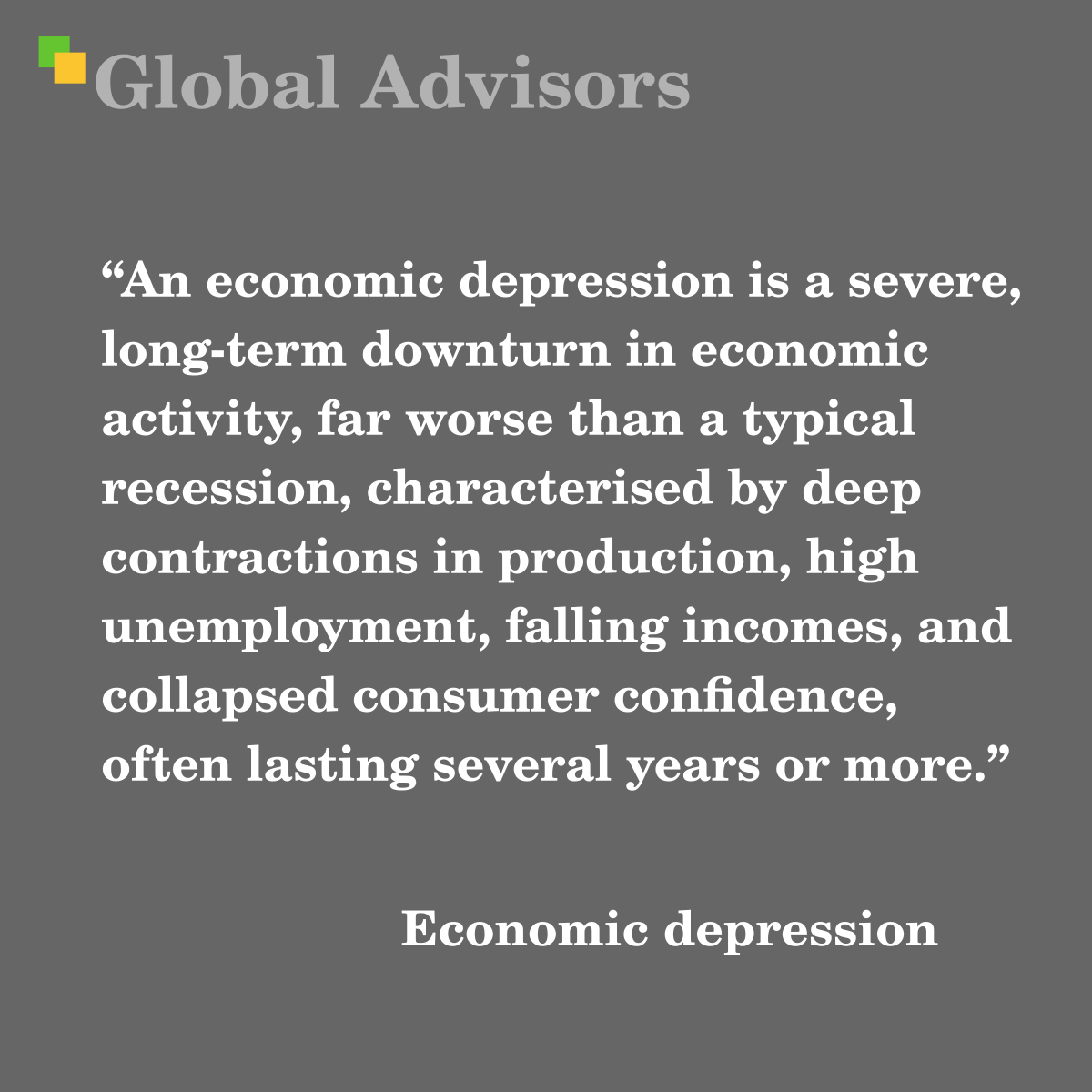
Term: Economic depressionAn economic depression is a severe and prolonged downturn in economic activity, markedly worse than a recession, featuring sharp contractions in production, employment, and gross domestic product (GDP), alongside soaring unemployment, plummeting incomes, widespread bankruptcies, and eroded consumer confidence, often persisting for years.1,2,3 Key Characteristics
Distinction from Recession
CausesEconomic depressions arise from intertwined factors, including:
The paradigmatic example is the Great Depression (1929–1939), triggered by the US stock market crash, speculative excesses, and trade barriers, resulting in a 30%+ GDP plunge, 25% unemployment, and global repercussions.1,7 Best Related Strategy Theorist: John Maynard KeynesJohn Maynard Keynes (1883–1946), the preeminent theorist linked to economic depression strategy, revolutionised macroeconomics through his analysis of depressions and advocacy for active government intervention—ideas forged directly amid the Great Depression, the defining economic depression of modern history.1 BiographyBorn in Cambridge, England, to economist John Neville Keynes and social reformer Florence Ada Brown, Keynes excelled at Eton and King's College, Cambridge, studying mathematics and philosophy under Alfred Marshall. Initially a civil servant in India (1906–1908), he joined Cambridge faculty in 1909, becoming a protégé of Marshall. Keynes's early works, like Indian Currency and Finance (1913), showcased his expertise in monetary policy. During World War I, he advised the Treasury, negotiating reparations at Versailles (1919), but resigned in protest, authoring the prophetic The Economic Consequences of the Peace (1919), warning of German hyperinflation and global instability—presciently linking punitive policies to economic downturns. Relationship to Economic DepressionKeynes's seminal The General Theory of Employment, Interest and Money (1936) emerged as the intellectual antidote to the Great Depression's paralysis, challenging classical economics' self-correcting market assumption. Observing 1929's cascade—falling demand, idle factories, and mass unemployment—he argued depressions stem from insufficient aggregate demand, not wage rigidity alone. His strategy: governments must deploy fiscal policy—deficit spending on public works, infrastructure, and welfare—to boost demand, employment, and GDP until private confidence revives. Expressed mathematically, equilibrium output occurs where aggregate demand equals supply: Y = C + I + G + (X - M) Here, Y (GDP) rises via increased G (government spending) or I (investment) when private C (consumption) falters. Keynes influenced Roosevelt's New Deal, wartime mobilisation, and postwar institutions like the IMF and World Bank, establishing Keynesianism as the orthodoxy for combating depressions until the 1970s stagflation challenged it. His framework remains central to modern counter-cyclical strategies, underscoring depressions' preventability through policy.1,2 References 1. https://study.com/academy/lesson/economic-depression-overview-examples.html 2. https://www.britannica.com/money/depression-economics 3. https://en.wikipedia.org/wiki/Economic_depression 4. https://corporatefinanceinstitute.com/resources/economics/economic-depression/ 5. https://www.imf.org/external/pubs/ft/fandd/basics/recess.htm 7. https://www.fdrlibrary.org/great-depression-facts
|
|||||||||||||||
| |
| |
Quote: Kazuo Ishiguro“Perhaps, then, there is something to his advice that I should cease looking back so much, that I should adopt a more positive outlook and try to make the best of what remains of my day.” - Kazuo Ishiguro - The Remains of the DayContext of the Quote in The Remains of the DayThe quote—“Perhaps, then, there is something to his advice that I should cease looking back so much, that I should adopt a more positive outlook and try to make the best of what remains of my day”—appears toward the novel's conclusion, spoken by the protagonist, Stevens, a stoic English butler reflecting on his life during a road trip across 1950s England.2,3 It captures Stevens grappling with regret over suppressed emotions, unrequited love for housekeeper Miss Kenton, and blind loyalty to his former employer, Lord Darlington, whose pro-appeasement stance toward Nazi Germany tainted his legacy. The "advice" comes from a genial stranger at a pier, who urges Stevens to enjoy life's "evening" after a day's work, echoing the novel's titular metaphor of time slipping away like a fading day.2,3,4 This moment marks Stevens's tentative shift from rigid self-denial toward acceptance, though his ingrained dignity—defined as unflinching duty—prevents full emotional release.1,2 Backstory on Kazuo Ishiguro and the NovelKazuo Ishiguro, born in 1954 in Nagasaki, Japan, moved to England at age five, shaping his themes of memory, displacement, and unspoken regret. A Nobel Prize winner in Literature (2017), he crafts subtle narratives blending historical realism with psychological depth, as in The Remains of the Day (1989), his third novel and Booker Prize victor.2 Inspired by unreliable narrators like those in Ford Madox Ford's works, Ishiguro drew from real English butlers' memoirs and interwar politics, critiquing class-bound repression without overt judgment. The Booker-winning story follows Stevens's six-day drive to reunite with Miss Kenton, framed as his self-justifying memoir, exposing how duty stifles personal fulfillment amid 1930s fascism's rise.1,2,4 Adapted into a 1993 Oscar-nominated film starring Anthony Hopkins and Emma Thompson, it remains Ishiguro's most acclaimed work, probing what dignity is there in that?—a line underscoring Stevens's crisis.2 Leading Theorists on Regret, Positive Outlook, and the "Remains of the Day"The quote's pivot from backward-glancing remorse to forward optimism ties into psychological and philosophical theories on regret minimization and temporal orientation. Key figures include:
These theorists illuminate the novel's insight: regret poisons the "remains," but a deliberate positive turn fosters redemption, blending empirical psychology with timeless wisdom.1,2,3 References 1. https://www.bookey.app/book/the-remains-of-the-day/quote 2. https://www.goodreads.com/work/quotes/3333111-the-remains-of-the-day 3. https://www.goodreads.com/work/quotes/3333111-the-remains-of-the-day?page=6 4. https://www.siquanong.com/book-summaries/the-remains-of-the-day/ 5. https://bookroo.com/quotes/the-remains-of-the-day 6. https://www.sparknotes.com/lit/remains/quotes/page/2/ 7. https://www.coursehero.com/lit/The-Remains-of-the-Day/quotes/ 8. https://www.litcharts.com/lit/the-remains-of-the-day/quotes 9. https://www.cliffsnotes.com/literature/the-remains-of-the-day/quotes 10. https://www.sparknotes.com/lit/remains/quotes/
|
| |

| |
Quote: Blackrock"The AI builders are leveraging up: investment is front-loaded while revenues are back-loaded. Along with highly indebted governments, this creates a more levered financial system vulnerable to shocks like bond yield spikes." - Blackrock - 2026 OutlookThe AI Financing Paradox: How Front-Loaded Investment and Back-Loaded Returns are Reshaping Global Financial RiskThe Quote in ContextBlackRock's 2026 Investment Outlook identifies a critical structural vulnerability in global markets: the massive capital requirements of AI infrastructure are arriving years before the revenue benefits materialize1. This temporal mismatch creates what the firm describes as a financing "hump"—a period of intense leverage accumulation across both the private sector and government balance sheets, leaving financial systems exposed to potential shocks from rising bond yields or credit market disruptions1,2. The quote reflects BlackRock's core thesis that AI's economic impact will be transformational, but the path to that transformation is fraught with near-term financial risks. As the world's largest asset manager, overseeing nearly $14 trillion in assets, BlackRock's assessment carries significant weight in shaping investment strategy and market expectations3. The Investment Spend-Revenue GapThe scale of the AI buildout is staggering. BlackRock projects $5-8 trillion in AI-related capital expenditure through 20305, with annual spending estimated at 5-8 trillion dollars globally until that date3. This represents the fastest technological buildout in recent centuries, yet the economics are unconventional: companies are committing enormous capital today with the expectation that productivity gains and revenue growth will materialize later2. BlackRock notes that while the overall revenues AI eventually generates could theoretically justify the spending at a macroeconomic level, it remains unclear how much of that value will accrue to the tech companies actually building the infrastructure1,2. This uncertainty creates a critical vulnerability—if AI deployment proves less profitable than anticipated, or if adoption rates slow, highly leveraged companies may struggle to service their debt obligations. The Leverage ImperativeThe financing structure is not optional; it is inevitable. AI spending necessarily precedes benefits and revenues, creating an unavoidable need for long-term financing and greater leverage2. Tech companies and infrastructure providers cannot wait years to recoup their investments—they must borrow in capital markets today to fund construction, equipment, and operations. This creates a second layer of risk. As companies issue bonds to finance AI capex, they increase corporate debt levels. Simultaneously, governments worldwide remain highly indebted from pandemic stimulus and ongoing fiscal pressures. The combination produces what BlackRock identifies as a "more levered financial system"—one where both public and private sector balance sheets are stretched1. The Vulnerability to ShocksBlackRock's warning about vulnerability to "shocks like bond yield spikes" is particularly prescient. In a highly leveraged environment, rising interest rates have cascading effects:
The AI buildout amplifies this risk because so much spending is front-loaded. If yield spikes occur before significant productivity gains materialize, companies may lack the cash flow to manage higher borrowing costs, creating potential defaults or forced asset sales that could trigger broader financial instability. BlackRock's Strategic ResponseRather than abandoning risk, BlackRock has taken a nuanced approach: the firm remains pro-risk and overweight U.S. stocks on the AI theme1, betting that the long-term benefits will justify near-term leverage accumulation. However, the firm has also shifted toward tactical underweighting of long-term Treasuries and identified opportunities in both public and private credit markets to manage risk while maintaining exposure1. This reflects a sophisticated view: the financial system's increased leverage is a real concern, but the AI opportunity is too significant to avoid. Instead, active management and diversification across asset classes become essential. Broader Economic ContextThe leverage dynamic intersects with broader macroeconomic shifts. BlackRock emphasizes that inflation is no longer the central issue driving markets; instead, labor dynamics and the distributional effects of AI now matter more4. The firm projects that AI could generate roughly $1.2 trillion in annual labor cost savings, translating into about $878 billion in incremental after-tax corporate profits each year, with a present value on the order of $82 trillion for corporations and another $27 trillion for AI providers4. These enormous potential gains justify the current spending—on a macro level. Yet for individual investors and companies, dispersion and default risk are rising4. The benefits of AI will be highly concentrated among successful implementers, while laggards face obsolescence. This uneven distribution of gains and losses adds another layer of risk to a more levered financial system. Historical and Theoretical ParallelsThe AI financing paradox echoes historical technology cycles. During the dot-com boom of the late 1990s, massive capital investment in internet infrastructure preceded revenue generation by years, creating similar leverage vulnerabilities. The subsequent crash revealed how vulnerable highly leveraged systems are to disappointment about future growth rates. However, this cycle differs in scale and maturity. Unlike the dot-com era, AI is already demonstrating productivity benefits across multiple sectors. The question is not whether AI creates value, but whether the timeline and magnitude of value creation justify the financial risks being taken today. BlackRock's insight captures a fundamental tension in modern finance: transformative technological change requires enormous upfront capital, yet highly leveraged financial systems are fragile. The path forward depends on whether productivity gains materialize quickly enough to validate the investment and reduce leverage before external shocks test the system's resilience. References 1. https://www.blackrock.com/americas-offshore/en/insights/blackrock-investment-institute/outlook 2. https://www.youtube.com/watch?v=eFBwyu30oTU 3. https://www.youtube.com/watch?v=Ww7Zy3MAWAs 4. https://www.blackrock.com/us/financial-professionals/insights/investing-in-2026 6. https://www.blackrock.com/corporate/insights/blackrock-investment-institute/publications/outlook 7. https://www.blackrock.com/institutions/en-us/insights/2026-macro-outlook
|
| |

| |
Term: Economic recessionAn economic recession is a significant, widespread downturn in economic activity, characterized by declining real GDP (often two consecutive quarters), rising unemployment, falling retail sales, and reduced business/consumer spending, signaling a contraction in the business cycle. - Economic recessionEconomic RecessionDefinition and MeasurementDifferent jurisdictions employ distinct formal definitions. In the United Kingdom and European Union, a recession is defined as negative economic growth for two consecutive quarters, representing a six-month period of falling national output and income.1,2 The United States employs a more comprehensive approach through the National Bureau of Economic Research (NBER), which examines a broad range of economic indicators—including real GDP, real income, employment, industrial production, and wholesale-retail sales—to determine whether a significant decline in economic activity has occurred, considering its duration, depth, and diffusion across the economy.1,2 The Organisation for Economic Co-operation and Development (OECD) defines a recession as a period of at least two years during which the cumulative output gap reaches at least 2% of GDP, with the output gap remaining at least 1% for a minimum of one year.2 Key CharacteristicsRecessions typically exhibit several defining features:
Causes and TriggersRecessions generally stem from market imbalances, triggered by external shocks or structural economic weaknesses.8 Common precipitating factors include:
Distinction from DepressionA depression represents a severe or prolonged recession. Whilst no universally agreed definition exists, a depression typically involves a GDP fall of 10% or more, a GDP decline persisting for over three years, or unemployment exceeding 20%.1 The informal economist's observation captures this distinction: "It's a recession when your neighbour loses his job; it's a depression when you lose yours."1 Policy ResponseGovernments typically respond to recessions through expansionary macroeconomic policies, including increasing money supply, decreasing interest rates, raising government spending, and reducing taxation, to stimulate economic activity and restore growth.2 Related Strategy Theorist: John Maynard KeynesJohn Maynard Keynes (1883–1946) stands as the preeminent theorist whose work fundamentally shaped modern understanding of recessions and the policy responses to them. Biography and ContextBorn in Cambridge, England, Keynes was an exceptionally gifted economist, mathematician, and public intellectual. After studying mathematics at King's College, Cambridge, he pivoted to economics and became a fellow of the college in 1909. His early career included service with the Indian Civil Service and as an editor of the Economic Journal, Britain's leading economics publication. Keynes' formative professional experience came as the chief representative of the British Treasury at the Paris Peace Conference in 1919 following the First World War. Disturbed by the punitive reparations imposed upon Germany, he resigned and published The Economic Consequences of the Peace (1919), which warned prophetically of economic instability resulting from the treaty's harsh terms. This work established his reputation as both economist and public commentator. Relationship to Recession TheoryKeynes' revolutionary contribution emerged with the publication of The General Theory of Employment, Interest and Money (1936), written during the Great Depression. His work fundamentally challenged the prevailing classical economic orthodoxy, which held that markets naturally self-correct and unemployment represents a temporary frictional phenomenon. Keynes demonstrated that recessions and prolonged unemployment result from insufficient aggregate demand rather than labour market rigidities or individual irresponsibility.C + I + G + (X - M) = Y, where aggregate demand (the sum of consumption, investment, government spending, and net exports) determines total output and employment. During recessions, demand contracts—consumers and businesses reduce spending due to uncertainty and falling incomes—creating a self-reinforcing downward spiral that markets alone cannot reverse. This insight proved revolutionary because it legitimised active government intervention in recessions. Rather than viewing recessions as inevitable and self-correcting phenomena to be endured passively, Keynes argued that governments could and should employ fiscal policy (taxation and spending) and monetary authorities could adjust interest rates to stimulate aggregate demand, thereby shortening recessions and reducing unemployment. His framework directly underpinned the post-war consensus on recession management: expansionary monetary and fiscal policies during downturns to restore demand and employment. The modern definition of recession as a statistical phenomenon (two consecutive quarters of negative GDP growth) emerged from Keynesian economics' focus on output and demand as the central drivers of economic cycles. Keynes' influence extended beyond economic theory into practical policy. His ideas shaped the institutional architecture of the post-1945 international economic order, including the International Monetary Fund and World Bank, both conceived to prevent the catastrophic demand collapse that characterised the 1930s. References 1. https://www.economicshelp.org/blog/459/economics/define-recession/ 2. https://en.wikipedia.org/wiki/Recession 3. https://den.mercer.edu/what-is-a-recession-and-is-the-u-s-in-one-mercer-economists-explain/ 4. https://www.imf.org/external/pubs/ft/fandd/basics/recess.htm 5. https://www.fidelity.com/learning-center/smart-money/what-is-a-recession 6. https://www.congress.gov/crs-product/IF12774 7. https://www.munich-business-school.de/en/l/business-studies-dictionary/financial-knowledge/recession 8. https://www.mckinsey.com/featured-insights/mckinsey-explainers/what-is-a-recession
|
| |

| |
Quote: William Makepeace Thackeray - English novelistThe world is a looking-glass, and gives back to every man the reflection of his own face. Frown at it, and it will in turn look sourly upon you; laugh at it and with it, and it is a jolly kind companion; and so let all young persons take their choice. - William Makepeace Thackeray - English novelistThe QuoteContext of the QuoteThis passage appears in William Makepeace Thackeray's seminal novel Vanity Fair: A Novel Without a Hero (serialized 1847–1848), during a narrative reflection on human behavior and perception13. It occurs amid commentary on a young character's misanthropic outlook, where the narrator observes that people who view the world harshly often receive harshness in return, attributing this to self-projection rather than external reality3. The metaphor of the world as a "looking-glass" (an old term for mirror) underscores the novel's core theme of vanity—how personal attitudes shape social interactions in a superficial, reciprocal society13. Thackeray uses it to advise youth to choose optimism, contrasting it with the book's satirical portrayal of ambition, deceit, and social climbing in early 19th-century England3. Backstory on William Makepeace ThackerayWilliam Makepeace Thackeray (1811–1863) was a prominent English novelist, satirist, and illustrator, often ranked alongside Charles Dickens as a Victorian literary giant1. Born in Calcutta, India, to British parents—his father a colonial administrator—he returned to England at age six after his father's early death1. Educated at Charterhouse School and Cambridge University, Thackeray initially pursued law and art but turned to journalism and writing amid financial ruin from failed investments and his wife's mental illness following childbirth1. His breakthrough came with Vanity Fair, a panoramic satire of British society during the Napoleonic Wars, drawing from John Bunyan's The Pilgrim's Progress (where "Vanity Fair" symbolizes worldly temptation)13. Published anonymously as monthly installments, it sold widely for its witty narration, moral ambiguity, and critique of hypocrisy among the upper and aspiring middle classes1. Thackeray followed with successes like Pendennis (1848–1850), Henry Esmond (1852), and The Newcomes (1853–1855), blending humor, pathos, and realism1. A rival to Dickens, he lectured on English humorists and edited Cornhill Magazine, but personal struggles with debt, health (addiction to opium and alcohol), and family tragedy marked his life. He died at 52 from a ruptured aneurysm1. Thackeray's style—omniscient, ironic narration—mirrors the quote's philosophy: life reflects one's inner disposition, a recurring motif in his works exposing human folly without heavy moralizing13. Leading Theorists Related to the Subject MatterThe quote's idea—that reality mirrors one's attitude—echoes longstanding philosophical and psychological concepts on perception, projection, and optimism. Below is a backstory on key theorists whose ideas parallel or influenced this theme of reciprocal self-fulfilling prophecy.
These ideas trace from Enlightenment rationalism through Victorian literature to modern psychology, all converging on the insight that personal disposition acts as a filter and catalyst for worldly responses, as Thackeray insightfully captured13. References 1. https://www.goodreads.com/author/quotes/3953.William_Makepeace_Thackeray 2. https://www.azquotes.com/author/14547-William_Makepeace_Thackeray 3. https://www.goodreads.com/work/quotes/1057468-vanity-fair-a-novel-without-a-hero 4. https://www.sparknotes.com/lit/vanity-fair/quotes/ 5. https://www.coursehero.com/lit/Vanity-Fair/quotes/ 6. http://www.freebooknotes.com/quotes/vanity-fair/ 7. https://libquotes.com/william-makepeace-thackeray/works/vanity-fair 8. https://www.litcharts.com/lit/vanity-fair/quotes
|
| |

| |
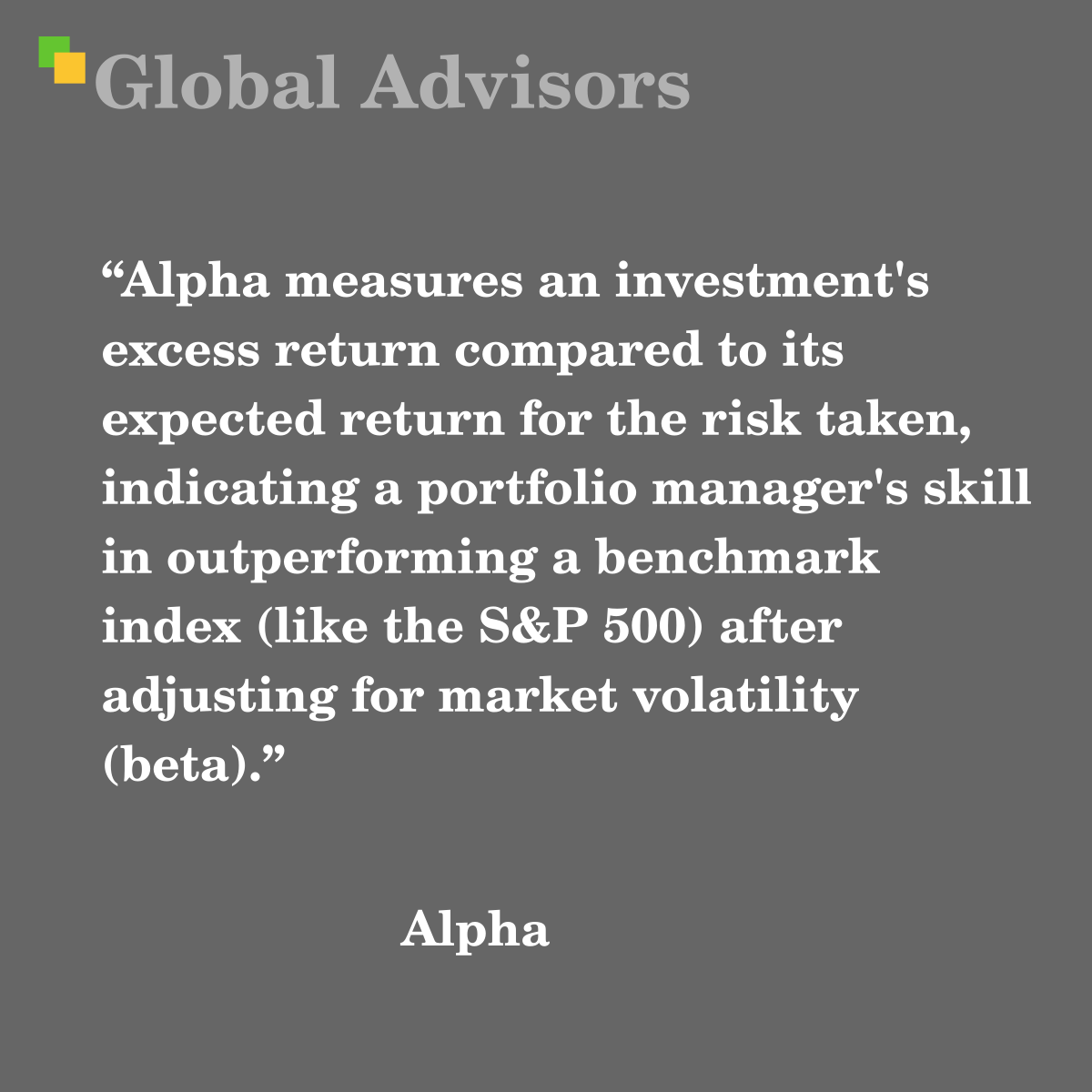
Term: AlphaComprehensive DefinitionAlpha isolates the value added (or subtracted) by active management, distinguishing it from passive market returns. It quantifies performance on a risk-adjusted basis, accounting for systematic risk via beta, which reflects an asset's volatility relative to the market. A positive alpha signals outperformance—meaning the manager has skilfully selected securities or timed markets to exceed expectations—while a negative alpha indicates underperformance, often failing to justify management fees.1,3,4,5 An alpha of zero implies returns precisely match the risk-adjusted benchmark.3,5 In practice, alpha applies across asset classes:
Alpha underpins debates on active versus passive investing: consistent positive alpha justifies active fees, but many managers struggle to sustain it after costs.1,4 Calculation MethodsThe simplest form subtracts benchmark return from portfolio return:
For precision, Jensen's Alpha uses the Capital Asset Pricing Model (CAPM) to compute expected return:
Example: ( Rp = 30\% ), ( Rf = 8\% ), ( \beta = 1.1 ), ( R_m = 20\% ) gives: This CAPM-based approach ensures alpha reflects true skill, not uncompensated risk.1,2,5 Key Theorist: Michael JensenThe foremost theorist linked to alpha is Michael Jensen (1939–2021), who formalised Jensen's Alpha in his seminal 1968 paper, "The Performance of Mutual Funds in the Period 1945–1964," published in the Journal of Finance. This work introduced alpha as a rigorous metric within CAPM, enabling empirical tests of manager skill.1,4 Biography and Backstory: Born in Independence, Missouri, Jensen earned a PhD in economics from the University of Chicago under Nobel laureate Harry Markowitz, immersing him in modern portfolio theory. His 1968 study analysed 115 mutual funds, finding most generated negative alpha after fees, challenging claims of widespread managerial prowess and bolstering efficient market hypothesis evidence.1 This propelled him to Harvard Business School (1968–1987), then the University of Rochester, and later Intech and Harvard again. Jensen pioneered agency theory, co-authoring "Theory of the Firm" (1976) on managerial incentives, and influenced private equity via leveraged buyouts. His alpha measure remains foundational, used daily by investors to evaluate funds against CAPM benchmarks, underscoring that true alpha stems from security selection or timing, not market beta.1,4,5 Jensen's legacy endures in performance attribution, with his metric cited in trillions of dollars' worth of evaluations. References 1. https://www.moonfare.com/glossary/investment-alpha 2. https://robinhood.com/us/en/learn/articles/2lwYjCxcvUP4lcqQ3yXrgz/what-is-alpha/ 3. https://corporatefinanceinstitute.com/resources/career-map/sell-side/capital-markets/alpha/ 4. https://www.wallstreetprep.com/knowledge/alpha/ 5. https://www.findex.se/finance-terms/alpha 6. https://www.ig.com/uk/glossary-trading-terms/alpha-definition 7. https://www.pimco.com/us/en/insights/the-alpha-equation-myths-and-realities 8. https://eqtgroup.com/thinq/Education/what-is-alpha-in-investing
|
| |
| |
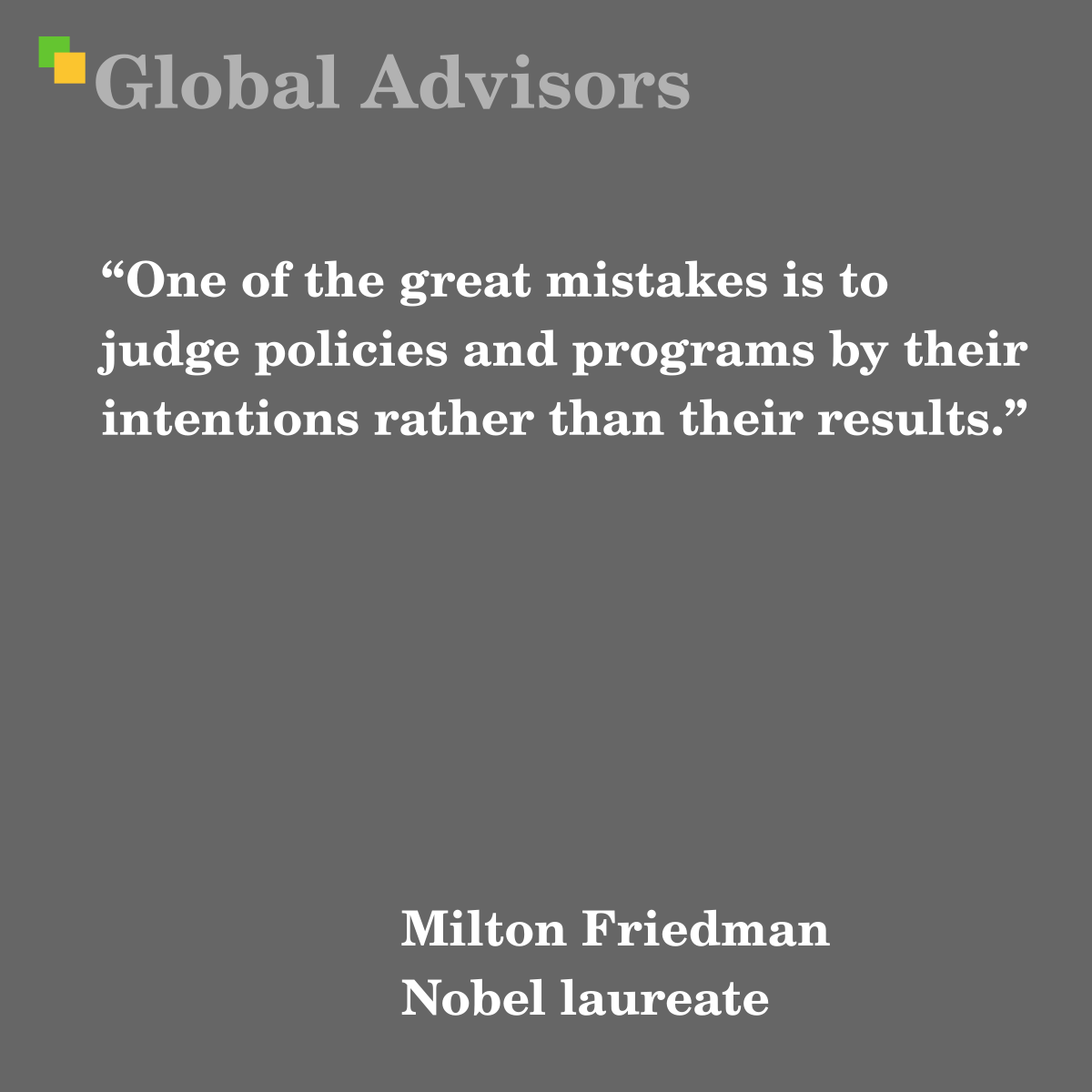
Quote: Milton Friedman - Nobel laureate"One of the great mistakes is to judge policies and programs by their intentions rather than their results." - Milton Friedman - Nobel laureateContext and OriginMilton Friedman first expressed this idea during a 1975 television interview on The Open Mind, hosted by Richard Heffner. Discussing government programs aimed at helping the poor and needy, Friedman argued that such initiatives, despite their benevolent intentions, often produce opposite effects. He tied the remark to the proverb "the road to hell is paved with good intentions," emphasizing that good-hearted advocates sometimes fail to apply the same rigor to their heads, leading to unintended harm1. The quote has since appeared in books like After the Software Wars (2009) and I Am John Galt (2011), a 2024 New York Times letter critiquing the Department of Education, and various quote collections13. This perspective underscores Friedman's broader critique of public policy: evaluate effectiveness through empirical outcomes, not rhetoric. He often highlighted how welfare programs, school vouchers, and monetary policies could backfire if results are ignored in favor of motives14. Backstory on Milton FriedmanMilton Friedman (1912–2006) was a pioneering American economist, statistician, and public intellectual whose work reshaped modern economic thought. Born in Brooklyn, New York, to Jewish immigrant parents from Hungary, he earned his bachelor's degree from Rutgers University in 1932 amid the Great Depression, followed by master's and doctoral degrees from the University of Chicago. There, he joined the "Chicago School" of economics, advocating free markets, limited government, and individual liberty1. Friedman's seminal contributions include A Monetary History of the United States (1963, co-authored with Anna Schwartz), which blamed the Federal Reserve's policies for exacerbating the Great Depression and influenced central banking worldwide. His advocacy for floating exchange rates contributed to the end of the Bretton Woods system in 1971. In Capitalism and Freedom (1962), he proposed ideas like school vouchers, a negative income tax, and abolishing the draft—many of which remain debated today. A fierce critic of Keynesian economics, Friedman championed monetarism: the idea that controlling money supply stabilizes economies better than fiscal intervention. His PBS series Free to Choose (1980) and bestselling book of the same name popularized these views for lay audiences. Awarded the Nobel Prize in Economic Sciences in 1976 "for his achievements in the fields of consumption analysis, monetary history and theory, and for his demonstration of the complexity of stabilization policy," Friedman influenced leaders like Ronald Reagan and Margaret Thatcher1. Later, he opposed the war on drugs, supported drug legalization, and critiqued Social Security. Friedman died in 2006, leaving a legacy as a defender of economic freedom against well-intentioned but flawed interventions. Leading Theorists Related to the Subject MatterFriedman's quote critiques the "intention fallacy" in policy evaluation, aligning with traditions emphasizing empirical results over moral or ideological justifications. Key related theorists include:
These thinkers form the backbone of outcome-based policy critique, contrasting with interventionist schools like Keynesianism, where intentions often justify expansions despite mixed results. Friedman's Permanent Income HypothesisLinked in some discussions to Friedman's consumption work, the Permanent Income Hypothesis (1957) posits that people base spending on "permanent" (long-term expected) income, not short-term fluctuations. In A Theory of the Consumption Function, Friedman argued transitory income changes (e.g., bonuses) are saved, not spent, challenging Keynesian absolute income hypothesis. Empirical tests via microdata supported it, influencing modern macroeconomics and fiscal policy debates on multipliers1. This hypothesis exemplifies Friedman's results-driven approach: policies assuming instant spending boosts (e.g., stimulus checks) overlook consumption smoothing. References 1. https://quoteinvestigator.com/2024/03/22/intentions-results/ 2. https://www.azquotes.com/quote/351907 3. https://www.goodreads.com/quotes/29902-one-of-the-great-mistakes-is-to-judge-policies-and
|
| |
| |
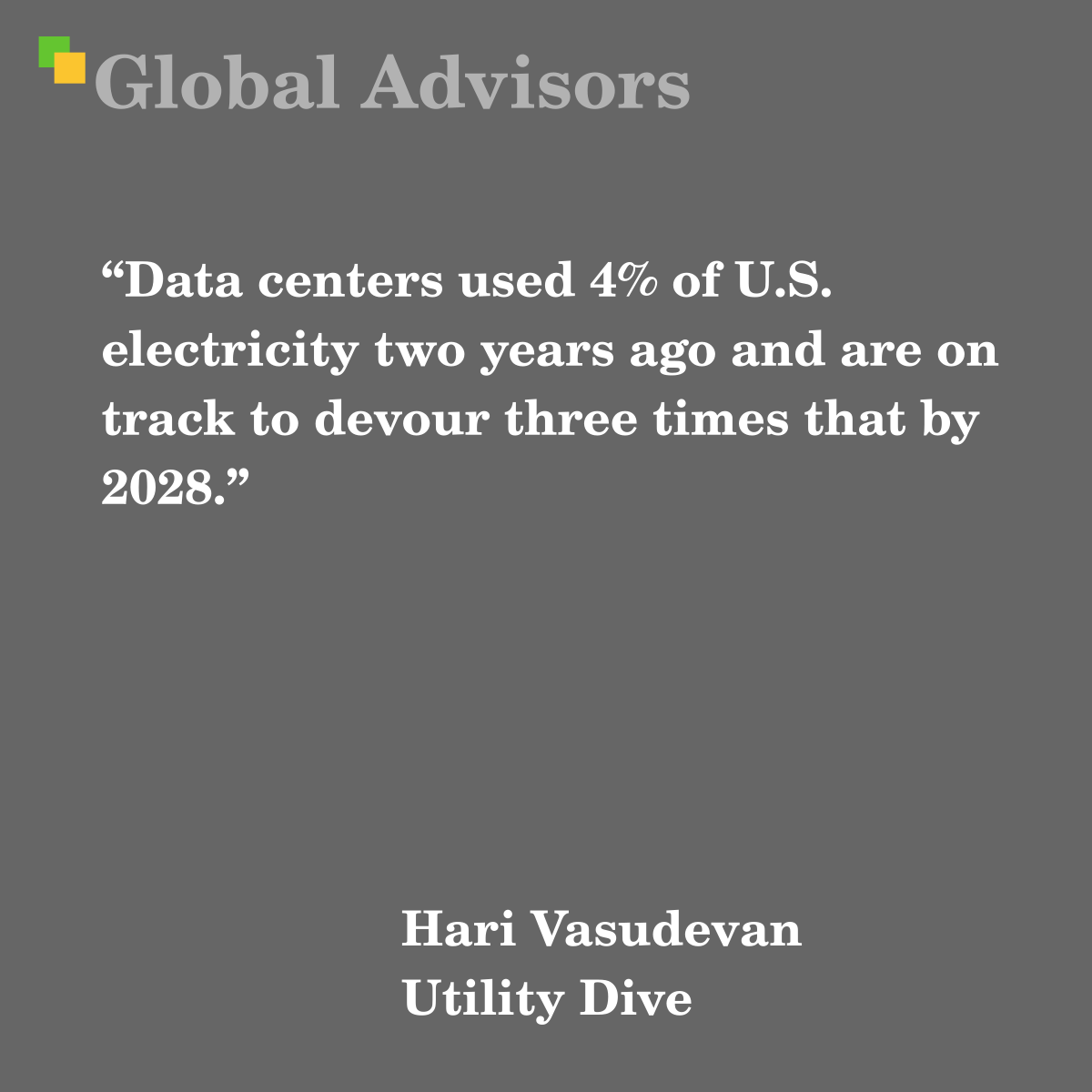
Quote: Hari Vasudevan - Utility Dive"Data centers used 4% of U.S. electricity two years ago and are on track to devour three times that by 2028." - Hari Vasudevan - Utility DiveHari Vasudevan is the founder and CEO of KYRO AI, an AI-powered platform designed to streamline operations in utilities, vegetation management, disaster response, and critical infrastructure projects, supporting over $150 billion in program value by enhancing safety, efficiency, and cost savings for contractors and service providers.1,3,4 Backstory and Context of the QuoteThe quote—"Utilities that embrace artificial intelligence will set reliability and affordability standards for decades to come"—originates from Vasudevan's November 26, 2025, opinion piece in Utility Dive titled "Data centers are breaking the old grid. Let AI build the new one."1,6 In it, he addresses the grid's strain from surging data center demand fueled by AI, exemplified by Georgia regulators' summer 2025 rules to protect residential customers from related cost hikes.6 Vasudevan argues that the U.S. power grid faces an "inflection point," where clinging to a reactive 20th-century model leads to higher bills and outages, while AI adoption enables a resilient system balancing homes, businesses, and digital infrastructure.1,6 This piece builds on his November 2025 Energy Intelligence article urging utilities and hyperscalers (e.g., tech giants building data centers) to collaborate via dynamic load management, on-site generation, and shared capital risks to avoid burdening ratepayers.5 The context reflects escalating challenges: data centers are driving grid overloads, extreme weather has caused $455 billion in U.S. storm damage since 1980 (one-third in the last five years), and utility rate disallowances have risen to 35-40% from 2019-2023 amid regulatory scrutiny.4,5,6 Vasudevan's perspective stems from hands-on experience. He founded Think Power Solutions to provide construction management and project oversight for electric utilities, managing multi-billion-dollar programs nationwide and achieving a 100% increase in working capital turns alongside 57% growth by improving billing accuracy, reducing delays, and bridging field-office gaps in thin-margin industries.3 After exiting as CEO, he launched KYRO AI to apply these efficiencies at scale, particularly for storm response—where AI optimizes workflows for linemen, fleets, and regulators amid rising billion-dollar weather events—and infrastructure buildouts like transmission lines powering data centers.3,4 In a CCCT podcast, he emphasized AI's role in powering the economy during uncertain times, closing gaps that erode profits, and aiding small construction businesses.3 Leading Theorists in AI for Grid Modernization and Utility ResilienceVasudevan's advocacy aligns with pioneering work in AI applications for energy systems. Key theorists include:
These theorists provide the intellectual foundation: Lovins for decentralization, Amin for smart infrastructure, Ng for scalable AI, and Hodge for optimization, all converging on AI as essential for affordable, resilient grids facing AI-driven demand.1,4,5,6
References 1. https://www.utilitydive.com/opinion/ 2. https://www.utilitydive.com/?page=1&p=505 3. https://www.youtube.com/watch?v=g8q16BWXk4o 4. https://www.utilitydive.com/news/ai-utility-storm-response-kyro/752172/ 5. https://www.energyintel.com/0000019b-2712-d02f-adfb-e7932e490000 6. https://www.utilitydive.com/news/ai-utilities-reliability-cost/805224/
|
| |
| |
Term: Sharpe RatioThe Sharpe Ratio is a key finance metric measuring an investment's excess return (above the risk-free rate) per unit of its total risk (volatility/standard deviation), with a higher ratio indicating better risk-adjusted performance. - Sharpe Ratio -The Sharpe Ratio is a fundamental metric in finance that quantifies an investment's or portfolio's risk-adjusted performance by measuring the excess return over the risk-free rate per unit of total risk, typically represented by the standard deviation of returns. A higher ratio indicates superior returns relative to the volatility borne, enabling investors to compare assets or portfolios on an apples-to-apples basis despite differing risk profiles.1,2,3 Formula and CalculationThe Sharpe Ratio is calculated using the formula: \text = \frac{\sigma_a} Where:
To compute it:
For example, if an investment yields 40% return with a 20% risk-free rate and 5% standard deviation, the Sharpe Ratio is (40% - 20%) / 5% = 4. In contrast, a 60% return with 80% standard deviation yields (60% - 20%) / 80% = 0.5, showing the lower-volatility option performs better on a risk-adjusted basis.4 Interpretation
This metric excels for comparing investments with varying risk levels, such as mutual funds, but assumes normal return distributions and total risk (not distinguishing systematic from idiosyncratic risk).1,2,5 LimitationsThe Sharpe Ratio treats upside and downside volatility equally, may underperform in non-normal distributions, and relies on historical data that may not predict future performance. Variants like the Sortino Ratio address some flaws by focusing on downside risk.1,2,5 Key Theorist: William F. SharpeThe best related strategy theorist is William F. Sharpe (born 16 June 1934), the metric's creator and originator of the Capital Asset Pricing Model (CAPM), which underpins modern portfolio theory. BiographySharpe earned a BA in economics from UCLA (1955), an MA (1956), and PhD (1961) from Stanford University. He joined Stanford's Graduate School of Business faculty in 1970, becoming STANCO 25 Professor Emeritus of Finance. His seminal 1964 paper, "Capital Asset Prices: A Theory of Market Equilibrium under Conditions of Risk," introduced CAPM, positing that expected return correlates linearly with systematic risk (beta). In 1990, Sharpe shared the Nobel Memorial Prize in Economic Sciences with Harry Markowitz and Merton Miller for pioneering financial economics, particularly portfolio selection and asset pricing.1,5,7,9 Relationship to the Sharpe RatioSharpe developed the ratio in his 1966 paper "Mutual Fund Performance," published in the Journal of Business, to evaluate active managers' skill beyond raw returns. It extends CAPM by normalising excess returns (alpha-like) by total volatility, rewarding efficient risk-taking. By 1994, he refined it in "The Sharpe Ratio" on his Stanford site, linking it to t-statistics for statistical significance. The metric remains the "golden industry standard" for risk-adjusted performance, integral to strategies like passive indexing and factor investing that Sharpe championed.1,5,7,9
References 1. https://en.wikipedia.org/wiki/Sharpe_ratio 2. https://www.businessinsider.com/personal-finance/investing/sharpe-ratio 3. https://www.kotakmf.com/Information/blogs/sharpe-ratio_ 4. https://www.cmcmarkets.com/en-gb/fundamental-analysis/what-is-the-sharpe-ratio 6. https://www.personalfinancelab.com/glossary/sharpe-ratio/ 7. https://www.risk.net/definition/sharpe-ratio 8. https://www.youtube.com/watch?v=96Aenz0hNKI 9. https://web.stanford.edu/~wfsharpe/art/sr/sr.htm
|
| |
| |
|


| |
| |