| |
|

| |
| |
| |
|
Our selection of the top business news sources on the web. |
| |
| |
| |
Quote: Jim Simons"One can predict the course of a comet more easily than one can predict the course of Citigroup's stock. The attractiveness, of course, is that you can make more money successfully predicting a stock than you can a comet." - Jim Simons - Renaissance Technologies founderJim Simons' observation that "one can predict the course of a comet more easily than one can predict the course of Citigroup's stock" encapsulates a profound paradox at the heart of modern finance. Yet Simons himself spent a lifetime proving that this apparent unpredictability could be systematically exploited through mathematical rigour. The quote reflects both the genuine complexity of financial markets and the tantalising opportunity they present to those equipped with the right intellectual tools. Simons made this observation as the founder of Renaissance Technologies, the quantitative hedge fund that would become one of the most successful investment firms in history. The statement reveals his pragmatic philosophy: whilst comets follow the deterministic laws of celestial mechanics, stock prices are influenced by countless human decisions, emotions, and unforeseen events. Yet this very complexity-this apparent chaos-creates inefficiencies that a sufficiently sophisticated mathematical model can exploit for profit. Jim Simons: The Mathematician Who Decoded MarketsJames Harris Simons (1938-2024) was born in Newton, Massachusetts, and demonstrated an early affinity for mathematics that would define his extraordinary career. He earned his Ph.D. in mathematics from the University of California, Berkeley at the remarkably young age of 23, establishing himself as a prodigy in pure mathematics before his unconventional path led him toward finance. Simons' early career trajectory was marked by intellectual distinction across multiple domains. He taught mathematics at the Massachusetts Institute of Technology and Harvard University, where he worked alongside some of the finest minds in academia. Between 1964 and 1968, he served on the research staff of the Communications Research Division of the Institute for Defence Analysis, where he contributed to classified cryptographic work, including efforts to break Soviet codes. In 1973, IBM enlisted his expertise to attack Lucifer, an early precursor to the Data Encryption Standard-work that demonstrated his ability to apply mathematical thinking to real-world security challenges. From 1968 to 1978, Simons chaired the mathematics department at Stony Brook University, building it from scratch into a respected institution. He received the American Mathematical Society's Oswald Veblen Prize in Geometry, one of the highest honours in his field. By conventional measures, he had achieved the pinnacle of academic success. Yet Simons harboured interests that set him apart from his peers. He traded stocks and dabbled in soybean futures whilst at Berkeley, and he maintained a fascination with business and finance that his academic colleagues did not share. In interviews, he reflected on feeling like "something of an outsider" throughout his career-immersed in mathematics but never quite feeling like a full member of the academic community. This sense of not fitting into conventional boxes would prove formative. The Catalyst: Control, Ambition, and the Vietnam WarSimons' transition from academia to finance was precipitated by both personal circumstances and philosophical conviction. In 1966, he published an article in Newsweek opposing the Vietnam War, a public stance that led to his dismissal from the Institute for Defence Analysis. With three young children and significant debts-he had borrowed money to invest in a manufacturing venture in Colombia-this abrupt termination shook him profoundly. The experience crystallised his realisation that he lacked control over his own destiny when working within established institutions. This episode proved transformative. Simons came to understand that financial independence equated to autonomy and power. He needed an environment where he could pursue his diverse interests-entrepreneurship, markets, and mathematics-simultaneously. No such environment existed within academia or traditional finance. Therefore, he would create one. The Birth of Renaissance Technologies: 1978In 1978, Simons left Stony Brook University to found Monometrics (later renamed Renaissance Technologies in 1982) in a modest strip mall near Stony Brook. The venture began with false starts, but Simons possessed a crucial insight: it should be possible to construct mathematical models of market data to identify profitable trading patterns. This represented a radical departure from Wall Street convention. Rather than hiring experienced traders and financial professionals, Simons recruited mathematicians, physicists, and computer scientists-individuals of exceptional intellectual calibre who had never worked in finance. As he explained to California magazine: "We didn't hire anyone who had worked on Wall Street before. We hired people who were very good scientists but who wanted to try something different. And make more money if it worked out." This hiring philosophy became Renaissance's "secret sauce." Simons assembled a team that included Leonard E. Baum and James Ax, mathematicians of the highest order. These scientists approached markets not as traders seeking intuitive edge, but as researchers seeking to identify statistical patterns and anomalies in vast datasets. They applied techniques from information theory, signal processing, and statistical analysis to construct algorithms that could identify and exploit market inefficiencies. The Medallion Fund: Unprecedented SuccessIn 1988, Renaissance established the Medallion Fund, a closed investment vehicle that would become the most profitable hedge fund in history. Between its inception in 1988 and 2018, the Medallion Fund generated over $100 billion in trading profits, achieving a 66.1% average gross annual return (or 39.1% net of fees). These figures are without parallel in investment history. For context, Warren Buffett's Berkshire Hathaway-widely regarded as the gold standard of long-term investing-has achieved approximately 20% annualised returns over decades. The Medallion Fund's success vindicated Simons' core thesis: whilst individual stock movements may appear random and unpredictable, patterns exist within the noise. By applying sophisticated mathematical models to vast quantities of market data, these patterns could be identified and exploited systematically. The fund's returns were not the product of luck or market timing, but of rigorous scientific methodology applied to financial data. Renaissance Technologies also managed three additional funds open to outside investors-the Renaissance Institutional Equities Fund, Renaissance Institutional Diversified Alpha, and Renaissance Institutional Diversified Global Equity Fund-which collectively managed approximately $55 billion in assets as of 2019. The Theoretical Foundations: Quantitative Finance and Market MicrostructureSimons' success emerged from a convergence of theoretical advances and technological capability. The intellectual foundations for quantitative finance had been developing throughout the twentieth century, though Simons and Renaissance were among the first to apply these theories systematically at scale. Eugene Fama and the Efficient Market Hypothesis Eugene Fama's Efficient Market Hypothesis (EMH), developed in the 1960s, posited that asset prices fully reflect all available information, making it impossible to consistently outperform the market through analysis. If markets were truly efficient, Simons' entire enterprise would be theoretically impossible. Yet Simons' empirical results demonstrated that markets contained exploitable inefficiencies-what economists would later term "market anomalies." Rather than accepting EMH as gospel, Simons treated it as a hypothesis to be tested against data. His success suggested that whilst markets were broadly efficient, they were not perfectly so, and the gaps could be identified through rigorous statistical analysis. Harry Markowitz and Modern Portfolio Theory Harry Markowitz's pioneering work on portfolio optimisation in the 1950s established the mathematical framework for understanding risk and return. Markowitz demonstrated that investors could construct optimal portfolios by balancing expected returns against volatility, measured as standard deviation. Renaissance built upon this foundation, but extended it dramatically. Whilst Markowitz's approach was largely static, Renaissance employed dynamic models that continuously adjusted positions based on evolving market conditions and statistical signals. Statistical Arbitrage and Market Microstructure Renaissance's core methodology centred on statistical arbitrage-identifying pairs or groups of securities whose prices had deviated from their historical relationships, then betting that these relationships would revert to equilibrium. This required deep understanding of market microstructure: the mechanics of how prices form, how information propagates through markets, and how trading activity itself influences prices. Simons and his team studied these phenomena with the rigour of physicists studying natural systems. Information Theory and Signal Processing Simons' background in cryptography and information theory proved invaluable. Just as cryptographers extract meaningful signals from noise, Renaissance's algorithms extracted trading signals from the apparent randomness of price movements. The team applied techniques from signal processing-originally developed for telecommunications and radar-to identify patterns in financial data that others overlooked. The Philosophical Implications of Simons' QuoteSimons' observation about comets versus stocks reflects a deeper philosophical position about the nature of complexity and predictability. Comets follow deterministic equations derived from Newton's laws of motion and gravitation. Their trajectories are, in principle, perfectly predictable given sufficient initial conditions. Yet they are also distant, their behaviour unaffected by human activity. Stock prices, by contrast, emerge from the aggregated decisions of millions of participants acting on incomplete information, subject to psychological biases, and influenced by unpredictable events. This apparent chaos seems to defy prediction. Yet Simons recognised that this very complexity creates opportunity. The inefficiencies that arise from human psychology, information asymmetries, and market structure are precisely what quantitative models can exploit. The quote also embodies Simons' pragmatism. He was not interested in predicting stocks with perfect accuracy-an impossible task. Rather, he sought to identify statistical edges: situations where the probability distribution of future returns was sufficiently favourable to generate consistent profits over time. This is fundamentally different from prediction in the deterministic sense. It is prediction in the probabilistic sense-identifying where odds favour the investor. Legacy and Impact on FinanceSimons' success catalysed a revolution in finance. The quantitative approach that Renaissance pioneered has become increasingly dominant. Today, algorithmic and quantitative trading account for a substantial portion of market activity. Universities have established entire programmes in financial engineering and computational finance. The intellectual framework that Simons helped develop-treating markets as complex systems amenable to mathematical analysis-has become orthodoxy. In 2006, Simons was named Financial Engineer of the Year by the International Association of Financial Engineers, recognition of his transformative impact on the field. His personal wealth accumulated accordingly: in 2020, he was estimated to have earned $2.6 billion, making him one of the highest-earning individuals in finance. Yet Simons' later life demonstrated that his intellectual curiosity extended far beyond finance. After retiring as chief executive officer of Renaissance Technologies in 2010, he devoted himself increasingly to the Simons Foundation, which he and his wife Marilyn had established. The foundation has become one of the world's leading supporters of fundamental scientific research, funding work in mathematics, theoretical physics, computer science, and biology. In 2012, Simons convened a seminar bringing together leading scientists from diverse fields, which led to the creation of Simons Collaborations-programmes supporting interdisciplinary research on fundamental questions about the nature of reality and life itself. In 2004, Simons founded Math for America, a nonprofit organisation dedicated to improving mathematics education in American public schools by recruiting and supporting highly qualified teachers. This initiative reflected his conviction that mathematical literacy is foundational to scientific progress and economic competitiveness. Conclusion: The Outsider Who Built a New WorldJim Simons' career exemplifies the power of intellectual courage and the willingness to challenge established paradigms. He was, by his own admission, an outsider-never quite fitting into the boxes that academia and conventional finance offered. Rather than accepting these constraints, he created an entirely new environment where his diverse talents could flourish: a place where pure mathematics, empirical data analysis, and financial markets intersected. His observation about comets and stocks captures this perfectly. Whilst others accepted that stock markets were fundamentally unpredictable, Simons saw opportunity in complexity. He assembled a team of the world's finest scientists and tasked them with finding patterns in apparent chaos. The result was not merely financial success, but a transformation of how finance itself is understood and practised. Simons passed away on 10 May 2024, at the age of 86, leaving behind a legacy that extends far beyond Renaissance Technologies. He demonstrated that intellectual rigour, scientific methodology, and collaborative excellence can generate both extraordinary financial returns and profound contributions to human knowledge. His life stands as a testament to the proposition that the greatest opportunities often lie at the intersection of disciplines, and that those willing to think differently can reshape entire fields. References 1. https://www.jermainebrown.org/posts/why-jim-simons-founded-renaissance-technologies 2. https://en.wikipedia.org/wiki/Jim_Simons 3. https://inspire.berkeley.edu/p/promise-spring-2016/jim-simons-life-left-turns/ 4. https://www.simonsfoundation.org/2024/05/10/remembering-the-life-and-careers-of-jim-simons/ 5. https://today.ucsd.edu/story/jim-simons 6. https://news.stonybrook.edu/university/jim-simons-a-life-of-scholarship-leadership-and-philanthropy/
|
| |
| |
Quote: Andrew Ng - AI guru. Coursera founder"I find that we've done this "let a thousand flowers bloom" bottom-up [AI] innovation thing, and for the most part, it's led to a lot of nice little things but nothing transformative for businesses." - Andrew Ng - AI guru, Coursera founderIn a candid reflection at the World Economic Forum 2026 session titled 'Corporate Ladders, AI Reshuffled,' Andrew Ng critiques the prevailing 'let a thousand flowers bloom' approach to AI innovation. He argues that while this bottom-up strategy has produced numerous incremental tools, it falls short of delivering the profound business transformations required in today's competitive landscape1,3,4. This perspective emerges from Ng's deep immersion in AI's evolution, where he observes a landscape brimming with potential yet hampered by fragmented efforts. Andrew Ng: The Architect of Modern AI Education and ResearchAndrew Ng stands as one of the foremost figures in artificial intelligence, often dubbed an 'AI guru' for his pioneering contributions. A British-born computer scientist, Ng co-founded Coursera in 2012, revolutionising online education by making high-quality courses accessible worldwide, with a focus on machine learning and AI1,4. Prior to that, he led the Google Brain project from 2011 to 2012, establishing one of the first large-scale deep learning initiatives that laid foundational work for advancements now powering Google DeepMind1. Today, Ng heads DeepLearning.AI, offering practical AI training programmes, and serves as managing general partner at AI Fund, investing in transformative AI startups. His career also includes professorships at Stanford University and Baidu's chief scientist role, where he scaled AI applications in China. At Davos 2026, Ng highlighted Google's resurgence with Gemini 3 while emphasising the 'white hot' AI ecosystem's opportunities for players like Anthropic and OpenAI1. He consistently advocates for upskilling, noting that 'a person that uses AI will be so much more productive, they will replace someone that doesn't,' countering fears of mass job losses with a vision of augmented human capabilities3. Context of the Quote: Davos 2026 and the Shift from Experimentation to Enterprise ImpactDelivered in January 2026 during a YouTube live session on how AI is reshaping jobs, skills, careers, and workflows, Ng's remark underscores a pivotal moment in AI adoption[Source]. Amid Davos discussions, he addressed the tension between hype and reality: bottom-up innovation has yielded 'nice little things' like chatbots and coding assistants, but businesses crave systemic overhauls in areas such as travel, retail, and domain-specific automation1. Ng points to underinvestment in the application layer, urging a pivot towards targeted, top-down strategies to unlock transformative value-echoing themes of agentic AI, task automation, and workflow integration[TAGS]. This aligns with his broader Davos narrative, including calls for open-source AI to foster sovereignty (as for India) and pragmatic workforce reskilling, where AI handles 30-40% of tasks, leaving humans to manage the rest2,3. The session, part of WEF's exploration of AI's role in corporate structures, signals a maturing field moving beyond foundational models to enterprise-grade deployment. Leading Theorists on AI Innovation Paradigms: From Bottom-Up Bloom to Structured TransformationNg's critique builds on foundational theories of innovation in AI, drawing from pioneers who shaped the debate between decentralised experimentation and directed progress.
These theorists collectively highlight a consensus: while bottom-up innovation democratised AI tools, the next phase requires deliberate, top-down engineering to embed AI into core business processes, driving productivity and competitive edges. Implications for Businesses and the AI EcosystemNg's insight challenges leaders to reassess AI strategies, prioritising agentic systems that automate tasks and elevate human judgement. As the AI landscape heats up-with models like Gemini 3, Llama-4, and Qwen-2-opportunities abound for those bridging the application gap1,2. This perspective not only contextualises current hype but guides towards sustainable, transformative deployment. References 2. https://www.aicerts.ai/news/andrew-ng-open-source-ai-india-call-resonates-at-davos/ 4. https://www.youtube.com/watch?v=oQ9DTjyfIq8 5. https://globaladvisors.biz/2026/01/23/the-ai-signal-from-the-world-economic-forum-2026-at-davos/
|
| |
!["I find that we've done this "let a thousand flowers bloom" bottom-up [AI] innovation thing, and for the most part, it's led to a lot of nice little things but nothing transformative for businesses." - Quote: Andrew Ng - AI guru. Coursera founder](https://globaladvisors.biz/wp-content/uploads/2026/02/20260202_10h15_GlobalAdvisors_Marketing_Quote_AndrewNg_GAQ-1.png)
| |
Quote: Bill Gurley"There are people in this world who view everything as a zero sum game and they will elbow you out the first chance they can get. And so those shouldn't be your peers." - Bill Gurley - GP at BenchmarkThis incisive observation comes from Bill Gurley, a General Partner at Benchmark Capital, shared during his appearance on Tim Ferriss's podcast in late 2025. In the discussion titled 'Bill Gurley - Investing in the AI Era, 10 Days in China, and Important Life Lessons,' Gurley outlines two key tests for selecting peers and collaborators: trust and a shared interest in learning. He warns against those with a zero-sum mentality-individuals who see success as limited, leading them to undermine others for personal gain. Instead, he advocates pushing such people aside to foster environments of mutual support and growth.3,6 The quote resonates deeply in careers, entrepreneurship, and high-stakes fields like venture capital, where collaboration can amplify success. Gurley, drawing from decades in tech investing, emphasises that true progress thrives in positive-sum dynamics, where celebrating peers' wins benefits all.1,3 Bill Gurley's BackstoryBill Gurley is a towering figure in Silicon Valley, renowned for his prescient investments and analytical rigour. A General Partner at Benchmark Capital since 1999, he has backed transformative companies including Uber, Airbnb, Zillow, and Grubhub, generating billions in returns. His early career included roles at Morgan Stanley and as an executive at Compaq Computers, followed by an MBA from the University of Texas and a Harvard undergraduate degree.1,2 Gurley's philosophy rejects rigid rules in favour of asymmetric upside-focusing on 'what could go right' rather than minimising losses. He famously critiques macroeconomics as a 'silly waste of time' for investors and champions products that are 'bought, not sold,' with high-quality, recurring revenue.1,2 An avid sports fan and athlete, he weaves analogies like 'muscle memory' into his insights, reminding entrepreneurs of past downturns like 1999 to build resilience.2 Beyond investing, Gurley blogs prolifically on 'Above the Crowd,' dissecting marketplaces, network effects, and economic myths, such as the fallacy of zero-sum thinking in microeconomics.5 Context of Zero-Sum Thinking in Careers and InvestingGurley's advice counters the pervasive zero-sum worldview, where one person's gain is another's loss. He argues life and business are not zero-sum: 'Don't worry about proprietary advantage. It is not a zero-sum game.'1 Celebrate peers' accomplishments to build collaborative networks that propel collective success.1 This mindset aligns with his investment strategy, prioritising demand aggregation and true network effects over cut-throat competition.1,2 In the Tim Ferriss interview, Gurley ties this to team-building, invoking sports leaders like Sam Hinkie for disciplined, curiosity-driven cultures. He contrasts this with zero-sum actors who erode trust, essential for long-term performance across domains.3 Leading Theorists on Zero-Sum vs Positive-Sum GamesJohn Nash (1928-2015), the Nobel-winning mathematician behind Nash Equilibrium, revolutionised game theory. His work shows scenarios need not be zero-sum; equilibria emerge where players cooperate for mutual benefit, influencing economics, evolution, and AI strategy. Robert Wright, in Nonzero: The Logic of Human Destiny (2000), posits history evolves towards positive-sum complexity. Trade, technology, and information sharing create interdependence, countering zero-sum tribalism-echoing Gurley's peer advice. Yuval Noah Harari, author of Sapiens, explores how shared myths enable large-scale cooperation, turning potential zero-sum conflicts into positive-sum societies through trust and collective fictions. Elinor Ostrom (1933-2012), Nobel economist, demonstrated via empirical studies that communities self-govern common resources without zero-sum tragedy, through trust-based rules-validating Gurley's emphasis on reliable peers. These theorists underpin Gurley's practical wisdom: reject zero-sum peers to unlock positive-sum opportunities in careers and ventures.1,3,5 Related Insights from Bill Gurley
References 1. https://www.antoinebuteau.com/lessons-from-bill-gurley/ 2. https://25iq.com/2016/10/14/a-half-dozen-more-things-ive-learned-from-bill-gurley-about-investing/ 3. https://tim.blog/2025/12/17/bill-gurley-running-down-a-dream/ 4. https://macroops.substack.com/p/the-bill-gurley-chronicles-part-i
|
| |
| |
Quote: Andrew Ng - AI guru, Coursera founder"My most productive developers are actually not fresh college grads; they have 10, 20 years of experience in coding and are on top of AI... one tier down... is the fresh college grads that really know how to use AI... one tier down from that is the people with 10 years of experience... the least productive that I would never hire are the fresh college grads that... do not know AI." - Andrew Ng - AI guru, Coursera founderIn a candid discussion at the World Economic Forum 2026 in Davos, Andrew Ng unveiled a provocative hierarchy of developer productivity, prioritising AI fluency over traditional experience. Delivered during the session 'Corporate Ladders, AI Reshuffled,' this perspective challenges conventional hiring norms amid AI's rapid evolution. Ng's remarks, captured in a live YouTube panel on 19 January 2026, underscore how artificial intelligence is redefining competence in software engineering. Andrew Ng: The Architect of Modern AI EducationAndrew Ng stands as one of the foremost pioneers in artificial intelligence, blending academic rigour with entrepreneurial vision. A British-born computer scientist, he earned his PhD from the University of California, Berkeley, and later joined Stanford University, where he co-founded the Stanford AI Lab. Ng's breakthrough came with his development of one of the first large-scale online courses on machine learning in 2011, which attracted over 100,000 students and laid the groundwork for massive open online courses (MOOCs). In 2012, alongside Daphne Koller, he co-founded Coursera, transforming global access to education by partnering with top universities to offer courses in AI, data science, and beyond. The platform now serves millions, democratising skills essential for the AI age. Ng also led Baidu's AI Group as Chief Scientist from 2014 to 2017, scaling deep learning applications at an industrial level. Today, as founder of DeepLearning.AI and managing general partner at AI Fund, he invests in and educates on practical AI deployment. His influence extends to Google Brain, which he co-founded in 2011, pioneering advancements in deep learning that power today's generative models. Ng's Davos appearances, including 2026 interviews with Moneycontrol and others, consistently advocate for AI optimism tempered by pragmatism. He dismisses fears of an AI bubble in applications while cautioning on model training costs, and stresses upskilling: 'A person that uses AI will be so much more productive, they will replace someone that doesn't use AI.'1,3 Context of the Quote: AI's Disruption of Corporate LaddersThe quote emerged from WEF 2026's exploration of how AI reshuffles organisational hierarchies and talent pipelines. Ng argued that AI tools amplify human capabilities unevenly, creating a new productivity spectrum. Seasoned coders who master AI-such as large language models for code generation-outpace novices, while AI-illiterate veterans lag. This aligns with his broader Davos narrative: AI handles 30-40% of many jobs' tasks, leaving humans to focus on the rest, but only if they adapt.3 Ng highlighted real-world shifts in Silicon Valley, where AI inference demand surges, throttling teams due to capacity limits. He urged infrastructure build-out and open-source adoption, particularly for nations like India, warning against vendor lock-in: 'If it's open, no one can mess with it.'2 Fears of mass job losses? Overhyped, per Ng-layoffs stem more from post-pandemic corrections than automation.3 Leading Theorists on AI, Skills, and Future WorkNg's views echo and extend seminal theories on technological unemployment and skill augmentation.
These theorists collectively frame AI as an amplifier, not annihilator, of labour-resonating with Ng's prescription for careers: master AI or risk obsolescence. As workflows agenticise, coding evolves from syntax drudgery to strategic orchestration. Implications for Careers and SkillsNg's ladder demands immediate action: prioritise AI literacy via platforms like Coursera, fine-tune open models like Llama-4 or Qwen-2, and rebuild talent pipelines around meta-skills like prompt engineering and bias auditing.2,5 For IT powerhouses like India's $280 billion services sector, upskilling velocity is non-negotiable.6 In this reshuffled landscape, productivity hinges not on years coded, but on AI mastery. References 2. https://www.aicerts.ai/news/andrew-ng-open-source-ai-india-call-resonates-at-davos/ 4. https://www.youtube.com/watch?v=oQ9DTjyfIq8 5. https://globaladvisors.biz/2026/01/23/the-ai-signal-from-the-world-economic-forum-2026-at-davos/
|
| |
| |
Term: Read the room"To read the room means to assess and understand the collective mood, attitudes, or dynamics of a group of people and adjust your behavior or communication accordingly." - Read the room"To read the room" means to assess and understand the collective mood, attitudes, or dynamics of a group of people in a particular setting, and to adjust one's behaviour or communication accordingly1,3. This idiom emphasises emotional intelligence, enabling individuals to gauge the emotions, thoughts, and reactions of others through nonverbal cues, body language, and the overall atmosphere2,4. Originating from informal English usage, the phrase is commonly applied in social, professional, and online contexts. For instance, a dinner party host might "read the room" to determine if guests are enjoying themselves or tiring, deciding whether to open another bottle of wine1. In meetings or video calls, it involves analysing general mood to adapt presentations, as visibility of only shoulders and faces can make this challenging1. Sales professionals use it to pick up nonverbal cues during pitches3,4, while social media users are advised to "read the room" before posting to avoid backlash, as seen in Kylie Jenner's 2021 GoFundMe post that appeared tone-deaf amid economic hardship2. Key Contexts and Applications
The skill relies on observing body language-such as foot direction or shoulder positioning-and intuition to interpret the prevailing vibe4. It enhances interpersonal reactions and is crucial for authentic, context-sensitive interactions2. Best Related Strategy Theorist: Daniel GolemanDaniel Goleman, a pioneering psychologist and science journalist, is the foremost theorist linked to "read the room" through his development of **emotional intelligence (EI)**, the core ability underpinning this idiom. Goleman popularised EI in his seminal 1995 book Emotional Intelligence: Why It Can Matter More Than IQ, arguing that EI-encompassing self-awareness, self-regulation, motivation, empathy, and social skills-often predicts success more than traditional IQ[supplied knowledge]. Born in 1946 in Stockton, California, Goleman earned a PhD in psychology from Harvard University in 1971, specialising in meditation and brain science. His early career as a New York Times science reporter (1972-1996) covered behavioural and brain sciences, leading to books like Vital Lies, Simple Truths (1985). Goleman's relationship to "read the room" stems directly from EI's social awareness component, particularly empathy and organisational awareness-skills for reading group emotions and dynamics to influence effectively[supplied knowledge]. He describes this as "reading the room" in leadership contexts, applying it to executives who attune to team moods for better decision-making. Goleman's work with the Hay Group (now Korn Ferry) developed EI assessments used in corporate training, reinforcing practical strategies for communication and behaviour adjustment. His biography reflects a blend of research and application: influenced by mindfulness studies in India during the 1970s, he bridged Eastern practices with Western psychology. Later books like Primal Leadership (2002, co-authored) apply EI to leadership, explicitly linking it to sensing group climates-a direct parallel to the term[supplied knowledge]. Goleman's theories provide the scientific foundation for "reading the room" as a strategic tool in business, education, and personal interactions. References 1. https://plainenglish.com/lingo/read-the-room/ 2. https://1832communications.com/blog/read-room/ 3. https://dictionary.cambridge.org/us/dictionary/english/read-the-room 4. https://www.youtube.com/watch?v=cRRlG39TKEA
|
| |
| |
Quote: Microsoft"DeepSeek's success reflects growing Chinese momentum across Africa, a trend that may continue to accelerate in 2026." - Microsoft - January 2026The quote originates from Microsoft's Global AI Adoption in 2025 report, published by the company's AI Economy Institute and detailed in a January 2026 blog post on 'On the Issues'. It highlights the rapid ascent of DeepSeek, a Chinese open-source AI platform, in African markets. Microsoft notes that DeepSeek's free access and strategic partnerships have driven adoption rates 2 to 4 times higher in Africa than in other regions, positioning it as a key factor in China's expanding technological influence.4,5 Backstory on the Source: Microsoft's PerspectiveMicrosoft, a global technology leader with deep investments in AI through partnerships like OpenAI, tracks worldwide AI diffusion to inform its strategy. The 2025 report analyses user data across countries, revealing how accessibility shapes adoption. While Microsoft acknowledges its stake in broader AI proliferation, the analysis remains data-driven, emphasising DeepSeek's role in underserved markets without endorsing geopolitical shifts.1,2,4 DeepSeek holds significant market shares in Africa: 16-20% in Ethiopia, Tunisia, Malawi, Zimbabwe, and Madagascar; 11-14% in Uganda and Niger. This contrasts with low uptake in North America and Europe, where Western models dominate.1,2,3 DeepSeek: The Chinese AI ChallengerFounded in 2023, DeepSeek is a Hangzhou-based startup rivalling OpenAI's ChatGPT with cost-effective, open-source models under an MIT licence. Its free chatbot eliminates barriers like subscription fees or credit cards, appealing to price-sensitive regions. The January 2025 release of its R1 model, praised in Nature as a 'landmark paper' co-authored by founder Liang Wenfeng, demonstrated advanced reasoning for math and coding at lower costs.2,4 Strategic distribution via Huawei phones as default chatbots, plus partnerships and telecom integrations, propelled its growth. Adoption peaks in China (89%), Russia (43%), Belarus (56%), Cuba (49%), Iran (25%), and Syria (23%). Microsoft warns this could serve as a 'geopolitical instrument' for Chinese influence where US services face restrictions.2,3,4 Broader Implications for Africa and the Global SouthAfrica's AI uptake accelerates via free platforms like DeepSeek, potentially onboarding the 'next billion users' from the global South. Factors include Huawei's infrastructure push and awareness campaigns. However, concerns arise over biases, such as restricted political content aligned with Chinese internet access, and security risks prompting bans in the US, Australia, Germany, and even Microsoft internally.1,2 Leading Theorists on AI Geopolitics and Global Adoption
These insights underscore a pivotal shift: AI's future hinges on openness and accessibility, reshaping power dynamics between US and Chinese ecosystems.4 References 5. https://blogs.microsoft.com/on-the-issues/2026/01/08/global-ai-adoption-in-2025/ 6. https://www.cryptopolitan.com/microsoft-says-china-beating-america-in-ai/
|
| |
| |
Quote: Andrew Ng - AI guru, Coursera founder"I think one of the challenges is, because AI technology is still evolving rapidly, the skills that are going to be needed in the future are not yet clear today. It depends on lifelong learning." - Andrew Ng - AI guru, Coursera founderDelivered during a session on Corporate Ladders, AI Reshuffled at the World Economic Forum in Davos in January 2026, this insight from Andrew Ng captures the essence of navigating an era where artificial intelligence advances at breakneck speed. Ng's words underscore a pivotal shift: as AI reshapes jobs and workflows, the uncertainty of future skills demands a commitment to continuous adaptation1,2. Andrew Ng: The Architect of Modern AI EducationAndrew Ng stands as one of the foremost figures in artificial intelligence, often dubbed an AI guru for his pioneering contributions to machine learning and online education. A British-born computer scientist, Ng co-founded Coursera in 2012, revolutionising access to higher education by partnering with top universities to offer massive open online courses (MOOCs). His platforms, including DeepLearning.AI and Landing AI, have democratised AI skills, training millions worldwide2,3. Ng's career trajectory is marked by landmark roles: he led the Google Brain project, which advanced deep learning at scale, and served as chief scientist at Baidu, applying AI to real-world applications in search and autonomous driving. As managing general partner at AI Fund, he invests in startups bridging AI with practical domains. At Davos 2026, Ng addressed fears of AI-driven job losses, arguing they are overstated. He broke jobs into tasks, noting AI handles only 30-40% currently, boosting productivity for those who adapt: 'A person that uses AI will be so much more productive, they will replace someone that doesn't use AI'2,3. His emphasis on coding as a 'durable skill'-not for becoming engineers, but for building personalised software to automate workflows-aligns directly with the quoted challenge of unclear future skills1. The Broader Context: AI's Impact on Jobs and Skills at Davos 2026The quote emerged amid Davos discussions on agentic AI systems-autonomous agents managing end-to-end workflows-pushing humans towards oversight, judgement, and accountability. Ng highlighted meta-cognitive agility: shifting from perishable technical skills to 'learning to learn'1. This resonates with global concerns; IMF's Kristalina Georgieva noted one in ten jobs in advanced economies already need new skills, with labour markets unprepared1. Ng urged upskilling, especially for regions like India, warning its IT services sector risks disruption without rapid AI literacy3,5. Corporate strategies are evolving: the T-shaped model promotes AI literacy across functions (breadth) paired with irreplaceable domain expertise (depth). Firms rebuild talent ladders, replacing grunt work with AI-supported apprenticeships fostering early decision-making1. Ng's optimism tempers hype; AI improves incrementally, not in dramatic leaps, yet demands proactive reskilling3. Leading Theorists Shaping AI, Skills, and Lifelong LearningNg's views build on foundational theorists in AI and labour economics:
These theorists converge on a consensus: AI disrupts routines but elevates human judgement, creativity, and adaptability-skills honed through lifelong learning, as Ng advocates. Ng's prescience positions this quote as a clarion call for individuals and organisations to embrace uncertainty through perpetual growth in an AI-driven world. References 1. https://globaladvisors.biz/2026/01/23/the-ai-signal-from-the-world-economic-forum-2026-at-davos/ 4. https://www.aicerts.ai/news/andrew-ng-open-source-ai-india-call-resonates-at-davos/
|
| |
| | |||||||||||||||
Term: Steelman argument"A steelman argument is a dialectical technique where you restate an opponent's position in its strongest, most charitable, and most convincing form, even better than they presented it, before you offer your counterargument, aiming to understand the truth and engage." - Steelman argumentThe purpose is not to score rhetorical points, but to understand the underlying truth of the issue, test your own beliefs, and engage respectfully and productively with those who disagree. In a steelman argument, a participant in a discussion:
This makes steelmanning the conceptual opposite of the straw man fallacy, where a position is caricatured or simplified to make it easier to attack. Where a straw man trades on distortion to make disagreement easier, a steelman trades on fairness and intellectual generosity to make understanding deeper. Core principles of steelmanningFour principles underpin effective steelman arguments:
Steelman vs. straw man vs. related techniques
Steelman arguments often incorporate elements of counterfactuals and thought experiments. For example, to strengthen a policy criticism, you might ask: "Suppose this policy were applied in a more extreme case - would the same concerns still hold?" You then build the best version of the concern across such scenarios before responding. Why steelmanning matters in strategy and decision-makingIn strategic analysis, investing, policy design, and complex organisational decisions, steelman arguments help to:
When used rigorously, the steelman discipline often turns a confrontational debate into a form of collaborative problem-solving, where each side helps the other refine their views and the final outcome is more robust than either starting position. Practical steps to construct a steelman argumentA practical steelmanning process in a meeting, negotiation, or analytical setting might look like this:
Best related strategy theorist: John Stuart MillAlthough the term "steelman" is modern, the deepest intellectual justification for the practice in strategy, policy, and public reasoning comes from the nineteenth-century philosopher and political economist John Stuart Mill. His work provides a powerful conceptual foundation for steelmanning, especially in high-stakes decision contexts. Mill's connection to steelmanningMill argued that you cannot truly know your own position unless you also understand, in its most persuasive form, the best arguments for the opposing side. He insisted that anyone who only hears or articulates one side of a case holds their opinion as a "prejudice" rather than a reasoned view. In modern terms, he is effectively demanding that responsible thinkers and decision-makers steelman their opponents before settling on a conclusion. In his work on liberty, representative government, and political economy, Mill repeatedly:
This method aligns closely with the steelman ethos in modern strategy work: before committing to a policy, investment, or organisational move, you owe it to yourself and your stakeholders to understand the most credible case against your intended path - not a caricature of it. Biography and intellectual contextJohn Stuart Mill (1806 - 1873) was an English philosopher, economist, and civil servant, widely regarded as one of the most influential thinkers in the liberal tradition. Educated intensively from a very young age by his father, James Mill, under the influence of Jeremy Bentham, he mastered classical languages, logic, and political economy in his childhood, but suffered a mental crisis in his early twenties that led him to broaden his outlook beyond strict utilitarianism. Mill's major works include:
As a senior official in the East India Company and later a Member of Parliament, Mill moved between theory and practice, applying his analytical methods to real-world questions of governance, representation, and reform. His insistence that truth and sound policy emerge only from confronting the strongest counter-arguments is a direct ancestor of the modern steelman method in strategic reasoning, board-level debate, and public policy design. Mill's legacy for modern strategic steelmanningFor contemporary strategists, investors, and leaders, Mill's legacy can be summarised as a disciplined demand: before acting, ensure that you could state the best good-faith case against your intention more clearly and powerfully than its own advocates. Only then is your subsequent decision genuinely informed rather than insulated by bias. In this way, John Stuart Mill stands as the key historical theorist behind the steelman argument - not for coining the term, but for articulating the intellectual and ethical duty to engage with opponents at their strongest, in pursuit of truth and resilient strategy. References 1. https://aliabdaal.com/newsletter/the-steelman-argument/ 2. https://themindcollection.com/steelmanning-how-to-discover-the-truth-by-helping-your-opponent/ 3. https://ratiochristi.org/the-anatomy-of-persuasion-the-steel-man/ 4. https://www.youtube.com/watch?v=veeGKTzbYjc 5. https://simplicable.com/en/steel-man 6. https://umbrex.com/resources/tools-for-thinking/what-is-steelmanning/
|
|||||||||||||||
| |
| |
Quote: Professor Hannah Fry - University of Cambridge"Humans are not very good at exponentials. And right now, at this moment, we are standing right on the bend of the curve. AGI is not a distant thought experiment anymore." - Professor Hannah Fry - Univeristy of CambridgeThe quote comes at the end of a wide?ranging conversation between applied mathematician and broadcaster Professor Hannah Fry and DeepMind co?founder Shane Legg, recorded for the “Google DeepMind, the podcast” series in late 2025. Fry is reflecting on Legg’s decades?long insistence that artificial general intelligence would arrive much sooner than most experts expected, and on his argument that its impact will be structurally comparable to the Industrial Revolution: a technology that reshapes work, wealth, and the basic organisation of society rather than just adding another digital tool. Her remark that “humans are not very good at exponentials” is a pointed reminder of how easily people misread compounding processes, from pandemics to technological progress, and therefore underestimate how quickly “next decade” scenarios can become “this quarter” realities.? Context of the quoteFry’s line follows a discussion in which Legg lays out a stepwise picture of AI progress: from today’s uneven but impressive systems, through “minimal AGI” that can reliably perform the full range of ordinary human cognitive tasks, to “full AGI” capable of the most exceptional creative and scientific feats, and then on to artificial superintelligence that eclipses human capability in most domains. Throughout, Legg stresses that current models already exceed humans in language coverage, encyclopaedic knowledge and some kinds of problem solving, while still failing at basic visual reasoning, continual learning, and robust commonsense. The trajectory he sketches is not a gentle slope but a sharpening curve, driven by scaling laws, data, architectures and hardware; Fry’s “bend of the curve” image captures the moment when such a curve stops looking linear to human intuition and starts to feel suddenly, uncomfortably steep.? That curve is not just about raw capability but about diffusion into the economy. Legg argues that over the next few years, AI will move from being a helpful assistant to doing a growing share of economically valuable work—starting with software engineering and other high?paid cognitive roles that can be done entirely through a laptop. He anticipates that tasks once requiring a hundred engineers might soon be done by a small team amplified by advanced AI tools, with similarly uneven but profound effects across law, finance, research, and other knowledge professions. By the time Fry delivers her closing reflection, the conversation has moved from technical definitions to questions of social contract: how to design a post?AGI economy, how to distribute the gains from machine intelligence, and how to manage the transition period in which disruption and opportunity coexist.? Hannah Fry: person and perspectiveHannah Fry is a professor in the mathematics of cities who has built a public career explaining complex systems—epidemics, finance, urban dynamics and now AI—to broad audiences. Her training in applied mathematics and complexity science has made her acutely aware of how exponential processes play out in the real world, from contagion curves during COVID?19 to the compounding effect of small percentage gains in algorithmic performance and hardware efficiency. She has repeatedly highlighted the cognitive bias that leads people to underreact when growth is slow and overreact when it becomes visibly explosive, a theme she explicitly connects in this podcast to the early days of the pandemic, when warnings about exponential infection growth were largely ignored while life carried on as normal.? In the AGI conversation, Fry positions herself as an interpreter between technical insiders and a lay audience that is already experiencing AI in everyday tools but may not yet grasp the systemic implications. Her remark that the general public may, in some sense, “get it” better than domain specialists echoes Legg’s observation that non?experts sometimes see current systems as already effectively “intelligent,” while many professionals in affected fields downplay the relevance of AI to their own work. When she says “AGI is not a distant thought experiment anymore,” she is distilling Legg’s timelines—his long?standing 50/50 prediction of minimal AGI by 2028, followed by full AGI within a decade—into a single, accessible warning that the window for slow institutional adaptation is closing.? Meaning of “not very good at exponentials”The specific phrase “humans are not very good at exponentials” draws on a familiar insight from behavioural economics and cognitive psychology: people routinely misjudge exponential growth, treating it as if it were linear. During the COVID?19 pandemic, this manifested in the gap between early warnings about exponential case growth and the public’s continued attendance at large events right up until visible crisis hit, an analogy Fry explicitly invokes in the episode. In technology, the same bias leads organisations to plan as if next year will look like this year plus a small increment, even when underlying drivers—compute, algorithmic innovation, investment, data availability—are compounding at rates that double capabilities over very short horizons.? Fry’s “bend of the curve” language marks the point where incremental improvements accumulate to the point that qualitative change becomes hard to ignore: AI systems not only answering questions but autonomously writing production code, conducting literature reviews, proposing experiments, or acting as agents in the world. At that bend, the lag between capability and governance becomes a central concern; Legg emphasises that there will not be enough time for leisurely consensus?building once AGI is fully realised, hence his call for every academic discipline and sector—law, education, medicine, city planning, economics—to begin serious scenario work now. Fry’s closing comment translates that call into a general admonition: exponential technologies demand anticipatory thinking, not reactive crisis management.? Leading theorists behind the ideasThe intellectual backdrop to Fry’s quote and Legg’s perspectives on AGI blends several strands of work in AI theory, safety and the study of technological revolutions.
Together, these theorists frame AGI as both a continuation of a long scientific project to build thinking machines and as a discontinuity in human history whose effects will compound faster than our default intuitions allow. In that context, Fry’s quote reads less as a rhetorical flourish and more as a condensed thesis: exponential dynamics in intelligence technologies are colliding with human cognitive biases and institutional inertia, and the moment to treat AGI as a practical, near?term design problem rather than a speculative future is now.? References https://eeg.cl.cam.ac.uk
|
| |
| |
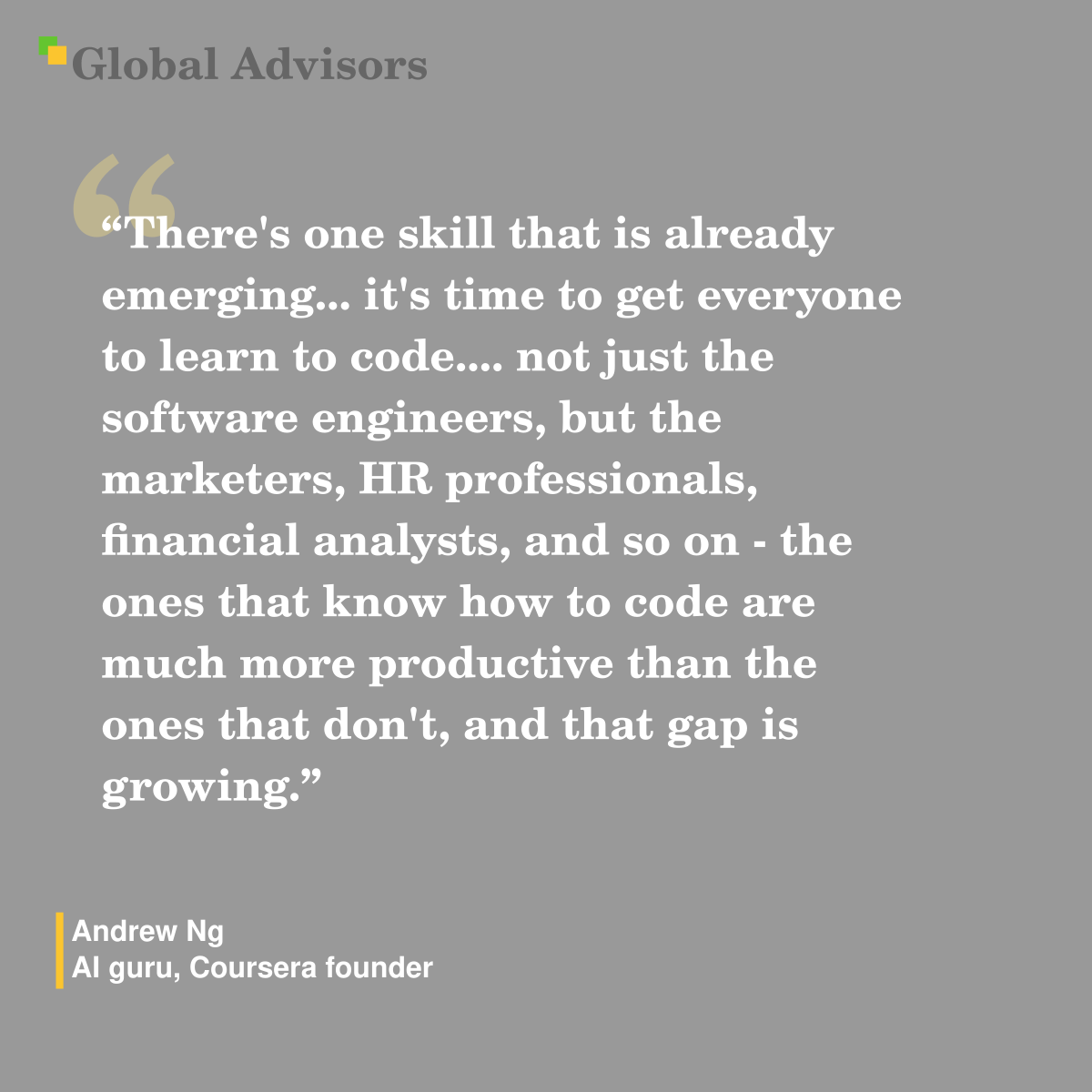
Quote: Andrew Ng - AI guru, Coursera founder"There's one skill that is already emerging... it's time to get everyone to learn to code.... not just the software engineers, but the marketers, HR professionals, financial analysts, and so on - the ones that know how to code are much more productive than the ones that don't, and that gap is growing." - Andrew Ng - AI guru, Coursera founderIn a forward-looking discussion at the World Economic Forum's 2026 session on 'Corporate Ladders, AI Reshuffled', Andrew Ng passionately advocates for coding as the pivotal skill defining productivity in the AI era. Delivered in January 2026, this insight underscores how AI tools are democratising coding, enabling professionals beyond software engineering to harness technology for greater efficiency1. Ng's message aligns with his longstanding mission to make advanced technology accessible through education and practical application. Who is Andrew Ng?Andrew Ng stands as one of the foremost figures in artificial intelligence, renowned for bridging academia, industry, and education. A British-born computer scientist, he earned his PhD from the University of California, Berkeley, and has held prestigious roles including adjunct professor at Stanford University. Ng co-founded Coursera in 2012, revolutionising online learning by offering courses to millions worldwide, including his seminal 'Machine Learning' course that has educated over 4 million learners. He led Google Brain, Google's deep learning research project, from 2011 to 2014, pioneering applications that advanced AI capabilities across industries. Currently, as founder of Landing AI and DeepLearning.AI, Ng focuses on enterprise AI solutions and accessible education platforms. His influence extends to executive positions at Baidu and as a venture capitalist investing in AI startups1,2. Context of the QuoteThe quote emerges from Ng's reflections on AI's transformative impact on workflows, particularly at the WEF 2026 event addressing how AI reshuffles corporate structures. Here, Ng highlights 'vibe coding'-AI-assisted coding that lowers barriers, allowing non-engineers like marketers, HR professionals, and financial analysts to prototype ideas rapidly without traditional hand-coding. He argues this boosts productivity and creativity, warning that the divide between coders and non-coders will widen. Recent talks, such as at Snowflake's Build conference, reinforce this: 'The bar to coding is now lower than it ever has been. People that code... will really get more done'1. Ng critiques academia for lagging behind, noting unemployment among computer science graduates due to outdated curricula ignoring AI tools, and stresses industry demand for AI-savvy talent1,2. Leading Theorists and the Broader FieldNg's advocacy builds on foundational AI theories while addressing practical upskilling. Pioneers like Geoffrey Hinton, often called the 'Godfather of Deep Learning', laid groundwork through backpropagation and neural networks, influencing Ng's Google Brain work. Hinton, Ng's former advisor at Stanford, warns of AI's job displacement risks but endorses human-AI collaboration. Yann LeCun, Meta's Chief AI Scientist, complements this with convolutional neural networks essential for computer vision, emphasising open-source AI for broad adoption. Fei-Fei Li, 'Godmother of AI', advanced image recognition and co-directs Stanford's Human-Centered AI Institute, aligning with Ng's educational focus. In skills discourse, World Economic Forum's Future of Jobs Report 2025 projects technological skills, led by AI and big data, as fastest-growing in importance through 2030, alongside lifelong learning3. Microsoft CEO Satya Nadella echoes: 'AI won't replace developers, but developers who use AI will replace those who don't'3. Nvidia's Jensen Huang and Klarna's Sebastian Siemiatkowski advocate AI agents and tools like Cursor, predicting hybrid human-AI teams1. Ng's tips-take AI courses, build systems hands-on, read papers-address a talent crunch where 51% of tech leaders struggle to find AI skills2. Implications for Careers and Workflows
Ng's vision positions coding not as a technical niche but a universal lever for productivity in an AI-driven world, urging immediate action to close the growing gap. References 2. https://www.finalroundai.com/blog/andrew-ng-ai-tips-2026 4. https://www.coursera.org/in/articles/ai-skills
|
| |
| |
|


| |
| |