| |
|

| |
| |
| |
|
Our selection of the top business news sources on the web. |
| |
| |
| |
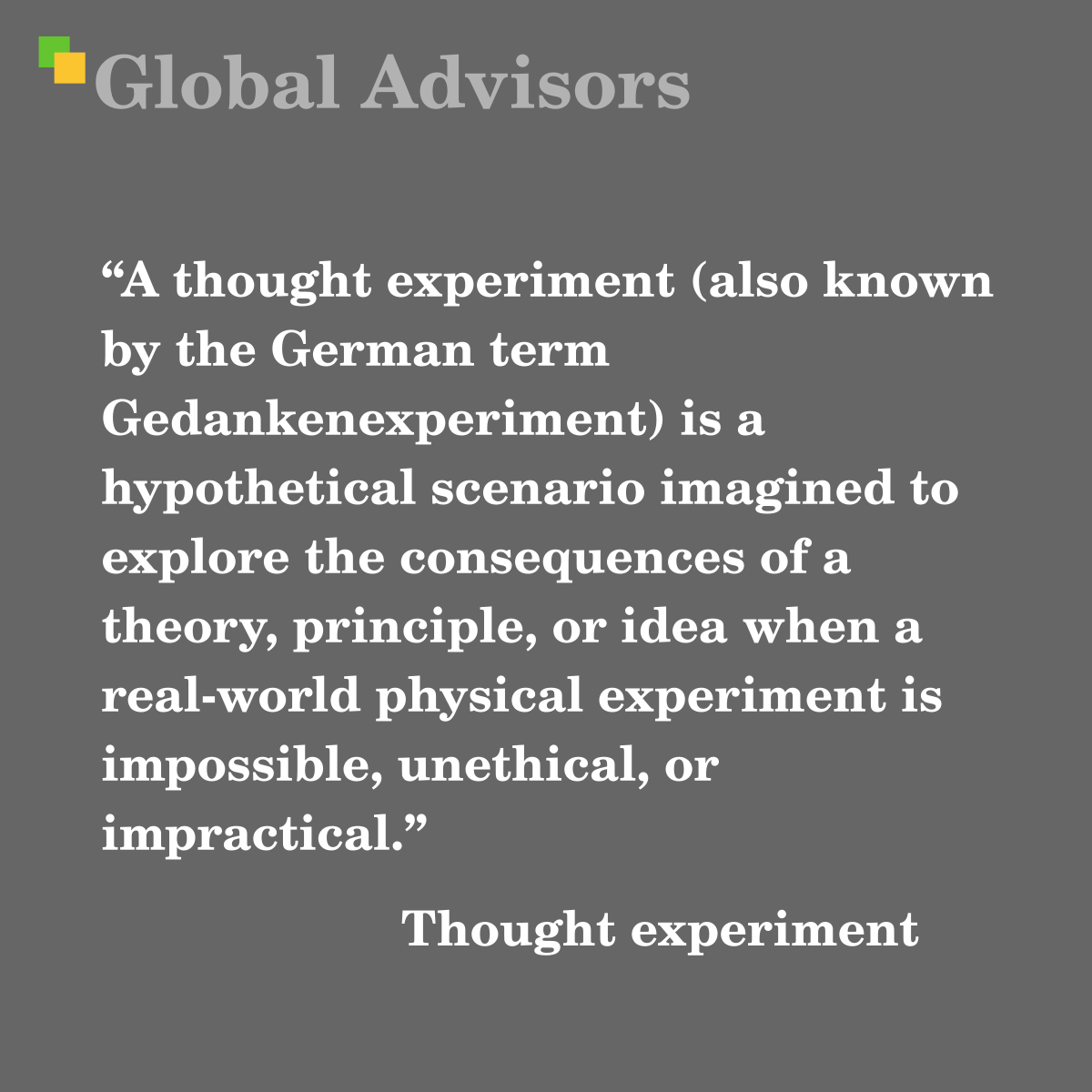
Term: Thought experiment"A thought experiment (also known by the German term Gedankenexperiment) is a hypothetical scenario imagined to explore the consequences of a theory, principle, or idea when a real-world physical experiment is impossible, unethical, or impractical." - Thought experimentA **thought experiment**, known in German as Gedankenexperiment, is a hypothetical scenario imagined to explore the consequences of a theory, principle, or idea when conducting a real-world physical experiment is impossible, unethical, or impractical1,7. It involves using hypotheticals to logically reason out solutions to difficult questions, often simulating experimental processes through imagination alone1. These mental exercises are employed across disciplines, particularly philosophy and theoretical sciences, for purposes such as education, conceptual analysis, exploration, hypothesising, theory selection, and implementation2,7. Thought experiments challenge beliefs, offer fresh perspectives, and examine abstract concepts imaginatively without real-world repercussions3. They construct extreme situations to reveal insights unavailable through formal logic or abstract reasoning, by generating mental models of scenarios and manipulating them via simulation2. Though sometimes circular or rhetorical to emphasise a point, they provide epistemic access to features of representations beyond propositional logic1,2. Famous Examples
Best Related Strategy Theorist: Erwin SchrödingerAmong theorists linked to thought experiments, **Erwin Schrödinger** stands out for his iconic contribution in quantum mechanics, with a profound backstory tying his work to strategic scientific reasoning. Born in 1887 in Vienna, Austria, Schrödinger was a physicist whose diverse interests spanned philosophy, biology, and Eastern mysticism. He studied at the University of Vienna, served in World War I, and held professorships in Zurich, Berlin (succeeding Planck), Oxford, Graz, and Dublin. Awarded the 1933 Nobel Prize in Physics (shared with Paul Dirac) for wave mechanics, he fled Nazi Germany in 1933 due to his opposition to antisemitism, despite his own complex personal life7. Schrödinger's polymath nature influenced his interdisciplinary approach, later extending to genetics via his 1944 book What is Life?, inspiring DNA discoverers Watson and Crick. His relationship to the thought experiment is epitomised by **Schrödinger's Cat** (1935), devised to critique the Copenhagen interpretation of quantum mechanics. Imagine a cat in a sealed box with a radioactive atom: if it decays (50% chance), poison releases, killing the cat. Quantum superposition implies the cat is simultaneously alive and dead until observed-a paradoxical Gedankenexperiment highlighting measurement problems and the absurdity of applying quantum rules macroscopically1,7. This strategic tool exposed flaws in prevailing theories, spurring debates on wave function collapse, many-worlds interpretation, and quantum reality. Schrödinger used it not to endorse but to provoke clearer strategies for quantum theory, cementing thought experiments' role in scientific strategy7. References 1. https://thedecisionlab.com/reference-guide/neuroscience/thought-experiments 2. https://www.missiontolearn.com/thought-experiments/ 3. https://bigthink.com/personal-growth/seven-thought-experiments-thatll-make-you-question-everything/ 4. https://www.toptenz.net/top-10-most-famous-thought-experiments.php 5. https://adarshbadri.me/philosophy/philosophical-thought-experiments/ 6. https://guides.gccaz.edu/philosophy-guide/experiments 7. https://plato.stanford.edu/entries/thought-experiment/ 8. https://miamioh.edu/howe-center/hwac/disciplinary-writing-guides/philosophy/thought-experiments.html
|
| |
| |
Quote: Bill Gurley - GP at Benchmark"AI is leverage because it can scale cognition. It can scale certain kinds of thinking and writing and analysis. And that means individuals can do more. Small teams can do more. It changes the power dynamics." - Bill Gurley - GP at BenchmarkBill Gurley: The Visionary Venture CapitalistBill Gurley serves as a General Partner at Benchmark, one of Silicon Valley's most prestigious venture capital firms. Renowned for his prescient investments in transformative companies such as Uber, Airbnb, and Zillow, Gurley has a track record of identifying technologies that reshape industries and power structures1,4,7. His perspective on artificial intelligence (AI) stems from deep engagement with the sector, including discussions on scaling laws, model sizes, and inference costs in podcasts like BG2 with Brad Gerstner1,2. In the quoted interview with Tim Ferriss, Gurley articulates how AI acts as a force multiplier, enabling individuals and small teams to achieve outsized impact by scaling cognitive tasks traditionally limited by human capacity7. Context of the QuoteThe quote originates from a conversation hosted by Tim Ferriss, where Gurley explores AI's role in the modern economy. He emphasises that AI scales cognition - encompassing thinking, writing, and analysis - thereby democratising high-level intellectual work. This shift empowers solo entrepreneurs and lean teams, disrupting traditional power dynamics dominated by large organisations with vast resources7. Gurley's views align with his broader commentary on AI's rapid evolution, including the implications of massive compute clusters by leaders like Elon Musk, OpenAI, and Meta, and the surprising efficiency of smaller models trained beyond conventional limits1. He highlights real-world applications, such as inference costs outweighing training in products like Amazon's Alexa, underscoring AI's scalability for practical deployment1. Backstory on Leading Theorists in AI Scaling and LeverageGurley's idea of AI as leverage builds on foundational theories in AI scaling laws and cognitive amplification. Key figures include:
These theorists collectively underpin Gurley's observation: AI's ability to scale cognition via compute, data, and innovative training redefines leverage, favouring nimble players over bureaucratic giants1,2,3. Gurley's real-world examples, like a 28-year-old entrepreneur superpowered by AI for site selection, illustrate this in action across regions including China3. Implications for Power DynamicsGurley's quote signals a paradigm shift akin to an 'Industrial Revolution for intelligence production', where inference compute scales exponentially, enabling small entities to rival incumbents1,2. Venture trends, such as mega-funds writing huge cheques to AI startups, reflect this frenzy, blurring early and late-stage investing5. Yet Gurley cautions staying 'far from the edge', advocating focus on core innovations amid hype4. References 1. https://www.youtube.com/watch?v=iTwZzUApGkA 2. https://www.youtube.com/watch?v=yPD1qEbeyac 4. https://www.youtube.com/watch?v=D0230eZsRFw 5. https://orbanalytics.substack.com/p/the-new-normal-bill-gurley-breaks 7. https://tim.blog/2025/12/17/bill-gurley-running-down-a-dream/
|
| |

| |
Quote: Johan van Jaarsveld - BHP Chief Technical Officer"AI is no longer a future concept for BHP. It is increasingly part of how we run our operations. Our focus is on applying it in practical, governed ways that support our teams in achieving safer, more productive and more reliable outcomes." - Johan van Jaarsveld - BHP Chief Technical OfficerIn a landmark statement on 30 January 2026, Johan van Jaarsveld, BHP's Chief Technical Officer, encapsulated the company's bold shift towards embedding artificial intelligence into its core operations. This perspective, drawn from BHP's article 'AI is improving performance across global mining operations', underscores a strategic pivot where AI transitions from experimental tool to operational mainstay, driving safer, more productive, and reliable outcomes in one of the world's largest mining enterprises.1,5 Who is Johan van Jaarsveld?Johan van Jaarsveld assumed the role of Chief Technical Officer at BHP effective 1 March 2024, bringing over 25 years of expertise spanning resources, finance, and technology across continents including Asia, Canada, Australia, and South Africa.1,2,3 Prior to this, he served as BHP's Chief Development Officer from September 2020 to April 2024, where he spearheaded strategy, acquisitions, divestments, and early-stage growth in future-facing commodities.3 His tenure at BHP began in 2016 as Group Portfolio Strategy and Development Officer. Before joining BHP, van Jaarsveld held senior executive positions at global giants: Senior Vice President of Business Development at Barrick Gold Corporation in Toronto (2015-2016), Managing Director at Goldman Sachs in Hong Kong (2011-2014), Managing Director at The Blackstone Group in Hong Kong (2008-2011), and Vice President at Lehman Brothers (2007).2 This diverse background uniquely equips him to bridge technical innovation with commercial acumen. Academically, van Jaarsveld holds a PhD in Engineering (Extractive Metallurgy) from the University of Melbourne (2001), a Master of Commerce in Applied Finance from Melbourne Business School (2002), and a Bachelor of Engineering (Chemical) from Stellenbosch University, South Africa.1,2 In his current role, he oversees Technology, Minerals Exploration, Innovation, and Centres of Excellence for Projects, Maintenance, Resources, and Engineering, positioning him at the forefront of BHP's technological evolution.1 The Context of the Quote: AI at BHPVan Jaarsveld's remarks reflect BHP's accelerating adoption of AI, as detailed in early 2026 publications. AI is enabling BHP to 'understand operations in new ways and act earlier', enhancing performance across global mining sites.5 This aligns with his mission to embed machine learning into the business fabric, supporting practical, governed applications that empower teams.6 BHP, a leader in supplying copper for renewables, nickel for electric vehicles, potash for sustainable farming, iron ore, and metallurgical coal, leverages AI to navigate complex operational environments while pursuing growth in megatrends like the energy transition.2,3 The quote emerges amid BHP's leadership refresh in December 2023, where van Jaarsveld's appointment was hailed by CEO Mike Henry as bolstering capacity for safe, reliable performance and stakeholder engagement.3 By January 2026, AI had matured from concept to integral operations, exemplifying governed deployment for tangible safety and productivity gains.1,5 Leading Theorists and Evolution of AI in MiningThe integration of AI in mining draws from foundational theories in artificial intelligence, machine learning, and operational optimisation, pioneered by key figures whose work underpins industrial applications.
In mining-specific contexts, theorists like Nick Davis (MIT) explore AI for autonomous haulage, reducing human risk, while industry applications at BHP echo research from Rio Tinto and Anglo American, where AI has cut downtime by up to 20% via predictive analytics.[Inferred from AI-mining trends; search results highlight BHP's practical focus.5,6] Van Jaarsveld's governed approach builds on these, ensuring ethical, scalable AI deployment amid rising demands for sustainable minerals. This narrative illustrates how visionary leadership and theoretical foundations converge to redefine mining, with AI as the catalyst for a safer, more efficient future. References 1. https://www.bhp.com/about/board-and-management/johan-van-jaarsveld 2. https://cio-sa.co.za/profiles/johan-van-jaarsveld/ 3. https://www.bhp.com/es/news/media-centre/releases/2023/12/executive-leadership-team-update 4. https://www.marketscreener.com/insider/JOHAN-VAN-JAARSVELD-A1Y5XA/ 6. https://www.miningmagazine.com/technology/news-analysis/4414802/bhp-faith-ai 7. https://www.bhp.com/about/board-and-management
|
| |

| |
Term: Abundance"Abundance is defined as a state where essential resources - such as housing, energy, healthcare, and transportation - are made flourishing, affordable, and universally accessible through an intentional focus on increasing supply." - AbundanceAbundance is defined as a state where essential resources - such as housing, energy, healthcare, and transportation - are made flourishing, affordable, and universally accessible through an intentional focus on increasing supply.1,2 Comprehensive Definition and ContextThe concept of abundance represents a paradigm shift in political and economic thinking, advocating a 'politics of plenty' that prioritises building and innovation over scarcity-driven approaches. Coined prominently in the 2025 book Abundance by Ezra Klein and Derek Thompson, it critiques how past regulations - intended to solve 1970s problems - now hinder progress in the 2020s by blocking urban density, green energy, and infrastructure projects.2,4 At its core, abundance calls for liberalism that not only protects but actively builds. It argues that modern crises stem from insufficient supply rather than mere distribution failures. Solutions involve streamlining regulations, boosting innovation in areas like clean energy, housing, and biotechnology, and fostering high-density economic hubs to enhance idea generation and mobility.1,2 This contrasts with traditional scarcity mindsets, where progressives fear growth and conservatives resist government intervention, trapping societies in unaffordability.4 Key pillars include:
Critics note it de-emphasises redistribution in favour of supply-side innovation, potentially overlooking power dynamics, though proponents see it as a path beyond socialist left and populist right extremes.3,4,5 Key Theorist: Ezra KleinEzra Klein is the pre-eminent theorist behind the abundance agenda, co-authoring the seminal book Abundance with Derek Thompson. A leading liberal thinker, Klein shifted focus from political polarisation to economic abundance, arguing it offers a unifying path forward.1,2 Born in 1984 in Irvine, California, Klein rose through blogging on Wonkblog at The Washington Post, analysing policy with data-driven rigour. He co-founded Vox in 2014 as editor-in-chief, building it into a platform for explanatory journalism. In 2021, he launched The Ezra Klein Show podcast and joined The New York Times as a columnist, influencing discourse on liberalism's failures.1,2 Klein's relationship to abundance stems from observing how liberal governance stagnated: over-regulation stifles building, exacerbating shortages in housing and energy. In conversations, like with Tyler Cowen, he defends scaling elite institutions (e.g., doubling Harvard's size) and critiques demand-side fixes without supply increases.1 His classically liberal view of power - checking arbitrary domination - underpins abundance as a corrective to equity-obsessed policies that neglect production.3 Klein positions it as reclaiming progressivism's building ethos, countering both left-wing caution and right-wing anti-statism.2,4 Through Abundance, Klein provides intellectual firepower for a 'liberalism that builds', impacting policymakers and coalitions seeking tangible solutions.6,7 References 1. https://conversationswithtyler.com/episodes/ezra-klein-3/ 2. https://www.simonandschuster.com/books/Abundance/Ezra-Klein/9781668023488 3. https://www.peoplespolicyproject.org/2025/06/09/abundance-has-a-theory-of-power/ 4. https://en.wikipedia.org/wiki/Abundance_(Klein_and_Thompson_book) 5. https://www.bostonreview.net/articles/the-real-path-to-abundance/ 6. https://www.inclusiveabundance.org/abundance-in-action/published-work/abundance-a-primer 7. https://www.eesi.org/articles/view/abundance-and-its-insights-for-policymakers
|
| |

| |
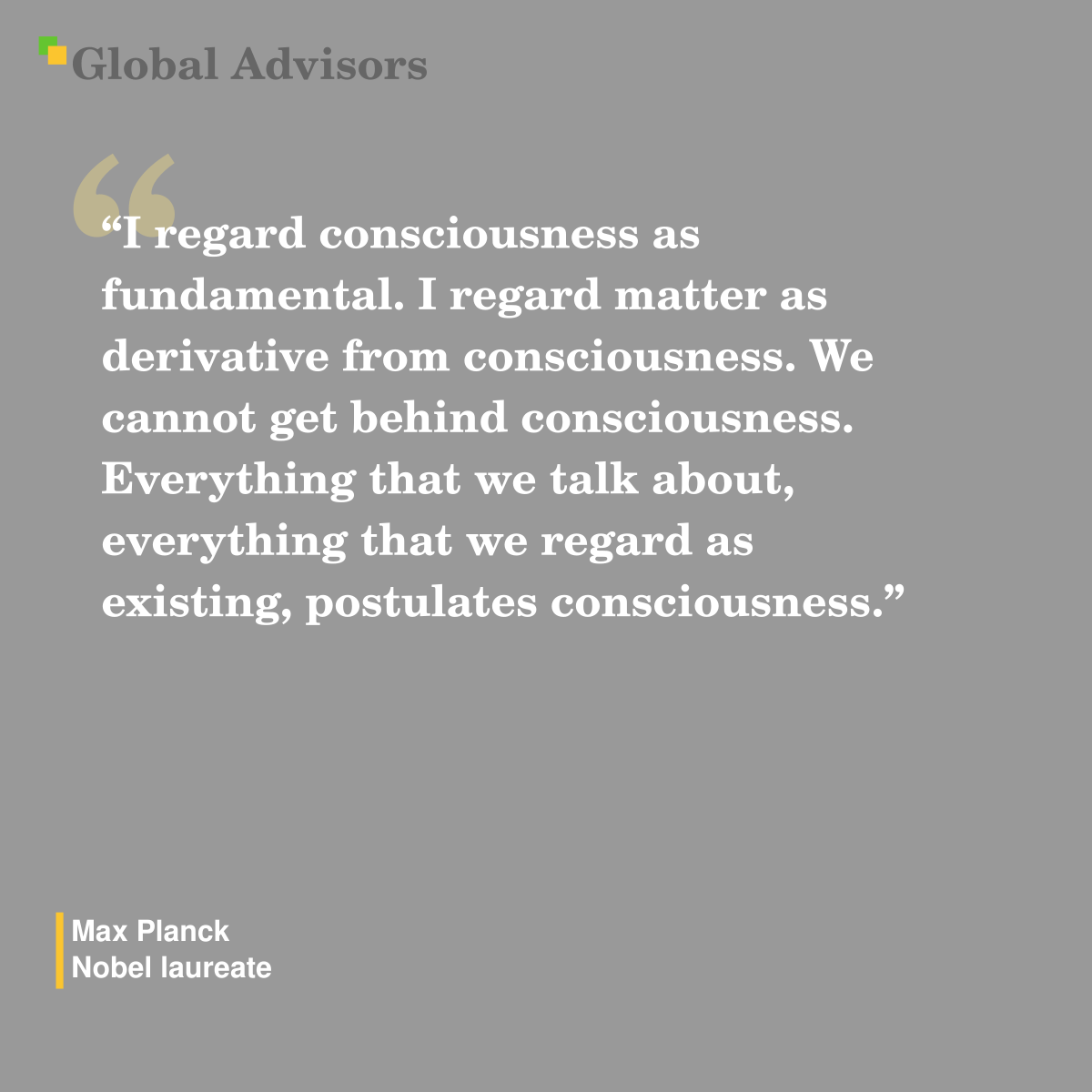
Quote: Max Planck - Nobel laureate"I regard consciousness as fundamental. I regard matter as derivative from consciousness. We cannot get behind consciousness. Everything that we talk about, everything that we regard as existing, postulates consciousness." - Max Planck - Nobel laureateThis striking statement, made by Max Planck in a 1931 interview with The Observer, encapsulates a radical departure from the materialist worldview dominant in physics at the time. Planck, the father of quantum theory, challenges the notion that matter is the foundation of existence, proposing instead that consciousness underpins all reality. Spoken amid the revolutionary upheavals of early quantum mechanics, the quote reflects his lifelong reconciliation of empirical science with metaphysical inquiry.1,2,3 Max Planck: Life, Legacy, and Philosophical EvolutionBorn in 1858 in Kiel, Germany, Max Karl Ernst Ludwig Planck rose from a family of scholars to become one of the 20th century's most influential physicists. He studied at the universities of Munich and Berlin, earning his doctorate in 1879. Initially drawn to thermodynamics, Planck's pivotal moment came in 1900 when he introduced the concept of energy quanta to resolve the 'ultraviolet catastrophe' in black-body radiation-a breakthrough that birthed quantum theory. For this, he received the Nobel Prize in Physics in 1918.3 Planck's career spanned turbulent times: he served as president of the Kaiser Wilhelm Society (later the Max Planck Society) and navigated the intellectual and political storms of two world wars. A devout Lutheran, he grappled with the implications of his discoveries, often emphasising the limits of scientific materialism. In works like Where Is Science Going? (1932), he argued that science presupposes an external world known only through consciousness, echoing themes in his famous quote.3,5 By 1931, at age 72, Planck was reflecting on quantum mechanics' philosophical ramifications. The interview in The Observer captured his mature view: matter derives from consciousness, not vice versa. This idealist stance contrasted with contemporaries like Einstein, who favoured a deterministic universe, yet aligned with Planck's belief in a 'conscious and intelligent Mind' as the force binding atomic particles.3,5 The Context of the Quote: Quantum Revolution and Metaphysical StirringsThe quote emerged during a period of crisis in physics. Quantum mechanics, propelled by Planck's quanta, Heisenberg's uncertainty principle, and Schrödinger's wave equation, shattered classical determinism. Reality at the subatomic level appeared probabilistic, observer-dependent-raising profound questions about observation's role. Planck, who reluctantly accepted these implications, saw consciousness not as a quantum byproduct but as fundamental.4,5 In the interview, Planck addressed the 'reality crisis': if physical laws are mental constructs, what grounds existence? His response prioritised consciousness as the irreducible starting point, influencing later debates in quantum interpretation, such as the Copenhagen interpretation where measurement (tied to observation) collapses the wave function.3 Leading Theorists on Consciousness and MatterPlanck's views resonate with a lineage of thinkers bridging physics, philosophy, and metaphysics. Here are key figures whose ideas shaped or paralleled his:
These theorists, from Kantian idealism to quantum pioneers, form the intellectual backdrop. Planck stands out for wedding rigorous physics with unapologetic metaphysics, suggesting science's foundations rest on conscious postulate.1,3,5 Enduring RelevancePlanck's declaration prefigures modern discussions in philosophy of mind, panpsychism, and quantum consciousness theories (e.g., by Roger Penrose and Stuart Hameroff). It invites reflection: if consciousness is fundamental, how does this reshape our understanding of the universe, free will, and even artificial intelligence? As Planck implied, all inquiry begins-and ends-with the mind.4,5 References 1. https://libquotes.com/max-planck/quote/lbm8d8r 2. https://www.quotescosmos.com/quotes/Max-Planck-quote-1.html 3. https://en.wikiquote.org/wiki/Max_Planck 4. https://bigthink.com/words-of-wisdom/max-planck-i-regard-consciousness-as-fundamental/ 5. https://www.informationphilosopher.com/solutions/scientists/planck/ 6. https://todayinsci.com/P/Planck_Max/PlanckMax-Quotations.htm
|
| |
| |
Term: Tokenisation"Tokenisation is the process of converting sensitive data or real-world assets into non-sensitive, unique digital identifiers (tokens) for secure use, commonly seen in data security (replacing credit card numbers with tokens) or blockchain (representing assets like real estate as digital tokens)." - TokenisationTokenisation is the process of replacing sensitive data or real-world assets with non-sensitive, unique digital identifiers called tokens. These tokens have no intrinsic value or meaning outside their specific context, ensuring security in data handling or asset representation on blockchain networks. In data security, tokenisation substitutes sensitive information like credit card numbers with tokens stored in secure vaults, allowing safe processing without exposing originals. This meets standards such as PCI DSS, GDPR, and HIPAA, reducing breach risks as stolen tokens are useless without vault access. In blockchain and crypto, it converts assets like real estate, artwork, or shares into digital tokens on a blockchain, enabling fractional ownership, trading, and custody while linking to the physical asset in secure facilities. How Tokenisation WorksTypically involves three parties: the data/asset owner, an intermediary (e.g., merchant), and a secure vault provider. Sensitive data is sent to the vault, replaced by a unique token, and the original is discarded or stored securely. Tokens preserve data format and length for system compatibility, unlike encryption which alters them.
Benefits of Tokenisation
Key Theorist: Don TapscottDon Tapscott, a pioneering strategist in digital economics and blockchain, is closely linked to asset tokenisation through his co-authorship of Blockchain Revolution (2016). With Alex Tapscott, he popularised the concept of tokenising real-world assets, arguing it democratises finance by enabling fractional ownership and liquidity for illiquid assets like property. Born in 1947 in Canada, Tapscott began as a management consultant, authoring bestsellers like The Digital Economy (1995), which foresaw internet-driven business shifts. He founded the Tapscott Group and New Paradigm, advising firms and governments. His blockchain work critiques centralised finance, promoting decentralised ledgers for transparency. As Chair of the Blockchain Research Institute, he influences policy, with tokenisation central to his vision of a 'token economy' transforming global markets. References 1. https://brave.com/glossary/tokenization/ 2. https://entro.security/glossary/tokenization/ 3. https://www.fortra.com/blog/what-data-tokenization-key-concepts-and-benefits 4. https://www.fortanix.com/faq/tokenization/data-tokenization 5. https://www.mckinsey.com/featured-insights/mckinsey-explainers/what-is-tokenization 6. https://www.ibm.com/think/topics/tokenization 7. https://www.keyivr.com/us/knowledge/guides/guide-what-is-tokenization/ 8. https://chain.link/education-hub/tokenization
|
| |

| |
Quote: Nate B Jones"The pleasant surprise is how much you can accomplish when you properly harness your agents, and how big companies are leaning in and able to actually get volume done on that basis." - Nate B Jones - AI News & Strategy DailyContext of the QuoteThis quote from Nate B Jones captures a pivotal moment in the evolution of AI agents within enterprise settings. Delivered in his AI News & Strategy Daily series, it highlights the unexpected productivity gains when organisations implement AI agents correctly. Jones emphasises that major firms like JP Morgan and Walmart are already deploying these systems at scale, achieving high-volume outputs that traditional software cycles could not match1,2. The core insight is that proper orchestration-combining AI with human oversight-unlocks disproportionate value, countering the hype-driven delays many companies face. Backstory on Nate B JonesNate B Jones is a leading voice in enterprise AI strategy, known for his pragmatic frameworks that guide businesses from AI hype to production deployment. Through his platform natebjones.com and Substack newsletter Nate's Newsletter, he distils complex AI developments into actionable insights for executives1,2,7. Jones produces daily video briefings like AI News & Strategy Daily, where he analyses real-world use cases, warns against common pitfalls such as over-reliance on unproven models, and provides custom prompts for rapid agent prototyping2,4. His work focuses on bridging the gap between AI potential and enterprise reality. For instance, he critiques the 'human throttle'-where hesitation and risk aversion limit agent autonomy-and advocates for decision infrastructure like audit logs and reversible processes to build trust3. Jones has documented production AI agents at scale, urging leaders to act swiftly as competitors gain 'durable advantage' through accumulated institutional intelligence2. His library of use cases spans finance (e.g., JP Morgan's choreographed workflows) to operations, emphasising that agents excel in 'level four' tasks: AI drafts, humans review, then AI proceeds1. By October 2025, his briefings were already forecasting 2026 as a year of job-by-job AI transformation5. Leading Theorists and the Subject of AI AgentsAI agents-autonomous systems that perceive, reason, act, and learn to achieve goals-represent a shift from passive tools to proactive workflows. Nate B Jones builds on foundational work by key theorists:
Jones synthesises these ideas into enterprise strategy, arguing that agents are not future tech but 'production infrastructure now.' He counters delays by outlining six principles for quick builds (days or weeks), including context-aware prompts and risk-mitigated deployment2. This positions him as a practitioner-theorist, translating academic foundations into C-suite playbooks amid the 2025-2026 agent revolution. Broader Implications for WorkflowsJones's quote underscores a paradigm shift: AI agents amplify top human talent, making them 'more fingertippy' rather than replacing them1. Big companies succeed by 'leaning in'-auditing processes, building observability, and iterating fast-yielding volume at scale. For leaders, the message is clear: harness agents properly, or risk irreversible competitive lag2,3. References 1. https://www.youtube.com/watch?v=obqjIoKaqdM 2. https://natesnewsletter.substack.com/p/executive-briefing-your-2025-ai-agent 3. https://www.youtube.com/watch?v=7NjtPH8VMAU 4. https://www.youtube.com/watch?v=1FKxyPAJ2Ok 5. https://natesnewsletter.substack.com/p/2026-sneak-peek-the-first-job-by-9ac 6. https://www.youtube.com/watch?v=xNcEgqzlPqs
|
| |

| |
Term: Stablecoin"A stablecoin is a type of cryptocurrency designed to maintain a stable value, unlike volatile assets like Bitcoin, by pegging its price to a stable reserve asset, usually a fiat currency (like the USD) or a commodity (like gold)." - StablecoinWhat is a Stablecoin?A **stablecoin** is a type of cryptocurrency engineered to preserve a consistent value relative to a specified asset, such as a fiat currency (e.g., the US dollar), a commodity (e.g., gold), or a basket of assets, in stark contrast to the high volatility of assets like Bitcoin. Unlike traditional cryptocurrencies, stablecoins employ stabilisation mechanisms including reserve assets held by custodians or algorithmic protocols that adjust supply and demand to sustain the peg. Fiat-backed stablecoins, the most common variant, mirror money market funds by holding reserves in short-term assets like treasury bonds, commercial paper, or bank deposits. Commodity-backed stablecoins peg to physical assets like gold, while cryptocurrency-backed ones, such as DAI or Wrapped Bitcoin (WBTC), use overcollateralised crypto reserves managed via smart contracts on decentralised networks. Types of Stablecoins
Despite the name, stablecoins are not immune to depegging, as evidenced by historical failures amid market stress or redemption pressures, potentially triggering systemic risks akin to fire-sale contagions in traditional finance. They facilitate rapid, low-cost blockchain transactions, serving as a bridge between fiat and crypto ecosystems for payments, settlements, and trading. Regulatory LandscapeGovernments worldwide are intensifying oversight due to stablecoins' growing role in transactions. For instance, Nebraska's Financial Innovation Act (2021, updated 2024) permits digital asset depositories to issue stablecoins backed by reserves in FDIC-insured institutions. Key Theorist: Robert Shiller and the Conceptual FoundationsThe most relevant strategy theorist linked to stablecoins is **Robert Shiller**, a Nobel Prize-winning economist whose pioneering work on financial stability, behavioural finance, and asset pricing underpins the economic rationale for pegged digital assets. Shiller's theories address the volatility that stablecoins explicitly counter, positioning them as practical applications of stabilising speculative markets. Born in 1946 in Detroit, Michigan, Shiller earned his PhD in economics from MIT in 1972 under advisor Robert Solow. He joined Yale University in 1982, where he remains the Sterling Professor of Economics. Shiller gained prominence for developing the Case-Shiller Home Price Index, a leading US housing market benchmark. His seminal book, Irrational Exuberance (2000), presciently warned of the dot-com bubble and later the 2008 financial crisis, critiquing how narratives drive asset bubbles. Shiller's relationship to stablecoins stems from his advocacy for financial innovations that mitigate volatility. In works like Finance and the Good Society (2012), he explores stabilising mechanisms such as index funds and derivatives, which parallel stablecoin pegs by tethering values to underlying assets. He has discussed cryptocurrencies in interviews and writings, noting their potential to enhance financial inclusion if stabilised-echoing stablecoins' design to combine crypto's efficiency with fiat-like reliability. Shiller's CAPE (Cyclically Adjusted Price-to-Earnings) ratio exemplifies pegging metrics to long-term fundamentals, a concept mirrored in stablecoin reserves. While not a crypto native, his behavioural insights explain depegging risks from herd mentality, making him the foremost theorist for stablecoin strategy in volatile markets. References 1. https://en.wikipedia.org/wiki/Stablecoin 2. https://csrc.nist.gov/glossary/term/stablecoin 3. https://www.fidelity.com/learning-center/trading-investing/what-is-a-stablecoin 5. https://klrd.gov/2024/11/15/stablecoin-overview/ 7. https://www.bankofengland.co.uk/explainers/what-are-stablecoins-and-how-do-they-work 8. https://bvnk.com/blog/stablecoins-vs-bitcoin 9. https://business.cornell.edu/article/2025/08/stablecoins/
|
| |

| |
Quote: Jim Simons - Renaissance Technologies founder"In this business it's easy to confuse luck with brains." - Jim Simons - Renaissance Technologies founderJim Simons: A Mathematical Outsider Who Conquered MarketsJames Harris Simons (1938-2024), founder of Renaissance Technologies, encapsulated the perils of financial overconfidence with his incisive observation: "In this business it's easy to confuse luck with brains." This quote underscores a core tenet of quantitative investing: distinguishing genuine predictive signals from random noise in market data1,2,4. Simons' Extraordinary BackstoryBorn in Brookline, Massachusetts, to a film industry salesman father and a shoe factory manager relative, Simons displayed early mathematical brilliance. He earned a bachelor's degree from MIT at 20 and a PhD from UC Berkeley by 23, specialising in topology and geometry. His seminal work on the Chern-Simons theory earned him the American Mathematical Society's Oswald Veblen Prize1,2,3. Simons taught at MIT and Harvard but felt like an outsider in academia, pursuing side interests in trading soybean futures and launching a Colombian manufacturing venture1. At the Institute for Defense Analyses (IDA), he cracked Soviet codes during the Cold War, honing skills in pattern recognition and data analysis that later fuelled his financial models. Fired for opposing the Vietnam War, he chaired Stony Brook University's mathematics department, building it into a world-class institution1,2,4. By his forties, disillusioned with academic constraints and driven by a desire for control after financial setbacks, Simons entered finance. In 1978, he founded Monemetrics (renamed Renaissance Technologies in 1982) in a modest strip mall near Stony Brook. Rejecting Wall Street conventions, he hired mathematicians, physicists, and code-breakers-not MBAs-to exploit market inefficiencies via algorithms2,3,4. Renaissance Technologies: The Quant RevolutionRenaissance pioneered quantitative trading, using statistical models to predict short-term price movements in stocks, commodities, and currencies. Key hires like Leonard E. Baum (creator of the Baum-Welch algorithm for hidden Markov models) and James Ax developed early systems. The Medallion Fund, launched in 1988, became legendary, averaging 66% annual returns before fees over three decades-vastly outperforming benchmarks2,4. Simons capped Medallion at $10 billion, expelling outsiders by 2005 to preserve edge, while public funds lagged dramatically (e.g., Medallion gained 76% in 2020 amid public fund losses)4. His firm amassed terabytes of data, analysing factors from weather to sunspots, embodying machine learning precursors like pattern-matching across historical market environments4,5. Dubbed the "Quant King," Simons ranked among the world's richest at $31.8 billion, yet emphasised collaboration: "My management style has always been to find outstanding people and let them run with the ball"3. He retired as CEO in 2010, with Peter Brown and Robert Mercer succeeding him4. Context of the QuoteThe quote reflects Simons' philosophy amid Renaissance's secrecy and success. In an industry rife with survivorship bias-where winners attribute gains to genius while ignoring luck-Simons stressed rigorous statistical validation. His models sought non-random patterns, acknowledging markets' inherent unpredictability. This humility contrasted with boastful peers, aligning with his outsider ethos and code-breaking rigour1,4. Leading Theorists in Quantitative Finance and Prediction
Simons' legacy endures through the Simons Foundation, funding maths and basic science, and Renaissance's proof that data-driven science trumps intuition in finance3. His quote remains a sobering reminder in prediction's high-stakes arena. References 1. https://www.jermainebrown.org/posts/why-jim-simons-founded-renaissance-technologies 2. https://en.wikipedia.org/wiki/Jim_Simons 3. https://www.simonsfoundation.org/2024/05/10/remembering-the-life-and-careers-of-jim-simons/ 4. https://fortune.com/2024/05/10/jim-simons-obituary-renaissance-technologies-quant-king/ 5. https://www.youtube.com/watch?v=xkbdZb0UPac 6. https://stockcircle.com/portfolio/jim-simons 7. https://mitsloan.mit.edu/ideas-made-to-matter/quant-pioneer-james-simons-math-money-and-philanthropy
|
| |

| |
Quote: Luis Flavio Nunes - Investing.com"The crash wasn't caused by manipulation or panic. It revealed something more troubling: Bitcoin had already become the very thing it promised to destroy." - Luis Flavio Nunes - Investing.comThe recent Bitcoin crashes of 2025 and early 2026 were not random market events driven by panic or coordinated manipulation. Rather, they exposed a fundamental paradox that has quietly developed as Bitcoin matured from a fringe asset into an institutional investment vehicle. What began as a rebellion against centralised financial systems has, through the mechanisms of modern finance, recreated many of the same structural vulnerabilities that plagued traditional markets. The Institutional TransformationBitcoin's journey from obscurity to mainstream acceptance represents one of the most remarkable financial transformations of the past decade. When Satoshi Nakamoto released the Bitcoin whitepaper in 2008, the explicit goal was to create "a purely peer-to-peer electronic cash system" that would operate without intermediaries or central authorities. The cryptocurrency was designed as a direct response to the 2008 financial crisis, offering an alternative to institutions that had proven themselves untrustworthy stewards of capital. Yet by 2025, Bitcoin had become something quite different. Institutional investors, corporations, and even governments began treating it as a store of value and portfolio diversifier. This shift accelerated dramatically following the approval of Bitcoin spot exchange-traded funds (ETFs) in major markets, which legitimised cryptocurrency as an institutional asset class. What followed was an influx of capital that transformed Bitcoin from a peer-to-peer system into something resembling a leveraged financial instrument. The irony is profound: the very institutions that Bitcoin was designed to circumvent became its largest holders and most active traders. Corporate treasury departments, hedge funds, and financial firms accumulated Bitcoin positions worth tens of billions of dollars. But they did so using the same tools that had destabilised traditional markets-leverage, derivatives, and interconnected financial relationships. The Digital Asset Treasury ParadoxThe clearest manifestation of this contradiction emerged through Digital Asset Treasury Companies (DATCos). These firms, which manage Bitcoin and other cryptocurrencies for corporate clients, accumulated approximately $42 billion in positions by late 2025.1 The appeal was straightforward: Bitcoin offered superior returns compared to traditional treasury instruments, and companies could diversify their cash reserves whilst potentially generating alpha. However, these positions were not held in isolation. Many DATCos financed their Bitcoin purchases through debt arrangements, creating leverage ratios that would have been familiar to any traditional hedge fund manager. When Bitcoin's price declined sharply in November 2025, falling to $91,500 and erasing most of the year's gains, these overleveraged positions became underwater.1 The result was a cascade of forced selling that had nothing to do with Bitcoin's utility or technology-it was pure financial mechanics. By mid-November 2025, DATCo losses had reached $1.4 billion, representing a 40% decline in their aggregate positions.1 More troublingly, analysts estimated that if even 10-15% of these positions faced forced liquidation due to debt covenants or modified Net Asset Value (mNAV) pressures, it could trigger $4.3 to $6.4 billion in selling pressure over subsequent weeks.1 For context, this represented roughly double the selling pressure from Bitcoin ETF outflows that had dominated market headlines. Market Structure and Liquidity CollapseWhat made this forced selling particularly destructive was the simultaneous collapse in market liquidity. Bitcoin's order book depth at the 1% price band-a key measure of market resilience-fell from approximately $20 million in early October to just $14 million by mid-November, a 33% decline that never recovered.1 Analysts described this as a "deliberate reduction in market-making commitment," suggesting that professional market makers had withdrawn support precisely when it was most needed. This combination of forced selling and vanishing liquidity created a toxic feedback loop. Small selling moves produced disproportionately large price movements. When prices fell sharply, leveraged positions across the entire crypto ecosystem faced liquidation. On January 29, 2026, Bitcoin crashed from above $88,000 to below $85,000 in minutes, triggering $1.68 billion in forced selling across cryptocurrency markets.5 The speed and violence of these moves bore no relationship to any fundamental change in Bitcoin's technology or adoption-they were purely mechanical consequences of leverage unwinding in illiquid markets. The Retail Psychology AmplifierInstitutional forced selling might have been manageable if retail investors had provided offsetting demand. Instead, retail psychology amplified the downward pressure. Many retail investors, armed with historical price charts and belief in Bitcoin's four-year halving cycle, began selling preemptively to avoid what they anticipated would be a 70-80% drawdown similar to previous market cycles.1 This created a self-fulfilling prophecy. Retail investors, convinced that a crash was coming based on historical patterns, exited their positions voluntarily. This removed the "conviction-based spot demand" that might have absorbed institutional forced selling.1 Instead of a market where buyers stepped in during weakness, there was only a queue of sellers waiting for lower prices. The belief in the cycle became the mechanism that perpetuated it. The psychological dimension was particularly striking. Reddit communities filled with discussions of Bitcoin falling to $30,000 or lower, with investors citing historical precedent rather than fundamental analysis.1 The narrative had shifted from "Bitcoin is digital gold" to "Bitcoin is a leveraged Nasdaq ETF." When Bitcoin gained only 4% year-to-date whilst gold rose 29%, and when AI stocks like C3.ai dropped 54% and Bitcoin crashed in sympathy, the pretence of Bitcoin as an independent asset class evaporated.1 The Macro Backdrop and Data VacuumThese structural vulnerabilities were exacerbated by macroeconomic uncertainty. In October 2025, a U.S. government shutdown resulted in missing economic data, leaving the Federal Reserve, as the White House stated, "flying blind at a critical period."1 Without Consumer Price Index and employment reports, Fed rate-cut expectations collapsed from 67% to 43% probability.1 Bitcoin, with its 0.85 correlation to dollar liquidity, sold off sharply as investors struggled to price risk in a data vacuum.1 This revealed another uncomfortable truth: Bitcoin's price movements had become increasingly correlated with traditional financial markets and macroeconomic conditions. The asset that was supposed to be uncorrelated with fiat currency systems now moved in lockstep with Fed policy expectations and dollar liquidity conditions. Theoretical Foundations: Understanding the ContradictionTo understand how Bitcoin arrived at this paradoxical state, it is useful to examine the theoretical frameworks that shaped both cryptocurrency's design and its subsequent institutional adoption. Hayek's Denationalisation of Money Friedrich Hayek's 1976 work "Denationalisation of Money" profoundly influenced Bitcoin's philosophical foundations. Hayek argued that government monopolies on currency creation were inherently inflationary and economically destructive. He proposed that competition between private currencies would discipline monetary policy and prevent the kind of currency debasement that had plagued the 20th century. Bitcoin's fixed supply of 21 million coins was a direct implementation of Hayekian principles-a currency that could not be debased through monetary expansion because its supply was mathematically constrained. However, Hayek's framework assumed that competing currencies would be held and used by individuals making rational economic decisions. He did not anticipate a world in which Bitcoin would be held primarily by leveraged financial institutions using it as a speculative asset rather than a medium of exchange. When Bitcoin became a vehicle for institutional leverage rather than a tool for individual monetary sovereignty, it violated the core assumption of Hayek's theory. Minsky's Financial Instability Hypothesis Hyman Minsky's Financial Instability Hypothesis provides a more prescient framework for understanding Bitcoin's recent crashes. Minsky argued that capitalist economies are inherently unstable because of the way financial systems evolve. In periods of stability, investors become increasingly confident and willing to take on leverage. This leverage finances investment and consumption, which generates profits that validate the initial optimism. But this very success breeds complacency. Investors begin to underestimate risk, financial institutions relax lending standards, and leverage ratios climb to unsustainable levels. Eventually, some shock-often minor in itself-triggers a reassessment of risk. Leveraged investors are forced to sell assets to meet margin calls. These sales drive prices down, which triggers further margin calls, creating a cascade of forced selling. Minsky called this the "Minsky Moment," and it describes precisely what occurred in Bitcoin markets in late 2025 and early 2026. The tragedy is that Bitcoin's design was explicitly intended to prevent Minskyan instability. By removing the ability of central banks to expand money supply and by making the currency supply mathematically fixed, Bitcoin was supposed to eliminate the credit cycles that Minsky identified as the source of financial instability. Yet by allowing itself to be financialised through leverage and derivatives, Bitcoin recreated the exact dynamics it was designed to escape. Kindleberger's Manias, Panics, and Crashes Charles Kindleberger's historical analysis of financial crises identifies a recurring pattern: displacement (a new investment opportunity emerges), euphoria (prices rise as investors become convinced of unlimited upside), financial distress (early investors begin to exit), and finally panic (a rush for the exits as leverage unwinds). Bitcoin's trajectory from 2020 to 2026 followed this pattern almost precisely. The displacement occurred with the approval of Bitcoin ETFs and corporate treasury adoption. The euphoria phase saw Bitcoin reach nearly $100,000 as institutions poured capital into the asset. Financial distress emerged when DATCo positions became underwater and forced selling began. The panic phase manifested in the sharp crashes of late 2025 and early 2026, where $1.68 billion in liquidations could occur in minutes. What Kindleberger's framework reveals is that these crises are not failures of individual decision-makers but rather inevitable consequences of how financial systems evolve. Once leverage enters the system, instability becomes structural rather than accidental. The Centralisation of Bitcoin OwnershipPerhaps the most damning aspect of Bitcoin's institutional transformation is the concentration of ownership. Whilst Bitcoin was designed as a decentralised system where no single entity could control the network, the distribution of Bitcoin wealth has become increasingly concentrated. Large institutional holders, including corporations, hedge funds, and DATCos, now control a substantial portion of all Bitcoin in existence. This concentration creates a new form of centralisation-not of the protocol itself, but of the economic incentives that drive price discovery. When a small number of large holders face forced selling, their actions dominate price movements. The market becomes less like a peer-to-peer system of millions of independent participants and more like a traditional financial market where large institutions set prices through their trading activity. The irony is complete: Bitcoin was created to escape the centralised financial system, yet it has become a vehicle through which that same centralised system operates. The institutions that Bitcoin was designed to circumvent are now its largest holders and most influential participants. What the Crashes RevealedThe crashes of 2025 and early 2026 were not anomalies or temporary setbacks. They were revelations of structural truths about how Bitcoin had evolved. The asset had retained the volatility and speculative characteristics of an emerging technology whilst acquiring the leverage and interconnectedness of traditional financial markets. It had none of the stability of fiat currency systems (which are backed by government power and tax revenue) and none of the decentralisation of its original design (which had been compromised by institutional concentration). Bitcoin had become, in the words attributed to Luis Flavio Nunes, "the very thing it promised to destroy." It had recreated the leverage-driven instability of traditional finance, the concentration of economic power in large institutions, and the vulnerability to forced selling that characterises modern financial markets. The only difference was that these dynamics operated at higher speeds and with greater violence due to the 24/7 nature of cryptocurrency markets and the absence of circuit breakers or trading halts. The question that emerged from these crashes was whether Bitcoin could evolve beyond this contradictory state. Could it return to its original purpose as a peer-to-peer currency system? Could it shed its role as a leveraged speculative asset? Or would it remain trapped in this paradoxical identity-a decentralised system controlled by centralised institutions, a hedge against financial instability that had become a vehicle for financial instability? These questions remain unresolved as of early 2026, but the crashes have made clear that Bitcoin's identity crisis is not merely philosophical. It has material consequences for millions of investors and reveals uncomfortable truths about how financial innovation can be absorbed and repurposed by the very systems it was designed to challenge. References 3. https://ca.investing.com/members/contributors/272097941/opinion/2 6. https://www.investing.com/members/contributors/272097941/opinion 7. https://www.investing.com/members/contributors/272097941 8. https://www.investing.com/analysis/cryptocurrency 10. https://www.investing.com/crypto/bitcoin/bitcoin-futures
|
| |

| |
|


| |
| |