| |
|

| |
| |
| |
|
Our selection of the top business news sources on the web. |
| |
| |
| |
Quote: Clayton Christensen"I had thought the destination was what was important, but it turned out it was the journey." - Clayton Christensen - AuthorClayton M. Christensen, the renowned Harvard Business School professor and author, encapsulated a profound shift in perspective with this reflection from his seminal work How Will You Measure Your Life? Published in 2010, the book draws on his business theories to offer timeless guidance on personal fulfilment, urging readers to prioritise meaningful processes over mere endpoints in life and career.1,2 Who Was Clayton Christensen?Born in 1952 in Salt Lake City, Utah, Christensen rose from humble beginnings to become one of the most influential thinkers in modern business. A devout member of The Church of Jesus Christ of Latter-day Saints, he integrated his faith with rigorous scholarship. He earned a BA from Brigham Young University, an MPhil from Oxford as a Rhodes Scholar, and both an MBA and DBA from Harvard Business School. Christensen's breakthrough came with The Innovator's Dilemma (1997), introducing **disruptive innovation** - the theory that established companies often fail by focusing on high-end customers, allowing nimble entrants to dominate lower markets and eventually upscale.3 This framework reshaped industries like technology and healthcare. He authored over a dozen books, consulted for global firms, and taught at Harvard for decades until his death in January 2020 from complications of leukemia. Despite professional acclaim, Christensen's later years emphasised personal integrity. He famously resisted 'just this once' compromises, a principle he credited for his life's direction: 'Resisting the temptation whose logic was 'In this extenuating circumstance, just this once, it's OK' has proven to be one of the most important decisions of my life.'3,6 Context of the Quote in How Will You Measure Your Life?The book stems from Christensen's 2010 Harvard MBA commencement address, expanded into chapters blending business strategy with life lessons. He warns against common traps: chasing rewards that scream loudest, neglecting family for career, or measuring success by wealth alone. Instead, he advocates allocating resources - time, energy, talent - towards aspirations.4,5,6 This quote emerges in discussions of motivation and growth. Christensen reflects that true satisfaction arises not from arriving at goals, but from the daily pursuit of meaningful work, learning, and relationships. He writes: 'In order to really find happiness, you need to continue looking for opportunities that you believe are meaningful, in which you will be able to learn new things, to succeed, and be given more and more responsibility to shoulder.'3,4 The journey, rich with motivators like progress and teamwork, forges character and joy. Leading Theorists on Life Priorities and the Journey MetaphorChristensen's insight echoes ancient and modern thinkers who elevate process over outcome.
These theorists converge on Christensen's message: life's value lies in intentional, principle-driven paths. As he noted, 'The only metrics that will truly matter to my life are the individuals whom I have been able to help, one by one, to become better people.'3,5 Enduring RelevanceIn an era of hustle culture and metric-driven success, Christensen's words challenge us to recalibrate. His life exemplified this: battling illness while mentoring students, he measured legacy by impact, not accolades. This quote invites reflection - are we journeying with purpose, or merely racing to destinations that may disappoint? References 2. https://www.goodreads.com/quotes/6847238-i-had-thought-the-destination-was-what-was-important-but 3. https://www.toolshero.com/toolsheroes/clayton-christensen/ 4. https://www.club255.com/p/book-byte-98-how-will-you-measure 6. https://www.goodreads.com/author/quotes/1792.Clayton_M_Christensen 7. https://www.claudioperfetti.com/all/how-will-you-measure-your-life/ 8. https://quirky-quests.com/ls-clayton-christensen/
|
| |

| |
Quote: Brian Moynihan - Bank of America CEO"You can see upwards of $6 trillion in deposits flow off the liabilities of a banking system... into the stablecoin environment... they're either not going to be able to loan or they're going to have to get wholesale funding and that wholesale funding will come at a cost that will increase the cost of borrowing." - Brian Moynihan - Bank of America CEOIn the rapidly evolving landscape of digital finance, Brian Moynihan, CEO of Bank of America, issued a stark warning during the bank's Q4 2025 earnings call on 15 January 2026. He highlighted the potential for up to $6 trillion in deposits - roughly 30% to 35% of total US commercial bank deposits - to shift from traditional banking liabilities into the stablecoin ecosystem if regulators permit stablecoin issuers to pay interest.1,2 Context of the QuoteMoynihan's comments arose amid intense legislative debates over stablecoin regulation in the United States. With US commercial bank deposits standing at $18.61 trillion in January 2026 and the stablecoin market capitalisation at just $315 billion, the scale of this projected outflow underscores a profound threat to the fractional reserve banking model.1 Banks rely on low-cost customer deposits to fund loans to households and businesses, especially small and mid-sized enterprises. A mass migration to interest-bearing stablecoins would cripple lending capacity or force reliance on pricier wholesale funding, thereby elevating borrowing costs across the economy.1,2 This concern echoes broader industry pushback. Executives from JPMorgan and Bank of America have criticised proposals allowing stablecoin yields or rewards, viewing them as direct competition. A US Senate bill aimed at formalising cryptocurrency regulation has stalled amid lobbying from the American Bankers Association, which seeks to prohibit interest on stablecoins. Meanwhile, the GENIUS Act, signed by President Donald Trump in July 2025, marked the first explicit crypto legislation, spurring financial institutions to enter the space while intensifying turf wars as crypto firms pursue banking charters.3 Who is Brian Moynihan?Brian Moynihan has led Bank of America since January 2010, steering the institution through post-financial crisis recovery, digital transformation, and now the crypto challenge. A Harvard Law graduate with a prior stint at FleetBoston Financial, Moynihan expanded BofA's wealth management and consumer banking arms, growing assets to over $3 trillion. His tenure has emphasised regulatory compliance and innovation, yet he remains vocal on threats like stablecoins that could disrupt deposit stability.1,2 Backstory on Leading Theorists in Stablecoins and Banking DisruptionThe stablecoin phenomenon builds on foundational ideas from monetary theorists and crypto pioneers who envisioned programmable money challenging centralised banking.
These thinkers collectively argue that stablecoins democratise finance, offering transparency, yield, and borderless access. Yet banking leaders like Moynihan counter that without safeguards, this shift risks systemic instability by eroding the deposit base that fuels economic growth.2 Implications for FinanceMoynihan's forecast spotlights a pivotal regulatory crossroads. Permitting interest on stablecoins could accelerate adoption, potentially reshaping payments, lending, and funding markets. Banks lobby for restrictions to preserve their model, while crypto advocates push for innovation. As frameworks like the GENIUS Act evolve, the battle over $6 trillion in deposits will define the interplay between traditional finance and blockchain.1,3 References 1. https://www.binance.com/sv/square/post/35227018044185 3. https://www.emarketer.com/content/stablecoin-rules-jpmorgan-bofa-interest
|
| |

| |
Term: Right to Win"The 'Right to Win' (RTW) is a company's unique, sustainable ability to succeed in a specific market by leveraging superior capabilities, products, and a differentiated 'way to play' that outperform competitors, giving them a better-than-even chance of creating value and growth." - Right to WinA company's right to win is the recognition that it is better prepared than its competitors to attract and keep the customers it cares about, grounded in a sustainable competitive advantage that extends beyond short-term market positioning.1 This concept represents more than simply having superior resources; it is the ability to engage in any competitive market with a better-than-even chance of success consistently over time.3 The right to win emerges when a company aligns three interlocking strategic elements: a differentiated way to play, a robust capabilities system, and product and service fit that work together coherently.1 The Three Pillars of Right to WinThe foundation of a right to win rests on understanding what your company can do better than anyone else. Rather than pursuing growth indiscriminately across multiple areas, successful organisations focus on identifying three to six differentiating capabilities-the interconnected people, knowledge, systems, tools and processes that create distinctive value to customers.1,5 These capabilities differ fundamentally from assets; whilst assets such as facilities, machinery, and supplier connections can be replicated by competitors, capabilities cannot.1 The critical question becomes: "What do we do well to deliver value?"1 A well-developed way to play represents a chosen position in a market, grounded in understanding your capabilities and where the market is heading.1 This positioning must fulfil four essential criteria: there must be a market that values your approach; it must be differentiated from competitors' ways to play; it must remain relevant given expected industry changes; and it must be supported by your capabilities system, making it feasible.1 Finally, the product and service fit ensures that offerings are directly aligned with the capabilities system, delivering superior returns to shareholders.1 Coherence acts as the binding agent across these three elements.1 Achieving alignment with one or even two elements proves insufficient; only when all three synchronise with one another and with the right market conditions can a company truly claim a sustainable right to win.1 Building and Sustaining Competitive AdvantageThe right to win is not inherited; it is earned through strategic alignment and disciplined execution.2 This requires an in-depth understanding of the competitive landscape, customer expectations, and team capabilities.2 A strategy that leverages unique assets or insights creates a competitive moat, making it challenging for competitors to catch up, though execution remains where many organisations falter.2 Innovation and adaptability prove essential to sustaining this advantage.2 Organisations that continuously evolve, anticipate market shifts, and adapt their goods and services accordingly are more likely to maintain their competitive edge.2 This does not mean chasing every new trend but rather maintaining a keen sense of which innovations align with core competencies and long-term vision.2 Building a culture of excellence-attracting and nurturing top talent, fostering continuous improvement, and encouraging innovation-represents an often-overlooked yet significant asset in securing the right to win.2 Strategic Applications and Growth PathwaysRight-to-win strategies fall into four categories: customer-driven, capability-driven, value-chain-based, and those building on disruptive business models or technologies.4 The most utilised approach involves fulfilling unmet needs for existing customers that the core business does not currently address.4 However, the strategy delivering the biggest revenue gains involves leveraging core business capabilities-such as patents, technological know-how, or brand equity-to expand into adjacent and breakout businesses.4 Companies successfully utilising two or more right-to-win strategies to move into adjacent markets delivered 12 percentage points higher excess total shareholder return versus their subindustry peers.4 Assessing Your Right to WinOrganisations can evaluate their right to win through systematic analysis. This involves identifying the two most relevant competitors, determining three to six differentiating capabilities required for success, listing key assets and table-stakes activities, and rating performance across these dimensions.5 Differentiating capabilities should be specific and interconnected rather than merely listing functions or organisational units.5 For example, one of Apple's differentiating capabilities is "innovation around customer interfaces to create better communications and entertainment experiences."5 Assets, whilst less sustainable than capabilities, represent criteria important to the market and warrant inclusion in competitive assessment.5 Related Theorist: C.K. Prahalad and the Core Competence FrameworkThe concept of right to win draws significantly from the work of C.K. Prahalad (1941-2010), an influential Indian-American business theorist and consultant who fundamentally shaped modern strategic thinking through his development of the core competence framework. Prahalad's seminal 1990 Harvard Business Review article, co-authored with Gary Hamel, "The Core Competence of the Corporation," introduced the revolutionary idea that organisations should identify and leverage their unique, hard-to-imitate capabilities rather than pursuing diversification across unrelated business areas.1 Born in Bangalore, India, Prahalad earned his undergraduate degree in physics and mathematics before pursuing business education. He spent much of his career at the University of Michigan's Ross School of Business, where he conducted extensive research on strategic management and organisational capability. His work challenged the prevailing strategic orthodoxy of the 1980s, which emphasised portfolio management and strategic business units. Instead, Prahalad argued that companies should view themselves as portfolios of core competencies-the collective learning and coordination of diverse production skills and technologies-rather than collections of discrete business units. Prahalad's framework directly underpins the right to win concept. He demonstrated that sustainable competitive advantage emerges not from owning assets but from developing distinctive capabilities that competitors cannot easily replicate. His research showed that companies like Sony, Honda, and 3M succeeded not because they possessed superior resources but because they had cultivated unique organisational capabilities in areas such as miniaturisation, engine design, or innovation processes. These capabilities enabled them to enter adjacent markets and create new products that competitors struggled to match. Beyond core competence theory, Prahalad later developed the concept of the "bottom of the pyramid," exploring how companies could create right-to-win strategies by serving low-income consumers in emerging markets through innovation and capability leverage. His work emphasised that strategic advantage comes from understanding what your organisation does distinctively well and then systematically building, protecting, and extending those capabilities across markets and customer segments. Prahalad's intellectual legacy remains central to contemporary strategic management. His insistence that capabilities-not assets-form the foundation of competitive advantage directly informs how modern organisations approach the right to win. His framework provides the theoretical scaffolding that explains why companies with seemingly fewer resources can outperform better-capitalised competitors: they possess superior, integrated capabilities that create distinctive value. This insight transformed strategic planning from a financial exercise into a capabilities-centred discipline, making Prahalad's work indispensable to understanding the right to win in contemporary business strategy. References 1. https://www.pwc.com/mt/en/publications/other/does-your-strategy-give-you-the-right-to-win.html 2. https://multifamilycollective.com/2024/02/strategy-how-do-we-define-our-right-to-win/ 3. https://intrico.io/interview-best-practices/right-to-win
|
| |

| |
Quote: Clayton Christensen"What's important is to get out there and try stuff until you learn where your talents, interests, and priorities begin to pay off. When you find out what really works for you, then it's time to flip from an emergent strategy to a deliberate one." - Clayton Christensen - AuthorThis profound advice from Clayton Christensen encapsulates a timeless principle for personal and professional growth: the value of experimentation followed by focused commitment. Drawn from his bestselling book How Will You Measure Your Life?, the quote urges individuals to embrace trial and error in discovering their true strengths before committing to a structured path. Christensen, a renowned Harvard Business School professor, applies business strategy concepts to life's big questions, advocating for an initial phase of exploration - termed 'emergent strategy' - before shifting to a 'deliberate strategy' once clarity emerges.1,7 Who Was Clayton Christensen?Clayton Magleby Christensen (1947-2020) was a Danish-American academic, author, and business consultant whose ideas reshaped management theory. Born in Salt Lake City, Utah, he earned a bachelor's degree in economics from Brigham Young University, an MBA from Harvard, and a DBA from Harvard Business School. Christensen joined the Harvard faculty in 1992, where he taught for nearly three decades, influencing generations of leaders.1,5 His seminal work, The Innovator's Dilemma (1997), introduced the theory of disruptive innovation, explaining how established companies fail by focusing on sustaining innovations for current customers while overlooking simpler, cheaper alternatives that disrupt markets from below. This concept has been applied to industries from technology to healthcare, predicting successes like Netflix over Blockbuster. Christensen authored over a dozen books, including The Innovator's Solution and How Will You Measure Your Life? (2010, co-authored with James Allworth and Karen Dillon), which blends business insights with personal reflections drawn from his Mormon faith, family life, and battle with leukemia.5,6,7 In How Will You Measure Your Life?, Christensen draws parallels between corporate pitfalls and personal missteps, warning against prioritising short-term gains over long-term fulfilment. The quoted passage appears in a chapter on career strategy, using emergent and deliberate strategies as metaphors for navigating life's uncertainties.7 Context of the Quote: Emergent vs Deliberate StrategyChristensen distinguishes two strategic approaches, rooted in his research on successful companies. A deliberate strategy stems from conscious planning, data analysis, and long-term goals - ideal for stable, mature organisations like Procter & Gamble, which refines products based on market data.1 It requires alignment across teams, where every member understands their role in the bigger picture. However, it risks blindness to peripheral opportunities, as rigid focus on the original plan can miss disruptions.1,2 Conversely, an emergent strategy arises organically from bottom-up initiatives, experiments, and adaptations - common in startups like early Walmart, which pivoted from small-town stores after unplanned successes. Christensen notes that over 90% of thriving new businesses succeed not through initial plans but by iterating on emergent learnings, retaining resources to pivot when needed.1,5,6 The quote applies this duality to personal development: start with emergent exploration - trying diverse roles, hobbies, and pursuits - to uncover what aligns talents, interests, and priorities. Once viable paths emerge, switch to deliberate focus for sustained progress. This mirrors Honda's accidental US motorcycle success, where employees' side experiments trumped the formal plan.6 Leading Theorists on Emergent and Deliberate StrategyChristensen built on foundational work by Henry Mintzberg, a Canadian management scholar. In his 1987 paper 'Crafting Strategy' and book Strategy Safari, Mintzberg challenged top-down planning, arguing strategies often emerge from patterns in daily actions rather than deliberate designs. He identified strategy as a 'continuous, diverse, and unruly process', blending deliberate intent with emergent flexibility - ideas Christensen explicitly referenced.2
These theorists collectively underscore strategy's dual nature: deliberate for execution, emergent for innovation. Christensen uniquely extended this to personal life, making abstract theory accessible for leadership, coaching, and self-management.3,4 Christensen's insights remain vital for leaders balancing adaptability with purpose, reminding us that true success - in business or life - demands knowing when to explore and when to commit. References 1. https://online.hbs.edu/blog/post/emergent-vs-deliberate-strategy 2. https://onlydeadfish.co.uk/2014/08/28/emergent-and-deliberate-strategy/ 3. https://blog.passle.net/post/102fytx/clayton-christensen-how-to-enjoy-business-and-life-more 4. https://www.azquotes.com/quote/1410310 6. https://www.businessinsider.com/clay-christensen-theories-in-how-will-you-measure-your-life-2012-7 7. https://www.goodreads.com/author/quotes/1792.Clayton_M_Christensen?page=17 8. https://www.azquotes.com/author/2851-Clayton_Christensen/tag/strategy 9. https://www.mstone.dev/values-how-will-you-measure-your-life/
|
| |
| |
Quote: Jamie Dimon - JP Morgan Chase CEO"I think the harder thing to measure has always been tech projects. That's been true my whole life. It's also been true my whole life, the tech is what changes everything, like everything." - Jamie Dimon - JP Morgan Chase CEOJamie Dimon's candid observation captures a fundamental tension at the heart of modern business strategy: the profound impact of technology juxtaposed against the persistent challenge of measuring its value. Delivered during JPMorgan Chase's 2026 Investor Day on 24 February, this remark came amid revelations of the bank's unprecedented $19.8 billion technology budget - a 10% increase from 2025, with significant allocations to artificial intelligence (AI) projects.1,2,4 As CEO of the world's largest bank by market capitalisation, Dimon's perspective is shaped by decades of navigating technological shifts, from the rise of digital banking to the current AI boom. Jamie Dimon's Career and Leadership at JPMorgan ChaseBorn in 1956 in New York City to Greek immigrant parents, Jamie Dimon began his career in finance at American Express in the 1980s, rising rapidly under the mentorship of Sandy Weill. He co-led the merger that created Citigroup in 1998 but parted ways acrimoniously in 2000. Dimon then transformed Bank One from near-collapse into a powerhouse, earning a reputation as a crisis manager. In 2004, he became CEO of JPMorgan Chase following its acquisition of Bank One, a role he has held for over two decades.3 Under Dimon's stewardship, JPMorgan has become a technology leader in banking. The firm employs over 300,000 people, with tens of thousands in tech roles, and invests billions annually in innovation. Dimon has long championed tech as a competitive moat, famously urging investors to 'trust him' on spending despite vague ROI metrics. In 2026, this commitment manifests in a tech budget swelled by $2 billion, driven by AI for customer service, personalised insights, and developer tools, amid rising hardware costs from AI chip demand.1,5 Dimon predicts JPMorgan will be a 'winner' in the AI race, leveraging its data assets and No. 1 ranking in AI maturity among banks.1,3 Context of the Quote: JPMorgan's 2026 Strategic FrameworkThe quote emerged in a Q&A at the 24 February 2026 event, responding to analyst pressure on tech ROI. CFO Jeremy Barnum highlighted technology as a major expense driver, up $9 billion overall, with $1.2 billion in investments including AI. Dimon acknowledged time savings from tech as 'too vague' to measure precisely, echoing lifelong observations from mainframes to cloud computing.1,2 This aligns with broader warnings: AI will revolutionise operations but displace jobs, necessitating societal preparation like retraining and phased adoption to avoid shocks, such as mass unemployment from autonomous trucks.4 JPMorgan is aggressively deploying AI - its large language model serves 150,000 users weekly - while planning 'huge redeployment' for affected staff. Executives like Marianne Lake stress paranoia in competition, quoting 'Only the paranoid survive'. Rivals like Bank of America ($14 billion tech spend) underscore the sector-wide arms race.1 Leading Theorists on Technology Measurement and ImpactDimon's views resonate with seminal thinkers on technology's intangible returns. Peter Drucker, the father of modern management, argued in The Practice of Management (1954) that knowledge workers' output defies traditional metrics, prefiguring tech's measurement woes. He coined 'knowledge economy', emphasising innovation's long-term value over short-term quantification. Erik Brynjolfsson and Andrew McAfee, MIT economists, explore this in The Second Machine Age (2014), detailing how digital technologies yield 'non-rival' benefits - exponential productivity without proportional costs - hard to capture in GDP or ROI. Their 'bounty vs. spread' framework warns of uneven gains, mirroring Dimon's job displacement concerns.4 Clayton Christensen's The Innovator's Dilemma (1997) explains why incumbents struggle with disruptive tech: metrics favour sustaining innovations, blinding firms to transformative ones. JPMorgan's shift from infrastructure modernisation to AI-ready data exemplifies overcoming this.5 In AI specifically, Nick Bostrom's Superintelligence (2014) and Stuart Russell's Human Compatible (2019) address measurement beyond finance - aligning superintelligent systems with human values amid unpredictable impacts. Dimon's pragmatic focus on phased integration echoes calls for cautious deployment.4 These theorists underscore Dimon's point: technology's true worth lies in reshaping 'everything', demanding faith in leadership over precise yardsticks. JPMorgan's strategy embodies this, positioning the bank at the vanguard of finance's technological frontier. References 1. https://www.businessinsider.com/jpmorgan-tech-budget-ai-20-billion-jamie-dimon-2026-2 2. https://www.aol.com/articles/jpmorgan-spend-almost-20-billion-000403027.html 4. https://fortune.com/2026/02/25/jamie-dimon-society-prepare-ai-job-displacement/ 5. https://finviz.com/news/321869/how-to-play-jpm-stock-as-tech-spend-ramps-in-2026-amid-ai-uncertainty 6. https://fintechmagazine.com/news/inside-jpmorgans-2026-stock-market-hopes-and-new-london-hq
|
| |
| |
Term: World model"A world model is defined as a learned neural representation that simulates the dynamics of an environment, enabling an AI agent to predict future states and reason about the consequences of its actions." - World modelA **world model** is an internal representation of the environment that an AI system creates to simulate the external world within itself. This learned neural representation enables an AI agent to predict future states, simulate the consequences of different actions before executing them in the real world, and reason about causal relationships, much like the human brain does when planning activities.1,3,6 At its core, a world model comprises key components:
Unlike traditional machine learning, which maps inputs directly to outputs, world models foster a general understanding of environmental dynamics, enhancing performance in novel situations.1,4 Key Capabilities and AdvantagesWorld models empower AI with:
Trained on diverse data like videos, photos, audio, and text, world models provide richer grounding in reality than LLMs, which focus on text patterns.2,4,6 Role in Achieving Artificial General Intelligence (AGI)Prominent figures like Yann LeCun (Meta), Demis Hassabis (Google DeepMind), and Yoshua Bengio (Mila) view world models as crucial for AGI, enabling safe, scientific, and intelligent systems that plan ahead and simulate outcomes.3 Recent advancements, such as DeepMind's Genie 3 (August 2025), generate diverse 3D environments from text prompts, simulating realistic physics for AI training.1 Runway's GWM-1 further advances general-purpose simulation for robotics and discovery.5 Best Related Strategy Theorist: Yann LeCun**Yann LeCun**, Chief AI Scientist at Meta and a pioneer of convolutional neural networks (CNNs), is the foremost theorist championing world models as foundational for intelligent AI. LeCun describes them as internal predictive models that simulate real-world dynamics, incorporating modules for perception, prediction, cost/reward evaluation, and planning. This allows AI to 'imagine' action consequences, vital for robotics, autonomous vehicles, and AGI.2,3 Born in 1960 in France, LeCun earned his PhD in 1987 from Universite Pierre et Marie Curie, Paris, under supervision of Yves Le Cun (no relation). He popularised CNNs in the 1980s-1990s for handwriting recognition, co-founding the field of deep learning. Joining New York University as a professor in 2003, he co-directed the NYU Center for Data Science. In 2013, he became Meta's first AI head, driving open-source initiatives like PyTorch. LeCun's advocacy for world models stems from his critique of LLMs' limitations in causal reasoning and physical simulation. He argues they enable 'objective-driven AI' with energy-based models for planning, positioning world models as the path beyond pattern-matching to human-like intelligence. A Turing Award winner (2018) with Bengio and Hinton, LeCun's vision influences labs worldwide, emphasising world models for safe, efficient real-world AI.2,3 References 1. https://deepfa.ir/en/blog/world-model-ai-agi-future 2. https://www.youtube.com/watch?v=qulPOUiz-08 3. https://www.quantamagazine.org/world-models-an-old-idea-in-ai-mount-a-comeback-20250902/ 4. https://www.turingpost.com/p/topic-35-what-are-world-models 5. https://runwayml.com/research/introducing-runway-gwm-1 6. https://techcrunch.com/2024/12/14/what-are-ai-world-models-and-why-do-they-matter/
|
| |
| |
Term: AI Data Centre"An AI Data Center is a highly specialized, power-dense physical facility designed specifically to train, deploy, and run artificial intelligence (AI) models, machine learning (ML) algorithms, and generative AI applications." - AI Data CentreThis specialised facility diverges significantly from traditional data centres, which handle mixed enterprise workloads, by prioritising accelerated compute, ultra-high-bandwidth networking, and advanced power and cooling systems to manage dense GPU clusters and continuous data pipelines for AI tasks like model training, fine-tuning, and inference.1,2,4 Central to its operation are high-performance computing resources such as Graphics Processing Units (GPUs) and Tensor Processing Units (TPUs). GPUs excel in parallel processing, enabling rapid handling of billions of data points essential for AI model training, while TPUs offer tailored efficiency for AI-specific tasks, reducing energy consumption.2,3,5 High-speed networking is critical, employing technologies like InfiniBand, 400 Gbps Ethernet, and optical interconnects to facilitate seamless data movement across thousands of servers, preventing bottlenecks in distributed AI workloads.2,4 Robust storage systems-including distributed file systems and object storage-ensure swift access to vast datasets, model weights, and real-time inference data, with scalability to accommodate ever-growing AI requirements.1,2,3 Addressing the immense power density, advanced cooling systems are vital, often accounting for 35-40% of energy use, incorporating liquid cooling and thermal zoning to maintain efficiency and low Power Usage Effectiveness (PUE) for sustainability.2,4 Additional features include data centre automation, network security, and energy-efficient designs, yielding benefits like enhanced performance, scalability, cost optimisation, and support for innovation in fields such as big data analytics, natural language processing, and computer vision.3,5 Key Theorist: Jensen Huang and the GPU RevolutionThe foremost strategist linked to the evolution of AI data centres is Jensen Huang, co-founder, president, and CEO of NVIDIA Corporation. Huang's vision has positioned NVIDIA's GPUs as the cornerstone of modern AI infrastructure, directly shaping the architecture of these power-dense facilities.2 Born in 1963 in Taiwan, Huang immigrated to the United States as a child. He earned a bachelor's degree in electrical engineering from Oregon State University and a master's from Stanford University. In 1993, at age 30, he co-founded NVIDIA with Chris Malachowsky and Curtis Priem, initially targeting 3D graphics for gaming and PCs. Huang recognised the parallel processing power of GPUs, pivoting NVIDIA towards general-purpose computing on GPUs (CUDA platform, launched 2006), which unlocked their potential for scientific simulations, cryptography, and eventually AI.2 Huang's prescient relationship to AI data centres stems from his early advocacy for GPU-accelerated computing in machine learning. By 2012, Alex Krizhevsky's use of NVIDIA GPUs to win the ImageNet competition catalysed the deep learning boom, proving GPUs' superiority over CPUs for neural networks. Under Huang's leadership, NVIDIA developed AI-specific hardware like A100 and H100 GPUs, Blackwell architecture, and full-stack solutions including InfiniBand networking via Mellanox (acquired 2020). These innovations address AI data centre challenges: massive parallelism for training trillion-parameter models, high-bandwidth interconnects for multi-node scaling, and power-efficient designs for dense racks consuming up to 100kW each.2,4 Huang's biography reflects relentless innovation; he famously wore a black leather jacket onstage, symbolising his contrarian style. NVIDIA's market cap surged from $3 billion in 2015 to over $3 trillion by 2024, propelled by AI demand. His strategic foresight-declaring in 2017 that "the era of AI has begun"-anticipated the hyperscale AI data centre boom, making NVIDIA indispensable to leaders like Microsoft, Google, and Meta. Huang's influence extends to sustainability, pushing for efficient cooling and low-PUE designs amid AI's energy demands.4 Today, virtually every major AI data centre relies on NVIDIA technology, underscoring Huang's role as the architect of the AI infrastructure revolution. References 1. https://www.aflhyperscale.com/articles/ai-data-center-infrastructure-essentials/ 2. https://www.rcrwireless.com/20250407/fundamentals/ai-optimized-data-center 3. https://www.racksolutions.com/news/blog/what-is-an-ai-data-center/ 4. https://www.f5.com/glossary/ai-data-center 5. https://www.lenovo.com/us/en/glossary/what-is-ai-data-center/ 6. https://www.ibm.com/think/topics/ai-data-center 7. https://www.generativevalue.com/p/a-primer-on-ai-data-centers 8. https://www.sunbirddcim.com/glossary/data-center-components
|
| |
| |
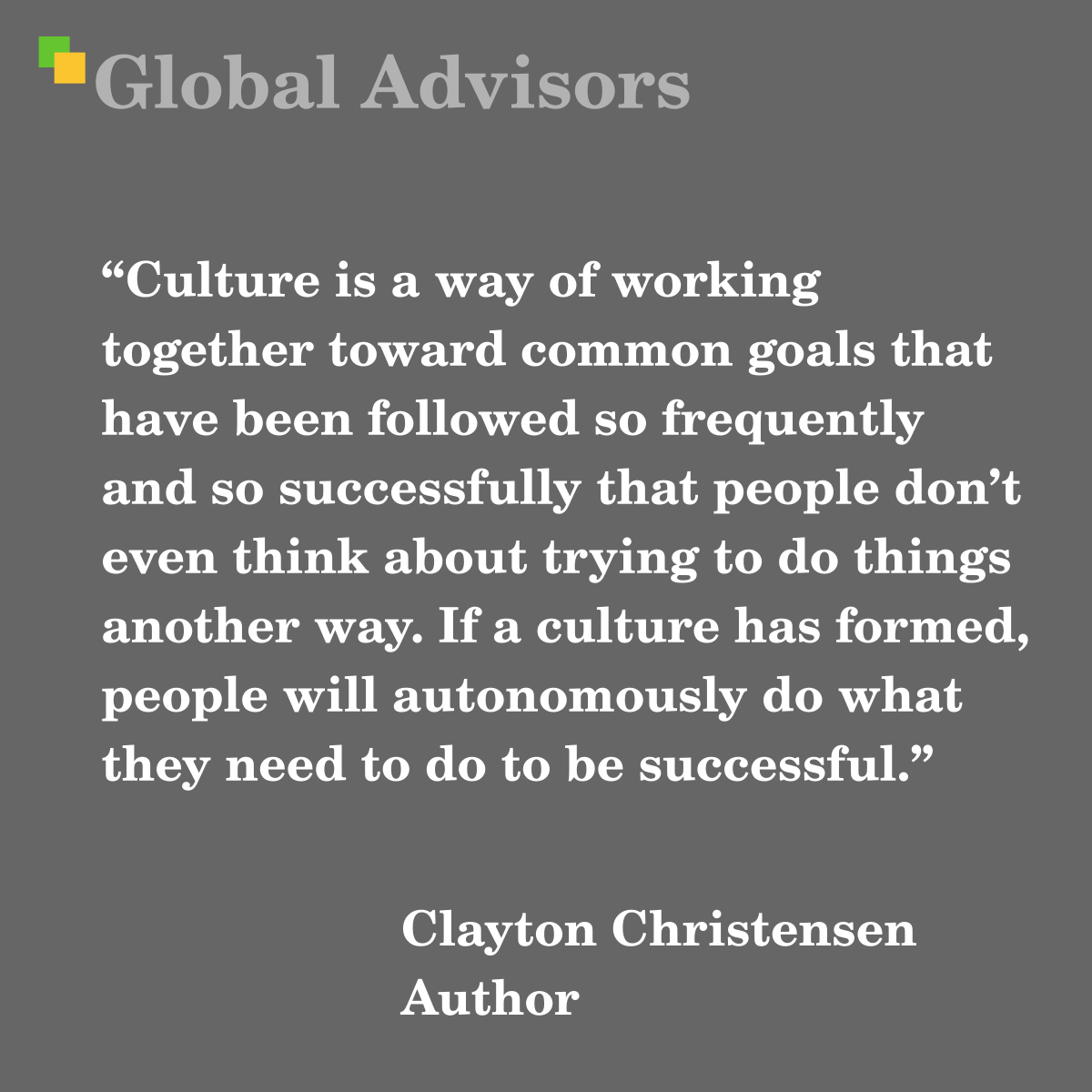
Quote: Clayton Christensen"Culture is a way of working together toward common goals that have been followed so frequently and so successfully that people don't even think about trying to do things another way. If a culture has formed, people will autonomously do what they need to do to be successful." - Clayton Christensen - AuthorClayton M. Christensen, the renowned Harvard Business School professor and author, offers a piercing definition of culture that underscores its invisible yet commanding influence on human behaviour. Drawn from his seminal 2010 book How Will You Measure Your Life?, this observation emerges from Christensen's broader exploration of how personal and professional success hinges on aligning daily actions with enduring principles.1,2 The book, blending business acumen with life lessons, distils decades of research into practical wisdom for leaders, managers, and individuals navigating career and family demands.1,3 Christensen's Life and Intellectual JourneyBorn in 1952 in Salt Lake City, Utah, Christensen rose from humble roots to become one of the most influential thinkers in business strategy. A devout Mormon, he integrated faith with rigorous analysis, viewing truth in science and religion as harmonious.2,4 Educated at Brigham Young University, Oxford as a Rhodes Scholar, and Harvard Business School, he joined Harvard's faculty in 1989. His breakthrough came with The Innovator's Dilemma (1997), introducing disruptive innovation - the theory explaining how market-leading firms falter by ignoring low-end or new-market disruptions.5 This framework, applied across industries from steel to smartphones, earned him global acclaim and advisory roles with Intel, Kodak, and others. Christensen's later works, including How Will You Measure Your Life?, shift from corporate strategy to personal integrity. Co-authored with Jeff Dyer and Hal Gregersen, it warns against marginal compromises - 'just this once' temptations - that erode character over time.3 He argued management is 'the most noble of professions' when it fosters growth, motivation, and ethical behaviour.2,3 Stricken with leukemia in 2017 and passing in 2020, Christensen left a legacy of over 150,000 citations and millions of books sold, emphasising that true metrics of life lie in helping others become better people.2,4 The Context of the Quote in Christensen's PhilosophyIn How Will You Measure Your Life?, the quote illuminates how organisations - and lives - succeed through ingrained habits. Christensen posits that culture forms when proven paths to common goals become automatic, enabling autonomous action without constant oversight.1 This ties to his 'resources, processes, priorities' (RPP) framework: resources fuel action, processes habitualise it, and priorities direct it.2,4 A strong culture aligns these, creating 'seamless webs of deserved trust' that propel success, echoing his warnings against short-termism where leaders chase loud demands over lasting value.3 He contrasts virtuous cultures fostering positive-sum interactions and lucky breaks with toxic ones breeding zero-sum games and isolation.3 For leaders, cultivating culture means framing work to motivators - purpose, progress, relationships - so employees end days fulfilled, much like Christensen's own 'good day' model.2 Leading Theorists on Organisational CultureChristensen's views build on foundational theorists who dissected culture's role in management and leadership.
These thinkers collectively affirm culture as the bedrock of sustained performance, where unconscious alignment trumps enforced compliance. Christensen's insight, rooted in their legacy, equips leaders to build environments where success feels inevitable. References 1. https://www.goodreads.com/quotes/7256080-culture-is-a-way-of-working-together-toward-common-goals 2. https://www.toolshero.com/toolsheroes/clayton-christensen/ 3. https://www.skmurphy.com/blog/2020/02/16/clayton-christensen-on-how-will-you-measure-your-life/ 4. https://quotefancy.com/clayton-m-christensen-quotes/page/2 5. https://www.azquotes.com/author/2851-Clayton_Christensen 6. https://memories.lifeweb360.com/clayton-christensen/a0d52888-de6d-4246-bce9-26d9aaee0aac
|
| |
| |
Quote: Jeremy Barnum - Executive VP and CFO of JP Morgan Chase"We're growing. We're onboarding new clients. In many cases, I'm looking at some of my colleagues on the corporate and investment bank, the growth in new clients comes with lending. That lending is relatively low returning then you eventually get other business. So yes, that's an example of an investment today that as it matures, has higher returns." - Jeremy Barnum - Executive VP & CFO of JP Morgan ChaseJeremy Barnum, Executive Vice President and Chief Financial Officer of JPMorgan Chase, shared this perspective during a strategic framework and firm overview executive Q&A on 24 February 2026. His remarks underscore a core tenet of modern banking: initial client acquisition often demands upfront investments in low-margin activities like lending, which pave the way for higher-return opportunities as relationships mature.[SOURCE] Barnum's career trajectory exemplifies the blend of analytical rigour and strategic foresight essential for leading one of the world's largest financial institutions. Joining JPMorgan Chase in 2007 as a managing director in treasury and risk management, he ascended rapidly through roles in investor relations and corporate development. By 2021, he was appointed CFO, succeeding Jennifer Piepszak, who transitioned to co-CEO of the commercial and investment bank. Under Barnum's stewardship, JPMorgan has navigated volatile markets, including the acquisition of Goldman Sachs' Apple Card portfolio, which contributed to a $2.2 billion pre-tax credit reserve build in Q4 2025, even as net income reached $13 billion and revenue climbed 7% to $46.8 billion.1 In the broader context of this quote, Barnum was addressing investor concerns about growth dynamics in the corporate and investment banking (CIB) division. New client onboarding frequently begins with lending - a relatively low-return activity due to compressed margins and credit risks - but evolves into a fuller ecosystem of services, including advisory, trading, and capital markets activities that deliver superior profitability over time. This 'investment today for returns tomorrow' model aligns with JPMorgan's 2026 expense projections of $105 billion, driven by 'structural optimism' and the imperative to invest in technology, AI, and competitive positioning against fintech challengers like Revolut and SoFi, as well as traditional rivals like Charles Schwab.1 The discussion occurred against a backdrop of heightened competitive and regulatory pressures. Just weeks earlier, in January 2026, Barnum warned of the perils of President Donald Trump's proposed 10% cap on credit card interest rates, arguing it would curtail credit access for higher-risk borrowers - 'the people who need it the most' - and force lenders to scale back operations in a fiercely competitive landscape.2,3 Consumer and community banking revenue rose 6% year-over-year to $19.4 billion, bolstered by 7% growth in card services, yet such policies threaten this momentum. JPMorgan's tech budget is set to surge by $2 billion to $19.8 billion in 2026, emphasising investments to maintain primacy.5 Leading theorists on relationship banking and client lifecycle management provide intellectual foundations for Barnum's approach. Jay R. Ritter, a pioneer in IPO and capital-raising research at the University of Florida, has long documented how initial public offerings often underperform short-term but enable firms to access deeper capital markets over time - a parallel to banking's lending-to-ecosystem progression. Similarly, Arnoud W.A. Boot, a professor at the University of Amsterdam and ECB Shadow Monetary Policy Committee member, theorises in works like 'Relationship Banking and the Death of the Middleman' (2000) that banks derive sustained value from 'household-specific' information built through ongoing relationships, transforming low-margin entry points into high-return sticky business. Robert M. Townsend, Caltech economist and Nobel laureate (2011, with Finn Kydland), extends this through his incomplete contracting models, showing how banks mitigate asymmetric information via repeated interactions, justifying upfront lending as a commitment device for future profitability. More contemporarily, Viral V. Acharya of NYU Stern emphasises in IMF and BIS papers the 'credit ecosystem' where initial low-yield loans signal credibility, unlocking cross-selling in a post-2008 regulatory environment marked by Basel III capital constraints. These frameworks validate JPMorgan's strategy: lending as the 'hook' in a maturing client portfolio amid rising competition and policy risks. Barnum's comments, delivered mere hours before this analysis (on 25 February 2026), reflect real-time strategic clarity. As JPMorgan projects resilience in consumer and small business segments, this philosophy positions the firm to convert today's investments into enduring leadership.1,4 References 1. https://fortune.com/2026/01/14/jpmorgan-ceo-cfo-staying-competitive-requires-investment/ 2. https://www.businessinsider.com/jpmorgan-warning-on-credit-card-cap-interest-2026-1 3. https://neworleanscitybusiness.com/blog/2026/01/13/jpmorgan-credit-card-rate-cap-warning/ 5. https://www.aol.com/news/jpmorgan-spend-almost-20-billion-000403027.html
|
| |

| |
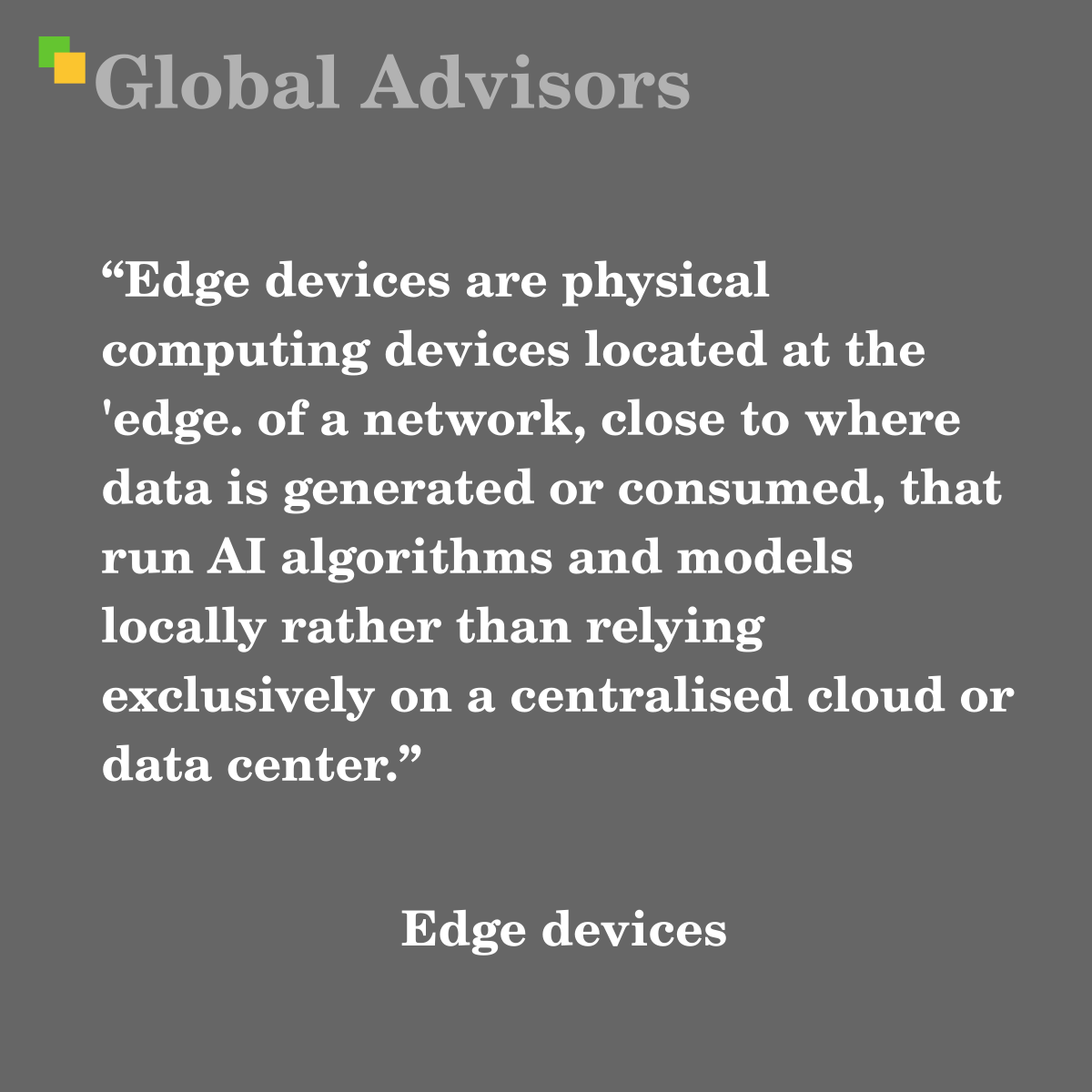
Term: Edge devices"Edge devices are physical computing devices located at the 'edge. of a network, close to where data is generated or consumed, that run AI algorithms and models locally rather than relying exclusively on a centralised cloud or data center." - Edge devicesEdge devices integrate edge computing with artificial intelligence, enabling real-time data processing on interconnected hardware such as sensors, Internet of Things (IoT) devices, smartphones, cameras, and industrial equipment. This local execution reduces latency to milliseconds, enhances privacy by retaining data on-device, and alleviates network bandwidth strain from constant cloud transmission.1,4,5 Unlike traditional cloud-based AI, where data travels to remote servers for computation, edge devices perform tasks like predictive analytics, anomaly detection, speech recognition, and machine vision directly at the source. This supports applications in autonomous vehicles, smart factories, healthcare monitoring, retail systems, and wearable technology.2,3,6 Key Characteristics and Benefits
Best Related Strategy Theorist: Dr. Andrew Chi-Chih YaoDr. Andrew Chi-Chih Yao, a pioneering computer scientist, stands as the most relevant strategy theorist linked to edge devices through his foundational contributions to distributed computing and efficient algorithms, which underpin modern edge AI architectures. Born in Shanghai, China, in 1946, Yao earned his PhD from Harvard University in 1972 under advisor Patrick C. Fischer. He held faculty positions at MIT, Princeton, and Stanford before joining Tsinghua University in 2004 as Director of the Institute for Interdisciplinary Information Sciences (IIIS), dubbed the 'Chinese Springboard for talents in computer science'.[external knowledge basis] Yao's relationship to edge devices stems from his seminal work on parallel and distributed algorithms, including the Yao minimax principle for computational complexity (1970s), which optimises resource allocation in decentralised systems-directly analogous to edge computing's local processing paradigm. His PRAM (Parallel Random Access Machine) model formalised efficient parallelism on resource-constrained devices, influencing how AI models are deployed on edge hardware with limited power and compute.[external knowledge basis] Notably, Yao's research on communication complexity minimises data exchange between nodes, mirroring edge devices' strategy of local inference to cut cloud dependency-a core tenet echoed in edge AI literature.1,7 A Turing Award winner (2000) for contributions to computation theory, Yao's strategic vision emphasises scalable, efficient computing at the periphery, shaping industries from IoT to AI. His mentorship of talents like Jack Ma (Alibaba founder) further extends his influence on practical deployments of edge technologies in global supply chains. References 1. https://www.ibm.com/think/topics/edge-ai 2. https://www.micron.com/about/micron-glossary/edge-ai 3. https://zededa.com/glossary/edge-ai-computing/ 4. https://www.flexential.com/resources/blog/beginners-guide-ai-edge-computing 5. https://www.splunk.com/en_us/blog/learn/edge-ai.html 6. https://www.f5.com/glossary/what-is-edge-ai 7. https://www.cisco.com/site/us/en/learn/topics/artificial-intelligence/what-is-edge-ai.html 8. https://blogs.nvidia.com/blog/what-is-edge-ai/
|
| |
| |
|


| |
| |