| |
|

| |
| |
| |
|
Our selection of the top business news sources on the web. |
| |
| |
| |
Quote: Max Planck - Nobel laureate"A new scientific truth does not generally triumph by persuading its opponents and getting them to admit their errors, but rather by its opponents gradually dying out and giving way to a new generation that is raised on it." - Max Planck - Nobel laureateThe observation that scientific progress often requires generational change rather than individual conversion represents one of the most candid reflections on the nature of scientific advancement. This principle emerged from the lived experience of one of the twentieth century's most transformative physicists, whose own struggles to gain acceptance for revolutionary ideas shaped his understanding of how science actually evolves. Max Planck: The Reluctant Philosopher of ScienceMax Planck (1858-1947) was a German theoretical physicist whose contributions fundamentally altered our understanding of matter and energy.1 As the originator of quantum theory, Planck discovered that energy is emitted in discrete packets called quanta, a finding that would eventually underpin modern physics and enable the theoretical frameworks of Einstein and subsequent generations of scientists.3 Yet despite the revolutionary nature of his work, Planck's path to recognition was neither swift nor universally celebrated. Planck's reflection on scientific change emerged not from abstract philosophical speculation but from personal frustration. In his own words, recorded in his 1949 Scientific Autobiography, he expressed the pain of his experience: "It is one of the most painful experiences of my entire scientific life that I have but seldom…[succeeded] in gaining universal recognition for a new result, the truth of which I could demonstrate by a conclusive, albeit only theoretical proof."1 This candid admission reveals that Planck's principle was born from the gap between theoretical demonstration and practical acceptance-a gap he experienced acutely throughout his career. The Genesis and Context of the PrinciplePlanck articulated his observation in his Scientific Autobiography, published posthumously in 1949 (originally in German in 1948, the year after his death). The fuller formulation reads: "A new scientific truth does not triumph by convincing its opponents and making them see the light, but rather because its opponents eventually die, and a new generation grows up that is familiar with it."2 He elaborated further: "An important scientific innovation rarely makes its way by gradually winning over and converting its opponents: it rarely happens that Saul becomes Paul. What does happen is that its opponents gradually die out, and that the growing generation is familiarized with the ideas from the beginning: another instance of the fact that the future lies with the youth."2 What makes this observation remarkable is that Planck himself identified it as such-he called it "a remarkable fact."1 The principle addresses a fundamental tension in scientific practice: despite science's claim to objectivity and rationality, it remains a deeply human endeavour, subject to the psychological, social, and biological constraints that govern all human activity. Planck recognised that the triumph of new scientific truths depends not primarily on the logical force of evidence, but on the passage of time and the natural succession of generations. Interpreting Planck's Insight: Multiple DimensionsScholars have identified several complementary interpretations of Planck's principle, each illuminating different aspects of scientific change.1 One interpretation emphasises the age-related dimension: older scientists, having invested their careers and reputations in existing theoretical frameworks, may be psychologically and professionally resistant to paradigm shifts. Younger scientists, by contrast, encounter new ideas without the burden of prior commitment and can adopt them more readily. A second interpretation connects Planck's observation to Karl Popper's philosophy of science, particularly the concept of falsifiability. Where Popper emphasised rational refutation of theories, Planck's principle suggests that scientific change operates through a different mechanism-not conversion through logical argument, but replacement through generational succession.1 This distinction matters: it implies that scientific progress may be less rational and more evolutionary than philosophers of science have traditionally assumed. A third, perhaps most fundamental interpretation treats Planck's statement as a truism-an important but often overlooked truth about the biological reality of scientific practice.1 Science progresses not because individual minds are particularly malleable or rational, but because the human lifespan is finite. New theories need not convince everyone; they need only survive long enough for their proponents to train the next generation whilst their opponents eventually pass away. This interpretation emphasises that science, despite its aspirations to transcend human limitation, remains embedded in human biology and mortality. The Principle in Practice: Quantum Theory and BeyondPlanck's own experience with quantum theory exemplifies his principle. When he first proposed that energy is quantised-emitted in discrete packets rather than continuously-the idea met with considerable resistance from the established physics community. Even Albert Einstein, who would later extend quantum ideas, initially had reservations. Yet within a generation, quantum mechanics became the foundation of modern physics, not because Planck's opponents suddenly saw the light, but because a new generation of physicists-including Werner Heisenberg, Erwin Schrödinger, and Paul Dirac-grew up with quantum ideas as their intellectual inheritance. The principle has proven remarkably durable. In 1962, Thomas S. Kuhn cited Planck's insight in his landmark work The Structure of Scientific Revolutions, using it to support his argument that scientific progress occurs through paradigm shifts rather than gradual accumulation of knowledge.3 Economist Paul A. Samuelson popularised a more concise formulation-"Science progresses one funeral at a time"-which captured the principle's essence in memorable language.3 This phrasing, whilst somewhat macabre, underscores the principle's central claim: generational succession, not rational persuasion, drives scientific change. The Broader Theoretical LandscapePlanck's principle intersects with several major theoretical frameworks in the philosophy and sociology of science. Thomas Kuhn's concept of paradigm shifts directly engages with Planck's observation: paradigms change not because scientists within the old paradigm convert to the new one, but because the old paradigm's defenders eventually retire and die, whilst younger scientists adopt the new paradigm from the outset.3 This process explains why scientific revolutions often appear sudden and discontinuous rather than gradual. The principle also resonates with sociological studies of scientific knowledge. Rather than viewing science as a realm of pure rationality insulated from social and psychological factors, this perspective acknowledges that scientists are human beings embedded in social networks, professional hierarchies, and generational cohorts. Their acceptance or rejection of new ideas depends not only on evidence but on factors such as professional investment, social standing, and the timing of their entry into the field. Furthermore, Planck's insight challenges the traditional image of scientific progress as a steady march toward truth. Instead, it suggests a more complex picture: scientific change involves both rational evaluation of evidence and irrational human factors such as professional pride, institutional inertia, and the simple fact of mortality. This does not diminish science's achievements; rather, it acknowledges that science succeeds despite-and sometimes because of-its human dimensions. Limitations and NuancesWhilst Planck's principle captures something important about scientific change, it requires qualification. Not all scientific progress depends on generational succession. Sometimes individual scientists do change their minds when confronted with compelling evidence. Moreover, the principle may apply differently across disciplines: experimental sciences with clear empirical benchmarks may see faster conversion of individuals than theoretical fields where evidence is more ambiguous. Additionally, in contemporary science with rapid communication and large collaborative teams, the generational mechanism may operate differently than it did in Planck's era. The principle also risks oversimplifying the psychology of scientific belief. Scientists are not uniformly stubborn or open-minded; individual variation is substantial. Some older scientists prove remarkably receptive to new ideas, whilst some younger ones cling to outdated frameworks. Planck's statement describes a statistical tendency rather than an iron law. Legacy and Contemporary RelevancePlanck's principle remains strikingly relevant in contemporary science. Recent empirical research has suggested that the principle holds true: studies examining citation patterns and the adoption of new theories across scientific fields have found evidence that scientific change does indeed correlate with generational succession.5 This finding validates Planck's cynical but penetrating observation about the human side of science. The principle also offers perspective on current scientific controversies. When new theories encounter resistance from established researchers, Planck's insight suggests patience: the theory need not convince its opponents, only survive long enough to become the intellectual foundation of the next generation. This perspective neither dismisses the importance of evidence nor ignores the reality that scientific communities are composed of human beings with all their attendant limitations and biases. Ultimately, Planck's principle stands as a humble acknowledgement that science, despite its extraordinary achievements, remains a human activity. Its progress depends not only on the power of ideas and the weight of evidence, but on the passage of time, the succession of generations, and the simple biological fact that we all eventually die. In recognising this, Planck offered not a cynical dismissal of science but a more realistic and ultimately more profound understanding of how human knowledge actually advances. References 1. https://buyscience.wordpress.com/history-of-science/plancks-principle/ 2. https://en.wikipedia.org/wiki/Planck's_principle 3. https://quoteinvestigator.com/2017/09/25/progress/ 4. https://insertphilosophyhere.com/science-its-tricky/ 6. https://www.ophthalmologytimes.com/view/moving-forward-does-science-progress-one-funeral-at-a-time-
|
| |
| |
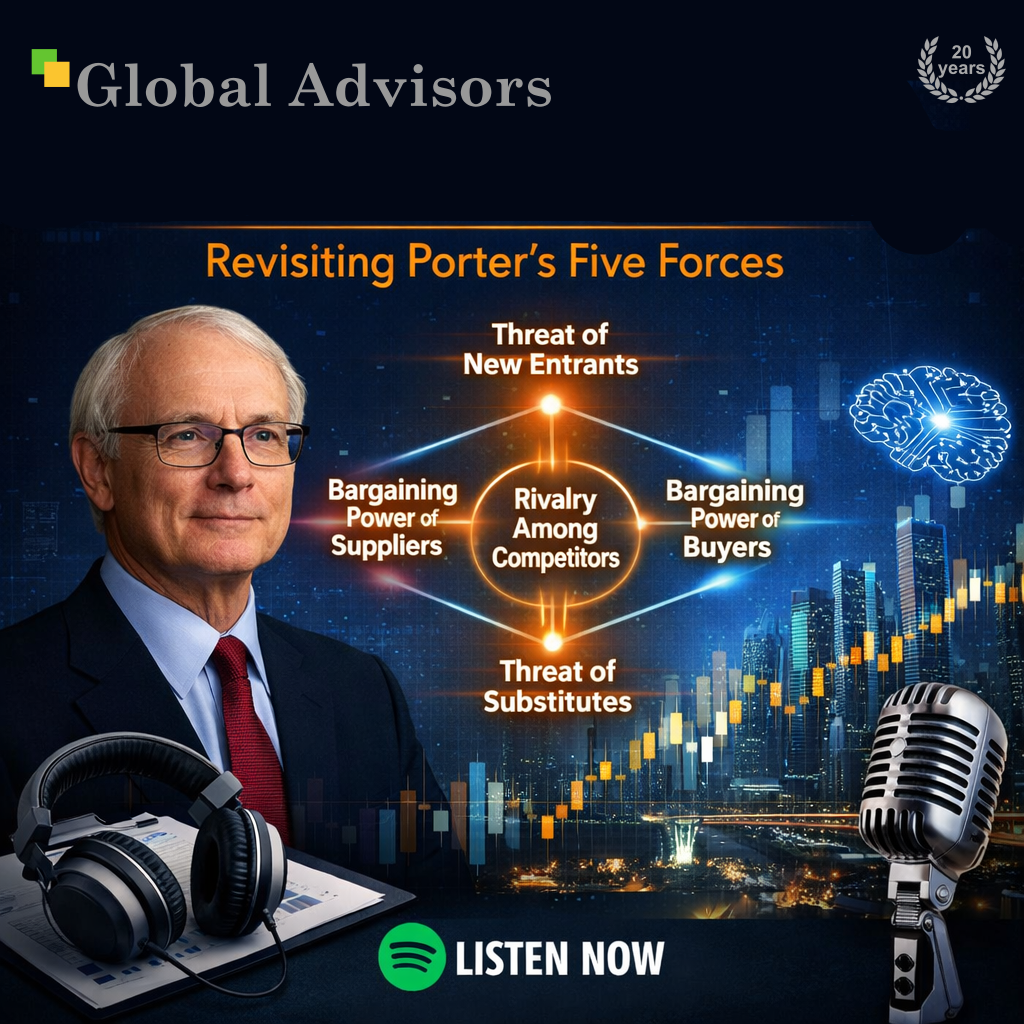
PODCAST: Quantifying Porter's Five Forces for CEOsIn this episode of the Global Advisors Spotify sequence, James and Lucy revisit Michael Porter’s Five Forces and reinterpret the framework for modern executives operating in volatile, digitally shaped markets. They trace its origins in industrial economics, examine its enduring value in understanding how profit is structurally distributed across industries, and address its limitations in a world shaped by platforms, network effects, data advantages, regulation, and AI. The discussion sets out the Global Advisors approach: move beyond qualitative strategy language, segment markets precisely, quantify structural forces with evidence, link analysis directly to capital allocation, and continuously recalibrate strategy as market conditions change. The result is a practical argument for more disciplined, data-backed, and ethically grounded strategic decision-making. Read more from the original article.
|
| |
| |
Term: Operational alpha"Operational alpha refers to the incremental value created through improvements in a portfolio company's operating performance, independent of financial leverage or changes in valuation multiples." - Operational alphaOperational alpha represents the incremental value created through improvements in a portfolio company's operating performance, independent of financial leverage or changes in valuation multiples.1 Rather than relying on financial engineering-such as debt restructuring or multiple expansion-operational alpha focuses on tangible, sustainable improvements to how businesses function and generate returns. Core Definition and ScopeAt its foundation, operational alpha encompasses the compounding effect of better decisions, faster execution, and scalable systems built on culture, structure, and technology.2 In wealth management and asset management contexts, operational alpha is essentially the value added by adopting more efficient processes and procedures, which is unrelated to the actual investment decision itself.3 This distinction is critical: operational alpha is about how well an organisation executes, not about market timing or investment selection alone. The concept extends beyond simple cost reduction. It encompasses risk mitigation and enhanced decision-making that investors achieve through streamlined systems and processes, ultimately reflecting an organisation's ability to withstand volatility and make sound decisions during market fluctuations.5 Evolution in Private EquityThe significance of operational alpha in private equity has grown substantially over the past decade. As capital flooded into private markets and competition intensified, the impact of financial engineering as a return driver began to diminish.1 With today's higher borrowing costs, compressed valuations, and more challenging deal environments, the trend has accelerated dramatically. Recent data underscores this shift. Research from Gain.pro, based on over 10,000 global private equity deals and exits, found that revenue growth accounted for 71% of total value creation at exit in 2024, compared to 64% the previous year.1 A 2024 McKinsey study of more than 100 private equity funds with post-2020 vintages discovered that firms focused on operational value-add achieved average internal rates of return that were 2-3 percentage points higher than their peers.1 Practical ImplementationModern operational alpha strategies involve several key components:
Specific value creation drivers include revenue expansion through new products, market entry, or acquisitions; margin improvement through lean manufacturing and digitalisation; and operational turnarounds involving leadership professionalisation and efficiency gains.1 Modern Evolution: Beyond Portfolio CompaniesContemporary understanding of operational alpha has expanded beyond improving individual portfolio companies. Today, it increasingly refers to turning the investment firm itself into a high-performance machine through better decisions, faster execution, and scalable systems built on strong foundations of culture, structure, and technology.6 This represents a fundamental shift from viewing operational alpha as solely a portfolio company improvement tool to recognising it as a competitive advantage for the investment firm itself. Leading firms like LaSalle Investment Management, Affinius Capital, and Harrison Street are embedding ownership mindsets, feedback loops, agile structures, and integrated platforms to reduce friction, empower people, and future-proof operations.2 Real-World ImpactThe tangible outcomes of operational alpha strategies are substantial. One private equity firm supported a global education provider in scaling through acquisitions, centralising operations, building digital infrastructure, and expanding product offerings such as personalised learning tools. Today, that business is a multibillion-pound leader in its sector.1 In another example, a sponsor led a full-scale operational turnaround of a United States manufacturing company, professionalising the leadership team, implementing lean practices, and expanding capacity, resulting in more than 3.5 times EBITDA growth and significantly stronger margins.1 Key Theorist: Steffen PaulsSteffen Pauls has emerged as a leading voice articulating the strategic importance of operational alpha in contemporary private equity. Currently serving as chief executive officer of Moonfare, a private market investment platform, Pauls brings extensive practical experience in value creation and operational excellence. Pauls' career trajectory demonstrates deep engagement with operational value creation. He previously served on the value creation team at Kohlberg Kravis Roberts & Co. (KKR), one of the world's largest private equity firms, where he gained first-hand experience in how deeply embedded and professionalised operational functions have become within leading sponsors. This background positioned him uniquely to observe and articulate the fundamental shift occurring within private equity. In a 2024 letter to the Financial Times, Pauls argued that private equity is fundamentally changing, with higher interest rates eroding the role of financial engineering in the traditional buyout model.1 He contends that managers must return to the basics of corporate craftsmanship by supporting portfolio companies in their efforts to increase revenue, margins, or ideally both. This may include rolling out new products, fine-tuning business models, expanding into new markets, or optimising costs through lean manufacturing and digitalisation.1 Pauls' perspective is grounded in observable market trends rather than theoretical speculation. He notes that the move away from financial engineering is anticipated to accelerate further, with operational improvements identified as the primary return driver for deals expected to exit over the coming years.1 His work at Moonfare, engaging closely with operators behind many platform funds, continues to inform his understanding of how operational excellence translates into differentiated investment performance. Pauls represents a new generation of private equity leaders who recognise that sustainable competitive advantage comes not from financial engineering or market timing, but from the disciplined, hands-on operational improvement of portfolio companies. His articulation of operational alpha as the future of private equity has influenced industry thinking and practice, particularly as traditional leverage-based return drivers have diminished in effectiveness. References 1. https://www.moonfare.com/blog/operational-alpha-private-equity 2. https://www.junipersquare.com/blog/operational-alpha 5. https://www.ai-cio.com/news/operational-alpha-can-provide-a-crucial-competitive-advantage/ 6. https://www.propertychronicle.com/what-is-operational-alpha-a-guide-for-modern-gps/ 9. https://jfdi.info/wp-content/uploads/2025/07/Achieving-Operational-Alpha-in-Private-Equity.pdf
|
| |
| |
Quote: Andrej Karpathy - AI Guru, Former head of Tesla AI"I think the industry has to reconfigure in so many ways. The customer is not the human anymore. It's agents acting on behalf of humans, and this refactoring will probably be substantial." - Andrej Karpathy - AI Guru, Former head of Tesla AIA Pivotal Shift in the AI LandscapeAndrej Karpathy, former Director of AI at Tesla and founding team member at OpenAI, stated: "I think the industry has to reconfigure in so many ways. The customer is not the human anymore. It's agents acting on behalf of humans, and this refactoring will probably be substantial." This quote from a March 20, 2026, discussion on No Priors podcast highlights the transformative impact of AI agents on software development and industry infrastructure. Context of Karpathy's VisionKarpathy describes a rapid evolution in programming, where AI agents have become reliable since late 2025. He notes that coding agents "basically didn't work before December and basically work since," exhibiting higher quality, long-term coherence, and tenacity1,2,3,5. Traditional coding-typing code into an editor-is giving way to delegating tasks in English, managing parallel agent workflows, and reviewing outputs1,2. For example, Karpathy built a video analysis dashboard for home cameras in 30 minutes using an AI agent that handled errors and research autonomously2. He emphasizes this as "delegation," not magic, requiring high-level direction and taste2. Implications for Programming and Industry
Karpathy predicts 2026 as a "high energy" year of industry adaptation, with LLMs surging ahead of integrations and workflows3. Professionals must build for agent autonomy, echoing early frameworks like BabyAGI1. Karpathy's CredentialsA leading AI expert, Karpathy advanced deep learning at OpenAI, led Tesla's Autopilot vision team, and coined "vibe coding." His insights reflect real-world shifts observed in early 20261,2. References 2. https://www.businessinsider.com/andrej-karpathy-programming-unrecognizable-ai-2026-2 3. https://paweldubiel.com/42l1%E2%81%9D--Andrej-Karpathy-quote-26-Jan-2026- 4. https://www.youtube.com/watch?v=HSshsQCEPC0 5. https://simonwillison.net/2026/Feb/26/andrej-karpathy/
|
| |
| |
Quote: Albert Einstein - Nobel laureate"Try not to become a man of success, but rather try to become a man of value." - Albert Einstein - Nobel laureateAlbert Einstein's timeless exhortation encapsulates a philosophy that transcends the boundaries of physics and delves into the essence of human purpose. This quote, often rendered as "Strive not to be a success, but rather to be of value," urges individuals to measure their worth not by accolades or wealth, but by the contributions they make to society1,3. It reflects Einstein's belief that true fulfilment arises from giving more than one receives, a principle he lived out through his groundbreaking scientific work and humanitarian efforts3. The Life and Context of Albert EinsteinBorn on 14 March 1879 in Ulm, Germany, to a secular Jewish family, Albert Einstein displayed early curiosity about the universe. His father, Hermann, ran an electrochemical factory, while his mother, Pauline, nurtured his love for music and mathematics. As a child, Einstein was slow to speak, yet he pondered deep questions, such as why a compass needle always pointed north-a mystery that ignited his lifelong passion for physics1. Einstein's academic journey was unconventional. He struggled in the rigid German school system, eventually attending the Swiss Federal Polytechnic in Zurich, graduating in 1900. Unable to secure an academic post, he worked as a patent clerk in Bern from 1902 to 1909. It was during these "miracle years" that he produced his annus mirabilis papers in 1905, revolutionising physics with the special theory of relativity, the photoelectric effect (earning him the 1921 Nobel Prize in Physics), Brownian motion, and mass-energy equivalence (E=mc2)1. The quote emerged from Einstein's mature reflections on life, likely in the mid-20th century amid his fame and exile. Fleeing Nazi persecution in 1933, he settled in Princeton, New Jersey, at the Institute for Advanced Study. There, he championed pacifism, civil rights, and Zionism while warning against nuclear weapons post-World War II. Einstein viewed success superficially-as status or possessions-but prized value as intrinsic worth, moral integrity, and selfless giving2,3. He embodied this by mentoring young scientists and advocating for global peace, famously stating that a life lived for others is worthwhile1. Einstein's Philosophy on Success and ValueEinstein distinguished success, often tied to material gains or recognition, from value, which he saw in three dimensions: intrinsic worth (personal authenticity), moral beliefs (ethical conduct), and giving (contributing to others)2. He warned that pursuing success at others' expense leads to emptiness, echoing his view that "the value of a man should be seen in what he gives and not in what he is able to receive"2. This resonated in his own life; despite global acclaim, he lived modestly, focusing on intellectual and humanitarian pursuits1. In broader context, the quote critiques consumerist culture, emphasising sustainable fulfilment over short-term triumphs. As one analysis notes, leaders excel by providing value first, creating reciprocal growth-a principle akin to physics' action-reaction law2. Einstein's words remain relevant, inspiring professionals to align achievements with purpose. Leading Theorists on Value, Success, and Human PurposeEinstein's ideas draw from and parallel thinkers who explored value beyond metrics of success:
These theorists collectively underscore that value-rooted in ethics, contribution, and purpose-yields enduring success, a thread woven through Einstein's legacy. Einstein's Enduring LegacyEinstein died on 18 April 1955 in Princeton, leaving an indelible mark on science and thought. His Nobel Prize affirmed his photoelectric contributions, but his cultural impact endures through quotes like this, challenging us to redefine success. By becoming people of value, we honour his vision: innovation, ethics, and service as the true measures of a meaningful life1,2. References 3. https://www.goodreads.com/quotes/8906892-try-not-to-become-a-man-of-success-but-rather 4. https://www.azquotes.com/author/4399-Albert_Einstein/tag/values
|
| |
| |
Quote: The Economist"Even the best-case scenario for energy markets is disastrous. Whatever happens, high prices will outlive the Iran war." - The EconomistThe Economist states that "Even the best-case scenario for energy markets is disastrous. Whatever happens, high prices will outlive the Iran war."1 This quote from their 22 March 2026 article highlights severe risks to global energy markets due to the Iran war. Disruptions in the Strait of Hormuz, through which 15-20% of world oil supply passes, are driving up oil and natural gas prices.1 Attacks on energy infrastructure in Saudi Arabia and Qatar's LNG facilities add to supply fears, potentially pushing Brent crude to $100 per barrel or higher.1,2 Analysts note that prolonged conflict could embed a risk premium in prices, with lasting impacts on inflation, GDP, and sectors like tourism in Gulf states such as Dubai, Saudi Arabia, and the UAE.1,2 Even short-term shocks may chill economic activity, as higher energy costs raise business and consumer expenses worldwide.1 Recent market movements show volatility: Brent crude hit $119 before retreating to around $105-107, with WTI at $94, reflecting uncertainty over escalation.2 Regions like Asia (Bangladesh, Philippines, Pakistan) are already implementing energy conservation measures.2 Key concerns include:
While some hope for a quick resolution under leaders like Trump and Netanyahu, experts warn the worst-case scenario grows more likely with escalation.1,2 References 1. https://www.youtube.com/watch?v=hw5K6x-YVo8 2. https://www.youtube.com/watch?v=BVceAzO-Uo8
|
| |
| |
Term: Investment thesis"An investment thesis is a clear, testable statement of why an investment should generate attractive returns, specifying the mechanisms through which value will be created and the key risks that could prevent that outcome." - Investment thesisAn investment thesis is a structured, evidence-based statement that articulates why a particular investment opportunity should generate attractive returns, specifying the concrete mechanisms through which value will be created and identifying the key risks that could prevent that outcome.1,2 Rather than a prediction or forecast, it represents a well-reasoned argument grounded in thorough research and analysis that guides disciplined decision-making across investment cycles.1 Core Components and FrameworkA robust investment thesis integrates several essential elements that work together to create a compelling investment narrative.1 The investment opportunity identifies the specific market, sector, or asset class being targeted, explaining why it merits exploration within the broader portfolio strategy.1 The value proposition articulates the unique advantages and competitive differentiation that will drive returns, moving beyond vague strategic statements to describe concrete, measurable benefits.4 Market analysis examines industry trends, competitive dynamics, and consumer behaviour to establish the foundation for opportunity assessment.1 The growth potential component evaluates long-term scalability and expansion opportunities, typically supported by projections based on market demand, innovation capacity, or strategic partnerships.1 Critically, risk assessment outlines potential obstacles to value creation and specifies mitigation strategies, ensuring the thesis acknowledges what could prevent the anticipated returns from materialising.1 The thesis must also demonstrate alignment with strategy, ensuring the investment fits within the investor's risk tolerance, time horizon, and broader portfolio objectives.1 In contemporary practice, macroeconomic and ESG considerations account for external factors such as interest rates, inflation, regulatory changes, and environmental, social, and governance practices that affect long-term sustainability.1 Application Across Investment DisciplinesIn private equity, investment theses typically focus on value creation through operational improvements, sector consolidation, and roll-up strategies.2 A credible private equity thesis describes how acquiring a target company-such as a regional healthcare services provider with strong recurring revenues-will generate returns through specific mechanisms: operational enhancements, digital transformation, geographic expansion, or margin improvement.2,4 The thesis quantifies expected outcomes, such as targeting an internal rate of return (IRR) of 20% or greater within a defined timeframe.2 In venture capital, theses often target scalable business models within high-growth sectors. For example, a fund thesis might specify focus on European government technology startups or U.S.-based climate technology companies, leveraging the investment team's domain expertise and network advantages.1 The thesis clarifies fund parameters including size, portfolio composition, average cheque size, follow-on investment reserves, and the differentiated support mechanisms the fund will provide to portfolio companies.3 Strategic and Operational FunctionsAn investment thesis serves multiple critical functions within investment organisations. It provides clarity and discipline by creating a repeatable evaluation framework that reduces cognitive biases and ensures consistent assessment across opportunities.2 It improves stakeholder communication by enabling investors to justify investment decisions to limited partners, co-investors, and internal stakeholders with a coherent narrative backed by evidence.2 It builds credibility and trust by demonstrating professional diligence and rigorous analysis, particularly important when pitching to sophisticated capital providers.2 Critically, the thesis bridges strategy and execution. A well-articulated thesis establishes the basis for future value creation, but realising that value requires disciplined follow-through post-acquisition.5 An effective value creation plan translates the thesis into an actionable operational framework with specific initiatives, performance metrics, and accountability mechanisms.5 Without this execution discipline, even compelling theses fail to generate anticipated returns.5 Key Theorist: Michael Porter and Competitive StrategyThe intellectual foundations of modern investment thesis frameworks draw significantly from Michael E. Porter, the Harvard Business School strategist whose work on competitive advantage and industry analysis fundamentally shaped how investors evaluate opportunities. Porter's seminal 1980 work, Competitive Strategy: Techniques for Analysing Industries and Competitors, introduced frameworks that became central to investment thesis development. His five forces model-examining supplier power, buyer power, competitive rivalry, threat of substitutes, and barriers to entry-provides the analytical structure that investors use when assessing market attractiveness and competitive positioning within an investment thesis.1 Porter's concept of sustainable competitive advantage, rooted in either cost leadership or differentiation, directly informs how investors identify and articulate the value proposition component of their theses. Born in 1947, Porter earned his undergraduate degree from Princeton University and his MBA and doctorate from Harvard Business School. His career at Harvard Business School, spanning from 1973 onwards, established him as one of the most influential business strategists of the modern era. Beyond Competitive Strategy, his 1985 work Competitive Advantage: Creating and Sustaining Superior Performance introduced the value chain concept-the notion that organisations create value through a series of interconnected activities. This framework became essential for private equity investors evaluating how operational improvements and strategic repositioning could unlock value in portfolio companies. Porter's influence on investment thesis development is particularly evident in how investors now structure their value creation narratives. Rather than relying on financial engineering or market timing, Porter's frameworks encourage investors to ground their theses in fundamental competitive dynamics and sustainable sources of advantage. His work emphasises that competitive advantage must be defensible and rooted in structural industry characteristics or organisational capabilities-precisely the kind of concrete, evidence-based reasoning that distinguishes credible investment theses from speculative assertions. Throughout his career, Porter has advised governments, corporations, and investment firms on strategy. His consulting work with major private equity and venture capital firms has directly shaped how these organisations develop and evaluate investment theses. His concept of strategic positioning-the idea that superior returns come from occupying a defensible competitive position rather than simply being "better" than competitors-remains central to how sophisticated investors construct their investment narratives and identify the mechanisms through which value will be created. References 1. https://growthequityinterviewguide.com/venture-capital/venture-capital-industry/investment-thesis 2. https://www.kadonetworks.com/blog/investment-thesis 3. https://carta.com/learn/private-funds/management/portfolio-management/investment-thesis/ 4. https://www.bain.com/insights/writing-credible-investment-thesis/ 6. https://www.intapp.com/blog/private-equity-investment-thesis/ 7. https://hbr.org/2025/04/how-vcs-can-create-a-winning-investment-thesis
|
| |
| |
Quote: Andrej Karpathy - AI Guru, Former head of Tesla AI"Peter [Steinberger] has done a really amazing job [with Openclaw]. I saw him recently and talked to him about it. He's very humble about it, but I think he innovated simultaneously in five different ways and put it all together." - Andrej Karpathy - AI Guru, Former head of Tesla AIAndrej Karpathy, former head of Tesla AI, recently praised Peter Steinberger's work on OpenClaw, stating: "Peter has done a really amazing job with OpenClaw. I saw him recently and talked to him about it. He's very humble about it, but I think he innovated simultaneously in five different ways and put it all together." This endorsement aligns with broader recognition of Steinberger's achievement. OpenClaw is an open-source agentic AI framework that functions as an autonomous digital assistant running on local machines, capable of managing emails, controlling web browsers, and completing workflows through messaging apps like WhatsApp and Telegram. Steinberger's project has achieved remarkable growth: by early February 2026, OpenClaw surpassed 145,000 GitHub stars and recorded peak traffic of 2 million visitors in a single week. Sam Altman, OpenAI's founder, also called Steinberger a "genius with a lot of amazing ideas." In February 2026, Steinberger announced he was joining OpenAI while committing to move OpenClaw into an independent, open-source foundation to preserve its community-driven roots and "local-first" architecture, which allows users to maintain personal data in simple Markdown files rather than corporate cloud storage. References 2. https://hanselminutes.com/1036/the-rise-of-the-claw-with-openclaws-peter-steinberger 4. https://www.youtube.com/watch?v=AcwK1Uuwc0U 5. https://steipete.me/posts/2026/openclaw 6. https://www.youtube.com/watch?v=YFjfBk8HI5o
|
| |
!["Peter [Steinberger] has done a really amazing job [with Openclaw]. I saw him recently and talked to him about it. He’s very humble about it, but I think he innovated simultaneously in five different ways and put it all together." - Quote: Andrej Karpathy - AI Guru, Former head of Tesla AI](https://globaladvisors.biz/wp-content/uploads/2026/03/20260322_18h30_GlobalAdvisors_Marketing_Quote_AndrejKarpathy_GAQ.png)
| |
Quote: Nate B Jones - AI News & Strategy Daily"The person who's been at the company for 20 years knows that things aren't written down anywhere. The AI doesn't. This knowledge is not promptable. The interface between general AI capability and specific organizational reality is where value gets lost or captured." - Nate B Jones - AI News & Strategy DailyThis observation captures a fundamental tension in the current wave of AI adoption: the gap between what large language models can do in theory and what they can accomplish within the messy, undocumented reality of actual organisations. Nate B. Jones identifies a critical vulnerability in the AI revolution-one that separates genuine competitive advantage from mere technological novelty. The Problem of Tacit KnowledgeJones points to a paradox that many organisations are only now beginning to recognise. A 20-year veteran of a company possesses something invaluable that no prompt can extract: tacit knowledge-the unwritten, often unconscious understanding of how things actually work. This includes informal decision-making processes, unspoken hierarchies, historical context that explains current practices, relationship dynamics, and the countless workarounds that keep operations running despite official procedures. This knowledge exists in the gaps between what's documented and what's done. It lives in conversations, in muscle memory, in the collective understanding of teams. It's the reason why onboarding a new employee takes months, not weeks, despite having an employee handbook. It's why a seasoned manager can navigate a crisis that would paralyse someone following the official playbook. Artificial intelligence systems, by contrast, operate on what can be tokenised and fed into a model. They excel at pattern recognition across documented information, at synthesising written knowledge, at optimising processes that have been explicitly defined. But they cannot intuit what isn't written down. They cannot absorb the cultural knowledge that shapes decision-making. They cannot understand the political landscape that determines which ideas succeed and which fail, regardless of merit. The Interface ProblemJones frames this as an interface problem-the boundary between what AI can do and what organisations actually need. This is where the real value creation or destruction occurs. Consider a practical example: an AI system might be asked to optimise a workflow, but without understanding the informal approval process that actually determines whether a decision gets implemented, it will generate recommendations that look good on paper but fail in practice. The interface problem manifests in several ways. First, there's the documentation gap. Most organisations have far less documented than they believe. Policies exist on paper, but actual practice diverges significantly. An AI trained on official documentation will generate advice that contradicts how things are actually done. Second, there's the context collapse. AI systems lack the historical understanding of why certain practices exist. A rule that seems arbitrary to an AI might exist because of a costly mistake made a decade ago that no one talks about anymore. Third, there's the relationship blindness. Organisations are fundamentally social systems, and AI cannot perceive the trust networks, rivalries, and alliances that shape outcomes. Nate B. Jones and the Evolution of AI ThinkingJones has emerged as one of the most incisive commentators on the practical reality of AI deployment in knowledge work. His analysis distinguishes between AI capability-what the technology can theoretically do-and AI utility-what it can actually accomplish within real organisational constraints. This distinction has become increasingly important as organisations move beyond initial AI experimentation into genuine integration. Jones's broader framework emphasises what he calls high agency-the ability to act decisively despite uncertainty, to reframe obstacles as skill gaps rather than immovable barriers, and to use AI as a force multiplier rather than a replacement for human judgment. In the context of tacit knowledge, this means recognising that AI's role is not to replace the 20-year veteran but to amplify their ability to codify and transmit what they know. The high-agency approach asks: "How can I use AI to bridge the gap between what I know implicitly and what the organisation needs explicitly?" This perspective aligns with Jones's broader work on second brains-AI-powered systems that don't just store information passively but actively work to classify, route, summarise, and surface knowledge. The second brain concept, which Jones has evolved beyond earlier frameworks like Tiago Forte's CODE methodology, recognises that the future of knowledge work lies not in replacing human expertise but in creating systems where human insight and AI capability work in concert. The Broader Context: Tacit Knowledge in Organisational TheoryThe challenge Jones identifies has deep roots in organisational theory and knowledge management. The distinction between explicit knowledge (what can be documented) and tacit knowledge (what is embodied in people and practice) was formalised by Michael Polanyi in the 1960s with his famous observation: "We know more than we can tell." This insight became foundational to understanding why knowledge transfer is so difficult and why organisations lose critical capabilities when experienced people leave. Ikujiro Nonaka and Hirotaka Takeuchi built on this framework in their theory of organisational knowledge creation, arguing that the most valuable knowledge emerges through the interaction between tacit and explicit forms. They identified four modes of knowledge conversion: socialisation (tacit to tacit), externalisation (tacit to explicit), combination (explicit to explicit), and internalisation (explicit to tacit). The challenge for organisations deploying AI is that most AI systems operate primarily in the combination mode-they're excellent at working with explicit knowledge but cannot participate in socialisation or externalisation without human intermediaries. This is where Jones's insight becomes strategically important. The organisations that will capture value from AI are not those that attempt to replace human knowledge with AI systems, but those that use AI to make tacit knowledge more accessible and actionable. This requires intentional effort to externalise what experienced people know, to document the undocumented, and to create systems where AI can help surface and apply that knowledge at scale. The Knowledge Capture ChallengeThe practical implication is that knowledge capture becomes a competitive advantage. Organisations that can systematically convert the tacit knowledge of their most experienced people into forms that AI can work with-whether through documentation, structured interviews, decision frameworks, or process mapping-will be able to scale that expertise. Those that cannot will find their AI investments generating plausible-sounding but contextually inappropriate recommendations. This is not a technical problem alone. It's an organisational and cultural challenge. It requires creating space for experienced people to articulate what they know, building systems that reward knowledge sharing rather than hoarding, and recognising that the 20-year veteran's value increases rather than decreases in an AI-augmented environment. Their tacit knowledge becomes the training data for organisational intelligence. Jones's framing also highlights why generic AI solutions often disappoint. A general-purpose AI system, no matter how capable, cannot understand your organisation's specific reality without significant human interpretation and guidance. The interface between general capability and specific context is where organisations must invest their effort. This is where the real work of AI adoption happens-not in implementing the technology, but in bridging the gap between what AI can do and what your organisation actually needs. Implications for Knowledge WorkFor knowledge workers and leaders, this insight suggests a reorientation of priorities. Rather than asking "How can AI replace this function?", the more productive question is "How can I use AI to make my tacit knowledge more valuable and more widely applicable?" This aligns with Jones's broader emphasis on agency-the ability to shape how technology serves your goals rather than being shaped by it. The organisations that thrive in the next phase of AI adoption will be those that recognise tacit knowledge not as an obstacle to automation but as a strategic asset to be systematically developed, documented, and amplified through AI systems. The 20-year veteran doesn't become obsolete; they become essential to the process of making AI genuinely useful. References 1. https://globaladvisors.biz/2026/01/30/quote-nate-b-jones-on-second-brains/ 3. https://www.natebjones.com/prompts-and-guides/products/second-brain 4. https://www.youtube.com/watch?v=Td_q0sHm6HU
|
| |
| |
Quote: Penny Pennington - Edward Jones CEO"Can things be automated? Yes. Can we be augmented as humans? Absolutely; in being even better advisers for our clients? Yes. Can we add value that we simply couldn't add before, because of compute power and because of insight that can be drawn from huge data sets? Absolutely." - Penny Pennington - Edward Jones CEOPenny Pennington, Managing Partner and CEO of Edward Jones, embodies a forward-thinking leadership style rooted in the firm's longstanding commitment to personalised financial advice. Appointed as the fourth managing partner in the company's history in 2019, Pennington has steered Edward Jones through transformative changes, including the accelerated adoption of artificial intelligence (AI) to empower its vast network of over 19,000 financial advisers managing $2.5 trillion in client assets. Her perspective, as articulated in the quote, reflects a balanced optimism: AI automates routine tasks, augments human capabilities, and unlocks unprecedented value through advanced compute power and data insights, ultimately making advisers more effective for clients. Context of the QuoteThe quote originates from discussions surrounding Edward Jones' strategic embrace of AI, notably highlighted in a Financial Times article titled 'Edward Jones insists AI will not replace its $2.5tn financial adviser network'.1 Pennington has consistently emphasised that AI serves as a 'helpmate' rather than a replacement for human advisers. In a 2023 AdvisorHub podcast, she detailed how AI integrates into investment management, fraud detection, and practice efficiency tools like Microsoft Copilot, which captures appointment notes, identifies action items, and saves advisers up to 10 hours weekly.1 This aligns with her view that 'human financial advisors utilising artificial intelligence will replace those who aren't', underscoring augmentation over automation.1 Pennington's stance counters fears of AI displacing jobs in finance. In interviews with Fortune and BizJournals, she highlighted how AI frees advisers to focus on client relationships, predicting a productivity boom.2,4 At a BizSTL podcast, she discussed AI's role alongside broader trends like the Great Wealth Transfer, where $84 trillion in assets will shift across generations, demanding deeper client engagement.3 Backstory on Penny PenningtonA native of St. Louis, Pennington joined Edward Jones in 1990 as a financial adviser and rose through the ranks, becoming the firm's first female managing partner. Her career trajectory showcases a blend of client-facing experience and executive strategy. Before her CEO role, she led branch development offices and served as head of US retail branches. Pennington champions Edward Jones' branch-based model, which prioritises face-to-face advice in over 15,000 US and Canadian locations. Under her leadership, the firm has invested in digital tools like Boon (a digital TPA for retirement plans) and Addition Wealth (financial wellness platforms), reducing plan setup from months to hours while expanding retirement services with partners like Nationwide and Voya.1 Pennington is vocal about St. Louis' untapped potential, praising its natural, cultural, and business assets in local media.3 Her vision positions Edward Jones as a trailblazer, piloting AI with 'elite cohorts' of advisers eager to adopt cutting-edge tools.1 Leading Theorists on AI in Finance and Advisory ServicesPennington's views resonate with pioneering thinkers in AI's application to finance and human augmentation:
These theorists collectively validate Pennington's optimism: AI automates mundanities, augments expertise, and generates novel value from data, positioning human advisers as irreplaceable when tech-empowered. Edward Jones' implementations exemplify this theory in practice, blending human insight with machine scale to serve clients amid evolving financial landscapes. References 1. https://www.youtube.com/watch?v=2t9kEAMyQzc 2. https://fortune.com/2023/09/22/ai-worker-productivity-boom-ceos/ 3. https://www.stlmag.com/podcasts/bizstl-podcast/episode-8/
|
| |
| |
|


| |
| |