| |
|

| |
| |
| |
|
Our selection of the top business news sources on the web. |
| |
| |
| |
Quote: Jim Simons - Hedge fund investor"We just hired smart people. My algorithm has always been: get smart people together, give them a lot of freedom, create an atmosphere where everyone talks to everyone else-they're not hiding in a corner with their own little thing-and provide the best infrastructure, the best computers, and so on, that people can work with. Make everyone partners." - Jim Simons - Hedge fund investor The core challenge in quantitative finance lies in extracting persistent statistical edges from vast, noisy market data while mitigating the emotional biases that plague traditional investing. Renaissance Technologies, under Jim Simons' leadership, addressed this by prioritising raw computational power and interdisciplinary collaboration over conventional Wall Street expertise. This approach enabled the firm to identify subtle patterns that others overlooked, turning minuscule probabilities into compounded returns exceeding 39% annually after fees over three decades. Simons' transition from academia to finance stemmed from a lifelong fascination with patterns, honed through breakthroughs in differential geometry and topology. After earning a PhD from UC Berkeley in 1962 and contributing to the Chern-Simons theory-a foundational tool in string theory and quantum field theory-he chaired Stony Brook University's mathematics department by age 30. Yet, an innate entrepreneurial drive pulled him towards markets; during his Berkeley days, he traded stocks and soybean futures, sensing untapped potential in applying rigorous analysis to financial chaos. By 1978, disillusioned with academic silos, he founded Monemetrics (later Renaissance Technologies) in a modest strip mall near Stony Brook, explicitly seeking to blend mathematics with trading. The firm's early years exposed the pitfalls of half-measures. Initial forays into currency trading yielded mixed results, prompting Simons to refine his hiring philosophy: recruit top scientists uninterested in finance pedigrees but eager to monetise intellect. Leonard E. Baum, co-inventor of the Baum-Welch algorithm for hidden Markov models, and James Ax, a Fields Medal contender, joined as pioneers. These hires shifted focus from discretionary bets to data modelling, launching the Medallion Fund in 1988. Medallion's closed structure-limited to employees and select partners-allowed unhindered experimentation, amassing over 100 billion dollars in profits by leveraging petabytes of historical data. Dissecting the People-First Mechanism Central to Simons' success was rejecting hierarchical silos in favour of fluid knowledge exchange. Traditional hedge funds compartmentalised teams-traders isolated from quants, analysts from risk managers-fostering turf wars and blind spots. Renaissance inverted this: scientists from physics, computer science, and linguistics mingled freely, debating signals over casual conversations. This 'everyone talks to everyone' ethos accelerated model iteration, as insights from one domain cross-pollinated others. For instance, speech recognition techniques informed pattern detection in tick data, while cryptographic methods enhanced signal security. Freedom was non-negotiable, but bounded by data discipline. Employees received autonomy to pursue hunches, backed by Renaissance's infrastructure: clusters of cutting-edge servers processing 150 000 to 300 000 trades daily. This automation eradicated human intervention, exploiting a 50,75% win rate-barely above coin-flip odds-into extraordinary gains via volume and precision. The mathematics underpinning this involved statistical arbitrage, where models like (geometric Brownian motion adapted for multi-asset inefficiencies) identified mean-reverting spreads. More advanced formulations incorporated jump-diffusion processes, , capturing discontinuous market shocks. Renaissance's edge lay in scale: analysing terabytes of granular data-trade timestamps, order book depths, macroeconomic releases-to uncover non-obvious correlations. Unlike efficient market hypothesis adherents, Simons asserted inefficiencies persist, provable with sufficient compute. His models bypassed narrative-driven forecasts, instead regressing vast datasets for predictive kernels. A simplified representation: expected return , where denotes hidden factors extracted via principal component analysis or kernel methods. This data hunger demanded unparalleled infrastructure, from custom ASICs to proprietary fibre networks, ensuring latency advantages. Strategic Tensions: Talent Wars and Secrecy Implementing this vision sparked tensions. Wall Street dismissed Simons as an academic interloper, while purist mathematicians scorned finance as 'plumbing'. Simons countered by offering partnership stakes, aligning incentives: everyone became an owner, sharing in Medallion's 66,1% gross returns (39,1% net) from 1988 to 2018. A 1 000 dollar investment in 1988 would have ballooned to nearly 400 million dollars by 2018, underscoring the model's potency. Yet, talent acquisition proved fierce; Renaissance poached PhDs with seven-figure incentives, eschewing MBAs for raw intellect. Secrecy amplified mystique and protection. Medallion's strategies remain black-boxed, with employees bound by NDAs. Leaks are rare, but former insiders describe a pressure-cooker culture: relentless model testing, where underperformers exit swiftly. Critics argue this fosters burnout, yet proponents cite retention through equity windfalls-Simons himself amassed 31,4 billion dollars. The partnership model democratised wealth; quants earned millions annually, far eclipsing academic salaries. Debates and Objections: Replicability and Ethics Sceptics challenge replicability. Detractors claim Renaissance's edge derived from proprietary data-early access to futures feeds or satellite imagery-not pure genius. Post-2000s regulation equalised data, yet Medallion adapted, incorporating machine learning precursors like kernel regressions and early neural nets. A key objection: overfitting. Models excelling in backtests falter live; Renaissance mitigated via out-of-sample validation and continuous retraining, embodying Bayesian updating . Ethical debates swirl around opacity and inequality. Renaissance's 100 billion dollars-plus profits dwarf peers, prompting IRS scrutiny over tax-advantaged structures. Philosophically, automating trading erodes market 'fairness', amplifying volatility via high-frequency signals. Defenders retort: markets reward efficiency; Simons merely quantified what others intuited. His philanthropy-co-founding the Simons Foundation with 6 billion dollars endowed for maths and autism research-counters greed narratives. Technological Backbone: From Mainframes to AI Precursors Infrastructure was the silent multiplier. In the 1980s, Renaissance outspent rivals on Sun Microsystems and custom Fortran code, evolving to petascale clusters by the 2000s. This enabled signal processing akin to , filtering noise via Kalman-like filters. Automation scaled edges: a 0,01% daily advantage, compounded over 250 trading days at 50,75% accuracy, yields exponential growth per . Today's quants ape this-Two Sigma, DE Shaw-but none match Medallion's 39% hurdle. Renaissance's moat: institutional memory. Decades of proprietary data form a flywheel, where refines successors. Lasting Implications: Redefining Finance Simons proved quantitative methods eclipse discretion, influencing 100 billion dollars-plus in AUM industry-wide. His model-smart hires, freedom, collaboration, infrastructure-extends beyond finance to tech giants like Google. Yet, it demands rare alchemy: outlier talent unafraid of uncertainty. As markets commoditise data, future edges hinge on causal inference and multimodal AI, echoing Simons' vision. The tension persists: can human creativity scale without emotion? Renaissance affirms yes, via structured serendipity. Its 130 billion dollars AUM underscores why: in a zero-sum game, the best models win. Simons' legacy endures not in returns alone, but in validating mathematics as finance's ultimate arbiter.
|
| |

| |
Term: Brownian motionBrownian motion in finance is a continuous-time stochastic process used to model random, unpredictable movements in financial asset prices, representing the "random walk" of markets. It provides a foundation for option pricing, risk management, and market simulation. - Brownian motion Asset prices exhibit unpredictable fluctuations that defy deterministic forecasting, compelling quants to model them as continuous-time random walks driven by infinitesimal shocks. These shocks accumulate in a manner captured by the quadratic variation property, where the sum of squared increments over fine partitions converges to elapsed time almost surely, distinguishing Brownian paths from smoother trajectories. This erratic behaviour underpins the diffusion component in stochastic differential equations governing security prices, enabling the quantification of risk through volatility parameters. In a frictionless market devoid of transaction costs and jumps, prices evolve continuously under the influence of both deterministic drift and stochastic diffusion. The risk-neutral measure transforms the physical drift into the risk-free rate, facilitating arbitrage-free pricing of derivatives via expectation of discounted payoffs. Portfolios can replicate complex claims through dynamic trading strategies, leveraging the completeness of multidimensional Brownian-driven markets when the volatility matrix is invertible. Mathematical Foundations of the Wiener Process The standard Brownian motion, or Wiener process, formalised on a probability space over , initiates at zero and possesses independent, stationary Gaussian increments. Specifically, for , the increment distributes as , ensuring zero mean and variance scaling linearly with time. Paths remain continuous almost surely yet nowhere differentiable, exhibiting infinite total variation but finite quadratic variation equal to . Covariance structure reinforces this: , reflecting shared history up to the earlier instant. Self-similarity manifests as for , preserving distributional scale-invariance. Martingale property holds: for , pivotal for no-arbitrage arguments. Stochastic integrals against introduce Itô calculus, where yields a martingale with variance under suitable integrability. Itô's lemma generalises chain rule: for twice differentiable, , the second-order term arising from quadratic variation. From Arithmetic to Geometric Dynamics in Asset Pricing Raw arithmetic Brownian motion permits negative prices, implausible for stocks. Geometric Brownian motion rectifies this via multiplicative shocks: , or . Solution yields lognormal dynamics: , ensuring positivity and returns distributed as . Here, denotes expected return (drift), volatility capturing diffusion scale. In multidimensional settings, risky assets follow , with volatility matrix and -dimensional Brownian motion. Market completeness requires and invertible , allowing replication of any contingent claim. The money market account evolves as , often with singular component for generality, though pure diffusion simplifies to exponential integral of stochastic rates. Black-Scholes Framework and Risk-Neutral Valuation Black-Scholes-Merton paradigm assumes constant , no dividends, and geometric Brownian motion for the underlying. The call option price solves the boundary value problem derived from hedging: , where . Risk-neutral measure adjusts drift to : , rendering discounted asset prices martingales. Option value equals , computable via lognormal density. Greeks quantify sensitivities: delta for hedging ratio, gamma for convexity. Assumptions falter empirically: constant volatility ignores smiles, continuous paths overlook jumps, normality contradicts fat tails. Yet, the framework endures for its tractability and foundational insights into dynamic hedging. Extensions and Alternatives: Capturing Real-World Frictions Jump-diffusion augments with Poisson processes: , where compounds lognormal jumps with intensity , mean size , volatility . Merton model prices options via infinite series of convolutions. Fractional Brownian motion introduces Hurst parameter : , modelling long-memory with persistence or anti-persistence. Lacking semimartingale property, it violates no-arbitrage unless rough volatility paths regularise. Stochastic volatility remedies constant-: Heston model posits , , correlated Browns via . Characteristic function enables Fourier pricing. Debates and Empirical Tensions Pure Brownian motion presumes efficient markets with no memory, yet volatility clusters and leverage effects pervade data. Efficient market hypothesis ties to random walk, but behavioural finance highlights herding and overreaction, spurring agent-based models. High-frequency data reveals microstructure noise, rendering observed quadratic variation noisy estimator of integrated variance. Realised volatility sums squared returns approximates as mesh refines. Epistemological critiques question mapping physical Brownian to finance: particle diffusion conserves mass, unlike price formation from heterogeneous beliefs. Samuelson-Merton extensions from Markowitz-Sharpe discrete models idealised continuous trading, yet liquidity constraints persist. Practical Implications for Risk Management and Simulation Value-at-Risk computes via historical simulation or parametric lognormals, incorporating Brownian increments for horizons. Monte Carlo deploys Euler-Maruyama discretisation: , , converging strongly order 0.5. Stress testing simulates extreme paths, exploiting Brownian scaling for multi-horizon scenarios. Portfolio optimisation via mean-variance in continuous time solves Hamilton-Jacobi-Bellman, yielding Merton proportions . Regulatory frameworks like Basel III mandate internal models calibrated to Brownian-based volatilities, with backtesting against P&L distributions. Enduring Relevance in Modern Quantitative Finance Despite empirics, Brownian motion anchors parabolic PDEs for pricing, Girsanov theorem for measure changes, and martingale representation for completeness. Machine learning hybrids forecast volatility surfaces, yet feed into Itô-driven simulators. Cryptocurrency markets, forex, and commodities retain geometric Brownian as benchmark, with refinements for regime switches. Climate risk modelling adapts to long-horizon Brownian for temperature paths impacting derivatives. Quantum finance explores non-commutative geometries, but classical stochastic calculus prevails for trillion-dollar options markets. As central banks navigate stochastic equilibria, Brownian-driven term structure models like Vasicek inform policy. The paradigm's resilience stems from mathematical elegance: semimartingale property ensures well-defined integrals, fundamental theorem of asset pricing links no-arbitrage to martingale measures. Ongoing research fuses with rough paths and machine-learned SDEs, perpetuating its core role. |
| |
| |
Quote: Jim Simons - Hedge fund investor"We underestimate the role of luck. Typically, if someone fails at something, he'll say, 'I had bad luck,' and if he makes a success, he'll say, 'I was a smart guy.' People don't usually say, 'Oh, I was just lucky,' when they make a big success. I think luck played a role. I was in the right place at the right time." - Jim Simons - Hedge fund investor The tension between attributing success to skill versus serendipity lies at the heart of quantitative finance, where mathematical models attempt to tame markets dominated by unpredictable forces. Jim Simons's career exemplifies this paradox, as his transition from academic geometry to hedge fund titan relied on improbable alignments of talent, timing, and circumstance that no algorithm could have foreseen. In the 1970s, as traditional Wall Street relied on gut instinct and insider networks, Simons recognised that vast datasets could reveal hidden patterns, but accessing those data required being at the epicentre of computing's nascent revolution. Simons's early immersion in differential geometry, studying curved spaces through rigorous proofs, honed his ability to discern structure amid complexity-a skill directly transferable to financial time series riddled with noise. Born in 1938, he excelled in mathematics from childhood, progressing to MIT and Berkeley by his early twenties, where he contributed to Chern-Simons theory, a cornerstone of modern theoretical physics influencing string theory and quantum field models. Yet academia's rigid hierarchies chafed against his entrepreneurial bent; by 1968, he chaired Stony Brook's mathematics department but grew restless, decoding Soviet messages for the Institute for Defense Analyses during the Cold War-a stint that exposed him to pattern recognition in encrypted signals, foreshadowing market signal extraction. Dismissed from IDA in 1968 amid political controversy over Vietnam War protests, Simons pivoted to currency trading in 1969, betting on fixed exchange rate breakdowns with modest success using basic statistical tools. This phase yielded returns but highlighted markets' chaotic nature, where geopolitical shocks overwhelmed models. By 1978, frustrated with academic silos, he founded Monemetrics-later Renaissance Technologies-in a Long Island strip mall, assembling physicists, astronomers, and codebreakers rather than MBAs. The firm's ethos rejected fundamental analysis for pure data empiricism: collect tick-by-tick prices, weather data, news sentiment-anything correlated-and let computers unearth non-linear relationships via kernel regressions and hidden Markov models. The Medallion Fund's Astonishing Performance Renaissance's Medallion Fund, closed to outsiders since 1993, delivered compounded annual returns exceeding 66% before fees from 1988 to 2018, turning 1 000 USD into over 20 000 USD net-a feat dwarfing Warren Buffett's 20% or George Soros's records. This outperformance stemmed from high-frequency signals decaying within days, captured through geometric Brownian motion extensions, augmented by regime-switching volatilities where adapts via GARCH processes. Yet Simons repeatedly cautioned that such edges erode; Medallion's 2020s drawdowns amid zero-commission trading underscore this fragility. The strategic tension emerged in hiring: Simons prioritised 'signal hunters' over theorists, fostering a flat structure where quants debated models freely, iterating thousands daily across petabytes of data. Unlike Citadel or Two Sigma's scale, Renaissance capped assets at 10 billion USD to avoid liquidity drag, trading 5% of daily volume stealthily via execution algorithms minimising market impact. This insularity bred secrecy-non-competes, no client meetings-fuelled by Simons's outsider mentality: 'I've always felt like something of an outsider,' he reflected, seeking a world blending maths, markets, and autonomy. Luck's Role in Quantitative Revolution Simons's path hinged on serendipitous convergences: 1970s mainframes enabled data hoarding when rivals used slide rules; the 1987 crash validated quant resilience while bankrupting discretionary traders; post-1990s democratisation of computing forced incumbents to adapt or perish. Being 'in the right place at the right time' meant Stony Brook's proximity to Wall Street pipelines, plus Cold War funding yielding cryptanalysis expertise inapplicable elsewhere. Critically, luck amplified skill attribution bias, a cognitive trap where survivors credit ability over randomness, as Nassim Taleb critiques in Fooled by Randomness. Debates rage over Renaissance's 'black box': was it genius or luck? Detractors argue Medallion's returns reflect data snooping bias-overfitting historical noise as signal-citing 1980s losses before profitability stabilised around 1988. Proponents counter with out-of-sample robustness, as models generalised across assets, regimes, and crises, generating over 100 billion USD profits. Objections intensify on ethics: Renaissance's 2010s IRS settlement for 6,8 billion USD in deferred taxes exposed aggressive structures, while opacity invites conspiracy theories of insider edges. Simons dismissed such barbs, insisting success fused data, compute, and team freedom: 'You put smart people together, you give them a lot of freedom'. Philosophical Underpinnings and Attribution Bias Psychologically, Simons challenged the fundamental attribution error, where dispositional factors overshadow situational luck. Empirical finance supports this: Jensen's alpha for Medallion hovers at 30-40% annually, but factor models like Fama-French decompose it into momentum, value, and residuals, with luck inflating variance. In stochastic terms, success probability follows , where captures skill but luck's volatility. Venture capital mirrors this: 80% of VC returns stem from 20% of funds, per Cambridge Associates, underscoring power-law distributions favouring outliers via survivorship. Simons's humility stemmed from mathematical realism; differential geometry taught that manifolds curve unpredictably, akin to markets' fat tails defying Gaussian assumptions. His 1980s pivot to hidden signals-correlations vanishing post-publication-anticipated efficient market hypothesis refinements, where alpha decays as , dissemination rate. This foresight positioned Renaissance ahead of Jane Street or DE Shaw, who scaled later but chased diminishing edges. Why Quant Success Matters Beyond Profits Renaissance redefined investing, spawning the 1,5 trillion USD quant industry by 2025, where ETFs like QQQ embed factor tilts derived from similar signals. Practically, it democratised returns: retail quants via QuantConnect replicate kernels, though none match Medallion's proprietary data moats. Strategically, tensions persist-2022's quant quake saw 20% drawdowns as crowded trades unwound, validating luck's role in crowded regimes. Simons's later philanthropy via the Simons Foundation, donating over 4 billion USD to maths and autism research, reflected redirected luck: funding flat geometry breakthroughs and AI alignment. His 2024 passing at 86 closed an era, but Medallion's successors-now under Robert Mercer then Peter Brown-navigate AI-driven competition, where transformers parse news at petabyte scales. Objections to luck narratives risk complacency; overemphasising agency ignores systemic risks like flash crashes from herded algos. Yet Simons's candour matters: in a skill-obsessed culture, acknowledging randomness fosters resilience, urging diversification over hero worship. For aspiring quants, it demands rigorous backtesting against walk-forward regimes, tempering hubris with probabilistic humility. Ultimately, Renaissance's legacy interrogates modernity's meritocracy myth. Simons solved markets not through omniscience but by probabilistically navigating chaos, his timing impeccable amid computing's ascent. This fusion-maths disciplining luck-powers ongoing quant dominance, even as quantum computing threatens to recompute edges anew.
|
| |

| |
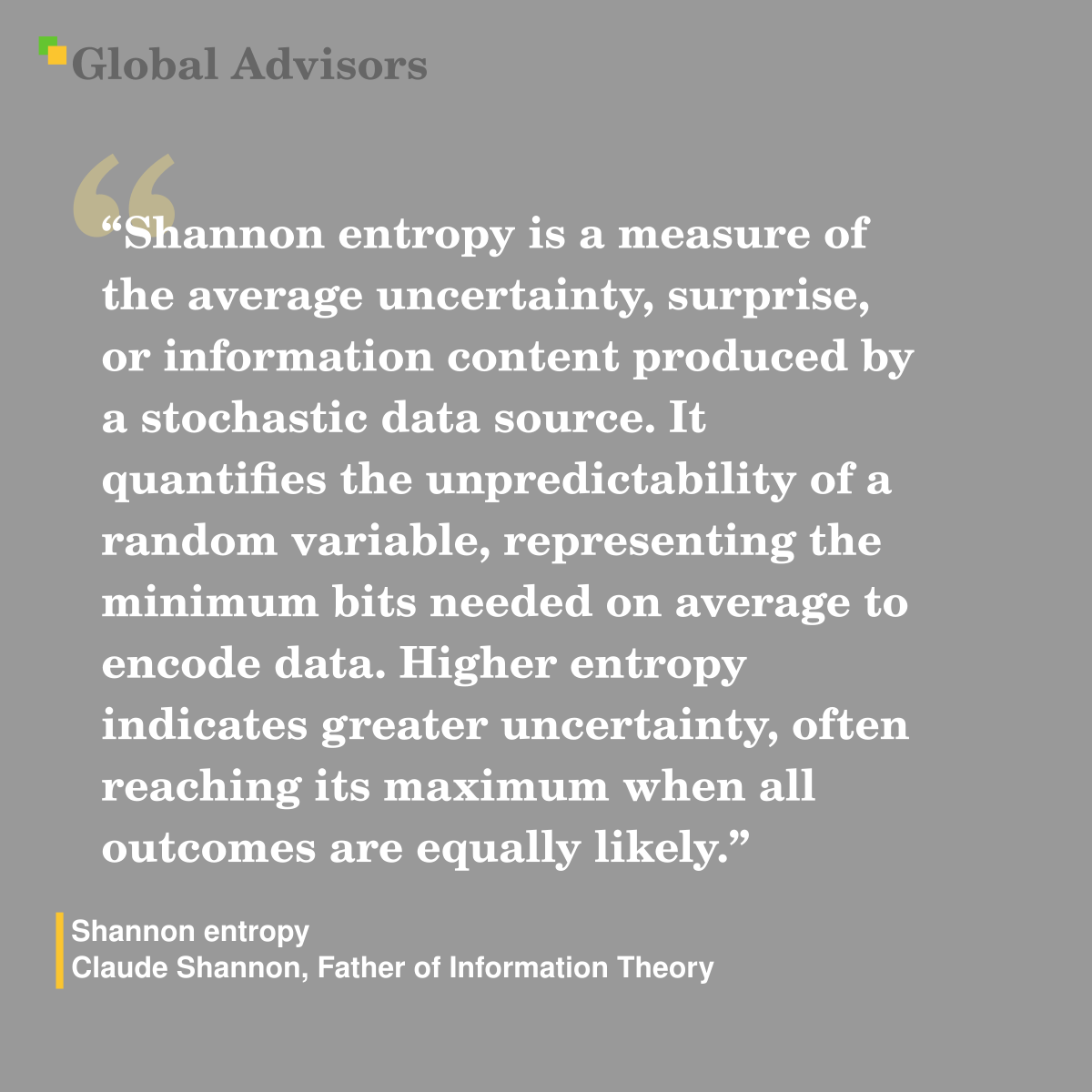
Term: Shannon entropy - Claude Shannon, Father of Information TheoryShannon entropy is a measure of the average uncertainty, surprise, or information content produced by a stochastic data source. It quantifies the unpredictability of a random variable, representing the minimum bits needed on average to encode data. Higher entropy indicates greater uncertainty, often reaching its maximum when all outcomes are equally likely. - Shannon entropy - Claude Shannon, Father of Information TheoryShannon entropy represents one of the most consequential abstractions in twentieth-century mathematics and engineering. Introduced by Claude Shannon in his 1948 paper "A Mathematical Theory of Communication," it provides a rigorous quantitative framework for measuring uncertainty, surprise, and information content in any stochastic system. Rather than treating information as a vague philosophical concept, Shannon transformed it into a measurable quantity-one that could be calculated, optimized, and engineered. This shift enabled the digital age itself. Core Definition and Mathematical FoundationShannon entropy, denoted as H(X), quantifies the average amount of information (measured in bits) required to encode the outcome of a random variable. For a discrete random variable X with possible outcomes x1, x2, ..., xn and corresponding probabilities p(x1), p(x2), ..., p(xn), entropy is calculated as: H(X) = ?? p(xi) log2 p(xi) The logarithm base determines the unit: base 2 yields bits, base e yields nats, and base 10 yields dits. The negative sign ensures a positive result. Intuitively, entropy measures how "spread out" or uncertain a probability distribution is. A coin flip with equal probability of heads or tails (0,5 each) produces maximum entropy of 1 bit. A coin that always lands heads produces zero entropy-no uncertainty, no information. Practical Meaning and InterpretationEntropy answers a fundamental question: on average, how many yes-or-no questions must you ask to determine the outcome of a random event? For a fair six-sided die, entropy equals log2(6) ? 2,585 bits. This means you need roughly 2,585 binary questions on average to identify which face appeared. For a loaded die favoring one outcome, entropy drops-fewer questions suffice because the distribution is less uniform. In practical terms, entropy captures three related concepts:
Maximum Entropy and Uniform DistributionsEntropy reaches its maximum when all outcomes are equally likely. For n possible outcomes, maximum entropy equals log2(n). A fair coin has maximum entropy of 1 bit. A fair die has maximum entropy of log2(6) ? 2,585 bits. A uniform distribution over 1 000 equally likely outcomes has maximum entropy of log2(1 000) ? 9,966 bits. This principle has profound implications: systems with uniform distributions are hardest to predict and carry the most information per outcome. Applications Across DomainsCryptography and Security: Entropy is central to cryptographic strength. A password with high entropy is difficult to crack because the attacker faces maximum uncertainty about which combination is correct. A 128-bit encryption key with uniform randomness has entropy of 128 bits-meaning an attacker must on average try 2127 combinations to break it. Weak passwords with low entropy (predictable patterns, common words) can be compromised far more quickly. Data Compression: Shannon's source coding theorem proves that any lossless compression algorithm cannot compress data below its entropy rate on average. This theoretical limit drives the design of practical algorithms like Huffman coding and arithmetic coding. Understanding entropy helps engineers identify when further compression is impossible and when algorithmic improvements are still feasible. Machine Learning and Feature Selection: Information gain, derived from entropy, measures how much a feature reduces uncertainty about a target variable. Decision tree algorithms like ID3 and C4.5 use information gain to select which features split data most effectively. High-entropy features provide more discriminative power. Communication Systems: Channel capacity-the maximum rate at which information can be reliably transmitted over a noisy channel-depends directly on entropy. Shannon's channel coding theorem establishes that reliable communication is possible up to the channel capacity, which is determined by the entropy of noise and signal characteristics. Natural Language Processing: Language models estimate the entropy of text. English has estimated entropy around 1,5 bits per character when accounting for statistical structure. This low entropy reflects the redundancy and predictability of language-why autocomplete works and why typos are often recoverable. Schools of Thought and Theoretical ExtensionsClassical Information Theory: Shannon's original framework treats entropy as a property of probability distributions. This remains the dominant approach in engineering and computer science. It is objective, calculable, and directly applicable to communication and compression problems. Bayesian Perspective: Some theorists interpret entropy as a measure of subjective uncertainty or degree of belief. From this view, entropy quantifies how much an observer's beliefs are spread across possibilities. This interpretation connects information theory to Bayesian statistics and decision theory. Thermodynamic Connection: Entropy in statistical mechanics and thermodynamics shares mathematical form with Shannon entropy. Ludwig Boltzmann's entropy formula S = k log(W) resembles Shannon's formula. This connection is not coincidental-both measure the number of microscopic configurations consistent with a macroscopic state. Some physicists argue this reveals a deep unity between information and thermodynamics, though others caution against over-interpreting the analogy. Algorithmic Information Theory: Gregory Chaitin and others developed algorithmic entropy (Kolmogorov complexity), which measures the length of the shortest computer program that generates a string. This differs from Shannon entropy by focusing on individual sequences rather than probability distributions, yet both capture intuitions about randomness and compressibility. Tensions and DebatesEntropy and Meaning: Shannon entropy measures information quantity, not quality or meaning. A random string has high entropy but conveys no semantic content. This limitation prompted later theorists to develop semantic information measures, though these remain less tractable mathematically. The distinction matters: a novel contains less Shannon entropy than random noise of equal length, yet carries far more meaningful information to a reader. Discrete vs. Continuous: Shannon entropy is well-defined for discrete random variables but becomes problematic for continuous distributions. Differential entropy can be negative and lacks some properties of discrete entropy. This technical issue has spawned alternative formulations and ongoing debate about the proper generalization. Subjective vs. Objective: Is entropy a property of the data source itself, or does it depend on an observer's knowledge? If you know a coin is biased but others do not, does the entropy differ? Classical information theory treats entropy as objective (determined by the true probability distribution), but Bayesian approaches allow subjective entropy based on beliefs. This tension reflects deeper questions about the nature of probability itself. Practical Measurement: Calculating entropy requires knowing true probability distributions, which are often unknown in practice. Estimating entropy from finite samples introduces bias and variance. Different estimation methods (plug-in, Miller-Madow, Chao-Shen) yield different results, creating practical ambiguity despite theoretical clarity. Why Shannon Entropy Still MattersMore than 75 years after Shannon's foundational work, entropy remains central to multiple fields. In cybersecurity, entropy quantifies password strength and random number quality. In machine learning, information gain guides model training. In data science, entropy helps identify which variables carry predictive power. In physics, connections between information and thermodynamics continue to deepen. The concept endures because it solves a genuine problem: how to measure uncertainty rigorously. Before Shannon, "information" was intuitive but unmeasurable. Shannon made it concrete, mathematical, and actionable. This transformation enabled engineers to design optimal communication systems, cryptographers to reason about security formally, and data scientists to select features systematically. Moreover, entropy captures something fundamental about reality. Systems with high entropy are harder to predict, control, and compress. This principle applies whether you are designing a cipher, compressing a file, or understanding why weather forecasts become unreliable beyond two weeks. Shannon entropy is not merely a mathematical convenience-it reflects deep structural properties of uncertainty itself. The ongoing relevance of Shannon entropy also reflects the enduring importance of information as a central concept in science and technology. As systems become more complex and data-driven, the ability to quantify and reason about information becomes more valuable. Shannon provided the foundational language for that reasoning, and that language remains indispensable. References 1. https://x.com/techNmak/status/2043253999391129878 - https://x.com/techNmak/status/2043253999391129878
|
| |
| |
Quote: Warren Buffet - Former Berkshire Hathaway CEO"What you're really looking for in life is something where you've got a job that you'd hold if you didn't need the money." - Warren Buffet - Former Berkshire Hathaway CEOUnderstanding the QuoteThe quote 'What you're really looking for in life is something where you've got a job that you'd hold if you didn't need the money.' captures Warren Buffett's philosophy on career fulfillment. It emphasizes pursuing work driven by passion rather than just financial necessity1. Context and AttributionAttributed to Warren Buffett, former Berkshire Hathaway CEO, this insight aligns with his views on loving your work. A similar sentiment appears in a 2025 Business Insider article discussing Buffett's hiring advice during a Dairy Queen CEO interview, highlighting passion as key to success[source]. Related Quotes from Buffett
Why It Matters for Leadership and CareersBuffett's advice resonates in **leadership** and **careers**, promoting passion as a driver of long-term success and happiness. It encourages persistence in finding meaningful work amid common tags like inspiration and motivation1. References 1. https://www.goodreads.com/quotes/7600403-never-give-up-searching-for-the-job-that-you-are 2. https://www.nasdaq.com/articles/warren-buffett-take-job-you-love-2016-04-22
|
| |

| |
Quote: General Eric Shinseki - Former U.S. Army Chief of Staff"If you don't like change, you're going to like irrelevance even less." - General Eric Shinseki - Former U.S. Army Chief of Staff
General Eric K. Shinseki served as the 34th Chief of Staff of the U.S. Army from 1999 to 2003 and later as Secretary of Veterans Affairs from 2009 to 2014. He was the first Asian-American four-star general.4 This quote emphasizes the importance of embracing change in **leadership** to avoid becoming irrelevant, a theme Shinseki applied during his efforts to modernize Army technology despite resistance.3 The quote appears with slight variations across sources, such as "you'll like irrelevance even less"1,2,5 or "you're going to dislike irrelevance even more,"4 first documented in a 2001 National Review Online article.4 References 1. https://www.goodreads.com/quotes/8074749-if-you-don-t-like-change-you-ll-like-irrelevance-even-less 3. https://www.insidearm.com/news/00045509-if-you-dont-change-youre-going-irrelevanc/ 4. https://en.wikiquote.org/wiki/Eric_Shinseki 5. https://quozio.com/quote/7315ee76
|
| |

| |
Term: Jump-diffusion framework - Robert C. Merton - 1976The jump-diffusion framework, pioneered by Robert Merton in 1976, is a financial modeling approach that extends the classical Black-Scholes option pricing model by introducing discontinuous, sudden price changes ("jumps") alongside continuous, daily price fluctuations ("diffusion"). - Jump-diffusion framework - Robert C. Merton - 1976 The Black-Scholes model revolutionised option pricing by treating asset prices as continuous processes governed by geometric Brownian motion. Yet empirical observation revealed a persistent problem: real market returns exhibit fat tails and sudden, large movements that the model systematically underestimates. Stock prices do not move smoothly. They leap. Takeover announcements, regulatory decisions, earnings surprises, and macroeconomic shocks create discontinuities that no amount of volatility adjustment within a purely diffusive framework can capture. Robert Merton's 1976 jump-diffusion model addressed this gap by superimposing a jump component onto the familiar diffusion process, creating a hybrid framework that reflects how financial markets actually behave. The Structural Problem with Pure Diffusion The Black-Scholes assumption that asset prices follow geometric Brownian motion implies that price changes are infinitesimally small and continuous. Under this framework, the probability of a large price movement in a short time interval approaches zero. Empirically, this assumption fails. Market crashes, flash events, and sudden information arrivals produce price jumps that violate the continuity assumption. These discontinuities have profound consequences for option pricing. When jumps occur, the standard dynamic hedging strategy that underpins Black-Scholes breaks down: an option holder cannot perfectly replicate the payoff by continuously rebalancing a position in the underlying asset and a risk-free bond, because the underlying can move discontinuously between rebalancing moments. This hedging failure means that jump risk cannot be fully diversified away, and option prices must reflect compensation for bearing this non-hedgeable risk. The empirical signature of this problem is the volatility smile: options at different strike prices trade at implied volatilities that vary systematically, contradicting the Black-Scholes prediction of constant volatility across strikes. Jump-diffusion models, and Merton's framework in particular, generate volatility smiles endogenously because jumps create fat-tailed return distributions, making out-of-the-money options relatively more valuable than the Black-Scholes model suggests. Mathematical Specification Merton's jump-diffusion model specifies the risk-neutral dynamics of the stock price as: where is the risk-free rate, is the volatility of the continuous diffusion component, is the increment of a standard Brownian motion, and represents the jump component. The jump process is governed by a compound Poisson process with intensity , meaning that jumps arrive randomly with expected frequency per unit time. The magnitude of each jump, denoted , is random and follows a lognormal distribution: , where is the mean log-jump size and is its variance. The term in the drift represents the expected return contribution from jumps, where is the expected jump magnitude. This adjustment ensures that the model remains internally consistent under the risk-neutral measure: the expected return on the stock under the risk-neutral probability is , the risk-free rate, as required for arbitrage-free pricing. The model decomposes into two components. The diffusion component captures small, continuous price movements driven by the arrival of routine information. The jump component captures rare but large discontinuous movements. This decomposition is not merely mathematical convenience; it reflects the economic reality that markets process information at different frequencies and magnitudes. Option Pricing Under Jump-Diffusion Pricing European options under Merton's framework requires solving a partial differential equation that generalises the Black-Scholes equation. The key insight is that the option price must satisfy a valuation equation that accounts for both the diffusive and jump components of risk. Unlike the Black-Scholes case, where dynamic hedging eliminates all risk, the jump component introduces systematic risk that cannot be hedged away. Merton's solution assumes that jump risk is not priced-that is, investors do not demand additional compensation for bearing jump risk beyond what is already reflected in the underlying asset's price. This assumption simplifies the mathematics but is not universally accepted; alternative frameworks allow for a market price of jump risk. Under Merton's assumption, the European call option price can be expressed as an infinite series of Black-Scholes terms, weighted by the probability of observing different numbers of jumps over the option's life: The price is a probability-weighted average of Black-Scholes prices, each computed with an adjusted volatility and effective time to maturity that depends on the number of jumps assumed to occur. If zero jumps occur (probability ), the option price is simply the Black-Scholes price with parameters . If one jump occurs, the calculation adjusts for the expected jump magnitude and its timing. The series converges rapidly in most practical cases, making the model computationally tractable. A critical consequence is that Merton's model produces option prices higher than Black-Scholes for out-of-the-money options and lower for in-the-money options, generating the characteristic volatility smile. The magnitude of this effect depends on the jump parameters: higher jump intensity , larger expected jump size , and greater jump volatility all increase the value of out-of-the-money options relative to Black-Scholes. Extensions and Refinements Merton's original framework has spawned numerous extensions. The double exponential jump-diffusion model, proposed by Kou and others, replaces the lognormal jump distribution with a mixture of two exponential distributions, one for upward jumps and one for downward jumps. This modification yields closed-form solutions for a wider range of exotic options, including barrier options, lookback options, and perpetual American options, which are difficult or impossible to price analytically under the original lognormal specification. The double exponential model sacrifices some realism in the jump distribution but gains analytical tractability, making it attractive for practitioners who require fast, reliable pricing across multiple instruments. More recent work has combined jump-diffusion dynamics with stochastic volatility, allowing both the diffusion volatility and the jump intensity to vary over time. These hybrid models capture both the continuous mean-reverting nature of volatility (addressed by models like Heston) and the discontinuous shocks in asset prices (addressed by Merton's framework), producing even more realistic return distributions and volatility surfaces. Practical Implications and Limitations The jump-diffusion framework has become standard in quantitative finance for option pricing, risk management, and trading strategy development. Traders and risk managers use it to price options more accurately than Black-Scholes, particularly for instruments sensitive to tail risk or for portfolios exposed to event risk. The model's ability to generate volatility smiles without resorting to ad hoc adjustments makes it theoretically more satisfying than simply varying volatility by strike. However, the framework carries important limitations. Estimating the jump parameters , , and from historical data is challenging, particularly for rare events. Jump intensity is difficult to estimate precisely because jumps are, by definition, infrequent. The assumption that jump risk is not priced is controversial; empirical evidence suggests that investors do demand compensation for bearing jump risk, especially during periods of market stress. Additionally, the model assumes that jumps follow a fixed distribution (lognormal or exponential), whereas real market jumps may exhibit time-varying characteristics or regime-dependent behaviour. The hedging problem also remains unresolved in a practical sense. Although Merton's framework acknowledges that jump risk cannot be hedged dynamically, it does not provide a complete solution for managing this risk in real portfolios. Practitioners must either accept the unhedged jump risk, use static hedges (such as buying out-of-the-money options), or employ more sophisticated dynamic strategies that adjust for estimated jump risk. Why the Framework Endures Nearly fifty years after its introduction, Merton's jump-diffusion framework remains central to quantitative finance because it addresses a fundamental tension between mathematical elegance and empirical reality. The Black-Scholes model is elegant precisely because it assumes continuity and constant volatility, allowing closed-form solutions. But this elegance comes at the cost of systematic mispricing, particularly for options exposed to tail risk. Merton's framework sacrifices some mathematical simplicity-option prices are now infinite series rather than closed-form expressions-but gains empirical realism. The framework also provides a conceptual bridge between two schools of thought in financial modelling. One school emphasises the importance of capturing realistic return distributions, including fat tails and skewness. The other emphasises the need for tractable, implementable models. Jump-diffusion models occupy the middle ground: they are more realistic than pure diffusion models yet more tractable than fully non-parametric approaches. For traders navigating volatile and complex markets, this balance between realism and tractability remains invaluable. |
| |
| |
Quote: Professor John Ousterhout - Stanford"A little bit of slope makes up for a lot of y-intercept." - Professor John Ousterhout - StanfordOrigin of the Quote"A little bit of slope makes up for a lot of y-intercept." This memorable line comes from Professor John Ousterhout during a lecture in his Stanford CS140 Operating Systems class on January 13, 2012.1,2 Mathematical MeaningIn a linear equation y = mx + b, where m is the slope and b is the y-intercept, even a small positive slope (m) will eventually surpass lines with higher starting points (b) over time. Professor Ousterhout notes this is mathematically obvious.2 Life ApplicationBeyond math, Ousterhout applies it to life: how fast you learn matters more than what you know initially. People overemphasize existing knowledge and underemphasize learning speed. A modest growth rate overcomes a strong starting position.2
Relevance to Success and GrowthThis principle resonates in computer science, career development, and personal growth. Starting early with consistent learning outpaces those with initial advantages but no progress. Comments echo: "If you start early, even with a small slope and a low intercept, you will surpass many with higher intercept but with zero slope."2 Context: CS140 CourseCS140 at Stanford, taught by John Ousterhout, covers operating systems fundamentals like concurrency, memory management, and file systems. The quote appeared in a Winter 2012 session, aligning with themes of systems evolution and continuous improvement.3,4,6
References 2. https://gist.github.com/gtallen1187/e83ed02eac6cc8d7e185 3. https://web.stanford.edu/~ouster/cgi-bin/cs140-spring18/lecture.php?topic=intro 4. https://web.stanford.edu/~ouster/cgi-bin/cs140-spring20/index.php 5. https://www.scs.stanford.edu/10wi-cs140/notes/l1-print.pdf 6. https://web.stanford.edu/~ouster/cgi-bin/cs140-winter12/index.php 7. http://www.contrib.andrew.cmu.edu/~bblum/thesis.pdf 9. https://web.stanford.edu/~ouster/cgi-bin/cs140-winter13/staff.php
|
| |

| |
Term: Platform risk"Platform risk is the vulnerability created by relying on a third-party platform (e.g., AI, AWS, Shopify, social media, payment processors) for core business operations. If the platform changes, your business can lose revenue, customer access, or infrastructure stability overnight." - Platform riskPlatform risk is the vulnerability created by reliance on a third-party platform for core business functions, compounded by the platform’s ability to expand upstream or downstream into adjacent layers of the value chain. In an AI-led economy, this risk is no longer limited to operational dependency; it increasingly reflects the strategic exposure that platform providers—particularly large AI and cloud ecosystems—can internalise customer relationships, replicate core capabilities, and compete directly with firms built on top of them. Platform risk therefore extends beyond service instability or policy changes. It captures the structural asymmetry whereby platforms control critical infrastructure (compute, models, distribution, data access) while simultaneously developing application-layer capabilities that encroach on their customers’ economic territory. As AI platforms evolve from tooling providers into full-stack ecosystem players, they can reprice, re-bundle, or vertically integrate in ways that compress margins, disintermediate intermediaries, and capture a disproportionate share of value. At its core, platform risk arises from concentrated dependency on external ecosystems that control infrastructure, intelligence, and market access. In the current cycle, this is amplified by the rapid capability expansion of AI providers.
Key Characteristics and Types of Platform RiskAt its core, platform risk arises from over-dependence on external services that control key aspects of a business, including infrastructure, distribution, monetisation, and customer engagement. Businesses often adopt these platforms for their scalability, cost-efficiency, and access to vast audiences, yet this creates single points of failure1,4,5.
Mitigating Platform RiskTo manage this risk, businesses should first map all dependencies, assessing their impact on revenue and operations. Diversify across multiple platforms, build contingency plans like backup systems, and monitor uptime metrics and policy changes. Regularly evaluate high-dependency services-those accounting for over 70% of sales or traffic-and invest in resilience strategies such as owned infrastructure or multi-vendor approaches4. Implications for StrategyThe defining shift is that platform risk is no longer purely defensive (resilience, redundancy), but strategic (positioning within an evolving value chain). Firms must explicitly decide where they sit relative to dominant platforms—whether as complementors, aggregators, or independent providers—and recognise that this position may be transient. Mitigation therefore requires more than diversification:
Related Strategy Theorist: Clayton ChristensenThe concept of platform risk aligns closely with the theories of Clayton Christensen, the Harvard Business School professor renowned for developing Disruptive Innovation theory. Christensen's work, particularly in books like The Innovator's Dilemma (1997) and The Innovator's Solution (2003), highlights how established firms-and by extension, businesses reliant on them-face existential threats from rapid technological shifts and dependency on dominant platforms. While Christensen focused on entrants displacing incumbents from below, AI platforms represent a parallel dynamic: powerful intermediaries moving laterally and vertically to absorb adjacent value pools. The risk is not only disruption from new entrants, but envelopment by the very platforms enabling growth. In this context, platform dependency accelerates modularisation, but AI re-integrates capabilities at the platform level—reversing the traditional value chain and concentrating power. Firms that fail to anticipate this shift risk being compressed into interchangeable components within a broader ecosystem. Born in 1952 in Salt Lake City, Utah, Christensen earned a BA from Brigham Young University, an MPhil from Oxford as a Rhodes Scholar, and an MBA and DBA from Harvard. His career spanned consulting at BCG, academia, and advising global leaders. Disruptive Innovation explains how simpler, cheaper technologies initially serve overlooked markets but eventually upend incumbents, much like how platform changes (e.g., AWS policy shifts or Shopify algorithm updates) can disrupt dependent businesses. Christensen applied these ideas to platforms in later works, warning of 'modularisation' risks where over-reliance on external ecosystems erodes control and invites sudden value destruction. His frameworks urge strategic diversification and building internal capabilities to counter such vulnerabilities, directly informing platform risk management5. Christensen's insights remain vital for today's AI-driven, cloud-centric economy, where platform dependencies amplify disruptive forces he first charted.
References 1. https://enlivy.dev/platform-risk-what-you-should-know/ 2. https://www.hirefacilitator.com/blog/what-is-platform-risk 3. https://simplicable.com/en/platform-risk 6. https://thecreatorsdiary.com/platform-risk/ 7. https://www.netwitness.com/cyber-glossary/risk-operations/ 8. https://www.allianz-trade.com/en_US/insights/business-risks.html
|
| |

| |
Term: Red Queen competition"The 'Red Queen' competition, or effect, is a business and evolutionary theory stating that companies must constantly innovate and run at maximum speed just to maintain their current market position. This dynamic forces continuous adaptation, but risks stagnation or failure if firms only work harder rather than smarter." - Red Queen competitionThe Red Queen competition, or effect, describes a dynamic where companies must continuously innovate and adapt at full speed merely to maintain their market position, much like the Red Queen in Lewis Carroll's Through the Looking-Glass who tells Alice, 'it takes all the running you can do, to keep in the same place'.3 Originating from evolutionary biology, this hypothesis posits that species-and by extension, businesses-must evolve constantly because their competitors and environments are also changing, turning competition into an unending arms race.1,3 In business terms, stagnation leads to irrelevance or extinction, as even superior efforts can be nullified by rivals' responses, demanding not just harder work but smarter strategies like differentiation and predictive data use.2,3 Origins in Evolutionary BiologyThe concept draws directly from Leigh Van Valen's 1973 paper 'A New Evolutionary Law', where he introduced the Red Queen Hypothesis to explain why organisms must adapt perpetually in co-evolving ecosystems.3 Van Valen, a palaeontologist at the University of Chicago, observed that survival rates decline over time not due to external catastrophes but because competitors evolve countermeasures, such as parasites adapting to hosts or predators to prey.1,3 This zero-sum game underscores that innovation alone is insufficient without meaningful adaptation; for instance, Kodak invented the digital camera in 1975 but failed to pivot from its film business, leading to bankruptcy in 2012.4 Applications in Business StrategyIn competitive markets, firms face similar pressures: even market leaders like Apple or Google cannot rest, as new entrants or technologies-such as IBM's Watson challenging search dominance-emerge relentlessly.1 Warren Buffett illustrated this with Berkshire Hathaway's textile investments, where cost reductions were undermined by competitors' price cuts, yielding poor returns.2 Strategies to counter it include escaping 'red oceans' of cut-throat rivalry via 'blue ocean' innovation, as per W. Chan Kim and Renée Mauborgne, or leveraging data for prediction in commoditised futures.1,3
Best Related Strategy Theorist: Michael PorterThe most pertinent strategy theorist linked to Red Queen competition is Michael Porter, whose Five Forces model complements the hypothesis by emphasising that competition extends beyond direct rivals to include suppliers, buyers, substitutes, and new entrants-all co-evolving forces firms must anticipate.1 Porter's framework warns that strategies provoke reactions, mirroring the Red Queen's arms race, where even dominance invites countermeasures, as seen when Apple's iPhone resurgence spurred superior Android rivals.1 Born in 1947 in New York, Porter earned a BSE from Princeton, an MBA from Harvard, and a PhD in Business Economics from Harvard, joining Harvard Business School faculty in 1973-the same year Van Valen published his hypothesis.1 His seminal works, including Competitive Strategy (1980) and Competitive Advantage (1985), introduced the Five Forces and value chain analysis, revolutionising how firms assess industry dynamics. Porter's career spans advising governments and corporations, founding strategy consultancies, and influencing global competitiveness indices. His emphasis on sustainable advantage through positioning aligns with escaping Red Queen traps, advocating analysis of rivals' likely responses rather than isolated innovation.1 To thrive amid Red Queen pressures, businesses should innovate smarter-diversifying ideas externally, building data moats, and fostering adaptive cultures-ensuring they not only run but outpace the pack.2,3 References 1. https://erisstrategy.com.au/red-queen-hypothesis-playing-to-win-in-the-brand-evolutionary-arms-race/ 2. https://www.revelo.com/blog/red-queen-hypothesis 3. https://scet.berkeley.edu/red-queen-inevitability-amazoogle-business-model/ 4. https://www.shortform.com/blog/the-red-queen-effect/ 5. https://theinnovationshow.io/healthy-terrain-healthy-business-the-red-queen-hypothesis/ 6. https://www.ascm.org/ascm-insights/the-red-queen-hypothesis/ 7. https://dksmo.com/blog/red-queen-effect/
|
| |

| |
|


| |
| |