| |
|

| |
| |
| |
|
Our selection of the top business news sources on the web. |
| |
| |
| |
Quote: Benedict Evans - Independent analyst"Don't stick your head in the sand and say, 'I hate all of this stuff.' That gives you a great feeling of moral superiority and you can go on Bluesky and shout at everybody about how evil AI is. Great, I'm happy for you, but that's not going to help. What helps is you diving into this and coming out understanding what you can do with it today." - Benedict Evans - Independent analyst The real tension is not between optimism and pessimism about AI, but between posture and practice. Evans is pushing against a kind of performative refusal: the emotionally satisfying move of treating AI as inherently corrupt, then converting that stance into public identity, while leaving the underlying technology untouched. His argument is that rejection may feel morally clean, but it does not change the fact that the tools are already being built, deployed, and woven into workflows across software, media, knowledge work, and administration . That matters because AI is not arriving as a single finished product with a neat set of social outcomes. It is arriving as a general-purpose capability whose effects depend on how it is embedded. In his broader work, Evans has repeatedly framed AI less as a monolithic intelligence and more as an enabling layer, similar to earlier platform shifts such as the internet and mobile, with the important caveat that the scale is large without being mystical . The practical question is therefore not whether one likes the technology in the abstract, but which tasks it can already improve, which ones it cannot, where it creates leverage, and where it introduces fresh failure modes . The strategic problem behind the rhetoric The rhetoric around AI often collapses three separate debates into one: whether the technology is impressive, whether its deployment is socially desirable, and whether its adoption can be slowed or redirected by denunciation. Evans separates those layers. His argument, as reflected in the source material, is that public moral outrage can become a substitute for analysis, especially on social platforms where opposition is rewarded with status signals and shared grievance . That dynamic is attractive because it offers immediate emotional certainty, but it is strategically weak because it does not answer the harder question of adaptation. The underlying strategic problem is that AI changes the economics of knowledge work by lowering the cost of many low- and medium-complexity tasks, while leaving judgment, integration, and accountability in human hands for longer than the hype cycle suggests. Evans has said in multiple discussions that the most interesting use cases are not abstract claims about artificial general intelligence, but concrete applications where people can ask a model to do useful work today: analyse cancellations, parse documents, guide forms, summarise information, or assist in coding and software development . That is a more awkward story than the grand narrative of replacement, but it is the story that shapes budgets, hiring, and competitive advantage. Why refusal is a weak strategy One reason the refusal posture is weak is that it confuses moral evaluation with operational response. A company, profession, or individual may decide that certain AI uses are unacceptable, but that decision does not remove competitive pressure from the market. If rivals are using AI to shorten response times, reduce support costs, or speed up software delivery, then abstention becomes a strategic choice with measurable trade-offs rather than a pure ethical position . The same logic applies to workers: a blanket refusal to learn the tools may preserve a sense of coherence, yet it can also reduce employability in environments where AI becomes part of the expected toolkit. Evans is not arguing that criticism is illegitimate. His point is that criticism becomes more credible when it is paired with operational understanding. That distinction matters because the most consequential debates about AI are not about whether it is good or bad in a totalising sense. They are about where it can be used safely, where it fails, how it should be governed, and how institutions should absorb it without degrading quality . A refusal to engage leaves those questions to people who are more interested in shipping products than in reflecting on their broader consequences. The practical value of engagement Engagement does not mean naïve enthusiasm. It means acquiring enough familiarity to distinguish between capabilities that are real and those that are theatrical. Evans's earlier writing suggests that the strongest AI thesis is not that one model magically solves every problem, but that a model can become a flexible interface over many tasks, provided the surrounding workflow is designed correctly . That is a subtle but important shift. It moves AI away from the fantasy of autonomous replacement and towards a reality of assisted production, in which the human operator remains responsible for framing the task, checking output, and deciding whether the result is acceptable. This is also why coding has emerged as a breakout use case. Software is already digital, the feedback loops are fast, and the domain has enough structure for models to provide obvious productivity gains without requiring the full complexity of the physical world . Once a technology proves itself in a high-velocity environment like software development, it becomes easier for businesses to imagine extensions into support, operations, finance, legal workflows, and internal knowledge systems. The significance is not that every task becomes automated. It is that the marginal cost of trying changes, and that alone can alter organisational behaviour. The moral superiority trap The language of moral superiority is central because it captures a recurring feature of technology debates: opposition can become a social performance detached from operational reality. Evans's target is not principled disagreement but the shortcut whereby people enjoy the identity benefits of resistance while avoiding the effort of understanding the tool they are criticising . That shortcut is especially tempting in AI, because the technology sits at the intersection of labour, creativity, power, and status. It therefore invites symbolic positioning, not just technical assessment. But symbolic positioning has limits. If the technology is becoming embedded in search, office software, customer service, design, programming, and content production, then the relevant questions become more granular: which roles are exposed first, what forms of human oversight remain necessary, how quality assurance changes, and what kinds of failures are tolerable . Moral language is often too blunt to answer those questions. It can identify anxiety, but it rarely produces a usable operating model. What the debate is really about The deeper disagreement is over pace and shape. Critics often assume that if a technology is important, then its consequences must be immediate, total, and visible. Evans's view is closer to the historical pattern of earlier platform shifts: transformative technologies usually matter first in narrow, messy, and unequal ways before they become generalised . That means the early evidence can look underwhelming to people expecting dramatic collapse, while still being sufficient to change incentives inside firms. There is also a genuine debate about whether AI is primarily a labour-saving tool or a new layer of infrastructure. If the models themselves become the value-capture point, then the economics may look concentrated. If, instead, the models become a commodity layer on which applications are built, then the value may move upward or outward into workflow software, services, and domain-specific products . Evans's work leans towards the idea that the most enduring effects may sit in how AI is applied rather than in the models alone . That makes the near-term competitive field more complex than the public conversation suggests. Why this matters now The urgency comes from the mismatch between how people talk about AI and how organisations actually adopt technology. Public debate rewards certainty, but deployment rewards iteration. A firm cannot manage AI risk by declaring it bad; it must decide where to allow it, where to block it, how to audit it, and how to train staff to use it responsibly. Likewise, an individual cannot assess the impact of AI on their career from slogans alone. They need exposure to the tools, because real displacement or augmentation will be mediated by tasks rather than ideology . That is the most durable implication of Evans's position: understanding is a form of leverage. The people who stand outside the technology and denounce it may preserve a sense of purity, but they surrender influence over how the technology is used. The people who enter the system, test it, and learn its failure modes are better placed to shape policy, product design, and workplace norms . In a field moving as quickly as AI, that difference is not philosophical. It is commercial, organisational, and increasingly personal.
|
| |

| |
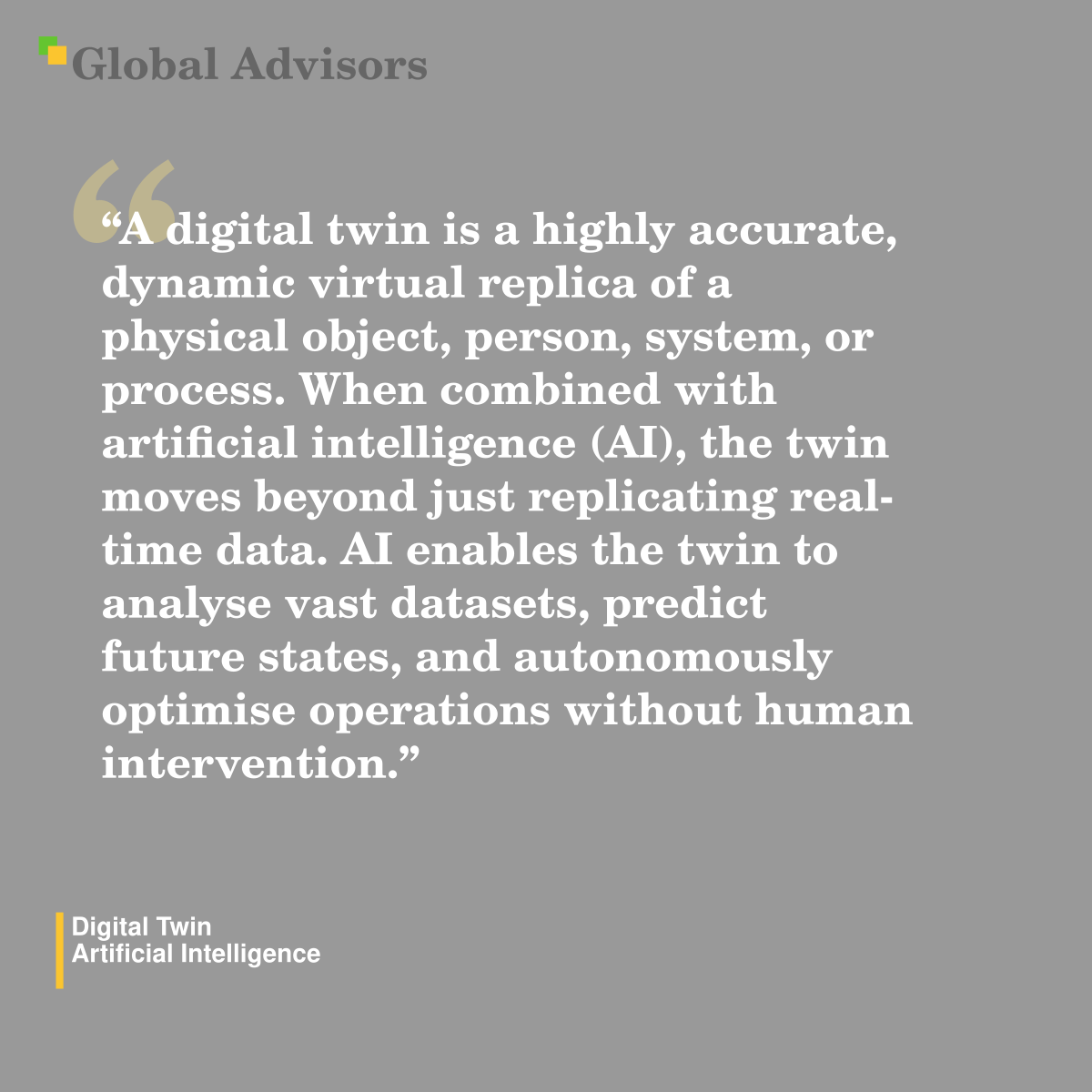
Term: Digital Twin - Artificial Intelligence"A digital twin is a highly accurate, dynamic virtual replica of a physical object, person, system, or process. When combined with artificial intelligence (AI), the twin moves beyond just replicating real-time data. AI enables the twin to analyse vast datasets, predict future states, and autonomously optimise operations without human intervention." - Digital Twin - Artificial Intelligence Operational systems increasingly need to be observed, predicted, and controlled as tightly coupled cyber-physical entities, not as isolated machines or spreadsheets of KPIs. The underlying issue is how to turn streaming telemetry, historical records, and domain knowledge into a continuously updated, decision-ready model that can both interpret current behaviour and test future interventions. Digital twins enhanced with artificial intelligence address this by binding data, models, and control logic into a dynamic virtual counterpart that can experiment safely while the physical system keeps running. From passive monitoring to active optimisation Traditional monitoring tools collect data and display dashboards, leaving humans to interpret patterns and decide what to do next. Conventional simulations, meanwhile, are static models that run offline on assumed conditions. The practical challenge is that complex assets and processes - an aircraft engine, a hospital, a city-scale energy grid - change faster than static models can be updated and exhibit interactions too intricate for simple rules of thumb. Digital twins resolve this tension by maintaining a high-fidelity virtual representation that is synchronised in real time with the physical counterpart via sensors and data platforms . When artificial intelligence is added, the role of the twin shifts from passively mirroring reality to actively exploring and optimising it. Machine learning models embedded in the twin learn from time-series telemetry and historical incidents, forecasting likely future states and detecting anomalies that human operators would miss . Optimisation algorithms and AI planners then evaluate alternative actions - maintenance schedules, configuration changes, routing decisions - and recommend or autonomously trigger the option expected to best meet objectives such as cost, safety, throughput, or energy use . This turns the twin into a decision engine rather than a visualisation tool. Core mechanisms and data flows The defining mechanism is a two-way data connection between the physical entity and its virtual counterpart. Sensors and operational systems stream telemetry - temperatures, vibrations, pressures, positions, inventory levels, patient metrics - into the twin, often via IoT networks and industrial data platforms . The twin's models process this input to maintain a live state and perform analyses. In the opposite direction, the twin produces recommendations or control signals that influence the physical system, such as adjusting setpoints, rescheduling jobs, or changing treatment plans . This closed loop allows the combination of data and AI to be applied continuously rather than in occasional studies. Data flows typically include three layers. First, raw telemetry, events, and contextual information (environmental conditions, schedules, configuration metadata) are ingested and harmonised into a common schema. Second, analytics and AI models transform this data into derived features - health indicators, risk scores, predicted demand - and scenario evaluations. Third, decision logic maps these model outputs into specific actions or alerts, factoring in business rules, regulatory constraints, and operator preferences . Over time, feedback from executed actions feeds back into model training, creating a learning loop. Practical meaning in industrial and service contexts In manufacturing, the practical consequence is that production engineers gain a live "digital sandbox" of the factory or process. They can simulate different batch sizes, routing rules, or layout changes inside the twin, observe expected utilisation, bottlenecks, and energy consumption, and only roll out changes that perform well in the virtual environment . Predictive models embedded in the twin anticipate machine failures or quality drift, enabling maintenance to be scheduled at convenient times and reducing unplanned downtime . This can translate directly into lower scrap rates, reduced maintenance labour, and higher throughput per line. In energy networks, twins of turbines, substations, or entire grids enable operators to model the effect of weather patterns, load surges, or equipment outages before they occur. AI components learn relationships between conditions and failures, recommending reconfigurations or dispatch strategies to maintain stability and minimise losses . For built environments - offices, campuses, or smart cities - twins provide a unified view of occupancy, HVAC performance, lighting, and security systems. Optimisation algorithms can then adjust settings to balance comfort with energy efficiency, often cutting consumption without major capital investment . In healthcare, patient-specific digital twins combine clinical records, imaging, sensor data, and biomechanical models to create virtual avatars that approximate an individual's physiology . AI-supported twins can simulate disease progression under different treatment options, estimate the risk of flares, and help design personalised rehabilitation regimes or dosage schedules . This reduces reliance on trial-and-error in the clinic and enables safer testing of innovative interventions before applying them to the patient. Conceptual structure and variants Although implementations vary by sector, most digital twin architectures share three conceptual layers. The first is the descriptive layer: a virtual model that represents geometry, topology, and configuration of the physical entity. This could range from a detailed CAD model of a component to a process flow model of a production line or a systems model of a hospital. The second is the analytical layer: algorithms and AI models that interpret data, run simulations, and compute KPIs. The third is the prescriptive and control layer: the set of rules, planners, and interfaces that turn analytical outputs into operational decisions . Within this structure, practitioners often distinguish between asset-level twins and system-level twins. An asset twin focuses on a single physical item, such as an engine or a robot, providing detailed health monitoring and failure prediction. A system twin models interactions across multiple assets and processes - for example, an entire factory, a logistics network, or a hospital ward - allowing optimisation of flows, capacities, and resource allocation . As AI capabilities evolve, there is growing interest in person-level twins, particularly in healthcare and elite sport, where the physical counterpart is an individual human rather than a machine . Mathematical specification and AI integration Mathematically, a digital twin can be seen as a stateful model that maps observed variables and inputs into a latent system state and predicted outcomes. Let the physical system's state at time be represented by , observed through telemetry , and controllable inputs . The twin maintains an estimate via a state estimation function , such that , where are model parameters learned from data. Predictive components compute future trajectories for steps ahead. AI models implement and as machine learning architectures (e.g. recurrent networks, transformers, probabilistic models) trained on historical sequences and updated with streaming data . Optimisation is often formalised as selecting control actions to minimise an expected cost function over a horizon . For example, given a cost , where penalises downtime, energy use, or safety risk, the AI planner searches over candidate sequences to find approximately optimal policies subject to constraints representing physical or regulatory limits. In complex settings, this is solved using reinforcement learning, model predictive control, or heuristic optimisation within the twin, leveraging its fast simulation capabilities . For predictive maintenance, a simple probabilistic formulation might model time to failure as a random variable with distribution inferred from telemetry history. A commonly used approach is to assume a parametric distribution such as or a survival model and update and with incoming data; the twin then recommends maintenance when exceeds a threshold for some lead time . Here, AI improves the fidelity of by capturing non-linear relationships between operating conditions and degradation . Key parameters and modelling choices Several parameters critically shape the behaviour and value of an AI-enabled twin. Data latency determines how close the virtual state is to real time; high-latency data can make predictions stale, while ultra-low latency streams demand more robust engineering and edge processing. Spatial and temporal resolution specify how fine-grained the model is - whether it tracks component-level temperatures every second or aggregate performance every hour. Model fidelity reflects how accurately the twin captures physics, control logic, and interactions; higher fidelity typically requires more data and computational effort. On the AI side, choices include the type of models used for different tasks: time-series forecasting models for demand and degradation, anomaly detection algorithms for spotting unusual behaviour, and causal or counterfactual models for estimating the impact of interventions. Hyperparameters such as learning rates, regularisation strengths, and window sizes influence stability and responsiveness. In autonomous scenarios, policy parameters in reinforcement learning or optimisation weights in multi-objective formulations determine how the twin trades off competing goals like cost versus reliability or speed versus quality . Major schools of thought One strand of thinking emphasises engineering roots, treating digital twins primarily as advanced simulation and control models grounded in physics-based representations. Here, the focus is on rigorous system identification, numerical methods, and safety-critical verification. AI plays a supporting role, augmenting classical models with data-driven corrections where physics is incomplete or too complex to model analytically . This perspective is common in aerospace, automotive, and energy sectors with strong engineering cultures. A second school is data-centric, viewing twins as overlays on large data platforms whose main function is to orchestrate analytics and machine learning at scale. In this view, the twin is less a detailed physical model and more a semantic layer that ties together data from IoT devices, enterprise systems, and simulations into a coherent operational picture . AI becomes central, from predictive models to generative techniques that synthesise missing data and scenario variants. This orientation dominates narratives within Industry 4.0 and AI-first organisations. A third perspective emerges in healthcare and personalised medicine, where the twin is conceived as a patient or human avatar integrating multi-modal data - clinical, behavioural, genomic - to support prediction and decision-making . The debate here centres on how far a twin can approximate individual physiology and whether such models should be used for high-stakes decisions. AI is essential, but it is constrained by ethical, legal, and interpretability requirements, leading to hybrid models that combine mechanistic descriptions with machine learning . Tensions, risks, and debates The first tension concerns autonomy. As AI-enhanced twins become capable of recommending and even executing actions, organisations must decide how much decision-making to delegate. In industrial environments, fully autonomous optimisation might conflict with operator intuition, safety protocols, or union rules. In healthcare, autonomy raises ethical questions about consent, accountability, and the acceptability of algorithmic treatment decisions. The debate is not only technical but institutional: how to structure governance and oversight for systems that continuously act based on learned patterns . Another debate centres on model realism versus practicality. High-fidelity twins with detailed physics and rich AI components can be expensive to build and maintain, especially when telemetry is noisy or incomplete. Some practitioners argue for minimal viable twins focused on specific high-value use cases - such as predictive maintenance for a handful of critical assets - rather than grand, all-encompassing models of entire organisations. Others view comprehensive twins as necessary infrastructure for long-term digital transformation and systemic optimisation . The choice affects investment profiles, required skills, and expectations about ROI. Data quality, privacy, and security form a third area of tension. Twins depend on continuous data flows, often from sensitive sources such as medical devices, worker wearables, or critical infrastructure sensors. Poor data quality can mislead AI models, while breaches or misuse can have serious consequences. In healthcare, building patient twins raises concerns about re-identification, surveillance, and secondary use of data. As AI models become more complex, explaining their recommendations to regulators and stakeholders becomes harder, increasing calls for transparency, validation, and robust risk management frameworks . Why AI-driven digital twins still matter Despite hype cycles and competing technologies, AI-enabled digital twins continue to matter because they align closely with structural shifts in how organisations operate. As systems become more interconnected and data-rich, the ability to reason about them in a unified, dynamic model - and to test changes safely before implementation - is a durable need. Twins provide a way to convert fragmented telemetry into coherent situational awareness and to use AI not just for offline analytics but for continuous, operational decision support . In sectors facing tight resource constraints and sustainability pressures, the capability to optimise energy use, reduce waste, and extend asset life via predictive and prescriptive analytics embedded in twins can have material economic and environmental impact . In healthcare, the prospect of more personalised, proactive care based on AI-supported patient twins offers a route to managing chronic disease burdens and complex treatment decisions . As generative AI and agent-based architectures mature, twins are likely to become increasingly conversational and autonomous, orchestrating actions across diverse systems while remaining anchored to the physical realities they represent . The continuing importance lies not in the label but in the underlying capability: maintaining a living, data-driven model of critical assets, systems, or people that can learn, predict, and act. Artificial intelligence expands this capability from faithful mirroring to intelligent stewardship, turning digital twins into central infrastructure for organisations seeking to manage complexity, risk, and performance in real time.
|
| |
| |
Quote: Kevin Warsh"It is called the lump-of-labor fallacy for a reason. Who knew when the internet was born that the internet was going to create a million and a half jobs as Uber drivers? We are in the first or second inning of [the AI] revolution. This is a big paradigm shift, both for the conduct of our policy and for our economies. I think the jobs will be greater and prosperity will be stronger." - Kevin Warsh - Chair of the Board of Governors of the Federal Reserve, CNBC policy panel at the ECB Forum on Central Banking 1 July 2026 Anxiety about artificial intelligence and jobs reflects a deeper confusion about how modern economies generate work, absorb technological shocks, and turn productivity gains into living standards. In public debate, the prospect of widespread automation is often treated as a zero-sum contest in which every task performed by a machine implies a human job lost forever. That framing misdiagnoses both the nature of labour demand and the historical record of past technological upheavals, from electrification and mass manufacturing to the internet and platform economies. It also risks steering policy towards defensive attempts to freeze existing job structures rather than towards the institutional and macroeconomic adjustments needed to harness a new wave of productivity growth. The lump-of-labour intuition and why it keeps returning The underlying belief that fuels much contemporary fear is the notion that there is a fixed quantity of work to be done in an economy. If technology allows one group of workers, or machines, to perform more tasks, the remaining workers are assumed to be surplus to requirements. Economists label this the lump-of-labour fallacy: the mistaken idea that the aggregate demand for labour is constant, so any addition of workers or machines simply redistributes a finite stock of jobs. The doctrine has intuitive appeal. Individuals experience work as slots: a firm has a certain number of positions; if a robot takes one of those positions, a person is displaced. At the level of a single factory or office, that description may be accurate in the short term. But labour demand at the macroeconomic level is a derived demand: it is determined by the demand for goods and services that labour helps produce. When productivity increases, unit costs tend to fall, prices are reduced or quality improves, and new customers enter the market. The resulting expansion of output often raises, rather than reduces, total labour demand, even if the mix of occupations changes. Historically, each major general-purpose technology has triggered a similar wave of fear. Mechanisation provoked nineteenth-century worries about permanent unemployment among textile workers; electrification reshaped manufacturing employment; computers were forecast to end clerical work. Yet in advanced economies, employment as a share of the adult population rose over long periods, especially for women, while working hours declined. The fallacy persists because transitional pain is real: job losses in specific sectors occur before new roles are visible, and those losses are concentrated in communities and occupations with limited mobility. Internet platforms and the emergence of unforeseen occupations The experience of the commercial internet illustrates how technological change can generate new forms of work that would have been difficult to anticipate during its early development. In the 1990s, policymakers discussed the web primarily as an information medium and a communication tool. Few foresaw a global ecosystem of search engine optimisation consultants, social media managers, app developers, and content creators. Ride-hailing services provide a vivid example: by combining smartphones, mapping, digital payments and algorithmic matching, platforms such as Uber enabled millions of people to earn income through quasi-formal driving work, often on a flexible basis that blurred the boundary between employment and self-employment. From an aggregate labour-market perspective, this was not a straightforward net addition of jobs. Platform driving substituted for some traditional taxi work and for other forms of casual labour. But the key analytical point is that the technology did not merely redistribute a pre-existing lump of tasks. It lowered transaction costs in urban transport, brought new riders into the market, and turned underutilised time and assets into productive inputs. In standard economic terms, a fall in the effective price of rides expanded demand; as demand rose, so did the derived demand for driving services, even if the nature and stability of those roles raised separate regulatory questions. For central banks and macroeconomic policymakers, the internet boom posed an early version of today's challenge: how to interpret a technology-driven surge in productivity that coexisted with structural labour-market change. Alan Greenspan's decision to allow the US economy to "run hot" in the late 1990s rested on a belief that higher measured and unmeasured productivity growth would allow faster output expansion without igniting inflation. That judgement reflected a willingness to treat technological progress as a disinflationary force, at least while labour supply and institutional frameworks could accommodate workers moving into new sectors. AI as a new general-purpose technology Artificial intelligence now occupies a similar, but more pervasive, role in macroeconomic debate. Advances in generative models, pattern recognition and optimisation promise simultaneous shocks to productivity across services, manufacturing, logistics, finance and creative industries. Senior policymakers increasingly frame AI as a general-purpose technology with the potential to reshape both the structure of the economy and the transmission of monetary policy. Kevin Warsh has argued in speeches and testimony that AI is rapidly reshaping the US economy and that the Federal Reserve will need substantial changes in its models to account for the technology's impact. His view emphasises AI as a significant disinflationary force: by enabling workers and firms to produce more output with the same or fewer inputs, AI should lower the cost of goods and services and relieve some of the upward pressure on prices. That perspective connects directly to the historical experience of the internet and earlier waves of digitisation, in which higher productivity helped central banks maintain or lower interest rates even as economies expanded. Conceptually, an AI-driven productivity shock can be represented in standard growth accounting. Output depends on capital , labour , and total factor productivity . A simple formulation is . AI, in this framing, operates primarily through : better algorithms, decision-making and automation raise , allowing higher for given and . If monetary policy holds nominal demand roughly stable, higher can lead to downward pressure on prices rather than reduced employment, provided that labour and capital reallocate towards expanding sectors. The macroeconomic policy tension: productivity vs unemployment risk The debate among central bankers and economists centres on how quickly and smoothly that reallocation occurs, and whether AI's productivity effects could be so extreme that they overwhelm traditional adjustment mechanisms. At the European Central Bank's annual forum, participants highlighted both the opportunity for efficiency gains and the risk that AI could accelerate bubbles, transmit shocks through financial markets, and destabilise labour demand in ways that conventional models may not capture. One scenario discussed in policy circles imagines AI-driven automation replacing large segments of routine and cognitive work, from call centres and paralegal tasks to driving and warehousing. If the resulting productivity gains are huge, the cost of these services might plummet. Consumers would have more disposable income, which they could spend on new goods and experiences, creating fresh jobs elsewhere. This is the canonical anti-lump-of-labour mechanism. However, if automation outpaces the creation of new high-demand sectors, or if capital owners capture the bulk of the gains without translating them into broader spending, the adjustment could be slower, leading to pockets of long-term unemployment and downward pressure on wages. Critics of an overly optimistic view argue that standard economic reasoning relies on assumptions about demand elasticity and redistribution that may not hold in extreme AI scenarios. If machines perform an ever-widening set of tasks, including creative and managerial functions, the share of income going to labour could fall significantly. In that case, the circular flow described in textbooks-workers earn wages, spend them on goods and services, businesses hire more workers-may be disrupted. The lump-of-labour fallacy, they contend, is not a fallacy in every conceivable technological regime; rather, it is an empirical claim about how far substitution can proceed before the structure of income and demand fundamentally changes. Warsh's stance within the emerging policy landscape Warsh's position sits within a broader spectrum of central bank thinking. He acknowledges labour concerns but insists that the labour market will evolve over time, with new roles emerging even as some existing jobs are displaced. In his public remarks, he stresses that AI does not repeal the basic logic of competitive markets or the derived nature of labour demand. Instead, he views AI as an accelerant of trends already familiar from earlier technological shifts, such as the internet: greater productivity, lower costs, and new categories of employment that are difficult to forecast in advance. For the Federal Reserve, such a stance has concrete policy implications. If AI is expected to be a disinflationary force, the central bank may judge that the neutral interest rate-consistent with stable inflation and full employment-is lower than previously assumed. That could justify a more accommodative stance than headline inflation data might suggest, especially if AI-related productivity gains are initially undercounted. However, Warsh has also emphasised that near-term inflation risks have only recently declined and that the Fed must still work to manage elevated prices. AI therefore becomes part of a medium-term story about potential growth and the equilibrium real interest rate, rather than a justification for immediate aggressive easing. Furthermore, Warsh's comments about updating the Fed's models indicate an institutional recognition that standard forecasting tools-such as Phillips curve-based relationships between unemployment and inflation-may not fully capture AI-induced shifts in labour-market behaviour. If workers can augment their output dramatically using AI tools, measures of slack and productivity may become more volatile. Monetary policy would need to incorporate richer data on technology adoption, sectoral reallocation, and wage dispersion to avoid misreading the signals. Why the lump-of-labour dispute matters for AI governance The argument over whether fears of job loss are a fallacious carryover from earlier eras, or a rational response to a uniquely powerful technology, shapes not just interest-rate decisions but the broader governance of AI. If policymakers are persuaded that labour demand is fundamentally elastic and that new jobs will arise to absorb displaced workers, they are more likely to focus on transitional support: retraining schemes, portable benefits, and regional adjustment policies. If, by contrast, they believe that AI could induce a structural decline in labour's share of income and a persistent shortage of suitable jobs, they may consider more radical measures such as universal basic income, public job guarantees, or aggressive regulation of automation. Economic history offers both reassurance and caution. On the reassuring side, the simple circular-flow reasoning supported by empirical studies suggests that as workers gain new jobs and income, the additional spending increases demand for goods and services and thereby for labour. Labour is not a fixed resource; workers move from declining sectors to expanding ones, and the "economic pie" grows over time. On the cautionary side, globalisation and digitalisation have already produced regions and cohorts experiencing years of stagnation or decline, even while aggregate indicators improved. Institutional context-education systems, social insurance, labour-market flexibility, competition policy-determines how effectively economies reallocate workers. In the AI context, the distributional question looms particularly large. If AI makes low-wage jobs more productive, allowing the same output with fewer workers, the proportion of middle- and high-wage roles could rise, potentially reducing income inequality by expanding access to high-value services for lower-income households. Yet that benign scenario depends on complementary policies that foster broad AI access, prevent excessive concentration of market power, and mitigate the risks of algorithmic discrimination or exclusion. Debates, objections and political constraints Warsh's optimism about jobs and prosperity attracts several lines of criticism. First, some economists argue that general-purpose technologies may differ in their labour impact depending on which tasks they primarily automate. The internet and earlier computing waves largely enhanced information access and communications, creating new industries around digital advertising, e-commerce and user-generated content. AI systems that can handle complex reasoning, code generation and professional services may threaten a wider range of occupations, including many that were previously insulated. Second, sceptics question the pace at which new roles appear. Historically, job-creating industries have sometimes lagged behind job-destroying innovations, leaving multi-decade stretches of adjustment. If AI accelerates both destruction and creation, but institutional mechanisms for retraining and relocation remain slow, communities dependent on vulnerable sectors could face prolonged stress. The lump-of-labour fallacy, they suggest, may be less a logical error and more a reflection of practical bottlenecks in matching displaced workers to emerging opportunities. Third, political economy considerations complicate the picture. Large firms investing heavily in AI may have incentives to lobby for regulatory frameworks that favour capital-intensive solutions over labour-intensive ones. If those firms capture outsize productivity gains and return them primarily to shareholders, the macroeconomic feedback loop from wages to demand could weaken. Central banks might then confront a world in which headline productivity is strong, inflation is subdued, but labour participation and wage growth stagnate, challenging traditional mandates focused on maximum employment and price stability. Finally, there is an epistemic objection: the claim that we simply do not yet know enough about AI's trajectory to make confident statements about its long-run labour impact. Warsh himself acknowledges that key effects remain uncertain and that the Fed must update its frameworks as evidence accumulates. This humility contrasts with stronger pronouncements from both techno-optimists and AI pessimists, underscoring that the argument about the lump-of-labour fallacy is partly a dispute about the reliability of historical analogies in unprecedented circumstances. Why the argument matters for future prosperity Despite disagreement on specifics, the discussion reveals a common thread: the prosperity of advanced economies over the coming decades will hinge on how effectively they translate AI-driven productivity into broad-based gains in employment, income and welfare. A policy stance that overestimates the risk of permanent job loss may discourage innovation and lead to defensive regulation that freezes outdated production structures. Conversely, an overly sanguine belief that jobs will always appear could justify neglect of transitional support and structural reforms. Warsh's framing places central banks in an active role. By recognising AI as both an opportunity and a source of model uncertainty, monetary authorities are encouraged to reconsider assumptions about equilibrium interest rates, inflation dynamics and labour-market slack. At the same time, their mandate does not extend to redistributive policy, education or industrial strategy. That division of responsibilities means that even if AI turns out to be strongly disinflationary and job-creating at the aggregate level, failings in other parts of the policy system could still leave many workers behind. The unresolved tension between lump-of-labour intuitions and dynamic labour-demand models therefore matters far beyond academic economics. It shapes public expectations, electoral debates and the legitimacy of institutions tasked with managing technological transitions. If societies accept that the amount of work is not fixed but remain sceptical that new work will be accessible and decent, they may demand more explicit guarantees of inclusion. The way central bankers, including Warsh, articulate the relationship between AI, jobs and policy will influence whether those demands are channelled into constructive reforms or into resistance to technological change itself. Ultimately, the question is not whether AI will eliminate a certain share of current occupations, but whether economic systems can be steered so that higher productivity expands the range of meaningful, well-paid work rather than narrowing it. Contesting the lump-of-labour fallacy is one part of that steering: it insists that labour demand can grow with innovation. The harder task lies in building the institutional scaffolding-skills, mobility, safety nets, competition frameworks-that ensures the expansion of jobs and prosperity that optimistic policymakers anticipate becomes a lived reality rather than a theoretical promise.
|
| |
!["It is called the lump-of-labor fallacy for a reason. Who knew when the internet was born that the internet was going to create a million and a half jobs as Uber drivers? We are in the first or second inning of [the AI] revolution. This is a big paradigm shift, both for the conduct of our policy and for our economies. I think the jobs will be greater and prosperity will be stronger." - Quote: Kevin Warsh - Chair of the Board of Governors of the Federal Reserve, CNBC policy panel at the ECB Forum on Central Banking 1 July 2026](https://globaladvisors.biz/wp-content/uploads/2026/07/20260701_17h45_GlobalAdvisors_Marketing_Quote_KevinWarsh_GAQ.png)
| |
Global Advisors News Brief - July 2 2026Read the full brief at the link Headlines for the last 24hrs
Time window: 2026-07-01T05:00:33.070Z to 2026-07-02T05:00:33.070Z |
| |
| |
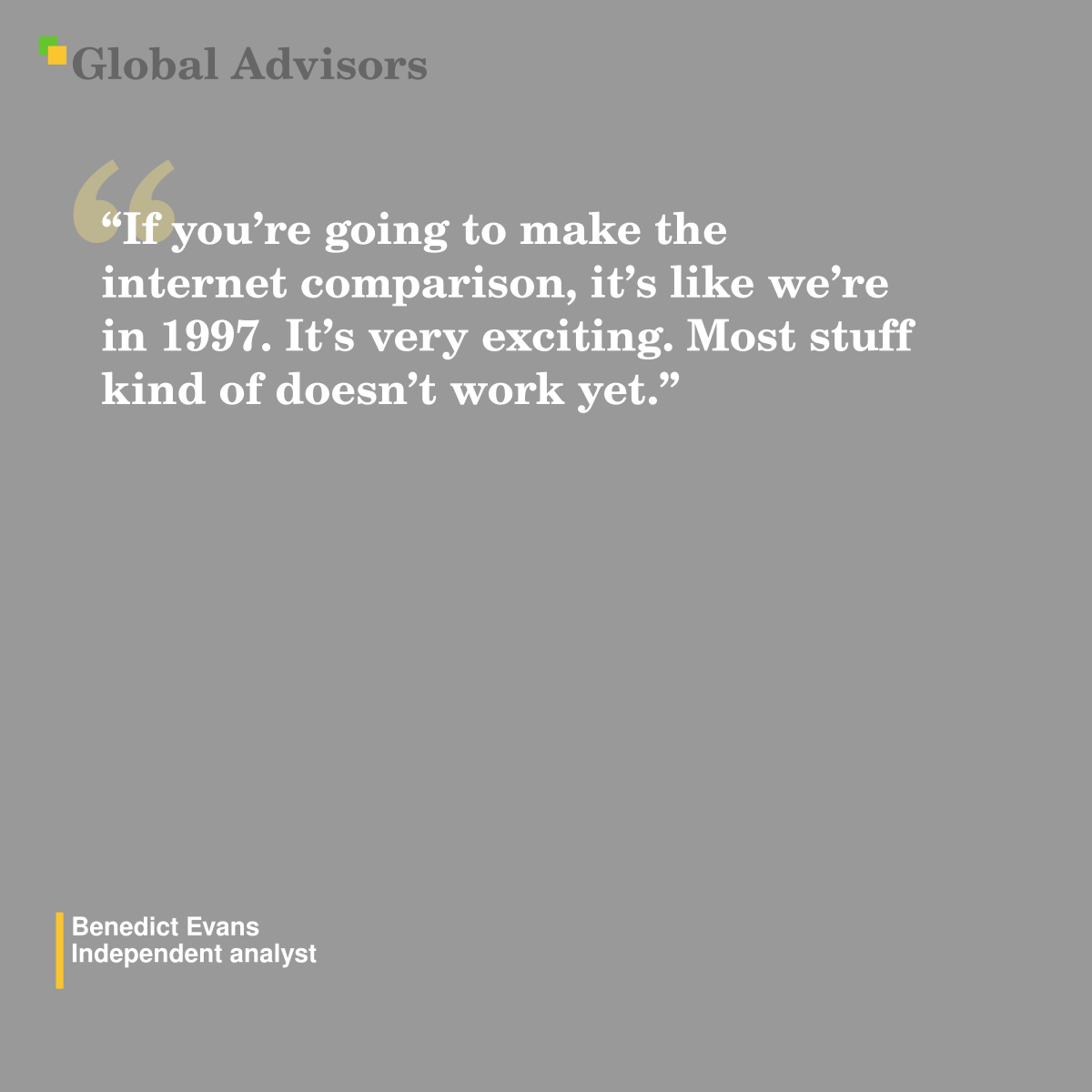
Quote: Benedict Evans - Independent analyst"If you're going to make the internet comparison, it's like we're in 1997. It's very exciting. Most stuff kind of doesn't work yet." - Benedict Evans - Independent analyst The recurring difficulty in technology cycles is distinguishing genuine platform shifts from speculative hype before the evidence is obvious. In artificial intelligence, the tension is acute: spectacular demonstrations sit alongside brittle systems, unclear business models and unpredictable cost curves, leaving practitioners unsure whether to treat current systems as infrastructure or experiments. The comparison with the commercial internet in the late 1990s is not about nostalgia; it is about how industries mis-price uncertainty when a technology is clearly powerful but operationally incomplete. Early platform moments and radical uncertainty The late 1990s were a period when the web was clearly going to be important, but almost no-one could specify how, for whom, or on what economic terms. Large incumbents funded speculative online divisions; start-ups raised capital on traffic metrics; and regulators struggled to map law designed for physical trade onto digital flows. Much of the infrastructure that would eventually make the internet ubiquitous either did not yet exist or was only partially deployed: broadband penetration was low, mobile data was negligible, and payment rails were fragmented. The current AI cycle exhibits a similar structure of known significance, unknown specifics . On any reasonable reading of the research trajectory, the capability frontier in machine learning has shifted substantially: models that perform language understanding, image generation, code synthesis and multi-modal reasoning at usable levels were simply not available a decade ago. Yet across most domains outside software development, robust product-market fit is partial at best. Organisations sense that ignoring AI is strategically dangerous, but cannot reliably determine which use cases will endure or how value will be captured. This pattern produces what Benedict Evans describes as a posture of "radical uncertainty": it is rational to assume that AI is transformative on the scale of the internet or mobile, while simultaneously accepting that most current artefacts are prototypes rather than settled products. The strategic challenge is therefore allocating capital, attention and organisational change in a context where timelines, winners and margins are all contested. Why "most stuff kind of doesn't work yet" Describing AI systems as "not working" is not a claim that they fail in all tasks; it is a statement about their reliability, scope and integration. In 1997, web pages loaded slowly, browsers crashed, payment systems were clunky, and basic actions like finding information or completing a purchase were error-prone compared with offline alternatives. Nevertheless, those fragile services pointed to entirely new ways of doing media, retail and communication. Current AI systems exhibit analogous fragility. Large language models hallucinate facts, struggle with long-horizon reasoning, and degrade under distribution shift; generative image systems mis-handle edge cases and embed training-data biases; and applied models often require extensive prompt engineering or guardrails to behave within acceptable safety boundaries. For many enterprise workflows, this yields value only when a human is firmly in the loop, constraining automation and complicating ROI calculations. The problem is compounded by infrastructure maturity. In many organisations, data is siloed, poorly labelled, or inconsistent, limiting the performance of domain-specific models and raising governance risks. Operationalising AI therefore demands simultaneous progress in data architecture, security, compliance and change management, not just model capability. The result is a landscape where demonstration projects look impressive, but production deployments remain narrow and fragile. Scale of impact: "as big as the internet or mobile" One of Evans' more controversial positions is that AI is "as big as the internet or mobile, and only as big". That formulation rejects both minimisation ("just another feature") and existential inflation ("beyond historical comparison"). By anchoring AI against the observed effects of the web and smartphones, the argument focuses analysis on what platform-scale change empirically looks like. The internet restructured distribution, lowered search costs and made information abundant. Mobile compressed those effects into personal context, creating continuous connectivity and location-aware services. AI, in this framing, is a third layer: pervasively embedding statistical inference and pattern recognition into interfaces, processes and decisions. Instead of treating models purely as centralised enterprise tools, the trajectory points towards AI-level capabilities being baked into most digital experiences, much as networking and touch screens are today. Thinking in platform terms matters because it changes strategic questions. The relevant issues are not whether a particular chatbot will dominate, but how AI affects cost structures, organisational design, regulatory regimes and competitive moats. As with the early internet, most enduring value is likely to be captured not by the first visible applications, but by businesses that correctly infer how the underlying capabilities alter industry economics. The 1997 internet analogy unpacked The comparison to 1997 does specific analytical work. That year sits after the web ceased to be fringe, but before search, social media, broadband and smartphones resolved the consumer experience into a mature pattern. For AI, the equivalent moment is one where models function well enough to be widely usable, but the larger stack - developer tools, standards, organisational practices, and complementary technologies - is not yet aligned. Several features of 1997 are salient: - Infrastructure present but partial . Core protocols existed and browsers were mainstream, but bandwidth, devices and hosting were constrained. Today's AI picture is parallel: transformer architectures, large-scale training and inference APIs are broadly available, yet context windows, latency, cost and tooling still limit what can be built. - Business models speculative . Early web firms monetised via banner advertising, subscription experiments or pure growth narratives. Current AI ventures are similarly divided between usage-based pricing, bundled SaaS add-ons, and pure platform plays, with unit economics often contingent on future cost curves. - Regulation and norms unsettled . Data privacy, jurisdiction, content liability and taxation for online activities were unclear in the 1990s. Today, policymakers struggle with AI-related copyright, safety standards, labour impacts and competition law, producing uncertainty for investors and operators. Positioning AI in "1997" therefore emphasises that a long, messy phase of experimentation and infrastructure building lies ahead. For participants, the implication is not to wait for clarity, but to recognise that present conditions are inherently provisional. Jobs, automation and misplaced apocalypses The analogy also reframes anxiety about employment. Each major technology cycle generates predictions of wholesale job destruction, often extrapolating from visible capability gains without accounting for institutional adaptation. Evans argues that fears of an imminent "job apocalypse" from AI repeat patterns seen around the internet and automation: genuine disruption, but not instantaneous collapse. The early web did eliminate certain roles - for instance, aspects of travel agency work, classified advertising or manual back-office processes - yet it also created new occupations in web design, digital marketing, e-commerce operations and software engineering that were hard to foresee ex ante. Similarly, mobile produced app ecosystems, gig work structures and location-based services. AI is likely to track this mixed pattern, altering task composition within roles as much as entire job categories. Critically, the current evidence suggests that coding is the clearest domain with strong product-market fit: developers using AI tools report substantial productivity improvements, even if these are not yet perfectly measured. Other domains, such as legal drafting, medical documentation or customer service, exhibit promising pilots but face heavier constraints from regulation, liability and organisational inertia. This divergence reinforces the idea that broad job impacts will be staggered and sector-specific, rather than uniform and immediate. Where value may accrue A central strategic question is who ultimately captures the surplus from AI deployment. During the internet's maturation, value pooled around a few horizontal platforms (search engines, social networks, cloud providers) and a series of vertical category leaders in e-commerce, media and software. Many early firms failed, not because demand for internet services vanished, but because they misjudged timing, economics or defensibility. In AI, there is an emerging stack with at least three economic layers: - Foundation and infrastructure : model providers, training hardware, data centres and orchestration tooling. - Horizontal application platforms : productivity suites, developer tools and integration frameworks embedding AI into general workflows. - Vertical and niche applications : sector-specific products built on top of models and infrastructure. The 1997 framing suggests that dominant players in each layer may not yet exist, and that switching costs, standards and regulatory constraints will significantly shape outcomes. For organisations, the safer assumption is that AI capability becomes ubiquitous and commoditised at the infrastructure level over time, shifting differentiating power towards proprietary data, domain knowledge and distribution. Technical and epistemological challenges One under-discussed aspect of the "most stuff doesn't work yet" observation is the epistemic instability of current AI techniques. Machine learning systems are fundamentally empirical: they learn statistical relationships from data rather than executing explicitly coded rules. A recent analysis argues that AI inherits a longstanding crisis from psychology, driven by the lack of a unified object of study, fragmented tasks and methodological eclecticism. This creates several practical difficulties. First, many models lack transparent mechanisms for explaining their decisions, complicating deployment in domains requiring accountability. Secondly, success in benchmark tasks does not necessarily translate into robust performance under real-world conditions, particularly when human behaviour responds strategically to the presence of AI systems. Thirdly, the relative success of existing approaches can discourage deeper critical reflection on their limitations. These challenges are not fatal, but they imply that reliability and trust will remain contested for some time. As with security and privacy on the early web, repeated failures are likely to drive iterative improvements in architecture, tooling and governance. However, the process will be uneven, and some classes of application may prove far harder to stabilise than optimistic early demos suggest. Analogy as a tool for strategic reasoning The use of historical analogy is not simply rhetorical. Cognitive science research indicates that analogical reasoning is central to human problem-solving, allowing us to project structure from familiar domains onto unfamiliar ones. When analysts invoke the 1997 internet to describe AI, they are engaging in a specific form of analogical mapping: identifying relational similarities (early infrastructure, speculative business models, regulatory lag) while acknowledging differences in detail. Work on analogy shows that the level of abstraction at which similarities are represented strongly affects how useful the analogy becomes. A superficial comparison (e.g. "lots of start-ups and hype") yields little guidance. A relational comparison - focusing on mechanisms such as network effects, cost declines, and complement development - can support more disciplined scenario planning. In this context, the 1997 analogy helps strategists think about: - How long it may take for AI to become boring infrastructure embedded in everything. - Which institutional adaptations (regulatory, organisational, educational) are typically required for a technology to stabilise. - Where mispricings of risk and opportunity are likely to occur, based on past cycles. Of course, analogies can mislead. The internet did not involve models making probabilistic inferences on human language at scale, nor did it raise identical safety questions about system autonomy or alignment. Analysts must therefore use historical comparison as a starting point, not an endpoint, testing where structural differences break the mapping. Why the moment is strategically uncomfortable For decision-makers, the present AI landscape is uncomfortable precisely because the technology is both too promising to ignore and too immature to plan around with confidence. Capital markets, media and internal stakeholders demand clear strategies and timelines, yet the rational stance is that many current assumptions - about costs, architectural patterns, dominant vendors and regulatory regimes - may be wrong. Evans' suggestion that people stop hiding from the technology and instead start using it reflects a pragmatic response to this discomfort. In an environment of radical uncertainty, learning-by-doing becomes a critical hedge: small-scale experimentation, capability building and cultural acclimatisation improve an organisation's option value irrespective of which specific AI paradigm wins. This echoes the late-1990s behaviour of firms that invested early in web literacy, internal tooling and online branding, positioning themselves to move faster once the infrastructure matured. Debates and objections The 1997 comparison is not universally accepted. Critics argue that AI may be more discontinuous than the internet, with potential to disrupt cognitive labour in ways that lack historical precedent. Others suggest that the pace of diffusion is faster today, given cloud infrastructure and existing digital workflows, implying that the "early" phase will be shorter. There are also concerns that safety and alignment issues make AI qualitatively different from previous platform shifts, requiring more conservative deployment. Defenders of the analogy respond that earlier technologies also provoked existential anxieties, from industrial automation to nuclear power, and that the eventual pattern was mixed: significant disruption, but embedded within broader institutional evolution. They contend that viewing AI as another major, but not unbounded, platform helps avoid both complacency and catastrophism, enabling more tractable discussions about governance, regulation and economic impact. Ultimately, the usefulness of the 1997 framing depends on how seriously one takes radical uncertainty. If the future path of AI is assumed to be largely determined and visible, the analogy looks unnecessarily cautious. If, however, one accepts that current systems may be several iterations away from their mature forms, then emphasising how much "doesn't work yet" becomes a way of protecting against premature extrapolation. Why it matters now The substantive meaning of Evans' remark is that AI should be treated as a major structural shift whose full consequences remain undecided. The technology is powerful enough that ignoring it is likely to be costly, but immature enough that making large, irreversible bets on specific applications or vendors is risky. Navigating this tension is now a central strategic problem for organisations, investors, policymakers and workers. For practitioners, the lesson is to separate conviction about direction from confidence about detail. It is reasonable to believe that AI-enhanced systems will permeate most digital workflows, just as networked services and mobile devices did. It is much less reasonable to assume that any particular current configuration - a given model architecture, product category or pricing structure - will survive intact. This distinction enables committed experimentation without dogmatic commitment. For policymakers, appreciating the "1997" nature of the moment underscores the need for adaptive regulation. Just as early internet rules evolved through trial, error and jurisprudence, AI governance will likely require iterative approaches, focusing first on clear harms while leaving room for positive-sum innovation. Overly rigid frameworks risk locking in today's imperfect systems; overly lax ones may allow preventable damage. And for individuals, the comparison serves as a reminder that skill sets, habits and mental models will need periodic revision. Learning to work effectively with imperfect AI tools - much as earlier generations learned to navigate clunky browsers, unstable connections and evolving interfaces - is likely to be more valuable than trying to predict precise future labour-market configurations. The discomfort of using technology that "kind of doesn't work yet" is not a bug of the current moment; it is a feature of living through the build-out of a new computational substrate.
|
| |
| |
Quote: Kevin Warsh"[Artificial Intelligence] is one of the central questions that all of us have for our day jobs in evaluating output, employment, and inflation. These are big questions, in part because the rate of change of improvement in these models is moving at an exponential level. This is hyper-Moore's law stuff. While we might see business surveys that say it is no big deal, my speculation is that six months from now the surveys will be saying quite the opposite." - Kevin Warsh - Chair of the Board of Governors of the Federal Reserve, CNBC policy panel at the ECB Forum on Central Banking 1 July 2026 Central banks find themselves trying to steer an economy whose production frontier is shifting faster than their measurement systems, models, and institutional reflexes can adapt. The traditional assumption that changes in technology are slow-moving background forces is breaking down just as monetary authorities are being asked to deliver low and stable inflation, maintain high employment, and preserve financial stability in a world where computing capability and AI deployment are compounding at unprecedented speed. The immediate problem is not simply that artificial intelligence might raise or lower productivity; it is that the rate and uneven pattern of change threaten to make familiar relationships between output, jobs, and prices unreliable at precisely the moment when policy is highly sensitive to small misjudgements. From Gradual Technological Diffusion to Exponential AI Adoption Previous general-purpose technologies, such as electrification or the microprocessor, spread over decades, allowing labour markets, education systems, and regulatory frameworks time to co-evolve. AI appears to be following a different trajectory. Empirical work on large language models shows token prices in the inference market falling roughly 600-fold between 2020 and 2026, with economy-tier models exhibiting a price half-life of around 1,10 years, substantially faster than the two-year benchmark associated with semiconductor progress under Moore's Law. Industry narratives of "Hyper Moore's Law" in AI emphasise annual doublings or triplings in effective compute performance, driven not only by hardware but by algorithmic efficiency, network architecture, and scale effects in data. This constellation of forces turns technological change from a slow economic backdrop into a central, near-term driver of macro dynamics. For monetary policy, the challenge is that AI diffusion is highly uneven: frontier firms in technology, finance, and professional services integrate advanced systems rapidly, while large parts of the economy remain in pilot mode. Micro-level studies show task-level productivity gains where AI assistants are deployed, with estimates of contributions to annual total factor productivity growth in the range of 0,3 to 0,9 percentage points over the next decade. Yet macro-level data so far detect only modest improvements in aggregate productivity growth, and many firms report useful but not transformative gains. Policymakers thus confront a hybrid reality: exponential technological potential with still-patchy adoption, leading to wide uncertainty about the timing and magnitude of macro effects. Output, Employment, and Inflation: A Mandate Under Strain The statutory mandates of major central banks - price stability and maximum sustainable employment - presuppose reasonably stable statistical relationships. Output gaps, Phillips curves, and measures of "natural" unemployment rely on historical patterns linking growth, joblessness, and inflation. AI threatens simultaneous shocks to each leg of this triangle. If AI boosts productivity, the same level of employment could produce more output, potentially lowering unit labour costs and dampening inflation pressures. If adoption also displaces workers or compresses demand for certain skill tiers, equilibrium unemployment might rise, complicating the interpretation of labour market slack. And if AI fuels new investment cycles in data centres, chips, and software, the capital-intensive nature of deployment could alter neutral interest rates and the transmission of monetary policy through financial markets. Officials are openly divided on these mechanisms. One camp emphasises AI as a disinflationary productivity engine, arguing that higher efficiency and lower marginal costs will give central banks space to accommodate stronger demand without triggering price spirals. Another stresses transitional frictions: elevated structural unemployment, sectoral mismatches, and potential cost-push pressures from constrained infrastructure and energy supply, all of which could sustain inflation even as output rises. The lack of definitive data - there is, as yet, limited evidence of AI having a large aggregate impact on wage growth or income distribution - forces monetary authorities into a probabilistic assessment of overlapping risks. Kevin Warsh's AI Productivity Thesis Against this unsettled backdrop, Kevin Warsh has advanced a relatively clear supply-side narrative: artificial intelligence will materially raise productivity, act as a significant disinflationary force, and thereby allow lower interest rates without destabilising prices. In public commentary and op-eds, he has characterised AI as a transformative boost to American competitiveness, arguing that traditional models overstate the link between tight labour markets and inflation when underlying technology is rapidly improving productive capacity. The core contention is that the central bank should treat AI-driven efficiency as an expansion of the economy's supply potential, which in turn justifies a looser stance than would otherwise be warranted by conventional indicators of employment or wage growth. Strategically, this position challenges the prevailing consensus that AI is not yet a reason to reduce policy rates. Most sitting policymakers acknowledge potential long-run gains but remain cautious, preferring to let realised data on inflation and employment guide decisions rather than extrapolating from speculative technology narratives. Warsh's view narrows this caution, effectively asking the institution to lean more heavily on forward-looking productivity assumptions and to discount some near-term inflation pressures as the transitory cost of adjusting to a higher-efficiency equilibrium. Hyper-Moore Dynamics and Monetary Strategy The reference to "hyper-Moore's law" condenses a broader perception that AI's improvement curve has moved beyond hardware-driven transistor scaling to a multi-factor exponential process. In semiconductors, Moore's Law originally captured the doubling of transistor density roughly every two years, delivering predictable gains in computing per dollar. That relationship has frayed as physical limits and economic constraints make further miniaturisation more difficult. AI has, paradoxically, arrived just as classical Moore's Law falters, but has generated its own compound curve through software, parallelism, and scale. Empirical work on AI agent capability, for instance, finds that the length of coding tasks frontier systems can autonomously complete is doubling approximately every 7 months, suggesting functional performance growth faster than traditional chip scaling. For a central banker, the critical issue is not the engineering detail but the macro consequence: policy models implicitly assume that technology progress is a slow-moving shock that can be captured by trend productivity parameters. Hyper-Moore dynamics break that assumption. If the effective cost of inference falls by an order of magnitude in a few years while capability surges, firms can reconfigure production processes, labour demand, and pricing strategies far more rapidly than historical data would predict. Survey-based measures of business conditions, often central to near-term policy deliberations, may lag actual behavioural shifts because managers only gradually realise how new tools alter competitive pressure and feasible workflows. Warsh's speculation that business surveys will move sharply within a six-month horizon implicitly recognises this lag. Early survey waves have tended to report AI as useful but non-transformational, with incremental investment plans rather than wholesale restructuring. However, as token prices collapse, accessible models proliferate, and practical success stories accumulate, managers may abruptly revise expectations about labour needs, cost bases, and pricing power. By the time those revisions show up in formal surveys, the underlying reallocation of tasks and capital may already be underway, leaving monetary policy reacting to second-order indicators rather than primary drivers. Labour Markets Between Disruption and Gradualism Employment is where the tension between exponential capability and institutional gradualism becomes sharpest. On one side are warnings that AI could raise the equilibrium unemployment rate, as displaced workers experience longer job searches and certain mid-skill clerical and analytical roles shrink. On the other side are analogies to past technologies: disruption creates new occupations, demand for complementary skills, and eventually higher overall employment once the reallocation phase is complete. Early evidence suggests a mixed picture. Task-level studies show improved efficiency, speed, and accuracy for workers using AI tools, often raising output per head without immediate job losses. At the same time, employers are reassessing entry-level hiring, automating routine tasks, and shifting human roles towards complex judgement, coordination, and client interaction. From a monetary policy perspective, the critical question is whether observed unemployment reflects cyclical weakness - something interest rate cuts can alleviate - or structural adjustment that is relatively insensitive to the policy rate. If AI pushes some workers into prolonged transition while simultaneously raising productivity among those who remain employed, standard indicators may mislead. An uptick in unemployment might coincide with firm-level profit growth and brisk investment in AI infrastructure, blurring the line between slack and overheating. In such a regime, lowering rates to support displaced workers could risk amplifying inflation in sectors experiencing AI-driven demand and pricing power. This possibility underpins the scepticism of officials who argue that AI is unlikely to justify near-term rate cuts. Their implicit model is one where supply-side gains and demand-side frictions run in parallel, requiring a cautious stance until data reveal whether the net effect is disinflationary or inflationary. Warsh's alternative is to place more analytical weight on the supply-side, betting that productivity effects will dominate and that the central bank can safely lean against transitional weakness without destabilising prices. Inflation Measurement and the Risk of Mis-calibration Inflation measurement is undergoing its own, quieter transformation. Headline indices capture average price changes across broad baskets, but they struggle to accommodate rapid quality improvements and new service bundles associated with AI. If AI tools dramatically improve output quality or reduce non-price costs such as time and error rates, official statistics may understate the effective welfare gain. Equally, if AI facilitates new forms of price discrimination, bundling, or subscription-based access, traditional indices may miss subtle shifts in pricing power and consumer surplus. Central banks experimenting with trimmed-mean or core measures, which strip out volatile components, are implicitly acknowledging that headline inflation can be noisy in a world of rapid technological change. The strategic risk is mis-calibration. If AI-related productivity gains are stronger than measured, central banks could hold policy unnecessarily tight, sacrificing employment and output to fight inflation pressures that are partly offset by technological efficiency. Conversely, if quality adjustments mask genuine price increases driven by infrastructure bottlenecks, energy constraints, or concentrated market power in AI platforms, authorities might loosen policy on the assumption of benign technology-driven disinflation, only to entrench higher underlying inflation. Warsh's stance leans towards the first scenario, treating AI as an under-recognised disinflationary force that justifies more accommodative settings. Critics warn about the second, stressing that the institution must not extrapolate from early micro-studies to systemic conclusions. Capital Expenditure, Neutral Rates, and Financial Stability AI is also reshaping the investment landscape. Hyperscale firms are committing hundreds of billions annually to AI infrastructure, with forecasts of global AI market value rising from under 300 billion dollars to several trillion over the coming decade and data centre investment running into multiple trillions. These figures imply significant shifts in the structure of capital demand, sectoral credit allocation, and equity valuations. If AI projects deliver the anticipated cash flows, neutral real interest rates - the levels compatible with stable inflation and full employment - may drift upwards as higher expected returns raise the economy-wide cost of capital. If, however, a substantial portion of AI investment proves speculative or fails to generate sufficient economic value, the correction could resemble a more severe version of the dot-com bust, with asset price deflation, financial instability, and sudden tightness in funding markets. Monetary authorities must therefore consider not only AI's direct effects on productivity and prices but also its indirect impact via financial cycles. A central bank that assumes strong AI-driven productivity and cuts rates aggressively might fuel an investment boom that overshoots sustainable cash flows. One that remains overly restrictive could slow the diffusion of beneficial technologies, entrenching incumbents with access to cheap capital while smaller firms struggle to adopt AI. Warsh's emphasis on AI as a pathway to lower rates and leaner balance sheets intersects with these concerns: shrinking central bank asset holdings and reducing reliance on quantitative easing while betting on productivity-driven disinflation could raise sensitivity to market corrections if AI narratives disappoint. Debates, Objections, and Institutional Caution Analytical objections to the AI-productivity-disinflation thesis cluster around three themes. First, the empirical record remains thin. Macro-studies so far find limited evidence of a large AI effect on aggregate productivity growth, and firms themselves often describe current gains as incremental. Betting monetary strategy on a still-emerging technology runs counter to the prudential ethos of central banking, which favours evidence-based calibration. Second, AI's distributional impacts may complicate aggregate narratives. If gains accrue primarily to highly skilled workers and capital owners, while mid-skill workers face displacement, the net effect on consumption, savings, and inflation could diverge from simple productivity stories. Third, infrastructure and energy constraints, combined with concentrated market power in AI platforms, could introduce new sources of cost-push inflation and systemic risk. Officials voicing caution argue that AI should be treated analogously to other supply shocks: recognised as a potentially important force, but incorporated into policy only to the extent that measured data support clear conclusions. They recommend anchoring expectations firmly around existing inflation targets, allowing time for the economy to reveal how AI interacts with wages, prices, and employment before adjusting frameworks or neutral rate estimates. Warsh's position, by contrast, favours a more activist reading of technological potential, seeking to pre-emptively adjust policy in anticipation of productivity waves. This divergence reflects deeper differences over how central banks should respond to uncertainty: lean against risks based on structural judgement, or wait for statistical confirmation even at the cost of short-term volatility. Why the Argument Matters The dispute over AI's macroeconomic role is not a narrow technical quarrel; it bears directly on households' job prospects, wage growth, and borrowing costs. If AI delivers strong productivity gains and central banks are slow to recognise them, economies may endure unnecessarily high unemployment and suppressed investment. If, alternatively, policy loosens prematurely on the assumption of technology-driven disinflation, households could face persistent inflation eroding real incomes, particularly if wage growth fails to keep pace. The stakes are amplified by AI's potential to reshape entire sectors: entry-level work, professional services, manufacturing, and logistics are all being re-engineered, with implications for career paths and regional labour markets. Monetary authorities thus confront a hard strategic question: how quickly to incorporate AI into their core models and reaction functions. Warsh's arguments push the institution towards a world in which technology narratives play a more central role in real-time policy, reducing reliance on backward-looking data and traditional inflation diagnostics. The prevailing consensus resists this shift, favouring a more incremental approach that treats AI as an important but still largely unmeasured structural factor. Whichever course is chosen, the interaction between exponential technological improvement and cautious institutional decision-making will define the next phase of macroeconomic management.
|
| |
!["[Artificial Intelligence] is one of the central questions that all of us have for our day jobs in evaluating output, employment, and inflation. These are big questions, in part because the rate of change of improvement in these models is moving at an exponential level. This is hyper-Moore’s law stuff. While we might see business surveys that say it is no big deal, my speculation is that six months from now the surveys will be saying quite the opposite." - Quote: Kevin Warsh - Chair of the Board of Governors of the Federal Reserve, CNBC policy panel at the ECB Forum on Central Banking 1 July 2026](https://globaladvisors.biz/wp-content/uploads/2026/07/20260701_17h01_GlobalAdvisors_Marketing_Quote_KevinWarsh_MW.png)
| |
Global Advisors News Brief - July 1 2026Read the full brief at the link Headlines for the last 24hrs
Time window: 2026-06-30T05:00:33.065Z to 2026-07-01T05:00:33.065Z |
| |
| |
Quote: Daron Acemoglu - Nobel Laureate"We need global governance for AI. We also need the 'AI race' not to get out of control. And we need the two sides to share best practices on things that are useful for humanity." - Daron Acemoglu - Nobel Laureate Fears about an unconstrained technological arms race emerge whenever a general-purpose technology begins to reshape economies, security doctrines, and political power. Artificial intelligence is now in that category. It touches not only labour markets and wealth distribution but also the informational infrastructure of democracies, the conduct of warfare, and the balance of power between states and between citizens and corporations. The underlying problem is not simply that AI is powerful, but that its direction is currently set by a small set of actors facing strong incentives to move fast, centralise data, and prioritise automation-heavy business models, with only weak countervailing institutions to discipline that trajectory. From industrial revolutions to algorithmic rivalry Daron Acemoglu's broader work on institutions and technology argues that major productivity-enhancing innovations have never been politically neutral. Each technological wave has produced a conflict over who controls it, which tasks are automated, which groups gain bargaining power, and whether the resulting prosperity is broadly shared or narrowly captured. In earlier industrial transformations, factory owners, financiers, and state elites tussled over railways, electricity, and mass production. With AI, the protagonists are large technology companies, data-rich platforms, security establishments, and a handful of states that host the key compute and talent hubs. Acemoglu's assessment of AI's likely macroeconomic impact is deliberately sober. He estimates that over the next decade, AI will raise GDP by only around 1,1 to 1,6 percent, with an annual total factor productivity gain of roughly 0,05 percent. This projection contrasts sharply with narratives that envisage AI doubling growth or generating explosive productivity miracles. The empirical basis for his estimate is a task-based approach: only about 5 percent of economic activities, mainly a subset of white-collar data-processing and pattern-recognition tasks, can be automated profitably by current and near-term AI systems. Yet even this modest aggregate impact disguises potentially stark distributional changes, especially between labour and capital. That asymmetry between modest growth and significant distributional upheaval is the first structural tension behind calls for global governance and for restraining an AI race. If the gains are relatively small in aggregate but heavily skewed towards owners of data, algorithms, and computational infrastructure, then the race is not about shared prosperity so much as about who captures the new rents, and who gains informational and surveillance leverage over everyone else. The logic of an AI race An arms-race dynamic in AI arises from several overlapping mechanisms. First, the technology itself exhibits powerful scale economies: model performance improves when firms can combine vast datasets, specialised talent, and massive computing clusters. That pushes actors towards bigger models, larger training runs, and deeper integration across services. Secondly, there are network effects and lock-in: platforms that deploy AI across search, advertising, cloud, and consumer services accumulate data feedback loops that entrench their lead. Third, AI has become strategically salient for both economic and security competition. States see leadership in frontier models, semiconductor design, and cloud infrastructure as a source of geopolitical leverage. A government that can deploy advanced AI for intelligence analysis, cyber operations, or autonomous weapons development may perceive falling behind as a security risk. That logic favours accelerating deployment even where safety, robustness, and distributional implications are poorly understood. This race logic is amplified by financial markets. Investors reward firms that promise large automation-driven cost savings and defensible moats around proprietary models and data. Acemoglu terms many of the resulting products "so-so technologies": systems that slightly outperform humans on narrow tasks, or merely match them, but are adopted because they reduce wage bills or centralise control, not because they open rich new domains of human activity. Under this incentive structure, firms race to automate existing tasks, even if the effect on aggregate productivity is underwhelming, and even if workers face stagnant or falling real earnings. Global governance as an institutional counterweight For Acemoglu, the central question is how institutions can redirect technological trajectories towards worker complementarity, shared prosperity, and democratic resilience. Global governance of AI is one proposed counterweight to the logic of the race. The idea is not simply to add another layer of bureaucracy but to shape incentives by establishing baseline rules on safety, transparency, labour impacts, and concentration of power, and by enabling cooperation between rival blocs where their interests overlap. The governance challenge is unusually complex. AI systems are general-purpose tools with applications ranging from drug discovery and climate modelling to mass surveillance, automated influence operations, and autonomous weapons. Regulation confined within national borders cannot fully address cross-border risks such as model-enabled cyber attacks, global misinformation cascades, or destabilising shifts in military doctrines. Nor can individual states easily regulate highly mobile capital and cloud-based services without coordination, as firms can arbitrage regulatory differences. Acemoglu's broader writing on multipolar AI governance highlights three linked dangers of leaving direction-setting to a few big actors. First, excessive automation and centralised control of information, which could reduce worker autonomy and undermine democratic deliberation. Secondly, a narrowing of the informational ecosystem, as large models trained on centralised datasets become the primary gateway to knowledge, marginalising alternative sources and local contexts. Thirdly, a potential race to the bottom on safety, labour standards, and data exploitation if firms and states fear losing advantage by adopting stricter rules. Global governance structures, whether formal treaties, standards bodies, or linked national regulators, can alter this calculus by fixing minimum safety tests, disclosure norms, and labour-impact assessments, and by encouraging more decentralised and pro-worker technological paths. They can also facilitate joint monitoring of truly systemic risks, such as widely deployed models with capabilities that neither developers nor regulators fully understand. Why "sharing best practices" is not a platitude Calls for sharing best practices between "sides" are sometimes dismissed as diplomatic boilerplate. In Acemoglu's usage, they are tightly connected to his view of technological direction and institutional pluralism. The "sides" are not only geopolitical rivals but also competing visions of AI's role in society: one anchored in heavy automation, data extraction, and centralised control; another focusing on augmenting human capabilities, creating new meaningful tasks, and empowering workers and citizens. Best practices in this context refer to concrete design choices and regulatory mechanisms that align AI with social goals. Examples include models optimised for assisting human professionals rather than replacing them; data governance schemes that give individuals and communities meaningful control over how their information is used; workplace AI systems that enhance worker discretion instead of monitoring and micromanaging them; and democratic oversight structures that scrutinise public-sector uses of AI. The sharing element matters because these design and governance choices are being explored in many jurisdictions simultaneously. Some labour markets have stronger collective bargaining institutions; some regulators are experimenting with algorithmic accountability and audit requirements; others are testing rules for foundation models, transparency of training data, or human-in-the-loop requirements in critical decision-making. Systematic exchange of what works and what fails could help steer the global trajectory towards configurations that demonstrably improve worker outcomes, reduce inequality, and preserve civic space, rather than leaving each jurisdiction to reinvent the wheel or copy the most commercially aggressive models. The economics of inequality in the AI era Acemoglu's empirical work on AI and inequality sharpens the urgency of these governance questions. Using a task-based model of production, he argues that AI will likely widen the gap between capital and labour income, even if its direct impact on wage inequality across demographic groups is more muted than earlier automation waves. In his framework, output is produced by a set of tasks performed by humans and machines. Automation replaces human labour in certain tasks, while "new task" creation introduces additional functions where humans have a productivity advantage. Formally, if denotes output and the set of tasks, then a simplified representation is , where captures the productivity of task and its level of performance. AI-driven automation effectively raises for machine-performed tasks and reduces demand for human labour in those segments. When many tasks are automated without a commensurate creation of new human-centric tasks, the labour share of income tends to fall, especially for lower-education workers whose tasks are more easily codified. Acemoglu's estimates suggest that, while AI exposure is more evenly spread across demographic groups than previous automation technologies, there is no evidence that it will significantly reduce wage inequality. Indeed, he finds that AI is likely to exert downward pressure on the real earnings of low-education women in particular, even as it provides moderate productivity gains in some low-skill tasks. AI may also generate "bads" such as manipulation algorithms and deepfakes, which have negative social value but can be privately profitable. These findings feed directly into his scepticism of narratives that treat AI as a technologically determined tide lifting all boats, and his insistence on governance structures that actively redirect innovation towards worker-complementing and socially valuable applications. Redirecting AI: from "so-so" to pro-worker technologies Behind the call for global governance is a more specific agenda: redirect AI away from excessive automation and centralisation, and towards "machine usefulness" that complements human skills. Acemoglu distinguishes between automation that merely replaces workers in existing tasks and innovation that creates new, more complex tasks that humans are uniquely well placed to perform. The latter historically underpinned shared gains from technological progress, not simply the volume of machinery deployed. In policy terms, he advocates a "balanced portfolio" of automation and new tasks. Excessive automation, especially when subsidised via tax systems that favour capital over labour, can generate job displacement without sufficient new opportunities, leading to lower labour-force participation and an expansion of low-quality, meaningless jobs. To counter this, he proposes measures such as equalising the tax treatment of labour and capital, using public funding to support "blue-sky" technologies that create new capabilities for workers, reforming data-ownership rules, and breaking up overly dominant tech platforms. Global governance enters here as a mechanism to coordinate these redirection efforts and avoid a scenario where jurisdictions that attempt to steer AI towards pro-worker uses are undercut by rivals who embrace high-automation, low-labour-cost models. Without some common floor of labour standards and shared norms about acceptable uses of AI in workplaces and markets, a regulatory race to the bottom remains a constant threat. Democracy, information, and the centralisation problem The informational dimension of AI is central to Acemoglu's concern about unregulated races. Large language models and related systems increasingly act as intermediaries between citizens and information. Their architecture inherently centralises knowledge: they ingest vast corpora of human-generated content, process it in proprietary infrastructures, and return outputs that can displace older, more decentralised forms of knowledge discovery and public debate. He warns that current incentives push AI towards tools for monitoring workers, reducing autonomy, and intensifying surveillance, rather than empowering individuals. In the workplace, AI systems can track keystrokes, assess performance in granular detail, and optimise task allocation in ways that strip workers of discretion and bargaining power. In the public sphere, models can be tuned to micro-target political messages, generate persuasive misinformation at scale, or filter content in opaque ways that shape collective perceptions. Global governance efforts cannot directly redesign each system, but they can set principles around transparency, auditability, and the preservation of pluralistic information ecosystems. Sharing best practices in democratic oversight, algorithmic auditing, and safeguards against state or corporate manipulation is thus not merely a technical exercise; it is part of a broader struggle over whether AI infrastructures entrench or rebalance existing power asymmetries. Objections, limits, and the politics of global rules Ambitious calls for global AI governance attract scepticism from several directions. Market optimists argue that heavy-handed regulation will stifle innovation and prevent societies from enjoying potential benefits such as new medical discoveries, climate modelling breakthroughs, and cost reductions in essential services. They suggest that competitive pressures already push firms to build trustworthy products, and that national-level regulations, if necessary, are sufficient. Another objection focuses on geopolitical realism. If major powers view AI as a strategic asset, why would they meaningfully constrain themselves through global regimes, especially on defence-related uses? Deep mistrust about cyber espionage, intellectual-property theft, and information operations can hinder cooperative arrangements, particularly in areas that touch on national security. Skeptics fear that governance frameworks will either be so weak as to be symbolic, or selectively observed by some actors and ignored by others. Acemoglu's response is pragmatic rather than utopian. He does not assume that global governance will eliminate competition or reconcile all interests. The aim is to define specific domains where cooperation is rational even for rivals: preventing catastrophic misuse, coordinating on safety standards for frontier models, avoiding destabilising military applications, and agreeing on baseline labour and data protections that reduce incentives for regulatory arbitrage. Beyond these minima, he expects contestation to continue, including about how far to push automation and how strongly to empower workers. There is also a technocratic risk: that global AI governance becomes dominated by the same narrow set of corporate and governmental actors currently steering AI, merely shifting their influence into a new institutional arena. Acemoglu's broader intellectual project emphasises the need for wider representation of workers, civil society, and marginalised groups in decisions about technological direction. Without that pluralistic input, global governance could entrench existing inequalities under the guise of expert management. Why the framing matters now The stakes of this debate are magnified by the timing. AI is still, by Acemoglu's account, early in its economic impact: a modest boost to productivity so far, concentrated in a limited set of tasks and sectors. This means the direction is more malleable than it will be once technological and institutional path dependencies harden. Choices made over the next decade about taxation, labour law, data governance, competition policy, public R&D, and international coordination will heavily influence whether AI becomes primarily a tool for augmenting human capabilities or a lever for further concentration of wealth and power. Against this backdrop, the call for global governance, restraint of the AI race, and meaningful sharing of best practices is not a plea for slow progress, but a demand for a different kind of progress. It reflects the view, developed across Acemoglu's work on institutions and technology, that prosperity and democracy are not automatic by-products of innovation. They depend on purposeful institutional design, contested political choices, and an ongoing willingness to align technological development with the needs and dignity of workers and citizens rather than the narrow goals of a small set of powerful actors.
|
| |
| |
Term: Lump of labour fallacy - Economics"The lump of labour fallacy is the mistaken economic belief that there is a finite, fixed amount of work - or a 'lump of jobs' - available in an economy. This zero-sum perspective assumes that if one person works more, another person is permanently deprived of a job." - Lump of labour fallacy - Economics Persistent anxiety about job scarcity reflects a deeper misunderstanding of how labour demand operates. Fears that new entrants to the workforce, immigrants, women, older workers, or machines will permanently displace existing workers rest on the assumption that economic activity and job creation are fundamentally zero-sum. Once that assumption is unpacked, it becomes clear why economists have spent more than a century attacking it and why the debate has intensified again in the context of ageing populations and rapid automation. The underlying economic mechanism: why work is not a fixed pie The critical mechanism undermining the notion of a fixed quantity of work is the way labour demand is derived from demand for goods and services. Firms do not hire workers to fill an abstract quota of jobs; they hire because there is profitable output to produce. When more people are employed, aggregate income rises, which feeds back into higher consumption, investment and, in turn, additional labour demand. The economy behaves less like a reservoir of pre-existing jobs and more like a dynamic engine in which output, income, demand and employment co-evolve. In standard microeconomic terms, the demand for labour reflects firms' desire to maximise profit subject to technology and factor prices. Let denote the quantity of labour, the real wage, capital, and output produced with a technology . Profit is , where is the output price and the rental rate of capital. Firms choose such that the marginal revenue product of labour equals the wage: . There is no constraint in this formulation imposing a maximum number of jobs; employment adjusts endogenously as technology, wages, prices and demand shift. Macroeconomically, employment is tied to overall output and aggregate demand. A simple representation is , where is national income, consumption, investment, government spending and net exports. Labour demand responds to changes in , not to a presumed ceiling on jobs. When additional workers earn income, their consumption raises ; when firms expand to serve them, increases; governments may adjust and trade patterns can alter . These adjustments can increase total employment even as the workforce grows. Substantive content of the fallacy The core mistaken belief asserts that an economy has only a certain number of jobs to distribute. From this starting point, it is inferred that any increase in labour supply - through demographic change, immigration, higher female labour-force participation, delayed retirement, or technological substitution - necessarily pushes some existing workers out of employment. This reasoning is attractive because it simplifies complex labour-market interactions into a single intuitive constraint: more workers imply fewer jobs per worker. Historically, the belief has informed arguments for work-sharing and enforced shorter hours. If total labour input is seen as fixed, redistributing a given number of hours across more people by cutting standard hours appears to offer a straightforward route to reduce unemployment. Similarly, when older workers remain in employment longer, activists sometimes claim that younger workers will be crowded out because the pool of jobs cannot expand. In immigration debates, claims that migrants "take" jobs are grounded in the same implicit picture of labour as a finite pie. Economists describe these arguments as fallacious because they ignore how labour markets adjust through wages, prices, investment and innovation. When more people participate in the workforce, they do not simply occupy pre-existing job slots; they help create new economic activity. Their spending generates further demand; firms respond by expanding output, hiring more staff and investing in capacity. Over time, this process can increase total employment even as labour supply rises. Practical meaning for policy and public debate In practical terms, rejecting the lump of labour view changes how policy interventions are evaluated. Instead of assuming job numbers are capped, policymakers must consider how measures affecting labour supply interact with demand and productivity. For example, policies that encourage older workers to remain employed are not automatically harmful to youth employment. Evidence from Latin America using panel data for 11 countries between 2002 and 2019 finds a positive correlation between employment rates of older and younger workers, as well as a positive association between their labour incomes. This suggests that when older workers stay economically active, they help sustain growth and job creation rather than displacing younger cohorts. Similarly, debates about automation and artificial intelligence often rely on a fixed-jobs narrative, predicting mass technological unemployment as machines perform tasks previously done by humans. Yet historical experience shows that while some occupations are destroyed, new categories of work emerge and overall employment can continue to grow. Analytically, technological change alters the production function and the composition of tasks, but it also reduces costs, lowers prices, raises real incomes and stimulates new demand. Those demand effects can expand labour requirements elsewhere in the economy. Immigration policy provides another concrete illustration. Anti-immigration arguments frequently claim that migrants depress wages and occupy jobs that would otherwise go to native workers. The fallacy lies in treating the economy as if it were a game of musical chairs, with a fixed number of seats. In reality, migrants not only supply labour but also consume goods and services, start businesses, and contribute to innovation, thereby affecting both sides of the labour-market equation. Empirical studies consistently find modest overall impacts on native employment and wages, with more substantial effects concentrated in specific segments or time periods, rather than a deterministic crowding-out of native workers. Mathematical specification of labour demand and the fallacy To formalise why the lump of labour view conflicts with standard economic theory, consider a simple labour-demand function for a representative firm. Suppose output is given by a Cobb-Douglas production function , where is total factor productivity and the capital share. Profit maximisation implies a demand for labour of the form . Here, labour demand depends on productivity , capital , the output price , and the wage . None of these parameters impose a fixed ceiling on employment; shifts in technology, capital accumulation or product demand can raise even as the labour force expands. At the macro level, jobs are often modelled using a matching function linking unemployed workers and vacancies. Let denote unemployment, vacancies and labour-market tightness defined as . A standard matching function is , where is the flow of new matches and a matching-efficiency parameter. Employment evolves as , where is the separation rate. Again, there is no exogenous cap on ; employment is determined endogenously by matching efficiency, vacancy posting and separation dynamics. Policies or shocks that change , or can alter equilibrium employment levels without relying on a fixed number of jobs. The lump of labour fallacy implicitly assumes a constraint of the form , where is employment for group and is a fixed total number of jobs. Under this assumption, any increase in employment for one group must be offset by a decrease for another. Yet economic models and empirical evidence treat as an outcome, not a constant. Aggregate employment responds to growth, technological change, demographic composition and policy; it is not mechanically fixed. Parameter meanings and labour-market interactions Several key parameters govern the relationship between labour supply, labour demand and employment outcomes. Productivity measures output per unit of inputs, capturing technology and organisational efficiency. Higher can have mixed short-term effects on employment: if demand is inelastic, output may rise less than proportionately, potentially reducing labour demand; but over time, cheaper goods and services tend to raise real incomes and stimulate further demand, often increasing employment. Wages influence both labour supply and demand. On the demand side, higher wages raise production costs, potentially reducing the quantity of labour firms are willing to hire at given output prices. On the supply side, higher wages attract more participants into the labour force. The equilibrium wage and employment emerge from the intersection of these schedules, and the resulting number of jobs depends on underlying preferences, technology and institutions, not on a pre-set cap. Labour-force size, captured by the population of working-age individuals and their participation rate, affects potential output and aggregate demand. More workers imply greater potential output through ; simultaneously, they represent more consumers and taxpayers. Models of overlapping generations often show how demographic structure influences saving, investment and growth, indirectly shaping labour demand across age cohorts. Empirical work on ageing societies challenges the assumption that older workers reduce opportunities for younger ones by staying in employment longer. Major schools of thought and their treatment of labour Although mainstream economists broadly reject the lump of labour view, different schools of thought emphasise distinct mechanisms. In neoclassical theory, flexible wages and prices ensure that labour markets clear, so any unemployment is voluntary or frictional. Under these assumptions, the idea of a fixed number of jobs is inconsistent with market adjustment: an excess supply of labour leads to falling wages, encouraging firms to hire more workers until equilibrium is restored. Keynesian and post-Keynesian perspectives accept that involuntary unemployment can persist due to demand deficiency, wage rigidities or coordination failures. From this vantage point, employment is constrained by aggregate demand rather than a technologically determined maximum. While this might appear superficially similar to a fixed-jobs view, the constraint is endogenous and policy-responsive: fiscal expansion, monetary easing or structural reforms can lift demand and raise employment. The core objection to the lump of labour logic remains-the number of jobs is not a fixed constant unaffected by macroeconomic conditions. Institutional and labour-market segmentation theories stress that bargaining power, norms and regulations shape job creation and distribution. They scrutinise work-sharing proposals, arguing that reducing hours may or may not raise employment depending on how firms respond to labour costs, productivity and organisational constraints. These analyses reject the simplistic premise that cutting hours automatically spreads a fixed amount of work more thinly; instead, they examine how hour reductions interact with demand, technology and profitability. Radical and Marxian approaches often focus on technological unemployment and the reserve army of labour. Nevertheless, they typically treat employment levels as outcomes of accumulation dynamics and class relations, not as a fixed quantity of jobs. Capitalist expansion, globalisation and technological change are seen as drivers of both job destruction and creation, with the balance mediated by power and policy rather than a lump of work constraint. Tensions, critiques and the "lump of labour fallacy" critique of economists Despite broad agreement that the lump of labour notion is flawed, there is tension over how forcefully to dismiss policies inspired by it. Some authors argue that economists have used the fallacy charge too liberally to shut down serious discussion of work-sharing, shorter hours and alternative labour-market institutions. On this view, branding proposals as fallacious can function as a rhetorical device rather than a careful empirical assessment. Critics contend that in contexts of persistent demand shortfalls or technological shocks, redistributing hours may have non-trivial effects on employment, particularly when combined with complementary policies that sustain demand. The accusation is that economists sometimes caricature such proposals as if they rested entirely on a fixed-jobs assumption, when more sophisticated versions recognise dynamic responses but still see merit in using hours adjustments to share risks and gains. Another emerging tension concerns the interaction between automation and the original reassurance that "new jobs will be created". A secondary argument, sometimes called the "lump of labour fallacy fallacy", notes that much of the newly created work may be performed by machines or software agents rather than humans. In other words, even if total work is not fixed, the subset of tasks accessible to human labour could shrink. This observation does not restore a fixed-jobs view, but it complicates the earlier optimistic narrative that rejected technological unemployment by pointing to offsetting job creation. These critiques highlight that dismissing lump of labour reasoning does not obviate the need to confront distributional questions. The volume of work can grow while specific groups or regions suffer persistent job loss. Sectoral shocks, skill-biased technological change and global integration can all lead to concentrated unemployment or wage stagnation even as aggregate employment rises. The important analytical distinction is between claiming a fixed job total and recognising complex, uneven adjustment processes. Contemporary relevance: ageing, automation and globalisation The concept remains salient because the contexts that trigger lump of labour reasoning are intensifying. Population ageing raises policy questions about pension ages, retirement patterns and intergenerational equity. The empirical evidence showing that higher employment among older adults can coincide with higher employment among the young challenges intuitive crowding-out narratives. Designing sustainable retirement and employment policies therefore requires thinking about growth, demand and productivity, not assuming a zero-sum competition for a static pool of jobs. Automation and artificial intelligence spark renewed fears of mass technological unemployment. Here, rejecting the lump of labour view pushes analysis towards understanding task reallocation, new industries and productivity-demand feedback loops. When technology reduces costs, incomes rise and new consumption possibilities emerge, potentially creating new categories of work and expanding total employment. The challenge is not that work disappears in the aggregate, but that transitions can be disruptive and require active policies around skills, mobility and social protection. Globalisation and migration also keep the debate alive. As labour and capital move across borders, communities confront visible job losses in particular sectors or regions. While the aggregate picture may show limited impacts or even gains, the perception of direct displacement remains strong. Addressing this requires granular analysis of local labour markets, combined with policies that help workers adjust, rather than appeals to a simplistic fixed-pie intuition. Why the term still matters The term continues to matter because it captures a recurring pattern of reasoning that can mislead policy and public debate. By making explicit the assumption that jobs are fixed, economists can distinguish between legitimate concerns about adjustment costs, distributional impacts and persistent unemployment, and mistaken claims that additional workers or new technologies must mechanically reduce the number of jobs available to others. For practitioners, analysts and citizens, recognising the fallacy encourages a more nuanced approach. It shifts attention from zero-sum narratives towards the conditions under which economies expand, jobs are created and losses are mitigated. This means analysing demand dynamics, investment behaviour, institutional settings and technological trajectories. It also entails acknowledging that even when the total amount of work is not fixed, the allocation of that work, the quality of jobs and the security of workers are all deeply contingent and subject to policy choice. As societies confront overlapping transitions-demographic, technological, environmental and geopolitical-the temptation to reach for simple fixed-pie stories will remain strong. The analytical value of the concept lies in resisting that temptation, demanding explicit modelling of labour demand and supply, and keeping open the possibility that more participants and new technologies can generate more, not fewer, opportunities for human work.
|
| |
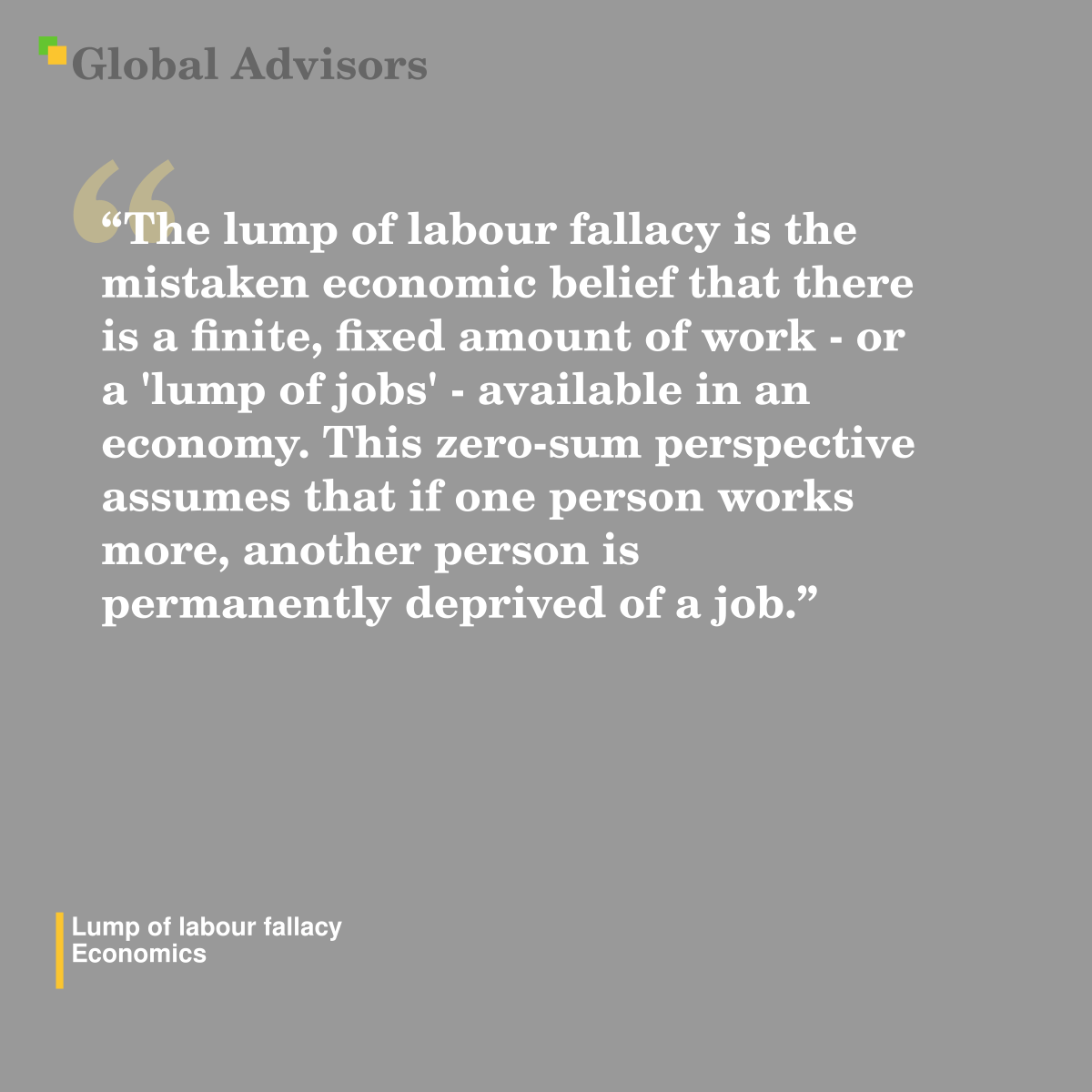
| |
Global Advisors News Brief - June 30 2026Read the full brief at the link Headlines for the last 24hrs
Time window: 2026-06-29T05:00:33.064Z to 2026-06-30T05:00:33.064Z |
| |
| |
|


| |
| |