| |
|

| |
| |
| |
|
Our selection of the top business news sources on the web. |
| |
| |
| |
Quote: Rob Haworth - Senior Investment Strategy, U.S. Bank"Four forces often shape the value of the dollar: interest-rate differences, global investing demand, trade flows, and inflation expectations." - Rob Haworth - Senior Investment Strategy, U.S. Bank Recent swings in the dollar have exposed how dependent the global financial system is on a small set of transmission channels: relative interest rates, cross-border investment flows, trade balances, and shifting inflation expectations. Each channel links domestic US policy choices to conditions in the rest of the world, creating feedback loops that can reinforce or offset one another. Understanding this interplay is crucial for investors, policy makers and corporates that are effectively long or short the dollar through their portfolios, balance sheets or supply chains. Interest-rate differences as the primary signalling device Interest-rate differentials are often the most visible driver of dollar moves because they directly affect the return investors earn on safe assets such as US Treasuries compared with foreign bonds. When US policy rates rise relative to other advanced economies, international capital typically flows toward US assets seeking higher yields, lifting demand for the dollar and pushing the currency higher. The theoretical transmission runs through uncovered interest parity, expressed as , where is the spot exchange rate and , are policy rates in the US and the rest of the world. Although empirical deviations are common, the expectation that higher US rates justify a stronger dollar remains deeply embedded in market behaviour. In practice, this linkage is mediated by perceptions of monetary policy credibility and risk appetite. A hawkish Federal Reserve combined with relatively resilient US growth has repeatedly supported dollar strength in periods of global stress, as investors treat US assets as a high-yielding safe haven. However, once markets anticipate that the rate differential has peaked or will compress, the same mechanism can trigger sharp reversals, with capital rotating out of the dollar toward economies expected to deliver better future returns. Global investing demand and the dollar as a safe asset Beyond simple yield comparison, the dollar's value reflects evolving global demand for dollar-denominated assets, particularly those regarded as safe stores of value. The currency functions not only as a medium of exchange but also as collateral in global funding markets, so changes in risk appetite or regulatory constraints can alter the convenience yield investors are willing to accept for holding dollar assets instead of higher-yielding alternatives. Research decomposing the dollar's appreciation since 2011 attributes roughly equal weight to higher US policy rates, increased global savings, and stronger structural demand for US assets such as Treasuries and investment-grade corporate bonds. In this framework, the exchange rate can be expressed via a portfolio-balance model where the equilibrium value of depends on global savings , the supply of dollar assets , and the desired share of those assets in worldwide portfolios. When global savings rise faster than safe asset issuance, competition for dollar instruments intensifies, supporting an appreciation even if trade fundamentals are unchanged. The dollar's status as the dominant reserve currency amplifies this effect: central banks and sovereign wealth funds allocate a large portion of their reserves to dollar assets, reinforcing demand during episodes of geopolitical uncertainty or market stress. At the same time, any credible threat to this privileged status, whether through technological disruption, alternative reserve currencies or concerns over US fiscal sustainability, would manifest first as shifts in global investing demand rather than abrupt changes in trade flows. Trade flows and the balance-of-payments constraint Trade balances provide the second major channel through which the dollar's value responds to underlying economic conditions, though the relationship is more nuanced than textbook models suggest. A widening US trade deficit implies that the US is importing more goods and services than it exports, which in principle increases the supply of dollars to the rest of the world. Under a simple balance-of-payments identity, the current account deficit must be matched by a capital account surplus, meaning foreign investors must be willing to accumulate more US assets to absorb the outward flow of dollars. If investor appetite lags behind the pace of deficit expansion, the resulting excess dollar supply tends to weaken the exchange rate. However, when US growth is strong and domestic assets are attractive, the capital inflow side of the balance can dominate, allowing the dollar to appreciate even as the trade deficit persists or widens. Trade flows also interact with the pricing behaviour of exporters and importers. A stronger dollar makes US exports more expensive in foreign currency terms and imports cheaper for US households and firms, which can gradually erode export competitiveness and reinforce external imbalances. Conversely, a weaker dollar supports export-oriented sectors and may spur reshoring or expansion of domestic manufacturing. Multinational businesses hedge these exposures through derivatives and operational adjustments, but their cumulative decisions feed back into the currency market as they manage dollar revenues, foreign expenses and cross-border funding. Inflation expectations and the credibility of policy Inflation expectations form the fourth key influence, connecting domestic price dynamics to the international valuation of the dollar. Expectations matter because they shape both nominal interest rates and perceptions of the real value of future dollar cash flows. If investors anticipate persistent US inflation above that of trading partners, they demand compensation in the form of higher nominal yields, but they may also mark down the expected purchasing power of the currency, producing a complex net effect on the exchange rate. Empirical work suggests that unexpected increases in inflation expectations tied to doubts about fiscal sustainability tend to depreciate the dollar, highlighting the importance of credible medium-term frameworks for managing public debt. One practical way markets infer inflation expectations is through Treasury Inflation-Protected Securities, where breakeven inflation rates approximate the difference between nominal yields and real yields. Fluctuations in these breakevens, caused both by genuine shifts in expectations and by trading flows in volatile conditions, feed directly into currency pricing models. Formally, the real interest rate relevant for exchange-rate determination can be expressed as , where denotes expected inflation; the dollar responds not only to changes in but to any revision in that alters the perceived real return on US assets. Interacting forces and feedback loops Although interest-rate differences, investing demand, trade flows and inflation expectations can be described separately, in reality they form a tightly coupled system. A tightening in US monetary policy aimed at restraining inflation raises policy rates and can attract foreign capital, supporting a stronger dollar. The appreciation lowers the local-currency cost of imports, influencing consumption patterns and potentially moderating goods inflation while increasing pressure on export sectors. At the same time, capital inflows generated by higher rates can boost domestic wealth and spending, creating offsetting price pressures that complicate the central bank's task. This topsey-turvy dynamic means that in some scenarios, aggressive rate hikes may unintentionally sustain inflation via capital-flow channels even as they depress growth, forcing policy makers to weigh the external effects of their decisions as carefully as the internal ones. On the structural side, prolonged periods of elevated US rates and strong demand for dollar assets may encourage foreign borrowers to take on more dollar-denominated debt, deepening global reliance on the currency and increasing vulnerability when conditions reverse. In downturns, heightened exchange-rate volatility can lead US banks to contract balance sheets and widen lending margins, transmitting dollar uncertainties back into domestic credit availability. These feedback loops illustrate why the dollar's value cannot be reduced to a single explanatory variable and why changes in one of the four forces often propagate through the others. Strategic implications and contested narratives For investors and corporates, the strategic challenge lies in assessing which of the four forces is likely to dominate over their planning horizon. Portfolio managers must decide whether current rate differentials and inflation expectations justify structural dollar exposure or whether global investing demand is vulnerable to regime shifts such as alternative payment systems, digital currencies or evolving geopolitical blocs. Exporters and importers face operational choices around invoicing currencies, hedging strategies and production locations, all of which depend on their view of trade flows and the durability of US policy frameworks. Policy makers, meanwhile, debate whether the dollar's strength is primarily a function of domestic fundamentals or of global imbalances that could unwind abruptly, especially if fiscal trajectories or political risks undermine confidence. Critics argue that reliance on the dollar-centric order imposes costs on emerging markets, exposing them to external shocks driven by US rate cycles and risk sentiment rather than local conditions. Proponents counter that the depth and liquidity of dollar markets, combined with the institutional resilience of US monetary and legal systems, continue to justify the currency's central role. The result is an ongoing tension between narratives of inevitable dollar decline and those of entrenched dominance, with each new episode of market volatility interpreted through these lenses. Why the four forces matter now Against this backdrop, framing dollar valuation through the interplay of interest-rate differences, global investing demand, trade flows and inflation expectations offers a practical roadmap for understanding current moves and stress-testing future scenarios. It emphasises that neither individual data releases nor headline events can be interpreted in isolation. A surprise change in US rates may matter less if global savings remain ample and demand for safe assets is strong; conversely, a modest policy adjustment could trigger outsized currency shifts if it coincides with deteriorating inflation expectations or abrupt changes in trade policy. For long-term investors, the framework reinforces the importance of diversification across currencies and asset classes, recognising that short-term exchange-rate swings can meaningfully affect returns on foreign holdings but that these effects tend to average out over longer horizons. For corporates, the same logic supports disciplined hedging and strategic flexibility in supply chains, reducing vulnerability to sudden shifts in any one of the four forces. Ultimately, the dollar's path will continue to reflect a complex negotiation between domestic policy choices, global financial preferences, real economic flows and collective beliefs about future inflation. Reading that negotiation through these four lenses does not eliminate uncertainty, but it clarifies where the most important pressures are likely to originate and how they may converge in the next phase of the currency cycle.
|
| |

| |
Term: DuPont analysis - Finance"DuPont analysis breaks down a company's Return on Equity (ROE) into three components - profitability (net profit margin), asset efficiency (total asset turnover), and financial leverage (equity multiplier) - to identify the specific drivers of financial performance. This framework allows for a detailed analysis of operational strengths, structural weaknesses, and risks." - DuPont analysis - Finance Shareholders care less about raw profit and more about how effectively their capital is being compounded, which makes the structure of Return on Equity critical to serious financial analysis. Two businesses can both report an ROE of 15%, yet one might achieve it through strong margins on modest leverage, while the other relies on thin margins, high asset churn, and aggressive borrowing that embeds material risk. Untangling these distinct pathways is the central analytical challenge addressed when ROE is decomposed into separate drivers rather than treated as a single headline number. From headline ROE to underlying drivers ROE starts with a simple relationship between the income a firm generates for ordinary shareholders and the equity they have committed. Formally, ROE is net income divided by average shareholders equity over the period, which measures how many pounds of profit are produced per pound of equity funding . That immediate ratio is highly informative, but it merges operating performance, asset deployment, and capital structure into one figure, leaving analysts unsure whether a respectable ROE reflects genuine commercial strength or merely financial engineering. Decomposing ROE into profitability, asset efficiency, and leverage isolates three mechanisms: how much profit is extracted from each pound of sales, how intensively the asset base is used to generate those sales, and how heavily those assets are financed by debt relative to equity . The mechanical link between the simple ROE and its components follows straightforward algebra using revenue and assets as intermediate steps. Net profit margin is defined as net income divided by revenue; total asset turnover as revenue divided by average total assets; and the equity multiplier as average total assets divided by average shareholders equity . Multiplying these three ratios cancels out revenue and assets in the numerator and denominator, leaving net income over equity, which is ROE. In symbolic terms one writes ROE as , where is net income, revenue, average total assets, and average equity . This identity ensures the decomposition is not a separate metric but an exact breakdown of the same underlying return. Profitability: net profit margin Net profit margin captures the economic value created per pound of sales after all operating expenses, interest, tax, and other costs. It is computed as net income divided by revenue and summarises pricing power, cost discipline, and tax efficiency . A margin of 10% means that each 1 pound of sales contributes 0,10 pounds of profit to shareholders. A company with robust margins can sustain a strong ROE even with moderate asset turnover and conservative leverage, because each unit of activity translates into substantial earnings. By contrast, structurally low margins may push management towards higher leverage or extreme efficiency measures to maintain headline ROE, increasing vulnerability to cyclical downturns or execution errors. For deeper insight, practitioners often expand net profit margin into finer components that reflect tax and financing effects separately. In a five step formulation net income over equity is expressed as the product of tax burden, interest burden, operating margin, asset turnover, and financial leverage . Tax burden is net income divided by pretax income, measuring how much profit is lost to tax; interest burden is pretax income divided by operating income, capturing the drag of financing costs; operating margin is operating income divided by revenue, focusing on core business economics. In notation one can write , where , , , , and are the respective ratio components . This extended breakdown distinguishes operational weakness from tax structuring and debt policy. Asset efficiency: total asset turnover Total asset turnover measures how effectively the firm uses its asset base to generate revenue, calculated as revenue divided by average total assets . A ratio of 2,0 indicates that for every 1 pound invested in assets, 2,0 pounds of sales are produced during the period. Capital light businesses with rapid inventory cycles and low fixed asset intensity, such as certain service or technology firms, typically exhibit higher asset turnover. Heavy manufacturing or utility companies often show lower turnover because large, long lived assets support relatively stable but less asset intensive revenues. From a strategic perspective, improving asset efficiency can raise ROE without altering margins or leverage, for example by tightening working capital, reducing idle capacity, or disposing of non core assets. However, there are trade offs: squeezing assets too hard can expose the firm to operational fragility, supply chain risk, or an inability to meet demand spikes. The decomposition highlights whether a high ROE is built on sustainable efficiency improvements or on temporarily elevated turnover due to aggressive credit terms or underinvestment in resilience. Financial leverage: equity multiplier The equity multiplier, defined as average total assets divided by average shareholders equity, indicates how much of the asset base is financed by debt or other non equity liabilities . A multiplier of 3,0 implies that for every 1 pound of equity, the firm controls 3,0 pounds of assets, with the difference funded by borrowing or payables. In the DuPont identity, leverage amplifies the effect of profitability and efficiency on ROE: given a fixed asset turnover and margin, increasing the equity multiplier raises earnings relative to equity because more assets, and thus more sales, are supported by the same equity stake. Yet leverage driven ROE comes with heightened risk. Heavier debt loads increase fixed interest obligations and reduce flexibility in downturns. Research using DuPont components often finds that firms whose ROE is primarily driven by margin and asset turnover exhibit more sustainable performance than those relying on high leverage multipliers . The decomposition allows analysts to flag companies where attractive ROE is largely a product of balance sheet stretch rather than genuine operating success, prompting further scrutiny of debt covenants, refinancing cliffs, and interest coverage ratios. Alternative formulations and ROA linkage An alternative, closely related identity links ROE to Return on Assets (ROA) and leverage. ROA is net income divided by total assets, capturing profit per pound of assets irrespective of funding mix . Using algebra one can show that ROE equals ROA times the equity multiplier: , because . This formulation clarifies whether strong ROE arises mainly from operating efficiency (high ROA) or from capital structure decisions (high leverage). A large and widening gap between ROE and ROA generally signals increasing reliance on debt, which may or may not be desirable depending on the firm s risk appetite and sector norms . The extended five factor versions described earlier further incorporate tax and interest effects into ROE, giving practitioners a way to analyse how changes in tax regimes, interest rates, or corporate treasury strategies propagate through to equity returns . For example, a firm might show stable operating margin and asset turnover, but a sharply rising ROE due to lower effective tax rates or cheaper refinancing. Without decomposition, this could be mistaken for a structural improvement in the business model; with DuPont style analysis, the source of the gain is properly identified as fiscal or financial rather than operational. Interpretation, debates, and continuing relevance Interpreting the decomposition involves more than computing the three ratios; it requires judgement about industry context, business model, and sustainability. In capital intensive sectors, lower asset turnover may be entirely normal, and ROE is expected to be driven by margin and judicious leverage. In fast moving consumer businesses, analysts often demand strong turnover and moderate margins, with leverage playing a smaller role. The framework does not prescribe an ideal mix but offers a disciplined lens for asking whether the current configuration fits the economic reality of the firm and whether recent changes in ROE stem from durable improvements or transient choices. Debate around this identity focuses on limitations and potential misuse. Critics note that accounting measures of net income and equity can be distorted by one off items, fair value movements, and share buybacks, which in turn affect DuPont components. Some argue that a heavy focus on ROE and its decomposition may encourage management to optimise reported ratios rather than underlying economic value creation, for example by increasing leverage or repurchasing shares to shrink equity. Proponents respond that when used alongside cash flow analysis, balance sheet scrutiny, and forward looking risk assessment, the framework remains one of the most informative ways to connect profitability, efficiency, and capital structure in a single coherent picture . The approach remains widely taught in professional curricula and used by investors, lenders, and corporate finance teams because it converts a blunt performance ratio into a structured diagnostic tool. Analysts can track each component through time, benchmark against peers, and model scenarios such as an improvement in margin from 8,0% to 9,0%, a change in turnover from 1,5 to 1,7, or a shift in equity multiplier from 2,0 to 2,5 to see how these levers interact to alter ROE . In doing so they move beyond asking whether ROE is high or low, and instead understand how and why equity returns arise, what risks accompany them, and which managerial decisions would most effectively enhance or stabilise shareholder value.
|
| |

| |
Global Advisors News Brief - July 13 2026Read the full brief at the link Headlines for the last 24hrs
Time window: 2026-07-12T05:00:33.072Z to 2026-07-13T05:00:33.072Z |
| |
| |
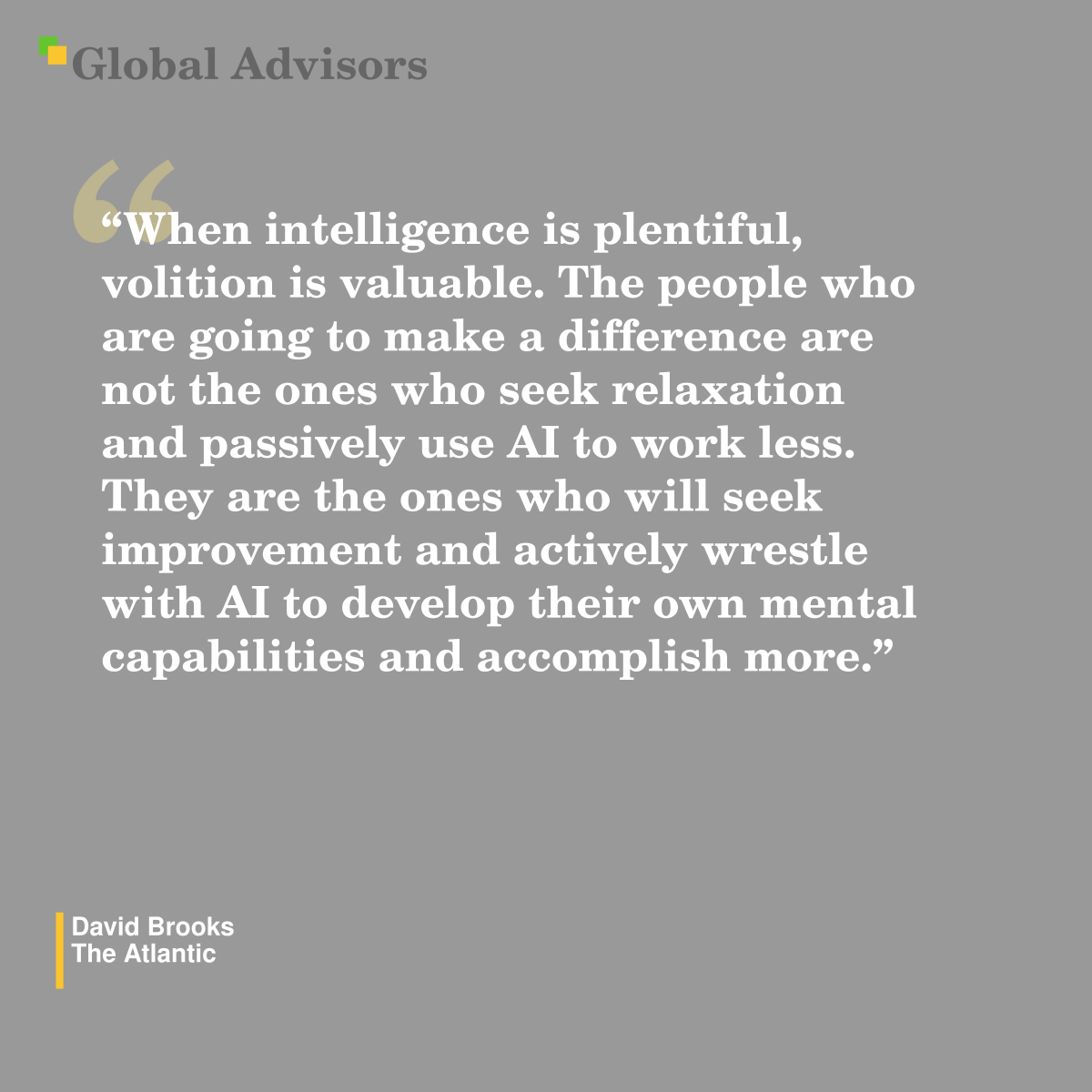
Quote: David Brooks - The Atlantic"When intelligence is plentiful, volition is valuable. The people who are going to make a difference are not the ones who seek relaxation and passively use AI to work less. They are the ones who will seek improvement and actively wrestle with AI to develop their own mental capabilities and accomplish more." - David Brooks - The Atlantic The spread of powerful language models has created a strange scarcity pattern: analytical horsepower is cheap, but directed human effort is not. Systems that once demanded years of training can now be approximated by prompts; what used to separate high performers was rare knowledge, whereas now the dividing line is how people choose to engage with tools that can think alongside them. The tension is no longer between the informed and the ignorant, but between those who treat artificial intelligence as a sofa and those who treat it as a sparring partner. The shift from intelligence as advantage to intelligence as infrastructure Historically, being able to recall facts, synthesise sources quickly, or draft cogent text at speed provided a reliable career advantage. Generative AI erodes that edge by automating many mid-level cognitive tasks: summarising documents, proposing outlines, drafting emails, generating code, or producing passable first drafts. Intelligence in this narrow, instrumental sense behaves more like infrastructure than personal capital; it is abundant, widely accessible, and embedded in dozens of everyday tools. When everyone can summon a competent explainer, translator, or analyst in seconds, the differentiator shifts from what you know to what you are prepared to do with what can now be known almost on demand. This reclassification has profound labour-market implications. Occupations once insulated by information asymmetry - consultants, lawyers, analysts, even educators - are being reconfigured as clients and students gain cheap access to quasi-expert reasoning. The human advantage migrates away from grinding through information to deciding which questions to ask, which paths to pursue, and which trade-offs to accept. In other words, volition - the disposition to initiate, persist, and take responsibility - becomes a primary economic and cultural asset. Volition as a scarce capability in an age of cognitive outsourcing Volition is more than generic motivation; it is a structured willingness to confront difficulty rather than route around it. Modern AI systems make avoidance deceptively easy. It is trivial to hand off the awkward email, the intimidating blank page, or the complex planning problem and accept the first adequate output. Evidence from education and mental health suggests that such passive use can dull both critical thinking and self-regulation, especially when users begin to anthropomorphise systems and treat their outputs as authoritative rather than provisional. Studies of technology and AI dependence describe patterns of reduced effort, weakened memory formation, and erosion of decision-making confidence when people consistently offload cognitive labour without reflective engagement. By contrast, using AI as a scaffold rather than a crutch can strengthen volitional muscles. Guidance from psychologists and educators stresses practices such as asking for hints instead of full solutions, writing one's own analysis before consulting a model, and using AI to critique or stress-test personally generated ideas. These strategies preserve the locus of control in the human user while still exploiting the model's breadth of knowledge. Volition shows up in choices like starting with a blank page, posing increasingly precise follow-up questions, iterating through counter-arguments, and deliberately tackling concepts that initially feel uncomfortable. The character of those who thrive: wrestlers, not delegators The statement splits future workers and citizens into two archetypes: those who seek relaxation through automation, and those who seek improvement through friction. The first group uses AI chiefly to shrink effort and time-on-task. They ask for complete essays, ready-made slide decks, or turnkey marketing campaigns, and treat the outputs as finished products rather than raw material. Educators already report that such uses correlate with diminished engagement and superficial learning, even when grades in the short term may not immediately suffer. Over time, their own mental models atrophy because they seldom practise original structuring, framing, or evaluation of information. The second group treats AI as an adversarial collaborator. They use it to surface objections to their arguments, uncover edge cases they might have missed, or rehearse difficult conversations in low-stakes simulations. They turn generative tools into tutors by asking them to probe their understanding, devise exercises, and generate alternative perspectives that must then be weighed rather than swallowed. In work settings, these individuals are more likely to deploy AI to expand project scope, run scenario analyses that would otherwise be unaffordable, or build prototypes that test new ideas. Their aim is not to do the same workload faster but to increase the ambition and complexity of what they attempt. Brooks's broader humanistic frame David Brooks has long been preoccupied with the question of what remains distinctly human when technological systems encroach on cognitive territory once reserved for people. In public writing and talks, he has argued that artificial intelligence clarifies human value by making machine-susceptible skills cheap and spotlighting those forms of understanding that resist codification: empathy, moral judgment, narrative meaning-making, and situational awareness. He contends that success will increasingly depend on cultivating a recognisable personal voice, the ability to move others, and the courage to hold unusual perspectives rather than merely conforming to standardised, optimised outputs. In that frame, volition is not only about economic productivity but about moral agency. The danger is not simply that people become less employable if they relax into AI; it is that they become less fully themselves, outsourcing not just drafts and diagrams but values, priorities, and identity-defining decisions. Brooks's warning therefore aligns with a growing chorus of psychologists and ethicists who worry that heavy AI reliance may blunt autonomy and leave individuals more susceptible to manipulation, persuasive design, and algorithmically curated realities. Debates and objections: is striving always superior? There are, however, important objections to a pure celebration of volition. One challenge comes from mental health research showing that constant striving, especially in precarious labour markets, can feed burnout, anxiety, and a sense of perpetual inadequacy. For individuals juggling care responsibilities, disability, or economic stress, using AI simply to ease burdens is not decadence but survival. In these contexts, seeking relaxation is a rational response to chronic overload, and the ethical focus should fall on how systems can reduce drudgery without undermining dignity or agency. Another critique questions whether the dichotomy between passive and active users is too binary. Many people will mix modes, sometimes leaning on AI to manage routine tasks and at other times engaging deeply for skill-building. Research on self-paced learning suggests that well-designed AI tools can boost engagement precisely by automating low-level chores, freeing time for higher-order thinking. From this angle, what matters is not whether one ever uses AI to work less, but whether one consistently chooses to grow in areas that machines cannot fully absorb. The key risk is not convenience itself, but unexamined convenience that gradually hollows out competence and initiative. Practical volition: how to wrestle productively with AI Turning the abstract ideal of volition into practice requires deliberate habits. One approach is to treat AI outputs as hypotheses to interrogate rather than answers to trust. In education, teachers are advised to ask students to critique AI-generated essays, identify weaknesses, and improve them, thereby turning the tool into a stimulus for human judgment. Knowledge workers can do something similar by generating multiple AI proposals and then justifying their final choice in writing, making their own reasoning explicit rather than implicit. This pattern keeps the human in the role of editor, strategist, and accountable decision-maker. Another practice is to use AI to expand the frontier of personal development. Examples include AI-assisted coaching platforms that pose reflective questions, track progress, and suggest challenges calibrated to the user's goals. Some professionals use models to simulate supervision conversations, invite critiques of their work, and discover blind spots in their reasoning. In all these cases, the tool becomes an instrument for building self-awareness, resilience, and creativity - the very capacities commentators argue are most resistant to automation. Volition here shows up as the willingness to be tested, corrected, and stretched rather than merely served. Why it matters: from personal success to cultural trajectory The deeper significance of the statement lies in how it frames the social trajectory of the AI age. If large numbers of people opt for the path of least resistance, delegating thought wherever possible, we risk a culture of shallow comprehension and brittle institutions dependent on opaque systems they do not really understand. Democracies become vulnerable when citizens lack both the skills and the will to interrogate automated decision-making, from credit scoring to predictive policing. Conversely, if enough individuals cultivate volition - the appetite to question, to learn, to assume responsibility - AI can function as a lever that raises collective capability instead of a cushion that lulls it. For organisations, the message is equally stark. Competitive advantage will not come from owning models that competitors can rent, but from assembling teams with the determination and curiosity to combine those models in novel ways, pursue bolder projects, and sustain learning loops over time. Hiring for volition - self-starting behaviour, tolerance for difficulty, and ethical seriousness - may prove more predictive of long-run value than hiring for narrow technical proficiency that AI can increasingly replicate. Strategically, the central question shifts from how much work can be automated to how much human ambition can be safely and wisely amplified.
|
| |
| |
Global Advisors News Brief - July 12 2026Read the full brief at the link Headlines for the last 24hrs
Time window: 2026-07-11T05:00:33.079Z to 2026-07-12T05:00:33.079Z |
| |
| |
Quote: Arthur Mensch - CEO, Mistral"All of these efforts might seem daunting - they are. This is both a complete replatforming of your IT, and a complete change in the way you're developing software, and operating your business. AI lifecycle management requires understanding human behaviour and gradient descent, that's a stretch." - Arthur Mensch - CEO, Mistral Enterprise leaders face a structural dilemma as they move from experimenting with generative AI toward embedding it across their organisations: the technologies promise compounding productivity and new products, but real adoption demands a fundamental rebuild of data architecture, software practices, and operating models. The challenge is not simply installing another tool; it is rethinking how information flows, who controls it, and how learning loops are wired through the business so that AI systems improve continuously while remaining governable. From incremental tooling to complete replatforming The starting tension lies in the gap between how most enterprises currently treat AI and what full-scale deployment actually requires. Many firms have layered chatbots or assistants on top of legacy systems, often using proprietary APIs and SaaS tools that sit at the edges of the business rather than at its core. Mensch argues that genuine AI transformation demands a complete replatforming of IT: data must be liberated from siloed applications, moved into open or at least interoperable stores, and exposed through standardised interfaces that foundation models and agents can query safely and efficiently. That implies redesigning identity, access, observability, and integration layers so that humans and AI agents share a coherent environment, not a patchwork of ad hoc connectors. This architectural shift is strategically charged because it forces a renegotiation of vendor relationships. Closed model providers and legacy software vendors increasingly retain customer data inside walled gardens, using it for their own training and product development. As AI systems become the nervous system of the enterprise, allowing key knowledge to sit inside opaque stacks controlled elsewhere creates leverage asymmetry: the provider can see the customer, learn from her operations, and build competing products using that insight. Replatforming, in Mensch's framing, is therefore as much about sovereignty and bargaining power as it is about technology. Open models, open systems, and strategic control The insistence on open-source or open-weight models reflects this concern for control. Open models expose their parameters, architectures, and licences, enabling enterprises to fine-tune on their own data, deploy on their own infrastructure, and adjust behaviour without depending on a single external roadmap. According to industry analyses, open models now provide competitive capabilities at lower cost and with greater customisation, while being only modestly behind the most expensive proprietary systems on headline metrics. For an enterprise, the relevant advantage is not simply performance on benchmarks; it is freedom from lock-in, the ability to move workloads, and the option to embed AI deeply into domain-specific processes without leaking strategic context to third parties. Mensch extends the open argument beyond models to include data storage and record systems. If core business records sit in closed platforms whose operators resist full data export or neutral access, AI initiatives will be constrained to the vendor's ecosystem and monetisation strategy. In such a scenario, any attempt to build independent AI capabilities will be slower, more expensive, and ultimately weaker than what the vendor can do with privileged visibility. By aggressively extracting data into open or at least portable formats and insisting on machine-readable, complete access, enterprises regain the ability to assemble their own flywheels: systems in which every interaction, document, and transaction can be used to refine models, workflows, and experiences. The data flywheel and proprietary edges Once data and models are under enterprise control, the task becomes constructing continuous learning loops that turn ordinary operations into a compounding advantage. Multiple practitioners describe this as a data or AI flywheel: a self-reinforcing cycle where interactions generate data, data improves models, better models enhance user experience and efficiency, and those improvements attract more usage and richer signals. In practical terms, this demands instrumentation of workflows, careful definition of feedback signals, and infrastructure for rapid retraining or fine-tuning so that errors and new patterns quickly feed back into system improvements. Mensch's argument is that the real defensible edge for enterprises will not come from generic frontier models, which competitors can also license, but from the way those models are continuously adapted to the organisation's specific processes, culture, and knowledge. By building a private flywheel on top of open-weight models, a retailer's customer service patterns, a manufacturer's maintenance logs, or a bank's risk decisions become part of a proprietary behavioural dataset that competitors cannot easily replicate. The flywheel turns not just on more data, but on better signals: clean, contextual interactions where success and failure are labelled, and where systems are designed from the outset to learn from them. AI lifecycle management: humans, models, and gradient descent Where Mensch becomes explicit about difficulty is in AI lifecycle management, the discipline of designing, deploying, monitoring, and continually improving AI systems across their operational lifespan. He highlights a dual requirement: understanding human behaviour and understanding gradient descent. The first involves behavioural design, organisational psychology, and security-aware access control; the second refers to the mathematical optimisation procedure at the heart of most modern machine learning models. Lifecycle management therefore lives at a junction of social systems and numerical optimisation. On the human side, enterprises must define hard and soft access rules: who can see which data, under what conditions, and with what oversight. Hard rules are enforced by identity management, role-based access control, and policy engines; soft rules concern contextual appropriateness, intent, and subtle privacy norms that pure code struggles to capture. AI systems are powerful at discovering edge cases and accidental exposures, so governance cannot rely on informal norms alone. On the optimisation side, every improvement cycle typically involves some variant of gradient descent, where model parameters are updated along the negative gradient of a loss function so that for learning rate . For enterprises, the concern is less the exact equation and more the implication: data decisions directly shape objective functions, constraints, and therefore model behaviour. This duality explains why Mensch calls the requirement a stretch. Organisations rarely possess enough people who are simultaneously comfortable discussing domain processes, behavioural risks, and the mechanics of training, fine-tuning, and evaluation. Strategy literature talks about the need for multilingual experts who can traverse data science, business modelling, and systems thinking; Mensch's observation is that AI demands a similar hybrid capability. Building these teams requires investment in skills, cross-functional collaboration, and a governance structure that treats AI not as isolated experiments but as evolving socio-technical systems. Debates: closed convenience vs sovereign complexity There is an important counter-argument to Mensch's stance: many enterprises prefer managed, closed platforms because they reduce complexity, offer reassuring service-level agreements, and avoid the need to hire scarce AI talent. Proponents of this view note that frontier proprietary models often lead in capabilities, and that outsourcing the hardest engineering and infrastructure problems to cloud providers allows firms to focus on domain applications. They warn that running open models and custom training pipelines on-premises or in sovereign clouds can divert attention from product innovation toward undifferentiated plumbing. Mensch's rebuttal, implicit in his statement and explicit in his wider writing, is that the convenience premium comes with hidden strategic costs: dependence on external roadmaps, limited ability to embed AI deeply into proprietary processes, and continual leakage of operational knowledge to providers who may later become competitors. As open-weight models and tooling improve, the performance gap narrows, while the opportunity cost of lock-in grows. The debate is therefore not purely technical; it is a question of which capabilities an enterprise wishes to own. For firms in regulated or intensely competitive sectors, the argument for sovereign control over data, models, and learning loops is stronger than for those in commoditised domains. Why the stretch matters for enterprises Mensch's framing matters because it clarifies that generative AI in the enterprise is a whole-of-business transformation rather than a narrow IT upgrade. Processes across finance, operations, compliance, and product development will be reorganised around agents, automated workflows, and continuous feedback loops. Supervisory roles and front-line jobs will shift as automation handles routine tasks and humans focus on quality, innovation, and exception handling. The organisations that manage the stretch between human understanding and gradient descent will be those that can design systems where people and AI complement each other rather than compete blindly for control. That stretch is also temporal. Replatforming, building open systems, and instituting lifecycle management are multi-year programmes, unfolding alongside rapid external advances in models and hardware. Enterprises that delay these moves risk being trapped in a series of tactical deployments that never cohere into a strategic architecture, leaving them dependent on external providers for critical functions and unable to generate proprietary learning advantages. Conversely, those that accept the daunting nature of the work, invest in braided capabilities spanning behavioural insight and optimisation theory, and commit to owning their data and models will be better positioned to turn frontier AI into their own growth rather than someone else's.
|
| |

| |
Term: DFlash speculative decoding - Artificial intelligence"DFlash is a speculative decoding technique that accelerates Large Language Model (LLM) inference by generating blocks of tokens in parallel rather than sequentially. It replaces the traditional autoregressive draft models used in standard speculative decoding with a lightweight block-diffusion model." - DFlash speculative decoding - Artificial intelligence Latency in large language model inference arises from the need to march through a sequence token by token, even when the underlying hardware is capable of far more parallel computation than the decoding loop exposes. This mismatch between sequential generation and massively parallel accelerators creates a ceiling on responsiveness for interactive systems, code assistants, and reasoning workloads, particularly once sequences extend to many hundreds or thousands of tokens . Diffusion-style speculative decoding, and specifically DFlash, tackles this bottleneck by restructuring how future tokens are proposed and verified, turning long chains of dependent predictions into short, parallelisable blocks that can be processed in a handful of high-throughput passes . From autoregressive bottlenecks to speculative acceleration Standard autoregressive decoding treats each token as conditioned on the full history , and the model outputs a probability distribution one step at a time. This makes inference conceptually simple but inherently serial: the model cannot know which token comes next until it has committed to the previous one. Speculative decoding introduces a second, lighter model that drafts multiple future tokens ahead of the main model, which then merely has to check and accept or reject those proposals . Traditional schemes use autoregressive mini-drafters or multi-token prediction heads; they typically draft short prefixes and accept a subset, yielding speedups around 2x to 3x under favourable conditions . The core limitation is that these drafters still rely on autoregressive structure, so their predictions degrade as they attempt longer bursts, capping acceptance rates and practical speed gains. Block diffusion as the drafting mechanism Block diffusion language models rethink drafting as a discrete denoising process over contiguous spans of tokens . Instead of sampling a single next token, the drafter operates on a block of length , represented as a partially corrupted sequence, and iteratively denoises it into a coherent completion conditioned on the context and masking pattern. In diffusion-style notation, one can view an initial block as heavily corrupted and define a reverse process over steps where a diffusion model predicts cleaner versions given , the surrounding context, and noise schedules . By tuning the block size and noise level, these models interpolate between pure autoregressive behaviour and fully diffusion-style generation, balancing sample efficiency against quality . Crucially, the objective is explicitly designed to restore all tokens in a span jointly, which naturally fits parallel sampling across positions within the block . DFlash: architecture and workflow DFlash builds on block diffusion by using a lightweight diffusion-LLM as a speculator that proposes entire blocks of future tokens in a single forward pass, conditioned on the hidden states of the heavy target model . The workflow can be summarised in four stages. First, the inference engine selects anchor positions in the sequence, typically at the current decoding frontier and sometimes at additional points if multiple blocks are drafted concurrently . Second, given the target model hidden states at those anchors, the DFlash speculator runs one diffusion-style pass to generate a candidate block of length , filling masked positions with sampled tokens that respect bidirectional context within the block . Third, the target LLM verifies the proposed block by computing its own logits over each position and checking whether the draft token matches the argmax or sits within an acceptance criterion; tokens that pass are deemed valid, while mismatches break the accepted prefix . Finally, the engine emits the longest contiguous prefix of accepted tokens and falls back to standard autoregressive decoding for any remaining positions, before repeating the cycle from the updated frontier . Mathematical view of acceptance and speedup It is useful to formalise the performance of speculative decoding in terms of acceptance length and speedup. Suppose DFlash proposes blocks of size and the expected number of accepted tokens per block is . If the target model alone would decode tokens sequentially with per-token cost , and the combined DFlash plus verification pipeline has effective cost per block , then the average cost per accepted token is approximately . The speedup factor over pure autoregressive decoding can then be expressed as . In practice, is dominated by one speculator pass plus verification, while is reported to be substantially larger for block diffusion drafters than for autoregressive drafters at similar compute, because the model is trained explicitly to restore spans under heavy corruption and can exploit bidirectional context inside the block . Empirical results for DFlash show lossless acceleration exceeding 6x on some benchmarks and up to 2,5x higher speedup than leading autoregressive speculative methods like EAGLE-3, with per-token generation times dropping by factors between roughly 2,3x and 3,5x depending on workload . Practical meaning and deployment behaviour In production systems, DFlash changes the character of latency from per-token to per-block behaviour. Users perceive responses as streaming quickly and sometimes in bursts, because the engine can accept long speculative prefixes and then only occasionally falls back to single-token steps when the drafter ventures into low-confidence territory. Integration guides from vLLM and serving stacks show DFlash acting as a plug-in speculator: the main LLM remains intact, while a separate diffusion model, often around 0,7 billion parameters, is loaded to provide blocks . This separation has operational advantages. Different speculators can be swapped in or tuned per task, and serving teams can place the diffusion drafter and verifier on distinct devices to overlap compute, hiding much of the drafting cost under verification latency . On high-end accelerators such as NVIDIA Blackwell and Google TPUs, DFlash-style pipelines have demonstrated end-to-end speedups of around 2,3x to 3,1x across diverse datasets, with even stronger gains for computationally heavy domains like maths and code . Relationship to broader parallel token generation research DFlash sits within a broader trend toward parallel token generation, where methods like Parallel Token Prediction and Fast-dLLM v2 also attempt to produce multiple dependent tokens in single passes . Parallel Token Prediction moves stochasticity into input variables so that a single transformer call can deterministically map those variables to a consistent multi-token continuation; this yields theoretical guarantees that one call can represent arbitrary dependencies and empirically reaches speedups of about 2,4x on speculative decoding benchmarks . Fast-dLLM v2, by contrast, converts pretrained autoregressive models into block diffusion decoders via limited fine-tuning, combining hierarchical caching with confidence-aware parallel decoding and reporting up to 2,5x decoding speed gains at similar quality . Compared with these approaches, DFlash emphasises a lightweight external block diffusion drafter that feeds a standard autoregressive verifier, retaining the original LLM unchanged while leveraging diffusion-style drafting to push acceptance rates higher and reduce verification work . Debates, trade-offs, and future directions Several tensions shape how DFlash and related block diffusion speculators are evaluated. One concern is the complexity of training and maintaining a separate diffusion-LLM: block diffusion training involves multi-stage schedules and sophisticated noise schemes, and there is ongoing debate over whether it is preferable to convert autoregressive backbones or train diffusion-native models from scratch . Another issue is robustness and quality at long horizons. While block diffusion models can exploit intra-block bidirectional context, they still rely on the autoregressive target for global coherence; misalignment between drafter and verifier distributions can lead to shorter acceptance lengths or subtle artefacts, particularly in open-ended creative writing relative to structured code or maths tasks where constraints are clearer . Finally, there is a systems-level trade-off: speculative decoding offers impressive speedups when batch sizes and sequence lengths are sufficiently large, but the gains can shrink for short prompts or in environments where quantisation, caching, and attention optimisations already saturate hardware utilisation . Why block-diffusion speculative decoding still matters Despite these caveats, DFlash-style speculative decoding is significant because it demonstrates that diffusion geometry is not restricted to images or audio, but can be harnessed as a practical inference-time accelerator for text models already deployed at scale . As diffusion LLMs mature, block diffusion has emerged as a standard architecture for production, often with compact block sizes around a few dozen tokens, and serving teams increasingly see block-wise speculative drafting as a natural way to unlock parallelism that autoregressive decoders leave unused . For real-world applications that demand both fast responses and high-quality reasoning, particularly on long contexts, DFlash offers a route to multi-x speedups without retraining the main model, preserving alignment and capabilities while squeezing more effective tokens per unit of compute . In a landscape where every marginal improvement in inference efficiency compounds across millions of users and requests, block diffusion speculative decoding provides a compelling blueprint for future LLM systems: keep the heavyweight verifier as a stable foundation, and let lightweight, parallel block drafters shoulder the burden of exploring the space of possible continuations quickly and efficiently.
|
| |

| |
Global Advisors News Brief - July 11 2026Read the full brief at the link Headlines for the last 24hrs
Time window: 2026-07-10T05:00:33.070Z to 2026-07-11T05:00:33.070Z |
| |
| |
Term: Pre-mortem - Strategic panning"A pre-mortem is a strategic planning technique where a project team imagines their proposed plan has completely failed, then works backward to identify the hypothetical causes. Popularized by psychologist Gary Klein, it aims to uncover hidden risks and prevent blind spots before execution begins." - Pre-mortem - Strategic panning Strategic plans most often unravel not because leaders lacked intelligence or effort, but because critical vulnerabilities were invisible, discounted, or too politically awkward to discuss openly before execution began. The central difficulty is that teams planning a high-stakes initiative are typically subject to optimism bias, groupthink, and hierarchical pressure, all of which suppress candid discussion of how and why failure could occur . A disciplined pre-mortem technique directly attacks these psychological obstacles by forcing participants to treat failure as certain and then trace back the mechanisms that could plausibly have produced it . In doing so, it converts vague unease into explicit risk narratives that can be built into the strategy rather than discovered too late. Cognitive mechanics: why imagining certain failure changes the conversation Traditional risk reviews invite people to list what might go wrong, but because success is still the default expectation, participants often feel they are being unduly pessimistic, or implicitly criticising colleagues, by raising serious concerns . The pre-mortem reframes the exercise: the facilitator asserts that an infallible crystal ball has revealed that the project has already failed, and that this is beyond dispute . Each person is then asked to write, within a strict time window, all the reasons this failure occurred, before the group discussion begins . This narrative shift from hypothetical failure to guaranteed failure removes the social cost of being the one who doubts the plan. People are no longer speculating about unlikely downsides; they are explaining an outcome everyone has been told to accept as given. The psychological evidence summarised by Gary Klein indicates that this subtle change increases the number, specificity, and candour of risks that are surfaced compared with standard risk assessment meetings . Equally important is the requirement that participants write down their reasons individually before open discussion starts . This step fights conformity pressures. Once a senior figure declares that the main risk is, for example, market adoption, others feel nudged to echo that storyline. By isolating the idea-generation phase, the pre-mortem protects minority viewpoints and idiosyncratic observations that might otherwise be suppressed. When the facilitator later goes around the room recording one novel item from each person, the group is exposed to a wider distribution of failure narratives, which systematically reduces blind spots and overconfidence in the baseline plan . Substance and practical meaning in strategy and projects In practice, a pre-mortem is structured as a focused workshop held after the draft strategy or project plan is understood but before it is locked in and execution begins . Participants first ensure they share an understanding of the initiative: scope, objectives, key assumptions, resource commitments, and success criteria. The facilitator then initiates the failure scenario and the individual writing phase, typically lasting 2-7 minutes depending on guidance, with the explicit prompt that the project has failed disastrously and the task is to explain why . Afterwards, the group moves into a systematic consolidation process: each reason for failure is read out, captured on a whiteboard or digital board, and grouped into themes such as governance, technical risk, market response, regulatory shocks, or organisational behaviour . This is the moment when the exercise shifts from imagination to prioritisation and design work. Teams rarely have capacity to address every hypothetical failure mode, so the next stage is to rank the identified risks by their importance. Common practice is to evaluate each item on two dimensions: likelihood and severity, sometimes using an explicit risk matrix . Items that score high on either axis are candidates for focused mitigation design. From a strategic planning perspective, this ranking process forces clarity about which assumptions truly underpin the plan and which hazards would be existential if realised. It often reveals that what seemed like small implementation details are in fact single points of failure, or that several distinct failure stories share the same hidden driver, such as an unrealistic dependency on a single customer segment or vendor . Once these high-impact risks have been selected, the group designs concrete actions, assigns owners, and feeds the resulting mitigations back into the evolving strategy document or project plan . Formal risk representation and integration with quantitative tools Although the pre-mortem is primarily a qualitative and narrative exercise, the outputs can be expressed in more formal risk notation where organisations rely on quantitative risk management. If the project outcome is represented as a random variable , such as net present value or delivery time, the failure scenario corresponds to for some critical threshold . The pre-mortem brainstorm aims to identify a set of risk factors that materially raise the probability . Each factor might be modelled as a change in parameters within a project cash-flow model, such as lower revenue growth , higher volatility , or discrete negative jumps with size and intensity if scenario analysis uses jump-diffusion structures common in financial risk modelling. In such a representation, the pre-mortem provides the qualitative mapping from narratives (for example, regulatory delay) to parameter shocks (for example, pushing revenue recognition back several periods and increasing cost-of-capital assumptions), which can then be explored numerically via sensitivity analysis or Monte Carlo simulation. Where organisations use a risk register, each pre-mortem output can be coded as an entry with estimated likelihood, impact, triggers, and mitigations . Over multiple projects, this allows empirical calibration: if a certain category of risks is repeatedly identified yet rarely materialises, assumptions about its probability can be adjusted; conversely, failure modes that were missed in past pre-mortems can be fed back as mandatory prompts in future sessions. Thus, while the technique is narrative at the moment of use, it sits comfortably within more formal risk frameworks and improves their inputs by surfacing richer, context-specific causal stories than top-down risk taxonomies usually provide. Parameters, roles, and process design Several practical parameters heavily influence the effectiveness of a pre-mortem. The composition of the group is central: advice from project management practitioners is to include a mix of experienced staff who have seen failures, newcomers who are not invested in the existing narrative, and stakeholders from affected functions, while avoiding very senior executives who might dampen frank conversation . Timing also matters. Guidance often recommends running the session one to three months before launch, once there is enough detail to reason about but still time to modify the plan and budget . The length of the workshop ranges from 45 minutes to two hours depending on project size and organisational culture, with a clear structure: plan review, failure visualisation, individual writing, collective listing, grouping, prioritisation, mitigation design, and assignment of actions . The facilitator role is particularly sensitive. They must insist on the certainty of failure during the imagination phase, enforce time limits to keep the energy focused, and prevent early criticism or debate while ideas are being collected . Later, they guide prioritisation and gently push the team beyond generic labels such as communication issues towards more precise, actionable formulations: which communication channels, with whom, at what stage, and under what constraints. After the meeting, the facilitator or project manager must ensure that high-ranked risks and mitigation actions are not left as workshop artefacts but embedded into the project governance: updated timelines, contingency budgets, revised performance indicators, and check-ins tied to specific triggers . Schools of thought, variations, and debates The most widely cited formulation stems from Gary Klein's 2007 description of the method in managerial literature, which emphasises certainty of failure, short individual writing, and collective listing as the core procedural pillars . Subsequent practitioners have developed variations tailored to their contexts. Agile software teams often integrate pre-mortems into sprint planning, focusing on operational obstacles and using digital boards and voting mechanisms to cluster and select issues quickly . Strategy consultants sometimes expand the exercise into a broader scenario-planning workshop, linking each failure narrative to external macroeconomic or geopolitical scenarios to test the robustness of corporate strategy . Klein himself has introduced more advanced forms such as the double-barrelled pre-mortem, which pairs failure-focused analysis with a parallel exercise on unexpected success, highlighting upside uncertainties and positive black swans . Critiques fall into several lines. Some argue that pre-mortems can foster excessive pessimism, leading organisations to over-invest in risk avoidance at the expense of bold innovation, particularly in contexts where upside opportunities are time-sensitive . Others worry about psychological safety: if the organisational culture punishes bad news, then inviting staff to catalogue reasons the project might fail can feel perilous, and the technique will yield sanitised, low-impact lists. There is also the concern of illusion of control: by naming many potential problems, teams may feel they have mastered risk when in fact some hazards, such as systemic regulatory shifts, remain largely uncontrollable. These debates have led to recommendations that pre-mortems be framed explicitly as tools for strengthening success, not just avoiding failure, and combined with clear leadership commitments that no one will be penalised for raising uncomfortable scenarios . Continuing relevance in contemporary execution environments Despite such tensions, the pre-mortem remains widely used in domains ranging from product launches and IT projects to public health campaigns and even individual study plans . Its enduring appeal lies in its low cost, simplicity, and ability to make hidden assumptions and fragile dependencies concrete before money and reputation are heavily committed. In complex organisations with high interdependence, no single leader can perceive all the ways a plan might fail. A structured, psychologically safe invitation to imagine certain failure harnesses distributed expertise, anecdotes from past projects, and local knowledge that may never appear in formal risk registers . By routing those insights into strategic planning, the pre-mortem helps close the gap between formal ambition and the realities of execution, making it an important continuing component of serious risk-aware strategy work.
|
| |

| |
Global Advisors News Brief - July 10 2026Read the full brief at the link Headlines for the last 24hrs
Time window: 2026-07-09T05:00:33.076Z to 2026-07-10T05:00:33.076Z |
| |
| |
|


| |
| |