| |
|

| |
| |
| |
|
Our selection of the top business news sources on the web. |
| |
| |
| |
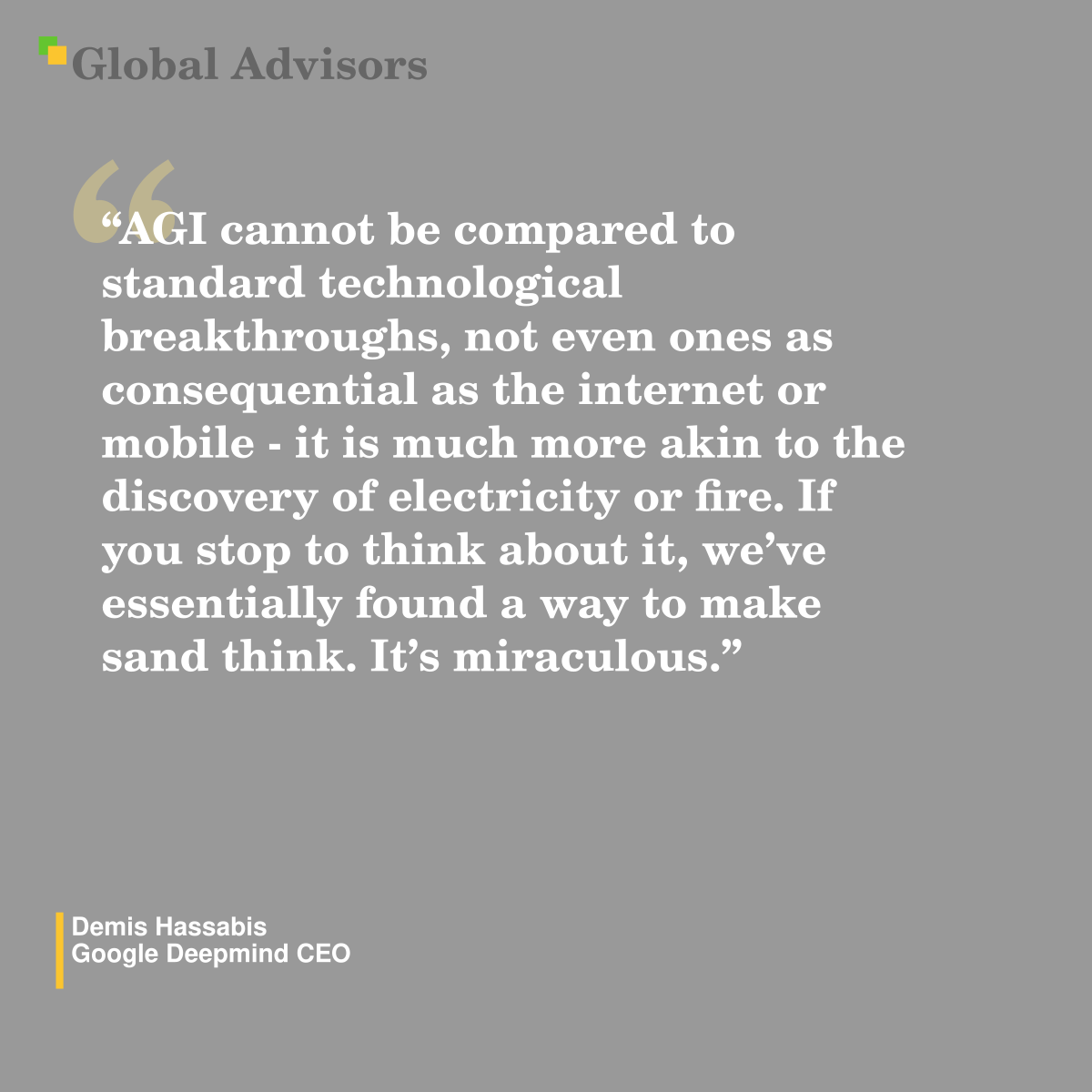
Quote: Demis Hassabis - Google Deepmind CEO"AGI cannot be compared to standard technological breakthroughs, not even ones as consequential as the internet or mobile - it is much more akin to the discovery of electricity or fire. If you stop to think about it, we've essentially found a way to make sand think. It's miraculous." - Demis Hassabis - Google Deepmind CEO The claim that contemporary AI research is converging on a transformation comparable to humanity harnessing electricity or fire rests on a tension between incremental technical progress and discontinuous civilisational impact. On one side sit the familiar patterns of technological diffusion: products launched, infrastructure scaled, regulations negotiated, and productivity gains compounding over decades. On the other side is the suggestion that when machine intelligence becomes general, cheap and widely deployed, it behaves less like another industrial tool and more like a new kind of capability layer for civilisation, reconfiguring how knowledge, labour and governance function. Demis Hassabis positions artificial general intelligence as belonging squarely in this second category, arguing that its arrival would mark the start of a new human era rather than just another technology cycle. From Narrow Tools To General Reasoning Engines Understanding the statement requires distinguishing current AI systems from the envisaged general intelligence. Today's models already rival or surpass humans on a narrow band of cognitive tasks: solving competition-level mathematics, generating code, and parsing multimodal inputs at scale. Yet Hassabis consistently stresses their deficits: inconsistent performance, weak long-term planning, limited creativity, and an inability to autonomously generate and test novel scientific hypotheses. His benchmark for AGI is not a supercharged autocomplete but a system exhibiting the full suite of human cognitive capabilities with robust, reliable behaviour across domains. In other interviews, he frames the missing capabilities as fewer than five fundamental breakthroughs: world models, continuous learning, extended planning, and the elimination of jagged intelligence where systems oscillate between superhuman and childlike errors. The claim that AGI resembles fire or electricity rather than the internet or mobile phones hinges precisely on this shift from tool to general reasoning substrate. Fire turned latent chemical energy into controllable heat and light, underpinning cooking, metallurgy and eventually industrial processes. Electricity transformed natural phenomena into universally routable energy, enabling everything from lighting to computation. In Hassabis's framing, general intelligence recast as an engineered system would similarly turn latent patterns in data and physical processes into universally accessible problem-solving capacity. By compressing cognition into reproducible algorithms, it promises to make reasoning itself a deployable resource rather than a scarce human trait. Sand That Thinks: The Material Substrate Of Intelligence The metaphor of making sand think draws attention to the physical strangeness of modern computing. Silicon, an abundant element in ordinary sand, becomes the substrate for digital logic through fabrication processes that etch transistors measured in nanometres into integrated circuits. These circuits are then orchestrated to manipulate symbolic representations under deterministic rules. What Hassabis highlights is the philosophical dislocation: arrangements of silicon switches now emulate aspects of neural computation to the point of solving tasks once reserved for human brains. In practical terms, what makes this vivid is the scale of computation deployed for frontier models. Training runs for leading systems involve clusters delivering on the order of hundreds of thousands of accelerator chips, each executing trillions of floating-point operations per second over months. If AGI emerges from further scaling and architectural refinements, then a global infrastructure of data centres effectively becomes a planetary cognition engine. The metaphor of thinking sand captures both humility and alarm: humble, because the substrate is inert matter guided by human-designed algorithms; alarming, because once those algorithms reach generality, they embody a new class of agentic processes that operate at digital speed and scale. Factual Context: Hassabis's Timelines And Impact Estimates Hassabis has, over several years, converged on the view that AGI is relatively near-term and vastly consequential. In talks and interviews he sets timelines of three to five years, or roughly by 2030 plus or minus a year, for systems reaching human-level general intelligence. He couples these timelines with quantitative impact estimates: AGI could deliver roughly ten times the impact of the Industrial Revolution, compressed into a decade instead of a century. That framing is not a precise forecast but an attempt to convey acceleration: whereas industrialisation unfolded over 100 years, with lagged adoption across sectors and geographies, digital intelligence can propagate as fast as infrastructure and policy allow. Importantly, Hassabis rarely presents this trajectory as unambiguously positive. He speaks of a new human era that could unlock scientific breakthroughs in medicine, energy and fundamental physics, while simultaneously emphasising existential risks and the need for robust safety research and regulatory frameworks. His public stance pairs what he calls cautious optimism with repeated warnings that society has very little time to prepare institutional responses before general systems become operational. That duality informs the electricity and fire analogy: both discoveries enabled extraordinary progress and catastrophic misuse, from industrial productivity to weaponised combustion and electrocution. Strategic And Technological Tensions Treating AGI as a fire-or-electricity scale event surfaces several strategic tensions that differ from earlier technology cycles. First, there is the race dynamic. If general intelligence is achievable within a handful of years, frontier labs and nation states have powerful incentives to accelerate research to secure economic and security advantages. Yet safety work, standards and governance mechanisms operate on slower political and bureaucratic timescales. Hassabis explicitly worries that agents and proto-AGI systems now being deployed are a practice run that offers only a narrow window to get guardrails in place before capabilities sharply increase. Second, there is the infrastructure question. Electricity required vast investment in generation, transmission and distribution networks over decades. AGI not only sits on top of existing digital and electrical infrastructure but drives demand for more, particularly high-density data centres and specialised chips. That generates geopolitical competition over semiconductor supply chains and energy availability, as well as environmental debates about the power consumption and carbon footprint of large-scale training. If intelligence behaves like a general-purpose technology similar to electrification, governments may need to treat AI compute and safety oversight as critical infrastructure, with direct public investment and regulation rather than leaving it entirely to private labs. Debates, Objections And Alternative Analogies The analogy to fire and electricity is contested. Some analysts argue that contemporary AI more closely resembles electricity as a slowly diffusing general-purpose technology than a sudden singularity event. On this view, the transformative potential lies in gradual augmentation of human capabilities across sectors, not in the emergence of autonomous general agents that displace human judgement. They point to historical electrification, which, while profound, required multi-decade infrastructure build-out, regulatory adaptation and cultural acceptance. The internet and mobile revolutions, though rapid in consumer terms, still unfolded over years and required complementary organisational and legal changes; AGI may similarly depend on institutional capacity building rather than simply model scaling. Others question whether current technical trajectories can deliver genuine general intelligence within the stated timelines. Hassabis himself acknowledges that major gaps remain: systems lack stable reasoning across long horizons, struggle with hierarchical planning, and sometimes fail at tasks trivial for children while excelling at advanced coding. Critics suggest these deficits might not yield to more data and compute, requiring deeper architectural rethinks or new theoretical breakthroughs. If that is right, then AGI is less a straightforward extrapolation of scaling trends and more a research frontier with uncertain timescales. The contention that we are a few years away rests partly on Hassabis's insider view that the field has identified the right technical path and is now filling in missing pieces. Why The Framing Matters Regardless of whether one accepts the fire and electricity analogy, its adoption by a leading AI lab head has practical consequences. First, it shapes regulatory expectations. Policymakers hearing AGI described as a new human era or a tenfold Industrial Revolution may treat it as a national priority on par with climate policy or defence modernisation, triggering dedicated safety institutes, compute oversight frameworks, and cross-border coordination. Second, it influences investment and public narrative. Comparing AGI to world-historic inventions legitimises massive capital allocation to frontier research while heightening public anxiety about job displacement, surveillance, and existential risk. Third, the metaphor affects how technologists conceptualise their own responsibility. Fire and electricity were harnessed through a mixture of scientific insight, engineering discipline and social regulation. If AGI is of comparable magnitude, frontier labs cannot treat safety and alignment as peripheral features; they must be treated as constitutive parts of system design and deployment. Hassabis's appeal to cautious optimism implies that embracing transformative potential carries a duty to anticipate failure modes, from misinformation and automated cyberattacks to loss of human control over strategic decision systems. By casting general intelligence as thinking sand, he underscores both the miraculous compression of cognition into silicon and the fragility of assuming such systems will remain docile tools. Finally, the framing matters for ordinary citizens who will live through any transition. The internet and mobile eras reshaped communication and commerce but largely preserved human centrality in decision-making. Framing AGI as analogous to fire or electricity signals a scenario where cognitive labour itself becomes ubiquitously automated, challenging educational models, employment structures and political representation. Whether that future arrives on a three- to five-year or longer horizon, Hassabis's statement invites society to treat frontier AI not as another app layer but as a candidate for civilisational infrastructure, demanding scrutiny commensurate with its promised power.
|
| |
| |
Global Advisors News Brief - July 15 2026Read the full brief at the link Headlines for the last 24hrs
Time window: 2026-07-14T05:00:33.074Z to 2026-07-15T05:00:33.074Z |
| |
| |
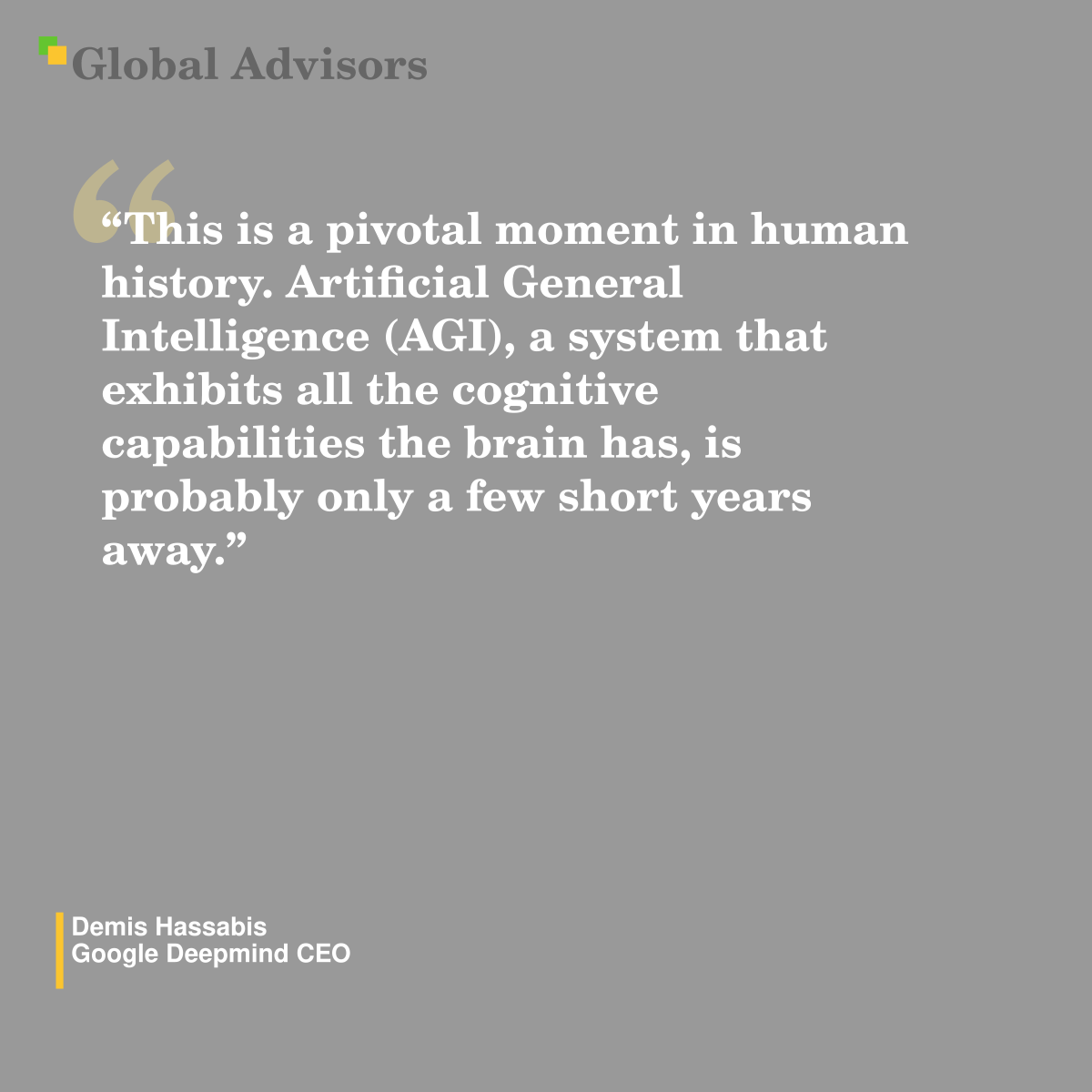
Quote: Demis Hassabis - Google Deepmind CEO"This is a pivotal moment in human history. Artificial General Intelligence (AGI), a system that exhibits all the cognitive capabilities the brain has, is probably only a few short years away." - Demis Hassabis - Google Deepmind CEO The claim that human civilisation is approaching a system with brain-level cognitive capabilities crystallises a long-building tension between incremental AI progress and the possibility of a phase shift in how intelligence exists in the world. It surfaces a practical question for governments, firms, and citizens: should the next five to ten years be treated as a continuation of current digital trends, or as preparation for a structural transformation in which non-biological minds become central economic and political actors. Competing Timelines And Moving Goalposts Forecasts for artificial general intelligence have compressed sharply, and Demis Hassabis has been one of the most visible architects of this tightening. In various public appearances he has suggested that systems matching human cognitive breadth could plausibly arrive between five and ten years from now, with more recent remarks narrowing the window to 2029-2030. This drift reflects both rapid empirical progress and changing definitions: earlier visions focused on science-fiction notions of sentient machines, whereas current discussions operationalise AGI in terms of performance against human baselines on diverse tasks, autonomy, and reliability. Shortening timelines therefore express not only increased technical confidence but also a reframing of what counts as general intelligence in machines. Outside frontier labs, the probability mass is distributed more conservatively. Meta-analyses of hundreds of expert surveys and prediction markets still cluster a 50% chance of human-level machine intelligence somewhere between 2040 and 2061. An updated quantitative forecast in early 2026 places only a 10% chance on AGI arriving by 2026, but a 50% chance by 2041. Yet the same data show that entrepreneurs and lab leaders consistently predict earlier arrival than academic researchers. Hassabis operates squarely in this entrepreneurial segment, where aggressive timelines serve both as internal motivation and external signalling that current architectures, given sufficient scaling and a handful of breakthroughs, will suffice to cross the generality threshold. Defining General Intelligence In Machines The phrase describing AGI as a system with all cognitive capabilities of the human brain hides a complex definitional struggle. Within cognitive science and psychology, human intelligence is decomposed into multiple faculties: perception, attention, memory, reasoning, learning, metacognition, executive control, problem solving, and social cognition. DeepMind has explicitly adopted this multi-ability framework, proposing that progress towards AGI should be measured by benchmarking systems on each of these dimensions against human performance distributions. Under this paradigm, AGI is not a binary label but a spectrum of capability levels: emerging, competent, expert, virtuoso, and super, each defined by percentile ranges across tasks relative to skilled adults. Current large models occupy only the lower rungs of this ladder. Public evaluations suggest that 2026 systems are at an emerging or, at best, partially competent level, with pockets of expert performance in coding or mathematical problem solving but substantial gaps in robust reasoning, long-term memory, and social cognition under novel conditions. A cognitively inspired framework changes the question from whether a single machine matches a generic conception of human intelligence to how its performance profile maps onto specific cognitive traits. It also implies that reaching AGI requires not just more data or parameters, but qualitative advances in how systems learn from the world, manage uncertainty, and reflect on their own limitations. The World Model Bet And The Path To Agents Hassabis grounds his optimism in a particular recipe: continued scaling of large language models combined with one or two new architectural breakthroughs, especially in reasoning and planning. Central to this view is the distinction between language models, which operate primarily over text, and world models, which develop internal representations of physical and social reality. DeepMind and related teams are building interactive systems such as Genie 3, which generate simulations that agents can move through and manipulate, effectively training not just on words but on virtual physics and causality. This work directly targets the missing ingredients for AGI-level agency: the ability to forecast consequences, plan multi-step actions, and adapt policies to new environments. From a technical standpoint, the shift from chatbots to agents marks a change in the objective function. Rather than merely predicting the next token in a conversation, agentic systems optimise sequences of actions to achieve external goals. In many prototypes, this is implemented as a combination of a base model, external tools, and a planning scaffold that iteratively calls the model, evaluates intermediate results, and updates a working plan. The frontier question is whether incremental improvements to this scaffold, combined with test-time compute that allows models to think for longer per decision, will suffice to close the reasoning gap evidenced by benchmarks such as ARC-AGI, where humans still significantly outperform machines. Hassabis argues that the missing capability is not mysterious but a matter of engineering breakthroughs of the scale of the Transformer or AlphaGo. Critics respond that planning and understanding are not mere extensions of pattern recognition and may require fundamentally new principles. Strategic And Societal Stakes Of A Short Horizon Framing the current decade as a pivotal juncture raises difficult strategic questions for policymakers and industry. If AGI is five to ten years away, regulatory regimes built for narrow recommendation algorithms or conversational assistants will likely be inadequate. Hassabis and others have emphasised that such systems could have an impact greater than any previous general-purpose technology since electricity or fire, altering the foundations of economic production, scientific discovery, and national security. This degree of potential transformation creates competing imperatives: accelerate innovation to capture benefits, build governance mechanisms to avert catastrophic misuse, and ensure that gains are distributed rather than concentrated. The compressed timeline exacerbates coordination problems. Investments in safety research, evaluation frameworks, and international standards typically unfold over decades, while fast-moving AI capabilities are arriving on a timescale closer to a single business cycle. Some analysts argue that if AGI does appear around 2030, the window to shape its deployment is already open and closing quickly; others warn that treating speculative systems as imminent risks diverting resources from current harms such as labour displacement, surveillance, and algorithmic discrimination. The tension is not simply between optimists and sceptics but between different notions of what preparation means: hard technical alignment, institutional reforms, or broader cultural adaptation to having non-human intelligence embedded in everyday life. Debates, Objections, And Epistemic Humility Objections to near-term AGI cluster around three themes: overestimation of scaling, definitional inflation, and social signalling. First, critics note that recent gains rely heavily on increasing compute and data, while classic scaling laws suggest diminishing returns at the frontier; additional orders of magnitude of resources may deliver impressive benchmark scores but fail to unlock robust general intelligence. Second, if AGI is defined primarily in terms of economic capabilities or median human performance on test suites, there is a risk of sliding the goalposts so that systems with glaring weaknesses are labelled general simply because they automate enough white-collar labour. Third, lab leaders have strategic incentives to project confidence, attracting talent and capital and shaping narratives that legitimise their approach. Hassabis is not immune to these dynamics, and the tightening of his timeline over successive interviews illustrates how public predictions can track institutional momentum as much as epistemic certainty. Yet purely sceptical positions must also confront the empirical reality of rapid capability growth. In less than five years, models have progressed from struggling with basic reasoning to scoring at or above human professional levels on legal, medical, and mathematical exams, achieving gold-medal performance on Olympiad-style problems and complex programming contests. Autonomous agents already handle substantial fractions of logistics and e-commerce workflows. With prediction markets assigning non-trivial probabilities to AGI by 2030, it is no longer reasonable to dismiss frontier claims as science fiction. The rational stance may be one of calibrated uncertainty: treat AGI as neither guaranteed by 2030 nor unlikely before 2060, but as a live possibility that warrants contingency planning across corporate strategy, research agendas, and public policy. Why This Moment Matters Describing the present as a pivotal moment is less a rhetorical flourish than a diagnostic of divergence between technological trajectories and institutional readiness. On one side, multi-modal systems, world models, and agent frameworks are converging towards machines that can autonomously learn, reason, and act across domains. On the other, governance structures still assume that AI is a tool wielded by humans rather than an increasingly autonomous counterpart capable of setting plans, choosing tactics, and, in some scenarios, negotiating trade-offs that humans do not fully understand. The backstory to the statement therefore lies in this gap: a frontier lab leader who has spent decades building systems like AlphaGo and AlphaFold now sees the technical path to general intelligence as visible, while the world around him still debates whether such systems belong to the twenty-first century or the distant future. Whether or not AGI arrives on Hassabis's preferred timeline, the convergence of definitional work, technical progress in agents and world models, and intensifying institutional concern suggests that the coming decade will be shaped by how societies respond to the possibility of non-biological general intelligence. The important question is not merely when a system achieves all human cognitive capabilities, but how many decisions its precursors will already make, how many systems they will design, and how many institutions they will reshape before anyone can confidently declare that the threshold has been crossed.
|
| |
| |
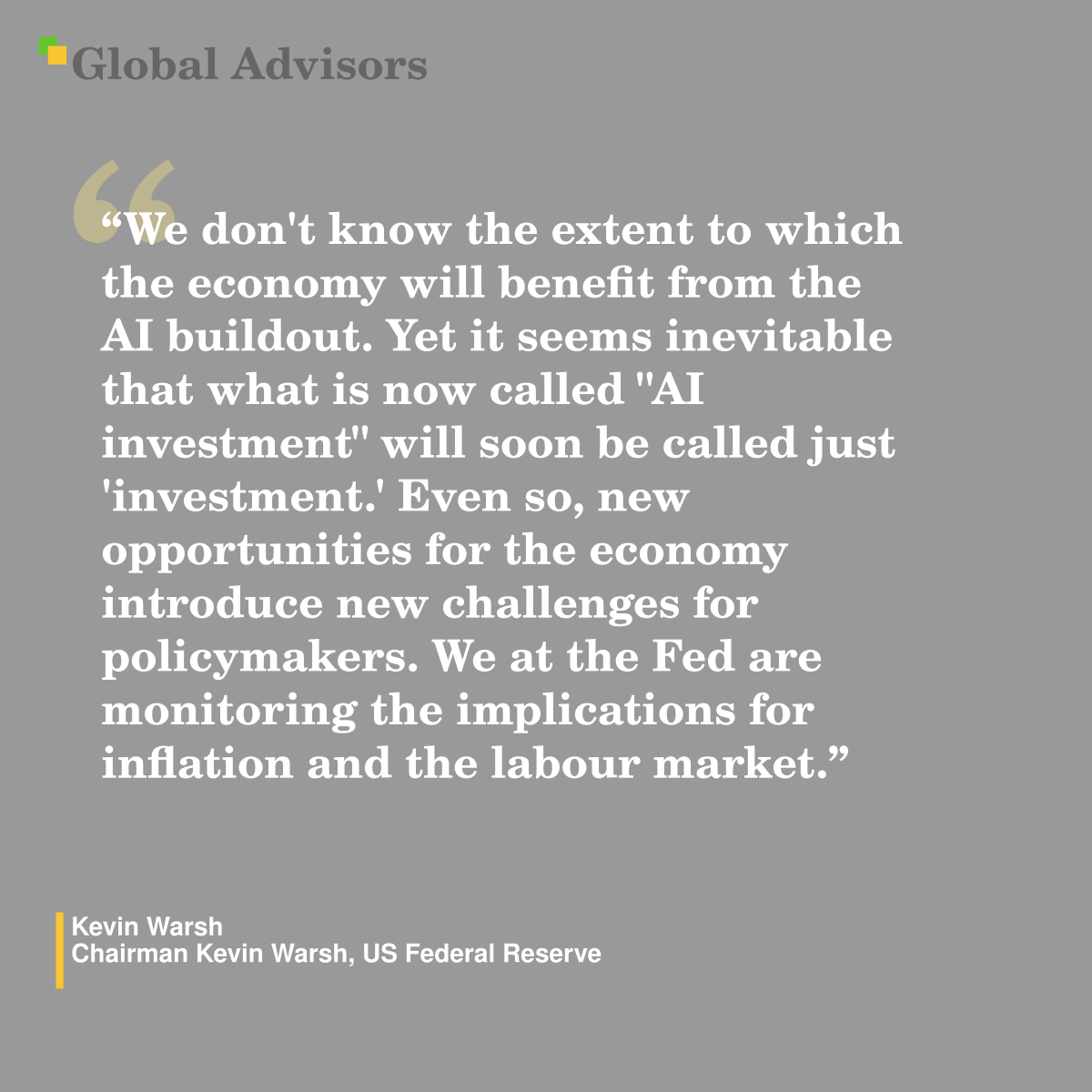
Quote: Kevin Warsh - Chairman Kevin Warsh, US Federal Reserve"We don't know the extent to which the economy will benefit from the AI buildout. Yet it seems inevitable that what is now called "AI investment" will soon be called just 'investment.' Even so, new opportunities for the economy introduce new challenges for policymakers. We at the Fed are monitoring the implications for inflation and the labour market." - Kevin Warsh - Chairman Kevin Warsh, US Federal Reserve The immediate policy problem is that a surge in AI spending can look like a conventional investment boom while behaving, in the short run, like a demand shock. Data centres, chips, electricity, specialised construction and software are all being pulled forward at once, and that means higher outlays before any broad productivity gain shows up in the accounts. The result is a gap between the speed of capital formation and the slower pace at which cheaper output, better margins or higher living standards arrive, which is why central bankers are being forced to think about AI as both a supply-side promise and a near-term source of inflation pressure. That tension sits behind the central claim that the category called 'AI investment' may eventually disappear into the broader, ordinary idea of investment. As the technology spreads, firms will no longer be buying AI as a special asset class so much as buying improved production capacity, better forecasting, faster workflows and more efficient distribution. In that sense, the label will change when the novelty fades and the spending is absorbed into standard capital deepening, much as electrification or cloud computing ceased to be treated as separate macroeconomic phenomena once they became embedded in routine business expenditure. From novelty to normal capital formation The deeper macroeconomic significance is that AI investment is already large enough to affect aggregate demand. The St Louis Fed estimated that AI categories contributed 0,97 percentage points to real GDP growth in the first three quarters of 2025, and that these categories accounted for 39 percent of total GDP growth over the same period. Separate Fed monitoring put AI-related capital expenditure at 131 billion dollars in Q4 2025 on a quarterly basis and 412 billion dollars for the year, equal to about 1,31 percent of U.S. GDP. Those are not marginal figures. They imply that AI is no longer only a research theme or a stock-market narrative; it is part of the spending base sustaining the cycle. That scale matters because capital booms do not become disinflationary the moment they begin. In the short run, firms building out capacity bid for the same scarce inputs, which pushes up prices for advanced semiconductors, power, land, cooling, fibre and engineering labour. Fed minutes and subsequent reporting have already linked AI-related demand to upward pressure on technology goods and electricity prices, alongside broader inflation pressures from energy and supply conditions. This is why the same wave of expenditure that might, over time, lower unit costs can initially make life more expensive. The transmission mechanism is straightforward: rises before potential output fully adjusts, so measured prices can rise faster than any future gain in productive capacity. The productivity case and the inflation case The productivity argument remains powerful, and it is the reason many economists and investors still expect AI to be disinflationary in the medium term. If AI raises output per worker, reduces error rates and automates routine tasks, then unit costs should fall and the economy's supply frontier should shift outwards. That is the logic behind the claim that AI will eventually be treated as plain investment rather than as a separate category. Fed officials have also pointed to labour-market gains, with one governor expecting AI to have a transformative effect and, in the longer run, to boost productivity and living standards. Other Fed research has found no clear evidence so far that industries with higher AI adoption are posting fewer jobs, suggesting that the first-order effect may be task reallocation rather than immediate mass displacement. The counterargument is that the timetable matters more than the theory. A technology can be supply-enhancing over several years while still being inflationary over the next several quarters. If businesses rush to secure compute, power and model capacity ahead of competitors, then the economy experiences a burst of derived demand before it experiences a broad efficiency dividend. One research note described the short-term effect as closer to a positive demand shock than a clean productivity windfall, because strong AI investment raises the price of AI-related inputs before the gains are widely diffused. That is the core reason monetary policymakers are uneasy: they must set rates on the basis of realised inflation, not on the assumption that future efficiency will eventually arrive. Why the Fed is uneasy The Federal Reserve's concern is not only that AI may lift prices, but also that it may alter the path of the labour market. If firms use AI to cut costs and speed up production, demand for certain occupations may soften even as the economy grows. If they use it to expand output without hiring proportionately, productivity rises but job creation becomes less labour-intensive. Fed Governor Barr has warned that AI will affect a large share of workers and challenge both private and public sectors to manage the adjustment, even as it boosts productivity over the longer run. That is exactly the sort of dual-mandate problem central bankers dislike: inflation may stay sticky while employment effects are uneven, making it harder to know whether tight policy is restraining excess demand or simply slowing a structural transition. The June meeting minutes and later commentary suggest that policymakers are already wrestling with this ambiguity. Some officials now see AI infrastructure demand as part of the explanation for firmer core goods inflation, while others emphasise the future productivity benefits and the possibility that AI will lower the neutral rate of interest over time. In practical terms, that means the Fed must decide whether today's spending boom represents a temporary overheating episode or the first phase of a durable investment regime. If it is the former, policy should stay restrictive. If it is the latter, the economy may be able to grow faster without the same inflationary penalty, but only after the supply side catches up. Debates, objections and the policy lag There are credible objections to the optimistic view. First, AI capex may prove concentrated in a small number of firms and sectors, limiting the transmission into broad productivity. Second, the costs of energy, land and specialist equipment may stay high long enough to absorb much of the private return, leaving consumer prices only modestly affected. Third, some of the apparent growth support could be a wealth effect from equity valuations rather than genuine efficiency gains, which would make the boom fragile if market sentiment turns. On that reading, the Fed could find itself easing into an asset-price-led expansion that has not yet generated commensurate supply benefits, a combination that would be awkward for both inflation control and financial stability. There is also a methodological issue. Central banks are trying to measure an economy that is changing faster than the statistical system. The Fed and other institutions are increasing their use of real-time data, private-sector indicators and AI-enabled analysis precisely because conventional data arrive too slowly to capture these shifts. That creates a second-order irony: the central bank may need AI to monitor the very AI boom that complicates its inflation forecast. The better the technology becomes at improving forecasting, the more pressure there is to update policy frameworks that were built for a slower-moving industrial economy. Why it matters for markets and policy For markets, the most important implication is that AI is no longer just a growth story or a valuation story. It is now a macro story about the composition of demand, the persistence of inflation and the timing of rate cuts or hikes. If the spending wave remains intense, bond yields may stay elevated because investors will keep pricing firmer nominal growth and a more cautious Fed. If the productivity payoff arrives sooner, then disinflation could strengthen, real rates could drift lower and the policy debate could move towards accommodation. That is why the same set of facts can support opposite trades: AI can be read as a route to faster growth, or as a reason inflation stays above target longer than markets expect. For policymakers, the broader lesson is that AI is reshaping the economy in stages. First comes the investment buildout, which stresses supply chains and lifts prices. Then comes the adoption phase, which may widen output and improve labour productivity. Only later, if diffusion is broad enough, does the technology become indistinguishable from ordinary business investment. That is the path implicit in the claim that AI investment will soon just be investment. The phrase is less a forecast about labels than a forecast about maturation: once AI ceases to be a separate macro event and becomes part of the economy's normal capital stock, the main question will no longer be whether it is special, but how quickly its gains are shared across firms, workers and consumers.
|
| |
| |
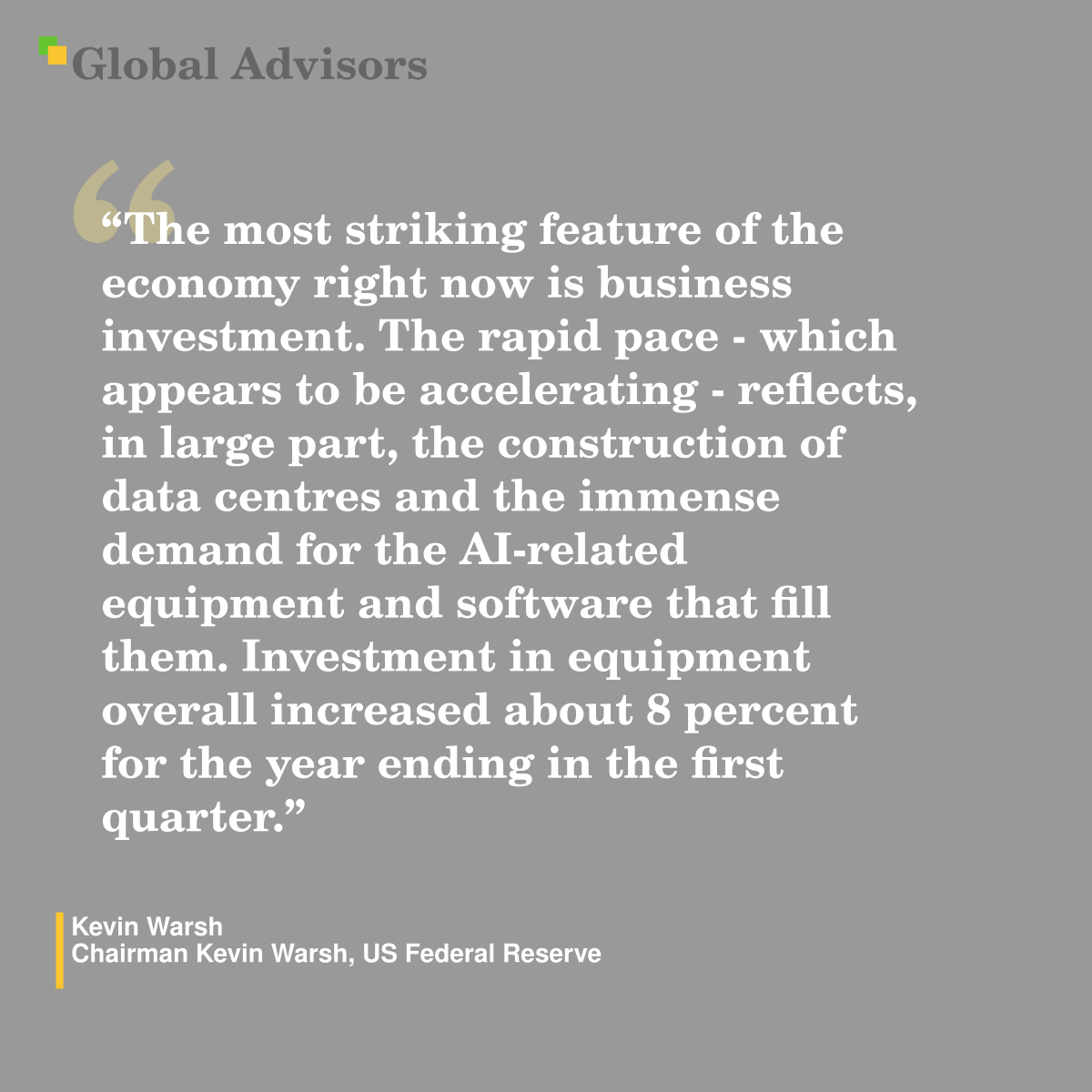
Quote: Kevin Warsh - Chairman Kevin Warsh, US Federal Reserve"The most striking feature of the economy right now is business investment. The rapid pace - which appears to be accelerating - reflects, in large part, the construction of data centres and the immense demand for the AI-related equipment and software that fill them. Investment in equipment overall increased about 8 percent for the year ending in the first quarter." - Kevin Warsh - Chairman Kevin Warsh, US Federal Reserve Business investment has become the primary transmission channel through which the artificial intelligence boom is reshaping the macroeconomy, displacing the long-standing primacy of consumer spending as the dominant driver of United States growth . The striking feature is not simply that investment is high, but that its composition has pivoted decisively toward the physical and digital infrastructure required to deliver AI at scale, particularly data centres, specialised equipment, and software. In recent national accounts data, equipment investment alone rose around 8 percent over the year to the first quarter, while broader non-residential investment is growing several times faster than in 2024, with AI-related categories responsible for the majority of the increase . This pattern marks the emergence of an AI-capital expenditure cycle that is strong enough to move headline GDP and, by extension, to complicate the task of monetary policy. From Consumer-Led Growth To Investment-Led Expansion For decades, the US economy has been characterised by narratives which emphasise household consumption as the key engine of growth, supported by stable employment and credit availability. Recent data challenge that familiar picture. Analysts now estimate that business investment contributed more to GDP growth in Q1 2026 than consumer spending, with chips, data centres and models overtaking the American consumer as the main incremental driver . When the Bureau of Economic Analysis decomposed the 2.0 percent annualised GDP growth rate in that quarter, computer and peripheral equipment investment grew at a 67.4 percent annualised pace and software at 22.6 percent, together contributing roughly 1.09 percentage points to the headline figure . Without this surge in digital and AI-related investment, overall growth would have been closer to 1.0 percent, implying that roughly half of the expansion can be traced to a single strategic theme . In that context, equipment investment rising about 8 percent year-on-year is not a marginal detail but a signal of a structural regime shift in how growth is being generated . The Data Centre Buildout As Macro-Level Phenomenon The centre of gravity of this investment wave lies in the construction and equipping of data centres optimised for AI workloads. Industry and policy research suggests that data-centre-related spending has become the largest single contributor to US growth, offsetting weakness in other investment categories and even the drag from policy uncertainty . Preliminary estimates indicate that AI-linked data centre and power investments lifted US GDP by about 0.5 percentage point in the second quarter of 2025 compared with a counterfactual where those components had grown only at their 2011-2022 trend . Private sector analysis reinforces this picture: AI and cloud computing are expected to deliver a 14 percent compound annual growth rate for the data centre sector through 2030, with global capacity roughly doubling as almost 97 GW of new capacity is added between 2025 and 2030 . The scale of capital commitments is extraordinary. The five largest US cloud and AI infrastructure providers plan to spend between 660 and 690 billion on infrastructure in 2026 alone, nearly doubling their 2025 levels, with the vast majority directed to AI compute, data centres and networking . Parallel estimates from infrastructure and real estate analysts point to more than 600 billion in hyperscaler capital expenditure in 2026, again focussed on data centres and digital infrastructure . In this context, the comment that the rapid pace of business investment reflects data centre construction and demand for AI equipment is a concise description of a multi-hundred-billion-dollar reallocation of capital . Investment Composition: Equipment, Software And Intellectual Property The investment acceleration is not limited to poured concrete and server racks; it is distributed across equipment, software, and intellectual property that together form the AI stack. Macroeconomic decompositions show that AI-related technologies now account for nearly three-quarters of all growth in business investment, despite representing only around 8 percent of total capital expenditure . Computer equipment and peripherals, software, and research and development associated with AI models have all registered double-digit or higher annualised growth rates . Venture capital flows indicate where future investment will concentrate: global VC investment in Q1 2026 reached 330.9 billion, driven by AI megadeals, with US AI-focused companies raising more than 267.2 billion in that quarter . Analysts estimate that 35 to 45 percent of AI venture funding ultimately migrates into physical infrastructure, including data centres, manufacturing facilities for chips, and R&D labs, implying 95 to 120 billion of commercial-real-estate-relevant deployment over 3 to 5 years from Q1 2026 alone . This pipeline links financial capital to tangible investment in equipment and structures, reinforcing the feedback loop between AI narratives and actual macroeconomic outcomes. Monetary Policy Tension: Strong Investment, Persistent Inflation For monetary authorities, the AI investment boom presents a paradox. On one hand, strong business investment supports output, employment and productivity in a period marked by geopolitical shocks and policy uncertainty. On the other, large capital outlays, rapid equipment demand and potential capacity bottlenecks risk sustaining inflationary pressures, particularly in construction, high-end electronics, and power markets. Current policy communication from the central bank has emphasised a firm commitment to restoring price stability, with the target fed funds rate held in the 3.5 to 3.75 percent range and forecasts tilting towards possible hikes by the end of 2026 . Officials have highlighted that inflation is running above target and that risks remain skewed towards persistence, even as energy-driven spikes begin to fade . The difficulty lies in distinguishing between demand-driven overheating and a supply-side investment surge that is simultaneously expanding capacity and straining current resources. If AI data centre investment lifts GDP growth mechanically while output gaps remain narrow, standard reaction functions would suggest tighter policy. Yet, raising rates too aggressively might impair the very investment that is increasing future productive capacity, creating a strategic tension between short-term stabilisation and long-term transformation. Infrastructure Constraints: Power, Land And Supply Chains The data centre boom is colliding with physical constraints in power generation, grid capacity, land availability and critical equipment supply, turning what might have been a smooth investment cycle into a series of bottlenecks. Infrastructure analysis now frames power as the primary limiting asset, with multi-gigawatt development pipelines and gigawatt-scale campuses across major regions . Deloitte estimates that demand from AI data centres could grow more than thirtyfold in the United States by 2035, from around 4 GW in 2024 to 123 GW, reflecting the higher energy intensity of AI workloads compared with traditional cloud applications . As energy became the key constraint in Q1 2026, data centres transitioned from a real-estate asset class into integrated energy and compute systems, requiring close coordination between utilities, regulators, and technology firms . On the equipment side, high-end GPUs, networking gear, and power systems are subject to lead times, fabrication bottlenecks, and export controls, amplifying the investment cycle but also increasing its vulnerability to shocks . These constraints shape the trajectory of business investment: capital spending continues to accelerate, but it does so under conditions where marginal capacity is more expensive, risk management more complex, and local communities more vocal about land use, water, and carbon footprints. Debates And Objections: Bubble Risk Or Rational Buildout? As the AI-capex cycle gathers pace, observers debate whether the present surge in data centre and equipment investment reflects a rational response to durable demand or a speculative overshoot reminiscent of the dot-com era. Advocates of the structural thesis point to several factors. First, estimates of required compute and data centre capacity for AI workloads through 2030 range into the trillions in global capital expenditure, with McKinsey projecting about 6.7 trillion in data centre investment by that date, 5.2 trillion of which is linked to AI applications . Second, the share of GDP attributable to computing infrastructure has more than doubled since the AI boom began in 2023, indicating that this is not a marginal technology hobby but a core production factor . Third, macro data show that AI-related investment has persisted despite higher borrowing costs and policy uncertainty, suggesting a robust underlying profitability and competitive imperative . Skeptics counter that revenue models for many AI services remain unproven, regulatory frameworks for safety and data use are evolving, and concentration of investment among a small set of large technology firms introduces systemic risk if expectations prove too optimistic . There is also concern that investment is geographically concentrated, potentially exacerbating regional inequality and leaving other sectors starved of capital. The tension between these perspectives shapes the interpretation of the current 8 percent plus equipment investment growth rate: either as a justified repositioning of the capital stock toward a new general-purpose technology, or as a potential overbuild that may be revealed only once the credit cycle turns. Why It Matters For The Real Economy The significance of the AI-driven business investment surge extends well beyond financial markets or central-bank deliberations. At the level of firms and workers, the pivot toward data centres and AI equipment is changing demand patterns for skills, altering industrial supply chains, and reconfiguring local economies. Construction employment and specialised trades linked to large-scale infrastructure projects benefit directly from the buildout . Semiconductor fabrication, advanced manufacturing, and electrical equipment industries experience spillover gains as orders for GPUs, high-density servers, cooling systems and grid upgrades multiply . Regions hosting large campuses see rising demand for commercial real estate, transport, and municipal services, even as they confront challenges around energy usage, environmental impacts and housing affordability . At the same time, sectors not directly tied to AI infrastructure may face relative neglect, with capital redirected away from more traditional projects. From a distributional perspective, the gains from AI investment are likely to be uneven, skewed towards highly skilled workers, technology clusters, and asset owners whose portfolios are exposed to the AI theme . This makes the macro story of rapid business investment inseparable from questions about inclusion, regulation and strategic industrial policy. Strategic Implications For Policy And Industry The present investment landscape implies that policymakers, regulators and corporate leaders are operating in an environment where capital allocation decisions in AI infrastructure have macro-critical consequences. For central banks, understanding the composition and drivers of business investment is now a prerequisite for accurate inflation and growth forecasting, particularly when a single category of spending can account for half of quarterly GDP growth . For fiscal and regulatory authorities, the challenge is to align energy policy, land-use planning, and competition frameworks with a trajectory that anticipates multi-hundred-billion annual outlays in data centres and related equipment. For firms, the strategic question is whether to join the AI buildout as an infrastructure owner, a software layer participant, or a user of commoditised services, recognising that the physical footprint of AI may influence everything from supply-chain resilience to environmental reporting. The rapid and accelerating pace of business investment in data centres, equipment and software signifies that AI is no longer an abstract technological theme but a concrete macroeconomic force, one that is reshaping the structure of the economy through the capital stock itself.
|
| |
| |
Global Advisors News Brief - July 14 2026Read the full brief at the link Headlines for the last 24hrs
Time window: 2026-07-13T05:00:33.074Z to 2026-07-14T05:00:33.074Z |
| |
| |
Quote: Rob Haworth - Senior Investment Strategy, U.S. Bank"Four forces often shape the value of the dollar: interest-rate differences, global investing demand, trade flows, and inflation expectations." - Rob Haworth - Senior Investment Strategy, U.S. Bank Recent swings in the dollar have exposed how dependent the global financial system is on a small set of transmission channels: relative interest rates, cross-border investment flows, trade balances, and shifting inflation expectations. Each channel links domestic US policy choices to conditions in the rest of the world, creating feedback loops that can reinforce or offset one another. Understanding this interplay is crucial for investors, policy makers and corporates that are effectively long or short the dollar through their portfolios, balance sheets or supply chains. Interest-rate differences as the primary signalling device Interest-rate differentials are often the most visible driver of dollar moves because they directly affect the return investors earn on safe assets such as US Treasuries compared with foreign bonds. When US policy rates rise relative to other advanced economies, international capital typically flows toward US assets seeking higher yields, lifting demand for the dollar and pushing the currency higher. The theoretical transmission runs through uncovered interest parity, expressed as , where is the spot exchange rate and , are policy rates in the US and the rest of the world. Although empirical deviations are common, the expectation that higher US rates justify a stronger dollar remains deeply embedded in market behaviour. In practice, this linkage is mediated by perceptions of monetary policy credibility and risk appetite. A hawkish Federal Reserve combined with relatively resilient US growth has repeatedly supported dollar strength in periods of global stress, as investors treat US assets as a high-yielding safe haven. However, once markets anticipate that the rate differential has peaked or will compress, the same mechanism can trigger sharp reversals, with capital rotating out of the dollar toward economies expected to deliver better future returns. Global investing demand and the dollar as a safe asset Beyond simple yield comparison, the dollar's value reflects evolving global demand for dollar-denominated assets, particularly those regarded as safe stores of value. The currency functions not only as a medium of exchange but also as collateral in global funding markets, so changes in risk appetite or regulatory constraints can alter the convenience yield investors are willing to accept for holding dollar assets instead of higher-yielding alternatives. Research decomposing the dollar's appreciation since 2011 attributes roughly equal weight to higher US policy rates, increased global savings, and stronger structural demand for US assets such as Treasuries and investment-grade corporate bonds. In this framework, the exchange rate can be expressed via a portfolio-balance model where the equilibrium value of depends on global savings , the supply of dollar assets , and the desired share of those assets in worldwide portfolios. When global savings rise faster than safe asset issuance, competition for dollar instruments intensifies, supporting an appreciation even if trade fundamentals are unchanged. The dollar's status as the dominant reserve currency amplifies this effect: central banks and sovereign wealth funds allocate a large portion of their reserves to dollar assets, reinforcing demand during episodes of geopolitical uncertainty or market stress. At the same time, any credible threat to this privileged status, whether through technological disruption, alternative reserve currencies or concerns over US fiscal sustainability, would manifest first as shifts in global investing demand rather than abrupt changes in trade flows. Trade flows and the balance-of-payments constraint Trade balances provide the second major channel through which the dollar's value responds to underlying economic conditions, though the relationship is more nuanced than textbook models suggest. A widening US trade deficit implies that the US is importing more goods and services than it exports, which in principle increases the supply of dollars to the rest of the world. Under a simple balance-of-payments identity, the current account deficit must be matched by a capital account surplus, meaning foreign investors must be willing to accumulate more US assets to absorb the outward flow of dollars. If investor appetite lags behind the pace of deficit expansion, the resulting excess dollar supply tends to weaken the exchange rate. However, when US growth is strong and domestic assets are attractive, the capital inflow side of the balance can dominate, allowing the dollar to appreciate even as the trade deficit persists or widens. Trade flows also interact with the pricing behaviour of exporters and importers. A stronger dollar makes US exports more expensive in foreign currency terms and imports cheaper for US households and firms, which can gradually erode export competitiveness and reinforce external imbalances. Conversely, a weaker dollar supports export-oriented sectors and may spur reshoring or expansion of domestic manufacturing. Multinational businesses hedge these exposures through derivatives and operational adjustments, but their cumulative decisions feed back into the currency market as they manage dollar revenues, foreign expenses and cross-border funding. Inflation expectations and the credibility of policy Inflation expectations form the fourth key influence, connecting domestic price dynamics to the international valuation of the dollar. Expectations matter because they shape both nominal interest rates and perceptions of the real value of future dollar cash flows. If investors anticipate persistent US inflation above that of trading partners, they demand compensation in the form of higher nominal yields, but they may also mark down the expected purchasing power of the currency, producing a complex net effect on the exchange rate. Empirical work suggests that unexpected increases in inflation expectations tied to doubts about fiscal sustainability tend to depreciate the dollar, highlighting the importance of credible medium-term frameworks for managing public debt. One practical way markets infer inflation expectations is through Treasury Inflation-Protected Securities, where breakeven inflation rates approximate the difference between nominal yields and real yields. Fluctuations in these breakevens, caused both by genuine shifts in expectations and by trading flows in volatile conditions, feed directly into currency pricing models. Formally, the real interest rate relevant for exchange-rate determination can be expressed as , where denotes expected inflation; the dollar responds not only to changes in but to any revision in that alters the perceived real return on US assets. Interacting forces and feedback loops Although interest-rate differences, investing demand, trade flows and inflation expectations can be described separately, in reality they form a tightly coupled system. A tightening in US monetary policy aimed at restraining inflation raises policy rates and can attract foreign capital, supporting a stronger dollar. The appreciation lowers the local-currency cost of imports, influencing consumption patterns and potentially moderating goods inflation while increasing pressure on export sectors. At the same time, capital inflows generated by higher rates can boost domestic wealth and spending, creating offsetting price pressures that complicate the central bank's task. This topsey-turvy dynamic means that in some scenarios, aggressive rate hikes may unintentionally sustain inflation via capital-flow channels even as they depress growth, forcing policy makers to weigh the external effects of their decisions as carefully as the internal ones. On the structural side, prolonged periods of elevated US rates and strong demand for dollar assets may encourage foreign borrowers to take on more dollar-denominated debt, deepening global reliance on the currency and increasing vulnerability when conditions reverse. In downturns, heightened exchange-rate volatility can lead US banks to contract balance sheets and widen lending margins, transmitting dollar uncertainties back into domestic credit availability. These feedback loops illustrate why the dollar's value cannot be reduced to a single explanatory variable and why changes in one of the four forces often propagate through the others. Strategic implications and contested narratives For investors and corporates, the strategic challenge lies in assessing which of the four forces is likely to dominate over their planning horizon. Portfolio managers must decide whether current rate differentials and inflation expectations justify structural dollar exposure or whether global investing demand is vulnerable to regime shifts such as alternative payment systems, digital currencies or evolving geopolitical blocs. Exporters and importers face operational choices around invoicing currencies, hedging strategies and production locations, all of which depend on their view of trade flows and the durability of US policy frameworks. Policy makers, meanwhile, debate whether the dollar's strength is primarily a function of domestic fundamentals or of global imbalances that could unwind abruptly, especially if fiscal trajectories or political risks undermine confidence. Critics argue that reliance on the dollar-centric order imposes costs on emerging markets, exposing them to external shocks driven by US rate cycles and risk sentiment rather than local conditions. Proponents counter that the depth and liquidity of dollar markets, combined with the institutional resilience of US monetary and legal systems, continue to justify the currency's central role. The result is an ongoing tension between narratives of inevitable dollar decline and those of entrenched dominance, with each new episode of market volatility interpreted through these lenses. Why the four forces matter now Against this backdrop, framing dollar valuation through the interplay of interest-rate differences, global investing demand, trade flows and inflation expectations offers a practical roadmap for understanding current moves and stress-testing future scenarios. It emphasises that neither individual data releases nor headline events can be interpreted in isolation. A surprise change in US rates may matter less if global savings remain ample and demand for safe assets is strong; conversely, a modest policy adjustment could trigger outsized currency shifts if it coincides with deteriorating inflation expectations or abrupt changes in trade policy. For long-term investors, the framework reinforces the importance of diversification across currencies and asset classes, recognising that short-term exchange-rate swings can meaningfully affect returns on foreign holdings but that these effects tend to average out over longer horizons. For corporates, the same logic supports disciplined hedging and strategic flexibility in supply chains, reducing vulnerability to sudden shifts in any one of the four forces. Ultimately, the dollar's path will continue to reflect a complex negotiation between domestic policy choices, global financial preferences, real economic flows and collective beliefs about future inflation. Reading that negotiation through these four lenses does not eliminate uncertainty, but it clarifies where the most important pressures are likely to originate and how they may converge in the next phase of the currency cycle.
|
| |
| |
Term: DuPont analysis - Finance"DuPont analysis breaks down a company's Return on Equity (ROE) into three components - profitability (net profit margin), asset efficiency (total asset turnover), and financial leverage (equity multiplier) - to identify the specific drivers of financial performance. This framework allows for a detailed analysis of operational strengths, structural weaknesses, and risks." - DuPont analysis - Finance Shareholders care less about raw profit and more about how effectively their capital is being compounded, which makes the structure of Return on Equity critical to serious financial analysis. Two businesses can both report an ROE of 15%, yet one might achieve it through strong margins on modest leverage, while the other relies on thin margins, high asset churn, and aggressive borrowing that embeds material risk. Untangling these distinct pathways is the central analytical challenge addressed when ROE is decomposed into separate drivers rather than treated as a single headline number. From headline ROE to underlying drivers ROE starts with a simple relationship between the income a firm generates for ordinary shareholders and the equity they have committed. Formally, ROE is net income divided by average shareholders equity over the period, which measures how many pounds of profit are produced per pound of equity funding . That immediate ratio is highly informative, but it merges operating performance, asset deployment, and capital structure into one figure, leaving analysts unsure whether a respectable ROE reflects genuine commercial strength or merely financial engineering. Decomposing ROE into profitability, asset efficiency, and leverage isolates three mechanisms: how much profit is extracted from each pound of sales, how intensively the asset base is used to generate those sales, and how heavily those assets are financed by debt relative to equity . The mechanical link between the simple ROE and its components follows straightforward algebra using revenue and assets as intermediate steps. Net profit margin is defined as net income divided by revenue; total asset turnover as revenue divided by average total assets; and the equity multiplier as average total assets divided by average shareholders equity . Multiplying these three ratios cancels out revenue and assets in the numerator and denominator, leaving net income over equity, which is ROE. In symbolic terms one writes ROE as , where is net income, revenue, average total assets, and average equity . This identity ensures the decomposition is not a separate metric but an exact breakdown of the same underlying return. Profitability: net profit margin Net profit margin captures the economic value created per pound of sales after all operating expenses, interest, tax, and other costs. It is computed as net income divided by revenue and summarises pricing power, cost discipline, and tax efficiency . A margin of 10% means that each 1 pound of sales contributes 0,10 pounds of profit to shareholders. A company with robust margins can sustain a strong ROE even with moderate asset turnover and conservative leverage, because each unit of activity translates into substantial earnings. By contrast, structurally low margins may push management towards higher leverage or extreme efficiency measures to maintain headline ROE, increasing vulnerability to cyclical downturns or execution errors. For deeper insight, practitioners often expand net profit margin into finer components that reflect tax and financing effects separately. In a five step formulation net income over equity is expressed as the product of tax burden, interest burden, operating margin, asset turnover, and financial leverage . Tax burden is net income divided by pretax income, measuring how much profit is lost to tax; interest burden is pretax income divided by operating income, capturing the drag of financing costs; operating margin is operating income divided by revenue, focusing on core business economics. In notation one can write , where , , , , and are the respective ratio components . This extended breakdown distinguishes operational weakness from tax structuring and debt policy. Asset efficiency: total asset turnover Total asset turnover measures how effectively the firm uses its asset base to generate revenue, calculated as revenue divided by average total assets . A ratio of 2,0 indicates that for every 1 pound invested in assets, 2,0 pounds of sales are produced during the period. Capital light businesses with rapid inventory cycles and low fixed asset intensity, such as certain service or technology firms, typically exhibit higher asset turnover. Heavy manufacturing or utility companies often show lower turnover because large, long lived assets support relatively stable but less asset intensive revenues. From a strategic perspective, improving asset efficiency can raise ROE without altering margins or leverage, for example by tightening working capital, reducing idle capacity, or disposing of non core assets. However, there are trade offs: squeezing assets too hard can expose the firm to operational fragility, supply chain risk, or an inability to meet demand spikes. The decomposition highlights whether a high ROE is built on sustainable efficiency improvements or on temporarily elevated turnover due to aggressive credit terms or underinvestment in resilience. Financial leverage: equity multiplier The equity multiplier, defined as average total assets divided by average shareholders equity, indicates how much of the asset base is financed by debt or other non equity liabilities . A multiplier of 3,0 implies that for every 1 pound of equity, the firm controls 3,0 pounds of assets, with the difference funded by borrowing or payables. In the DuPont identity, leverage amplifies the effect of profitability and efficiency on ROE: given a fixed asset turnover and margin, increasing the equity multiplier raises earnings relative to equity because more assets, and thus more sales, are supported by the same equity stake. Yet leverage driven ROE comes with heightened risk. Heavier debt loads increase fixed interest obligations and reduce flexibility in downturns. Research using DuPont components often finds that firms whose ROE is primarily driven by margin and asset turnover exhibit more sustainable performance than those relying on high leverage multipliers . The decomposition allows analysts to flag companies where attractive ROE is largely a product of balance sheet stretch rather than genuine operating success, prompting further scrutiny of debt covenants, refinancing cliffs, and interest coverage ratios. Alternative formulations and ROA linkage An alternative, closely related identity links ROE to Return on Assets (ROA) and leverage. ROA is net income divided by total assets, capturing profit per pound of assets irrespective of funding mix . Using algebra one can show that ROE equals ROA times the equity multiplier: , because . This formulation clarifies whether strong ROE arises mainly from operating efficiency (high ROA) or from capital structure decisions (high leverage). A large and widening gap between ROE and ROA generally signals increasing reliance on debt, which may or may not be desirable depending on the firm s risk appetite and sector norms . The extended five factor versions described earlier further incorporate tax and interest effects into ROE, giving practitioners a way to analyse how changes in tax regimes, interest rates, or corporate treasury strategies propagate through to equity returns . For example, a firm might show stable operating margin and asset turnover, but a sharply rising ROE due to lower effective tax rates or cheaper refinancing. Without decomposition, this could be mistaken for a structural improvement in the business model; with DuPont style analysis, the source of the gain is properly identified as fiscal or financial rather than operational. Interpretation, debates, and continuing relevance Interpreting the decomposition involves more than computing the three ratios; it requires judgement about industry context, business model, and sustainability. In capital intensive sectors, lower asset turnover may be entirely normal, and ROE is expected to be driven by margin and judicious leverage. In fast moving consumer businesses, analysts often demand strong turnover and moderate margins, with leverage playing a smaller role. The framework does not prescribe an ideal mix but offers a disciplined lens for asking whether the current configuration fits the economic reality of the firm and whether recent changes in ROE stem from durable improvements or transient choices. Debate around this identity focuses on limitations and potential misuse. Critics note that accounting measures of net income and equity can be distorted by one off items, fair value movements, and share buybacks, which in turn affect DuPont components. Some argue that a heavy focus on ROE and its decomposition may encourage management to optimise reported ratios rather than underlying economic value creation, for example by increasing leverage or repurchasing shares to shrink equity. Proponents respond that when used alongside cash flow analysis, balance sheet scrutiny, and forward looking risk assessment, the framework remains one of the most informative ways to connect profitability, efficiency, and capital structure in a single coherent picture . The approach remains widely taught in professional curricula and used by investors, lenders, and corporate finance teams because it converts a blunt performance ratio into a structured diagnostic tool. Analysts can track each component through time, benchmark against peers, and model scenarios such as an improvement in margin from 8,0% to 9,0%, a change in turnover from 1,5 to 1,7, or a shift in equity multiplier from 2,0 to 2,5 to see how these levers interact to alter ROE . In doing so they move beyond asking whether ROE is high or low, and instead understand how and why equity returns arise, what risks accompany them, and which managerial decisions would most effectively enhance or stabilise shareholder value.
|
| |
| |
Global Advisors News Brief - July 13 2026Read the full brief at the link Headlines for the last 24hrs
Time window: 2026-07-12T05:00:33.072Z to 2026-07-13T05:00:33.072Z |
| |
| |
Quote: David Brooks - The Atlantic"When intelligence is plentiful, volition is valuable. The people who are going to make a difference are not the ones who seek relaxation and passively use AI to work less. They are the ones who will seek improvement and actively wrestle with AI to develop their own mental capabilities and accomplish more." - David Brooks - The Atlantic The spread of powerful language models has created a strange scarcity pattern: analytical horsepower is cheap, but directed human effort is not. Systems that once demanded years of training can now be approximated by prompts; what used to separate high performers was rare knowledge, whereas now the dividing line is how people choose to engage with tools that can think alongside them. The tension is no longer between the informed and the ignorant, but between those who treat artificial intelligence as a sofa and those who treat it as a sparring partner. The shift from intelligence as advantage to intelligence as infrastructure Historically, being able to recall facts, synthesise sources quickly, or draft cogent text at speed provided a reliable career advantage. Generative AI erodes that edge by automating many mid-level cognitive tasks: summarising documents, proposing outlines, drafting emails, generating code, or producing passable first drafts. Intelligence in this narrow, instrumental sense behaves more like infrastructure than personal capital; it is abundant, widely accessible, and embedded in dozens of everyday tools. When everyone can summon a competent explainer, translator, or analyst in seconds, the differentiator shifts from what you know to what you are prepared to do with what can now be known almost on demand. This reclassification has profound labour-market implications. Occupations once insulated by information asymmetry - consultants, lawyers, analysts, even educators - are being reconfigured as clients and students gain cheap access to quasi-expert reasoning. The human advantage migrates away from grinding through information to deciding which questions to ask, which paths to pursue, and which trade-offs to accept. In other words, volition - the disposition to initiate, persist, and take responsibility - becomes a primary economic and cultural asset. Volition as a scarce capability in an age of cognitive outsourcing Volition is more than generic motivation; it is a structured willingness to confront difficulty rather than route around it. Modern AI systems make avoidance deceptively easy. It is trivial to hand off the awkward email, the intimidating blank page, or the complex planning problem and accept the first adequate output. Evidence from education and mental health suggests that such passive use can dull both critical thinking and self-regulation, especially when users begin to anthropomorphise systems and treat their outputs as authoritative rather than provisional. Studies of technology and AI dependence describe patterns of reduced effort, weakened memory formation, and erosion of decision-making confidence when people consistently offload cognitive labour without reflective engagement. By contrast, using AI as a scaffold rather than a crutch can strengthen volitional muscles. Guidance from psychologists and educators stresses practices such as asking for hints instead of full solutions, writing one's own analysis before consulting a model, and using AI to critique or stress-test personally generated ideas. These strategies preserve the locus of control in the human user while still exploiting the model's breadth of knowledge. Volition shows up in choices like starting with a blank page, posing increasingly precise follow-up questions, iterating through counter-arguments, and deliberately tackling concepts that initially feel uncomfortable. The character of those who thrive: wrestlers, not delegators The statement splits future workers and citizens into two archetypes: those who seek relaxation through automation, and those who seek improvement through friction. The first group uses AI chiefly to shrink effort and time-on-task. They ask for complete essays, ready-made slide decks, or turnkey marketing campaigns, and treat the outputs as finished products rather than raw material. Educators already report that such uses correlate with diminished engagement and superficial learning, even when grades in the short term may not immediately suffer. Over time, their own mental models atrophy because they seldom practise original structuring, framing, or evaluation of information. The second group treats AI as an adversarial collaborator. They use it to surface objections to their arguments, uncover edge cases they might have missed, or rehearse difficult conversations in low-stakes simulations. They turn generative tools into tutors by asking them to probe their understanding, devise exercises, and generate alternative perspectives that must then be weighed rather than swallowed. In work settings, these individuals are more likely to deploy AI to expand project scope, run scenario analyses that would otherwise be unaffordable, or build prototypes that test new ideas. Their aim is not to do the same workload faster but to increase the ambition and complexity of what they attempt. Brooks's broader humanistic frame David Brooks has long been preoccupied with the question of what remains distinctly human when technological systems encroach on cognitive territory once reserved for people. In public writing and talks, he has argued that artificial intelligence clarifies human value by making machine-susceptible skills cheap and spotlighting those forms of understanding that resist codification: empathy, moral judgment, narrative meaning-making, and situational awareness. He contends that success will increasingly depend on cultivating a recognisable personal voice, the ability to move others, and the courage to hold unusual perspectives rather than merely conforming to standardised, optimised outputs. In that frame, volition is not only about economic productivity but about moral agency. The danger is not simply that people become less employable if they relax into AI; it is that they become less fully themselves, outsourcing not just drafts and diagrams but values, priorities, and identity-defining decisions. Brooks's warning therefore aligns with a growing chorus of psychologists and ethicists who worry that heavy AI reliance may blunt autonomy and leave individuals more susceptible to manipulation, persuasive design, and algorithmically curated realities. Debates and objections: is striving always superior? There are, however, important objections to a pure celebration of volition. One challenge comes from mental health research showing that constant striving, especially in precarious labour markets, can feed burnout, anxiety, and a sense of perpetual inadequacy. For individuals juggling care responsibilities, disability, or economic stress, using AI simply to ease burdens is not decadence but survival. In these contexts, seeking relaxation is a rational response to chronic overload, and the ethical focus should fall on how systems can reduce drudgery without undermining dignity or agency. Another critique questions whether the dichotomy between passive and active users is too binary. Many people will mix modes, sometimes leaning on AI to manage routine tasks and at other times engaging deeply for skill-building. Research on self-paced learning suggests that well-designed AI tools can boost engagement precisely by automating low-level chores, freeing time for higher-order thinking. From this angle, what matters is not whether one ever uses AI to work less, but whether one consistently chooses to grow in areas that machines cannot fully absorb. The key risk is not convenience itself, but unexamined convenience that gradually hollows out competence and initiative. Practical volition: how to wrestle productively with AI Turning the abstract ideal of volition into practice requires deliberate habits. One approach is to treat AI outputs as hypotheses to interrogate rather than answers to trust. In education, teachers are advised to ask students to critique AI-generated essays, identify weaknesses, and improve them, thereby turning the tool into a stimulus for human judgment. Knowledge workers can do something similar by generating multiple AI proposals and then justifying their final choice in writing, making their own reasoning explicit rather than implicit. This pattern keeps the human in the role of editor, strategist, and accountable decision-maker. Another practice is to use AI to expand the frontier of personal development. Examples include AI-assisted coaching platforms that pose reflective questions, track progress, and suggest challenges calibrated to the user's goals. Some professionals use models to simulate supervision conversations, invite critiques of their work, and discover blind spots in their reasoning. In all these cases, the tool becomes an instrument for building self-awareness, resilience, and creativity - the very capacities commentators argue are most resistant to automation. Volition here shows up as the willingness to be tested, corrected, and stretched rather than merely served. Why it matters: from personal success to cultural trajectory The deeper significance of the statement lies in how it frames the social trajectory of the AI age. If large numbers of people opt for the path of least resistance, delegating thought wherever possible, we risk a culture of shallow comprehension and brittle institutions dependent on opaque systems they do not really understand. Democracies become vulnerable when citizens lack both the skills and the will to interrogate automated decision-making, from credit scoring to predictive policing. Conversely, if enough individuals cultivate volition - the appetite to question, to learn, to assume responsibility - AI can function as a lever that raises collective capability instead of a cushion that lulls it. For organisations, the message is equally stark. Competitive advantage will not come from owning models that competitors can rent, but from assembling teams with the determination and curiosity to combine those models in novel ways, pursue bolder projects, and sustain learning loops over time. Hiring for volition - self-starting behaviour, tolerance for difficulty, and ethical seriousness - may prove more predictive of long-run value than hiring for narrow technical proficiency that AI can increasingly replicate. Strategically, the central question shifts from how much work can be automated to how much human ambition can be safely and wisely amplified.
|
| |
| |
|


| |
| |