| |
|

| |
| |
| |
|
Our selection of the top business news sources on the web. |
| |
| |
| |
Quote: David Frankel - Founder Collective"Are we headed for another dot crash? Definitely. It's not a question of if. When, nobody knows." - David Frankel - Founder Collective The central tension is between technological truth and financial timing. AI can be transformational and still leave a trail of mispriced companies, inflated expectations and broken portfolios, because capital markets reward narrative far faster than they reward durable economics. David Frankel's warning lands in that gap: the technology may be real, the opportunity may be enormous, and the crash may still be unavoidable . Why the warning matters Frankel's position is not that AI is a mirage. He treats it as the most consequential technology wave of his venture career, with the capacity to produce a small number of genuinely giant companies while destroying a much larger number of hopeful entrants . That matters because the market tends to flatten very different kinds of company into the same theme. A startup using AI well, a startup built around AI infrastructure, and a startup merely borrowing AI language for fundraising can all look identical in a pitch deck, even though their economics and survival prospects are radically different . The background to that view is historical concentration. Frankel repeatedly returns to the idea that venture outcomes are not normally distributed in the way many current investors would prefer. Dealroom's summary of the discussion notes his argument that the most valuable companies of the last quarter century were exceedingly rare, and that the median value of the top 500 companies created over that period was about $2.6 billion . In practical terms, that means the AI wave does not need dozens of $10 billion winners to look impressive; it only needs a handful. But it also means that most of the capital already deployed into the category will not be rewarded at the same level. The crash can be real without invalidating the technology Frankel's most important distinction is between a good technological thesis and a bad market structure. He does not argue that AI progress will stop. He argues that valuations, round structures and investor behaviour are likely to outrun what the underlying businesses can support . That is why he is willing to say a dot-com style crash is coming, while also insisting that the underlying wave is still the opportunity of a generation . In his framing, the crash is not a rebuttal to AI; it is a consequence of everyone trying to own the same future at once. This is a familiar pattern in technology cycles. First comes a genuine capability shift. Then capital floods in. Then investor discipline weakens because no one wants to miss the next category-defining company. Then the market starts financing too many lookalikes at prices that assume all of them will become category leaders . Frankel's language is blunt because he thinks the distortion is already visible. He suggests that a large share of today's AI startups are effectively roadkill in waiting, not because they are useless, but because the market is treating a very narrow top tier as if it were broadly available . Seed investing has become a different business The quote also makes more sense when placed inside the economics of seed venture. Frankel argues that small funds can still work because their return requirements are different from those of larger firms . A boutique seed fund can be made whole by owning a meaningful stake in an outcome that would barely move a mega-fund. By contrast, bigger platforms increasingly need exposure to the very largest companies in order to justify their own scale . That is why he sees seed as crowded but not dead: the stage still works if the fund size, entry price and ownership model remain coherent . His scepticism is aimed at a specific intermediate category: the enlarged seed fund that is too big to be nimble and too small to dominate later rounds . Those firms often depend on access, branding and reserve power, but Frankel thinks they can lose the intimacy that matters most at the point of company formation. The irony is that the current market sometimes treats capital scale as proof of strength, when in practice it can become a weakness if the firm can no longer support founders once the next financing decision arrives . Price, ownership and the mathematics of dilution Frankel is also pushing back against the idea that price no longer matters if the company is a future winner. His objection is simple: it is still a ratio problem. The higher the entry valuation, the larger the outcome required to generate the same return . That means uncapped notes, oversized seed rounds and momentum pricing all compress the margin for error. A company can be excellent and still be a bad venture investment if the entry price is too aggressive . This is why he is comfortable missing some deals. Founder Collective's model is explicitly disciplined, even if that means leaving upside on the table . The firm may invest smaller cheques, act as a back-pocket insurer for founders and accept that some later growth will accrue to larger funds . Frankel would rather preserve a framework than become a momentum investor by default. That choice is not cost-free, and he admits it can look foolish in retrospect . But it keeps the firm aligned with the type of outcome it can actually monetise. What changes inside the company There is another layer to the warning: AI changes company formation itself. Frankel argues that more people can now start companies, but fewer possess the entrepreneurial stamina required to build them through a full cycle . That distinction matters because an AI-enabled market lowers the friction to launch, yet does not lower the emotional cost of persistence. Many teams can look like founders at the start, but far fewer can sustain the pressure, ambiguity and constant reinvention demanded when the tide turns . He also sees AI reducing the minimum size of a viable company. Very small teams can now do work that previously required much larger organisations, and that will create new forms of efficiency as well as new forms of concentration . But the stronger consequence may be psychological rather than operational. If a tiny team can now ship like a much larger one, investors may start demanding compressed growth timelines from everyone else, even where that makes no strategic sense . The market then mistakes AI speed for universal speed, and penalises companies that are strong but not spectacular. Why incumbency may be shorter than it looks The crash warning also reflects Frankel's broader belief that no current leader is safe for long. He expects today's apparent AI incumbents to be challenged by new model architectures, Chinese competitors, open-source systems and eventually shifts in compute itself . That is one reason he is interested in photonic computing and other technologies that could change the cost base beneath Nvidia's current dominance . The message is not that one company will definitely lose, but that every layer of the stack is provisional. That same logic shapes his view of regulation and state capacity. Frankel worries that the United States may underinvest in basic research, while China may continue to compress experimentation cycles through faster deployment and looser constraints . If that is true, then the next turn in AI may not merely be a better model, but a different industrial geography. The market implication is stark: a company that looks dominant in one cycle can become just another historical footnote if the capital, policy and research environment changes underneath it. Why the warning is also a strategy note Frankel's phrasing sounds like a prediction, but it also functions as guidance. If a crash is coming, then investors should care less about being seen in the hottest rounds and more about whether the business can survive a changed financing environment . That pushes the best capital towards founders with domain knowledge, real product edge and enough discipline to build through volatility rather than merely ride it . It also rewards firms that can remain active when valuations are less fashionable and liquidity is more constrained . The deeper strategic point is that AI is not a single market. It is a series of overlapping markets: models, tooling, infrastructure, application layers, professional services, data, workflow software and compute . Some of those layers will see spectacular concentration. Others will be commoditised. Some will expand because costs fall. Others will contract because new tools displace old ones. Frankel's warning cuts through the fantasy that all of these outcomes can be financed at once and still produce acceptable returns. In his view, the wave is real, but the market's current enthusiasm is too broad to be sustainable . That is why the phrase 'another dot crash' should be read less as a prophecy of technological failure and more as a statement about discipline. In periods of intense innovation, capital often confuses participation with conviction. Frankel is arguing for a harder standard: if the next decade will reward a small number of extraordinary companies, then the burden on investors is to identify genuine edge, price it honestly and accept that most of the category will not make it through intact .
|
| |

| |
Term: Analysis of Variance (ANOVA) - Statistics"ANOVA stands for Analysis of Variance. It is a statistical test used to check if the average values (means) of three or more groups are different from each other. Instead of running multiple t-tests - which increases the chance of a false-positive error - ANOVA looks at the data all at once to see if the group differences are real or just random luck." - Analysis of Variance (ANOVA) - Statistics Group comparison becomes fragile the moment the analyst moves beyond two samples, because repeated pairwise testing inflates the probability of a false positive. ANOVA addresses that problem by asking a single omnibus question: do the observed differences among group means exceed what would be expected from ordinary sampling variation alone? The method is built around variance partitioning, so it compares how far group averages sit from the overall mean against how much spread remains inside each group . That framing matters in practice because the test is designed to separate signal from noise when the explanatory variable is categorical and the outcome is numerical. In the standard one-way case, there is one factor with multiple levels and one response variable, and the null hypothesis states that all population means are equal. A significant result does not prove that every group differs from every other group; it only shows that at least one mean is inconsistent with the rest . How ANOVA works The mechanical idea is simple even if the bookkeeping is not. ANOVA decomposes total variation into a between-group component and a within-group component, then forms an F ratio from the corresponding mean squares. In symbolic form, a one-way model is often written as , where is the observation in group , is the grand mean, is the effect of group , and is the residual error . The test statistic is usually expressed as , where is the between-group mean square and is the within-group mean square . If the groups are genuinely different, the numerator should be large relative to the denominator, because the group means will be pulled apart more than can be explained by random scatter within groups. The resulting value is then compared with an distribution with suitable degrees of freedom to obtain a p-value . Another way to see the logic is through the sum of squares. The total sum of squares is partitioned into between-group and within-group parts, often written as . The between-group term measures how far each group mean sits from the grand mean, while the within-group term measures how far individual observations sit from their own group mean. This partition is why ANOVA is often described as a model of variation rather than simply a test of means . Why variance, not direct mean comparison The choice to work through variance is not a cosmetic one. If one were to compare several means by running many t-tests, each test would carry its own chance of error, and the overall false-positive rate would rise quickly. ANOVA avoids that by pooling the comparison into one test, which preserves the intended type I error rate much more effectively than an uncorrected battery of pairwise tests . That is why the method is usually treated as the first gate in a wider inferential workflow rather than as the final word on which specific groups differ. This also explains a common misunderstanding. ANOVA does not directly tell the analyst which treatments, categories, or conditions differ from each other. A significant omnibus result only justifies further investigation, usually with post hoc procedures that adjust for multiple comparisons. In applied work, this distinction is crucial: the test answers whether there is evidence of any difference, while follow-up analysis answers where that difference lies . Assumptions and their practical meaning Classical ANOVA rests on three core assumptions: independence of observations, approximately normal residuals within each group, and equal variances across groups. These are often presented as technical requirements, but they have ordinary practical meanings. Independence means one measurement should not mechanically determine another, normality concerns the shape of the error distribution in each group, and homogeneity of variance means the groups should have roughly comparable spread . The equal-variance condition is especially important because the ratio implicitly assumes that any within-group variation is measuring the same underlying error scale across groups. When that assumption is badly violated, the nominal p-value can be misleading, particularly if sample sizes are also uneven. In such cases, analysts may use a robust alternative such as Welch's ANOVA, transform the response, or model the structure differently rather than forcing the classical test to fit the data . Major schools of thought Historically, ANOVA is associated with Fisher's experimental design tradition, where randomisation, replication, and blocking are central to credible inference. In that school, the method is not merely a computational test but part of a disciplined way of structuring experiments so that treatment effects can be separated from nuisance variation . The appeal of that approach is its clarity: design the study well, then let the variance decomposition do the inferential work. A second tradition treats ANOVA as a special case of the general linear model. In that view, the same algebra underlies t-tests, one-way ANOVA, factorial designs, and regression with categorical predictors. This unifying perspective is attractive because it shows that the method is not a standalone ritual, but a particular parameterisation of linear modelling with indicators for group membership . It also makes extensions such as two-way ANOVA and interactions easier to understand, since the analyst is simply adding structure to the model . A third perspective is more pragmatic and less doctrinal. Here the emphasis is on whether the question asks for an ordered comparison of several means, whether the sample sizes are adequate, and whether the assumptions are plausible enough to justify the method. This school is less interested in defending ANOVA as a universal solution and more interested in using it as one tool among others, alongside robust tests, mixed models, or non-parametric alternatives where appropriate . Tensions, limitations, and common misuses One tension is that ANOVA is often described as a test of means, yet it is operationalised through variance. That wording can mislead users into thinking the procedure directly measures average differences in a simple way. In fact, the logic is inferential and indirect: means matter because their separation changes the variance structure, and the test statistic captures that change through a ratio of estimated error terms . Another limitation is that statistical significance can be overinterpreted. A small p-value indicates that the observed pattern would be unlikely if all population means were equal, but it does not say that the effect is practically important, causally identified, or stable across samples. In applied settings, the analyst still needs effect sizes, confidence intervals, diagnostic checks, and subject-matter judgement to decide whether the difference is meaningful . There is also a recurring temptation to treat ANOVA as if it were immune to poor design. It is not. If groups differ systematically in ways that were never controlled, if observations are dependent, or if variance heterogeneity is severe, the tidy algebra can produce a false sense of certainty. That is why serious use of the method begins with the design of the comparison, not with the software output . Why it still matters ANOVA remains important because many real questions are still group-comparison questions: do teaching methods produce different outcomes, do treatments differ, do factories produce products with the same mean quality, or do policy regimes lead to distinct average results? The method offers a compact answer to those questions while controlling the error rate better than ad hoc multiple testing . Its longevity comes from that combination of statistical discipline and practical usefulness. It also matters because it teaches a broader lesson about inference. Differences in raw averages are not enough; one must ask whether those differences exceed the background variation that naturally appears in data. ANOVA formalises that idea in a way that is portable across disciplines, from medicine and psychology to agriculture, engineering, and business research . The method endures because the underlying problem endures: real decisions usually depend on whether apparent differences are genuine or merely the noise of sampling.
|
| |
| |
Global Advisors News Brief - August 13 2026Read the full brief at the link Headlines for the last 24hrs
Time window: 2026-08-12T07:00:52.108Z to 2026-08-13T07:00:52.108Z |
| |
| |
Quote: Aswath Damodaran - Professor at NYU Stern School of Business"The problem with smart money is that its self-regard makes its susceptible to attributing more precision to its own convictions, than merited by the circumstances, and that, in turn, results in over reach (portfolios that are much too concentrated or levered)." - Aswath Damodaran - Professor at NYU Stern School of Business The central problem is not intelligence alone, but the way intelligence can mutate into certainty when it is rewarded by a strong narrative, rapid gains and a receptive audience. In markets, a strong view about the future can be useful only if it remains tethered to uncertainty, because the moment a trader starts treating a scenario as near-certainty, position sizes and borrowed money can rise faster than the evidence justifies. That is why the recent rise and collapse of Situational Awareness matters beyond one fund: it illustrates how a persuasive macro thesis can be converted into excessive concentration, excessive leverage and, eventually, forced liquidation . The immediate backdrop was the extraordinary ascent of Leopold Aschenbrenner, whose AI manifesto made him a conspicuous voice in the technology debate and whose fund then channelled that worldview into public markets . The strategy was simple enough to understand and difficult to execute safely: own the companies most exposed to the build-out of AI infrastructure, and short those most vulnerable to disruption from it . In principle, such a trade can work if the direction of technological change is right and the market is slow to absorb it. In practice, it becomes dangerous when the manager starts treating a theme as if it were a settled fact rather than a probabilistic call . Conviction as a market force Conviction is often praised in investing because without it, capital stays idle. Yet conviction is not the same as insight. It is the willingness to act on an estimate of value, a view about how the market will correct, and a belief that the correction will happen inside the investor's time horizon . When those three elements align, conviction can be productive. When they drift apart, conviction becomes a lever that magnifies error. The important distinction is between being right about a broad direction and being right about the path, timing and scale of the move. Markets punish confusion between those things, especially in fast-moving sectors such as AI where expectations can reprice sharply from week to week . The fund's early success helped create the conditions for overconfidence. Returns reportedly surged at a pace that made the strategy appear more precise than it really was, and that kind of feedback can narrow an investor's tolerance for ambiguity . Strong paper gains are psychologically dangerous because they can be mistaken for proof that the underlying model is robust. The danger is greater when the thesis itself is already seductive: AI spending was real, semiconductor demand was real, and the market had genuine reasons to bid up the enabling infrastructure . When a sound macro intuition is packaged inside a concentrated portfolio, the very fact that it has worked for a while can tempt the manager to add more size and more leverage, just when humility is most needed . Why the structure mattered What made the episode fragile was not only the direction of the bet, but the financing of it. Reports indicated leverage of up to 400%, meaning a relatively modest adverse move in the underlying holdings could produce a much larger fall in equity value . That is the arithmetic of borrowed money: if assets rise, returns are amplified; if they fall, losses are accelerated. Once margin pressure arrives, the problem stops being theoretical. Forced selling replaces debate. A manager who may still believe in the thesis is required to unwind positions at exactly the wrong time, handing the market the power to determine the exit price . This is why the comparison with less levered investing is so important. A concentrated book can survive if it is funded conservatively and the thesis has time to mature. But a concentrated and levered book has to be correct not only on substance, but on tempo. Aschenbrenner's public portfolio was heavily exposed to AI infrastructure names, including semiconductors and related beneficiaries, while also carrying shorts against software and other areas thought to be on the wrong side of the transition . When the trade moved against him and funding tightened, the fund was forced to sell most of its public holdings to Citadel, turning a thesis-driven portfolio into a distressed transaction . What the episode reveals about AI investing The wider lesson is that AI investing contains a structural asymmetry. The upside story is easy to tell because the market can already see the capital expenditure cycle: more chips, more data centres, more power, more networking and more speculative enthusiasm around the firms enabling those layers . The harder part is knowing which companies will retain economic power once the technology diffuses. That uncertainty is not a minor footnote; it is the core risk. A manager can be directionally correct about AI and still be wrong about the timing, the beneficiaries and the price paid for the exposure . The market also introduces a momentum problem. If the relevant stocks have already been rising, then a bullish portfolio can look brilliant for reasons that have little to do with original insight. Momentum can validate a thesis in the short run, then reverse without warning . That is particularly dangerous when the trade is crowded, because a manager may believe the position is grounded in fundamental conviction when it is also piggybacking on a broader market trend. Several reports on the fund's unwinding pointed to sharp declines in the very names that had powered the AI trade, alongside pressure from shorts that moved the wrong way . In that setting, leverage does not just increase risk; it compresses time and removes room for interpretation . Reputation, pedigree and overreach The phrase smart money carries its own trap. It flatters managers into thinking that superior pedigree, access or intelligence can convert uncertainty into precision. In reality, strong credentials may improve judgement, but they can also intensify self-regard, especially after early success . Aschenbrenner's background gave him unusual credibility for a young manager: a precocious academic record, experience at OpenAI, and a public intellectual profile around AI safety and AGI timelines . Those assets helped him raise capital and shape expectations. They may also have made it easier, both for him and for his backers, to believe that the portfolio was expressing unusually deep foresight rather than a high-conviction but still vulnerable market view . That is why the collapse resonated so widely. It was not merely a story about one fund losing money. It was a reminder that markets do not reward self-belief in proportion to how compelling it sounds. They reward position sizing that survives mistakes. They reward structures that let a thesis breathe through volatility. They reward investors who can distinguish between a valuable view and an overextended one . The market can tolerate boldness, but it is unforgiving of boldness financed with too much debt. The eventual lesson is less about AI than about the old investment rule that being right is never enough if you have borrowed too much, concentrated too much and left too little room for error . Why it matters now The importance of this backstory lies in what it says about the next generation of thematic funds. AI, climate, energy transition, defence technology and other large secular narratives will continue to attract managers who believe they see the future sooner than everyone else. Some of them will be right for long enough to build real track records. The danger is that markets often allow a view to look more predictive than it is, precisely because narrative and price momentum can reinforce one another . When that happens, investors may confuse early success with durable edge, and a strategy that should have been sized for uncertainty instead becomes a vehicle for one person's confidence . For allocators, the question is not whether a manager has conviction, but whether the portfolio is built to survive the possibility that the conviction is only partly right. For managers, the challenge is to remember that a persuasive thesis about AI adoption is not a licence to ignore balance-sheet discipline. The recent collapse shows how quickly a supposedly brilliant trade can become a forced sale once leverage meets volatility . It also shows that in markets, the difference between insight and overreach is often just a matter of how much money has been borrowed to express the view .
|
| |
| |
Term: Hill climbing - Artificial intelligence"Hill climbing in artificial intelligence is a local optimisation technique. It continuously adjusts a candidate solution to maximise or minimise an objective function. It always moves toward immediate incremental improvements until it reaches a peak where no further local gains are possible." - Hill climbing - Artificial intelligence Search quality in hill climbing depends less on brute force than on how well the problem is shaped into a landscape of scores, neighbours and stopping rules. The method keeps only the current candidate, tests nearby alternatives, and accepts a move only if it improves the objective, which makes it a local search procedure rather than a full tree search . That simplicity is the reason it remains useful in artificial intelligence, but it is also the source of its main weakness: once no nearby move is better, the algorithm stops even if a far better solution exists elsewhere . Core mechanism In practical terms, hill climbing starts from an initial solution and repeatedly generates one or more neighbouring solutions by making small changes, such as swapping items, adjusting a parameter or modifying a state by a fixed step . An evaluation function then scores each candidate, and the algorithm moves to a neighbour only when that score is better than the current one . For maximisation, the process seeks higher values; for minimisation, the same logic is applied to a cost function by moving towards lower values, which is why sources describe hill climbing as a general optimisation technique rather than a method tied to a single type of goal . The mathematical structure is straightforward. Let the current state be and the objective be . Hill climbing evaluates neighbouring states and accepts a move when for maximisation, or for minimisation . The update rule is therefore greedy and incremental: when a better neighbour exists, otherwise the algorithm terminates . In this formulation, the meaning of the parameter set is unusually important. The neighbourhood definition determines what counts as a small move, the scoring function determines what counts as improvement, and the stopping condition determines how long the search can continue . Why the method works The appeal of hill climbing comes from its economy. It stores almost no search history, examines only the current state and its immediate surroundings, and can therefore be very memory efficient compared with methods that maintain large frontiers or full search trees . That matters in AI settings where the state space is large, the objective is expensive to compute, or the application needs a quick approximate answer rather than a provably optimal one . In such cases, a good local improvement step may deliver most of the value at a fraction of the computational cost of exhaustive search. That economy also explains why the method is often described as greedy. The algorithm never sacrifices an immediate gain in the hope of a better later outcome, and it does not backtrack once a move has been accepted . This makes it easy to implement and interpret, but it also means the search is myopic. Hill climbing can become trapped at a local maximum, a plateau where several neighbouring states have the same score, or a ridge where progress requires a sequence of sideways or temporarily worse steps . Those failure modes are not edge cases; they are the central reason optimisation researchers treat hill climbing as a useful baseline rather than a universal answer . Major variants and schools of thought Different variants try to reduce the cost of greediness or soften its rigidity. Simple hill climbing checks neighbours in a fixed order and stops as soon as it finds an improvement, which is fast but can miss a better alternative . Steepest-ascent hill climbing evaluates all neighbours and chooses the best one, which usually improves solution quality but increases per-step cost . Stochastic hill climbing samples from the set of improving moves, which introduces randomness and can help avoid some poor local traps . First-choice hill climbing tests random neighbours until it finds one that is better, which is useful when the neighbourhood is large and exhaustive comparison is expensive . These variants reflect a broader debate in AI search: should the algorithm favour speed, stability or escape from local optima. Deterministic versions are easier to reason about, but randomised versions often perform better in hard spaces where the landscape is irregular . Another division concerns whether the problem should be treated as maximisation or minimisation. In machine learning and control, for example, the same logic may be used to reduce error, loss or cost, which simply means the score is interpreted in reverse . The method therefore sits at the intersection of heuristic search, local optimisation and practical engineering judgement, with the choice of variant often more important than the label itself . Practical meaning in AI systems In real applications, hill climbing is best understood as a disciplined way to improve one candidate at a time. It is commonly used when an exact global optimum is difficult to compute, when a near-optimal solution is enough, or when the search space is too large for exhaustive methods . This makes it relevant to scheduling, path adjustment, parameter tuning, game playing and other problems where local edits can be scored quickly . The method is also pedagogically valuable because it exposes the main logic of heuristic search without hiding it behind elaborate machinery. Yet the practical meaning of hill climbing is not that it always finds the best answer, but that it offers a controlled compromise between solution quality and computational effort . A good run depends on the starting point, the shape of the objective surface and the design of the neighbourhood. A poor starting point can send the search into an inferior basin; a narrow neighbourhood can prevent meaningful movement; and a noisy objective can make the algorithm chase small fluctuations rather than real improvement . In other words, the method does not eliminate modelling judgement. It transfers that judgement into the choice of representation, scoring and move generation. Tensions and limitations The most persistent criticism is that hill climbing confuses local improvement with global progress . A state can look best among its immediate neighbours while still being far from the best overall solution, and the algorithm has no built-in mechanism for escaping such traps . This limitation is especially serious in landscapes with many peaks, flat regions or deceptive gradients, where the first locally improving path may lead to a mediocre result . Because of this, more advanced methods often borrow the hill climbing idea but add random restarts, sideways moves, simulated annealing or population-based exploration to broaden the search . There is also a conceptual tension between its simplicity and the complexity of the problems it is used to solve. On one side, the algorithm is attractive because it is transparent, cheap and easy to adapt . On the other, the very features that make it simple also make it fragile when the landscape is noisy, discontinuous or highly multimodal . That tension explains why hill climbing has survived for so long: it is not the final word in optimisation, but it remains one of the clearest ways to think about local improvement, and many stronger methods can be read as attempts to repair its weaknesses without losing its efficiency . Why it still matters Hill climbing still matters because much of AI is not about finding a single perfect solution in one leap, but about making repeated, informed improvements under constraints. That pattern appears in optimisation, search, feature adjustment, configuration tuning and many other tasks where incremental change is natural . The algorithm also remains a useful conceptual bridge between informal intuition and formal optimisation. It helps explain why local score improvements can be powerful, why they can also fail, and why the shape of a problem often matters more than the cleverness of any single move . For that reason, hill climbing is best viewed as both a method and a warning. It shows how far a simple greedy rule can go, but it also shows exactly where such a rule breaks down . In modern AI practice, that combination is valuable. It encourages compact implementations when speed matters, disciplined problem formulation when accuracy matters, and a realistic understanding that many optimisation tasks are solved not by one elegant search, but by a sequence of increasingly better local decisions .
|
| |
| |
Global Advisors News Brief - August 12 2026Read the full brief at the link Headlines for the last 24hrs
Time window: 2026-08-11T07:28:03.917Z to 2026-08-12T07:28:03.917Z |
| |
| |
Quote: Jensen Huang - Nvidia CEO"Greatness comes from character, and character isn't formed out of smart people. It is formed out of people who have suffered." - Jensen Huang - Nvidia CEO The strategic problem behind this line is not whether intelligence matters, but whether intelligence is enough when a business is exposed to repeated shocks, brutal competition and fast-changing technology. Huang is pointing to a gap between capability and endurance: a person or company can be highly competent and still fail if it cannot absorb disappointment, delay and reversals without losing judgement or momentum. That distinction matters because modern technology markets do not reward brilliance in the abstract; they reward the ability to keep learning when the environment refuses to stay still. Huang has made this argument publicly in the context of his own career, especially Nvidia's early years, when the company came close to collapse and he was forced to cut half the staff. That experience appears to have shaped his belief that hardship is not merely unfortunate background noise, but a forcing mechanism that strips away illusion. In that reading, difficulty reveals what people actually understand, who can adapt, and who can make decisions under pressure rather than in comfort. The line about character therefore sits inside a larger theory of leadership: pressure does not simply test people, it remakes them. Why character matters more than raw intelligence Huang's phrasing deliberately challenges a popular meritocratic assumption that intelligence is the main predictor of success. He does not dismiss smart people, but he places a different attribute above them: character, meaning the habits that govern how someone behaves when the easy path disappears. That framing helps explain why he links greatness to suffering rather than to education alone. If a person has never had to absorb failure, then talent can become fragile, because each setback feels abnormal instead of routine. The emphasis on resilience also reflects a practical problem in elite environments. Huang has said that people with very high expectations often have very low resilience, because the gap between expectation and reality can make ordinary setbacks feel catastrophic. That is a useful warning for highly selected organisations, where many people arrive used to winning and to being told they are exceptional. In those settings, achievement can create a hidden vulnerability: the more a person identifies with never being wrong, the harder it becomes to recover when reality contradicts them. What Nvidia's early history adds The phrase carries extra weight because it is backed by a company history full of near misses. Nvidia did not become dominant by moving smoothly from one triumph to the next; it was built through periods of severe uncertainty, forced retrenchment and repeated technical bets that could have gone badly wrong. Huang's claim that pain helped him become a better leader is credible precisely because it aligns with that record. When a firm survives only by confronting failure honestly, it often learns to make decisions with more discipline than a firm that has never been truly tested. This is also where the tension becomes strategic rather than inspirational. Huang is not praising suffering for its own sake; he is describing the discipline that hardship can impose on an organisation. If a company becomes too comfortable, it may mistake momentum for durability and assumption for insight. Nvidia's history suggests that repeated pressure can sharpen market reading, improve timing and force a leadership team to focus on what actually matters in the next decision, not on what looked impressive in the last one. Comfort, expectations and the limits of confidence Another important layer in Huang's remarks is his scepticism towards high expectations as a virtue in themselves. In his view, expectations can become a liability when they are detached from the realities of execution, because they amplify disappointment and weaken the capacity to recover. That is a pointed message for a generation accustomed to being told to 'aim high' without equal attention to the emotional and operational cost of failing often. Huang's counterargument is that resilience is built less by aspiration than by repeated exposure to friction. There is, however, a debate hidden inside the statement. Critics argue that suffering is too blunt a category to serve as a reliable recipe for success, because hardship can also damage health, confidence and judgement rather than strengthening them. That criticism matters because resilience is not the same as deprivation. A person can be overburdened, traumatised or simply exhausted, none of which automatically produces character or competence. The more defensible reading of Huang is not that pain is good in itself, but that setbacks can become educational when they are survivable, reflected upon and converted into better habits. How the idea shapes company culture Huang has also linked this thinking to Nvidia's internal culture, saying that he uses the phrase 'pain and suffering' inside the company with 'great glee' because he wants to refine the character of the organisation. That is a revealing phrase, because it turns adversity into a management tool rather than a private philosophy. In effect, he is saying that high performance requires a tolerance for discomfort, frank feedback and the willingness to keep working through ambiguity until the answer becomes clear. This matters in a sector where the cost of hesitation is enormous. In semiconductor design and artificial intelligence infrastructure, long development cycles, massive capital outlay and technical complexity mean that one failed assumption can cascade into strategic failure. A company in that position cannot rely on inspiration alone; it needs habits that reduce panic, sustain effort and keep teams learning under strain. Huang's point is that character is not a decorative add-on to this process. It is the operating condition that allows a company to endure the delays, misses and revisions that advanced technology inevitably demands. Why the line resonated beyond Silicon Valley The reason this remark travelled so widely is that it speaks to a broader cultural unease about success being presented as smooth, linear and emotionally easy. Many leaders now talk about optimisation, efficiency and scale, but fewer are willing to describe the ugly middle stages where uncertainty is constant and progress is hard to measure. Huang's language is unusually direct because it restores difficulty to the centre of the story. He is arguing that greatness is not produced by comfort with performance metrics, but by the capacity to stay functional when the metrics are bad and the future is unclear. That is why the line continues to attract both admiration and pushback. Admiration, because it captures a lived truth about leadership, entrepreneurship and engineering: difficult periods often reveal who can sustain the work long enough for results to appear. Pushback, because the line can sound as if suffering itself is the credential, when in fact the crucial factor is what people do with adversity once it arrives. Read carefully, the statement is less a romanticisation of pain than a challenge to the assumption that talent alone will carry people through the hardest stages of building anything lasting. In that sense, Huang's underlying message is blunt but coherent. Markets punish fragility, organisations reward composure, and technologies evolve faster than self-confidence can keep up. Character, as he uses the term, is the capacity to stay engaged with reality after reality has already said no. That is why the idea remains relevant well beyond Nvidia: it describes a competitive environment in which the people who last are often not the brightest in the room, but the ones who can keep going after being corrected by the world.
|
| |

| |
Term: AI Factory or Token Factory - Artificial Intelligence"An AI Factory is a specialised data centre infrastructure that transforms raw data and electricity into artificial intelligence, measured by the production of tokens. A token factory specifically describes this system or economic model focused on maximizing token throughput and metered inference delivery." - AI Factory or Token Factory - Artificial Intelligence The practical shift is from treating AI as an occasional software project to treating it as a production line with measurable output, constrained inputs and tight operational discipline. That matters because the bottleneck is no longer just model design; it is the ability to turn data, compute, networking and power into reliable inference at scale, with value judged by how many useful tokens can be produced, delivered and governed per second . In this framing, the key distinction is between an ordinary data centre and a purpose-built AI production environment. A conventional data centre is optimised for storage, retrieval and general IT services, whereas an AI factory is engineered for accelerated compute, data pipelines, orchestration and continuous AI workloads, with token throughput used as the operational metric rather than raw hardware inventory . The token factory variant tightens the focus further: it treats the system as an economic engine whose purpose is to maximise metered inference delivery and reduce cost per token, turning output into something that can be measured, priced and managed like industrial throughput . Substance and practical meaning At the operational level, an AI factory is an end-to-end system that covers data ingestion, model training, fine-tuning, deployment, monitoring and feedback loops . The practical meaning is straightforward: instead of isolated experiments that end when a model is demoed, the organisation builds a repeatable assembly line that can absorb new data, retrain models, deploy updates and serve large volumes of inference without breaking service levels . In enterprise usage, that makes the AI factory a management model as much as a technical architecture, because it formalises governance, standardisation and lifecycle control . The token factory idea is narrower and more commercial. It assumes that the real product is not a model in the abstract, but tokens delivered under latency, quality and security constraints . That is why recent infrastructure discussions emphasise tokens per second, cost per token, throughput under load and service reliability. In other words, the unit of value becomes the measurable stream of AI output, and the infrastructure is judged by how efficiently it converts electricity and data into that stream . How the mechanism works The underlying mechanism is an input-output transformation. Data enters through storage and pipelines, is processed by accelerators and software stacks, and emerges as trained models or inference responses . Where the metaphor of a factory becomes useful is that every stage can be optimised separately and then linked into a chain. Faster storage reduces waiting time, better networking reduces communication overhead, orchestration improves scheduling, and model tuning can reduce the number of tokens needed for a given task . When mathematics is relevant, the basic model is not complicated. If throughput is represented by tokens per second, a simple capacity relationship is , where is the number of active accelerators, is their effective raw generation rate, is utilisation, and captures coordination and overhead losses. Likewise, if cost per token is , with as total operating cost and as output tokens, the economic aim of a token factory is to raise faster than grows. That is the logic behind claims that improvements in batching, routing, scheduling and model efficiency directly improve gross margin . Parameter meanings therefore matter. Utilisation is not just busy hardware; it is sustained occupancy under useful workload. Overhead is not merely software inefficiency; it includes network contention, queueing, data movement and underused capacity. Latency is not merely speed in the colloquial sense; it is the response delay experienced by the user, which can determine whether inference is suitable for customer support, trading, search or agentic workflows . This is why the term token factory has traction in commercial settings: it makes performance legible to finance teams, product managers and infrastructure teams at the same time. Schools of thought and architectural debate There is no single settled definition, and the disagreements are revealing. One school treats the AI factory as a specialised data centre, especially in vendor and infrastructure circles, with emphasis on the physical stack of compute, networking, storage and power . Another school uses the phrase more broadly to describe the entire AI lifecycle, including methods, data, governance and human workflows . A third school, often more strategic than architectural, sees the AI factory as a new operating model for turning raw data into business outcomes through repeatable industrial process . The token factory view adds a sharper economic argument. It says that once inference is sufficiently central to business value, operators should stop measuring success by GPU-hours alone and instead measure the delivered output that matters to customers or internal users . This produces a second debate: whether the real scarce resource is compute capacity or usable tokens. In practice it is both, but the token factory lens forces attention on conversion efficiency, not just acquisition of hardware . That is a useful corrective in periods when organisations buy accelerators faster than they learn how to run them efficiently. There is also a tension between flexibility and control. Open model ecosystems, managed inference platforms and hybrid cloud deployments promise choice and speed, but they can complicate governance, security and cost discipline . By contrast, tightly integrated stacks can improve throughput and reliability, but may increase vendor dependence or reduce portability. This is why AI factory debates often cluster around standards, orchestration, sovereignty, and whether the centre of gravity should sit in one highly optimised site or across distributed environments linked by interconnects . Why the term still matters The phrase remains useful because it captures a genuine shift in how AI value is created. As models move from novelty to infrastructure, the winning organisations are often those that can industrialise the full loop: ingest data, tune models, serve inference, monitor quality and feed production signals back into the next cycle . The factory metaphor is not decorative here. It forces attention on repeatability, yield, waste, bottlenecks and reliability, all of which are as relevant to AI as they are to manufacturing . For strategy teams, the relevance is that AI investment can now be discussed in production terms. If a system is a token factory, then the key questions become: how many tokens can be served, at what latency, with what failure rate, under what governance, and at what cost per unit . That lets firms connect technical choices to commercial outcomes. A better model, a better scheduler or a better network is no longer just an engineering improvement; it is an increase in economic output. The term also matters because it marks a change in competitive language. Hyperscalers, enterprise vendors and infrastructure providers are all trying to define the category in ways that support their own product stacks, from rack-scale systems to managed inference services . The risk is definitional inflation, where the phrase becomes so broad that it explains everything and nothing . The value of the term, then, lies in keeping it concrete: an AI factory is a system for industrialising intelligence, while a token factory is that system viewed through the economics of measurable output . For readers assessing procurement, investment or platform strategy, the important question is not whether the label sounds fashionable, but whether the organisation can actually convert power and data into dependable tokens at scale. If it can, the factory metaphor is more than branding; it is a description of a new industrial base for artificial intelligence .
|
| |
| |
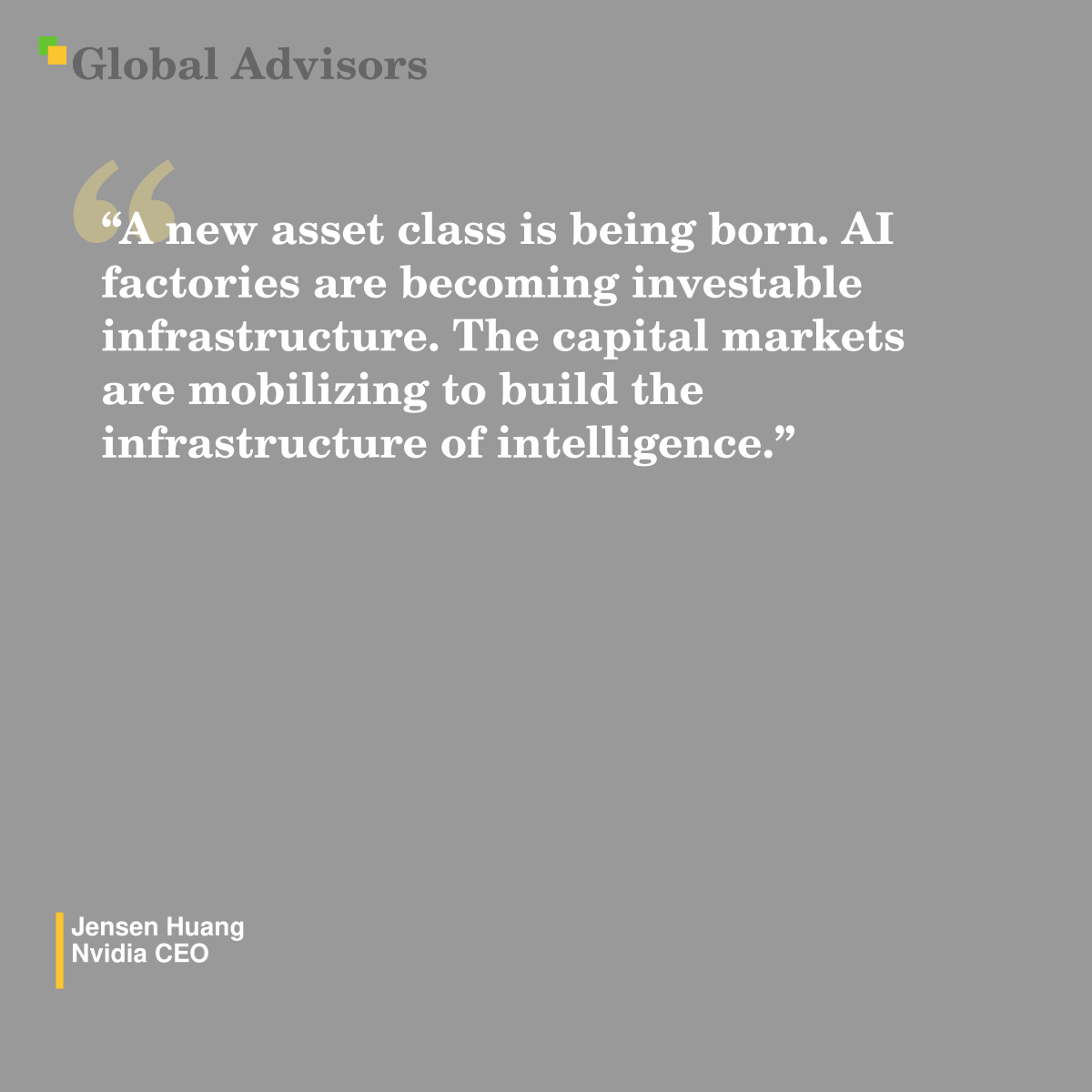
Quote: Jensen Huang - Nvidia CEO"A new asset class is being born. AI factories are becoming investable infrastructure. The capital markets are mobilizing to build the infrastructure of intelligence." - Jensen Huang - Nvidia CEO The argument begins with a financing problem rather than a technology slogan. AI demand is no longer confined to experiments in research labs; it now depends on large, power hungry systems that must be built, funded and kept useful over many years, which means the economics increasingly resemble infrastructure rather than software. Huang's claim sits inside a broader shift in which compute is being treated as a productive asset with revenue potential, and the attached source makes that case explicit by describing partnerships intended to mobilise more than $500 billion of third party capital for AI buildout over time . The shift from product purchase to industrial platform For most of the digital era, buyers acquired servers, chips or cloud access as discrete inputs. The emerging logic is different: AI systems are being packaged as factories that can be financed, depreciated and redeployed like transport networks, utilities or industrial plants. NVIDIA's own definition of an AI factory emphasises a full stack environment covering data ingestion, training, fine tuning and high volume inference, rather than a single machine or model . That matters because it recasts value creation as a continuous process, not a one off purchase. The commercial implication is that infrastructure has to justify itself through utilisation, resilience and flexibility. The primary source argues that one AI factory can serve many customers and many workloads, because it combines accelerated computing, networking, systems software and a broad developer ecosystem . In other words, the asset is not merely a rack of GPUs; it is a platform whose residual value depends on how well it can be switched from one client or model family to another. That is a more financeable story than a bespoke build for a single workload, because investors prefer assets with a wide potential user base and a clear secondary market. Why capital is willing to listen The most important reason institutional capital is interested is that AI demand is already showing signs of recurring consumption. The source notes that legacy NVIDIA A100 hardware, first introduced in 2020, remains in active commercial use six years later, while customers continue to commit capacity for multi year deployments . That longevity matters because infrastructure investors care less about headline novelty than about economic life. If an installed base keeps earning for close to a decade, the asset begins to look less like rapidly obsolete electronics and more like a productive plant with a durable cash flow profile. Pricing evidence strengthens that case. Huang's source cites rising GPU rental rates, including a one year H100 rental increase from about $1.70 per GPU hour in October 2025 to about $2.35 in March 2026, and cross provider on demand median pricing moving from roughly $2.00 to $2.70 per GPU hour over the same general period . Those are not small moves. They suggest that the market is not simply buying hardware in anticipation of future demand; it is already pricing scarcity, which is one of the classic preconditions for an investable infrastructure theme. The infrastructure of intelligence The phrase 'infrastructure of intelligence' is doing heavy analytical work. It suggests that intelligence, like electricity or bandwidth, can be produced at scale if the right physical and software layers are assembled. The source ties that idea to CUDA, explaining that each software generation improves the performance, efficiency and total cost of ownership of already installed infrastructure . That software upgradability is crucial because it stretches the useful life of the asset and softens the standard depreciation argument against hardware investments. There is also a strategic advantage in the fact that the platform is widely adopted. NVIDIA argues that its architecture is used across major clouds, system makers and enterprises, which broadens the set of possible offtakers and protects residual value . This is the kind of ecosystem depth that financiers like, because it reduces the risk that an asset becomes stranded if a single customer changes direction. It also explains why the company is positioning itself not just as a chip supplier but as the architect of a financingable industrial layer. What the financial architecture is trying to solve Behind the language of mobilisation lies a specific funding gap. AI infrastructure is expensive, and the source is candid that many companies, enterprises and AI clouds have demand for compute without immediate access to capital at the required scale . This creates a bottleneck between technical possibility and physical deployment. By bringing in firms such as Apollo, BlackRock, Blackstone, Brookfield, Goldman Sachs and KKR, NVIDIA is trying to make the capital stack as scalable as the technology stack . The structure also addresses a key objection: circular financing. Critics worry that if a chip maker supports the financing of the systems built around its own products, the result can resemble self referential demand creation rather than independent market validation. Huang's source anticipates this concern and insists that the financial institutions independently underwrite demand, utilisation, cash flow and residual value . The company says any support mechanism it provides is limited, residual value based and capped at up to 25% of an opportunity on a project by project basis . That is intended to signal discipline, though sceptics will still ask whether the dependence on one vendor's architecture weakens the claim of true market independence. Why the return case matters now The return on investment argument is not about chips in isolation. It depends on whether AI turns into a persistent source of economic output across sectors. Huang frames that return as usefulness: AI helps write software, discover drugs, design products, automate operations and serve customers, and more compute leads to better AI, which leads to more usage and more revenue . The circularity here is productive rather than financial. It is a thesis about compounding demand, where every incremental improvement in capability expands the addressable market for more compute. This is also why the language of a new asset class is more than marketing. If AI factories can be priced by revenue generation, redeployment potential and software enhanced productivity, then they begin to resemble a distinct category that can be pooled, financed and risk managed. That helps explain the interest from large asset managers and private capital groups: they are not merely betting on one application or one model cycle, but on the underlying machinery that converts energy, data and capital into machine intelligence . Debates, objections and the limits of the analogy The strongest objection is that the factory metaphor may conceal more than it reveals. A steel mill or port has comparatively stable end demand, while AI demand is still shaped by model breakthroughs, pricing pressure and uncertain enterprise adoption. Even if compute is revenue today, the size of that revenue pool can change quickly if efficiency gains reduce token consumption or if model architectures shift in ways that reduce the need for the current generation of hardware. The source tries to answer this by emphasising fungibility, redeployability and ecosystem breadth, but those features do not remove the possibility of technological discontinuity . Another objection concerns concentration risk. If the same company supplies the platform, influences the financing and benefits from the hardware being installed, then the industrial logic and the market logic can start to blur. Supporters argue that this is precisely what a vertically integrated infrastructure leader should do: remove friction, reduce financing barriers and accelerate deployment. Critics will reply that a healthy capital market should not require one supplier to be central to both the technology layer and the capital formation layer. That tension will shape how credible the 'investable infrastructure' story remains over time. Why it matters beyond one company The wider significance is that AI buildout is moving into a phase where the bottleneck is not simply model quality but financing capacity, power delivery and asset management. If investors accept the framework, then AI infrastructure could be financed in tranches, underwritten like utility assets and reused across customers and workloads. That would lower the cost of capital for large deployments and accelerate the spread of AI capability into enterprises, clouds and public institutions . It would also encourage a more mature market language around utilisation, residual value and lifetime output. Seen this way, Huang is not only describing a business opportunity for NVIDIA. He is arguing that the industrial basis of AI is now deep enough to support a capital market of its own. That is a significant claim because it implies that intelligence is becoming not just a product of software innovation, but a class of infrastructure that can be financed, traded and expanded at scale .
|
| |
| |
Global Advisors News Brief - August 11 2026Read the full brief at the link Headlines for the last 24hrs
Time window: 2026-08-10T05:00:33.089Z to 2026-08-11T05:00:33.089Z |
| |
| |
|


| |
| |