| |
|

| |
| |
| |
|
Our selection of the top business news sources on the web. |
| |
| |
| |
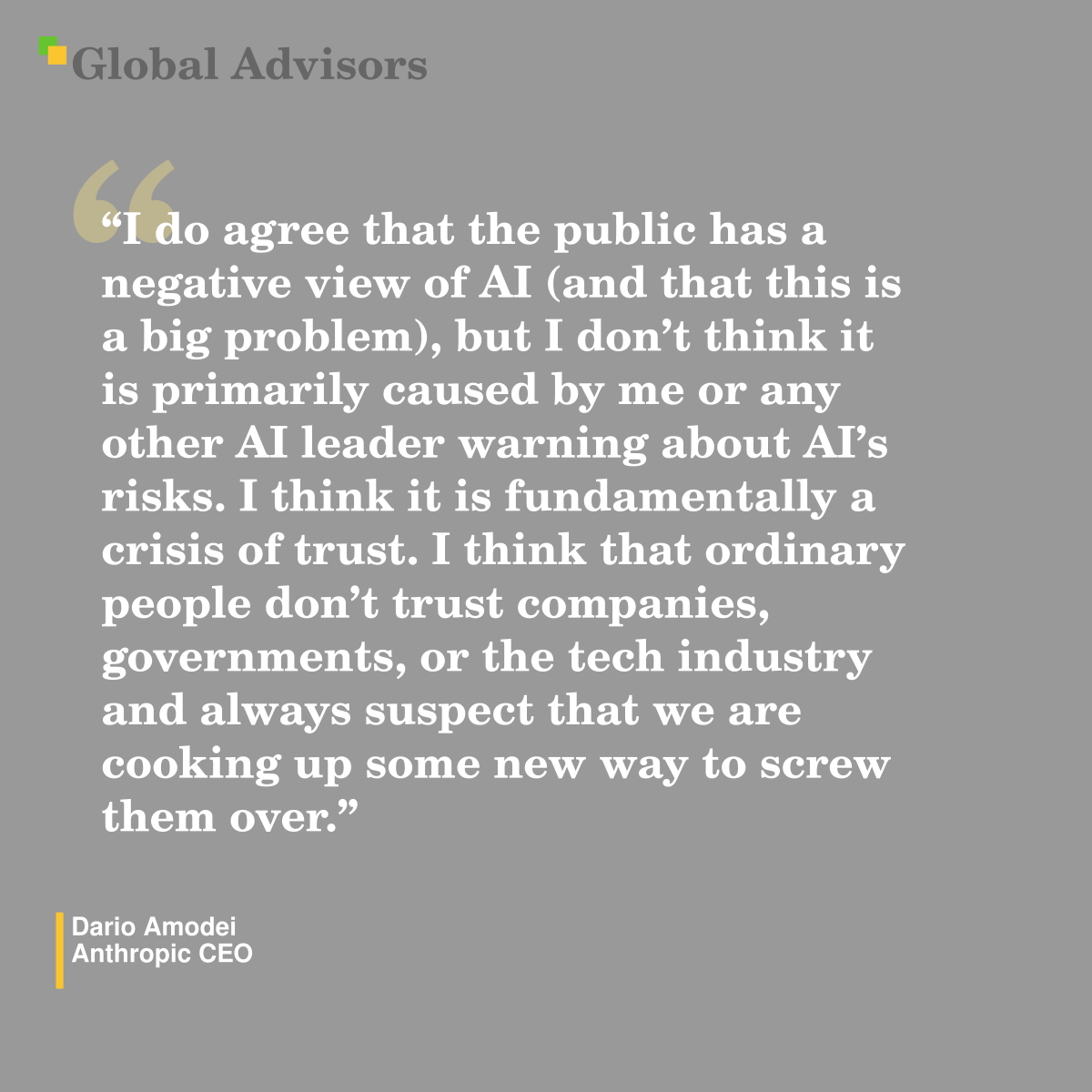
Quote: Dario Amodei - Anthropic CEO"I do agree that the public has a negative view of AI (and that this is a big problem), but I don't think it is primarily caused by me or any other AI leader warning about AI's risks. I think it is fundamentally a crisis of trust. I think that ordinary people don't trust companies, governments, or the tech industry and always suspect that we are cooking up some new way to screw them over." - Dario Amodei - Anthropic CEO Public anxiety around advanced AI is driven less by technical detail and more by a deep-seated suspicion that powerful actors will once again deploy a transformative technology without protecting ordinary people from its downsides or sharing its benefits fairly. Decades of experience with financial crises, data breaches, monopolistic platforms, and opaque political decision-making have created a default expectation that any new system built by large firms and governments will primarily serve insiders, even when wrapped in utopian language about innovation and progress. In that light, current fears about AI look less like a reaction to any single statement by a prominent executive and more like a cumulative response to a long record of perceived betrayal, broken promises, and one-sided bargains that left citizens feeling exploited rather than empowered. This crisis of trust has a history rooted in prior waves of technological and institutional change that were marketed as universally beneficial yet often produced highly uneven outcomes. Mass offshoring of manufacturing was sold as a path to cheaper goods and higher productivity, but many communities experienced only job loss, wage stagnation, and fraying social fabric. Consumer internet platforms were promoted as tools for connection and empowerment, yet users discovered that their data was harvested, profiled, and monetised at vast scale with little transparency or meaningful consent. Algorithmic credit scoring, predictive policing, and targeted advertising repeatedly showed how technical systems could encode bias, reinforce inequality, and concentrate informational power. Against that backdrop, new AI claims about curing disease or automating drudgery sound to many citizens like a familiar script in which distant elites reap outsized gains while ordinary people absorb the risks. Institutional behaviour has reinforced this suspicion by repeatedly prioritising short-term commercial advantage over robust safeguards, and by relying on public relations campaigns to manage concern rather than accepting binding accountability. Major firms have often reacted to criticism with carefully crafted messaging, emphasising positive use cases while minimising or compartmentalising discussion of harm, instead of structurally changing incentives or governance. Governments, for their part, have oscillated between enthusiastic promotion of national champions and reactive, sometimes fragmented attempts to regulate after scandals erupt. Every instance in which a company knowingly deploys a system with significant externalities, or a regulator appears captured or ineffective, deepens the intuitive belief that the next wave of technology will be another round of the same game, with citizens as experimental subjects rather than genuine stakeholders. AI risk messaging and the perception of negativity Within this context, warnings about AI risks are frequently interpreted by critics as part of an elite narrative that both dramatises long-term threats and sidesteps near-term accountability. Commentators argue that discussion of existential or catastrophic scenarios can sometimes function as a form of strategic distraction, shifting attention away from issues such as labour displacement, data exploitation, and concentration of market power. When prominent leaders emphasise alignment or long-run safety, sceptical observers worry that the frame implicitly accepts the inevitability of deployment while placing the burden on future technical fixes rather than present restraint. Yet this interpretation depends crucially on pre-existing mistrust: if the same institutions had a record of transparent governance and equitable benefit sharing, equivalent warnings might be taken as evidence of responsibility rather than manipulation. The individual messenger is therefore assessed through the lens of broader industry behaviour. In the specific exchange that prompted the statement, critics suggested that one executive had shaped a disproportionately negative public narrative around AI, contributing to fearful sentiment. In response, he pointed out that his public work includes substantial emphasis on potential medical breakthroughs, including arguments that advanced AI could help cure most human disease within roughly 5 to 10 years, if combined with appropriate regulatory adaptation. He also noted that short interview clips shared on social platforms tend to highlight dramatic risk-focused soundbites because they attract engagement, thereby skewing perceptions of his stance. This dynamic illustrates how algorithmic curation of media can amplify particular tones of discourse and reinforce impressions of unrelenting doom, even when longer-form material is more balanced. Regulation, power concentration, and institutional process The trust crisis is sharpened by a structural tension over who will set AI rules and how those rules will shape the distribution of power. One influential Silicon Valley narrative holds that rigorous regulation inevitably equals regulatory capture, entrenching incumbent firms and political elites. Under this view, any attempt to impose licensing, testing, or compliance requirements on frontier models risks locking smaller innovators out and centralising control of capability at the hands of a few. The executive in question challenges this binary and argues that it is possible to design regulatory regimes that are objectively administered, transparently scoped, and deliberately structured to slow down the largest players while exempting or advantaging smaller competitors. He cites specific proposals such as state-level bills that only apply to companies above certain revenue or training-cost thresholds, and testing regimes that impose stricter scrutiny on frontier systems than on off-frontier models. Here the argument is that institutionally grounded processes, akin to formal courts rather than social media mobs, can sometimes decentralise power by vesting decisions in publicly contestable rules rather than in ad hoc corporate discretion. If pre-deployment testing for frontier models is managed by an independent body with clear standards, subject to public reasoning and expert input, it may constrain the ability of major labs to unilaterally roll out high-risk systems, while leaving space for open-weights models and challenger firms. The trust question then becomes whether such institutions will be genuinely independent, adequately resourced, and robust against capture, or whether they will be perceived as yet another venue where well-connected actors negotiate permissive oversight behind closed doors. The fact that many citizens expect the latter outcome reflects not a detailed analysis of each technical bill but a long historical pattern in which powerful organisations appear to bend process to their interests. Promises, delivery, and scepticism about AI benefits A central claim in the statement is that public distrust stems primarily from a gap between lofty promises and concrete results, rather than from warnings about risk themselves. The executive argues that many people now react with cynicism to visionary rhetoric about AI curing cancer or revolutionising healthcare, interpreting it as clichéd marketing rather than serious commitment. He suggests that the only reliable way to rebuild trust is to deliver tangible benefits at scale, such as genuinely transformative progress in biology and medicine, rather than to repeat aspirational narratives. This stance implicitly recognises an empirical pattern: fields such as antiviral therapy or oncology contain clear benchmarks by which claims of impact can be judged, such as cure rates or survival improvements, whereas broad productivity or creativity gains are harder for citizens to perceive in their everyday lives. The backstory here includes personal motivation: the writer describes losing a close family member to Hepatitis C shortly before highly effective direct-acting antivirals became widely available, a timeline that shapes his sense of urgency about speeding medical innovation. He links AI policy proposals to ideas for streamlining regulatory pathways, for example by adjusting drug approval processes so that AI-accelerated candidates are not stuck for years in slow evaluation pipelines. Whether such reforms would themselves be trusted is another question: critics might worry that faster approval motivated by technological optimism could increase the risk of unforeseen side effects. Yet the broader point is that credible trust-building must connect to demonstrable, life-improving outcomes, not merely to refined messaging strategies or brand campaigns. In this view, communications are secondary; the primary task is to make advances real and visible. Debates over messaging, honesty, and strategic risk framing A notable tension in the narrative concerns how candidly AI companies should talk about severe risks, given public sensitivity and existing scepticism. Some observers advocate a more upbeat communication strategy, arguing that constant emphasis on catastrophic scenarios depresses investment in beneficial applications and alienates users. Others insist that understatement would itself be deceptive, given the genuine possibility that highly capable systems could enable serious cyber or biological misuse or misaligned behaviour. The executive argues that honesty about risks, even when uncomfortable, is preferable both on ethical grounds and in terms of long-run credibility, compared with a polished optimism that ignores threats people instinctively suspect are real. He notes that criticism should focus less on tone of messaging and more on the fact that companies have not yet fully delivered on promised societal benefits. This stance raises practical questions about how technical leaders can communicate complex risk landscapes without reinforcing narratives of inevitability or helplessness. If firms repeatedly emphasise that certain trajectories could lead to extreme concentration of capability or alignment failure, citizens may either demand strong constraints or disengage from the debate, assuming that decisions will be made elsewhere regardless of their views. Conversely, if communication tilts too heavily toward potential upside, trust may further erode when negative incidents occur, such as high-profile misuse of models or abrupt capability jumps that contradict earlier assurances. Balancing these effects requires not only rhetoric but also institutional commitments: mechanisms for red-teaming, transparent reporting of incidents, and meaningful channels through which affected communities can influence deployment choices. Why the crisis of trust matters for AI governance The diagnosis of a structural trust crisis has direct implications for how AI governance frameworks are likely to be received and implemented. If citizens begin from the assumption that companies and governments are seeking new ways to exploit them, then even well-designed regulatory schemes may be perceived as cosmetic or self-serving, undermining compliance and cooperation. Public buy-in to measures such as frontier testing, incident disclosure, or capability thresholds depends on the belief that these measures are intended to protect broad interests rather than to sanctify existing power structures. Conversely, if AI firms can demonstrate consistent patterns of self-restraint, transparency, and genuine responsiveness to societal concerns, they may gradually shift expectations, making it easier to construct robust institutional arrangements. The executive contends that this shift will only occur if firms deliver substantive benefits and accept real constraints, rather than relying on glitzy campaigns or abstract reassurances. At stake is the legitimacy of decisions about how far and how fast to push AI capability, which cannot be resolved purely through technical expertise. When risk assessments involve potential global externalities, and when scaling laws imply the possibility of systems whose impacts are hard to foresee, governance must rest on a foundation of trust that current institutions do not fully command. The negative public view of AI is therefore not merely a communications challenge but a signal that the broader social contract surrounding technological development has been strained. Whether leaders can repair that contract will depend less on the eloquence of their explanations and more on whether people experience, in their own lives, that powerful technologies are being used to cure disease, expand opportunity, and reduce harm, rather than to extract more value from them without commensurate benefit.
|
| |
| |
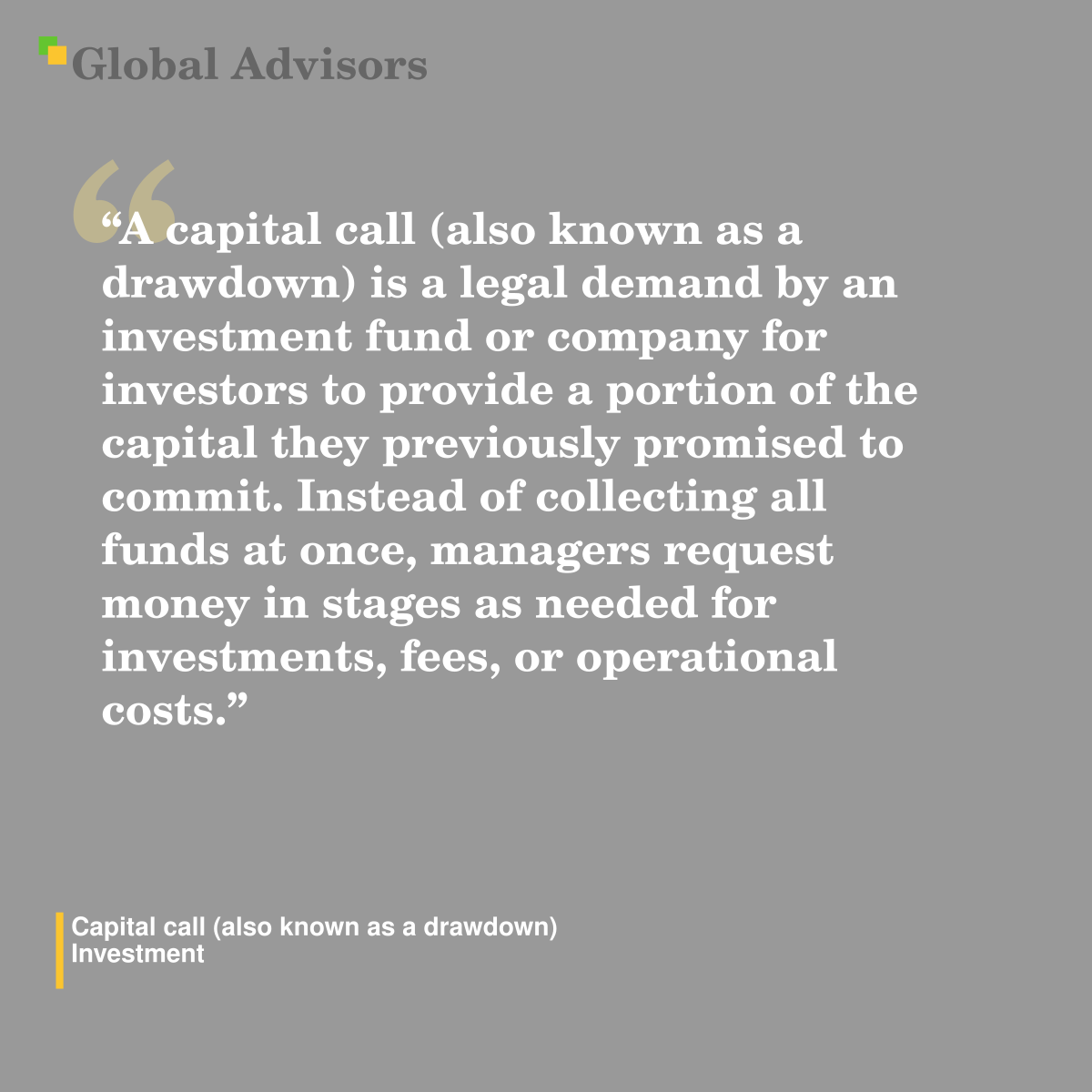
Term: Capital call (also known as a drawdown) - Investment"A capital call (also known as a drawdown) is a legal demand by an investment fund or company for investors to provide a portion of the capital they previously promised to commit. Instead of collecting all funds at once, managers request money in stages as needed for investments, fees, or operational costs." - Capital call (also known as a drawdown) - Investment The practical issue is timing: investors agree to fund a vehicle, but the cash does not move until the manager actually needs it. That staggered funding model is central to private funds because it lets managers reserve dry powder for opportunities while keeping uncalled cash in investors' hands until deployment is justified . In substance, a capital call is a formal demand for part of a previously agreed commitment. The commitment is the promise; the capital call is the legal request that turns that promise into paid-in capital, usually under the fund's governing documents and capital call notice process . What the term means in practice In private equity, venture capital, and related private investment vehicles, the general partner or fund manager issues a notice when money is needed for an acquisition, follow-on investment, fees, expenses, or other fund obligations . The investor, usually a limited partner, then wires only its pro rata share of the requested amount rather than the full commitment at closing . This matters because it separates the financing decision from the deployment decision. A fund may raise a large committed pool at launch, yet call capital in tranches over months or years as deals close and reserves are set aside for later support of portfolio companies . The result is a more controlled deployment path and less idle cash sitting uninvested at fund level . How the mechanism works The sequence is typically straightforward. First, the fund identifies a need and calculates the amount required. Second, it allocates that amount across investors according to each investor's commitment percentage. Third, it sends a formal notice specifying the amount due, purpose, payment deadline, and wiring instructions. Fourth, the investors fund the call, and the money is recorded as paid-in capital and deployed . Timelines are contract-driven, but many funds use notice periods of about 10 business days, with some extending into the 10 to 15 business day range . Failure to fund can trigger remedies in the partnership agreement, so the notice is not a courtesy request but a binding funding obligation tied to the original commitment . Why managers use drawdowns The principal advantage is capital efficiency. Managers do not need to hold all committed money in cash from day one, which reduces dead capital and aligns funding with actual investment opportunities . For investors, this means committed capital can remain in their own portfolios or cash management programmes until called, rather than being transferred upfront and left to sit unused . Drawdowns also support portfolio management. Funds often need capital not only for initial acquisitions but also for fees, operating costs, bridge financing, and follow-on rounds in companies they already own . In practice, a fund may call capital multiple times over the investment period, with the heaviest call activity often concentrated in the early years of a closed-end fund . Mathematical specification The mechanics can be expressed cleanly. If investor has a total commitment of , and the fund issues a call for total amount , then investor 's call amount is often . This pro rata rule preserves each investor's agreed economic share of the fund . Over time, the investor's unfunded commitment can be written as , where is the amount called at time . Once cash is received, the investor's paid-in capital becomes , which is the amount actually transferred into the fund . From the fund's perspective, the total amount callable at any moment is the aggregate unfunded commitment. If a fund has commitments and has already called , then remaining callable capital is . This is the buffer managers rely on when sequencing investments and reserves . Definitions that often get blurred Commitment, capital call, and paid-in capital are related but not identical. The commitment is the headline amount pledged at fund closing; the capital call is the request for a slice of that pledge; and paid-in capital is the cash already transferred . Confusing these terms leads to poor liquidity planning, especially for investors who assume a commitment means immediate cash outflow . The word drawdown is used in two ways. In fund administration, it is largely synonymous with capital call. In broader finance usage, it can also describe a decline in asset value from a peak to a trough, so context matters and the two meanings should not be mixed . Schools of thought and fund structures The classic drawdown model is associated with closed-ended private equity and venture capital funds, where the manager raises commitments at the start and then calls capital over the investment period . A more recent alternative is the evergreen or semi-liquid structure, which reduces reliance on repeated calls by keeping capital continuously available, though often with different liquidity and valuation trade-offs . Supporters of drawdown funds argue that staged funding improves discipline, reduces cash drag, and keeps the manager's incentives tied to real deployment rather than upfront balance-sheet accumulation . Critics focus on the operational burden: investors must maintain liquidity for unpredictable calls, monitor deadlines, and manage treasury processes to avoid default risk . There is also a debate about transparency. Sophisticated investors often want advance visibility on expected pacing, reserves, and likely call dates, yet managers need enough flexibility to react to deal timing and market conditions . That tension is one reason capital call notices are usually detailed, with allocation, purpose, deadline, and bank instructions set out explicitly . Why the concept still matters Capital calls remain a core operating feature of private markets because they bridge the gap between commitment and deployment. They define how a fund converts promised capital into investment capacity without forcing all investors to pre-fund the entire vehicle at once . That structure is especially important in private equity and venture capital, where deal timing is uneven and follow-on support can be as important as the initial investment . The term also matters beyond fund law and administration because it shapes liquidity, governance, and risk management. For investors, it affects cash planning and portfolio construction. For managers, it affects deal execution, compliance, and the cadence of capital deployment . In that sense, a capital call is not just a paperwork event but the operational moment when an investment promise becomes executable capital .
|
| |
| |
Global Advisors News Brief - August 19 2026Read the full brief at the link Headlines for the last 24hrs
Time window: 2026-08-18T05:00:33.084Z to 2026-08-19T05:00:33.084Z |
| |
| |
Quote: Travis Kalanick - Uber founder"The lifestyle of an entrepreneur at its core is: I can take more pain than the other guy. You are taking on a life of adversity & overcoming all the time." - Travis Kalanick - Uber founder The central tension behind this statement is that entrepreneurship often rewards endurance long before it rewards elegance. Early-stage founders spend as much time absorbing rejection, operational chaos and financial strain as they do building products, and the ability to stay functional under that pressure can become a competitive advantage. Travis Kalanick's career makes that logic easier to understand because he came to Uber after earlier ventures that had already taught him how unforgiving startup life can be. Kalanick's path before Uber was not the polished trajectory of a conventional corporate executive. He dropped out of UCLA, worked on Scour, a peer-to-peer search service that failed amid litigation, and later co-founded Red Swoosh, a company he helped build through years of severe resource constraints before its sale to Akamai in 2007. That sequence matters because it shaped a founder who associated progress with survival, and survival with tolerance for discomfort. When he later described entrepreneurship as a condition of enduring adversity, he was not speaking abstractly; he was generalising from a career in which persistence had already produced one turnaround and one large exit. Uber itself emerged from a practical inconvenience that exposed a much larger market inefficiency. In Paris in 2008, Kalanick and Garrett Camp struggled to get a cab, and that irritation became the seed of a service that would attempt to make premium transport as easy as ordering a car from a phone. The early company, then known as UberCab, began with a narrow proposition and a small fleet, but it quickly ran into the realities that define platform businesses: regulation, local incumbents, driver supply, consumer trust and the difficulty of scaling a two-sided marketplace faster than opponents can respond. That is why the language of pain and adversity is not merely motivational rhetoric in Uber's case. The company expanded by colliding with taxi regulation, municipal politics and entrenched licensing systems, while also trying to convince passengers and drivers that the service was reliable, safe and worth using. Growth depended on repeated conflict, whether in negotiations with city authorities, in product launches against competitors or in the constant task of maintaining service quality while the network widened. For founders in that environment, adversity is not an occasional interruption but the operating condition itself. From personal grit to company culture Kalanick's framing of entrepreneurship also reflects a particular Silicon Valley worldview that treats stress tolerance as a managerial asset. In that view, the founder is not simply a strategist but the person willing to absorb the most uncertainty, the most criticism and the most failure without slowing down. That attitude helped Uber project speed and aggression at a time when many rivals moved more cautiously, and it supported the company's rapid rise from a small black-car service to a global ride-hailing platform. Yet the same logic can become a liability when resilience hardens into a culture that normalises friction, overreach and confrontation. The objection to this style is straightforward: endurance is not the same as sound judgement. A founder may indeed outlast competitors, but the willingness to tolerate pain can also become a licence to ignore warning signs, minimise internal dysfunction or treat external criticism as proof of strength rather than as evidence of a problem. Uber's later history made that risk visible. Kalanick resigned in 2017 after a series of scandals, including allegations about the company's workplace culture and pressure from investors, showing that the ability to withstand adversity does not automatically create the discipline needed to govern a large organisation well. That distinction is important because the statement can be read in two very different ways. The generous reading is that entrepreneurship requires a high pain threshold because building something new inevitably exposes founders to rejection, uncertainty and sacrifice. The harsher reading is that some founders equate suffering with legitimacy, and then mistake intensity for leadership. Kalanick's record supports both interpretations. He undeniably built companies in hostile or difficult conditions, but the controversies around Uber suggest that a mindset trained to fight external battles can struggle when the harder task is internal restraint. Why the language still resonates Even with those objections, the statement has enduring force because it captures a structural truth about startup creation. New ventures rarely begin with stable demand, predictable cash flow or institutional protection. They begin with incomplete information, thin margins and repeated rejection, which means the founder's job is often less about avoiding pain than about sequencing it, controlling it and continuing despite it. Kalanick's earlier years at Red Swoosh, when he was reportedly working without salary and under constant pressure, provide a concrete example of the kind of endurance that can make later risk-taking feel manageable. The broader market significance of that mindset is that it helps explain why certain founders move faster than incumbents are comfortable with. A founder who has already lived through failures, lawsuits, funding gaps and product uncertainty may be more willing to take regulatory risks or press ahead despite scepticism. Uber's rise depended on exactly that kind of appetite for friction. But there is a threshold beyond which pain tolerance stops being a strategic advantage and becomes a distortion, because markets also reward trust, governance and durable institutions. Uber's history shows that scale achieved through relentless force can produce backlash just as quickly as growth. Seen in that light, the statement is best understood as a compressed theory of startup life rather than a universal truth about entrepreneurs. It describes a world in which success often goes to the person who can remain engaged after other people have become exhausted, discouraged or cautious. Kalanick's own career, from Scour to Red Swoosh to Uber, gave him repeated reasons to believe that the decisive trait was not comfort but stamina. The debate is whether stamina alone is enough. His story suggests it is necessary, but not sufficient, and that the hardest form of entrepreneurship is not simply taking pain, but knowing which pain is worth taking.
|
| |

| |
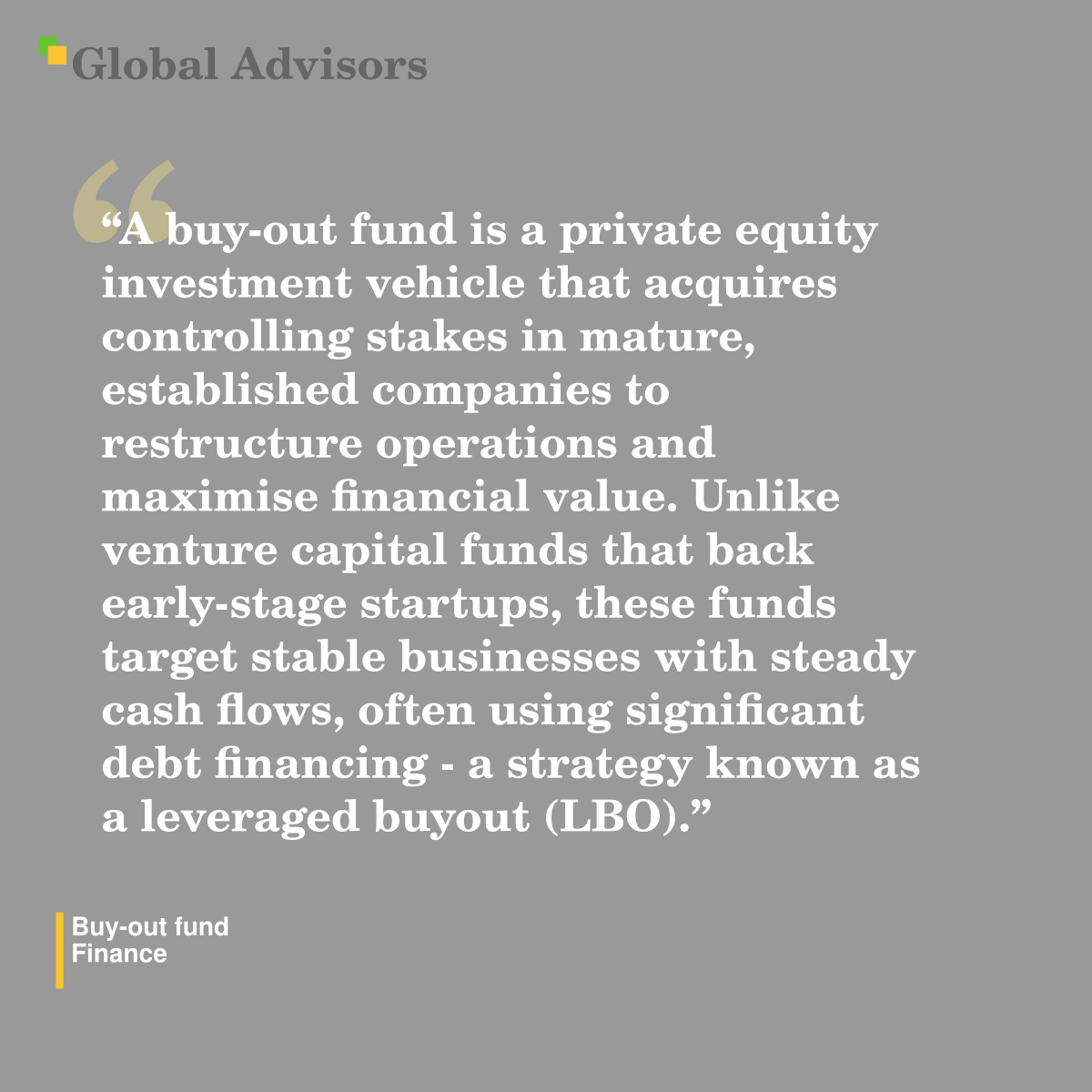
Term: Buy-out fund - Finance"A buy-out fund is a private equity investment vehicle that acquires controlling stakes in mature, established companies to restructure operations and maximise financial value. Unlike venture capital funds that back early-stage startups, these funds target stable businesses with steady cash flows, often using significant debt financing - a strategy known as a leveraged buyout (LBO)." - Buy-out fund - Finance Buy-out funds sit at the point where corporate control, balance-sheet engineering and long-horizon ownership meet. They buy businesses not to hold minority exposure to growth, but to take decisive control, alter how the company is run and then realise value through a sale, public listing or other exit once the work is done. The practical consequence is that the fund is less a passive allocator of capital than an active owner with a time limit, a financing plan and a specific thesis about how cash flows can be improved and converted into investor returns . The defining feature is ownership. Buy-out funds usually seek majority or controlling stakes in established companies, often mature businesses with predictable cash generation, so that operational changes and debt servicing can be supported by the target's own earnings . That distinguishes them from venture capital, which generally backs earlier-stage companies with less reliable revenues and far more uncertainty. It also explains why buy-out funds often prefer businesses with stable market positions, resilient customer demand and enough asset backing to support borrowing . What the fund is buying In substance, a buy-out fund is a pooled private equity vehicle raised from limited partners such as pension funds, endowments and wealthy individuals, and managed by a general partner that selects, structures and oversees investments . The fund's objective is not merely to own a company, but to change the capital structure and governance of that company so that equity value grows faster than it would under the previous ownership model . In many cases, the fund acquires the entire business or a majority position, sometimes taking a listed company private, sometimes buying from founders, families or corporate sellers . The practical meaning of that control is broad. A buy-out sponsor may replace board members, tighten reporting, redesign incentives, change pricing, rationalise product lines, or sell non-core divisions. It may also bring in a new management team or work closely with existing executives under stronger performance targets . The common thread is that the fund is betting that operational discipline, capital allocation and improved governance can lift enterprise value beyond the purchase price and the cost of financing . How leverage changes the economics Most buy-out transactions rely on leverage, which is why the strategy is closely associated with leveraged buyouts, or LBOs . In a typical LBO, the acquisition is funded by a mix of equity from the fund and significant debt secured against the acquired business's assets and cash flows . The debt portion matters because it reduces the amount of sponsor equity needed upfront, while magnifying the return on that equity if the business performs well . The basic economic logic can be expressed as . A sponsor seeks to increase the first term through earnings growth and valuation discipline, while reducing the second term by using operating cash flow to repay borrowings over time . If the company generates each year, then debt can be reduced roughly by , subject to covenants and working-capital needs. The attraction of leverage is therefore not simply borrowing more, but using predictable cash generation to transform modest equity into a much larger claim on the residual value . How value is created in practice Buy-out funds generally rely on three linked sources of value creation. First is operational improvement: better margins, stronger procurement, leaner overheads and more effective pricing. Second is deleveraging: as debt is repaid, the equity slice expands mechanically. Third is multiple expansion: if the business is sold at a higher valuation multiple than the entry price, the gain is amplified further . These drivers help explain why sponsors are so focused on EBITDA, free cash flow and exit multiples rather than simply revenue growth . A simplified model often projects investment returns over a five to seven year holding period . If entry enterprise value is and exit enterprise value is , then the fund's return depends on both operating change and market pricing. The internal rate of return, or IRR, is the discount rate that solves , where is the initial equity investment and are interim distributions plus exit proceeds. This formalism matters because buy-out funds do not only ask whether a company is good; they ask whether the cash flows and exit conditions can support a target IRR within the fund's life . Major schools of thought There are two broad schools of thought on buy-outs. The first views them as a disciplined ownership model that corrects managerial slack, aligns incentives and improves under-managed businesses through active stewardship . On this view, leverage is not the main story; it is a tool that sharpens incentives and forces capital discipline. The second school is more sceptical, arguing that the strategy can overemphasise financial engineering, cost cutting and short-term exit logic, especially when debt loads are heavy or when growth investment is deferred to protect cash flow . The reality is that both views contain truth. Buy-out funds can create substantial value when they buy cash-generative businesses at sensible prices, install credible governance and execute measured operational change . They can also fail when entry valuations are too high, debt is too aggressive, or the business proves more cyclical than expected. Because the fund's capital is committed for a finite period, timing matters as much as strategy: an excellent operating turnaround can still produce poor outcomes if exit markets weaken before the fund sells . Key tensions in the debate The central tension is between control and fragility. Leverage increases return potential, but it also increases vulnerability to downturns, refinancing risk and covenant pressure . A company with strong cash flow may support substantial debt in normal conditions, yet become exposed if demand weakens or rates rise. That is why many analysts focus on the quality and predictability of free cash flow rather than on headline profitability alone . Another tension lies between operational patience and fund-cycle pressure. Buy-out funds are typically structured as limited partnerships with a finite investment horizon, so they must demonstrate progress within a defined period . This can encourage decisive action, but it can also favour quick fixes over deep transformation. A related debate concerns stakeholder outcomes. Supporters point to stronger governance and improved company performance; critics point to job cuts, asset sales and the transfer of value from employees and creditors to equity holders when deals are highly leveraged . Why the term still matters Buy-out funds remain central to private markets because they are one of the few structures that combine capital, control and operating intent at scale . They matter to founders deciding whether to sell, to corporate managers facing recapitalisation, to lenders assessing credit risk and to institutional investors seeking long-term returns. They also matter because they shape how large parts of the corporate economy are owned and governed, especially in sectors where stable cash generation makes leveraged ownership feasible . In analytical terms, the term captures a specific investment doctrine: buy a mature business, control it, finance much of the purchase with debt, improve the business, and exit at a higher equity value . That doctrine continues to influence deal pricing, capital markets and corporate strategy because it sits at the intersection of risk, leverage and control. Even where practitioners disagree about its social costs, the model remains one of the most consequential mechanisms in modern finance .
|
| |
| |
Global Advisors News Brief - August 18 2026Read the full brief at the link Headlines for the last 24hrs
Time window: 2026-08-17T05:00:33.093Z to 2026-08-18T05:00:33.093Z |
| |
| |
Quote: Dario Amodei - Anthropic CEO"At this point, saying that AI will cure cancer is more a cliche than it is inspiring, and most people think it is deceptive. The thing that will work is *actually curing cancer*. I think by far the most accurate criticism of AI companies including Anthropic is that we haven't yet delivered on our big promises to benefit the world." - Dario Amodei - Anthropic CEO The central problem is not whether artificial intelligence can one day produce dramatic medical breakthroughs, but whether a technology industry can keep asking for trust before it has earned it. The tension is between grand claims and visible delivery: promises about curing disease, transforming science, and improving human welfare are easy to make, yet they quickly lose force when the public sees mainly product launches, market hype, and warnings about risk. That gap matters because credibility in frontier technology is cumulative, and once it erodes, even sincere claims begin to sound like salesmanship . That is the background to Dario Amodei's position as Anthropic's chief executive. In the attached source, he argues that the public has become sceptical not because leaders talk too much about danger, but because the industry has not yet produced enough undeniable benefits. He also makes a sharper point: saying that AI will cure cancer has already become a cliche, and cliches do not persuade people who suspect they are being manipulated. The more persuasive test is not rhetorical ambition but actual therapeutic progress, because tangible success changes the terms of the debate in a way no slogan can . The logic here is pragmatic rather than defensive. Amodei is not rejecting the aspiration that AI could reshape biology; in the same source he says he believes the technology could help cure most human disease within 5 to 10 years, and he links that belief to concrete work on biology, medicine, and regulatory streamlining . The deeper point is that future-facing industries are judged less by their stated intentions than by whether they convert capability into public value. A company can announce a transformative mission, but if ordinary people cannot see the output, they will treat the mission as branding. That is why the issue is not simply messaging. It is the credibility deficit created when talk outruns proof . Trust, delivery, and the politics of evidence Amodei's claim is also a critique of the broader tech cycle. Many companies now rely on a familiar sequence: announce a world-changing objective, describe the scale of the opportunity, and then ask critics to wait for the long arc of innovation to deliver results. In sectors such as consumer software, that pattern can work because benefits arrive quickly and individually. In AI, especially in medicine, the public asks for stronger evidence because the stakes are higher and the promised gains are more consequential. If a system is said to revolutionise cancer care, people do not want an ever-receding vision. They want a trial, a therapy, a measurable improvement, and a reason to believe the claim is more than aspiration . The source also shows why this issue is linked to regulation rather than standing apart from it. Amodei argues that objective institutional processes can decentralise power, and he presents regulation not as a simplistic route to capture, but as a possible discipline on frontier labs that still leaves room for open-weights models and smaller competitors . That matters because public trust is not only emotional. It is institutional. When people see rules applied unevenly, or see powerful firms exempt themselves from scrutiny, they infer that promised benefits may never arrive for them. By contrast, a system that tests the most powerful models more rigorously than smaller ones can signal that the goal is safety and accountability, not cartel protection . There is also a strategic reason the medical promise sounds less convincing today than it did a few years ago. The industry has spent a long time describing AI in terms of scale, speed, and generality, while the public has mostly experienced it through chatbots, workplace tools, and content systems that feel impressive but not existentially beneficial. That creates a perception problem. If the technology is supposed to accelerate drug discovery, diagnose disease, or improve clinical workflow, then visible proof has to show up in those domains before the public will accept the larger narrative. Without that proof, any claim about curing cancer sounds detached from reality, even if the underlying research programme is serious . Why the public reads optimism as manipulation Amodei's most pointed line is that people now think the promise is deceptive. That reaction is rooted in a wider cultural memory of industries that overstated social benefit while externalising costs. In that climate, a polished campaign about AI saving lives can sound less like a commitment and more like a reputational shield. The irony is that overstatement can weaken the very cause it is meant to advance. If leaders promise too much too early, they raise the burden of proof beyond what current systems can meet, and each unmet forecast then hardens scepticism further . His preferred answer is not to soften the ambition but to earn the right to speak ambitiously. In the source, he says Anthropic is increasing its work in biology and medicine, hopes for strong results in the coming years, and expects early signs in the coming months . That is a significant shift in emphasis from abstract possibility to operational pipeline. It suggests that the industry's legitimacy will depend on whether frontier labs can produce visible wins in high-impact fields, not merely on whether they can publish long research essays or give polished interviews. In other words, the path back to trust runs through evidence generation, not narrative management . That also explains why Amodei resists the idea that more positive messaging would solve the problem. A marketing campaign can amplify attention, but it cannot substitute for competence or delivery. Once the public decides that a claim sounds rehearsed, more enthusiasm often backfires. His argument is that honesty about risk is compatible with optimism about benefit, but optimism must remain tethered to demonstrated progress. Otherwise, the industry risks reinforcing the very cynicism it wants to dissolve . Seen this way, the statement is less about one company than about a maturation test for the whole AI sector. The next phase is not simply making models larger or interfaces smoother. It is translating frontier capability into socially legible gains that survive public scrutiny, regulatory oversight, and clinical validation. Until that happens, the phrase about curing cancer will keep sounding premature, not because the research agenda is meaningless, but because the public has learned to separate possibility from proof. The companies that close that gap will shape the reputation of AI far more decisively than any slogan ever could .
|
| |

| |
Global Advisors News Brief - August 17 2026Read the full brief at the link Headlines for the last 24hrs
Time window: 2026-08-16T16:57:31.118Z to 2026-08-17T16:57:31.118Z |
| |
| |
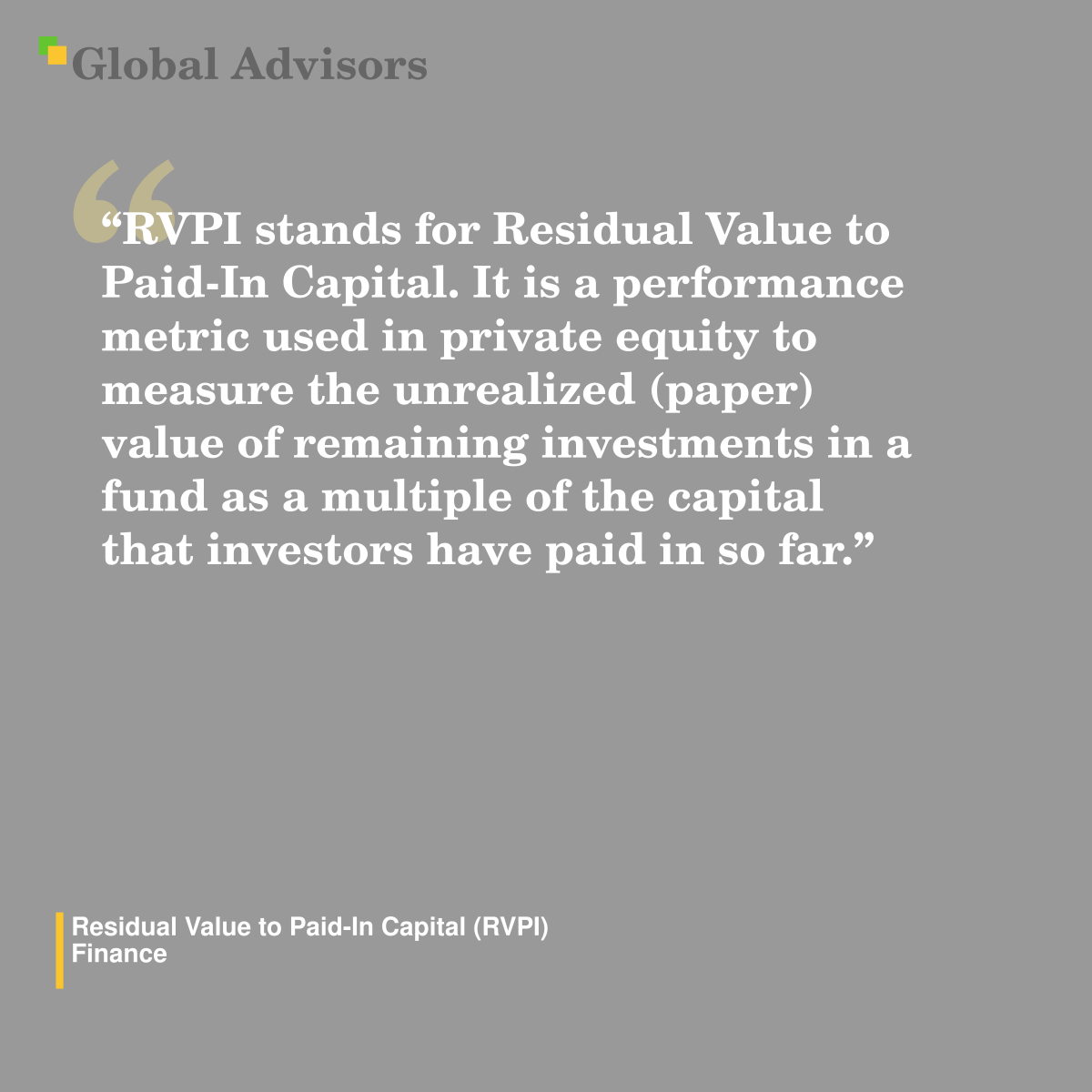
Term: Residual Value to Paid-In Capital (RVPI) - Finance"RVPI stands for Residual Value to Paid-In Capital. It is a performance metric used in private equity to measure the unrealized (paper) value of remaining investments in a fund as a multiple of the capital that investors have paid in so far." - Residual Value to Paid-In Capital (RVPI) - Finance RVPI matters because private equity and venture capital returns are not fully captured by cash that has already come back to investors. It measures the remaining unrealised value in a fund relative to the capital that has been paid in, which makes it a live indicator of what is still sitting on the balance sheet rather than what has already been realised . In practice, that means RVPI tells limited partners how much paper value remains in the portfolio at a given valuation date, while also reminding them that this value is still dependent on future exits and marking discipline . At the simplest level, the metric is calculated as , where residual value is usually treated as the current fair value, or net asset value, of the fund's remaining investments . A result of means the unrealised holdings are marked at exactly the amount of capital contributed so far, while means there is of residual value for every of paid-in capital . Because it is a ratio, RVPI can be read as a multiple, which is why fund reports often present it alongside other money-multiple metrics rather than as a percentage . What RVPI is measuring in substance The practical meaning of RVPI is narrower than overall performance and broader than a single unrealised holding. It captures the portion of a fund's value that remains inside the portfolio and has not yet been distributed to investors, which is why sources commonly describe it as the paper or unrealised slice of fund value . In other words, it is not a forecast of eventual proceeds and it is not a cash return measure; it is a snapshot of the value that the fund claims is still embedded in companies or assets that have not yet been sold, exited, or otherwise converted into cash . This distinction matters because private market funds can look strong on paper long before they generate large distributions. A young fund may post a high RVPI simply because portfolio marks have risen, even though investors have not yet received meaningful cash back . Conversely, a mature fund approaching wind-down can have a low RVPI because most value has already been realised, even if its realised outcome has been excellent . The number therefore says as much about fund age and exit timing as it does about underlying investment quality . How RVPI fits with DPI and TVPI RVPI is best understood as one part of the standard private equity return trio. DPI, or distributed to paid-in capital, measures cash actually returned to investors, while TVPI, or total value to paid-in capital, combines realised and unrealised value . The relationship is usually expressed as , provided the same denominator is used for each metric . This identity is useful because it separates a fund's realised progress from its still-unrealised mark . That separation is important for interpretation. A fund with and has a TVPI, but only of that value has actually been distributed in cash . For investors, the gap between TVPI and DPI is the central analytical issue: RVPI fills that gap, but it does so with an estimate, not a settled receipt . In due diligence, that makes RVPI a necessary but not sufficient indicator of fund health . Why valuation methodology is the main controversy The strongest debate around RVPI is not the formula, but the quality of the underlying valuation. Because residual value is generally based on fair value or net asset value marks, it depends on manager judgement, third-party appraisal, comparable transaction data, and changing market conditions . Those marks can move materially between reporting dates, and the same portfolio can produce different RVPI readings depending on assumptions about revenue growth, exit multiples, discount rates, and liquidity . That is why many LPs treat RVPI as more fragile than DPI. Cash distributions are observable; residual value is modelled or estimated . In practice, an inflated mark can make a fund appear stronger than it really is, particularly in venture capital where recent financing rounds may be used as valuation anchors even when later market conditions are less favourable . The same logic cuts the other way: conservative marks can suppress RVPI and understate embedded value, especially in illiquid assets where exits are rare and comparable prices are noisy . Interpretation across fund life RVPI behaves differently depending on where the fund sits in its life cycle. Early in a fund's life, RVPI may be the dominant component of TVPI because companies are still being built and realisations are limited . In this phase, a high RVPI mostly signals that the fund still owns a large unrealised book rather than that investors have been paid back. Later in the fund cycle, as exits accumulate, RVPI should normally decline while DPI rises, because more value is converted into cash and less remains inside the portfolio . This time profile is why RVPI is often read alongside vintage year and fund age. A high RVPI in year 3 means something very different from the same figure in year 10 . Early on, it may simply reflect an active portfolio that has not yet had time to mature. Later on, a persistently high RVPI may indicate that the fund has not harvested value efficiently, or that exits have been delayed by market conditions . The ratio therefore needs context, not just comparison against a neat benchmark. Major schools of thought on usefulness One school of thought treats RVPI as an essential interim metric because it captures the state of the portfolio between inception and final exit . Under this view, LPs need RVPI to understand what value remains, how much of TVPI is still unrealised, and whether the manager is adding or destroying value before distributions arrive . This perspective is especially important in capital-intensive strategies where exits may take many years and where NAV marks are an unavoidable part of reporting . A second school of thought is more sceptical and argues that DPI deserves far more weight because realised cash is harder to manipulate and easier to compare across funds . From this angle, RVPI can be useful, but only as a provisional signal that may be revised downward later. The practical tension is that LPs need RVPI to assess current portfolio value, yet they know that the number can be gamed or simply proved wrong by future exits . That tension is not a flaw in the metric so much as a feature of private markets, where return data are inherently incomplete until assets are sold. What the metric does and does not tell you RVPI tells investors how much unrealised value remains relative to capital paid in, but it does not tell them how much will actually be realised, when it will be realised, or whether the current marks are defensible in a stressed market . It also does not capture the time value of money, which is why IRR remains important alongside money multiples . A fund can show a healthy RVPI and still disappoint if exits take too long or if the realised value eventually falls short of the marks . For that reason, RVPI works best as part of a wider reading of fund performance rather than as a stand-alone verdict. It is most informative when paired with DPI, TVPI, vintage context, and the underlying valuation process . Used properly, it answers a precise question: how much value is still sitting inside the fund today, relative to what investors have already funded . That question remains central to private capital because the difference between a strong mark and a strong outcome can be several years, several exits, and several revisions apart .
|
| |
| |
Quote: Simon Willison - AI commentator"The fact that a 17GB file can do all of this stuff on my home machines is a miracle. Once again, I'm delighted and amazed at how much progress local models have made this year. A year ago [Qwen3.8-27b] would have been competitive with the best and most expensive of the proprietary models - today it can run on a capable laptop." - Simon Willison - AI commentator Local execution of sophisticated language models reshapes the balance between cloud platforms and personal computing by converting what once required specialised infrastructure into workloads that fit on consumer hardware. The ability to run a multi-modal, 27B-parameter system with long context and agents on a laptop compresses the distance between experimental research environments and everyday development practice. Instead of treating foundation models as remote services priced per token, technically literate users can now install a 17 GB checkpoint, wire it to tools, and iterate at negligible marginal cost aside from electricity and hardware wear. That shift in deployment topology changes who can experiment with agent frameworks, data workflows and novel interfaces, because experimentation moves from metered APIs into unbounded local sandboxes. The factual backdrop is the August 2026 release of Qwen3.8-27B, a dense, multi-modal model from Alibaba's Qwen research lab, distributed with open weights under Apache 2.0. The checkpoint contains roughly 27,78 billion parameters and accepts text, images and video, with a native context window of 262 144 tokens extendable to 1 000 000 via techniques such as YaRN. Officially, the weights ship in BF16 and FP8 formats, with community-provided GGUF and quantised builds allowing deployment through frameworks like llama.cpp and desktop front-ends such as LM Studio. Simon Willison's detailed review situates the model as a new quality leader in the locally realistic 30B-class, highlighting its strong coding performance, credible vision capabilities and robust tool-calling behaviour. The particular 17 GB file referenced is a quantised Q4_K_M or related variant, tuned to trade memory footprint against modest reductions in quality while retaining the long context and multi-modal support that define the full model. From proprietary APIs to laptop-scale frontier capabilities Only a year prior, comparable functionality was reserved for proprietary systems exposed through managed APIs, with long-context, multi-modal reasoning and agent orchestration sold as premium features. In that landscape, cost and governance constraints shaped experimentation: each large-scale prompt or agentic loop incurred a real bill, and permissions around data retention and fine-tuning were mediated by provider terms. Qwen3.8-27B breaks that dependency chain by offering Apache 2.0 weights that teams can download, modify and redeploy without negotiating bespoke commercial agreements. It effectively repackages what would previously be a flagship feature set into something that runs locally on capable laptops and workstations using commodity tooling. This blurring of boundaries between consumer hardware and state-of-the-art capabilities reopens questions about where computation should live, and which parts of AI value chains remain defensible for cloud-first vendors. The hardware story is important in explaining why the 17 GB figure carries so much weight in practitioner commentary. Kingy AI's guidance describes a practical minimum of 24 GB unified memory or VRAM to run a four-bit Q4 build comfortably, with 32-48 GB emerging as a sweet spot for laptop or desktop usage. AMD's launch-day notes similarly report usable throughput in the 24,5 to 51,8 tokens-per-second range on Ryzen AI Max and Radeon AI hardware when configured with multi-token prediction and appropriate memory budgets. Quantisation reduces the storage footprint of the model to a point where a single 17 GB file fits easily on consumer SSDs while still allowing CPU-only or modest-GPU execution. As a result, developers can spin up agentic coding loops, long-context document analysis and image-bound reasoning sequences directly on their own machines, accepting some speed penalty relative to cloud APIs but gaining autonomy and privacy in exchange. Reasoning knobs, overthinking, and the behaviour of local agents Qwen3.8-27B illustrates how open systems are increasingly shipping with configurable reasoning modes that mediate a trade-off between thoroughness and latency. Willison's experiments highlight that the default setting in some desktop front-ends is effectively extra-high reasoning effort, meaning the model produces large numbers of internal thinking tokens before emitting an answer. In one SVG generation test, the model consumed 22 276 reasoning tokens over roughly 21 minutes to produce 3 223 output tokens, an extreme example of over-elaboration for a relatively simple prompt. With reasoning disabled or set to low, the same task completes in around 137 seconds, demonstrating that the same 17 GB file can operate as either an exhaustive explainer or a more streamlined assistant depending on configuration. This underscores a critical tension: local models expose controls that were previously invisible in hosted APIs, but users must learn how to tune them to avoid pathological behaviour such as chronic overthinking or runaway agent loops. Formally, these reasoning modes can be viewed as altering the effective sampling process over internal token sequences. If the base model is represented by a conditional distribution over outputs given inputs , then a thinking-enabled variant introduces latent chains reflecting internal steps, with the observable output governed by . Raising the reasoning level increases the expected length and may sharpen or diversify the conditional distribution for , but at the cost of time and compute. In an agent setting, where external tools are called whenever specific patterns appear in , mis-tuned thinking modes can trigger unnecessary tool invocations, inflating runtime and complicating logs. Local deployment makes these dynamics visible in ways that are harder to perceive through abstracted cloud endpoints, inviting more granular experimentation with how much structured reasoning is appropriate for different task classes. Licensing, ecosystem incentives, and competitive pressure The open Apache 2.0 licence attached to Qwen3.8-27B reconfigures industry incentives around integration and downstream products. Developers can embed the model in desktop applications, edge devices or internal tools without negotiating separate usage contracts, provided they respect attribution and licence terms. That freedom tilts competitive pressure onto proprietary vendors whose differentiation increasingly depends on reliability, ecosystem services and integrated tooling rather than exclusive access to raw model capabilities. When a 17 GB local file matches or exceeds the performance of expensive hosted models on benchmarks like SWE-bench Pro and OSWorld-Verified, the perceived premium for closed systems starts to narrow. Cloud providers respond by emphasising higher throughput, managed scaling, fine-tuning pipelines and compliance frameworks, while local-first offerings appeal to teams that prioritise data locality, offline operation and the ability to inspect or modify serving stacks at will. This licensing posture also encourages an ecosystem of derivative quantisations, wrappers and platform integrations tailored to varied hardware budgets. Community contributors produce GGUF builds tuned for CPU-only environments, MLX variants optimised for macOS, and bespoke quantised checkpoints geared towards embedded deployments. Hardware vendors, including AMD, seize the opportunity to showcase that their consumer and workstation lines can handle state-of-the-art open-weight models on day zero, using carefully curated benchmark numbers and configuration recipes. Tool vendors such as LM Studio and Unsloth Desktop build streamlined interfaces that turn model acquisition, quantisation and configuration into near one-click operations. This network of actors - research lab, hardware makers, tool authors and independent reviewers - collectively reduces friction for practitioners who want to experiment locally, thereby amplifying the significance of the 17 GB threshold as a practical rather than merely technical milestone. Debates over overkill, accessibility, and responsible use Not everyone is convinced that pushing increasingly powerful systems onto laptops is unambiguously positive. Some critics argue that the ability to run long-context, multi-modal models locally may accelerate misuse by lowering barriers for anonymous experimentation with disinformation, invasive scraping or automated harassment workflows. Others suggest that the assumption of a capable laptop or workstation - often 24-32 GB of memory and recent GPUs - still excludes large portions of the population, meaning local-first narratives mainly benefit already privileged technical users. There are also pragmatic concerns about whether the energy costs and thermal constraints of sustained local inference compare favourably with well-optimised data centres, particularly when workloads become heavy and continuous. These debates mirror earlier arguments around cryptocurrency mining and peer-to-peer networks, but with a twist: foundation models capable of complex coding, vision and long-horizon reasoning introduce societal risks and benefits that are less straightforward to quantify than raw hash rates. Supporters of local deployment counter that keeping data and computation on personal or organisational hardware can reduce exposure to centralised surveillance and model training externalities. Running an Apache-licensed model locally means sensitive documents, proprietary codebases and experimental workflows need not traverse third-party infrastructure, which is attractive to teams concerned about confidentiality or regulatory obligations. The ability to adjust reasoning levels, context sizes and tool access on the client side fosters more nuanced governance at the edge, with administrators free to restrict particular agents or disable high-overhead thinking modes for everyday usage. Crucially, local experimentation still feeds back into broader discourse: measurements of token throughput on varied hardware, qualitative reports of overthinking or hallucination behaviour, and shared configuration recipes help refine expectations about what frontier-like capabilities look like outside centralised platforms. The backstory behind the excitement is therefore not just that a 17 GB file can do impressive things, but that its existence crystallises practical, strategic and ethical questions about where intelligence should reside and who gets to control it.
|
| |
!["The fact that a 17GB file can do all of this stuff on my home machines is a miracle. Once again, I’m delighted and amazed at how much progress local models have made this year. A year ago [Qwen3.8-27b] would have been competitive with the best and most expensive of the proprietary models - today it can run on a capable laptop." - Quote: Simon Willison - AI commentator](https://globaladvisors.biz/wp-content/uploads/2026/08/20260817_07h15_GlobalAdvisors_Marketing_Quote_SimonWillison_GAQ.png)
| |
|


| |
| |