| |
|

| |
| |
| |
|
Our selection of the top business news sources on the web. |
| |
| |
| |
Term: Reinforcement Learning for Calibrated Decisions (RLCD) - Artificial intelligence"RLCD represents Reinforcement Learning for Calibrated Decisions, a training methodology optimised for structured decision-making rather than conversational text generation. This approach rewards models such as Jev based on real-world outcomes and mathematically calibrated confidence levels, producing strict data types and probability scores for deterministic software automation." - Reinforcement Learning for Calibrated Decisions (RLCD) - Artificial intelligence Enterprise automation increasingly hinges on the ability to turn messy, unstructured state into reliable, thresholdable decisions that software can execute without human supervision. Traditional large language models are optimised for conversational text and human preference, which makes them powerful assistants but brittle controllers for deterministic workflows. Reinforcement Learning for Calibrated Decisions, or RLCD, emerges in this context as a response to the chronic gap between how confident models sound and how often they are actually correct, replacing fluency as the training target with probabilistic honesty and structured outputs that code can depend on. From human preference to calibrated outcomes Most frontier language models are fine-tuned with reinforcement learning from human feedback, where raters score alternative responses and the model learns to maximise the probability of answers that people prefer. This pipeline implicitly rewards plausibility, politeness and narrative coherence, not statistical alignment between stated confidence and realised accuracy. RLCD keeps the reinforcement learning machinery but switches the reward signal from human preference to calibration: the model is trained on structured decision tasks with known outcomes, and receives higher reward when the probability it assigns to an option matches the empirical frequency with which that option proves correct. If a decision is tagged 80% confidence, RLCD aims for that class of decisions to actually be right about 80% of the time, so downstream systems can use confidence thresholds as genuine control levers rather than vague hints. Decision structure and type safety RLCD is tightly coupled to a design shift away from free-form text towards decisions encoded as strict data types. In Jev, the flagship RLCD-trained model, the interface exposes a small family of question shapes such as discrete choice among options, ordinal scoring against defined levels, and binary outcomes with associated probability. Inputs may still be unstructured state, but the outputs are typed fields plus a confidence figure, produced in parallel rather than token by token. This architecture eliminates entire classes of errors: the calling code no longer needs to parse prose, guess intent, or detect hallucinated entities, because the model is constrained to return values that satisfy a predefined schema. RLCD underpins that constraint by treating the confidence as part of the decision, not commentary on it, and by heavily penalising both overconfident mistakes and unnecessarily timid correct answers. Mathematical calibration and proper scoring rules Calibration in RLCD is formal rather than informal, drawing on decision theory and proper scoring rules. A model is said to be calibrated when, for any probability level p, the subset of predictions issued at confidence p has an empirical accuracy close to p. If the model frequently assigns 90% confidence to a class of decisions, those decisions should be correct in roughly 90% of cases. To enforce this property, RLCD discards cross-entropy as the main objective and instead uses composite rewards built from strictly proper scoring rules such as bounded log scores, spherical scores, and ranked probability scores. In abstract terms, if Jev outputs a distribution over outcomes and the realised outcome is , the reward may take a form like , where is chosen so that its expected value is uniquely maximised when equals the true data-generating distribution. This property means the optimal policy for the model is to report its genuine beliefs about the likelihood of each option, pushing it towards epistemically honest probabilities rather than cosmetically pleasing ones. RLCD's reinforcement learning loop Although RLCD is described as reinforcement learning, the environment is typically a static dataset of decision problems with labelled outcomes, not an interactive game or simulator. Each training example contains a state, a structured question, and a correct answer, alongside a defined output schema. The model produces a probabilistic decision; a reward function based on the distance between its probability distribution and the ground truth evaluates how well calibrated that decision was, and a policy gradient update adjusts parameters to increase future rewards. To preserve exploration in this non-interactive setting, RLCD injects noise into the logit layer so the policy samples varied probability profiles rather than collapsing into deterministic choices too early. The resulting training loop resembles other policy-gradient methods, but its distinctive feature is that the reward depends on both being right and being appropriately confident, aligning the learned policy with downstream automation needs such as routing, escalation, and fail-safe triggers. Contrasting RLCD with RLHF and verifiable rewards RLHF and related schemes like reinforcement learning with verifiable rewards target different objectives and therefore encourage different behaviours. In the RLHF paradigm, the reward signal captures human judgements over textual responses, incentivising models to be polite, clear and high-level even when their underlying uncertainty is substantial. Reinforcement learning with verifiable rewards narrows the focus to outputs that can be automatically checked, such as code that compiles or arithmetic that matches a known answer, but still treats success as a binary event, rewarding correctness without explicitly considering the calibration of the associated confidence. RLCD instead optimises for decisions that can be thresholded: a single typed value plus a probability that preserves information about uncertainty. This reorientation produces different failure modes. Under RLHF, systems are prone to confident, fluent wrong answers, which humans may over-trust. Under RLCD, the anticipated pattern is occasional wrong answers flagged as low confidence, which can be trapped by policies that require human review below a given probability level. That distinction matters particularly in high-stakes domains, where silent overconfidence is significantly more dangerous than transparent doubt. System One models and automation use cases RLCD is part of a broader attempt to create so-called System One models that exist primarily as callable functions for software rather than conversational partners for people. In this class, Jev is designed to sit inside production systems, consuming logs, events and structured metadata to make fast decisions about routing, classification, or control actions. Every answer includes a calibrated confidence figure, enabling applications to write simple branching logic such as: act automatically above 95% confidence, escalate to human review between 60% and 95%, and log for analysis below 60%. Because outputs are type-safe and generated in parallel, latency and cost characteristics differ from autoregressive models that stream tokens; reports suggest Jev can be two orders of magnitude more efficient on these structured tasks than general-purpose LLMs while avoiding hallucinations entirely by disallowing unconstrained string generation. In effect, RLCD-trained models become probabilistic controllers for workflows, offering a middle ground between brittle rule-based systems and opaque end-to-end neural policies. Debates, limitations, and open questions The RLCD approach raises several technical and philosophical debates. One concern is over-reliance on static datasets as the training environment: calibration measured on historical data may degrade as the deployment context drifts, especially in domains with non-stationary dynamics. Another question is how well strict proper scoring rule objectives scale to very high-dimensional decision spaces, where sampling-based estimation of gradients may introduce variance that is difficult to control without reintroducing surrogate losses such as cross-entropy. There is also a trade-off between transparency and usability: some critics argue that insisting on explicit probabilities for every decision might overwhelm less technical users, though RLCD's primary audience is other software agents rather than humans. On the governance side, calibrated confidence can be a double-edged sword: it enables precise risk budgeting and escalation policies, but it may also create an illusion of objectivity if teams treat the numbers as ground truth rather than as modelled estimates subject to shift and bias. These debates suggest that while RLCD improves the alignment between model outputs and automation needs, it is not a complete solution to reliability or safety; calibration is necessary but not sufficient. Why RLCD matters for the future of AI systems Despite these open issues, RLCD exemplifies a shift toward AI systems that treat decisions as first-class objects with well-defined probabilistic semantics. By rewarding epistemically honest probabilities tied to strict data types, the methodology directly addresses the known failure pattern where models sound more certain than they deserve, and where software has to guess how much to trust an answer. For engineers designing data pipelines, operations centres, or programmatic trading systems, the ability to call a model like Jev and receive a decision plus a calibrated confidence score changes the design surface: instead of bolting heuristics onto opaque outputs, they can encode explicit policies such as minimal confidence thresholds, structured fallbacks, and differentiated handling of ambiguous cases. In that sense, RLCD is less about incremental gain in benchmark scores and more about reframing what it means for an artificial system to be reliable: correctness is coupled to a numerical measure of self-belief that is itself trained to match empirical accuracy. As automation spreads beyond conversational interfaces into core decision loops, such calibrated structures are likely to become central, making RLCD and related methods an influential strand in the evolution of artificial intelligence.
|
| |

| |
Global Advisors News Brief - September 21 2026Read the full brief at the link Headlines for the last 24hrs
Time window: 2026-09-20T05:00:33.079Z to 2026-09-21T05:00:33.079Z |
| |
| |
Quote: James Clear - Author of Atomic Habits"Winning isn't what makes you feel good. Growth makes you feel good. Sometimes they are the same thing. When you achieve something for the first time, it's growth. You've reached a new level. The win feels satisfying. But when you do it for the tenth time (or the hundredth time), it can feel stale. You're still winning, but you're not necessarily growing." - James Clear - Author of Atomic Habits The tension between winning and growth sits at the heart of modern performance culture, from elite sport and high finance to creative work and personal development. Outcomes are celebrated, rankings are public, and streaks of success can become both a badge of honour and a subtle trap. The central issue is whether repeated success continues to expand our capacities or quietly shifts our focus from learning to preservation. When results stay high but challenge falls, people often report a strange mix of satisfaction and flatness: the scoreboard says they are doing well, but their inner sense of progress has stalled. The distinction between outcomes and trajectories James Clear's broader work on habits offers a useful lens for understanding why growth feels different from winning. In Atomic Habits, he repeatedly frames success not as a single peak event but as the product of a system that makes improvement slightly more likely each day. His idea of getting 1 percent better is essentially a trajectory concept: the crucial question is not whether today's result is a win or a loss, but whether today's behaviour nudges the long-term line of capability upward. Within that framework, a win without learning is a static data point, while a tough day that stretches skills can still be part of an upward curve. This reframing helps explain why the first time we achieve something often feels electrifying; it marks a visible change in the trajectory, not just an entry on the record. Clear's emphasis on systems over goals also recasts the role of victory. Goals are defined by discrete outcomes: run a marathon, hit a revenue target, finish a manuscript. Systems, by contrast, are the daily habits that make repeated progress inevitable. He argues that people routinely overvalue goals because they appear at the top of success stories, yet in practice both winners and losers often share the same goals. What differentiates them is the discipline of maintaining a system that pushes the boundary of competence. In that light, an outcome-focused mindset can become misleading: you may be winning because your environment is favourable or because the competition is weak, not because your underlying pattern of effort is evolving. Growth, however, is evident whenever the system nudges you into new behaviours, higher standards, or novel domains. Identity, mastery, and the psychology of improvement A further layer in Clear's thinking is the role of identity-based habits. Rather than aiming only for external achievements, he encourages people to ask what kind of person they are trying to become and to let that answer shape their daily choices. For example, the shift from aspiring to finish one marathon to embracing the identity of a runner subtly alters what counts as a meaningful win. A single race victory may matter less than the gradual construction of a life in which running is integrated, sustainable, and continually challenging. Growth becomes tied to whether you are deepening that identity, not simply collecting more proof points. This perspective aligns with psychological research on mastery, which distinguishes hedonic pleasure from eudaimonic fulfilment. Hedonic satisfaction peaks with short-term comfort and positive feelings, whereas eudaimonic wellbeing arises from engagement, challenge, and the sense that one's capacities are being developed. Repeating familiar wins can feed hedonic pleasure, but growth tends to depend on situations where skills and demands are in dynamic tension. Empirical work on mastery experiences suggests that immersion in difficult tasks, rather than immediate comfort, predicts stronger feelings of competence over time. Climbers, for instance, often report that strenuous routes feel uncomfortable during the attempt but are remembered as deeply satisfying afterwards, precisely because they demanded adaptation. This resonates with Clear's advice about building habits that are small enough to be sustainable yet oriented toward stretching one's capabilities. The underlying psychological mechanism is that repeated engagement with manageable challenge creates a feedback loop: effort leads to small gains, those gains reinforce identity, and identity in turn motivates further effort. Winning in a narrow sense might happen sporadically within that loop, but the more powerful signal is whether the tasks continue to demand new learning. Hedonic adaptation and the fading thrill of repeated success The phenomenon whereby the emotional impact of repeated outcomes diminishes over time is widely described as hedonic adaptation. Once a particular level of success becomes normal, the nervous system recalibrates, and the same win produces a weaker response. Clear's long-game commentary reflects this dynamic when he notes that a person's thousandth workout or article will not carry the same excitement as their first, even though it may be objectively better. As performance becomes routine, the brain's reward systems respond less intensely, and the subjective feeling of progress shifts from novelty to continuity. The crucial point is that hedonic adaptation can make sustained winning feel stale unless the underlying tasks continue to evolve. Without fresh challenge, the result becomes an expected baseline rather than a meaningful achievement. This adaptation process helps explain why high performers sometimes feel oddly detached from their own success. They may accumulate titles, income, or public recognition, yet report boredom or a sense of plateau. The numbers have improved, but their day-to-day experience has narrowed to repeating known patterns. Clear's guidance implicitly suggests an antidote: redefine achievement in terms of the depth and breadth of growth, not only repetition of victories. That might mean adding a harder constraint, learning an adjacent skill, or redesigning the environment so that today's habits nudge the edge of competence once more. By doing so, individuals can shift their focus from preserving their current status to expanding what they are capable of, which tends to rekindle motivation even when outward markers of success remain unchanged. Strategic tension: systems that win versus systems that grow In organisational settings, the distinction between winning and growth introduces a strategic tension. Many institutions optimise their systems for short-term metrics, such as quarterly earnings or annual rankings, but those systems can gradually discourage experimentation. Clear's insistence on asking what the system is truly oriented toward is powerful here. If a company's routines, incentives, and habits are tuned solely to protecting current market share, staff will rationally avoid initiatives that risk small losses in the short run even if they promise large capability gains over the long run. In contrast, an organisation that consciously optimises for learning may accept occasional visible setbacks as the price of building novel strengths. The same applies to careers: a professional whose habits are designed only to maintain their present status may accumulate safe wins while slowly becoming brittle in the face of change. This strategic tension shows up vividly in fields where disruption is common. Teams that focus on replicating yesterday's winning formula can initially outperform more experimental rivals because their systems are tuned for efficiency. Over time, however, the environment shifts, and the ability to absorb new technologies, skills, or models becomes decisive. Clear's emphasis on small, compounding improvements offers a way to reconcile this conflict: by building habits that are both reliable and exploratory, individuals and organisations can secure enough wins to remain viable while deliberately creating conditions for growth. That might mean allocating a fixed slice of effort to projects that stretch capabilities, even when their payoff is uncertain. In that sense, growth-oriented systems treat occasional losses or plateaus as information rather than failure. Debates, objections, and the risk of undervaluing outcomes Not everyone accepts the primacy of growth over winning. Critics argue that downplaying outcomes can slide into complacency, rationalising poor performance under the banner of learning. Competitive fields such as sport or law often insist that the discipline of chasing clear victories is itself developmental: without strict standards, people may drift into comfortable mediocrity. Some point out that external results are frequently the only observable proxy for competence, especially in environments where decisions must be made quickly and accountability is public. From this perspective, emphasising growth might be seen as a luxury afforded to those who have already secured a strong track record. Clear's broader body of work anticipates part of this critique by insisting that systems must be aligned with the outcomes one genuinely cares about. Growth, in his framing, is not an excuse for ignoring results but a way of ensuring that the daily behaviours capable of producing those results are robust and sustainable. His call to ask what you are optimising for highlights the danger of inheriting other people's goals and then building habits that do not match your own priorities. If someone values a particular form of winning, their growth should be channelled into the skills, environments, and identities that make that kind of success more likely over time. What he challenges is the assumption that repeating the same win indefinitely will continue to feel meaningful or that it automatically signals ongoing development. Why the distinction matters for modern lives For individuals navigating careers, relationships, and health, the practical importance of distinguishing growth from winning lies in how it shapes day-to-day choices. Clear has noted that the people who succeed in the long run are often those who want the lifestyle that precedes the results, not only the results themselves. That lifestyle is built from habits: what time you train, how you structure deep work, how you allocate attention among competing demands. Treating growth as the real source of fulfilment encourages people to design their routines so that they regularly encounter manageable challenges, rather than simply repeating proven behaviours. It also reframes temporary setbacks as normal features of a growth-oriented trajectory rather than evidence of fundamental failure. At a cultural level, this perspective offers a counterweight to the dominance of metrics, rankings, and instantaneous feedback. When platforms and institutions reward visible wins, it becomes easy to conflate a streak of favourable outcomes with genuine development. Clear's work on atomic habits and identity offers an alternative narrative: meaning arises when everyday actions move someone closer to the person they want to become, even if that motion is slow and sometimes obscured by short-term noise. In that story, the thrill of early victories is replaced over time by the quieter satisfaction of knowing that one's capacity, character, and contribution are steadily expanding. Wins matter, but they matter most when they signal growth rather than merely confirm that we have stayed within the boundaries we already know we can handle.
|
| |

| |
Term: Special purpose vehicle (SPV) - Commercial law"A special purpose vehicle (SPV) is a separate legal entity created by a parent company to isolate financial risk, securitise assets, or carry out a specific, narrow objective. By operating as a distinct standalone company with its own balance sheet, the SPV ensures that its liabilities do not affect the parent company, effectively shielding the parent from bankruptcy and financial distress if the isolated venture or project fails." - Commercial law Corporate groups use ring-fencing structures to ensure that specific projects, asset pools, or financing arrangements do not contaminate the wider group if they fail, and the special purpose vehicle sits at the centre of this risk segregation strategy. By placing assets and liabilities into a narrowly defined entity with limited activities, originators and sponsors can channel cash flows to investors while seeking to avoid contagion from the parent companys insolvency. The legal and economic logic is straightforward: creditors should only have recourse to the entity whose balance sheet they rely upon, and the corporate veil should prevent spillover into other group companies except where the law allows consolidation or veil piercing. This mechanism has become central to securitisation, project finance, real estate structures, and investment funds, but it also raises concerns about opacity, regulatory arbitrage, and the shifting of risks away from those best placed to manage them. Core legal features and bankruptcy remoteness In commercial law terms, the special purpose vehicle is typically constituted as a company, limited liability partnership, or trust, but its distinguishing feature is not its form but its function: it is organised to do one job and to do almost nothing else. Organisational documents commonly contain a limited purpose clause, restrictions on incurring further debt, prohibitions on engaging in unrelated business, and covenants to maintain separateness from the sponsor. The goal is bankruptcy remoteness: the SPV is structured so that the insolvency of the parent does not automatically bring the SPV into bankruptcy proceedings, and the SPV itself is made unlikely to file for relief except in tightly circumscribed conditions. Techniques include independent directors who must consent to any filing, non-petition clauses that bar transaction parties from forcing the SPV into insolvency, and separateness covenants to avoid substantive consolidation with the parents estate. When successful, these devices mean that the SPVs assets can continue to serve as collateral for investors even while the sponsor goes through restructuring, improving recoveries and stabilising financing markets. Economic substance and balance-sheet isolation From an economic perspective, the SPV exists to separate specific cash flows from the general credit risk of the sponsor and to match those flows to securities or financing commitments. In securitisation, for instance, trade receivables, mortgages, or other claims are transferred to the SPV in a transaction designed to constitute a true sale, so that the assets are no longer part of the originators estate if it later becomes insolvent. The SPV issues asset-backed securities to investors, who receive payments funded by the underlying pool rather than by the sponsors broader business. Because the SPVs balance sheet is narrowly defined and its activities are constrained, rating agencies can model the credit risk of the structure more precisely than they could for a diversified operating company, often leading to higher ratings for senior tranches than the sponsor could obtain directly. However, balance-sheet isolation is only effective if courts respect the separateness of the SPV, decline to recharacterise the transfer as a secured loan, and resist arguments for substantive consolidation; legal opinions on true sale and non-consolidation are therefore integral to structured finance practice. Mathematical representation of risk transfer In structured finance, the SPV can be represented as holding an asset process whose dynamics are insulated, as far as legal engineering allows, from the sponsors own risk factors. A simplified model might treat the sponsors asset value as and the SPVs asset pool as , with investors exposed primarily to rather than . If the SPV issues tranches of securities with different seniorities, one can express the cash flow allocation via functions , mapping the underlying pool to payments on tranche . Credit enhancement mechanisms such as overcollateralisation and reserve accounts can be described as adjustments , where denotes enhancement resources that absorb first losses. The legal design of bankruptcy remoteness aims to ensure that shocks to associated with the sponsors insolvency do not trigger default or acceleration in the securities backed by , except where structural triggers explicitly reference sponsor behaviour. In quantitative terms, this can be seen as an attempt to reduce correlation between the SPVs default probability and that of the sponsor, even though extreme systemic events can still create linkages that legal structuring cannot fully eliminate. Commercial applications: securitisation and project finance In securitisation, the SPV typically functions as a pass-through vehicle that acquires assets from the originator and issues securities backed by those assets. The SPV may be an orphan entity, with shares held by a charitable trust or professional trustee, so that it is not consolidated into the sponsors group accounts and is legally distinct for insolvency purposes. In project finance, by contrast, the SPV is often the borrower that owns a single infrastructure asset or concession, with project lenders relying on the cash flows from that asset rather than the sponsors wider business. The limited recourse nature of these financings means that if the project fails, lenders may enforce against the SPVs assets but cannot automatically pursue the parent, and the parents own creditors generally cannot reach the project assets. Similar logic appears in real estate deals where a property is ring-fenced in a single-purpose entity, and in investment structures where multiple investors pool capital into an SPV to access a venture or fund while maintaining insulation from the managers balance sheet. Legal tensions: veil piercing, consolidation, and control Despite their design, SPVs are not immune to legal challenge, and commercial law has developed doctrines that may undermine their bankruptcy remoteness in certain circumstances. Courts can pierce the corporate veil or apply substantive consolidation doctrines where they find that separateness covenants were ignored, the SPV was undercapitalised, or it was operated as a mere instrumentality of the sponsor. Excessive control by the parent, commingling of funds, or failure to observe corporate formalities can lead to creditors arguing that the SPV and sponsor should be treated as a single debtor, bringing the SPVs assets into the insolvency estate. Regulatory and accounting developments, such as variable interest entity rules, have also curtailed the use of unconsolidated SPVs to hide leverage or transfer risk off balance sheet, as seen in post-crisis reforms following the misuse of SPVs in certain corporate scandals. These tensions reflect a fundamental trade-off: commercial law allows parties to allocate risks and creditors via separate entities, but it also preserves the ability of courts and regulators to unwind structures that are abusive, misleading, or lacking genuine economic substance. Debates over transparency, systemic risk, and investor protection Scholars and policymakers debate whether widespread reliance on SPVs improves or undermines financial stability. On one view, carefully designed SPVs enhance resilience by compartmentalising risk, allowing failing projects to be resolved without dragging down healthy parts of the corporate group, and by providing investors with well-defined exposures to particular asset pools. On another view, the proliferation of SPVs enables regulatory arbitrage, obscures the true leverage and interconnectedness of financial institutions, and contributed to the build-up of complex securitisation chains prior to the global financial crisis. Concerns include the use of SPVs in tax planning, off balance-sheet financing, and structured products that ordinary investors may not fully understand, raising issues of disclosure and suitability. Modern regulatory frameworks therefore combine acceptance of SPVs as legitimate commercial tools with enhanced requirements for transparency, capital, and risk retention, ensuring that sponsors retain skin in the game and cannot entirely shift downside risk to dispersed investors. Continuing relevance in contemporary commercial law Special purpose vehicles remain a core technology in commercial law because they enable fine-grained allocation of rights and obligations that general company law and simple bilateral contracts cannot achieve. They sit at the intersection of corporate law, secured transactions, insolvency regimes, and securities regulation, requiring coordination across these domains to deliver the intended bankruptcy remoteness without undermining creditor protection or market integrity. As cross-border finance has grown, SPVs are increasingly established in jurisdictions with favourable insolvency and tax regimes, raising questions about choice of law and the treatment of delocalised structures in international insolvency proceedings. For practitioners, the challenge is to design SPVs that genuinely isolate risk, comply with regulatory standards, and maintain sufficient transparency to satisfy investors and supervisors, while recognising that legal engineering cannot fully eliminate economic risk or systemic correlation. This continuing tension between risk segregation and accountability ensures that the SPV remains a central, and sometimes controversial, instrument in commercial law and modern finance.
|
| |

| |
Global Advisors News Brief - September 20 2026Read the full brief at the link Headlines for the last 24hrs
Time window: 2026-09-19T05:00:33.076Z to 2026-09-20T05:00:33.076Z |
| |
| |
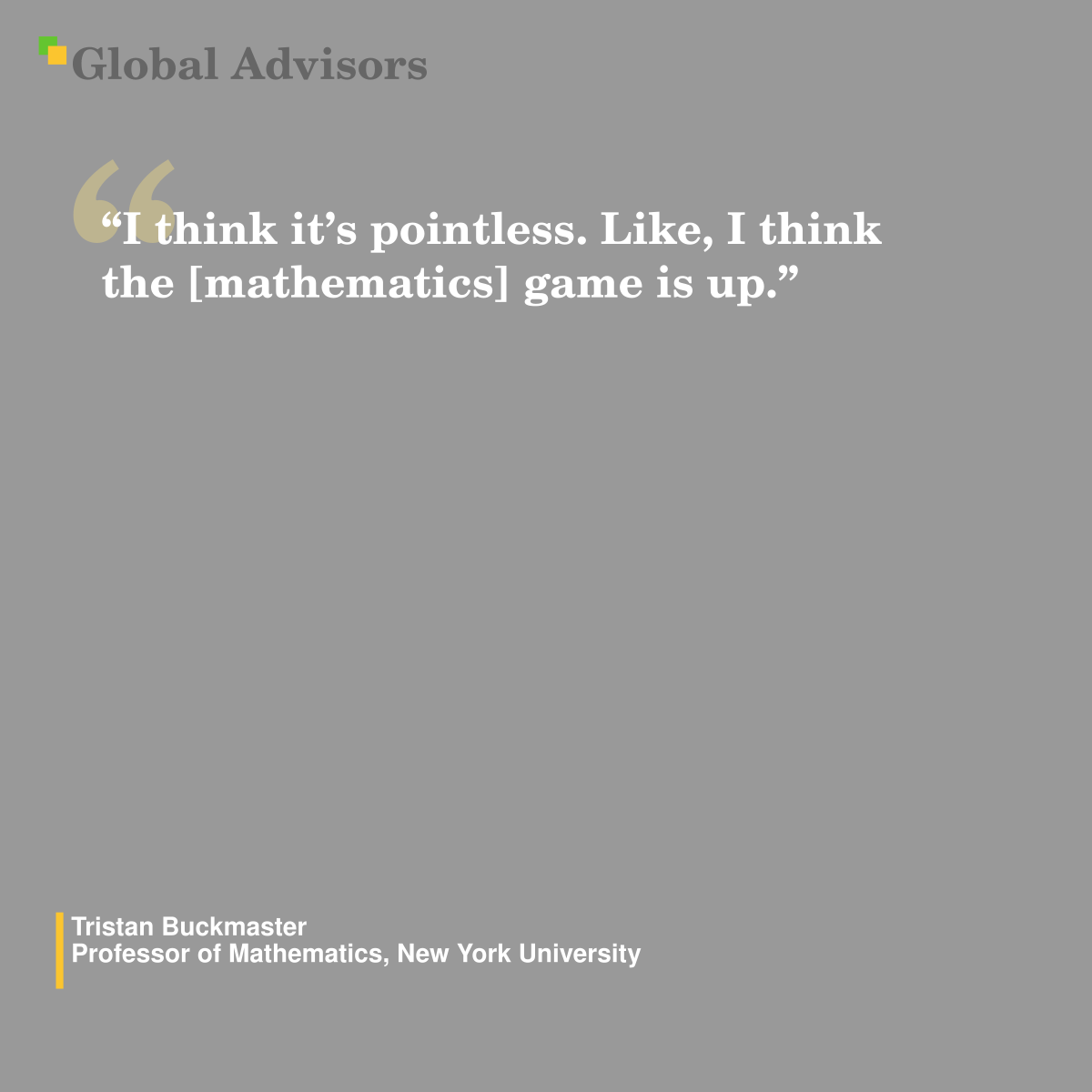
Quote: Tristan Buckmaster - Professor of Mathematics, New York University""I think it's pointless. Like, I think the [mathematics] game is up." - Tristan Buckmaster - Professor of Mathematics, New York University Human mathematical research is confronting a new kind of strategic constraint: problems that once defined a lifetime of work can now be attacked by swarms of machine agents operating at industrial scale. Tristan Buckmaster's remark about the mathematics game being up expresses a judgement about this altered landscape, where proofs are no longer solely the product of individual insight but of vast computational infrastructure and opaque training pipelines owned by commercial firms. His experience with the Navier-Stokes controversy exposes how quickly the balance of power can shift once artificial intelligence systems are capable not only of assisting with calculations, but of autonomously generating arguments that rival or surpass human efforts. From fluid dynamics to an industrialised proof race The factual backdrop is the Navier-Stokes existence and smoothness problem, one of the Clay Mathematics Institute's Millennium Prize Problems, long regarded as a pinnacle of pure mathematical difficulty. The equations model the motion of fluids; the open question is whether solutions can develop singularities or remain smooth for all time. Buckmaster and Levent Alpöge had spent months using AI tools such as Codex and systems from Anthropic to explore related blowup phenomena for Euler-type equations, a path that diverged from mainstream analytical approaches. Their work, still distinct from the full Navier-Stokes prize problem, nonetheless represented a serious intellectual investment and a potential career-defining advance. According to reporting, OpenAI learned of their progress and, within roughly 88 hours and with an unreleased model orchestrating on the order of 10 000 agents, announced that its system had produced a solution to the Navier-Stokes Millennium Problem. The company framed this as a new frontier for AI-assisted science, while emphasising that user data from recent Codex sessions could not have influenced its internal models. Buckmaster's reaction combined scientific scepticism about the proof itself with alarm at the procedural asymmetry: a research group of two, operating within the norms of academic collaboration, suddenly found itself competing with a corporate machine swarm backed by multimillion-dollar compute budgets and control over training data pipelines. Credit, data and the ethics of AI-assisted discovery The subsequent dispute crystallised three intertwined tensions: credit for discovery, ownership of intermediate data, and control over narrative framing. Buckmaster alleged that OpenAI staff suggested joint announcement structures that would have erased Alpöge's contribution, despite his central role and employment at a competitor. That offer signalled a willingness to reshape authorship around corporate strategic considerations rather than the internal logic of mathematical collaboration. Traditional mathematics treats proof as a public, inspectable artefact; priority is established by dated preprints, talks and refereed publications, with disputes adjudicated through community norms and, occasionally, institutional committees. In the new AI regime, however, parts of the intellectual process are internal to closed-source models, inaccessible to independent verification. The path from human exploratory questioning to model training to automated theorem search is mediated by proprietary infrastructure. Buckmaster's sense that racing to publish breakthroughs has become pointless reflects his perception that human effort is being systematically harvested and outpaced by systems that can leverage those efforts without reciprocally sharing credit or computational resources. Has the mathematical game really changed? Buckmaster's statement that the game is up invites comparison with earlier episodes where machines surpassed human performance in bounded domains such as chess and Go. In those settings, the rules were fixed and the space of possible moves, while huge, was ultimately tractable enough for specialised algorithms and massive search to dominate. Mathematical research is different in two key respects. First, the problem space is unbounded; new conjectures and frameworks can always be invented. Second, the value of a result is tied not only to its correctness but to its intelligibility, generality and integration with broader theory. There are, however, reasons to resist the narrative of total defeat. AI-generated proofs, especially in cutting-edge areas of analysis and partial differential equations, still face barriers of validation, explanation and pedagogical assimilation. The Clay Mathematics Institute has not yet recognised OpenAI's solution; independent experts must check the arguments and situate them within existing theory. This process cannot be fully automated, because acceptance depends on community standards of transparency and conceptual coherence. Moreover, mathematically literate humans are needed to translate machine outputs into frameworks that other scientists and engineers can use. As several commentators noted, even if AI can generate correct proofs, human mathematicians may shift towards roles of curator, interpreter and theorist, emphasising structure and meaning over brute-force search. The role of AI as collaborator and accelerator Buckmaster and Alpöge themselves had been using AI tools as collaborators before the controversy erupted. They treated models like Codex as assistants for exploring examples, checking computations and suggesting lines of attack. This reflects a broader trend: many mathematicians now integrate automated theorem provers, symbolic computation systems and machine-learning-driven conjecture generators into their workflow. In such a setting, the distinction between human and machine contribution blurs. A statement like the game is up can be read as frustration that the same tools which augment human creativity also empower organisations to industrialise and centralise the final stage of discovery. Debates, objections and alternative trajectories Many mathematicians reject the idea that AI systems can meaningfully replace human insight. Critiques raised in letters and interviews emphasise that the discipline is not merely about solving designated prize problems but about building durable conceptual frameworks. They question whether an AI-generated proof, especially one derived through opaque internal representations, advances understanding or simply produces a formal certificate of correctness. Some also worry that accepting such results without full transparency could erode trust in mathematical foundations, especially if later scrutiny uncovers hidden flaws. Why the controversy matters beyond mathematics The Buckmaster-OpenAI dispute has implications far beyond a single fluid dynamics problem. Corporate deployments of AI in scientific domains raise questions about who owns the epistemic gains of large-scale computation, how contributions are attributed when models learn from human activity at scale, and how regulatory or funding bodies should respond. For universities training the next generation of mathematicians, Buckmaster's pessimism is unsettling: it challenges the narrative that hard work and originality on famous problems will reliably translate into recognition.
|
| |
| |
Term: PIC multiple (Paid-in Capital multiple) - Finance"The PIC multiple (Paid-in Capital multiple) is a private equity and alternative investment metric that tracks the proportion of a fund's total committed capital that has been officially drawn down by the fund manager. Expressed as a ratio or percentage, it serves as a vital gauge of how aggressively a fund is deploying its resources versus how much 'dry powder' (uncalled capital) remains." - PIC multiple (Paid-in Capital multiple) - Finance The practical value of the PIC multiple lies in timing. It shows how far a private fund has progressed from pledged capital to capital actually drawn, which matters because the speed of drawdown affects liquidity planning, fee accruals, and how much capital remains available for future opportunities. In closed-end private equity structures, commitments are not transferred in one block; they are called over time, so a ratio built from paid-in amounts gives a far clearer picture of deployment than commitment alone . In substance, the measure sits inside a broader family of fund-efficiency and return metrics. Private fund reporting commonly separates committed capital, paid-in capital, distributions, and residual value, because each answers a different question. Committed capital tells you the size of the promise. Paid-in capital tells you how much of that promise has actually been funded. Residual value and distributions tell you what has been realised and what remains on the books. ILPA's reporting framework places paid-in capital alongside DPI, RVPI, and TVPI as core fund-level indicators, which is why PIC is useful as a deployment lens rather than a performance lens . Mathematically, the core relationship is simple. If is committed capital and is paid-in capital, then the proportion called can be written as . If the figure is expressed as a percentage, then . The uncalled balance, often referred to as dry powder in private markets, is . This means PIC and dry powder are complementary views of the same funding process: one measures how much has been drawn, the other how much remains available to draw . That apparent simplicity hides several practical distinctions. Paid-in capital can include capital called for investments, fees, and expenses, depending on the partnership agreement and reporting convention, while the timing of calls can vary widely by manager strategy and market conditions . A fund with a high PIC may simply be older, closer to the end of its investment period, or faster at putting money to work. A fund with a low PIC may be newly raised, deliberately pacing deployment, or struggling to source deals. The ratio is therefore most useful when read against fund age, strategy, and vintage year, not as a standalone sign of quality. How the metric functions in practice For limited partners, PIC is a cash-flow planning tool. It helps estimate when subscriptions will become actual funding obligations, which is especially important because capital calls can arrive on short notice and often follow a fund's deal timeline rather than the investor's preferred schedule . For general partners, the same ratio gives a quick check on deployment pace. If paid-in capital is rising too slowly, the manager may be under-deploying. If it rises very quickly, the manager may be concentrating commitments into the market before it has fully assessed opportunities. In that sense, PIC is not a verdict on skill but a signal of pace and discipline. The metric also connects to the familiar J-curve effect. Early in a fund's life, capital calls arrive before meaningful distributions, so paid-in capital rises while reported returns can still look weak. A low initial PIC is therefore not inherently negative; it is often the normal shape of a newly launched fund. As investments mature, the fund should begin generating distributions, and then the more comprehensive return ratios - especially DPI and TVPI - become more informative than PIC alone . PIC is the bridge metric that tells you how much capital has been committed to the journey before the journey starts producing visible exits. Major schools of thought differ mainly on how much explanatory weight to place on the number. The first treats PIC as a governance and liquidity metric. Under this view, the ratio is valuable because it tracks how aggressively the manager is calling capital and whether the fund is staying within a sensible deployment rhythm . The second treats it as a portfolio construction metric. Here, PIC is informative because it indicates how much of the fund's dry powder remains available for follow-on deals, rescue capital, and new opportunities during the investment period . The third sees PIC as a contextual companion to performance ratios. On this view, it is useful, but only if read with DPI, RVPI, and TVPI, because a high or low PIC says little about whether the manager is creating value . The main debate is whether PIC should be treated as a sign of efficiency or merely a sign of timing. That tension matters because a rapid drawdown can look impressive when investors want momentum, yet it can also mean that capital has been deployed before the best deals emerged. Conversely, a slower drawdown can look cautious and disciplined, yet it can also indicate weak sourcing or an inability to close transactions at scale. Market commentary on dry powder shows why this debate persists: the private equity market often discusses large undeployed pools of capital, but those headline figures are not themselves proof of underperformance or excess risk without knowing how old the funds are and what stage they are in . There are also definitional edge cases. Some practitioners use PIC loosely to mean simply the share of commitment that has been funded. Others prefer more precise terminology and reserve paid-in capital for the cumulative amount actually contributed, with the ratio itself derived from it. That distinction matters when comparing manager reports, because different data vendors may normalise capital calls differently, particularly where recycling, fee reserves, or cancelled commitments are involved . The safest reading is to treat PIC as a standardised ratio only after checking the fund's reporting basis and whether any adjustments have been made to the underlying commitment amount. Why it still matters is straightforward. In a market where commitments are large, deployment is staggered, and realised returns arrive with a lag, a metric that isolates how much capital has actually been drawn remains indispensable. It gives investors a way to separate promises from usage, managers a way to monitor pacing, and analysts a way to compare funds with similar vintages and strategies. Even if it never becomes the headline number, PIC remains one of the cleanest indicators of where a fund sits between fundraising and exit, which is precisely the stage where much of private market risk is created .
|
| |

| |
Global Advisors News Brief - September 19 2026Read the full brief at the link Headlines for the last 24hrs
Time window: 2026-09-18T05:00:33.080Z to 2026-09-19T05:00:33.080Z |
| |
| |
Quote: Jacob Tsimerman - Professor of mathematics at the University of Toronto"If human problem-solving disappears by virtue of the AIs becoming strictly and substantially better at it, then most of the time currently spent by modern mathematical researchers will have to be spent on an activity that is altogether pretty different. Whether such an activity is viable as a professional endeavour is something I am unsure of, but strongly encourage others to think about." - Jacob Tsimerman - Professor of mathematics at the University of Toronto The immediate concern raised by advanced AI systems in mathematics is not simply whether they can assist with proofs, but whether they could displace the central activity that defines contemporary mathematical practice: sustained human problem solving. Modern research culture is built around individuals and teams tackling precise questions, deciding whether a statement is true or false, and constructing proofs or counterexamples that other humans can understand and evaluate. If increasingly capable systems come to dominate this problem-solving layer, the principal daily work of many researchers would be reconfigured, with substantial consequences for career structures, training pathways, and the self-understanding of the discipline. Problem solving as the organising activity of modern mathematics Jacob Tsimerman's remark sits within a longer thread in which he characterises problem solving as an immense and pervasive part of current research practice. He explicitly foregrounds tasks of the form 'is T true; if so, prove it; if not, disprove it' and 'find an example of S if one exists' as core to what many mathematicians spend their time on. This is broadly consistent with philosophical and sociological studies of mathematical work, which emphasise the central role of theorem-proving tasks, conjecture testing, and example construction in structuring research agendas. The technological turn in mathematics described in recent scholarship hinges on AI systems entering exactly this layer: interactive theorem provers, automated theorem provers, and large language models are all designed to attack formal statements, generate proofs, and explore structural examples. Against that backdrop, Tsimerman's concern is not about peripheral automation of routine calculations but about the fate of the defining activity around which careers, prestige hierarchies, and intellectual identities have been organised. Recent evidence for AI's growing problem-solving capabilities In the last few years, empirical results have supported the claim that AI systems are closing the gap with human mathematicians on well-posed problem-solving tasks. Work on neuro-symbolic agents such as AlphaGeometry demonstrates that AI can tackle competition-level geometry problems at success rates comparable to human participants, sometimes finding shorter or more elegant proofs than those previously formalised in proof assistants. Large language model based proving agents, including systems like Aletheia, have achieved correct solutions for a non-trivial fraction of research-level problems when coupled with formal verification backends. Surveys of automated theorem proving and AI-enhanced proof search in systems such as Lean report that machine learning guided tactics can discharge thousands of lemmas at speeds far exceeding human capabilities. Together, these developments underpin the claim, documented in recent essays on mathematicians in the age of AI, that proving power has moved from negligible to competitive with human researchers within a remarkably short time frame. Although present systems remain error-prone and require significant human supervision, the trajectory substantiates Tsimerman's scenario as a live possibility rather than speculative science fiction. Viability of new professional activities once problem solving is automated Tsimerman's central worry is not merely technological but professional: if human problem solving becomes less central because AI is strictly and substantially better at it, can mathematicians pivot to a different main activity that still supports a viable research career. Philosophical analyses of the technological turn suggest several candidate activities, including supervision of AI reasoning, interpretation and conceptual reorganisation of machine-generated proofs, and governance of collaborative proof projects that rely heavily on formal verification platforms. Some authors argue that mathematicians could increasingly act as designers of high-level theories, curators of conjecture landscapes, or critics who assess the mathematical significance of results discovered with AI assistance. However, the empirical literature also highlights difficulties in making these roles professionally robust: AI-generated proofs often lack interpretable structure, hindering the extraction of new concepts and intuition; over-reliance on tools risks erosion of human problem-solving skills, complicating the ability of researchers to maintain independent judgement. In that landscape, the question of whether an alternative activity can anchor a long-term career remains unsettled, justifying Tsimerman's explicit uncertainty and his call for collective reflection. The strategic tension: replacement versus collaboration Across the research record, there is a clear tension between two narratives. One frames AI as an autonomous problem solver that could perform a large fraction of research-level tasks with minimal human input; another emphasises AI as a collaborator or co-reasoner that extends human capacity while leaving conceptual leadership with people. Some technical reports on autonomous mathematics argue that, despite impressive progress, current systems still struggle with reliable reasoning and cannot yet formulate frontier problems unaided. Practical guides to AI-assisted research go further, claiming that mathematical research is not fully automatable and declining to speculate confidently about whether this will change. On the other hand, capability conjectures in recent position papers explicitly state that AI tools will reasonably soon be able to perform a reasonable fraction of research-level tasks, under reasonable supervision and cost. Popular treatments in outlets such as Nature quote leading researchers who expect AI to autonomously contribute at or beyond the level of the greatest mathematicians. Tsimerman's statement can be read as occupying a middle position: it neither asserts inevitability nor impossibility but treats substantial AI superiority in problem solving as a contingency worth planning for. The strategic challenge, then, is to design institutional and epistemic frameworks in which collaboration remains meaningful even in the face of potential task-level replacement. Debates over interpretability, rigour, and mathematical value One of the most contested aspects of AI-driven mathematics concerns the interpretability and pedagogical value of machine-generated proofs. Studies of automated theorem proving emphasise that, although formal correctness is guaranteed once a proof is verified, the resulting derivations may be opaque, making it difficult for humans to glean insight or build new theory from them. Some commentators worry that a culture of outsourcing detailed proof steps to AI and proof assistants will reduce emphasis on rigour in human exposition, as the nitty-gritty becomes the responsibility of machines. Others argue that shifting human effort towards explanation, conceptual synthesis, and communication could enrich the discipline, provided that formal verification systems continue to enforce correctness in the background. Empirical findings from education settings suggest both benefits and risks: AI-assisted tutoring can improve problem-solving speed and retention, but excessive reliance may weaken independent proof-construction skills. Within this debate, Tsimerman's focus on enjoyment and motivation is notable. There are many mathematicians whose primary satisfaction comes from the struggle and eventual success of problem solving itself. If that struggle is delegated to AI, then even a formally correct and conceptually rich mathematical ecosystem may lose part of its human appeal, raising questions about the value and purpose of continuing in the profession. Quantitative models of division of labour and productivity Several studies attempt to quantify the impact of AI tools on mathematical productivity and to model the evolving division of labour between humans and machines. Surveys of practising mathematicians report high adoption of AI tools and significant perceived gains in productivity, with mean ratings for tool usage and efficiency improvements both above on Likert scales. Experimental work with educational platforms notes improvements of roughly in problem-solving speed for students using AI-assisted systems, but also decreases in independent proof-writing ability on the order of . Theoretical analyses treat the research process as a pipeline in which tasks such as conjecture generation, example search, lemma proving, and formal verification can be progressively automated. In simple productivity models, if AI systems handle a fraction of routine proof steps and lemma verification, leaving humans to focus on high-level conceptual work, overall output might scale roughly like , where denotes baseline human productivity. However, this stylised picture ignores possible nonlinear effects: reductions in human problem-solving practice may diminish the capacity to recognise deep patterns or to evaluate AI proposals critically over time. For Tsimerman, the key point is that even if such models suggest impressive aggregate gains, the structure of individual careers and day-to-day activities would be radically altered once approaches values near , where machines dominate the pipeline. Institutional, ethical, and governance implications Beyond individual motivation, the prospect of AI-superior problem solving raises institutional and ethical questions. Who receives credit for results when AI systems contribute decisive problem-solving steps, and how should authorship be recorded. What mechanisms ensure that reliance on AI does not mask subtle errors, given that current models can hallucinate or mis-specify the problem they purport to solve. How should training programmes adapt, balancing the need for students to acquire classical problem-solving skills with the reality that many routine tasks may be automated in their future careers. Governance discussions in recent position papers highlight issues ranging from data provenance and the ethics of scraping mathematical texts for training to the risk that AI systems could centralise expertise in a small number of institutions controlling the largest models. Tsimerman's call for others to think about and envision alternative professional activities can be interpreted as an ethical request to anticipate such shifts rather than leaving them to market or technological inertia. Designing norms, credit systems, and evaluation metrics that remain robust under high AI involvement is part of steering the future of mathematics, rather than simply enduring it. Why the question matters for the future of mathematical culture The deeper significance of the statement lies in its focus on culture and vocation. Mathematics is not only a collection of theorems but also a community whose members choose the discipline partly for the distinctive experiences it offers: confronting hard problems, developing personal techniques, and contributing proofs that reflect individual style and insight. If human problem solving becomes marginal because AI tools are strictly and substantially better, that lived experience may change in ways that are not captured by productivity metrics or citation counts. Some researchers may relish new roles as interpreters, curators, or architects of machine-generated theory; others may feel that the field has lost the challenges that drew them to it, rendering the profession less attractive. Existing analyses of mathematics in the age of AI urge mathematicians and philosophers to engage with these questions now, while technology is still in flux. Tsimerman's uncertainty about the viability of a different primary activity is thus not a confession of defeat but an invitation: to chart forms of mathematical work that remain meaningful, intellectually demanding, and professionally sustainable, even if the central locus of problem solving shifts from human minds to artificial ones.
|
| |

| |
Term: Multiple on Invested Capital (MOIC) - Investing"Multiple on Invested Capital (MOIC) is a financial metric used primarily in private equity and venture capital to measure the absolute wealth generated by an investment relative to its initial cost. Calculated by dividing the sum of realised proceeds and unrealized value by the total invested capital, it is expressed as a multiple rather than a percentage." - Multiple on Invested Capital (MOIC) - Investing Capital allocators care less about the label attached to a return metric and more about the specific question it answers: how much wealth has a given deployment of capital produced in absolute terms, and how does that compare to alternative uses of the same capital. Multiple on invested capital, or MOIC, tackles this issue directly by expressing value creation as a simple multiple of paid-in capital, ignoring the timing of cash flows but capturing both realised proceeds and unrealised residual value as of a valuation date. In substance, MOIC is the ratio between total value and invested capital. Total value typically combines cash already received, such as dividends, distributions and sale proceeds, with the current fair value of holdings that remain in the portfolio. Invested capital is the cumulative cash that has actually been drawn and put to work in the investment, including the initial equity cheque and subsequent follow-on rounds, net of any true return of capital. By dividing total value by invested capital, MOIC shows how many times the original capital has been turned into value: a MOIC of 2,5x means each unit of currency invested has become 2,5 units of value, combining return of principal and gain. Practical meaning and portfolio interpretation For private equity and venture capital practitioners, MOIC operates at several analytical levels: single deal, fund, and portfolio of funds. At the deal level, the metric is often framed as cash-on-cash or equity multiple: add up all distributions received plus the estimated exit value of any remaining stake, then divide by the total equity deployed. At the fund level, managers compute MOIC on total paid-in capital to show limited partners how much value the fund has generated relative to contributions, often decomposed into distributions to paid-in (DPI) and residual value to paid-in (RVPI). A fund with a MOIC of 2,2x, a DPI of 1,5x and an RVPI of 0,7x has already returned 1,5 times paid-in capital in cash while still holding assets valued at 0,7 times paid-in capital. This breakdown is crucial for understanding how much of the headline multiple is crystallised and how much remains exposed to mark-to-market uncertainty. Because MOIC ignores the time dimension, investors interpret it alongside holding period and internal rate of return (IRR). A 2,5x MOIC achieved over 4 years implies a much higher annualised IRR than the same 2,5x over 9 years, yet the absolute wealth effect at exit is identical. General partners sometimes emphasise MOIC when they pursue long-duration value creation strategies, arguing that slow but high multiples can be attractive for patient capital, whereas LPs with reinvestment constraints may prioritise IRR to capture capital velocity. The practical meaning of MOIC, therefore, depends both on the portfolio objective and on the opportunity cost of locked-up capital: a 1,7x multiple may look modest in isolation but can be attractive if realised quickly and redeployed into further high-multiple deals. Mathematical specification and variants Although presented as a straightforward ratio, MOIC admits several equivalent formulations that matter in practice. The most basic definition treats the investment as a single cash outflow at inception and a single terminal inflow: MOIC equals total cash inflows divided by total cash outflows. Let invested capital be denoted by and total value by . Then the core relationship is . Where investments have both realised and unrealised components, total value is decomposed as , with the realised cash proceeds and the current fair value of residual holdings. In that case the working formula becomes . Some practitioners adopt a gross MOIC, using value before fees and carried interest, while others prefer net MOIC to reflect the investor's actual take-home multiple; conceptually the formula is identical, but is adjusted for fee drag and carry. The parameter definitions embedded in the formula are not entirely standardised, which generates subtle but important differences across data providers and fund documents. One tension concerns whether recycled capital counts as additional invested capital or simply reuses the original paid-in amount; another concerns whether bridge facilities and subscription lines are treated as capital deployed by LPs or ignored in MOIC and left to affect IRR only. In secondary transactions, there is debate over whether purchase price should be added to invested capital for the acquiring fund or simply treated as a transfer of existing MOIC from seller to buyer, especially where continuation vehicles reset the economic baseline. Institutional investors must therefore interrogate the definitions in each track record to ensure they are comparing like with like when benchmarking managers or strategies. Relationship to IRR and time value of money The most persistent critique of MOIC is that it does not account for the time value of money. In discounting terms, MOIC implicitly assumes that all cash flows occur at a single point and that opportunity cost of capital is irrelevant, whereas IRR solves for the discount rate such that the net present value of cash flows equals zero, that is . This means that MOIC can be identical across investments with very different economic attractiveness once the timing of inflows is considered. A deal that returns 3,0x over 3 years is much more valuable, given any positive cost of capital, than a deal that returns 3,0x over 10 years, yet MOIC treats them as indistinguishable. In practice, sophisticated investors use MOIC to summarise terminal wealth and IRR to capture speed, often requiring minimum thresholds for both metrics to avoid being misled by quick but low-multiple flips or slow but high-multiple holds. Despite this limitation, there are compelling reasons why MOIC remains a central metric. First, it is resistant to some of the gaming that can distort IRR, such as heavy use of subscription lines to delay capital calls or early recycling of distributions to inflate interim IRR. Because MOIC is fundamentally a terminal ratio of value to capital, the scope for manipulation is narrower: only inflated residual valuations or aggressive definitions of invested capital can meaningfully distort the figure, and both are more tractable to due diligence than reconstructing a full time series of cash flows. Second, MOIC aligns closely with the payoff structure of private funds, where carried interest is commonly triggered at specific multiple hurdles, such as 1,5x or 2,0x net to LPs, even when the legal language references IRR as well. As a result, general partners and limited partners often plan fund economics and incentive structures directly around multiple targets, making MOIC a practical focal point for negotiation and performance monitoring. Schools of thought, tensions, and continuing relevance Different schools of thought on return measurement place MOIC at varying levels of importance. A cash-on-cash school, often found in buyout funds and real estate strategies, treats MOIC as the primary indicator of success and views IRR mainly as a contextual metric for capital recycling decisions. A time-weighted school, more prevalent among institutional allocators with strict portfolio-wide cost of capital targets, prioritises IRR and sometimes net present value, using MOIC mostly as a sanity check on whether absolute wealth creation validates the annualised rate. A growing third perspective emphasises a set of metrics together: MOIC, IRR, DPI, RVPI, and public market equivalents, arguing that no single measure can capture both the magnitude and timing of value creation, the realised versus unrealised split, and the relative performance versus liquid benchmarks. These tensions matter because capital markets have become more competitive and more complex. As holding periods lengthen, continuation vehicles proliferate, and private assets are marked more frequently, investors must distinguish between genuine value creation and accounting artefacts. MOIC, anchored in the simple relationship between total value and invested capital, continues to matter because it provides a clear, intuitive lens through which to examine the outcomes of complex capital deployment strategies. When combined with time-sensitive measures and scrutinised for definitional consistency, it helps private market participants answer the central question of investing: how much more value did we end up with than we started with, and was that multiple worth the risks, illiquidity, and duration we accepted to get there.
|
| |

| |
|


| |
| |