| |
|

| |
| |
| |
|
Our selection of the top business news sources on the web. |
| |
| |
| |
Quote: Biz Stone“Timing, perseverance, and ten years of trying will eventually make you look like an overnight success.” – Biz Stone, Co-Founder Twitter Success rarely happens overnight. Instead, it is often the result of years of hard work, perseverance, and strategic decision-making. The quote suggests that even seemingly rapid successes can be the culmination of a long period of effort and dedication. Key Takeaways from the Quote Timing: The quote underscores the significance of timing in achieving success. It implies that being at the right place at the right time can make all the difference. Implications of the Quote Long-Term Focus: It encourages individuals to adopt a long-term perspective and focus on making steady progress towards their objectives.
|
| |

| |
Quote: Max Levchin“Hang on tight to those who make you a better you!” Max Levchin delivered a heartfelt commencement address at the University of Illinois at Urbana-Champaign in 2018, marking the 150th anniversary of the university's first class. As an alumnus, Levchin shared his journey from a Soviet Union immigrant to a successful entrepreneur, emphasizing the importance of taking risks and embracing failure. He recounted his early experiences with failed startups, highlighting how these setbacks shaped his path to co-founding PayPal. Levchin stressed that while failure is painful, it is crucial to remain human and compassionate, especially when others are affected by your decisions. He shared a poignant lesson learned from a challenging period in his career: "Failing people who trust in you, hurts a lot more than just failing yourself." This insight underscored the emotional weight of leadership and the responsibility towards those who believe in you. Levchin encouraged graduates to surround themselves with people who inspire them to be better and to take risks to discover their true selves. His speech was a call to action for the class of 2018 to embrace uncertainty and pursue their passions with resilience and integrity.
|
| |

| |
Quote: Max Levchin“Surround yourself with people who will help you cope with the darkest moments, be a human, and you will survive, and ultimately thrive.” Max Levchin delivered a heartfelt commencement address at the University of Illinois at Urbana-Champaign in 2018, marking the 150th anniversary of the university's first class. As an alumnus, Levchin shared his journey from a Soviet Union immigrant to a successful entrepreneur, emphasizing the importance of taking risks and embracing failure. He recounted his early experiences with failed startups, highlighting how these setbacks shaped his path to co-founding PayPal. Levchin stressed that while failure is painful, it is crucial to remain human and compassionate, especially when others are affected by your decisions. He shared a poignant lesson learned from a challenging period in his career: "Failing people who trust in you, hurts a lot more than just failing yourself." This insight underscored the emotional weight of leadership and the responsibility towards those who believe in you. Levchin encouraged graduates to surround themselves with people who inspire them to be better and to take risks to discover their true selves. His speech was a call to action for the class of 2018 to embrace uncertainty and pursue their passions with resilience and integrity.
|
| |

| |
Quote: Max Levchin“Failing people who trust in you, hurts a lot more than just failing yourself.” Max Levchin delivered a heartfelt commencement address at the University of Illinois at Urbana-Champaign in 2018, marking the 150th anniversary of the university's first class. As an alumnus, Levchin shared his journey from a Soviet Union immigrant to a successful entrepreneur, emphasizing the importance of taking risks and embracing failure. He recounted his early experiences with failed startups, highlighting how these setbacks shaped his path to co-founding PayPal. Levchin stressed that while failure is painful, it is crucial to remain human and compassionate, especially when others are affected by your decisions. He shared a poignant lesson learned from a challenging period in his career: "Failing people who trust in you, hurts a lot more than just failing yourself." This insight underscored the emotional weight of leadership and the responsibility towards those who believe in you. Levchin encouraged graduates to surround themselves with people who inspire them to be better and to take risks to discover their true selves. His speech was a call to action for the class of 2018 to embrace uncertainty and pursue their passions with resilience and integrity.
|
| |

| |
Quote: Yann Lecun“Most of the infrastructure cost for AI is for inference: serving AI assistants to billions of people.” Yann LeCun made this comment in response to the sharp drop in Nvidia’s share price on January 27, 2024, following the launch of Deepseek R1, a new AI model developed by Deepseek AI. This model was reportedly trained at a fraction of the cost incurred by Hyperscalers like OpenAI, Anthropic, and Google DeepMind, raising questions about whether Nvidia’s dominance in AI compute was at risk. The market reaction stemmed from speculation that the training costs of cutting-edge AI models—previously seen as a key driver of Nvidia’s GPU demand—could decrease significantly with more efficient methods. However, LeCun pointed out that most AI infrastructure costs come not from training but from inference, the process of running AI models at scale to serve billions of users. This suggests that Nvidia’s long-term demand may remain strong, as inference still relies heavily on high-performance GPUs. LeCun’s view aligned with analyses from key AI investors and industry leaders. He supported the argument made by Antoine Blondeau, co-founder of Alpha Intelligence Capital, who described Nvidia’s stock drop as “vastly overblown” and “NOT a ‘Sputnik moment’”, referencing the concern that Nvidia’s market position was insecure. Additionally, Jonathan Ross, founder of Groq, shared a video titled “Why $500B isn’t enough for AI,” explaining why AI compute demand remains insatiable despite efficiency gains. This discussion underscores a critical aspect of AI economics: while training costs may drop with better algorithms and hardware, the sheer scale of inference workloads—powering AI assistants, chatbots, and generative models for billions of users—remains a dominant and growing expense. This supports the case for sustained investment in AI infrastructure, particularly in Nvidia’s GPUs, which continue to be the gold standard for inference at scale.
|
| |

| |
Quote: Andrew Johnson“The men of our race in every age have struggled to tie up the hands of their Governments and keep them within the law; because their own experience of all mankind taught them that rulers could not be relied on to concede those rights which they were not legally bound to respect.” - Andrew Johnson. US President — Veto of the First Military Reconstruction Act , March 2 1867 The quote reflects his views on the relationship between government authority and individual rights, particularly in the context of post-Civil War America. Johnson, who served as the 17th President of the United States (1865-1869), assumed office after the assassination of Abraham Lincoln and faced the monumental task of reconstructing the nation following the Civil War. In this statement, Johnson emphasizes the historical struggle of people to limit governmental power and ensure that rulers adhere to the law. He suggests that throughout history, individuals have sought to "tie up the hands of their Governments" to prevent abuses of power and protect their rights. This perspective is rooted in a fundamental belief in the rule of law and the idea that governments must be held accountable to the rights of the governed. Johnson's assertion that "rulers could not be relied on to concede those rights which they were not legally bound to respect" highlights a skepticism toward government authority. He implies that without legal constraints, those in power are unlikely to voluntarily respect the rights of individuals. This reflects a broader philosophical view that emphasizes the necessity of legal frameworks to safeguard civil liberties and prevent tyranny. The context of Johnson's veto is significant. The First Military Reconstruction Act was part of a series of measures aimed at rebuilding the South and ensuring civil rights for newly freed African Americans. Johnson's opposition to the act stemmed from his belief in a more lenient approach to Reconstruction, which favored the rights of Southern states over federal intervention. His veto was indicative of his contentious relationship with Congress, particularly with the Radical Republicans who sought to enforce stricter measures for Reconstruction. Johnson's quote can be interpreted as a defense of limited government and a warning against the potential for governmental overreach. However, it also reflects his political stance during a critical period in American history, where the struggle for civil rights and the integration of formerly enslaved individuals into society were at the forefront of national discourse. Overall, this quote serves as a reminder of the ongoing tension between individual rights and governmental authority, a theme that remains relevant in contemporary discussions about civil liberties, the rule of law, and the responsibilities of government to its citizens. Johnson's emphasis on the need for legal constraints on power resonates with the foundational principles of democracy and the importance of protecting the rights of all individuals against potential abuses by those in authority.
|
| |
| |
Quote: Gerald Ford“America's strength has never rested on arms alone. It is rooted in our mutual commitment of our citizens and leaders in the highest standards of ethics and morality and in the spiritual renewal.” - Gerald Ford, US President — President Gerald R. Ford's Remarks in Kansas City Upon Accepting the 1976 Republican Presidential Nomination on August 19, 1976 Ford, who served as the 38th President of the United States from 1974 to 1977, took office during a tumultuous period marked by political scandal, economic challenges, and a national crisis of confidence following the Watergate scandal. In this statement, Ford emphasizes that America's strength is not solely derived from its military power or military might ("arms alone") but is fundamentally rooted in the ethical and moral commitments of its citizens and leaders. He highlights the importance of high standards of ethics and morality, suggesting that the integrity of individuals in positions of power is crucial for the health and stability of the nation. This perspective underscores the belief that effective governance and national strength are built on trust, accountability, and a shared commitment to ethical principles. Ford's mention of "spiritual renewal" adds another layer to his message, indicating that the nation's strength also relies on a sense of purpose, community, and shared values. This call for spiritual renewal can be interpreted as a plea for Americans to reconnect with the ideals that define the nation, such as liberty, justice, and the common good. In the context of the 1970s, a decade marked by social upheaval and disillusionment, Ford's remarks served as a reminder of the importance of unity and moral clarity in overcoming challenges. The quote also reflects Ford's broader vision for America as a nation that values not only its material and military capabilities but also its moral and ethical foundations. By advocating for a commitment to high standards of conduct, Ford sought to inspire citizens to engage in civic responsibility and to hold their leaders accountable. Overall, this quote resonates with contemporary discussions about the role of ethics in politics, the importance of civic engagement, and the need for a collective commitment to the values that define a democratic society. Ford's assertion serves as a reminder that true strength lies not just in power or resources but in the integrity and character of the people who make up the nation. His call for mutual commitment to ethics and morality encourages citizens to actively participate in shaping a just and equitable society.
|
| |

| |
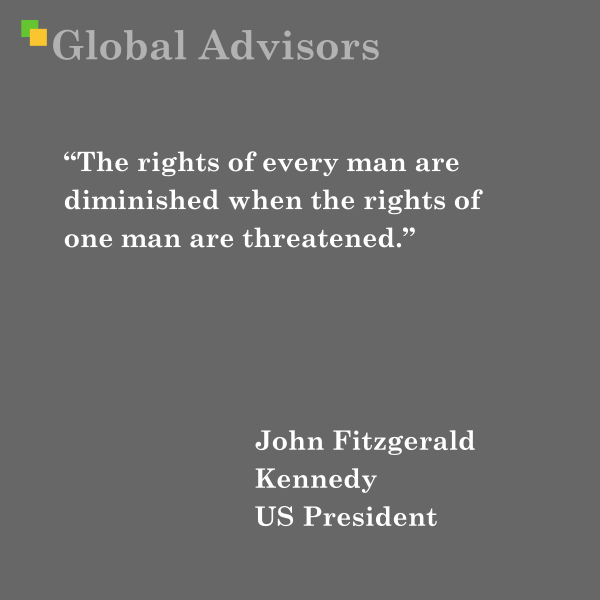
Quote: John Fitzgerald Kennedy“The rights of every man are diminished when the rights of one man are threatened.” - John Fitzgerald Kennedy, US President — June 11, 1963 televised address The quote from John F. Kennedy's televised address on June 11, 1963, encapsulates a profound understanding of civil rights and social justice. As the 35th President of the United States (1961-1963), Kennedy was a pivotal figure during a time of significant social change, particularly regarding the civil rights movement, which sought to end racial segregation and discrimination against African Americans. In this statement, Kennedy emphasizes the interconnectedness of individual rights within a society. He asserts that the rights of every person are compromised when any individual's rights are threatened. This idea reflects a fundamental principle of justice and equality: that the protection of rights is not merely an individual concern but a collective responsibility. When one person's rights are violated, it creates a ripple effect that undermines the rights and freedoms of all. Kennedy's message was particularly relevant in the context of the civil rights movement, which was gaining momentum in the early 1960s. His address came at a time when the nation was grappling with issues of racial inequality, segregation, and violence against civil rights activists. By highlighting the importance of protecting the rights of all individuals, Kennedy called for a moral imperative to stand against injustice and discrimination, regardless of race or background. This quote also serves as a reminder of the broader implications of social justice. It suggests that a society cannot claim to be truly free or just if it allows any group to be marginalized or oppressed. Kennedy's words encourage citizens to recognize their shared humanity and the importance of solidarity in the fight for equality and justice. Kennedy's commitment to civil rights was further demonstrated in his administration's support for legislation aimed at ending segregation and ensuring voting rights. His advocacy for civil rights laid the groundwork for the Civil Rights Act of 1964, which would be enacted after his assassination. Overall, this quote resonates with contemporary discussions about human rights, social justice, and the importance of collective action in addressing inequality. Kennedy's assertion serves as a powerful reminder that the fight for justice is a shared responsibility, and that the protection of individual rights is essential for the well-being of society as a whole.
|
| |
| |
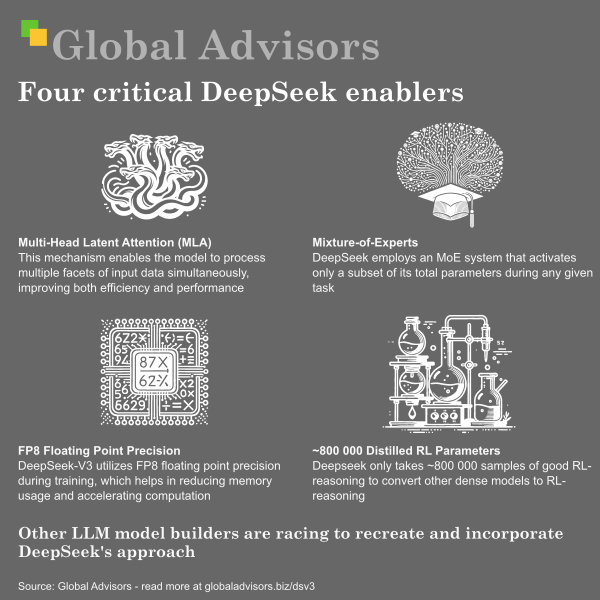
Infographic: Four critical DeepSeek enablersThe DeepSeek team has introduced several high-impact changes to Large Language Model (LLM) architecture to enhance performance and efficiency:
The Impact of Open-Source Models:DeepSeek's success highlights a fundamental shift in AI development. Traditionally, leading-edge models have been closed-source and controlled by Western AI firms like OpenAI, Google, and Anthropic. However, DeepSeek's approach, leveraging open-source components while innovating on training efficiency, has disrupted this dynamic. Pelliccione notes that DeepSeek now offers similar performance to OpenAI at just 5% of the cost, making high-quality AI more accessible. This shift pressures proprietary AI companies to rethink their business models and embrace greater openness. Challenges and Innovations in the Chinese AI Ecosystem:China's AI sector faces major constraints, particularly in access to high-performance GPUs due to U.S. export restrictions. Yet, Chinese companies like DeepSeek have turned these challenges into strengths through aggressive efficiency improvements. MLA and FP8 precision optimizations exemplify how innovation can offset hardware limitations. Furthermore, Chinese AI firms, historically focused on scaling existing tech, are now contributing to fundamental advancements in AI research, signaling a shift towards deeper innovation. The Future of AI Control and Adaptation:DeepSeek-R1’s approach to training AI reasoners poses a challenge to traditional AI control mechanisms. Since reasoning capabilities can now be transferred to any capable model with fewer than a million curated samples, AI governance must extend beyond compute resources and focus on securing datasets, training methodologies, and deployment platforms. OpenAI has previously obscured Chain of Thought traces to prevent leakage, but DeepSeek’s open-weight release and published RL techniques have made such restrictions ineffective. Broader Industry Context:
These innovations collectively contribute to more efficient and effective LLMs, balancing performance with resource utilization while shaping the future of AI model development. Sources: Global Advisors, Jack Clark - Anthropic, Antoine Blondeau, Alberto Pelliccione, infoq.com, medium.com, en.wikipedia.org, arxiv.org |
| |
| |
Quote: Dwight D. Eisenhower“The general limits of your freedom are merely these: that you do not trespass upon the equal rights of others.” - Dwight D. Eisenhower, US President — April 22, 1954 address to the National Society of Daughters of the American Revolution The quote from Dwight D. Eisenhower's address to the National Society of Daughters of the American Revolution on April 22, 1954, succinctly captures a fundamental principle of democratic governance and individual liberty. Eisenhower, who served as the 34th President of the United States from 1953 to 1961, was known for his emphasis on unity, civic responsibility, and the importance of balancing individual freedoms with the rights of others. In this statement, Eisenhower articulates a clear boundary for personal freedom: it is limited by the equal rights of others. This idea reflects the core tenet of democratic societies that individual liberties must coexist with the rights and freedoms of fellow citizens. Eisenhower's assertion underscores the notion that true freedom is not absolute; rather, it is contingent upon mutual respect and consideration for the rights of others. This perspective is particularly relevant in discussions about civil rights, social justice, and the responsibilities that accompany freedom. Eisenhower's emphasis on "trespassing upon the equal rights of others" highlights the importance of recognizing that one's actions and freedoms should not infringe upon the rights and dignity of others. This principle is foundational to the rule of law and the social contract that underpins democratic societies. Eisenhower's message also resonates with the historical context of the 1950s, a period marked by significant social change, including the civil rights movement. His call for respect for the rights of others aligns with the broader struggle for equality and justice during this time, as marginalized groups sought to assert their rights and challenge systemic discrimination. Overall, this quote serves as a reminder of the delicate balance between individual freedom and social responsibility. Eisenhower's words encourage citizens to reflect on their actions and the impact they have on the rights of others, promoting a culture of respect, empathy, and civic engagement. By advocating for a framework of freedom that is mindful of the rights of all, Eisenhower reinforces the idea that a healthy democracy relies on the active participation of informed and responsible citizens who uphold the principles of equality and justice.
|
| |

| |
|


| |
| |