| |
|

| |
| |
| |
|
A daily bite-size selection of top business content. |
| |
| |
| |
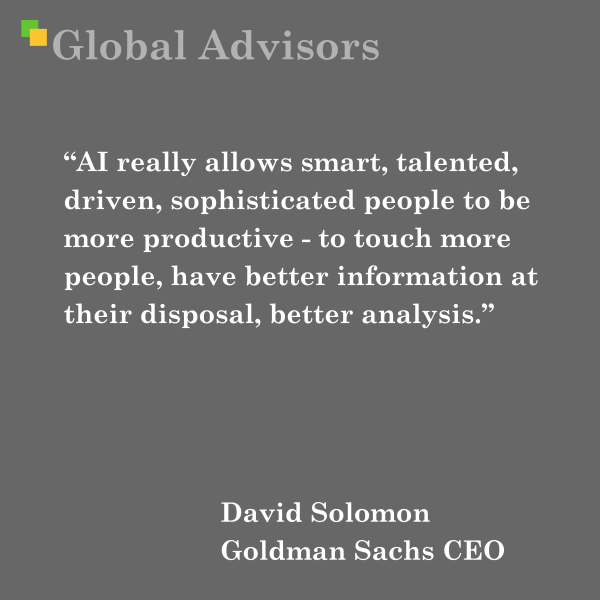
Quote: David Solomon - Goldman Sachs CEO“AI really allows smart, talented, driven, sophisticated people to be more productive - to touch more people, have better information at their disposal, better analysis.” - David Solomon - Goldman Sachs CEODavid Solomon, CEO of Goldman Sachs, made the statement “AI really allows smart, talented, driven, sophisticated people to be more productive - to touch more people, have better information at their disposal, better analysis” during an interview at Italian Tech Week 2025, reflecting his conviction that artificial intelligence is redefining productivity and impact across professional services and finance. David Solomon is one of the most influential figures in global finance, serving as Chairman and CEO of Goldman Sachs since 2018. Born in 1962 in Hartsdale, New York, Solomon’s early years were shaped by strong family values, a pursuit of education at Hamilton College, and a keen interest in sport and leadership. Solomon’s ascent in the industry began after stints at Irving Trust and Drexel Burnham, specialising early in commercial paper and junk bonds, then later at Bear Stearns where he played a central role in project financing. In 1999, he joined Goldman Sachs as a partner and quickly rose through the ranks—serving as Global Head of the Financing Group and later Co-Head of the Investment Banking Division for a decade. His leadership is marked by an emphasis on modernisation, talent development, and integrating technology into the financial sector. Notably, Solomon has overseen increased investments in digital platforms and has reimagined work culture, including reducing working hours and implementing real-time performance review systems. Outside his professional life, Solomon is distinctively known for his passion for music, performing as “DJ D-Sol” at major electronic dance music venues, symbolising a leadership style that blends discipline with creative openness. Solomon’s remarks on AI at Italian Tech Week are rooted in Goldman Sachs’ major investments in technology: with some 12,000 engineers and cutting-edge AI platforms, Solomon champions the view that technology not only streamlines operational efficiency but fundamentally redefines the reach and ability of talented professionals, providing richer data, deeper insights, and more effective analysis. He frames AI as part of a long continuum—from the days of microfiche and manual records to today’s instant, voice-powered analytics—positioning technology as both a productivity enabler and an engine for growth. Leading Theorists and Context in AI ProductivitySolomon’s thinking sits at the crossroads of key theoretical advances in artificial intelligence and productivity economics. The transformation he describes draws extensively from foundational theorists and practitioners who have shaped our understanding of AI’s organisational impact:
Contemporary Application and AnalysisThe productivity gains Solomon identifies are playing out across multiple sectors:
Solomon’s perspective resonates strongly with current debates on the future of work. While risks—such as AI investment bubbles, regulatory uncertainty, and workforce displacement—are acknowledged, Solomon positions AI as a strategic asset: not a threat to jobs, but a catalyst for organisational expansion and client impact, consistent with the lessons learned through previous technology cycles. Theoretical Context TableEssential Insights
|
| |
| |
Quote: Jamie Dimon - JP Morgan Chase CEO“Take the Internet bubble. Remember that blew up and I can name 100 companies that were worth $50 billion and disappeared.... So there will be some real big companies, real big success. [ AI ]will work in spite of the fact that not everyone invested is going to have a great investment return.” - Jamie Dimon, CEO JP Morgan ChaseJamie Dimon's observation about artificial intelligence investment echoes his experience witnessing the dot-com bubble's collapse at the turn of the millennium—a period when he was navigating his own career transition from Citigroup to Bank One. Speaking to Bloomberg in London during October 2025, the JPMorgan Chase chairman drew upon decades of observing technological disruption to contextualise the extraordinary capital deployment currently reshaping the AI landscape. His commentary serves as a measured counterpoint to the euphoria surrounding generative artificial intelligence, reminding investors that transformative technologies invariably produce both spectacular winners and catastrophic losses. The Speaker: Institutional Banking's Preeminent FigureJamie Dimon has commanded JPMorgan Chase since 2006, transforming it into America's largest bank by assets whilst establishing himself as Wall Street's most influential voice. His journey to this position began in 1982 when he joined American Express as an assistant to Sandy Weill, embarking upon what would become one of the most consequential partnerships in American finance. For sixteen years, Dimon and Weill orchestrated a series of acquisitions that built Travelers Group into a financial services colossus, culminating in the 1998 merger with Citicorp to form Citigroup. The relationship ended abruptly that same year when Weill asked Dimon to resign—a decision Weill later characterised as regrettable to The New York Times. The ouster proved fortuitous. In 2000, Dimon assumed leadership of Bank One, a struggling Chicago-based institution he successfully revitalised. When JPMorgan acquired Bank One in 2004, Dimon became president and chief operating officer before ascending to chief executive two years later. Under his stewardship, JPMorgan's stock value has tripled, and in 2023 the bank recorded the largest annual profit in US banking history at nearly $50 billion. Dimon's leadership during the 2008 financial crisis distinguished him amongst his peers. Whilst competitors collapsed or required government rescue, JPMorgan emerged strengthened, acquiring Bear Stearns and Washington Mutual. He reprised this role during the 2023 regional banking crisis, coordinating an industry response that saw eleven major banks contribute $30 billion to stabilise First Republic Bank. This pattern of crisis management has positioned him as what analyst Mike Mayo termed "a senior statesperson" for the financial industry. Beyond banking, Dimon maintains substantial political engagement. Having donated over $500,000 to Democratic candidates between 1989 and 2009, he has since adopted a more centrist posture, famously declaring to CNBC in 2019 that "my heart is Democratic, but my brain is kind of Republican". He served briefly on President Trump's business advisory council in 2017 and has repeatedly faced speculation about presidential ambitions, confirming in 2016 he would "love to be president" whilst acknowledging the practical obstacles. In 2024, he endorsed Nikki Haley in the Republican primary before speaking positively about Trump following Haley's defeat. The Technological Context: AI's Investment FrenzyDimon's October 2025 remarks addressed the extraordinary capital deployment underway in artificial intelligence infrastructure. His observation that approximately $1 trillion in AI-related spending was occurring "this year" encompasses investments by hyperscalers—the massive cloud computing providers—alongside venture capital flowing to companies like OpenAI, which despite substantial losses continues attracting vast sums. This investment boom has propelled equity markets into their third consecutive year of bull-market conditions, with asset prices reaching elevated levels and credit spreads compressing to historical lows. At JPMorgan itself, Dimon revealed the bank has maintained systematic AI investment since 2012, allocating $2 billion annually and employing 2,000 specialists dedicated to the technology. The applications span risk management, fraud detection, marketing, customer service, and software development, with approximately 150,000 employees weekly utilising the bank's internal generative AI tools. Crucially, Dimon reported achieving rough parity between the $2 billion expenditure and measurable benefits—a ratio he characterised as "the tip of the iceberg" given improvements in service quality that resist quantification. His assessment that AI "will affect jobs" reflects the technology's capacity to eliminate certain roles whilst enhancing others, though he expressed confidence that successful deployment would generate net employment growth at JPMorgan through retraining and redeployment programmes. This pragmatic stance—neither utopian nor dystopian—typifies Dimon's approach to technological change: acknowledge disruption candidly whilst emphasising adaptive capacity. The Dot-Com Parallel: Lessons from Previous Technological EuphoriaDimon's reference to the Internet bubble carries particular resonance given his vantage point during that era. In 1998, whilst serving as Citigroup's president, he witnessed the NASDAQ's ascent to unsustainable valuations before the March 2000 collapse obliterated trillions in market capitalisation. His claim that he could "name 100 companies that were worth $50 billion and disappeared" speaks to the comprehensive destruction of capital that accompanied the bubble's deflation. Companies such as Pets.com, Webvan, and eToys became cautionary tales—businesses predicated upon sound concepts executed prematurely or inefficiently, consuming vast investor capital before failing entirely. Yet from this wreckage emerged the digital economy's defining enterprises. Google, incorporated in 1998, survived the downturn to become the internet's primary gateway. Facebook, founded in 2004, built upon infrastructure and lessons from earlier social networking failures. YouTube, established in 2005, capitalised on broadband penetration that earlier video platforms lacked. Dimon's point—that "there will be some real big companies, real big success" emerging from AI investment despite numerous failures—suggests that capital deployment exceeding economically optimal levels nonetheless catalyses innovation producing enduring value. This perspective aligns with economic theories recognising that technological revolutions characteristically involve overshoot. The railway boom of the 1840s produced excessive track mileage and widespread bankruptcies, yet established transportation infrastructure enabling subsequent industrialisation. The telecommunications bubble of the late 1990s resulted in overbuilt fibre-optic networks, but this "dark fibre" later supported broadband internet at marginal cost. Dimon's observation that technological transitions prove "productive" in aggregate "in spite of the fact that not everyone invested is going to have a great investment return" captures this dynamic: society benefits from infrastructure investment even when investors suffer losses. Schumpeterian Creative Destruction and Technological TransitionJoseph Schumpeter's concept of creative destruction provides theoretical foundation for understanding the pattern Dimon describes. Writing in Capitalism, Socialism and Democracy (1942), Schumpeter argued that capitalism's essential characteristic involves "the process of industrial mutation that incessantly revolutionises the economic structure from within, incessantly destroying the old one, incessantly creating a new one." This process necessarily produces winners and losers—incumbent firms clinging to obsolete business models face displacement by innovators exploiting new technological possibilities. Schumpeter emphasised that monopolistic competition amongst innovators drives this process, with entrepreneurs pursuing temporary monopoly rents through novel products or processes. The expectation of extraordinary returns attracts excessive capital during technology booms, funding experiments that collectively advance knowledge even when individual ventures fail. This mechanism explains why bubbles, whilst financially destructive, accelerate technological diffusion: the availability of capital enables rapid parallel experimentation impossible under conservative financing regimes. Clayton Christensen's theory of disruptive innovation, elaborated in The Innovator's Dilemma (1997), complements Schumpeter's framework by explaining why established firms struggle during technological transitions. Christensen observed that incumbent organisations optimise for existing customer needs and established value networks, rendering them structurally incapable of pursuing initially inferior technologies serving different markets. Entrants unburdened by legacy systems and customer relationships therefore capture disruptive innovations' benefits, whilst incumbents experience declining relevance. Dimon's acknowledgement that "there will be jobs that are eliminated" whilst predicting net employment growth at JPMorgan reflects these dynamics. Artificial intelligence constitutes precisely the type of general-purpose technology that Christensen's framework suggests will restructure work organisation. Routine tasks amenable to codification face automation, requiring workforce adaptation through "retraining and redeployment"—the organisational response Dimon describes JPMorgan implementing. Investment Cycles and Carlota Pérez's Technological SurgesCarlota Pérez's analysis in Technological Revolutions and Financial Capital (2002) offers sophisticated understanding of the boom-bust patterns characterising technological transitions. Pérez identifies a consistent sequence: technological revolutions begin with an "irruption" phase as entrepreneurs exploit new possibilities, followed by a "frenzy" phase when financial capital floods in, creating asset bubbles disconnected from productive capacity. Inevitable crash precipitates a "synergy" phase when surviving innovations diffuse broadly, enabling a "maturity" phase of stable growth until the next technological revolution emerges. The dot-com bubble exemplified Pérez's frenzy phase—capital allocated indiscriminately to internet ventures regardless of business fundamentals, producing the NASDAQ's March 2000 peak before three years of decline. The subsequent synergy phase saw survivors like Amazon and Google achieve dominance whilst countless failures disappeared. Dimon's reference to "100 companies that were worth $50 billion and disappeared" captures the frenzy phase's characteristic excess, whilst his citation of "Facebook, YouTube, Google" represents the synergy phase's enduring value creation. Applying Pérez's framework to artificial intelligence suggests current investment levels—the $1 trillion deployment Dimon referenced—may indicate the frenzy phase's advanced stages. Elevated asset prices, compressed credit spreads, and widespread investor enthusiasm traditionally precede corrections enabling subsequent consolidation. Dimon's observation that he remains "a long-term optimist" whilst cautioning that "asset prices are high" reflects precisely the ambivalence appropriate during technological transitions' financial euphoria: confidence in transformative potential tempered by recognition of valuation excess. Hyman Minsky's Financial Instability HypothesisHyman Minsky's financial instability hypothesis, developed throughout the 1960s and 1970s, explains the endogenous generation of financial fragility during stable periods. Minsky identified three financing postures: hedge finance, where cash flows cover debt obligations; speculative finance, where near-term cash flows cover interest but not principal, requiring refinancing; and Ponzi finance, where cash flows prove insufficient even for interest, necessitating asset sales or further borrowing to service debt. Economic stability encourages migration from hedge toward speculative and ultimately Ponzi finance as actors' confidence increases. During technological booms, this migration accelerates—investors fund ventures lacking near-term profitability based upon anticipated future cash flows. The dot-com era witnessed classic Ponzi dynamics: companies burning capital quarterly whilst promising eventual dominance justified continued financing. When sentiment shifted, refinancing evaporated, triggering cascading failures. Dimon's comment that "not everyone invested is going to have a great investment return" implicitly acknowledges Minskian dynamics. The $1 trillion flowing into AI infrastructure includes substantial speculative and likely Ponzi finance—investments predicated upon anticipated rather than demonstrated cash flows. OpenAI's losses despite massive valuation exemplify this pattern. Yet Minsky recognised that such dynamics, whilst generating financial instability, also fund innovation exceeding levels conservative finance would support. Society gains from experiments capital discipline would preclude. Network Effects and Winner-Take-All DynamicsThe persistence of "real big companies, real big success" emerging from technological bubbles reflects network effects characteristic of digital platforms. Economist W. Brian Arthur's work on increasing returns demonstrated that technologies exhibiting positive feedback—where adoption by some users increases value for others—tend toward monopolistic market structures. Each additional Facebook user enhances the platform's value to existing users, creating barriers to competitor entry that solidify dominance. Carl Shapiro and Hal Varian's Information Rules (1998) systematically analysed information goods' economics, emphasising that near-zero marginal costs combined with network effects produce natural monopolies in digital markets. This explains why Google commands search, Amazon dominates e-commerce, and Facebook controls social networking despite numerous well-funded competitors emerging during the dot-com boom. Superior execution combined with network effects enabled these firms to achieve sustainable competitive advantage. Artificial intelligence exhibits similar dynamics. Training large language models requires enormous capital and computational resources, but deploying trained models incurs minimal marginal cost. Firms achieving superior performance attract users whose interactions generate data enabling further improvement—a virtuous cycle competitors struggle to match. Dimon's prediction of "some real big companies, real big success" suggests he anticipates winner-take-all outcomes wherein a handful of AI leaders capture disproportionate value whilst numerous competitors fail. Public Policy Implications: Industrial Policy and National SecurityDuring the Bloomberg interview, Dimon addressed the Trump administration's emerging industrial policy, particularly regarding strategic industries like rare earth minerals and semiconductor manufacturing. His endorsement of government support for MP Materials—a rare earth processor—reveals pragmatic acceptance that national security considerations sometimes warrant departure from pure market principles. This stance reflects growing recognition that adversarial competition with China necessitates maintaining domestic production capacity in strategically critical sectors. Dani Rodrik's work on industrial policy emphasises that whilst governments possess poor records selecting specific winners, they can effectively support broad technological capabilities through coordinated investment in infrastructure, research, and human capital. Mariana Mazzucato's The Entrepreneurial State (2013) documents government's crucial role funding high-risk innovation underlying commercial technologies—the internet, GPS, touchscreens, and voice recognition all emerged from public research before private commercialisation. Dimon's caution that industrial policy must "come with permitting" and avoid "virtue signalling" reflects legitimate concerns about implementation quality. Subsidising industries whilst maintaining regulatory barriers preventing their operation achieves nothing—a pattern frustrating American efforts to onshore manufacturing. His emphasis on "long-term purchase agreements" as perhaps "the most important thing" recognises that guaranteed demand reduces risk more effectively than capital subsidies, enabling private investment that government funding alone cannot catalyse. Market Conditions and Forward-Looking ConcernsDimon's October 2025 assessment of macroeconomic conditions combined optimism about continued expansion with caution regarding inflation risks. His observation that "consumers are still okay" because of employment—"jobs, jobs, jobs"—identifies the crucial variable determining economic trajectory. Consumer spending constitutes approximately 70% of US GDP; sustained employment supports spending even as other indicators suggest vulnerability. Yet his expression of being "a little more nervous about inflation not coming down like people expect" challenges consensus forecasts anticipating Federal Reserve interest rate cuts totalling 100 basis points over the subsequent twelve months. Government spending—which Dimon characterised as "inflationary"—combined with potential supply-side disruptions from tariffs could reverse disinflationary trends. Should inflation prove stickier than anticipated, the Fed would face constraints limiting monetary accommodation, potentially triggering the 2026 recession Dimon acknowledged "could happen." This assessment demonstrates Dimon's characteristic refusal to offer false certainty. His acknowledgement that forecasts "have almost always been wrong, and the Fed's been wrong too" reflects epistemic humility appropriate given macroeconomic forecasting's poor track record. Rather than pretending precision, he emphasises preparedness: "I hope for the best, plan for the worst." This philosophy explains JPMorgan's consistent outperformance—maintaining sufficient capital and liquidity to withstand adverse scenarios whilst remaining positioned to exploit opportunities competitors' distress creates. Leadership Philosophy and Organisational AdaptationThe interview revealed Dimon's approach to deploying artificial intelligence throughout JPMorgan's operations. His emphasis that "every time we meet as a business, we ask, what are you doing that we could do to serve your people?" reflects systematic organisational learning rather than top-down technology imposition. This methodology—engaging managers to identify improvement opportunities rather than mandating specific implementations—enables bottom-up innovation whilst maintaining strategic coherence. Dimon's observation that "as managers learn how to do it, they're asking more questions" captures the iterative process through which organisations absorb disruptive technologies. Initial deployments generate understanding enabling more sophisticated applications, creating momentum as possibilities become apparent. The statistic that 150,000 employees weekly utilise JPMorgan's internal AI tools suggests successful cultural embedding—technology adoption driven by perceived utility rather than compliance. This approach contrasts with common patterns wherein organisations acquire technology without changing work practices, yielding disappointing returns. Dimon's insistence on quantifying benefits—"we have about $2 billion of benefit" matching the $2 billion expenditure—enforces accountability whilst acknowledging that some improvements resist measurement. The admission that quantifying "improved service" proves difficult "but we know" it occurs reflects sophisticated understanding that financial metrics capture only partial value. Conclusion: Technological Optimism Tempered by Financial RealismJamie Dimon's commentary on artificial intelligence investment synthesises his extensive experience navigating technological and financial disruption. His parallel between current AI enthusiasm and the dot-com bubble serves not as dismissal but as realistic framing—transformative technologies invariably attract excessive capital, generating both spectacular failures and enduring value creation. The challenge involves maintaining strategic commitment whilst avoiding financial overextension, deploying technology systematically whilst preserving adaptability, and pursuing innovation whilst managing risk. His perspective carries weight because it emerges from demonstrated judgement. Having survived the dot-com collapse, steered JPMorgan through the 2008 crisis, and maintained the bank's technological competitiveness across two decades, Dimon possesses credibility competitors lack. When he predicts "some real big companies, real big success" whilst cautioning that "not everyone invested is going to have a great investment return," the statement reflects neither pessimism nor hype but rather accumulated wisdom about how technological revolutions actually unfold—messily, expensively, destructively, and ultimately productively.
|
| |

| |
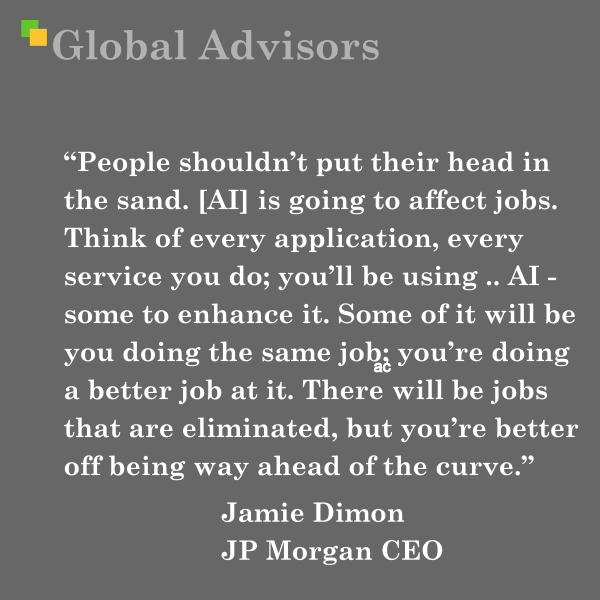
Quote: Jamie Dimon - JP Morgan Chase CEO“People shouldn’t put their head in the sand. [AI] is going to affect jobs. Think of every application, every service you do; you’ll be using .. AI - some to enhance it. Some of it will be you doing the same job; you’re doing a better job at it. There will be jobs that are eliminated, but you’re better off being way ahead of the curve.” - Jamie Dimon, CEO JP Morgan ChaseJamie Dimon delivered these observations on artificial intelligence during an interview with Bloomberg's Tom Mackenzie in London on 7 October 2025, where he discussed JPMorgan Chase's decade-long engagement with AI technology and its implications for the financial services sector. His comments reflect both the pragmatic assessment of a chief executive who has committed substantial resources to technological transformation and the broader perspective of someone who has navigated multiple economic cycles throughout his career. The Context of Dimon's StatementJPMorgan Chase has been investing in AI since 2012, well before the recent generative AI explosion captured public attention. The bank now employs 2,000 people dedicated to AI initiatives and spends $2 billion annually on these efforts. This investment has already generated approximately $2 billion in quantifiable benefits, with Dimon characterising this as merely "the tip of the iceberg." The technology permeates every aspect of the bank's operations—from risk management and fraud detection to marketing, idea generation and customer service. What makes Dimon's warning particularly salient is his acknowledgement that approximately 150,000 JPMorgan employees use the bank's suite of AI tools weekly. This isn't theoretical speculation about future disruption; it's an ongoing transformation within one of the world's largest financial institutions, with assets of $4.0 trillion. The bank's approach combines deployment across business functions with what Dimon describes as a cultural shift—managers and leaders are now expected to ask continuously: "What are you doing that we could do to serve your people? Why can't you do better? What is somebody else doing?" Dimon's perspective on job displacement is notably unsentimental whilst remaining constructive. He rejects the notion of ignoring AI's impact, arguing that every application and service will incorporate the technology. Some roles will be enhanced, allowing employees to perform better; others will be eliminated entirely. His solution centres on anticipatory adaptation rather than reactive crisis management—JPMorgan has established programmes for retraining and redeploying staff. For the bank itself, Dimon envisions more jobs overall if the institution succeeds, though certain functions will inevitably contract. His historical framing of technological disruption provides important context. Drawing parallels to the internet bubble, Dimon noted that whilst hundreds of companies worth billions collapsed, the period ultimately produced Facebook, YouTube and Google. He applies similar logic to current AI infrastructure spending, which is approaching $1 trillion annually across the sector. There will be "a lot of losers, a lot of winners," but the aggregate effect will prove productive for the economy. Jamie Dimon: A BiographyJamie Dimon has served as Chairman and Chief Executive Officer of JPMorgan Chase since 2006, presiding over its emergence as the leading US bank by domestic assets under management, market capitalisation and publicly traded stock value. Born on 13 March 1956, Dimon's ascent through American finance has been marked by both remarkable achievements and notable setbacks, culminating in a position where he is widely regarded as the dominant banking executive of his generation. Dimon earned his bachelor's degree from Tufts University in 1978 before completing an MBA at Harvard Business School in 1982. His career began with a brief stint as a management consultant at Boston Consulting Group, followed by his entry into American Express, where he worked under the mentorship of Sandy Weill—a relationship that would prove formative. At the age of 30, Dimon was appointed chief financial officer of Commercial Credit, later becoming the firm's president. This role placed him at the centre of an aggressive acquisition strategy that included purchasing Primerica Corporation in 1987 and The Travelers Corporation in 1993. From 1990 to 1998, Dimon served as Chief Operating Officer of both Travelers and Smith Barney, eventually becoming Co-Chairman and Co-CEO of the combined brokerage following the 1997 merger of Smith Barney and Salomon Brothers. When Travelers Group merged with Citicorp in 1998 to form Citigroup, Dimon was named president of the newly created financial services giant. However, his tenure proved short-lived; he departed later that year following a conflict with Weill over leadership succession. This professional setback led to what would become one of the defining chapters of Dimon's career. In 2000, he was appointed CEO of Bank One, a struggling institution that required substantial turnaround efforts. When JPMorgan Chase merged with Bank One in July 2004, Dimon became president and chief operating officer of the combined entity. He assumed the role of CEO on 1 January 2006, and one year later was named Chairman of the Board. Under Dimon's leadership, JPMorgan Chase navigated the 2008 financial crisis with relative success, earning him recognition as one of the few banking chiefs to emerge from the period with an enhanced reputation. As Duff McDonald wrote in his 2009 book "Last Man Standing: The Ascent of Jamie Dimon and JPMorgan Chase," whilst much of the crisis stemmed from "plain old avarice and bad judgment," Dimon and JPMorgan Chase "stood apart," embodying "the values of clarity, consistency, integrity, and courage". Not all has been smooth sailing. In May 2012, JPMorgan Chase reported losses of at least $2 billion from trades that Dimon characterised as "flawed, complex, poorly reviewed, poorly executed and poorly monitored"—an episode that became known as the "London Whale" incident and attracted investigations from the Federal Reserve, SEC and FBI. In May 2023, Dimon testified under oath in lawsuits accusing the bank of serving Jeffrey Epstein, the late sex offender who was a client between 1998 and 2013. Dimon's political evolution reflects a pragmatic centrism. Having donated more than $500,000 to Democratic candidates between 1989 and 2009 and maintained close ties to the Obama administration, he later distanced himself from strict partisan identification. "My heart is Democratic," he told CNBC in 2019, "but my brain is kind of Republican." He primarily identifies as a "capitalist" and a "patriot," and served on President Donald Trump's short-lived business advisory council before Trump disbanded it in 2017. Though he confirmed in 2016 that he would "love to be president," he deemed a campaign "too hard and too late" and ultimately decided against serious consideration of a 2020 run. In 2024, he endorsed Nikki Haley in the Republican primary before speaking more positively about Trump following Haley's defeat. As of May 2025, Forbes estimated Dimon's net worth at $2.5 billion. He serves on the boards of numerous organisations, including the Business Roundtable, Bank Policy Institute and Harvard Business School, whilst also sitting on the executive committee of the Business Council and the Partnership for New York City. Leading Theorists on AI and Labour DisplacementThe question of how artificial intelligence will reshape employment has occupied economists, technologists and social theorists for decades, producing a rich body of work that frames Dimon's observations within broader academic and policy debates. John Maynard Keynes introduced the concept of "technological unemployment" in his 1930 essay "Economic Possibilities for our Grandchildren," arguing that society was "being afflicted with a new disease" caused by "our discovery of means of economising the use of labour outrunning the pace at which we can find new uses for labour." Keynes predicted this would be a temporary phase, ultimately leading to widespread prosperity and reduced working hours. His framing established the foundation for understanding technological displacement as a transitional phenomenon requiring societal adaptation rather than permanent catastrophe. Joseph Schumpeter developed the theory of "creative destruction" in his 1942 work "Capitalism, Socialism and Democracy," arguing that innovation inherently involves the destruction of old economic structures alongside the creation of new ones. Schumpeter viewed this process as the essential fact about capitalism—not merely a side effect but the fundamental engine of economic progress. His work provides the theoretical justification for Dimon's observation about the internet bubble: widespread failure and waste can coexist with transformative innovation and aggregate productivity gains. Wassily Leontief, winner of the 1973 Nobel Prize in Economics, warned in 1983 that workers might follow the path of horses, which were displaced en masse by automobable and tractor technology in the early twentieth century. His input-output economic models attempted to trace how automation would ripple through interconnected sectors, suggesting that technological displacement might be more comprehensive than previous episodes. Leontief's scepticism about labour's ability to maintain bargaining power against capital in an automated economy presaged contemporary concerns about inequality and the distribution of AI's benefits. Erik Brynjolfsson and Andrew McAfee at MIT have produced influential work on digital transformation and employment. Their 2014 book "The Second Machine Age" argued that we are in the early stages of a transformation as profound as the Industrial Revolution, with digital technologies now able to perform cognitive tasks previously reserved for humans. They coined the term "skill-biased technological change" to describe how modern technologies favour workers with higher levels of education and adaptability, potentially exacerbating income inequality. Their subsequent work on "machine learning" and "AI and the modern productivity paradox" has explored why measured productivity gains have lagged behind apparent technological advances—a puzzle relevant to Dimon's observation that some AI benefits are difficult to quantify precisely. Daron Acemoglu at MIT has challenged technological determinism, arguing that the impact of AI on employment depends crucially on how the technology is designed and deployed. In his 2019 paper "Automation and New Tasks: How Technology Displaces and Reinstates Labor" (co-authored with Pascual Restrepo), Acemoglu distinguished between automation that merely replaces human labour and technologies that create new tasks and roles. He has advocated for "human-centric AI" that augments rather than replaces workers, and has warned that current tax structures and institutional frameworks may be biasing technological development towards excessive automation. His work directly addresses Dimon's categorisation of AI applications: some will enhance existing jobs, others will eliminate them, and the balance between these outcomes is not predetermined. Carl Benedikt Frey and Michael Osborne at Oxford produced a widely cited 2013 study estimating that 47 per cent of US jobs were at "high risk" of automation within two decades. Their methodology involved assessing the susceptibility of 702 occupations to computerisation based on nine key bottlenecks, including creative intelligence, social intelligence and perception and manipulation. Whilst their headline figure attracted criticism for potentially overstating the threat—since many jobs contain a mix of automatable and non-automatable tasks—their framework remains influential in assessing which roles face displacement pressure. Richard Freeman at Harvard has explored the institutional and policy responses required to manage technological transitions, arguing that the distribution of AI's benefits depends heavily on labour market institutions, educational systems and social policy choices. His work emphasises that historical episodes of technological transformation involved substantial political conflict and institutional adaptation, suggesting that managing AI's impact will require deliberate policy interventions rather than passive acceptance of market outcomes. Shoshana Zuboff at Harvard Business School has examined how digital technologies reshape not merely what work is done but how it is monitored, measured and controlled. Her concept of "surveillance capitalism" highlights how data extraction and algorithmic management may fundamentally alter the employment relationship, potentially creating new forms of workplace monitoring and performance pressure even for workers whose jobs are augmented rather than eliminated by AI. Klaus Schwab, founder of the World Economic Forum, has framed current technological change as the "Fourth Industrial Revolution," characterised by the fusion of technologies blurring lines between physical, digital and biological spheres. His 2016 book of the same name argues that the speed, scope and systems impact of this transformation distinguish it from previous industrial revolutions, requiring unprecedented coordination between governments, businesses and civil society. The academic consensus, insofar as one exists, suggests that AI will indeed transform employment substantially, but that the nature and distributional consequences of this transformation remain contested and dependent on institutional choices. Dimon's advice to avoid "putting your head in the sand" and to stay "way ahead of the curve" aligns with this literature's emphasis on anticipatory adaptation. His commitment to retraining and redeployment echoes the policy prescriptions of economists who argue that managing technological transitions requires active human capital investment rather than passive acceptance of labour market disruption. What distinguishes Dimon's perspective is his position as a practitioner implementing these technologies at scale within a major institution. Whilst theorists debate aggregate employment effects and optimal policy responses, Dimon confronts the granular realities of deployment: which specific functions can be augmented versus automated, how managers adapt their decision-making processes, what training programmes prove effective, and how to balance efficiency gains against workforce morale and capability retention. His assertion that JPMorgan has achieved approximately $2 billion in quantifiable benefits from $2 billion in annual AI spending—whilst acknowledging additional unquantifiable improvements—provides an empirical data point for theories about AI's productivity impact. The ten-year timeframe of JPMorgan's AI journey also matters. Dimon's observation that "people think it's a new thing" but that the bank has been pursuing AI since 2012 challenges narratives of sudden disruption, instead suggesting a more gradual but accelerating transformation. This accords with Brynjolfsson and McAfee's argument about the "productivity J-curve"—that the full economic benefits of transformative technologies often arrive with substantial lag as organisations learn to reconfigure processes and business models around new capabilities. Ultimately, Dimon's warning about job displacement, combined with his emphasis on staying ahead of the curve through retraining and redeployment, reflects a synthesis of Schumpeterian creative destruction, human capital theory, and practical experience managing technological change within a complex organisation. His perspective acknowledges both the inevitability of disruption and the possibility of managing transitions to benefit both institutions and workers—provided leadership acts proactively rather than reactively. For financial services professionals and business leaders more broadly, Dimon's message is clear: AI's impact on employment is neither hypothetical nor distant, but rather an ongoing transformation requiring immediate and sustained attention.
|
| |
| |
Quote: Jamie Dimon - JP Morgan Chase CEO“We have about $2 billion of [AI] benefit. Some we can detail...we reduced headcount, we saved time and money. But there is some you can’t; it’s just improved service and it’s almost worthless to ask what’s the NPV. But we know about $2 billion of actual cost savings. And I think it’s the tip of the iceberg. ” - Jamie Dimon, CEO JP MorganJamie Dimon's assertion that JPMorgan Chase has achieved "$2 billion of [AI] benefit" represents a landmark moment in corporate artificial intelligence adoption, delivered by one of the most influential figures in global banking. This statement, made during a Bloomberg interview in London on 7th October 2025, encapsulates both the tangible returns from strategic AI investment and the broader transformation reshaping the financial services industry. The Executive Behind the InnovationJamie Dimon stands as arguably the most prominent banking executive of his generation, having led JPMorgan Chase through nearly two decades of unprecedented growth and technological transformation. Born in 1956, Dimon's career trajectory reads like a masterclass in financial leadership, beginning with his early mentorship under Sandy Weill at American Express in 1982. His formative years were spent navigating the complex world of financial consolidation, serving as Chief Financial Officer and later President at Commercial Credit, before ascending through the ranks at Travelers Group and briefly serving as President of Citigroup in 1998. The defining moment of Dimon's career came in 2000 when he assumed leadership of the struggling Bank One, transforming it into a profitable institution that would merge with JPMorgan Chase in 2004. His appointment as CEO of JPMorgan Chase in 2006 marked the beginning of an era that would see the firm become America's largest bank by assets, with over $4 trillion under management. Under his stewardship, JPMorgan emerged from the 2008 financial crisis stronger than its competitors, earning Dimon recognition as one of Time magazine's most influential people on multiple occasions. Dimon's leadership philosophy centres on long-term value creation rather than short-term earnings management, a principle clearly evident in JPMorgan's substantial AI investments. His educational foundation—a bachelor's degree from Tufts University and an MBA from Harvard Business School—provided the analytical framework that has guided his strategic decision-making throughout his career. The Strategic Context of AI InvestmentJPMorgan's artificial intelligence journey, as Dimon revealed in his October 2025 interview, began in 2012—long before the current generative AI boom captured public attention. This early start positioned the bank advantageously when large language models and generative AI tools became commercially viable. The institution now employs 2,000 people dedicated to AI initiatives, with an annual investment of $2 billion, demonstrating the scale and seriousness of their commitment to technological transformation. The $2 billion in benefits Dimon describes represents a rare quantification of AI's return on investment at enterprise scale. His candid acknowledgment that "some we can detail... we reduced headcount, we saved time and money. But there is some you can't; it's just improved service and it's almost worthless to ask what's the NPV" reflects the dual nature of AI value creation—measurable efficiency gains alongside intangible service improvements that ultimately drive customer satisfaction and competitive advantage. The deployment spans multiple business functions including risk management, fraud detection, marketing, customer service, and idea generation. Particularly striking is Dimon's revelation that 150,000 employees weekly utilise internal AI tools for research, report summarisation, and contract analysis—indicating systematic integration rather than isolated pilot programmes. The Broader AI Investment LandscapeDimon's comments on the broader AI infrastructure spending—the trillion-dollar investments in chips, cloud computing, and AI model development—reveal his seasoned perspective on technological transformation cycles. Drawing parallels to the Internet bubble, he noted that whilst many companies worth billions ultimately failed, the infrastructure investments enabled the emergence of Facebook, YouTube, and Google. This historical context suggests that current AI spending, despite its magnitude, follows established patterns of technological disruption where substantial capital deployment precedes widespread value creation. His observation that "there will be some real big companies, real big success. It will work in spite of the fact that not everyone invested is going to have a great investment return" provides a pragmatic assessment of the AI investment frenzy. This perspective, informed by decades of witnessing technological cycles, lends credibility to his optimistic view that AI benefits represent merely "the tip of the iceberg." Leading Theorists and Foundational ConceptsThe theoretical foundations underlying JPMorgan's AI strategy and Dimon's perspective draw from several key areas of economic and technological theory that have shaped our understanding of innovation adoption and value creation. Clayton Christensen's theory of disruptive innovation provides crucial context for understanding JPMorgan's AI strategy. Christensen's framework distinguishes between sustaining innovations that improve existing products and disruptive innovations that create new market categories. JPMorgan's approach appears to embrace both dimensions—using AI to enhance traditional banking services whilst simultaneously creating new capabilities that could redefine financial services delivery. Joseph Schumpeter's concept of "creative destruction" offers another lens through which to view Dimon's frank acknowledgment that AI "is going to affect jobs." Schumpeter argued that technological progress inherently involves the destruction of old economic structures to create new ones. Dimon's emphasis on retraining and redeploying employees reflects an understanding of this dynamic, positioning JPMorgan to capture the benefits of technological advancement whilst managing its disruptive effects on employment. Michael Porter's competitive strategy theory illuminates the strategic logic behind JPMorgan's substantial AI investments. Porter's work on competitive advantage suggests that sustainable competitive positions arise from activities that are difficult for competitors to replicate. By building internal AI capabilities over more than a decade, JPMorgan has potentially created what Porter would term a "activity system"—a network of interconnected organisational capabilities that collectively provide competitive advantage. Erik Brynjolfsson and Andrew McAfee's research on digital transformation and productivity paradoxes provides additional theoretical grounding. Their work suggests that the full benefits of technological investments often emerge with significant time lags, as organisations learn to reorganise work processes around new capabilities. Dimon's observation that parts of AI value creation are "almost worthless to ask what's the NPV" aligns with their findings that transformational technologies create value through complex, interconnected improvements that resist simple measurement. Geoffrey Moore's "Crossing the Chasm" framework offers insights into JPMorgan's AI adoption strategy. Moore's model describes how technological innovations move from early adopters to mainstream markets. JPMorgan's systematic deployment across business units and its achievement of 150,000 weekly users suggests successful navigation of this transition—moving AI from experimental technology to operational infrastructure. Paul David's work on path dependence and technological lock-in provides context for understanding the strategic importance of JPMorgan's early AI investments. David's research suggests that early advantages in technological adoption can become self-reinforcing, creating competitive positions that persist over time. JPMorgan's 2012 start in AI development may have created such path-dependent advantages. Brian Arthur's theories of increasing returns and network effects add further depth to understanding JPMorgan's AI strategy. Arthur's work suggests that technologies exhibiting increasing returns—where value grows with adoption—can create winner-take-all dynamics. The network effects within JPMorgan's AI systems, where each application and user potentially increases system value, align with Arthur's theoretical framework. Economic and Strategic ImplicationsDimon's AI commentary occurs within a broader economic context characterised by elevated asset prices, low credit spreads, and continued consumer strength, as he noted in the Bloomberg interview. His cautious optimism about economic conditions, combined with his bullish view on AI benefits, suggests a nuanced understanding of how technological investment can provide competitive insulation during economic uncertainty. The timing of Dimon's remarks—amid ongoing debates about AI regulation, job displacement, and technological sovereignty—positions JPMorgan as a thought leader in practical AI implementation. His emphasis on "rules and regulations" around data usage and deployment safety reflects awareness of the regulatory environment that will shape AI adoption across financial services. His comparison of current AI spending to historical technology booms provides valuable perspective on the sustainability of current investment levels. The acknowledgment that "not everyone invested is going to have a great investment return" whilst maintaining optimism about overall technological progress reflects the sophisticated risk assessment capabilities that have characterised Dimon's leadership approach. The broader implications of JPMorgan's AI success extend beyond individual firm performance to questions of competitive dynamics within financial services, the future of employment in knowledge work, and the role of large institutions in technological advancement. Dimon's frank discussion of job displacement, combined with JPMorgan's commitment to retraining, offers a model for how large organisations might navigate the social implications of technological transformation. The quote thus represents not merely a financial milestone but a crystallisation of strategic thinking about artificial intelligence's role in institutional transformation—delivered by an executive whose career has been defined by successfully navigating technological and economic disruption whilst building enduring competitive advantage.
|
| |

| |
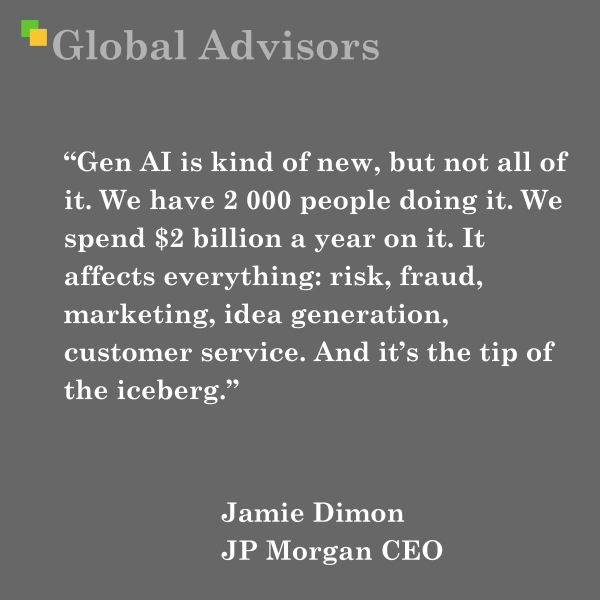
Quote: Jamie Dimon - JP Morgan Chase CEO“Gen AI is kind of new, but not all of it. We have 2 000 people doing it. We spend $2 billion a year on it. It affects everything: risk, fraud, marketing, idea generation, customer service. And it’s the tip of the iceberg.” - Jamie Dimon - JP Morgan Chase CEOThis comment reflects the culmination of over a decade of accelerated investment and hands-on integration of machine learning and intelligent automation within the bank. JPMorgan Chase has been consistently ahead of its peers: by institutionalising AI and harnessing both mature machine learning systems and the latest generative AI models, the bank directs efforts not only towards operational efficiency, but also towards deeper transformation in client service and risk management. With an annual spend of $2 billion and a dedicated workforce of more than 2,000 AI professionals, JPMorgan Chase’s implementation spans from fraud detection and risk modelling through to marketing, client insight, coding automation, and contract analytics—with generative AI driving new horizons in these areas. Dimon’s “tip of the iceberg” metaphor underscores a strategic recognition that, despite substantial results to date, the majority of possibilities and business impacts from AI adoption—particularly generative AI—lie ahead, both for JPMorgan Chase and the wider global banking sector. About Jamie DimonJamie Dimon is one of the most influential global banking leaders of his generation. Born in Queens, New York, into a family with deep Wall Street roots, he earned a Bachelor’s degree from Tufts University followed by an MBA from Harvard Business School. His early professional years were shaped under Sanford I. Weill at American Express, where Dimon soon became a trusted lieutenant. Rising through the ranks, Dimon played strategic roles at Commercial Credit, Primerica, Travelers, Smith Barney, and Citigroup, pioneering some of the largest and most consequential mergers on Wall Street through the 1990s. Dimon’s leadership style—marked by operational discipline and strategic vision—framed his turnaround of Bank One as CEO in 2000, before orchestrating Bank One's transformative merger with JPMorgan Chase in 2004. He has led JPMorgan Chase as CEO and Chairman since 2006, overseeing the company’s expansion to $4 trillion in assets and positioning it as a recognised leader in investment banking, commercial banking, and financial innovation. Through the global financial crisis, Dimon was noted for prudent risk management and outspoken industry leadership. He sits on multiple influential boards and business councils, and remains a voice for free market capitalism and responsible corporate governance, with periodic speculation about his potential political aspirations. Theorists and Pioneers in Generative AIDimon’s remarks rest on decades of foundational research and development in AI from theory to practice. Key figures responsible for the rapid evolution and commercialisation of generative AI include:
These theorists' work ensures that generative AI is not a passing trend, but the result of methodical advances in algorithmic intelligence—now entering practical, transformative use cases across the banking and professional services landscape. The strategic embrace by large corporates, as described by Jamie Dimon, thus marks a logical next step in the commercial maturity of AI technologies. Summary:
|
| |
| |
Quote: Dr. Jane Goodall- Environmental activist“In the place where I am now, I look back over my life... What message do I want to leave? I want to make sure that you all understand that each and every one of you has a role to play. You may not know it, you may not find it, but your life matters, and you are here for a reason.” - Dr. Jane Goodall - Environmental activistDr Jane Goodall’s final published words reflect not only a lifetime of scientific pioneering and passionate environmentalism but also a worldview grounded in the intrinsic significance of every individual and the power of hope to catalyse meaningful change. Her message, left as a legacy, underscores that each person—regardless of circumstance—has a unique, essential role to play on Earth, even if that role is not always immediately apparent. She urges recognition of our interconnectedness with nature and calls for resilience and conscious action, particularly in a time of global ecological uncertainty. Context of the Quote This message stems from Dr Goodall’s unique vantage point following a long, globally influential life. She addresses not only the scientific community but citizens broadly, emphasising that daily choices and individual agency accumulate to drive change. The reflection is both a personal summation and a universal exhortation—drawing on decades spent witnessing the impact of individual and collective action, whether through habitat protection, compassionate choices, or environmental advocacy. Her words encapsulate a persistent theme from her life’s work: hope is not passive, but an active discipline that demands our participation. Dr Jane Goodall: Backstory and Influence Jane Goodall (1934–2025) began her career without formal training, yet revolutionised primatology—most notably through her extended fieldwork at Gombe Stream National Park, Tanzania, beginning in 1960. By meticulously documenting chimpanzee behaviours—tool use, social structures, and emotional expressions—she dismantled long-held assumptions surrounding the human-animal divide. Her findings compelled the scientific world to re-evaluate the concept of animal minds, emotions, and even culture. Goodall’s methodological hallmark was the fusion of empathy and rigorous observation, often eschewing traditional scientific detachment in favour of fostering understanding and connection. This approach not only advanced natural science, but also set the stage for her lifelong advocacy. Her research evolved into a commitment to conservation, culminating in the founding of the Jane Goodall Institute in 1977, and later, Roots & Shoots in 1991—a global youth movement empowering the next generations to enact practical, local initiatives for the environment and society. As a tireless speaker and advisor, Goodall travelled globally, addressing world leaders and grassroots communities alike, continually reinforcing the power and responsibility of individuals in safeguarding the planet. Her activism grew ever more encompassing: she advocated for animal welfare, ethical diets, and systemic change in conservation policy, always championing “those who cannot speak for themselves”. Her campaigns spanned from ending unethical animal research practices to encouraging tree-planting initiatives across continents. Related Theorists and Intellectual Foundations The substance of Goodall’s quote—regarding the existential role and agency of each person—resonates with leading figures in several overlapping fields:
Legacy and Enduring Impact Jane Goodall’s final words distil her life’s central insight: significance is not reserved for the prominent or powerful, but is inherent in every lived experience. The challenge she poses—to recognise, enact, and never relinquish our capacity to make a difference—is rooted in decades of observational science, a global environmental crusade, and a fundamental hopefulness about humanity’s potential to safeguard and restore the planet. This ethos is as relevant to individuals seeking purpose as it is to leaders shaping the future of conservation science and policy. |
| |
| |
Quote: Dr Martin Luther King Jr. - American Baptist minister“Darkness cannot drive out darkness: only light can do that. Hate cannot drive out hate: only love can do that.” - Dr Martin Luther King Jr. - American Baptist ministerThis line, included in A Testament of Hope: The Essential Writings and Speeches of Martin Luther King, Jr., is not only emblematic of King’s message but also of his lived philosophy—one deeply rooted in Christian ethics and the practice of nonviolence. Martin Luther King, Jr. (1929–1968) was an American Baptist minister and activist who became the most visible spokesman for the nonviolent civil rights movement from the mid-1950s until his assassination in 1968. King drew extensively from Gospel teachings, particularly the Sermon on the Mount, and from earlier theorists of nonviolent resistance, notably Mohandas Gandhi. He argued that true social transformation could only be achieved through love and reconciliation, not retaliation or hatred. The Testament of Hope anthology, compiled by James Melvin Washington at the request of Coretta Scott King, brings together King’s seminal essays, iconic speeches, sermons, and interviews—showing the evolution of his thought in response to the escalating struggles of the American civil rights movement. This specific quote reflects King’s insistence on moral consistency: that the means must be as righteous as the ends. It was delivered against the backdrop of violent backlash against civil rights progress, racial segregation, and systemic injustice in the United States. King’s philosophy sought not merely to win legal rights for African Americans, but to do so in a way that would heal society and affirm the dignity of all individuals. The quote serves as a concise manifesto for constructive, rather than destructive, social change—urging individuals and movements to transcend cycles of resentment and to build a community rooted in justice and mutual respect. Context: Leading Theories and TheoristsGandhi and the Power of Satyagraha Christian Ethics and the Social Gospel Thoreau and Civil Disobedience Pacifism and Social Democracy Insights for Contemporary ConsiderationKing’s assertion that love and light—not their opposites—are the true agents of change remains pertinent. In an era marked by polarisation, the temptation to meet hostility with hostility is ever-present. King’s legacy, however, suggests that sustainable progress is built not on animosity but on courageous empathy, principled nonviolence, and a steadfast commitment to the common good. His writings compiled in A Testament of Hope continue to challenge us to consider not just what we seek to achieve, but how we pursue it—reminding us that the character of our methods shapes the quality of our outcomes.
|
| |

| |
Quote: Jane Goodall- Environmental activist“The greatest danger to our future is apathy.” - Jane Goodall- Environmental activistJane Goodall delivered this insight in the context of decades spent on the front lines of scientific research and environmental advocacy, witnessing the delicate balance between hope and despair in combating environmental crises. The quote reflects a central tenet of Goodall’s philosophy: that the single greatest threat to human and ecological wellbeing is not malice or ignorance, but the widespread absence of concern and action—apathy. This perspective was distilled from her experiences observing both the destructive potential of human indifference and the transformative impact of individual engagement at every level of society. For Goodall, apathy signified a turning away from the responsibility each person bears to confront environmental and social challenges, thereby imperilling prospects for sustainability, justice, and collective flourishing. Profile: Jane Goodall Dame Jane Goodall (1934–2025) was one of the most influential primatologists, conservationists, and environmental activists of the twentieth and twenty-first centuries. Without formal scientific training, Goodall began her career in 1960 as a protégé of anthropologist Louis Leakey, embarking on fieldwork at Gombe Stream National Park in Tanzania. Her discovery that chimpanzees use tools—then considered a uniquely human trait—fundamentally reshaped the scientific understanding of the boundary between humans and other animals. Goodall’s approach, combining empathetic observation with methodical research, forced a reconsideration of animal sentience, intelligence, and culture. She chronicled not only the nurturing bonds but also the complex, sometimes violent, social lives of chimpanzees, upending previous assumptions about their nature and adding profound ethical dimensions to the study of animals. Beyond science, Goodall’s life work was propelled by activism: she founded the Jane Goodall Institute in 1977 to foster community-centred conservation and established Roots & Shoots in 1991, creating a youth movement active in over one hundred countries. Her advocacy extended from forest communities in Tanzania to global forums, urging political leaders and young people alike to resist resignation and take up stewardship of the planet. Goodall remained unwavering in her belief that hope is not passive optimism but a discipline requiring steady, collective effort and moral courage. The message embodied in the quote is echoed throughout her legacy: indifference is a luxury the future cannot bear, and meaningful change depends on the active involvement of ordinary people. Leading Theorists and Thought-Leaders in the Field The danger of apathy as a barrier to social and environmental progress has been examined by leading figures across disciplines:
Contextual Summary Jane Goodall’s quote stands within a tradition of environmental and ethical thought that identifies apathy not only as a personal failing, but as a systemic obstacle with existential implications. Her legacy, and that of her intellectual predecessors and contemporaries, attests to the enduring call for engagement, responsibility, and active hope in shaping a liveable future.
|
| |

| |
Quote: James Clear - Atomic Habits“You do not rise to the level of your goals, you fall to the level of your systems.” - James Clear - Atomic Habitslasting success emerges not from setting ambitious goals, but from designing robust systems that shape daily behaviours. This approach transforms “goal-setting” from a matter of aspiration to one of sustainable execution. The Quote: Context & MeaningThis quote appears in Atomic Habits (2018), Clear’s widely influential book on behaviour change and personal development. In the book, Clear argues that while goals are useful for providing direction, they are not sufficient to drive results. Instead, he suggests that the systems—the routines, processes, and environments that shape behaviour—are what ultimately determine outcomes. Clear’s key insight is that:
He illustrates this with practical examples, such as habit loops (cue, craving, response, reward) and the "1% better every day" philosophy, emphasising that meaningful change results from continuous, small improvements, not heroic isolated efforts. James Clear: BackstoryJames Clear is an American author, entrepreneur, and advocate for evidence-based self-improvement. With a background in biomechanics and years spent researching psychology and behavioural science, Clear built a career distilling complex academic insights into actionable strategies for individuals and organisations. Key facts:
Clear’s work is valued for its blend of scientific credibility and pragmatic applicability, appealing both to high-performers in business and sports and individuals seeking personal growth. Leading Theorists: Development of the FieldJames Clear’s approach builds on and synthesises decades of behavioural and psychological research:
Each theorist has contributed frameworks that reinforce Clear’s central thesis: lasting, repeatable change depends less on what people aspire to, and more on how they build and manage their systems. Application & Implications
Adopting Clear’s principle encourages a shift from superficial goal-setting to building the underlying architecture for sustainable excellence. In sum: The quote encapsulates a paradigm in behavioural science—systematic small improvements, compounded over time, eclipse even the most ambitious goals . This realisation continues to influence leaders, coaches, and strategists globally.
|
| |

| |
Quote: George W. Bush - Former USA President“Too often we judge other groups by their worst examples, while judging ourselves by our best intentions.” - George W. Bush - Former USA PresidentContext of the Quote George W. Bush delivered this insight during a speech in Dallas in July 2016, a period marked by heightened social tension and polarisation in the United States. The address came days after the fatal shooting of five police officers at a protest, itself a reaction to controversial police actions. Seeking to foster unity, Bush acknowledged America’s tendency towards group bias and emphasised the need for empathy and shared commitment to democratic ideals. His observation draws attention to a universal cognitive and social phenomenon: ingroup/outgroup bias. When confronted with behaviours or actions from those outside our immediate social or cultural group, we are prone to interpret those actions through a lens of suspicion and selective memory, spotlighting their most negative examples. Conversely, when assessing ourselves or those we identify with, we prefer generous interpretations, focusing on intentions rather than shortcomings. Bush’s wider message underscored the importance of humility, perspective-taking, and the recommitment to values that transcend background or ideology. Profile: George W. Bush Serving as the 43rd President of the United States from 2001 to 2009, George W. Bush led through a tumultuous era defined by the September 11 attacks, wars in Afghanistan and Iraq, and significant domestic debate. Known for his plainspoken style, Bush’s post-presidential efforts have often revolved around advocacy for veterans, public service, and fostering civil discourse. Bush’s later public statements—such as the one quoted—reflect a reflective approach to leadership, consistently urging Americans to recognise shared values rather than be divided by fear, prejudice, or misunderstanding. His comments on our tendency to judge others harshly, while pardoning ourselves, reveal an awareness of the psychological barriers that undermine social cohesion. Theoretical Underpinnings: Ingroup/Outgroup Bias and Attribution Theory Bush’s observation is grounded in a longstanding body of social scientific research. Several leading theorists have dissected the mechanisms underlying the very human tendencies he describes:
Practical Relevance and Enduring Significance Bush’s statement sits at the intersection of leadership, societal cohesion, and cognitive psychology. It resonates in organisational contexts, policy development, and everyday interpersonal relations, offering a reminder of the pitfalls of selective empathy. The theorists cited above provide the academic scaffolding for these insights, underscoring that while group divisions are deeply embedded, they are not immutable; awareness, shared objectives, and deliberate effort can bridge divides. Promoting an understanding of these biases is critical for any leader or organisation working to build trust, foster diversity, or drive collective progress.
|
| |

| |
|


| |
| |