| |
|

| |
| |
| |
|
A daily bite-size selection of top business content. |
| |
| |
| |
Quote: Alex Karp - Palantir CEO“The idea that chips and ontology is what you want to short is batsh*t crazy.” - Alex Karp -Palantir CEOAlex Karp, co-founder and CEO of Palantir Technologies, delivered the now widely-circulated statement, “The idea that chips and ontology is what you want to short is batsh*t crazy,” in response to famed investor Michael Burry’s high-profile short positions against both Palantir and Nvidia. This sharp retort came at a time when Palantir, an enterprise software and artificial intelligence (AI) powerhouse, had just reported record earnings and was under intense media scrutiny for its meteoric stock rise and valuation. Context of the Quote The remark was made in early November 2025 during a CNBC interview, following public disclosures that Michael Burry—of “The Big Short” fame—had taken massive short positions in Palantir and Nvidia, two companies at the heart of the AI revolution. Burry’s move, reminiscent of his contrarian bets during the 2008 financial crisis, was interpreted by the market as both a challenge to the soaring “AI trade” and a critique of the underlying economics fueling the sector’s explosive growth. Karp’s frustration was palpable: not only was Palantir producing what he described as "anomalous" financial results—outpacing virtually all competitors in growth, cash flow, and customer retention—but it was also emerging as the backbone of data-driven operations across government and industry. For Karp, Burry’s short bet went beyond traditional market scepticism; it targeted firms, products (“chips” and “ontology”—the foundational hardware for AI and the architecture for structuring knowledge), and business models proven to be both technically indispensable and commercially robust. Karp’s rejection of the “short chips and ontology” thesis underscores his belief in the enduring centrality of the technologies underpinning the modern AI stack. Backstory and Profile: Alex Karp Alex Karp stands out as one of Silicon Valley’s true iconoclasts:
Theoretical Background: ‘Chips’ and ‘Ontology’ Karp’s phrase pairs two of the foundational concepts in modern AI and data-driven enterprise:
Leading theorists in the domain of ontology and AI include:
In the chip space, the pioneering work of:
Insightful Context for the Modern Market Debate The “chips and ontology” remark reflects a deep divide in contemporary technology investing:
With Palantir and Nvidia at the centre of the current AI-driven transformation, Karp’s comment captures not just a rebuttal to market short-termism, but a broader endorsement of the foundational technologies that define the coming decade. The value of “chips and ontology” is, in Karp’s eyes, anchored not in market narrative but in empirical results and business necessity—a perspective rooted in a unique synthesis of philosophy, technology, and radical pragmatism.
|
| |
| |
Quote: David Solomon - Goldman Sachs CEO“Generally speaking people hate change. It’s human nature. But change is super important. It’s inevitable. In fact, on my desk in my office I have a little plaque that says 'Change or die.' As a business leader, one of the perspectives you have to have is that you’ve got to constantly evolve and change.” - David Solomon - Goldman Sachs CEOThe quoted insight comes from David M. Solomon, Chief Executive Officer and Chairman of Goldman Sachs, a role he has held since 2018. It was delivered during a high-profile interview at The Economic Club of Washington, D.C., 30 October 2025, as Solomon reflected on the necessity of adaptability both personally and as a leader within a globally significant financial institution. “We have very smart people, and we can put these [AI] tools in their hands to make them more productive... By using AI to reimagine processes, we can create operating efficiencies that give us a scaled opportunity to reinvest in growth.” - David Solomon - Goldman Sachs CEODavid Solomon, Chairman and CEO of Goldman Sachs, delivered the quoted remarks during an interview at the HKMA Global Financial Leaders’ Investment Summit on 4 November 2025, articulating Goldman’s strategic approach to integrating artificial intelligence across its global franchise. His comments reflect both personal experience and institutional direction: leveraging new technology to drive productivity, reimagine workflows, and reinvest operational gains in sustainable growth, rather than pursuing simplistic headcount reductions or technological novelty for its own sake. Backstory and Context of the QuoteDavid Solomon’s statement arises from Goldman Sachs' current transformation—“Goldman Sachs 3.0”—centred on AI-driven process re-engineering. Rather than employing AI simply as a cost-cutting device, Solomon underscores its strategic role as an enabler for “very smart people” to magnify their productivity and impact. This perspective draws on his forty-year career in finance, where successive waves of technological disruption (from Lotus 1-2-3 spreadsheets to cloud computing) have consistently shifted how talent is leveraged, but have not diminished its central value. The immediate business context is one of intense change: regulatory uncertainty in cross-border transactions, rebounding capital flows into China post-geopolitical tension, and a high backlog of M&A activity, particularly for large-cap US transactions. In this environment, efficiency gains from AI allow frontline teams to refocus on advisory, origination, and growth while adjusting operational models at a rapid pace. Solomon’s leadership style—pragmatic, unsentimental, and data-driven—favours process optimisation, open collaboration, and the breakdown of legacy silos. About David SolomonBackground:
Leadership and Culture:
Institutional Impact:
Leading Theorists and Intellectual Lineage of AI-Driven Productivity in BusinessSolomon’s vision is shaped and echoed by several foundational theorists in economics, management science, and artificial intelligence: 1. Clayton Christensen
2. Erik Brynjolfsson & Andrew McAfee
3. Michael Porter
4. Herbert Simon
5. Geoffrey Hinton, Yann LeCun, Yoshua Bengio
Synthesis and Strategic ImplicationsSolomon’s quote epitomises the intersection of pragmatic executive leadership and theoretical insight. His advocacy for AI-integrated productivity reinforces a management consensus: sustainable competitive advantage hinges not just on technology, but on empowering skilled individuals to unlock new modes of value creation. This approach is echoed by leading researchers who situate automation as a catalyst for role evolution, scalable efficiency, and the ability to redeploy resources into higher-value growth opportunities. Goldman Sachs’ specific AI play is therefore neither a defensive move against headcount nor a speculative technological bet, but a calculated strategy rooted in both practical business history and contemporary academic theory—a paradigm for how large organisations can adapt, thrive, and lead in the face of continual disruption.
|
| |
| |
Quote: Satya Nadella - Microsoft CEO“At scale, nothing is a commodity. We have to have our cost structure, supply-chain efficiency, and software efficiencies continue to compound to ensure margins. Scale - and one of the things I love about the OpenAI partnership - is it’s gotten us to scale. This is a scale game.” - Satya Nadella - Microsoft CEOSatya Nadella has been at the helm of Microsoft since 2014, overseeing its transformation into one of the world’s most valuable technology companies. Born in Hyderabad, India, and educated in electrical engineering and computer science, Nadella joined Microsoft in 1992, quickly rising through the ranks in technical and business leadership roles. Prior to becoming CEO, he was best known for driving the rapid growth of Microsoft Azure, the company’s cloud infrastructure platform—a business now central to Microsoft’s global strategy. Nadella’s leadership style is marked by systemic change—he has shifted Microsoft away from legacy, siloed software businesses and repositioned it as a cloud-first, AI-driven, and highly collaborative tech company. He is recognised for his ability to anticipate secular shifts—most notably, the move to hyperscale cloud computing and, more recently, the integration of advanced AI into core products such as GitHub Copilot and Microsoft 365 Copilot. His background—combining deep technical expertise with rigorous business training (MBA, University of Chicago)—enables him to bridge both the strategic and operational dimensions of global technology. This quote was delivered in the context of Nadella’s public discussion on the scale economics of AI, hyperscale cloud, and the transformative partnership between Microsoft and OpenAI (the company behind ChatGPT, Sora, and GPT-4/5/6) on the BG2 podcast, 1st November 2025 In this conversation, Nadella outlines why, at the extreme end of global tech infrastructure, nothing remains a “commodity”: system costs, supply chain and manufacturing agility, and relentless software optimisation all become decisive sources of competitive advantage. He argues that scale—meaning not just size, but the compounding organisational learning and cost improvement unlocked by operating at frontier levels—determines who captures sustainable margins and market leadership. The OpenAI partnership is, from Nadella’s perspective, a practical illustration of this thesis. By integrating OpenAI’s frontier models deeply (and at exclusive scale) within Azure, Microsoft has driven exponential increases in compute utilisation, data flows, and the learning rate of its software infrastructure. This allowed Microsoft to amortise fixed investments, rapidly reduce unit costs, and create a loop of innovation not accessible to smaller or less integrated competitors. In Nadella’s framing, scale is not a static achievement, but a perpetual game—one where the winners are those who compound advantages across the entire stack: from chip supply chains through to application software and business model design. Theoretical Foundations and Key ThinkersThe quote’s themes intersect with multiple domains: economics of platforms, organisational learning, network effects, and innovation theory. Key theoretical underpinnings and thinkers include: Scale Economics and Competitive Advantage
Network Effects and Platform Strategy
Learning Curves and Experience Effects
Supply Chain and Operations
Economics of Cloud and AI
Why This Matters NowOrganisations at the digital frontier—notably Microsoft and OpenAI—are now locked in a scale game that is reshaping both industry structure and the global economy. The cost, complexity, and learning rate needed to operate at hyperscale mean that “commodities” (compute, storage, even software itself) cease to be generic. Instead, they become deeply differentiated by embedded knowledge, utilisation efficiency, supply-chain integration, and the ability to orchestrate investments across cycles of innovation. Nadella’s observation underscores a reality that now applies well beyond technology: the compounding of competitive advantage at scale has become the critical determinant of sector leadership and value capture. This logic is transforming industries as diverse as finance, logistics, pharmaceuticals, and manufacturing—where the ability to build, learn, and optimise at scale fundamentally redefines what was once considered “commodity” business. In summary: Satya Nadella’s words reflect not only Microsoft’s strategy but a broader economic and technological transformation, deeply rooted in the theory and practice of scale, network effects, and organisational learning. Theorists and practitioners—from Chandler and BCG to Christensen and Varian—have analysed these effects for decades, but the age of AI and cloud has made their insights more decisive than ever. At the heart of it: scale—properly understood and operationalised—remains the ultimate competitive lever.
|
| |

| |
Quote: David Solomon - Goldman Sachs CEO“Generally speaking people hate change. It’s human nature. But change is super important. It’s inevitable. In fact, on my desk in my office I have a little plaque that says 'Change or die.' As a business leader, one of the perspectives you have to have is that you’ve got to constantly evolve and change.” - David Solomon - Goldman Sachs CEOThe quoted insight comes from David M. Solomon, Chief Executive Officer and Chairman of Goldman Sachs, a role he has held since 2018. It was delivered during a high-profile interview at The Economic Club of Washington, D.C., 30 October 2025, as Solomon reflected on the necessity of adaptability both personally and as a leader within a globally significant financial institution. His statement is emblematic of the strategic philosophy that has defined Solomon’s executive tenure. He uses the ‘Change or die’ principle to highlight the existential imperative for renewal in business, particularly in the context of technological transformation, competitive dynamics, and economic disruption. Solomon’s leadership at Goldman Sachs has been characterised by deliberate modernisation. He has overseen the integration of advanced technology, notably in artificial intelligence and fintech, implemented culture and process reforms, adapted workforce practices, and expanded strategic initiatives in sustainable finance. His approach blends operational rigour with entrepreneurial responsiveness – a mindset shaped both by his formative years in high-yield credit markets at Drexel Burnham and Bear Stearns, and by his rise through leadership roles at Goldman Sachs. His remark on change was prompted by questions of business resilience and the need for constant adaptation amidst macroeconomic uncertainty, regulatory flux, and the competitive imperatives of Wall Street. For Solomon, resisting change is an instinct, but enabling it is a necessity for long-term health and relevance — especially for institutions in rapidly converging markets. About David M. Solomon
Theoretical Backstory: Leading Thinkers on Change and Organisational Adaptation Solomon’s philosophy echoes decades of foundational theory in business strategy and organisational behaviour: Charles Darwin (1809–1882) Peter Drucker (1909–2005) John Kotter (b. 1947) Clayton Christensen (1952-2020) Rosabeth Moss Kanter Integration: The Leadership Challenge Solomon’s ethos channels these frameworks into practical executive guidance. For business leaders, particularly in financial services and Fortune 500 firms, the lesson is clear: inertia is lethal; organisational health depends on reimagining processes, culture, and client engagement for tomorrow’s challenges. The psychological aversion to change must be managed actively at all levels — from the boardroom to the front line. In summary, the context of Solomon’s quote reflects not only a personal credo but also the consensus of generations of theoretical and practical leadership: only those prepared to “change or die” can expect to thrive and endure in an era defined by speed, disruption, and relentless unpredictability.
|
| |

| |
Quote: Andrej Karpathy - Ex-OpenAI, Ex-Tesla AI“[With AI] we're not building animals. We're building ghosts or spirits.” - Andrej Karpathy - Ex-OpenAI, Ex-Tesla AIAndrej Karpathy, renowned for his leadership roles at OpenAI and Tesla’s Autopilot programme, has been at the centre of advances in deep learning, neural networks, and applied artificial intelligence. His work traverses both academic research and industrial deployment, granting him a panoramic perspective on the state and direction of AI. When Karpathy refers to building “ghosts or spirits,” he is drawing a conceptual line between biological intelligence—the product of millions of years of evolution—and artificial intelligence as developed through data-driven, digital systems. In his view, animals are “baked in” with instincts, embodiment, and innate learning capacities shaped by evolution, a process unfolding over geological timeframes. By contrast, today’s AI models are “ghosts” in the sense that they are ethereal, fully digital artefacts, trained to imitate human-generated data rather than to evolve or learn through direct interaction with the physical world. They lack bodily instincts and the evolutionary substrate that endows animals with survival strategies and adaptation mechanisms. Karpathy describes the pre-training process that underpins large language models as a form of “crappy evolution”—a shortcut that builds digital entities by absorbing the statistical patterns of internet-scale data without the iterative adaptation of embodied beings. Consequently, these models are not “born” into the world like animals with built-in survival machinery; instead, they are bootstrapped as “ghosts,” imitating but not experiencing life. The Cognitive Core—Karpathy’s Vision for AI IntelligenceKarpathy’s thinking has advanced towards the critical notion of the “cognitive core”: the kernel of intelligence responsible for reasoning, abstraction, and problem-solving, abstracted away from encyclopaedic factual knowledge. He argues that the true magic of intelligence is not in the passive recall of data, but in the flexible, generalisable ability to manipulate ideas, solve problems, and intuit patterns—capabilities that a system exhibits even when deprived of pre-programmed facts or exhaustive memory. He warns against confusing memorisation (the stockpiling of internet facts within a model) with general intelligence, which arises from this cognitive core. The most promising path, in his view, is to isolate and refine this core, stripping away the accretions of memorised data, thereby developing something akin to a “ghost” of reasoning and abstraction rather than an “animal” shaped by instinct and inheritance. This approach entails significant trade-offs: a cognitive core lacks the encyclopaedic reach of today’s massive models, but gains in adaptability, transparency, and the capacity for compositional, creative thought. By foregrounding reasoning machinery, Karpathy posits that AI can begin to mirror not the inflexibility of animals, but the open-ended, reflective qualities that characterise high-level problem-solving. Karpathy’s Journey and InfluenceKarpathy’s influence is rooted in a career spent on the frontier of AI research and deployment. His early proximity to Geoffrey Hinton at the University of Toronto placed him at the launch-point of the convolutional neural networks revolution, which fundamentally reshaped computer vision and pattern recognition. At OpenAI, Karpathy contributed to an early focus on training agents to master digital environments (such as Atari games), a direction in retrospect he now considers premature. He found greater promise in systems that could interact with the digital world through knowledge work—precursors to today’s agentic models—a vision he is now helping to realise through ongoing work in educational technology and AI deployment. Later, at Tesla, he directed the transformation of autonomous vehicles from demonstration to product, gaining hard-won appreciation for the “march of nines”—the reality that progressing from system prototypes that work 90% of the time to those that work 99.999% of the time requires exponentially more effort. This experience informs his scepticism towards aggressive timelines for “AGI” and his insistence on the qualitative differences between robust system deployment and controlled demonstrations. The Leading Theorists Shaping the DebateKarpathy’s conceptual framework emerges amid vibrant discourse within the AI community, shaped by several seminal thinkers: Sutton’s “bitter lesson” posits that scale and generic algorithms, rather than domain-specific tricks, ultimately win—suggesting a focus on evolving animal-like intelligence. Karpathy, however, notes that current development practices, with their reliance on dataset imitation, sidestep the deep embodiment and evolutionary learning that define animal cognition. Instead, AI today creates digital ghosts—entities whose minds are not grounded in physical reality, but in the manifold of internet text and data. Hinton and LeCun supply the neural and architectural foundations—the “cortex” and reasoning traces—while both Karpathy and their critics note the absence of rich, consolidated memory (the hippocampus analogue), instincts (amygdala), and the capacity for continual, self-motivated world interaction. Why “Ghosts,” Not “Animals”?The distinction is not simply philosophical. It carries direct consequences for:
This lens sharpens expectations: the way forward is not to mimic biology in its totality, but to pursue the unique strengths and affordances of a digital, disembodied intelligence—a spirit of the datasphere, not a beast evolved in the forest. Broader SignificanceKarpathy’s “ghosts” metaphor crystallises a critical moment in the evolution of AI as a discipline. It signals a turning point: the shift from brute-force memorisation of the internet to intelligent, creative algorithms capable of abstraction, reasoning, and adaptation. This reframing is shaping not only the strategic priorities of the most advanced labs, but also the philosophical and practical questions underpinning the next decade of AI research and deployment. As AI becomes increasingly present in society, understanding its nature—not as an artificial animal, but as a digital ghost—will be essential to harnessing its strengths and mitigating its limitations.
|
| |
| |
Quote: Sholto Douglas - Anthropic“People have said we’re hitting a plateau every month for three years... I look at how models are produced and every part could be improved. The training pipeline is primitive, held together by duct tape, best efforts, and late nights. There’s so much room to grow everywhere.” - Sholto Douglas - AnthropicSholto Douglas made the statement during a major public podcast interview in October 2025, coinciding with Anthropic’s release of Claude Sonnet 4.5—at the time, the world’s strongest and most “agentic” AI coding model. The comment specifically rebuts repeated industry and media assertions that large AI models have reached a ceiling or are slowing in progress. Douglas argues the opposite: that the field is in a phase of accelerating advancement, driven both by transformative hardware investment (“compute super-cycle”), new algorithmic techniques (particularly reinforcement learning and test-time compute), and the persistent “primitive” state of today’s AI engineering infrastructure. He draws an analogy with early-stage, improvisational systems: the models are held together “by duct tape, best efforts, and late nights,” making clear that immense headroom for improvement remains at every level, from training data pipelines and distributed infrastructure to model architecture and reward design. As a result, every new benchmark and capability reveals further unrealised opportunity, with measurable progress charted month after month. Douglas’s deeper implication is that claims of a plateau often arise from surface-level analysis or the “saturation” of public benchmarks, not from a rigorous understanding of what is technically possible or how much scale remains untapped across the technical stack. Sholto Douglas: Career Trajectory and PerspectiveSholto Douglas is a leading member of Anthropic’s technical staff, focused on scaling reinforcement learning and agentic AI. His unconventional journey illustrates both the new talent paradigm and the nature of breakthrough AI research today:
Douglas is distinctive for his advocacy of “taste” in AI research, favouring mechanistic understanding and simplicity over clever domain-specific tricks—a direct homage to Richard Sutton’s “bitter lesson.” This perspective shapes his belief that the greatest advances will come not from hiding complexity with hand-crafted heuristics, but from scaling general algorithms and rigorous feedback loops. Intellectual and Scientific Context: The ‘Plateau’ Debate and Leading TheoristsThe debate around the so-called “AI plateau” is best understood against the backdrop of core advances and recurring philosophical arguments in machine learning. The “Bitter Lesson” and Richard Sutton
Yann LeCun and Alternative Paradigms
Shane Legg, Demis Hassabis, and DeepMind
The Scaling Hypothesis: GW’s Essay and the Modern Era
Summing Up: The Current FrontierToday, researchers like Douglas are moving beyond the original transformer pre-training paradigm, leveraging multi-axis scaling (pre-training, RL, test-time compute), richer reward systems, and continuous experimentation to drive model capabilities in coding, digital productivity, and emerging physical domains (robotics and manipulation). Douglas’s quote epitomises the view that not only has performance not plateaued—every “limitation” encountered is a signpost for further exponential improvement. The modest, “patchwork” nature of current AI infrastructure is a competitive advantage: it means there is vast room for optimisation, iteration, and compounding gains in capability. As the field races into a new era of agentic AI and economic impact, his perspective serves as a grounded, inside-out refutation of technological pessimism and a call to action grounded in both technical understanding and relentless ambition.
|
| |
| |
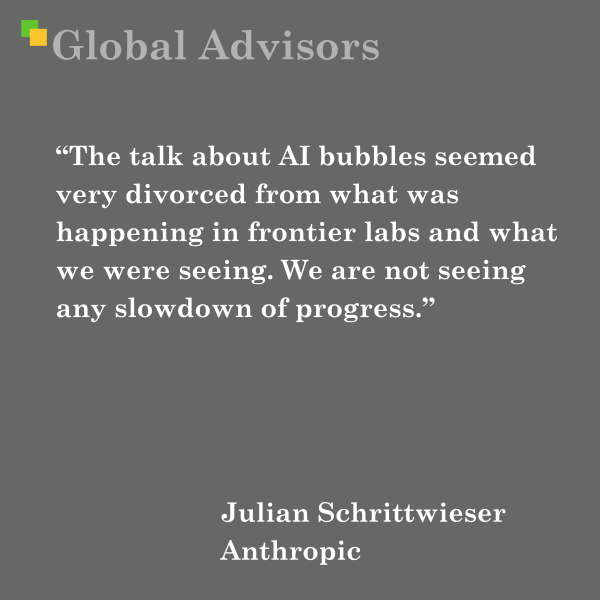
Quote: Julian Schrittwieser - Anthropic“The talk about AI bubbles seemed very divorced from what was happening in frontier labs and what we were seeing. We are not seeing any slowdown of progress.” - Julian Schrittwieser - AnthropicThose closest to technical breakthroughs are witnessing a pattern of sustained, compounding advancement that is often underestimated by commentators and investors. This perspective underscores both the power and limitations of conventional intuitions regarding exponential technological progress. Context of the QuoteSchrittwieser delivered these remarks in a 2025 interview on the MAD Podcast, prompted by widespread discourse on the so-called ‘AI bubble’. His key contention is that debate around an AI investment or hype “bubble” feels disconnected from the lived reality inside the world’s top research labs, where the practical pace of innovation remains brisk and outwardly undiminished. He outlines that, according to direct observation and internal benchmarks at labs such as Anthropic, progress remains on a highly consistent exponential curve: “every three to four months, the model is able to do a task that is twice as long as before completely on its own”. He draws an analogy to the early days of COVID-19, where exponential growth was invisible until it became overwhelming; the same mathematical processes, Schrittwieser contends, apply to AI system capabilities. While public narratives about bubbles often reference the dot-com era, he highlights a bifurcation: frontier labs sustain robust, revenue-generating trajectories, while the wider AI ecosystem might experience bubble-like effects in valuation. But at the core—the technology itself continues to improve at a predictably exponential rate well supported by both qualitative experience and benchmark data. Schrittwieser’s view, rooted in immediate, operational knowledge, is that the default expectation of a linear future is mistaken: advances in autonomy, reasoning, and productivity are compounding. This means genuinely transformative impacts—such as AI agents that function at expert level or beyond for extended, unsupervised tasks—are poised to arrive sooner than many anticipate. Profile: Julian SchrittwieserJulian Schrittwieser is one of the world’s leading artificial intelligence researchers, currently based at Anthropic, following a decade as a core scientist at Google DeepMind. Raised in rural Austria, Schrittwieser’s journey from an adolescent fascination with game programming to the vanguard of AI research exemplifies the discipline’s blend of curiosity, mathematical rigour, and engineering prowess. He studied computer science at the Vienna University of Technology, before interning at Google. Schrittwieser was a central contributor to several historic machine learning milestones, most notably:
At Anthropic, Schrittwieser is at the frontier of research into scaling laws, reinforcement learning, autonomous agents, and novel techniques for alignment and safety in next-generation AI. True to his pragmatic ethos, he prioritises what directly raises capability and reliability, and advocates for careful, data-led extrapolation rather than speculation. Theoretical Backstory: Exponential AI Progress and Key ThinkersSchrittwieser’s remarks situate him within a tradition of AI theorists and builders focused on scaling laws, reinforcement learning (RL), and emergent capabilities: Leading Theorists and Historical PerspectiveThese thinkers converge on several key observations directly reflected in Schrittwieser's view:
Synthesis: Why the Perspective MattersThe quote foregrounds a gap between external perceptions and insider realities. Pioneers like Schrittwieser and his cohort stress that transformative change will not follow a smooth, linear or hype-driven curve, but an exponential, data-backed progression—one that may defy conventional intuition, but is already reshaping productivity and the structure of work. This moment is not about “irrational exuberance”, but rather the compounding product of theoretical insight, algorithmic audacity, and relentless engineering: the engine behind the next wave of economic and social transformation.
|
| |
| |
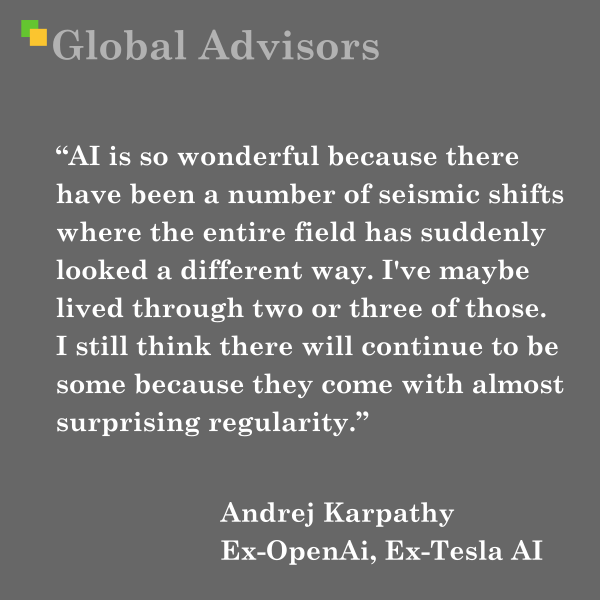
Quote: Andrej Karpathy - Ex-OpenAI, Ex-Tesla AI“AI is so wonderful because there have been a number of seismic shifts where the entire field has suddenly looked a different way. I've maybe lived through two or three of those. I still think there will continue to be some because they come with almost surprising regularity.” - Andrej Karpathy - Ex-OpenAI, Ex-Tesla AIAndrej Karpathy, one of the most recognisable figures in artificial intelligence, has spent his career at the epicentre of the field’s defining moments in both research and large-scale industry deployment. Karpathy’s background is defined by deep technical expertise and a front-row seat to AI’s rapid evolution. Having completed his PhD at Stanford and held pivotal research positions, he worked alongside Geoffrey Hinton at the University of Toronto during the early surge of deep learning. His career encompasses key roles at Tesla, where he led the Autopilot vision team, and at OpenAI, contributing to some of the world’s most prominent large language models and generative AI systems. This vantage point has allowed him to participate in, and reflect upon, the discipline’s “seismic shifts”. Karpathy’s narrative has been shaped by three inflection points:
His reflection on these ‘regular’ paradigm shifts arises from lived experience: "I've maybe lived through two or three of those. I still think there will continue to be some because they come with almost surprising regularity." These moments recalibrate assumptions, redirect research priorities, and set new benchmarks for capability. Karpathy’s practical orientation—building “useful things” rather than targeting biological intelligence or pure AGI—shapes his approach to both innovation and scepticism about hype. Context of the Quote Karpathy relates how, early in his career, neural networks were a marginal interest and large-scale “representation learning” was only beginning to be considered viable by a minority in the community. With the advent of AlexNet, the landscape shifted overnight, rapidly making previous assumptions obsolete. Later, the pursuit of RL-driven agents led to a phase where entire research agendas were oriented toward gameplay and synthetic environments—another phase later superseded by the transformer revolution and language models. Karpathy reflects candidly on earlier missteps, as well as the discipline’s collective tendency to over- or under-predict the timetable and trajectory of progress. Leading Theorists and Intellectual Heritage
Karpathy’s own stance is partly a pragmatic response to this heritage: rather than pursuing analogues of biological brains, he views the productive path as building digital “ghosts”—entities that learn by imitation and are shaped by patterns in data, rather than evolutionary processes. Beyond individual theorists, the field’s quantum leaps are rooted in a culture of intellectual rivalry and rapid intellectual cross-pollination:
The Architecture of Progress: Seismic Shifts and Pragmatic Tension His observation on the “regularity” of shifts also signals a strategic realism: each wave brings both opportunity and risk. New architectures (such as transformers or large reinforcement learning agents) frequently overshoot expectations before their real limitations become clear. Karpathy remains measured on both promise and limitation—anticipating continued progress, but cautioning against overpredictions and hype cycles that fail to reckon with the “march of nines” needed to reach true reliability and impact. Closing Perspective
|
| |
| |
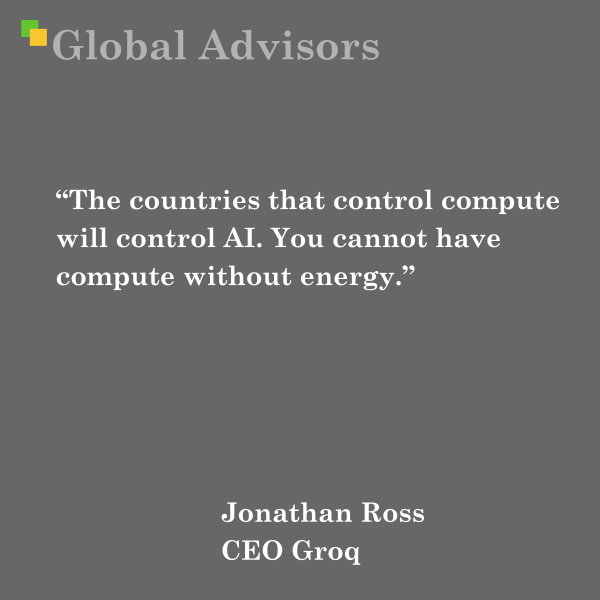
Quote: Jonathan Ross - CEO Groq“The countries that control compute will control AI. You cannot have compute without energy.” - Jonathan Ross - CEO GroqJonathan Ross stands at the intersection of geopolitics, energy economics, and technological determinism. As founder and CEO of Groq, the Silicon Valley firm challenging Nvidia's dominance in AI infrastructure, Ross articulated a proposition of stark clarity during his September 2025 appearance on Harry Stebbings' 20VC podcast: "The countries that control compute will control AI. You cannot have compute without energy." This observation transcends technical architecture. Ross is describing the emergence of a new geopolitical currency—one where computational capacity, rather than traditional measures of industrial might, determines economic sovereignty and strategic advantage in the 21st century. His thesis rests on an uncomfortable reality: artificial intelligence, regardless of algorithmic sophistication or model architecture, cannot function without the physical substrate of compute. And compute, in turn, cannot exist without abundant, reliable energy. The Architecture of AdvantageRoss's perspective derives from direct experience building the infrastructure that powers modern AI. At Google, he initiated what became the Tensor Processing Unit (TPU) project—custom silicon that allowed the company to train and deploy machine learning models at scale. This wasn't academic research; it was the foundation upon which Google's AI capabilities were built. When Amazon and Microsoft attempted to recruit him in 2016 to develop similar capabilities, Ross recognised a pattern: the concentration of advanced AI compute in too few hands represented a strategic vulnerability. His response was to establish Groq in 2016, developing Language Processing Units optimised for inference—the phase where trained models actually perform useful work. The company has since raised over $3 billion and achieved a valuation approaching $7 billion, positioning itself as one of Nvidia's most credible challengers in the AI hardware market. But Ross's ambitions extend beyond corporate competition. He views Groq's mission as democratising access to compute—creating abundant supply where artificial scarcity might otherwise concentrate power. The quote itself emerged during a discussion about global AI competitiveness. Ross had been explaining why European nations, despite possessing strong research talent and model development capabilities (Mistral being a prominent example), risk strategic irrelevance without corresponding investment in computational infrastructure and energy capacity. A brilliant model without compute to run it, he argued, will lose to a mediocre model backed by ten times the computational resources. This isn't theoretical—it's the lived reality of the current AI landscape, where rate limits and inference capacity constraints determine what services can scale and which markets can be served. The Energy CalculusThe energy dimension of Ross's statement carries particular weight. Modern AI training and inference require extraordinary amounts of electrical power. The hyperscalers—Google, Microsoft, Amazon, Meta—are each committing tens of billions of dollars annually to AI infrastructure, with significant portions dedicated to data centre construction and energy provision. Microsoft recently announced it wouldn't make certain GPU clusters available through Azure because the company generated higher returns using that compute internally rather than renting it to customers. This decision, more than any strategic presentation, reveals the economic value density of AI compute. Ross draws explicit parallels to the early petroleum industry: a period of chaotic exploration where a few "gushers" delivered extraordinary returns whilst most ventures yielded nothing. In this analogy, compute is the new oil—a fundamental input that determines economic output and strategic positioning. But unlike oil, compute demand doesn't saturate. Ross describes AI demand as "insatiable": if OpenAI or Anthropic received twice their current inference capacity, their revenue would nearly double within a month. The bottleneck isn't customer appetite; it's supply. This creates a concerning dynamic for nations without indigenous energy abundance or the political will to develop it. Ross specifically highlighted Europe's predicament: impressive AI research capabilities undermined by insufficient energy infrastructure and regulatory hesitance around nuclear power. He contrasted this with Norway's renewable capacity (80% wind utilisation) or Japan's pragmatic reactivation of nuclear facilities—examples of countries aligning energy policy with computational ambition. The message is uncomfortable but clear: technical sophistication in model development cannot compensate for material disadvantage in energy and compute capacity. Strategic ImplicationsThe geopolitical dimension becomes more acute when considering China's position. Ross noted that whilst Chinese models like DeepSeek may be cheaper to train (through various optimisations and potential subsidies), they remain more expensive to run at inference—approximately ten times more costly per token generated. This matters because inference, not training, determines scalability and market viability. China can subsidise AI deployment domestically, but globally—what Ross terms the "away game"—cost structure determines competitiveness. Countries cannot simply construct nuclear plants at will; energy infrastructure takes decades to build. This asymmetry creates opportunity for nations with existing energy advantages. The United States, despite higher nominal costs, benefits from established infrastructure and diverse energy sources. However, Ross's framework suggests this advantage is neither permanent nor guaranteed. Control over compute requires continuous investment in both silicon capability and energy generation. Nations that fail to maintain pace risk dependency—importing not just technology, but the capacity for economic and strategic autonomy. The corporate analogy proves instructive. Ross predicts that every major AI company—OpenAI, Anthropic, Google, and others—will eventually develop proprietary chips, not necessarily to outperform Nvidia technically, but to ensure supply security and strategic control. Nvidia currently dominates not purely through superior GPU architecture, but through control of high-bandwidth memory (HBM) supply chains. Building custom silicon allows organisations to diversify supply and avoid allocation constraints that might limit their operational capacity. What applies to corporations applies equally to nations: vertical integration in compute infrastructure is increasingly a prerequisite for strategic autonomy. The Theorists and PrecedentsRoss's thesis echoes several established frameworks in economic and technological thought, though he synthesises them into a distinctly contemporary proposition. Harold Innis, the Canadian economic historian, developed the concept of "staples theory" in the 1930s and 1940s—the idea that economies organised around the extraction and export of key commodities (fur, fish, timber, oil) develop institutional structures, trade relationships, and power dynamics shaped by those materials. Innis later extended this thinking to communication technologies in works like Empire and Communications (1950) and The Bias of Communication (1951), arguing that the dominant medium of a society shapes its political and social organisation. Ross's formulation applies Innisian logic to computational infrastructure: the nations that control the "staples" of the AI economy—energy and compute—will shape the institutional and economic order that emerges. Carlota Perez, the Venezuelan-British economist, provided a framework for understanding technological revolutions in Technological Revolutions and Financial Capital (2002). Perez identified how major technological shifts (steam power, railways, electricity, mass production, information technology) follow predictable patterns: installation phases characterised by financial speculation and infrastructure building, followed by deployment phases where the technology becomes economically productive. Ross's observation about current AI investment—massive capital expenditure by hyperscalers, uncertain returns, experimental deployment—maps cleanly onto Perez's installation phase. The question, implicit in his quote, is which nations will control the infrastructure when the deployment phase arrives and returns become tangible. W. Brian Arthur, economist and complexity theorist, articulated the concept of "increasing returns" in technology markets through works like Increasing Returns and Path Dependence in the Economy (1994). Arthur demonstrated how early advantages in technology sectors compound through network effects, learning curves, and complementary ecosystems—creating winner-take-most dynamics rather than the diminishing returns assumed in classical economics. Ross's emphasis on compute abundance follows this logic: early investment in computational infrastructure creates compounding advantages in AI capability, which drives economic returns, which fund further compute investment. Nations entering this cycle late face escalating barriers to entry. Joseph Schumpeter, the Austrian-American economist, introduced the concept of "creative destruction" in Capitalism, Socialism and Democracy (1942)—the idea that economic development proceeds through radical innovation that renders existing capital obsolete. Ross explicitly invokes Schumpeterian dynamics when discussing the risk that next-generation AI chips might render current hardware unprofitable before it amortises. This uncertainty amplifies the strategic calculus: nations must invest in compute infrastructure knowing that technological obsolescence might arrive before economic returns materialise. Yet failing to invest guarantees strategic irrelevance. William Stanley Jevons, the 19th-century English economist, observed what became known as Jevons Paradox in The Coal Question (1865): as technology makes resource use more efficient, total consumption typically increases rather than decreases because efficiency makes the resource more economically viable for new applications. Ross applies this directly to AI compute, noting that as inference becomes cheaper (through better chips or more efficient models), demand expands faster than costs decline. This means the total addressable market for compute grows continuously—making control over production capacity increasingly valuable. Nicholas Georgescu-Roegen, the Romanian-American economist, pioneered bioeconomics and introduced entropy concepts to economic analysis in The Entropy Law and the Economic Process (1971). Georgescu-Roegen argued that economic activity is fundamentally constrained by thermodynamic laws—specifically, that all economic processes dissipate energy and cannot be sustained without continuous energy inputs. Ross's insistence that "you cannot have compute without energy" is pure Georgescu-Roegen: AI systems, regardless of algorithmic elegance, are bound by physical laws. Compute is thermodynamically expensive—training large models requires megawatts, inference at scale requires sustained power generation. Nations without access to abundant energy cannot sustain AI economies, regardless of their talent or capital. Mancur Olson, the American economist and political scientist, explored collective action problems and the relationship between institutional quality and economic outcomes in works like The Rise and Decline of Nations (1982). Olson demonstrated how established interest groups can create institutional sclerosis that prevents necessary adaptation. Ross's observations about European regulatory hesitance and infrastructure underinvestment reflect Olsonian dynamics: incumbent energy interests, environmental lobbies, and risk-averse political structures prevent the aggressive nuclear or renewable expansion required for AI competitiveness. Meanwhile, nations with different institutional arrangements (or greater perceived strategic urgency) act more decisively. Paul Romer, the American economist and Nobel laureate, developed endogenous growth theory, arguing in works like "Endogenous Technological Change" (1990) that economic growth derives from deliberate investment in knowledge and technology rather than external factors. Romer's framework emphasises the non-rivalry of ideas (knowledge can be used by multiple actors simultaneously) but the rivalry of physical inputs required to implement them. Ross's thesis fits perfectly: AI algorithms can be copied and disseminated, but the computational infrastructure to deploy them at scale cannot. This creates a fundamental asymmetry that determines economic power. The Historical PatternHistory provides sobering precedents for resource-driven geopolitical competition. Britain's dominance in the 19th century rested substantially on coal abundance that powered industrial machinery and naval supremacy. The United States' 20th-century ascendance correlated with petroleum access and the industrial capacity to refine and deploy it. Oil-dependent economies in the Middle East gained geopolitical leverage disproportionate to their population or industrial capacity purely through energy reserves. Ross suggests we are witnessing the emergence of a similar dynamic, but with a critical difference: AI compute is both resource-intensive (requiring enormous energy) and productivity-amplifying (making other economic activity more efficient). This creates a multiplicative effect where compute advantages compound through both direct application (better AI services) and indirect effects (more efficient production of goods and services across the economy). A nation with abundant compute doesn't just have better chatbots—it has more efficient logistics, agricultural systems, manufacturing processes, and financial services. The "away game" concept Ross introduced during the podcast discussion adds a critical dimension. China, despite substantial domestic AI investment and capabilities, faces structural disadvantages in global competition because international customers cannot simply replicate China's energy subsidies or infrastructure. This creates opportunities for nations with more favourable cost structures or energy profiles, but only if they invest in both compute capacity and energy generation. The Future Ross EnvisionsThroughout the podcast, Ross painted a vision of AI-driven abundance that challenges conventional fears of technological unemployment. He predicts labour shortages, not mass unemployment, driven by three mechanisms: deflationary pressure (AI makes goods and services cheaper), workforce opt-out (people work less as living costs decline), and new industry creation (entirely new job categories emerge, like "vibe coding"—programming through natural language rather than formal syntax). This optimistic scenario depends entirely on computational abundance. If compute remains scarce and concentrated, AI benefits accrue primarily to those controlling the infrastructure. Ross's mission with Groq—creating faster deployment cycles (six months versus two years for GPUs), operating globally distributed data centres, optimising for cost efficiency rather than margin maximisation—aims to prevent that concentration. But the same logic applies at the national level. Countries without indigenous compute capacity will import AI services, capturing some productivity benefits but remaining dependent on external providers for the infrastructure that increasingly underpins economic activity. The comparison Ross offers—LLMs as "telescopes of the mind"—is deliberately chosen. Galileo's telescope revolutionised human understanding but required specific material capabilities to construct and use. Nations without optical manufacturing capacity could not participate in astronomical discovery. Similarly, nations without computational and energy infrastructure cannot participate fully in the AI economy, regardless of their algorithmic sophistication or research talent. ConclusionRoss's statement—"The countries that control compute will control AI. You cannot have compute without energy"—distils a complex geopolitical and economic reality into stark clarity. It combines Innisian materialism (infrastructure determines power), Schumpeterian dynamism (innovation renders existing capital obsolete), Jevonsian counterintuition (efficiency increases total consumption), and Georgescu-Roegen's thermodynamic constraints (economic activity requires energy dissipation). The implications are uncomfortable for nations unprepared to make the necessary investments. Technical prowess in model development provides no strategic moat if the computational infrastructure to deploy those models remains controlled elsewhere. Energy abundance, or the political will to develop it, becomes a prerequisite for AI sovereignty. And AI sovereignty increasingly determines economic competitiveness across sectors. Ross occupies a unique vantage point—neither pure academic nor disinterested observer, but an operator building the infrastructure that will determine whether his prediction proves correct. Groq's valuation and customer demand suggest the market validates his thesis. Whether nations respond with corresponding urgency remains an open question. But the framework Ross articulates will likely define strategic competition for the remainder of the decade: compute as currency, energy as prerequisite, and algorithmic sophistication as necessary but insufficient for competitive advantage.
|
| |
| |
Quote: J.W. Stephens - Author“Be the person your dog thinks you are!” - J.W. Stephens - AuthorThe quote "Be the person your dog thinks you are!" represents a profound philosophical challenge wrapped in disarming simplicity. It invites us to examine the gap between our idealised selves and our everyday reality through the lens of unconditional canine devotion. This seemingly light-hearted exhortation carries surprising depth when examined within the broader context of authenticity, aspiration and the moral psychology of personal development. The Author and the Quote's OriginsJ.W. Stephens, a seventh-generation native Texan, has spent considerable time travelling and living across various locations in Texas and internationally. Whilst the search results provide limited biographical detail about this particular author, the quote itself reveals a distinctively American sensibility—one that combines practical wisdom with accessible moral instruction. The invocation of dogs as moral exemplars reflects a cultural tradition deeply embedded in American life, where the human-canine bond serves as both comfort and conscience. The brilliance of Stephens' formulation lies in its rhetorical structure. By positioning the dog's perception as the aspirational standard, the quote accomplishes several objectives simultaneously: it acknowledges our frequent moral shortcomings, suggests that we already possess knowledge of higher standards, and implies that achieving those standards is within reach. The dog becomes both witness and ideal reader—uncritical yet somehow capable of perceiving our better nature. The quote functions as what philosophers might term a "regulative ideal"—not a description of what we are, but a vision of what we might become. Dogs, in their apparent inability to recognise human duplicity or moral inconsistency, treat their owners as wholly trustworthy, infinitely capable, and fundamentally good. This perception, whether accurate or illusory, creates a moral challenge: can we rise to meet it? Philosophical Foundations: Authenticity and the Divided SelfThe intellectual lineage underpinning this seemingly simple maxim extends deep into Western philosophical tradition, touching upon questions of authenticity, self-knowledge, and moral psychology that have preoccupied thinkers for millennia. Søren Kierkegaard (1813-1855) stands as perhaps the most important theorist of authenticity in Western philosophy. The Danish philosopher argued that modern life creates a condition he termed "despair"—not necessarily experienced as anguish, but as a fundamental disconnection from one's true self. Kierkegaard distinguished between the aesthetic, ethical, and religious stages of existence, arguing that most people remain trapped in the aesthetic stage, living according to immediate gratification and social conformity rather than choosing themselves authentically. His concept of "becoming who you are" anticipates Stephens' formulation, though Kierkegaard's vision is considerably darker and more demanding. For Kierkegaard, authentic selfhood requires a "leap of faith" and acceptance of radical responsibility for one's choices. The dog's unwavering faith in its owner might serve, in Kierkegaardian terms, as a model of the absolute commitment required for authentic existence. Jean-Paul Sartre (1905-1980) developed Kierkegaard's insights in a secular, existentialist direction. Sartre's notion of "bad faith" (mauvaise foi) describes the human tendency to deceive ourselves about our freedom and responsibility. We pretend we are determined by circumstances, social roles, or past choices when we remain fundamentally free. Sartre argued that consciousness is "condemned to be free"—we cannot escape the burden of defining ourselves through our choices. The gap between who we are and who we claim to be constitutes a form of self-deception Sartre found both universal and contemptible. Stephens' quote addresses precisely this gap: the dog sees us as we might be, whilst we often live as something less. Sartre would likely appreciate the quote's implicit demand that we accept responsibility for closing that distance. Martin Heidegger (1889-1976) approached similar territory through his concept of "authenticity" (Eigentlichkeit) versus "inauthenticity" (Uneigentlichkeit). For Heidegger, most human existence is characterised by "fallenness"—an absorption in the everyday world of "das Man" (the "They" or anonymous public). We live according to what "one does" rather than choosing our own path. Authentic existence requires confronting our own mortality and finitude, accepting that we are "beings-toward-death" who must take ownership of our existence. The dog's perspective, unburdened by social conformity and living entirely in the present, might represent what Heidegger termed "dwelling"—a mode of being that is at home in the world without falling into inauthenticity. The Psychology of Self-Perception and Moral DevelopmentMoving from continental philosophy to empirical psychology, several theorists have explored the mechanisms by which we maintain multiple versions of ourselves and how we might reconcile them. Carl Rogers (1902-1987), the founder of person-centred therapy, developed a comprehensive theory of the self that illuminates Stephens' insight. Rogers distinguished between the "real self" (who we actually are) and the "ideal self" (who we think we should be). Psychological health, for Rogers, requires "congruence"—alignment between these different self-concepts. When the gap between real and ideal becomes too wide, we experience anxiety and employ defence mechanisms to protect our self-image. Rogers believed that unconditional positive regard—accepting someone fully without judgment—was essential for psychological growth. The dog's perception of its owner represents precisely this unconditional acceptance, creating what Rogers termed "conditions of worth" that are entirely positive. Paradoxically, this complete acceptance might free us to change precisely because we feel safe enough to acknowledge our shortcomings. Albert Bandura (born 1925) developed social learning theory and the concept of self-efficacy, which bears directly on Stephens' formulation. Bandura argued that our beliefs about our capabilities significantly influence what we attempt and accomplish. When we believe others see us as capable (as dogs manifestly do), we are more likely to attempt difficult tasks and persist through obstacles. The dog's unwavering confidence in its owner might serve as what Bandura termed "vicarious experience"—seeing ourselves succeed through another's eyes increases our own self-efficacy beliefs. Moreover, Bandura's later work on moral disengagement explains how we rationalise behaviour that conflicts with our moral standards. The dog's perspective, by refusing such disengagement, might serve as a corrective to self-justification. Carol Dweck (born 1946) has explored how our beliefs about human qualities affect achievement and personal development. Her distinction between "fixed" and "growth" mindsets illuminates an important dimension of Stephens' quote. A fixed mindset assumes that qualities like character, intelligence, and moral worth are static; a growth mindset sees them as developable through effort. The dog's perception suggests a growth-oriented view: it sees potential rather than limitation, possibility rather than fixed character. The quote implies that we can become what the dog already believes us to be—a quintessentially growth-minded position. Moral Philosophy and the Ethics of CharacterThe quote also engages fundamental questions in moral philosophy about the nature of virtue and how character develops. Aristotle (384-322 BCE) provides the foundational framework for understanding character development in Western thought. His concept of eudaimonia (often translated as "flourishing" or "the good life") centres on the cultivation of virtues through habituation. For Aristotle, we become virtuous by practising virtuous actions until they become second nature. The dog's perception might serve as what Aristotle termed the "great-souled man's" self-regard—not arrogance but appropriate recognition of one's potential for excellence. However, Aristotle would likely caution that merely aspiring to virtue is insufficient; one must cultivate the practical wisdom (phronesis) to know what virtue requires in specific circumstances and the habituated character to act accordingly. Immanuel Kant (1724-1804) approached moral philosophy from a radically different angle, yet his thought illuminates Stephens' insight in unexpected ways. Kant argued that morality stems from rational duty rather than inclination or consequence. The famous categorical imperative demands that we act only according to maxims we could will to be universal laws. Kant's moral agent acts from duty, not because they feel like it or because they fear consequences. The gap between our behaviour and the dog's perception might be understood in Kantian terms as the difference between acting from inclination (doing good when convenient) and acting from duty (doing good because it is right). The dog, in its innocence, cannot distinguish these motivations—it simply expects consistent goodness. Rising to meet that expectation would require developing what Kant termed a "good will"—the disposition to do right regardless of inclination. Lawrence Kohlberg (1927-1987) developed a stage theory of moral development that explains how moral reasoning evolves from childhood through adulthood. Kohlberg identified six stages across three levels: pre-conventional (focused on rewards and punishment), conventional (focused on social approval and law), and post-conventional (focused on universal ethical principles). The dog's expectation might be understood as operating at a pre-conventional level—it assumes goodness without complex reasoning. Yet meeting that expectation could require post-conventional thinking: choosing to be good not because others are watching but because we have internalised principles of integrity and compassion. The quote thus invites us to use a simple, pre-moral faith as leverage for developing genuine moral sophistication. Contemporary Perspectives: Positive Psychology and Virtue EthicsRecent decades have seen renewed interest in character and human flourishing, providing additional context for understanding Stephens' insight. Martin Seligman (born 1942), founder of positive psychology, has shifted psychological focus from pathology to wellbeing. His PERMA model identifies five elements of flourishing: Positive emotion, Engagement, Relationships, Meaning, and Accomplishment. The human-dog relationship exemplifies several of these elements, particularly the relationship component. Seligman's research on "learned optimism" suggests that how we explain events to ourselves affects our wellbeing and achievement. The dog's relentlessly optimistic view of its owner might serve as a model of the explanatory style Seligman advocates—one that sees setbacks as temporary and successes as reflective of stable, positive qualities. Christopher Peterson (1950-2012) and Martin Seligman collaborated to identify character strengths and virtues across cultures, resulting in the Values in Action (VIA) classification. Their research identified 24 character strengths organised under six core virtues: wisdom, courage, humanity, justice, temperance, and transcendence. The quote implicitly challenges us to develop these strengths not because doing so maximises utility or fulfils duty, but because integrity demands that our actions align with our self-understanding. The dog sees us as possessing these virtues; the challenge is to deserve that vision. Alasdair MacIntyre (born 1929) has argued for recovering Aristotelian virtue ethics in modern life. MacIntyre contends that the Enlightenment project of grounding morality in reason alone has failed, leaving us with emotivism—the view that moral judgments merely express feelings. He advocates returning to virtue ethics situated within narrative traditions and communities of practice. The dog-owner relationship might be understood as one such practice—a context with implicit standards and goods internal to it (loyalty, care, companionship) that shape character over time. Becoming worthy of the dog's trust requires participating authentically in this practice rather than merely going through the motions. The Human-Animal Bond as Moral MirrorThe specific invocation of dogs, rather than humans, as moral arbiters merits examination. This choice reflects both cultural realities and deeper philosophical insights about the nature of moral perception. Dogs occupy a unique position in human society. Unlike wild animals, they have co-evolved with humans for thousands of years, developing sophisticated abilities to read human gestures, expressions, and intentions. Yet unlike humans, they appear incapable of the complex social calculations that govern human relationships—judgement tempered by self-interest, conditional approval based on social status, or critical evaluation moderated by personal advantage. Emmanuel Levinas (1906-1995) developed an ethics based on the "face-to-face" encounter with the Other, arguing that the face of the other person makes an ethical demand on us that precedes rational calculation. Whilst Levinas focused on human faces, his insight extends to our relationships with dogs. The dog's upturned face, its evident trust and expectation, creates an ethical demand: we are called to respond to its vulnerability and faith. The dog cannot protect itself from our betrayal; it depends entirely on our goodness. This radical vulnerability and trust creates what Levinas termed the "infinite responsibility" we bear toward the Other. The dog's perception is powerful precisely because it is not strategic. Dogs do not love us because they have calculated that doing so serves their interests (though it does). They do not withhold affection to manipulate behaviour (though behavioural conditioning certainly plays a role in the relationship). From the human perspective, the dog's devotion appears absolute and uncalculating. This creates a moral asymmetry: the dog trusts completely, whilst we retain the capacity for betrayal or manipulation. Stephens' quote leverages this asymmetry, suggesting that we should honour such trust by becoming worthy of it. Practical Implications: From Aspiration to ActionThe quote's enduring appeal lies partly in its practical accessibility. Unlike philosophical treatises on authenticity or virtue that can seem abstract and demanding, Stephens offers a concrete, imaginable standard. Most dog owners have experienced the moment of returning home to exuberant welcome, seeing themselves reflected in their dog's unconditional joy. The gap between that reflection and one's self-knowledge of moral compromise or character weakness becomes tangible. Yet the quote's simplicity risks trivialising genuine moral development. Becoming "the person your dog thinks you are" is not achieved through positive thinking or simple willpower. It requires sustained effort, honest self-examination, and often painful acknowledgment of failure. The philosophical traditions outlined above suggest several pathways: The existentialist approach demands radical honesty about our freedom and responsibility. We must acknowledge that we choose ourselves moment by moment, that no external circumstance determines our character, and that self-deception about this freedom represents moral failure. The dog's trust becomes a call to authentic choice. The Aristotelian approach emphasises habituation and practice. We must identify the virtues we lack, create situations that require practising them, and persist until virtuous behaviour becomes natural. The dog's expectation provides motivation for this long-term character development. The psychological approach focuses on congruence and self-efficacy. We must reduce the gap between real and ideal self through honest self-assessment and incremental change, using the dog's confidence as a source of belief in our capacity to change. The virtue ethics approach situates character development within practices and traditions. The dog-owner relationship itself becomes a site for developing virtues like responsibility, patience, and compassion through daily engagement. The Quote in Contemporary ContextStephens' formulation resonates particularly in an era characterised by anxiety about authenticity. Social media creates pressure to curate idealised self-presentations whilst simultaneously exposing the gap between image and reality. Political and institutional leaders frequently fail to live up to professed values, creating cynicism about whether integrity is possible or even desirable. In this context, the dog's uncomplicated faith offers both comfort and challenge—comfort that somewhere we are seen as fundamentally good, challenge that we might actually become so. The quote also speaks to contemporary concerns about meaning and purpose. In a secular age lacking consensus on ultimate values, the question "How should I live?" lacks obvious answers. Stephens bypasses theological and philosophical complexities by offering an existentially grounded response: live up to the best version of yourself as reflected in uncritical devotion. This moves the question from abstract principle to lived relationship, from theoretical ethics to embodied practice. Moreover, the invocation of dogs rather than humans as moral mirrors acknowledges a therapeutic insight: sometimes we need non-judgmental acceptance before we can change. The dog provides that acceptance automatically, creating psychological safety within which development becomes possible. In an achievement-oriented culture that often ties worth to productivity and success, the dog's valuation based simply on existence—you are wonderful because you are you—offers profound relief and, paradoxically, motivation for growth. The quote ultimately works because it short-circuits our elaborate mechanisms of self-justification. We know we are not as good as our dogs think we are. We know this immediately and intuitively, without needing philosophical argument. The quote simply asks: what if you were? What if you closed that gap? The question haunts precisely because the answer seems simultaneously impossible and within reach—because we have glimpsed that better self in our dog's eyes and cannot quite forget it.
|
| |

| |
|


| |
| |