| |
|

| |
| |
| |
|
A daily bite-size selection of top business content. |
| |
| |
| |
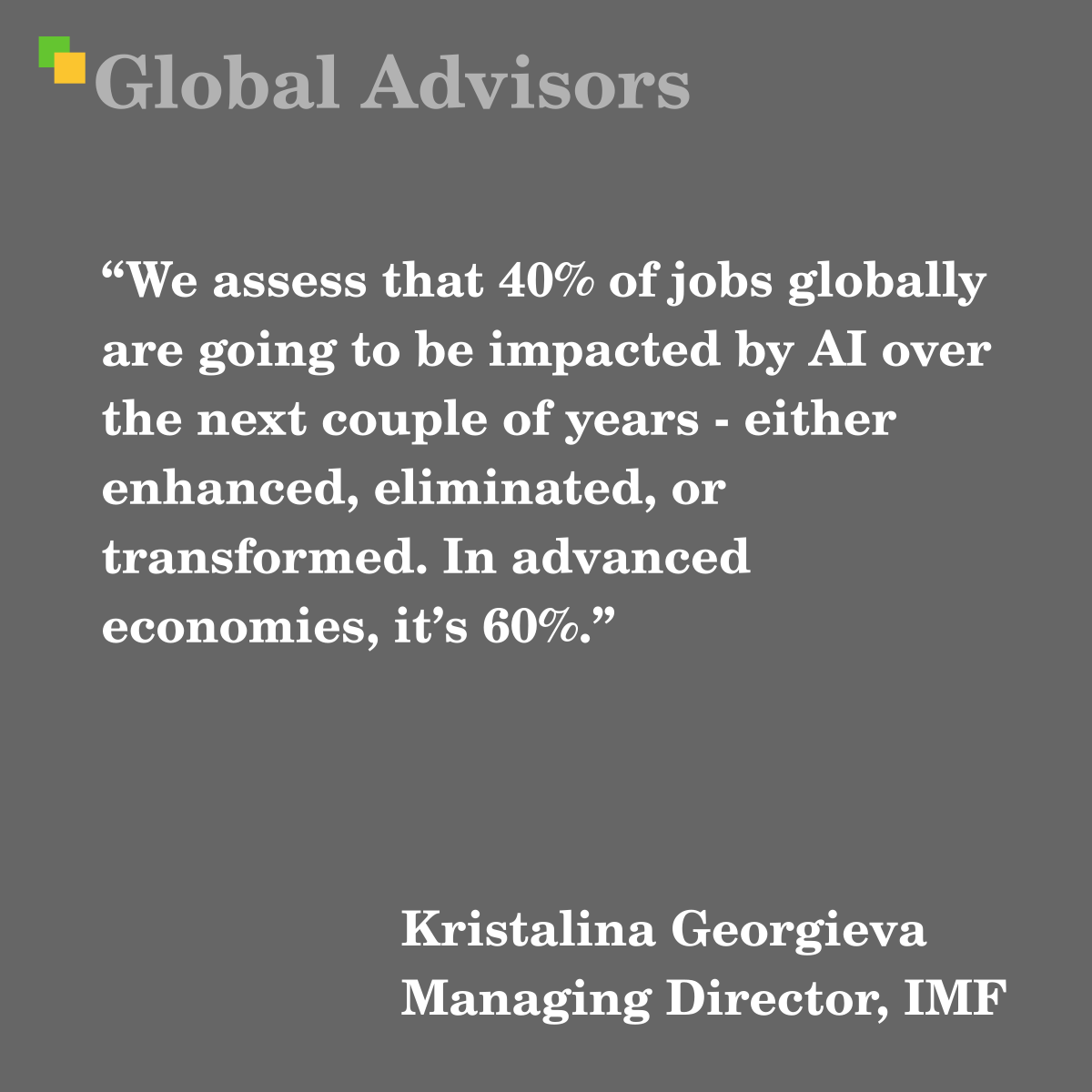
Quote: Kristalina Georgieva - Managing Director, IMF"We assess that 40% of jobs globally are going to be impacted by AI over the next couple of years - either enhanced, eliminated, or transformed. In advanced economies, it's 60%." - Kristalina Georgieva - Managing Director, IMFKristalina Georgieva's assessment of AI's labour market impact represents one of the most consequential economic forecasts of our time. Speaking at the World Economic Forum in Davos in January 2026, the Managing Director of the International Monetary Fund articulated a sobering reality: artificial intelligence is not a distant threat but an immediate force already reshaping employment globally. Her invocation of a "tsunami"-a natural disaster of overwhelming force and scale-captures the simultaneity and inevitability of this transformation. The Scale of DisruptionGeorgieva's figures warrant careful examination. The IMF calculates that 40 per cent of jobs globally will be touched by AI, with each affected role falling into one of three categories: enhancement (where AI augments human capability), elimination (where automation replaces human labour), or transformation (where roles are fundamentally altered without necessarily improving compensation). This is not speculative projection but empirical assessment grounded in IMF research across member economies. The geographical disparity is striking and consequential. In advanced economies-the United States, Western Europe, Japan, and similar developed nations-the figure reaches 60 per cent. By contrast, in low-income countries, the impact ranges from 20 to 26 per cent. This divergence is not accidental; it reflects the concentration of AI infrastructure, capital investment, and digital integration in wealthy nations. The IMF's concern, as Georgieva articulated, is what she termed an "accordion of opportunities"-a compression and expansion of economic possibility that varies dramatically by geography and development status. Understanding the Context: AI as Economic TransformationGeorgieva's warning must be situated within the broader economic moment of early 2026. The global economy faces simultaneous pressures: geopolitical fragmentation, demographic shifts, climate transition, and technological disruption occurring in parallel. AI is not the sole driver of economic uncertainty, but it is perhaps the most visible and immediate. The IMF's analysis distinguishes between AI's productivity benefits and its labour market risks. Georgieva acknowledged that AI is generating genuine economic gains across sectors-agriculture, healthcare, education, and transport have all experienced productivity enhancements. Translation and interpretation services have been enhanced rather than eliminated; research analysts have found their work augmented by AI tools. Yet these gains are unevenly distributed, and the labour market adjustment required is unprecedented in speed and scale. The productivity question is central to Georgieva's economic outlook. Global growth has been underwhelming in recent years, with productivity growth stagnant except in the United States. AI represents the most potent force for reversing this trend, with potential to boost global growth between 0.1 and 0.8 per cent annually. A 0.8 per cent productivity gain would restore growth to pre-pandemic levels. Yet this upside scenario depends entirely on successful labour market adjustment and equitable distribution of AI's benefits. The Theoretical Foundations: Labour Economics and Technological DisruptionGeorgieva's analysis draws on decades of labour economics scholarship examining technological displacement. The intellectual lineage traces to economists such as David Autor, who has extensively studied how technological change reshapes labour markets. Autor's research demonstrates that whilst technology eliminates routine tasks, it simultaneously creates demand for new skills and complementary labour. However, this adjustment is neither automatic nor painless; workers displaced from routine cognitive tasks often face years of unemployment or underemployment before transitioning to new roles. The "task-based" framework of labour economics-developed by scholars including Autor and Frank Levy-provides the theoretical scaffolding for understanding AI's impact. Rather than viewing jobs as monolithic units, this approach recognises that occupations comprise multiple tasks. AI may automate certain tasks within a role whilst leaving others intact, fundamentally altering job content and skill requirements. A radiologist's role, for instance, may be transformed by AI's superior pattern recognition in image analysis, but the radiologist's diagnostic judgment, patient communication, and clinical decision-making remain valuable. Erik Brynjolfsson and Andrew McAfee, prominent technology economists, have argued that AI represents a qualitative shift from previous technological waves. Unlike earlier automation, which primarily affected routine manual labour, AI threatens cognitive work across income levels. Their research suggests that without deliberate policy intervention, AI could exacerbate inequality rather than reduce it, concentrating gains among capital owners and highly skilled workers whilst displacing middle-skill employment. Daron Acemoglu, the MIT economist, has been particularly critical of "so-so automation"-technology that increases productivity marginally whilst displacing workers without creating sufficient new opportunities. His work emphasises that technological outcomes are not predetermined; they depend on institutional choices, investment priorities, and policy frameworks. This perspective is crucial for understanding Georgieva's policy recommendations. The Policy ImperativeGeorgieva's framing of the challenge as a policy problem rather than an inevitable outcome reflects this economic thinking. She has consistently advocated for three policy pillars: investment in skills development, meaningful regulation and ethical frameworks, and ensuring AI's benefits penetrate across sectors and geographies rather than concentrating in advanced economies. The IMF's own research indicates that one in ten jobs in advanced economies already require substantially new skills-a figure that will accelerate. Yet educational and training systems globally remain poorly aligned with AI-era skill demands. Georgieva has urged governments to invest in reskilling programmes, particularly targeting workers in roles most vulnerable to displacement. Her emphasis on regulation and ethics reflects growing recognition that AI's trajectory is not technologically determined. The choice between AI as a tool for broad-based productivity enhancement versus a mechanism for labour displacement and inequality concentration remains open. This aligns with the work of scholars such as Shoshana Zuboff, who argues that technological systems embody political choices about power distribution and social organisation. The Global Inequality DimensionPerhaps most significant is Georgieva's concern about the "accordion of opportunities." The 60 per cent figure for advanced economies versus 20-26 per cent for low-income countries reflects not merely different levels of AI adoption but fundamentally different economic trajectories. Advanced economies possess the infrastructure, capital, and institutional capacity to invest in AI whilst simultaneously managing labour market transition. Low-income countries risk being left behind-neither benefiting from AI's productivity gains nor receiving the investment in skills and social protection that might cushion displacement. This concern echoes the work of development economists such as Dani Rodrik, who has documented how technological change can bypass developing economies entirely, leaving them trapped in low-productivity sectors. If AI concentrates in advanced economies and wealthy sectors, developing nations may face a new form of technological colonialism-dependent on imported AI solutions without developing indigenous capacity or capturing value creation. The Measurement ChallengeGeorgieva's 40 per cent figure, whilst grounded in IMF research, represents a probabilistic assessment rather than a precise prediction. The IMF acknowledges a "fairly big range" of potential impacts on global growth (0.1 to 0.8 per cent), reflecting genuine uncertainty about AI's trajectory. This uncertainty itself is significant; it suggests that outcomes remain contingent on policy choices, investment decisions, and institutional responses. The distinction between jobs "touched" by AI and jobs eliminated is crucial. Enhancement and transformation may be preferable to elimination, but they still require worker adjustment, skill development, and potentially geographic mobility. A job that is transformed but offers no wage improvement-as Georgieva noted-may be economically worse for the worker even if technically retained. The Broader Economic ContextGeorgieva's warning arrives amid broader economic fragmentation. Trade tensions, geopolitical competition, and the shift from a rules-based global economic order toward competing blocs create additional uncertainty. AI development is increasingly intertwined with strategic competition between major powers, particularly between the United States and China. This geopolitical dimension means that AI's labour market impact cannot be separated from questions of technological sovereignty, supply chain resilience, and economic security. The IMF chief has also emphasised that AI's benefits are not automatic. She personally undertook training in AI productivity tools, including Microsoft Copilot, and urged IMF staff to embrace AI-based enhancements. Yet this individual adoption, multiplied across millions of workers and organisations, requires deliberate choice, investment in training, and organisational restructuring. The productivity gains Georgieva projects depend on this active embrace rather than passive exposure to AI technology. Implications for Policy and StrategyGeorgieva's analysis suggests several imperatives for policymakers. First, labour market adjustment cannot be left to market forces alone; deliberate investment in education, training, and social protection is essential. Second, the distribution of AI's benefits matters as much as aggregate productivity gains; without attention to equity, AI could deepen inequality within and between nations. Third, regulation and ethical frameworks must be established proactively rather than reactively, shaping AI development toward socially beneficial outcomes. Her invocation of a "tsunami" is not mere rhetoric but a precise characterisation of the challenge's scale and urgency. Tsunamis cannot be prevented, but their impact can be mitigated through preparation, early warning systems, and coordinated response. Similarly, AI's labour market impact is largely inevitable, but its consequences-whether broadly shared prosperity or concentrated disruption-remain subject to human choice and institutional design. References 2. https://time.com/collections/davos-2026/7339218/ai-trade-global-economy-kristalina-georgieva-imf/ 4. https://www.youtube.com/watch?v=4ANV7yuaTuA 5. https://www.weforum.org/stories/2026/01/live-from-davos-2026-what-to-know-on-day-2/ 6. https://www.perplexity.ai/page/ai-impact-on-jobs-debated-as-l-_a7uZvVcQmWh3CsTzWfkbA
|
| |
| |
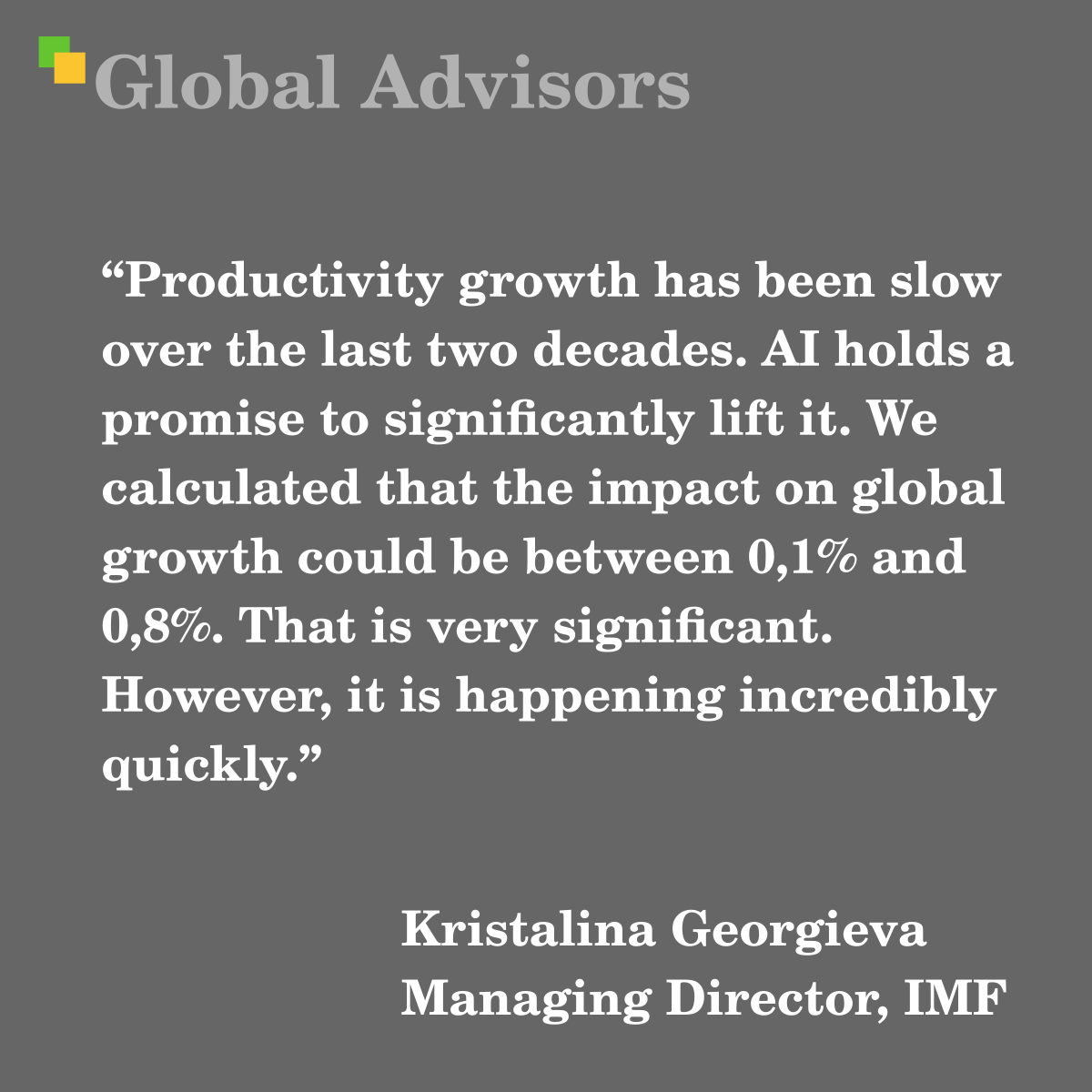
Quote: Kristalina Georgieva - Managing Director, IMF"Productivity growth has been slow over the last two decades. AI holds a promise to significantly lift it. We calculated that the impact on global growth could be between 0,1% and 0,8%. That is very significant. However, it is happening incredibly quickly." - Kristalina Georgieva - Managing Director, IMFKristalina Georgieva, Managing Director of the International Monetary Fund, has emerged as one of the most influential voices in the global conversation about artificial intelligence's economic impact. Her observation about productivity growth-and AI's potential to reverse it-reflects a fundamental shift in how policymakers understand the relationship between technological innovation and economic resilience. The Productivity Crisis That Defined Two DecadesTo understand Georgieva's urgency about AI, one must first grasp the economic malaise that has characterised the past twenty years. Since the 2008 financial crisis, advanced economies have experienced persistently weak productivity growth-the measure of how much output an economy generates per unit of input. This sluggish productivity has become the primary culprit behind anaemic economic growth across developed nations. Georgieva has repeatedly emphasised that approximately half of the slow growth experienced globally stems directly from this productivity deficit, a structural problem that conventional policy tools have struggled to address. This two-decade productivity drought represents more than a statistical curiosity. It reflects an economy that, despite technological advancement, has failed to translate innovation into widespread efficiency gains. Workers produce less per hour worked. Businesses struggle to achieve meaningful cost reductions. Investment returns diminish. The result is an economy trapped in a low-growth equilibrium, unable to generate the dynamism required to address mounting fiscal challenges, rising inequality, and demographic pressures. AI as Economic Catalyst: The Quantified PromiseGeorgieva's confidence in AI stems from rigorous analysis rather than technological evangelism. The IMF has calculated that artificial intelligence could boost global growth by between 0.1 and 0.8 percentage points-a range that, whilst appearing modest in isolation, becomes transformative when contextualised against current growth trajectories. For an advanced economy growing at 1-2 percent annually, an additional 0.8 percentage points represents a 40-80 percent acceleration. For developing economies, the multiplier effect could be even more pronounced. This quantification matters because it grounds AI's potential in measurable economic impact rather than speculative hype. The IMF's methodology reflects analysis of AI's capacity to enhance productivity across multiple sectors-from agriculture and healthcare to education and transportation. Unlike previous technological revolutions that took decades to diffuse through economies, AI applications are already penetrating operational workflows at unprecedented speed. The Velocity Problem: Why Speed Reshapes the EquationGeorgieva's most critical insight concerns not the magnitude of AI's impact but its velocity. Technological transformations typically unfold gradually, allowing labour markets, educational systems, and social safety nets time to adapt. The Industrial Revolution took generations. The digital revolution unfolded over decades. AI, by contrast, is compressing transformation into years. This acceleration creates what Georgieva describes as a "tsunami" effect on labour markets. The IMF's assessment indicates that 40 percent of global jobs will be impacted by AI within the coming years-either enhanced through augmentation, fundamentally transformed, or eliminated entirely. In advanced economies, the figure rises to 60 percent. Simultaneously, preliminary data suggests that one in ten jobs in advanced economies already require new skills, a proportion that will accelerate dramatically. The velocity problem generates a dual challenge: whilst AI promises to solve the productivity crisis that has constrained growth for two decades, it simultaneously threatens to outpace society's capacity to manage labour market disruption. This is why Georgieva emphasises that the economic benefits of AI cannot be assumed to distribute evenly or automatically. The speed of technological change can easily outstrip the speed of policy adaptation, education reform, and social support systems. Theoretical Foundations: Understanding Productivity and GrowthGeorgieva's analysis builds upon decades of economic theory regarding the relationship between productivity and growth. The Solow growth model, developed by Nobel laureate Robert Solow in the 1950s, established that long-term economic growth depends primarily on technological progress and productivity improvements rather than capital accumulation alone. This framework explains why economies with similar capital stocks can diverge dramatically based on their capacity to innovate and improve efficiency. The productivity slowdown that has characterised recent decades puzzled economists, leading to what some termed the "productivity paradox"-the observation that despite massive investment in information technology, measured productivity growth remained disappointingly weak. Erik Brynjolfsson and Andrew McAfee, leading scholars of technology's economic impact, have argued that this paradox reflects a measurement problem: much of technology's benefit accrues as consumer surplus rather than measured output, and the transition period between technological eras involves disruption that temporarily suppresses measured productivity. AI potentially resolves this paradox by offering productivity gains that are both measurable and broad-based. Unlike previous waves of automation that concentrated benefits in specific sectors, AI's general-purpose nature means it can enhance productivity across virtually every economic activity. This aligns with the theoretical work of economists like Daron Acemoglu, who emphasises that sustained growth requires technologies that complement rather than simply replace human labour, creating new opportunities for value creation. The IMF's Institutional PerspectiveAs Managing Director of the IMF, Georgieva speaks from an institution uniquely positioned to assess global economic trends. The Fund monitors economic performance across 190 member countries, providing unparalleled visibility into comparative growth patterns, labour market dynamics, and policy effectiveness. Her warnings about AI's labour market impact carry weight precisely because they emerge from this comprehensive global perspective rather than from any single national vantage point. The IMF's own experience with AI implementation reinforces Georgieva's optimism about productivity gains. As a data-intensive institution, the Fund has deployed AI-powered tools to enhance analytical capacity, accelerate research, and improve forecasting accuracy. Georgieva has personally engaged with productivity-enhancing AI tools, including Microsoft Copilot and fund-specific AI assistants, and reports measurable gains in institutional output. This first-hand experience lends credibility to her broader claims about AI's transformative potential. The Policy Imperative: Managing TransformationGeorgieva's framing of AI's impact as both opportunity and risk reflects a sophisticated understanding of technological change. The productivity gains she describes will not materialise automatically; they require deliberate policy choices. For advanced economies, she counsels concentration on three areas: ensuring AI penetration across all economic sectors rather than concentrating benefits in technology-intensive industries; establishing meaningful regulatory frameworks that reduce risks of misuse and unintended consequences; and building ethical foundations that maintain public trust in AI systems. Critically, Georgieva emphasises that the labour market challenge demands proactive intervention. The speed of AI adoption means that waiting for market forces to naturally realign skills and employment will result in unnecessary disruption and inequality. Instead, she advocates for policies that support reskilling, particularly targeting workers in roles most vulnerable to displacement. The IMF's research suggests that higher-skilled workers benefit disproportionately from AI augmentation, creating a risk of widening inequality unless deliberate efforts ensure that lower-skilled workers also gain access to AI-enhanced productivity tools. Global Context: Divergence and OpportunityGeorgieva's analysis of AI's growth potential must be understood within the broader context of global economic divergence. The United States, which has emerged as the global leader in large-language model development and AI commercialisation, stands to capture disproportionate benefits from AI-driven productivity gains. This concentration of AI capability in a single economy risks exacerbating existing inequalities between advanced and developing nations. However, Georgieva's emphasis on AI's application layer-rather than merely its development-suggests opportunities for broader participation. Countries with strong capabilities in enterprise software, business process outsourcing, and operational integration, such as India, can leverage AI to enhance service delivery and create new value propositions. This perspective challenges the notion that AI benefits will concentrate exclusively in technology-leading nations, though it requires deliberate policy choices to realise this potential. The Uncertainty FrameworkGeorgieva frequently describes the contemporary global environment as one where "uncertainty is the new normal." This framing contextualises her AI analysis within a broader landscape of simultaneous transformations-geopolitical fragmentation, demographic shifts, climate change, and trade tensions all accelerating simultaneously. AI does not exist in isolation; it emerges as one force among many reshaping the global economy. This multiplicity of transformations creates what Georgieva terms "more fog within which we operate." Policymakers cannot assume that historical relationships between variables will hold. The interaction between AI-driven productivity gains, trade tensions, demographic decline in advanced economies, and climate-related resource constraints creates a genuinely novel economic environment. This is why Georgieva emphasises the need for international coordination, adaptive policy frameworks, and institutional flexibility. Conclusion: The Productivity ImperativeGeorgieva's statement about AI and productivity growth reflects a conviction grounded in both rigorous analysis and institutional responsibility. The two-decade productivity drought has constrained growth, limited policy options, and contributed to the political instability and inequality that characterise contemporary democracies. AI offers a genuine opportunity to reverse this trajectory, but only if its benefits are deliberately distributed and its disruptions actively managed. The speed of AI's development means that the window for shaping this outcome is narrow. Policymakers who treat AI as merely a technological phenomenon rather than as an economic and social challenge risk squandering the productivity gains Georgieva describes, converting opportunity into disruption. References 1. https://time.com/collections/davos-2026/7339218/ai-trade-global-economy-kristalina-georgieva-imf/ 2. https://www.youtube.com/watch?v=4ANV7yuaTuA
|
| |
| | ||||||||||||||||
Term: Acquihire"An acquihire (acquisition + hire) is a business strategy where a company buys another, smaller company primarily for its talented employees, rather than its products or technology, often to quickly gain skilled teams." - Acquihire -An acquihire (a portmanteau of "acquisition" and "hire") is a business strategy in which a larger company acquires a smaller firm, such as a startup, primarily to recruit its skilled employees or entire teams, rather than for its products, services, technology, or customer base.1,2,3,7 This approach enables rapid talent acquisition, often bypassing traditional hiring processes, while the acquired company's offerings are typically deprioritised or discontinued post-deal.1,4,7 Key Characteristics and ProcessAcquihires emphasise human capital over tangible assets, with the acquiring firm integrating the talent to fill skill gaps, drive innovation, or enhance competitiveness—particularly in tech sectors where specialised expertise like AI or engineering is scarce.1,2,6 The process generally unfolds in structured stages:
For startups, acquihires provide an exit amid funding shortages, offering employees better opportunities, while acquirers gain entrepreneurial spirit and eliminate nascent competition.1,7 Strategic Benefits and Drawbacks
Acquihires surged in Silicon Valley post-2008, with valuations tied to per-engineer pricing (e.g., $1–2 million per key hire).7 Best Related Strategy Theorist: Mark ZuckerbergMark Zuckerberg, CEO of Meta (formerly Facebook), stands out as the preeminent figure linked to acquihiring, having pioneered its strategic deployment to preserve startup agility within a scaling giant.7 His philosophy framed acquihires as dual tools for talent infusion and cultural retention, explicitly stating that "hiring entrepreneurs helped Facebook retain its start-up culture."7 Biography and Backstory: Born in 1984 in New York, Zuckerberg co-founded Facebook in 2004 from his Harvard dorm, launching a platform that redefined social networking and grew to billions of users.7 By the late 2000s, as Facebook ballooned, it faced talent wars and innovation plateaus amid competition from nimble startups. Zuckerberg championed acquihires as a counter-strategy, masterminding over 50 such deals totalling hundreds of millions—exemplars include:
These moves exemplified three motives Zuckerberg articulated: strategic (elevating founders to leadership), innovation (rapid feature development), and product enhancement.7 Unlike traditional M&A, his acquihires prioritised "acqui-hiring" founders into high roles, fostering Meta's entrepreneurial ethos amid explosive growth. Critics note antitrust scrutiny (e.g., Instagram, WhatsApp debates), but Zuckerberg's playbook influenced tech giants like Google and Apple, cementing acquihiring as a core talent strategy.7 His approach evolved with Meta's empire-building, blending opportunism with long-term vision. References 1. https://mightyfinancial.com/glossary/acquihire/ 2. https://allegrow.com/acquire-hire-strategies/ 3. https://velocityglobal.com/resources/blog/acquihire-process 4. https://visible.vc/blog/acquihire/ 5. https://eqvista.com/acqui-hire-an-effective-talent-acquisition-strategy/ 6. https://wowremoteteams.com/glossary-term/acqui-hiring/ 7. https://en.wikipedia.org/wiki/Acqui-hiring 8. https://a16z.com/the-complete-guide-to-acquihires/ 9. https://www.mascience.com/podcast/executing-acquihires
|
||||||||||||||||
| |

| |
Quote: Kazuo Ishiguro"While it is all very well to talk of ‘turning points’, one can surely only recognize such moments in retrospect." - Kazuo Ishiguro - The Remains of the DayThe Quote in Context"While it is all very well to talk of ‘turning points’, one can surely only recognize such moments in retrospect." This line, spoken by the protagonist Stevens in Kazuo Ishiguro's The Remains of the Day, captures the novel's central theme of hindsight and regret. Stevens reflects on his life of unwavering duty as a butler, questioning whether pivotal decisions—such as suppressing his emotions for Miss Kenton or blindly serving Lord Darlington—could have been foreseen as life-altering. The surrounding narrative expands: "But then, I suppose, when with the benefit of hindsight one begins to search one's past for such 'turning points', one is apt to start seeing them everywhere," and "But what is the sense in forever speculating what might have happened had such and such a moment turned out differently?"3,4,5 These thoughts arise as Stevens drives across England in 1956, revisiting his past amid a changing post-war world, realizing his pursuit of "dignity" through professionalism has left him emotionally barren. Kazuo Ishiguro: Life and LegacyKazuo Ishiguro, born in 1954 in Nagasaki, Japan, moved to England at age five, where he was raised in Guildford, Surrey. His early life bridged cultures: Japanese heritage shaped his themes of memory, loss, and restraint, while British education immersed him in its class structures and imperial history. He studied English and philosophy at the University of Kent, then creative writing at the University of East Anglia under Malcolm Bradbury. Ishiguro's debut novel A Pale View of Hills (1982) drew from his parents' Hiroshima experiences; An Artist of the Floating World (1986) explored post-war Japanese guilt. The Remains of the Day (1989), his third novel, marked his breakthrough. Narrated by Stevens, an impeccably dutiful butler at Darlington Hall in the 1930s, it chronicles his suppressed romance with housekeeper Miss Kenton and his service to Lord Darlington, a well-meaning aristocrat who unwittingly aids pro-Nazi appeasement. Stevens's road trip decades later forces confrontation with missed opportunities. The Booker Prize-winning novel critiques English stoicism, loyalty's cost, and hindsight's clarity. It inspired the 1993 Merchant Ivory film starring Anthony Hopkins and Emma Thompson. Ishiguro won the 2017 Nobel Prize in Literature for "uncovering the abyss beneath our illusory sense of connection with the world." His works, including Never Let Me Go (2005) and Klara and the Sun (2021), consistently probe unreliable memory and human fragility. The Novel's Backstory and Historical ContextPublished amid Thatcher-era Britain, The Remains of the Day dissects interwar aristocracy's decline. Stevens embodies "great butler" ideals from P.G. Wodehouse's Jeeves or Saki's Edwardian tales, yet Ishiguro subverts them: Stevens's "dignity"—stoic suppression of self—mirrors Britain's appeasement of Hitler, as Lord Darlington hosts pro-German conferences. Quotes like “Lord Darlington wasn’t a bad man… He chose a certain path in life, it proved to be a misguided one… As for myself, I cannot even claim that. You see, I trusted” underscore blind loyalty's tragedy.1 The 1930s setting evokes real history: Darlington echoes figures like Lord Halifax, who favored Nazi conciliation. Stevens's regret—"What a terrible mistake I’ve made with my life"—peaks in his reunion with Miss Kenton, affirming no turning back.1 Ishiguro drew from his father's tales of English formality and researched butlers' memoirs, blending personal exile with national introspection. Leading Theorists on Hindsight, Regret, and Turning PointsIshiguro's meditation on retrospective recognition aligns with psychological and philosophical theories of hindsight bias—the tendency to view past events as predictably inevitable—and counterfactual thinking, imagining "what if" alternatives. Key figures include:
These theorists illuminate Ishiguro's insight: turning points are myths of hindsight, breeding regret unless harnessed for forward momentum. Stevens's story warns of dignity's peril when it stifles agency. References 1. https://www.siquanong.com/book-summaries/the-remains-of-the-day/ 3. https://www.goodreads.com/quotes/431607-in-any-case-while-it-is-all-very-well-to 4. https://www.goodreads.com/quotes/623975-but-then-i-suppose-when-with-the-benefit-of-hindsight 5. https://www.goodreads.com/quotes/206103-but-what-is-the-sense-in-forever-speculating-what-might 6. https://www.whatshouldireadnext.com/quotes/kazuo-ishiguro-but-what-is-the-sense 7. https://www.cliffsnotes.com/literature/the-remains-of-the-day/quotes 8. https://www.allgreatquotes.com/the_remains_of_the_day_quotes.shtml
|
| |

| |
Term: Tensor Processing Unit (TPU)"A Tensor Processing Unit (TPU) is an application-specific integrated circuit (ASIC) custom-designed by Google to accelerate machine learning (ML) and artificial intelligence (AI) workloads, especially those involving neural networks." - Tensor Processing Unit (TPU)A Tensor Processing Unit (TPU) is an application-specific integrated circuit (ASIC) custom-designed by Google to accelerate machine learning (ML) and artificial intelligence (AI) workloads, particularly those involving neural networks and matrix multiplication operations.1,2,4,6 Core Architecture and FunctionalityTPUs excel at high-throughput, parallel processing of mathematical tasks such as multiply-accumulate (MAC) operations, which form the backbone of neural network training and inference. Each TPU features a Matrix Multiply Unit (MXU)—a systolic array of arithmetic logic units (ALUs), typically configured as 128x128 or 256x256 grids—that performs thousands of MAC operations per clock cycle using formats like 8-bit integers, BFloat16, or floating-point arithmetic.1,2,5,9 Supporting components include a Vector Processing Unit (VPU) for non-linear activations (e.g., ReLU, sigmoid) and High Bandwidth Memory (HBM) to minimise data bottlenecks by enabling rapid data retrieval and storage.2,5 Unlike general-purpose CPUs or even GPUs, TPUs are purpose-built for ML models relying on matrix processing, large batch sizes, and extended training periods (e.g., weeks for convolutional neural networks), offering superior efficiency in power consumption and speed for tasks like image recognition, natural language processing, and generative AI.1,3,6 They integrate seamlessly with frameworks such as TensorFlow, JAX, and PyTorch, processing input data as vectors in parallel before outputting results to ML models.1,4 Key Applications and Deployment
Development HistoryGoogle developed TPUs internally from 2015 for TensorFlow-based neural networks, deploying them in data centres before releasing versions for third-party use via GCP in 2018.1,4 Evolution includes shifts in array sizes (e.g., v1: 256x256 on 8-bit integers; later versions: 128x128 on BFloat16; v6: back to 256x256) and proprietary interconnects for enhanced scalability.5,6 Best Related Strategy Theorist: Norman Foster RamseyThe most pertinent strategy theorist linked to TPU development is Norman Foster Ramsey (1915–2011), a Nobel Prize-winning physicist whose foundational work on quantum computing architectures and coherent manipulation of quantum states directly influenced the parallel processing paradigms underpinning TPUs. Ramsey's concepts of separated oscillatory fields—a technique for precisely controlling atomic transitions using microwave pulses separated in space and time—paved the way for systolic arrays and matrix-based computation in specialised hardware, which TPUs exemplify through their MXU grids for simultaneous MAC operations.5 This quantum-inspired parallelism optimises energy efficiency and throughput, mirroring Ramsey's emphasis on minimising decoherence (data loss) in high-dimensional systems. Biography and Relationship to the Term: Born in Washington, D.C., Ramsey earned his PhD from Columbia University in 1940 under I.I. Rabi, focusing on molecular beams and magnetic resonance. During World War II, he contributed to radar and atomic bomb research at MIT's Radiation Laboratory. Post-war, as a Harvard professor (1947–1986), he pioneered the Ramsey method of separated oscillatory fields, earning the 1989 Nobel Prize in Physics for enabling atomic clocks and quantum computing primitives. His 1950s–1960s work on quantum state engineering informed ASIC designs for tensor operations; Google's TPU team drew on these principles for weight-stationary systolic arrays, reducing data movement akin to Ramsey's coherence preservation. Ramsey advised early quantum hardware initiatives at Harvard and Los Alamos, influencing strategists in custom silicon for AI acceleration. He lived to 96, authoring over 250 papers and mentoring figures in computational physics.1,5 References 1. https://www.techtarget.com/whatis/definition/tensor-processing-unit-TPU 2. https://builtin.com/articles/tensor-processing-unit-tpu 3. https://www.iterate.ai/ai-glossary/what-is-tpu-tensor-processing-unit 4. https://en.wikipedia.org/wiki/Tensor_Processing_Unit 5. https://blog.bytebytego.com/p/how-googles-tensor-processing-unit 6. https://cloud.google.com/tpu 7. https://docs.cloud.google.com/tpu/docs/intro-to-tpu 8. https://www.youtube.com/watch?v=GKQz4-esU5M 9. https://lightning.ai/docs/pytorch/1.6.2/accelerators/tpu.html
|
| |

| |
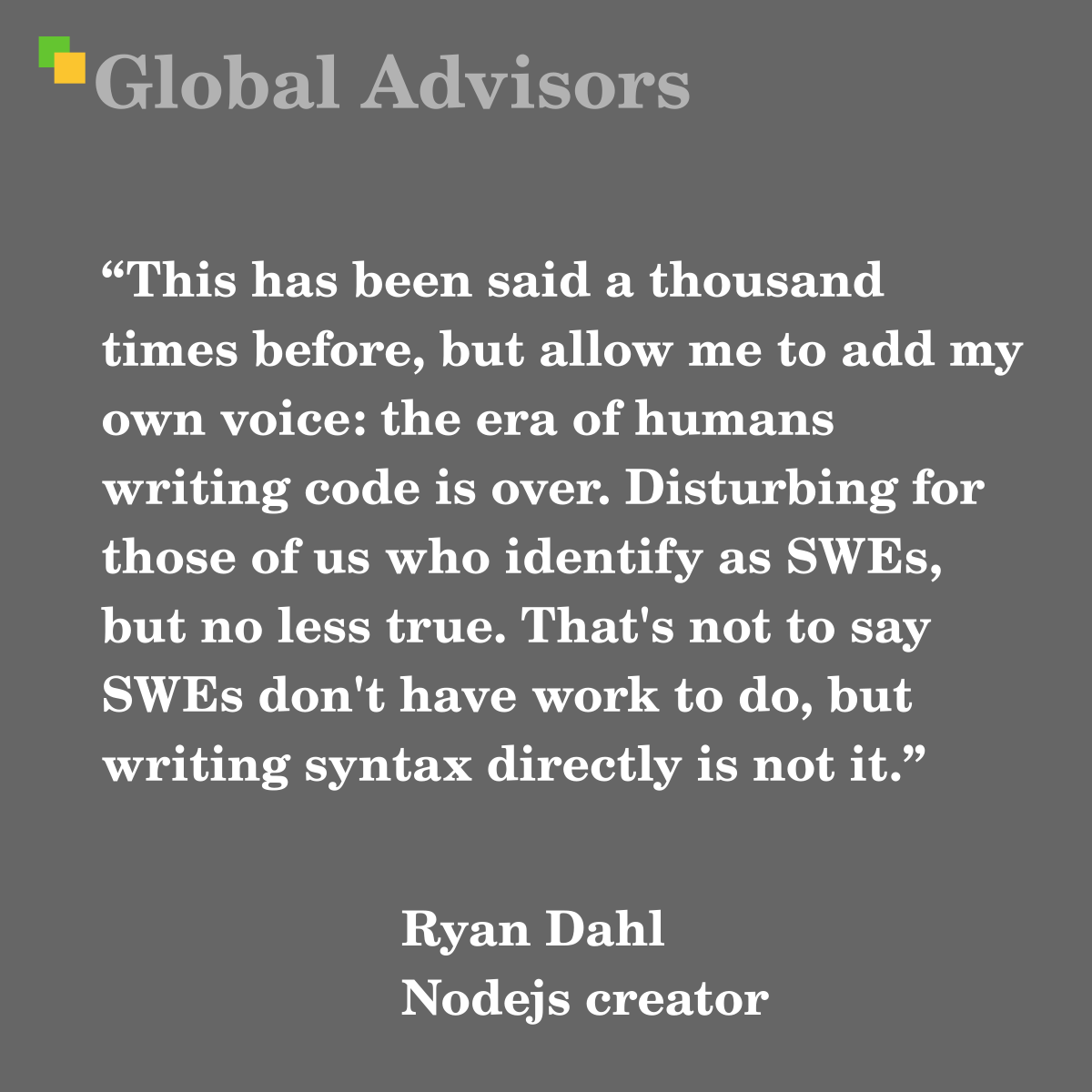
Quote: Ryan Dahl"This has been said a thousand times before, but allow me to add my own voice: the era of humans writing code is over. Disturbing for those of us who identify as SWEs, but no less true. That's not to say SWEs don't have work to do, but writing syntax directly is not it." - Ryan Dahl - Nodejs creatorRyan Dahl's candid declaration captures a pivotal moment in software engineering, where artificial intelligence tools like Claude and Codex are reshaping the craft of coding. As the creator of Node.js and co-founder of Deno, Dahl speaks from the front lines of innovation, challenging software engineers (SWEs) to adapt to a future where manual syntax writing fades into obsolescence. Who is Ryan Dahl?Ryan Dahl is a pioneering figure in JavaScript runtime environments. In 2009, while a graduate student at the University of California, Los Angeles (UCLA), he created Node.js, a revolutionary open-source, cross-platform runtime that brought JavaScript to server-side development. Node.js addressed key limitations of traditional server architectures by leveraging an event-driven, non-blocking I/O model, enabling scalable network applications. Its debut at the inaugural JSConf EU in 2009 sparked rapid adoption, powering giants like Netflix, Uber, and LinkedIn.1 By 2018, Dahl reflected critically on Node.js's shortcomings for massive-scale servers, noting in interviews that alternatives like Go might suit such workloads better-a realisation that prompted his departure from heavy Node.js involvement.2 This introspection led to Deno's launch in 2018, a modern runtime designed to fix Node.js pain points: it offers secure-by-default permissions, native TypeScript support, and bundled dependencies via URLs, eschewing Node's npm-centric vulnerabilities. Today, as Deno's CEO, Dahl continues advocating for JavaScript's evolution, including efforts to challenge Oracle's JavaScript trademark to free the term for generic use.1 Dahl's career embodies pragmatic evolution. He views TypeScript-Microsoft's typed superset of JavaScript-as the language's future direction, predicting standards-level integration of types, though he respects Microsoft's stewardship.1 Context of the QuoteDelivered via X (formerly Twitter), Dahl's words respond to the explosive rise of AI coding assistants. Tools like Claude (Anthropic's LLM) and Codex (OpenAI's precursor to GPT models, powering GitHub Copilot) generate syntactically correct code from natural language prompts, rendering rote typing archaic. The quote acknowledges discomfort among SWEs-professionals who pride themselves on craftsmanship-yet insists the shift is inevitable. Dahl clarifies that engineering roles persist, evolving towards higher-level design, architecture, and oversight rather than syntax drudgery. This aligns with Dahl's history of bold pivots: from Node.js's server-side breakthrough to Deno's security-focused redesign, and now to AI's paradigm shift. His voice carries weight amid 2020s AI hype, urging adaptation over denial. Leading Theorists on AI and the Future of CodingDahl's thesis echoes thinkers at the intersection of AI and software development:
These voices build on earlier foundations: Alan Kay's 1970s vision of personal computing democratised programming, now amplified by AI. Critics like Grady Booch warn of over-reliance, stressing human insight for complex systems, yet consensus grows that AI accelerates rote tasks, freeing creativity. Implications for Software EngineeringDahl's provocation signals a renaissance: SWEs must master prompt engineering, AI evaluation, system design, and ethical oversight. Node.js's legacy-empowering non-experts via JavaScript ubiquity-foreshadows AI's democratisation. As Deno integrates AI-native features, Dahl positions himself at this frontier, inviting engineers to evolve or risk obsolescence.
References 1. https://redmonk.com/blog/2024/12/16/rmc-ryan-dahl-on-the-deno-v-oracle-petition/ 2. https://news.ycombinator.com/item?id=15767713
|
| |
| |
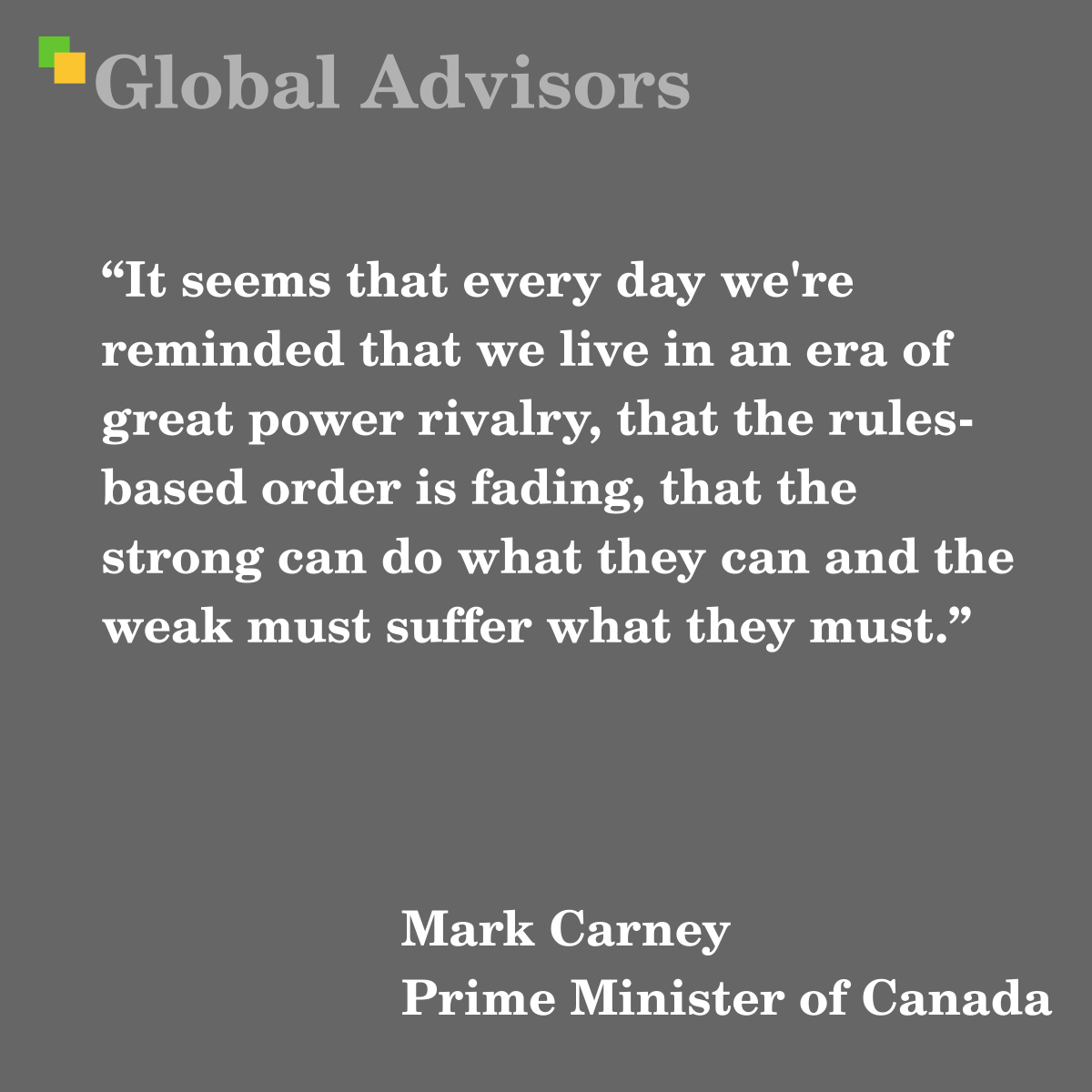
Quote: Mark Carney"It seems that every day we're reminded that we live in an era of great power rivalry, that the rules-based order is fading, that the strong can do what they can and the weak must suffer what they must." - Mark Carney - Prime Minister of CanadaMark Carney's invocation of Thucydides at the World Economic Forum represents far more than rhetorical flourish-it signals a fundamental recalibration of how middle powers must navigate an era of renewed great power competition. Delivered at Davos on 20 January 2026, the Canadian Prime Minister's address articulates a doctrine of "value-based realism" that acknowledges the erosion of the post-Cold War international architecture whilst refusing to accept the fatalism such erosion might imply. The Context: A World in TransitionCarney's speech arrives at a pivotal moment in international affairs. The rules-based order that underpinned global stability since 1945-and particularly since the Cold War's conclusion-faces unprecedented strain from great power rivalry, economic fragmentation, and the weaponisation of interdependence. The Canadian Prime Minister's diagnosis is unflinching: the comfortable assumptions that geography and alliance membership automatically confer prosperity and security are no longer valid.1 This is not mere academic observation; it reflects lived experience across the Western alliance as traditional frameworks prove inadequate to contemporary challenges. The quote itself draws directly from Thucydides' account of the Melian Dialogue, wherein the Athenian envoys declare that "the strong do what they can and the weak suffer what they must." By invoking this ancient formulation, Carney grounds contemporary geopolitical anxiety in historical precedent, suggesting that the current moment represents not an aberration but a return to a more primal logic of international relations-one temporarily obscured by the post-1989 liberal consensus. The Intellectual Foundations: Realism and Its EvolutionCarney's framework draws upon several strands of international relations theory, most notably classical realism and its contemporary variants. The concept of "value-based realism," which Carney attributes to Alexander Stubb, President of Finland, represents an attempt to synthesise realist analysis of power distribution with liberal commitments to human rights, sovereignty, and territorial integrity.1 This is a deliberate intellectual move-rejecting both naive multilateralism and amoral power politics in favour of a pragmatic middle path. Classical realism, articulated most influentially by Hans Morgenthau in the mid-twentieth century, posits that states are rational actors pursuing power within an anarchic international system. Morgenthau's seminal work Politics Among Nations established that national interest, defined in terms of power, constitutes the objective of statecraft. Yet Morgenthau himself recognised that power encompasses more than military capacity-it includes economic strength, technological capability, and moral authority. Carney's approach resurrects this more nuanced understanding, arguing that middle powers possess distinct forms of leverage beyond military might. The realist tradition has evolved considerably since Morgenthau. Kenneth Waltz's structural realism emphasised the anarchic nature of the international system and the security dilemma it generates, wherein defensive measures by one state appear threatening to others, creating spirals of mistrust. This framework helps explain contemporary great power competition: as American hegemony faces challenge from rising powers, each actor rationally pursues security through military buildups and alliance formation, inadvertently triggering the very insecurity it seeks to prevent. Carney's diagnosis aligns with this logic-the "end of the rules-based order" reflects not malice but the structural pressures inherent in multipolarity. More recent theorists have grappled with how middle powers navigate such environments. Scholars such as Andrew Pratt and Fen Osler Hampton have examined "middle power diplomacy," arguing that states lacking superpower status can exercise disproportionate influence through coalition-building, norm entrepreneurship, and strategic positioning. This intellectual tradition directly informs Carney's prescription: middle powers must act together, creating what he terms "a dense web of connections across trade, investment, culture" upon which they can draw for future challenges.1 The Diagnosis: Structural TransformationCarney's analysis identifies three interconnected phenomena reshaping the international landscape. First, the erosion of the rules-based order reflects genuine shifts in material power distribution. The post-Cold War moment, characterised by American unipolarity and the apparent triumph of liberal democracy, has given way to multipolarity and ideological contestation. Great powers-whether the United States, China, or Russia-increasingly view international institutions and agreements as constraints on their freedom of action rather than frameworks for mutual benefit. Second, economic interdependence, once theorised as a force for peace, has become weaponised. Sanctions regimes, technology restrictions, and supply chain manipulation now constitute standard instruments of statecraft. This transformation reflects what scholars term the "securitisation" of economics-the process whereby economic relationships become framed through security logics. Carney explicitly warns against this: middle powers must resist the temptation to accept "economic intimidation" from one direction whilst remaining silent about it from another, lest they signal weakness and invite further coercion.1 Third, the traditional alliance structures that provided security guarantees to middle powers have become less reliable. NATO's continued existence notwithstanding, the United States under various administrations has questioned its commitment to collective defence, whilst simultaneously pursuing unilateral policies (such as tariff regimes) that undermine allied interests. This creates what Carney identifies as a fundamental strategic problem: bilateral negotiation between a middle power and a hegemon occurs from a position of weakness, forcing accommodation and competitive deference.1 The Intellectual Lineage: From Thucydides to Contemporary GeopoliticsCarney's invocation of Thucydides connects to a broader contemporary discourse on great power competition. Graham Allison's "Thucydides Trap" thesis-the proposition that conflict between a rising power and a declining hegemon is structurally likely-has become influential in policy circles. Allison argues that of sixteen historical cases where a rising power challenged a ruling one, twelve ended in war. This framework, whilst contested by scholars who emphasise contingency and agency, captures genuine anxieties about Sino-American relations and broader multipolarity. Yet Carney's deployment of Thucydides differs subtly from Allison's. Rather than accepting the Trap as inevitable, Carney uses the ancient formulation to establish a baseline-the world as it actually is, stripped of comforting illusions-from which alternative paths become possible. This reflects what might be termed "tragic realism": an acknowledgment of structural constraints coupled with insistence on human agency and moral choice. Contemporary theorists of middle power strategy have developed frameworks relevant to Carney's prescription. Scholars such as Amitav Acharya have examined how middle powers can exercise "agency" within structural constraints through what he terms "norm localisation"-adapting global norms to regional contexts and thereby shaping international discourse. Similarly, theorists of "minilateral" cooperation-agreements among smaller groups of like-minded states-provide intellectual scaffolding for Carney's vision of issue-specific coalitions rather than universal institutions. The Prescription: Strategic Autonomy and Collective ActionCarney's response to this diagnosis comprises several elements. First, building domestic strength: Canada is cutting taxes, removing interprovincial trade barriers, investing a trillion dollars in energy, artificial intelligence, and critical minerals, and doubling defence spending by decade's end.1 This reflects a classical realist insight-that international influence ultimately rests upon domestic capacity. A state cannot punch above its weight indefinitely; sustainable influence requires genuine economic and military capability. Second, strategic autonomy: rather than accepting subordination to any hegemon, middle powers must calibrate relationships so their depth reflects shared values.1 This requires what Carney terms "honesty about the world as it is"-recognising that some relationships will be transactional, others deeper, depending on alignment of interests and values. It also requires consistency: applying the same standards to allies and rivals, thereby avoiding the appearance of weakness or double standards that invites further coercion. Third, coalition-building: Carney proposes plurilateral arrangements-bridging the Trans-Pacific Partnership and European Union to create a trading bloc of 1.5 billion people, forming buyers' clubs for critical minerals anchored in the G7, cooperating with democracies on artificial intelligence governance.1 These initiatives reflect what might be termed "competitive multilateralism"-creating alternative institutional frameworks that function as described, rather than relying on existing institutions that have become gridlocked or captured by great powers. This approach draws upon theoretical work on institutional design and coalition formation. Scholars such as Barbara Koremenos have examined how states choose institutional forms-examining when they prefer bilateral arrangements, multilateral institutions, or minilateral coalitions. Carney's framework suggests that in an era of great power rivalry, minilateral coalitions organised around specific issues prove more effective than universal institutions, precisely because they exclude actors whose interests diverge fundamentally. The Philosophical Underpinning: Beyond NostalgiaCarney's most provocative claim may be his insistence that "nostalgia is not a strategy."1 This rejects a tempting response to the erosion of the post-Cold War order: attempting to restore it through diplomatic pressure or institutional reform. Instead, Carney argues, middle powers must accept that "the old order is not coming back" and focus on building "something bigger, better, stronger, more just" from the fracture.1 This reflects a philosophical stance sometimes termed "constructive realism"-accepting structural constraints whilst refusing to accept that they determine outcomes. It echoes the existentialist insight that humans are "condemned to be free," forced to choose even within constraining circumstances. For middle powers, this means accepting that great power rivalry is real and structural, yet refusing to accept that this reality precludes agency, moral choice, or the possibility of building alternative arrangements. The intellectual roots of this position extend to theorists of social construction in international relations, particularly Alexander Wendt's argument that "anarchy is what states make of it." Whilst the anarchic structure of the international system is given, the meaning states attribute to it-whether it necessitates conflict or permits cooperation-remains contestable. Carney's vision assumes that middle powers, acting together, can construct a different meaning of multipolarity: not a return to Hobbesian warfare but a framework of genuine cooperation among states that share sufficient common ground. Contemporary Relevance: The Middle Power MomentCarney's address arrives at a moment when middle power agency has become increasingly salient. The traditional Cold War binary-alignment with either superpower-has dissolved, creating space for states to pursue more autonomous strategies. Countries such as India, Brazil, Indonesia, and the European Union member states increasingly resist pressure to choose sides in great power competition, instead pursuing what scholars term "strategic autonomy" or "non-alignment 2.0." Yet Carney's formulation differs from classical non-alignment. Rather than attempting to remain neutral between competing blocs, he proposes active coalition-building among states that share values-democracy, human rights, rule of law-whilst remaining pragmatic about interests. This reflects what might be termed "values-based coalition-building," distinguishing it both from amoral realpolitik and from idealistic universalism. The stakes Carney identifies are genuine. In a world of great power fortresses-blocs organised around competing powers with limited cross-bloc exchange-middle powers face subordination or marginalisation. Conversely, in a world of genuine cooperation among willing partners, middle powers can exercise disproportionate influence through coalition-building and norm entrepreneurship. Carney's challenge to middle powers is thus existential: act together or accept subordination. This framing resonates with contemporary scholarship on the future of international order. Scholars such as Hal Brands and Michael Beckley have examined whether the liberal international order can be reformed or whether it will fragment into competing blocs. Carney's implicit answer is that the outcome remains undetermined-it depends on choices made by middle powers in the coming years. This is neither optimistic nor pessimistic but genuinely open-ended, contingent upon agency. The Broader ImplicationsCarney's Davos address represents more than Canadian foreign policy positioning. It articulates a vision of international order that acknowledges structural realities-great power rivalry, the erosion of universal institutions, the weaponisation of economic interdependence-whilst refusing to accept that these realities preclude alternatives to hegemonic subordination or great power conflict. For middle powers, this vision offers both diagnosis and prescription: the world has changed fundamentally, but middle powers retain agency if they act together with strategic clarity and moral consistency. The intellectual traditions informing this vision-classical and structural realism, middle power diplomacy theory, constructivist international relations scholarship-converge on a common insight: international order is not simply imposed by the powerful but constructed through the choices and actions of all states. In an era of multipolarity and great power rivalry, this construction becomes more difficult but also more consequential. The question Carney poses to middle powers is whether they will accept the role assigned to them by great power competition or whether they will actively construct an alternative. References 2. https://www.youtube.com/watch?v=miM4ur5WH3Y 3. https://www.youtube.com/watch?v=btqHDhO4h10 4. https://www.youtube.com/watch?v=NjpjEoJkUes 5. https://www.youtube.com/watch?v=vxXsXXT1Dto
|
| |
| |
Quote: Mark Carney - Prime Minister of Canada"It is time for companies and countries to take their signs down... You cannot live within the lie of mutual benefit through integration when integration becomes the source of your subordination." - Mark Carney - Prime Minister of CanadaIn his special address at the World Economic Forum's Annual Meeting 2026 in Davos, delivered on 20 January 2026, Canada's Prime Minister Mark Carney issued a stark warning about the collapse of the rules-based international order. The quote captures Carney's pivot towards 'value-based realism,' urging nations to abandon naive assumptions of automatic prosperity through globalisation and instead prioritise strategic autonomy, domestic strength, and recalibrated alliances.3,5 Mark Carney: From Central Banker to Prime MinisterMark Joseph Carney, born on 16 March 1965, is a Canadian economist and politician serving as Canada's 24th Prime Minister since March 2025. Elected leader of the Liberal Party with over 85.9% of the vote on 9 March 2025, Carney was sworn in as Prime Minister on 14 March without prior elected office, a first in Canadian history. He represents Nepean in Parliament and led the Liberals to a minority government in the subsequent election.1,2 Carney's career trajectory is marked by high-profile roles in global finance. He served as Governor of the Bank of Canada from 2008 to 2013 and then as Governor of the Bank of England from 2013 to 2020, becoming the first non-Briton in that position. Post-governorship, he advised Canadian Prime Minister Justin Trudeau on COVID-19 economic responses and chaired the Liberal Party's Task Force on Economic Growth in 2024. Ideologically a centrist technocrat and 'Blue Grit Liberal,' Carney's premiership has focused on economic resilience amid geopolitical tensions.2 Since taking office, Carney has enacted transformative policies: repealing the federal consumer carbon tax, passing the One Canadian Economy Act to eliminate interprovincial trade barriers, fast-tracking a trillion dollars in investments in energy, AI, critical minerals, and infrastructure, and doubling defence spending by decade's end. His government has recognised the State of Palestine, improved ties with China-including a January 2026 visit yielding tariff reductions on canola and electric vehicles-and sustained support for Ukraine.2,3,4 Context of the Quote: Davos 2026 and Canada's Strategic ShiftCarney's address came amid an escalating trade war with the United States and the erosion of post-Cold War globalisation. He declared the end of comfortable assumptions that geography and alliances guaranteed security and prosperity, advocating engagement 'with open eyes' and relationships calibrated to shared values. Canada, he noted, was among the first to heed this 'wake-up call,' shifting to build strength at home while inviting middle powers to join in 'value-based realism'-a term borrowed from Finland's President Alexander Stubb.3 The speech highlighted domestic actions like tax cuts on incomes, capital gains, and business investment, alongside broad engagement to maximise influence in a fluid world. Carney received a standing ovation, underscoring the resonance of his message on naming 'reality' and acting decisively.2,3 Leading Theorists on Globalisation, Integration, and SubordinationCarney's critique echoes longstanding debates in international relations and economics on the limits of globalisation. Key theorists provide intellectual foundations for his views:
These thinkers collectively underscore Carney's thesis: integration's promise of mutual benefit dissolves when it enables dominance, necessitating realism over idealism in trade and alliances. References 1. https://www.pm.gc.ca/en/about 2. https://en.wikipedia.org/wiki/Mark_Carney 5. https://www.youtube.com/watch?v=miM4ur5WH3Y 6. https://www.youtube.com/watch?v=7qIUrFANCvU 7. https://www.youtube.com/watch?v=01QBT5fR-DY
|
| |

| |
Quote: Mark Carney - Prime Minister of Canada"We know the old order is not coming back. We shouldn't mourn it; nostalgia is not a strategy. But we believe that from the fracture, we can build something bigger, better, stronger, and more just." - Mark Carney - Prime Minister of CanadaMark Carney's address at the World Economic Forum in Davos on 20 January 2026 articulated a philosophical pivot that extends far beyond Canadian policy. His assertion that "the old order is not coming back" represents a candid acknowledgement of the structural transformation reshaping international relations-a transformation that demands not nostalgic resistance but strategic innovation. The quote encapsulates a broader intellectual movement among contemporary policymakers who recognise that the post-Cold War consensus, built on rules-based multilateralism and assumed Western dominance, has fundamentally fractured. The Context of Carney's InterventionCarney delivered this address as Canada's 24th Prime Minister, having assumed office in March 2025 following his election as Liberal Party leader with an unprecedented 85.9% of the vote on the first ballot. His ascension marked a significant departure in Canadian political history: he became the first Canadian Prime Minister never to have held elected office before assuming the premiership. This unconventional trajectory-from central banking to the highest political office-reflects the technocratic orientation increasingly evident in responses to complex geopolitical challenges. The timing of Carney's Davos intervention proved strategically significant. His address came mere days after a high-profile visit to Beijing, where he met with Chinese President Xi Jinping and negotiated a "new strategic partnership" that substantially reduced tariffs on Canadian canola oil (from 85% to 15%) and Chinese electric vehicles (from 100% to 6.1%). This diplomatic manoeuvre exemplified the very philosophy he articulated at Davos: rather than lamenting the erosion of Western-led institutional frameworks, Canada was actively recalibrating its relationships to reflect contemporary geopolitical realities. The Intellectual Architecture: Value-Based RealismCarney's formulation draws explicitly on what he termed "value-based realism," a concept articulated by Alexander Stubb, President of Finland. This framework represents a deliberate synthesis of two traditionally opposed analytical traditions: the idealist commitment to universal values (human rights, sovereignty, democratic governance) and the realist acknowledgement of power dynamics and national interest. Rather than treating these as contradictory, value-based realism posits that nations can maintain principled commitments whilst simultaneously engaging pragmatically with the world as it exists rather than as they wish it to be. This intellectual positioning reflects broader currents in contemporary international relations theory. The concept challenges what scholars term "liberal internationalism"-the post-1945 consensus that institutionalised rules, multilateral organisations, and shared norms could transcend power politics. Carney's acknowledgement that "the old comfortable assumptions that our geography and alliance memberships automatically conferred prosperity and security" no longer hold valid represents a significant concession to structural realist arguments that have long emphasised the primacy of material capabilities and strategic positioning over institutional arrangements. Leading Theorists and Intellectual FoundationsStructural Realism and the Multipolar Transition: Carney's analysis aligns substantially with structural realist scholarship, particularly the work of scholars examining the transition from unipolarity to multipolarity. Theorists such as John Mearsheimer have long argued that the post-Cold War unipolar moment was inherently unstable and that the rise of peer competitors (particularly China) would inevitably erode the institutional frameworks built during American hegemony. Carney's acknowledgement that "the powerful have their power" whilst Canada must "build our strength at home" reflects this realist recognition that material capabilities ultimately determine strategic options. Strategic Autonomy and Middle Power Theory: Carney explicitly positioned Canada as a "middle power" capable of exercising disproportionate influence through strategic positioning. This concept draws on middle power theory, developed by scholars including Andrew Cooper and Evan Potter, which argues that states occupying the intermediate tier of the international system can leverage their geographic position, institutional expertise, and coalition-building capacity to exercise influence beyond their material weight. Carney's emphasis on "building strategic autonomy whilst maintaining values" reflects this theoretical framework-middle powers must avoid dependency on great power patrons whilst retaining the principled commitments that differentiate them from purely transactional actors. The Fracture Metaphor and Institutional Decay: Carney's use of "fracture" rather than "collapse" or "transformation" carries theoretical significance. This language echoes the work of scholars examining institutional erosion, particularly those studying the decline of post-war multilateral organisations. Theorists including Dani Rodrik have documented how globalisation and geopolitical competition have strained the institutional consensus that underpinned the Bretton Woods system and its successors. The fracture metaphor suggests not apocalyptic breakdown but rather the splintering of previously unified frameworks into competing regional and bilateral arrangements. Constructivist Approaches to Order-Building: Carney's assertion that "from the fracture, we can build something bigger, better, stronger, and more just" reflects constructivist international relations theory, which emphasises that international orders are socially constructed rather than determined by material forces alone. Scholars including Alexander Wendt have argued that actors can reshape international structures through strategic communication and norm entrepreneurship. Carney's framing positions Canada not as a passive victim of systemic change but as an active participant in constructing new institutional arrangements-a distinctly constructivist orientation. The Rejection of Nostalgia as Strategic DoctrineCarney's explicit rejection of nostalgia as a strategic framework warrants particular attention. This formulation directly challenges what scholars term "nostalgic nationalism"-the tendency of declining powers to seek restoration of previous hierarchies rather than adaptation to new circumstances. The statement "nostalgia is not a strategy" functions as both intellectual critique and practical warning. It implicitly critiques both American efforts to reassert unilateral dominance and European attempts to preserve Cold War alliance structures unchanged. This positioning reflects contemporary debates within strategic studies about how established powers should respond to relative decline. Scholars including Hal Brands have examined whether declining powers typically pursue accommodation or confrontation; Carney's framework suggests a third path: strategic recalibration that preserves core values whilst abandoning outdated institutional assumptions. Domestic Foundations: Building Strength at HomeCarney's emphasis on building "strength at home" through tax reductions, removal of interprovincial trade barriers, and a trillion-dollar investment programme in energy, artificial intelligence, and critical minerals reflects economic nationalism tempered by liberal institutional commitments. This approach synthesises elements of developmental state theory (the strategic deployment of state capacity to build competitive advantage) with market-liberal principles. The doubling of defence spending by decade's end, coupled with investments in domestic industrial capacity, reflects what scholars term "strategic decoupling"-the deliberate reduction of dependency on potentially unreliable partners through domestic capability development. This domestic orientation also reflects recognition of what political economists call the "trilemma of globalisation": the impossibility of simultaneously maintaining democratic sovereignty, deep economic integration, and fixed exchange rates. By prioritising sovereignty and strategic autonomy, Carney's government implicitly accepts reduced integration with some partners whilst deepening selective relationships (notably with China) where mutual benefit is demonstrable. The Broader Geopolitical SignificanceCarney's Davos address arrived at a moment of acute geopolitical tension. The ongoing trade conflict with the United States, the continuation of Russian aggression in Ukraine, and the intensifying competition for technological and resource dominance between Western and Chinese-led blocs have created what scholars term a "multiplex world order"-one characterised by simultaneous cooperation and competition across multiple domains rather than simple bipolarity or unipolarity. His reception-described as earning "a rare standing ovation" at Davos-suggests that his articulation of value-based realism resonated with an international audience of business and political leaders grappling with similar strategic dilemmas. The framework offers intellectual legitimacy for the pragmatic recalibration that many middle and smaller powers have already undertaken, whilst maintaining rhetorical commitment to universal principles. Implications for International Order-BuildingCarney's vision of building "something bigger, better, stronger, and more just" from the fracture of the old order represents an optimistic but contingent proposition. It assumes that the emerging multipolar system need not replicate the zero-sum competition that characterised earlier multipolar eras, and that institutional innovation can accommodate both great power competition and cooperative problem-solving on transnational challenges. This optimism reflects what scholars call "liberal institutionalism"-the belief that even in anarchic international systems, institutions can facilitate cooperation and reduce transaction costs. Yet Carney's framework differs from earlier liberal institutionalism in its explicit acknowledgement that such institutions must reflect contemporary power distributions rather than attempting to preserve outdated hierarchies. The Canada-China strategic partnership, with its focus on trade, energy, and technology, exemplifies this approach: cooperation structured around mutual benefit rather than ideological alignment or institutional obligation. The intellectual coherence of Carney's position lies in its rejection of false dichotomies. It refuses the choice between principled commitment and pragmatic engagement, between national interest and international cooperation, between acknowledging systemic change and working to shape its trajectory. Whether this framework can sustain itself amid intensifying great power competition remains an open question-one that will substantially determine the character of the emerging international order. References 2. https://www.pm.gc.ca/en/about 3. https://en.wikipedia.org/wiki/Mark_Carney 5. https://www.youtube.com/watch?v=miM4ur5WH3Y 6. https://www.youtube.com/watch?v=7qIUrFANCvU 7. https://www.youtube.com/watch?v=01QBT5fR-DY
|
| |
| |
Term: Forward Deployed Engineer (FDE)"An AI Forward Deployed Engineer (FDE) is a technical expert embedded directly within a client's environment to implement, customise, and operationalize complex AI/ML products, acting as a bridge between core engineering and customer needs." - Forward Deployed Engineer (FDE)Forward Deployed Engineer (FDE)A Forward Deployed Engineer (FDE) is a highly skilled technical specialist embedded directly within a client's environment to implement, customise, deploy, and operationalise complex software or AI/ML products, serving as a critical bridge between core engineering teams and customer-specific needs.1,2,5 This hands-on, customer-facing role combines software engineering, solution architecture, and technical consulting to translate business workflows into production-ready solutions, often involving rapid prototyping, integrations with legacy systems (e.g., CRMs, ERPs, HRIS), and troubleshooting in real-world settings.1,2,3 Key Responsibilities
Essential Skills and Qualifications
FDEs differ from traditional support or sales engineering roles by writing production code, owning outcomes like a "hands-on AI startup CTO," and enabling scalable AI delivery in complex enterprises.2,5,7 In the AI era, they excel as architects of agentic operations, leveraging AI for diagnostics, automation, and pattern identification to accelerate value realisation.7 Best Related Strategy Theorist: Clayton ChristensenThe concept of the Forward Deployed Engineer aligns most closely with Clayton Christensen (1947–2020), the Harvard Business School professor renowned for pioneering disruptive innovation theory, which emphasises how customer-embedded adaptation drives technology adoption and market disruption—mirroring the FDE's role in customising complex AI products for real-world fit.2,7 Biography and Backstory: Born in Salt Lake City, Utah, Christensen earned a BA in economics from Brigham Young University, an MPhil from Oxford as a Rhodes Scholar, and a DBA from Harvard. After consulting at BCG and founding Innosight, he joined Harvard faculty in 1992, authoring seminal works like The Innovator's Dilemma (1997), which argued that incumbents fail by ignoring "disruptive" technologies that initially underperform but evolve to dominate via iterative, customer-proximate improvements.8 His theories stemmed from studying disk drives and steel minimills, revealing how "listening to customers" in sustained innovation traps firms, while forward-deployed experimentation in niche contexts enables breakthroughs. Relationship to FDE: Christensen's framework directly informs the FDE model, popularised by Palantir (inspired by military "forward deployment") and scaled in AI firms like Scale AI and Databricks.5,6 FDEs embody disruptive deployment: embedded in client environments, they prototype and iterate solutions (e.g., GenAI agents) that bypass headquarters silos, much like disruptors refine products through "jobs to be done" in ambiguous, high-stakes settings.2,5,7 Christensen advised Palantir-like enterprises on scaling via such roles, stressing that technical experts "forward-deployed" accelerate value by solving unspoken problems—echoing FDE skills in rapid problem identification and agentic orchestration.7 His later work on AI ethics and enterprise transformation (e.g., Competing Against Luck, 2016) underscores FDEs' strategic pivot: turning customer feedback into product evolution, ensuring AI scales disruptively rather than generically.1,3 References 1. https://avaamo.ai/forward-deployed-engineer/ 2. https://futurense.com/blog/fde-forward-deployed-engineers 3. https://theloops.io/career/forward-deployed-ai-engineer/ 4. https://scale.com/careers/4593571005 5. https://jobs.lever.co/palantir/636fc05c-d348-4a06-be51-597cb9e07488 7. https://www.rocketlane.com/blogs/forward-deployed-engineer 8. https://thomasotter.substack.com/p/wtf-is-a-forward-deployed-engineer 9. https://www.salesforce.com/blog/forward-deployed-engineer/
|
| |
| |
|


| |
| |