| |
|

| |
| |
| |
|
A daily bite-size selection of top business content. |
| |
| |
| |
Term: Tokenmaxxing - Artificial intelligence"Tokenmaxxing is a workplace trend and slang term where employees maximise their AI tool usage and treat high token consumption as a direct metric of personal productivity. Workers compete on internal company leaderboards to see who can 'burn' the most AI tokens-the basic units of text processed by language models." - Tokenmaxxing - Artificial intelligence Obsessions with activity metrics rarely end well for organisations. When a single, easily measured input becomes a proxy for effectiveness, employees rationally optimise for that number even if it degrades the underlying work. Counting AI tokens is simply the latest incarnation of this pattern: a technical billing unit is being elevated into a performance scoreboard, with strategic, financial and cultural consequences that reach far beyond the infrastructure budget. The underlying mechanism: when cost telemetry becomes a KPI Large language models process text in small units called tokens, each representing a few characters of input or output text. Providers meter and bill usage in these units; a typical business integration pays per or tokens processed, often at different rates for input and output. What began as internal cost telemetry for AI infrastructure has, in some firms, been repurposed as a people metric: managers track tokens per employee, teams are benchmarked against one another, and dashboards surface who is consuming the most AI capacity. The logic appears seductively simple. If AI tools make knowledge workers more productive, and tokens measure how much of those tools they use, then more tokens should correlate with more work completed or more value created. This framing encourages employees to increase their AI interaction volume, often by running larger prompts, more autonomous workflows, or multiple agents in parallel. In some companies this has evolved into explicit competition, with internal leaderboards that celebrate the highest token burners and occasionally attach perks or performance narrative to their ranking. Once the metric is operationalised this way, a classic Goodhart dynamic emerges. As soon as token consumption becomes a target, employees begin to optimise directly for it: prompts get longer than necessary, loops are allowed to run unattended, and tasks are split or duplicated purely to increase measured AI involvement. What had been a neutral measure of system utilisation becomes a distorted proxy for individual impact. What tokens represent in practice From a technical standpoint, a token is a fragment of text or symbol that a model uses as a basic processing unit. A short word may be a token; a longer word might be split into multiple tokens; punctuation marks typically count individually. A frequently cited rule of thumb is that one token corresponds to roughly four characters of English text, which equates to approximately three-quarters of a word on average. In the accounting systems of model providers, total tokens for a request are simply the sum of input tokens and output tokens. Costs and usage limits are then linear in token volume: if and are per-token prices for input and output, and , are the respective counts, the marginal cost of a single call is For an organisation, aggregate monthly spend is the sum of this cost across all calls made by all users and systems. In that sense, total tokens consumed provide a clean, additive measure of AI workload and associated expenditure. It is therefore natural for finance and platform teams to track metrics such as tokens per team, per product, or per service, alongside traditional infrastructure statistics like CPU hours or storage consumption. Problems arise when this cost telemetry is reinterpreted as a direct measure of employee productivity rather than system utilisation. As several commentators have noted, using token counts to assess individual performance is an updated version of measuring developers by lines of code or sales staff by number of emails sent. In all these cases the metric captures volume of activity, not the quality, relevance or impact of that activity. Tokenmaxxing as a workplace behaviour In some technology firms, combining token dashboards with cultural pressure to be seen embracing AI has created a distinctive pattern of behaviour. Employees compete, formally or informally, to consume the most tokens, on the assumption that high AI usage signals that they are more ambitious, more efficient or more aligned with leadership priorities. Internal messaging may emphasise that staff should use AI for every possible task, and low token numbers can be read as resistance or underperformance. Because modern models can generate thousands of tokens per minute, especially in coding or multi-agent workflows, it is straightforward for a motivated individual to push their numbers sharply upwards. Techniques include writing highly verbose prompts with extensive context, chaining many calls in agent loops, configuring large context windows that pull in documents wholesale, and spinning up background tasks that run continuously. From an infrastructure perspective, this looks like heavy adoption of AI tools; from a business perspective, it may simply represent noisy churn. Some organisations have added game-like features on top of this telemetry. Leaderboards sort employees by their token burn, dashboards broadcast aggregate consumption, and anecdotal reports describe managers informally praising high-ranking staff as early AI power users. In extreme cases workers leave autonomous agents running around the clock, generating vast volumes of tokens with limited supervision. The result can be significant cloud and API spend that is only loosely connected with meaningful business outcomes. A simple quantitative description Although tokenmaxxing is fundamentally behavioural and cultural, it can be described in simple quantitative terms. Consider a team of employees over a period (say, one month). Let denote the total tokens consumed by employee in that period, and denote a measure of their output quality or business impact. Tokenmaxxing culture implicitly assumes that there is a strong positive relationship between and , often approximated by a monotonic function such as with increasing and representing noise. In many implementations, the assumption is effectively linear: doubling tokens is presumed to mean roughly doubling AI-assisted productivity. Empirical concerns focus on the fact that beyond a basic threshold of adoption, the marginal relationship between tokens and outcomes can easily flatten or even become negative: additional prompts may produce redundant or lower-quality work, require more human review, or introduce new errors. In that case, the true relationship may look more like a concave function or even a hump-shaped curve where, past some optimum , additional token use damages effective productivity. A blind focus on maximising then pushes employees into the region where , i.e. extra AI consumption no longer improves outcomes. From a cost perspective, if the organisation pays an average price per token, its AI spend over the period is Tokenmaxxing increases without necessarily improving , thereby lowering the implicit return on AI investment, often dramatically. Productivity, vanity metrics and misaligned incentives The central tension is that tokens are a clean measure of AI inputs but a poor measure of human productivity outputs. Advocates argue that tracking token usage encourages experimentation, accelerates cultural adoption, and reveals where AI can have the largest impact. Visible leaderboards, they claim, help normalise AI use and highlight internal champions who build new workflows or automation scripts. Critics counter that this is a textbook vanity metric. Just as counting emails sent failed to tell managers whether clients were better served, counting tokens says nothing about whether customer issues were resolved faster, products shipped sooner, or risks reduced more effectively. Treating token totals as a performance KPI encourages AI theatre : activity that looks technologically sophisticated but has limited commercial or operational value. The analogy to lines of code is especially instructive. Measuring developers by the volume of code they produce led to bloated, fragile systems and maximised work-in-progress rather than delivered value. Many engineers and managers see tokenmaxxing as repeating this mistake in a new medium: optimising for quantity of AI interaction rather than the quality and impact of the resulting artefacts. Where developers previously padded functions, they may now pad prompts and agent chains. Why the practice has emerged now Several structural forces have converged to make tokenmaxxing appealing to leadership and individual workers. First, AI tools are still relatively new in everyday workflows, so executives feel pressure to demonstrate adoption to investors, boards and the market. Publishing internal token statistics or highlighting heroic usage stories allows companies to claim rapid transformation even before rigorous productivity studies are complete. Second, the economics of AI APIs tie vendor revenue directly to token volume. This creates an ecosystem-level bias towards normalising heavy usage as a sign of progress and sophistication, in contrast to traditional software licences which were largely decoupled from intensity of day-to-day use. Vendor marketing frequently frames high token consumption as evidence of strong AI integration rather than a potential cost overhang. Third, measurement of knowledge work has always been difficult. Traditional output metrics can be lagging, noisy or hard to compare across roles. Infrastructure telemetry feels objective and immediately available; in the absence of better-designed indicators, it is being repurposed as a proxy for impact. For time-poor managers, seeing a dashboard with rising token counts may provide psychological reassurance that their teams are not being left behind. Consequences for costs, culture and capability The financial implications are obvious. High-end models with large context windows and rich tool use can be significantly more expensive per token than earlier systems, and organisations experimenting aggressively report startling increases in AI line items, in some cases rivaling or exceeding the salary costs of the very employees whose work the tools are meant to augment. Tokenmaxxing multiplies this pressure by encouraging usage patterns that are structurally wasteful: long-running agents left unsupervised, redundant queries against the same context, or verbose, exploratory interactions that are never distilled into reusable automations. Culturally, tying performance narratives to token burn risks entrenching superficial AI usage. Employees learn that visible interaction with AI matters more than critical thinking about when and how to deploy it. Those who prefer to use models selectively and rigorously may find themselves disadvantaged relative to colleagues who choreograph conspicuous AI-heavy workflows. Over time, this can erode trust between technical and non-technical staff, as engineers tasked with controlling costs clash with managers incentivised to trumpet adoption. There is also a capability cost. When the goal is to maximise tokens, there is little incentive to refine prompts, streamline pipelines or design efficient multi-agent architectures. Engineers who could otherwise focus on optimisation and reliability are instead rewarded for orchestrating larger, more expensive runs. This differs sharply from traditional performance engineering, where success often consists of reducing resource consumption for the same or better output. Alternative ways to use token data None of this implies that token telemetry is useless. On the contrary, it is valuable when treated as an input to cost management, capacity planning and workflow analysis, not as a direct measure of individual effectiveness. Several practitioners advocate a layered approach: - Use tokens primarily as a financial and operational signal: which teams, products or services drive the largest AI costs, and how does that map to revenue or risk reduction? - Normalise token usage by relevant outcome metrics, such as tickets resolved, features shipped, or incidents mitigated, to estimate cost per unit of value rather than raw consumption. - Investigate spikes or anomalies in token graphs as potential indicators of inefficient workflows, misconfigurations or emerging high-value use cases that deserve further investment. - Set budgets and guardrails for unattended agent loops, including stop conditions and audit logs, to prevent runaway spending while still enabling ambitious experiments. At the same time, productivity measurement should gravitate toward outcome-based indicators. Suggestions commonly include changes in cycle time for projects, error and rework rates, client satisfaction scores, capacity to handle more work with the same headcount, innovation outputs such as prototypes or experiments, and financial figures such as revenue per employee. In this framing, AI usage is evaluated by how much it improves these measures, not by how many tokens it burns along the way. Positioning tokenmaxxing within broader AI governance The controversy over tokenmaxxing is a microcosm of a broader governance challenge: distinguishing between genuine AI-enabled transformation and metric-driven theatre. As AI systems become more capable and more deeply embedded in workflows, organisations will need robust frameworks for deciding where measurement helps and where it distorts behaviour. Some commentators recommend treating AI tokens analogously to cloud compute or energy consumption in data centres: important for budgeting, sustainability and operational planning, but never as a proxy for individual merit. Others argue that the very existence of token leaderboards reflects premature attempts to quantify an evolving technology before its most valuable use cases are fully understood. In their view, early phases should focus on qualitative learning, careful experimentation and targeted domain integration rather than high-volume generic prompting. There is also an emerging counter-trend towards deliberate token minimisation. As the true costs of large-scale model usage become more visible, some teams are actively optimising prompts, choosing cheaper models for routine tasks, constraining context windows, and redesigning workflows to achieve the same outcomes with fewer tokens. These efforts often report substantial reductions in usage - sometimes on the order of 70-80 percent - without measurable loss in output quality, illustrating how weak the correlation between raw token burn and productivity can be. Why the concept still matters Even if tokenmaxxing as a fashionable label eventually fades, the underlying issues it crystallises will remain central to AI-era management. It surfaces questions about how to measure knowledge work when machine assistance blurs the line between individual and system output; how to balance exploration and exploitation in adopting powerful but costly tools; and how to design incentives so that people pursue value, not vanity metrics. Understanding the mechanics of token accounting, and the temptation to turn tokens into performance targets, is therefore not just a curiosity about a Silicon Valley fad. It is a case study in the dangers of conflating resource usage with value creation, especially when the resource in question is both easy to count and heavily marketed as a symbol of innovation. As organisations continue to integrate AI into core processes, the lesson is clear: use token data to manage systems and budgets, but judge human contribution by the quality, timeliness and impact of the outcomes delivered, not by the number of digital counters incremented along the way.
|
| |

| |
Global Advisors News Brief - June 25 2026Read the full brief at the link Headlines for the last 24hrs
Time window: 2026-06-24T05:00:33.070Z to 2026-06-25T05:00:33.070Z |
| |
| |
Quote: Aswath Damodaran - Professor of Finance at Stern School of Business"Distributions of values are good to counter hubris, because what they show you is: this is my estimate of value, and this is how wrong I can be." - Aswath Damodaran - Kerschner Family Chair in Finance Education, Professor of Finance at Stern School of Business of New York University Valuation in public markets suffers from a deeply human problem: the urge to collapse uncertainty into a single, confident number. Analysts publish target prices, founders cling to pitch-deck valuations, and boards defend deal multiples as if they were facts rather than beliefs. That impulse is not merely a stylistic choice; it is a structural source of risk, because it conceals how fragile those numbers are to modest changes in assumptions, competitive dynamics, or funding conditions. The tyranny of the single number Traditional discounted cash flow models institutionalise this problem. A spreadsheet typically outputs one intrinsic value, often carried out to two decimal places, as though the valuation were the result of a physical measurement rather than a probabilistic estimate. In practice, every component that feeds that value - revenue growth, margins, reinvestment rates, risk-free rates, equity risk premia, default spreads - is uncertain and correlated with other unknowns. This single-number culture invites overconfidence. Once a valuation is expressed as one figure, discussion drifts towards defending that figure rather than interrogating the assumptions that produced it. Analysts tweak discount rates to "fix" discrepancies with market prices, or fine-tune terminal growth by 0,25 percentage points to justify a deal premium, turning the model into a receptacle for narrative rather than a tool for confronting uncertainty. The psychological temptation is to turn valuation into a debate about being right, instead of a structured exploration of how wrong one could plausibly be. In volatile domains such as early-stage technology, space infrastructure, or artificial intelligence platforms, the gap between the apparent precision of the number and the true uncertainty behind it can be enormous. When markets extrapolate optimistic narratives into aggressive growth and margin paths, a point estimate can hide a very wide probability mass of possible outcomes, including substantial downside. That is the breeding ground for hubris: the illusion that a favourable central case is destiny rather than one draw from a broad distribution. From point estimates to probabilistic thinking Probabilistic valuation reframes the task. Rather than asking "what is this company worth?", it asks "what is the distribution of possible values, given what we know and do not know?". This shift requires modelling uncertainty explicitly in the key inputs and propagating that uncertainty through to the value itself. At the foundation sits the familiar discounted cash flow relationship, where the value of a risky asset is expressed as the present value of expected cash flows discounted at a risk-adjusted rate: In practice, analysts plug in point estimates for and . In a probabilistic framework, selected inputs are replaced with distributions: revenue growth might follow a triangular distribution bounded by conservative and aggressive scenarios, operating margin might be modelled as a normal distribution around a base case, and the cost of capital might be allowed to vary with macro conditions. Monte Carlo simulation operationalises this idea. Instead of one run of the model, the analyst performs thousands of iterations. Each iteration draws random realisations of uncertain inputs from the specified distributions, computes a corresponding cash flow path and discount rate, and produces a single implied value. After, say, 10 000 runs, the result is not a number but a value distribution: a full empirical approximation of the probability that the firm is worth any given amount. This probabilistic approach does not remove uncertainty; it makes uncertainty visible. Scenario analysis and decision trees serve similar purposes when risk is best captured through discrete states of the world or sequential hurdles. In each case, the central intellectual move is the same: accept that multiple futures are possible and that the valuation exercise should quantify, rather than suppress, that fact. Humility as a quantitative output The strategic significance of a value distribution is not merely computational; it is behavioural. When the output of a valuation is a range with associated probabilities, it becomes difficult to sustain the illusion of deterministic foresight. A median value of 50 with a 10-90 percentile range from 20 to 110 tells a very different story from a bare claim that the company is "worth 50". This structure forces several confronting questions. First, what is the probability that the asset is worth less than the current market price? Secondly, how far could one be off in a plausible downside scenario? Thirdly, what fraction of the distribution relies on extreme good fortune - market share dominance, benign regulation, unusually low capital intensity - to justify today's valuation? Asking these questions in probabilistic terms pushes analysts away from absolutist language and towards humility about both model and judgement. Hubris in markets often masquerades as rigour: ever more detailed spreadsheets, sprawling tabs, and cross-linked models. Yet, as Damodaran repeatedly argues in his work on uncertainty, adding line-item detail does not meaningfully reduce estimation error; it simply hides it deeper in the model. The more levers one introduces, the easier it becomes to "solve" for a desired value while persuading oneself that the result is analytically grounded. A value distribution, by contrast, focuses attention on a small set of fundamental drivers and reveals how sensitive the entire exercise is to them. This is also a defence against narrative overreach. When new technologies like reusable rockets or foundation AI models inspire vivid growth stories, investors can become anchored on the upside path and underweight the probability and severity of adverse outcomes. By quantifying the spread of possible values, distributions make it harder to ignore the left tail. Even when the mean or median value appears to justify a high price, a fat downside tail may warn that the situation is closer to a speculation than a disciplined investment. Context: SpaceX, AI, and the big market delusion Recent discussions about the valuation of companies in areas such as commercial space, AI infrastructure, and platform-scale software provide a vivid test case. Businesses that address enormous total addressable markets are often awarded valuations that assume they will capture a substantial fraction of that opportunity with high and durable margins. When those markets are poorly understood or still forming, traditional point estimates tend to be anchored on a stylised success path. Damodaran's broader analysis of the "big market delusion" emphasises that large potential markets are systematically over-capitalised and over-valued because investors underestimate competition, execution risk, and regulatory response. For a company like SpaceX, for example, one can tell a persuasive story about satellite internet, launch services, and downstream applications. Yet each layer introduces new uncertainties: launch reliability, spectrum allocation, cost curves for competitors, and evolving political constraints on space-based capabilities. In that environment, a single DCF value glosses over the fact that many combinations of assumptions are plausible. Some pathways produce enormous equity value; others produce fairly modest outcomes if competition intensifies, unit economics disappoint, or capital markets become less forgiving. A distribution of values makes that divergence plain and provides a quantitative antidote to narratives that conflate possibility with probability. The same logic applies to AI businesses. Many models assume aggressive adoption, high switching costs, and long-run pricing power for infrastructure platforms. Yet the field is characterised by rapid technological progress, open-source competition, uncertain regulation, and unknown end-user willingness to pay. By treating these as random variables rather than fixed inputs, simulations can illuminate not just the upside potential but also how quickly value erodes if margins compress or capital expenditure remains structurally high. From uncertainty avoidance to uncertainty design Most valuation processes in practice are structured to suppress uncertainty. Investment committees often demand a single fair value, a single upside, a single downside, and a crisp internal rate of return. Analysts learn to round off messy ranges into precise numbers because decision-makers are uncomfortable with probabilistic narratives. This cultural preference incentivises overconfident modelling and encourages people to under-state parameter uncertainty or correlation. Probabilistic valuation requires re-designing that culture. The question is no longer "what is the right number?" but "what is a reasonable characterisation of the range and its drivers?". That is a more honest and demanding task. It demands parsimony in model structure - focusing on the handful of variables that genuinely drive value - and discipline in connecting those variables to observable data. It also demands transparency about the subjective judgements embedded in the choice of distributions and correlations. Damodaran's own guidance on dealing with uncertainty emphasises this disciplined minimalism: use fewer inputs when faced with uncertainty, build internal checks for reasonableness, and avoid letting the discount rate absorb all your doubts. Value distributions are most informative when they are generated from a model that is both simple enough to understand and constrained enough to prevent internally inconsistent assumptions. A complex simulation layered on an incoherent model does not counter hubris; it automates it. Risk, diversification, and the law of large numbers Once valuations are expressed as distributions, portfolio questions can also be framed probabilistically. One investment may have a relatively narrow value distribution centred modestly above price; another may have a much wider distribution with a similar median but a larger right tail. A risk-averse investor might prefer the former; a risk-seeking investor, the latter. Yet both choices are now explicitly about tolerances for tail risk rather than latent assumptions of certainty. Here the law of large numbers becomes an ally. If the distribution of errors across many valuations is roughly symmetric and independent, then a diversified portfolio can harness diversification to make aggregate outcomes more predictable even when individual positions are highly uncertain. In probabilistic terms, if each valuation error has and finite variance, then the portfolio-level error shrinks in proportion to as the number of holdings increases. That formalises Damodaran's repeated argument that diversification is not an admission of ignorance but a rational response to unavoidable noise. This perspective also leads to a more nuanced view of concentration risk. Concentrated positions effectively place a large weight on the tails of a single value distribution. If that distribution is poorly specified or heavily reliant on untested assumptions, the investor is implicitly betting not just on the business but on the accuracy of their own model. By making the breadth of the distribution explicit, probabilistic valuation allows one to see how much of the risk is business risk and how much is model-confidence risk. Margin of safety as a probabilistic concept Value distributions naturally lead to a richer treatment of margin of safety. Traditional value investing often works with a fixed percentage discount to a point estimate of intrinsic value - for example, buying only if price is at least 40 % below estimated value. That approach assumes that estimation error is roughly constant across opportunities. Yet uncertainties differ drastically between mature utilities, cyclical industrials, pre-revenue biotech, and frontier technology. A fixed margin of safety ignores this heterogeneity. In a probabilistic framework, margin of safety can instead be tied to the shape of the value distribution. One might ask what price level corresponds to the 25th percentile of the distribution and decide to buy only if the market trades below that level. Alternatively, one might target situations where the probability that value exceeds price by a given multiple exceeds a chosen threshold. In formal terms, let be the random variable representing intrinsic value and the market price. A probabilistic margin of safety could be defined by conditions such as or , depending on risk preferences. The distribution makes these probabilities computable rather than intuitive guesses. That reframes margin of safety from a static buffer to a dynamic function of uncertainty. Limits, objections, and misuses Critics of probabilistic valuation raise several objections. One is that specifying input distributions imposes a veneer of false precision. Encoding "revenue growth is between 5 % and 25 % with a most likely value of 12 %" into a triangular distribution may look scientific, but the parameters are themselves judgement calls. Another concern is that Monte Carlo simulation can lull users into complacency; dense histograms and percentile bands can create the impression that uncertainty has been fully captured when key risks - such as regulatory shocks or business model breakage - are structurally absent from the model. These criticisms are valid as warnings, not as refutations. The answer is not to retreat to point estimates, which conceal their subjectivity, but to acknowledge that distributions are only as good as the thoughtfulness of the assumptions behind them. Damodaran's own work repeatedly stresses the need for economic first principles: growth cannot permanently exceed the economy, margins cannot rise indefinitely without competitive response, and total revenues must remain plausible relative to the addressable market. Distributions that violate these constraints are numerically elegant but conceptually hollow. A second practical limitation is organisational. Many investment or corporate finance processes are not set up to digest probabilistic outputs. Committees often want a single internal rate of return, a single net present value, a single target price. Shifting to distributions requires education, changes to reporting templates, and a willingness to embed probability language into mandates and incentives. In some contexts - for instance, regulatory capital calculations - this shift is already happening; in others, it remains culturally difficult. A third risk is selective use. It is tempting to deploy simulations only where they support an attractive upside story, while sticking to point estimates for more mundane cases. That asymmetry reintroduces bias. To genuinely counter overconfidence, probabilistic methods need to be integrated into the standard toolkit rather than reserved for high-profile narratives. Why it matters for capital allocation Despite these limitations, the move from single-point valuations to distributions has important implications for how capital is raised, allocated, and monitored. For boards evaluating transformative acquisitions, a value distribution can reveal whether the headline synergies are do-or-die assumptions or marginal contributors. If the transaction only creates value in the upper decile of assumed cost savings, decision-makers can recognise that they are effectively betting on execution perfection. For founders and venture investors, distributions put a discipline around long-tail narratives. A start-up whose value relies almost entirely on a small, extreme right tail of the distribution may still merit investment, but its risk should be priced as such and position sizes set accordingly. Conversely, a company with a moderate median value but a very limited downside tail may deserve larger, lower-return allocations as a stabilising anchor. For asset allocators, probabilistic thinking allows more coherent aggregation of risk across strategies. Instead of summing up "expected returns" derived from incompatible point estimates, they can examine portfolio-level distributions that incorporate the variability and correlation of underlying valuations. That enables more informed decisions about how much exposure to concentrate in high-uncertainty segments like early-stage technology relative to more stable cash-generative businesses. Underlying all these applications is a simple, uncomfortable recognition: valuation is unavoidably a blend of data, economic structure, and judgement. Point estimates pretend otherwise, encouraging a confidence that is not justified by the state of knowledge. Distributions do not make the uncertainty go away, but they give it shape, and by doing so, they create space for more honest conversations about how much one really knows - and how much one might be wrong by - before committing capital.
|
| |

| |
Term: Soft dollars - Corporate finance"'Soft dollars' refers to an illegal or highly controversial 'kickback' scheme where institutional investors funnel trading commissions back to an underwriter to secure allocations of 'hot' IPOs." - Soft dollars - Corporate finance The contested feature of soft dollars is not the accounting label itself but the way commission flow can blur the line between paying for execution and paying for access, research, or favours. In legitimate market practice, soft-dollar arrangements allow an investment manager to use client commissions to obtain brokerage and research services, but that structure has long been criticised for weak transparency and for creating incentives that may not align cleanly with end investors' interests.
|
| |

| |
Global Advisors News Brief - June 24 2026Read the full brief at the link Headlines for the last 24hrs
Time window: 2026-06-23T05:00:33.084Z to 2026-06-24T05:00:33.084Z |
| |
| |
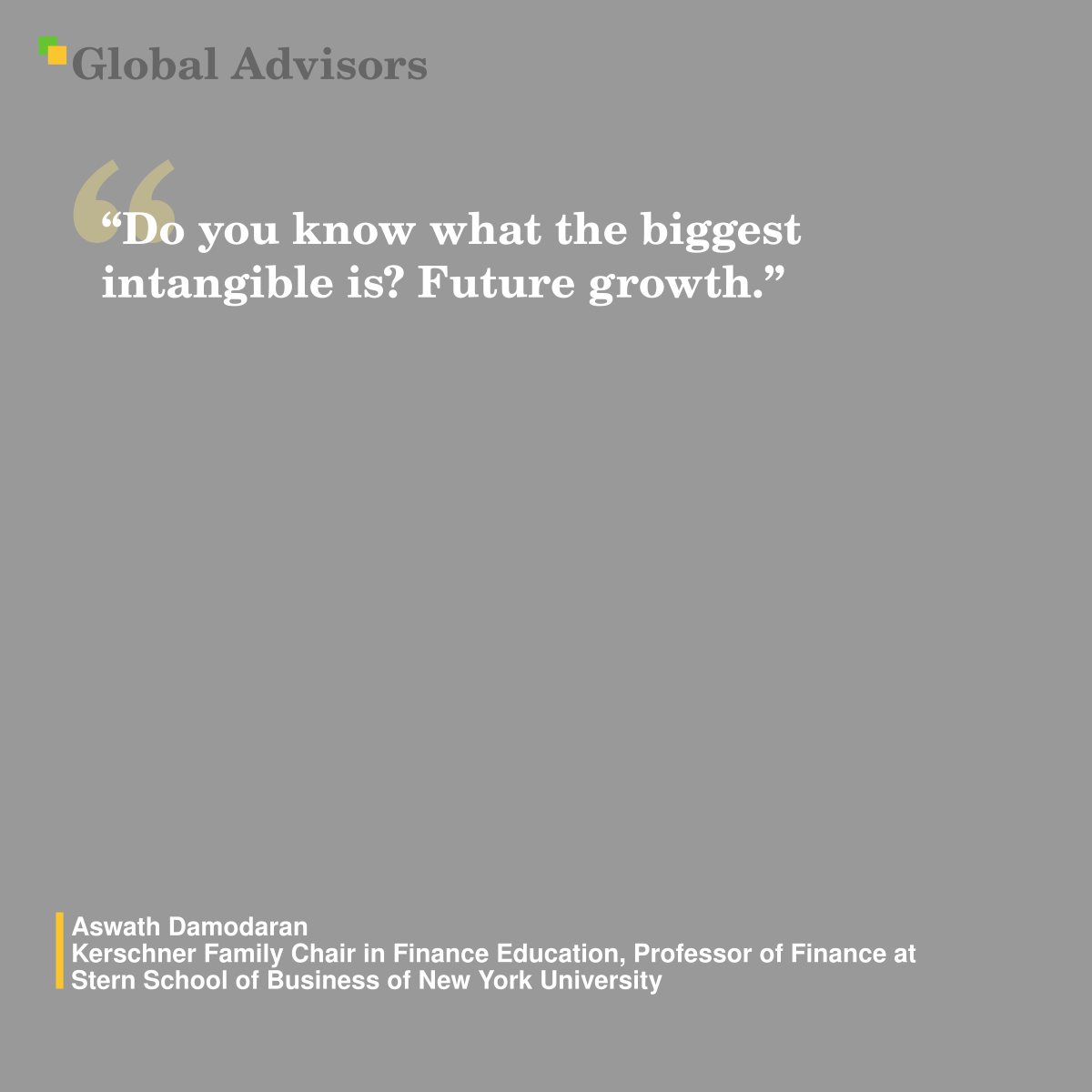
Quote: Aswath Damodaran - Professor of Finance at Stern School of Business"Do you know what the biggest intangible is? Future growth." - Aswath Damodaran - Kerschner Family Chair in Finance Education, Professor of Finance at Stern School of Business of New York University Equity markets today are dominated by businesses whose most important assets do not sit on a factory floor or appear cleanly on a balance sheet. Software platforms, artificial intelligence models, orbital networks, brands and ecosystems all promise cash flows that are mostly still to come, and investors routinely pay valuations that can only be justified if those promises materialise at scale. The analytical problem is not whether such businesses can have enormous value; it is how much of that value is grounded in demonstrable economics and how much is simply hope dressed up as narrative. From factories to code: the rise of the invisible balance sheet The transformation of corporate value over the past three decades is stark. In the 1980s and 1990s, the largest listed companies were dominated by capital-heavy sectors whose worth could be roughly proxied by tangible assets and established cash flows. Today, the top market capitalisations are technology and platform firms whose physical footprint is modest relative to their valuations, but whose market prices embed expectations about data, network effects, intellectual property and human capital. That shift has created what is sometimes called the invisible balance sheet: the pool of competitive advantages and capabilities that standard accounting either misclassifies as expenses or ignores altogether. Economic statistics bear this out. Studies tracking corporate investment show that spending on research and development, software, organisational capital, data and other non-physical capabilities has risen inexorably, often outpacing traditional capital expenditure. Top-quartile growth companies invest more than 2,6 times as much in such intangibles as low growers, evidence that the race for future profits now runs through ideas and code rather than steel and concrete. For investors, the question is not whether intangibles matter, but how to connect these outlays to future cash flows with enough discipline to avoid self-delusion. Damodaran's framing: value as existing assets plus growth assets Aswath Damodaran's valuation framework starts from a deceptively simple decomposition: the worth of a business is the value of cash flows from existing assets plus the value of growth assets, adjusted for risk and the time value of money. Existing assets are the businesses and projects already in place, producing observable revenues and margins. Growth assets are the projects the firm has not yet taken, the markets it has not yet entered, and the improvements in economics that investors expect but have not yet been realised. When market capitalisation exceeds the value of existing assets, the difference is what he labels the value of growth assets. In intrinsic valuation terms, if is enterprise value, the expected cash flows from existing assets, the incremental cash flows from growth assets, the weighted average cost of capital, and the steady-state growth rate beyond a high-growth period, then the stylised structure is: The second term captures the economic payoff from future growth. In mature, low-growth firms this component is small; in young, high-growth or platform businesses it can be the dominant driver of value. When Damodaran refers to the biggest intangible, he is pointing to this wedge: the capitalised value of improvements and expansions that have not yet occurred but are assumed in the price. Accounting blind spots: why future growth is hard to see Standard financial reporting is poorly designed to capture this wedge. Research and development, software engineering, brand-building and training are typically expensed as incurred, reducing current earnings rather than being placed on the balance sheet as assets that generate benefits over multiple years. This treatment may be conservative from an accounting perspective, but it also means that the economic engine of future growth is pushed into the income statement noise rather than recorded as a stock of productive assets. As a result, conventional measures such as return on equity and profit margins can be systematically distorted for intangible-intensive businesses. Damodaran's empirical work shows that capitalising certain categories of expenditure - for example, treating research and development as an asset with an amortisable life - can significantly alter reported profitability and capital efficiency. If a firm invests steadily in research with an assumed life of 5 or 10 years, the adjusted book value of equity and adjusted earnings both rise relative to reported figures, often yielding more meaningful estimates of return on invested capital. Yet even these adjustments only partially bridge the gap, because they rely on backward-looking spend data, whereas market prices embed forward-looking expectations about the productivity of future investments. Growth narratives and the "big market" temptation SpaceX illustrates how the biggest intangible can dominate debate. In the run-up to its planned public listing, the company has been associated with valuations in the to trillion US dollar range, numbers that dwarf the current revenues and cash flows of the business. Analysts decomposing these figures typically ascribe fragments of value to Starlink's broadband business, to launch services, and to emerging lines such as orbital computing and artificial intelligence infrastructure. Sum-of-the-parts exercises might reach trillion US dollars in intrinsic value, leaving hundreds of billions as a residual priced in for future growth, scarcity premia and the allure of a founder associated with previous outlier successes. Corporate presentations add another layer by pointing to enormous total addressable markets. SpaceX materials have framed artificial intelligence as a trillion US dollar opportunity, connectivity as trillion and space as billion, figures designed to signal that even modest market shares could justify lofty valuations. The tension Damodaran has explored in conversations about such cases is not whether these markets are large; it is whether investors are correctly distinguishing between "big market" and "big value". Many companies can point to the same large pie, but only a few will capture durable, high-return slices. From narrative to numbers: disciplining the growth intangible Controlling for hype requires translating stories about the future into explicit, testable assumptions. Damodaran's approach is to force every narrative about competitive advantage, business model or market expansion into three quantitative levers: revenue growth, operating margins and reinvestment. A claim that a firm will dominate a new market must show up as higher expected revenue growth . Assertions about network effects or superior technology must translate into sustainably higher operating margins or long-lived excess returns on capital. Ambitions for rapid expansion must be matched with a reinvestment rate that is compatible with funding constraints and cost of capital. In a stylised framework, if grow at rate and the target operating margin is , then operating income in year is . If the business needs to reinvest at rate to sustain that growth, the free cash flow to the firm becomes: The "biggest intangible" is encoded in , and for future years. Overly optimistic narratives will quietly assume implausibly high growth, ever-expanding margins, or unrealistically low reinvestment needs, yielding cash-flow paths that can justify almost any price. The discipline lies in benchmarking these parameters against the economics of the industry, the history of similar firms and the constraints imposed by competition and capital markets. When growth creates value - and when it destroys it One of Damodaran's more counterintuitive observations is that growth is not automatically valuable. A company that reinvests heavily at returns below its cost of capital destroys value with each additional dollar of expansion, even if reported revenues and earnings are rising. In such cases, the intangible of future growth is negative: the more the firm grows, the less it is worth. This is particularly relevant for companies that chase large markets at the cost of deep discounts, uneconomic customer acquisition and heavy capital intensity. In contrast, growth becomes a powerful positive intangible when the firm can sustain returns above its cost of capital while scaling. Here, every additional unit of incremental capital deployed into high-return projects adds more to enterprise value than it costs. The challenge is empirical: investors must decide whether the business really has the competitive advantages - brand, technology, regulatory barriers, network effects - that allow such excess returns to persist, and for how long. Since many of these drivers are themselves intangible assets, the analytical loop tightens: future growth depends on the durability and monetisation of other intangibles. SpaceX, AI and the "trillion-dollar gap" Damodaran has described a "trillion-dollar gap" between his assessment of SpaceX's intrinsic value and the prices rumoured or proposed in the marketplace. Part of that gap is a straightforward scarcity premium: a large, high-profile listing with limited initial float can trade at a temporary premium as investors scramble for exposure. But a significant portion is also the capitalised value of growth imagined in fields such as orbital computing, global connectivity and artificial intelligence platforms that leverage SpaceX's infrastructure. The AI angle is instructive. The company's pitch positions AI as a market segment measured in tens of trillions of dollars, with SpaceX and its affiliates claiming unique advantages in distributed compute and data. Investors extrapolating from the success of previous AI leaders may be tempted to assume that any credible player capturing even a small share of such vast markets will justify astronomical valuations. Damodaran counters that the relevant questions are narrower: what specific products and services will SpaceX sell, at what margins, with what reinvestment needs, under what competitive conditions? Once those are mapped into cash-flow forecasts, the space for justified growth value shrinks, even if it remains very large. Debates and objections: are markets overpaying for growth? Critics of the current environment argue that investors are systematically overpaying for future growth, particularly in sectors like AI, biotech and space, where uncertainty is extreme and feedback loops are slow. The worry is a replay of prior episodes - the dot-com bubble, the cleantech boom - in which vast sums were allocated based on narratives about transformative technologies and enormous addressable markets, only for capital to be destroyed when unit economics failed to justify the optimism. SpaceX's eye-watering revenue multiples - sometimes cited near times forward sales and over times EBITDA - fuel this concern that the pendulum has swung too far towards growth as an unquestioned good. On the other side, proponents of high valuations point out that conventional metrics are backward-looking and that transformative platforms systematically look expensive before their economics mature. Many of the world's most valuable technology firms spent years investing heavily in intangible assets, posting weak or negative accounting profits while building networks and capabilities that would later yield outsized cash flows. From this perspective, treating growth as the biggest intangible is simply a recognition that the market is paying for optionality in environments where a small probability of extreme success justifies seemingly aggressive prices. Why future growth matters for capital allocation Beneath the market debates lies a more fundamental consequence for corporate behaviour. When investors assign enormous value to future growth, boards and management teams face powerful incentives to prioritise expansion over current profitability. That can be beneficial when it encourages investment in innovation, infrastructure and experimentation that would otherwise be starved. However, it can also lead to overextension, empire-building and a tolerance for value-destructive projects so long as they feed the narrative of a boundless future. Damodaran's framework offers a partial antidote by downgrading growth that fails the excess-return test. If declines towards as a business scales, the incremental value of further expansion falls, even if headline revenues are rising. Managers who understand this dynamic may rationally choose to slow growth, return cash to shareholders, or focus on improving the quality of existing operations rather than chasing every new market adjacent to their core. The discipline of treating future growth as an intangible that must earn its keep - not an automatic virtue - becomes central to long-term value creation. Implications for investors in an intangible-heavy world For investors, taking future growth seriously as the largest intangible reshapes analysis in several ways. First, it requires a move away from simple multiples towards explicit cash-flow modelling, however approximate. Multiples can still be useful as sanity checks, but they implicitly embed assumptions about growth and risk that are rarely unpacked. Second, it makes the study of intangible drivers - talent, culture, product architecture, data advantages, regulatory positioning - as important as understanding plant, property and equipment. Yet these drivers must always be channelled back into the hard numbers of growth, margins and reinvestment. Third, it demands a more probabilistic mindset. When value is dominated by the payoff from uncertain future states, investors must think in terms of distributions rather than point forecasts. Conceptually, one can model enterprise value as an expected value over scenarios, , where is the probability of scenario and the intrinsic value in that state. The "biggest intangible" is then not a single number but a weighted bet across paths the business might take. Valuations such as those surrounding SpaceX suggest that the market is assigning fairly high probability to very optimistic scenarios; Damodaran's more conservative estimates imply lower weights on those outcomes. Finally, the focus on future growth as the dominant intangible has macro implications. As more global wealth is concentrated in firms whose value rests on expectations about innovation, network effects and data, shocks to sentiment around growth can propagate quickly through markets and economies. Conversely, underinvestment in intangible assets can sap productivity and long-term growth at the country level. Policymakers concerned with economic complexity and competitiveness increasingly treat intangible investment - in education, research, digital infrastructure and institutions - as a key lever, mirroring the micro-level dynamics at the firm. A continuing tension between imagination and discipline Future growth, treated as an intangible, sits at the intersection of imagination and discipline. It asks investors to picture businesses and markets that do not yet exist, while simultaneously constraining those visions within the bounds of economic logic and competitive dynamics. Damodaran's work on SpaceX, AI and the broader intangible economy is an attempt to keep that balance: to acknowledge that vast value can reside in prospects not yet visible in cash flows, but to insist that those prospects be translated into explicit, testable assumptions about revenues, margins, reinvestment and risk. In a world where companies sell narratives as much as products, the largest component of valuation will often be the portion that cannot yet be audited, depreciated or insured. Whether that component proves durable value or transient illusion depends on how rigorously both managers and investors interrogate the stories they tell themselves about the future.
|
| |
| |
Term: Sparse Attention - Artificial Intelligence"Sparse attention is an AI technique that optimizes Transformer models by having each token focus only on a small, strategic subset of relevant past tokens, rather than evaluating every possible token pair. This significantly reduces computational costs and memory usage, enabling Large Language Models (LLMs) to process massive contexts." - Sparse Attention - Artificial Intelligence The central pressure shaping current language model design is not sophistication of algorithms but the brutal scaling behaviour of attention. Dense self-attention couples every token to every other visible token, giving models powerful global context at the price of computation and memory in the sequence length . That quadratic wall collides with real-world demands for million-token contexts, low-latency inference and constrained hardware budgets. The result is a design space in which techniques that compress, prune or selectively route attention - without destroying model quality - are now strategically decisive. From dense attention bottlenecks to structured sparsity Transformer self-attention operates by computing pairwise similarity scores between all query and key vectors, then forming a weighted sum of value vectors. For a sequence of length and hidden width , naive implementation requires on the order of operations and an attention matrix with entries. As context length grows from 4 000 to 128 000 tokens, the cost multiplies by a factor of . That scaling is untenable for both training and deployment. Profiled long-context workloads show that the attention matrices of trained models are highly sparse in practice: only a small fraction of token pairs carry large attention weights, while the rest are near-zero. In other words, dense attention spends most of its budget confirming irrelevance. Sparse attention begins from this empirical asymmetry and asks how to construct an attention pattern that computes only the interactions likely to matter, while avoiding substantial degradation in downstream performance. Substantive definition: what is sparse attention doing? In substantive terms, sparse attention replaces the full attention matrix with a pattern in which the overwhelming majority of entries are fixed to zero by design. For each query token, the mechanism restricts the keys it can attend to a strategically chosen subset - often a small window of neighbours, a set of global indices, and perhaps some adaptively selected long-range positions. The effect is to exchange universal visibility for targeted connectivity. Formally, standard scaled dot-product attention for a single head computes where and the softmax is taken row-wise. Sparse attention introduces a binary mask matrix which prevents attention to disallowed positions by setting their logits to a very negative constant before the softmax: Entries mark allowed query-key pairs; (or a large negative value) effectively zeroes those attention weights. When the pattern of non- entries is sparse - for example each query attends to keys with - the attention computation can be implemented in rather than time and memory. Complexity reduction and memory savings The appeal of sparse attention lies in its asymptotic behaviour. For dense attention with sequence length , the cost per layer scales as By restricting each query to at most keys, we can design mechanisms with expenditure approximately If is treated as a constant or grows slowly (for example ), this cost becomes linear or near-linear in . Similar savings apply to memory: instead of storing attention weights and key-value (KV) cache elements, sparse designs track only the subset involved in actual computation. These reductions translate into concrete system-level benefits. Sparse Transformer architectures have demonstrated the ability to model sequences 30 times longer than dense counterparts at similar compute budgets. Industrial comparisons find that tailored sparse patterns enable effective attention over contexts of around 100 000 tokens with approximate memory reductions of 100-1 000 times relative to naive dense baselines, with limited performance loss. Modern KV-cache aware sparse schemes recover 80-90 percent of full-attention accuracy while operating with sparsity levels beyond 95 percent of potential query-key pairs, yielding prefill speedups of 30 times or more over highly optimised dense kernels in million-token regimes. Major pattern families and their practical meaning Sparse attention is not a single method but a family of pattern-design and routing strategies. These can be grouped into several broad categories, each encoding different inductive assumptions about where useful information lies in a sequence. Local or sliding-window patterns Local attention restricts each token to attend to a fixed window of nearby tokens. If the window size is , each query attends to at most keys, giving cost . Sliding-window designs move this window along the sequence, creating a banded attention matrix. This reflects an assumption that most dependencies are short-range - reasonable for local syntax or audio modelling but limiting for tasks requiring distant cross-references. In practice, local patterns are often used as the backbone of more sophisticated schemes. For example, one can make all heads perform local attention in lower layers to capture fine-grained locality, while higher layers use more global or adaptive sparse mechanisms. Global tokens and hierarchical patterns Pure local attention cannot capture long-range structure such as document-level topics or cross-chapter references. To address this, many sparse designs introduce special global tokens or summary positions that are visible to, and from, all tokens. In matrix terms, this keeps a few full columns and rows dense while leaving most entries masked. Approaches such as Extended Transformer Construction (ETC) exploit explicit structure in the input, for example document segments or graph nodes, to define subsets of tokens that act as hubs. Local tokens attend densely within their segment plus a small set of global anchors, while global tokens attend more broadly. This yields effective linear complexity in sequence length while preserving routes for long-range information flow via those anchors. Random and hybrid connectivity Random attention supplements local and global connections with a small number of randomly selected long-range links. The intuition is similar to small-world graphs: a few random edges dramatically shorten path lengths between distant nodes, improving the ability to propagate information without constructing a fully dense adjacency matrix. Hybrid patterns typically define the attention neighbourhood for each token as the union of three sets: a local window, a fixed set of global tokens, and a handful of random or structured long-range targets. This combination aims to balance three types of modelling capacity: precise local detail, coherent global context and flexible long-distance reasoning, all under tight compute budgets. Blockwise and compressed schemes Blockwise methods partition the sequence into contiguous chunks and compute full attention only within each block, or between selected pairs of blocks. Instead of token-level sparsity, the attention matrix becomes sparse at block granularity. Some methods summarise each block into a representative vector and use coarse block-to-block scores to decide which blocks warrant fine-grained attention, effectively using a two-stage routing mechanism. A related but conceptually distinct approach compresses tokens before attention is applied. If the sequence length can be compressed into representative tokens with , dense attention over the compressed sequence has cost instead of . Token compression and anchor-based methods can be combined with sparse attention masks to aggressively reduce both effective length and pairwise connectivity. Dynamic and learned sparsity Static sparsity patterns are fixed before seeing data. Dynamic methods attempt to select attention partners adaptively per query, per input, or per layer. One example is top- routing: an auxiliary scoring network assigns a relevance score to each potential key, and only the top keys are attended for each query. SPARSEK attention embodies this idea by introducing a differentiable top- mask operator, enabling end-to-end learning of which key-value pairs to keep while maintaining linear time and constant memory during generation. Dynamic designs promise better use of the attention budget, since they can concentrate capacity on genuinely task-relevant positions rather than on pattern-defined neighbours. However, they must pay overhead for scoring and routing, and they complicate implementation on modern accelerators, where regular dense kernels are heavily optimised. Mathematical specification and parameter roles Sparse attention mechanisms can be characterised by a small set of structural and hyperparameter choices. Let denote the set of indices of keys that query token is permitted to attend to. The sparse attention output for token can be written as where The structural design problem becomes the selection of for each , given budget constraints and task demands. Key parameters include: - Sparsity level or density > How many keys each query can see, either as an absolute number or as a fraction of . - Pattern type Local, blockwise, global-token augmented, random, hierarchical, or fully learned routing, which determines the structure of . - Head allocation How different attention heads specialise to different distance ranges or structural roles; some modern methods consciously partition the distance spectrum into non-overlapping bands per head. - Window size For local and sliding-window attention, the number of neighbours on each side of the current token. - Global token count For schemes with global positions, how many such tokens exist and how they are selected (learned, fixed, or structure-driven). - Routing overhead For dynamic mechanisms, the complexity and parameterisation of the scoring network or heuristic used to choose . These design degrees of freedom enable a large configuration space. Recent systematic studies explore accuracy-FLOPs Pareto frontiers, revealing that, for very long sequences, larger models with high sparsity can dominate smaller dense models under equal compute budgets. Such analyses motivate scaling strategies in which increased parameter count is paired with increasingly aggressive sparsity in attention. Schools of thought: structured sparsity vs accuracy preservation Research philosophies around sparse attention can be roughly divided into two tendencies. Structured sparsity as inductive bias One camp emphasises sparsity patterns as a way to encode inductive biases about sequence structure. Local windows express a belief that nearby tokens are most informative; global tokens and hierarchical patterns encode the existence of segment-level summaries or key anchors. Methods such as SPAttention go further by structurally partitioning the distance spectrum across heads, compelling different heads to specialise in distinct ranges and eliminating redundancy in multi-head attention. This view argues that many dense attention interactions are not just computationally wasteful but actively unhelpful, encouraging the model to memorise shortcuts instead of learning robust abstractions. Imposing structured sparsity can therefore improve generalisation, interpretability and robustness, not merely efficiency. Sparse approximations to full attention The second camp treats sparsity primarily as an approximation to full quadratic attention, aiming to preserve its behaviour while trimming cost. Techniques like Delta Attention explicitly estimate and correct the error introduced by sparsifying attention. In that approach, a small, strategically chosen subset of queries still performs full dense attention; the discrepancy between dense and sparse outputs for those queries is used to compute a correction term, which is then propagated back to all queries. Formally, if and denote outputs under dense and sparse attention for sampled indices , the method estimates a delta and forms corrected outputs as where interpolates or assigns the estimated correction across tokens. Empirically, this kind of procedure can recover a large fraction of the performance lost to simple sparsification, while maintaining very high sparsity levels and substantial speedups for long contexts. This approximation-focused school is often more conservative regarding inductive bias: the aim is to behave as similarly to dense attention as possible under a given resource budget, rather than to reshape the model's information pathways. Tensions and trade-offs Despite impressive results, sparse attention is not a universal panacea. Several tensions shape current debates. Speed vs capability across tasks Large-scale comparisons across models up to 72B parameters and sequences up to 128K tokens show that no single sparse strategy dominates across all tasks and phases. Methods that perform best on retrieval-style benchmarks may lag on complex aggregation or multi-hop reasoning tasks, and vice versa. Moreover, even modest sparsity levels can cause significant performance drops on at least one benchmark when applied indiscriminately. The isoFLOPs analysis suggests that, for short sequences, increasing density or model size reliably improves performance, whereas for long sequences only highly sparse models sit on the Pareto frontier. This underscores that sparse attention is a tool for particular regimes - especially long-context workloads - rather than a universally superior replacement for dense attention. Careful evaluation per application, sequence length, and latency target remains essential. Hardware efficiency vs algorithmic elegance Many theoretical sparsity gains fail to materialise in wall-clock speed because modern accelerators are highly optimised for dense matrix multiplications. Irregular or fine-grained sparsity can incur additional overhead from indexing, memory indirection and load imbalance. Consequently, practical sparse attention designs increasingly favour blockwise structures, banded patterns and other forms of structured sparsity that align with hardware-friendly kernels. There is an active tension between expressing the most information-efficient pattern and the pattern that maps best onto GPUs or specialised accelerators. Some recent work explicitly frames scalable sparse attention as the task of converting theoretical FLOPs reductions into real-world speedups via hardware-aware design. KV-cache management and long-horizon coherence For deployed LLMs, the dominant bottleneck increasingly lies not in compute FLOPs but in the memory footprint and bandwidth of the KV cache. Sparse attention interacts with this constraint in subtle ways. Sliding-window schemes aggressively evict old tokens, reducing cache size but risking loss of information needed for long-range dependencies. Query-aware sparsity methods, such as page-based or block-based selective retrieval, keep a large cache but only touch a subset of blocks for each new token. The operational question becomes which tokens to preserve, which to compress, and which to drop entirely, such that long-horizon coherence and factual consistency are maintained. There is mounting evidence that different tasks demand distinct cache policies: conversational agents may tolerate aggressive eviction of early context, whereas code assistants or long-form reasoning systems may require much longer effective memory with more careful sparsification. Why sparse attention still matters for modern LLMs The strategic importance of sparse attention has only increased as frontier models target million-token contexts and agentic behaviour. Three considerations stand out. First, scaling laws for sparse attention indicate that, in the long-context regime, it is more compute-efficient to increase model size while increasing attention sparsity than to deploy smaller dense models. This shifts the design frontier: breakthroughs in sparsity are directly translatable into larger, more capable models under fixed hardware budgets. Second, sparse mechanisms are now intertwined with advances in fast inference. Techniques combining sparsified attention with KV-cache compression, blockwise retrieval and learned routing are enabling near-real-time interaction with extremely long documents, codebases and tool outputs without prohibitive latency. In many production systems the difference between viable and impractical deployments is determined precisely by whether attention can be made sparse enough without unacceptable quality loss. Third, the research agenda has moved beyond simply dropping connections. Work on principled structural sparsity, dynamic selection and error-corrected sparse inference suggests that the historical trade-off between speed and performance is not fundamental. Architectures that reorganise and specialise attention across heads, distances and patterns demonstrate that models can retain - or sometimes surpass - dense-attention performance while enjoying significant efficiency gains.
|
| |

| |
Global Advisors News Brief - June 23 2026Read the full brief at the link Headlines for the last 24hrs
Time window: 2026-06-22T05:00:33.067Z to 2026-06-23T05:00:33.067Z |
| |
| |
Quote: Brady Ng - The Ken"Super apps never really took off anywhere outside of the [Chinese Great Firewall], despite attempts to create them...Now, something new is in the works that would help super apps make much more sense. Alipay is getting a built-in agent..." - Brady Ng - The Ken Attempts to transplant an entire digital ecosystem from one regulatory and cultural context into another have repeatedly run into the same wall: users outside China have not reorganised their online lives around a single, general-purpose gateway. The large technology and conglomerate groups that tried to replicate a one-stop mobile environment in India and other markets discovered that assembling many services into one app is not enough; orchestration, not aggregation, is the scarce capability. The emerging generation of AI agents, and Alipay's recent move to embed such an agent natively into its wallet, reframes that problem. Instead of asking consumers to live inside one giant application, the new question is whether an intelligent intermediary can stitch together services across apps, merchants and contexts so effectively that the experience becomes super-app-like without requiring a monolithic front end. Why super apps flourished in China but stalled elsewhere China's mobile internet developed in a compressed window, with hundreds of millions of users coming online via smartphones rather than PCs. In the early 2010s, messaging, payments, ride-hailing, food delivery and e-commerce were all still fluid, contested categories. Fierce competition among a small number of platform giants with access to substantial capital and regulatory room for experimentation created a race to deepen engagement per user rather than per app. When user acquisition costs rose sharply and growth in new internet users slowed, the dominant platforms shifted focus to increasing revenue per user by layering additional services onto their existing bases. That logic made it rational for firms like Tencent and Ant Group to pack payments, mini-programs, gaming, shopping, travel and financial products into a single mobile entry point. Outside the Chinese mainland, the structure of digital markets looked very different. In North America and Europe, many users had already adopted large numbers of specialised apps before any credible super app project appeared. Regulatory frameworks emphasised competition and data protection, making it harder to build the kind of tightly integrated, data-rich ecosystems seen behind the Chinese firewall. Payment systems relied more heavily on card networks and bank-centric rails, limiting the space for wallet providers to become universal identity and transaction layers. In such an environment, consumers grew used to juggling multiple apps, while merchants and regulators were wary of single companies occupying the entire stack from messaging to money. In India and Southeast Asia, the picture was more mixed. Market fragmentation, gaps in digital infrastructure and a largely mobile-first user base created opportunities for super-app-like visions, and companies such as Grab, Gojek and Paytm pushed aggressively in that direction. Yet even there, building a genuine everything-app demanded alignment of payments, logistics, content, and financial services, all under one governance and technology umbrella. Conglomerates could integrate some assets, but they rarely commanded the same level of regulatory protection or data centralisation that Chinese platforms enjoyed. The result was a patchwork of ambitious but incomplete super apps, powerful in particular verticals but unable to reshape the entire consumer digital journey. Commercial incentives, not user love, built the classic super app Contrary to a popular narrative about Asian users supposedly preferring all-in-one applications, detailed reconstructions of China's platform history suggest that most consumers accepted bundled apps because they were the only way to access specific services under conditions of strong platform power. Platform companies were motivated by cross-selling, data synergies and competitive blocking: once a user's payments, social graph and identity all lived in one environment, rival firms faced steep barriers to poaching that user. The super app was, in this reading, the front-end manifestation of a digital conglomerate's internal incentive to reduce churn, increase wallet share and commoditise third-party services accessed as mini-programs or plug-ins. This logic explains why conglomerates and diversified groups in other markets were attracted to the model. If a group already owned telecoms, retail, financial services and travel businesses, collapsing multiple customer apps into a single portal looked like an efficient way to share data, cut marketing costs and create cross-vertical bundles. However, without control over the foundational payment behaviours of the population or a unique social graph, such efforts ran into natural ceilings. Users treated these complexes as loyalty apps tied to a particular brand family rather than universal operating systems for daily life. That divergence between commercial logic and user behaviour reveals a deeper design flaw. The classic super app assumes that the right unit of aggregation is the application itself: one UI, one ID, one wallet, one feed. Yet most people experience their lives not as product categories, but as tasks and situations: getting to work, managing bills, planning holidays. A purely app-centric approach struggles to anticipate and co-ordinate those tasks when they cut across organisational boundaries. The platform can host more services, but it still requires the user to know which mini-program to open, which coupon to apply, which credit product to choose. The cognitive load remains on the user, even if the app count drops. The agent paradigm: from aggregation to orchestration AI agents challenge that assumption by shifting the locus of intelligence from the app cluster to an intermediary that acts on the user's behalf across multiple systems. Defined narrowly, an agent is software that can perceive context, plan, and execute multi-step actions to achieve a user-defined goal, while learning from feedback over time. Instead of offering a storefront of options, an agent can interpret a natural-language instruction - for example, to renew a subscription, organise a trip or manage recurring payments - then decide which services to call, in what order, and under what constraints, before returning a completed outcome for approval. In consumer finance and commerce, this implies a different architecture. The user no longer needs to know which merchant app, bank portal or loyalty programme is relevant to a task. They express an intent in language; the agent evaluates available options, checks balances and constraints, negotiates with APIs and mini-programs, and prepares a transaction. The heavy lifting moves from visual navigation to machine reasoning and protocol-level integrations. In effect, the agent becomes the new operating system for interactions with services that still exist as separate applications behind the scenes. This is where Alipay's decision to extend its wallet into an agentic platform becomes strategically important. By enabling AI agents to initiate and complete payments directly through Alipay, with user authorisation and risk controls, Ant transforms the wallet from a passive rail into an execution substrate for autonomous tools. In China, early implementations like conversational ordering and payment in the Luckin Coffee mini-program show how an assistant can coordinate the whole flow - recommendation, order, payment - without the user tapping through multiple interfaces. For external developers, Alipay's agentic protocols offer a way to embed payment capabilities into their own agents, making the wallet a programmable endpoint rather than merely a consumer-facing app. Reframing the super app question Once agents are capable of orchestrating actions across apps, the earlier question - why did full-spectrum super apps fail outside China? - becomes less central. The more relevant inquiry is who will own the agent-to-rail interface and the associated data. Payments sit at the heart of this contest. To turn a user's intent into a completed transaction, an agent must authenticate identity, understand account balances or credit lines, select an appropriate instrument, and settle funds. Providers that offer agent-friendly payment rails with rich APIs, low latency risk checks and fine-grained consent controls gain leverage as indispensable infrastructure. In that world, a traditional super app is just one of many environments an agent can call into. Users may never open a dedicated wallet application if their preferred personal agent can route payments through it invisibly. The critical questions become: which wallets and banks expose the necessary agent protocols, and which AI platforms integrate those protocols most deeply into their planning and execution engines? Firms that cling to app-centric thinking risk discovering that they have built elaborate gardens that agents visit only as needed, while loyalty and data gravity shift to the agent layer. For technology and industrial groups in markets like India, where earlier super app projects struggled to gain comprehensive traction, this agentic turn is both an opportunity and a threat. On the one hand, they no longer need to convince users to adopt a single mega-app; they can instead expose services and payment capabilities via agent-ready APIs and compete to be the most responsive, transparent and reliable among many options surfaced by agents. On the other, their brand and UX differentiation becomes less visible when users experience them through a third-party agent's conversational interface. Strategic advantage shifts towards depth of integration, quality of data, and compatibility with dominant agent ecosystems. Technical and economic foundations of agentic payments From an economic perspective, the agent model can be framed as a problem of delegated optimisation. The user specifies a goal - for instance, minimising cost subject to quality and convenience constraints - and the agent seeks an action plan that optimises an objective function. Formally, one might imagine an agent maximising expected utility over a set of possible action sequences , under constraints representing budgets, risk preferences and time. While real-world agents rely on approximate methods rather than closed-form solutions, the underlying idea is a shift from menu selection to constrained optimisation on the user's behalf. In payments, risk and control considerations introduce additional layers. Alipay's implementations, for example, emphasise multi-layer security, identity verification and continuous risk control systems that monitor transactions initiated by agents. Conceptually, this can be thought of as applying a risk-scoring function to each transaction initiated for user by agent , and blocking or flagging those where exceeds a threshold set by the wallet provider and regulators. The agent must also respect spending limits, category restrictions and consent scopes defined by the user, which adds a layer of policy-compliance planning to the pure optimisation problem. These technical affordances matter because they directly affect whether regulators and mainstream users will accept agentic commerce at scale. If consumers perceive autonomous payments as opaque, insecure or prone to error, they will resist delegating meaningful control. Conversely, if wallets can provide transparent logs, simple revocation controls and robust recovery mechanisms, the friction of delegation may fall sufficiently for agent-driven flows to become routine. In that case, the economic advantages of automation - lower search costs, better matching, reduced friction - could push a significant share of everyday transactions into agent-orchestrated channels. Debates and objections: control, competition and fragmentation There are, however, material objections to the idea that agents will finally unlock the unrealised promise of the super app. One line of argument holds that app fragmentation is not primarily a UX problem but a reflection of underlying competitive and regulatory structures. Even if agents can navigate between many services, those services are still governed by separate contracts, jurisdictional rules and business models. Agents may smooth over surface friction, but they cannot erase the economic reality that ride-hailing, banking and messaging are regulated and monetised differently. Another concern focuses on concentration of power. If a small number of AI platforms provide the dominant personal agents, those entities could become even more powerful gatekeepers than today's app stores. They would mediate which merchants and services are surfaced, on what terms, and at what implicit ranking. Payments providers that bind themselves tightly to one agent ecosystem risk becoming subordinate rails rather than full-fledged platforms. Conversely, attempts to build proprietary agents tied to a single wallet or bank could recreate the same siloed dynamics that limited super apps' global spread. There is also a question of user trust and cognitive comfort. Many people are willing to let automation handle specific, well-understood tasks - recurring bill payment, subscription management, simple reorders - but may hesitate to grant broad authority to a digital agent that roams across their financial and commercial lives. Expressing goals precisely in natural language can be difficult; mis-specified intents could produce unwanted outcomes. Designers must resolve tensions between autonomy and oversight: agents that require constant confirmation for every step defeat the purpose, while agents that act too freely risk backlash when they make mistakes. Why Alipay's agent move matters beyond China Despite these concerns, Alipay's shift towards agent-native payments is significant for global observers because it illustrates how a mature super app-style wallet repurposes itself for the agent era. Rather than just adding chat interfaces or recommendation features, Ant is exposing granular capabilities - identity, authorisation, payment execution, risk checks - as building blocks that external AI systems can call. In doing so, it indicates one plausible path for other payments providers: treat the agent not as a bolt-on chatbot but as a first-class client whose needs shape protocol design. For Western and Indian financial institutions that never managed to turn their apps into super apps, this offers a different kind of ambition. Instead of chasing the impossible dream of monopolising user attention in a single application, they can aim to be the preferred rails for agents. That means focusing on high-availability APIs, transparent pricing, rich metadata, and robust consent frameworks. Banks and wallets will compete less on splashy front-end design and more on how easily agents can discover, compare and invoke their products. This shift also alters the calculus for regulators. Earlier debates about super apps worried about bundled dominance: a single company controlling messaging, payments, shopping and more, often with limited external interoperability. The agentic model creates new risks - particularly around opaque algorithmic steering and data concentration in AI platforms - but it also offers levers for maintaining competition. Regulators can insist on open, standardised interfaces that allow multiple agents to access payment rails on equal terms, and they can monitor agent ranking behaviour for anti-competitive patterns, much as they do with search engines today. The strategic horizon: from app empires to protocol wars If the trajectory towards agent-mediated commerce continues, the decisive contests are likely to take place at the protocol and standard layer, not the visible app surface. Wallets, banks and merchants will need to answer two strategic questions. First, which agent platforms do they integrate with, and at what depth? Second, do they collaborate on shared standards for consent, payment intent expression and transaction metadata, or try to lock in proprietary schemas that tie agents to their rails? In markets where previous super app projects fell short, the emergence of cross-app agents powered by strong payment infrastructure could produce user experiences that feel super-app-like without any firm owning the full stack. A commuter might ask a personal agent to arrange transport, pay road tolls and manage loyalty points, while the agent quietly orchestrates between multiple mobility apps and a bank account. A household could delegate routine budgeting and bill payment to a financial agent that optimises across banks, credit providers and utilities. No single application would host the entire journey, yet the lived experience would be of a coherent, low-friction layer over fragmented services. In that sense, the apparent failure of the traditional super app model beyond China may turn out to have been a transitional outcome. What conglomerates could not achieve by pulling every service into one branded container may instead be realised by agents that push intelligence into the space between users, apps and payments. The contest is no longer about who can cram the most features into a single icon on a home screen, but about who can best support the autonomous intermediaries that users will increasingly rely on to navigate a complex digital economy.
|
| |
!["Super apps never really took off anywhere outside of the [Chinese Great Firewall], despite attempts to create them...Now, something new is in the works that would help super apps make much more sense. Alipay is getting a built-in agent..." - Quote: Brady Ng - The Ken](https://globaladvisors.biz/wp-content/uploads/2026/06/20260621_09h45_GlobalAdvisors_Marketing_Quote_BradyNg_GAQ.png)
| |
Quote: Lionel Messi - Argentinian football player"I prefer to win titles with the team ahead of individual awards or scoring more goals than anyone else. I'm more worried about being a good person than being the best football player in the world. When all this is over, what are you left with? When I retire, I hope I am remembered for being a decent guy." - Lionel Messi - Argentinian football player Elite sport is usually framed as a zero-sum hierarchy of status, quantified in goals, trophies and awards. Modern football magnifies that hierarchy through global broadcasting, commercialisation and an obsessive statistical culture that reduces complex human performances to leaderboards. Against that backdrop, the question of what remains when the numbers stop accumulating is not sentimental; it is structural. Careers are now longer, media archives are permanent, and the financial rewards for the very best players are so vast that material scarcity is no longer the binding constraint. The real scarcity is reputational: how a player is interpreted once they no longer influence matches each weekend. From Rosario to global icon: context for a different value system Lionel Messi's perspective cannot be separated from his formative environment. Born in Rosario in 1987, he grew up in a working-class, football-saturated culture where street play, family networks and local clubs were more formative than structured academies. A growth hormone deficiency diagnosed in childhood threatened his progression, both medically and financially, as the treatment was costly relative to his family's means. Barcelona's willingness to cover his medical care and relocate the family reshaped his trajectory, embedding him early in an institutional culture that emphasised collective play, technical education and modest public conduct. La Masia's philosophy, heavily influenced by Johan Cruyff's ideas, treated team structure and positional play as non-negotiable foundations. Young players were taught that individual talent only made sense inside a system of passing lanes, pressing triggers and mutual responsibility. This was not just tactical; it was ethical. Success was defined primarily as contribution to the collective, not individual showmanship. That environment intersected with an Argentine football culture haunted by the figure of Diego Maradona, whose genius and chaos still dominate national memory. To grow up Argentine after Maradona is to inherit a double expectation: artistry that borders on the mystical, and a personal life that navigates the dangers of excess and idolatry. Messi's own personality - shy, conflict-averse, family-oriented - interacted with these forces to produce an unusually stable superstar profile. He moved steadily from academy prospect to first-team player in 2004, and then to focal point of one of football's most successful dynasties. Across more than two decades he accumulated a volume of honours unprecedented in the professional game, yet his public narrative has consistently resisted the pure individualism that contemporary sports marketing prefers. The weight of numbers: a player defined yet constrained by statistics The scale of Messi's measurable achievements is difficult to overstate. He is widely regarded as one of the greatest players in history and holds records across club, league and international football. He has won 8 Ballons d'Or, more than any other player, along with 4 The Best FIFA Men's Player awards and multiple UEFA and domestic player-of-the-year titles. At club level he became the all-time top scorer in La Liga with 474 goals and set the record for most goals in a calendar year with 91 in 2012. For Barcelona he scored 672 competitive goals, the most for a single club in football history. These statistics understate his creative influence. Across his career he has supplied more than 400 assists for club and country, producing well over 1 320 direct goal contributions. He is also joint top scorer in World Cup history with 16 goals and holds the record for most assists in international football. Team success has been equally relentless: 10 La Liga titles, 4 Champions League titles and numerous domestic cups in Spain, followed by league and cup success in France and North America. Internationally, the narrative that he lacked trophies for Argentina was overturned decisively by Copa Am?rica 2021 and the 2022 World Cup triumph. In a sports culture dominated by data, such records create a gravitational pull. Media coverage, fan arguments and commercial campaigns often flatten careers into comparative tables - goals per season, titles per club, awards versus rivals such as Cristiano Ronaldo. In that ecosystem, personal worth can appear synonymous with statistical dominance. The tension arises when an athlete recognises both the reality of those numbers and their insufficiency as a measure of a life. Team success versus individual awards: reordering the hierarchy of value Modern football's incentive structure pushes players towards personal metrics: goal tallies, expected goals, key passes, dribbles completed. Contracts often include bonuses indexed to individual statistics and award shortlists. Yet Messi has repeatedly framed his priorities in terms of collective success, describing team titles as more meaningful than individual awards. This attitude aligns with the way he plays: drifting into midfield to facilitate, sacrificing central scoring positions to create space for others, and accepting system roles under different managers even when they reduced his individual scoring potential in the short term. From a strategic point of view, privileging team trophies over personal accolades can be rational. Titles depend on coordination, tactical understanding and mutual trust, attributes that enhance the collective and tend to sustain long-term success for a club or national side. Individual awards, by contrast, are partly shaped by narrative, marketing and media visibility. They are path-dependent: early recognition amplifies future votes, and the decision-making process is often influenced by recency bias and geopolitical factors. By anchoring value in team achievements, a player implicitly critiques the volatility and subjectivity of personal awards. There is also a deeper professional calculation. Team titles are harder to dismiss historically; they are embedded in club honour boards and national memory. A Champions League win or a World Cup medal becomes part of a collective mythology that survives changes in fashion. Individual awards, though prestigious, are more obviously tied to the specific era's preferences and media ecosystem. Choosing the former over the latter as the primary goal is a way of securing a more robust legacy. Character, humility and the politics of being "a decent guy" Messi's stated concern with being a good person rather than the best player in the world invites a different reading of football celebrity. Fame at his level entails not only financial wealth but also symbolic power: the ability to shape consumer behaviour, political discourse and cultural aspiration. Many modern athletes lean into this power, constructing highly curated personal brands that foreground luxury, dominance and exceptionalism. Messi's public persona, by contrast, emphasises ordinariness - family life, quiet loyalty to friends and team-mates, and an absence of overt controversy. This is not to say his life is ordinary; it plainly is not. But his communication strategy consistently downplays the distance between himself and supporters. His rare public comments about legacy often stress being remembered as a normal, good person above all. That stance functions as both moral aspiration and risk management. In an era where reputational crises can emerge from a single incident amplified through social media, cultivating an image grounded in decency provides resilience. It also resonates with the emotional needs of fans who project onto him not just sporting excellence but a particular idea of how to live with success. There is a cultural dimension here. Argentine narratives around football heroes are suffused with ideas of suffering, sacrifice and moral ambiguity. Maradona's story, for instance, intertwines genius with addiction, political defiance and institutional conflict. Messi's more measured life path offers a contrast that some commentators interpret as a kind of secular sainthood - extraordinary on the pitch yet disciplined and understated off it. This dual identity allows supporters to experience a form of vicarious transcendence without confronting the same ethical discomfort that often accompanies adulation of more volatile figures. Legacy, memory and the end of a career The question of what remains after the final whistle of a career has become more complicated in the digital era. Every goal, dribble and interview is archived, clipped and recontextualised across platforms. Statisticians will continue to compare Messi's numbers to future generations, and algorithmic highlight reels will keep his best moments in circulation long after retirement. Yet the individual has limited control over how that archive is interpreted. This is where the desire to be remembered primarily for character rather than ability becomes strategic as well as ethical. By foregrounding personal decency, Messi subtly shifts the locus of evaluation from performance metrics to interpersonal conduct: treatment of team-mates, respect for opponents, relationship with fans, and contribution to community projects. Evidence of this orientation appears in his longstanding charitable activities, including support for children's healthcare and education initiatives through his foundation, and his role as a UNICEF Goodwill Ambassador. These efforts are not as spectacular as his football achievements, but they form part of the narrative infrastructure that will sustain his reputation when his playing days are distant. Importantly, he has often claimed not to obsess over legacy, saying he tries to enjoy daily life and accepts that time passes regardless. That stance acts as a psychological buffer against the pressure of constant comparison. From a performance psychology perspective, detaching self-worth from external ranking can enable sustained focus on process - training, tactical understanding, team relationships - which in turn supports high-level output over many years. His longevity at the top, including major success with Argentina late in his career, suggests that this approach has practical benefits. The rivalry with Ronaldo: contrasting philosophies of greatness No discussion of Messi's outlook is complete without reference to the long-standing comparison with Cristiano Ronaldo. Their careers have overlapped in time, position and competition level, creating a decade-long statistical and symbolic rivalry that structured global football discourse. Ronaldo's public persona foregrounds physical power, relentless self-improvement and explicit ambition to be recognised as the best. His goal celebrations, body language and marketing partnerships reinforce a narrative of individual conquest. Messi's stance, prioritising team success and personal decency over individual recognition, provides a counterpoint within the same performance band. Both have extraordinary records of goals, titles and awards, yet they represent different models for how greatness might be expressed. That contrast has fuelled endless debates about which approach is more admirable or sustainable, but it also illuminates the structural pressures of modern football. When the game's economic model turns top players into global assets, they face a choice: lean into the image of singular, dominating brand, or offer a more relational, modest self-presentation. Messi's framing invites fans to evaluate him not only on what he does but on how he relates: to his boyhood club, to team-mates, to a national team that once doubted him, and to competing narratives of success. In doing so, he broadens the definition of greatness from a purely statistical contest to a more textured question of life conduct. Objections and sceptical readings Some observers might argue that it is easier to de-emphasise individual awards once you already possess more than anyone else. With 8 Ballons d'Or and a dense catalogue of personal honours, Messi can afford to claim that such recognition is secondary. From this perspective, his public humility could be seen as a form of reputational optimisation rather than a purely ethical stance. In any case, the market continues to celebrate him as a record-breaking individual, regardless of his stated preferences. Others might point out that he has occasionally displayed frustration on the pitch - remonstrating with officials, reacting to rough treatment, or expressing disappointment after major defeats, such as the early losses with Argentina in finals before 2021. These moments complicate a simplistic picture of always choosing character over competition. The reality is more nuanced: an extremely driven professional who experiences emotions intensely but seeks, over time, to be remembered more for kindness and integrity than for flashes of anger or disappointment. There is also a broader debate about whether athletes should be judged on personal virtue at all. Some argue that elite performance is what fans pay to see, and moral expectations beyond legal behaviour are an unreasonable burden. In this view, it is enough for a footballer to entertain and deliver results; their private character is largely irrelevant. Messi's emphasis on being a decent person implicitly rejects that narrow conception of sporting responsibility, suggesting that with extraordinary visibility comes some obligation to model certain forms of behaviour. Why this perspective matters beyond football The significance of this value hierarchy extends beyond one individual's career. Football occupies a central role in global culture, shaping aspirations of millions of children and influencing norms around masculinity, success and competition. When one of the most decorated players in history insists that being a good person matters more than being the best, he challenges a set of assumptions embedded in youth academies, talent pipelines and fan culture. For young players, the message recalibrates what counts as success. Training regimes and scouting reports will continue to focus on physical and technical metrics, but coaches increasingly acknowledge the importance of psychological traits such as resilience, empathy and team orientation. Messi's public statements give those priorities social legitimacy, making it easier for clubs and federations to argue that character development is not a distraction from performance but a complement to it. For the industry, this perspective raises uncomfortable questions about labour conditions and hero-making. If the measure of a career is not only trophies but how you treated others along the way, the ethical responsibilities of agents, clubs and governing bodies become clearer. Recurring scandals about exploitation, racism, corruption and mental health abuses suggest that modern football often fails to align its business practices with the values it markets. An icon who foregrounds decency exposes that gap. For supporters, there is a different kind of reckoning. Fans often participate in dehumanising behaviour towards rival players and even their own team's athletes when performances dip. Social media abuse, invasive scrutiny of private life and conditional adoration based on form are now normalised. A value system that prizes being remembered as a decent person invites spectators to reflect on whether their own consumption habits and online conduct support or undermine that aspiration in the athletes they idolise. The quiet radicalism of redefining "what is left" Ultimately, the perspective under discussion is a refusal to let external rankings define the meaning of a life in sport. In a domain where careers are measured in seasons and legacies in records, insisting that the final residue should be decency rather than dominance is quietly radical. It reorients the narrative away from an arms race of statistical superiority and towards long-term relationships, community impact and ordinary human virtues. That reorientation does not erase the astonishing statistics or the dramatic peaks of a career that includes a long-awaited World Cup with Argentina, multiple club trebles and record-breaking scoring feats. Instead, it situates them as chapters in a wider story about how to handle power, adulation and failure. When the final whistle of the last match has blown and the highlight reels become historical artefacts, what remains is the composite memory held by team-mates, opponents, coaches, journalists and fans. To hope that this memory centres on being a decent person is to assert that greatness without goodness is incomplete.
|
| |

| |
|


| |
| |