| |
|

| |
| |
| |
|
A daily bite-size selection of top business content. |
| |
| |
| |
Global Advisors News Brief - July 1 2026Read the full brief at the link Headlines for the last 24hrs
Time window: 2026-06-30T05:00:33.065Z to 2026-07-01T05:00:33.065Z |
| |
| |
Quote: Daron Acemoglu - Nobel Laureate"We need global governance for AI. We also need the 'AI race' not to get out of control. And we need the two sides to share best practices on things that are useful for humanity." - Daron Acemoglu - Nobel Laureate Fears about an unconstrained technological arms race emerge whenever a general-purpose technology begins to reshape economies, security doctrines, and political power. Artificial intelligence is now in that category. It touches not only labour markets and wealth distribution but also the informational infrastructure of democracies, the conduct of warfare, and the balance of power between states and between citizens and corporations. The underlying problem is not simply that AI is powerful, but that its direction is currently set by a small set of actors facing strong incentives to move fast, centralise data, and prioritise automation-heavy business models, with only weak countervailing institutions to discipline that trajectory. From industrial revolutions to algorithmic rivalry Daron Acemoglu's broader work on institutions and technology argues that major productivity-enhancing innovations have never been politically neutral. Each technological wave has produced a conflict over who controls it, which tasks are automated, which groups gain bargaining power, and whether the resulting prosperity is broadly shared or narrowly captured. In earlier industrial transformations, factory owners, financiers, and state elites tussled over railways, electricity, and mass production. With AI, the protagonists are large technology companies, data-rich platforms, security establishments, and a handful of states that host the key compute and talent hubs. Acemoglu's assessment of AI's likely macroeconomic impact is deliberately sober. He estimates that over the next decade, AI will raise GDP by only around 1,1 to 1,6 percent, with an annual total factor productivity gain of roughly 0,05 percent. This projection contrasts sharply with narratives that envisage AI doubling growth or generating explosive productivity miracles. The empirical basis for his estimate is a task-based approach: only about 5 percent of economic activities, mainly a subset of white-collar data-processing and pattern-recognition tasks, can be automated profitably by current and near-term AI systems. Yet even this modest aggregate impact disguises potentially stark distributional changes, especially between labour and capital. That asymmetry between modest growth and significant distributional upheaval is the first structural tension behind calls for global governance and for restraining an AI race. If the gains are relatively small in aggregate but heavily skewed towards owners of data, algorithms, and computational infrastructure, then the race is not about shared prosperity so much as about who captures the new rents, and who gains informational and surveillance leverage over everyone else. The logic of an AI race An arms-race dynamic in AI arises from several overlapping mechanisms. First, the technology itself exhibits powerful scale economies: model performance improves when firms can combine vast datasets, specialised talent, and massive computing clusters. That pushes actors towards bigger models, larger training runs, and deeper integration across services. Secondly, there are network effects and lock-in: platforms that deploy AI across search, advertising, cloud, and consumer services accumulate data feedback loops that entrench their lead. Third, AI has become strategically salient for both economic and security competition. States see leadership in frontier models, semiconductor design, and cloud infrastructure as a source of geopolitical leverage. A government that can deploy advanced AI for intelligence analysis, cyber operations, or autonomous weapons development may perceive falling behind as a security risk. That logic favours accelerating deployment even where safety, robustness, and distributional implications are poorly understood. This race logic is amplified by financial markets. Investors reward firms that promise large automation-driven cost savings and defensible moats around proprietary models and data. Acemoglu terms many of the resulting products "so-so technologies": systems that slightly outperform humans on narrow tasks, or merely match them, but are adopted because they reduce wage bills or centralise control, not because they open rich new domains of human activity. Under this incentive structure, firms race to automate existing tasks, even if the effect on aggregate productivity is underwhelming, and even if workers face stagnant or falling real earnings. Global governance as an institutional counterweight For Acemoglu, the central question is how institutions can redirect technological trajectories towards worker complementarity, shared prosperity, and democratic resilience. Global governance of AI is one proposed counterweight to the logic of the race. The idea is not simply to add another layer of bureaucracy but to shape incentives by establishing baseline rules on safety, transparency, labour impacts, and concentration of power, and by enabling cooperation between rival blocs where their interests overlap. The governance challenge is unusually complex. AI systems are general-purpose tools with applications ranging from drug discovery and climate modelling to mass surveillance, automated influence operations, and autonomous weapons. Regulation confined within national borders cannot fully address cross-border risks such as model-enabled cyber attacks, global misinformation cascades, or destabilising shifts in military doctrines. Nor can individual states easily regulate highly mobile capital and cloud-based services without coordination, as firms can arbitrage regulatory differences. Acemoglu's broader writing on multipolar AI governance highlights three linked dangers of leaving direction-setting to a few big actors. First, excessive automation and centralised control of information, which could reduce worker autonomy and undermine democratic deliberation. Secondly, a narrowing of the informational ecosystem, as large models trained on centralised datasets become the primary gateway to knowledge, marginalising alternative sources and local contexts. Thirdly, a potential race to the bottom on safety, labour standards, and data exploitation if firms and states fear losing advantage by adopting stricter rules. Global governance structures, whether formal treaties, standards bodies, or linked national regulators, can alter this calculus by fixing minimum safety tests, disclosure norms, and labour-impact assessments, and by encouraging more decentralised and pro-worker technological paths. They can also facilitate joint monitoring of truly systemic risks, such as widely deployed models with capabilities that neither developers nor regulators fully understand. Why "sharing best practices" is not a platitude Calls for sharing best practices between "sides" are sometimes dismissed as diplomatic boilerplate. In Acemoglu's usage, they are tightly connected to his view of technological direction and institutional pluralism. The "sides" are not only geopolitical rivals but also competing visions of AI's role in society: one anchored in heavy automation, data extraction, and centralised control; another focusing on augmenting human capabilities, creating new meaningful tasks, and empowering workers and citizens. Best practices in this context refer to concrete design choices and regulatory mechanisms that align AI with social goals. Examples include models optimised for assisting human professionals rather than replacing them; data governance schemes that give individuals and communities meaningful control over how their information is used; workplace AI systems that enhance worker discretion instead of monitoring and micromanaging them; and democratic oversight structures that scrutinise public-sector uses of AI. The sharing element matters because these design and governance choices are being explored in many jurisdictions simultaneously. Some labour markets have stronger collective bargaining institutions; some regulators are experimenting with algorithmic accountability and audit requirements; others are testing rules for foundation models, transparency of training data, or human-in-the-loop requirements in critical decision-making. Systematic exchange of what works and what fails could help steer the global trajectory towards configurations that demonstrably improve worker outcomes, reduce inequality, and preserve civic space, rather than leaving each jurisdiction to reinvent the wheel or copy the most commercially aggressive models. The economics of inequality in the AI era Acemoglu's empirical work on AI and inequality sharpens the urgency of these governance questions. Using a task-based model of production, he argues that AI will likely widen the gap between capital and labour income, even if its direct impact on wage inequality across demographic groups is more muted than earlier automation waves. In his framework, output is produced by a set of tasks performed by humans and machines. Automation replaces human labour in certain tasks, while "new task" creation introduces additional functions where humans have a productivity advantage. Formally, if denotes output and the set of tasks, then a simplified representation is , where captures the productivity of task and its level of performance. AI-driven automation effectively raises for machine-performed tasks and reduces demand for human labour in those segments. When many tasks are automated without a commensurate creation of new human-centric tasks, the labour share of income tends to fall, especially for lower-education workers whose tasks are more easily codified. Acemoglu's estimates suggest that, while AI exposure is more evenly spread across demographic groups than previous automation technologies, there is no evidence that it will significantly reduce wage inequality. Indeed, he finds that AI is likely to exert downward pressure on the real earnings of low-education women in particular, even as it provides moderate productivity gains in some low-skill tasks. AI may also generate "bads" such as manipulation algorithms and deepfakes, which have negative social value but can be privately profitable. These findings feed directly into his scepticism of narratives that treat AI as a technologically determined tide lifting all boats, and his insistence on governance structures that actively redirect innovation towards worker-complementing and socially valuable applications. Redirecting AI: from "so-so" to pro-worker technologies Behind the call for global governance is a more specific agenda: redirect AI away from excessive automation and centralisation, and towards "machine usefulness" that complements human skills. Acemoglu distinguishes between automation that merely replaces workers in existing tasks and innovation that creates new, more complex tasks that humans are uniquely well placed to perform. The latter historically underpinned shared gains from technological progress, not simply the volume of machinery deployed. In policy terms, he advocates a "balanced portfolio" of automation and new tasks. Excessive automation, especially when subsidised via tax systems that favour capital over labour, can generate job displacement without sufficient new opportunities, leading to lower labour-force participation and an expansion of low-quality, meaningless jobs. To counter this, he proposes measures such as equalising the tax treatment of labour and capital, using public funding to support "blue-sky" technologies that create new capabilities for workers, reforming data-ownership rules, and breaking up overly dominant tech platforms. Global governance enters here as a mechanism to coordinate these redirection efforts and avoid a scenario where jurisdictions that attempt to steer AI towards pro-worker uses are undercut by rivals who embrace high-automation, low-labour-cost models. Without some common floor of labour standards and shared norms about acceptable uses of AI in workplaces and markets, a regulatory race to the bottom remains a constant threat. Democracy, information, and the centralisation problem The informational dimension of AI is central to Acemoglu's concern about unregulated races. Large language models and related systems increasingly act as intermediaries between citizens and information. Their architecture inherently centralises knowledge: they ingest vast corpora of human-generated content, process it in proprietary infrastructures, and return outputs that can displace older, more decentralised forms of knowledge discovery and public debate. He warns that current incentives push AI towards tools for monitoring workers, reducing autonomy, and intensifying surveillance, rather than empowering individuals. In the workplace, AI systems can track keystrokes, assess performance in granular detail, and optimise task allocation in ways that strip workers of discretion and bargaining power. In the public sphere, models can be tuned to micro-target political messages, generate persuasive misinformation at scale, or filter content in opaque ways that shape collective perceptions. Global governance efforts cannot directly redesign each system, but they can set principles around transparency, auditability, and the preservation of pluralistic information ecosystems. Sharing best practices in democratic oversight, algorithmic auditing, and safeguards against state or corporate manipulation is thus not merely a technical exercise; it is part of a broader struggle over whether AI infrastructures entrench or rebalance existing power asymmetries. Objections, limits, and the politics of global rules Ambitious calls for global AI governance attract scepticism from several directions. Market optimists argue that heavy-handed regulation will stifle innovation and prevent societies from enjoying potential benefits such as new medical discoveries, climate modelling breakthroughs, and cost reductions in essential services. They suggest that competitive pressures already push firms to build trustworthy products, and that national-level regulations, if necessary, are sufficient. Another objection focuses on geopolitical realism. If major powers view AI as a strategic asset, why would they meaningfully constrain themselves through global regimes, especially on defence-related uses? Deep mistrust about cyber espionage, intellectual-property theft, and information operations can hinder cooperative arrangements, particularly in areas that touch on national security. Skeptics fear that governance frameworks will either be so weak as to be symbolic, or selectively observed by some actors and ignored by others. Acemoglu's response is pragmatic rather than utopian. He does not assume that global governance will eliminate competition or reconcile all interests. The aim is to define specific domains where cooperation is rational even for rivals: preventing catastrophic misuse, coordinating on safety standards for frontier models, avoiding destabilising military applications, and agreeing on baseline labour and data protections that reduce incentives for regulatory arbitrage. Beyond these minima, he expects contestation to continue, including about how far to push automation and how strongly to empower workers. There is also a technocratic risk: that global AI governance becomes dominated by the same narrow set of corporate and governmental actors currently steering AI, merely shifting their influence into a new institutional arena. Acemoglu's broader intellectual project emphasises the need for wider representation of workers, civil society, and marginalised groups in decisions about technological direction. Without that pluralistic input, global governance could entrench existing inequalities under the guise of expert management. Why the framing matters now The stakes of this debate are magnified by the timing. AI is still, by Acemoglu's account, early in its economic impact: a modest boost to productivity so far, concentrated in a limited set of tasks and sectors. This means the direction is more malleable than it will be once technological and institutional path dependencies harden. Choices made over the next decade about taxation, labour law, data governance, competition policy, public R&D, and international coordination will heavily influence whether AI becomes primarily a tool for augmenting human capabilities or a lever for further concentration of wealth and power. Against this backdrop, the call for global governance, restraint of the AI race, and meaningful sharing of best practices is not a plea for slow progress, but a demand for a different kind of progress. It reflects the view, developed across Acemoglu's work on institutions and technology, that prosperity and democracy are not automatic by-products of innovation. They depend on purposeful institutional design, contested political choices, and an ongoing willingness to align technological development with the needs and dignity of workers and citizens rather than the narrow goals of a small set of powerful actors.
|
| |

| |
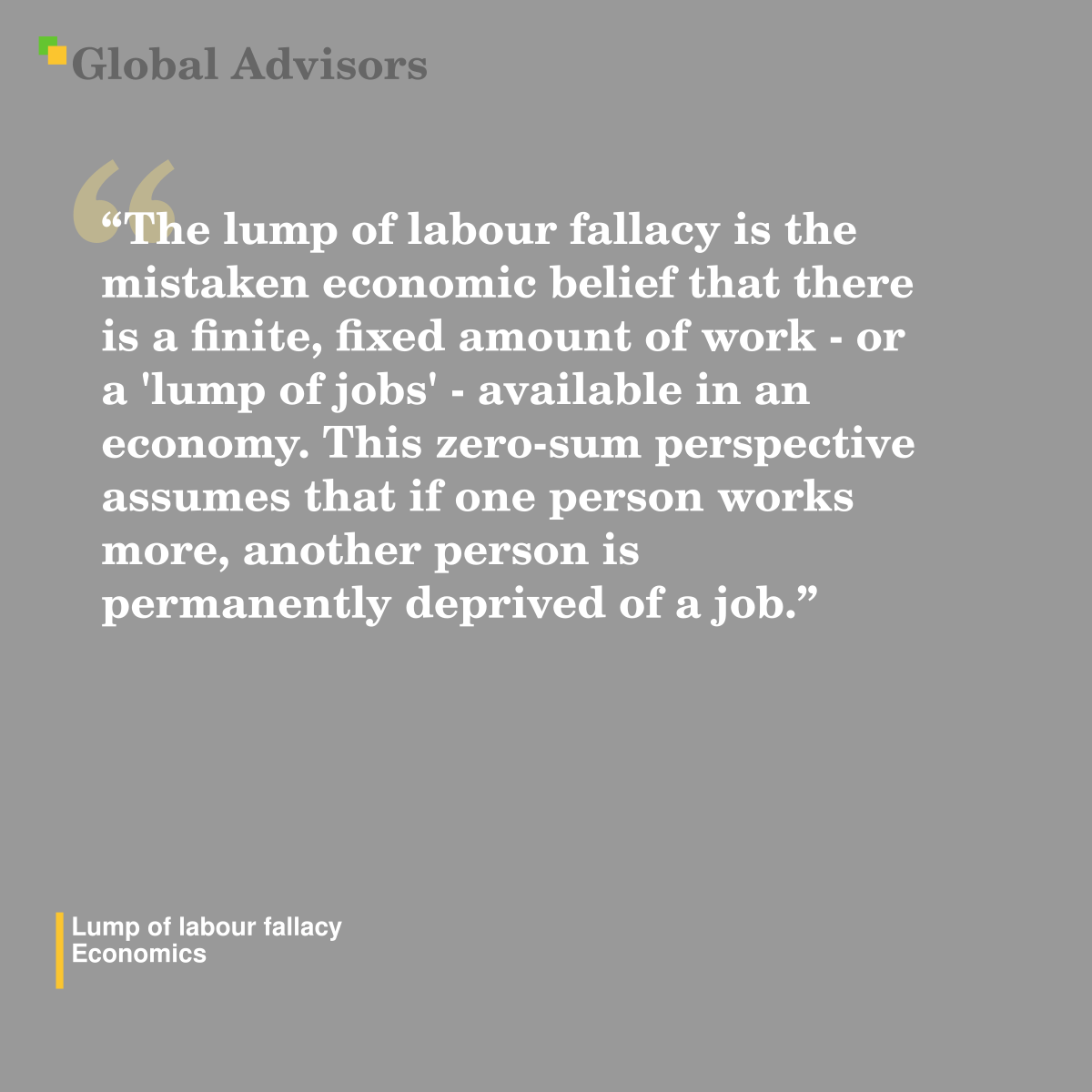
Term: Lump of labour fallacy - Economics"The lump of labour fallacy is the mistaken economic belief that there is a finite, fixed amount of work - or a 'lump of jobs' - available in an economy. This zero-sum perspective assumes that if one person works more, another person is permanently deprived of a job." - Lump of labour fallacy - Economics Persistent anxiety about job scarcity reflects a deeper misunderstanding of how labour demand operates. Fears that new entrants to the workforce, immigrants, women, older workers, or machines will permanently displace existing workers rest on the assumption that economic activity and job creation are fundamentally zero-sum. Once that assumption is unpacked, it becomes clear why economists have spent more than a century attacking it and why the debate has intensified again in the context of ageing populations and rapid automation. The underlying economic mechanism: why work is not a fixed pie The critical mechanism undermining the notion of a fixed quantity of work is the way labour demand is derived from demand for goods and services. Firms do not hire workers to fill an abstract quota of jobs; they hire because there is profitable output to produce. When more people are employed, aggregate income rises, which feeds back into higher consumption, investment and, in turn, additional labour demand. The economy behaves less like a reservoir of pre-existing jobs and more like a dynamic engine in which output, income, demand and employment co-evolve. In standard microeconomic terms, the demand for labour reflects firms' desire to maximise profit subject to technology and factor prices. Let denote the quantity of labour, the real wage, capital, and output produced with a technology . Profit is , where is the output price and the rental rate of capital. Firms choose such that the marginal revenue product of labour equals the wage: . There is no constraint in this formulation imposing a maximum number of jobs; employment adjusts endogenously as technology, wages, prices and demand shift. Macroeconomically, employment is tied to overall output and aggregate demand. A simple representation is , where is national income, consumption, investment, government spending and net exports. Labour demand responds to changes in , not to a presumed ceiling on jobs. When additional workers earn income, their consumption raises ; when firms expand to serve them, increases; governments may adjust and trade patterns can alter . These adjustments can increase total employment even as the workforce grows. Substantive content of the fallacy The core mistaken belief asserts that an economy has only a certain number of jobs to distribute. From this starting point, it is inferred that any increase in labour supply - through demographic change, immigration, higher female labour-force participation, delayed retirement, or technological substitution - necessarily pushes some existing workers out of employment. This reasoning is attractive because it simplifies complex labour-market interactions into a single intuitive constraint: more workers imply fewer jobs per worker. Historically, the belief has informed arguments for work-sharing and enforced shorter hours. If total labour input is seen as fixed, redistributing a given number of hours across more people by cutting standard hours appears to offer a straightforward route to reduce unemployment. Similarly, when older workers remain in employment longer, activists sometimes claim that younger workers will be crowded out because the pool of jobs cannot expand. In immigration debates, claims that migrants "take" jobs are grounded in the same implicit picture of labour as a finite pie. Economists describe these arguments as fallacious because they ignore how labour markets adjust through wages, prices, investment and innovation. When more people participate in the workforce, they do not simply occupy pre-existing job slots; they help create new economic activity. Their spending generates further demand; firms respond by expanding output, hiring more staff and investing in capacity. Over time, this process can increase total employment even as labour supply rises. Practical meaning for policy and public debate In practical terms, rejecting the lump of labour view changes how policy interventions are evaluated. Instead of assuming job numbers are capped, policymakers must consider how measures affecting labour supply interact with demand and productivity. For example, policies that encourage older workers to remain employed are not automatically harmful to youth employment. Evidence from Latin America using panel data for 11 countries between 2002 and 2019 finds a positive correlation between employment rates of older and younger workers, as well as a positive association between their labour incomes. This suggests that when older workers stay economically active, they help sustain growth and job creation rather than displacing younger cohorts. Similarly, debates about automation and artificial intelligence often rely on a fixed-jobs narrative, predicting mass technological unemployment as machines perform tasks previously done by humans. Yet historical experience shows that while some occupations are destroyed, new categories of work emerge and overall employment can continue to grow. Analytically, technological change alters the production function and the composition of tasks, but it also reduces costs, lowers prices, raises real incomes and stimulates new demand. Those demand effects can expand labour requirements elsewhere in the economy. Immigration policy provides another concrete illustration. Anti-immigration arguments frequently claim that migrants depress wages and occupy jobs that would otherwise go to native workers. The fallacy lies in treating the economy as if it were a game of musical chairs, with a fixed number of seats. In reality, migrants not only supply labour but also consume goods and services, start businesses, and contribute to innovation, thereby affecting both sides of the labour-market equation. Empirical studies consistently find modest overall impacts on native employment and wages, with more substantial effects concentrated in specific segments or time periods, rather than a deterministic crowding-out of native workers. Mathematical specification of labour demand and the fallacy To formalise why the lump of labour view conflicts with standard economic theory, consider a simple labour-demand function for a representative firm. Suppose output is given by a Cobb-Douglas production function , where is total factor productivity and the capital share. Profit maximisation implies a demand for labour of the form . Here, labour demand depends on productivity , capital , the output price , and the wage . None of these parameters impose a fixed ceiling on employment; shifts in technology, capital accumulation or product demand can raise even as the labour force expands. At the macro level, jobs are often modelled using a matching function linking unemployed workers and vacancies. Let denote unemployment, vacancies and labour-market tightness defined as . A standard matching function is , where is the flow of new matches and a matching-efficiency parameter. Employment evolves as , where is the separation rate. Again, there is no exogenous cap on ; employment is determined endogenously by matching efficiency, vacancy posting and separation dynamics. Policies or shocks that change , or can alter equilibrium employment levels without relying on a fixed number of jobs. The lump of labour fallacy implicitly assumes a constraint of the form , where is employment for group and is a fixed total number of jobs. Under this assumption, any increase in employment for one group must be offset by a decrease for another. Yet economic models and empirical evidence treat as an outcome, not a constant. Aggregate employment responds to growth, technological change, demographic composition and policy; it is not mechanically fixed. Parameter meanings and labour-market interactions Several key parameters govern the relationship between labour supply, labour demand and employment outcomes. Productivity measures output per unit of inputs, capturing technology and organisational efficiency. Higher can have mixed short-term effects on employment: if demand is inelastic, output may rise less than proportionately, potentially reducing labour demand; but over time, cheaper goods and services tend to raise real incomes and stimulate further demand, often increasing employment. Wages influence both labour supply and demand. On the demand side, higher wages raise production costs, potentially reducing the quantity of labour firms are willing to hire at given output prices. On the supply side, higher wages attract more participants into the labour force. The equilibrium wage and employment emerge from the intersection of these schedules, and the resulting number of jobs depends on underlying preferences, technology and institutions, not on a pre-set cap. Labour-force size, captured by the population of working-age individuals and their participation rate, affects potential output and aggregate demand. More workers imply greater potential output through ; simultaneously, they represent more consumers and taxpayers. Models of overlapping generations often show how demographic structure influences saving, investment and growth, indirectly shaping labour demand across age cohorts. Empirical work on ageing societies challenges the assumption that older workers reduce opportunities for younger ones by staying in employment longer. Major schools of thought and their treatment of labour Although mainstream economists broadly reject the lump of labour view, different schools of thought emphasise distinct mechanisms. In neoclassical theory, flexible wages and prices ensure that labour markets clear, so any unemployment is voluntary or frictional. Under these assumptions, the idea of a fixed number of jobs is inconsistent with market adjustment: an excess supply of labour leads to falling wages, encouraging firms to hire more workers until equilibrium is restored. Keynesian and post-Keynesian perspectives accept that involuntary unemployment can persist due to demand deficiency, wage rigidities or coordination failures. From this vantage point, employment is constrained by aggregate demand rather than a technologically determined maximum. While this might appear superficially similar to a fixed-jobs view, the constraint is endogenous and policy-responsive: fiscal expansion, monetary easing or structural reforms can lift demand and raise employment. The core objection to the lump of labour logic remains-the number of jobs is not a fixed constant unaffected by macroeconomic conditions. Institutional and labour-market segmentation theories stress that bargaining power, norms and regulations shape job creation and distribution. They scrutinise work-sharing proposals, arguing that reducing hours may or may not raise employment depending on how firms respond to labour costs, productivity and organisational constraints. These analyses reject the simplistic premise that cutting hours automatically spreads a fixed amount of work more thinly; instead, they examine how hour reductions interact with demand, technology and profitability. Radical and Marxian approaches often focus on technological unemployment and the reserve army of labour. Nevertheless, they typically treat employment levels as outcomes of accumulation dynamics and class relations, not as a fixed quantity of jobs. Capitalist expansion, globalisation and technological change are seen as drivers of both job destruction and creation, with the balance mediated by power and policy rather than a lump of work constraint. Tensions, critiques and the "lump of labour fallacy" critique of economists Despite broad agreement that the lump of labour notion is flawed, there is tension over how forcefully to dismiss policies inspired by it. Some authors argue that economists have used the fallacy charge too liberally to shut down serious discussion of work-sharing, shorter hours and alternative labour-market institutions. On this view, branding proposals as fallacious can function as a rhetorical device rather than a careful empirical assessment. Critics contend that in contexts of persistent demand shortfalls or technological shocks, redistributing hours may have non-trivial effects on employment, particularly when combined with complementary policies that sustain demand. The accusation is that economists sometimes caricature such proposals as if they rested entirely on a fixed-jobs assumption, when more sophisticated versions recognise dynamic responses but still see merit in using hours adjustments to share risks and gains. Another emerging tension concerns the interaction between automation and the original reassurance that "new jobs will be created". A secondary argument, sometimes called the "lump of labour fallacy fallacy", notes that much of the newly created work may be performed by machines or software agents rather than humans. In other words, even if total work is not fixed, the subset of tasks accessible to human labour could shrink. This observation does not restore a fixed-jobs view, but it complicates the earlier optimistic narrative that rejected technological unemployment by pointing to offsetting job creation. These critiques highlight that dismissing lump of labour reasoning does not obviate the need to confront distributional questions. The volume of work can grow while specific groups or regions suffer persistent job loss. Sectoral shocks, skill-biased technological change and global integration can all lead to concentrated unemployment or wage stagnation even as aggregate employment rises. The important analytical distinction is between claiming a fixed job total and recognising complex, uneven adjustment processes. Contemporary relevance: ageing, automation and globalisation The concept remains salient because the contexts that trigger lump of labour reasoning are intensifying. Population ageing raises policy questions about pension ages, retirement patterns and intergenerational equity. The empirical evidence showing that higher employment among older adults can coincide with higher employment among the young challenges intuitive crowding-out narratives. Designing sustainable retirement and employment policies therefore requires thinking about growth, demand and productivity, not assuming a zero-sum competition for a static pool of jobs. Automation and artificial intelligence spark renewed fears of mass technological unemployment. Here, rejecting the lump of labour view pushes analysis towards understanding task reallocation, new industries and productivity-demand feedback loops. When technology reduces costs, incomes rise and new consumption possibilities emerge, potentially creating new categories of work and expanding total employment. The challenge is not that work disappears in the aggregate, but that transitions can be disruptive and require active policies around skills, mobility and social protection. Globalisation and migration also keep the debate alive. As labour and capital move across borders, communities confront visible job losses in particular sectors or regions. While the aggregate picture may show limited impacts or even gains, the perception of direct displacement remains strong. Addressing this requires granular analysis of local labour markets, combined with policies that help workers adjust, rather than appeals to a simplistic fixed-pie intuition. Why the term still matters The term continues to matter because it captures a recurring pattern of reasoning that can mislead policy and public debate. By making explicit the assumption that jobs are fixed, economists can distinguish between legitimate concerns about adjustment costs, distributional impacts and persistent unemployment, and mistaken claims that additional workers or new technologies must mechanically reduce the number of jobs available to others. For practitioners, analysts and citizens, recognising the fallacy encourages a more nuanced approach. It shifts attention from zero-sum narratives towards the conditions under which economies expand, jobs are created and losses are mitigated. This means analysing demand dynamics, investment behaviour, institutional settings and technological trajectories. It also entails acknowledging that even when the total amount of work is not fixed, the allocation of that work, the quality of jobs and the security of workers are all deeply contingent and subject to policy choice. As societies confront overlapping transitions-demographic, technological, environmental and geopolitical-the temptation to reach for simple fixed-pie stories will remain strong. The analytical value of the concept lies in resisting that temptation, demanding explicit modelling of labour demand and supply, and keeping open the possibility that more participants and new technologies can generate more, not fewer, opportunities for human work.
|
| |
| |
Global Advisors News Brief - June 30 2026Read the full brief at the link Headlines for the last 24hrs
Time window: 2026-06-29T05:00:33.064Z to 2026-06-30T05:00:33.064Z |
| |
| |
Quote: Alan Greenspan - Former Chairman of the US Federal Reserve"I found a flaw in my model of the world." - Alan Greenspan - Former Chairman of the US Federal Reserve Modern financial capitalism depends on the assumption that complex systems can be modelled, and that those models are robust enough to guide policy at scale. When that assumption fails, the consequences are measured not in academic footnotes but in unemployment, foreclosures, and shattered political trust. Alan Greenspan's admission to Congress in October 2008 that he had discovered a flaw in his mental model of how the world works was not simply a personal confession; it was a rare public acknowledgment that the intellectual architecture underpinning decades of deregulation and central bank strategy had mis-specified how risk, incentives, and human behaviour interact in advanced financial markets. From Objectivist salons to policy orthodoxy Greenspan's intellectual trajectory matters because his personal model of the world became, for a time, close to orthodoxy in policy circles. In the early 1950s he entered the inner circle of Ayn Rand, absorbing the Objectivist emphasis on radical individualism, rational self-interest, and deep suspicion of state intervention. That philosophical base translated into an economic worldview in which markets, if left largely to themselves, would efficiently allocate resources, discipline bad actors, and self-correct deviations with minimal need for regulatory oversight. Over subsequent decades, this belief in market self-regulation hardened into a systematic framework: market prices were assumed to aggregate dispersed information; participants were presumed broadly rational; and contractual structures, rating agencies, and reputation effects were seen as sufficient to manage risk without heavy-handed supervision. When Greenspan became Chairman of the Federal Reserve in 1987, that worldview migrated from theory to practice. His tenure covered the 1987 stock market crash, the 1990s boom, and the aftermath of 9/11, and he acquired a reputation as the "Maestro" whose deft interventions stabilised shocks while preserving a broadly laissez-faire environment. Crucially, this was not merely operational skill; it was ideology enacted through policy tools. The conviction that financial innovation was beneficial, that sophisticated institutions could manage their own risks, and that regulatory interference would mostly destroy value shaped decisions about interest rates, supervision, and the permissive stance toward instruments such as over-the-counter derivatives. The flaw in the model: trust in self-regulating markets Greenspan's 2008 testimony identified the failure point in direct terms. Under pressure from legislators, he acknowledged that his belief in the capacity of markets to self-police had been mistaken, describing "a flaw in the model that I perceived as the critical functioning structure that defines how the world works". Earlier he had conceded that his governing ideology had led him to resist regulating the trade in complex derivatives, including credit default swaps, which proved central to propagating systemic risk. The flaw was not a single technical error but a structural misreading of how human behaviour and incentives operate in environments of high leverage, opacity, and moral hazard. In formal terms, the model he trusted assumed that financial actors internalise the consequences of their risk-taking, so that each institution's optimisation problem aligns with system stability. If one were to express this stylised vision, each institution maximises expected profit subject to constraints on capital, liquidity, and risk tolerance, with market discipline ensuring that unsustainable strategies are punished. In such a world, widely used frameworks treat risk as if it followed stable distributions such as , and assume that correlations and volatilities, though time-varying, remain tractable. Greenspan's flaw lay in underestimating how incentive structures, regulatory gaps, and bounded rationality distort these assumptions: risks become highly correlated through common exposures; distributions develop fat tails; and short-term profit motives overpower concern for long-term solvency. Easy money, asset bubbles, and the Greenspan put The flaw in the worldview manifested concretely in policy choices. One of the most discussed is the so-called "Greenspan put", the perception that the Federal Reserve would reliably ease monetary conditions or support markets after significant asset price declines, effectively providing a downside insurance to investors. During Greenspan's tenure from 1987 to 2006, commentators noted a pattern in which rate cuts and liquidity support followed market stress, encouraging the belief that bold risk-taking would be partially backstopped by the central bank. The model assumed that providing such insurance would stabilise the system without materially distorting incentives. In practice, repeated interventions contributed to a culture of leveraged speculation and the erosion of market discipline. Sebastian Mallaby and other analysts have argued that Greenspan's critical misjudgement was the assumption that keeping consumer price inflation low would allow other problems to resolve themselves. The Federal Reserve maintained low interest rates for an extended period in the early 2000s, aiming to avoid deflationary pressures. Nominal inflation remained subdued, but credit availability surged, fuelling a housing boom and encouraging complex securitisation structures. The governing model prioritised conventional metrics like headline inflation while underweighting systemic financial risk created by balance sheet expansion, shadow banking growth, and opaque derivatives exposures. Deregulation, derivatives, and the shadow banking system Greenspan's faith in market self-regulation shaped his approach to financial innovation. He argued that counterparties in derivative contracts had strong incentives to scrutinise each other, and that bespoke over-the-counter instruments did not require intrusive oversight. Consequently, he opposed tighter regulation of derivatives markets, including proposals to subject credit default swaps and similar products to more rigorous supervision. This stance was consistent with a model in which sophisticated actors manage their own risk and where regulatory intervention risks stifling beneficial innovation. In reality, the growth of the shadow banking system undermined those assumptions. Securitisation chains transformed illiquid mortgages into tradable securities, slicing risk into tranches that appeared safe according to rating agency models. Institutions used derivatives to hedge or magnify exposures, often with limited understanding of counterparty interlinkages. In stylised form, total system leverage grew far faster than headline bank balance sheets suggested, because off-balance-sheet vehicles, structured investment conduits, and derivative positions amplified effective risk. Greenspan's model underestimated how such intermediation could create feedback loops: small shocks to mortgage performance cascaded through highly leveraged structures, triggering margin calls, forced asset sales, and widespread contagion. Housing, bubbles, and misread signals Another dimension of the flaw lay in the treatment of asset prices as largely benign reflections of fundamentals until very late in the cycle. Critics argue that Greenspan discounted evidence of an unsustainable housing bubble, failing to "prick" it with higher rates or tighter credit standards. The worldview prioritised general macro indicators: as long as GDP growth, employment, and inflation stayed within acceptable ranges, rising house prices could be rationalised as a function of demographics, productivity, or financial innovation. The model thus treated housing as a set of local markets rather than a national speculative dynamic powered by loose underwriting standards and cheap leverage. When the bubble burst, the transmission mechanism exposed the fragility of assumptions about diversification and localised risk. Mortgage-backed securities had been structured on the presumption that regional housing downturns would be uncorrelated, allowing tranching to create instruments with small default probabilities. In mathematical language, models treated default events as near-independent, with correlation coefficients assumed to be modest. In practice, macroeconomic and behavioural factors drove correlations much closer to in stress conditions, invalidating the diversification logic. Greenspan's flaw was not merely personal misjudgement of housing conditions; it reflected a broader overconfidence in quantitative frameworks that failed to capture regime shifts, non-linearities, and systemic feedbacks. The October 2008 hearing: ideology meets empirical shock Greenspan's admission came during a tense House committee hearing in October 2008, as policymakers grappled with what he described as a "once-in-a-century credit tsunami". Under questioning from Henry Waxman and other legislators, he conceded that he had been "partially wrong" in not moving to regulate derivatives and that his ideology had contained a serious flaw. NBC and PBS coverage captured the moment in which a former central banker who had long championed deregulation acknowledged that his conceptual framework had failed under real-world conditions. Although he continued to argue that markets had already imposed significant discipline and that future regulation would be limited in impact compared with private-sector adjustments, the core admission marked a break with decades of unwavering confidence in free-market models. Importantly, Greenspan's testimony did not repudiate market economics; rather, it recognised that his version of it had misjudged the boundaries between self-regulation and necessary oversight. The flaw he described was an internal inconsistency: if human beings are fallible and prone to herding, and if institutions can externalise risk onto the system, then relying on private incentives alone to contain leverage and opacity becomes untenable. In this sense, his confession was less a philosophical conversion than an acknowledgement that the calibration of trust in markets had been set too high relative to empirical evidence. Strategic and technological tensions revealed The backstory casts light on a broader strategic tension in modern financial governance. Central banks operate at the intersection of macroeconomic management and micro-level financial stability, yet they often rely on models that treat the financial system as a relatively frictionless transmission mechanism rather than a complex network with its own dynamics. Greenspan's worldview placed primary weight on controlling inflation and supporting growth, delegating much of the work of risk management to market processes. The flaw exposed by the crisis was that financial innovation and deregulation had materially altered the system's topology: instruments such as collateralised debt obligations, credit default swaps, and structured products created highly non-linear propagation channels for shocks. Technologically, the expansion of computational power and data availability reinforced confidence in sophisticated risk models. Value-at-risk frameworks, Monte Carlo simulations, and scenario analysis gave quantitative form to Greenspan's belief that markets could manage their own exposures. However, these tools typically encoded assumptions about distributions, correlations, and liquidity that break down in extreme stress. Where models implied that the probability of simultaneous failure of many institutions was vanishingly small, the crisis demonstrated that under wrong incentives and incomplete information, such outcomes are far more likely. The flaw, therefore, was not just ideological but methodological: a misalignment between model space and real-world behaviour. Debates, objections, and alternative readings Greenspan's admission has been interpreted in multiple ways by economists and historians. Some argue that his confession was tactical, designed to deflect blame by suggesting that everyone's models were flawed, not only his. They point to his continued reluctance to accept personal responsibility for the scale of the meltdown, noting that he often emphasised global factors, regulatory decisions beyond the Fed, and the role of investors who chased yield despite warnings. Others see the statement as a genuine, if partial, intellectual reckoning: a long-time advocate of laissez-faire acknowledging that specific beliefs about derivatives and bank behaviour were inconsistent with observed outcomes. There is also disagreement over the magnitude of the flaw. Some critics maintain that Greenspan's trust in markets was not merely slightly miscalibrated but "catastrophically wrong", enabling the worst financial crisis since the Great Depression. They stress his refusal to tighten supervision of subprime lending, his opposition to more stringent capital requirements, and his underestimation of housing risks. Others highlight his successes: stabilising multiple shocks, steering the economy through long expansions, and avoiding high inflation. From this angle, the model worked well under many conditions but broke down in the face of unprecedented financial complexity and global imbalances. There remains a further objection grounded in political economy. Some argue that attributing failure to a "flaw in the model" risks depoliticising what were, in fact, contested choices shaped by lobbying, ideology, and institutional culture. Regulatory relaxations benefited powerful financial interests; low rates were popular with borrowers and asset holders; resistance to stricter oversight reflected more than abstract theoretical commitments. To this camp, the flaw language obscures structural power relations and regulatory capture, making it sound as if an unfortunate miscalculation rather than deliberate policy decisions generated the crisis. Implications for central banking and economic modelling Despite these debates, Greenspan's confession has become a touchstone in discussions of how central banks should relate to financial markets. One clear implication is that models must incorporate systemic risk more explicitly. Instead of treating institutions as isolated optimisers, frameworks need to account for network effects, common exposures, and liquidity spirals. Techniques inspired by complex systems analysis, where the state of the financial system at time is represented by a network with nodes as institutions and edges as exposures, can help identify fragility that conventional macro models miss. The challenge is to integrate such complexity into policy decisions without paralysing the capacity to act. Another implication concerns humility and stress testing. Greenspan's experience illustrates the danger of assuming that a single coherent worldview can reliably guide decisions over decades of rapid innovation. Empirical stress tests, scenario analyses that emphasise extreme but plausible conditions, and explicit recognition of model uncertainty can reduce overconfidence. In formal terms, central banks increasingly acknowledge that their estimates of key parameters, such as for jump intensity in asset prices or for jump size volatility, are subject to error, and they design policies robust to a range of possible states rather than a single forecast. Greenspan's flaw was to assume that the world conformed closely enough to his preferred vision that robustness was less urgent. Why the admission still matters The statement continues to resonate because it dramatizes a recurring problem in technocratic governance: the tension between the need for confident action and the reality of deep uncertainty. Central bankers, regulators, and economic advisers operate in environments where hesitation can be costly, yet history shows that systemic crises often stem from misplaced confidence in prevailing models. Greenspan's confession is frequently cited in teaching and commentary not because it is theatrically self-effacing, but because it marks one of the rare occasions where a powerful policymaker publicly conceded an error in the architecture of their thinking rather than merely in its implementation. For contemporary policymakers, the lesson is not to reject modelling or markets but to recognise that the world is more adaptive, strategic, and prone to non-linear crises than any single framework can fully capture. Incentives change, technologies evolve, and actors respond to policy itself in ways that reshape the system. The flaw Greenspan identified thus serves as a warning that ideological commitments, however intellectually elegant, must be continuously tested against emerging evidence. Where models begin to diverge from observable behaviour, loyalty to theory must yield to empirical revision. Failing to do so risks, once again, constructing a mental map of the world so convincing that it blinds its architect to the cliffs hidden at the edge of the chart.
|
| |

| |
Term: Convertible - Corporate finance"In corporate finance, convertible refers to a hybrid financial instrument that can be traded in for a predetermined number of common equity shares. This structure bridges the gap between fixed-income safety and equity growth." - Convertible - Corporate finance Corporate treasurers and boards face a recurring trade-off between locking in predictable funding costs and preserving participation in future equity upside. Traditional straight debt provides contractual coupons and principal repayment but no growth participation; pure equity offers unbounded upside at the price of dilution and higher required returns. Convertible instruments arise precisely to mediate this tension, by embedding an equity option into a fixed-income claim so that risk, control and cost of capital can be tuned with much finer granularity than with a simple bond-share dichotomy. Debt-equity tension and the rationale for convertibles For the issuing company, straight bonds are attractive because interest is usually tax-deductible and does not dilute control, but the more leverage is added, the greater the risk of financial distress and restrictive covenants. Equity avoids mandatory payments and often improves credit quality, yet it is expensive capital: investors demand higher returns to compensate for residual risk, and incumbent shareholders suffer permanent dilution. Convertibles allow issuers to offer investors a relatively modest fixed coupon plus a contingent claim on future equity value, thereby lowering the contractual interest rate relative to straight debt while postponing dilution until the business has grown and valuation is clearer. For investors, especially those with mandates spanning both fixed income and equities, convertibles offer a self-hedging profile. When the underlying share price is far below the conversion threshold, the instrument behaves primarily like a bond, with the present value anchored by coupon payments and principal, often described as a bond floor. As the equity appreciates towards and beyond the conversion price, the convertible's value becomes more sensitive to the share price, capturing upside in a way that resembles holding a call option on the stock. This convex payoff profile - limited downside relative to equity, but meaningful participation in upside - explains the persistent demand for such hybrid structures across market cycles. Substantive definition and core economic substance In substance, a corporate convertible is a fixed-income claim issued by a company that gives its holder the right, but not the obligation, to exchange that claim for a predetermined number of ordinary shares of the same issuer, under conditions set out in the issuance documentation. While legal forms vary - bonds, notes, preferred shares and structured loans - they share three economic components: - a debt component with stated principal, maturity and coupon or interest schedule; - an embedded call option on the issuer's equity, entitling the holder to convert into a specified number of shares; - contractual terms governing when, how and at what price conversion or redemption can occur, including issuer call rights, investor puts, and contingent triggers. Because of this dual character, convertibles are classified as hybrid securities in most regulatory and market taxonomies, combining the contractual cash flows of debt with the residual claim nature of equity. Accounting standards typically require the issuer to disaggregate the initial proceeds into a liability component measured at the present value of contractual cash flows and an equity component representing the embedded option. Practical structures in corporate finance Although the conceptual template is simple, corporate practice has produced a spectrum of convertible structures tailored to different stages of a firm's life cycle, regulatory context and investor base. Public-market convertible bonds Listed companies often issue convertible bonds as part of their capital market strategy. These instruments usually have medium- to long-dated maturities, fixed or occasionally floating coupons below those of comparable straight bonds, and a standardised conversion mechanism defined by a conversion price and ratio. They are typically marketed to institutional investors who may employ dedicated convertible arbitrage strategies, exploiting the embedded option by hedging the equity risk while collecting coupon and volatility premia. Public convertibles are frequently used as delayed equity financing. A firm expecting future equity appreciation can fund itself at lower current cost while deferring dilution until the share price has risen sufficiently to make conversion attractive. From a tax perspective, coupons remain deductible until conversion, while post-conversion the capital structure shifts towards equity as the debt is extinguished and shares are issued. Private convertible notes and loan notes In private markets, especially for early-stage or high-growth firms, convertible debt in the form of notes or convertible loan notes is a prevalent financing tool. A business borrows funds; instead of being repaid purely in cash, the loan is designed from the outset to convert into equity when specified events occur, such as the next qualified funding round, an acquisition or an IPO. Until that trigger, the instrument behaves like debt, often with interest accruing and being capitalised into principal rather than being paid in cash. Convertible loan notes in jurisdictions such as the UK commonly include a maturity date, an interest rate, a valuation cap, and a conversion discount relative to the price paid by new investors at the trigger event. This structure allows founders to defer an explicit valuation negotiation while giving investors downside protection and preferential pricing if the company subsequently raises equity at a higher valuation. Contingent convertibles and regulatory hybrids In regulated sectors, most notably banking, contingent convertible bonds (CoCos) represent a specialised variant in which conversion into equity or principal write-down occurs automatically if capital ratios or other regulatory triggers breach defined thresholds. These instruments are explicitly designed to absorb losses and bolster regulatory capital during stress, sitting between senior debt and ordinary equity in the capital structure. Key parameters and mathematical specification Even without deep quantitative modelling, understanding the core parameters that define a convertible's economics is essential for corporate users and investors. A simplified convertible bond can be decomposed as: where is the value of the convertible, is the value of an otherwise identical non-convertible bond, and is the value of the embedded call option on the issuer's shares. Conversion ratio and conversion price The conversion ratio determines how many shares the holder receives per unit of nominal principal if conversion occurs. If is the number of shares received for each unit of principal , then the implied conversion price is: Issuers usually set at a premium to the prevailing share price at issuance - for example, 20 % to 40 % above the spot price - to limit immediate dilution and signal confidence in future growth. The conversion value at a given share price is then: When is substantially below the bond's investment value, the option is said to be out of the money, and the instrument is bond-like; as rises and approaches or exceeds the bond floor, equity sensitivity increases. Bond floor and investment value The straight debt value can be estimated as the present value of future coupons and principal discounted at an appropriate straight-debt yield : This discounted cash-flow value anchors downside: even if the equity performs poorly, the convertible's price tends not to fall much below this bond floor, subject to credit risk and market conditions. Embedded option valuation Conceptually, the option component can be valued using equity option pricing techniques, treating the conversion right as a call option with strike on the issuer's shares, adjusted for features such as callability, soft calls and make-whole provisions. A simplified representation is: where is the current share price, the time to maturity or last conversion date, the risk-free rate, the equity volatility, and the dividend yield. In practice, valuation specialists often apply a binomial lattice or Monte Carlo approach incorporating credit spreads, conversion probabilities and issuer call strategies. Early-stage convertibles and deferred valuation For start-up-style convertible notes, the mathematics centres less on continuous pricing and more on conversion mechanics at the next financing. If an investor provides principal , and the next equity round prices shares at with a conversion discount , the effective conversion price may be: where is the price implied by any valuation cap. The resulting shares issued on conversion are . This mechanism protects early investors by guaranteeing them a better price per share than new entrants or a maximum valuation at which their note converts. Accounting, classification and capital structure implications International accounting standards treat convertible bonds as compound instruments containing both a financial liability and an equity component. On initial recognition, the issuer measures the liability element at the fair value of a similar debt instrument without the conversion feature, typically via present value of contractual cash flows discounted at a market interest rate for comparable non-convertible debt. The equity component is the residual, representing the value of the holder's conversion option. Subsequently, the liability is accounted for using amortised cost, with interest expense recognised using the effective interest method, while the equity component remains in equity unless extinguished, for example through conversion or buy-back. From a capital structure perspective, this accounting treatment can make convertibles attractive: the company reports a lower liability than if the entire proceeds were debt, yet avoids immediate recognition of full equity dilution. Regulators and rating agencies evaluate the mix of debt-like and equity-like characteristics to determine how much equity credit to assign to hybrid instruments. Features such as subordination, permanence (long or perpetual maturity), discretionary coupons and loss-absorption mechanisms all influence the proportion of an issue treated as equity for regulatory capital or leverage metrics. Major schools of thought on convertible use Academic and practitioner debates about convertibles revolve around why firms choose them instead of straightforward combinations of debt and equity, and what agency or information problems they are intended to solve. Delayed equity and signalling theories One strand of theory emphasises convertibles as delayed equity financing. When management believes the market undervalues the firm, issuing straight equity is unattractive because it locks in dilution at an unfavourable price. By issuing convertibles with conversion prices above the current share level, firms effectively commit to issuing equity only if and when the market validates higher valuations, thus aligning equity issuance with favourable states of the world. This perspective links to signalling: a firm that expects its share price to rise may prefer a convertible because it can offer investors upside potential without conceding immediate underpricing. Conversely, if the market infers overconfidence or adverse selection, the pricing of the convertible will adjust via higher coupons or lower conversion premia. Agency cost and risk-shifting arguments Another school of thought analyses convertibles through the lens of agency conflicts between managers, shareholders and creditors. Straight debt can induce shareholders and managers to undertake excessively risky projects, transferring value from creditors to equity holders (asset substitution). Convertibles partially align interests: as the firm's risk and value increase, creditors become potential shareholders via conversion, reducing conflict over risk-shifting. Yet the same instruments can also create new agency issues. Managers may face incentives to manipulate the timing of information or corporate actions to influence conversion outcomes, either to forestall dilution or to manage reported leverage. Investors, aware of these incentives, price such risks into the terms, leading to complex bargaining over covenants and trigger definitions. Market segmentation and investor clientele A more pragmatic explanation is that convertibles appeal to specific investor clienteles that value the hybrid payoff profile and may be constrained from holding pure equity. Dedicated convertible funds, balanced mandates and some insurers prefer instruments that yield fixed income but include embedded growth optionality. Issuers tap this demand to diversify their funding base and potentially achieve more favourable pricing than issuing separate straight bonds and equity. Advantages, disadvantages and design trade-offs For issuers, the central advantage is a lower explicit cost of debt financing. Because investors receive an equity option, they are willing to accept a lower coupon than would be required on a straight bond of comparable risk. In addition, interest is typically tax-deductible until conversion, and dilution is contingent on share-price performance. Convertibles can also broaden the investor base and provide a flexible path to equity funding without immediate valuation shocks. The disadvantages include eventual dilution if the firm performs well, potential complexity in financial reporting, and the risk of mis-timed conversion. If the share price does not exceed the conversion price, the firm may have to refinance or repay the principal in cash at maturity, effectively having paid an unnecessary option premium. Early-stage convertible notes can also introduce cap table complexity and misaligned expectations between founders and investors at later equity rounds. For investors, benefits encompass downside protection through the bond floor combined with equity upside, portfolio diversification, and in some structures, seniority over equity in insolvency. However, they bear credit risk, equity volatility risk and the possibility that issuer call features limit full participation in extreme upside scenarios. Pricing complexity can also disadvantage less sophisticated investors relative to specialist funds capable of modelling embedded options and hedging efficiently. Current relevance and evolving practice Despite periodic swings in issuance volumes driven by interest-rate cycles, equity valuations and regulatory shifts, convertibles retain a distinctive role in corporate finance. In low-rate environments with buoyant equity markets, companies exploit the appetite for hybrid instruments to secure cheap capital while investors seek yield plus optionality. In more stressed conditions, convertibles may serve as restructuring tools, enabling creditors to accept haircuts compensated by future equity participation rather than forcing immediate write-offs or liquidations. Innovation continues around contingent structures, sustainability-linked convertibles and instruments with complex step-up or reset features. Yet the fundamental mechanism remains unchanged: by embedding a conversion right into a contractual fixed-income claim, firms and investors create a risk-sharing arrangement that tempers the rigid separation between debt and equity. The enduring appeal of convertibles lies precisely in this capacity to reallocate risk and reward dynamically over time, as the issuer's fortunes evolve and as capital markets update their valuation of the underlying business.
|
| |

| |
Global Advisors News Brief - June 29 2026Read the full brief at the link Headlines for the last 24hrs
Time window: 2026-06-28T05:00:33.063Z to 2026-06-29T05:00:33.063Z |
| |
| |
Quote: Satya Nadella - Microsoft CEO"What is happening in coding will happen even in knowledge work." - Satya Nadella - Microsoft CEO The reorganisation of work in the firm is no longer a theoretical debate about distant automation; it is already happening in one of the most structurally conservative domains of modern business: software engineering. When a major platform company reports that AI now generates roughly 20-30% of its integrated code and expects that proportion to rise further, the boundary between human and machine contribution is not just shifting, it is being structurally redrawn. The claim that similar dynamics will extend into broader knowledge work is therefore less a speculative projection than an extrapolation from an observable production transformation inside the world's largest software organisations. From Coding as Craft to Coding as Orchestration Software development has historically been treated as a high-skill craft defined by mastery of languages, frameworks, and architectural patterns. For decades, productivity revolved around tools that accelerated human effort-IDEs, version control, libraries-while leaving the cognitive locus firmly with the engineer. The arrival of AI code generation, and especially copilots integrated into development environments, alters that locus. A growing fraction of work now consists of specifying intent, critiquing generated artefacts, and managing systems, rather than manually authoring every line. Inside firms such as Microsoft and Google, AI now produces a substantial share of new code in live repositories, with estimates in the range of 20-30% for Microsoft and above 25% for Google. What matters is not only the percentages but the behaviour they induce. Developers increasingly work in an iterative loop with AI assistants: describing functionality in natural language, evaluating candidate implementations, and steering revisions. Nadella has described this shift as simultaneously lowering the floor-allowing far more people to participate in development-and raising the ceiling by demanding new forms of sophistication to avoid black-box codebases. The capability required is evolving from syntax and pattern recall towards system-level thinking, prompt design, constraint specification, and risk assessment. This redefinition of the role is crucial because coding is the archetypal form of digital knowledge work. If the labour process in coding becomes a structured dialogue with AI agents rather than solitary manipulation of abstract symbols, it suggests a template for other fields: legal drafting, financial modelling, marketing strategy, operations planning, and research analysis. The underlying mechanism is not discipline-specific; it is the pairing of domain expertise with generative tools that can synthesise, draft, and simulate at scale. The Firm as an AI-Augmented Knowledge System Nadella's broader argument places AI not as an external service but as a reconfiguring force for the firm itself. In conversation with Reid Hoffman, he frames the future organisation as one where human capital and what he calls "AI capital" are deeply intertwined, with business logic executed by agents that operate over proprietary data and processes. In this view, software development is merely the first domain in which the firm's internal knowledge is being turned into machine-usable artefacts that continuously regenerate outputs. Historically, firms created value by embedding tacit knowledge into repeatable routines, documented processes, and software systems. Those artefacts made "knowledge work" possible at scale: employees could interact with digital systems, query databases, and use productivity tools to drive decisions and outputs. Nadella suggests that the next stage is a new class of digital capital formed by the interplay between AI systems and human expertise. Where previous generations produced static documents and code, the new layer will consist of dynamic agents able to reason over firm-specific context, respond to natural language, and orchestrate complex workflows. From a strategic perspective, this implies that firms must treat their accumulated data, models, and process definitions as inputs to intelligent systems rather than as passive records. The firm becomes a kind of internal platform where AI agents embody business logic: from pricing heuristics to compliance rules, from customer segmentation to supply chain optimisation. Software development is simply the most visible frontier because it directly touches the tools that implement and expose this logic. Once AI systems can write, test, and deploy code, they can continuously modify the very infrastructure through which knowledge work is performed. Why Coding Is the Leading Indicator Coding offers a uniquely measurable and tightly scoped domain in which to observe AI impact. Lines of code can be quantified, repositories audited, and commit histories analysed. When executives publicly state that a material fraction of corporate code is now AI-generated, they are providing one of the few hard metrics for AI's penetration into high-skill work. By contrast, knowledge work in areas such as consulting, marketing, or internal strategy often lacks precise measurement: productivity gains are inferred rather than directly captured. The developer workflow is also structurally conducive to AI augmentation. It is modular, testable, and governed by clear correctness criteria. Tools like GitHub Copilot plug into existing IDEs and continuous integration pipelines, making adoption relatively frictionless. The feedback loop is tight: a developer can see immediately whether generated code compiles, passes tests, and meets performance constraints. This rapid validation accelerates learning and de-risks experimentation with AI support. Nadella has argued that these features make software engineering a proving ground for a broader transformation. As AI systems increasingly operate not just at the level of code snippets but of system design-suggesting architectures, integrating services, and managing multi-agent workflows-the pattern generalises. In non-technical domains, the equivalents are automated drafting, data analysis, and scenario generation. The move from AI as a tool for isolated tasks to AI as an orchestrator of complex knowledge workflows is the deeper shift that his remark points towards. Reimagining Knowledge Work: From Documents to Agents Knowledge work has long been defined by interactions with documents, spreadsheets, presentations, and emails. These artefacts encode decisions, arguments, and plans, but they are static representations of thinking rather than thinking entities themselves. Nadella consistently emphasises that AI agents will act as intelligent orchestrators, collapsing traditional application layers into dynamic systems that read and write across multiple tools and data sources. In practical terms, that means a marketing manager might interact with an AI agent that can access historical campaign data, customer behaviour, product roadmaps, and financial constraints, then propose strategies, generate creative material, and simulate ROI under different scenarios. A financial analyst could work with an agent able to ingest live market feeds, internal risk models, and regulatory rules, and then structure trades or hedging strategies while continuously monitoring risk exposures. In healthcare, clinicians could rely on AI systems that synthesise patient histories, imaging data, and clinical guidelines to propose personalised treatment options. What links these examples is the same structural change visible in coding: the human shifts from being the sole producer of content to the director of a generative process. The artefacts of knowledge work-reports, code, models, strategies-become outputs of a dialogue with AI. The value of the human contribution lies increasingly in posing the right questions, imposing constraints, judging trade-offs, and injecting tacit knowledge about context, ethics, and risk. Nadella has described the future of work as an interplay where tacit understanding emerges from joint activity between humans and AI, generating new forms of digital capital. The Strategic Tension: Automation vs Reorganisation A central tension in this trajectory concerns whether firms use AI primarily for cost-cutting automation or for job reorganisation and capability expansion. Nadella has publicly warned executives against viewing AI purely as a replacement mechanism, arguing that the strategic question is how to restructure jobs around new tools rather than simply eliminating roles. In software development, this manifests as a shift towards higher-level responsibilities: system design, security, governance, and performance optimisation. Routine coding tasks may be automated, but the surrounding job expands in scope and complexity. Extending this logic to broader knowledge work implies that many existing roles will be decomposed and recomposed. Routine analysis, reporting, and drafting can be offloaded to AI agents, but firms still require humans who understand organisational objectives, stakeholder dynamics, and regulatory obligations. Nadella has characterised human responsibilities in the AI era as "glue work": connecting disparate systems, validating outputs, and ensuring that automated processes align with societal and organisational norms. This orientation reframes AI not as a simple labour-substitution technology but as a capability multiplier that demands reskilling. In software engineering, he notes that while anyone can now participate in coding through natural language interfaces, the bar for deep expertise rises as engineers must understand the "new medium" and prevent codebases from becoming opaque black boxes. In knowledge work, parallel demands will emerge: professionals must learn to specify tasks precisely to AI, interrogate outputs rigorously, and design workflows that preserve accountability. Objections and Debates: Is Knowledge Work Really Analogous to Coding? Critics often argue that coding is uniquely well-suited to automation because its outputs are formal, testable, and constrained, whereas much knowledge work is unstructured, political, and context-dependent. Legal arguments, board-level strategy, or diplomatic negotiation cannot be unit-tested in the same way as software modules. This leads to scepticism about claims that what is happening in coding will map neatly onto fields where outcomes depend heavily on persuasion, interpersonal trust, and long-term narrative framing. There is merit in the objection. Nadella himself is cautious about over-indexing on speculative "AGI" narratives and emphasises practical constraints relating to law, liability, and social trust. He acknowledges barriers to AI adoption beyond the technical: firms must rethink liability frameworks, auditability, and the social legitimacy of delegating decisions to machines. In domains such as healthcare, finance, and public administration, the tolerance for model error is low and the requirement for explainability high. However, the analogy between coding and knowledge work does not rest on identical formal properties; it rests on common workflow patterns. Many knowledge tasks involve gathering information, synthesising it according to rules or heuristics, and producing artefacts-contracts, decks, analyses-that could be at least partially generated by machines. Nadella's position is that these workflows will increasingly be "re-imagined" around AI, with humans retaining ultimate responsibility but offloading large portions of the mechanical synthesis. The debates will centre not on whether automation is possible for discrete sub-tasks, but on where the boundary of acceptable delegation lies. Architecting AI-First Firms: Data, Agents, and Governance For firms that accept the trajectory implied by current coding practice, the strategic challenge becomes architectural. Nadella and other Microsoft leaders describe an evolving "agent layer" sitting above grounded data stores, where AI systems can read and write business-relevant information under controlled entitlements. This architecture transforms applications from siloed front-ends into components of a larger orchestration environment where agents can traverse systems and execute complex workflows. Implementing such a model requires several capabilities. First, firms must curate high-quality, well-governed data estates: structured records, documents, logs, and knowledge bases that AI systems can operate over without breaching privacy, security, or compliance constraints. Second, they must design entitlement frameworks that specify which agents can access which data under what conditions and with what audit trails. Third, they must build memory systems that allow AI agents to maintain context across interactions, learning from past decisions and adjusting behaviour accordingly. These challenges are technical but also organisational. Nadella promotes a "learn-it-all" culture in which employees are encouraged to reskill continuously and experiment with AI tools rather than defending existing workflows. Firms that treat AI as a marginal add-on risk missing the compounding benefits of integrated systems. By contrast, firms that internalise AI capabilities-building their own models, agents, and toolchains tailored to their domain-stand to create defensible advantages, as their AI capital becomes tightly bound to their unique data and expertise. Implications for Labour Markets and Skills As coding becomes more accessible through natural language interfaces, Nadella has argued that "anyone can be a software developer", whilst stressing that this does not eliminate the need for skilled engineers. The same pattern will likely appear across knowledge professions. Entry barriers will drop as junior staff or even non-specialists can use AI to produce competent drafts, analyses, or prototypes. At the same time, senior roles will demand more meta-level skills: workflow design, risk governance, AI tool selection, and strategic integration. In labour market terms, this suggests an expansion of hybrid roles that combine domain expertise with AI fluency. For example, a lawyer proficient in AI-assisted drafting who understands how to specify search criteria, validate citations, and manage confidentiality constraints may be significantly more productive than a counterpart relying solely on manual methods. A financial analyst who can configure AI agents to monitor portfolio risk, automatically adjust hedging strategies, and generate alerts under bespoke conditions will be more valuable than one who only builds static models. Nadella's emphasis on "glue work" implies that humans will retain centrality where tasks involve cross-system coordination, ethical judgement, and exception handling. Yet the distribution of tasks within professions will change. Routine activities may be compressed in time and importance, while higher-order tasks-scenario design, stakeholder negotiation, institutional learning-gain relative weight. Education systems and corporate training will need to pivot from teaching static tool use towards adaptive mastery of AI ecosystems. Trust, Liability, and the Social Contract of Knowledge Work Scaling AI across knowledge work raises questions that are only partially visible in coding. When AI systems write code, defects can be found through testing and instrumentation; when they shape public policy, medical decisions, or financial exposures, the consequences are more opaque and potentially systemic. Nadella has highlighted the need to rethink liability law and mechanisms for social trust if AI is to be deployed responsibly at scale. Firms will need robust frameworks for attributing responsibility when AI-generated artefacts cause harm: who is accountable when an AI-drafted contract contains a fatal ambiguity, or an AI-generated investment recommendation drives excessive risk? These issues intersect with regulation, insurance, and governance. Nadella's call for an "AI reset" beyond frontier model races points towards a landscape where model choice, cost efficiency, data control, and public trust become differentiators, not just raw capability. Trust will also depend on transparency. In coding, developers can inspect generated artefacts line by line. In many knowledge domains, outputs may be more qualitative and less amenable to exhaustive checking. Firms will need tooling and culture that encourage continuous validation, peer review, and scenario stress-testing. Human experts must remain willing to challenge AI outputs and articulate their own reasoning, rather than deferring to machine authority. Why the Trajectory Matters for the Future of the Firm The factual context around AI-generated code reveals a concrete shift: large firms are already embedding generative systems deeply into production workflows, not just experimental pilots. Nadella's broader argument extends this reality to the organisational level. If software development-a canonical form of knowledge work-is being structurally transformed by AI collaboration, then the firm's other knowledge-intensive functions are unlikely to remain untouched. Strategy, finance, operations, HR, marketing, and R&D will all confront versions of the same question: how to reorganise work so that human expertise and AI capability operate as a composite system rather than as separate layers. Debates will continue about the pace, scope, and ethical boundaries of this transformation. Some fields may resist deep automation longer than others; certain tasks may remain stubbornly human due to irreducible interpersonal or moral complexity. But the coding frontier provides both a warning and a roadmap. It shows that once AI tools reach a threshold of reliability and integration, they do not remain optional add-ons. They become embedded in the daily routines of professionals, reshaping what competence looks like and what firms regard as core capabilities. Understanding this trajectory is therefore not merely a matter of tracking AI adoption statistics. It requires grappling with how the firm's knowledge is stored, accessed, and operationalised; how roles are defined and rewarded; and how responsibility is assigned in systems where decisions emerge from human-AI interplay. The dynamics currently visible in software development offer a live, measurable case study of these forces. The contention that similar dynamics will propagate across knowledge work is best seen not as a slogan, but as a strategic forecast rooted in observable practice inside the world's most advanced digital firms.
|
| |

| |
Term: Bullet payments - Corporate finance"A bullet payment in corporate finance is a large, lump-sum repayment of the principal borrowed on a loan or bond. Instead of slowly paying down the principal over time (amortisation), the borrower makes periodic payments and pays the residual at the end of the term (maturity)." - Bullet payments - Corporate finance Concentrating a large cash obligation at a single point in time changes every aspect of a corporate borrower's risk profile. It shifts concerns away from short-term cash generation towards the reliability of long-term refinancing, asset sales, or exit events. In credit markets, this trade-off between near-term liquidity and future refinancing pressure is precisely what makes bullet structures strategically powerful and potentially dangerous. Economic substance and corporate context In corporate finance, the underlying economic reality of a bullet structure is that the borrower retains the full debt principal on its balance sheet throughout the life of the instrument and settles it in one large repayment at maturity. The firm may pay only interest during the term or, in some variants, even capitalise interest and pay both principal and accumulated interest at the end. The absence of interim principal reduction magnifies the importance of future cash flow scenarios and refinancing conditions: the credit decision becomes a bet on the borrower's solvency at a single, concentrated date rather than across a long schedule of instalments. This structure is particularly attractive when management expects a clear liquidity event: a business sale, a refinancing at better terms, a large asset disposal, or a forecast step-change in profitability. In each case, bullet design allows the company to preserve cash in early years, allocating resources to growth or restructuring rather than debt amortisation. However, the residual risk is that the anticipated event is delayed, smaller than expected, or fails to materialise, leaving the firm exposed to a large obligation that must still be honoured. Debt structures: bullet versus amortising A useful way to understand the structure is by contrasting it with amortising corporate debt. In an amortising term loan, principal is gradually repaid through regular instalments, so the outstanding balance falls over time. This reduces the amount at risk at any single future date but increases the ongoing cash outflow burden on the borrower. By contrast, a bullet facility keeps the principal outstanding until maturity, with the entire amount due in one lump sum. The only recurring payments may be interest or modest fees. From the lender's perspective, amortisation provides a progressive reduction in exposure and an early warning mechanism: if the borrower struggles with scheduled instalments, distress appears sooner. Bullet structures delay such signals, since the borrower can appear comfortable during the term but still fail at the final payment. This timing difference underpins much of the debate about the appropriate balance between bullet and amortising debt in corporate capital structures. Practical forms in corporate finance In practice, bullet payments appear across several corporate instruments: - Bullet term loans and bank credits. Corporate borrowers may obtain medium- to long-term bullet loans to fund long-lived assets or expansion projects, paying interest periodically and repaying principal in one lump sum at maturity. This is common in investment loans where the economic benefits materialise later in the project lifecycle. - Bullet bonds. Many corporate bonds are structured so that the full principal is repaid at a single maturity date, while interest is paid periodically through coupons. Bondholders receive a predictable interest stream and then a single principal repayment, which can be planned against their own liabilities. - Balloon or partial-bullet structures. Some corporate facilities mix modest amortisation with a large residual payment. The final instalment is still significantly larger than earlier ones and functionally behaves like a bullet repayment. These structures can be embedded individually or combined in a broader funding mix, for example by pairing an amortising bank loan with a bullet bond to shape the overall maturity profile. Cash flow profile and basic mathematical specification Consider a simple fixed-rate bullet loan or bond with notional principal , annual coupon or interest rate , maturity years and payment frequency times per year. The periodic coupon payment is . Cash flows are then: - At times : the borrower pays and no principal. - At maturity : the borrower pays plus principal . The present value from the lender's viewpoint under a discount rate can be written as: This is the standard valuation of a non-amortising fixed-income instrument. For a zero-coupon bullet structure with all interest effectively deferred and incorporated into the final payment, all intermediate are zero and the terminal payment becomes , or equivalently in a continuous compounding setting. From the borrower's perspective, the key implication is that, apart from coupons, there is no reduction in the debt stock: for all . This stability of principal distinguishes bullet structures from amortising loans where declines over time according to an amortisation schedule. Balance sheet and leverage dynamics On the corporate balance sheet, a bullet loan or bond appears as a single liability whose nominal value remains unchanged until close to maturity. Over time, the classification between current and non-current portions will shift, with the entire principal migrating into current liabilities as the maturity approaches. However, the accounting carrying value of the outstanding principal does not shrink via repayments during the term; instead, interest expenses flow through the income statement and reduce equity if not fully covered by earnings. This has several implications: - Leverage trajectory. Because principal does not amortise, leverage ratios such as net debt to EBITDA will not fall mechanically through scheduled repayments. Deleveraging must come from retained earnings, equity issuance, or asset disposals. - Interest coverage. With only interest due before maturity, interest coverage ratios may appear comfortable even when the eventual principal repayment will be challenging. Lenders therefore pay particular attention to forward-looking coverage at maturity and realistic refinancing options. - Covenant design. To manage the risk that the borrower drifts into an unsustainable position before maturity, creditors often impose maintenance covenants (for example, leverage or interest cover tests) that constrain behaviour throughout the term, not just at the end. Risk characteristics: liquidity versus refinancing concentration The core economic tension is between short-term liquidity and long-term refinancing risk. Bullet structures improve liquidity in the early years by eliminating scheduled principal repayments, which can be particularly valuable for growth companies, cyclical businesses, or firms undergoing restructuring. These borrowers benefit from lower cash outflows, allowing them to support working capital, capital expenditure, or acquisitions. However, this liquidity comes at the cost of a concentrated refinancing event. At maturity, the firm must either repay the principal from internal resources, roll it into new borrowing, or raise equity. If credit markets are tight, the sector is out of favour, or the firm's own performance has deteriorated, refinancing can be expensive or unavailable. This is known as refinancing risk, and bullet structures inherently magnify it. Corporate treasurers and boards therefore treat the maturity profile of bullet obligations as a strategic variable. Large clusters of bullet maturities can create a so-called maturity wall, where multiple instruments require refinancing in a narrow window. To avoid this, firms may stagger maturities across years or combine bullet bonds with amortising loans and revolving credit facilities. Determinants of suitability Whether a bullet structure is appropriate depends on several factors: - Predictability of future cash flows. Businesses with stable, long-term contracted cash flows (for example, certain infrastructure or utility projects) can justify bullet obligations more readily than highly volatile, unproven ventures. - Access to capital markets. Large, frequent issuers with diversified funding relationships and a strong credit rating are better placed to refinance bullet maturities than small, privately held companies dependent on a single lender. - Asset profile and collateral. When the loan is linked to a specific asset that can be sold or refinanced (for example, real estate or a portfolio of receivables), bullet repayment can be aligned with the asset's disposal or refinancing plan. - Regulatory and covenant environment. Restrictions on leverage or dividend payments may be tighter for bullet instruments, partly offsetting their liquidity benefits. Variations: interest-only, capitalised interest, and partial bullets Bullet repayment is a feature of multiple structural variants: - Interest-only bullets. The borrower pays periodic interest during the term and repays principal in a lump sum at maturity. This is common in standard bullet bonds and many bank bullet loans. - Capitalised-interest bullets. In some cases (particularly for short-term or distressed funding), all or part of the interest is capitalised and added to the principal. The borrower then pays a single, larger bullet including original principal and accumulated interest. The effective cost of capital rises sharply if the instrument remains outstanding for long. - Balloon structures. These incorporate some amortisation but leave a large residual principal amount for final repayment. The bullet-like final payment is smaller than the original notional but still large relative to prior instalments. From a valuation perspective, these variants simply alter the pattern of cash flows and the time path of the outstanding principal . However, from a risk-management standpoint, they meaningfully change interim liquidity needs and the size of the eventual bullet. Credit analysis and covenant design Because the probability of default peaks around the bullet date, credit analysis for such instruments focuses heavily on the borrower's projected position at maturity. Lenders assess not only historical performance but also scenarios for earnings, leverage, asset values, and market conditions at that future point. Tools may include downside projections, stress testing, and conservative assumptions about refinancing terms. Covenants are designed to align incentives and ensure the borrower prepares early for the bullet. Common approaches include: - Financial covenants that limit leverage or require minimum interest coverage, thereby constraining dividend distributions or additional indebtedness. - Information covenants mandating regular reporting, budgets, and business plans, so lenders can monitor whether a credible path exists to meet the bullet. - Collateral and security packages, such as mortgages, pledges over business assets, or parent-company guarantees, which give lenders recourse if the bullet cannot be paid from operating cash flows. Many lenders also expect management to initiate refinancing well ahead of maturity, often 18-24 months in advance, to avoid last-minute pressure if markets turn adverse. Investor perspective on bullet bonds For investors in bullet bonds, the structure offers a clear, predictable cash-flow pattern: regular coupons (in most cases) and a single principal repayment at maturity. This profile can be matched against future liabilities such as pension payments or planned capital expenditures. Portfolios can be built around multiple bullet bonds of varying issuers and maturities to shape overall cash-flow timing and interest-rate exposure. However, investors assume both credit risk and reinvestment risk. Credit risk is concentrated at maturity, since most of the principal is still outstanding; if the issuer defaults near the bullet date, recovery will depend on the value of its assets and seniority structure. Reinvestment risk pertains to coupons: while principal is locked in until maturity, coupons must be reinvested at prevailing rates, which may be lower than at issuance. Some investors manage these risks by blending bullet bonds with amortising instruments or using strategies that align multiple bullet maturities with their own funding needs. Major schools of thought and ongoing debates Corporate-finance practitioners and academics debate the optimal use of bullet debt along several dimensions: - Liquidity-first versus prudence-first. One school emphasises the value of preserving cash in early years, especially for growth-orientated or cyclical firms that need flexibility to invest and navigate volatility. Another cautions that too much bullet debt can create fragile maturity walls that amplify shocks when credit conditions tighten. - Matching principle. Some argue that bullet payments are appropriate when financing long-lived assets whose economic benefits are realised and potentially monetised at or near the debt maturity. Others prefer amortising structures that mirror the asset's depreciation and avoid large residual obligations. - Market timing versus robustness. Bullet-heavy capital structures implicitly assume that refinancing will be available on reasonable terms at maturity. Critics view this as a form of market-timing risk and advocate maturity ladders with a mix of amortising and bullet instruments to spread exposure. These debates are not purely theoretical. During periods of credit stress, firms with large near-term bullet maturities face intense pressure, often leading to distressed exchanges, equity dilutions, or asset sales at unfavourable prices. By contrast, companies that have staggered maturities and modest bullet exposure tend to be more resilient. Why bullet payments remain central in corporate finance Despite the risks, bullet structures remain ubiquitous because they align with several practical realities of corporate finance. Many institutions, such as insurers or pension funds, prefer non-amortising fixed-income instruments for simplicity and liability-matching reasons, reinforcing demand for bullet bonds. Issuers, in turn, value the ability to lock in long-term funding while retaining operational cash flow in the near term. Bullet loans also play a key role in bridge financing, acquisition funding, and project finance. In each case, the expectation of a later refinancing, sale, or step-change in earnings makes it rational to defer principal repayment. Provided that the risks are explicitly recognised and mitigated through diversification, covenants, and proactive maturity management, bullet payments can be integrated into robust capital structures. Ultimately, the significance of bullet payments lies not in their mechanical definition but in the strategic questions they force corporate decision-makers to confront: how confident are we in our future cash flows and refinancing access; how much leverage is sustainable when a large portion comes due at once; and how should we design our maturity ladder so that a single date does not determine the fate of the entire enterprise.
|
| |

| |
Global Advisors News Brief - June 28 2026Read the full brief at the link Headlines for the last 24hrs
Time window: 2026-06-27T05:00:33.068Z to 2026-06-28T05:00:33.068Z |
| |
| |
|


| |
| |