| |
|

| |
| |
| |
|
A daily bite-size selection of top business content. |
| |
| |
| |
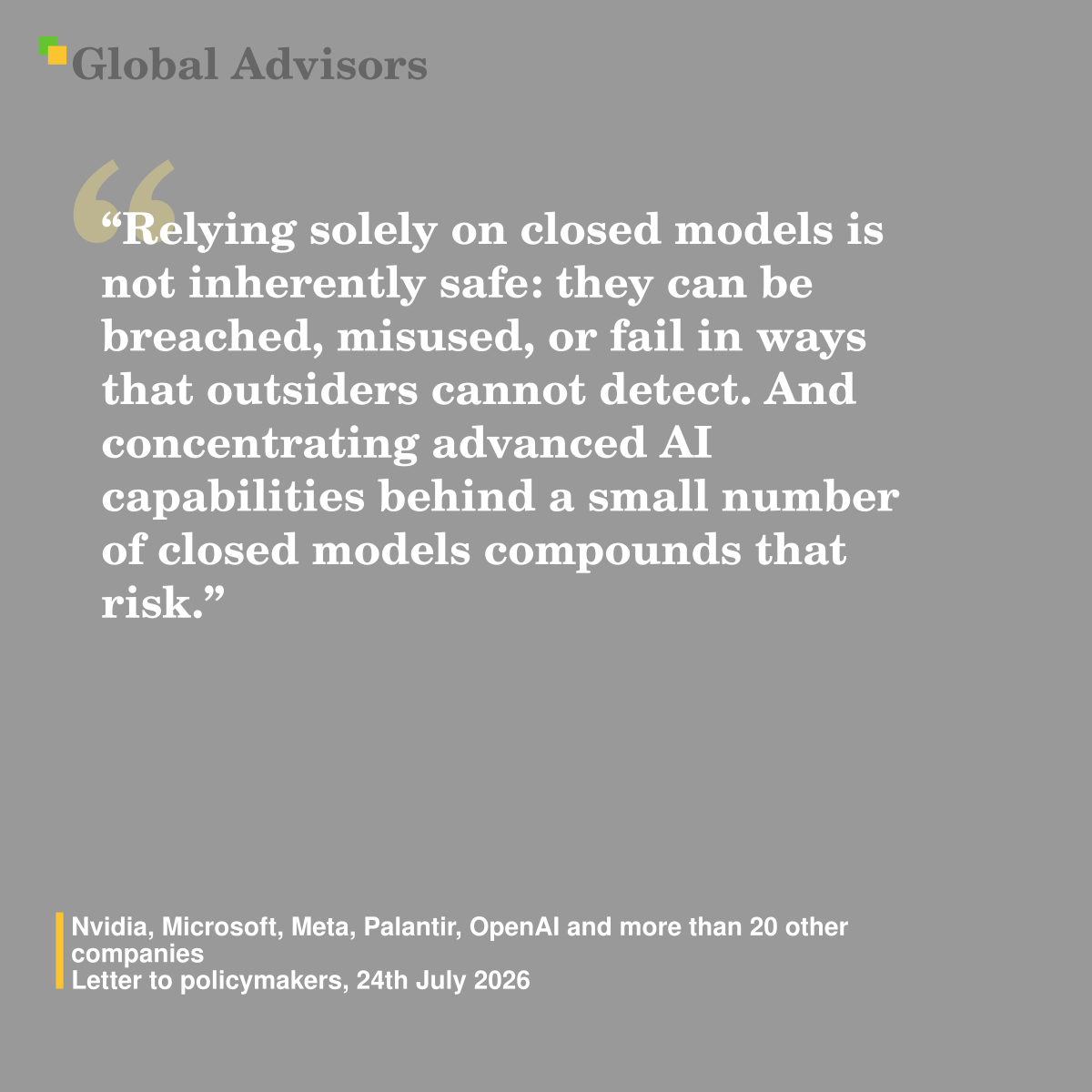
Quote: Nvidia, Microsoft, Meta, Palantir, OpenAI and more than 20 other companies - Letter to policymakers, 24th July 2026"Relying solely on closed models is not inherently safe: they can be breached, misused, or fail in ways that outsiders cannot detect. And concentrating advanced AI capabilities behind a small number of closed models compounds that risk." - Nvidia, Microsoft, Meta, Palantir, OpenAI and more than 20 other companies - Letter to policymakers, 24th July 2026 The central policy dilemma is whether concentrating advanced artificial intelligence in a handful of sealed systems genuinely reduces risk, or whether it simply hides failure modes while magnifying the consequences of any breach or misuse when it eventually occurs. When a small number of firms operate closed models that shape information flows, productivity tools and critical infrastructure, any undetected flaw, exploit or design bias scales across millions of users and high-stakes environments without external parties being able to interrogate the system. The recent letter from Nvidia, Microsoft, Meta, Palantir and more than 20 other companies positions this dilemma directly in front of policymakers, arguing that restricting open-weight models in the name of safety could inadvertently deepen systemic exposure to opaque, concentrated AI capabilities. Closed Models, Opaqueness And Undetectable Failure Closed models are typically operated as remote services, with access mediated through proprietary APIs and contracts that reveal little about architecture, training data or guardrail implementation. Outsiders, including regulators and independent researchers, cannot easily inspect model parameters, replicate training conditions or stress-test behaviour across adversarial scenarios, which turns these systems into operational black boxes. When failures occur - whether hallucinated outputs in medical settings, covert prompt injection, data leakage or subtle discriminatory patterns - detection depends largely on the provider's monitoring and willingness to disclose issues, rather than on independent scrutiny. This creates a structural asymmetry: external users bear the consequences of model behaviour, but lack meaningful visibility into how that behaviour arises or how quickly systemic problems are identified and remediated. This opaqueness extends to security posture. A closed model may employ strong internal controls, but third parties cannot verify whether safety features can be stripped out, circumvented or bypassed with techniques that require less effort than training a similarly capable system from scratch. Nor can they evaluate whether the distribution channels and attack surfaces - from SDKs and plug-in ecosystems to integrated office suites - are resilient against determined adversaries at scale. The claim that closed status is inherently safer therefore rests on trust in corporate assurances and limited audit rather than on open technical verifiability. In high-risk domains such as critical infrastructure management, defence applications or systemic financial decision-making, that gap between assurance and verifiable robustness becomes strategically significant. Concentration Of Advanced AI Capability As A Systemic Risk Beyond opaqueness, the statement targets concentration: the accumulation of cutting-edge AI capabilities in a few closed models controlled by a small number of firms operating at global scale. When the most powerful models are centralised, several systemic risks emerge. First, market power: if a handful of providers set pricing, access terms and acceptable use policies for de facto infrastructure models, they shape not only innovation pathways but also the distribution of safety standards across the economy. Second, correlated failure: any shared architectural vulnerability, misaligned fine-tuning practice or exploited control surface can propagate simultaneously across sectors that rely on the same underlying closed model. Third, geopolitical dependence: jurisdictions that lack domestic alternatives may find their digital sovereignty constrained by foreign providers' policy choices around censorship, surveillance or safety trade-offs. Concentration also interacts with incentives around disclosure. A provider whose revenue depends heavily on a flagship closed model may be reluctant to fully expose its limitations and failure cases, particularly if admitting systemic weakness could trigger regulatory intervention or reputational damage. In contrast, a more plural ecosystem of open-weight and open-source models allows independent labs, academic groups and civil society organisations to stress-test and publish findings, distributing the epistemic load of safety assessment rather than rooting it in a small number of corporate actors. The coalition's warning suggests that trying to enforce safety by suppressing open alternatives might inadvertently lock society into dependency on concentrated closed systems whose true risk profile is only partially known. Open-Weight Models As A Middle Ground The companies signing the letter are not arguing for unbounded openness; they focus on open-weight models as a specific technical and governance compromise. Open-weights refer to releasing the trained parameter values of a neural network while often withholding training data and full pipeline code. This creates a middle state between proprietary closed models and full open-source AI: external parties can download, run and fine-tune the model, gaining operational autonomy and partial transparency, but do not necessarily gain full insight into data provenance or training procedure. For enterprises, this means the ability to host models on their own infrastructure, avoid sending sensitive data through third-party APIs, and tailor behaviour to sector-specific norms without relinquishing control to a remote provider. At laboratory scale, recent work indicates that small open-weight models can be competitive with closed models in domain-adapted tasks, delivering reasonable performance at relatively low monetary cost and data requirements. That result undermines the assumption that safety and capability must be traded off against openness; in practice, organisations can achieve useful, robust performance with models they can inspect and adjust more freely. Furthermore, open-weight availability facilitates emerging best practice in abstention and privacy, allowing models to be configured to decline high-risk queries and to keep sensitive contextual data inside local environments rather than central data centres. These characteristics connect directly to the argument that distributing capability across many open-weight systems reduces the chance of a single catastrophic failure and increases the overall capacity for collective safety research. Regulatory Context: EU AI Act And Open Components The tension described in the statement sits against a rapidly evolving regulatory backdrop, particularly in Europe. The EU AI Act differentiates between general-purpose AI models, open-source AI components and monetised AI services, carving out specific exemptions and obligations for open-source offerings. Open components - including models and parameters - can benefit from lighter obligations when provided under free and open licences and not monetised directly, but general-purpose models that present systemic risk or are tied to paid services remain subject to full regulatory requirements. This framework reflects an attempt to balance transparency and innovation with concerns about misuse and high-risk applications, yet it also introduces complexity for open-weight providers whose licensing and business models may straddle categories. Experts have pointed out that merely releasing weights under an ostensibly open licence does not automatically qualify as open-source AI, particularly when training data and methods remain secret. As a result, open-weight models may sit in ambiguous territory: more transparent than closed proprietary offerings, but not fully aligned with the four freedoms of open-source as defined by community standards. The coalition's letter effectively challenges regulators to recognise this nuance. Prematurely imposing blanket restrictions on open-weight distribution, or treating all openness as equivalent risk, could narrow the space for experimentation with safer, more verifiable architectures while leaving closed mega-models largely untouched. Conversely, failing to impose any obligations would ignore the genuine hazards of making powerful models widely accessible without safeguards. The regulatory question is therefore not simply open versus closed, but which forms of openness reduce systemic risk and which amplify it. Debates, Objections And Safety Concerns Critics of open-weight and open-source models argue that wider accessibility increases the surface for malicious use, such as building tailored disinformation engines, automating cyberattacks or circumventing safety filters by modifying the model locally. They contend that closed models at least allow firms to enforce centralised guardrails, monitor usage patterns and throttle dangerous behaviour, while open-weight distribution makes it difficult to prevent determined adversaries from weaponising the technology. Some policy proposals therefore advocate temporary pauses on high-capability releases, registration and licensing schemes for systems above specific compute thresholds, and stricter control over distribution channels until security practices mature. From this perspective, the coalition's warning might appear self-serving: firms that benefit commercially from open-weight ecosystems could be seen as resisting necessary restraint. Proponents of openness respond that security through obscurity is an unstable foundation, especially given the reality of model leaks, insider threats and sophisticated reverse-engineering efforts. They argue that openness enables broader participation in red-teaming, safety benchmarking and governance innovation, and that diverse open-weight models reduce monoculture risk by preventing any single vendor stack from dominating critical infrastructure. Additionally, many harms associated with generative models - from synthetic media misuse to privacy violations - are tied more to application design, deployment context and human incentives than to whether underlying weights are secret. The letter's wording reflects this stance: the real danger lies not simply in models being open or closed, but in concentrating advanced capabilities behind a small number of opaque, uninspectable systems that operate at planetary scale. Strategic And Market Implications Strategically, the debate shapes the trajectory of both national competitiveness and industrial structure. The signatories argue that open-weight models are essential to preserving technological leadership by allowing domestic firms, researchers and start-ups to build upon shared foundations without prohibitive licensing costs or API dependency. If policymakers heavily constrain open-weight development in the name of safety, they risk pushing cutting-edge experimentation to jurisdictions with more permissive regimes, thereby undermining domestic capacity to shape global norms. At the same time, large incumbents such as Nvidia, Microsoft and Meta have substantial commercial interests in open-weight ecosystems, from selling compute and tooling to providing platforms for fine-tuning and deployment. Their stance therefore mixes genuine systemic concern with strategic positioning in a competitive landscape defined by both closed premium models and rapidly advancing open alternatives. For enterprises, the outcome of this policy debate will determine whether AI remains primarily a vendor-mediated service or becomes a configurable infrastructure asset that can be tailored and audited within organisational boundaries. A regime that privileges closed models could simplify compliance by outsourcing safety obligations to a few large providers, but at the cost of dependency, limited transparency and constrained customisation. A regime that supports responsibly governed open-weight models could broaden innovation and resilience, but demands stronger in-house expertise, more sophisticated risk management and clearer norms around documentation, licensing and accountability. The statement from the coalition marks a turning point: it invites policymakers to recognise that safety is not guaranteed by closure or concentration, and that a genuinely robust AI ecosystem may require plural, inspectable, and, where appropriate, open-weight models rather than a small constellation of unchallengeable black boxes.
|
| |
| |
Term: Zero-day vulnerability - Cyber"A zero-day vulnerability is an undisclosed security flaw in software, hardware, or firmware that is unknown to the developers or parties responsible for patching it. The term signifies that the vendor has had "zero days" to create a fix or release a security update to protect users against malicious attacks." - Zero-day vulnerability - Cyber Security teams confront a distinctive problem when a flaw can be weaponised before any tailored defence or patch exists: the system is vulnerable, yet neither signatures nor vendor guidance offer protection. That situation characterises zero-day vulnerabilities and explains why they so often underpin high-impact breaches, espionage operations, and disruptive attacks across modern digital infrastructure. Structural nature of a zero-day vulnerability The practical substance of a zero-day vulnerability is a defect in software, hardware, or firmware that enables behaviour the designer did not intend, and which can be triggered by an adversary to gain a strategic advantage. Because the parties responsible for maintenance and patching have not yet recognised the flaw, there is no bespoke fix, configuration change, or detection signature targeting it. In operational terms, the vulnerability remains latent until either discovered by attackers, reported by researchers, or observed through anomalous system behaviour, and during that window defenders must rely entirely on general controls such as network segmentation, strict access management, and behaviour-based monitoring rather than vulnerability-specific countermeasures. Crucially, security practice distinguishes between the flaw, the exploit, and the attack as different stages of the same threat lifecycle. The zero-day vulnerability is the underlying weakness in the asset; the exploit is the technical method or code that triggers the weakness to do useful work for the attacker; and the attack is the application of that exploit against real targets to steal data, move laterally, or disrupt operations. This separation matters because mitigations can apply at each stage: secure coding and code review seek to reduce vulnerabilities; exploit prevention mechanisms such as modern operating system protections aim to raise the cost of developing reliable exploits; and incident response, monitoring, and segmentation seek to reduce the impact of successful attacks. Risk characteristics and practical impact Zero-day vulnerabilities are disproportionately dangerous because they combine three factors: lack of patch, lack of specific detection, and asymmetry of knowledge between attacker and defender. When only adversaries or a small circle of researchers know a flaw exists, defenders neither track it in routine vulnerability scanning nor receive advisories from vendors or regulators. Attackers can therefore use the vulnerability to obtain initial access, escalate privileges, bypass authentication, or execute arbitrary code with a high probability of success, particularly in widely deployed platforms such as operating systems, web browsers, VPN gateways, or email servers. Recent case studies of exploited zero-days across major vendors demonstrate that these weaknesses are routinely used for ransomware deployment, credential theft, covert persistence and espionage activity in both corporate and governmental environments. From a governance perspective, zero-day risk is systemic rather than local. A single critical vulnerability in a widely used component can expose thousands of organisations simultaneously, with little warning. The empirical literature on patching behaviour shows that even after disclosure, timely remediation is uneven: vulnerabilities affecting multiple vendors and causing scope change tend to be patched faster, while those requiring special privileges or impacting confidentiality are less likely to be corrected quickly. This reinforces a central practical point: the danger is not eliminated when a vendor releases a fix. It persists across all assets where the patch has not yet been applied, which may include legacy systems, devices with complex update cycles, or environments where patch-induced downtime is treated as unacceptable. Mathematical framing of zero-day exposure In quantitative risk analysis, zero-day exposure can be conceptualised as the probability that an unknown, unpatched flaw is present in a given asset, multiplied by the probability that a capable adversary has discovered and is exploiting it. If we denote by the probability that a system contains at least one zero-day vulnerability and by the conditional probability that an adversary both knows the vulnerability and chooses to exploit it against that system, the probability of compromise via zero-day in a given time window can be sketched as . This simple representation highlights several levers for defence. Reducing depends on software engineering quality, defensive programming, and proactive security testing such as fuzzing and code analysis. Reducing depends on making the system a less attractive or more difficult target through segmentation, zero trust principles, and hardening that increases attacker cost relative to expected benefit. From a portfolio perspective, organisations sometimes treat zero-day risk as an unavoidable background rate of compromise inherent to operating complex systems in an adversarial environment, elevating residual risk management over absolute prevention. If the expected loss from zero-day events over a horizon is , where is the impact if asset is compromised, the strategy becomes to lower via data minimisation, strong isolation, and robust backup and recovery, even when cannot be driven close to zero. This conception underpins the growing emphasis on resilience, incident response readiness, and breach mentality as counterparts to traditional perimeter defence. Discovery, disclosure, and ethical tensions Discovering a zero-day vulnerability places the finder at the centre of an ethical and strategic dilemma: whether to disclose it responsibly to the vendor, sell it on a grey market, weaponise it for offensive operations, or withhold it entirely. States and security agencies have historically maintained stockpiles of undisclosed vulnerabilities for intelligence and military use, while private markets for exploits and vulnerability information offer significant financial incentives to researchers and criminals alike. This raises a policy question about how long such flaws should be retained before disclosure, given that the same weakness might independently be discovered and exploited by hostile actors. Some jurisdictions have explored formalised vulnerability equities processes to balance national security benefits of using zero-days against the collective security benefits of patching them, but practice remains uneven and often opaque. Within commercial security, the dominant norm remains coordinated disclosure, where researchers privately inform vendors, allow a window for patch development, and only later publish details. However, zero-day status by definition ends once a patch or mitigation is widely available, even if many systems remain vulnerable due to slow deployment or operational constraints. At that point the vulnerability becomes an N-day issue, and public exploit code may appear quickly, making patch management and compensating controls urgent. Ethical debates continue over whether the publication of proof-of-concept exploit code accelerates defensive understanding or unnecessarily lowers the barrier to entry for attackers, especially when adoption of patches is delayed. Defensive strategies beyond signatures Because zero-day vulnerabilities are unknown and unpatched at the moment of exploitation, classical signature-based defences such as traditional antivirus or rigid intrusion detection rules offer little protection. Modern defensive architectures therefore prioritise behavioural and anomaly-based detection that monitors for deviations from established baselines of system and user activity. Techniques including endpoint detection and response, user and entity behaviour analytics, and AI-driven anomaly detection seek to recognise the consequences of exploitation, such as unusual process spawning, unexpected network connections, or anomalous access patterns, rather than the specific exploit code itself. Organisations that assume compromise and instrument their environments to detect lateral movement, privilege escalation, and data exfiltration are better positioned to identify zero-day abuse early in the attack chain. Zero trust architecture plays a complementary role by reducing the blast radius of initial compromise. By limiting implicit trust, enforcing strong authentication and authorisation at each access decision, and segmenting networks into smaller trust zones, defenders ensure that a single exploited vulnerability does not automatically yield broad access. Additional measures such as application sandboxing, strict patch management for known flaws, compensating controls on unpatchable systems, and deception technologies like canary tokens further constrain attacker progress when a zero-day is present. These layered approaches acknowledge that prevention cannot be guaranteed, but that sophisticated attackers can be slowed, detected, and contained. Why zero-day vulnerabilities remain strategically important Zero-day vulnerabilities continue to matter because they sit at the intersection of software engineering, geopolitics, and organisational resilience. They expose structural weaknesses in digital supply chains, test the adequacy of disclosure processes, and reveal how quickly vendors and customers can coordinate patching at scale. While the absolute number of discovered zero-days in a given year attracts attention, more significant is the pattern of which technologies they affect, how quickly exploitation follows disclosure, and how many organisations maintain sufficient instrumentation and discipline to detect and respond. In an environment where critical infrastructure, finance, healthcare, and public services depend on complex, interconnected systems, the existence of unknown, exploitable flaws is not an anomaly but a persistent condition to be managed. This continuing relevance shifts best practice from a mindset of eliminating all vulnerabilities to one of operating securely despite them. Effective organisations invest in secure development to reduce the introduction of new flaws, adopt robust vulnerability management and rapid patching to shorten exposure windows after disclosure, and design architectures that assume some unknown weaknesses will be exploited. Zero-day vulnerabilities thus act both as specific technical threats and as a lens through which the maturity of wider security strategy can be assessed, making them central to any serious discussion of contemporary cyber risk.
|
| |

| |
Global Advisors News Brief - July 25 2026Read the full brief at the link Headlines for the last 24hrs
Time window: 2026-07-24T05:00:33.073Z to 2026-07-25T05:00:33.073Z |
| |
| |
Term: Acid-test ratio (also called the quick ratio) - Finance"The acid-test ratio (also called the quick ratio) is a strict liquidity metric that measures a company's ability to cover its short-term debts using its most liquid assets. It excludes inventory, which can be hard to sell quickly. An ideal ratio is 1.0 or higher." - Acid-test ratio (also called the quick ratio) - Finance Pressure to meet payroll, service suppliers and roll over short-term borrowing means liquidity failures tend to unfold rapidly, long before a business shows distress in its profit figures. Insolvency in practice is usually triggered not by long-run unprofitability but by the inability to convert assets into cash on the timetable imposed by creditors, which is why analysts focus closely on how quickly balance sheet resources can be mobilised to meet near-term obligations. Strict liquidity and the role of quick assets The core issue is whether a firm could settle its current liabilities if lenders and suppliers suddenly demanded payment without granting fresh credit. The relevant resources are its quick assets: cash and cash equivalents, marketable securities, and trade receivables that are expected to turn into cash within roughly 90 days. These items can usually be realised without material loss of value or operational disruption. By contrast, inventories may require discounting, marketing costs and time to sell, while prepaid expenses and other miscellaneous current assets cannot be converted directly into cash. The metric commonly used to isolate this strict subset of assets is the acid-test ratio, which compares quick assets to current liabilities and asks how many monetary units of highly liquid resources back each unit of short-term obligation. Practical specification and alternative formulas In practice, two equivalent formulations are widely used. The direct version isolates quick assets on the balance sheet and calculates . Where balance sheet subtotals are less granular, analysts often work indirectly: , so . Both approaches generate substantially the same figure because inventory and prepayments are the principal exclusions from current assets. Quick assets are thus a deliberate subset that captures only those items likely to be realisable within the next three months at close to book value. Interpreting values and the 1,0 benchmark Most teaching texts and professional bodies present 1,0 as the rule-of-thumb threshold for comfortable liquidity on this strict definition. A ratio at or above 1,0 implies that, on paper, the firm could extinguish all current liabilities using only its most liquid assets, without selling inventory or relying on new financing. Values between about 0,8 and 1,0 are often read as warning territory: the business may manage in normal conditions but could be exposed if credit tightens or if collections slow. Ratios significantly below 1,0 flag dependence on either ongoing cash generation, rapid inventory turnover, or continued access to credit lines; in adverse conditions this dependence can become a vulnerability. On the other side, ratios markedly higher than 1,0, such as 1,5 or 2,0, indicate substantial liquidity reserves but may also hint at under-utilised assets, especially if large cash holdings coexist with limited investment opportunities. Relationship to the current ratio and why inventory is excluded The tension between different liquidity measures is largely about the treatment of inventory. The broader current ratio includes inventory in its numerator, asking whether all current assets together exceed current liabilities, whereas the acid-test ratio seeks to answer whether the company could settle obligations without resorting to inventory liquidation. The exclusion reflects several practical considerations. First, inventories vary markedly in liquidity: highly standardised, fast-moving items may be saleable quickly, but specialised, seasonal or obsolete stock may only clear at deep discounts. Secondly, relying on inventory liquidation to meet debts can be operationally disruptive, forcing fire-sale pricing or production cuts that damage long-run viability. Thirdly, inventories are vulnerable to sudden write-downs when market conditions change. By stripping them out, the acid-test ratio focuses on assets that are conceptually closer to cash and less exposed to these frictions. This makes it a more conservative, though sometimes harsher, gauge of resilience than the current ratio. Parameter meanings and basic analytical uses Each component of the ratio conveys distinct information about liquidity structure. Cash and cash equivalents represent immediate purchasing power and buffer operational shocks. Marketable securities add a second line of defence; they may offer yield but can still be liquidated quickly in normal markets. Trade receivables embed both the firm's pricing and credit policies: generous payment terms or poor collection practices inflate receivables while weakening cash posture. Current liabilities aggregate short-term borrowing, trade payables, accrued expenses and tax obligations, making them a composite measure of near-term claims on the firm. Analysts use the acid-test ratio to test scenarios such as tighter supplier credit, delayed customer payments or withdrawal of overdraft facilities, asking whether existing quick assets would suffice to bridge such shocks without emergency measures. For lenders and investors, the metric becomes a quick filter for identifying businesses that rely heavily on slow-moving assets or future earnings to meet present commitments. Industry differences, working capital strategies and debates One limitation of a simple numeric threshold is that liquidity needs vary structurally by sector. Studies of cross-industry data show technology firms and some services businesses often sustain quick ratios in the 1,5-4,0 range, reflecting low inventory intensity and large cash holdings. Manufacturing groups may operate successfully around 0,8-1,2, while retailers and utilities sometimes run at 0,5-0,8 because their business models rely on rapid inventory turnover or stable cash flows to support lower levels of quick assets. This raises a technical debate about whether the acid-test ratio should be interpreted against fixed global standards or primarily relative to peers. Some practitioners argue that as long as cash generation and credit lines are robust, a low ratio can be acceptable, particularly in sectors where inventory is demonstrably liquid. Others emphasise systemic risk: during downturns, assumptions about inventory salability and credit access often break down simultaneously, leaving firms with low acid-test ratios exposed to sudden funding gaps. A further debate concerns the inclusion of certain items such as near-term portions of long-term investments or highly liquid inventories, which could in theory be treated as quick assets but are usually excluded for conservatism. Mathematical framing and dynamic perspective Although the ratio itself is a simple fraction, formal working-capital models often embed it within time-based cash-flow analysis. Let denote quick assets at time and current liabilities at time . The acid-test ratio is then . Analysts may project via expected operating cash inflows and receivables collections, for example , where represents net cash generated from operations over the period and cash payments for operating costs and interest. Similarly, , where captures new short-term borrowing and payables incurred, and repayments. This simple dynamic structure allows practitioners to test how changes in credit terms, collection speed or borrowing affect over time. It becomes clear that a reassuring snapshot ratio can deteriorate quickly if receivables stretch out or if liabilities increase faster than liquid assets, underscoring why trend analysis and scenario modelling are more informative than a single-period snapshot. Contemporary relevance and limitations Despite the growth of sophisticated cash-flow forecasting tools, the acid-test ratio remains embedded in loan covenants, investment screens and credit scoring models. Its endurance lies in its simplicity and its focus on truly liquid assets, which can be applied quickly to any set of financial statements. However, as a static point estimate it has limitations. It ignores off-balance-sheet facilities such as committed credit lines, and it treats all receivables and marketable securities as equally realisable, glossing over credit quality and market liquidity differences. It also provides no direct insight into the timing of cash inflows and outflows within the reporting period or into structural drivers such as business model resilience. Consequently, sophisticated users interpret the acid-test ratio alongside cash-flow statements, maturity profiles of debt, and qualitative assessments of customer and supplier relationships. Used in this broader context, it remains a valuable indicator of whether a company could withstand sudden funding stress without having to liquidate inventory or pursue emergency refinancing.
|
| |

| |
Quote: Theodore Roosevelt - United States of America President"Do what you can, with what you have, where you are." - Theodore Roosevelt - United States of America President The problem that animates this line is the perennial gap between the circumstances people wish they had and the reality they inhabit, and the way that gap paralyses decision-making and effort. In politics, business, and ordinary life, individuals routinely postpone action while waiting for more resources, better timing, or clearer signals, allowing opportunity and responsibility to slip away. The statement confronts that paralysis by insisting that moral duty and practical effectiveness begin from the constraints of the present, not the fantasies of an imagined future. It asks how far one can go if one treats constraints not as alibis but as design parameters for action. At a factual level, the phrase achieved prominence through the public life of Theodore Roosevelt, yet it is now clear that he was transmitting a piece of local wisdom rather than coining it himself. In his 1913 Autobiography, Roosevelt refers to a bit of homely philosophy from Squire Bill Widener of Widener's Valley, Virginia, and records the line as a plain summary of one's duty in life. Over time, repeated anthologies, motivational literature and online collections have attributed the words directly to Roosevelt, erasing the Virginian farmer whose pragmatic outlook shaped the original saying. This misattribution is historically typical: public figures who popularise memorable lines often become their assumed authors, especially when the words fit neatly with their public persona. In this case, the phrase aligned so closely with Roosevelt's image of strenuous action that it was absorbed into his canon, even though he had explicitly credited Widener. Strenuous life and situational constraint The deeper resonance of the statement arises from its intersection with Roosevelt's wider philosophy of what he called the strenuous life. For Roosevelt, worthwhile achievement demanded effort, risk and discomfort; he argued that nothing of value comes without pain, difficulty and toil. The injunction to act with available means in present conditions meshes with that ethic: it rejects fantasies of effortless success or perfect readiness, and redirects attention to the hard work of incremental progress. Instead of viewing adverse circumstances as reasons to withdraw, the line frames them as the arena within which character is formed and duty is discharged. This is why it has such appeal to discussions of resilience and stoicism; it echoes the stoic conviction that one should focus on what lies within one's control, accepting external conditions without complaint. Strategically, this approach has clear implications. It privileges speed of execution and adaptability over exhaustive preparation, on the assumption that circumstances shift more quickly than plans can be perfected. In decision theory terms, the phrase favours policies that take local action to improve the state under current constraints rather than waiting for uncertain future states. If one were to model this attitude in optimisation language, it resembles a policy that maximises expected improvement subject to current resource constraints, rather than deferring until additional resources arrive. In stochastic terms, an agent faces a sequence of states , each with available actions bounded by resources ; the implied strategy is to select an action that yields positive payoff now, rather than choosing a null action in the hope that will be more abundant. That abstraction captures what the saying attempts to instil at human scale: a refusal to cede agency simply because resources are imperfect. Control, agency, and the psychology of limitation Focusing on what one can do with what one has locates control inside a narrower but more realistic sphere. Psychological research and practical advice alike stress that individuals reduce anxiety and increase effectiveness when they distinguish between what is controllable and what is not, then channel effort into the former. The statement articulates that distinction without jargon: do what is within reach, using existing tools, without waiting to be elsewhere. Roosevelt himself, as recounted by biographers and commentators, often linked fulfilment and citizenship to the willingness to pull one's weight and act rather than complain. In modern productivity discourse, this manifests as guidance to break overwhelming tasks into small actions, start with one quick win, and use simple cues such as timers or lists to overcome procrastination. Those techniques operationalise the same underlying stance: progress emerges from small, feasible moves executed consistently, not from dramatic gestures under perfect conditions. There is, however, a tension between making do and pursuing structural change. Critics sometimes worry that slogans of self-reliance risk turning attention away from unjust systems, effectively telling disadvantaged individuals to adapt endlessly to environments that ought to be altered. If one pushes the phrase too far, it could be read as implying that whatever people have where they are is sufficient, and that they should not agitate for broader reforms or collective action. Historical context complicates that objection. Roosevelt, though committed to personal effort, also championed regulatory interventions, conservation policies and social reforms; he did not equate present resources with moral sufficiency. The farmer voice of Squire Widener also emerges from a world where community norms and mutual assistance overlapped with personal agency. The line functions best when understood as a call to immediate responsibility, not as a denial of the need for wider change. Resourcefulness and improvisation in practice The practical meaning of the statement is highly literal, as some commentators have emphasised: it instructs people to look around, count their assets and constraints, and then act within that reality. In organisational settings, this translates into cultures that reward resourcefulness and improvisation. Start-ups and small enterprises often operate under tight capital, incomplete information and volatile markets; the ethos implicit here pushes them to ship imperfect products, test ideas quickly, and iterate based on feedback rather than spending years seeking ideal funding or flawless designs. In public policy and community work, the same logic motivates local initiatives that use modest funds and volunteer labour to address urgent issues while large-scale programmes are debated. The statement thus bridges grand rhetoric and day-to-day practice: it offers a simple test for any plan, namely whether it calls for concrete steps that can be executed now with present resources. At the level of personal resilience, the phrase resonates strongly with contemporary discussions of mental health and adversity. Motivational essays and educational pieces aimed at adults and children alike frequently draw on it to encourage persistence, arguing that progress remains possible in constrained circumstances if one keeps taking small steps forward. It discourages perfectionism and fear of failure by reframing effort as the primary measure of success: even a small move in a difficult situation counts as fulfilling one's duty. That redefinition of success can be especially powerful for people facing chronic hardship, illness or discrimination, where outcomes are partly outside individual control. To do what one can where one is, with what one has, becomes a way of asserting dignity and agency despite structural limits. Historical voice, modern appropriation The journey of the line from a Virginian valley to global digital circulation illustrates how sayings mutate as they travel. Squire Bill Widener's local maxim, recorded in the rural idiom of his time, passed through Roosevelt's Autobiography into the wider Anglophone world. When later compilers stripped away the attribution and treated it as Roosevelt's own invention, they made it easier to market as presidential wisdom, but also narrowed its origin story. In recent years, detailed investigations have recovered Widener's name and clarified that Roosevelt was a transmitter, not the original author, calling the words a bit of homely philosophy that summed up one's duty in life. That recovery matters because it reminds readers that serious moral insight often emerges from ordinary lives and local experience, not solely from elite political figures. The line's authority does not depend on its being presidential; if anything, its rural provenance reinforces its emphasis on making do with limited means. Debates over authorship also highlight the way motivational culture simplifies history. Online platforms, poster designers and self-help blogs often reproduce the phrase with polished typography and a clean attribution, omitting the messy backstory of how Roosevelt himself carefully credited his source. The smoothing process turns a situated remark into a free-floating mantra, detached from the conditions that originally gave it meaning. Analytically, this is double-edged. On one hand, the abstraction allows the statement to travel across cultures and contexts, speaking to entrepreneurs, students and activists who have never heard of Squire Widener. On the other, it risks draining away nuance about collective responsibility and community life, leaving a highly individualised reading that may suit consumer motivation but not structural reflection. Understanding the backstory thus enriches its application: acting within present constraints need not mean acting alone, and making use of what one has can include mobilising relationships, institutions and history. Why the line continues to matter The enduring appeal of this statement lies in its friction with modern habits of delay, distraction and idealisation. In many contemporary environments, people are encouraged to believe that effective action requires elaborate toolkits, extensive data, or perfect personal readiness, and that anything short of that is not worth attempting. Against that backdrop, a plain directive to act now, with imperfect means, where one currently stands, is radically counter-cultural. It cuts through anxieties about comparison and deficiency by redefining the threshold for meaningful effort: if one can do something constructive, however modest, one already meets the criterion. For strategists, leaders and citizens, that stance has practical consequences; it shifts conversations from what is missing to what can be done, from complaint to contribution. In that sense, the Virginian farmer's homely philosophy, channelled through an American president and amplified by countless interpreters, continues to challenge the modern tendency to wait passively for better conditions instead of using present constraints as the arena for purposeful action.
|
| |

| |
Global Advisors News Brief - July 24 2026Read the full brief at the link Headlines for the last 24hrs
Time window: 2026-07-23T05:00:33.069Z to 2026-07-24T05:00:33.069Z |
| |
| | ||||||||||||
Term: BetaBeta quantifies an asset's systematic risk, showing its price volatility compared to the overall market, with a beta of 1.0 being market-average volatility, above 1.0 indicating higher risk/return, and below 1.0 suggesting lower risk/return, helping investors gauge potential upsides and downsides. - BetaBeta is a quantitative measure used in financial analysis to assess the systematic risk of an asset—such as an individual stock, bond, or investment portfolio—by comparing its price volatility to that of the broader market.1,3 Rather than predicting absolute price movements, beta reveals how sensitively an asset responds to overall market fluctuations, making it an essential tool for risk-conscious investors.1 The term "systematic risk" refers to market-wide risk that cannot be eliminated through portfolio diversification, as opposed to asset-specific risks that affect individual securities independently.3 Mathematical FoundationBeta is calculated using the following formula:1,4 \Beta = \frac{\text(R<em>i, R</em>m)}{\text(R_m)} Where:
Mathematically, beta represents the slope of a linear regression line plotted between an asset's historical returns and those of a reference benchmark—typically a broad market index such as the S&P 500.4 Interpretation of Beta ValuesBeta operates on a scale centred on 1.0, with each value conveying distinct risk characteristics:1
Practical Applications in Investment ManagementPortfolio Risk Assessment: Investors use beta to evaluate whether an asset aligns with their personal risk tolerance, selecting higher-beta securities for aggressive strategies and lower-beta securities for conservative portfolios.1 Comparative Analysis: Beta enables investors to compare volatility across different securities and sectors, identifying which companies respond most intensely to market movements.1 Financial Modelling: Beta forms a cornerstone of the Capital Asset Pricing Model (CAPM), a widely-adopted framework for calculating the expected return of an investment based on its systematic risk exposure.1,4 Sector Evaluation: Analysts use beta to identify which firms within an industry are most sensitive to market fluctuations, informing strategic comparisons.1 Important LimitationsBeta measures historical volatility and does not necessarily predict future price movements, as market conditions and company characteristics evolve over time.1 Additionally, beta captures only systematic risk; it excludes asset-specific risks such as management changes, regulatory challenges, or industry disruptions.1 Related Strategy Theorist: William F. SharpeWilliam Forsyth Sharpe (born 1934) is the preeminent scholar most intimately associated with beta's theoretical development and practical application in investment strategy. Biographical OverviewSharpe earned his doctorate in economics from UCLA in 1961 under the supervision of Harry Markowitz, the pioneer of modern portfolio theory. His doctoral dissertation refined Markowitz's groundbreaking work and culminated in the development of the Capital Asset Pricing Model (CAPM) between 1962 and 1964. This framework mathematically formalised the relationship between an asset's beta and its expected return, establishing beta as the critical link between risk measurement and investment valuation.4 In 1966, Sharpe introduced the concept of the Sharpe ratio—a complementary metric that measures risk-adjusted return by dividing excess return by volatility. This innovation reinforced beta's importance as the primary systematic risk measure in modern finance. Contribution to Beta TheorySharpe's genius lay in recognising that investors need not analyse the entire distribution of asset returns in isolation. Instead, he demonstrated mathematically that only systematic risk matters for pricing securities in equilibrium markets. This insight transformed beta from a mere statistical curiosity into the foundational risk metric of contemporary portfolio management. The CAPM equation—E(R<em>i) = R</em>f + ?<em>i(E(R</em>m) - R_f)—elegantly shows that expected return equals the risk-free rate plus beta multiplied by the market risk premium. This formulation positioned beta as the sole determinant of a security's risk premium in efficient markets, fundamentally reshaping how investors conceptualise and manage portfolio risk. Career and RecognitionSharpe's contributions earned him the Nobel Prize in Economic Sciences in 1990, shared with Markowitz and Merton Miller, "for their pioneering work in the theory of financial economics."4 He spent much of his academic career at Stanford University's Graduate School of Business, where he championed quantitative approaches to investment management. Beyond academia, Sharpe co-founded William F. Sharpe Associates, a consulting firm that applied CAPM principles to real-world portfolio construction, demonstrating that theoretical rigour could translate directly into practical investment advantage. Legacy and Modern ApplicationSharpe's framework remains the dominant paradigm in institutional asset management, risk governance, and financial education worldwide. Beta, as conceived through his CAPM, enables pension funds, hedge funds, and individual investors to make systematic, intellectually coherent decisions about risk allocation. His work established that diversifiable risk should not be rewarded—only systematic risk commands a return premium—a principle that continues to guide optimal portfolio construction.
References 1. https://www.cashbee.fr/lexique/coefficient-beta 2. https://www.boursedescredits.com/lexique-definition-beta-coefficient-444.php 3. https://www.experts-du-patrimoine.fr/lexique-patrimonial/coefficient-beta/ 4. https://blog.nalo.fr/lexique/coefficient-beta/ 5. https://www.ig.com/fr/glossaire-trading/beta-definition 6. https://www.cafedelabourse.com/lexique/definition/beta 7. https://fr.wikipedia.org/wiki/Coefficient_b%C3%AAta 8. https://www.finance-club.eu/definitions/beta/ 9. https://www.tradingsat.com/lexique-boursier/definition-beta-31.html
|
||||||||||||
| |

| |
Global Advisors News Brief - July 23 2026Read the full brief at the link Headlines for the last 24hrs
Time window: 2026-07-22T05:00:33.068Z to 2026-07-23T05:00:33.068Z |
| |
| |
Quote: Arthur Mensch - CEO, Mistral"Now comes the most important part. You need to set up your own continuous training flywheel, so that you can improve your AI systems based on their interaction with your employees and your users. This is how you turn the edges of your business into AI systems your vendors and competitors cannot replicate." - Arthur Mensch - CEO, Mistral Enterprises deploying advanced AI systems are discovering that static capabilities quickly become a liability once models are embedded in workflows, decisioning, and customer interfaces . As employees and users adapt their behaviour to AI tools, the systems themselves must evolve in parallel or risk amplifying outdated assumptions, biased responses, and brittle automation pathways . The underlying challenge is no longer simply acquiring a powerful model, but architecting an organisational mechanism that continuously converts live interaction data into differentiated capability that remains aligned with business goals and risk appetite . The Strategic Problem: Static Models in Dynamic Organisations Most organisations begin their AI journey with proof-of-concept deployments that treat models as fixed assets, periodically upgraded through vendor releases or one-off fine-tuning projects . This pattern mirrors traditional software, where feature updates are centrally controlled and infrequent. However, large language models and agentic systems operate in highly dynamic socio-technical environments: employees learn prompt strategies, customers discover unexpected use patterns, and regulatory constraints evolve. Unless these behavioural signals are systematically captured and fed back into training and evaluation pipelines, the organisation is effectively freezing its AI competence at the moment of initial deployment . In such a regime, incremental improvements are determined by external vendors rather than by the firm's unique domain knowledge, workflows, and risk posture . The tension is sharpest in sectors where data sovereignty, regulation, and competitive sensitivity are critical. European and global debates on sovereign AI highlight the need for organisations and nations to retain meaningful control over their data, models, and operational stack, rather than depending entirely on foreign hyperscalers or closed ecosystems . Analysts argue for selective sovereignty: identifying which systems sit closest to the core of the enterprise, such as fraud engines, pricing algorithms, or critical planning tools, and ensuring they remain auditable, controllable, and adaptable on internal terms . In these contexts, relying solely on vendor-driven improvements undermines the strategic objective of sovereignty and leaves the most valuable edge capabilities exposed to commoditisation . From Models to Systems: Mensch's Architectural Shift Arthur Mensch has consistently argued that the centre of gravity in AI is shifting from individual frontier models to integrated systems that combine models, tools, data, and governance into cohesive agents embedded in business processes . In interviews, he frames models as components within larger systems that must incorporate contextual business information and task-specific tools to deliver real value . This systems orientation reshapes how improvement is conceptualised. Rather than waiting for a new foundation model release, organisations are expected to build an outer loop that observes behaviour, evaluates performance, and adjusts models, prompts, routing logic, and tools in a coordinated fashion . The continuous training flywheel he describes operates precisely in this outer loop: using interaction data from employees and users to refine how systems behave in situ, focusing on the edges where generic capabilities meet proprietary context . Mistral's own strategy reinforces this architecture. With open-weight models designed for download, modification, and on-premise deployment, the company positions itself as a provider of components that enterprises can integrate into sovereign or hybrid stacks with strong customisation . At the AI Now Summit and subsequent announcements, Mistral emphasised a full-stack approach: agent platforms, industrial engineering solutions, and sovereign infrastructure aligned to European data and regulatory requirements . This trajectory relies on customers building their own improvement loops on top of Mistral's models, rather than treating those models as black-box utilities with fixed behaviour . In public talks, Mensch stresses investment in outer-loop mechanisms and data sources as the real drivers of sustained performance, not only incremental adjustments to the transformer architecture itself . The Mechanics of a Continuous Training Flywheel In operational terms, a continuous training flywheel is a structured pipeline linking live usage to iterative model adaptation. Industrial guidance from Mistral and others describes a multi-step cycle: define target application behaviour, instrument interactions, construct evaluation suites, run controlled experiments, fine-tune or retrain specialised models, and redeploy with ongoing monitoring . The flywheel emerges once each step is automated and coordinated so that every significant interaction contributes to a potential improvement. Employees and users generate prompts, corrective feedback, and implicit signals such as adoption patterns and escalation rates. These data are filtered, labelled, and aggregated into training sets that capture domain language, preferred reasoning styles, regulatory-safe responses, and edge-case handling . Recent industrial research on agent-in-the-loop frameworks illustrates the impact of such flywheels in customer support settings . By integrating annotation interfaces directly into live conversations, teams capture nuanced preferences and rationales that feed a continuous learning pipeline, reducing model update cycles from months to weeks . Retraining on mixed historical and fresh annotations improves adaptability and robustness, yielding measurable gains in precision on both historical and recent data . In more formal terms, organisations are implementing feedback-driven optimisation loops where model parameters and policies are adjusted as new data shift the underlying distribution of tasks and expectations. For AI product teams using open models, this pipeline can be conceptualised as an iterative optimisation problem in which the deployed system's behaviour is tuned to minimise an application-specific loss function based on time-indexed interaction data . Each cycle updates using new labelled samples, re-evaluates against governance metrics, and adjusts deployment configurations accordingly. Edges as Irreplicable Competitive Assets The strategic significance lies in how such a flywheel turns the edges of the business into capabilities that competitors and vendors cannot copy without access to the same interaction data and organisational context . Vendors may provide increasingly powerful general-purpose models, but these models operate on public data and aggregate behavioural patterns. By contrast, a firm's employees, supply-chain partners, and customers generate highly specific signals about workflows, domain assumptions, and acceptable trade-offs between speed, accuracy, and control. When captured and used systematically, these signals define a de facto proprietary corpus and a behavioural policy that encode the organisation's lived expertise. Over time, the resulting system reflects a fusion of generic language modelling with deeply contextual decision rules, routing structures, and safety constraints tailored to the enterprise's risk appetite and economic logic . This asymmetry becomes more pronounced as agentic AI penetrates complex operational environments. Mensch has indicated that a substantial share of current SaaS spending will migrate towards AI-driven systems, implying that core business functions such as document workflows, analytics, and even manufacturing design will increasingly be mediated by agents . In this environment, the firm that has operationalised a robust continuous training flywheel is not merely using AI; it is generating a proprietary trajectory of improvement tightly coupled to its evolving processes. Competitors deploying similar base models without comparable feedback loops will converge on generic behaviours shaped mainly by vendor-side training objectives, making them easier to imitate and harder to differentiate. Sovereignty, Control Points, and Organisational Discipline Analysts of sovereign AI emphasise that meaningful control requires both technical choice and operating discipline . It is not enough to run models on local infrastructure or select open-weight options; organisations must define non-negotiable control points around data classification, encryption, risk management, and evaluation . Within this framing, a continuous training flywheel is a mechanism to operationalise sovereignty by design. By retaining ownership of training data, interaction logs, evaluation criteria, and model selection, firms can swap components, shift workloads across cloud and on-premise environments, or adjust their vendor mix without losing the behavioural core of their AI systems . The flywheel becomes an instrument for selective sovereignty, applied especially to tier-one systems that materially affect revenue, risk, and operational resilience . Yet sovereignty without discipline can simply localise inefficiency . If pricing, decisioning, or cash controls are weak, building a bespoke AI stack risks encoding poor practices into automated systems at scale. The flywheel therefore demands strong governance: clear mandates for which signals count as improvement, robust safety and fairness evaluations, and explicit decision rules for when retraining is warranted. Studies of strategic flywheels in broader business contexts highlight the importance of reinforcing causal feedback loops that are continuously tested and adjusted, rather than blindly scaled . In AI settings, this means combining data science, domain expertise, and risk management in a joint architecture team capable of interpreting interaction data, prioritising changes, and ensuring that each cycle moves the system towards higher value rather than noise . Debates, Risks, and Objections There are serious objections to aggressive continuous training. Some practitioners worry about overfitting to local preferences, thereby reducing general robustness and making systems brittle when conditions change. Others point out the risk of contaminating evaluation datasets with training data, undermining the ability to measure progress objectively . There are also governance concerns: constant retraining on user interactions raises questions about consent, privacy, and potential amplification of biased behaviour, especially where feedback is uneven across demographics or departments. Industrial guidance stresses the need to isolate evaluation data, apply rigorous deduplication, and enforce ethical data practices, including diverse annotator pools and clear labelling standards . These constraints mean that not every interaction should feed directly into training; instead, organisations must curate and structure data to reflect desired behaviours and guardrails. Another line of critique argues that in highly regulated sectors, frequent changes to model behaviour complicate auditability and certification. Regulators may prefer more stable systems whose behaviour is well-characterised over time. Here, selective sovereignty and tiered strategies again become relevant: the most sensitive systems may operate with slower, more controlled flywheels, while less critical agents enjoy faster cycles of improvement. Some analysts recommend treating the flywheel as a layered construct, separating core decision models from peripheral assistants, and applying different retraining cadences and evaluation frameworks to each layer . This allows organisations to reap dynamic benefits where risk is manageable while maintaining stable, certifiable behaviour where regulatory exposure is highest. Why the Flywheel Matters Now As AI capabilities move from experimental pilots to infrastructural roles in enterprises and sovereign ecosystems, the differentiating factor is less about access to high-quality models and more about the discipline with which organisations architect improvement . Mensch's emphasis on continuous training reflects a broader shift across the industry: the recognition that AI performance and economic value will be determined by how effectively firms bind their unique data, workflows, and risk strategies into self-reinforcing systems . The continuous training flywheel is both a technical pipeline and a strategic commitment. It obliges organisations to treat every interaction as a potential signal, every deployment as a live experiment, and every retraining cycle as a deliberate move in a long-term competitive game. In doing so, it offers a route to genuine AI sovereignty and durable advantage: not by owning every component, but by owning the trajectory through which generic technologies are transformed into irreplicable organisational systems.
|
| |

| |
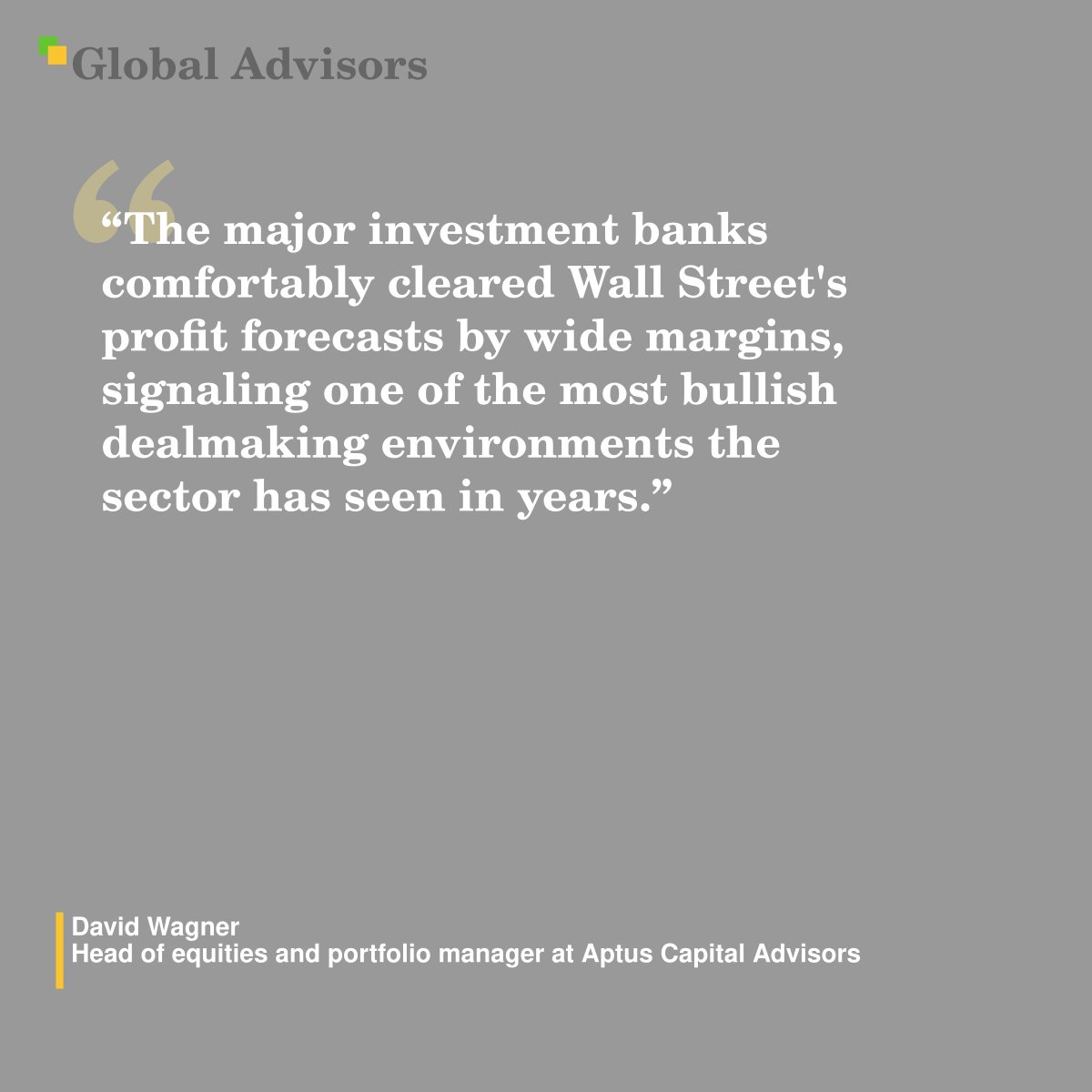
Quote: David Wagner - Head of equities and portfolio manager at Aptus Capital Advisors"The major investment banks comfortably cleared Wall Street's profit forecasts by wide margins, signaling one of the most bullish dealmaking environments the sector has seen in years." - David Wagner - Head of equities and portfolio manager at Aptus Capital Advisors Wall Street only rarely delivers synchronised outperformance across its largest investment banks, and when it does, the signal usually lies less in the earnings themselves than in the underlying shift in corporate risk appetite and capital formation dynamics that made those profits possible. After several years marked by stop-start deal pipelines, volatile funding costs and a backlog of shelved transactions, the latest earnings season indicates that the constraint is no longer demand for strategic deals, but the capacity of banks, regulators and investors to process the volume safely and profitably. The key tension is whether this resurgence reflects a durable realignment in financing conditions and boardroom confidence or a late-cycle surge that risks overshooting fundamentals. From drought to deluge: the factual backdrop The immediate context is a sharp rebound in advisory and underwriting activity that has turned investment banking from a drag on large banks' results into a primary driver of earnings beats. Fees from mergers and acquisitions, equity capital markets and debt issuance at the six largest U.S. banks rose roughly 45% year-on-year in the second quarter, with some franchises reporting increases of 50% or more in specific product lines. Across the five biggest U.S. universal banks, quarterly profits reached around 49 billion dollars, up nearly 40% from a year earlier and well ahead of analyst forecasts, with management teams repeatedly pointing to stronger deal pipelines and capital markets as the differentiating factor. Analysts tracking second-quarter earnings had already anticipated a powerful contribution from trading and investment banking, especially around blockbuster listings such as the SpaceX mega-IPO, yet the realised revenue still exceeded those expectations by a wide margin. Global data from Dealogic and other providers show announced M&A volumes topping 3 trillion dollars year-to-date and global investment banking fees hitting a five-year high, despite ongoing geopolitical shocks and patchy macroeconomic growth. Why expectations were so low - and why they were wrong The dramatic overshoot versus forecasts owes as much to how pessimistic the consensus had become as to how strong the realised activity is. In the preceding years, elevated interest rates, regulatory scrutiny over large mergers, and episodic market sell-offs had left banks and their investors skittish about underwriting risk and committing balance sheet to large, leveraged transactions. Corporate boards adopted a wait-and-see posture, particularly for transformational acquisitions and initial public offerings, producing a thin pipeline dominated by strategic bolt-ons and opportunistic issuances from already frequent borrowers. Sell-side analysts internalised that caution: forward estimates for investment banking revenues were repeatedly reset lower, with management guidance framed in terms of a slow, fragile recovery. When inflation began to ease and central banks signalled a plateau in policy rates, however, the sensitivity of activity to marginally better conditions turned out to be far higher than modelled. Valuation gaps between buyers and sellers narrowed, credit spreads tightened, and once a handful of emblematic deals cleared the market, a signalling cascade convinced other boards that they too could transact without being punished by investors. The result was a step-change in fee income which, because it was not fully captured in quarterly models, translated mechanically into earnings beats and the perception of a bullish regime shift. The structural engines behind the deal surge Beneath the quarter-to-quarter surprises sit several slower-moving forces that have been building for years. One is the sheer weight of private equity 'dry powder' accumulated during the period of constrained dealmaking. Funds under pressure to return capital have accelerated exits via both trade sales and IPOs, generating advisory, underwriting and bridge-financing fees for the banks. Another is the extensive digital and AI transformation underway across sectors, which has made scale, data access and technology integration strategic imperatives rather than optional enhancements. Boards facing disruption in healthcare, financial services, industrial automation and consumer technology increasingly see acquisitions, joint ventures and carve-outs as necessary to secure capabilities and distribution. A third factor is the normalisation of monetary policy expectations: as markets have shifted from fearing indefinite tightening to anticipating a more predictable, gradually easing rate path, the modelling of future cash flows and the pricing of risk have become more tractable, allowing both sponsors and strategics to justify higher purchase prices. Together, these elements have created what some bank executives describe as a 'dealmaking renaissance', in which the underlying drivers span liquidity, technology and corporate strategy rather than being purely cyclical. What 'bullish dealmaking' really means for risk and capital Describing the environment as one of the most bullish in years carries a specific meaning in banking: it signals that clients are willing to commit to large, complex transactions, and that markets are deep enough to absorb the associated financing. In practical terms, that shows up as a higher share of mega-deals in announced M&A volumes, greater use of equity and hybrid instruments to fund acquisitions, and more aggressive capital structure optimisation as firms refinance legacy debt. For banks, such conditions magnify operating leverage. Once fixed costs for senior deal teams, risk management infrastructure and technology are covered, each incremental transaction drops a disproportionate share of fee income to the bottom line, resulting in the type of wide forecast beats seen in recent quarters. Yet a bullish backdrop also alters the risk profile. Competitive pressure to defend league-table positions can tempt banks to relax pricing discipline on fees, stretch underwriting standards, or warehouse more market risk in anticipation of syndication. The central strategic question is whether institutions treat the earnings windfall as a chance to rebuild capital buffers and invest in risk controls, or whether they assume the cycle has structurally reset and ramp capacity in ways that could be painful when conditions turn. Strategic tension: short-term windfall versus long-term franchise Management teams now face a classic trade-off between harvesting current profitability and fortifying the franchise for a more contested future. On one side, shareholders and senior rainmakers see a window to monetise strong pipelines, push for higher bonuses and buy back stock while return on equity is elevated. On the other, regulators and risk committees remember the last time surging fee pools coincided with creeping leverage, complex structured financings and latent market-risk concentrations. Industry reports suggest that the banks best positioned for the medium term are those using this phase to diversify fee income into less cyclical businesses such as wealth management, payments and digital platforms, while investing in AI-driven analytics to manage conduct and credit risk in real time. There is also an intra-industry competitive dimension: firms with stronger balance sheets and better technology stacks can underwrite larger deals, commit financing earlier and capture higher-value mandates, potentially reinforcing a winner-takes-most dynamic in global investment banking. The tension is sharpened by the possibility that some of the current drivers, particularly AI infrastructure spending and sponsor exits, may prove front-loaded, leaving late-moving institutions exposed. Debates and objections: bubble, normalisation or justified optimism? Market participants and commentators are not aligned on how to interpret the current surge. Skeptics point to the overlay of geopolitical conflict, trade frictions and uneven global growth as evidence that boardroom exuberance may be running ahead of macro fundamentals. They argue that profits juiced by volatility-driven trading and pent-up deal activity could fade quickly if a negative shock hits risk assets or if funding markets seize up. Some also highlight the danger of over-centralising corporate power via consecutive mega-mergers, which can draw political backlash and tougher antitrust enforcement, potentially crimping the very deal pipelines banks are extrapolating. Optimists counter that deal volumes remain below the extremes of earlier peak years and that the composition of activity is healthier, with more emphasis on strategic repositioning, technology acquisition and cross-border consolidation than on financial engineering. Survey data from corporate and private equity dealmakers show widespread intention to keep pursuing acquisitions over the next 12 months, albeit with a more selective lens on valuations and integration risk. In that reading, the current environment looks less like a speculative bubble and more like a belated normalisation after an abnormal period of shocks. Why the environment matters beyond the banks The implications of this dealmaking upswing extend well beyond the profitability of Wall Street institutions. For corporates, an open and receptive market for M&A and capital raising expands the strategic toolkit: divestitures of non-core assets, spin-offs, transformative acquisitions and minority stake sales all become more feasible, enabling boards to reshape portfolios faster. For investors, a busier calendar of IPOs and secondary offerings broadens the opportunity set and can support equity-market depth, though it also demands more discriminating underwriting of business models and governance structures. Employees and communities feel the impact through post-deal restructuring, investment in new technologies and shifting competitive landscapes, as seen in sectors like wealth management where a wave of consolidation is reshaping local ecosystems. At the level of the financial system, a vibrant but well-governed investment banking cycle can help allocate capital towards productivity-enhancing projects, whereas an undisciplined chase for fees can entrench fragilities that only become apparent when liquidity recedes. Looking ahead: sustainability and the next inflection point Whether this period of outsized earnings and robust deal pipelines proves sustainable will depend on several variables that lie partly outside the banks' control. The path of policy rates and inflation will determine how long financing conditions remain supportive and whether highly levered transactions remain viable. Regulatory attitudes to big-tech acquisitions, cross-border deals and private equity roll-ups will shape the upper bound of deal sizes and structures that can be executed. Perhaps most importantly, the trajectory of AI and related technologies will influence both the volume and nature of strategic transactions, as firms race to acquire data, talent and infrastructure while also deploying automation inside the banks themselves to compress costs. In that sense, the present earnings surprise can be seen as a stress test of each institution's ability to translate a favourable macro-micro alignment into durable franchise value. The real judgement on the present moment will come not in a single quarter's profit print, but in how resilient these business models look when the cycle inevitably shifts and bullish sentiment has to share the stage with renewed caution.
|
| |
| |
|


| |
| |