| |
|

| |
| |
| |
|
A daily bite-size selection of top business content. |
| |
| |
| |
Term: Total Addressable Market (TAM) - Strategy and finance"Total Addressable Market (TAM) is the total revenue opportunity available for a product or service if it achieves a 100% market share. It helps businesses see the absolute maximum market demand and overall potential scale without factoring in competitors, resource limits, or geographic barriers." - Total Addressable Market (TAM) - Strategy and finance Founders, investors and corporate strategists are ultimately concerned with the ceiling on growth, because no business can outgrow the market that underpins it forever. The constraint is not the current customer base or sales capacity, but the fundamental demand that exists if every economically rational buyer who could benefit from a solution decided to purchase. That upper bound is what market analysts attempt to capture when they talk about the total revenue opportunity accessible to a product category in idealised conditions of full penetration and unconstrained execution. In practical decision-making, this abstract ceiling shapes capital allocation, risk appetite and valuation. A venture backed by aggressive investment must demonstrate that even modest penetration of a sufficiently large opportunity can justify the funding required to achieve it. Similarly, a corporate choosing between adjacent product lines will compare their respective scale of potential demand. Without an explicit quantification of this maximum market opportunity, management teams default to intuition, which tends to overweight current penetration and underweight unserved segments. The result is mispriced growth options: projects with small upside but strong narratives get funded, while those with large upside but uncertain access are neglected. Conceptual substance and boundary choices The underlying construct is the aggregate demand for a given value proposition across all customers that plausibly fit the problem definition, assuming unconstrained access and 100% share of that defined market. Critically, this is not simply the entire economy or the broad industry label; it is demand for a specific solution category defined by needs, not by existing product boundaries. If a company provides cloud accounting for small firms, the relevant universe is all small businesses that require bookkeeping and would rationally adopt software, not only those already served by similar vendors. The conceptual work therefore lies in drawing the boundary around who is in-scope. Overly generous boundaries that include marginal or implausible buyers inflate the theoretical maximum; overly narrow ones leave genuine upside uncounted. Strategic rigour demands that these inclusion criteria be explicit and defensible rather than a vague assertion. This definition also separates the concepts of market volume, measured in potential units or customers, and market value, measured in potential revenue. Volume defines how many entities are in scope, while value incorporates price and intensity of use. A market with 200 000 potential customers at modest spend may have less total opportunity than one with 20 000 customers at high recurring spend. Analysts must therefore avoid equating large headcounts with large TAM; high willingness to pay, regulatory drivers, or mission-critical status can make a smaller customer universe more valuable than a broader but low-yield audience. Mathematical specification and core parameters Despite the strategic nuance, the simplest quantitative representation is a straightforward product of customer count and revenue per customer. At its most basic, analysts model total potential revenue as , where is the number of potential customers in scope and is the average annual revenue per user or account. In business-to-business contexts, is typically replaced by an annual contract value ; in that case . This formulation is conceptually simple but hides considerable complexity in the estimation of its components. The parameter requires robust market sizing: identifying all entities that meet the inclusion criteria across geographies, segments and channels. Analysts may derive from census data, industry reports, commercial databases or bespoke research. The parameter or demands an understanding of pricing, product configuration and usage patterns. For subscription or SaaS models, reflects recurring licence income; for transaction-based businesses it bundles expected frequency and ticket size. Both parameters are heavily assumption-driven, and changes in either can materially shift the implied TAM. To recognise heterogeneity, many practitioners generalise to a segmented formula , where indexes customer tiers or regions. Alternative formulations reframe the revenue per customer term through value-based logic. Instead of extrapolating from current pricing, the analyst estimates the economic value created or costs saved by the product and derives a plausible share of that value that customers would be willing to pay. In such models, the revenue per customer is not constrained by existing price points but by willingness to pay, yielding , where is the average monetisable value per customer. While more speculative, this method can better capture disruptive offerings that reshape cost structures or unlock new revenue streams. Top-down, bottom-up and value-based approaches Three broad methodological schools dominate TAM estimation. The top-down approach starts with macro industry data and applies successive filters to isolate the relevant segment. Analysts might take the reported size of an industry, restrict it to digital channels, then further narrow to a specific geography or customer band. This method is quick but prone to overstatement, as each filter embeds assumptions about relevance and conversion without direct evidence. Conversely, the bottom-up approach begins with micro-level data: real or proxy customers, observed pricing and adoption patterns. Analysts extrapolate from a known base to the wider market using , where is constructed from counts of similar entities that match the ideal customer profile. Bottom-up estimates are generally considered more credible for early-stage products because they anchor assumptions in observed behaviour rather than abstract industry aggregates. The third approach, value-based TAM, is particularly relevant for innovations that do not fit neatly into existing categories. Here the analyst estimates how much economic value the solution could generate or preserve for each customer and what proportion of that value could conceivably be captured in pricing. If a tool reduces error rates that cost an average enterprise 250 000 per year, and the market will bear a price of 50 000, then this sets the revenue per customer parameter for TAM. Multiplying by the number of enterprises at similar risk yields a value-theory TAM. This method is helpful when historical spend patterns understate future potential because the product creates a new class of value rather than substituting for existing cost items. Relationship to SAM and SOM, and strategic use On its own, the maximum market ceiling is only part of the story. Strategy teams then layer in constraints to derive narrower constructs: serviceable addressable market and serviceable obtainable market. The serviceable addressable market applies filters for geography, regulatory permissions, channel reach and product fit, representing the portion of TAM that the company could realistically serve with its current offering. The serviceable obtainable market goes further, incorporating competition and execution capacity to represent the share that could plausibly be captured within a given horizon. This cascade forces a disciplined distinction between what exists in principle and what is realistically accessible. Investors, lenders and acquirers rely on TAM, SAM and SOM hierarchies to judge whether a proposed growth story is internally consistent. A pitch that promises 25% penetration of its serviceable market must implicitly align with sales capacity, competitive dynamics and reasonable adoption curves. If the implied revenue from the claimed market share overshoots the estimated TAM, the story is incoherent. Equally, if the TAM itself is too small, even optimistic share gains cannot support large-scale valuations. In that sense, TAM is a gatekeeping metric: it determines whether a business can logically support venture-scale, private equity-scale or niche-lifestyle outcomes. Debates, distortions and continuing relevance Despite its ubiquity, the concept attracts criticism. One tension lies between theoretical purity and practical usability: a perfectly unconstrained TAM may have little bearing on actual strategic choices, while an excessively constrained TAM can collapse into a proxy for current market share. Another arises from optimistic bias. Teams have incentives to inflate TAM to impress investors or justify expansion, leading to methodology choices that emphasise broad inclusions, heroic pricing assumptions or future categories that may never materialise. Some practitioners argue that presenting a range, derived from multiple independent methods and clearly documented assumptions, is more honest than a single point estimate. Even with these flaws, the construct remains central in strategy and finance because it anchors high-level thinking about scale. It forces a translation from qualitative enthusiasm for a product to a quantitative statement about how many buyers exist and how much they might plausibly spend. When used rigorously, with explicit boundary choices, segmented formulas and triangulation across top-down, bottom-up and value-based views, TAM is less a marketing slogan and more a disciplined estimate of the economic envelope within which a business must operate. The concept matters not because any firm will ever capture 100% of its theoretical opportunity, but because every credible growth plan must be reconciled against that upper limit.
|
| |

| |
Quote: Tom Brokaw - Journalist"It's easy to make a buck. It's a lot tougher to make a difference." - Tom Brokaw - Journalist The persistent tension in contemporary work is between activity that merely sustains a system and action that materially alters outcomes for others. Economic structures are remarkably efficient at rewarding the production of short-term, monetisable gains, yet far less reliable at recognising contributions that change lives, institutions or trajectories in enduring ways. That divide shapes career choices, corporate strategies and civic behaviour, creating a landscape in which individuals can accrue financial success while remaining marginal to any genuine improvement in the conditions around them. From earning money to creating impact The expression make a buck belongs to the everyday vocabulary of transactional exchange, capturing the ease of engaging in work that is narrowly focused on pay rather than consequence. In mature market economies, pathways to earning are abundant: routine service roles, speculative trading, algorithmically optimised advertising, and monetised attention all offer relatively straightforward routes to revenue for those with access and basic capability. By contrast, to make a difference, in the commonly understood sense of causing a meaningful change or having a positive impact on others, entails a qualitatively different objective. It requires that action be evaluated not only by income generated but by the degree to which it improves a situation, addresses a harm or expands possibilities for those previously constrained. That shift in objective immediately introduces complexity: impact is harder to measure, more contested to define, and often realised only over extended time horizons. The meaning of making a difference In ordinary English usage, to make a difference is to cause a change that matters, either by altering a state of affairs or by providing help that makes the world better in some discernible way. Dictionaries note both the general sense of causing a change and the more specific sense of improving a situation or having a positive effect through good actions. In practice, that dual meaning marks out two distinct but related terrains. On one side lies impact understood as significance: actions that have noticeable effects regardless of moral valence, such as a new technology reshaping labour markets or a regulatory adjustment shifting investment flows. On the other lies impact understood as value-laden improvement: alleviating poverty, increasing access to education, strengthening democratic participation or reducing environmental harm. When people speak of making a difference in ethical or professional discourse, they overwhelmingly invoke this second usage, emphasising contribution to public good rather than mere disruption. Tom Brokaw and the context of the remark Tom Brokaw emerged as a prominent journalist in the United States through decades of reporting on politics, war, social change and civic life. His professional vantage point exposed him to both the machinery of economic power and the grassroots realities of communities attempting to address hardship, injustice or neglect. The remark about the relative ease of making money compared with the difficulty of making a difference gains much of its texture from that dual perspective. It reflects long observation of how quickly capital can be mobilised for private gain, and how slowly institutions move when the objective is structural improvement rather than short-term returns. Brokaw reported across periods of deregulation, rising financialisation and widening inequality, where fortunes were built in highly leveraged markets while public services struggled with underinvestment and political polarisation. The statement functions as a compressed judgement drawn from that historical experience. Structural reasons impact is harder than income There are several structural reasons why contributing to meaningful change is more demanding than simply earning. Financial gain is rewarded within clear, codified systems: prices, salaries, bonuses and profit-and-loss accounts provide immediate feedback and create strong incentives for optimisation. Mechanisms for social or human impact are more diffuse. Outcomes such as educational attainment, health improvements or institutional trust are influenced by multiple variables, many outside the direct control of a single actor. As a result, causal attribution is complex and progress often ambiguous. Individuals trying to improve a situation must navigate competing priorities, political resistance, entrenched interests and resource constraints, whereas those focused narrowly on revenue can concentrate on efficiency within given rules. Moreover, the costs of failure differ. A failed commercial experiment may be easily written off as a loss; a failed intervention aimed at vulnerable communities can carry consequences for those communities themselves, increasing the moral weight and perceived risk of attempting change. Ethical tension in professional decision-making The statement crystallises a broader ethical tension faced by professionals across sectors: whether to allocate capability to activities that maximise personal security or to arenas where the same skills might serve collective improvement. In fields such as finance, technology or media, highly trained individuals are often rewarded most for work that amplifies existing systems of monetisation, data extraction or narrative packaging. Opportunities to direct expertise towards public-interest projects, investigative work or socially grounded innovation exist but are seldom priced at the same level. That differential leads to persistent dilemmas for those who are acutely aware of the disparity between what they are paid to do and what they believe would make conditions genuinely better. Brokaw, speaking from journalism, implicitly draws attention to paths such as investigative reporting, public-service broadcasting and local journalism, which are labour-intensive, uncertain and often underfunded despite their importance for democratic accountability. Debates and objections There are, however, serious debates around the claim that making a difference is tougher than making money. Some entrepreneurs argue that the contemporary wave of impact investing and mission-led start-ups has narrowed the gap, creating business models where social benefit and financial success are aligned rather than opposed. Advocates of market-based solutions contend that commercial innovation, from affordable technologies to scalable health interventions, can deliver more durable change than traditional philanthropy, precisely because it is sustainable and disciplined by market signals. Others challenge the implicit romanticism that can attach to talk of difference-making, pointing out that good intentions are not a guarantee of good outcomes, and that complex systems can render well-meaning interventions ineffective or even harmful. There is also the objection that for many people, particularly those in precarious labour markets or marginalised communities, making a buck is not easy at all; rather, access to stable income is itself a major social struggle. The remark, framed from the vantage point of an established professional, can therefore be read as highlighting a tension that is experienced differently across social strata. Measurement, visibility and recognition Another layer of difficulty lies in measurement and recognition. Monetary success is visible, countable and often publicly acknowledged through status symbols, rankings or promotional narratives. Impact in the sense of improved lives or stronger institutions is frequently invisible, dispersed and uncelebrated. A teacher who alters the trajectory of a student, a nurse who stabilises fragile patients, or a community organiser who prevents escalation of local conflict may produce outcomes that never appear on national metrics or social media feeds. In journalism, detailed reporting that influences policy or shifts public understanding can be overshadowed by faster, more sensational content that generates clicks but little learning. Brokaw's observation nods implicitly to those routine forms of contribution that rarely receive commensurate status, yet are central to any functioning civic and social order. Making a difference, in many professions, involves accepting a degree of anonymity and delayed, indirect recognition. Why the distinction matters for contemporary culture The distinction between easy money and difficult change matters because it shapes cultural norms about success and purpose. When societies valorise rapid monetisation above sustained contribution, they create incentives for short-termism and speculative behaviour while under-resourcing domains such as public-interest media, social care, scientific inquiry and community infrastructure. Brokaw's perspective provides a counterweight, suggesting that seriousness of purpose is measured less by personal prosperity than by proximity to those tasks that genuinely alter circumstances for others. In a media environment where attention is fragmented and outrage cycles often crowd out detailed analysis, the remark serves as a reminder of the value of long-haul engagement: spending years on a subject, staying with a story after the headlines move on, and prioritising work whose significance lies in quiet shifts in understanding rather than spectacular ratings. Practical implications for individuals and organisations For individuals, the underlying argument invites a reconsideration of how careers and projects are chosen. It does not deny the need to earn, but suggests that once the capability to make a buck is established, the more demanding question is where that capability can be leveraged for real improvement. That may mean accepting lower immediate financial rewards in exchange for participation in endeavours that reshape institutions, strengthen communities or expand access to knowledge. For organisations, particularly those in media and communications, the statement points towards strategic choices about content and resource allocation: whether to prioritise superficial output that is commercially safe, or invest in deeper, riskier work that engages structural issues and gives voice to under-represented perspectives. In either case, the central challenge is to resist conflating revenue with relevance and to recognise that the tougher task is to design structures in which making a difference is not an occasional by-product but a deliberate objective woven into everyday practice.
|
| |

| |
Global Advisors News Brief - July 28 2026Read the full brief at the link Headlines for the last 24hrs
Time window: 2026-07-27T05:00:33.162Z to 2026-07-28T05:00:33.162Z |
| |
| |
Term: LoRA (Low-Rank Adaptation) - Artificial intelligence"LoRA (Low-Rank Adaptation) is a parameter-efficient fine-tuning technique that adapts large pre-trained AI models by freezing the original weights and training much smaller, auxiliary rank-decomposition matrices. .By focusing computation only on these compact adapter layers, it drastically reduces resource requirements without sacrificing model performance." - LoRA (Low-Rank Adaptation) - Artificial intelligence Organisations trying to adapt foundation models to niche tasks quickly run into a hard constraint: the cost of moving and updating tens of billions of parameters dwarfs the incremental value of most applications. GPU memory, bandwidth and training time become the binding bottlenecks, not data or ideas. Low-rank adaptation tackles this bottleneck by reframing the update itself as a compact, structured object that can be trained and stored far more cheaply while preserving most of the performance of full fine-tuning . In practical terms, the technique achieves parameter efficiency by freezing the base model and pushing all task-specific learning into small auxiliary modules attached to existing layers . Instead of rewriting the model's knowledge, these modules learn additive corrections that steer behaviour on the new task. This architecture has concrete deployment advantages: teams can keep a single shared base checkpoint and swap in different adapters for legal reasoning, medical question answering or code generation, each occupying only a tiny fraction of the storage and memory footprint of the base model . That modularity also simplifies governance, since task-specific adapters can be versioned, audited and rolled back without touching the core model. Mechanism: low-rank updates to frozen weights The core idea is that the update needed to adapt a well-trained model to a specific task lies in a low-dimensional subspace, so it can be represented by a low-rank matrix rather than a full dense weight update . Suppose a given linear projection in a transformer layer is parameterised by a weight matrix . Classical fine-tuning learns a full update , giving an effective weight . In low-rank adaptation, one constrains to the form , where and with . Only and are trainable; the original is kept fixed. This factorisation means the number of new parameters scales with rather than , yielding orders-of-magnitude reductions for typical transformer dimensions . During fine-tuning, the forward pass through the adapted linear layer is commonly written as , where is the input vector and is a scaling factor controlling the strength of the adaptation . Gradients flow only into , and possibly ; the base weight receives no updates and is typically stored in quantised or otherwise compressed form. After training, the low-rank update can be algebraically merged back into to produce a single, adapted checkpoint for deployment, with no extra latency relative to a fully fine-tuned model . Parameter meanings and configuration choices The most important hyperparameter in low-rank adaptation is the rank , which directly controls the expressive power and size of the adapter . Low ranks such as or are often sufficient for style transfer, light domain adaptation or instruction tuning on modest datasets . Higher ranks, for example or greater, may be needed for complex reasoning tasks, highly specialised jargon, or multi-step workflows, at the cost of increased memory and training time . Practitioners thus treat as a knob trading off accuracy against efficiency, tuned empirically under hardware constraints . The scaling parameter rescales the contribution of the adapter relative to the frozen base and can act as a regulariser, preventing the low-rank update from overwhelming the prior knowledge encoded in . Dropout applied inside the adapter path further reduces overfitting when data is scarce . Another design choice is where to insert adapters in the network. Many implementations start by targeting the attention projections, such as query and value matrices, because small changes there can significantly influence how the model attends to task-relevant tokens . More aggressive configurations attach adapters to all linear transformations in both attention and feedforward blocks, increasing effective capacity but also memory usage . The distribution of rank across layers is an active area of research; approaches that allocate higher rank to layers with greater task-relevant entropy or sensitivity can improve performance without uniformly increasing the footprint . Practical meaning: why it matters operationally From an operational perspective, low-rank adaptation reshapes the economics of customising large models. By reducing trainable parameters by factors of up to 10 000 and lowering GPU memory by roughly 3 times for some configurations, it allows teams to fine-tune models that would previously have required large clusters, using a single high-end GPU instead . This cost compression enables experimentation with many candidate tasks or data slices, since each adapter can be trained cheaply and evaluated in isolation. It also encourages a plug-in mindset: an organisation may maintain dozens of small domain-specific adapters, switching between them per request or per product, while all share a single central base model . The technique also mitigates catastrophic forgetting, the phenomenon where full fine-tuning on a narrow dataset degrades performance on broader capabilities . Because the original weights remain untouched, the base model's general language understanding is preserved, and the adapter learns to specialise without erasing prior knowledge . This makes low-rank adaptation appealing for applications that must balance strong performance on a target task with adequate behaviour on generic queries, such as customer support assistants that alternately handle policy questions and free-form conversation. However, this same regularisation means that when data and compute budgets are very large and peak accuracy on a single domain is paramount, full fine-tuning can still outperform adapter-based methods . Mathematical and conceptual foundations The use of a low-rank factorisation connects the method to long-standing ideas in numerical linear algebra and statistical learning. Low-rank approximations exploit the observation that many high-dimensional datasets and transformations lie close to a subspace of far lower intrinsic dimension, which can be captured by a small number of basis vectors . In the context of large language models, the claim is that the gradient-informed update for a downstream task mostly lives in such a subspace, so optimising and suffices to encode the relevant change . One can view this as projecting the full gradient update into a lower-dimensional manifold where optimisation is cheaper and less prone to overfitting, then lifting it back to the original space via the product . Formally, if one considers the full fine-tuning update as sampling from a distribution over matrices, low-rank adaptation restricts that distribution to those matrices with rank at most . This constraint acts as an implicit prior favouring simpler, smoother updates which can improve generalisation in data-poor regimes . It also aligns well with modern PEFT (parameter-efficient fine-tuning) frameworks that treat task adaptation as learning a compact, structured perturbation rather than a full re-optimisation of billions of parameters . That said, the assumption that the optimal update is low-rank may not hold in all domains, and empirical work continues to probe which tasks and architectures are best suited to this constraint . Schools of thought and emerging debates One school of thought emphasises low-rank adaptation as the default tool for downstream tuning of large language models, pointing to its strong performance on instruction tuning, style transfer and moderate-scale domain adaptation relative to its low compute cost . Proponents argue that for most enterprise workloads-summarisation, translation, retrieval-augmented question answering-the marginal gains of full fine-tuning do not justify the complexity and expense, especially given risks around forgetting and model drift . A contrasting view sees adapters as a pragmatic compromise but still regards full fine-tuning, possibly combined with further pretraining, as the gold standard for high-stakes domains such as advanced coding assistance or mathematical reasoning . In this view, low-rank methods are invaluable for prototyping and mid-tier applications but may underperform when deep conceptual shifts in the model's representation are required. A more recent debate concerns how low-rank adaptation interacts with quantisation and other compression strategies. Techniques such as QLoRA retain the frozen low-rank adapters but apply aggressive quantisation to base weights, achieving roughly 4x further memory reductions and enabling fine-tuning of models with 65B+ parameters on commodity hardware . While this widens accessibility, it introduces new questions about numerical stability, sensitivity to hyperparameters, and the cumulative effect of approximations at both the base and adapter levels. Researchers are also exploring alternatives such as prefix-tuning, parallel adapters, and multi-task adapter routing, all of which compete or combine with low-rank methods in different regimes . These debates highlight that the technique sits within a broader ecosystem of PEFT methods, rather than as a singular solution. Continuing relevance Low-rank adaptation remains central to the current generation of AI practice because it squarely addresses the main practical friction in deploying foundation models: the gulf between theoretical capability and affordable, governable customisation. By reframing task adaptation as learning compact, low-rank corrections to a frozen base, it unlocks workflows in which a single general model can underpin many specialised products and internal tools, each represented by a small adapter file . That shift supports organisational scaling, since different teams can iterate on their own adapters independently without competing for scarce training capacity on the full model. As models grow larger and regulations tighten around data use and model behaviour, the ability to adapt efficiently, reversibly and in a modular fashion will only grow more important, ensuring low-rank techniques continue to matter even as alternative PEFT methods and more powerful base models emerge .
|
| |

| |
Global Advisors News Brief - July 27 2026Read the full brief at the link Headlines for the last 24hrs
Time window: 2026-07-26T05:00:33.073Z to 2026-07-27T05:00:33.073Z |
| |
| |
Quote: Professor Erik Brynjolfsson - Stanford economist, Director of the Stanford Digital Economy Lab"If you get rid of the base of the [organisational] pyramid, it becomes like a a diamond. Then where are those junior those middle managers going to come from and where the senior people going to come from? And too many companies are being shortsighted about that." - Professor Erik Brynjolfsson - Stanford economist, Director of the Stanford Digital Economy Lab The structural problem facing advanced economies is not simply that automation removes tasks, but that it selectively erodes the bottom rungs of professional labour markets while leaving demand for experienced judgement intact. Entry-level, routine knowledge work is disproportionately exposed to generative AI, yet organisations still need mid-level managers and senior experts to coordinate, decide and lead. The tension is straightforward: firms optimise costs by shrinking junior roles today, but they also depend on those same roles as the training ground for tomorrow's decision-makers. The pyramid under pressure: AI and entry-level work Recent research led by Erik Brynjolfsson and colleagues at the Stanford Digital Economy Lab shows a striking decline in employment for young workers in occupations most exposed to generative AI. In these roles, employment for people in their early twenties has fallen by around 16 % relative to less-exposed occupations, while older workers in the same fields have largely maintained or increased employment. The pattern is consistent with AI systems taking over routine, well-specified tasks that previously justified hiring larger cohorts of juniors, especially in software development, call centres, customer support, paralegal work and some marketing and sales functions. Senior workers remain because they supply judgement, context, client interaction and organisational memory - capabilities that current models cannot fully replicate. Brynjolfsson repeatedly emphasises that the analytical unit is the task rather than the occupation. Most jobs consist of bundles of tasks, and generative AI is automating specific components - coding small features, drafting emails, summarising documents - rather than entire professions. That nuance matters, yet the aggregate effect at the bottom of organisational hierarchies is clear: the share of human effort devoted to routine execution is falling, and the first group to feel it is junior staff. When organisations respond by cutting entry-level hiring rather than redesigning roles, they begin to hollow out the base of the pyramid that traditionally fed into middle management and senior leadership. From pyramid to diamond: a changed organisational geometry Professional services firms, large corporates and technology companies have historically adopted a pyramidal staffing structure: many junior employees, fewer mid-level managers and a relatively small group of senior partners or executives. Juniors handled labour-intensive, repeatable tasks, generating leverage for experienced staff who focused on complex decisions, client relationships and high-value work. Over time, some juniors were promoted into mid-level roles, creating a natural pipeline of talent. AI systems disrupt this geometry by absorbing a growing fraction of the routine work once done by the base. In software engineering, junior developers used to spend years writing boilerplate code, fixing defects and implementing well-understood patterns under supervision. Now coding assistants and agentic tools can generate plausible implementations directly from natural-language specifications, enabling a smaller number of more experienced developers to oversee much larger codebases. In call centres, conversational models have progressed from supporting human agents to autonomously handling a substantial share of inbound queries, reducing the need for large cohorts of novice staff. Similar trends appear in document-heavy fields such as law and compliance, where paralegal-style tasks are increasingly automated. The immediate result is that firms can plausibly operate with fewer juniors while retaining or even expanding their cadre of mid-level and senior staff. The longer-term consequence is more subtle and potentially damaging: without a broad base of early-career employees gaining experience, the future supply of people capable of occupying those higher-level roles shrinks. The organisational pyramid begins to resemble a diamond - relatively narrow at the bottom, wide through the middle, and tapering again at the top - but that diamond shape is unstable if the mid-section is not continually replenished. Career formation without apprenticeship The traditional route into managerial and expert positions involved prolonged apprenticeship: juniors observed how decisions were made, absorbed tacit knowledge and gradually took on more complex responsibilities. Much of this learning occurred incidentally through the performance of routine tasks - reviewing documents, preparing reports, shadowing meetings - that were economically necessary even if intellectually basic. AI-driven automation strips away exactly those tasks, leaving fewer natural opportunities for observational learning. The structural risk Brynjolfsson highlights is that firms enjoy short-term cost savings while inadvertently destroying the mechanisms that produced their own human capital. If junior positions vanish, aspiring professionals face a paradox: they are told that senior judgement, project management and domain insight are the safest skills, but they are denied the environments in which those skills were historically developed. At the societal level, this becomes a coordination problem. Each individual firm has an incentive to reduce entry-level hiring and lean on AI substitutes; collectively, the economy needs a steady stream of workers acquiring experience to sustain future productivity and leadership. Infosys, the Indian technology and consulting company, appears in Brynjolfsson's narrative as a counterexample. Rather than sharply cutting junior recruitment in response to AI, it continues hiring young staff but redesigns their work. Routine coding and documentation are delegated to AI tools; juniors focus earlier on project management, systems thinking and broader contextual understanding. Learning that once occurred by osmosis is replaced with explicit training, often supported by AI itself as a teaching aid. The strategic bet is that human taste, judgement and leadership will remain scarce and valuable, so preserving the pipeline into those capabilities outweighs immediate savings from eliminating novice roles. Strategic myopia and distributional risk Brynjolfsson's broader economic work suggests that the same dynamic operates beyond individual firms in the form of skill-biased technical change. Technologies that complement highly skilled workers while substituting for less-skilled ones tend to widen wage and income gaps, an effect documented historically with earlier waves of computerisation. Generative AI threatens to accelerate that pattern by disproportionately eliminating entry-level white-collar roles while expanding the productivity of incumbents who already possess experience and decision rights. If organisations underinvest in junior development, they will ultimately face a shortage of experienced managers and specialists, but the transitional damage may be borne by cohorts of young workers who struggle to enter professional careers at all. Brynjolfsson warns that this could echo the policy failures of globalisation: aggregate gains in productivity and wealth coinciding with concentrated losses for specific communities, generating political backlash and social instability. In the AI context, he argues for deliberate investment in education, retraining and apprenticeship-style pathways to avoid repeating that mistake. Proposed mechanisms include public funding for skills development, more flexible labour-market institutions and the use of AI itself to support job matching and personalised training. Redesigning roles around agents, not eliminating people A recurrent theme in Brynjolfsson's interviews is that future knowledge work will revolve around defining questions and evaluating answers, with AI agents handling much of the execution. He divides projects into three stages: define, execute, evaluate. AI excels in the middle once a problem is clearly specified, but humans remain essential for identifying the real problem and judging whether the solution is correct or useful. This framing suggests an alternative to removing junior staff: train them early to manage fleets of agents, formulate valuable questions and interpret outputs, rather than simply carrying out pre-defined procedures. Under such a model, junior roles would be reconfigured rather than erased. Instead of spending years on manual data cleaning or repetitive coding, new entrants would learn to orchestrate AI tools across workflows: decomposing tasks, specifying constraints, monitoring for errors and integrating results into decisions. They would acquire the meta-skills - problem framing, stakeholder communication, risk awareness - that constitute the foundation of senior responsibility, while agents supply the routine labour. This path preserves a developmental ladder even as the nature of rungs changes, aligning organisational needs for future leadership with technological realities. Debates, objections and alternative trajectories Not all economists agree that hollowing out entry-level roles will persist or that the organisational pyramid must fundamentally change. Some argue that new categories of junior work will emerge around AI maintenance, data curation, prompt engineering or human oversight, effectively replacing traditional routine tasks with technologically mediated ones. Others note that if AI substantially lowers the cost of producing certain services, demand elasticities may lead to expanded employment even at junior levels, as happened with radiology when cheaper imaging increased the total volume of scans. Brynjolfsson himself acknowledges this mechanism, highlighting that roughly half the economy may see rising employment when prices fall, depending on demand curves. However, the entry-level job data for generative-AI-exposed occupations suggest that, at least in the current phase, displacement is outpacing creation for young workers in affected fields. The diamond-shaped organisational concern arises specifically where demand does not expand enough to justify large numbers of juniors, yet mid-level and senior roles remain necessary. The debate therefore centres less on whether AI will ultimately create new work - historical evidence suggests it will - and more on whether current corporate decisions around hiring, training and role design are aligned with long-term capability needs. Why the organisational base still matters The underlying message in Brynjolfsson's warning is not nostalgic protection of obsolete jobs but a pragmatic assessment of capability formation. Advanced technologies, including AI, are general-purpose tools whose economic impact depends on complementary investments in human capital, organisational redesign and institutional adaptation. If firms treat AI purely as a substitution technology - a way to remove headcount at the bottom - they may gain short-term margin improvements but weaken their ability to innovate, coordinate and exercise judgement over time. Conversely, organisations that explicitly preserve and reconfigure junior pathways, teaching novices to manage agents, frame problems and develop domain expertise, are more likely to sustain a robust pipeline of mid-level managers and senior leaders. At the economy level, such choices affect whether AI becomes primarily a force for shared prosperity or for increased concentration of wealth and power. The geometry of the organisational pyramid is therefore not merely a staffing diagram; it is a reflection of how societies choose to invest in human potential under conditions of rapid technological change.
|
| |
!["If you get rid of the base of the [organisational] pyramid, it becomes like a a diamond. Then where are those junior those middle managers going to come from and where the senior people going to come from? And too many companies are being shortsighted about that." - Quote: Professor Erik Brynjolfsson - Stanford economist, Director of the Stanford Digital Economy Lab](https://globaladvisors.biz/wp-content/uploads/2026/07/20260726_21h00_GlobalAdvisors_Marketing_Quote_ProfessorErikBrynjolfsson_GAQ.png)
| |
Global Advisors News Brief - July 26 2026Read the full brief at the link Headlines for the last 24hrs
Time window: 2026-07-25T05:00:33.068Z to 2026-07-26T05:00:33.068Z |
| |
| |
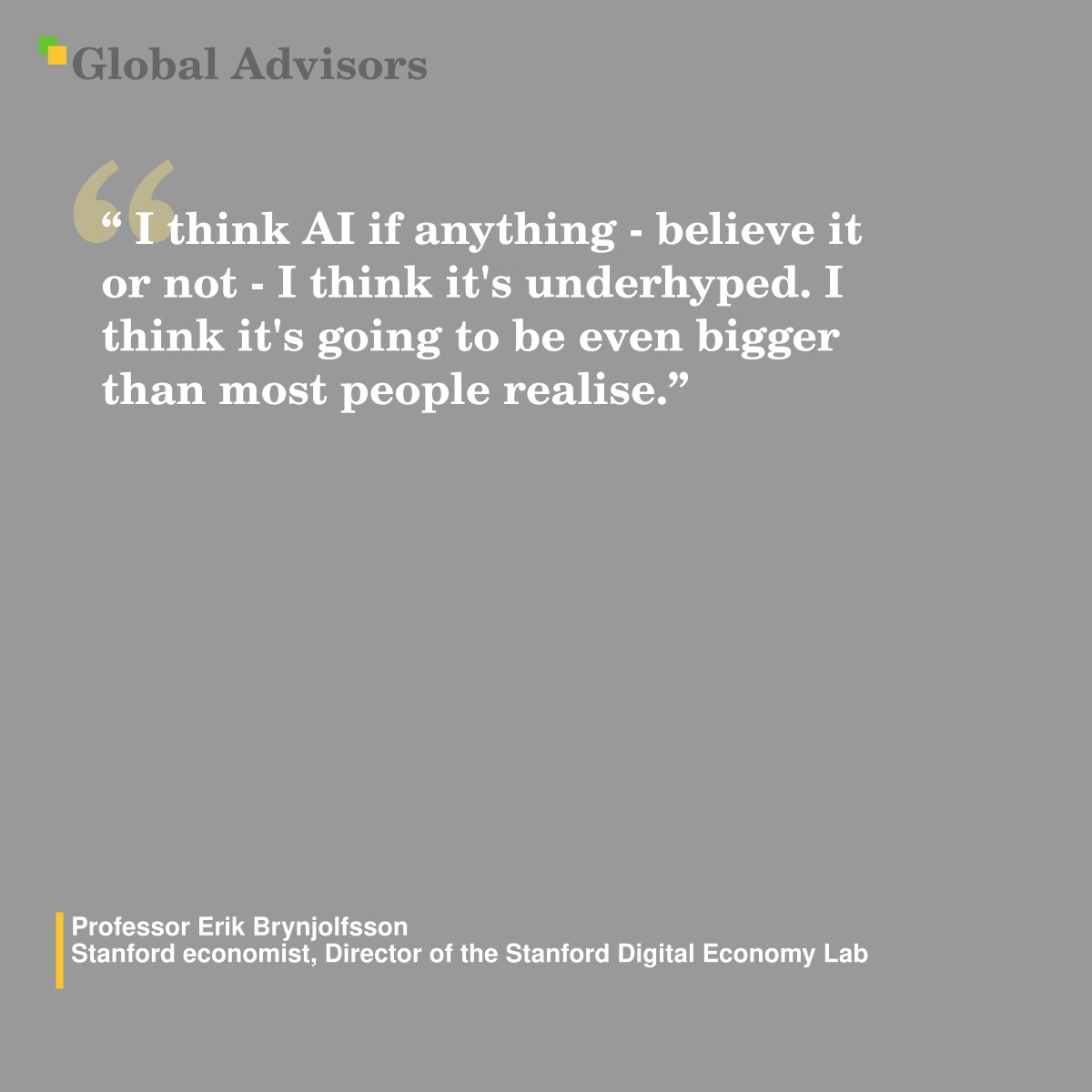
Quote: Professor Erik Brynjolfsson - Stanford economist, Director of the Stanford Digital Economy Lab" I think AI if anything - believe it or not - I think it's underhyped. I think it's going to be even bigger than most people realise." - Professor Erik Brynjolfsson - Stanford economist, Director of the Stanford Digital Economy Lab The striking claim that artificial intelligence is still underhyped speaks to a structural mismatch between the technology's rapidly compounding capabilities and the pace at which economies, organisations and institutions are absorbing and exploiting those capabilities. The underlying issue is not whether AI can perform impressive benchmarks in coding, language and reasoning; that is already evident. The tension lies in the lag between what systems can do and how quickly business models, workflows, skills and policy frameworks are being redesigned to convert those capabilities into broad-based economic value. From capability curve to economic J-curve Over the past few years, frontier AI models have improved at an extraordinary rate on tasks such as software development, document analysis, mathematical reasoning and multi-step planning. Measured purely as a capability curve, the trajectory looks exponential. Yet the impact on aggregate productivity statistics, labour markets and GDP remains relatively modest. Brynjolfsson describes this as a technology adoption -curve: an early phase in which investment, experimentation and organisational disruption rise sharply, while observable economic gains appear muted. Only after firms re-architect processes, data flows and decision rights around the new technology does the curve inflect and value creation become visible at scale. The factual context of his remark is a bet with another economist, Robert Gordon, who is sceptical that AI will materially accelerate productivity. Official projections for US productivity growth into the late 2020s remain anchored around pre-AI assumptions. Brynjolfsson argues that these forecasts are systematically too low, because they implicitly treat current institutional arrangements as fixed rather than adjustable. In his view, once organisations complete the redesign necessary to integrate AI deeply into production and services, productivity growth will exceed the Bureau of Labor Statistics baseline by 2030, with knock-on effects for fiscal sustainability, healthcare and living standards. AI as a general-purpose technology Another layer of meaning in the statement is the classification of AI as a general-purpose technology comparable to electricity or the internal combustion engine. General-purpose technologies display three properties: they improve rapidly over time; they become pervasive across sectors; and they enable complementary innovations in products, processes and organisational forms. Historically, their full economic impact has been delayed by the need for complementary investments. Electric motors, for instance, were installed into factories designed for steam, producing few early gains; only when factories were rebuilt around decentralised power did productivity accelerate. Brynjolfsson's argument is that AI now sits in a similar transitional zone. Providing employees with chatbots or code assistants is equivalent to installing motors in old steam-era layouts. The larger effects will only appear when firms deliberately redesign end-to-end workflows, redefine roles, restructure data infrastructure and launch new AI-native products and services. Because digital systems can be reconfigured far faster than physical factories, he expects the AI transition to play out over roughly 3 to 5 years rather than the 30-year lag observed with electricity. That compressed timeline is one reason he judges AI to be underhyped: most forecasts still treat the transformation as distant, when in his view the economy is already turning the corner of the J-curve. The labour market tension behind the optimism The claim that AI is underhyped sits alongside clear evidence of labour market disruption, especially for younger workers in highly exposed occupations. Research from the Stanford Digital Economy Lab and ADP shows employment among workers aged roughly 22 to 25 falling sharply in jobs where generative AI can perform core tasks, such as junior coding, call-centre work, paralegal support and some routine marketing functions. The same datasets show far milder effects for older workers and less-exposed occupations, and even positive outcomes where AI is used to augment rather than fully automate tasks. This duality creates a strategic tension. On one hand, AI boosts the productivity of workers and can improve customer satisfaction, retention and job quality when used as an assistive tool. On the other hand, the disappearance of entry-level roles threatens traditional talent pipelines, making organisational structures more diamond-shaped: fewer juniors, continued demand for mid-level and senior staff, and an emerging shortage of people with accumulated experience. Brynjolfsson's optimism about AI's aggregate impact therefore coexists with a warning that firms and societies must explicitly redesign education, apprenticeships and early-career development rather than relying on routine work to train future leaders. Demand elasticity and why automation can expand jobs Another factual foundation for the underhyped claim is a subtle point about demand elasticity. Automation does not automatically reduce employment; the outcome depends on how buyers respond to lower costs. Using the standard downward-sloping demand curve, Brynjolfsson distinguishes between relatively inelastic markets, where falling prices lead to only modest increases in quantity and thus lower total spending, and highly elastic markets, where price reductions trigger large increases in quantity and potentially higher overall expenditure. In sectors such as air travel, the introduction of jet engines cut per-trip costs but created such a surge in demand that total spending and employment in airlines grew rather than shrank. He expects roughly half the economy to behave in this expansionary manner as AI reduces costs and increases quality. Radiology offers a contemporary example: early headlines predicted that image-recognition systems would eliminate radiologists, yet many countries now face radiologist shortages as cheaper and faster imaging has increased demand for scans. In this framing, AI is underhyped not because it will avoid disruption, but because commentators fixate on job destruction and miss the employment created by lower prices, new services and expanded markets. Redefining work around defining and evaluating A central mechanism behind Brynjolfsson's optimism is his view of future work as structured into three stages: defining the problem, executing the work and evaluating the output. AI agents are becoming remarkably capable in the middle stage once a problem is well specified: writing software, drafting documents, analysing data and completing procedural tasks. Yet they remain limited in selecting economically meaningful problems, understanding organisational context and exercising judgement about the adequacy and implications of their outputs. He expects most knowledge workers to manage fleets of specialised AI agents, operating more like chief executives of small digital workforces than individual contributors. Competence will shift towards the ability to frame questions, set objectives and constraints, interpret ambiguous results and iterate when literal answers miss the true need. This is where he sees human value persisting and potentially increasing: in agency, initiative, domain knowledge, interpersonal skills and situational judgement. If work is redesigned accordingly, AI amplifies human capability rather than simply substituting it, which in his view justifies a more optimistic forecast than typical narratives of wholesale job loss. Strategic underdeployment inside organisations Despite these possibilities, Brynjolfsson observes that many corporate AI initiatives remain superficial, misdirected or disconnected from core value creation. Hackathons produce playful applications such as automated lunch menus, while high-stakes processes in revenue generation, risk management, supply chains or customer service remain largely unchanged. This behaviour reflects a familiar pattern from earlier technologies: executives experiment at the periphery, but delay difficult redesign of central workflows, incentives and governance. His argument that AI is underhyped therefore contains a critique of business strategy. The bottleneck is not access to models, but managerial imagination and organisational willingness to tackle the messy work of restructuring. In his policy testimony and interviews, he consistently urges leaders to focus AI efforts on economically material use cases, decompose roles into tasks that can be automated or augmented, and build agent-management skills across the workforce rather than treating AI as a bolt-on tool. He believes that firms which move fastest on this agenda will capture outsize gains in productivity and profitability, reinforcing his view that conventional forecasts underestimate AI's upside. Distributional risks and concentrated power The underhyped assessment does not imply that outcomes will be uniformly positive. Brynjolfsson repeatedly warns that AI could intensify inequality and concentrate economic and political power in a small cluster of companies or states. If ownership of data, models and digital infrastructure remains narrow, the benefits of higher productivity may accrue disproportionately to capital, senior talent and platform monopolies. Earlier waves of information technology already contributed to skill-biased technical change, widening gaps between workers with and without advanced education. He argues that repeating the policy failures of globalisation would be a grave mistake. Trade raised aggregate output but left many displaced workers unsupported, generating political backlash. With AI, the stakes are higher: the same tools could enable extraordinary prosperity or unprecedented surveillance, autonomous weapons and engineered biological threats. Brynjolfsson's underhyped claim is therefore conditional. AI can be far more transformative than mainstream commentary allows, but whether that transformation yields shared prosperity or extreme concentration depends on deliberate choices around taxation, education, entrepreneurship, competition policy and safety regulation. Beyond GDP: measuring the invisible value One reason he believes mainstream assessments understate AI's impact is the inadequacy of conventional economic metrics. Standard GDP records market transactions and assigns zero weight to free digital goods such as search, email, Wikipedia and widely accessible AI tools. Brynjolfsson's research on alternative welfare measures, particularly GDP-B, tries to quantify consumer surplus by asking how much people would need to be paid to forego a given service. Early results indicate that free digital services generate trillions of dollars in value that never appear in GDP figures. Similar surveys applied to language models suggest rapid growth in perceived value as adoption and usefulness increase. In other words, even if measured GDP and productivity rise only gradually, underlying welfare may be climbing much faster. This measurement problem reinforces his belief that AI's true economic significance is underhyped: official statistics and headline narratives are simply not capturing where value is created, especially when tools are free or bundled into existing products. Why the next decade could be the best and the worst Ultimately, the statement that AI is underhyped is less a prediction of automatic utopia than a call to recognise the scale of the stakes. Brynjolfsson argues that the coming decade could plausibly be the most prosperous period in human history, with breakthroughs in medicine, education, science and material abundance driven by AI-accelerated discovery and innovation. At the same time, he accepts that the same systems could enable catastrophic misuse, from bioengineered pandemics to pervasive manipulation and autonomous warfare. In his view, the decisive variable is human agency. AI is a powerful tool for amplifying intention: it expands the reach and speed of whatever goals individuals, firms and governments choose to pursue. If societies channel that amplification towards entrepreneurship, problem-solving and shared prosperity, the technology's upside will be far larger than many current forecasts assume. If they neglect safety, inclusion and distribution, the downside could be equally dramatic. The remark that AI is underhyped is therefore both a descriptive claim about the technology's potential and a normative challenge: to upgrade institutions, strategies and values quickly enough that the eventual scale of impact is used well rather than squandered or weaponised.
|
| |
| |
Quote: Nvidia, Microsoft, Meta, Palantir, OpenAI and more than 20 other companies - Letter to policymakers, 24th July 2026"Relying solely on closed models is not inherently safe: they can be breached, misused, or fail in ways that outsiders cannot detect. And concentrating advanced AI capabilities behind a small number of closed models compounds that risk." - Nvidia, Microsoft, Meta, Palantir, OpenAI and more than 20 other companies - Letter to policymakers, 24th July 2026 The central policy dilemma is whether concentrating advanced artificial intelligence in a handful of sealed systems genuinely reduces risk, or whether it simply hides failure modes while magnifying the consequences of any breach or misuse when it eventually occurs. When a small number of firms operate closed models that shape information flows, productivity tools and critical infrastructure, any undetected flaw, exploit or design bias scales across millions of users and high-stakes environments without external parties being able to interrogate the system. The recent letter from Nvidia, Microsoft, Meta, Palantir and more than 20 other companies positions this dilemma directly in front of policymakers, arguing that restricting open-weight models in the name of safety could inadvertently deepen systemic exposure to opaque, concentrated AI capabilities. Closed Models, Opaqueness And Undetectable Failure Closed models are typically operated as remote services, with access mediated through proprietary APIs and contracts that reveal little about architecture, training data or guardrail implementation. Outsiders, including regulators and independent researchers, cannot easily inspect model parameters, replicate training conditions or stress-test behaviour across adversarial scenarios, which turns these systems into operational black boxes. When failures occur - whether hallucinated outputs in medical settings, covert prompt injection, data leakage or subtle discriminatory patterns - detection depends largely on the provider's monitoring and willingness to disclose issues, rather than on independent scrutiny. This creates a structural asymmetry: external users bear the consequences of model behaviour, but lack meaningful visibility into how that behaviour arises or how quickly systemic problems are identified and remediated. This opaqueness extends to security posture. A closed model may employ strong internal controls, but third parties cannot verify whether safety features can be stripped out, circumvented or bypassed with techniques that require less effort than training a similarly capable system from scratch. Nor can they evaluate whether the distribution channels and attack surfaces - from SDKs and plug-in ecosystems to integrated office suites - are resilient against determined adversaries at scale. The claim that closed status is inherently safer therefore rests on trust in corporate assurances and limited audit rather than on open technical verifiability. In high-risk domains such as critical infrastructure management, defence applications or systemic financial decision-making, that gap between assurance and verifiable robustness becomes strategically significant. Concentration Of Advanced AI Capability As A Systemic Risk Beyond opaqueness, the statement targets concentration: the accumulation of cutting-edge AI capabilities in a few closed models controlled by a small number of firms operating at global scale. When the most powerful models are centralised, several systemic risks emerge. First, market power: if a handful of providers set pricing, access terms and acceptable use policies for de facto infrastructure models, they shape not only innovation pathways but also the distribution of safety standards across the economy. Second, correlated failure: any shared architectural vulnerability, misaligned fine-tuning practice or exploited control surface can propagate simultaneously across sectors that rely on the same underlying closed model. Third, geopolitical dependence: jurisdictions that lack domestic alternatives may find their digital sovereignty constrained by foreign providers' policy choices around censorship, surveillance or safety trade-offs. Concentration also interacts with incentives around disclosure. A provider whose revenue depends heavily on a flagship closed model may be reluctant to fully expose its limitations and failure cases, particularly if admitting systemic weakness could trigger regulatory intervention or reputational damage. In contrast, a more plural ecosystem of open-weight and open-source models allows independent labs, academic groups and civil society organisations to stress-test and publish findings, distributing the epistemic load of safety assessment rather than rooting it in a small number of corporate actors. The coalition's warning suggests that trying to enforce safety by suppressing open alternatives might inadvertently lock society into dependency on concentrated closed systems whose true risk profile is only partially known. Open-Weight Models As A Middle Ground The companies signing the letter are not arguing for unbounded openness; they focus on open-weight models as a specific technical and governance compromise. Open-weights refer to releasing the trained parameter values of a neural network while often withholding training data and full pipeline code. This creates a middle state between proprietary closed models and full open-source AI: external parties can download, run and fine-tune the model, gaining operational autonomy and partial transparency, but do not necessarily gain full insight into data provenance or training procedure. For enterprises, this means the ability to host models on their own infrastructure, avoid sending sensitive data through third-party APIs, and tailor behaviour to sector-specific norms without relinquishing control to a remote provider. At laboratory scale, recent work indicates that small open-weight models can be competitive with closed models in domain-adapted tasks, delivering reasonable performance at relatively low monetary cost and data requirements. That result undermines the assumption that safety and capability must be traded off against openness; in practice, organisations can achieve useful, robust performance with models they can inspect and adjust more freely. Furthermore, open-weight availability facilitates emerging best practice in abstention and privacy, allowing models to be configured to decline high-risk queries and to keep sensitive contextual data inside local environments rather than central data centres. These characteristics connect directly to the argument that distributing capability across many open-weight systems reduces the chance of a single catastrophic failure and increases the overall capacity for collective safety research. Regulatory Context: EU AI Act And Open Components The tension described in the statement sits against a rapidly evolving regulatory backdrop, particularly in Europe. The EU AI Act differentiates between general-purpose AI models, open-source AI components and monetised AI services, carving out specific exemptions and obligations for open-source offerings. Open components - including models and parameters - can benefit from lighter obligations when provided under free and open licences and not monetised directly, but general-purpose models that present systemic risk or are tied to paid services remain subject to full regulatory requirements. This framework reflects an attempt to balance transparency and innovation with concerns about misuse and high-risk applications, yet it also introduces complexity for open-weight providers whose licensing and business models may straddle categories. Experts have pointed out that merely releasing weights under an ostensibly open licence does not automatically qualify as open-source AI, particularly when training data and methods remain secret. As a result, open-weight models may sit in ambiguous territory: more transparent than closed proprietary offerings, but not fully aligned with the four freedoms of open-source as defined by community standards. The coalition's letter effectively challenges regulators to recognise this nuance. Prematurely imposing blanket restrictions on open-weight distribution, or treating all openness as equivalent risk, could narrow the space for experimentation with safer, more verifiable architectures while leaving closed mega-models largely untouched. Conversely, failing to impose any obligations would ignore the genuine hazards of making powerful models widely accessible without safeguards. The regulatory question is therefore not simply open versus closed, but which forms of openness reduce systemic risk and which amplify it. Debates, Objections And Safety Concerns Critics of open-weight and open-source models argue that wider accessibility increases the surface for malicious use, such as building tailored disinformation engines, automating cyberattacks or circumventing safety filters by modifying the model locally. They contend that closed models at least allow firms to enforce centralised guardrails, monitor usage patterns and throttle dangerous behaviour, while open-weight distribution makes it difficult to prevent determined adversaries from weaponising the technology. Some policy proposals therefore advocate temporary pauses on high-capability releases, registration and licensing schemes for systems above specific compute thresholds, and stricter control over distribution channels until security practices mature. From this perspective, the coalition's warning might appear self-serving: firms that benefit commercially from open-weight ecosystems could be seen as resisting necessary restraint. Proponents of openness respond that security through obscurity is an unstable foundation, especially given the reality of model leaks, insider threats and sophisticated reverse-engineering efforts. They argue that openness enables broader participation in red-teaming, safety benchmarking and governance innovation, and that diverse open-weight models reduce monoculture risk by preventing any single vendor stack from dominating critical infrastructure. Additionally, many harms associated with generative models - from synthetic media misuse to privacy violations - are tied more to application design, deployment context and human incentives than to whether underlying weights are secret. The letter's wording reflects this stance: the real danger lies not simply in models being open or closed, but in concentrating advanced capabilities behind a small number of opaque, uninspectable systems that operate at planetary scale. Strategic And Market Implications Strategically, the debate shapes the trajectory of both national competitiveness and industrial structure. The signatories argue that open-weight models are essential to preserving technological leadership by allowing domestic firms, researchers and start-ups to build upon shared foundations without prohibitive licensing costs or API dependency. If policymakers heavily constrain open-weight development in the name of safety, they risk pushing cutting-edge experimentation to jurisdictions with more permissive regimes, thereby undermining domestic capacity to shape global norms. At the same time, large incumbents such as Nvidia, Microsoft and Meta have substantial commercial interests in open-weight ecosystems, from selling compute and tooling to providing platforms for fine-tuning and deployment. Their stance therefore mixes genuine systemic concern with strategic positioning in a competitive landscape defined by both closed premium models and rapidly advancing open alternatives. For enterprises, the outcome of this policy debate will determine whether AI remains primarily a vendor-mediated service or becomes a configurable infrastructure asset that can be tailored and audited within organisational boundaries. A regime that privileges closed models could simplify compliance by outsourcing safety obligations to a few large providers, but at the cost of dependency, limited transparency and constrained customisation. A regime that supports responsibly governed open-weight models could broaden innovation and resilience, but demands stronger in-house expertise, more sophisticated risk management and clearer norms around documentation, licensing and accountability. The statement from the coalition marks a turning point: it invites policymakers to recognise that safety is not guaranteed by closure or concentration, and that a genuinely robust AI ecosystem may require plural, inspectable, and, where appropriate, open-weight models rather than a small constellation of unchallengeable black boxes.
|
| |

| |
Term: Zero-day vulnerability - Cyber"A zero-day vulnerability is an undisclosed security flaw in software, hardware, or firmware that is unknown to the developers or parties responsible for patching it. The term signifies that the vendor has had "zero days" to create a fix or release a security update to protect users against malicious attacks." - Zero-day vulnerability - Cyber Security teams confront a distinctive problem when a flaw can be weaponised before any tailored defence or patch exists: the system is vulnerable, yet neither signatures nor vendor guidance offer protection. That situation characterises zero-day vulnerabilities and explains why they so often underpin high-impact breaches, espionage operations, and disruptive attacks across modern digital infrastructure. Structural nature of a zero-day vulnerability The practical substance of a zero-day vulnerability is a defect in software, hardware, or firmware that enables behaviour the designer did not intend, and which can be triggered by an adversary to gain a strategic advantage. Because the parties responsible for maintenance and patching have not yet recognised the flaw, there is no bespoke fix, configuration change, or detection signature targeting it. In operational terms, the vulnerability remains latent until either discovered by attackers, reported by researchers, or observed through anomalous system behaviour, and during that window defenders must rely entirely on general controls such as network segmentation, strict access management, and behaviour-based monitoring rather than vulnerability-specific countermeasures. Crucially, security practice distinguishes between the flaw, the exploit, and the attack as different stages of the same threat lifecycle. The zero-day vulnerability is the underlying weakness in the asset; the exploit is the technical method or code that triggers the weakness to do useful work for the attacker; and the attack is the application of that exploit against real targets to steal data, move laterally, or disrupt operations. This separation matters because mitigations can apply at each stage: secure coding and code review seek to reduce vulnerabilities; exploit prevention mechanisms such as modern operating system protections aim to raise the cost of developing reliable exploits; and incident response, monitoring, and segmentation seek to reduce the impact of successful attacks. Risk characteristics and practical impact Zero-day vulnerabilities are disproportionately dangerous because they combine three factors: lack of patch, lack of specific detection, and asymmetry of knowledge between attacker and defender. When only adversaries or a small circle of researchers know a flaw exists, defenders neither track it in routine vulnerability scanning nor receive advisories from vendors or regulators. Attackers can therefore use the vulnerability to obtain initial access, escalate privileges, bypass authentication, or execute arbitrary code with a high probability of success, particularly in widely deployed platforms such as operating systems, web browsers, VPN gateways, or email servers. Recent case studies of exploited zero-days across major vendors demonstrate that these weaknesses are routinely used for ransomware deployment, credential theft, covert persistence and espionage activity in both corporate and governmental environments. From a governance perspective, zero-day risk is systemic rather than local. A single critical vulnerability in a widely used component can expose thousands of organisations simultaneously, with little warning. The empirical literature on patching behaviour shows that even after disclosure, timely remediation is uneven: vulnerabilities affecting multiple vendors and causing scope change tend to be patched faster, while those requiring special privileges or impacting confidentiality are less likely to be corrected quickly. This reinforces a central practical point: the danger is not eliminated when a vendor releases a fix. It persists across all assets where the patch has not yet been applied, which may include legacy systems, devices with complex update cycles, or environments where patch-induced downtime is treated as unacceptable. Mathematical framing of zero-day exposure In quantitative risk analysis, zero-day exposure can be conceptualised as the probability that an unknown, unpatched flaw is present in a given asset, multiplied by the probability that a capable adversary has discovered and is exploiting it. If we denote by the probability that a system contains at least one zero-day vulnerability and by the conditional probability that an adversary both knows the vulnerability and chooses to exploit it against that system, the probability of compromise via zero-day in a given time window can be sketched as . This simple representation highlights several levers for defence. Reducing depends on software engineering quality, defensive programming, and proactive security testing such as fuzzing and code analysis. Reducing depends on making the system a less attractive or more difficult target through segmentation, zero trust principles, and hardening that increases attacker cost relative to expected benefit. From a portfolio perspective, organisations sometimes treat zero-day risk as an unavoidable background rate of compromise inherent to operating complex systems in an adversarial environment, elevating residual risk management over absolute prevention. If the expected loss from zero-day events over a horizon is , where is the impact if asset is compromised, the strategy becomes to lower via data minimisation, strong isolation, and robust backup and recovery, even when cannot be driven close to zero. This conception underpins the growing emphasis on resilience, incident response readiness, and breach mentality as counterparts to traditional perimeter defence. Discovery, disclosure, and ethical tensions Discovering a zero-day vulnerability places the finder at the centre of an ethical and strategic dilemma: whether to disclose it responsibly to the vendor, sell it on a grey market, weaponise it for offensive operations, or withhold it entirely. States and security agencies have historically maintained stockpiles of undisclosed vulnerabilities for intelligence and military use, while private markets for exploits and vulnerability information offer significant financial incentives to researchers and criminals alike. This raises a policy question about how long such flaws should be retained before disclosure, given that the same weakness might independently be discovered and exploited by hostile actors. Some jurisdictions have explored formalised vulnerability equities processes to balance national security benefits of using zero-days against the collective security benefits of patching them, but practice remains uneven and often opaque. Within commercial security, the dominant norm remains coordinated disclosure, where researchers privately inform vendors, allow a window for patch development, and only later publish details. However, zero-day status by definition ends once a patch or mitigation is widely available, even if many systems remain vulnerable due to slow deployment or operational constraints. At that point the vulnerability becomes an N-day issue, and public exploit code may appear quickly, making patch management and compensating controls urgent. Ethical debates continue over whether the publication of proof-of-concept exploit code accelerates defensive understanding or unnecessarily lowers the barrier to entry for attackers, especially when adoption of patches is delayed. Defensive strategies beyond signatures Because zero-day vulnerabilities are unknown and unpatched at the moment of exploitation, classical signature-based defences such as traditional antivirus or rigid intrusion detection rules offer little protection. Modern defensive architectures therefore prioritise behavioural and anomaly-based detection that monitors for deviations from established baselines of system and user activity. Techniques including endpoint detection and response, user and entity behaviour analytics, and AI-driven anomaly detection seek to recognise the consequences of exploitation, such as unusual process spawning, unexpected network connections, or anomalous access patterns, rather than the specific exploit code itself. Organisations that assume compromise and instrument their environments to detect lateral movement, privilege escalation, and data exfiltration are better positioned to identify zero-day abuse early in the attack chain. Zero trust architecture plays a complementary role by reducing the blast radius of initial compromise. By limiting implicit trust, enforcing strong authentication and authorisation at each access decision, and segmenting networks into smaller trust zones, defenders ensure that a single exploited vulnerability does not automatically yield broad access. Additional measures such as application sandboxing, strict patch management for known flaws, compensating controls on unpatchable systems, and deception technologies like canary tokens further constrain attacker progress when a zero-day is present. These layered approaches acknowledge that prevention cannot be guaranteed, but that sophisticated attackers can be slowed, detected, and contained. Why zero-day vulnerabilities remain strategically important Zero-day vulnerabilities continue to matter because they sit at the intersection of software engineering, geopolitics, and organisational resilience. They expose structural weaknesses in digital supply chains, test the adequacy of disclosure processes, and reveal how quickly vendors and customers can coordinate patching at scale. While the absolute number of discovered zero-days in a given year attracts attention, more significant is the pattern of which technologies they affect, how quickly exploitation follows disclosure, and how many organisations maintain sufficient instrumentation and discipline to detect and respond. In an environment where critical infrastructure, finance, healthcare, and public services depend on complex, interconnected systems, the existence of unknown, exploitable flaws is not an anomaly but a persistent condition to be managed. This continuing relevance shifts best practice from a mindset of eliminating all vulnerabilities to one of operating securely despite them. Effective organisations invest in secure development to reduce the introduction of new flaws, adopt robust vulnerability management and rapid patching to shorten exposure windows after disclosure, and design architectures that assume some unknown weaknesses will be exploited. Zero-day vulnerabilities thus act both as specific technical threats and as a lens through which the maturity of wider security strategy can be assessed, making them central to any serious discussion of contemporary cyber risk.
|
| |

| |
|


| |
| |