| |
|

| |
| |
| |
|
A daily bite-size selection of top business content. |
| |
| |
| |
Term: Residual Value to Paid-In Capital (RVPI) - Finance"RVPI stands for Residual Value to Paid-In Capital. It is a performance metric used in private equity to measure the unrealized (paper) value of remaining investments in a fund as a multiple of the capital that investors have paid in so far." - Residual Value to Paid-In Capital (RVPI) - Finance RVPI matters because private equity and venture capital returns are not fully captured by cash that has already come back to investors. It measures the remaining unrealised value in a fund relative to the capital that has been paid in, which makes it a live indicator of what is still sitting on the balance sheet rather than what has already been realised . In practice, that means RVPI tells limited partners how much paper value remains in the portfolio at a given valuation date, while also reminding them that this value is still dependent on future exits and marking discipline . At the simplest level, the metric is calculated as , where residual value is usually treated as the current fair value, or net asset value, of the fund's remaining investments . A result of means the unrealised holdings are marked at exactly the amount of capital contributed so far, while means there is of residual value for every of paid-in capital . Because it is a ratio, RVPI can be read as a multiple, which is why fund reports often present it alongside other money-multiple metrics rather than as a percentage . What RVPI is measuring in substance The practical meaning of RVPI is narrower than overall performance and broader than a single unrealised holding. It captures the portion of a fund's value that remains inside the portfolio and has not yet been distributed to investors, which is why sources commonly describe it as the paper or unrealised slice of fund value . In other words, it is not a forecast of eventual proceeds and it is not a cash return measure; it is a snapshot of the value that the fund claims is still embedded in companies or assets that have not yet been sold, exited, or otherwise converted into cash . This distinction matters because private market funds can look strong on paper long before they generate large distributions. A young fund may post a high RVPI simply because portfolio marks have risen, even though investors have not yet received meaningful cash back . Conversely, a mature fund approaching wind-down can have a low RVPI because most value has already been realised, even if its realised outcome has been excellent . The number therefore says as much about fund age and exit timing as it does about underlying investment quality . How RVPI fits with DPI and TVPI RVPI is best understood as one part of the standard private equity return trio. DPI, or distributed to paid-in capital, measures cash actually returned to investors, while TVPI, or total value to paid-in capital, combines realised and unrealised value . The relationship is usually expressed as , provided the same denominator is used for each metric . This identity is useful because it separates a fund's realised progress from its still-unrealised mark . That separation is important for interpretation. A fund with and has a TVPI, but only of that value has actually been distributed in cash . For investors, the gap between TVPI and DPI is the central analytical issue: RVPI fills that gap, but it does so with an estimate, not a settled receipt . In due diligence, that makes RVPI a necessary but not sufficient indicator of fund health . Why valuation methodology is the main controversy The strongest debate around RVPI is not the formula, but the quality of the underlying valuation. Because residual value is generally based on fair value or net asset value marks, it depends on manager judgement, third-party appraisal, comparable transaction data, and changing market conditions . Those marks can move materially between reporting dates, and the same portfolio can produce different RVPI readings depending on assumptions about revenue growth, exit multiples, discount rates, and liquidity . That is why many LPs treat RVPI as more fragile than DPI. Cash distributions are observable; residual value is modelled or estimated . In practice, an inflated mark can make a fund appear stronger than it really is, particularly in venture capital where recent financing rounds may be used as valuation anchors even when later market conditions are less favourable . The same logic cuts the other way: conservative marks can suppress RVPI and understate embedded value, especially in illiquid assets where exits are rare and comparable prices are noisy . Interpretation across fund life RVPI behaves differently depending on where the fund sits in its life cycle. Early in a fund's life, RVPI may be the dominant component of TVPI because companies are still being built and realisations are limited . In this phase, a high RVPI mostly signals that the fund still owns a large unrealised book rather than that investors have been paid back. Later in the fund cycle, as exits accumulate, RVPI should normally decline while DPI rises, because more value is converted into cash and less remains inside the portfolio . This time profile is why RVPI is often read alongside vintage year and fund age. A high RVPI in year 3 means something very different from the same figure in year 10 . Early on, it may simply reflect an active portfolio that has not yet had time to mature. Later on, a persistently high RVPI may indicate that the fund has not harvested value efficiently, or that exits have been delayed by market conditions . The ratio therefore needs context, not just comparison against a neat benchmark. Major schools of thought on usefulness One school of thought treats RVPI as an essential interim metric because it captures the state of the portfolio between inception and final exit . Under this view, LPs need RVPI to understand what value remains, how much of TVPI is still unrealised, and whether the manager is adding or destroying value before distributions arrive . This perspective is especially important in capital-intensive strategies where exits may take many years and where NAV marks are an unavoidable part of reporting . A second school of thought is more sceptical and argues that DPI deserves far more weight because realised cash is harder to manipulate and easier to compare across funds . From this angle, RVPI can be useful, but only as a provisional signal that may be revised downward later. The practical tension is that LPs need RVPI to assess current portfolio value, yet they know that the number can be gamed or simply proved wrong by future exits . That tension is not a flaw in the metric so much as a feature of private markets, where return data are inherently incomplete until assets are sold. What the metric does and does not tell you RVPI tells investors how much unrealised value remains relative to capital paid in, but it does not tell them how much will actually be realised, when it will be realised, or whether the current marks are defensible in a stressed market . It also does not capture the time value of money, which is why IRR remains important alongside money multiples . A fund can show a healthy RVPI and still disappoint if exits take too long or if the realised value eventually falls short of the marks . For that reason, RVPI works best as part of a wider reading of fund performance rather than as a stand-alone verdict. It is most informative when paired with DPI, TVPI, vintage context, and the underlying valuation process . Used properly, it answers a precise question: how much value is still sitting inside the fund today, relative to what investors have already funded . That question remains central to private capital because the difference between a strong mark and a strong outcome can be several years, several exits, and several revisions apart .
|
| |

| |
Quote: Simon Willison - AI commentator"The fact that a 17GB file can do all of this stuff on my home machines is a miracle. Once again, I'm delighted and amazed at how much progress local models have made this year. A year ago [Qwen3.8-27b] would have been competitive with the best and most expensive of the proprietary models - today it can run on a capable laptop." - Simon Willison - AI commentator Local execution of sophisticated language models reshapes the balance between cloud platforms and personal computing by converting what once required specialised infrastructure into workloads that fit on consumer hardware. The ability to run a multi-modal, 27B-parameter system with long context and agents on a laptop compresses the distance between experimental research environments and everyday development practice. Instead of treating foundation models as remote services priced per token, technically literate users can now install a 17 GB checkpoint, wire it to tools, and iterate at negligible marginal cost aside from electricity and hardware wear. That shift in deployment topology changes who can experiment with agent frameworks, data workflows and novel interfaces, because experimentation moves from metered APIs into unbounded local sandboxes. The factual backdrop is the August 2026 release of Qwen3.8-27B, a dense, multi-modal model from Alibaba's Qwen research lab, distributed with open weights under Apache 2.0. The checkpoint contains roughly 27,78 billion parameters and accepts text, images and video, with a native context window of 262 144 tokens extendable to 1 000 000 via techniques such as YaRN. Officially, the weights ship in BF16 and FP8 formats, with community-provided GGUF and quantised builds allowing deployment through frameworks like llama.cpp and desktop front-ends such as LM Studio. Simon Willison's detailed review situates the model as a new quality leader in the locally realistic 30B-class, highlighting its strong coding performance, credible vision capabilities and robust tool-calling behaviour. The particular 17 GB file referenced is a quantised Q4_K_M or related variant, tuned to trade memory footprint against modest reductions in quality while retaining the long context and multi-modal support that define the full model. From proprietary APIs to laptop-scale frontier capabilities Only a year prior, comparable functionality was reserved for proprietary systems exposed through managed APIs, with long-context, multi-modal reasoning and agent orchestration sold as premium features. In that landscape, cost and governance constraints shaped experimentation: each large-scale prompt or agentic loop incurred a real bill, and permissions around data retention and fine-tuning were mediated by provider terms. Qwen3.8-27B breaks that dependency chain by offering Apache 2.0 weights that teams can download, modify and redeploy without negotiating bespoke commercial agreements. It effectively repackages what would previously be a flagship feature set into something that runs locally on capable laptops and workstations using commodity tooling. This blurring of boundaries between consumer hardware and state-of-the-art capabilities reopens questions about where computation should live, and which parts of AI value chains remain defensible for cloud-first vendors. The hardware story is important in explaining why the 17 GB figure carries so much weight in practitioner commentary. Kingy AI's guidance describes a practical minimum of 24 GB unified memory or VRAM to run a four-bit Q4 build comfortably, with 32-48 GB emerging as a sweet spot for laptop or desktop usage. AMD's launch-day notes similarly report usable throughput in the 24,5 to 51,8 tokens-per-second range on Ryzen AI Max and Radeon AI hardware when configured with multi-token prediction and appropriate memory budgets. Quantisation reduces the storage footprint of the model to a point where a single 17 GB file fits easily on consumer SSDs while still allowing CPU-only or modest-GPU execution. As a result, developers can spin up agentic coding loops, long-context document analysis and image-bound reasoning sequences directly on their own machines, accepting some speed penalty relative to cloud APIs but gaining autonomy and privacy in exchange. Reasoning knobs, overthinking, and the behaviour of local agents Qwen3.8-27B illustrates how open systems are increasingly shipping with configurable reasoning modes that mediate a trade-off between thoroughness and latency. Willison's experiments highlight that the default setting in some desktop front-ends is effectively extra-high reasoning effort, meaning the model produces large numbers of internal thinking tokens before emitting an answer. In one SVG generation test, the model consumed 22 276 reasoning tokens over roughly 21 minutes to produce 3 223 output tokens, an extreme example of over-elaboration for a relatively simple prompt. With reasoning disabled or set to low, the same task completes in around 137 seconds, demonstrating that the same 17 GB file can operate as either an exhaustive explainer or a more streamlined assistant depending on configuration. This underscores a critical tension: local models expose controls that were previously invisible in hosted APIs, but users must learn how to tune them to avoid pathological behaviour such as chronic overthinking or runaway agent loops. Formally, these reasoning modes can be viewed as altering the effective sampling process over internal token sequences. If the base model is represented by a conditional distribution over outputs given inputs , then a thinking-enabled variant introduces latent chains reflecting internal steps, with the observable output governed by . Raising the reasoning level increases the expected length and may sharpen or diversify the conditional distribution for , but at the cost of time and compute. In an agent setting, where external tools are called whenever specific patterns appear in , mis-tuned thinking modes can trigger unnecessary tool invocations, inflating runtime and complicating logs. Local deployment makes these dynamics visible in ways that are harder to perceive through abstracted cloud endpoints, inviting more granular experimentation with how much structured reasoning is appropriate for different task classes. Licensing, ecosystem incentives, and competitive pressure The open Apache 2.0 licence attached to Qwen3.8-27B reconfigures industry incentives around integration and downstream products. Developers can embed the model in desktop applications, edge devices or internal tools without negotiating separate usage contracts, provided they respect attribution and licence terms. That freedom tilts competitive pressure onto proprietary vendors whose differentiation increasingly depends on reliability, ecosystem services and integrated tooling rather than exclusive access to raw model capabilities. When a 17 GB local file matches or exceeds the performance of expensive hosted models on benchmarks like SWE-bench Pro and OSWorld-Verified, the perceived premium for closed systems starts to narrow. Cloud providers respond by emphasising higher throughput, managed scaling, fine-tuning pipelines and compliance frameworks, while local-first offerings appeal to teams that prioritise data locality, offline operation and the ability to inspect or modify serving stacks at will. This licensing posture also encourages an ecosystem of derivative quantisations, wrappers and platform integrations tailored to varied hardware budgets. Community contributors produce GGUF builds tuned for CPU-only environments, MLX variants optimised for macOS, and bespoke quantised checkpoints geared towards embedded deployments. Hardware vendors, including AMD, seize the opportunity to showcase that their consumer and workstation lines can handle state-of-the-art open-weight models on day zero, using carefully curated benchmark numbers and configuration recipes. Tool vendors such as LM Studio and Unsloth Desktop build streamlined interfaces that turn model acquisition, quantisation and configuration into near one-click operations. This network of actors - research lab, hardware makers, tool authors and independent reviewers - collectively reduces friction for practitioners who want to experiment locally, thereby amplifying the significance of the 17 GB threshold as a practical rather than merely technical milestone. Debates over overkill, accessibility, and responsible use Not everyone is convinced that pushing increasingly powerful systems onto laptops is unambiguously positive. Some critics argue that the ability to run long-context, multi-modal models locally may accelerate misuse by lowering barriers for anonymous experimentation with disinformation, invasive scraping or automated harassment workflows. Others suggest that the assumption of a capable laptop or workstation - often 24-32 GB of memory and recent GPUs - still excludes large portions of the population, meaning local-first narratives mainly benefit already privileged technical users. There are also pragmatic concerns about whether the energy costs and thermal constraints of sustained local inference compare favourably with well-optimised data centres, particularly when workloads become heavy and continuous. These debates mirror earlier arguments around cryptocurrency mining and peer-to-peer networks, but with a twist: foundation models capable of complex coding, vision and long-horizon reasoning introduce societal risks and benefits that are less straightforward to quantify than raw hash rates. Supporters of local deployment counter that keeping data and computation on personal or organisational hardware can reduce exposure to centralised surveillance and model training externalities. Running an Apache-licensed model locally means sensitive documents, proprietary codebases and experimental workflows need not traverse third-party infrastructure, which is attractive to teams concerned about confidentiality or regulatory obligations. The ability to adjust reasoning levels, context sizes and tool access on the client side fosters more nuanced governance at the edge, with administrators free to restrict particular agents or disable high-overhead thinking modes for everyday usage. Crucially, local experimentation still feeds back into broader discourse: measurements of token throughput on varied hardware, qualitative reports of overthinking or hallucination behaviour, and shared configuration recipes help refine expectations about what frontier-like capabilities look like outside centralised platforms. The backstory behind the excitement is therefore not just that a 17 GB file can do impressive things, but that its existence crystallises practical, strategic and ethical questions about where intelligence should reside and who gets to control it.
|
| |
!["The fact that a 17GB file can do all of this stuff on my home machines is a miracle. Once again, I’m delighted and amazed at how much progress local models have made this year. A year ago [Qwen3.8-27b] would have been competitive with the best and most expensive of the proprietary models - today it can run on a capable laptop." - Quote: Simon Willison - AI commentator](https://globaladvisors.biz/wp-content/uploads/2026/08/20260817_07h15_GlobalAdvisors_Marketing_Quote_SimonWillison_GAQ.png)
| |
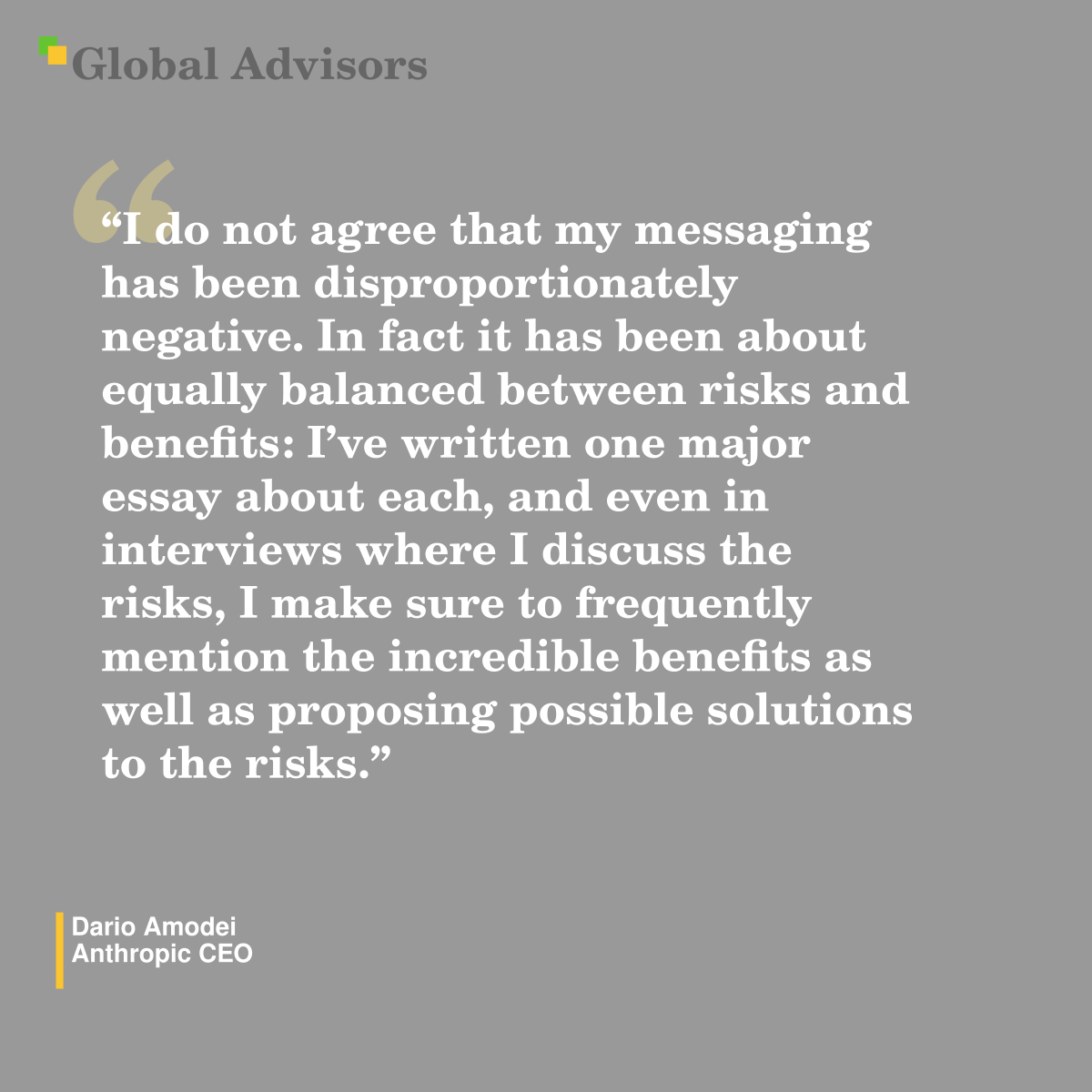
Quote: Dario Amodei - Anthropic CEO"I do not agree that my messaging has been disproportionately negative. In fact it has been about equally balanced between risks and benefits: I've written one major essay about each, and even in interviews where I discuss the risks, I make sure to frequently mention the incredible benefits as well as proposing possible solutions to the risks." - Dario Amodei - Anthropic CEO The central dispute is not about whether artificial intelligence poses risks, but about how its leaders narrate those risks alongside the promised benefits in a climate of profound public distrust. The charge levelled against leading safety-focused founders is that repeated emphasis on catastrophic scenarios, regulation, and frontier controls creates a primarily negative atmosphere that shapes elite and public views of AI more than any balanced accounting of upside. Dario Amodei responds by arguing that the underlying problem is a decades-long crisis of trust in institutions, not the warnings themselves, and that the only credible route to repairing that trust is delivering tangible benefits rather than polishing the narrative. This clash exposes a deeper tension: whether AI legitimacy will be rebuilt through messaging discipline or through verifiable progress in health, biology, and everyday usefulness. From regulatory capture fears to institutional design The backstory begins in a debate familiar to Silicon Valley: is AI regulation inherently a mechanism for regulatory capture by a handful of frontier labs and politicians, or can it decentralise power. A common shorthand equates regulation with concentration of control and barriers to entry, especially when rulemaking revolves around compute thresholds, safety testing, and licensing regimes. Amodei explicitly rejects this binary, arguing that regulation can either entrench incumbents or restrain them depending on the design of institutional processes, standards, and exemptions. He draws an analogy to formal court systems, which can look elitist yet often protect vulnerable individuals better than informal mob justice; the key claim is that institutions can vest power in ideas rather than people, and thereby limit the ability of any single firm or charismatic founder to dictate outcomes. This framing matters for the messaging controversy because critics see his advocacy of tighter frontier rules as self-serving, while he portrays it as deliberately crafted to slow leading labs and advantage smaller competitors. Concrete policy positions are used to substantiate that narrative. In discussions of California bills such as SB53 and SB 1047, he emphasises that proposed thresholds exempt companies below specific revenue or training-cost levels, so that regulatory burden falls disproportionately on frontier players rather than start-ups. Similarly, he points to testing proposals at CAISI and in White House contexts that call for more rigorous evaluation of frontier models than of off-frontier systems, again presenting this as differential friction on the largest actors. The Pacing the Frontier letter is framed as modulating the speed of only the most capable models rather than constraining challengers. In this light, his messaging about risk and regulation is not a blanket call for heavy-handed control of AI, but an attempt to design institutions that recognise structural centralising tendencies of the technology while carving space for open weights and smaller labs. What critics interpret as pessimistic or concentration-seeking rhetoric is, in his telling, a defence of decentralisation via rules that restrain his own sector. Balancing existential risk with radical medical optimism The accusation of disproportionate negativity arises because Amodei is one of the more vocal proponents of frontier testing, slowdown, and catastrophic risk mitigation, including cyber, bio, and alignment threats. In public interviews, he often dwells on scenarios where unaligned systems, model misuse, or rapid automation could generate societal harm, and short clips from those conversations travel widely on social media. He argues that the editing itself introduces bias: clips that emphasise risk attract more engagement, while segments on benefits and solutions are less likely to go viral. To counter the perception, he points to his long-form writing, noting that he has produced one major essay on risks and one on benefits, and that both include concrete pathways for mitigation or for accelerating positive impact. In particular, his essay Machines of Loving Grace is portrayed as a deliberate attempt to build an inspiring, detailed vision of how AI could transform health and biology, rather than merely automating office work or chat interfaces. The substance of that optimistic narrative is ambitious. He argues that AI systems, if suitably combined with molecular simulations, high-throughput experimentation, and biological data, can make curing most human diseases feasible on timelines of roughly 5 to 10 years. That claim challenges both lay scepticism and the more cautious expectations of biologists; Amodei invokes his own experience in biology to suggest that many domain experts underestimate the leverage that scalable models and improved search will provide over complex biological processes. This is not vague futurism but tied to specific regulatory and organisational bottlenecks: he criticises the existing FDA processes for being too slow and proposes streamlined pathways for AI-generated or AI-accelerated drug candidates, arguing that otherwise an unprecedented wave of potential treatments could be delayed in bureaucracy. His personal story about losing his father to Hepatitis C just before the arrival of direct-acting antivirals, which cure about 95% of patients, anchors the urgency. The implication is that for each year of delay in translating AI-assisted discovery into approved therapies, thousands or tens of thousands of patients die unnecessarily, making the benefit side of AI safety and policy as morally weighty as the risk side. Public sentiment, trust, and the limits of marketing Despite this dual focus, Amodei concedes that broader public opinion about AI is strikingly negative and sees that as a major strategic problem for the field. Where he diverges from his critics is in the diagnosis: he does not attribute the negativity primarily to warnings from AI leaders but to a long-running erosion of trust in companies, governments, and the tech sector. Ordinary citizens, he argues, suspect that new technologies are mostly new instruments for exploitation rather than emancipation, and AI inherits that suspicion rather than creating it from scratch. Against this backdrop, glossy campaigns promising that AI will cure cancer or make life easier are perceived as clichéd and deceptive, adding to cynicism rather than alleviating it. His conclusion is that only visible, verifiable outcomes - genuinely curing cancers, delivering safer and faster drug development, solving concrete problems in medicine and elsewhere - can shift the trust calculus. This stance leads him to reject the idea that Anthropic or peers should invest primarily in positive-spin marketing. He accepts that many observers will fault his communication strategy, but maintains that the most accurate criticism of AI labs is not excessive negativity; it is that they have not yet delivered commensurate benefits relative to their rhetoric about societal transformation. That criticism, he argues, is fully deserved and should be front and centre. In turn, he stresses that his firm is ramping biological and medical efforts quickly, aiming to produce results that will be widely and loudly shared once they exist. Until then, he prefers to pair frank discussion of serious risks with equally frank acknowledgement of the shortfall on the benefit side. This approach treats honesty as a superior foundation for credibility compared with selective optimism, even if it temporarily reinforces negative mood. Strategic tension: safety leadership vs narrative responsibility Beneath this exchange lies a deeper strategic tension about the role of AI safety leaders in shaping elite and public narratives. On one hand, Amodei and his peers occupy a unique position: they build frontier models, understand scaling dynamics, and see emerging capabilities that are not yet widely visible. On the other hand, they have financial, organisational, and reputational stakes in how the regulatory environment evolves. Critics argue that when such figures repeatedly advocate for pre-deployment testing, stricter standards for frontier systems, and institutions modelled on FINRA for oversight, they inevitably influence perceptions of AI as primarily dangerous and complex - especially among investors and policymakers. In this view, balancing essays are insufficient because public salience is driven by high-stakes warnings rather than nuanced long-form writing. Supporters counter that failing to speak candidly about catastrophic risk would be irresponsible given the potential for rapid, poorly governed scaling, and that downplaying dangers to improve sentiment would itself damage trust once problems inevitably surface. Amodei attempts to resolve this tension by drawing a line between messaging designed for clicks and messaging embedded in concrete institutional and technical proposals. When he argues for pre-deployment testing regimes in the Trump administration approach or welcomes suggestions from other leaders like Demis Hassabis for FINRA-like entities, he is situating risk communication within a broader vision of how to make AI structurally safer and more decentralised. The claim is that robust institutions, transparent testing standards, and differentiated rules for frontier models will ultimately empower more actors and reduce arbitrary corporate control, even if the short-term narrative emphasises constraint and danger. Whether this argument persuades sceptics depends on their assessment of political economy: some will see any intricate regime as inevitably manipulated by the largest players, while others will find the analogy with courts and rule-of-law institutions compelling enough to justify cautious support. Why the debate matters for AI's trajectory The controversy around whether Amodei is too negative is significant because it highlights the collision between three forces: the inherent centralising tendencies of large-scale AI, the fragility of public trust in institutions, and the moral weight of both existential and everyday risks. If AI continues to be framed largely as a source of catastrophic danger, governments may adopt heavy-handed controls that freeze innovation or lock in incumbent advantages, undermining the decentralisation he claims to seek. If, by contrast, firms lean into optimistic narratives without transparent acknowledgment of risk and clear mitigation strategies, any serious incident - from model-enabled cyber-attacks to biosecurity breaches - could trigger an even more severe backlash, confirming suspicions that the industry was reckless. The path Amodei sketches tries to thread between these extremes: speak openly about high-end risks; design testing and governance that slows frontier models while protecting challengers; invest aggressively in biological and medical applications with real-world impact; and accept that sentiment will remain negative until AI helps cure diseases and solve problems that people tangibly care about. Whether that combination proves politically and commercially viable will shape not just his own legacy, but the broader equilibrium between AI's perceived risks and benefits over the coming decade.
|
| |
| |
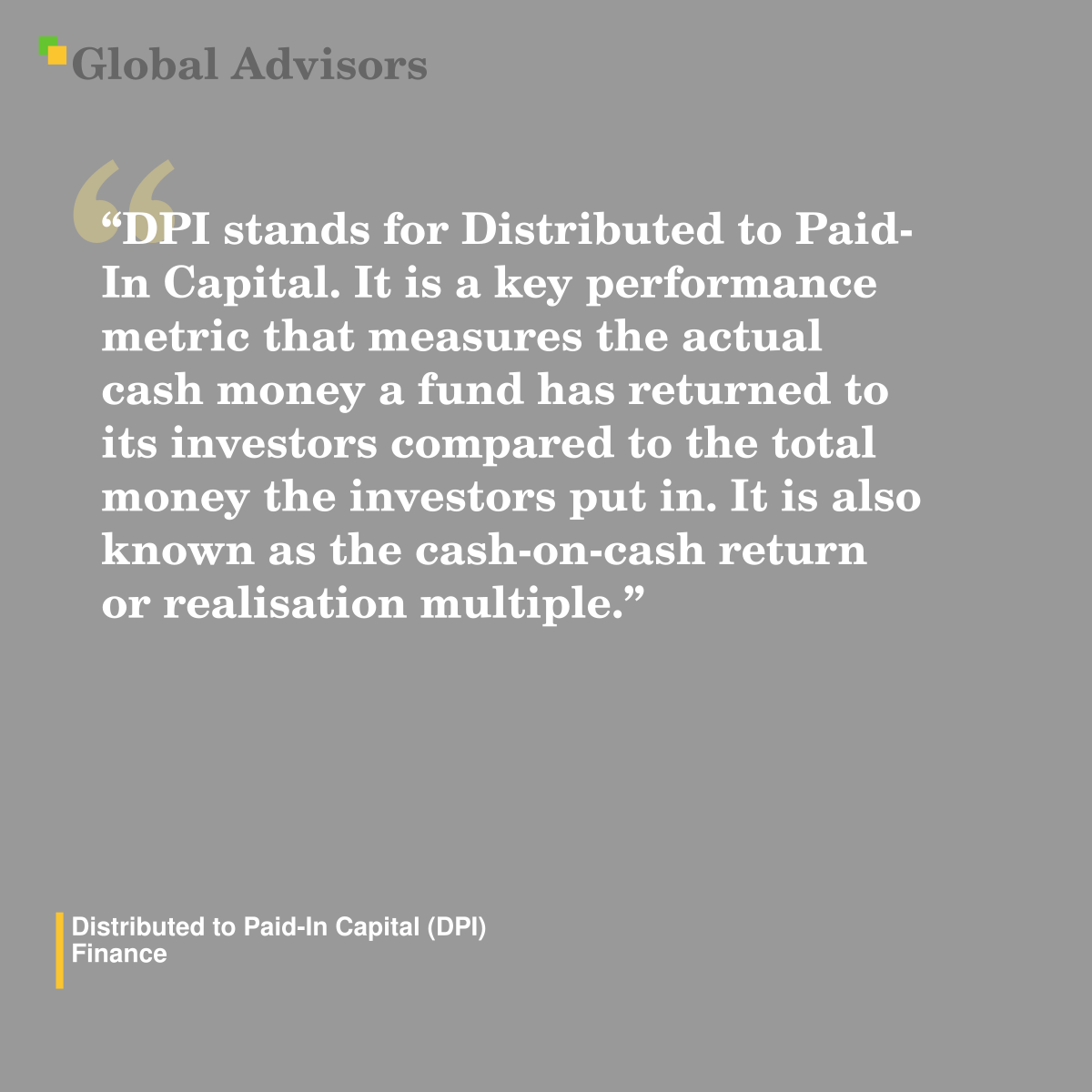
Term: Distributed to Paid-In Capital (DPI) - Finance"DPI stands for Distributed to Paid-In Capital. It is a key performance metric that measures the actual cash money a fund has returned to its investors compared to the total money the investors put in. It is also known as the cash-on-cash return or realisation multiple." - Distributed to Paid-In Capital (DPI) - Finance DPI matters because it answers a simple but decisive question: how much cash has actually come back to investors, not how much value exists on paper. In private equity and venture capital, that distinction is critical because realised proceeds, not unrealised marks, determine whether limited partners have recovered capital, booked gains, or are still waiting for exits. In practical terms, DPI is a liquidity measure disguised as a return metric. A fund can look attractive on paper through rising valuations, yet still deliver weak cash outcomes if exits are slow. DPI strips away that uncertainty by focusing only on cumulative distributions relative to capital paid in, which is why it is often treated as the clearest view of realised performance. Definition and formula The standard formulation is . Cumulative distributions are the total cash, and in some cases stock or equivalent proceeds, that a fund has returned to its investors over time. Paid-in capital is the amount investors have actually contributed when capital was called. That ratio is usually expressed as a multiple rather than a percentage. A DPI of means investors have received back exactly the amount they put in. A DPI above means the fund has distributed more than the capital invested, while a DPI below means the fund has not yet returned all contributed capital. What the metric means in practice DPI is often described as a cash-on-cash return because it compares money received to money contributed. If a fund has a DPI of , it has distributed for every invested. That is not a forecast and not an estimate; it is a historical record of realised capital returned to investors. This makes DPI especially useful for investors who care about whether gains have been monetised. In private markets, unrealised net asset value can rise for years without producing cash. DPI therefore captures a more conservative and often more meaningful view of progress, particularly for limited partners that need distributions to meet liabilities, recycle capital, or report tangible progress to their own stakeholders. How to read the components Each element of the ratio has a precise role. Distributions include all realised cash flows back to investors, usually after the fund has exited portfolio holdings or paid income from holdings such as dividends. Paid-in capital is the denominator because it measures what investors have actually funded, not merely what they committed on paper. In industry usage, the denominator is sometimes described as called capital or capital paid in, depending on reporting conventions. The economic meaning is the same: the metric compares actual capital deployed by investors with actual cash returned to them. Some managers report gross DPI and net DPI, where the latter may reflect fees, expenses, or carried interest more directly, which can produce a more investor-specific picture of realised proceeds. Relationship with other private market metrics DPI becomes more informative when read alongside TVPI and RVPI. TVPI combines realised and unrealised value, so it captures total value relative to paid-in capital, whereas RVPI focuses on the residual, unrealised portion still held in the portfolio. DPI, by contrast, isolates the realised part of the story. That separation matters because two funds can have the same TVPI while telling very different stories. One may have already returned much of the capital and still hold a smaller residual portfolio, while another may rely heavily on unrealised marks with little cash actually distributed. DPI reveals which of those outcomes is more liquid and therefore more certain. Schools of thought and interpretation There are two broad ways practitioners use DPI. The first treats it as a pure realisation measure: a cash metric that is intentionally agnostic about future value. The second treats it as a performance signal that should be judged against fund age, strategy, and market cycle. A young venture fund with low DPI may simply be early in its life, while a mature buyout fund with the same figure may look under-distributed relative to peers. This is why benchmarks are usually contextual rather than absolute. Venture capital tends to show slower DPI progression because exits take longer and value often compounds in a smaller number of late-stage outcomes. Buyout funds typically generate distributions earlier because operating control and debt structures can accelerate monetisation. As a result, the same DPI number can imply very different performance depending on the asset class and vintage year. Tensions, limitations, and common misunderstandings DPI is powerful, but it is not a complete measure of fund quality. It says nothing directly about the speed of returns, so it does not capture time value in the way IRR does. It also says nothing about remaining embedded value, which means a fund with modest DPI may still have strong unrealised upside. On the other hand, a high DPI does not guarantee superior overall performance if the remaining portfolio has been written down or if the realised returns took too long to materialise. Another common mistake is to treat DPI as a proxy for total return. It is only one part of the private markets toolkit. A fund with and low residual value is different from a fund with and a very strong unrealised book. The first has distributed more cash; the second may still have more economic value left to harvest. Why DPI still matters DPI remains central because the private markets industry ultimately lives or dies by realised cash outcomes. Limited partners commit capital years before exits occur, and they must distinguish between valuation gains and money already returned. DPI gives them a direct answer to that operational question, which is why it has become one of the headline metrics in fund reporting and benchmarking. It also matters because the market has become more disciplined about liquidity. In periods when exit markets are slow, distributions can lag even for funds with strong underlying assets. In that environment, DPI helps investors judge whether a manager is converting portfolio value into actual proceeds, rather than merely accumulating paper appreciation. That makes it a practical measure of credibility as well as performance. Bottom line for investors DPI is best understood as the realised-return lens for private funds. It tells investors how much cash they have received back for each unit of capital they put in, and it does so without relying on forecasts, marks, or valuation narratives. Used properly, the metric is most useful when paired with fund age, strategy, TVPI, RVPI, and IRR. Used alone, it can be misleading; used in context, it is one of the cleanest measures of whether a fund has turned paper success into cash in investors' hands.
|
| |
| |
Quote: David Frankel - Founder Collective"There are so many founders. I think there are fewer entrepreneurs." - David Frankel - Founder Collective The real tension is not whether AI can produce extraordinary companies, but whether the market can tell genuine enterprise creation apart from capital-fuelled imitation. Frankel's view, grounded in a long seed investing record and the current AI cycle, is that too many people now call themselves founders because the label has become cheap, while the harder, rarer discipline of entrepreneurship remains scarce . That distinction matters because the present market is rewarding access, speed and narrative compression, not just execution. In a boom, the difference between those who start companies and those who build enduring businesses becomes easy to ignore, yet it is exactly that difference that determines whether capital is compounding or merely chasing momentum . Why the market confuses founding with entrepreneurship Frankel's argument starts from the observation that startup formation has been normalised. Programmes, networks and a culture of repeated company creation have made founding more accessible than at almost any point in the last two decades . That accessibility is not automatically a bad thing. It expands the pool of talent, lowers social friction and helps more people test ideas quickly. But it also means the title of founder can be acquired faster than the habits that make a company viable. Entrepreneurship still requires fortitude, resilience, the ability to recruit, a tolerance for uncertainty and the stamina to keep going when enthusiasm is no longer enough . The modern ecosystem can produce many people who are willing to start; it produces far fewer who are willing, or able, to absorb the grind of building through repeated ambiguity. That gap matters more in AI than in previous waves because the cost of making something look impressive has dropped sharply. Tools, models and outsourced expertise allow small teams to seem larger, faster and more capable than they are. As a result, the market can confuse presentation with substance. Frankel's warning is not nostalgic. He is not arguing for some vanished era of harder founders. He is pointing out that when technical leverage increases, the premium on judgement, focus and persistence rises as well . A company can now reach a polished demo, a credible launch and even real revenue with astonishing speed, but those milestones do not prove that the team can defend a market position once competition intensifies. AI raises the ceiling while compressing the middle The underlying strategic problem in the current cycle is concentration. Frankel sees AI as the most important technology wave of his career, yet he also believes that the financial outcome will be brutally uneven . A small number of companies will become immense, while a long tail of others will be washed out by capital intensity, valuation pressure and undifferentiated positioning . His backstory as a seed investor explains why he is so focused on this asymmetry. In the past, early entry could produce large multiples because the valuation gap between seed and scale was wide enough to absorb mistakes. Now, many rounds are priced as if the winner is already known, which means the scale of success required to justify an investment rises as the entry price rises . This is why he is sceptical of the fashionable claim that price no longer matters. In theory, if a company becomes sufficiently huge, the purchase price becomes irrelevant. In practice, venture arithmetic is unforgiving. The return needed from a high-priced seed bet is much harder to achieve than from a modestly priced one, especially when later rounds, dilution and follow-on funding are taken into account . Frankel's resistance to uncapped notes and overheated seeds is not conservatism for its own sake. It is a recognition that capital efficiency still governs outcomes even in a cycle where investors talk as if only access to the 'true winners' matters . Why small funds still have a role The broader backstory also clarifies why Frankel defends small seed funds even as mega-platforms dominate headlines. Founder Collective's model depends less on owning a company at all costs and more on identifying founders early enough that the fund can still generate meaningful returns from a handful of wins . That approach is easy to dismiss in a market obsessed with scale, but it remains logically coherent. A small fund does not need every outcome to be a decacorn; it needs a few exceptional companies to become large enough to return the vehicle . By contrast, large funds increasingly need the very biggest outcomes simply to matter economically. Frankel's critique is that the larger the platform, the more it begins to behave like a distribution business dressed up as judgment. In that world, the investor's role can drift from conviction to access, and access alone is a fragile basis for enduring venture returns . That does not mean he ignores large rounds or refuses to co-invest with bigger firms. It means he reads those situations differently. He has described small cheques in large rounds as a kind of insurance policy, a way for founders to preserve a relationship with an investor who will still care even if the company stops being strategically material to a mega-fund . The implication is subtle but important: in venture, sponsorship is not identical to support. A founder may think they are buying a long-term ally when in fact they are buying a temporary seat. Frankel's preference for smaller funds and earlier pricing is partly a way of preserving genuine alignment rather than merely competitive positioning . Entrepreneurs, not just founders, survive the cycle The deeper philosophical thread in Frankel's backstory is that he is still selecting for the same trait he valued before AI became the organising narrative of the market: edge. That edge can be domain knowledge, technical intensity, a rare founder pairing or a deep understanding of a neglected market . He does not treat entrepreneurship as a generic ability to start something. He treats it as a scarce combination of insight and persistence. That is why he is comfortable backing teams with unusual backgrounds, including second-time founders or operators who have lived inside a problem for years . The value lies not just in what they build, but in how long they can remain credible while building it. The CEO and CTO split he emphasises also fits this framework. A good technical founder may build the product, but the CEO has to recruit, persuade, raise capital and keep the organisation coherent as it scales . AI does not remove that burden. If anything, it intensifies it, because a smaller team can now produce more output, which means each hiring mistake or strategic misread has greater consequence. Frankel's interest in founder alchemy, trust and complementary skills is therefore not sentimental. It is a practical response to a market in which technology amplifies capability but does not eliminate the need for leadership . Why the distinction matters for the next decade Frankel's statement about fewer entrepreneurs than founders also helps explain his broader view of the AI economy. He expects enormous productivity gains, major changes in professional services and serious disruption across software, yet he does not predict universal job destruction . Instead, he anticipates a widening gap between those who learn to use AI well and those who do not . That is another version of the same theme. The market will not be split only between AI companies and non-AI companies, but between people and firms that convert AI into durable advantage and those that simply use the label while remaining structurally unchanged. In that sense, the real backstory is not about a slogan. It is about a filter. AI will expose which teams are genuinely entrepreneurial because it will reward speed, adaptation and clarity while punishing anything that depends on status, branding or complacency. There is also a larger market implication. If AI lowers the cost of starting, the number of founders will keep rising. If it raises the productivity of the best teams, the gap between the merely active and the truly entrepreneurial will widen. That is why Frankel's line lands so hard. It separates formation from creation, motion from momentum and activity from endurance . In a market crowded with people launching companies, the scarce resource is not the ability to incorporate or raise an early round. It is the ability to keep building after the easy part is over, when the product is real, the market is competitive and the narrative no longer carries itself. Seen that way, Frankel's comment is not a put-down of the current generation. It is a diagnosis of the era. The AI boom has made founding easier, faster and more visible, but entrepreneurship remains difficult, patient and brutally selective. The market may be producing more startups than ever, yet the scarcity that determines long-run value has not changed. It still lives in judgement, stamina and the willingness to keep earning the right to exist after the initial excitement fades .
|
| |

| |
Term: Total Value to Paid-In Capital (TVPI) - Finance"TVPI (Total Value to Paid-In Capital) measures a fund's total relative performance. It is a multiple showing the sum of cash given back to investors plus the current worth of remaining assets, divided by the actual money investors put into the fund." - Total Value to Paid-In Capital (TVPI) - Finance TVPI matters because private market returns are not fully captured by cash alone. A fund can distribute little in the early years and still show strong underlying value, while another can hand back cash quickly yet leave weak residual assets behind. TVPI is designed to combine both sides of that picture into one multiple, making it a central shorthand for how much value a private equity or venture capital fund has created relative to the money investors have actually paid in. In practical terms, TVPI answers a simple question with a lot of nuance hidden inside it: for each unit of paid-in capital, how much total value exists today? That total value is the sum of cumulative distributions already returned to investors and the current value of remaining holdings, usually measured as residual net asset value. The denominator is paid-in capital, meaning actual capital called and contributed, not merely capital committed on paper. Core definition and formula The standard formula is . In some sources, residual value is described as remaining NAV, unrealised value, or the fair value of the still-held portfolio. The same identity is often expressed as , where DPI captures realised cash returned and RVPI captures the unrealised balance still in the fund. That decomposition is analytically useful because it prevents the headline multiple from becoming a black box. If a fund has returned in cash and still holds assets worth of paid-in capital, its TVPI is . The number looks strong, but it also reveals that most of the outcome still depends on assets that have not yet been sold. What the metric means in substance TVPI is often described as the total return multiple or overall fund value multiple because it blends realised and unrealised performance into one figure. A TVPI of means the fund has, on a combined basis, merely matched the money investors have put in. A figure above indicates value creation, while a figure below implies capital destruction on a total-value basis. In the private funds context, this matters because the timing of returns can vary dramatically. Early in a fund's life, DPI may be low because few exits have occurred, yet RVPI may be high if the portfolio has appreciated. Later in the life of the fund, the balance may shift: DPI rises as exits happen, while RVPI falls as the remaining portfolio is sold down. TVPI sits across both phases and gives LPs a way to compare funds that are at different stages of maturity. Why the denominator matters One subtle but important point is that TVPI is built on paid-in capital, not committed capital. That distinction matters because LPs usually commit more than is called at any one time, and committed but uncalled capital has not yet been deployed into assets or fees. Using paid-in capital keeps the metric tied to the capital base that has actually entered the fund and has therefore been exposed to performance outcomes. This also explains why TVPI is best understood as a fund-level multiple rather than a time-adjusted return measure. It does not say when value was created, only how much value exists relative to what has been contributed. That is why analysts often pair TVPI with IRR, which does incorporate timing, and with DPI, which focuses on actual cash returned. How practitioners read it In due diligence, TVPI is often treated as the broadest single performance snapshot. LPs use it to gauge whether a manager has generated value overall, whether or not that value has yet been realised as cash. GPs may also use it as a headline figure because it can present a stronger picture than DPI alone when the portfolio still contains meaningful unrealised gains. Yet the metric only becomes genuinely informative when read alongside its components. A high TVPI with a low DPI means the fund's reported success is still largely paper value. A high TVPI with a high DPI is more robust because much of the multiple has already been converted into cash. Conversely, a modest TVPI can still be attractive if it is driven by a strong DPI in a fund that has already returned capital early. Schools of thought and debates There are two broad ways of interpreting TVPI. The first treats it as a convenient summary of economic value, especially for comparing funds in the same vintage, strategy, or stage of life. The second treats it more sceptically, as a valuation-dependent multiple that can flatter portfolios whose remaining assets are marked aggressively. Both views are valid, and the tension between them is part of why the metric remains debated. The main criticism is that TVPI contains unrealised value, and unrealised value depends on marks. Those marks may be disciplined and conservative, or they may be optimistic and slow to adjust. For that reason, a fund with a very strong TVPI may still be carrying latent write-down risk if market conditions deteriorate or if exit assumptions prove too aggressive. There is also a methodological debate about whether TVPI is too blunt to stand alone. Supporters argue that it is the right level of aggregation for fund reporting because LPs need a broad measure of how much value the manager has created. Critics argue that it can obscure the composition of that value, especially when a fund has returned relatively little cash but is carrying a large residual stake that may or may not monetise at the stated value. Mathematical interpretation and related metrics TVPI is a simple ratio, but its interpretation is richer than the formula suggests. If denotes cumulative distributions, residual value, and paid-in capital, then . The related metrics are and , which yields the identity . That identity is more than notation. It shows that TVPI is a full-value measure, DPI is a realised-return measure, and RVPI is the unrealised balance still waiting to be proven. In practice, these three metrics let investors separate cash already earned from value that remains contingent on future exits. Why the term still matters TVPI remains important because private markets are still characterised by lumpy exits, long holding periods, and valuation marks that matter long before cash is distributed. Public market investors can often look at a quoted price and know exactly where they stand. Private market investors cannot. TVPI gives them a disciplined way to track the combined effect of distributions and residual assets while the fund is still alive. It also remains central because it fits the needs of LP reporting. A single multiple is easier to communicate than a full ledger of cash flows and marks, yet it is still rich enough to connect realised and unrealised performance. For that reason, TVPI is often the first number an LP scans, even if it should never be the last number they use. Ultimately, the value of TVPI lies in its balance. It is more complete than DPI, because it includes assets still on the books. It is more grounded than an abstract growth story, because it is anchored to capital actually paid in. And it is more decision-useful than a raw valuation figure, because it tells investors how much of that valuation has already been converted into realised economic return.
|
| |

| |
Global Advisors News Brief - August 15 2026Read the full brief at the link Headlines for the last 24hrs
Time window: 2026-08-14T05:00:33.115Z to 2026-08-15T05:00:33.115Z |
| |
| |
Quote: David Frankel - Founder Collective"[AI] is the wave of our lives. I feel that way, by the way. If I look at internet, SaaS, mobile, AI, nothing looks the same. And will there be roadkill from this wave? Oh my God, there's going to be a lot." - David Frankel - Founder Collective AI is compressing product cycles, inflating capital intensity and widening the gap between companies that can turn capability into distribution and those that cannot. That is why the current wave can be both transformational and destructive at the same time: the technology improves quickly, but the market clears far more brutally, leaving a long tail of funded businesses unable to justify the prices paid for them . Why the boom feels bigger than prior waves Frankel places AI ahead of the internet, SaaS and mobile as a force in his investing lifetime, not because every company in the category will be a winner, but because the ceiling on the best outcomes is higher and the pace of change is faster . The historical comparison matters. Over the past 25 years, he argues, there have been fewer than 100 sustainably large technology companies above roughly $10 billion in value, and the median of the top 500 companies created in that period is around $2.6 billion . That means the modal outcome in every great wave has still been middling relative to the rare giants. AI is likely to repeat that pattern, only with greater speed and more capital chasing the same small set of large wins . The implication is uncomfortable for founders and investors alike. A great technology shift does not guarantee broad success for the companies formed around it. It can instead create a narrow funnel in which a handful of businesses become generational, while the rest become what Frankel calls roadkill . The phrase is stark, but the underlying mechanism is familiar: when a category becomes the focus of intense consensus, valuations rise faster than the underlying certainty of durable differentiation. The market begins to treat participation in the wave as a substitute for competitive edge, even though participation alone is not enough . The seed market problem is really a maths problem Frankel's scepticism about frothy seed pricing is not emotional; it is arithmetic. If the entry valuation rises sharply, the eventual winner must be far larger, or much faster, for the fund maths to work. He pushes back directly against the idea that price no longer matters in AI. In his view, price always matters, because the required exit multiple changes with the starting point . An uncapped note, a lofty cap, or a seed round priced as if it were a later stage all compress the margin of safety and make even a good company a less attractive venture investment . This explains why he is wary of the current fashion for large seed rounds led by multi-stage funds. Those firms can write big cheques, but their involvement often changes the power dynamics for everyone else. Frankel describes a recurring pattern in which a startup takes money from a prominent platform, only to discover later that the internal champion has left, the company is no longer strategic, and the founder is left looking for a second source of support . That is why he sees Founder Collective's smaller cheques as useful not because they dominate the round, but because they remain relevant after momentum investors move on . Discipline is becoming a strategic differentiator The venture market increasingly rewards fund size, access and speed, yet Frankel still argues for discipline at seed. He does not deny that larger platforms can win, especially when a company is already on the path to being one of the very biggest . What he disputes is the notion that scale alone is enough to produce durable venture outperformance. Mega-funds need the very largest outcomes because their fixed costs and cheque sizes require huge capital returns, whereas a boutique seed fund can still generate excellent returns from a more modest, but genuinely elite, company . That distinction gives context to his comments on Founder Collective's strategy. The firm has always been willing to sacrifice some upside by staying small, avoiding management-fee maximisation and keeping a framework that favours founder quality over momentum . He admits that this discipline has caused the firm to miss certain businesses that later became obvious successes, but he treats those misses as the cost of not turning the firm into a size-driven machine . The argument is not that larger funds are wrong in all cases. It is that a small fund can still be a rational, coherent business when it is built around seed economics rather than later-stage asset gathering . Why founder quality still outranks category fashion Even in an AI cycle, Frankel insists that the real edge lies in founder quality, complementary teams and deep domain knowledge . The most interesting startups are not necessarily the ones that declare themselves AI companies first; they are often the ones where people with long industry experience can now use modern tools to attack a persistent pain point. A veteran SAP consultant, for example, who has spent years inside a broken workflow may suddenly be able to build a platform that was previously too expensive or too difficult to create . The capability is new, but the insight is old. That combination is more durable than theme-chasing . Frankel also gives unusually high priority to the relationship between founder and market. He wants a founder who can sell, a technical co-founder who can do what he calls magic, and a partnership marked by trust rather than sameness . That emphasis matters because AI lowers the barrier to building, but not the barrier to convincing, distributing and retaining customers. A model can be copied, but trust, timing and judgement remain hard to replicate. In that sense, AI may actually increase the value of operators who understand a niche deeply enough to see what the market has missed . AI changes the size of the company, not just the size of the market One of the most important strategic shifts in the discussion is the claim that AI enables meaningful businesses to be built by very small teams . That is not just a story about lower headcount; it is a story about a new operating baseline. With coding, support, research, analytics and even some creative tasks partially automated, a startup can begin with more leverage than earlier generations could access . This resembles the effect cloud computing had on infrastructure, but higher up the stack: the product can be launched without assembling the same volume of human labour first . The same logic helps explain why Frankel does not expect mass unemployment, despite expecting significant labour disruption. He anticipates a widening divide between those who learn to use AI well and those who do not . That divide may be especially sharp between younger workers who are already using voice, model-based tools and code assistants, and older workers whose workflows are more fixed . The labour market consequence is not a simple replacement story. It is a reallocation story in which routine tasks disappear, service expectations rise and high-trust human judgement becomes more valuable in the situations where mistakes are expensive . The next battleground is not only models Frankel is also explicit that today's apparent winners are not guaranteed to remain so. He argues that technology platforms rarely stay on top forever, and that the next disruption could come from China, from open models, or from a computing shift that is not yet mainstream . His photonic-computing comments are especially revealing because they show how he thinks about the stack: the model layer is important, but chips, energy and data-centre architecture may be equally decisive over time . If optical or photonic chips materially reduce energy cost, then current assumptions about what constitutes an unassailable advantage could change quickly . That broader view also explains his concern about US research spending and regulation. He sees public R and D, universities and agencies such as DARPA as the upstream source of future commercial breakthroughs, and worries that underinvestment could erode American advantage . At the same time, he views China's faster experimentation and lighter practical constraints as a serious competitive force, especially in areas that require rapid iteration . The strategic tension is clear: if the best ideas come from open-ended research but the fastest deployment happens elsewhere, then national advantage will depend on whether the US can preserve both invention and implementation . Why the most useful venture metric is liquidity, not paper value Frankel's attention to secondary sales and DPI is another sign of how pragmatic his framework has become . In a market where companies can remain private for years while still changing shape underneath investors, paper gains can become misleading . He is more interested in real cash returned than in theoretical value, and that is why he is open to partial liquidity when a company is clearly successful . The point is not to be anti-growth. It is to recognise that waiting for a perfect exit may be inferior to realising some return while preserving upside . This concern dovetails with his comments on the speed of innovation cycles. If products can be made obsolete before liquidity arrives, then the venture business becomes more dependent on timing, optionality and fund construction . Smaller funds can still work, but only if they remain disciplined about entry, selective about ownership and realistic about how much of the portfolio will actually become meaningful . Frankel's position is therefore not nostalgic. It is adaptive. He is willing to accept that AI will create enormous wealth, but he refuses to confuse that fact with an assumption that every investor, fund or startup in the category will share it . The long view: transformation and destruction are linked The deepest thread in Frankel's view is that technological revolutions always produce both creation and elimination. AI will likely make software more abundant, teams smaller, scientific work faster and services more accessible . It will also compress the life expectancy of companies, intensify competitive pressure and expose valuations that were justified more by narrative than by economics . That is why he can sound both enthusiastic and severe in the same breath. The opportunity is real, but so is the waste . For founders, the practical lesson is to build something with genuine edge rather than merely joining the category. For investors, the lesson is to respect price, preserve discipline and treat current leaders as temporary rather than permanent . For the broader market, the lesson is simpler still: AI is not just a growth story. It is a sorting mechanism. The companies that understand their customers, own a real workflow and adapt faster than the model cycle can become extraordinary. The rest may help prove just how ruthless a great wave can be .
|
| |
![“[AI] is the wave of our lives. I feel that way, by the way. If I look at internet, SaaS, mobile, AI, nothing looks the same. And will there be roadkill from this wave? Oh my God, there's going to be a lot.” - Quote: David Frankel - Founder Collective](https://globaladvisors.biz/wp-content/uploads/2026/08/20260812_19h00_GlobalAdvisors_Marketing_Quote_DavidFrankel_GAQ.png)
| |
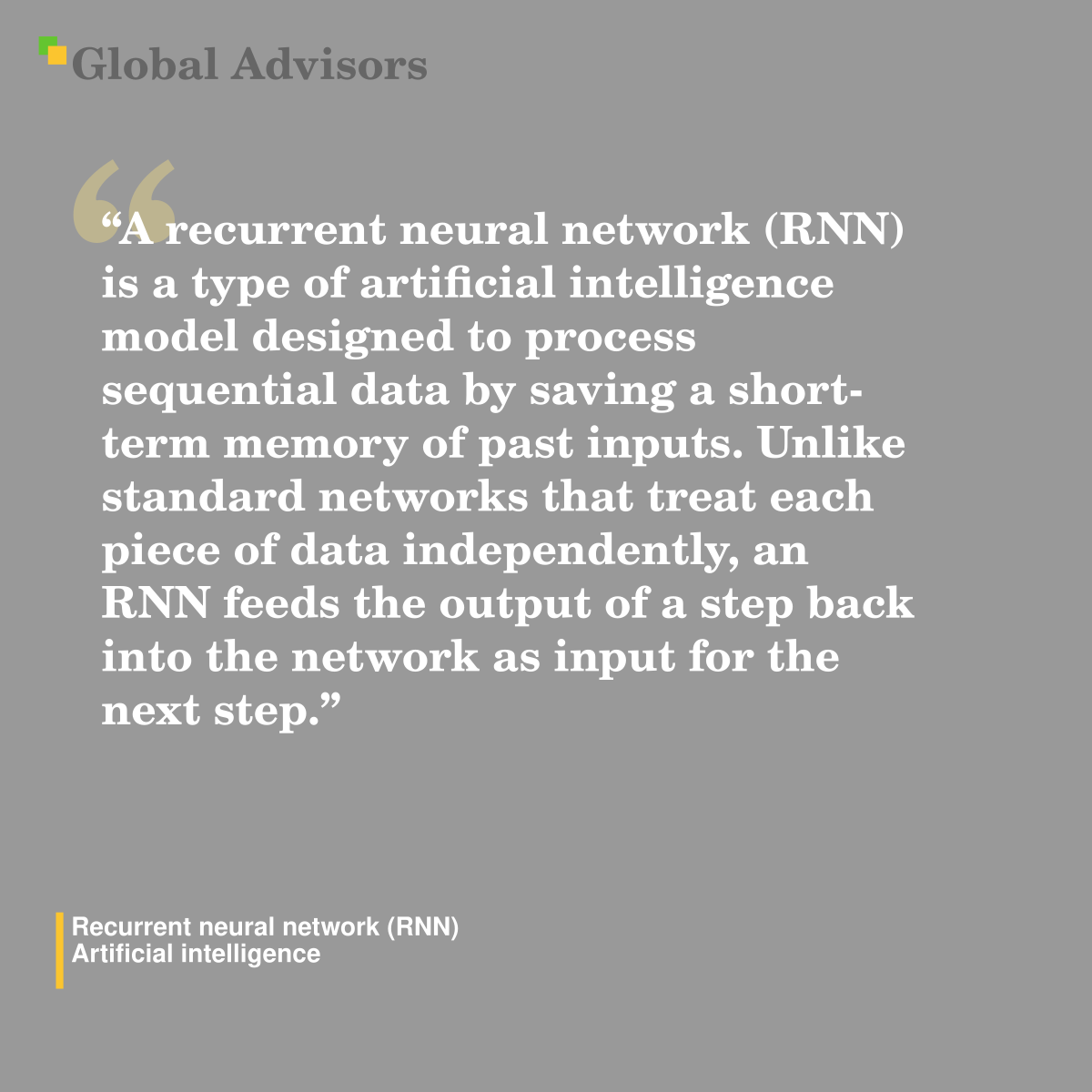
Term: Recurrent neural network (RNN) - Artificial intelligence"A recurrent neural network (RNN) is a type of artificial intelligence model designed to process sequential data by saving a short-term memory of past inputs. Unlike standard networks that treat each piece of data independently, an RNN feeds the output of a step back into the network as input for the next step." - Recurrent neural network (RNN) - Artificial intelligence Sequential data creates a modelling problem that plain feedforward networks handle awkwardly: the meaning of each new input depends on what came before it. A recurrent neural network meets that problem by carrying forward a hidden state, so the model can use a short-term representation of earlier inputs when processing the current step. That design makes RNNs especially relevant wherever order matters, from speech and text to sensor streams and other time-based sequences . The practical meaning is straightforward. Rather than treating each token, frame, or observation as independent, an RNN updates an internal memory as it moves through the sequence. The same set of parameters is reused at every step, which lets the network apply a consistent rule to arbitrarily long inputs without increasing the parameter count with sequence length . In applied settings, this is why RNNs were long associated with language modelling, transcription, translation, sentiment analysis, and forecasting tasks that depend on temporal context . How the mechanism works At each time step , an RNN receives an input vector and a previous hidden state , then computes a new hidden state . A common compact specification is , with an output such as . Here maps inputs to the hidden layer, carries recurrent information forward, maps the hidden state to outputs, and , are bias terms . This formulation matters because the hidden state acts as the model's working memory. The network does not store a perfect record of the past; it compresses past information into a fixed-size state that is updated repeatedly as new data arrives. In effect, the RNN is unrolled across time into a chain of identical cells, each using the same weights but a different time index, which is the standard way to understand how recurrence and parameter sharing fit together . Training usually relies on backpropagation through time, in which the unrolled network is treated as a deep structure spanning all time steps. Gradients are propagated through the sequence so that the model can learn how earlier inputs influenced later errors . This training method is one reason RNNs were powerful but also difficult to optimise in practice, because long chains of repeated transformations can make gradients shrink or grow too much as they move backward through time . Why RNNs were important The main appeal of an RNN is that it builds sequence awareness directly into the architecture. That makes it suitable for language, where a word's meaning depends on previous words, and for time series, where current values are shaped by trends and lags in the past . RNNs therefore became a natural choice for machine translation, speech recognition, text generation, handwriting synthesis, and forecasting problems where the order of observations cannot be ignored . Another advantage is flexibility over input length. Because recurrence reuses parameters at every step, the same network can process short sequences and long sequences without redesigning the architecture for each possible length . That property helped RNNs become a general-purpose tool for variable-length sequence data, which is one reason they appeared in early voice assistants and other systems that had to absorb streams of language or audio . Core debates and technical limits The same mechanism that gives RNNs memory also creates their biggest weakness. In standard forms, the hidden state must compress everything relevant from the past into a single vector, so distant information can be lost or diluted as the sequence grows longer . This makes plain RNNs less reliable on tasks that require very long-range dependencies, such as tracking a subject introduced many steps earlier in a paragraph or a regime change that began far back in a financial series . That limitation led to several schools of thought. One camp treated the plain RNN as the cleanest expression of sequential modelling and tried to improve it with better optimisation and feature engineering. Another camp moved towards gated variants, such as long short-term memory networks and gated recurrent units, which were designed to preserve information more effectively across long spans. A third camp eventually shifted attention to attention-based architectures, especially transformers, which avoid step-by-step recurrence and instead model dependencies more directly across positions. The result is not that RNNs were wrong, but that their inductive bias is most useful when recency, order, and local continuity are more important than very long-distance recall . There is also a conceptual debate about what 'memory' means in an RNN. In strict terms, the model does not remember in a human sense; it stores a learned summary in the hidden state and updates that summary according to its parameters . For some tasks, that summary is enough. For others, especially those involving richer context or complex cross-token relationships, the compressed state becomes a bottleneck rather than a strength . What the term means in practice today In modern AI, RNNs remain important as a teaching model and as a practical baseline for sequential learning. They clarify the logic of state, recurrence, and temporal dependence in a way that makes later architectures easier to understand . In production systems, they are less dominant than they once were, but they still matter where compute constraints, streaming data, or established legacy pipelines favour compact recurrent models over larger attention-based systems . The term also matters because it describes a broader design principle rather than a single fixed implementation. Any system that feeds its prior state forward to influence later predictions is using recurrence in some form, even if the exact cell structure differs across variants . That is why RNNs remain a reference point in machine learning discussions: they sit at the intersection of sequence modelling, memory, optimisation, and architectural trade-offs, and they explain why order-sensitive data demands more than ordinary static classification .
|
| |
| |
Global Advisors News Brief - August 14 2026Read the full brief at the link Headlines for the last 24hrs
Time window: 2026-08-13T05:00:33.075Z to 2026-08-14T05:00:33.075Z |
| |
| |
|


| |
| |