| |
|

| |
| |
| |
|
A daily bite-size selection of top business content. |
| |
| |
| |
Quote: Ardie Savea - All Blacks captain"You can let it drown you out and end up in the headlights, or you can love those moments. As All Blacks, we love those moments." - Ardie Savea - All Blacks captain High-stakes international rugby turns pressure into a structural feature rather than a passing mood. For New Zealand, a small country that has built a disproportionate share of its modern identity around one team, expectation is not episodic; it is a standing condition. Every test, particularly against historic rivals such as South Africa and emerging powers like Ireland, carries layers of memory, national pride, and comparative status that cannot be reduced to a single match preview. The tension is less about a ninety-minute contest and more about the recurring question of whether the team can continue to carry a legacy that has often felt larger than the sport itself. In this environment, public discourse tends to oscillate between reverence and scrutiny. The All Blacks are measured not only against current opponents but against their own past versions, from the near-mythic dominance of earlier decades to more recent disappointments that punctured assumptions of inevitability. Losses to Ireland, a World Cup exit earlier than many New Zealanders consider acceptable, and periods of coaching transition have all contributed to a sharper edge in commentary. For players, that means each series, particularly against traditional rivals such as the Springboks, is framed as a referendum on whether the side is still the global benchmark. Pressure, in other words, is not an anomaly; it is the default context. When Ardie Savea speaks about these moments, he is drawing on a decade-long career of living inside that environment. He has described being almost addicted to the sensory overload of big-game atmospheres, from walking into bright lights in Chicago as a young player to dealing with late-game turnovers against South Africa with a centurion cap on his head. The narrative arc is not of a prodigy shielded from stress, but of a player who has repeatedly faced matches where a single mistake - a missed tackle, an overthrown lineout support, a penalty at the breakdown - can flip a result and, with it, the discourse of a nation. That history gives weight to his comments about either being paralysed like a startled animal or deliberately stepping into the intensity. Context for the statement lies in the build-up to a test series in South Africa, where tension between hosts and visitors had been steadily rising. Media questions emphasised hostility, crowd noise, and the prospect of a physical battle between two of rugby's most storied teams. Asked whether he fed off that noise, Savea used the deer in the headlights image to describe one pathway and contrasted it with deliberately embracing those moments. Referring to New Zealand as coming from a small island, he has elsewhere noted feeling like he had arrived when playing in big overseas venues, yet he also emphasises that pressure from strong opponents, such as Ireland, is a necessary stimulus for growth. This combination of humility about origin and relish for big stages forms a recurring thread in his public comments. The All Blacks and the normalisation of pressure One reason the remark resonates is that it speaks to how the All Blacks have long framed pressure internally. Players describe the black jersey as bound to a legacy that demands a certain standard every time they run out. Successive generations have been socialised into seeing scrutiny as part of the privilege of representing the side, not an injustice to be resented. Savea has explicitly invited media and public pressure, noting after a tense win over South Africa that journalists do a great job building that pressure and that players thrive on it because it drives improvement and matches what New Zealanders expect from their team. This approach treats external expectation as a performance tool rather than a psychological threat. Yet there is a nuance in his view of what counts as real hardship. On the eve of another high-pressure test, he remarked that pressure for him is people at home not being able to eat or lacking housing. That perspective reframes rugby stress as challenging but fundamentally privileged, a chance to serve as a vessel for a wider national story about resilience and bouncing back from setbacks. When he later talks about walking toward pressure rather than letting it become a burden, he is not trivialising the demands of elite sport, but situating them within a broader moral hierarchy of difficulties. The tension here lies between acknowledging the genuine mental strain on players and resisting the temptation to equate sporting stakes with life-or-death stakes. From reactive survival to proactive appetite The imagery of being in the headlights evokes a state of reactive survival: the player or team is flooded by noise, hostility, and consequence, and responds by freezing or narrowing decision-making to short-term avoidance. In contrast, the idea of loving those moments points to a proactive appetite for exposure. Savea often describes dreaming of decisive moments - a late turnover, a critical defensive stand, or a key carry - and wanting to be where a teammate needs him most when the game is on the line. In psychological terms, this aligns with a challenge mindset, where the same physiological arousal that can trigger panic is interpreted as fuel for performance, and with flow states that many elite athletes seek when stakes are highest. This mindset is not purely individual, however. Savea is careful to link his personal orientation to a collective culture, using the language of brothers, shared responsibility, and distributed leadership. After a tight win in France, he highlighted how another player, Ruben Love, took control with clear messaging under pressure, emphasising pride in the team's mindset rather than focusing solely on his own decisions. The implication is that loving such moments is not about heroic individualism but about a group habituated to seeing pressure as a shared problem to be solved in real time. Leadership, in this frame, is less about stoic detachment and more about emotional regulation that allows communication and decision-making to remain functional. Strategic tension: embracing hype versus managing risk Strategically, leaning into hype carries both benefits and risks. On the positive side, framing hostile stadiums and intense media cycles as energising can lift performance, particularly in contests where emotional intensity is likely to be decisive, such as New Zealand versus South Africa in front of a partisan crowd. Players who derive joy from that environment may access higher physical outputs and sharper focus. Savea's description of being almost addicted to running out to hear the crowd fits that interpretation. It also aligns with sports psychology findings that athletes who appraise stress as a challenge tend to show better decision-making and maintain technical execution under pressure than those who appraise it as a threat. The risk is that romanticising pressure can blur the line between constructive arousal and reckless over-investment. The All Blacks' own history includes matches where emotional spikes led to discipline lapses or tactical impatience, particularly when facing opponents who specialise in squeezing games through set-piece dominance or aerial contests, such as South Africa and Ireland. There is also the danger that a culture of loving pressure might silence individuals who genuinely struggle with anxiety, encouraging them to mask issues rather than seek support. Savea's emphasis on personal differences in dealing with stress acknowledges this variability and suggests that even within a shared narrative, there is room for diverse coping strategies. Debates, objections, and evolving leadership Not everyone accepts that embracing pressure is the right path. Some critics argue that New Zealand's mid-2020s wobble in results reflected a team too focused on intangible narratives and not enough on system coherence and technical detail. From that perspective, public talk about loving big moments can sound like rhetorical cover for structural weaknesses in defence systems, attacking shapes, or selection policies. Others worry that the constant framing of tests as existential challenges feeds boom-and-bust cycles in public mood, where one defeat is treated as a crisis and one win as redemption, exacerbating volatility for players and coaches. These concerns reflect a broader trend in rugby discourse, where national teams are increasingly analysed through the lens of high-performance systems rather than heroic mythology. Savea's own leadership path sits at the intersection of these debates. As captain, he has been open about feeling the pressure that comes with leading one of the sport's most iconic teams, but he frames it as an opportunity to grow and to represent Kiwis around the world. He often combines talk of challenge with references to faith and gratitude, thanking Jesus after major victories and framing success as something to be offered back rather than hoarded. This blend of humility, spiritual reference, and competitive edge distinguishes his public persona from some of his predecessors and may reflect a generational shift in how leaders integrate personal values with the demands of professional sport. Why it matters beyond one team The significance of this stance extends beyond New Zealand rugby. In an era where elite athletes across sports speak more openly about mental health, burnout, and the costs of constant scrutiny, Savea's framing offers a counterpoint that does not minimise those issues but reframes stress as a chosen battleground. For aspiring players, it provides a language for seeing hostile environments not as anomalies but as natural habitats for high performance. For coaches and support staff, it suggests that cultivating a culture where players can both respect and relish pressure may be as important as technical training. And for the wider public, it invites reflection on where genuine hardship lies and how much of the emotional energy invested in sport can be channelled into constructive narratives about resilience, collective identity, and the capacity to bounce back from setbacks.
|
| |

| |
Quote: Siya Kolisi - Springbok rugby captain"And despite all this we are a great people, we South Africans. We are a great people, and we are good people: kind, generous, passionate, fun-loving, open, talented, creative, driven, resilient, people who work hard in the week and on weekends love nothing more than to meet with our friends and enjoy their company. History has battered our country time and time again, and still we endure." - Siya Kolisi - Springbok rugby captain The tension running through contemporary South Africa is the coexistence of deep structural crisis with a stubborn everyday refusal to give up. Economic stagnation, institutional mistrust and intensifying inequality sit alongside scenes of collective joy, sporting success and ordinary neighbourliness that defy simple narratives of decline. To understand why affirmations of national character resonate so strongly, it is necessary to trace how the country was shaped by both historical trauma and repeated episodes of civic mobilisation, and how sport has become one of the few shared arenas where the possibility of a different future is regularly rehearsed. South Africa's modern story is marked by layered violence: colonial dispossession, codified racial segregation, and the formal system of apartheid that ended only in 1994. Those structures produced what local researchers often describe as the triple challenge of poverty, inequality and unemployment, a set of problems that did not disappear with democratisation and in many respects hardened over the last three decades. The Gini coefficient remains among the world's highest; unemployment is entrenched for young people, and basic services fail too often in townships and rural communities. At the same time, the constitutional order built in the 1990s gave South Africans language and institutions for contesting injustice, sustaining a dense culture of rights talk, legal activism and community organising that has tried to hold the democratic project together during periods of corruption and state failure. Against that backdrop, collective episodes that momentarily cut across race, class and geography acquire outsized meaning. Rugby carries particular weight because of its history as a symbol of white Afrikaner power and its reappropriation in the post-apartheid era. The 1995 Rugby World Cup, narrated through Nelson Mandela's decision to don a Springbok jersey, became a global shorthand for reconciliation, even though material change for the poor was slower and more uneven. Later triumphs, including the 2007 title, reinforced a sense that sporting success could temporarily loosen the grip of everyday pessimism. Yet by the mid-2010s, rugby still looked, to many, like a domain of limited transformation; the appointment in 2018 of a captain from a township background posed a direct challenge to that perception. The making of a symbolic captain Siya Kolisi's rise from Zwide township near Gqeberha to captaincy of the Springboks condensed many of the country's contradictions. Growing up in a community marked by poverty and limited opportunity, he entered elite rugby via scholarship pathways that themselves highlight how exceptional talent can escape structural constraints that keep most peers locked in. When he was named Springbok captain in 2018, he became the first black man to occupy that role in a team historically associated with white privilege. The appointment was celebrated as a turning point precisely because it had to carry more than sporting significance: it suggested that institutions long resistant to change could be reshaped without collapsing their competitive edge. The subsequent results made that symbolism harder to dismiss as mere optics. Under Kolisi's captaincy, South Africa won the Rugby World Cup in 2019, defeating England in the final, and then again in 2023, edging New Zealand by a single point after a sequence of knockout matches each decided by the smallest of margins. That back-to-back achievement placed Kolisi in a tiny leadership bracket, alongside Richie McCaw, and confirmed him as the most decorated Springbok captain. More important for domestic politics was the image of a black captain lifting the Webb Ellis Cup twice, in a side whose composition and tactical identity reflected deliberate transformation as well as traditional rugby virtues of physicality and discipline. The victory runs coincided with years in which South Africans were grappling with corruption revelations, electricity blackouts and declining trust in state capacity, making any moment of shared celebration feel politically charged. Resilience against structural strain Kolisi has repeatedly insisted that the national mood surrounding the Springboks cannot be separated from the country's social crises. In interviews after both World Cup wins he stressed that there is 'so much going wrong' in South Africa, describing the team as a kind of last line of defence for hope and as a proof that people from sharply different backgrounds can work together. Such claims sit within a broader argument made by civic organisations and researchers: that South Africans have developed everyday repertoires of endurance, from informal economic activity to local mutual aid networks, in response to the failures of formal systems. Community-based feeding schemes, safety initiatives and educational projects often operate where municipalities falter, embodying a practical ethic of care that many citizens recognise instinctively. Kolisi's own foundation, launched after the 2019 World Cup, aims to tackle inequality and gender-based violence, signalling an expectation that high-profile figures should help to institutionalise the solidarity invoked in celebratory speeches. Resilience, however, is a contested concept. Critics point out that celebrating the ability of ordinary people to endure repeated shocks risks normalising the lack of structural reform. When leaders praise national toughness without facing down corruption or delivering basic services, they may be seen as romanticising struggle, shifting responsibility from state to citizen. Yet Kolisi's comments usually pair affirmation with an acknowledgment of division and pain: he speaks about homelessness, rural marginalisation and tavern culture, explicitly naming places and communities that rarely feature in elite policy discourse. The rhetorical move is to refuse both despair and denial, asserting that an honest inventory of suffering does not negate pride in everyday generosity, humour and creativity. This balance resonates with many South Africans' lived experience, in which joy and hardship collide in rapid succession. Sport, narrative and contested nationhood Rugby's role in shaping political imagination continues to attract debate among scholars and journalists. Some argue that the powerful imagery of united stadiums and spontaneously mixed celebrations can distract from structural realities, providing catharsis without transformation. Others suggest that symbolic breakthroughs in historically exclusionary institutions are not trivial, because they shift what younger generations consider possible in public life. Kolisi's captaincy operates at this intersection. On the one hand, his personal story, amplified by international media, risks becoming a familiar narrative of individual triumph that leaves systemic barriers untouched. On the other, his presence at the centre of a team deliberately built across racial and regional lines undermines long-standing stereotypes about who can embody national leadership. His insistence that he is 'serving the team, not representing every struggle' plays against expectations that black leaders must always speak directly in the idiom of liberation politics, even as he acknowledges the broader implications of his role. The Springboks' recent path sharpened these arguments. The 2023 World Cup run required winning three knockout games in a row by just a single point, a sequence that depended on tactical clarity, squad depth and psychological resilience under severe pressure. Columnists have treated this as an allegory for a country that survives on thin margins, constantly improvising to stay afloat. Yet allegories are double-edged: they can illuminate shared values like determination and mutual trust, but they can also obscure the fact that success in elite sport depends on resources, high-performance systems and international networks that are inaccessible to most citizens. Using rugby as a national mirror therefore demands care, especially in a society where many feel permanently excluded from the formal economy. The politics of character and why it matters Affirmations of collective character matter in South Africa partly because competing narratives vie to define the national project. Cynical accounts emphasise crime, corruption and decline, suggesting that social cohesion has fractured beyond repair. Alternative stories foreground everyday kindness, creativity and humour, arguing that the country's future will be determined not only in parliament or boardrooms but in ordinary decisions to keep showing up for one another despite fatigue. When a widely trusted figure asserts the goodness and generosity of South Africans while acknowledging historical battering, it intervenes in that contest over identity. It does not erase the fact that many communities experience violence and exclusion, but it refuses to cede the symbolic ground to narratives of irredeemable failure. This matters beyond rugby. South Africa's ability to tackle its triple challenge of poverty, inequality and unemployment depends not just on policy and investment but on whether citizens believe that collective action is worthwhile. If people internalise a sense of permanent dysfunction, they are less likely to participate in local initiatives, vote strategically, or hold leaders accountable. By contrast, dignifying ordinary endurance and mutual care can help sustain the psychological infrastructure on which reform efforts depend. Kolisi's public language, grounded in his own trajectory from township childhood to global sporting prominence, offers one strand of that dignifying narrative. It insists that history's repeated blows are real, that structural injustice remains entrenched, but that those facts coexist with qualities of kindness, creativity and drive that can be mobilised rather than merely admired during moments of celebration.
|
| |

| |
Term: Tag-along and drag-along rights - Finance"Tag-along and drag-along rights are protective clauses found in shareholder agreements. Tag-along rights protect minority owners by letting them join a company sale to get the same price and terms. Drag-along rights protect majority owners by letting them force minority owners to join a sale so the buyer can purchase 100% of the company." - Tag-along and drag-along rights - Finance Control over exit rights shapes bargaining power long before a sale is signed. In private companies, the central issue is not only who can sell, but who can prevent a sale, who can share in it, and whether a buyer can acquire the whole equity stack without being blocked by holdouts. Tag-along and drag-along clauses answer those problems by allocating exit rights between majority and minority owners, and by doing so they reduce transaction friction while also redistributing leverage in a shareholder agreement . Tag-along rights protect minority holders by allowing them to join a sale initiated by a controlling shareholder on the same price and broadly the same terms . The practical effect is straightforward: if the controller finds a buyer for its stake, the minority is not stranded in a company with a new owner it did not choose, or left behind while the controller exits at a premium . Drag-along rights work in the opposite direction. They allow a sufficient majority to require minority holders to sell too, so the buyer can take 100% of the company and the deal does not collapse because a small bloc refuses to go along . Economic function and deal mechanics These provisions matter most where shares are illiquid and secondary sales are rare. In a listed market, an investor can usually exit by selling into the market, but in a private company the opportunity to realise value often arrives only when a strategic buyer or financial sponsor wants control . Tag-along rights therefore operate as a minority liquidity safeguard, giving the smaller holder a chance to monetise alongside the controller rather than being trapped in a closed company . Drag-along rights, by contrast, are a clean-sale device. They reduce the risk that a buyer discounts the offer because it cannot acquire complete ownership, and they help the seller present a coherent transfer package rather than a partial stake with residual governance complications . In practice, the clauses are usually triggered only when specified thresholds are met. A drag provision may require approval by holders of a defined supermajority, a board resolution, or both, before minority holders can be compelled to join the sale . A tag provision is usually tied to a controlling or majority sale to a third party, and it may require the selling shareholder to procure that the buyer offers the same terms to the minority holders . The drafting choices matter because they determine whether the clause applies to an asset sale, a share sale, a sale of control, or some broader change in ownership . Mathematical and contractual logic The economic logic can be stated simply. If the company has shareholders and a majority seller owns shares, then a tag-along right lets the minority sell a proportion of its holding alongside that majority sale, often on a pro-rata basis . If the buyer wants all shares, a drag-along clause permits the seller to impose the transaction on the remaining holders once the contractual trigger is met . In valuation terms, the minority should usually receive the same per-share price as the majority, though the exact distribution of consideration can become more complex where there are preference shares, liquidation preferences, or multiple share classes . That complexity is why drag provisions are often negotiated alongside the capital structure itself. If the company has preferred and ordinary shares, a sale may be allocated through a waterfall, so each class receives the amount it would have received in liquidation if the sale proceeds were distributed under the governing rights attached to the share classes . In venture-backed deals, this can be contentious because a drag at a modest valuation may be attractive to investors with preferred protections while leaving founders or common holders with much less upside . Tag rights, meanwhile, can be framed as a quid pro quo for conceding drag rights, since they preserve a minority exit when the controller sells . Major schools of thought One school treats drag and tag clauses as efficiency tools. On this view, drag rights prevent holdout behaviour and ensure that a valuable sale is not blocked by a few dissenting investors, while tag rights reduce unfairness by preventing a controller from capturing the exit premium alone . This perspective is common in private equity and venture capital, where deal certainty and full ownership are often commercially important . A second school sees them primarily as allocation devices. Rather than being inherently pro- or anti-minority, the clauses distribute control over exit in a way that reflects relative bargaining power at the time the company is financed . A third school is more sceptical and focuses on agency costs. Here, drag rights can be used to pressure weaker investors into accepting a sale they would not have chosen, especially if the sale is timed to suit the controller or a preferred class rather than the company as a whole . From this viewpoint, tag rights are not enough on their own because they protect only participation in a sale, not the ability to block one that may be unfairly priced or badly timed . The debate therefore turns on governance context: in a company with strong disclosure, board oversight, and statutory minority remedies, these clauses may be less dangerous; in a poorly governed private company, they can be highly consequential . Tensions, safeguards, and drafting choices The key tension is between liquidity and autonomy. Drag clauses make a company easier to sell, but they reduce the veto power of smaller holders. Tag clauses preserve fairness in a controller-led exit, but they do not prevent a majority from choosing when to sell or what price to accept . That is why the details of drafting are often as important as the headline right. Lawyers focus on the threshold that triggers drag, the types of transaction covered, whether the minority must receive exactly the same terms or merely broadly equivalent terms, and whether transfer taxes, warranties, indemnities, or escrow obligations are shared equally . Another important issue is whether the clauses sit only in the shareholder agreement or also in the articles of association. In many private structures, putting the mechanism in both places strengthens enforceability, because a buyer needs confidence that every holder can be bound to the same transaction path . Minority protections may also be supplemented by other devices such as pre-emption rights, anti-dilution protections, board representation, appraisal rights, unfair prejudice remedies, and class consent requirements for fundamental changes . Seen together, these rights form a broader architecture of minority protection, with tag-along and drag-along provisions acting as the exit-related parts of that architecture rather than as standalone safeguards . Why the distinction still matters The distinction remains highly relevant because ownership concentration and exit pressure are common in start-ups, growth capital rounds, family companies, and sponsor-backed businesses. Investors want assurance that a future sale will not be derailed by holdouts, while founders and minority holders want assurance that a majority cannot sell their value without offering them the same opportunity . The result is a negotiated balance: drag rights make a sale executable, tag rights make it equitable, and the exact wording determines how much leverage each side keeps . For practitioners, the clauses are best understood less as abstract labels and more as a transfer regime for private-company control. They determine whether an exit is collective or fragmented, whether the premium for control is shared or captured, and whether a buyer can insist on certainty before committing capital . That is why they remain standard features of shareholder agreements and why they are often among the most intensely negotiated provisions in any private equity or venture financing .
|
| |

| |
Global Advisors News Brief - August 22 2026Read the full brief at the link Headlines for the last 24hrs
Time window: 2026-08-21T05:00:33.078Z to 2026-08-22T05:00:33.078Z |
| |
| |
Term: Leveraged buyout (LBO) - Finance"An LBO, or leveraged buyout, is when a company or investor (usually a private equity firm) buys another company using a very large amount of borrowed money and only a small amount of their own cash." - Leveraged buyout (LBO) - Finance A leveraged buyout concentrates ownership change, financing risk, and operational pressure into a single transaction. The core logic is simple: a buyer acquires a company with a relatively small equity cheque and a much larger layer of borrowed money, then relies on the target's cash generation, asset base, and eventual resale value to make the deal work. This structure matters because it changes who bears risk and how value is created. In a conventional acquisition, the buyer mainly depends on the company being worth more over time; in an LBO, the buyer also depends on the business producing enough cash to service debt while the ownership group uses leverage to magnify returns on the equity they did contribute. How the structure works An LBO is usually built around a financing stack that combines sponsor equity, senior bank debt, and sometimes subordinated debt or high-yield bonds. The acquired company's assets or future cash flows are commonly used as collateral, which is why lenders focus on downside protection and repayment capacity as much as on the headline purchase price. The practical meaning is that the transaction is not simply an acquisition method but a capital structure choice. The buyer is attempting to buy control of a business with borrowed funds, then improve the business, reduce debt, and exit later at a higher valuation, ideally generating a return that is far greater than the initial equity outlay. A simplified financial identity helps explain the logic. If is the purchase price, is sponsor equity, and is debt, then . The appeal of the deal comes from the fact that the sponsor seeks to maximise the return on , not merely the absolute value of , while the debt is repaid from operating cash flow and, if needed, asset sales or refinancing. What makes a company suitable Not every business can support a leveraged buyout. The target must usually have stable and predictable cash flows, limited cyclicality, enough asset quality to support lending, and room for margin improvement or strategic change. Businesses with recurring revenue, strong market positions, and operational inefficiencies are often favoured because they can sustain interest payments and offer levers for post-deal value creation. That is why LBO screening tends to begin with repayment capacity rather than with growth dreams. A buyer typically models future free cash flow, debt service, and exit value to see whether the company can survive a highly geared balance sheet without violating covenants or starving investment in the business. In analytic terms, if denotes free cash flow at time and denotes scheduled principal and interest, then a basic feasibility test is whether over the relevant horizon. That inequality is not the whole story, but it captures the central constraint: leverage must be supportable by actual cash generation, not just accounting profits. Major schools of thought One school views LBOs as disciplined ownership structures. Advocates argue that heavy debt forces management and sponsors to focus on cash conversion, cost control, and portfolio discipline, because excess leverage punishes complacency and idle capital. From this perspective, the debt is not merely a financing tool but a governance mechanism that can sharpen incentives and accelerate reform. A second school treats LBOs as value extraction machines that can transfer risk to workers, creditors, and the target company while leaving sponsors with convex returns. The criticism is that the upside to equity can be large even if the downside is partly borne by lenders and other stakeholders, especially if the post-deal environment weakens or if the business has been over-levered. A third view sits between those positions. It sees LBOs as a neutral financial technology whose social value depends on pricing, structure, and execution. Under this reading, leverage can support genuine operational improvement when debt is sized conservatively and the acquisition thesis is grounded in real cash flow, but it can also destroy value when used to justify expensive deals or aggressive assumptions. Mathematics and deal logic The basic return logic can be expressed as equity value creation relative to invested equity. If the exit enterprise value is , net debt at exit is , and the sponsor initially invested , then a simplified equity multiple is . This ratio rises when enterprise value grows, debt falls, or both. The internal rate of return is the discount rate that solves , where are interim distributions and is the final exit value to equity. In LBO modelling, that equation is central because sponsors care less about accounting earnings than about the timing and magnitude of cash returned on the equity cheque. Debt capacity is usually tested with leverage and coverage ratios. If is too high, refinancing risk and covenant pressure increase; if interest coverage is too low, even a small earnings miss can threaten the deal. The exact threshold varies by sector and credit cycle, which is why LBO structuring is as much a market exercise as a company analysis. Historical context and deal types LBOs became especially visible in the 1980s, when public-to-private transactions and hostile takeovers gave the technique a reputation for aggression and scale. Landmark deals such as RJR Nabisco, TXU, HCA, Hilton, and Heinz illustrate how the strategy can be deployed across consumer goods, energy, healthcare, hospitality, and industrial sectors. These deals are not identical, but they share a common pattern: a sponsor identifies a business with durable cash flows, raises a large debt package, buys control, and then seeks to improve performance or restructure ownership before exit. Some deals become celebrated case studies because they deliver exceptional sponsor returns; others become warnings because the debt burden proves too heavy once trading conditions deteriorate. The historical record therefore cuts both ways. The same leverage that can amplify gains when management execution is strong can also magnify losses when assumptions prove too optimistic, which is why LBOs are often discussed alongside bankruptcy risk, creditor negotiations, and restructuring law. Why the term still matters The term remains important because it describes a recurring pattern in modern private equity and corporate finance: control is bought with borrowed money, then the capital structure itself becomes part of the investment thesis. That matters for boards, lenders, regulators, and management teams because the transaction changes incentives, risk allocation, and strategic freedom from day one. It also matters because LBO thinking has spread beyond classic private equity. Companies, founders, and executives use similar logic when considering buy-and-build strategies, take-private transactions, or management buyouts, all of which rely on the idea that a business can support more debt than it would under a purely conservative capital structure. For practitioners, the real question is not whether leverage is inherently good or bad, but whether the business can safely carry it. The decisive issues are the quality of cash flow, the price paid, the resilience of the industry, and the sponsor's ability to improve operations faster than debt erodes flexibility. That is why an LBO remains one of the clearest tests of whether finance is being used to create control, discipline, and value, or merely to postpone the reckoning.
|
| |

| |
Global Advisors News Brief - August 21 2026Read the full brief at the link Headlines for the last 24hrs
Time window: 2026-08-20T05:00:33.075Z to 2026-08-21T05:00:33.075Z |
| |
| |
Quote: Aaron Levie - Box CEO"There tends to be a debate between being an expert or generalist in the era of AI. So far, the experts appear to have the upper hand, and that's not slowing down." - Aaron Levie - Box CEO The central tension is not whether AI can generate more output, but who can most effectively direct that output towards something valuable. As the cost of first drafts, search, synthesis, and routine analysis falls, the scarce resource shifts towards judgement: deciding what problem to solve, knowing when the system has gone off course, and recognising whether the result is actually good enough to use. That is why expertise has not been diluted by AI as much as some expected; it has become more visible, more leveraged, and in many settings more valuable . That pattern fits the evidence emerging across productivity research. The OECD has argued that AI can raise output and labour productivity, but its estimates are measured rather than euphoric, with annual total-factor productivity gains in the range of 0,25 to 0,6 percentage points over a decade in the most AI-ready economies . At the same time, OECD work on experimental studies finds that generative AI often improves efficiency in writing, summarising, editing, translation, and coding, while the size of the gains depends on task fit, user skill, and the ability to evaluate outputs . The implication is straightforward: AI is not a universal equaliser. It is a force multiplier that rewards people who already know how to ask sharper questions and judge the answers more rigorously . That is also why the debate between expert and generalist is so persistent. Generalists can now get started faster across a wider range of tasks, and that creates the impression that breadth is winning. Yet the harder part of the work has not gone away. The more an agent can do, the more valuable it becomes to understand the boundaries of what it should do, where it is likely to fail, and how to verify the result. MIT Sloan's discussion of a study on highly skilled workers found that AI improved performance when used within its capability boundary, but performance dropped when users pushed it beyond that boundary, reinforcing the importance of expert review and cognitive effort . In other words, AI reduces the barrier to entry, but it does not remove the barrier to reliable judgement . Expertise as a control system The most useful way to understand this shift is to think of expertise as a control system rather than a repository of static knowledge. In that model, AI produces candidate outputs at speed, but the human expert sets the objective, monitors for drift, and corrects the path when the system starts optimising the wrong thing. This is particularly obvious in fields where the right answer is not merely a technically plausible one, but one that is contextually defensible, legally sound, commercially coherent, or strategically wise. Research on human-AI collaboration has increasingly described the value of hybrid decision-making, where machine speed and human judgement are combined rather than treated as substitutes . The review literature also suggests why the expert advantage persists. AI is especially powerful where a task is structured, repeatable, and easy to verify, but it is far less reliable where the task depends on tacit knowledge, domain-specific standards, or incomplete information. A legal brief, a finance model, or a product strategy memo may all look polished in draft form, yet each requires a different kind of expert filter to determine whether the assumptions are sound and the reasoning holds together. OECD analysis has noted that better decision-making, sense-making, and forecasting are among the most important benefits of AI, while also warning against over-reliance because errors can propagate quickly when human judgement is deferred to machines . The same pattern is visible in empirical productivity studies. Generative AI often helps less experienced workers the most because it compensates for gaps in fluency, structure, and speed of execution . That does not contradict the claim that experts gain more leverage. It means the gains are different in kind. Novices may get a larger lift in basic throughput, but experts can use the same tools to expand scope, test more alternatives, and compress hours of routine labour into a shorter decision cycle. The result is not simple replacement, but a widening of the gap between people who can merely produce text and people who can identify what the text should achieve . Why judgement is becoming scarcer There is a deeper reason why expertise is becoming more valuable: AI makes mediocre output cheaper, but it does not make good judgement cheaper. The tools can draft, summarise, classify, and propose, but they cannot reliably supply institutional memory, ethical responsibility, or the tacit sense of what will work in a specific environment. That is why the burden on experts often increases rather than falls. A senior professional using AI may spend less time on first-pass production, but more time reviewing, redrafting, and stress-testing the agent's recommendations. This is not a sign that the technology has failed. It is a sign that the high-value portion of the job has moved upstream into framing and downstream into verification . That shift also explains why expertise development itself matters more, not less. There is a risk that people mistake tool fluency for domain competence, especially when AI can make a novice look more polished than would once have been possible. But polish is not the same as depth. Studies and policy work alike warn that automated workflows can erode opportunities for deliberate practice if organisations allow the machine to take over the work that builds skill . If the next generation of professionals learns only how to prompt, rather than how to evaluate, they may gain short-term speed while losing the slower capabilities that actually make AI useful in serious work . That is where the strategic implication becomes clearest. AI does not eliminate the need for experts; it changes the economics of expertise. Someone who knows the field can now work across a wider surface area, examine more possibilities, and delegate more routine preparation to the machine. This produces real leverage in consulting, law, software, finance, research, and operations, where the value of a senior person's hour lies less in typing and more in synthesis, prioritisation, and risk management . The market consequence is a premium on people who can combine technical literacy with deep domain knowledge, and on organisations that know how to design workflows around human oversight rather than around blind automation . The objection from the generalist camp The strongest objection is that AI will flatten the value of specialism because broad competence becomes cheap. There is truth in that, but only up to a point. AI does let more people participate in more kinds of work, and that broadens opportunity. It also means that many routine tasks once protected by gatekeeping are now easier to attempt. Yet the very accessibility of these tools makes evaluation harder, not easier, because plausible output arrives faster than human review capacity. The more generalist the user, the more likely they are to accept fluent but weak answers. The more expert the user, the more likely they are to exploit the model's strengths while detecting its blind spots . This is why the old distinction between doing and knowing becomes less useful than the distinction between generating and governing. AI is very good at generation. Experts remain essential for governance. They decide what counts as evidence, which trade-offs matter, and whether a recommendation aligns with the underlying objective. In practical terms, that means the future belongs less to the person who can ask any question and more to the person who can ask the right one, interpret the answer, and revise the problem definition when needed. That is the part of work that still resists automation, and it is precisely why the upper hand has, for now, stayed with expertise . The longer-term question is not whether AI will create generalists, but what kind of generalists it will create. The most durable generalist may be someone with enough depth in one area to judge quality, plus enough breadth to transfer that judgement across adjacent tasks. That is a very different profile from a shallow all-rounder. As AI spreads, the winners are likely to be those who use breadth as an interface and depth as an anchor, because the machine can help with expansion but cannot supply the standards by which expansion is worth anything at all .
|
| |

| |
Term: buy-and-build, roll-up, add-on or bolt-on strategy - Investment"A buy-and-build (or roll-up) strategy is a corporate development approach where an investor acquires a well-established "platform" company and rapidly scales it by purchasing and integrating smaller, related "add-on" businesses." - buy-and-build, roll-up, add-on or bolt-on strategy - Investment Value creation in a buy-and-build programme depends on more than simply buying several companies in the same sector. The central challenge is turning a collection of small, often owner-managed businesses into a single operating system with stronger pricing power, denser distribution, lower overhead, and a valuation profile that is usually better than the parts on their own. Private equity houses and other investors use the approach because fragmented markets often contain many firms that are individually too small to enjoy scale advantages, yet collectively large enough to justify consolidation . The basic structure is straightforward. An investor first acquires a well-positioned platform company and then acquires a sequence of related add-on or bolt-on businesses that are integrated into that base. The platform is chosen for stability, management depth, and the ability to absorb further acquisitions; the add-ons are usually smaller, complementary, and easier to buy at lower earnings multiples than the platform itself . Bain defines buy-and-build as an explicit strategy that uses a platform company to make repeated add-on acquisitions, with the aim of creating value through scale and scope rather than only through financial engineering . In practical terms, the strategy is an answer to market fragmentation. Many service industries, niche industrial subsectors, and regional business-to-business markets are populated by dozens or hundreds of small operators. That fragmentation creates a gap between operational reality and market valuation: the small businesses may lack the systems to grow efficiently, while the combined group can support central procurement, shared administration, better data, and more ambitious commercial coverage. Connection Capital notes that the purpose is to grow faster than organic expansion alone would allow, increase profitability, widen services, and make the business more attractive at exit . How the economics work The financial logic is often described as multiple arbitrage, although that shorthand can obscure the operating work required to make it real. Smaller acquisitions are often bought on lower EBITDA multiples than the eventual platform multiple, and once they are absorbed into a larger, better run group they may be valued as part of a stronger whole . A simplified relationship is , where is enterprise value, is earnings before interest, tax, depreciation and amortisation, and is the valuation multiple. If an investor buys at a lower and later combines it into a business that trades at , part of the return comes from the spread between the two multiples, provided the integration does not destroy value . That is only one part of the equation. The more durable sources of value are operational synergies and improved capital deployment. Cost synergies arise when duplicated overheads are removed, procurement is centralised, systems are standardised, and local back-office functions are brought under one roof . Revenue synergies can come from cross-selling, broader geographic coverage, more complete customer propositions, and the ability to win larger contracts after scale is built . In well-executed programmes, scale and scope can improve margins, reduce customer acquisition costs, and create a more resilient platform for future acquisitions . The numbers matter because the strategy is not just about sequencing deals; it is about sequencing them at a pace the platform can absorb. Bain describes buy-and-build as typically involving at least four sequential add-ons, while other industry guides note that some sponsors execute a handful and others dozens during a single holding period . A practical acquisition cadence is therefore not a fixed rule but a capacity question: how much integration, governance, financing, and management bandwidth can the platform carry without weakening execution . What the key terms mean The platform company is the anchor investment. It is usually the first acquisition and functions as the operating, financial, and managerial core of the broader group . A good platform often has established processes, a strong market position, and enough scale to support further transactions . Add-ons, also called bolt-ons or tuck-ins, are the subsequent acquisitions that fill gaps in geography, service range, product depth, or customer base . They are generally smaller, more numerous, and more dependent on the platform for systems and governance . There is a useful distinction between a simple acquisition chain and a true buy-and-build strategy. A serial acquirer may buy businesses opportunistically, but buy-and-build is more deliberate: the platform is selected with future consolidation in mind, targets are chosen for fit rather than only for price, and integration is designed into the plan from the start . That distinction matters because the strategy only works when the investor can translate ownership into operating coherence. If the acquired firms remain loosely linked, the group may resemble a holding company more than a scaled operating business . Some practitioners also distinguish between horizontal and vertical logic. Most buy-and-build programmes are horizontal, consolidating competitors or near peers in a fragmented market . Others have a more hybrid logic, where the platform expands into adjacent services, complementary products, or new geographies. The choice affects integration risk, because adjacent acquisitions may create more cross-sell opportunity but also more process complexity, while pure horizontal consolidation may be easier to standardise but less differentiated commercially . Major schools of thought One school sees buy-and-build primarily as a private equity value creation tool. In this view, the strategy exists to accelerate returns within a finite holding period: buy a platform, add acquisitions, improve operations, and exit at a higher multiple through sale or IPO . Another school treats it as a general corporate development method that any scale-seeking owner can use, including family businesses and strategic corporates, particularly in fragmented sectors where inorganic growth is faster than internal expansion . A third perspective focuses less on financial structuring and more on operating architecture. Research and practitioner commentary increasingly emphasise that buy-and-build succeeds only when the platform can standardise data, finance, procurement, identity, and service delivery across the portfolio . In this view, the acquisition is simply the trigger; the real source of value is the design of the combined operating model. That is why integration capability has become a core competitive advantage rather than an afterthought . There is also a critical school of thought that warns against overreliance on multiple expansion. If buyers pay too much for add-ons, or assume exit multiples will remain favourable, the arithmetic can disappoint even when headline revenue growth looks strong . This criticism is especially relevant in overheated markets, where many sponsors pursue the same fragmented sectors and compete for the same small founders. In such settings, the discipline of sourcing, integration, and governance matters more than the promise of scale alone . The main tensions and debates The best-known tension is between speed and integration quality. Rapid acquisition can capture market share quickly, but every new business raises the burden on finance teams, systems, leadership, and culture. If integration lags, promised synergies may never arrive, and management attention becomes fragmented . This is why many guides stress that integration should be planned before close, not after it, and why the best platforms are chosen for their capacity to absorb change as much as for their current profitability . A second debate concerns the treatment of founder-led businesses. Add-ons are often owner-managed firms, and the seller may care about legacy, local brand identity, or employee continuity as much as price . A platform that imposes uniformity too aggressively can damage customer relationships or key staff retention, yet a platform that preserves too much autonomy may fail to achieve the synergies that justify the strategy. The most successful buyers therefore strike a balance between central control and local continuity . A third debate concerns valuation discipline. Buy-and-build can create strong returns when smaller companies are bought cheaply and combined into a more valuable group, but it can also become a justification for paying up on the assumption that future efficiencies will fix a poor entry price . The strategy still matters because it offers one of the clearest routes from fragmented small-business ownership to institutional scale, but the market has become more sophisticated about what constitutes a genuine platform, what counts as a true add-on, and how much integration capability is worth in the price . That is why the term remains relevant. It captures a recurring pattern in private equity and corporate development: identify fragmentation, back a capable platform, add complementary businesses, and turn operational coherence into higher value . The appeal lies in combining growth, control, and scalability in one model, but the discipline lies in doing the hard work of integration well enough to convert aggregation into genuine advantage .
|
| |

| |
Global Advisors News Brief - August 20 2026Read the full brief at the link Headlines for the last 24hrs
Time window: 2026-08-19T05:00:33.075Z to 2026-08-20T05:00:33.075Z |
| |
| |
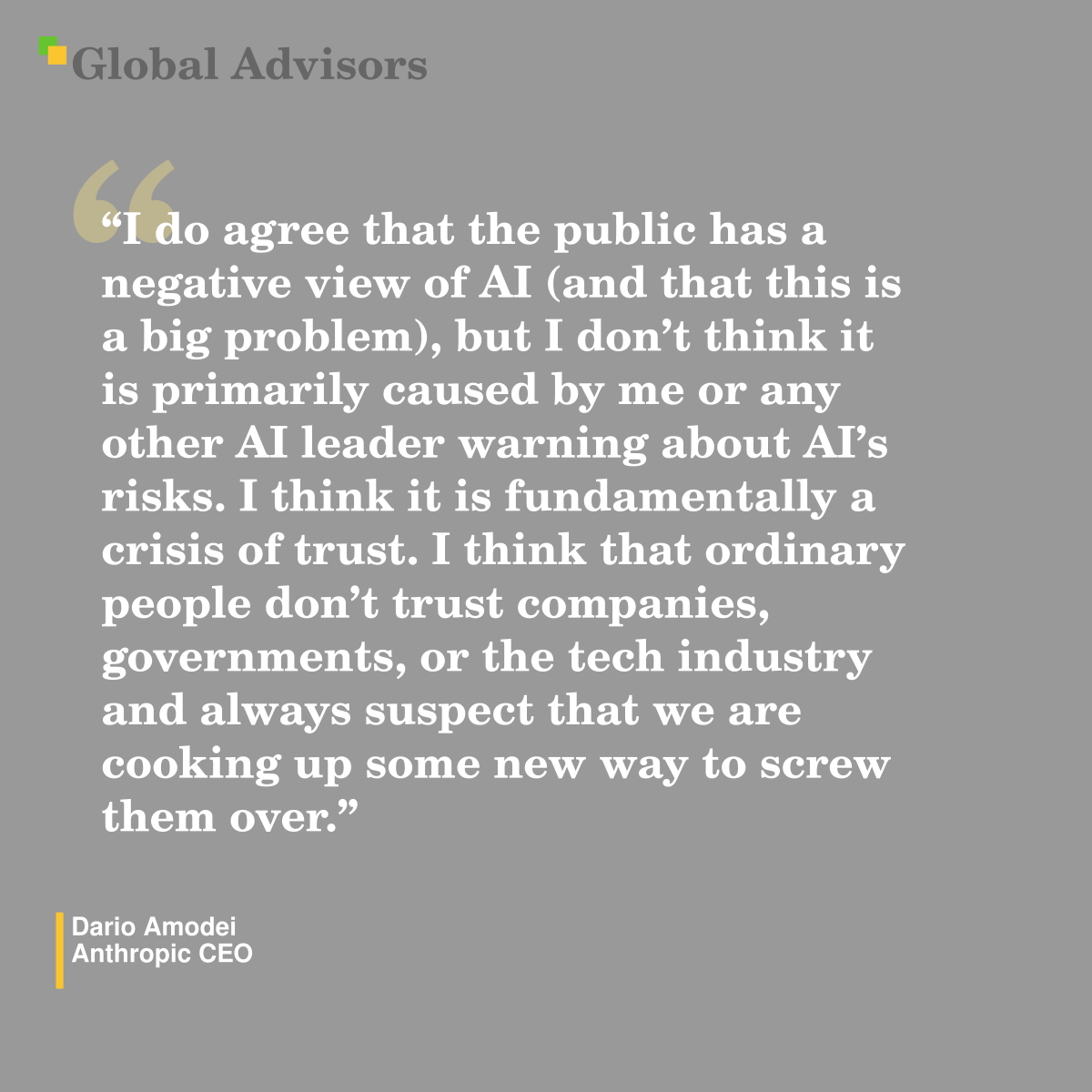
Quote: Dario Amodei - Anthropic CEO"I do agree that the public has a negative view of AI (and that this is a big problem), but I don't think it is primarily caused by me or any other AI leader warning about AI's risks. I think it is fundamentally a crisis of trust. I think that ordinary people don't trust companies, governments, or the tech industry and always suspect that we are cooking up some new way to screw them over." - Dario Amodei - Anthropic CEO Public anxiety around advanced AI is driven less by technical detail and more by a deep-seated suspicion that powerful actors will once again deploy a transformative technology without protecting ordinary people from its downsides or sharing its benefits fairly. Decades of experience with financial crises, data breaches, monopolistic platforms, and opaque political decision-making have created a default expectation that any new system built by large firms and governments will primarily serve insiders, even when wrapped in utopian language about innovation and progress. In that light, current fears about AI look less like a reaction to any single statement by a prominent executive and more like a cumulative response to a long record of perceived betrayal, broken promises, and one-sided bargains that left citizens feeling exploited rather than empowered. This crisis of trust has a history rooted in prior waves of technological and institutional change that were marketed as universally beneficial yet often produced highly uneven outcomes. Mass offshoring of manufacturing was sold as a path to cheaper goods and higher productivity, but many communities experienced only job loss, wage stagnation, and fraying social fabric. Consumer internet platforms were promoted as tools for connection and empowerment, yet users discovered that their data was harvested, profiled, and monetised at vast scale with little transparency or meaningful consent. Algorithmic credit scoring, predictive policing, and targeted advertising repeatedly showed how technical systems could encode bias, reinforce inequality, and concentrate informational power. Against that backdrop, new AI claims about curing disease or automating drudgery sound to many citizens like a familiar script in which distant elites reap outsized gains while ordinary people absorb the risks. Institutional behaviour has reinforced this suspicion by repeatedly prioritising short-term commercial advantage over robust safeguards, and by relying on public relations campaigns to manage concern rather than accepting binding accountability. Major firms have often reacted to criticism with carefully crafted messaging, emphasising positive use cases while minimising or compartmentalising discussion of harm, instead of structurally changing incentives or governance. Governments, for their part, have oscillated between enthusiastic promotion of national champions and reactive, sometimes fragmented attempts to regulate after scandals erupt. Every instance in which a company knowingly deploys a system with significant externalities, or a regulator appears captured or ineffective, deepens the intuitive belief that the next wave of technology will be another round of the same game, with citizens as experimental subjects rather than genuine stakeholders. AI risk messaging and the perception of negativity Within this context, warnings about AI risks are frequently interpreted by critics as part of an elite narrative that both dramatises long-term threats and sidesteps near-term accountability. Commentators argue that discussion of existential or catastrophic scenarios can sometimes function as a form of strategic distraction, shifting attention away from issues such as labour displacement, data exploitation, and concentration of market power. When prominent leaders emphasise alignment or long-run safety, sceptical observers worry that the frame implicitly accepts the inevitability of deployment while placing the burden on future technical fixes rather than present restraint. Yet this interpretation depends crucially on pre-existing mistrust: if the same institutions had a record of transparent governance and equitable benefit sharing, equivalent warnings might be taken as evidence of responsibility rather than manipulation. The individual messenger is therefore assessed through the lens of broader industry behaviour. In the specific exchange that prompted the statement, critics suggested that one executive had shaped a disproportionately negative public narrative around AI, contributing to fearful sentiment. In response, he pointed out that his public work includes substantial emphasis on potential medical breakthroughs, including arguments that advanced AI could help cure most human disease within roughly 5 to 10 years, if combined with appropriate regulatory adaptation. He also noted that short interview clips shared on social platforms tend to highlight dramatic risk-focused soundbites because they attract engagement, thereby skewing perceptions of his stance. This dynamic illustrates how algorithmic curation of media can amplify particular tones of discourse and reinforce impressions of unrelenting doom, even when longer-form material is more balanced. Regulation, power concentration, and institutional process The trust crisis is sharpened by a structural tension over who will set AI rules and how those rules will shape the distribution of power. One influential Silicon Valley narrative holds that rigorous regulation inevitably equals regulatory capture, entrenching incumbent firms and political elites. Under this view, any attempt to impose licensing, testing, or compliance requirements on frontier models risks locking smaller innovators out and centralising control of capability at the hands of a few. The executive in question challenges this binary and argues that it is possible to design regulatory regimes that are objectively administered, transparently scoped, and deliberately structured to slow down the largest players while exempting or advantaging smaller competitors. He cites specific proposals such as state-level bills that only apply to companies above certain revenue or training-cost thresholds, and testing regimes that impose stricter scrutiny on frontier systems than on off-frontier models. Here the argument is that institutionally grounded processes, akin to formal courts rather than social media mobs, can sometimes decentralise power by vesting decisions in publicly contestable rules rather than in ad hoc corporate discretion. If pre-deployment testing for frontier models is managed by an independent body with clear standards, subject to public reasoning and expert input, it may constrain the ability of major labs to unilaterally roll out high-risk systems, while leaving space for open-weights models and challenger firms. The trust question then becomes whether such institutions will be genuinely independent, adequately resourced, and robust against capture, or whether they will be perceived as yet another venue where well-connected actors negotiate permissive oversight behind closed doors. The fact that many citizens expect the latter outcome reflects not a detailed analysis of each technical bill but a long historical pattern in which powerful organisations appear to bend process to their interests. Promises, delivery, and scepticism about AI benefits A central claim in the statement is that public distrust stems primarily from a gap between lofty promises and concrete results, rather than from warnings about risk themselves. The executive argues that many people now react with cynicism to visionary rhetoric about AI curing cancer or revolutionising healthcare, interpreting it as clichéd marketing rather than serious commitment. He suggests that the only reliable way to rebuild trust is to deliver tangible benefits at scale, such as genuinely transformative progress in biology and medicine, rather than to repeat aspirational narratives. This stance implicitly recognises an empirical pattern: fields such as antiviral therapy or oncology contain clear benchmarks by which claims of impact can be judged, such as cure rates or survival improvements, whereas broad productivity or creativity gains are harder for citizens to perceive in their everyday lives. The backstory here includes personal motivation: the writer describes losing a close family member to Hepatitis C shortly before highly effective direct-acting antivirals became widely available, a timeline that shapes his sense of urgency about speeding medical innovation. He links AI policy proposals to ideas for streamlining regulatory pathways, for example by adjusting drug approval processes so that AI-accelerated candidates are not stuck for years in slow evaluation pipelines. Whether such reforms would themselves be trusted is another question: critics might worry that faster approval motivated by technological optimism could increase the risk of unforeseen side effects. Yet the broader point is that credible trust-building must connect to demonstrable, life-improving outcomes, not merely to refined messaging strategies or brand campaigns. In this view, communications are secondary; the primary task is to make advances real and visible. Debates over messaging, honesty, and strategic risk framing A notable tension in the narrative concerns how candidly AI companies should talk about severe risks, given public sensitivity and existing scepticism. Some observers advocate a more upbeat communication strategy, arguing that constant emphasis on catastrophic scenarios depresses investment in beneficial applications and alienates users. Others insist that understatement would itself be deceptive, given the genuine possibility that highly capable systems could enable serious cyber or biological misuse or misaligned behaviour. The executive argues that honesty about risks, even when uncomfortable, is preferable both on ethical grounds and in terms of long-run credibility, compared with a polished optimism that ignores threats people instinctively suspect are real. He notes that criticism should focus less on tone of messaging and more on the fact that companies have not yet fully delivered on promised societal benefits. This stance raises practical questions about how technical leaders can communicate complex risk landscapes without reinforcing narratives of inevitability or helplessness. If firms repeatedly emphasise that certain trajectories could lead to extreme concentration of capability or alignment failure, citizens may either demand strong constraints or disengage from the debate, assuming that decisions will be made elsewhere regardless of their views. Conversely, if communication tilts too heavily toward potential upside, trust may further erode when negative incidents occur, such as high-profile misuse of models or abrupt capability jumps that contradict earlier assurances. Balancing these effects requires not only rhetoric but also institutional commitments: mechanisms for red-teaming, transparent reporting of incidents, and meaningful channels through which affected communities can influence deployment choices. Why the crisis of trust matters for AI governance The diagnosis of a structural trust crisis has direct implications for how AI governance frameworks are likely to be received and implemented. If citizens begin from the assumption that companies and governments are seeking new ways to exploit them, then even well-designed regulatory schemes may be perceived as cosmetic or self-serving, undermining compliance and cooperation. Public buy-in to measures such as frontier testing, incident disclosure, or capability thresholds depends on the belief that these measures are intended to protect broad interests rather than to sanctify existing power structures. Conversely, if AI firms can demonstrate consistent patterns of self-restraint, transparency, and genuine responsiveness to societal concerns, they may gradually shift expectations, making it easier to construct robust institutional arrangements. The executive contends that this shift will only occur if firms deliver substantive benefits and accept real constraints, rather than relying on glitzy campaigns or abstract reassurances. At stake is the legitimacy of decisions about how far and how fast to push AI capability, which cannot be resolved purely through technical expertise. When risk assessments involve potential global externalities, and when scaling laws imply the possibility of systems whose impacts are hard to foresee, governance must rest on a foundation of trust that current institutions do not fully command. The negative public view of AI is therefore not merely a communications challenge but a signal that the broader social contract surrounding technological development has been strained. Whether leaders can repair that contract will depend less on the eloquence of their explanations and more on whether people experience, in their own lives, that powerful technologies are being used to cure disease, expand opportunity, and reduce harm, rather than to extract more value from them without commensurate benefit.
|
| |
| |
|


| |
| |