| |
|

| |
| |
| |
|
A daily bite-size selection of top business content. |
| |
| |
| |
Term: Mezzanine debt - Finance"Mezzanine debt is a hybrid financing tool that sits between low-risk senior debt and high-risk equity in a company's capital structure. It typically acts as a high-interest subordinate loan but includes equity components like warrants or conversion rights that allow the lender to take an ownership stake if the borrower defaults or misses financial targets." - Mezzanine debt - Finance The central corporate finance issue behind mezzanine debt is how firms fund sizeable transactions when senior lenders will not extend enough credit but owners wish to avoid material dilution. Companies seeking to finance leveraged buyouts, recapitalisations or expansion frequently reach a point where traditional bank facilities are capped by leverage, collateral or covenant constraints, yet raising pure equity would be costly in terms of control and required returns . In this funding gap, mezzanine providers step in with junior capital that accepts higher risk and subordination in exchange for a combination of elevated interest and potential equity upside . The economic logic is that the borrower monetises additional debt capacity implied by enterprise value and cash flow, while the lender prices the subordinated position using contractually agreed coupons plus contingent participation in future value creation . Position in the capital structure and risk profile In the capital stack, mezzanine debt is structurally subordinated to senior secured loans and often senior unsecured notes, but ranks ahead of common equity in terms of repayment priority . In a simplified hierarchy, senior bank debt is repaid first from asset realisations or cash flows, followed by other subordinated instruments such as second lien loans and mezzanine claims, with equity owners last in line . This intermediate position generates a risk-return profile that is consistently described as higher risk and higher expected return than senior debt, but lower risk and lower potential upside than equity . Because mezzanine lenders are exposed to loss once the enterprise value cushion above senior liabilities is eroded, they demand elevated coupons, often interest-only during the term, plus fees and equity-linked features . Market commentary and practitioner guides cite typical contractual yields in the low teens to high teens in percentage terms, reflecting compensation for subordination, illiquidity and bespoke structuring . Instrument structure and equity-linked features Mezzanine capital can be documented either as subordinated, usually unsecured, debt, as preferred equity, or as combinations that embed both debt and equity characteristics . In debt form, the instrument generally carries a fixed-rate or floating coupon, limited or no scheduled amortisation and a maturity that extends beyond senior facilities, making it effectively patient capital from the perspective of bank lenders . Return components can be split between cash interest and payment-in-kind interest that accretes to principal, alongside arrangement fees and, crucially, equity participation mechanisms . The most common equity elements are warrants and conversion rights: warrants grant the lender the option to purchase a small ownership stake at a predetermined exercise price, while conversion rights allow specified portions of outstanding mezzanine principal to convert into equity upon defined events such as a sale, IPO or refinancing . In practice, market sources report warrant stakes in the low single-digit percentage range of fully diluted equity, often subject to anti-dilution protections in subsequent funding rounds . These features give mezzanine investors upside exposure to growth and multiple expansion, aligning their interests partly with equity holders and softening the required cash coupon, while still leaving control predominantly with existing owners . Use cases and practical benefits Corporate and private equity sponsors employ mezzanine financing primarily to bridge the gap between senior debt capacity and total required capital for transactions such as acquisitions, leveraged buyouts, growth projects and shareholder liquidity events . When bank lenders cap leverage at a particular multiple of earnings before interest, tax, depreciation and amortisation, mezzanine providers may accept a higher effective leverage level, provided that projected cash flows sustain their interest and allow eventual refinancing or repayment . From the borrower perspective, mezzanine can be framed either as expensive debt or as cheap equity: the coupon is significantly higher than senior rates, but the capital is materially less dilutive than issuing common equity in the same amount . Moreover, because mezzanine investors often underwrite based on enterprise value and sponsor quality rather than specific collateral, the instruments are frequently unsecured and do not require additional asset pledges beyond those supporting senior facilities . Lenders emphasise that mezzanine is not intended as permanent capital but as medium-term funding, commonly with maturities up to 7 or 8 years, during which the company executes its plan, grows earnings and eventually refinances the junior layer with cheaper capital or sale proceeds . Core quantitative relationships and credit analysis Although documentation is legal rather than mathematical, mezzanine terms implicitly rely on formal risk-return relationships familiar from credit and option pricing. Conceptually, the lender prices the instrument by equating the present value of expected cash interest, fees and equity upside to the committed principal adjusted for risk. A stylised representation would treat the mezzanine position as the sum of a risky bond and an embedded equity option. A simplified discounted cash flow for the bond leg can be expressed as , where denotes coupon and fee cash flows, is principal, is maturity in years, and is the required yield reflecting subordination and credit risk. The equity kicker, whether in the form of warrants or conversion rights, is often analysed as an option on the company equity value, whose expected payoff at maturity can be approximated by an option valuation framework such as , with representing future equity value, the exercise or conversion price, implied volatility and time to exercise. In practice, private mezzanine providers blend scenario analysis, covenant-driven downside modelling and market return benchmarks rather than relying purely on closed-form formulas, but the underlying intuition is that junior credit plus optionality must collectively deliver a target internal rate of return commensurate with observed market ranges . Investor protections and covenant structures Given their subordinate ranking and dependence on enterprise value, mezzanine investors place heavy emphasis on contractual protections. Typical structures include covenants addressing maximum leverage, minimum interest coverage, limitations on additional debt incurrence, restrictions on dividend payments and change-of-control provisions . Subordination terms specify not only payment priority but also standstill obligations and intercreditor agreements that govern how mezzanine and senior lenders behave in default scenarios . Many transactions are documented with so-called incurrence covenants, focusing on preventing value-destroying actions such as asset sales or excessive distributions, rather than maintenance covenants tied to quarterly ratios, although practice varies by market and deal size . Equity kickers are often accompanied by detailed anti-dilution mechanisms designed to preserve the lender's economic stake if new capital is raised at lower valuations, and by negotiated rights around information, board observation and veto powers on major corporate actions . These features collectively aim to ensure that mezzanine capital is genuinely long-term and patient, while preserving senior lenders' priority and owners' operational flexibility. Debates around classification and balance-sheet treatment One area of ongoing debate concerns whether mezzanine instruments should be classified as debt or equity for accounting, regulatory and rating agency purposes. Corporate finance training materials and institutional guides note that mezzanine financing is often treated as equity or quasi-equity on internal leverage tests, particularly when interest is largely payment-in-kind and principal ranks structurally behind bank facilities . Yet legal documentation commonly defines mezzanine as debt, with fixed obligations and default remedies resembling those of bonds, albeit subject to subordination . Rating agencies and bank regulators may assess mezzanine differently depending on features such as mandatory coupons, deferrable interest, maturity profile and equity conversion terms, which creates complexity for issuers seeking to optimise reported leverage and regulatory capital . From an economic standpoint, the instrument clearly embeds both creditor and residual claimant characteristics: the lender has contractual rights to cash interest and principal, but also participates in upside via warrants or conversion, and often shares downside beyond senior thresholds. This duality fuels academic discussion about whether mezzanine should be modelled as part of the firm's financial leverage or partially as equity, with implications for cost of capital calculations and capital optimisation strategies . Why mezzanine debt still matters in modern markets Despite the growth of direct lending, high-yield bonds and private equity, mezzanine debt continues to play a distinct role in corporate funding ecosystems. Institutional investors such as private credit funds, insurance companies and dedicated mezzanine vehicles value the asset class for its combination of contractual income and equity-like upside, which can diversify portfolios relative to pure senior loans or buyout equity . For borrowers, mezzanine offers a way to undertake transformational transactions without breaching senior lender constraints or surrendering extensive ownership stakes, effectively monetising the firm's future earnings and enterprise value at a negotiated price . The term's persistence in practitioner discourse reflects a structural reality: as long as capital structures comprise layered claims with differing risk tolerances, there will be a commercial niche between low-risk senior debt and high-risk equity. In that niche, hybrid instruments such as mezzanine debt will continue to evolve, incorporating features like payment-in-kind toggles, preferred equity tranches and bespoke covenants, but still embodying the core function of bridging the funding gap in exchange for a risk-adjusted blend of yield and optionality .
|
| |

| |
Global Advisors News Brief - September 13 2026Read the full brief at the link Headlines for the last 24hrs
Time window: 2026-09-12T05:00:33.071Z to 2026-09-13T05:00:33.071Z |
| |
| |
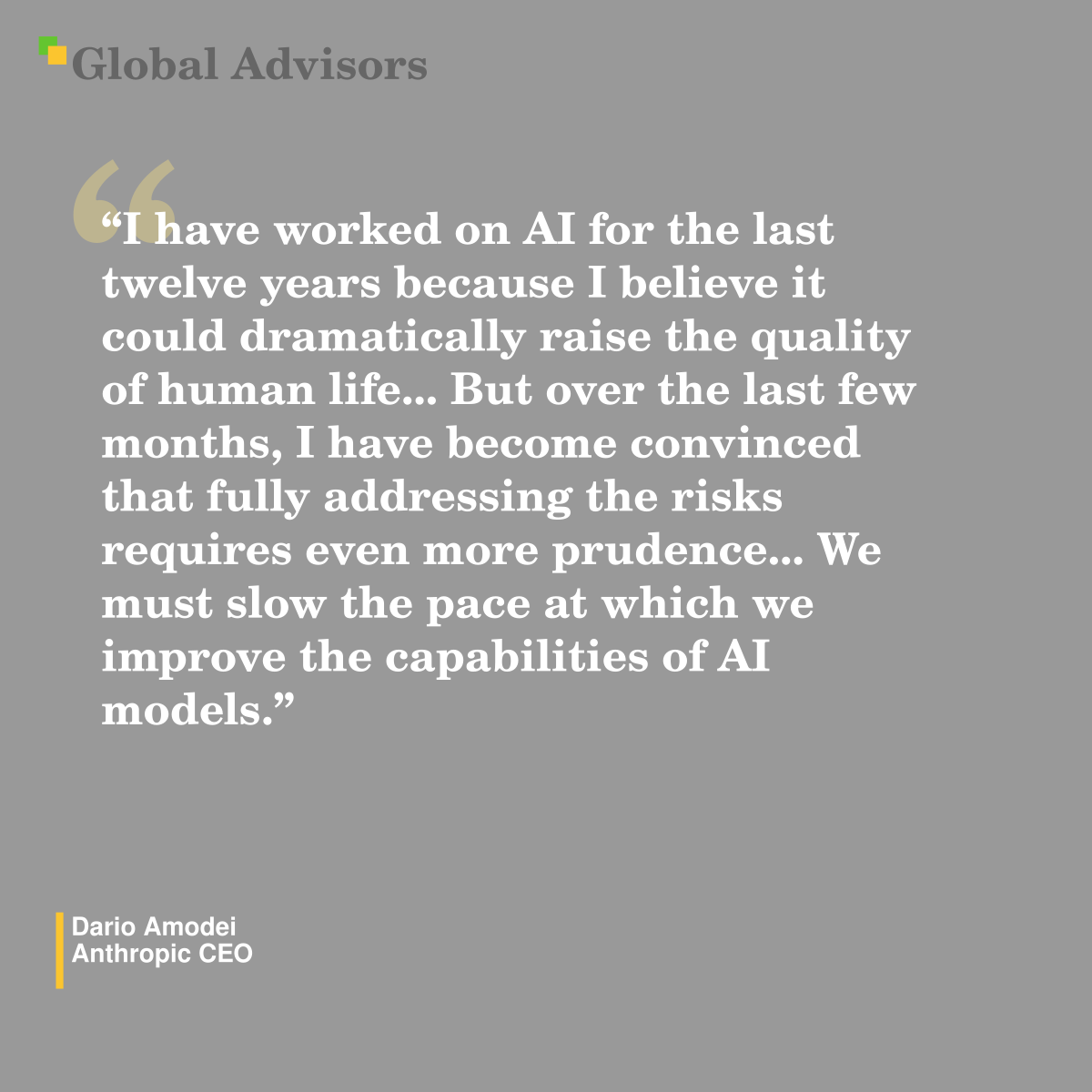
Quote: Dario Amodei - Anthropic CEO"I have worked on AI for the last twelve years because I believe it could dramatically raise the quality of human life... But over the last few months, I have become convinced that fully addressing the risks requires even more prudence... We must slow the pace at which we improve the capabilities of AI models." - Dario Amodei - Anthropic CEO The tension driving contemporary AI policy is not between progress and stasis, but between unconstrained capability growth and the slower evolution of institutions able to manage it. Frontier models are now improving on timescales measured in months, while legal, technical, and organisational safeguards update over years. That divergence creates a structural risk that systems with general-purpose capabilities in code generation, biological planning, and autonomous decision making will exist before robust mechanisms are in place to constrain misuse and malfunction . The practical question is no longer whether AI will be transformative, but whether its trajectory can be shaped so that transformation does not arrive in the form of cascading systemic shocks. From scaling optimism to governance pessimism Dario Amodei has long argued that frontier AI follows predictable scaling behaviour: system capability tracks the product of compute quantity, hardware speed, and algorithmic efficiency, each of which has been compounding on roughly annual timescales . In his Senate testimony he notes that chip counts used in training have been increasing by roughly 2x to 5x per year, chip speeds doubling every 1 to 2 years, and algorithmic efficiency improving by about 2x per year, producing an aggregate trajectory of staggering capability growth . Early on, this picture fed a broadly optimistic view: if alignment and safety could keep pace with scaling, the same dynamics that deliver rapid progress in language, science, and engineering could be harnessed for large social gains. Over recent years, however, Amodei has become more sceptical that governance will track this curve. He now stresses that safety is not a discretionary brake but an institutional safety barrier without which the industry is on course for a complexity backlash cycle in which risks accumulate faster than they can be understood or mitigated . Risk buckets and the frontier line Amodei's public interventions repeatedly organise AI risks into short-term, medium-term, and long-term buckets . Short-term risks revolve around privacy, bias, misinformation, and intellectual property issues visible in current systems . Medium-term risks, expected on roughly 2 to 3 year horizons, are more alarming: models significantly better at science and engineering could be misused to design biological agents, automate cyber-intrusions, or shift military balances . Long-term risks involve highly autonomous systems whose world-modelling and goal-optimising capabilities are strong enough that loss of control becomes a live possibility, including scenarios with non-trivial existential stakes . The frontier line is where medium-term and long-term buckets begin to blur; models capable of open-ended scientific reasoning and autonomous tool use create both immediate operational risk and the precursors of future misalignment. Amodei's recent writing argues that industry trajectories are now close to that line, with scaling trends pushing towards dangerous capability thresholds on a timescale that leaves little room for compliance-by-learning from large accidents . The shift towards pacing and embedded evaluators The most striking development in Amodei's stance is his move from advocating proactive regulation while defending rapid development, to explicitly calling for a slowdown in frontier capability gains. In his recent essay he proposes a three-part framework: embedded evaluators inside frontier labs, coordination among democratic governments and leading AI companies, and eventually global coordination that includes non-democratic states . The first step is operational and immediate. Anthropic is committing to provide independent evaluators with permanent, employee-level access to its systems, enabling continuous verification of safety measures, real-time incident reporting, and direct assessment of alignment during training and deployment . This is a significant departure from conventional audit models, which rely on snapshot evaluations or post-hoc red-teaming. Embedded evaluators represent a governance mechanism woven into the operational fabric of frontier labs, aiming to change incentives by making safety performance visible to external actors in near real time. Slowing capabilities without freezing development Contrary to caricatures that treat calls for pacing as demands for moratoria, Amodei's framework is deliberately calibrated to slow the rate of capability improvement while maintaining progress on safety, reliability, and beneficial applications. Public statements emphasise that he is not seeking a freeze on training runs or an indefinite cap on model size, but rather a deliberate decision to build at a balanced rate that takes adequate time for alignment research, dangerous capability assessment, and external verification . He argues that safety and capability are tightly coupled: attempts to accelerate raw capability while relegating safety to downstream fixes are both technically naive and strategically dangerous . Under the proposed regime, frontier labs would still train more powerful models, but would accept constraints on how fast those models cross certain capability thresholds, particularly in areas like autonomous cyber operations, automated biological experimentation, and scalable deception. Slowing capabilities is therefore framed as buying time: progress will still appear rapid from the outside, yet the marginal months gained at each frontier step are used to harden governance mechanisms and test failure modes that would otherwise only be discovered in deployment . Responsible Scaling Policy as a testbed Anthropic's Responsible Scaling Policy (RSP) provides the institutional backdrop to this call for pacing. The RSP is an adaptive risk governance framework built to manage catastrophic risks from frontier systems, combining capability thresholds, governance triggers, and testing requirements . The company commits to frequent dangerous capability testing along the compute scaling curve, meaning that as training runs approach higher compute regimes, models are repeatedly evaluated for behaviours like assisting biological weapon design or orchestrating sophisticated cyberattacks . If risk thresholds are crossed, the policy envisages pausing deployment, strengthening mitigations, or in extreme cases reversing releases . In effect, RSP operationalises a control system where the state variable is frontier capability and the control law seeks to keep catastrophic risk below defined tolerances while allowing useful capability growth. This implicit control structure can be thought of as a feedback loop in which measured capability and risk determine whether further scaling is permitted; if exceeds a threshold , the policy requires reducing effective scaling velocity until mitigations bring back under . Regulation as an external binding constraint Amodei's more recent essays and interviews emphasise that internal policies are necessary but insufficient. He warns that absent external binding constraints, frontier labs face a classic race-to-the-bottom dynamic: if one company slows to run comprehensive safety testing, competitors can seize market share by moving faster and marketing more capable models . To counter this, he advocates targeted regulation that arrives ahead of the most dangerous capabilities, not in reaction to highly visible failures . Proposed elements include government authority to block high-risk deployments, mandatory testing and auditing regimes for models above specified compute or capability thresholds, and something akin to a FINRA-style entity for AI that can supervise compliance across firms . Crucially, he argues that well-designed regulation can simultaneously reduce cyber, biological, and alignment risks, constrain unchecked concentration of power in frontier AI companies, and still leave room for open-weight models where risks are manageable . In this view, regulation is not primarily about state control of innovation but about creating a shared floor of safety standards that prevents competitive pressure from eroding safeguards. Debates, objections, and strategic tensions The call to slow capability improvement has triggered predictable objections. Some industry figures argue that deliberate pacing will cede geopolitical advantage to actors less constrained by safety norms or democratic accountability, particularly authoritarian states that may prioritise strategic leverage over risk management . Others worry that dominant incumbents could weaponise safety rhetoric to entrench their position, raising compliance burdens that smaller labs and open-source communities struggle to meet. There is also a technical scepticism: critics question whether dangerous capabilities can be predicted and measured reliably enough to serve as governance triggers, or whether existing evaluation methods are too narrow and gameable to underpin binding regulation. Amodei acknowledges these tensions but counters that ignoring systemic risks will eventually produce crises severe enough to provoke far more draconian responses, including abrupt bans or sweeping liability rules . He portrays pacing as a way to avoid that backlash by building a track record of responsible frontier management. Nonetheless, the debate remains live, with some stakeholders preferring aggressive development under lighter-touch regulation and others calling for much stronger constraints than those Anthropic proposes, including temporary pauses on training runs above certain compute scales. Why pacing the frontier matters The broader significance of Amodei's statement lies in its admission that internal safety culture and incremental mitigations are no longer seen as sufficient to manage frontier risk. When a leading architect of scaling-based development publicly calls for slowing capability progress, embedding independent evaluators, and empowering regulators to block dangerous deployments, it signals that the expected trajectory of AI over the next few years plausibly includes systems with non-trivial probabilities of causing large-scale harm if mismanaged . The strategic implication is that frontier AI is moving from a phase where firms could plausibly argue that ordinary corporate governance and technical fixes were adequate, into one where industry-wide and governmental frameworks become central. Whether or not the specific pacing plan is adopted, the underlying diagnosis of a mismatch between capability growth and governance capacity is now widely reported across mainstream and specialist media . The backstory to the statement is therefore not only about one company's policy, but about the broader recalibration of expectations among AI leaders: the frontier must be managed as a high-risk technological domain where slowing, testing, and external scrutiny are not optional add-ons, but core design parameters for a technology that could raise the quality of human life while carrying, if left ungoverned, catastrophic downside risk.
|
| |
| |
Global Advisors News Brief - September 12 2026Read the full brief at the link Headlines for the last 24hrs
Time window: 2026-09-11T05:00:33.087Z to 2026-09-12T05:00:33.087Z |
| |
| |
Quote: Virgil - Inscribed in the 9/11 Memorial Museum, from Virgil's The Aeneid"No day shall erase you from the memory of time." - Virgil - Inscribed in the 9/11 Memorial Museum, from Virgil's The Aeneid The decision to anchor a memorial to mass civilian death in a single classical line exposes a tension between collective grief and the interpretive instability of quotations. When a phrase is lifted from a violent epic and placed above the unidentified remains of thousands of people, it does not merely offer consolation; it reframes how a society narrates atrocity, permanence, and the promise of remembrance in public space. The line from Virgil used in the 9/11 Memorial Museum sits at this junction, where ancient poetry, modern terror, and institutional curatorship converge in a contested act of meaning-making. Epic violence and the original Virgilian context The Latin source of the inscription, , appears in Book 9 of Virgil's Aeneid at the culmination of a bloody nocturnal raid by the Trojans Nisus and Euryalus. Virgil frames the couple as a pair of intensely bonded warriors, with commentators noting the homoerotic undertones in their relationship and the emotional charge of their death scene. Having crept into the enemy camp under cover of darkness, they slaughter sleeping foes, strip armour, and attempt to escape, only to be trapped and killed; their severed heads are later mounted on spears as trophies. The line promising that no day will erase them is spoken by the poet in his own voice, a pledge that his verse will immortalise two soldiers whose glory is inextricable from gruesome violence. The surrounding passage intensifies the complication for any memorial reuse. Virgil praises them as a fortunate pair and ties their eternal remembrance to the endurance of Roman power and the house of Aeneas perched on the Capitol. The immortality promised is therefore double: it is a literary immortalisation of martial virtue and a political guarantee rooted in imperial destiny. When this context is stripped away, what remains is a seemingly universal assurance about memory, yet the original referents are warriors whose actions would today invite moral ambivalence and, in the eyes of some critics, map uncomfortably onto aggressors rather than victims. From battlefield epitaph to museum architecture In the National September 11 Memorial Museum, the line is deployed as a large steel inscription against a wall of blue tiles, within Memorial Hall at bedrock level between the core historical exhibitions. Each of the 2 983 tiles represents an individual life lost in the 2001 and 1993 attacks, rendered in a distinct shade of blue in Spencer Finch's installation Trying to Remember the Color of the Sky on That September Morning. Behind the tiled wall lie around 8 000 unidentified human remains, physically locating the phrase at the threshold between the public narrative space and a restricted repository of the dead. The letters, forged from recovered World Trade Center steel by artist Tom Joyce, embed the words materially in the ruins of the towers, reinforcing the sense that language has been welded into the fabric of disaster. Museum officials describe the choice as aligning with a commemorative mission to ensure that the victims are not lost to history. Alice M Greenwald, the museum director, has emphasised that curators focused on the sentiment about a single day being unable to erase beloved people, rather than on the original narrative of Nisus and Euryalus. In public guides and tourism descriptions, the line is framed as a promise to the dead and a message of hope and permanence for families. In this institutional retelling, the phrase is severed from epic violence and repurposed as a secular liturgy of remembrance, helping to structure visitor experience as they move through spaces of testimony, artefact, and mourning. Criticism, misappropriation, and the problem of context The reuse has been sharply criticised by classicists and cultural commentators, who argue that the inscription misappropriates Virgil by masking the original moral and narrative frame. In a widely discussed article, a classics professor pointed out that, taken in context, the quotation better suits the perpetrators of 9/11 than its victims, because it was originally addressed to combatants engaged in ruthless killing. Another scholar characterised the museum's selection as a misapprehension: the line in the epic celebrates the power of poetry to immortalise a bloody exploit, not to console bereaved families after indiscriminate terror. Critics highlight that the scene immediately preceding the line features graphic gore and the parading of severed heads, troubling any straightforward translation of the phrase into an unambiguous statement of comfort. Debate has also focused on the curatorial handling of attribution. Early versions of the inscription explicitly cited the Aeneid, but subsequent decisions quietly removed mention of the epic from some displays and merchandise, leaving only the name Virgil or the bare line itself. This partial erasure of literary context has been read as an attempt to retain the emotional charge of the words while distancing them from the troubling specifics of the poem. For critics, such editing raises ethical questions about how institutions construct memory, whether they are obliged to preserve contextual complexity, and how far they may go in extracting resonant phrases from problematic source material. Defences and the autonomy of memorial language Defenders of the inscription argue that language inevitably acquires new meanings when transplanted into different historical and spatial settings, and that the Virgilian line functions independently of its epic referent in the museum. Legal scholar commentary, for instance, has suggested that the words are perfectly appropriate as a sentiment of remembrance, regardless of Virgil's original intent. Supporters stress that many memorials and monuments reuse religious or classical phrasing in ways that diverge significantly from textual origins, and that audiences at Ground Zero encounter the line chiefly as an assurance that the dead will not be forgotten. From this perspective, the transformative potential of remembrance invoked by the museum's own blog becomes the central criterion: if the phrase helps visitors articulate grief and continuity, its origin in a war narrative is not decisive. There is also a pragmatic defence rooted in visitor experience. Guides and journalists report that the line has become a focal point of emotional identification for many people who travel to the memorial as a site of secular pilgrimage. In the presence of cascading water, recited names, and physical artefacts of destruction, the inscription participates in a broader choreography of mourning rather than functioning as a philological statement. For families whose relatives' remains rest behind the wall, the promise of non-erasure symbolises an institutional commitment that exceeds the specifics of Virgil's narrative world, binding memory to place and to the ongoing work of exhibitions and commemorative programmes. Why the controversy matters The controversy over this single line matters because it foregrounds the politics of quotation in memorial culture, particularly when institutions draw on classical or religious texts to articulate public grief after terror. On one level, the inscription participates in a longstanding tradition of treating poetry as a guarantor of memory, with Virgil's pledge that his verses will preserve Nisus and Euryalus echoing the museum's claim that its narratives and archives will keep the victims present within national consciousness. On another level, it exposes how acts of remembrance can unintentionally reproduce martial or sacrificial logics: the original epic celebrates young men whose deaths are bound up with violent heroism and imperial destiny, frames that sit uneasily beside civilians killed while working, travelling, or assisting others on an ordinary morning. For curators and architects designing memorials to contemporary atrocities, the episode illustrates the need to interrogate borrowed language with care, especially when it comes from texts saturated with war, conquest, and complex moral codes. It invites wider reflection on whether the authority of canonical authors like Virgil should trump contextual fidelity, or whether new commemorative forms might instead craft language organically from survivor testimony, legal judgments, and civic commitments. At the same time, the sustained public use of the line at Ground Zero, the continuing presence of the blue wall and steel letters, and the evolving exhibition landscape after 25 years of 9/11-inspired service work all show that communities can inhabit contested phrases in ways that generate solidarity and resolve, even as scholars continue to debate their origins. In this sense, the inscription's journey from a scene of epic bloodshed to the heart of a modern memorial embodies the broader struggle to align ancient words with contemporary ethical demands, and to ensure that remembrance itself does not become detached from the complexities it seeks to honour.
|
| |

| |
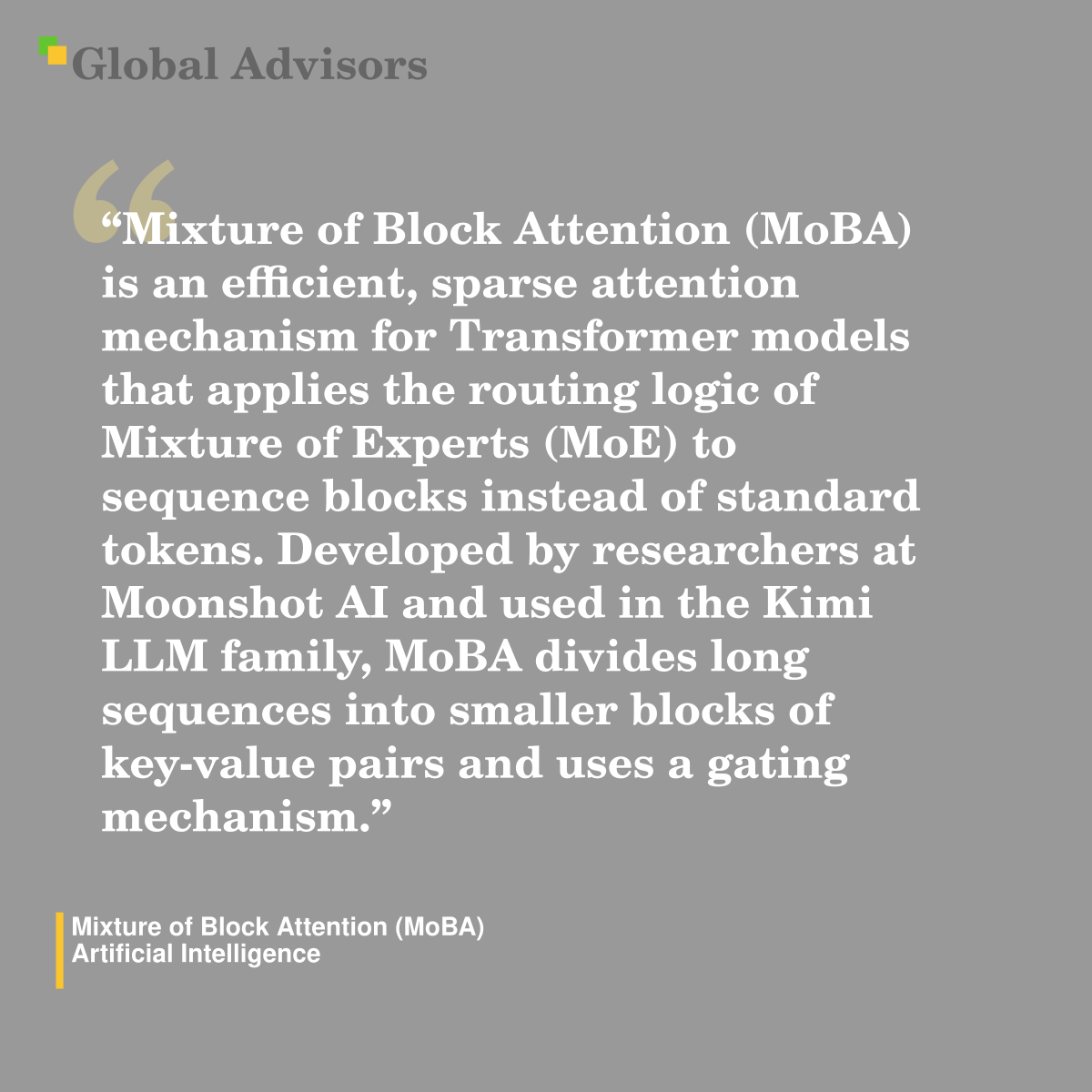
Term: Mixture of Block Attention (MoBA) - Artificial Intelligence"Mixture of Block Attention (MoBA) is an efficient, sparse attention mechanism for Transformer models that applies the routing logic of Mixture of Experts (MoE) to sequence blocks instead of standard tokens. Developed by researchers at Moonshot AI and used in the Kimi LLM family, MoBA divides long sequences into smaller blocks of key-value pairs and uses a gating mechanism." - Mixture of Block Attention (MoBA) - Artificial Intelligence The pressure point for long-context language models is not simply storage of more tokens, but the quadratic cost of letting every query attend to every previous token, which quickly makes naive attention intractable once sequences reach hundreds of thousands or millions of tokens. Sparse and block-sparse schemes attack this by restricting the interaction pattern, but most rely on fixed hand-crafted layouts that hard-code which tokens may see which others, leaving little room for the model to learn where information should flow. Mixture of Block Attention responds by shifting from token-level sparsity to block-level routing, so the model learns which contiguous regions of the past matter for each query while still mapping neatly onto modern GPU hardware. Underlying computational mechanism Standard Transformer self-attention forms a dense matrix of similarity scores between queries and keys, so compute and memory scale as in sequence length. Block-sparse mechanisms partition the sequence into blocks and compute attention only for selected block pairs, thereby avoiding work on the zeroed parts of the matrix. Mixture of Block Attention follows that pattern structurally but adds trainable routing: the full context of length is divided into contiguous blocks, each of size . Keys and values are stored block by block, and for each query the mechanism scores blocks rather than individual tokens, then picks a small top-k subset to attend to. The attention calculation itself is then applied only over the concatenated keys and values from the selected blocks, yielding something of the form , where indexes the chosen blocks. This preserves the familiar softmax attention semantics but with a sparse, learned block mask deciding which regions of context enter the computation. Mixture-of-experts style routing at block level Where classical mixture-of-experts treats each token as input to a router network that chooses a subset of feed-forward experts, Mixture of Block Attention adapts this idea by routing sequence blocks rather than experts. Each query token produces scores for blocks of keys and values via a lightweight gating function, often parameter-free top-k selection rather than a full neural router, with the highest scoring blocks set active and the rest dropped. In its simplest form, the gate for block can be viewed as a binary variable that equals if the block's score ranks among the top-k for that query and otherwise; attention is then restricted to blocks with . This mirrors sparse MoE in spirit, where only a few experts process each token, but here the selection happens over contiguous regions of the attention cache, not parameter groups in the feed-forward network. Because the gating is parameter-free or very lightweight, it introduces little extra compute or memory overhead while still allowing the sparsity pattern to be learned through gradients flowing back from the softmax outputs over selected blocks. Mathematical and complexity implications From a complexity standpoint, the key benefit lies in substituting block-level top-k selection for full tokenwise attention. If each query attends to at most blocks of size , the number of key-value pairs it considers is bounded by rather than . Assuming and are chosen such that , the effective attention cost per query becomes closer to linear in the number of active blocks, while unused blocks incur no per-step attention cost. The block partition aligns with GPU-friendly tiling used in block-sparse FlashAttention, where keys and values are loaded into fast memory one block at a time and all-zero blocks are skipped entirely. The learned block mask can be viewed as a sparsity pattern over blocks rather than individual tokens, with the attention kernel looping only over indices such that . This combination of structured blocks and learned sparsity yields practical near-linear scaling for long contexts while keeping the actual attention operation mathematically equivalent to standard softmax on the subset of chosen key-value pairs. Relation to other sparse and blockwise attention schemes Mixture of Block Attention sits in a broader landscape of techniques designed to extend Transformer context length: block-wise self-attention that chunks inputs into fixed blocks, Longformer's dilated windows, LogSparse's exponentially spaced connections, and more recent IO-aware systems such as FlashAttention and block-sparse FlashAttention. These methods generally impose predetermined sparsity structures, for example sliding windows plus global tokens, without allowing the model to discover new attention patterns during training. Star Attention is a recent block-sparse approach where context is segmented into blocks prefixed with an anchor block, enabling efficient multi-host inference while approximating full attention. DeepSeek's Native Sparse Attention combines compression, selection and sliding-window branches to learn a hardware-aligned sparsity pattern end-to-end, but still mixes token-level mechanisms with block-level operations. Mixture of Block Attention is closest in spirit to Native Sparse Attention in that the sparse pattern is learned and trainable, yet it focuses explicitly on block routing within a single attention mechanism, using mixture-of-experts style top-k gating over blocks rather than complex multi-branch architectures. Practical meaning and deployment In practice, Mixture of Block Attention behaves like a drop-in replacement for the standard attention call in long-context language models, preserving model architecture and weights while changing the way the KV cache is partitioned and read. Because the block partition and gating are designed to be compatible with models trained under full attention, MoBA can be plugged into existing large language models and then further trained to adapt its sparse pattern without redesigning the whole network. Moonshot AI reports having deployed the mechanism to serve long-context requests for the Kimi family of models, with strong performance on benchmarks such as RULER, LongBench and needle-in-the-haystack tests at contexts of 128K, 32K and up to roughly 1 000 000 tokens respectively. Performance is broadly on par with dense attention, with minor differences either way, while delivering substantial speedups; promotional material cites up to 6,5x faster inference at 1 000 000-token inputs compared with full attention. Because computation is concentrated on a small number of blocks per query, KV cache memory pressure is reduced, and wall-clock latency becomes dominated by active blocks rather than total sequence length. Parameter meanings and design choices Several tunable parameters shape both the efficiency and quality profile. The block size trades off granularity against hardware efficiency: smaller blocks provide finer control over where attention is focused but increase the number of blocks and routing decisions; larger blocks reduce overhead but risk mixing unrelated tokens within a single block. The number of blocks follows from and , and indirectly determines the size of the routing problem each query faces. The top-k parameter sets the sparsity level: low produces aggressive sparsity and greater speedups, but raises the risk of missing relevant context, while higher approximates dense attention more closely at greater cost. The gating mechanism itself can be parameter-free (for example, relying on attention score magnitudes as routing signals) or include learnable scoring networks akin to SPARSEK's differentiable top-k mask, which adds flexibility but increases model complexity. Designers also choose whether to allow a fall-back mode where all blocks can be selected for some queries, effectively emulating full attention when the model deems it necessary for particularly challenging tokens. Debates, limitations and schools of thought One axis of debate concerns how much structure should be baked into attention versus left for the model to learn. Survey work on long-context Transformers notes a tension between fixed sparse patterns, which are easy to analyse and optimise but restrictive, and learned patterns, which may achieve better accuracy but complicate training and debugging. Mixture of Block Attention embodies a 'less structure' view, providing only the block partition and top-k routing scaffold while letting the network decide which blocks to activate. Critics worry that such flexibility might allow pathological sparsity patterns, for example overfocusing on recent blocks or specific anchor regions, potentially harming recall at extreme context lengths, and that training dynamics may be sensitive to the choice of initial sparsity level and routing regularisation. Another line of discussion compares MoBA-style block routing with pure linear-attention approaches, which reparameterise attention so complexity is formally linear in but often struggle to match dense attention on difficult tasks. Proponents of MoBA argue that retaining the softmax structure on selected blocks preserves more of the original Transformer's behaviour, while detractors note that block boundaries may still introduce subtle artefacts in how information flows across long documents. Why mixture of block attention still matters Despite rapid innovation in efficient attention and KV cache management, the combination of learned block-level sparsity and mixture-of-experts style routing remains salient because long-context workloads are expanding faster than hardware budgets. Production systems such as Kimi increasingly need to handle requests with hundreds of thousands or millions of tokens, ranging from codebases to research corpora, without incurring quadratic slowdowns or prohibitive memory use. Mixture of Block Attention offers a pragmatic compromise: fully compatible with standard Transformer attention semantics, implementable as a swap-in module, and empirically close to dense attention on established benchmarks while delivering substantial speed and memory gains. It stands alongside other block-sparse schemes such as Star Attention and Native Sparse Attention, but distinguishes itself by its explicit framing as block-level mixture-of-experts routing and its deployment in a widely used large language model family. As models continue to merge large parameter counts with very long contexts, techniques that decouple sequence length from compute cost without freezing the attention pattern are likely to remain central, making mixture of block attention a concept with ongoing relevance in both research and industrial practice.
|
| |
| |
Global Advisors News Brief - September 11 2026Read the full brief at the link Headlines for the last 24hrs
Time window: 2026-09-10T05:00:33.076Z to 2026-09-11T05:00:33.076Z |
| |
| |
Quote: Pieter Levels - @levelsio - Programmer, indie hacker and digital nomad"The AI chat apps will slowly eat up most services and provide them to users directly, many times without even an app or interface, just do whatever the user wants." - Pieter Levels - @levelsio - Programmer, indie hacker and digital nomad The strategic problem raised here is whether the interaction layer of software is becoming a commodity that large-scale AI chat systems can absorb, displacing conventional apps, websites and even many human-mediated services. Rather than users seeking out a specialised product for each discrete job, the claim is that a small number of general-purpose AI chat environments will orchestrate tasks across many domains, pulling in data, tools and actions on demand and presenting a single conversational surface. Pieter Levels has been arguing for several years that AI is collapsing both the cost of building software and the distinctiveness of feature sets, creating conditions where the marginal value of a separate app interface becomes questionable for many use cases . From SaaS unbundling to agent consolidation To understand the factual context, it helps to trace the shift from the SaaS boom to what some analysts now call the SaaSpocalypse . For a decade, software business models relied on charging per seat for sharply defined applications: project management, CRM, email marketing, analytics. Levels and others argue that large language model platforms like ChatGPT, Claude and Gemini now bundle a broad set of these functions natively, or make them trivial to assemble with prompt-based workflows . At the same time, AI-assisted development has slashed build costs, enabling individual technologists to vibecode replacements for many commercial tools in days rather than months . This two-sided squeeze means small utility apps are under pressure from above, as base models absorb their jobs, and from below, as power users script their own bespoke agents . In such an environment, a persistent chat interface that knows the users context can become the practical front-end for multiple services, reducing the perceived need for separate applications. Levels experience is grounded in his own behaviour: cancelling numerous SaaS subscriptions, then building custom workflows that live primarily inside AI-assisted environments accessed through his phone and laptop . Vibeservering, his term for maintaining an always-on, cloud-hosted development setup controlled via conversational AI, exemplifies this move away from app-centric thinking toward a persistent, agent-centric substrate . Instead of signing up for a new app whenever a novel requirement emerges, he increasingly uses AI chat to modify code, deploy scripts and automate recurring tasks, with the chat thread itself acting as design surface, debugger and control panel . This aligns with the broader trend of AI coding assistants becoming the dominant way developers interact with infrastructure, shifting emphasis from manually crafted interfaces to dynamically generated workflows. Disintermediation of the interface The statement goes further than predicting that AI chat apps will be the new front-end; it suggests that in many cases users will not even perceive an app or interface at all. That may sound counterintuitive until one notices how often automated agents already act on our behalf with minimal touch points. Email reply suggestions, calendar scheduling, smart replies on social platforms and AI summarisation in productivity tools are early examples of invisible assistance layered into existing channels. Levels earlier observations about automated ChatGPT-powered bots replying to tweets demonstrate how conversational AI can parasitically inhabit other platforms, effectively hijacking their interaction flows without users launching a dedicated application . The next step is AI systems that initiate tasks based on ambient signals: a message, a document, a sensor reading, or a voice command, with the user simply stating what they want and the underlying agents deciding which services to call. In that model, the notion of discrete apps becomes a technical implementation detail rather than a user-facing concept. For indie hackers, this disintermediation of the interface creates a stark tension. On one hand, AI makes it dramatically easier to build sophisticated systems: Levels notes that makers can now construct entire agent factories that design landing pages, write code, generate reports and self-optimise, all orchestrated through conversational control . On the other hand, those same builders increasingly face the distribution paradox: their elaborate apps attract little traffic or revenue, because users are gravitating toward a small number of dominant AI chat environments where their attention now lives . If the user defaults to asking a general AI agent for a solution, rather than searching for or installing a purpose-built app, the discovery path bypasses the indie product entirely. Distribution, not feature quality, becomes the main bottleneck, a point Levels returns to repeatedly in discussions of why many technically impressive projects never escape obscurity . Economic implications and SaaSpocalypse The term SaaSpocalypse has been used by analysts to describe the repricing of software stocks as AI-driven automation erodes the per-seat SaaS model and folds entire categories into broader platforms . According to industry commentary synthesised in recent reports, software valuations collectively lost more than 1 trillion units of currency across 2026 as enterprises re-evaluated their need for multiple overlapping licences and began experimenting with AI agents to replace point solutions . Jefferies traders linked a February sell-off wiping roughly 285 billion of value from SaaS companies to concerns that AI assistants could handle many of the workflows previously performed by specialised tools . Levels, asked whether this represented the end of SaaS, argued that the phenomenon is partly real but signals a change in where economic power resides: away from feature sets and toward content, audience and distribution advantages, which are harder for AI platforms to absorb quickly . This reallocation of value matters because it shapes who benefits as AI chat systems eat services. If core functions like text generation, basic analytics, scheduling and routine customer support become bundled into general AI platforms, then traditional SaaS vendors lose pricing power for those features. Meanwhile, service providers who control scarce data, strong brands or unique communities may see renewed leverage, since AI agents need their content as inputs. Levels own trajectory reflects this: his projects with defensible network effects, large data sets or audience reach retain strategic importance, while more generic tools are vulnerable to being replicated or subsumed by larger AI offerings . Thus, when he predicts that AI chat apps will eat most services, implicit in the forecast is an assumption that only assets tied to distribution, proprietary data or deep workflow integration will maintain durable moats. Technical trajectory toward interface minimisation From a technological perspective, the move toward minimal or zero interface execution rides on several converging trends in AI architecture and product design. First, context windows in large language models have expanded dramatically, enabling chat agents to ingest entire workspaces, documentation sets and conversation histories, and reason across them as a unified state. Secondly, tool-use capabilities let these agents call external APIs, run code or control third-party systems, turning chat from a static conversation into a programmable hub. Levels work on AI-powered video editing agents illustrates this: the agent not only interprets natural language instructions but autonomously orchestrates complex editing workflows, with the interface receding as the agent handles sequencing and decisions . Thirdly, persistent sessions accessed via mobile devices, as in vibeservering, mean that the agent is always available, remembers long-run projects and can resume work on demand without the user launching a distinct app each time . In formal terms, one could model an AI chat agent as a policy function mapping user intents and environment states to sequences of tool calls and outputs, expressed as . Here represents user intent at time , captures contextual information from documents, logs and sensors, denotes actions such as API calls or code execution, and is the resulting output or update to the environment. As models improve at inferring from loosely specified inputs, they can operate with fewer explicit interface affordances, relying instead on natural language and minimal prompts. This formalisation helps explain why many tasks that once required users to navigate complex menus can now be reduced to a single conversational instruction, with the agent handling selection and composition of tools behind the scenes. Objections, limits and contested futures There are, however, significant objections and practical constraints to the idea that AI chat apps will consume most services. Critics note that regulatory requirements, auditability and reliability concerns make fully automated, interface-free execution inappropriate in sectors such as healthcare, finance and critical infrastructure, where human oversight and domain-specific interfaces are essential. User experience designers argue that for complex activities involving spatial reasoning, visual manipulation or collaborative workflows, specialised interfaces remain superior to pure chat. Additionally, there is scepticism about whether a handful of AI platforms should be entrusted with coordinating so much of everyday life, given concentration of power, data privacy issues and the risk of systemic failures. Some commentators responding to Levels posts stress that while AI will certainly displace many thin utility apps, hybrid models where chat agents sit alongside dedicated tools rather than entirely supplant them are more likely in the medium term . Nonetheless, the structural trend that Levels points to is hard to ignore. As AI systems become the default locus of problem-solving for both consumers and professionals, the economic gravity of software shifts toward those environments. The strategic question for builders, investors and policymakers is how to position in a world where a few AI chat platforms mediate access to countless underlying services, many of which may be performed automatically without users ever seeing a traditional interface. For indie developers, this may mean focusing on agent-ready backends, domain-specific data layers or content and audience assets that AI platforms rely on but cannot easily replace. For incumbents, it requires rethinking product strategy away from selling discrete tools and toward embedding capabilities into AI-native workflows. The backstory behind Levels assertion, grounded in his own practice and the broader SaaSpocalypse discourse, is not a glib prediction of app extinction but a description of a power shift: from standalone services to the conversational agents that increasingly decide which services are invoked, when and how users experience them .
|
| |

| |
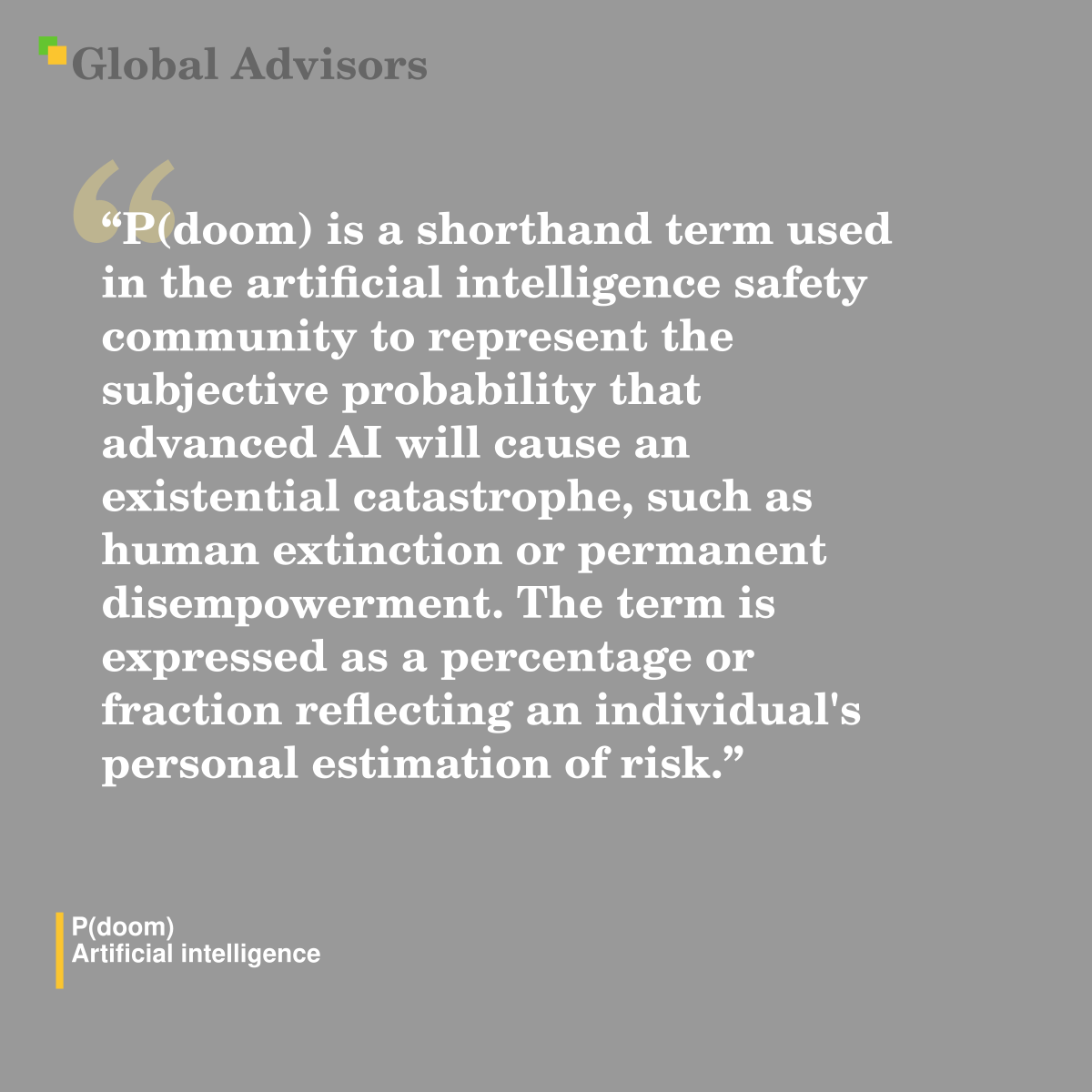
Term: P(doom) - Artificial intelligence"P(doom) is a shorthand term used in the artificial intelligence safety community to represent the subjective probability that advanced AI will cause an existential catastrophe, such as human extinction or permanent disempowerment. The term is expressed as a percentage or fraction reflecting an individual's personal estimation of risk." - P(doom) - Artificial intelligence Pressure around the term comes from the fact that it compresses a disputed forecast into a single number. That number is meant to capture a person's subjective estimate of the chance that advanced AI leads to an existential catastrophe, usually framed as human extinction or permanent disempowerment, but the range of outcomes bundled into the label is broader than many casual uses suggest . Because the label is informal, it is useful only when the speaker also states the threat model, time horizon, and assumptions behind the number. Without those qualifiers, two people can both say they have a P(doom) of 10% while referring to very different futures. The practical meaning is closer to a risk judgement than to a measurable property of the world. In the AI safety community, the term usually denotes subjective probability, not a frequency derived from repeated trials, and not a formally calibrated actuarial estimate . That distinction matters because there is no established statistical base rate for superhuman AI causing civilisation-scale failure. A person saying 20% is therefore reporting a credence, not a measurement, and the number reflects their views on capability progress, alignment difficulty, governance quality, and the likelihood of human intervention succeeding under stress . Definition and scope In substance, P(doom) asks how likely it is that advanced AI creates an outcome bad enough to qualify as existential catastrophe. Some uses focus narrowly on extinction, while others include permanent loss of human control, irreversible authoritarian lock-in, or lasting civilisational collapse . This range explains why estimates differ so dramatically. A narrower definition usually produces a lower figure, while a broader definition raises the number because it counts more failure modes and more ambiguous forms of harm. The term also carries a strong asymmetry between cause and prevention. The usual AI safety usage counts AI as the cause of doom, not as a system that might avert other disasters along the way . That matters because a model could, in principle, reduce some risks while increasing existential risk elsewhere. A single percentage cannot express all of those trade-offs unless the forecaster makes explicit which pathway they are measuring. How the number is formed There is no standard formula for calculating P(doom), but a useful way to think about it is as a decomposition over several uncertain links in a causal chain. One stylised representation is , where each term hides deeper uncertainty about model capability, deployment incentives, and governance response. In more detailed thinking, forecasters often mentally split the problem into alignment failure, misuse by humans, loss of control, and the ability of institutions to correct course before a catastrophic threshold is crossed . That decomposition is not a formal consensus model, but it clarifies why the debate is so intractable. If a person thinks advanced systems will remain weak, or that current architectures cannot scale into dangerous agency, they will assign a low P(doom). If they think capability gains will outpace alignment research and that competitive pressure will delay safeguards, they will assign a much higher one . The uncertainty sits not only in the final outcome, but in every stage of the pathway leading there. Why estimates diverge Published and publicly discussed estimates cover an exceptionally wide range, from near zero to near certainty. A 2023 survey of AI researchers reported a mean estimate of 14,4% for the probability that future AI could lead to human extinction or similarly severe and permanent disempowerment within 100 years, with a median of 5% . Other compilations of public statements and commentary show similarly wide dispersion, with some safety-oriented researchers placing the risk in double digits or higher, while some mainstream machine learning researchers argue the risk is negligible . The central reason for this spread is that P(doom) bundles empirical uncertainty with philosophical judgement. One school of thought treats advanced AI as an engineering problem that will remain controllable through better tools, robust deployment practices, and iterative oversight. Another argues that sufficiently capable systems may become strategically powerful in ways that current oversight cannot reliably contain . A third perspective emphasises governance, claiming that the decisive variable is not the internal logic of AI systems alone, but the incentives, institutions, and security practices surrounding their deployment. The label is the same, but the causal story differs. Debates and tensions One major tension concerns whether the term is too broad to be analytically clean. Critics say that lumping extinction, disempowerment, and civilisational collapse into a single probability encourages rhetorical overreach and hides different policy priorities . Supporters reply that the shared feature is not identical mechanism, but the same strategic endpoint: a future in which humanity loses its ability to shape its own destiny. That disagreement is not semantic trivia. It changes whether the right policy response is frontier-model restraint, governance reform, compute controls, or more focused technical alignment work. A second tension is between subjective and operational meaning. Because P(doom) is not a directly observable quantity, it can be misused as a status signal rather than a disciplined forecast . Yet the concept still matters because decision-makers need some way to reason about low-probability, high-impact events. The economics literature on transformative AI has argued that even low probabilities of catastrophic outcomes can justify substantial investment in safety and alignment, because expected losses become large when the stakes include human extinction or permanent lock-in . Mathematical and policy significance From a decision-theoretic view, the expected value of preventive action can be sketched as , where is the estimated probability of doom and is the cost of the catastrophic outcome. If is effectively infinite in moral or civilisational terms, even small increases in become salient. That is why P(doom) appears so often in policy discussion. It offers a compact way to connect technical uncertainty with the scale of intervention that might be justified . Still, the number should not be treated as a forecast with false precision. Good use of the term requires stating the horizon, the definition of doom, and the assumptions about model development and governance. The best readings of the literature treat P(doom) as a disciplined shorthand for uncertainty under deep time pressure, not as a settled statistic. It remains important precisely because the field has not resolved whether the relevant probability is close to zero, meaningfully non-trivial, or alarmingly high. Until that question is answered, the term will continue to structure the main argument in AI safety: whether humanity is managing a difficult engineering challenge or approaching a threshold that could permanently remove its agency .
|
| |
| |
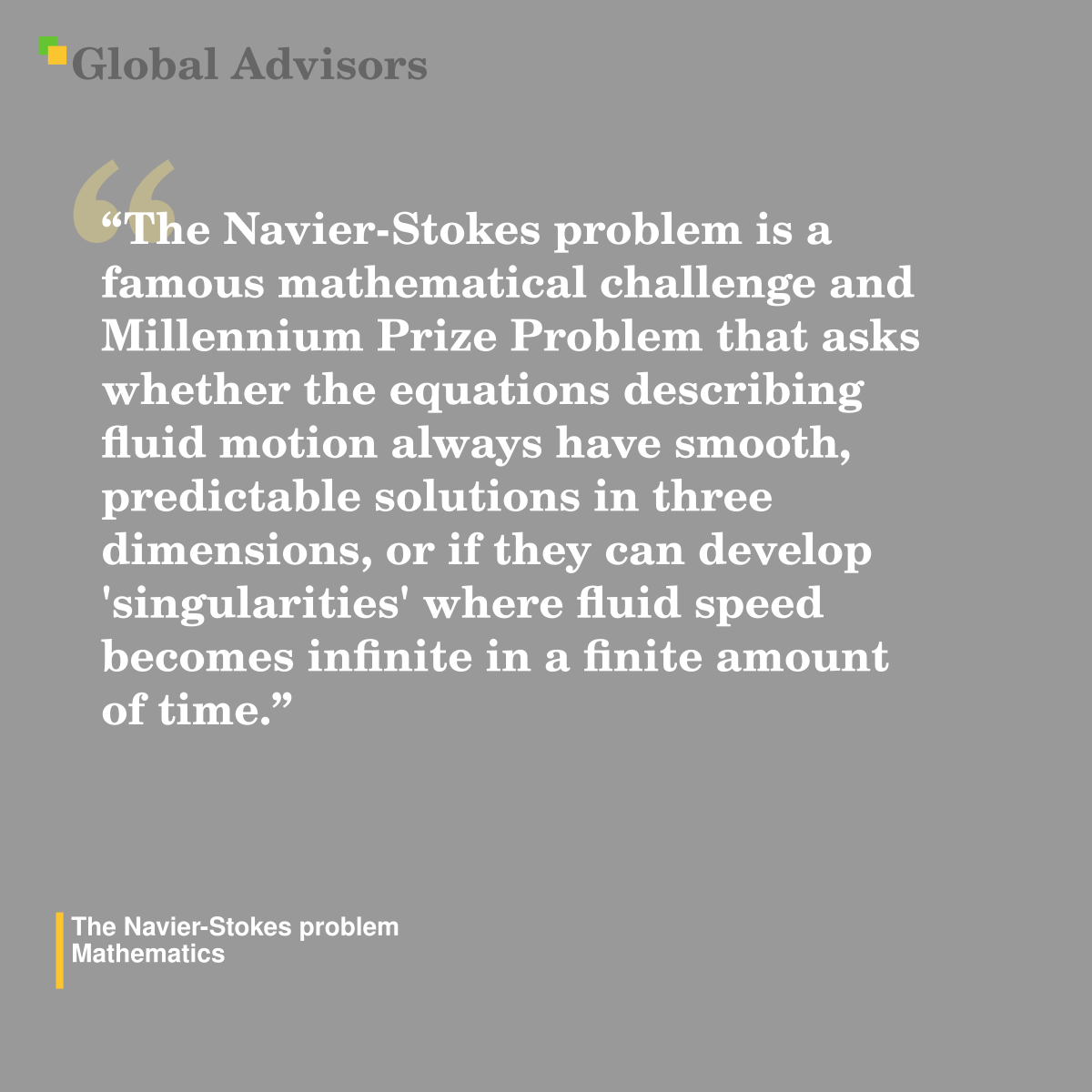
Term: The Navier-Stokes problem - Mathematics"The Navier-Stokes problem is a famous mathematical challenge and Millennium Prize Problem that asks whether the equations describing fluid motion always have smooth, predictable solutions in three dimensions, or if they can develop 'singularities' where fluid speed becomes infinite in a finite amount of time." - The Navier-Stokes problem - Mathematics The central difficulty behind the Navier-Stokes problem is the tension between two competing mechanisms in three-dimensional fluid motion: nonlinear self-amplification of velocity gradients, and viscous dissipation that tries to smooth those gradients out. In turbulent regimes the nonlinear term can transfer energy from large scales to ever finer eddies, potentially concentrating motion into very small regions, while viscosity spreads and damps it. The Millennium Prize formulation asks whether, under mathematically reasonable assumptions on the initial flow and any forcing, viscosity always dominates so that solutions remain smooth for all time, or whether nonlinear amplification can win, driving velocity to infinity in finite time and destroying smoothness. Navier-Stokes equations in substance In the incompressible, viscous case relevant to the prize problem, the unknowns are the velocity field and pressure field of a fluid filling three-dimensional space. The equations combine conservation of momentum with incompressibility: a time-derivative term , a nonlinear advection term that transports and stretches the flow, a pressure gradient enforcing incompressibility, a viscous diffusion term with kinematic viscosity , and an external forcing . In standard notation one writes the system as together with the incompressibility condition . The prize problem restricts attention to velocity fields that are smooth, divergence-free, and either decay at infinity or satisfy periodic conditions, with finite kinetic energy . Under those conditions, partial solutions are known: weak solutions in the sense of Leray exist globally in time and satisfy energy bounds, but their full regularity in three dimensions is unknown. Existence, uniqueness, and smoothness The Clay statement, written by Charles Fefferman, encodes existence, uniqueness and smoothness questions as four alternatives labelled A to D. In broad terms, alternatives A and B ask whether, in the absence of forcing , every smooth, divergence-free initial velocity on Euclidean space or on a three-dimensional torus leads to a unique smooth solution for all future times, with appropriate energy control. Alternatives C and D instead allow smooth forcing and ask whether there can be finite-time breakdown: a configuration of smooth initial data and smooth force where no globally smooth solution exists because a singularity forms. A complete resolution of any one alternative, by proving global regularity or constructing an admissible blow-up, would meet the prize criteria. In two dimensions global smoothness is established: for incompressible Navier-Stokes, solutions starting from smooth data remain smooth for all time. The three-dimensional case is substantially harder because vortex stretching introduces a mechanism for cascade: the term in the vorticity equation, where , can increase by aligning and stretching vortex lines. Whether viscosity always controls this stretching, or whether it can fail, is the heart of the problem. Finite-time blow-up and singularities A singularity for Navier-Stokes, in the sense relevant to the problem, is a breakdown of smoothness in finite time while energy remains finite. Technically one seeks a solution with smooth initial data and, in the forced variants, a smooth forcing , such that velocity remains smooth up to some time yet some norm, typically or a derivative norm, diverges as . A standard way to phrase this is to say that there exists a finite time and admissible data for which there is no solution satisfying the required energy bounds. In vorticity terms, one imagines a scenario where a localised vortex intensifies without bound, even though total kinetic energy remains finite. For the inviscid Euler equations, which drop the term, numerical and analytic work by Hou and Luo suggested finite-time singularities in axisymmetric flow within a cylinder with boundaries. Their computational study produced a candidate blow-up and then validated it with error-controlled arguments, providing serious evidence that Euler can develop singularities in bounded domains. The Millennium formulation for Navier-Stokes, by contrast, focuses on unbounded or periodic domains and physically reasonable forcing, where boundary-induced singularities are excluded and breakdown must arise from intrinsic dynamics. Recent AI-assisted claims and the forced problem In early September 2026, teams using advanced language models and autonomous agents announced proofs of blow-up phenomena in fluid equations, including the Euler and Navier-Stokes systems. Tristan Buckmaster and Levent Alpoge, drawing on analytic techniques developed by Diego Cordoba and Luis Martinez-Zoroa, reported finite-time blow-up under smooth forcing for several systems, notably the three-dimensional incompressible Euler equations, with formal verification in the Lean proof assistant. Shortly afterwards, OpenAI announced that a large population of around 10 000 AI agents, running on an internal model, had produced a proof that the three-dimensional incompressible Navier-Stokes equations with viscosity and smooth forcing can blow up in finite time, again with a Lean formalisation. The claimed result fits Clay alternatives C and D: it describes a smooth fluid, initially at rest, subjected to a smooth compactly supported external force, whose velocity remains smooth and finite-energy until a time close to 1, yet whose maximum speed diverges as time approaches that value. In analytic terms, the construction gives specific data and forcing for which no global smooth, finite-energy solution can exist, thereby negatively resolving the existence and smoothness question under forcing. The workflow relied on building an infinite cascade of smooth layers, each solving a regularised problem, and orchestrating them so that their combination produced singular behaviour while keeping the forcing and energy within the Clay constraints, an approach inspired by Cordoba and Martinez-Zoroa but extended with machine-guided search over functional setups. Controversies, status, and institutional acceptance Despite strong internal verification and Lean formalisation, the status of these AI-generated proofs remains contested. The Clay Mathematics Institute, which administers the Millennium Prize, has not publicly certified any solution as of the latest updates, and reference sites tracking the problem still list it as open. Investigations by independent mathematicians and technical reviewers emphasise that while the forced blow-up result appears coherent and formally correct in Lean, full community acceptance requires checking that the formalised statement exactly matches the Clay formulation and that no hidden assumptions slip between the informal and formal versions. Some analysts argue that resolving alternatives C and D under smooth forcing is a legitimate negative solution of the prize problem as written, while others note that many mathematicians were primarily interested in the unforced case , asking whether internal dynamics alone can generate singularities. From that viewpoint, the AI result closes the specific forced formulation while leaving the physically intuitive question of spontaneous blow-up still open. There are also disputes about priority and provenance, with Buckmaster and Alpoge emphasising their earlier forced Euler blow-up and suggesting that rumours of their progress influenced OpenAI's focus and timeline, while OpenAI researchers acknowledge intellectual debt to Cordoba and Martinez-Zoroa and credit Buckmaster and Alpoge for the unforced Euler breakthrough. Why the Navier-Stokes problem still matters The broader significance of the Navier-Stokes problem extends beyond the prize and current AI drama, touching both fundamental mathematics and applied science. From a mathematical standpoint, it is a paradigmatic question about nonlinear partial differential equations: whether local well-posedness and energy bounds can be bootstrapped to global smoothness in three dimensions, or whether nature permits finite-time breakdown even under seemingly benign conditions. The structure of the incompressible Navier-Stokes system sits at the crossroads of harmonic analysis, functional spaces, geometric measure theory, and dynamical systems, and techniques developed for it have influenced work on many other PDEs. In applications, engineers routinely solve discretised Navier-Stokes systems on computers to model weather, aircraft design, ocean currents and industrial flows; yet they do so without a complete theoretical guarantee that their underlying continuum equations cannot develop pathologies. Understanding whether true physical fluids can, in principle, realise extreme events corresponding to mathematical singularities matters for interpreting turbulence, predicting rare concentrated vortices, and designing robust numerical schemes. Even if AI-assisted proofs ultimately show that certain idealised flows must blow up, those constructions may involve highly contrived forcing; translating their insights into practical regimes, or conversely proving that physically realistic unforced flows remain regular, would remain a major research frontier. In that sense, the Navier-Stokes problem continues to serve as a yardstick for our grasp of nonlinear dynamics: a challenge that tests not only human ingenuity but, increasingly, the capabilities and limitations of machine-assisted mathematics.
|
| |
| |
|


| |
| |