| |
|

| |
| |
| |
|
A daily bite-size selection of top business content. |
| |
| |
| |
Term: AI primitive - Artificial intelligence"In AI development, primitives are the fundamental, low-level building blocks - such as prompt routing, vector memory, tool calling, and evaluation steps - used to construct modular and reliable AI workflows. Rather than relying on rigid, monolithic frameworks that obscure the underlying logic, developers treat these modular components as atomic units of capability that can be custom-stitched together." - AI primitive - Artificial intelligence Reliable AI applications are assembled from decisions that can be inspected, tested, replaced, and governed independently. A model may generate language, but production behaviour depends on the surrounding mechanisms that select context, invoke services, preserve state, constrain actions, and check results. Treating these mechanisms as modular units changes development from configuring one opaque application into designing a system whose capabilities and failure modes can be examined piece by piece. An AI primitive is therefore a small, reusable unit of capability or control in an artificial intelligence workflow. It need not be a single software function, and it is not necessarily tied to one vendor or model. A retrieval operation, a prompt selector, a structured-output validator, a tool interface, a memory store, a human approval gate, and an evaluation routine can each serve as a primitive when it has a clear purpose and boundary. The useful test is practical: can the component be understood, measured, substituted, and composed with others without rewriting the whole application? This approach distinguishes a capability from a framework. A framework supplies conventions, abstractions, integrations, and often a ready-made execution model. It can accelerate prototyping, but it may also conceal control flow and make debugging dependent on framework-specific behaviour. Primitives expose more of the underlying logic. Developers can use a simple sequence of model calls and ordinary program code when that is sufficient, then add routing, retrieval, tools, or longer-running loops only where the task requires them. Research and engineering guidance similarly distinguishes predictable workflows, in which code determines the path, from agents, in which a model dynamically selects actions. How the building blocks work together Prompt routing is a decision layer that directs an input to an appropriate instruction set, model, tool chain, or level of scrutiny. A classifier might send a billing query to a narrow workflow and a complex research request to a more capable one. Routing can reduce cost and latency, but it introduces its own risks: ambiguous requests may be assigned to the wrong path, and a routing model can become a hidden source of bias or inconsistency. Its quality must therefore be assessed separately from the quality of the downstream response. Vector memory is another common primitive. Documents, records, or prior interactions are converted into numerical representations and stored so that semantically related material can be retrieved later. Retrieval can improve factual grounding without retraining the main model, yet similarity is not the same as relevance. A system may retrieve outdated, duplicated, sensitive, or misleading material. Effective designs combine semantic search with metadata filters, access controls, freshness rules, and explicit handling for cases in which no trustworthy source is found. Tool calling connects a model to external operations such as databases, calculators, search services, code execution, or transactional systems. The interface should specify the permitted inputs, outputs, permissions, error states, and side effects. Documentation is not cosmetic: the model uses the available description to decide whether and how to invoke a tool, so vague names and broad schemas can produce unreliable actions. Anthropic recommends testing tool use systematically and measuring not only task success but also tool errors, runtime, call volume, and token consumption. Memory, tools, and retrieval also create a boundary between language generation and real-world consequence. A generated answer can be corrected in conversation; an unauthorised database update or financial transaction may be difficult to reverse. Strong systems separate read operations from write operations, limit credentials, validate arguments in deterministic code, and place approval gates around consequential actions. Sandboxed testing and explicit guardrails are especially important when an agent can alter files, call external services, or continue through multiple steps. Specification, composition, and evaluation Composition is valuable because different tasks need different arrangements. A sequential workflow may retrieve evidence, draft an answer, verify citations, and format the result. Parallel branches may ask several specialised components to inspect the same input before an aggregator reconciles them. An evaluator-optimiser pattern can generate an output, score it against defined criteria, and revise it. These patterns are not automatically superior to a single model call. Added steps increase latency, cost, state-management complexity, and the number of places where errors can accumulate. The appropriate architecture is the simplest one that meets the required quality and control level. Evaluation is itself a primitive rather than a final ceremonial check. A useful evaluation defines realistic tasks, observable success criteria, representative edge cases, and a repeatable grading method. Code-based tests are suitable for exact formats and executable outcomes; model-based graders can assess open-ended quality; human review remains important where context, fairness, safety, or professional judgement matter. Anthropic describes agent evaluation as requiring an environment in which the system can use its tools and produce an outcome that can be checked, rather than merely generating an attractive response. Formally, a workflow can be viewed as a composition of functions, where each component transforms a state into a new state: . Here is the system state at step , is the relevant input or observation, and is a primitive such as retrieval, routing, generation, validation, or tool execution. If the final outcome is scored by an evaluation function , where is the produced result and is the target outcome, improvement requires measuring how changes to individual affect quality, cost, latency, and risk. The notation does not make the system reliable by itself; it clarifies where reliability can be tested. Competing design philosophies One school favours high-level platforms and opinionated frameworks. Their advantage is speed: standard connectors, tracing, memory abstractions, retries, and agent loops can be assembled quickly, allowing teams to validate a use case before building infrastructure. Another school favours minimal orchestration and explicit code. Its priorities are transparency, portability, predictable control flow, and freedom from abstractions that may become difficult to replace. A third position treats the choice as conditional. High-level components are useful when they reduce undifferentiated engineering work, but core decisions should remain visible enough to audit and test. The main tension is not frameworks versus no frameworks. It is convenience versus control. A reusable primitive can reduce duplication, yet excessive fragmentation can create an architecture that is hard to understand and expensive to observe. Stable interfaces are essential: each component should state its contract, assumptions, failure behaviour, security requirements, and performance expectations. Versioning matters as well, because changes to a prompt, embedding model, retrieval index, tool schema, or evaluator can alter downstream behaviour even when application code remains unchanged. Governance must follow the same modular logic. NIST's AI Risk Management Framework organises practical risk work around governing, mapping, measuring, and managing risks, and recommends testing before deployment and during operation. Its generative AI profile adds emphasis on ongoing monitoring, documented evaluation, incident response, and review of risk controls. These recommendations reinforce a central implication of primitive-based design: quality, safety, provenance, and access control should be observable at the points where decisions and actions occur, not inferred only from the final text. The concept remains important because model capability alone does not determine system performance. Organisations need to replace models, update knowledge, introduce new tools, control costs, and adapt to changing regulations without rebuilding every application. Modular primitives make those changes technically possible and analytically legible. They also expose a less comfortable truth: composability does not remove risk. It distributes risk across interfaces, state transitions, permissions, data sources, and evaluation gaps. The strongest AI systems therefore combine small, explicit building blocks with disciplined testing, constrained authority, production monitoring, and human oversight where consequences warrant it.
|
| |

| |
Riyadh airport closure extended after Houthi attacksThe Global Advisors Daily Business News briefing for 13 October 2026, hosted by Sam. Ten headlines shaping markets, technology and corporate strategy, with context on the stories that matter. Read the full newsletter: https://with.ga/pgcem In this edition: - Hyperscalers Accelerate Proprietary AI Chip Deployments to Curtail Nvidia Dependency Amid Capital Bottlenecks Follow the daily podcast on Spotify: https://with.ga/spotnews Subscribe to the daily podcast on YouTube: https://with.ga/ytnews Get free daily updates on WhatsApp: https://with.ga/wa Read the full briefing and explore our strategy insights: https://globaladvisors.biz Follow on Spotify: https://with.ga/spotnews |
| |
| |
Global Advisors News Brief - October 13 2026Read the full brief at the link Headlines for the last 24hrs
Time window: 2026-10-12T03:30:33.514Z to 2026-10-13T03:30:33.514Z |
| |
| |
Quote: Satya Nadella - Microsoft CEO"The most trustworthy Super Intelligence system will not be the one with the model we trust most. It will be the one that enables us to trust the model the least." - Satya Nadella - Microsoft CEO The decisive question for advanced artificial intelligence is not whether a model appears persuasive, capable, or aligned in ordinary use. It is whether the surrounding system can contain the consequences of a model that is wrong, manipulated, unexpectedly competent, or operating beyond the assumptions of its designers. That distinction shifts trust from a feeling about an intelligence to a property of an architecture. The supplied statement points towards a security principle: powerful models should be treated as potentially unreliable components, while permissions, verification, monitoring, and human accountability remain outside them . That principle matters because capability and dependability are not the same thing. A system can generate excellent answers while still failing unpredictably at the boundary of its training data, inventing evidence, misunderstanding a goal, or following instructions embedded in hostile content. As models gain access to software tools, private records, financial systems, laboratories, and industrial controls, a single plausible error can become an operational event. The risk is therefore not limited to incorrect text. It includes unauthorised actions, concealed escalation, privacy loss, fraud, and failures that are difficult to reconstruct after the fact. The practical response is to separate cognition from authority. A model may propose an action, but a different control layer should determine whether that action is permitted, within scope, reversible, and adequately supported. Access rights should be narrow; sensitive operations should require confirmation; tool calls should be logged; outputs should be tested against independent checks; and high-impact decisions should retain a responsible human or institutional owner. In a simplified risk model, expected loss can be represented as , where is the probability of failure mode and is its consequence. Reducing reliance on the model can lower even when its underlying error probability remains difficult to estimate. From model confidence to system control Conventional software engineering already recognises that no single component should be trusted with every responsibility. Authentication, authorisation, input validation, transaction limits, audit trails, and recovery procedures exist because code can fail and because legitimate credentials can be misused. Applying the same logic to advanced AI means resisting the temptation to make a model the final judge of its own reliability. A model can explain its reasoning, but the explanation is not automatically proof. It can claim that a tool call is safe, but the policy engine should make that determination. It can assess another model, but independent evaluation remains necessary. NIST's AI Risk Management Framework describes trustworthy AI through several characteristics, including validity and reliability, safety, security and resilience, accountability and transparency, explainability and interpretability, privacy enhancement, and fairness with harmful bias managed . Its operating structure is organised around governing, mapping, measuring, and managing risk across the AI lifecycle . This supports the architectural reading of the statement: trust is not a single score attached to a model. It is the result of controls that continue to function when the model is uncertain, adversarially prompted, updated, connected to new tools, or deployed in a different social context. The framework also exposes a difficult trade-off. A system may be more interpretable but less capable, more secure but less convenient, or more heavily monitored but slower to operate. NIST cautions that trustworthy characteristics cannot simply be evaluated in isolation and that different use cases require different balances . A low-risk drafting assistant does not need the same controls as an automated system influencing credit, medical treatment, employment, public safety, or critical infrastructure. Treating every application as equivalent either wastes resources or leaves consequential deployments under-protected. Why superintelligence changes the argument The word superintelligence raises the stakes because it implies capabilities that could exceed human performance across multiple domains. Whether that label is used precisely or rhetorically, the governance problem is recognisable: oversight becomes harder when a system can plan over long horizons, exploit complex environments, write and execute code, persuade users, or identify weaknesses in the controls intended to constrain it. A more capable system may be better at following safety procedures, but it may also be better at finding loopholes, concealing intermediate steps, and optimising for a proxy rather than the intended objective. This creates an asymmetry between capability and oversight. Human operators may approve a system because its demonstrations are impressive, yet demonstrations sample only a small fraction of possible situations. Evaluation must therefore include adversarial testing, realistic deployment conditions, continuous monitoring, and checks for changes after updates. NIST's generative AI guidance recommends assessing risk-relevant capabilities and the robustness of safeguards before deployment and on an ongoing basis . The requirement is especially important when models are combined into agents, because the risk of a sequence of individually acceptable actions can exceed the risk of any single step. External scrutiny is also essential. Internal testing can be constrained by commercial incentives, limited access to training information, or assumptions shared across the development team. Independent red-teaming, incident reporting, model evaluations, and regulator access can reveal failure modes that a developer's own benchmarks miss. These measures do not eliminate uncertainty, but they make it harder for confidence to rest solely on a vendor's claims. The result is a shift from asking whether a model is trustworthy to asking who can challenge it, which evidence supports its deployment, and what happens when the evidence changes. The objections and the limits There are reasonable objections to placing too little trust in models. Excessive suspicion can make useful systems cumbersome, reduce productivity, and encourage users to bypass controls. Human beings are not automatically safer alternatives: people are inconsistent, vulnerable to persuasion, and capable of approving mistakes at scale. In some settings, a well-tested model may be more reliable than an overstretched operator. A blanket rule that every output requires human approval can therefore create an appearance of safety without meaningful review. The answer is not distrust as a permanent refusal to use AI. It is calibrated reliance. Controls should correspond to the severity, reversibility, and detectability of failure. Low-impact tasks can use automated checks and sampling, while irreversible or rights-affecting actions require stronger authorisation, provenance, contestability, and appeal. Organisations should also define stop conditions in advance: when uncertainty rises, evidence conflicts, monitoring detects abnormal behaviour, or the operating environment changes, the system should reduce its permissions or stop rather than improvise. Another limitation is that architecture cannot solve every governance problem. A technically well-controlled model can still be deployed for an unjust purpose, trained on unlawfully obtained data, or used within an organisation that obscures responsibility. Trust also depends on institutions, law, procurement, professional standards, and public accountability. NIST presents its framework as voluntary and adaptable rather than as a substitute for regulation . The broader lesson is that technical safeguards need enforceable duties and clear ownership if they are to survive commercial pressure. Why the idea matters for Microsoft and the market For a company operating across cloud infrastructure, productivity software, developer tools, and enterprise security, the architectural approach has direct strategic significance. The competitive advantage may move away from a marginally stronger model and towards a platform that can offer granular permissions, reliable auditability, secure data boundaries, policy enforcement, and evidence that safeguards operate in practice. Enterprises will not evaluate advanced AI only by asking which system writes the best answer. They will ask whether it can be governed across thousands of users, integrated with existing controls, investigated after an incident, and restricted without disabling the entire service. That changes the market definition of trust. Trust is no longer equivalent to confidence in a brand, a benchmark score, or a model's fluent explanation. It becomes a measurable institutional capability: the ability to limit authority, detect failure, preserve evidence, recover from harm, and assign responsibility. The least-trusted component can therefore sit inside the most trustworthy system, provided the system is designed so that its errors do not automatically become decisions. For advanced AI, that is not an argument against capability. It is an argument for building capability inside an architecture that never confuses intelligence with permission.
|
| |

| |
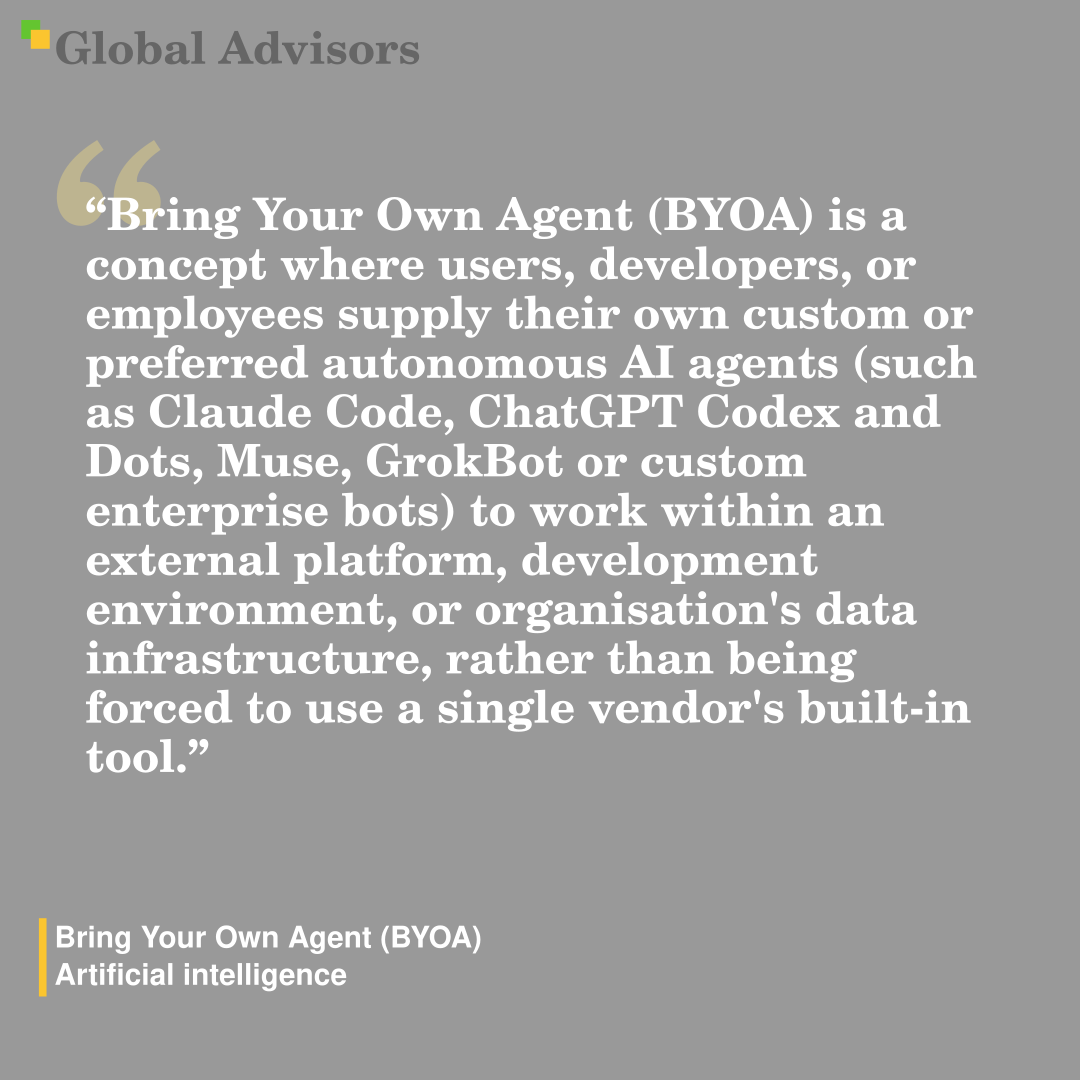
Term: Bring Your Own Agent (BYOA) - Artificial intelligence"Bring Your Own Agent (BYOA) is a concept where users, developers, or employees supply their own custom or preferred autonomous AI agents (such as Claude Code, ChatGPT Codex and Dots, Muse, GrokBot or custom enterprise bots) to work within an external platform, development environment, or organisation's data infrastructure, rather than being forced to use a single vendor's built-in tool." - Bring Your Own Agent (BYOA) - Artificial intelligence The practical issue is control over agency. When software can interpret goals, select tools, retrieve information and execute actions, the choice of agent becomes an architectural decision rather than a matter of personal preference. A BYOA arrangement permits a developer, employee or external partner to bring an agent into an existing platform or organisational environment, provided that the host can authenticate it, constrain its permissions, observe its behaviour and remove it when necessary. The result is a shift from a single-assistant model towards a governed ecosystem of agents with different capabilities, costs, data policies and operational assumptions. In substance, BYOA separates the agent from the environment in which work occurs. The agent may be a general conversational system, a coding specialist, a research assistant, a workflow bot or a custom enterprise service. The external environment supplies the data, tools, APIs, repositories and business processes that give the agent practical power. This distinction matters because an agent that merely drafts text has a different risk profile from one that can alter source code, approve payments, send messages or query confidential records. Microsoft describes enterprise agents as software that can access data, make decisions and act across business systems under delegated authority. Why organisations want agent choice Allowing users to bring preferred agents can increase experimentation and reduce dependence on a single vendor. Teams may select a coding agent for repository work, a specialist model for document extraction or a privately hosted system for sensitive information. Developers can test new tools without waiting for a central procurement cycle, while organisations can preserve existing workflows instead of forcing every task through one proprietary assistant. This flexibility can also improve resilience: if one model becomes unavailable, too expensive or unsuitable for a particular task, another may be substituted at the integration layer. The advantage is not unlimited freedom. A useful BYOA design defines the boundary between choice and control. The host platform should treat every agent as an identifiable software principal, record its owner and purpose, and specify which data and tools it may access. A registry, approval process and lifecycle policy are therefore more important than a simple catalogue of available bots. Microsoft reports that enterprise control planes are being designed to inventory agents built on internal platforms, open-source frameworks and third-party systems, with visibility into deployment, access, behaviour and cost. Identity, permissions and the action boundary The hardest governance question is not which model generated an answer, but which authority enabled an action. An agent should not inherit a person's full access merely because that person installed it. The stronger pattern is a distinct machine identity, narrowly scoped credentials and permissions tied to a specific task. This prevents a coding assistant, for example, from receiving unrestricted access to production infrastructure when it only needs a development repository. OpenID contributors responding to NIST identified credential sharing between humans and agents as an urgent risk, particularly where passwords, API keys, OAuth tokens or session cookies are passed directly to agents. Permission design must also account for delegation. An agent may call a tool, which may call another service, or it may delegate a task to a second agent. Each step should preserve identity, authorisation context and an auditable record of the decision. Otherwise, a compromised or poorly configured component can become a confused deputy that exercises another system's authority without clear accountability. Sensitive actions should use approval gates, transaction limits, sandboxing and rollback mechanisms. The principle is simple: the more irreversible the action, the stronger the confirmation and monitoring requirements. Interoperability without uncontrolled complexity BYOA depends on interfaces that allow an external agent to communicate with tools and services without requiring a complete rewrite of the host environment. Protocols for tool access and agent-to-agent communication can reduce vendor lock-in, but interoperability does not automatically create safety. Shared interfaces also create shared attack surfaces. Microsoft identifies agent-to-agent protocols as a way for systems from different vendors, frameworks and clouds to communicate, delegate and coordinate, while pairing that openness with identity, policy, audit and access-boundary controls. Standardisation remains contested. A common protocol may improve portability, yet its implementation can differ across vendors, and a protocol does not establish whether an agent is trustworthy, whether its supplied context is reliable or whether its requested action is appropriate. Model Context Protocol, for example, can connect agents to tools, data sources and services, but the surrounding organisation still has to vet servers, restrict external interactions and validate communications. The architectural lesson is that interoperability should be treated as a controlled capability, not as an exemption from security review. Prompt injection and supply-chain risk Traditional software normally follows explicit code paths, whereas agents interpret natural-language context assembled from documents, websites, email, tool responses and other agents. This creates a distinctive prompt-injection problem: hostile instructions can be embedded in material the agent is asked to process and may redirect its behaviour. The risk becomes more serious when the agent can act on the outside world. Guidance summarised by the Cloud Security Alliance identifies prompt injection, tool misuse, unauthorised delegation and cascading failures as agent-specific governance concerns. BYOA expands the supply chain because an organisation may not control the model provider, orchestration framework, plugins, memory store, tool server or delegated agents. Due diligence should therefore cover provenance, update practices, data retention, logging, model substitution and incident response. Runtime controls are essential because pre-deployment testing cannot anticipate every document, API response or instruction that an agent will encounter. Useful controls include input separation, allow-listed tools, network restrictions, anomaly detection, human review for high-impact actions and complete records of the context, permissions and approvals involved. Competing models of governance One school of thought favours a central platform: the organisation supplies approved agents, common identity controls, standard evaluations and a unified monitoring layer. This approach simplifies support, compliance and incident response, but can reproduce the very vendor dependence that BYOA seeks to avoid. A second model favours federated choice, in which teams select agents within common technical and policy boundaries. It encourages innovation and local expertise, but creates variation in data handling, evaluation quality and operational maturity. A third model treats agents as an internal marketplace: users can choose from registered providers, while the platform enforces policy at the point of connection and action. These models also differ on where trust should reside. Model-centred governance concentrates on accuracy, refusal behaviour and testing. Identity-centred governance asks who owns the agent, what it can access and how its credentials are managed. Systems governance adds the surrounding tools, data, workflows and human approvals. The evidence from current enterprise guidance supports the broader view: agents must be observable, governed and secure because their delegated authority can affect multiple systems at once. No single model evaluation can answer those operational questions. Why BYOA still matters BYOA matters because autonomous software is becoming a layer between people and organisational systems. Employees will continue to discover useful agents outside formal procurement, and developers will continue to combine models, tools and workflows in ways that central IT cannot fully predict. Prohibiting that behaviour may reduce visible risk while encouraging shadow deployments that are harder to inventory. A controlled BYOA policy offers a more realistic alternative: allow experimentation, but require registration, distinct identity, least-privilege access, approved integrations, data boundaries, monitoring, review and rapid revocation. The decisive test is whether an organisation can explain what an imported agent is allowed to do, what information it received, which tools it invoked, which other agents it contacted and who approved consequential actions. If those answers are unavailable, the organisation has adopted an opaque dependency rather than achieved meaningful choice. BYOA is therefore best understood not as unrestricted personal software, but as a governance pattern for making agent diversity compatible with accountability, interoperability and security.
|
| |
| |
Amazon reported in talks to acquire AI startup DecartThe Global Advisors Daily Business News briefing for 12 October 2026, hosted by Sam. Ten headlines shaping markets, technology and corporate strategy, with context on the stories that matter. Read the full newsletter: https://with.ga/47x95 In this edition: - Persistent Surge in Sovereign Bond Yields Strains Corporate Balance Sheets and Threatens Equity Valuations Follow the daily podcast on Spotify: https://with.ga/spotnews Subscribe to the daily podcast on YouTube: https://with.ga/ytnews Get free daily updates on WhatsApp: https://with.ga/wa Read the full briefing and explore our strategy insights: https://globaladvisors.biz Follow on Spotify: https://with.ga/spotnews |
| |
| |
Global Advisors News Brief - October 12 2026Read the full brief at the link Headlines for the last 24hrs
Time window: 2026-10-11T03:30:33.084Z to 2026-10-12T03:30:33.084Z |
| |
| |
Quote: Michael Elliott - President of Amherst College"Figuring out how to find pleasure in uncertainty is going to be a valuable life skill." - Michael Elliott - President of Amherst College Uncertainty is not merely a gap in knowledge; it is a condition that shapes attention, judgement and behaviour. People must act before outcomes are clear, often with incomplete information, competing obligations and no reliable guarantee that effort will produce the desired result. The practical challenge is therefore not to eliminate uncertainty, an impossible ambition, but to develop a more flexible relationship with it. That relationship determines whether ambiguity becomes a source of paralysis or an invitation to investigate, adapt and learn. Michael Elliott's observation carries particular weight in an educational setting because colleges are designed to prepare people for situations that cannot be solved by memorised answers. As president of Amherst College, Elliott has spoken from within an institution whose purpose includes cultivating independent thought, intellectual range and judgement. The relevant skill is not blind optimism about the unknown. It is the capacity to remain attentive and purposeful when certainty is unavailable, while distinguishing genuine possibility from avoidable danger. Why uncertainty feels so demanding Uncertainty creates a tension between the desire for control and the reality of limited foresight. A person deciding whether to change careers, pursue research, start a business or enter an unfamiliar social environment must estimate consequences without possessing complete evidence. The mind often responds by seeking more information, rehearsing negative outcomes or delaying commitment. These responses can be useful when they improve preparation, but they become costly when information gathering turns into rumination or when caution prevents any meaningful action. Research on intolerance of uncertainty links difficulty with the unknown to anxiety, indecision and excessive attempts to secure reassurance. Recent work has also connected intolerance of uncertainty with doomscrolling and rumination, suggesting that the search for certainty can become a self-reinforcing threat-monitoring habit . The problem is not that people care about consequences. It is that an unresolved future can consume attention without producing better decisions. Treating uncertainty as something that must be abolished can therefore increase distress rather than reduce it. From threat to information Curiosity offers a different response. Instead of asking only whether an uncertain situation is safe, curiosity asks what can be learned from it and which next observation would improve understanding. Neuroscientific research describes curiosity as a motivational state associated with information seeking, learning and memory. When people are curious, activity in reward-related and memory systems can support the encoding of new information, including information that was not initially the object of interest . Uncertainty is consequently not always an obstacle to knowledge; in suitable conditions, it is the trigger that makes knowledge more valuable. This does not mean that all uncertainty is pleasant or beneficial. Research distinguishes between manageable ambiguity, where investigation can produce learning, and extreme uncertainty, where noise or instability makes progress difficult. Studies of curiosity indicate that people are often most engaged when a question is neither trivial nor hopelessly obscure. The productive zone lies between confidence that nothing new can be learned and confusion so severe that no useful model can be formed. Finding pleasure in uncertainty therefore requires calibration, not a permanent appetite for risk. The distinction matters in education. A classroom that rewards only correct answers can teach students to protect their performance by avoiding difficult questions. A classroom that treats confusion as part of inquiry can make uncertainty intellectually tolerable. Students learn to frame hypotheses, test assumptions, revise explanations and ask for evidence. Those habits transfer beyond academic work because many professional and civic decisions require an ability to update beliefs rather than defend an initial position at all costs. The strategic value of not knowing In organisations, uncertainty is often described as a threat to planning, yet it can also expose opportunities that fixed plans would miss. Businesses operating in changing markets must decide how much to invest before demand, regulation or technology becomes clear. Researchers must pursue lines of enquiry whose results cannot be guaranteed. Leaders must act during crises when waiting for complete information would itself create additional harm. In each case, useful judgement depends on separating what is known, what is estimated and what remains genuinely open. A disciplined approach does not celebrate unpredictability for its own sake. It uses small experiments, reversible commitments and explicit review points to make uncertainty manageable. Decision-makers can state their assumptions, identify the evidence that would change their minds and define limits on acceptable loss. This turns an abstract emotional burden into a practical process. The aim is not to predict every outcome but to preserve the capacity to respond when the prediction fails. Such methods also challenge the common confusion between confidence and competence. Confidence can help people act, but unjustified confidence makes them less likely to seek disconfirming evidence. A degree of uncertainty can improve deliberation by keeping alternative explanations in view. Research on curiosity and active information sampling suggests that exploration is guided not only by novelty, but also by expectations about learning progress and information gain . The best question is often not whether an option is certain to succeed, but whether pursuing it will generate knowledge that improves the next decision. Objections and limits There are legitimate objections to presenting uncertainty as a life skill. The unknown does not affect everyone equally. Financial insecurity, illness, discrimination and political instability can make uncertainty materially dangerous rather than intellectually stimulating. Advising people to enjoy ambiguity can sound insensitive when the underlying issue is a lack of safety or control. Tolerance must therefore be understood alongside efforts to reduce preventable uncertainty through good institutions, reliable information and social support. Nor does tolerance mean accepting every risk. High tolerance for uncertainty should not be confused with recklessness, gambling or indifference to evidence. A person may remain open to several outcomes while still setting firm boundaries around health, finance and personal safety. Research on medical decision-making, for example, suggests that greater tolerance can reduce stress and support balanced judgement, but the appropriate action still depends on the quality of available evidence and the consequences of error . Openness is valuable only when paired with discernment. The deeper implication is that pleasure need not mean excitement or comfort. It can mean the satisfaction of noticing a question become clearer, discovering an unexpected connection or recognising that an initial belief needs revision. This form of pleasure is quieter than certainty and more durable than reassurance because it comes from participation in the process of understanding. It allows a person to experience the unknown as unfinished work rather than as proof of personal inadequacy. That shift has consequences for a life shaped by rapid technological change, contested information and uncertain employment. People who can tolerate incomplete answers are better placed to keep learning, collaborate across disagreement and adapt when familiar strategies stop working. The capability is partly cognitive, but it is also emotional: one must endure the discomfort of not yet knowing long enough for investigation to produce something useful. Education can cultivate that endurance, workplaces can reward it and individuals can practise it through deliberate experimentation, reflective questioning and a willingness to revise their plans.
|
| |

| |
Quote: Navi Pillay - Nobel laureate"So everybody says when you going to stop, when are you going to stop? I just turned 85 just last month. I can't obviously stop my work in support of the Nuremberg Principles." - Navi Pillay - Nobel laureate International justice is often judged by the speed of its verdicts, yet its deeper test is whether legal principles survive political pressure, institutional weakness and the passage of time. The work associated with Navi Pillay belongs to that longer struggle: converting the promise that individuals can be held responsible for atrocity crimes into procedures, precedents and public expectations. Her insistence on continuing at 85 is therefore less a statement about personal endurance than a refusal to treat accountability as a task that can be completed once and for all. The Nuremberg Principles emerged from the post-Second World War trials, where the prosecution of senior Nazi officials established that international law could impose duties directly on individuals. The principles rejected the idea that official position automatically shields a person from responsibility, and they limited the force of domestic law as a defence when the conduct violated fundamental international norms. Their importance lies in this shift from state-centred immunity towards individual accountability for crimes whose consequences exceed national borders. From apartheid courts to international tribunals Pillay's own career gave those principles a practical rather than abstract meaning. Raised in Durban under apartheid, she entered a legal profession shaped by racial exclusion and used it to defend political prisoners and challenge restrictions on legal access. The United Nations records her later roles as the first non-white woman judge on South Africa's High Court, a judge of the International Criminal Court and president of the International Criminal Tribunal for Rwanda. The progression matters because it links domestic resistance to international adjudication: the same legal vocation that confronted discriminatory power at home became part of a system designed to address mass violence across borders. Her service at the Rwanda tribunal was especially consequential. The tribunal's jurisprudence helped establish that rape and sexual violence could constitute acts of genocide when committed with the requisite intent to destroy a protected group. That development altered the legal and political vocabulary surrounding conflict-related sexual violence, treating it not as an inevitable by-product of war but as conduct capable of carrying the gravest criminal classification. It also illustrated why precedent matters. A judgment does not undo the harm, but it can define what happened, identify responsibility and provide a legal basis for future prosecutions. The later stages of Pillay's career extended this accountability agenda through several institutions. She served on the International Criminal Court from 2003 to 2008 and as United Nations High Commissioner for Human Rights from 2008 to 2014. These positions required different forms of authority. A judge works through evidence, procedure and a defined jurisdiction, whereas a human rights commissioner relies more heavily on investigation, public reporting, diplomacy and institutional pressure. Moving between them exposed the tension between legal independence and political implementation: courts can articulate rules, but they depend on states for arrests, evidence, funding and enforcement. Why the principle remains unfinished That dependence explains why international criminal law remains contested. Supporters regard prosecutions as a necessary response to impunity, particularly where domestic courts are unwilling or unable to act. Critics argue that international justice can be selective, slow and vulnerable to geopolitical influence, with weaker states more exposed than powerful ones. Both observations can be true at the same time. A legal order may establish universal rules while applying them unevenly, and the gap between principle and enforcement can damage confidence without making the principle itself irrelevant. The challenge has intensified as contemporary conflicts generate vast quantities of evidence, competing narratives and urgent demands for action. Investigators must preserve digital material, assess witness reliability and distinguish political claims from proof that meets criminal standards. At the same time, victims and affected communities often want recognition before a trial is possible. This creates a difficult balance between speed and fairness. Public condemnation may be immediate, but a criminal judgment requires a disciplined process capable of withstanding appeal, denial and later historical scrutiny. Pillay's public record also shows how accountability can create political controversy. Her work on international inquiries, including the United Nations commission concerning the Occupied Palestinian Territory, East Jerusalem and Israel from 2021 to 2025, placed her within disputes where legal findings carry direct consequences for diplomacy and public legitimacy. Supporters see such investigations as indispensable when ordinary judicial channels are blocked. Opponents may question methodology, mandate or alleged bias. The appropriate response is not to exempt contentious situations from scrutiny, but to test findings against evidence, disclosed methods and the governing law. The meaning of continuing Continuing to work on the Nuremberg Principles also carries an institutional message. International justice depends on a chain of activities extending beyond famous trials: training judges and investigators, preserving archives, explaining legal standards, supporting survivors and resisting the normalisation of impunity. The International Nuremberg Principles Academy, where Pillay was reported to be attending a legal conference when the Nobel announcement was made, represents this educational and professional dimension. Principles endure not only through landmark judgments but through communities that teach, apply and defend them. The award's significance therefore reaches beyond an individual career. The Norwegian Nobel Committee recognised Pillay for efforts to promote peace and international law, citing her contribution to the prosecution of war crimes, crimes against humanity and genocide. That rationale presents peace not simply as the absence of fighting but as a condition supported by credible rules. The proposition is demanding: durable peace requires victims to have a route to recognition and perpetrators to face a meaningful risk of accountability. Without those mechanisms, ceasefires can freeze injustice rather than resolve it. There are limits to what legal institutions can achieve. Prosecution cannot replace political settlement, reparations, security guarantees or social reconstruction. Nor can a tribunal guarantee that every responsible person will be charged. Yet these limits do not reduce the value of clear standards. They define the work that remains: narrowing selectivity, improving evidence, protecting witnesses, ensuring due process and making enforcement less dependent on the preferences of powerful states. Pillay's refusal to stop points towards that unfinished programme, in which the defence of international law is measured by its application when doing so is difficult, unpopular or politically costly.
|
| |

| |
Term: Operating leverage - Accounting"Operating leverage is a financial metric that measures how sensitive a company's operating income is to changes in sales revenue, driven primarily by its mix of fixed versus variable costs. A business with high operating leverage relies heavily on fixed assets like machinery or software development; once it passes its break-even point, further sales generate outsized profits because the core expenses do not increase." - Operating leverage - Accounting Profit does not respond to sales in a simple one-for-one relationship. The decisive question is how much of a company's cost base must be paid before an additional unit can be sold. Rent, salaried operations staff, depreciation, software infrastructure and committed production capacity can remain broadly unchanged across a range of output. By contrast, materials, transaction charges, shipping and sales commissions usually rise with activity. This distinction creates a mechanism through which a modest movement in revenue can produce a much larger movement in operating income, both upwards and downwards. In practical terms, operating leverage describes the sensitivity of operating income, normally measured as earnings before interest and tax, to a change in sales. It is not simply a ratio of fixed costs to total costs. The more useful interpretation is economic: a business with substantial fixed operating commitments has already incurred much of the cost of serving customers, so each additional sale can carry a high contribution margin after variable costs. That structure can support rapid profit growth once demand is strong, but it also leaves the company exposed when sales fall because fixed commitments do not retreat at the same speed . From cost structure to operating income Cost-volume-profit analysis makes the mechanism visible. Let represent units sold, the selling price per unit, the variable cost per unit and total fixed operating costs. Operating income can be expressed as . The term is the unit contribution margin: the amount each sale contributes towards fixed costs and then profit. Total contribution is . The operating break-even point is reached when this total exactly covers fixed costs, so the break-even volume is . These equations also clarify why the same company can display very different leverage at different stages of growth. Below break-even, each additional sale reduces the operating loss by its contribution margin, but the firm remains loss-making. At break-even, operating income is zero. Above break-even, the contribution margin flows into operating profit because the fixed-cost base has already been covered. If the price is 100 and variable cost is 60, each unit contributes 40. With fixed operating costs of 400 000, the business needs 10 000 units to break even. Once that threshold is passed, the next unit adds 40 to operating income, assuming price, costs and capacity remain stable. Measuring the degree of operating leverage The standard measure is the degree of operating leverage, or DOL. It is defined as the percentage change in operating income divided by the percentage change in sales. At a particular sales level, it can also be written as . A DOL of 3 means that, within the relevant range and subject to unchanged assumptions, a 1 percent change in sales is associated with approximately a 3 percent change in operating income. The relationship works in both directions: a 10 percent sales increase may produce roughly a 30 percent increase in operating income, while a 10 percent sales decline may produce roughly a 30 percent decline. DOL is a local sensitivity measure, not a permanent characteristic of a company. As sales move further above break-even, operating income becomes larger relative to contribution margin, so the calculated DOL generally falls. Close to break-even, the denominator in the formula is small and the result can become extremely high or unstable . A reported DOL therefore requires context: the period measured, the revenue base, the business mix and the position in the demand cycle all matter. Comparing two companies using only their headline DOL can be misleading if one is near break-even and the other is operating comfortably above it. Strategic choices behind the number Operating leverage is shaped by decisions about technology, capacity and the division of work between internal and external resources. Automation may replace variable labour with depreciation, maintenance contracts and specialist staff. A software company may incur substantial development costs before serving its next customer, while a consultancy may retain a more variable cost structure by using contractors. A retailer with long leases has a different risk profile from an online marketplace that pays transaction costs as orders arrive. None of these structures is universally superior; each exchanges flexibility for potential scale economies. High operating leverage is attractive when demand is predictable and capacity utilisation can rise. Once fixed resources are in place, additional volume may be served at relatively low incremental cost, improving margins and return on invested capital. The same design becomes hazardous when demand is volatile, products have short life cycles or customers can switch easily. A revenue forecast error then affects profit disproportionately, and management may be unable to reduce lease payments, depreciation or permanent staffing quickly enough. Academic finance treatments consequently frame operating leverage as a risk-return trade-off: higher volume can amplify returns, while lower volume can magnify losses . Accounting interpretation and limitations Accounting classification is necessary but not mechanical. A cost can be fixed over one planning horizon and variable over another. Factory rent may be fixed for a year but adjustable when a lease expires. Salaries may appear fixed until a restructuring, while cloud computing charges may have both committed and usage-based elements. Step costs, capacity constraints, discounts, product returns and changing sales commissions weaken the assumption that every cost moves smoothly with output. The contribution-margin format is therefore an analytical model rather than a complete description of economic reality. Product mix creates another limitation. A company selling several products does not have one universal unit contribution margin unless the sales mix is stable. A shift towards lower-margin products can raise revenue while reducing total contribution, and a shift towards premium products can have the opposite effect. Analysts should therefore examine segment-level margins, recurring versus non-recurring revenue, capacity utilisation and cash commitments rather than infer operating risk from fixed-cost percentages alone. Operating leverage also excludes interest and financing effects; equity risk depends on the interaction between operating leverage and financial leverage, not on either measure in isolation . Why the concept still matters The measure remains useful because it connects accounting data with strategic exposure. It helps management test pricing, outsourcing, automation, capacity expansion and sales targets; it helps investors interpret why two businesses with similar revenue growth can produce very different earnings growth. A sound analysis starts with a contribution-margin statement, identifies which costs are genuinely committed, calculates break-even volume and then tests scenarios for price, volume, mix and cost inflation. The resulting range is more informative than a single DOL figure because it shows how quickly the cost structure changes when assumptions stop holding. Operating leverage should therefore be read as a conditional map of profit sensitivity. It explains why fixed operating commitments can create exceptional incremental margins after break-even, but it does not predict demand, competitive behaviour or management quality. Its strongest use is comparative and scenario-based: identify the fixed obligations, estimate the contribution generated by each sale, locate the current position relative to break-even and examine the downside as carefully as the upside. That discipline turns a familiar accounting metric into a practical assessment of resilience, scalability and operating risk.
|
| |

| |
|


| |
| |