| |
|

| |
| |
| |
|
A daily bite-size selection of top business content. |
| |
| |
| |
Term: Unit economics - Finance"Unit economics evaluates the financial sustainability of a business model by analysing the direct revenue and costs associated with a single, repeatable unit, such as an item sold or an individual customer. By subtracting variable costs from unit revenue, companies determine their contribution margin to ensure that each transaction is fundamentally profitable before trying to scale." - Unit economics - Finance Growth does not repair a weak commercial engine. If each additional sale consumes as much cash as it creates, higher volume can enlarge losses, increase working-capital pressure and conceal poor pricing behind impressive revenue figures. Unit economics therefore supplies a disciplined test: does a repeatable transaction create economic value before the business carries the burden of its wider organisation? The unit may be an order, subscription, delivery, customer, loan or completed project, but the choice must match how the business actually earns and spends money. The analysis starts with revenue attributable to that unit and deducts costs that change because the unit is delivered. These can include materials, payment processing, fulfilment, usage-based hosting, delivery, refunds, sales commissions and customer support where support rises with usage. The result is contribution margin, the cash contribution available to cover fixed costs and eventually produce operating profit. Accounting classifications require judgement because a cost can be fixed over one activity range and variable over another. From revenue to contribution A useful specification is , where denotes contribution margin per unit, unit revenue and variable cost per unit. The contribution margin ratio is . If a product sells for 80 and incurs 50 of variable cost, its contribution is 30 and its contribution margin ratio is 37,5 percent. That figure is not net profit: rent, permanent salaries, product development, insurance, financing and other fixed or semi-fixed costs still have to be paid. At company level, the same logic is expressed as , where is operating profit, the number of units sold and total fixed costs. The break-even volume is , while break-even revenue is . These relationships underpin cost-volume-profit analysis, which examines how price, volume, variable cost and fixed cost affect profit. They are decision tools rather than forecasts, because their basic assumptions include stable prices, linear cost behaviour and a relevant operating range. Customer economics and time For recurring or relationship-based businesses, a single transaction is rarely enough. The relevant unit may be a customer over an observed period, with revenue adjusted for churn, discounts, bad debt and refunds. A simplified customer contribution measure can be written as , where and are customer revenue and variable cost in period , and is customer acquisition cost. Acquisition spending should be included when asking whether growth is self-funding, even though it may be paid before the customer generates revenue. Lifetime value is often presented as a single number, but it is better treated as a distribution of possible outcomes. Retention, expansion, price changes, service intensity and payment behaviour all vary across cohorts. A rough subscription approximation might use , where is average revenue per user, the contribution margin ratio and the periodic customer loss rate. The approximation becomes unreliable when churn is not constant, customer lifetimes are censored, or acquisition channels produce materially different cohorts. Wise describes unit economics through the practical question of what is earned from each customer or sale after the costs required to obtain and serve it, but that simplicity should not be mistaken for measurement precision. Why scale can help or hurt Positive unit economics is necessary but not sufficient for a viable business. A company can earn contribution on every order and still fail because fixed costs are excessive, cash conversion is slow, inventory is obsolete or acquisition requires continuing subsidies. Conversely, a temporarily negative contribution may be rational when an introductory offer creates durable retention, provided the future economics are evidenced rather than assumed. The key distinction is between a loss caused by planned investment in scalable capacity and a loss embedded in the transaction itself. Operating leverage makes this distinction more consequential. When fixed costs dominate, additional contribution after break-even can increase profit rapidly, but a downturn can reverse that effect just as quickly. Sources on cost-volume-profit analysis note that fixed costs remain constant in total only within a relevant range, while variable costs generally change with activity. Capacity constraints, overtime, cloud usage tiers, logistics congestion and support queues can therefore create step changes that a simple per-unit average obscures. A model should test marginal economics at the next volume level, not merely report historical averages. Schools of thought and measurement disputes Management accounting traditionally emphasises contribution margin and break-even analysis. This approach is useful for pricing, product mix and short-run decisions because it separates cost behaviour and shows how sales contribute towards fixed expenditure. The accounting perspective also warns against allocating fixed costs mechanically to individual units when those allocations do not change with the decision. The relevant question is usually whether a cost is avoidable or incremental, not whether an accounting system assigns it to the product. Venture and growth analysis adds customer acquisition, retention and payback. Its attraction is that it links marketing investment with future revenue, but it introduces more assumptions. A reported customer acquisition cost can understate reality if brand expenditure, sales salaries, partner commissions or onboarding labour are excluded. Lifetime value can be overstated by projecting early retention indefinitely. Cohort analysis, contribution after fulfilment and cash payback are stronger safeguards than a headline ratio. The underlying debate is not whether one metric is correct, but which costs and time horizon answer the decision being made. Practical use and enduring relevance A robust analysis begins by defining the unit and decision horizon, then reconciling operational data with the general ledger. Revenue should be net of discounts, returns, taxes collected on behalf of authorities and doubtful receipts where relevant. Variable costs should reflect the resources consumed to deliver the sale, including expected refunds and service obligations. Results should then be segmented by product, channel, geography, customer type and acquisition cohort. Aggregated averages can hide profitable customers subsidising loss-making ones. The framework matters because it disciplines the seductive equation of scale with success. Before expanding capacity, cutting price or increasing advertising, management can ask whether the incremental unit improves contribution, how quickly acquisition spend is recovered, which assumptions are most fragile and what fixed-cost threshold must be covered. Contribution margin and break-even analysis remain simplified models, and their limitations are well documented, particularly where cost behaviour is nonlinear or product mix changes. Used with cohort evidence, cash-flow analysis and sensitivity testing, unit economics becomes more than a finance ratio: it is a practical method for deciding which growth is valuable, which growth is subsidised and which growth should be stopped.
|
| |

| |
US inflation jump revives interest rate hike fearsThe Global Advisors Daily Business News briefing for 15 October 2026, hosted by Sam. Ten headlines shaping markets, technology and corporate strategy, with context on the stories that matter. Read the full newsletter: https://with.ga/ec7b2 In this edition: - Anthropic Revenue Surges to $16.8 Billion in Third Quarter Ahead of Planned Public Listing Follow the daily podcast on Spotify: https://with.ga/spotnews Get free daily updates on WhatsApp: https://with.ga/wa |
| |
| |
Global Advisors News Brief - October 15 2026Read the full brief at the link Headlines for the last 24hrs
Time window: 2026-10-14T03:30:33.080Z to 2026-10-15T03:30:33.080Z |
| |
| |
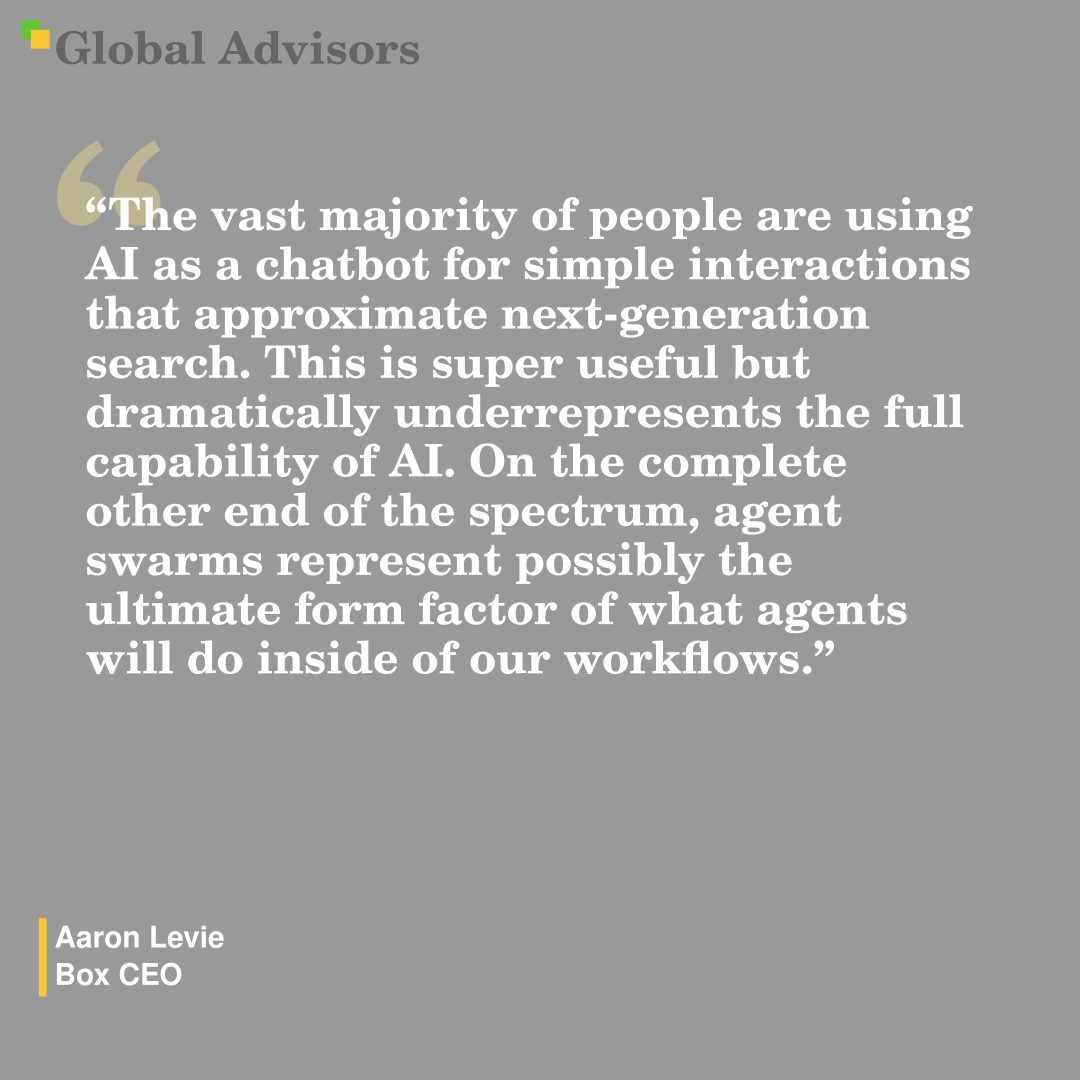
Quote: Aaron Levie - Box CEO"The vast majority of people are using AI as a chatbot for simple interactions that approximate next-generation search. This is super useful but dramatically underrepresents the full capability of AI. On the complete other end of the spectrum, agent swarms represent possibly the ultimate form factor of what agents will do inside of our workflows." - Aaron Levie - Box CEO The strategic gap in enterprise AI is no longer access to a capable model. It is the distance between asking a system for an answer and giving it responsibility for a bounded result. A chatbot compresses search, drafting and explanation into a convenient interface. An agent changes the operating model by interpreting an objective, selecting actions, using tools, checking intermediate results and escalating when uncertainty or authority limits are reached. The distinction matters because productivity gains from assistance are usually local, while workflow automation can alter how an organisation allocates labour, control and accountability. Levie's position reflects an adoption pattern visible across business. Employees often begin with low-risk interactions: summarising documents, rewriting messages, finding information or generating first drafts. These uses are valuable because they require little integration and preserve human judgement. They also make AI easy to evaluate through personal experience. Yet they leave the underlying workflow intact. The worker still gathers inputs, decides what matters, moves information between systems and accepts responsibility for the final action. The model accelerates a task without necessarily changing the chain of work. The next stage introduces agency. An agent can be assigned a goal such as resolving a support case, preparing a procurement recommendation or monitoring a software deployment. It may need to retrieve records, apply policies, call an application programming interface, compare alternatives and request approval before committing an irreversible step. McKinsey describes agents as systems capable of planning and executing multiple steps in a workflow, rather than merely producing a response to a prompt. That capability moves the central question from 'What can the model write?' to 'What work can the organisation safely delegate?' From answers to delegated outcomes The economic distinction is significant. A chatbot mainly increases the output of an existing employee, while an agent can coordinate a sequence that previously crossed several roles and software systems. The gain may come from lower waiting time, fewer hand-offs and continuous monitoring rather than from faster text generation. In a mature deployment, the user supplies an objective and constraints, not a detailed sequence of instructions. The system then performs routine orchestration while people focus on exceptions, judgement and relationships. That promise should not be confused with autonomy without limits. An agent is useful only when its authority, information and success criteria are clearly defined. A system that can edit a document is different from one that can send it externally; one that can recommend a payment is different from one that can execute it. Risk rises with the sensitivity of the data, the reversibility of the action, the breadth of connected tools and the speed at which decisions propagate. The relevant design unit is therefore not the model alone but the model, tools, permissions, workflow and oversight mechanism operating as one system. Agent swarms extend this logic by distributing a complex objective among specialised agents. One may gather evidence, another may test an assumption, a third may plan execution and a fourth may review the proposed result. In theory, parallel work can reduce latency and allow each component to operate within a narrower role. In practice, coordination creates new failure modes. A mistaken assumption can be copied across the group, conflicting instructions can produce circular work and a weak reviewer may approve an error generated by another agent. Safety cannot be inferred simply by checking each component in isolation. Adoption is ahead of transformation Current enterprise adoption supports a more measured reading of the opportunity. McKinsey reported that 23 percent of respondents said their organisations were scaling an agentic AI system in at least one function, while a further 39 percent had begun experimenting with agents; most scaling remained limited to one or two functions. The figures indicate substantial interest but not universal operational maturity. They also suggest that experimentation is easier than redesigning the processes, data access and governance needed for dependable deployment. This helps explain why chatbot use can appear ubiquitous while agentic transformation remains uneven. Chatbots fit existing procurement, security and user habits. They can often be introduced through a browser or workplace application, with a human reviewing the output. Agents demand deeper integration with identity systems, records, permissions, audit trails and escalation procedures. They also expose process weaknesses that conversational interfaces can conceal. If ownership is unclear, data is inconsistent or approval rules are undocumented, automation does not remove the problem; it turns the ambiguity into a machine-speed operational risk. The most credible early use cases are consequently narrow, measurable and reversible. Internal knowledge retrieval, software testing, service triage, document classification and routine reconciliation can provide useful evidence without granting unrestricted authority. Leaders can compare completion time, error rates, rework, escalation frequency and user satisfaction before expanding the system. A staged approach also makes it possible to identify whether value comes from the agent itself or from process improvements that would have been beneficial regardless of the technology. The governance problem Security becomes more difficult when agents can act through a user's credentials. NIST has highlighted risks including unauthorised access, data exposure, privilege expansion and unintended actions in agentic architectures. A connected agent may read email, access files, query customer systems and communicate externally. If malicious instructions are hidden in retrieved content, an agent may treat them as legitimate guidance, a threat commonly described as indirect prompt injection. The danger is not limited to a poor answer; it can involve a sequence of authorised-looking actions with real consequences. Multi-agent systems magnify the governance challenge because authority can move through delegation chains. A parent agent may ask a specialist to investigate, the specialist may invoke another service and the resulting output may influence a consequential decision. Every hand-off introduces questions about identity, scope and accountability. Organisations need explicit permissions, time-limited access, comprehensive logs, approval gates for high-impact actions and a reliable means of stopping agents and revoking their credentials. Human oversight must be operational rather than ceremonial: a nominal shutdown button is not meaningful if the system has already acted faster than people can review it. There is also a debate about whether swarms are the ultimate form factor or simply one design pattern among several. More agents do not automatically produce more intelligence. Coordination overhead, duplicated work and correlated errors can outweigh parallelism. A single well-integrated agent with clear tools and strong evaluation may outperform a swarm assembled primarily to signal sophistication. The decisive test is not the number of agents but whether the architecture improves outcomes under realistic constraints, including incomplete information, adversarial inputs, changing policies and failures in connected systems. The strategic implication for technology leaders is to treat agent deployment as an organisational redesign programme. Begin with a process whose objective, owner and risk boundary are explicit. Separate recommendation from execution, grant the minimum necessary access and record every material action. Evaluate not only average performance but also rare failures, escalation quality and recovery after interruption. As capability expands, preserve a clear human hierarchy for decisions that affect money, rights, safety, reputation or access to sensitive information. The movement from conversational assistance to delegated workflows will be consequential because it changes where judgement sits. Chatbots make intelligence easier to access; agents attempt to make action easier to coordinate. The opportunity is substantial, but the transition will be durable only when autonomy is matched by authority controls, measurable accountability and processes designed for intervention. Adoption statistics show that organisations are beginning this shift, while the security and governance evidence shows why scaling it responsibly requires more than connecting a model to more tools.
|
| |
| |
Term: CRISPR (Clustered Regularly Interspaced Short Palindromic Repeats) - Biology"CRISPR (Clustered Regularly Interspaced Short Palindromic Repeats) is a revolutionary gene-editing technology adapted from a natural defence system that bacteria use to fight off viruses. By pairing a programmable guide RNA with a specialised enzyme like Cas9, scientists can precisely target, cut, and modify specific sequences of DNA within a genome." - CRISPR (Clustered Regularly Interspaced Short Palindromic Repeats) - Biology The central significance of CRISPR lies in the separation of recognition from cutting. A researcher can alter the sequence of a guide RNA so that it pairs with a chosen stretch of DNA, while a CRISPR-associated protein performs the chemical work of cleavage. This makes genome editing programmable rather than dependent on designing a new protein for every target. The result is not perfect control, however. The guide, enzyme, delivery system and cell-repair pathway jointly determine what actually happens after the DNA is cut. In bacteria, CRISPR systems form part of an adaptive defence against viruses. Short fragments of invading viral DNA can be stored between repeated sequences in the bacterial genome. When a related virus returns, RNA produced from this region helps a Cas protein recognise matching genetic material and destroy it. Laboratory methods adapted this arrangement by combining a targeting RNA with an enzyme such as Cas9. The guide RNA supplies sequence recognition, while Cas9 cuts both strands of DNA near the matching site, provided the target also satisfies the enzyme's neighbouring sequence requirements. That mechanism supports several distinct editing outcomes. If the cell repairs a double-strand break through non-homologous end joining, small insertions or deletions may disrupt a gene. If a repair template is supplied, homology-directed repair can introduce a specified sequence, although this pathway is often inefficient and depends strongly on cell type and cell-cycle state. Newer systems avoid cutting both DNA strands: base editors chemically convert one DNA base into another, while prime editors use a modified guide and reverse-transcriptase activity to write a broader range of changes. These approaches reduce some risks but introduce their own constraints and possible unintended edits. Precision therefore has a practical rather than absolute meaning. A guide RNA may bind a near-match elsewhere in the genome, producing an off-target alteration. Even at the intended site, repair can create larger deletions, rearrangements or mixtures of edited and unedited cells. A review in Nature Communications notes that CRISPR systems can generate both intended and unintended genetic changes, including rare chromosomal events that could matter if affected cells expand in the body. Safety assessment consequently requires sequencing and functional testing beyond checking whether the intended nucleotide change is present. From molecular tool to medical treatment The most advanced clinical use has been ex vivo editing, in which cells are removed from a patient, modified in a controlled laboratory process and then returned. Casgevy, approved by the US Food and Drug Administration for eligible patients with sickle cell disease and later expanded indications, uses the patient's own blood stem cells. CRISPR editing alters an enhancer associated with BCL11A, reducing its repression of fetal haemoglobin production. Higher fetal haemoglobin can lessen the tendency of red blood cells to sickle, addressing a major biological driver of painful vaso-occlusive crises. This treatment illustrates both the promise and the burden of genome editing. The edited cells must be collected, processed, quality-tested and reinfused after conditioning that clears space in the bone marrow. It is therefore not a simple injection of molecular scissors. The treatment can be transformative for appropriately selected patients, but manufacturing complexity, specialised clinical infrastructure, long-term monitoring and cost limit immediate access. The UK regulator became the first national regulator to approve Casgevy in November 2023, followed by US approval the next month, marking a regulatory milestone without proving that CRISPR is broadly safe for every disease. In vivo editing presents a different challenge because the editing components must reach the correct tissue inside the body. Viral vectors, lipid nanoparticles and other carriers can transport guide RNA and editing proteins, but they differ in distribution, immune response, duration and capacity. Delivery to the liver is comparatively tractable for some approaches; reaching the brain, muscle, lung or scattered tumour cells is more difficult. A recent review identifies limited packaging capacity of certain viral vectors and immune responses to both carriers and CRISPR components as continuing obstacles. A useful therapy must therefore solve delivery and biological specificity together, not merely identify a desirable gene. Competing approaches and unresolved tensions One school of thought treats CRISPR primarily as a precision instrument for correcting pathogenic variants. Another emphasises regulation rather than correction: changing gene expression may be safer than rewriting a faulty sequence, especially when the disease results from an overactive pathway. A third approach focuses on cell engineering, including immune cells designed to recognise cancer. These strategies differ in risk because editing a short-lived cell population, an ex vivo stem-cell population and reproductive cells have very different consequences. The sharpest ethical boundary concerns heritable germline editing. Changes made to embryos, eggs or sperm could pass to future generations, including people who cannot consent and whose biological circumstances are unknown. Somatic editing, by contrast, is intended to affect only the treated individual. This distinction does not remove ethical questions about access, disability, enhancement or unequal distribution, but it provides a central framework for governance. The medical success of an approved somatic therapy should not be treated as a mandate for reproductive editing. CRISPR also exposes a tension between biological precision and social simplicity. Public descriptions often call Cas9 molecular scissors, but cutting is only the first event in a chain involving DNA repair, cell selection, immune surveillance and long-term clonal behaviour. Researchers must decide how much residual risk is acceptable for a serious disease with few alternatives, how long follow-up should continue, and which outcomes count as success. A small off-target rate may be unacceptable for treating a healthy person at risk of a future condition, yet potentially acceptable when treating a life-threatening disorder, subject to evidence and oversight. CRISPR remains important because it has made genetic intervention faster to design, easier to adapt and applicable across research, agriculture and medicine. It enables functional experiments in which genes are disrupted, activated or tagged to test their roles in living systems. It also provides a platform rather than one fixed technology: nuclease editing, base editing, prime editing, epigenetic regulation and RNA targeting each address different weaknesses. The enduring question is not whether CRISPR can edit DNA, but whether a particular system can reach the right cells, make the right change, avoid damaging alternatives and deliver a benefit that outweighs its clinical, economic and ethical costs.
|
| |

| |
Global semiconductor stocks tumble on China chip advanceThe Global Advisors Daily Business News briefing for 14 October 2026, hosted by Sam. Ten headlines shaping markets, technology and corporate strategy, with context on the stories that matter. Read the full newsletter: https://with.ga/4k4es In this edition: - Global Semiconductor Stocks Tumble as China Memory Breakthroughs and AI Spending Scrutiny Trigger Market Correction Follow the daily podcast on Spotify: https://with.ga/spotnews Get free daily updates on WhatsApp: https://with.ga/wa |
| |
| |
Global Advisors News Brief - October 14 2026Read the full brief at the link Headlines for the last 24hrs
Time window: 2026-10-13T03:30:33.081Z to 2026-10-14T03:30:33.081Z |
| |
| |
Quote: Andrej Karpathy - AI guru, Anthropic"This is the weirdness of the moment. The general public has mostly not interacted with [AI]. When they have, it looks like a derpy chatbot. The majority of professionals still see only a modest uplift. And a small sliver of professionals are experiencing the vertigo of the curve going vertical. And it is all happening at the same time." - Andrej Karpathy - AI guru, Anthropic The defining problem is not simply whether artificial intelligence works. It is that different groups are forming radically different judgements about what works, how quickly capability is improving, and what the technology means for their own work. A casual user encounters an unreliable conversational interface, while a specialist may be integrating increasingly capable systems into coding, research, analysis, or operational workflows. Both observations can be accurate at the same time, which makes public debate unusually vulnerable to confusion. That split is partly a matter of exposure. Adoption is growing quickly, but it is still uneven across populations, occupations, organisations, and use cases. A nationally representative US survey found that nearly 40 percent of people aged 18 to 64 had used generative AI by late 2024, while 23 percent of employed respondents had used it for work during the previous week and 9 percent used it every working day. Later tracking reported that 37,4 percent of employed respondents had adopted the technology for work by August 2025, alongside 54,6 percent of the wider working-age population using it at work or home. These figures describe adoption, not competence or impact. A person who asks a chatbot for a recipe, a student who requests an explanation, a marketer who drafts copy, and a software engineer who uses an agent to inspect a repository are counted within the same broad category. Their experiences are not comparable. The first may judge the system by fluency and occasional factual errors; the last may judge it by the number of useful changes it can make across a large codebase. Segmentation by task is therefore more informative than a single user percentage. Why the productivity experience diverges Workplace gains depend on the relationship between a model, a task, and the surrounding process. When the task is well specified, digitally accessible, repetitive, and easy to verify, AI can remove substantial friction. When success depends on tacit knowledge, ambiguous objectives, accountability, or long chains of dependent decisions, the same system may create more checking work than it removes. The relevant question is not whether a model is generally intelligent, but whether it can reliably complete a particular part of a workflow at an acceptable cost. Available evidence supports both modest and substantial accounts of impact. In late 2024, respondents to the Real-Time Population Survey reported time savings equivalent to 1,4 percent of total work hours, while users saved considerably more during the hours in which they actually used the technology. A Federal Reserve analysis estimated that the implied aggregate productivity effect could reach 1,1 percent, while noting that the gain was concentrated among users and particular occupations. By August 2025, another analysis estimated aggregate time savings at 1,7 percent of total worked hours and suggested a possible productivity increase of up to 1,3 percent since the arrival of ChatGPT. Those estimates should not be mistaken for settled measurements of long-term economic output. They rely partly on self-reported time savings, and saved time can be absorbed by additional work, higher quality standards, organisational delay, or new verification requirements. A worker may complete a draft more quickly but spend the difference reviewing errors. A company may gain capacity without reducing headcount. Productivity can rise at the task level while remaining difficult to observe in national statistics. The capability curve and the interface problem The most consequential source of divergence is the distance between publicly available interfaces and the strongest systems used by advanced practitioners. Consumer products often expose a general-purpose assistant designed to be safe, accessible, and responsive across many contexts. Specialist users may instead work with better models, larger context windows, tool access, custom data, evaluation harnesses, persistent memory, and multi-step agents. The resulting difference is not merely a matter of expertise. It is a difference in the system being evaluated. Technical progress has also become uneven across capabilities. The Stanford AI Index reported that performance on SWE-bench rose from 4,4 percent in 2023 to 71,7 percent in 2024, while noting that difficult benchmarks still expose substantial weaknesses. Its subsequent reporting described performance approaching 100 percent on SWE-bench Verified in 2025, although autonomous software engineering and computer-use tasks remained areas where systems could fall below human baselines. The UK AI Security Institute likewise reported rapid improvement in tested frontier capabilities, including a rise in success on apprentice-level cyber tasks from 9 percent in late 2023 to 50 percent in its later testing. Such benchmark movement can feel vertical to people whose work is close to the frontier, particularly when several improvements arrive together: better reasoning, stronger tool use, longer context, lower costs, and more reliable execution. Yet benchmark scores do not automatically translate into dependable autonomy. A system can solve a constrained test while failing in an unfamiliar environment, misunderstanding a requirement, or producing an answer that is difficult to audit. The apparent acceleration is therefore real in some dimensions, but its practical value remains conditional. Three realities operating together The public reality is shaped by visibility and disappointment. People encounter generated text, images, or answers in products that may be limited by access, poor prompting, weak integration, or cautious product design. Errors are memorable, especially when they concern basic facts. Because most people do not routinely compare models or construct evaluation pipelines, they may reasonably infer from these encounters that progress has been incremental or cosmetic. The professional middle experiences a more modest uplift. Many workers use AI for brainstorming, summarisation, translation, drafting, meeting notes, or routine analysis. These applications can save minutes without changing the structure of a job. They may improve convenience rather than create a dramatic change in output. Organisational policies, data restrictions, procurement processes, and uncertainty about responsibility further limit the effects. Adoption can therefore be widespread while transformation remains shallow. A smaller frontier-facing group experiences a different phenomenon. These users repeatedly test systems against difficult tasks, connect them to tools, and redesign processes around their strengths and limitations. Their learning compounds because each successful experiment reveals another use case. They may move from asking for an answer to assigning a bounded objective, providing context, checking intermediate results, and letting the system execute part of the workflow. The gain comes from the combination of model capability and workflow redesign, not from the chat interface alone. Objections and limits There are good reasons to resist dramatic interpretations. Capability demonstrations can overrepresent favourable tasks, omit failed attempts, and blur the difference between assistance and independent responsibility. Frontier systems remain prone to hallucination, brittle reasoning, security failures, and inconsistent behaviour. Access is also unequal: expensive models, specialised tools, high-quality data, and technical expertise are not distributed evenly. A small group may therefore experience a genuine transformation without that experience representing the median worker or consumer. There is an equally serious risk in treating ordinary experience as a reliable forecast of the frontier. Current interfaces are not fixed descriptions of future use. Costs can fall, models can become more dependable, and tools can make complex capabilities easier to deploy. The gap between expert and general users may narrow, but it could also widen if the most valuable advances require engineering skill, proprietary data, or organisational authority. Policymakers and business leaders therefore need measures that distinguish access, frequency, task completion, quality, supervision, and economic value rather than relying on a single adoption headline. The strategic implication is that AI change will not arrive as one uniform wave. It will appear first where tasks are measurable, digital, and easy to decompose, then spread through organisations that can redesign roles and controls around the technology. Public scepticism, moderate workplace gains, and intense frontier optimism can coexist because they describe different layers of the same transition. The important question is where a system sits in a workflow, what evidence supports its reliability, and who bears the cost when its confidence exceeds its competence.
|
| |

| |
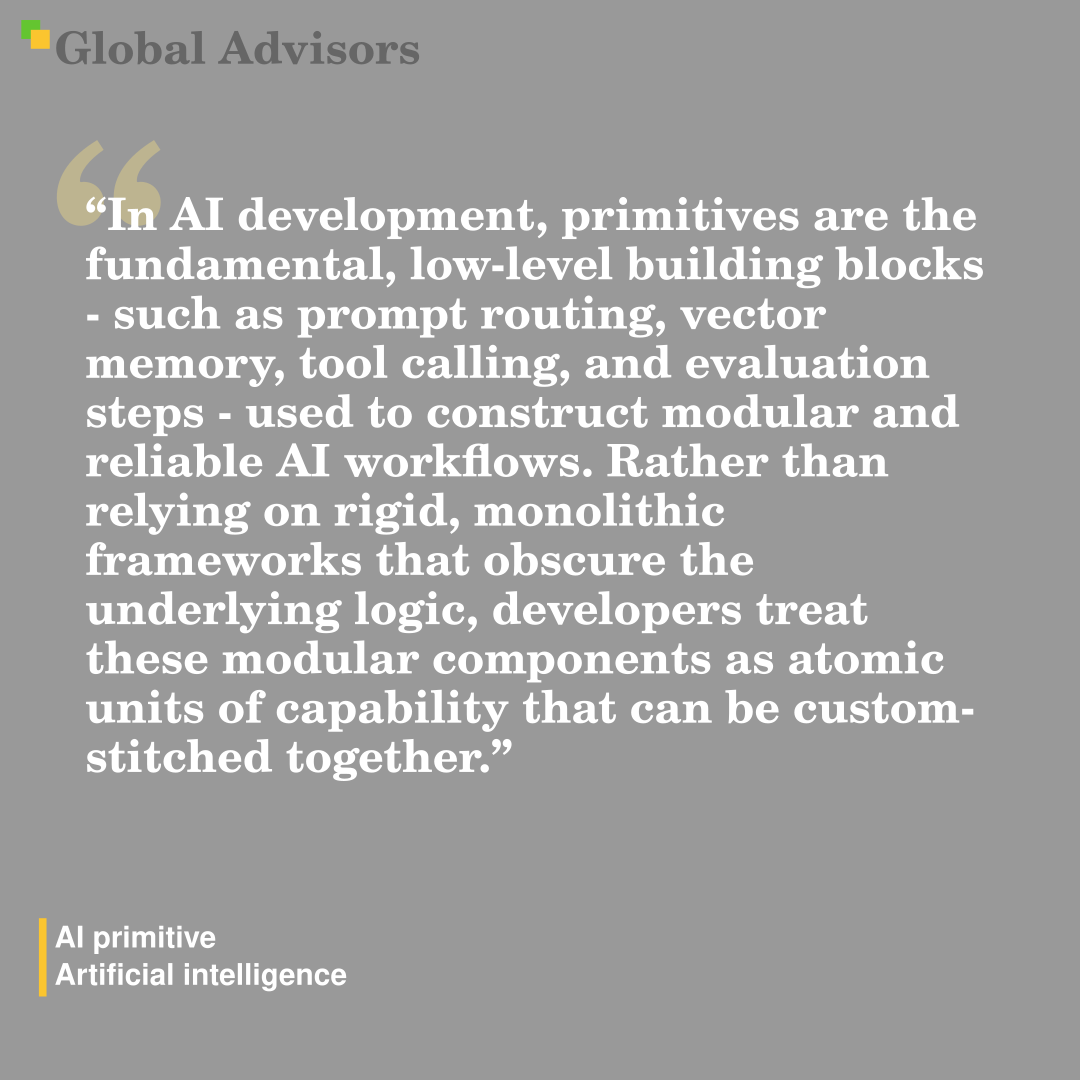
Term: AI primitive - Artificial intelligence"In AI development, primitives are the fundamental, low-level building blocks - such as prompt routing, vector memory, tool calling, and evaluation steps - used to construct modular and reliable AI workflows. Rather than relying on rigid, monolithic frameworks that obscure the underlying logic, developers treat these modular components as atomic units of capability that can be custom-stitched together." - AI primitive - Artificial intelligence Reliable AI applications are assembled from decisions that can be inspected, tested, replaced, and governed independently. A model may generate language, but production behaviour depends on the surrounding mechanisms that select context, invoke services, preserve state, constrain actions, and check results. Treating these mechanisms as modular units changes development from configuring one opaque application into designing a system whose capabilities and failure modes can be examined piece by piece. An AI primitive is therefore a small, reusable unit of capability or control in an artificial intelligence workflow. It need not be a single software function, and it is not necessarily tied to one vendor or model. A retrieval operation, a prompt selector, a structured-output validator, a tool interface, a memory store, a human approval gate, and an evaluation routine can each serve as a primitive when it has a clear purpose and boundary. The useful test is practical: can the component be understood, measured, substituted, and composed with others without rewriting the whole application? This approach distinguishes a capability from a framework. A framework supplies conventions, abstractions, integrations, and often a ready-made execution model. It can accelerate prototyping, but it may also conceal control flow and make debugging dependent on framework-specific behaviour. Primitives expose more of the underlying logic. Developers can use a simple sequence of model calls and ordinary program code when that is sufficient, then add routing, retrieval, tools, or longer-running loops only where the task requires them. Research and engineering guidance similarly distinguishes predictable workflows, in which code determines the path, from agents, in which a model dynamically selects actions. How the building blocks work together Prompt routing is a decision layer that directs an input to an appropriate instruction set, model, tool chain, or level of scrutiny. A classifier might send a billing query to a narrow workflow and a complex research request to a more capable one. Routing can reduce cost and latency, but it introduces its own risks: ambiguous requests may be assigned to the wrong path, and a routing model can become a hidden source of bias or inconsistency. Its quality must therefore be assessed separately from the quality of the downstream response. Vector memory is another common primitive. Documents, records, or prior interactions are converted into numerical representations and stored so that semantically related material can be retrieved later. Retrieval can improve factual grounding without retraining the main model, yet similarity is not the same as relevance. A system may retrieve outdated, duplicated, sensitive, or misleading material. Effective designs combine semantic search with metadata filters, access controls, freshness rules, and explicit handling for cases in which no trustworthy source is found. Tool calling connects a model to external operations such as databases, calculators, search services, code execution, or transactional systems. The interface should specify the permitted inputs, outputs, permissions, error states, and side effects. Documentation is not cosmetic: the model uses the available description to decide whether and how to invoke a tool, so vague names and broad schemas can produce unreliable actions. Anthropic recommends testing tool use systematically and measuring not only task success but also tool errors, runtime, call volume, and token consumption. Memory, tools, and retrieval also create a boundary between language generation and real-world consequence. A generated answer can be corrected in conversation; an unauthorised database update or financial transaction may be difficult to reverse. Strong systems separate read operations from write operations, limit credentials, validate arguments in deterministic code, and place approval gates around consequential actions. Sandboxed testing and explicit guardrails are especially important when an agent can alter files, call external services, or continue through multiple steps. Specification, composition, and evaluation Composition is valuable because different tasks need different arrangements. A sequential workflow may retrieve evidence, draft an answer, verify citations, and format the result. Parallel branches may ask several specialised components to inspect the same input before an aggregator reconciles them. An evaluator-optimiser pattern can generate an output, score it against defined criteria, and revise it. These patterns are not automatically superior to a single model call. Added steps increase latency, cost, state-management complexity, and the number of places where errors can accumulate. The appropriate architecture is the simplest one that meets the required quality and control level. Evaluation is itself a primitive rather than a final ceremonial check. A useful evaluation defines realistic tasks, observable success criteria, representative edge cases, and a repeatable grading method. Code-based tests are suitable for exact formats and executable outcomes; model-based graders can assess open-ended quality; human review remains important where context, fairness, safety, or professional judgement matter. Anthropic describes agent evaluation as requiring an environment in which the system can use its tools and produce an outcome that can be checked, rather than merely generating an attractive response. Formally, a workflow can be viewed as a composition of functions, where each component transforms a state into a new state: . Here is the system state at step , is the relevant input or observation, and is a primitive such as retrieval, routing, generation, validation, or tool execution. If the final outcome is scored by an evaluation function , where is the produced result and is the target outcome, improvement requires measuring how changes to individual affect quality, cost, latency, and risk. The notation does not make the system reliable by itself; it clarifies where reliability can be tested. Competing design philosophies One school favours high-level platforms and opinionated frameworks. Their advantage is speed: standard connectors, tracing, memory abstractions, retries, and agent loops can be assembled quickly, allowing teams to validate a use case before building infrastructure. Another school favours minimal orchestration and explicit code. Its priorities are transparency, portability, predictable control flow, and freedom from abstractions that may become difficult to replace. A third position treats the choice as conditional. High-level components are useful when they reduce undifferentiated engineering work, but core decisions should remain visible enough to audit and test. The main tension is not frameworks versus no frameworks. It is convenience versus control. A reusable primitive can reduce duplication, yet excessive fragmentation can create an architecture that is hard to understand and expensive to observe. Stable interfaces are essential: each component should state its contract, assumptions, failure behaviour, security requirements, and performance expectations. Versioning matters as well, because changes to a prompt, embedding model, retrieval index, tool schema, or evaluator can alter downstream behaviour even when application code remains unchanged. Governance must follow the same modular logic. NIST's AI Risk Management Framework organises practical risk work around governing, mapping, measuring, and managing risks, and recommends testing before deployment and during operation. Its generative AI profile adds emphasis on ongoing monitoring, documented evaluation, incident response, and review of risk controls. These recommendations reinforce a central implication of primitive-based design: quality, safety, provenance, and access control should be observable at the points where decisions and actions occur, not inferred only from the final text. The concept remains important because model capability alone does not determine system performance. Organisations need to replace models, update knowledge, introduce new tools, control costs, and adapt to changing regulations without rebuilding every application. Modular primitives make those changes technically possible and analytically legible. They also expose a less comfortable truth: composability does not remove risk. It distributes risk across interfaces, state transitions, permissions, data sources, and evaluation gaps. The strongest AI systems therefore combine small, explicit building blocks with disciplined testing, constrained authority, production monitoring, and human oversight where consequences warrant it.
|
| |
| |
Riyadh airport closure extended after Houthi attacksThe Global Advisors Daily Business News briefing for 13 October 2026, hosted by Sam. Ten headlines shaping markets, technology and corporate strategy, with context on the stories that matter. Read the full newsletter: https://with.ga/pgcem In this edition: - Hyperscalers Accelerate Proprietary AI Chip Deployments to Curtail Nvidia Dependency Amid Capital Bottlenecks Follow the daily podcast on Spotify: https://with.ga/spotnews Subscribe to the daily podcast on YouTube: https://with.ga/ytnews Get free daily updates on WhatsApp: https://with.ga/wa Read the full briefing and explore our strategy insights: https://globaladvisors.biz Follow on Spotify: https://with.ga/spotnews |
| |
| |
|


| |
| |