| |
|

| |
| |
| |
|
A daily bite-size selection of top business content. |
| |
| |
| |
Quote: Jennifer Garner - Actress and Entrepreneur"Guilt cannot be part of friendships. Friendships have to have grace." - Jennifer Garner - Actress and Entrepreneur Friendship becomes fragile when care is converted into an account of debts, failures, and emotional obligations. Guilt can acknowledge harm and motivate repair, but it can also make intimacy feel like a tribunal in which every missed call, cancelled plan, or imperfect response becomes evidence of moral failure. The distinction matters because friendships are voluntary relationships, sustained not by contract but by repeated acts of trust, understanding, and choice. Grace does not erase responsibility; it prevents responsibility from becoming the only language available between people. There is a useful tension here. Guilt is not inherently destructive. Psychological research describes it as a social and other-oriented emotion that can encourage repair and pro-social behaviour, particularly when someone recognises that their actions have affected another person . A sincere apology, an attempt to make amends, or a change in conduct may all begin with discomfort. Without some capacity to feel regret, friendship can become a place where harm is denied and injured people are expected to remain endlessly accommodating. The problem begins when guilt moves beyond a specific action and becomes a judgement about the whole person. Saying that a friend was hurt by a forgotten birthday is different from treating the friend as selfish, unreliable, or unworthy of closeness. The first statement identifies an event that can be discussed and repaired. The second turns the relationship into a verdict. Grace creates room between those positions: it allows a person to admit the failure without being reduced to it, and allows the injured friend to express pain without demanding permanent punishment. Why friendship needs a different moral rhythm Romantic partnerships and family relationships often carry explicit duties, legal ties, or established routines. Friendships usually operate with less formal structure, which makes them both liberating and vulnerable. A friend may be deeply important while remaining outside the practical architecture of daily life. Work, parenthood, illness, distance, grief, and financial pressure can interrupt contact without necessarily ending affection. Treating every interruption as betrayal mistakes consistency of communication for consistency of care. That does not mean friendship should excuse indifference. Research on wrongdoing between friends shows that forgiveness and unforgiveness are distinct responses, and that forgiving someone does not necessarily restore the relationship to its former condition . A person can release the desire for revenge while still changing the level of trust they offer. Grace therefore differs from automatic reconciliation. It may mean allowing a friendship to continue with clearer boundaries, slower rebuilding, or a more honest recognition of what the relationship can now support. The social function of guilt also explains why close friendships can feel especially intense after conflict. Studies of friends and strangers found that people who felt guilty were motivated to repair wrongdoing, while observers sometimes punished guilty close friends more strongly than acquaintances . Emotional closeness raises the stakes. A friend who has disappointed us matters enough to hurt us, and their visible remorse can paradoxically make the offence feel more serious. The desire for accountability can then become entangled with the desire to see the other person suffer. Grace is not permission to avoid accountability Grace works best when paired with accurate naming. A friend cannot repair what remains vague, and a relationship cannot become safer if the injured person must disguise their experience to appear forgiving. Useful conversations often involve three separate questions: what happened, how it affected each person, and what needs to change. This structure avoids the two most common extremes, namely total self-condemnation and total defensiveness. It also gives an apology a practical purpose rather than reducing it to a ritual phrase. An apology is more credible when it recognises the specific harm, avoids unnecessary excuses, and identifies a future action. If a friend repeatedly cancels at the last minute, grace may make room for the possibility that life has become difficult. Accountability still requires a conversation about reliability and expectations. The result might be a different way of making plans, a willingness to give earlier notice, or an agreement that some invitations should not be accepted unless they can genuinely be kept. Grace also has an inward dimension. People who are habitually guilty often believe that self-punishment proves their love. They apologise repeatedly, reject reassurance, and keep reopening an incident after the other person has accepted repair. That pattern can transfer emotional labour to the friend who was hurt, who must then comfort the person responsible. Genuine remorse is oriented towards the injured person and the future of the relationship; shame is often oriented towards defending a damaged self-image. The strategic value of leaving room In practical terms, friendships need slack. A relationship with no tolerance for delay, awkwardness, changing priorities, or imperfect communication becomes efficient only by becoming brittle. The strongest friendships are not those in which nothing goes wrong, but those in which difficulties can be discussed without threatening immediate extinction. This does not require unlimited access or endless patience. It requires an understanding that people are larger than their worst week and that closeness cannot be measured solely through performance. That principle has particular relevance as adults move through different life stages. Friends may be separated by geography, careers, caring responsibilities, health problems, or bereavement. Jennifer Garner has spoken publicly about friendship as something that requires intention, while also arguing for room to give oneself and friends grace . Her comments connect emotional generosity with practical effort: grace is not passive sentiment, but the willingness to make contact, acknowledge distance, and create a route back into conversation. There are limits, however. Grace should not be used to keep a person attached to manipulation, contempt, coercion, or repeated betrayal. Research on forgiveness in friendship recognises that even when an offence is forgiven, long-term changes in how the offender is viewed may remain . A generous response can include ending the friendship, reducing contact, or declining to offer the same trust again. The moral test is not whether the relationship survives at any cost, but whether both people can participate without fear, humiliation, or chronic emotional accounting. What the principle asks of both friends For the person who caused harm, the task is to replace guilt with responsibility. That means listening without insisting on immediate absolution, apologising without making the injured friend manage the conversation, and accepting that repair may be gradual. For the person who was hurt, the task is to distinguish a repairable failure from a pattern that makes closeness unsafe. Grace does not demand that pain be hidden. It asks whether the response can be proportionate, truthful, and directed towards a workable future. Friendship survives through this combination of candour and mercy. Guilt may open the door to repair, but grace determines whether the conversation can continue after the apology. It protects people from being trapped in fixed roles: the guilty one, the injured one, the disappointing one, or the unforgiving one. When friends can acknowledge harm without turning each other into permanent moral cases, they gain something more durable than innocence. They gain a relationship capable of bearing ordinary human imperfection while still taking love seriously.
|
| |

| |
Brent crude touches 110 dollars as Hormuz attacks escalateThe Global Advisors Daily Business News briefing for 17 October 2026, hosted by Sam. Ten headlines shaping markets, technology and corporate strategy, with context on the stories that matter. Read the full newsletter: https://globaladvisors.biz/?p=3167525 In this edition: - CoreWeave Shares Plunge as Surging Bond Yields Expose AI Debt-Financing Pressures Follow the daily podcast on Spotify: https://with.ga/spotnews Get free daily updates on WhatsApp: https://with.ga/wa |
| |
| |
Global Advisors News Brief - October 17 2026Read the full brief at the link Headlines for the last 24hrs
Time window: 2026-10-16T03:30:33.093Z to 2026-10-17T03:30:33.093Z |
| |
| |
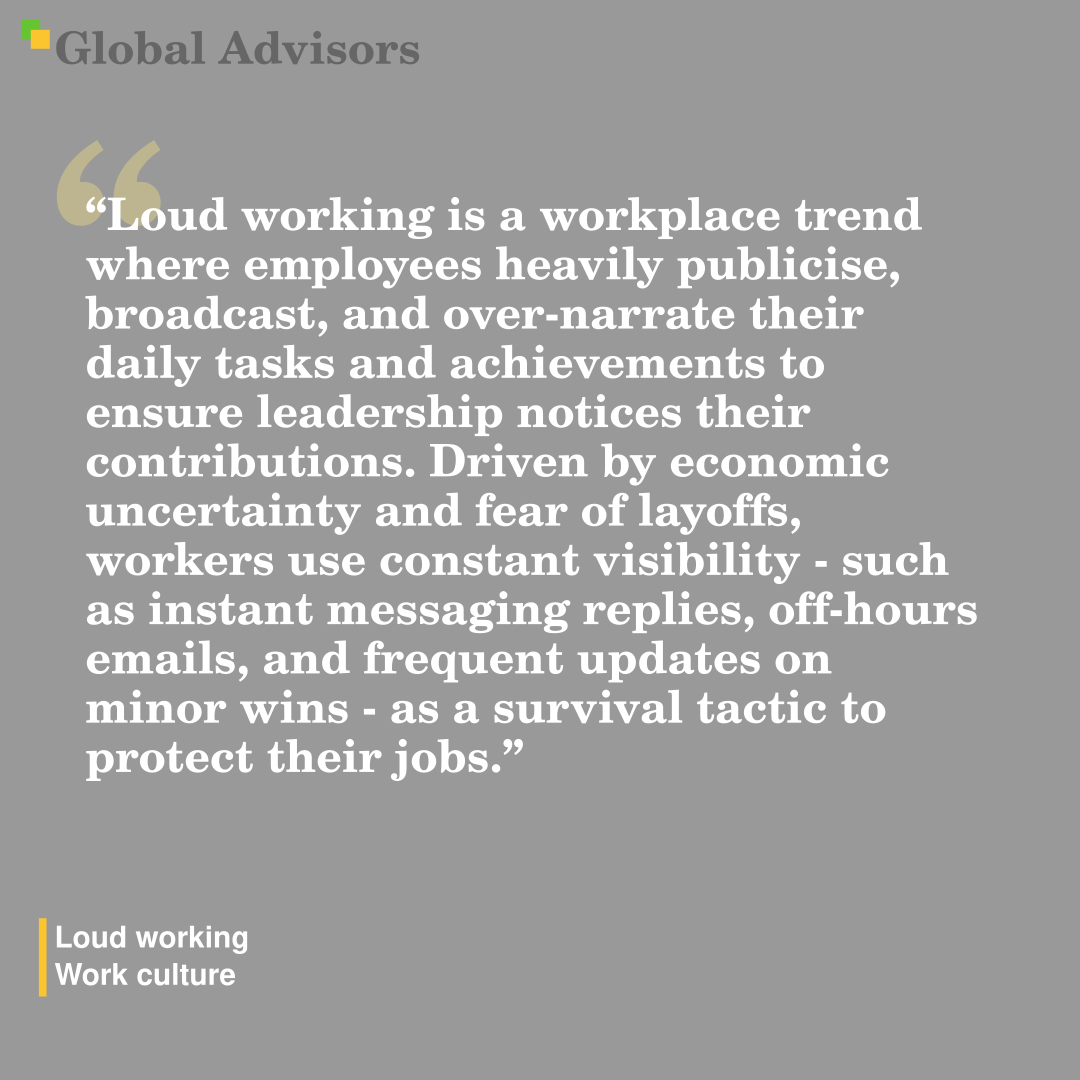
Term: Loud working - Work culture"Loud working is a workplace trend where employees heavily publicise, broadcast, and over-narrate their daily tasks and achievements to ensure leadership notices their contributions. Driven by economic uncertainty and fear of layoffs, workers use constant visibility - such as instant messaging replies, off-hours emails, and frequent updates on minor wins - as a survival tactic to protect their jobs." - Loud working - Work culture Visibility can protect a contribution from being overlooked, but it can also turn ordinary work into a continuous performance. When employees feel that redundancy decisions, promotions, and access to senior leaders depend on being remembered, they may devote time to narrating activity rather than improving outcomes. The result is a workplace where responsiveness, presence, and self-promotion become informal signals of value, even when they are weak measures of contribution . The behaviour usually appears through frequent progress updates, highly visible instant-message replies, emails sent outside normal hours, meeting interventions, public task lists, and announcements of minor accomplishments. Some employees deliberately choose projects with senior exposure or build a personal brand on professional platforms. These actions are not identical: a concise update that clarifies ownership can improve coordination, while a stream of low-value messages can create noise. The defining feature is not communication itself but the pressure to make work continually observable. This pressure is intensified by economic insecurity. The supplied account links the trend to fears of layoffs and a more difficult job market, while recent reporting describes employees concentrating more effort on demonstrating value inside organisations where they already work . Visibility becomes a form of insurance, although it cannot guarantee employment. Restructuring decisions may reflect budgets, strategy, acquisitions, automation, geography, or managerial preferences that an individual employee cannot control. Treating self-promotion as protection therefore risks giving workers responsibility for structural decisions. Why visibility becomes a proxy for performance Managers rarely observe every important contribution directly, particularly in hybrid and remote teams. They often rely on memorable examples, recent interactions, and signals of availability when forming judgements. This creates a measurement problem: observable activity is easier to recall than prevention, careful analysis, maintenance, or work whose benefits appear months later. Survey reporting from MyPerfectResume found that 70% of United States workers believed highly visible employees were rewarded more than colleagues who quietly produced strong results, while 82% had at least occasionally worried that appearing idle could harm job security or career growth . These figures measure perceptions rather than verified promotion or redundancy outcomes, but perceptions alone can alter behaviour. The incentive can be expressed as a simple trade-off. Let represent perceived visibility, represent substantive impact, and represent time available for useful work. If employees believe evaluation depends on a weighted combination , with larger than , increasing visible activity may appear rational even when it reduces impact. If appearance management consumes units of time, productive capacity becomes . The organisational danger arises when leaders reward without checking whether it is associated with customer value, quality, risk reduction, learning, or completed outcomes. Research and commentary on productivity theatre describe similar behaviour, including taking extra tasks for exposure, staying late to be noticed, joining meetings for presence, and prioritising speed of response over durable results . These activities may sometimes be useful, but their value depends on context. Immediate replies can prevent delays in a crisis; outside-hours messages can be necessary across time zones; public recognition can help a team learn. The problem begins when such signals become compulsory demonstrations rather than proportionate tools for coordination. The tension between healthy advocacy and performance theatre A strong distinction separates responsible self-advocacy from loud working. Responsible advocacy makes outcomes legible: it states what changed, why it mattered, what evidence supports the claim, and which colleagues contributed. It does not imply that constant availability proves commitment. Performance theatre, by contrast, maximises the appearance of effort, often through repetition, exaggerated urgency, or activity that has little relationship to organisational priorities. The same message can therefore be constructive or performative depending on whether it enables a decision, records an outcome, or merely signals busyness. The trend also exposes unequal access to visibility. Employees with caring responsibilities, disabilities, demanding operational roles, or cultural preferences for measured communication may be less likely to perform availability in public channels. People working behind the scenes can create essential infrastructure while receiving little recognition. If managers confuse vocality with leadership, they may disadvantage precisely those employees whose work is reliable, technical, or collaborative. A visibility culture can therefore reproduce inequalities while presenting its judgements as meritocratic. There is a personal cost to maintaining the signal. After-hours digital communication has been associated with emotional exhaustion and negative extra-role behaviours in research involving full-time employees . The mechanism is credible: each message extends cognitive availability, blurs recovery time, and creates uncertainty about whether silence will be interpreted as disengagement. Over time, workers may answer faster, attend more meetings, and take on more visible tasks while losing the concentration required for complex work. A culture that rewards permanent reachability can consequently undermine the performance it claims to measure. What better management looks like Organisations can reduce the incentive for loud working by defining outcomes before activity begins. A useful performance system combines deliverables, quality, customer or stakeholder effects, collaboration, and learning. Managers should ask what was completed, what evidence shows its value, what risks were avoided, and what dependencies were resolved. These questions make invisible work discussable without demanding a constant broadcast. They also help distinguish a short, informative update from a long stream of status signals. Evaluation should use multiple time horizons. Recent visibility can be useful for identifying emerging problems, but promotion and redundancy decisions should draw on documented results over an appropriate period and input from people who understand the work. Clear criteria are particularly important during restructuring, when rumours and selective attention magnify insecurity. Leaders should explain which business factors drive decisions without implying that more messages, longer hours, or physical presence can guarantee protection. Employees still need practical ways to make their contribution legible. A monthly record of completed work, decisions influenced, measurable improvements, lessons learned, and feedback received is more defensible than continuous self-advertising. Updates should be audience-specific: senior leaders need strategic implications, collaborators need dependencies, and managers need evidence against agreed objectives. The aim is not silence but signal quality. Loud working persists because visibility solves a real coordination and recognition problem, yet solving it through constant performance transfers the cost to attention, wellbeing, and trust.
|
| |
| |
CoreWeave credit swaps flash distress on debt concernsThe Global Advisors Daily Business News briefing for 16 October 2026, hosted by Sam. Ten headlines shaping markets, technology and corporate strategy, with context on the stories that matter. Read the full newsletter: https://globaladvisors.biz/?p=3167515 In this edition: - CoreWeave Credit Default Swaps Top 1,000 Basis Points as AI Debt Scrutiny Mounts Follow the daily podcast on Spotify: https://with.ga/spotnews Get free daily updates on WhatsApp: https://with.ga/wa |
| |
| |
Global Advisors News Brief - October 16 2026Read the full brief at the link Headlines for the last 24hrs
Time window: 2026-10-15T03:30:33.111Z to 2026-10-16T03:30:33.111Z |
| |
| |
Quote: Warren Thompson - President and Chairman of the board of Thompson Hospitality"Everybody's got to be a perceived winner in the deal or it's not going to work." - Warren Thompson - President and Chairman of the board of Thompson Hospitality Successful negotiation depends on more than extracting the highest immediate value. A transaction must also leave each participant with a credible reason to defend the decision after signing. That reason may be financial, strategic, reputational, operational or personal, but without it even a technically attractive agreement can become fragile. Parties that feel defeated tend to search for ways to recover their position, whether by slowing implementation, withholding cooperation, reopening settled points or abandoning the relationship at the first opportunity. The practical meaning is not that every side receives identical value. Commercial agreements rarely produce perfect symmetry, and one party may contribute more capital, assume greater risk or possess stronger alternatives. The requirement is perceived legitimacy: each participant must believe the exchange improves its position relative to the available alternatives. A buyer may accept a higher price because the asset accelerates growth. A seller may accept less cash because certainty, speed or a continuing partnership matters more. An employee may accept a demanding role because it offers authority and development. The visible terms are only part of the bargain. This distinction between objective value and perceived value is central to deal-making. Objective value concerns measurable outcomes such as price, margin, ownership and risk allocation. Perceived value includes the story each side tells about why the agreement is sensible. People do not evaluate transactions as detached calculators. They assess fairness, status, control, reciprocity and whether the other side has respected their contribution. A concession that costs little to the giver can carry substantial symbolic value to the recipient, while a concession that appears generous on paper can feel insulting if it removes autonomy or implies distrust. From restaurant purchase to strategic partnership Warren Thompson's business history gives the principle a practical setting. After nine years at Marriott, he pursued the acquisition of restaurants that the company was divesting. In 1992, he completed a leveraged buyout of 31 Big Boy restaurants in the Washington, DC, market and converted most of them to Shoney's locations, using his experience, personal capital and external backing to build a new company. Thompson Hospitality later expanded beyond restaurants into contract food service, facilities management and hotels, while a 1997 strategic partnership with Compass Group supplied the reach and capabilities of a much larger operator. That path also shows why a winning deal is not the same as a deal that performs perfectly from the outset. The restaurant conversion strategy encountered difficulties, and the company moved towards contract food service sooner than originally planned. Unprofitable restaurants were sold to reduce debt, while the business developed a more diversified model. The lesson is significant: mutual advantage does not eliminate uncertainty or guarantee that the original plan will work. It creates enough alignment for the parties to manage setbacks without immediately treating every problem as evidence of bad faith. In a partnership, perceived victory can come from different sources. A large corporation may value a local operator's relationships, entrepreneurial energy and market knowledge. A smaller enterprise may value access to capital, systems, purchasing power and institutional credibility. The parties do not need the same objectives; they need compatible objectives. Thompson Hospitality's association with Compass illustrates how scale and ownership can be combined rather than treated as mutually exclusive. The partnership gave each side a reason to participate, provided the arrangement preserved meaningful benefits for both. The danger of creating losers Negotiators often focus on winning the meeting rather than sustaining the agreement. Aggressive tactics can produce a favourable headline price, but they may also create resentment, hidden resistance and reputational damage. A supplier forced below viable economics may reduce service quality. An acquired team that feels humiliated may leave. A joint-venture partner that believes it was outmanoeuvred may protect information and limit future opportunities. In each case, the apparent victory transfers costs into the implementation stage. There is also a difference between hard bargaining and making the other side feel defeated. Hard bargaining tests assumptions, insists on evidence and protects legitimate interests. Defeat-oriented bargaining uses pressure to diminish the other party's agency. The first can clarify value; the second can turn a commercial disagreement into a status contest. Once status is involved, a rational settlement becomes harder because the parties may prefer a costly delay to accepting an outcome that appears humiliating. Critics may argue that the language of mutual winners disguises unequal power. That objection is valid. A party with no realistic alternative cannot always negotiate a genuinely beneficial outcome, and describing a coercive arrangement as a win does not make it fair. The principle therefore works best when paired with transparency, competition, legal protection and a serious assessment of alternatives. It should not be used to pressure weaker participants into accepting terms that merely sound positive. Perception matters, but perception cannot substitute for adequate value or informed consent. Turning the principle into practice Effective negotiators begin by identifying what each side is actually trying to protect. The stated demand may be price, yet the underlying priority could be cash certainty, timing, control, confidentiality, employment continuity or access to a new market. Separating positions from interests creates room for trades. One party may concede on timing in exchange for stronger payment security; another may accept a narrower territorial right in exchange for renewal options. The agreement improves when low-cost concessions are exchanged for high-value outcomes. It is also useful to define success before negotiations become adversarial. Each side should know its minimum acceptable outcome, preferred outcome and credible alternative. Those boundaries reduce the temptation to accept an attractive but unstable compromise. They also make it easier to explain the final agreement internally. A transaction is stronger when decision-makers can show not only what they obtained, but why the trade-offs were reasonable given the available choices. Implementation should be treated as part of the negotiation rather than an administrative afterthought. Clear responsibilities, review points, dispute procedures and measures of performance help preserve the sense of fairness after signing. Early wins can be deliberately designed, especially in partnerships where trust is still developing. Small delivered commitments provide evidence that the other side is not merely claiming to be a winner; it is making the promised benefits real. The wider significance extends beyond corporate transactions. Hiring, procurement, investment, franchising and community partnerships all rely on continuing cooperation. Thompson's career shows how a difficult initial move can evolve through adaptation, diversification and carefully chosen alliances. The strongest deal-makers therefore judge success twice: first by the terms secured, and later by whether the relationship remains productive. A transaction becomes durable when every participant can defend it as a sensible decision, see a path to future value and recognise that cooperation offers more than retaliation. That is the practical standard behind a deal in which everyone can credibly regard themselves as a winner.
|
| |

| |
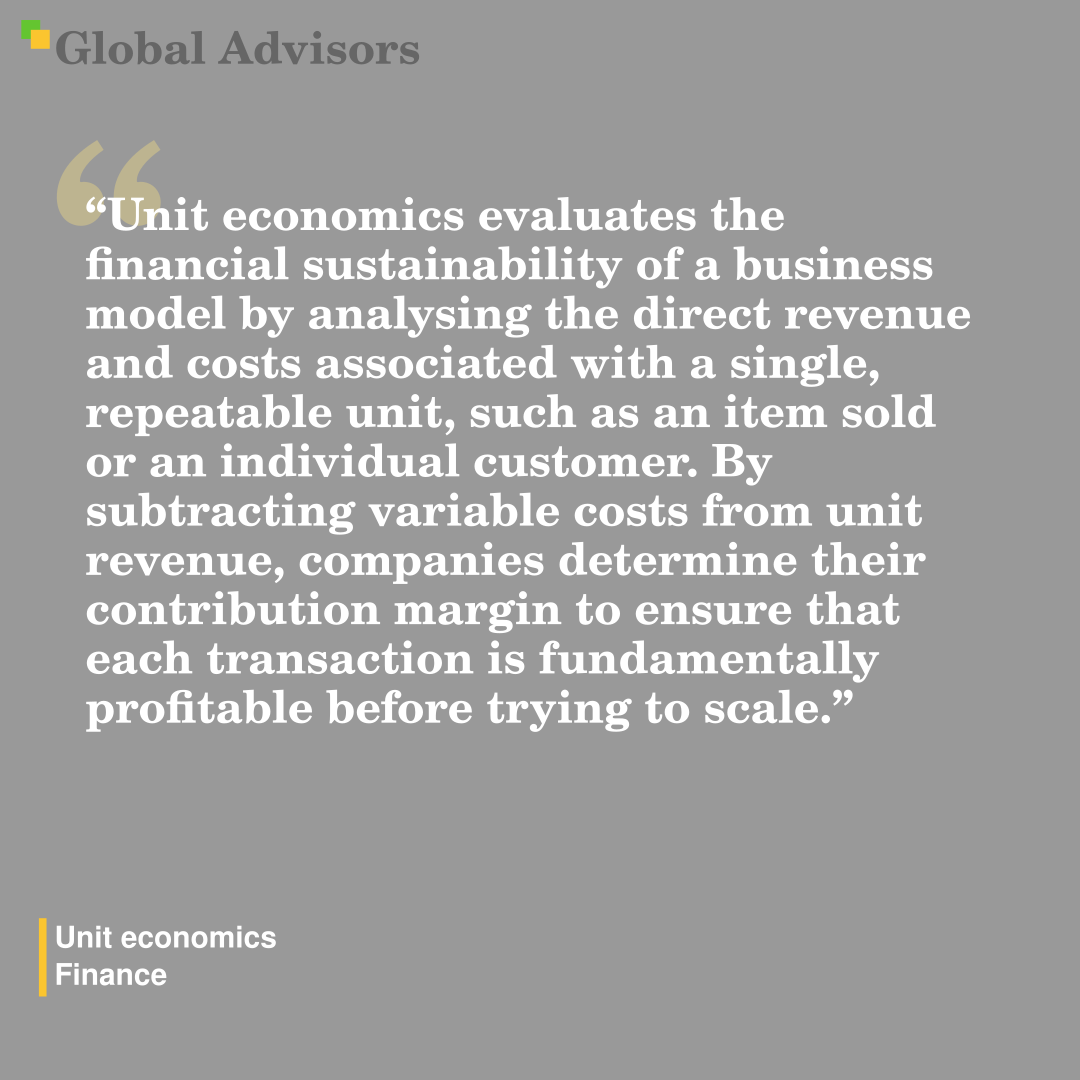
Term: Unit economics - Finance"Unit economics evaluates the financial sustainability of a business model by analysing the direct revenue and costs associated with a single, repeatable unit, such as an item sold or an individual customer. By subtracting variable costs from unit revenue, companies determine their contribution margin to ensure that each transaction is fundamentally profitable before trying to scale." - Unit economics - Finance Growth does not repair a weak commercial engine. If each additional sale consumes as much cash as it creates, higher volume can enlarge losses, increase working-capital pressure and conceal poor pricing behind impressive revenue figures. Unit economics therefore supplies a disciplined test: does a repeatable transaction create economic value before the business carries the burden of its wider organisation? The unit may be an order, subscription, delivery, customer, loan or completed project, but the choice must match how the business actually earns and spends money. The analysis starts with revenue attributable to that unit and deducts costs that change because the unit is delivered. These can include materials, payment processing, fulfilment, usage-based hosting, delivery, refunds, sales commissions and customer support where support rises with usage. The result is contribution margin, the cash contribution available to cover fixed costs and eventually produce operating profit. Accounting classifications require judgement because a cost can be fixed over one activity range and variable over another. From revenue to contribution A useful specification is , where denotes contribution margin per unit, unit revenue and variable cost per unit. The contribution margin ratio is . If a product sells for 80 and incurs 50 of variable cost, its contribution is 30 and its contribution margin ratio is 37,5 percent. That figure is not net profit: rent, permanent salaries, product development, insurance, financing and other fixed or semi-fixed costs still have to be paid. At company level, the same logic is expressed as , where is operating profit, the number of units sold and total fixed costs. The break-even volume is , while break-even revenue is . These relationships underpin cost-volume-profit analysis, which examines how price, volume, variable cost and fixed cost affect profit. They are decision tools rather than forecasts, because their basic assumptions include stable prices, linear cost behaviour and a relevant operating range. Customer economics and time For recurring or relationship-based businesses, a single transaction is rarely enough. The relevant unit may be a customer over an observed period, with revenue adjusted for churn, discounts, bad debt and refunds. A simplified customer contribution measure can be written as , where and are customer revenue and variable cost in period , and is customer acquisition cost. Acquisition spending should be included when asking whether growth is self-funding, even though it may be paid before the customer generates revenue. Lifetime value is often presented as a single number, but it is better treated as a distribution of possible outcomes. Retention, expansion, price changes, service intensity and payment behaviour all vary across cohorts. A rough subscription approximation might use , where is average revenue per user, the contribution margin ratio and the periodic customer loss rate. The approximation becomes unreliable when churn is not constant, customer lifetimes are censored, or acquisition channels produce materially different cohorts. Wise describes unit economics through the practical question of what is earned from each customer or sale after the costs required to obtain and serve it, but that simplicity should not be mistaken for measurement precision. Why scale can help or hurt Positive unit economics is necessary but not sufficient for a viable business. A company can earn contribution on every order and still fail because fixed costs are excessive, cash conversion is slow, inventory is obsolete or acquisition requires continuing subsidies. Conversely, a temporarily negative contribution may be rational when an introductory offer creates durable retention, provided the future economics are evidenced rather than assumed. The key distinction is between a loss caused by planned investment in scalable capacity and a loss embedded in the transaction itself. Operating leverage makes this distinction more consequential. When fixed costs dominate, additional contribution after break-even can increase profit rapidly, but a downturn can reverse that effect just as quickly. Sources on cost-volume-profit analysis note that fixed costs remain constant in total only within a relevant range, while variable costs generally change with activity. Capacity constraints, overtime, cloud usage tiers, logistics congestion and support queues can therefore create step changes that a simple per-unit average obscures. A model should test marginal economics at the next volume level, not merely report historical averages. Schools of thought and measurement disputes Management accounting traditionally emphasises contribution margin and break-even analysis. This approach is useful for pricing, product mix and short-run decisions because it separates cost behaviour and shows how sales contribute towards fixed expenditure. The accounting perspective also warns against allocating fixed costs mechanically to individual units when those allocations do not change with the decision. The relevant question is usually whether a cost is avoidable or incremental, not whether an accounting system assigns it to the product. Venture and growth analysis adds customer acquisition, retention and payback. Its attraction is that it links marketing investment with future revenue, but it introduces more assumptions. A reported customer acquisition cost can understate reality if brand expenditure, sales salaries, partner commissions or onboarding labour are excluded. Lifetime value can be overstated by projecting early retention indefinitely. Cohort analysis, contribution after fulfilment and cash payback are stronger safeguards than a headline ratio. The underlying debate is not whether one metric is correct, but which costs and time horizon answer the decision being made. Practical use and enduring relevance A robust analysis begins by defining the unit and decision horizon, then reconciling operational data with the general ledger. Revenue should be net of discounts, returns, taxes collected on behalf of authorities and doubtful receipts where relevant. Variable costs should reflect the resources consumed to deliver the sale, including expected refunds and service obligations. Results should then be segmented by product, channel, geography, customer type and acquisition cohort. Aggregated averages can hide profitable customers subsidising loss-making ones. The framework matters because it disciplines the seductive equation of scale with success. Before expanding capacity, cutting price or increasing advertising, management can ask whether the incremental unit improves contribution, how quickly acquisition spend is recovered, which assumptions are most fragile and what fixed-cost threshold must be covered. Contribution margin and break-even analysis remain simplified models, and their limitations are well documented, particularly where cost behaviour is nonlinear or product mix changes. Used with cohort evidence, cash-flow analysis and sensitivity testing, unit economics becomes more than a finance ratio: it is a practical method for deciding which growth is valuable, which growth is subsidised and which growth should be stopped.
|
| |
| |
US inflation jump revives interest rate hike fearsThe Global Advisors Daily Business News briefing for 15 October 2026, hosted by Sam. Ten headlines shaping markets, technology and corporate strategy, with context on the stories that matter. Read the full newsletter: https://with.ga/ec7b2 In this edition: - Anthropic Revenue Surges to $16.8 Billion in Third Quarter Ahead of Planned Public Listing Follow the daily podcast on Spotify: https://with.ga/spotnews Get free daily updates on WhatsApp: https://with.ga/wa |
| |
| |
Global Advisors News Brief - October 15 2026Read the full brief at the link Headlines for the last 24hrs
Time window: 2026-10-14T03:30:33.080Z to 2026-10-15T03:30:33.080Z |
| |
| |
|


| |
| |