| |
|

| |
| |
| |
|
A daily bite-size selection of top business content. |
| |
| |
| |
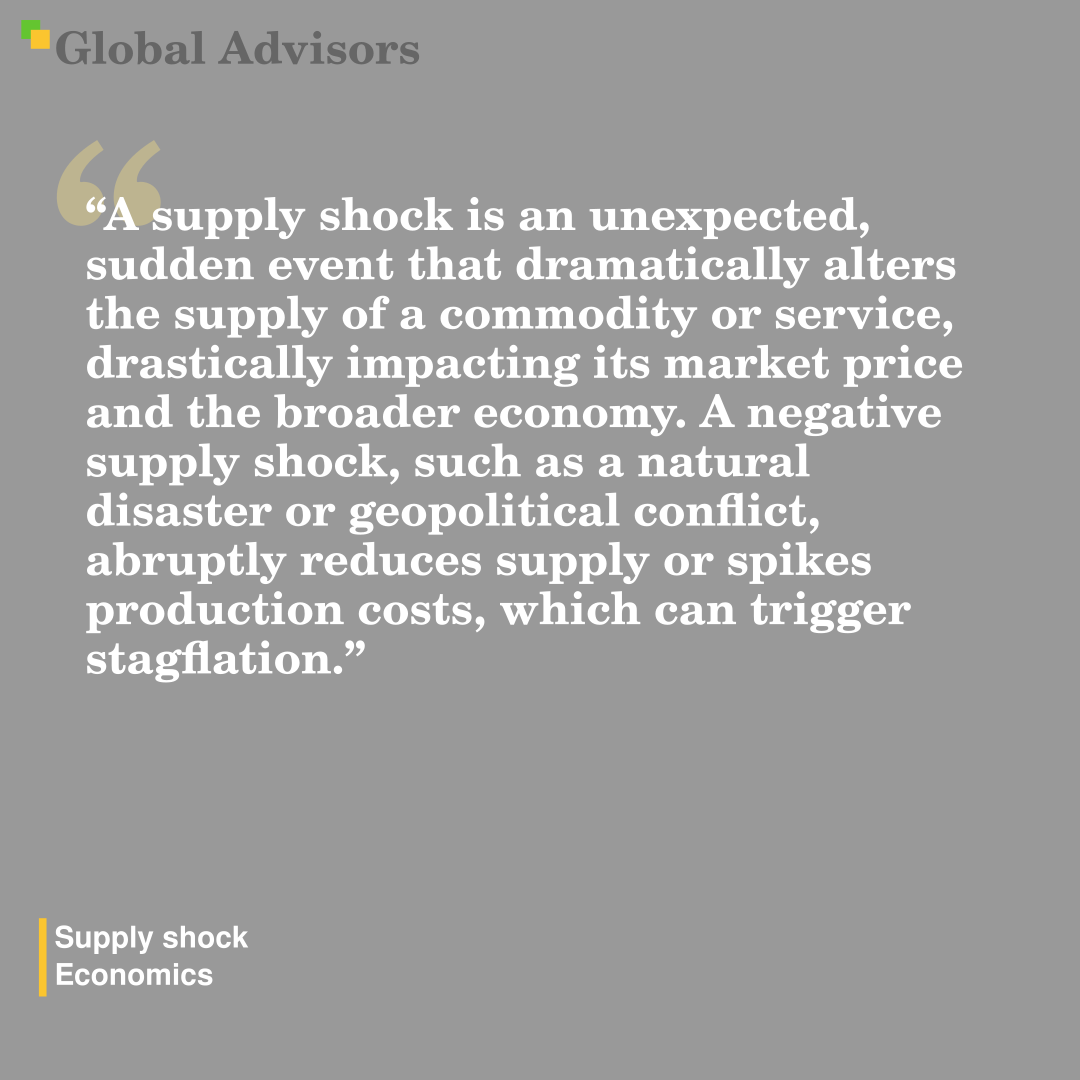
Term: Supply shock - Economics"A supply shock is an unexpected, sudden event that dramatically alters the supply of a commodity or service, drastically impacting its market price and the broader economy. A negative supply shock, such as a natural disaster or geopolitical conflict, abruptly reduces supply or spikes production costs, which can trigger stagflation." - Supply shock - Economics When a vital input becomes scarce, an economy faces more than a temporary price movement. Its productive system must either pay more for the same resources, substitute towards less efficient inputs, or reduce output. That combination distinguishes a supply shock from an ordinary change in demand: prices can rise even while production, real incomes and employment weaken. The shock therefore creates a policy conflict rather than a straightforward stabilisation problem. A supply shock is an unexpected change that shifts the economy's capacity or cost of production. A negative shock may destroy physical output, interrupt transport, remove workers or machinery from use, restrict access to energy, or raise the price of imported materials. A positive shock works in the opposite direction, expanding available production or lowering costs through better technology, favourable weather, new infrastructure or restored trade. The word 'shock' refers to the suddenness, scale or unexpected nature of the disturbance, not necessarily to a permanent change. The practical mechanism is easiest to see through a firm using fuel, electricity, fertiliser or imported components. If diesel becomes more expensive, transport operators face higher marginal costs. Those costs move through wholesalers, manufacturers and retailers before reaching households. Some firms absorb the increase through lower margins; others raise prices, cut production or postpone investment. Households then face reduced purchasing power, particularly when the affected input is essential and difficult to replace. The same price increase can therefore redistribute income from consumers and energy-intensive firms towards resource producers while reducing total real output. How the macroeconomic mechanism works In a simple aggregate-supply model, a negative supply shock shifts short-run supply upwards or to the left. The immediate result is a higher price level and lower real output. A compact representation is , where denotes output, capital, labour, productivity and the availability of energy or other critical inputs. A disruption that lowers reduces the amount firms can produce from given quantities of capital and labour. If the shock raises unit costs rather than removing physical capacity, the production function may remain unchanged while the economy's feasible price-output combinations deteriorate. Energy shocks illustrate the distinction between direct and indirect effects. The direct effect appears in petrol, gas or electricity prices. Indirect effects arise when energy is embedded in food, chemicals, metals, construction, logistics and services. The eventual inflation rate depends on pass-through, competition, contracts, spare capacity and expectations. The European Central Bank reports that global energy shocks tend to produce larger indirect inflation effects than regional shocks because they limit the ability of producers to obtain cheaper alternatives abroad. Research on energy shocks also finds that price transmission can be stronger when inflation is already high, making the response state-dependent rather than mechanically proportional. Supply disturbances can also affect potential output, the level of production that an economy can sustain over time without persistent instability. The Federal Reserve describes productive capacity as depending on available labour and capital and on the productivity with which those inputs are used. A short-lived storm may mainly create a temporary price and output fluctuation. By contrast, prolonged conflict, damaged infrastructure, lost productive capital or reduced labour-force participation can lower potential output. In that case, restoring demand alone cannot return the economy to its previous path; investment, reconstruction and changes in trade or technology are required. Why stagflation is difficult to manage Stagflation describes the uncomfortable combination of weak or falling output and elevated inflation. A negative supply shock can generate it because the inflationary and recessionary channels operate simultaneously. Monetary policy can restrain demand and reduce the risk that temporary cost increases become persistent, but higher interest rates cannot create oil, repair a port or produce missing semiconductors. If policy is tightened aggressively, consumption and investment may weaken further. If policy does nothing while wages, prices and expectations adjust upwards, an initial relative-price change may broaden into sustained inflation. The central question is whether the shock remains a first-round event or develops second-round effects. First-round inflation reflects the direct repricing of the scarce input and the immediate costs passed into related goods. Second-round effects occur when workers seek compensation for lost purchasing power, firms raise prices to protect margins, and households or businesses revise inflation expectations. The Bank for International Settlements stresses that policymakers must distinguish an energy-price increase that is large but temporary from one that begins embedding itself in wages, expectations and wider price-setting behaviour. The appropriate response consequently depends on magnitude, duration, credibility and the state of demand, not simply on the label 'supply shock'. Fiscal policy faces a related trade-off. Targeted transfers can protect vulnerable households from an abrupt rise in heating, food or transport costs, while temporary support for viable firms can prevent otherwise reversible closures. Broad-based subsidies, however, may preserve demand for a scarce resource, weaken incentives to conserve and place pressure on public finances. They can also delay adjustment if they keep uneconomic production patterns in place. Well-designed support should therefore be targeted, temporary and transparent, with measures that expand supply or reduce bottlenecks where possible. Competing interpretations and measurement problems Economists disagree less about the basic mechanism than about identification. Observed inflation and weak growth rarely arise from one pure shock. Strong post-pandemic demand, supply-chain disruption, energy shortages, fiscal support, market power and changing expectations can reinforce one another. ECB research on the euro-area inflation episode concluded that supply and demand forces both mattered, and that genuine energy shortages explained only part of the peak energy-price inflation. Other ECB analysis attributes a substantial share of the 2020-2022 rise in core prices and expectations to supply-chain disruption and energy shocks, while finding that supply-chain effects were especially important because they were more persistent. This matters for diagnosis. A fall in oil production accompanied by rising global demand will raise prices for reasons that are partly supply-driven and partly demand-driven. A shipping blockage may reduce goods availability, but fiscal transfers or pent-up consumption can determine how far firms pass the cost into final prices. Analysts therefore examine inventories, delivery times, freight rates, commodity markets, capacity utilisation, wage growth, profit margins, exchange rates and inflation expectations rather than relying on one indicator. Historical comparisons with the 1970s are useful, but they cannot be copied mechanically because energy intensity, monetary regimes, labour markets and industrial structures have changed. Why the concept still matters The concept remains valuable because it clarifies why a higher inflation rate does not always signal excessive demand. It directs attention to resilience: diversified suppliers, strategic inventories, flexible energy systems, efficient transport networks, domestic productive capacity and credible institutions. It also improves policy communication. Households and firms need to know which part of an inflation surge is likely to reverse through base effects and which part may persist through wages, investment and expectations. The most reliable response combines short-term protection with long-term adaptation. Central banks should prevent a temporary shock from becoming an unanchored inflation process while recognising the output costs of excessive tightening. Governments should support those most exposed without indiscriminately boosting demand. Businesses should assess critical-input concentration, substitution options and contractual exposure. Supply shocks cannot be eliminated, but their economic damage can be reduced when institutions identify bottlenecks early, preserve credibility and invest before scarcity becomes a crisis.
|
| |
| |
Saudi Arabia postpones Future Investment Initiative to 2027The Global Advisors Daily Business News briefing for 20 October 2026, hosted by Sam. Ten headlines shaping markets, technology and corporate strategy, with context on the stories that matter. Read the full newsletter: https://globaladvisors.biz/?p=3167654 In this edition: - Anthropic and Nscale Reportedly in Talks for Second $45 Billion Compute Agreement Follow the daily podcast on Spotify: https://with.ga/spotnews Get free daily updates on WhatsApp: https://with.ga/wa |
| |
| |
Global Advisors News Brief - October 20 2026Read the full brief at the link Headlines for the last 24hrs
Time window: 2026-10-19T03:30:33.108Z to 2026-10-20T03:30:33.108Z |
| |
| |
Quote: Ravi Narayanan - VP, Nisum"AI is a mirror, reflecting our intellect and our values." - Ravi Narayanan - VP, Nisum Artificial intelligence does not develop in a social vacuum. Its outputs are shaped by the data selected, the objectives defined, the boundaries imposed and the institutions that decide where the system may act. That makes every AI deployment partly a technical decision and partly a judgement about whose experience counts, which outcomes matter and what kinds of error are acceptable. The practical consequence is that a system can expose the strengths of its designers while also reproducing their blind spots at scale. The metaphor of a mirror is useful because it rejects the idea that AI is an independent source of wisdom. A model can identify patterns across vast quantities of information, generate fluent language and support decisions with remarkable speed, but these abilities do not amount to personal judgement or moral agency. The system reflects the material available to it and the incentives built around it. If the underlying record contains unequal treatment, cultural assumptions or historical exclusion, the output may make those features appear objective simply because they have been converted into a technical process. That conversion is particularly significant because machine-generated results often carry an aura of neutrality. A recruiter may treat a ranking as evidence, a lender may treat a score as risk, or a public authority may treat a recommendation as administrative fact. Yet the result depends on choices made earlier: which variables were measured, how labels were defined, what examples were omitted and how success was evaluated. NIST identifies systemic, computational and statistical, and human-cognitive bias as distinct categories that need to be managed, while warning that AI can amplify inequitable outcomes without proper controls. The problem is therefore not limited to defective code. It also includes institutional habits and social conditions that the code may inherit. Values enter the system at several stages. They appear in the design brief, in decisions about data access, in the weighting of competing objectives and in the threshold for intervention. A fraud detector calibrated to minimise financial losses may produce more false alerts if it gives insufficient weight to the burden placed on legitimate customers. A medical tool tuned for average performance may perform less reliably for groups under-represented in clinical data. A content moderation system may prioritise safety, expression, commercial reach or legal caution, but it cannot maximise all of these aims simultaneously. The technical architecture may hide these trade-offs, yet it does not remove them. From reflection to amplification The mirror metaphor becomes more demanding when scale is considered. Human judgement can be biased, but its reach is usually limited by time, attention and institutional capacity. An automated system can repeat the same assumption across millions of interactions, giving a local weakness the force of a general rule. Feedback loops can intensify the effect: predictions influence decisions, decisions generate new data, and that data is then used to justify later predictions. A model that repeatedly directs scrutiny towards one community may create records that appear to confirm the original suspicion. These risks explain why ethical governance cannot be reduced to a general commitment to good intentions. UNESCO's global recommendation calls for respect for human rights and dignity, diversity and inclusiveness, environmental sustainability, transparency, accountability and human oversight across the AI life cycle. Its emphasis on impact assessment is important because harms often arise after deployment, when a system encounters real institutional pressures and affected communities. Testing before launch remains necessary, but it cannot substitute for monitoring, routes of appeal and the ability to suspend or redesign a system when evidence changes. Human oversight, however, must be meaningful rather than ceremonial. A person who merely approves an automated recommendation under time pressure is unlikely to provide genuine scrutiny. Effective oversight requires authority, relevant expertise, access to the evidence behind an output and enough time to challenge it. It also requires clear responsibility. If a harmful decision is attributed vaguely to the model, the vendor, the data or the user, accountability becomes diffuse. UNESCO consequently stresses that AI systems should not displace ultimate human responsibility, while also calling for systems to be auditable and traceable. The strategic tension for organisations For organisations, the central challenge is to gain efficiency without outsourcing judgement. AI can improve discovery, summarise complex material, support forecasting and reduce routine workload. Those benefits are strongest when the system is treated as an instrument within a controlled process rather than as an authority whose conclusions require no examination. Leaders need to define acceptable use, identify affected groups, document assumptions and establish escalation procedures before efficiency claims are measured. This discipline also changes how performance should be assessed. Accuracy alone is insufficient when errors have unequal consequences. An evaluation should consider reliability, security, privacy, explainability, fairness and resilience, alongside operational gains. NIST describes trustworthy AI through this broader set of characteristics and links risk management to organisational governance, values and risk tolerance. A system may be statistically impressive while still being unsuitable for a high-stakes context if its errors cannot be explained, corrected or contested. Critics may object that values are too contested to provide a stable foundation for engineering. There is force in that concern: societies disagree about acceptable surveillance, speech restrictions, distributive fairness and the balance between privacy and convenience. Yet disagreement does not justify pretending that a system is value-free. It makes disclosure and participation more important. Different stakeholders should be able to identify which interests are being prioritised, challenge the evidence and propose safeguards. A visible disagreement is healthier than an invisible assumption embedded in a procurement specification. The same caution applies to the language of human intelligence. Systems can display impressive competence in bounded tasks without possessing understanding in the human sense. They can combine patterns from prior material, but they do not bear the consequences of an error, experience dignity or hold a personal stake in justice. Treating fluency as wisdom encourages over-reliance, especially when users are impressed by confident prose. The more persuasive the interface becomes, the more important it is to distinguish useful assistance from justified belief. Why the metaphor matters The deeper implication is that AI governance is also governance of institutions. If an organisation values speed above recourse, its systems will tend to compress deliberation. If it values inclusion, it will invest in representative testing and accessible remedies. If it values accountability, it will preserve records of data provenance, model changes and human decisions. The technology may reveal these priorities more clearly than a mission statement because it converts them into repeated operational behaviour. That is why the most constructive response is neither technological optimism nor technological fatalism. AI can expose patterns that human attention misses and help people make better decisions, but only when its limits are treated as part of the design problem. UNESCO warns that poorly governed systems may reproduce and amplify bias, threaten rights and deepen social divisions, while its framework places human dignity, fairness and oversight at the centre of responsible use. The enduring question is not whether AI reflects human intellect and values, but whether institutions are prepared to recognise what is being reflected, correct what is harmful and remain answerable for the result.
|
| |

| |
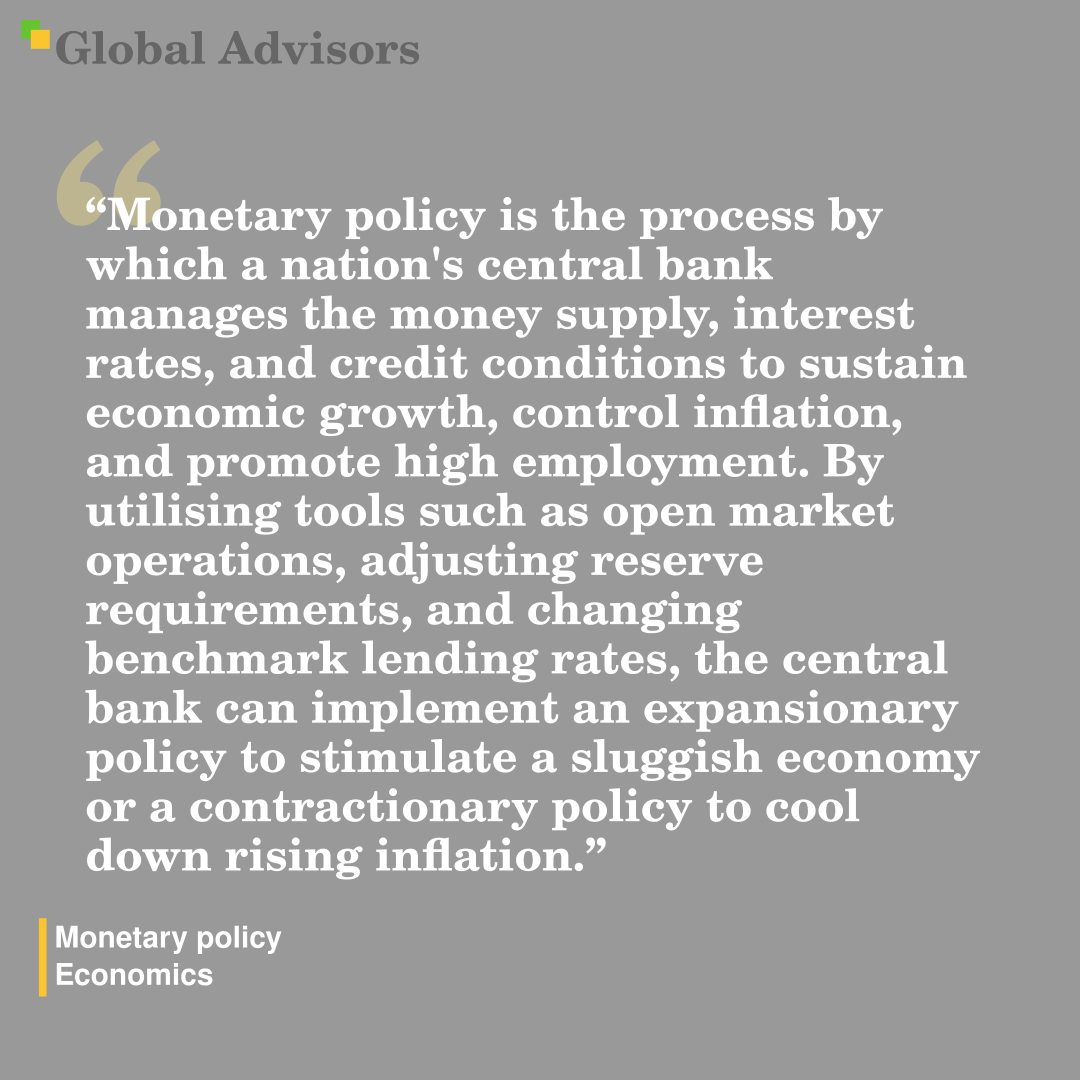
Term: Monetary policy - Economics"Monetary policy is the process by which a nation's central bank manages the money supply, interest rates, and credit conditions to sustain economic growth, control inflation, and promote high employment. By utilising tools such as open market operations, adjusting reserve requirements, and changing benchmark lending rates, the central bank can implement an expansionary policy to stimulate a sluggish economy or a contractionary policy to cool down rising inflation." - Monetary policy - Economics Economic stability depends partly on how effectively a central bank influences spending, borrowing, saving and expectations without directly directing every transaction. Monetary policy provides that influence. Its practical challenge is that decisions made today affect output, employment and inflation only after uncertain and variable delays, while the same interest-rate change can help one sector and harm another. In substance, monetary policy is the management of financial conditions to pursue macroeconomic objectives. Most contemporary central banks give priority to low and stable inflation, while also considering employment, output and financial stability. The precise mandate differs by jurisdiction: the Federal Reserve, for example, is charged with maximum employment and stable prices, whereas many other central banks operate an explicit or implicit inflation target. The policy process therefore combines an institutional objective with judgements about the economy's current position and likely path. The conventional transmission mechanism begins with a policy instrument, usually a short-term interest rate. A reduction in that rate lowers the cost of some forms of borrowing, raises the attractiveness of investment and durable consumption, and can weaken the incentive to save. Higher demand may then support production and employment. As spare capacity diminishes, firms may gain pricing power and wage pressures may strengthen. A rate increase reverses much of this chain by making credit more expensive and discouraging interest-sensitive expenditure. The IMF describes this route from policy rates through longer-term rates and economic activity as a central feature of monetary policy. Open market operations illustrate how the mechanism works operationally. When a central bank purchases eligible securities, it credits the banking system with reserves; sales remove reserves or tighten market liquidity. The Federal Reserve identifies purchases and sales of securities as a key method for implementing policy. In a scarce-reserves system, changing reserve supply can move an overnight interbank rate towards the desired level. In an ample-reserves system, administered rates on reserve balances and related facilities play a larger role, with market operations supporting control of short-term rates. The familiar textbook statement that central banks simply control the money supply is therefore useful but incomplete. Other instruments address different operating needs. A lending facility can provide short-term liquidity to solvent institutions facing funding stress, helping prevent a temporary market disruption from becoming a wider crisis. Reserve requirements can influence the relationship between deposits and liquid balances, although their importance varies across countries and operating frameworks. Repurchase and reverse-repurchase operations help manage money-market rates and the distribution of liquidity. Large-scale asset purchases, sometimes called quantitative easing, seek to lower longer-term yields and improve financial conditions when short-term rates are already close to their effective lower bound. The Federal Reserve lists open market operations, discount-window lending, reserve balances, reverse repos and other facilities among its policy tools. Expansionary policy is generally used when demand is weak, unemployment is elevated or inflation is below target. The central bank may lower its policy rate, purchase assets or communicate an expectation of easier conditions. Contractionary policy is used when demand is excessive or inflation is persistent. The bank may raise rates, allow assets to mature, sell securities or signal that restrictive conditions will remain. Neither stance guarantees a particular outcome. A rate cut cannot repair a destroyed supply chain, raise productivity immediately or make households borrow when confidence is collapsing. A rate rise can reduce demand, but it cannot directly produce more energy, food or housing. Formalising the policy stance A useful analytical distinction separates the nominal policy rate from the real rate that borrowers and savers face. A simplified expression is , where is the real short-term policy rate, is the nominal policy rate and is expected inflation over the relevant horizon. Policy is often described as accommodative when the real rate is below the economy's neutral real rate, and restrictive when it is above it. The neutral rate, written as , is not directly observed; it is an estimate of the real rate consistent with output near potential and stable inflation. One simplified representation of demand is . Here represents the output gap, is expected future activity, measures sensitivity to the real-rate gap, and captures other demand shocks. Inflation dynamics can be represented as , where captures the weight on expected inflation, measures the relationship between slack and inflation, and represents supply disturbances. These equations are not forecasts; they clarify why expectations and supply shocks complicate policy decisions. Several schools of thought disagree about how much weight should be placed on rules, discretion and financial conditions. Monetarist approaches stress the importance of money and nominal anchors, although the stability of money demand has weakened in many modern economies. New Keynesian models emphasise inflation expectations, the output gap and an interest-rate rule, such as . Here is a benchmark nominal rate, is the inflation objective, and and describe policy responses. Post-Keynesian and institutional perspectives place greater emphasis on credit creation, balance sheets, distribution and the fact that commercial banks create deposits through lending. These approaches need not imply that central banks are powerless, but they challenge the idea that a single policy rate fully describes monetary conditions. The largest practical tension is the trade-off between stabilising inflation and supporting activity. Tightening can lower inflation but weaken employment, investment and asset prices. Easing can support jobs and output but may intensify inflation, currency depreciation or financial risk. Distributional effects also matter: borrowers with floating-rate debt may suffer quickly from higher rates, while cash savers may benefit; homeowners, renters, pensioners and firms experience different exposures. Monetary policy cannot reliably solve fiscal problems, inequality or inadequate productive capacity, and excessive reliance on it can encourage risk-taking when rates remain low for too long. Credibility and communication are therefore policy instruments in their own right. If households and firms expect inflation to remain contained, temporary price shocks may have less chance of becoming embedded in wages and contracts. If expectations become unanchored, restoring credibility may require a sharper contraction than would otherwise have been necessary. Forward guidance, published forecasts and clear explanations can influence financial conditions before a formal rate change, but communication also creates risks when economic data later force a reversal. Central banks must balance transparency with the uncertainty inherent in forecasting. Monetary policy still matters because it is one of the fastest macroeconomic tools available and can usually be adjusted more readily than taxation or public spending. Its effectiveness depends on the banking system, household balance sheets, exchange rates, asset valuations, fiscal policy, global capital flows and the credibility of the institution. The modern task is not to control every measure of money mechanically, but to steer expectations and financing conditions towards price stability while limiting unnecessary damage to employment and productive investment. Understanding that distinction makes it easier to interpret rate decisions, quantitative easing and policy disagreements without treating any single instrument as a complete explanation of the economy.
|
| |
| |
Anthropic proposes 5% equity grant for public benefit fundThe Global Advisors Daily Business News briefing for 19 October 2026, hosted by Sam. Ten headlines shaping markets, technology and corporate strategy, with context on the stories that matter. Read the full newsletter: https://globaladvisors.biz/?p=3167623 In this edition: - Anthropic Proposes Dedicating 5% of Shares to New Public Benefit Fund Follow the daily podcast on Spotify: https://with.ga/spotnews Get free daily updates on WhatsApp: https://with.ga/wa |
| |
| |
Global Advisors News Brief - October 19 2026Read the full brief at the link Headlines for the last 24hrs
Time window: 2026-10-18T03:30:33.099Z to 2026-10-19T03:30:33.099Z |
| |
| |
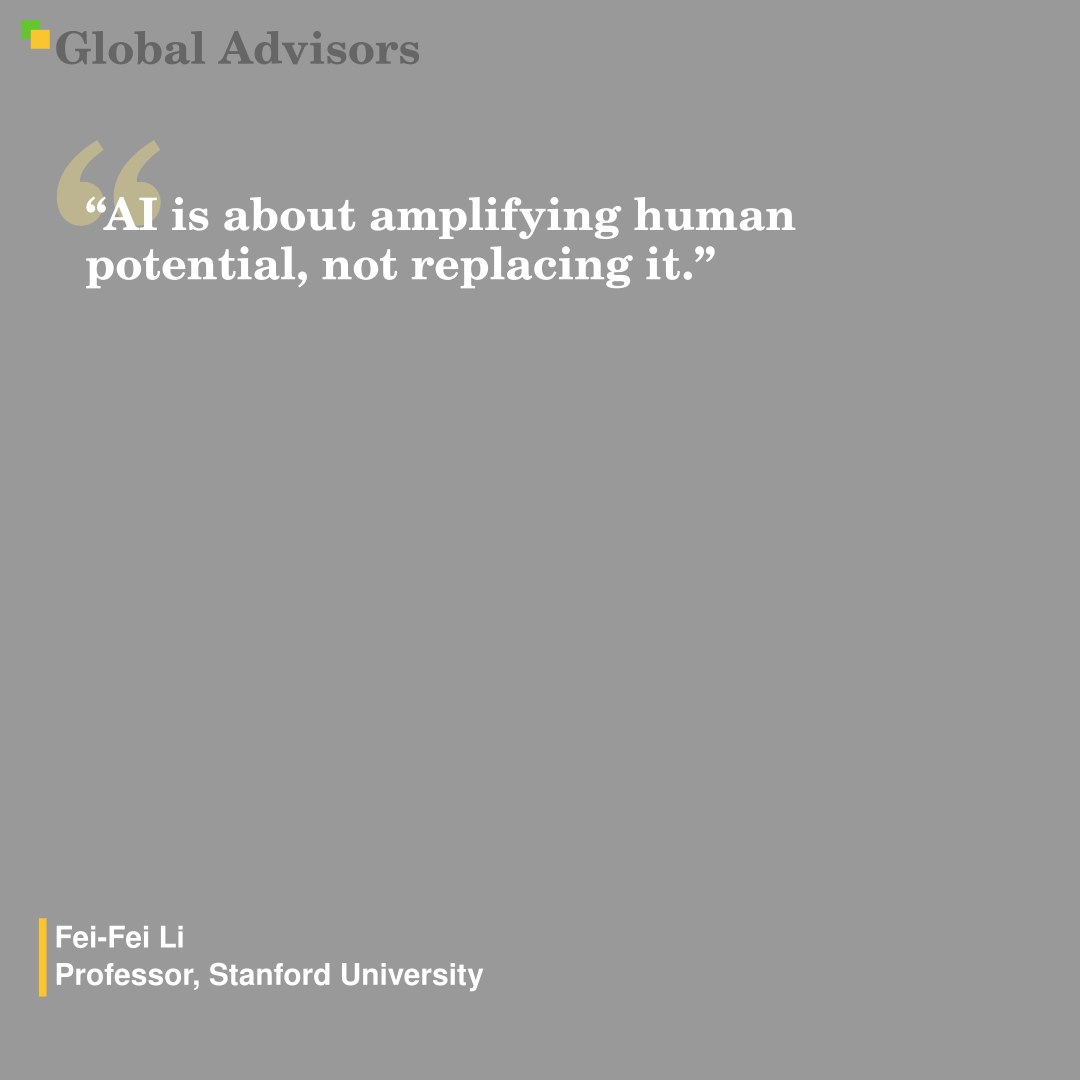
Quote: Fei-Fei Li - Professor, Stanford University"AI is about amplifying human potential, not replacing it." - Fei-Fei Li - Professor, Stanford University The practical question is not whether machines can perform tasks once reserved for skilled people. They already can. The harder question is who gains agency when capability becomes cheap, who loses bargaining power, and which human abilities remain decisive. A human-centred view treats artificial intelligence as an instrument whose value depends on the goals, judgement and institutions surrounding it, rather than as an autonomous substitute for human purpose. That distinction matters because technological substitution is rarely a simple exchange between one worker and one machine. A system may automate transcription while increasing the value of editing, automate image classification while creating demand for better clinical interpretation, or generate software while shifting effort towards architecture, testing and governance. The outcome depends on how organisations redesign work. If managers use AI only to reduce headcount, amplification becomes a slogan for intensification. If they use it to remove repetitive effort and widen access to expertise, productivity can be shared more broadly. Fei-Fei Li is relevant to this debate because her career connects technical progress with the conditions that make progress possible. As a Stanford professor and founding co-director of the Stanford Institute for Human-Centred Artificial Intelligence, she has argued for research and policy that place human welfare inside the design brief rather than treating it as an afterthought. Her position also carries practical weight: she co-founded World Labs, which focuses on spatial intelligence, while continuing research across computer vision, robotics, healthcare and embodied intelligence. From data infrastructure to human capability Li's influence is closely associated with ImageNet, the large-scale visual database that helped reshape computer vision. The project supplied researchers with a common benchmark and a vast body of labelled examples; later systems could be compared systematically rather than demonstrated through isolated experiments. Britannica describes the database as containing nearly 15 million images across close to 22 000 indexed synonym sets, and identifies it as a foundation for modern image-recognition research. The point is not that data alone created the deep-learning era, but that progress required an ecosystem of datasets, hardware, algorithms, researchers and evaluation practices. The history also complicates any clean separation between human and machine achievement. ImageNet depended on extensive human labour to collect, filter and label visual material. Critical scholarship has examined the dataset's construction, assumptions and social consequences, showing that training data is not a neutral mirror of the world. Categories reflect choices about what deserves a name, how objects are grouped and whose perspective defines normality. A model trained on such material can reproduce useful patterns, but it can also inherit omissions and bias. Human contribution therefore does not end when a model is trained; it continues through curation, auditing and interpretation. This is why amplification should not be confused with mere acceleration. A faster system can magnify sound decisions and bad ones alike. In a hospital, an AI assistant might help prioritise scans, but clinicians still need to assess context, communicate uncertainty and accept responsibility for treatment. In education, a generative tool might provide personalised exercises, yet teachers remain responsible for motivation, safeguarding and the social dimensions of learning. In public administration, automated recommendations may improve consistency while also making errors harder to challenge if citizens cannot understand or appeal them. The strategic tension The commercial pressure points in the opposite direction. Investors often reward measurable automation because labour savings are easier to model than better judgement, stronger trust or improved resilience. Firms may therefore deploy systems in ways that narrow roles, monitor workers more closely or transfer risk to individuals. Research on employment effects commonly finds that exposure to AI does not map neatly onto mass replacement: many occupations contain tasks that can be assisted, redesigned or partially automated rather than eliminated. The distributional question remains severe, however, because workers with less control over job design may receive the burdens of transition without sharing the gains. A credible human-centred strategy needs concrete safeguards. Organisations should identify which decisions remain human, record when automated systems influence outcomes, test performance across relevant populations and provide routes for correction. Workers need training that is tied to redesigned roles rather than generic enthusiasm for reskilling. Leaders should measure quality, safety and access alongside output. Regulators, meanwhile, must distinguish low-risk assistance from systems used in employment, healthcare, credit, education or public services, where errors can affect rights and life chances. There are also legitimate objections to the optimistic reading. Some tasks will disappear, and not every displaced worker will move smoothly into a better role. A company can describe a system as augmentative while using it to weaken professional autonomy. Human oversight can become ceremonial if employees lack time, authority or information to challenge a machine recommendation. Even well-intentioned design may fail when commercial incentives favour scale over care. The language of potential is therefore insufficient unless it is matched by ownership, accountability and a fair distribution of productivity gains. Li's work on spatial intelligence adds another dimension. Language models operate through patterns in text and other data, while systems that perceive and act in physical environments must contend with geometry, timing, uncertainty and consequences. World Labs describes spatial intelligence as the ability to understand, perceive, reason about and interact with the world, a direction that could affect robotics, design, healthcare and simulation. As AI moves from screens into workplaces and homes, the requirement for human-centred design becomes more demanding, not less. Physical systems can cause immediate harm, and their usefulness depends on fitting safely into environments shaped by human habits and values. The lasting significance of the argument lies in its choice of benchmark. A system should not be judged only by whether it matches or exceeds human performance on a narrow task. It should also be assessed by whether it expands meaningful choice, improves access to expertise, supports dignity and leaves people able to understand and contest consequential decisions. ImageNet helped show how infrastructure can unlock a technological leap; the next challenge is building social and institutional infrastructure that ensures the leap serves more than efficiency alone. Human potential is amplified only when people retain purpose, voice and a genuine share in the future being automated.
|
| |
| |
CoreWeave shares tumble as bond yields reach fifteen percentThe Global Advisors Daily Business News briefing for 18 October 2026, hosted by Sam. Ten headlines shaping markets, technology and corporate strategy, with context on the stories that matter. Read the full newsletter: https://with.ga/yoihr In this edition: - CoreWeave Shares Drop and Bond Yields Touch 15% Amid Scrutiny Over $52 Billion in Debt and Leases Follow the daily podcast on Spotify: https://with.ga/spotnews Get free daily updates on WhatsApp: https://with.ga/wa |
| |
| |
Global Advisors News Brief - October 18 2026Read the full brief at the link Headlines for the last 24hrs
Time window: 2026-10-17T03:30:33.098Z to 2026-10-18T03:30:33.098Z |
| |
| |
|


| |
| |