| |
|

| |
| |
| |
|
Our selection of the top business news sources on the web. |
| |
| |
| |
Quote: Shannon L. Alder - Author, therapist“You have two choices in life when it comes to truthful observations by others that anger you: You can be ashamed and cover it up by letting your pride take you in the extreme opposite direction, in order to make the point that they are wrong. Or, you can break down the walls of pride by accepting vulnerability as a strength, not a weakness. As you walk through your vulnerability, you will meet humility on the way to courage. From here, courage allows us to let go of shame and rise higher into the person we are meant to be, not the person that needs to be right. This is the road to confidence and self worth.” - Shannon L. Alder - Author, therapistShannon L. Alder is an American inspirational author and therapist known for her practical wisdom and deeply empathetic approach to personal growth and relationships. Born in New Mexico in 1970, Alder has built a reputation as a widely quoted writer, with her insights appearing in over 300 books by other authors and extensive online publications. Her works include bestsellers like 300 Questions to Ask Your Parents Before It’s Too Late, 300 Questions LDS Couples Should Ask Before Marriage, and The Narcissistic Abuse Recovery Bible, among others. Alder’s writing is renowned for its direct, nurturing style that invites readers to confront personal truths and seek healing without shame. She draws from her dual experience as a therapist—specializing in recovery from emotional and narcissistic abuse—and as someone who has herself faced and overcome adversity. This combination gives her a unique authority and compassion for the complexities of vulnerability, humility, and courage. Alder is also known for her “Shannonisms”—aphoristic expressions and bite-sized reflections that circulate widely on social media and in motivational literature. Her focus on vulnerability as a strength, not a weakness, is a cornerstone of her message. She encourages readers to see the act of opening oneself to discomfort and critique as an entry point not to shame, but to authentic self-worth and confidence. Context of the Quote The featured quote is drawn from Alder’s exploration of how individuals respond to truthful, sometimes uncomfortable observations from others. She contrasts two paths:
Alder suggests that “as you walk through your vulnerability, you will meet humility on the way to courage.” In this philosophy, humility is not about humiliation but about openness to growth. With humility comes courage—the courage to release shame and become the person one is truly meant to be, rather than someone fixated on being right. The result is true confidence and self-worth, achieved through acceptance and transformation rather than avoidance or denial. Leading Theorists and Intellectual Context While Shannon L. Alder’s work is highly personal and practical, her ideas align with and echo several major theorists in psychology and personal development: Alder’s insights are thus part of a rich tradition that challenges ingrained beliefs about strength, urging us to see openness, humility, and self-reflection as the true sources of personal growth and leadership. Summary of the Insight Shannon L. Alder invites us to reconsider our reflex to defend pride and instead walk courageously through vulnerability. The journey she describes is not merely personal but universal—one that has been explored by leading minds in psychology and embraced in modern thinking about what it means to live authentically and lead with empathy. Her words serve as both comfort and call to action: to value truth, abandon defensive pride, and step into the ever-rising cycle of humility, courage, and self-worth
|
| |

| |
Term: Relational humilityRelational humility is the capacity to recognize the limits of your own perspective and to value the experiences, insights, and feelings of others, especially within interpersonal relationships. It means understanding that your view is only one among many, fostering deeper connection and genuine dialogue instead of prioritizing pride or the need to be ‘right’. Unlike self-deprecation or meekness, relational humility is an active openness—it is not about diminishing your worth but rather acknowledging that everyone’s contributions matter. Key characteristics of relational humility:
Relational humility in the business setting is a powerful and necessary asset that directly contributes to superior individual and organizational performance. In the workplace, relational humility is the willingness of leaders and team members to admit limitations, value diverse contributions, and maintain authentic, open communication—even when doing so might challenge one’s ego or established authority. Why is relational humility so valuable in business?
Relational humility is courageous and strategically right. In environments where competition and performance pressure are high, it takes courage to admit you might be wrong or that someone else has a better idea. But this courage sends a powerful message: that long-term results and genuine connection matter more than protecting one's pride. Humility is not weakness; it is a strategic strength that enables better decision-making, attracts and retains talent, and positions organizations to thrive. Relational humility also prevents the self-sabotage of pride. In business, burning bridges, refusing to listen, or failing to seek feedback can lead to missed opportunities, stalled careers, and organizational failure—the professional equivalent of “cutting one’s nose to spite one’s face.” By embracing humility, professionals keep doors open, nurture valuable networks, and create opportunities for reconciliation and growth. Practicing relational humility is authentic leadership. Leaders who are humble empower their people, acknowledge their dependence on others, and create an environment where purpose and results align. Research shows that humble leaders are seen as more promotable, foster higher team morale, and build more resilient organizations.
Relational humility is both courageous and right, because it demands we put outcomes, relationships, and the greater good above ego. In business, as in life, it is the foundation for meaningful connection, authentic leadership, and lasting success. ExemplificationConsider the classic example of someone who, after a falling out, refuses to reach out and mend the relationship. This person may feel justified in their anger or embarrassment, but their pride creates a barrier they cannot cross, leaving them isolated and unhappy—what’s often called “cutting one’s nose to spite one’s face.” Pride prevents them from apologizing or forgiving, leading to lost opportunities for reconciliation and happiness. Conversely, relational humility is shown when someone swallows their pride to return and say, “I was wrong,” or “Can we start again?” It’s the parent embracing a child who has made grave mistakes, or the friend who chooses understanding over holding a grudge. These choices often repair and deepen bonds, creating a richer, more resilient social fabric. Consequences of Lacking Relational HumilityA lack of relational humility often results in burned bridges, ongoing conflict, and missed opportunities for growth. Research shows people low in humility struggle to form and repair strong social bonds, which can lead to poorer emotional well-being and less support—ultimately impacting long-term health and happiness. Theoretical Roots and Key TheoristThe most influential psychologist in this field is Dr. Everett L. Worthington, Jr. His Relational Humility Scale is widely used to measure this trait, and his published work frames relational humility as the ability to put the health and needs of the relationship above one’s own pride or desire for dominance. Dr. Everett L. Worthington, Jr.
If you find yourself miserable after burning bridges and unable to go back, know that relational humility is the key to change. By acknowledging your limitations, embracing vulnerability, and reaching out, you can rebuild connections and enrich your life. Pride may keep you stuck, but humility opens the door to healing and new beginnings.
|
| |
| |
Quote: R.D. Laing - Scottish psychiatrist“The range of what we think and do is limited by what we fail to notice. And because we fail to notice that we fail to notice, there is little we can do to change; until we notice how failing to notice shapes our thoughts and deeds.” - R.D. Laing - Scottish psychiatristThe quote is among the most incisive observations made by R. D. Laing, a Scottish psychiatrist whose work fundamentally reshaped how the world understands mental health, perception, and consciousness. This reflection appears in Daniel Goleman’s Vital Lies, Simple Truths, a seminal work on the psychology of self-deception and the mechanisms by which individuals and institutions hide painful truths from themselves. Goleman’s book explores how the human mind deploys subtle avoidance strategies, not merely to escape uncomfortable realities, but to shield entire frameworks of thought from scrutiny. Laing’s insight captures the paradox that the greatest limitations on our freedom and awareness stem from that which remains invisible to us—not out of malice or ignorance, but precisely because the act of not noticing is itself unnoticed. Laing’s statement addresses a core theme in Vital Lies, Simple Truths: the mental blind spots that arise from habitual thinking, cultural conditioning, and social pressures. Only by cultivating awareness of these patterns can individuals or organizations begin to expand their potential for change and adaptation. R. D. Laing: The Person Behind the Quote Ronald David Laing (1927–1989) was a British psychiatrist whose career challenged the mainstream conventions of psychiatry, particularly in the treatment and understanding of schizophrenia. He emerged as a leading voice in what was labeled the “anti-psychiatry” movement (though Laing himself rejected this term). Rather than viewing psychosis as a biological flaw to be chemically or physically corrected, Laing argued that “madness” was often a meaningful—if deeply troubled—response to untenable situations, usually within the structure of the family or society. Laing was deeply influenced by existentialist and phenomenologist philosophers such as Nietzsche, Husserl, Heidegger, Sartre, Jaspers, and Merleau-Ponty. He believed that the lived experience of the patient—what they perceived, thought, and felt—was central, and should be taken seriously as an expression of existential reality. In his explorations, Laing even traveled to Asia to study Buddhist meditation, seeking insights into the nature of consciousness and the boundaries of perception. Laing’s clinical innovations included his willingness to simply sit with deeply disturbed patients, listening without preconceptions and attempting to understand the “existential truth” behind their symptoms. He rejected the prevailing emphasis on physical treatments such as electroshock and lobotomy, advocating for a more humane, attentive, and socially aware psychiatry. Theoretical Foundations and Leading Thinkers Laing’s work was at the intersection of multiple influential currents:
Together, these theorists challenged the reduction of mental suffering to mere biochemical imbalance, insisting on the complex interplay between individual perception, family structure, social context, and culture. The Subject’s Lasting Impact Laing’s approach—and the insight captured in the quote—remains vital today, not just in psychiatry but in any domain where awareness, self-limitation, and the unseen forces shaping behaviour are of concern. His work underscores the necessity of noticing our own blind spots, because only from that awareness can meaningful change originate. The journey toward transformation, personally or collectively, begins with “noticing what we fail to notice”—and recognizing how our unnoticed frames of reference define what we believe is possible.
|
| |
| |
Term: Self AwarenessSelf-awareness is the capacity to consciously recognize, observe, and understand one’s own feelings, thoughts, motives, and behaviours as they arise. It involves stepping back to notice your internal world—your emotions, thoughts, physical sensations, and urges—which often operate outside of conscious attention. This reflective process can be simple, such as noticing the feelings you have in different social situations, or more complex, such as understanding how your thoughts and emotions interact and influence your behaviour over time. Key aspects of self-awareness include:
Daniel Goleman: Theorist and AuthorDaniel Goleman is widely regarded as a leading authority on self-awareness and its importance in personal and professional development. A psychologist, journalist, and author, Goleman popularized the concept of emotional intelligence (EQ), of which self-awareness is a fundamental component. Goleman’s 1985 book, “Vital Lies, Simple Truths”, delves deeply into the mechanisms of self-deception—the ways we avoid confronting uncomfortable truths about ourselves—and how this impedes self-awareness and, subsequently, genuine personal growth. In the book, he explores the psychological defenses that cloud our objective self-perception:
Goleman’s analysis makes the case that self-awareness is both essential and challenging, as our minds are wired to sometimes shield us from harsh realities. By bringing these mechanisms to light, Goleman offers strategies to enhance self-awareness, emphasizing the benefits of honest introspection for both individuals and organizations. Goleman's Biography and Relationship to Self-awarenessDaniel Goleman earned his Ph.D. in psychology from Harvard University, after which he spent many years as a science journalist for The New York Times, reporting on brain and behavioural research. His influential work on emotional intelligence, beginning with his best-selling book “Emotional Intelligence” (1995), reshaped how leaders, companies, and individuals think about personal and social competence. Goleman’s academic rigor, combined with his skill in making psychological concepts accessible, established him as the primary theorist linking self-awareness and emotional intelligence. Goleman’s insights into self-awareness have had a profound impact on leadership theory, psychotherapy, education, and workplace training, emphasizing that truly understanding oneself is the cornerstone for developing every other aspect of emotional intelligence. His work—especially as detailed in “Vital Lies, Simple Truths”—remains foundational for anyone seeking to understand or improve their own self-awareness and psychological well-being.
|
| |
| |
Quote: Fyodor Dostoevsky - Russian novelist, philosopher, and journalist“There are other things which a man is afraid to tell even to himself, and every decent man has a number of such things stored away in his mind.” - Fyodor Dostoyevsky - Notes from UndergroundFyodor Dostoevsky’s Notes from Underground (1864) is a foundational text of existential literature, probing the paradoxes and inner conflicts of human consciousness. The quote is spoken by the novella’s unnamed protagonist, the Underground Man—a figure marked by hyperawareness, self-loathing, and paralyzing introspection. This sentence illustrates one of Dostoevsky’s core insights: the depth of human self-deception and the layers of secret shame and fear that even the most honest individuals conceal from themselves. Notes from Underground was Dostoevsky’s response to the growing intellectual currents of rational egoism and utopian optimism in 19th-century Russia. Through the internal monologue of the Underground Man, Dostoevsky warns against the dangers of reducing human nature to tidy scientific or logical schemes. He argues that consciousness can become a torment when it turns inward, endlessly dissecting motives, memories, and desires. The narrator is both acutely self-conscious and incapable of action, trapped in a cycle of self-reflection and spite, which he describes as a kind of illness. Context of the Quote This passage reflects Dostoevsky’s belief in the complexity and contradiction at the heart of human psychology. The idea that each person hides certain thoughts even from themselves speaks to the unconscious mind’s power and the defense mechanisms we deploy to protect ourselves from uncomfortable truths. For Dostoevsky, true self-knowledge is painful and, therefore, often avoided; we construct elaborate rationalizations and illusions to mask our deeper uncertainties or shame. The Underground Man’s confession is both a critique and a mirror: in his vulnerability, he exposes a universal human tendency. About Dostoevsky Fyodor Dostoevsky (1821–1881) was a Russian novelist, philosopher, and journalist whose works explore the psychological and spiritual depths of his characters. A former political prisoner, Dostoevsky’s novels—including Crime and Punishment, The Brothers Karamazov, and Notes from Underground—delve into moral dilemmas, the nature of free will, and the search for meaning in a turbulent world. His insights into the shadowy corners of the human mind anticipate many of the ideas later developed in psychology and existential philosophy. Related Theory: Daniel Goleman and Self-Deception The themes Dostoevsky investigates find scientific elaboration in the work of Daniel Goleman. Goleman is a psychologist and journalist best known for popularizing the concept of emotional intelligence. His seminal book, Vital Lies, Simple Truths: The Psychology of Self-Deception (1985), synthesizes decades of research to explain why and how individuals, organizations, and even societies distort reality to avoid painful truths. Vital Lies, Simple Truths: Core Ideas
Daniel Goleman: Background
Intellectual Lineage and Perspective Both Dostoevsky and Goleman are united in their skepticism toward claims of complete self-knowledge and their recognition that self-deception is an ingrained facet of being human. Dostoevsky frames it as tragic and inescapable, while Goleman provides a scientific explanation for its universality and necessity. Their combined perspectives invite us to consider that clarity about ourselves is a rare achievement—and perhaps, at times, an unbearable one.
|
| |

| |
Term: Self DeceptionSelf-deception is the act of denying, minimizing, or rationalizing away information, evidence, or logical arguments that challenge one’s existing beliefs, preferences, or self-image. At its core, self-deception involves convincing oneself of a truth—or the absence of a truth—in such a manner that it conceals uncomfortable self-knowledge. It is a psychological process where individuals deliberately or subconsciously avoid facing facts, often by distorting reality or ignoring disconfirming evidence. This can lead to holding motivated false beliefs that persist even in the presence of contradicting information. Self-deception ranges from conscious rationalizations to unconscious avoidance and forgetting, sometimes involving holding conflicting beliefs—one known to be true but suppressed, and another maintained at the surface. Key aspects include:
Self-deception can act as a defense mechanism for self-protection—shielding individuals from painful truths or threats to self-esteem. However, it is also linked to self-sabotage, as persistent denial of reality impairs judgment, relationships, and effective leadership. Research shows that self-deception is intertwined with memory and social status, and can be influenced by stress or situational pressures. Daniel Goleman: The Strategist of Self-DeceptionDaniel Goleman is widely recognized as a pivotal theorist in the study of self-deception, particularly through his influential book "Vital Lies, Simple Truths: The Psychology of Self-Deception." Goleman, an American psychologist, author, and science journalist, gained international acclaim for his work on emotional intelligence but has made significant contributions to understanding how humans deceive themselves. Biography:
Relationship to the Term:
Goleman's approach integrates insights from psychology, neuroscience, and social dynamics, illustrating how self-deception functions as both a protective strategy and a barrier to growth. His work remains foundational in understanding why people—and leaders especially—sometimes fail to see or admit critical truths, and how confronting self-deception is vital for personal development and organizational health. By framing self-deception as a universal, adaptive, yet ultimately limiting human tendency, Goleman's scholarship provides a strategic lens for advisors, leaders, and individuals seeking self-awareness and more effective decision-making.
|
| |

| |
Quote: Carl Jung - pioneering figure in psychology“Everyone carries a shadow, and the less it is embodied in the individual’s conscious life, the blacker and denser it is. If an inferiority is conscious, one always has a chance to correct it… But if it is repressed and isolated from consciousness, it never gets corrected, and is liable to burst forth suddenly in a moment of unawareness.” - Carl Jung - pioneering figure in psychologyJung described the shadow as the unconscious part of the personality that consists of repressed ideas, weaknesses, desires, instincts, and shortcomings—essentially the darker, hidden side of ourselves that the conscious ego does not identify with or wishes to deny. It is a "cognitive blind spot" within the psyche, representing aspects of the self that one is unaware of or rejects because they don't fit with the socially acceptable or conscious self-image. The quote explains that when these shadow aspects remain unconscious and repressed, they become "blacker and denser," meaning they grow more intense and potentially destructive. Conscious awareness or acknowledgment of these inferiority feelings or shadow elements gives one the chance to address and integrate them, promoting psychological growth and balance. Importance of Shadow IntegrationJung emphasized that the path to self-knowledge and individuation—the process of becoming a whole person—requires confronting and embracing the shadow. This is often painful and challenging because it involves recognizing traits, desires, or impulses we typically deny. However, doing so prevents these shadow elements from erupting uncontrollably or damagingly, as they might if suppressed too long. Jung wrote that the shadow is not solely negative but contains valuable qualities such as instincts, emotional energy, creativity, and realistic insights, which can be reclaimed through awareness. If left unrecognized, the shadow keeps a person psychologically impoverished and disconnected. Carl Jung’s BackgroundCarl Gustav Jung (1875–1961) was a pioneering figure in psychology who diverged from Freud to develop his own theories about the unconscious mind. He introduced terms such as archetypes, the collective unconscious, and the personal unconscious, with the shadow being a central archetype representing the hidden dimension of personality. His work has deeply influenced not only psychology but also philosophy, literature, and spirituality. Jung’s exploration of the shadow was part of his broader interest in the balance of conscious and unconscious parts of the self, aiming for personal wholeness. In Summary
This quote encapsulates a key psychological insight from Jung’s analytical psychology, highlighting the importance of self-consciousness in managing the darker sides of human nature and achieving personal growth.
|
| |
| |
Term: Persona InflationPersona inflation, as defined by Carl Jung, refers to the psychological phenomenon where an individual becomes excessively identified with their persona—the social mask or role they present to the world—leading to an inflated sense of self that is cut off from deeper, more authentic layers of the psyche. The persona is the social mask we create to meet external expectations. When we identify with it—“I am the CEO, the star, the influencer”—the ego becomes inflated, cut off from shadow and Self. Jung’s Concept of the PersonaJung introduced the concept of the persona as the mask or identity we adopt to meet the expectations and norms of society. It acts as a kind of psychological armor, allowing us to function in social roles—such as the CEO, the star, or the influencer. However, this mask is not our true self; it is a construct designed to navigate external realities. Backstory: How Persona Inflation Occurs
Symptoms and Societal Implications
Jung’s Warning and the Path to WholenessJung consistently warned about the dangers of inflation, emphasizing that it is not always consciously felt; often, its presence is best inferred from symptoms like arrogance, extreme defensiveness, or the reactions of others. The antidote lies in differentiating between the persona and the deeper Self, integrating unconscious elements, and maintaining humility. This ongoing process leads to greater psychological health and authentic living. In summary, persona inflation is the over-identification with one’s social mask, resulting in an ego that is inflated and disconnected from one’s deeper self, relationships, and authentic human experience. Jung saw this as a common but perilous condition, especially prevalent in environments that reward surface performance over genuine self-knowledge
|
| |
| |
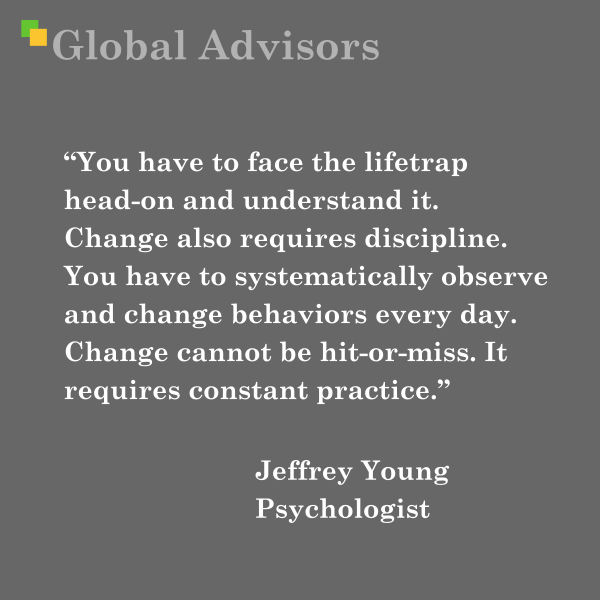
Quote: Jeffrey E. Young - the creator of schema therapy and a transformative figure in modern psychology“You have to face the lifetrap head-on and understand it. Change also requires discipline. You have to systematically observe and change behaviors every day. Change cannot be hit-or-miss. It requires constant practice.” - Jeffrey E. Young - the creator of schema therapy and a transformative figure in modern psychologyJeffrey Young developed schema therapy in response to the limitations he observed in traditional forms of cognitive behavioral therapy, particularly with clients experiencing chronic, deeply rooted emotional difficulties. After studying at Yale University and the University of Pennsylvania—and completing postdoctoral work under Aaron Beck, the father of CBT—Young realized that many people struggle with what he called “lifetraps,” now more widely known as early maladaptive schemas.These are enduring, self-defeating emotional and cognitive patterns established in childhood, usually due to unmet core emotional needs. Young’s work led him to found the Schema Therapy Institute, where he and his colleagues developed integrative methods that blend cognitive, attachment, psychodynamic, and experiential approaches. Central to schema therapy is the insight that awareness alone isn’t enough—patients must actively and systematically challenge and change their ingrained reactions and beliefs. “Lifetraps” or schemas can’t be altered by insight alone; they demand disciplined, daily effort to observe one's thoughts and behaviors and to practice new, healthier ways of responding to life’s challenges. This quote distills Young’s belief that enduring change is a process, not a single event: it requires direct confrontation with one’s schemas, daily self-observation, disciplined practice, and persistence. The path to change, as Young outlines in both his professional texts (Schema Therapy) and his bestselling self-help book (Reinventing Your Life), is structured, intentional, and ongoing—a philosophy that has helped millions worldwide recognize and heal their deepest emotional wounds. Leading with EMS or Leading Those with EMSIn leadership and workplace settings, understanding EMS has profound implications. Leaders with unaddressed schemas may unconsciously enact patterns such as perfectionism, avoidance, mistrust, or overcompensation, which can undermine their effectiveness and harm team dynamics. For instance, a leader with an "unrelenting standards" schema might push themselves and their team too hard, causing burnout and resentment. Conversely, an "abandonment" schema might result in over-accommodation or difficulty setting boundaries, diminishing authority and clarity. Leading individuals with EMS requires attunement, clear boundaries, and consistent, compassionate communication. It is important to recognize when an employee's reactions may stem from deep-seated patterns rather than surface-level conflicts or incompetence. Effective leaders:
Leaders who are aware of EMS—in themselves and in others—can foster a work environment that supports psychological growth, resilience, and healthy relational patterns. This not only improves individual well-being but also enhances collective performance, creativity, and loyalty. Ultimately, addressing EMS in the workplace is about creating a culture where people can move beyond self-defeating patterns and realize their full potential, both individually and as part of a team About Jeffrey Young
This quote embodies the core message and method of schema therapy: change is possible, but only through purposeful, disciplined, and sustained action.
|
| |
| |
Term: Early Maladaptive SchemasEarly maladaptive schemas are deeply ingrained patterns of thinking and feeling about oneself and one’s relationships, originating in childhood or adolescence and persisting into adulthood in dysfunctional way. The concept is foundational to Schema Therapy, introduced and developed by psychologist Jeffrey Young in the 1990s. Young and colleagues defined these schemas as “broad, pervasive themes regarding oneself and one's relationship with others, developed during childhood and elaborated throughout one's lifetime, and dysfunctional to a significant degree." Backstory and Major Analysts
How This Plays Out in LifeThe effects of early maladaptive schemas permeate multiple domains: Life and Choice
Relationships
Careers and Work
Illustration with ExamplesA psychology student who experienced critical parenting may develop an unrelenting standards schema, perpetually pushing themselves out of fear they will never measure up. In relationships, a history of emotional neglect may result in a social isolation schema, prompting avoidance of social connection and reinforcing loneliness. Schema Therapy aims to identify these schemas and shift the underlying patterns, promoting healthier ways of thinking and relating to oneself and others. In summary: Early maladaptive schemas are enduring, self-defeating patterns shaped by early adversity, described and categorized by Jeffrey Young and other schema therapy analysts. They have far-reaching effects on personal choices, relationships, careers, and psychological health, underpinning many persistent emotional and behavioral problems throughout life
|
| |

| |
|


| |
| |