| |
|

| |
| |
| |
|
Our selection of the top business news sources on the web. |
| |
| |
| |
Quote: Dr. Jane Goodall- Environmental activist“In the place where I am now, I look back over my life... What message do I want to leave? I want to make sure that you all understand that each and every one of you has a role to play. You may not know it, you may not find it, but your life matters, and you are here for a reason.” - Dr. Jane Goodall - Environmental activistDr Jane Goodall’s final published words reflect not only a lifetime of scientific pioneering and passionate environmentalism but also a worldview grounded in the intrinsic significance of every individual and the power of hope to catalyse meaningful change. Her message, left as a legacy, underscores that each person—regardless of circumstance—has a unique, essential role to play on Earth, even if that role is not always immediately apparent. She urges recognition of our interconnectedness with nature and calls for resilience and conscious action, particularly in a time of global ecological uncertainty. Context of the Quote This message stems from Dr Goodall’s unique vantage point following a long, globally influential life. She addresses not only the scientific community but citizens broadly, emphasising that daily choices and individual agency accumulate to drive change. The reflection is both a personal summation and a universal exhortation—drawing on decades spent witnessing the impact of individual and collective action, whether through habitat protection, compassionate choices, or environmental advocacy. Her words encapsulate a persistent theme from her life’s work: hope is not passive, but an active discipline that demands our participation. Dr Jane Goodall: Backstory and Influence Jane Goodall (1934–2025) began her career without formal training, yet revolutionised primatology—most notably through her extended fieldwork at Gombe Stream National Park, Tanzania, beginning in 1960. By meticulously documenting chimpanzee behaviours—tool use, social structures, and emotional expressions—she dismantled long-held assumptions surrounding the human-animal divide. Her findings compelled the scientific world to re-evaluate the concept of animal minds, emotions, and even culture. Goodall’s methodological hallmark was the fusion of empathy and rigorous observation, often eschewing traditional scientific detachment in favour of fostering understanding and connection. This approach not only advanced natural science, but also set the stage for her lifelong advocacy. Her research evolved into a commitment to conservation, culminating in the founding of the Jane Goodall Institute in 1977, and later, Roots & Shoots in 1991—a global youth movement empowering the next generations to enact practical, local initiatives for the environment and society. As a tireless speaker and advisor, Goodall travelled globally, addressing world leaders and grassroots communities alike, continually reinforcing the power and responsibility of individuals in safeguarding the planet. Her activism grew ever more encompassing: she advocated for animal welfare, ethical diets, and systemic change in conservation policy, always championing “those who cannot speak for themselves”. Her campaigns spanned from ending unethical animal research practices to encouraging tree-planting initiatives across continents. Related Theorists and Intellectual Foundations The substance of Goodall’s quote—regarding the existential role and agency of each person—resonates with leading figures in several overlapping fields:
Legacy and Enduring Impact Jane Goodall’s final words distil her life’s central insight: significance is not reserved for the prominent or powerful, but is inherent in every lived experience. The challenge she poses—to recognise, enact, and never relinquish our capacity to make a difference—is rooted in decades of observational science, a global environmental crusade, and a fundamental hopefulness about humanity’s potential to safeguard and restore the planet. This ethos is as relevant to individuals seeking purpose as it is to leaders shaping the future of conservation science and policy. |
| |
| |
Quote: Dr Martin Luther King Jr. - American Baptist minister“Darkness cannot drive out darkness: only light can do that. Hate cannot drive out hate: only love can do that.” - Dr Martin Luther King Jr. - American Baptist ministerThis line, included in A Testament of Hope: The Essential Writings and Speeches of Martin Luther King, Jr., is not only emblematic of King’s message but also of his lived philosophy—one deeply rooted in Christian ethics and the practice of nonviolence. Martin Luther King, Jr. (1929–1968) was an American Baptist minister and activist who became the most visible spokesman for the nonviolent civil rights movement from the mid-1950s until his assassination in 1968. King drew extensively from Gospel teachings, particularly the Sermon on the Mount, and from earlier theorists of nonviolent resistance, notably Mohandas Gandhi. He argued that true social transformation could only be achieved through love and reconciliation, not retaliation or hatred. The Testament of Hope anthology, compiled by James Melvin Washington at the request of Coretta Scott King, brings together King’s seminal essays, iconic speeches, sermons, and interviews—showing the evolution of his thought in response to the escalating struggles of the American civil rights movement. This specific quote reflects King’s insistence on moral consistency: that the means must be as righteous as the ends. It was delivered against the backdrop of violent backlash against civil rights progress, racial segregation, and systemic injustice in the United States. King’s philosophy sought not merely to win legal rights for African Americans, but to do so in a way that would heal society and affirm the dignity of all individuals. The quote serves as a concise manifesto for constructive, rather than destructive, social change—urging individuals and movements to transcend cycles of resentment and to build a community rooted in justice and mutual respect. Context: Leading Theories and TheoristsGandhi and the Power of Satyagraha Christian Ethics and the Social Gospel Thoreau and Civil Disobedience Pacifism and Social Democracy Insights for Contemporary ConsiderationKing’s assertion that love and light—not their opposites—are the true agents of change remains pertinent. In an era marked by polarisation, the temptation to meet hostility with hostility is ever-present. King’s legacy, however, suggests that sustainable progress is built not on animosity but on courageous empathy, principled nonviolence, and a steadfast commitment to the common good. His writings compiled in A Testament of Hope continue to challenge us to consider not just what we seek to achieve, but how we pursue it—reminding us that the character of our methods shapes the quality of our outcomes.
|
| |
| |
Quote: Jane Goodall- Environmental activist“The greatest danger to our future is apathy.” - Jane Goodall- Environmental activistJane Goodall delivered this insight in the context of decades spent on the front lines of scientific research and environmental advocacy, witnessing the delicate balance between hope and despair in combating environmental crises. The quote reflects a central tenet of Goodall’s philosophy: that the single greatest threat to human and ecological wellbeing is not malice or ignorance, but the widespread absence of concern and action—apathy. This perspective was distilled from her experiences observing both the destructive potential of human indifference and the transformative impact of individual engagement at every level of society. For Goodall, apathy signified a turning away from the responsibility each person bears to confront environmental and social challenges, thereby imperilling prospects for sustainability, justice, and collective flourishing. Profile: Jane Goodall Dame Jane Goodall (1934–2025) was one of the most influential primatologists, conservationists, and environmental activists of the twentieth and twenty-first centuries. Without formal scientific training, Goodall began her career in 1960 as a protégé of anthropologist Louis Leakey, embarking on fieldwork at Gombe Stream National Park in Tanzania. Her discovery that chimpanzees use tools—then considered a uniquely human trait—fundamentally reshaped the scientific understanding of the boundary between humans and other animals. Goodall’s approach, combining empathetic observation with methodical research, forced a reconsideration of animal sentience, intelligence, and culture. She chronicled not only the nurturing bonds but also the complex, sometimes violent, social lives of chimpanzees, upending previous assumptions about their nature and adding profound ethical dimensions to the study of animals. Beyond science, Goodall’s life work was propelled by activism: she founded the Jane Goodall Institute in 1977 to foster community-centred conservation and established Roots & Shoots in 1991, creating a youth movement active in over one hundred countries. Her advocacy extended from forest communities in Tanzania to global forums, urging political leaders and young people alike to resist resignation and take up stewardship of the planet. Goodall remained unwavering in her belief that hope is not passive optimism but a discipline requiring steady, collective effort and moral courage. The message embodied in the quote is echoed throughout her legacy: indifference is a luxury the future cannot bear, and meaningful change depends on the active involvement of ordinary people. Leading Theorists and Thought-Leaders in the Field The danger of apathy as a barrier to social and environmental progress has been examined by leading figures across disciplines:
Contextual Summary Jane Goodall’s quote stands within a tradition of environmental and ethical thought that identifies apathy not only as a personal failing, but as a systemic obstacle with existential implications. Her legacy, and that of her intellectual predecessors and contemporaries, attests to the enduring call for engagement, responsibility, and active hope in shaping a liveable future.
|
| |
| |
Quote: James Clear - Atomic Habits“You do not rise to the level of your goals, you fall to the level of your systems.” - James Clear - Atomic Habitslasting success emerges not from setting ambitious goals, but from designing robust systems that shape daily behaviours. This approach transforms “goal-setting” from a matter of aspiration to one of sustainable execution. The Quote: Context & MeaningThis quote appears in Atomic Habits (2018), Clear’s widely influential book on behaviour change and personal development. In the book, Clear argues that while goals are useful for providing direction, they are not sufficient to drive results. Instead, he suggests that the systems—the routines, processes, and environments that shape behaviour—are what ultimately determine outcomes. Clear’s key insight is that:
He illustrates this with practical examples, such as habit loops (cue, craving, response, reward) and the "1% better every day" philosophy, emphasising that meaningful change results from continuous, small improvements, not heroic isolated efforts. James Clear: BackstoryJames Clear is an American author, entrepreneur, and advocate for evidence-based self-improvement. With a background in biomechanics and years spent researching psychology and behavioural science, Clear built a career distilling complex academic insights into actionable strategies for individuals and organisations. Key facts:
Clear’s work is valued for its blend of scientific credibility and pragmatic applicability, appealing both to high-performers in business and sports and individuals seeking personal growth. Leading Theorists: Development of the FieldJames Clear’s approach builds on and synthesises decades of behavioural and psychological research:
Each theorist has contributed frameworks that reinforce Clear’s central thesis: lasting, repeatable change depends less on what people aspire to, and more on how they build and manage their systems. Application & Implications
Adopting Clear’s principle encourages a shift from superficial goal-setting to building the underlying architecture for sustainable excellence. In sum: The quote encapsulates a paradigm in behavioural science—systematic small improvements, compounded over time, eclipse even the most ambitious goals . This realisation continues to influence leaders, coaches, and strategists globally.
|
| |

| |
Quote: George W. Bush - Former USA President“Too often we judge other groups by their worst examples, while judging ourselves by our best intentions.” - George W. Bush - Former USA PresidentContext of the Quote George W. Bush delivered this insight during a speech in Dallas in July 2016, a period marked by heightened social tension and polarisation in the United States. The address came days after the fatal shooting of five police officers at a protest, itself a reaction to controversial police actions. Seeking to foster unity, Bush acknowledged America’s tendency towards group bias and emphasised the need for empathy and shared commitment to democratic ideals. His observation draws attention to a universal cognitive and social phenomenon: ingroup/outgroup bias. When confronted with behaviours or actions from those outside our immediate social or cultural group, we are prone to interpret those actions through a lens of suspicion and selective memory, spotlighting their most negative examples. Conversely, when assessing ourselves or those we identify with, we prefer generous interpretations, focusing on intentions rather than shortcomings. Bush’s wider message underscored the importance of humility, perspective-taking, and the recommitment to values that transcend background or ideology. Profile: George W. Bush Serving as the 43rd President of the United States from 2001 to 2009, George W. Bush led through a tumultuous era defined by the September 11 attacks, wars in Afghanistan and Iraq, and significant domestic debate. Known for his plainspoken style, Bush’s post-presidential efforts have often revolved around advocacy for veterans, public service, and fostering civil discourse. Bush’s later public statements—such as the one quoted—reflect a reflective approach to leadership, consistently urging Americans to recognise shared values rather than be divided by fear, prejudice, or misunderstanding. His comments on our tendency to judge others harshly, while pardoning ourselves, reveal an awareness of the psychological barriers that undermine social cohesion. Theoretical Underpinnings: Ingroup/Outgroup Bias and Attribution Theory Bush’s observation is grounded in a longstanding body of social scientific research. Several leading theorists have dissected the mechanisms underlying the very human tendencies he describes:
Practical Relevance and Enduring Significance Bush’s statement sits at the intersection of leadership, societal cohesion, and cognitive psychology. It resonates in organisational contexts, policy development, and everyday interpersonal relations, offering a reminder of the pitfalls of selective empathy. The theorists cited above provide the academic scaffolding for these insights, underscoring that while group divisions are deeply embedded, they are not immutable; awareness, shared objectives, and deliberate effort can bridge divides. Promoting an understanding of these biases is critical for any leader or organisation working to build trust, foster diversity, or drive collective progress.
|
| |
| |
Quote: Giorgio Armani - Design icon“To create something exceptional, your mindset must be relentlessly focused on the smallest detail.” - Giorgio Armani - Design iconGiorgio Armani, widely acknowledged as one of the most transformative figures in twentieth-century design, epitomises the principle that true excellence is achieved through obsessive attention to detail. This quote captures the ethos that defined his rise from humble beginnings in Piacenza, Italy, to global dominance in luxury fashion. Armani’s design philosophy, anchored in modernity, simplicity, and timeless sophistication, is the product of a painstaking process. He pioneered the unstructured jacket, stripping away traditional padding and lining to achieve effortless elegance—a concept that necessitated precision in tailoring and fabric selection. His working process has always been one of distillation: removing the superfluous to reveal the essential, with every stitch, seam, and cut scrutinised for perfection. This relentless focus on detail is not merely aesthetic. For Armani, quality is the root of style, distinguishing enduring design from fleeting fashion. He famously declared that “the difference between style and fashion is quality”—a conviction visible in his restrained palettes, expert drape, and revolutionary silhouettes. Colleagues and clients note that Armani would spend hours refining proportions, reviewing fabrics under different lights, and perfecting the fit to ensure each garment “lives” on its wearer. His leadership style reflects the same philosophy. Armani built a fiercely loyal team, involving his sister and nieces in the business, and entrusted collaborators with significant autonomy—provided they shared his obsession with craftsmanship and consistency. His pursuit of detail extended to every aspect of the organisation, from product to brand experience. The Person: Giorgio Armani
Leading Theorists on the Subject of Detail and ExcellenceThe intellectual lineage underpinning Armani’s obsession with detail and excellence spans several disciplines:
LegacyArmani’s insistence that exceptional outcomes arise from relentless focus on detail endures not only as a maxim for fashion, but as a universal lesson in craft, leadership, and business. His body of work, rooted in patient observation, continuous refinement, and respect for the essentials, stands as a testament to the enduring power of detail as the heartbeat of exceptional achievement.
|
| |

| |
Quote: Steven Bartlett - The Diary of a CEO“The most convincing sign that someone will achieve new results in the future is new behaviour in the present.” - Steven Bartlett - The Diary of a CEOBartlett’s perspective places emphasis on observable action as the true metric of transformation—echoing a wider movement in leadership and psychology that privileges habits and behaviours over abstract ambition. Bartlett’s own career is a practical testament to this principle. His path is distinguished by a series of bold behavioural changes—leaving university after one lecture to pursue entrepreneurship, relocating to San Francisco as a young founder, and then returning to launch and scale Social Chain, which redefined social media marketing in Europe and beyond. Each pivot was marked by visible, immediate action, not just planning or strategic intention. This lifelong theme—prioritising what a person does in the present over what they claim they will do—underpins his philosophy as shared through his internationally successful podcast and bestselling books. About Steven BartlettSteven Bartlett (b. 1992) is a Botswana-born British-Nigerian entrepreneur, investor, author, and broadcaster. Raised in Plymouth, his upbringing was shaped by multicultural heritage, resilience, and early experiences as an outsider—a perspective he credits for instilling tenacity and creative ambition. Bartlett’s journey began with the launch of Wallpark, a student-focused digital noticeboard, before his rise to prominence as co-founder and CEO of Social Chain. Under his leadership, Social Chain grew from a Manchester-based start-up into a global media and e-commerce group, eventually merging to become Social Chain AG—a publicly listed company valued at over $600 million by 2021. Bartlett stood out for his keen ability to anticipate digital trends and boldness in experimenting with new forms of communication and commerce. Following his departure from Social Chain, Bartlett diversified his portfolio, investing in some of the UK’s fastest-growing firms across e-commerce, nutrition (such as Huel and Zoe), biotech, and technology, alongside founding the media company Flight Story. He gained wide public recognition as the youngest-ever panellist on BBC’s “Dragons’ Den” and, above all, as the host of “The Diary of a CEO”—Europe’s leading business podcast, renowned for candid conversations with visionaries across industries. Bartlett’s insights are distinguished by their grounding in lived experience. His work advocates for radical transparency, incremental yet consistent change, and the idea that individual and organisational futures are shaped not by intention alone, but by fresh, deliberate action in the present. Theoretical Context and Leading ThinkersBartlett’s quote sits at the intersection of several influential fields: behavioural psychology, change management, and personal development. It manifests key ideas from renowned theorists whose work reshaped how leaders, organisations, and individuals understand transformation.
In synthesising these perspectives, Bartlett’s quote encapsulates a broader realisation: whether for individuals, teams, or organisations, the most credible predictor of breakthrough achievement is evidence of changed action today. Thought alone is insufficient; it is the present, observable behaviour—trial, risk, discipline, and adjustment—that fundamentally alters future trajectories. ConclusionSteven Bartlett’s career and philosophy are rooted in action—his own journey mirrors his message, and his quote distils the modern imperative for leaders and individuals alike: change is evidenced not by plans or words, but by new behaviour enacted now. This perspective is foundational to contemporary business literature, psychology, and leadership strategy, and remains a critical insight for anyone committed to authentic, measurable progress.
|
| |
| |
Quote: Steve Schwartzman - Blackstone CEO“Finance is not about math... To figure out what the right assumptions are is the whole game.” - Steve Schwartzman -Blackstone CEOWhile mathematics underpins financial models, Schwarzman emphasises that lasting success in investing comes not from the calculations themselves, but from understanding which inputs actually reflect reality, and which assumptions withstand scrutiny through market cycles. This mindset has been central to Schwarzman’s career and Blackstone’s sustained outperformance through complex, shifting economic environments. Schwarzman’s insight emerges from decades of experience at the highest levels of global finance. Having worked as a young managing director at Lehman Brothers before co-founding Blackstone in 1985, he observed that spreadsheet models are only as robust as their underlying assumptions. The art, as he sees it, is to discern which variables are truly fundamental, and which are wishful thinking. This view became especially pertinent as Blackstone led major buyouts, navigated financial crises, and managed risk across economic cycles. Profile: Steve Schwarzman Stephen A. Schwarzman (b. 1947) is the co-founder, chairman, and CEO of Blackstone, recognised as one of the most influential figures in alternative asset management. Blackstone—founded in 1985—has become the world’s largest alternative investment manager, with over $1.2 trillion in assets as of mid-2025, spanning private equity, real estate, credit, infrastructure, hedge funds, and life sciences investing. Schwarzman’s leadership style is defined by:
Beyond finance, Schwarzman is a noted philanthropist, supporting educational causes worldwide, including transformative gifts to Yale, Oxford, and MIT. He holds a BA from Yale and an MBA from Harvard Business School, and has served in advisory roles at both institutions. Theoretical Foundations: The Role of Assumptions in Finance Schwarzman’s quote aligns with a lineage of thinkers who reposition the foundations of finance away from pure mathematics and towards decision theory, uncertainty, and behavioural judgement. Leading theorists include:
These theorists consistently reveal that while mathematics structures finance, judgement about assumptions determines outcomes. Schwarzman's observation mirrors the practical wisdom of top investors: the difference between success and failure is not in the formulae, but in the insight to know where the numbers truly matter. Strategic Implications Schwarzman’s remark is a call for intellectual humility and rigorous inquiry in finance. The most sophisticated models can collapse under faulty premises. Persistent outperformance, as demonstrated by Blackstone, is achieved by relentless scrutiny of underlying assumptions, the courage to challenge comfortable narratives, and the discipline to act only when conviction aligns with reality. This remains the enduring game in global financial leadership.
|
| |

| |
Quote: Doug Conant - Business Leader“People don’t care how much you know until they know how much you care.” - Doug Conant - Business LeaderThis quote encapsulates a central tenet of effective leadership: authentic connection precedes credible influence. Doug Conant, the speaker, is an internationally respected business leader renowned for his transformation of major American corporations and for his passionate advocacy of purpose-driven leadership. Throughout a career spanning more than four decades, Conant has consistently championed the primacy of empathy, trust and genuine engagement in leading change, especially during times of organisational upheaval. Conant’s perspective on leadership is rooted in extensive and tested experience. After beginning his career in marketing at General Mills and Kraft Foods, he ascended to the role of President of Nabisco Foods Company, where he navigated a period of intense corporate restructuring and private equity ownership. His leadership resulted in five consecutive years of sustained sales, market share and double-digit earnings growth. He then became CEO of Campbell Soup Company at a crucial point when the company faced significant challenges and declining value. Conant orchestrated a turnaround widely regarded as one of the most successful in the food industry's recent history, fostering not only financial recovery but also a revitalised culture centred on trust, performance, and inclusion. Following his corporate career, Conant founded ConantLeadership, a community devoted to studying and teaching ‘leadership that works’—an ethos built on the conviction that personal authenticity and care for others are prerequisites for sustainable organisational success. His influence continues through bestselling books (TouchPoints and The Blueprint), frequent keynote addresses, and leadership development programmes designed for all levels, from administrative assistants to C-suite executives. Notably, Conant channels resources from his initiatives into advancing leadership in the non-profit sector. Origin of the QuoteThe phrase “People don’t care how much you know until they know how much you care” reflects a view that transcends technical competence: it is not merely expertise, but also empathy, vulnerability, and connection that inspire trust and mobilise collective effort. Conant repeatedly tested and refined this principle as he led teams through difficult restructurings and cultural transformations. In his writings and teachings, he emphasises that leaders must earn the right to be heard by first demonstrating genuine concern for their colleagues as people—listening, recognising individual contributions, and building an emotional foundation for effective collaboration. Related Theorists and Their InfluenceThe underpinning values of Conant's quote resonate with several leading theorists and foundational literature in leadership and organisational behaviour:
These theorists collectively reinforce the shift from transactional, authority-based leadership towards relational and values-driven models. Modern change leadership research consistently finds that employee engagement, resilience, and discretionary effort are all strongly correlated with perceived authenticity and emotional commitment from senior leaders. Strategic InsightThus, Doug Conant’s quote is not simply an aphorism—it is a summation of the trust-based leadership philosophy that has become central to successful change management, stakeholder engagement, and organisational transformation. In an era marked by volatility, uncertainty, and constant adjustment, leaders who prioritise care and human connection are those most able to galvanise people, sustain performance, and leave enduring legacies.
|
| |

| |
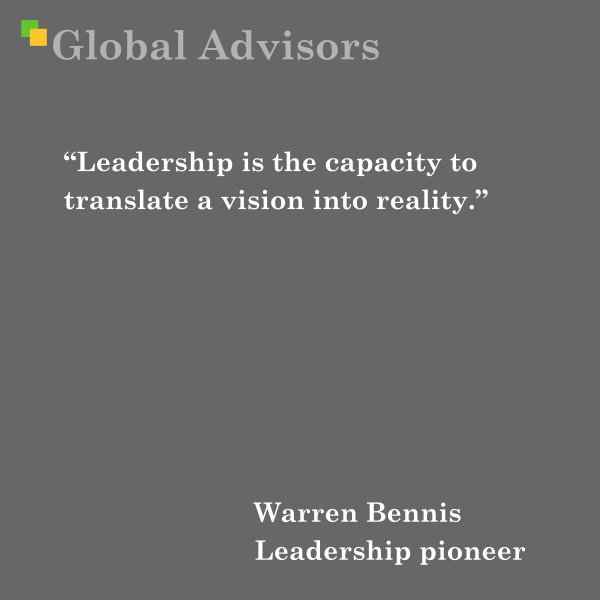
Quote: Warren Bennis - pioneer in leadership studies“Leadership is the capacity to translate a vision into reality.” - Warren BennisThis quote by Warren Bennis, a celebrated pioneer in leadership studies, elegantly captures a central premise of modern organisational theory: that the true essence of leadership lies not merely in the ability to conceive an ambitious vision, but in the intricate craft of motivating others and marshalling resources to make that vision tangible. Bennis consistently advocated that leadership is dynamic, adaptive, and fundamentally a matter of personal influence—distinct from management, which is rooted in processes and control. He asserted that leaders must inspire and engage their followers, weaving collective talent into purposeful action. The quote encapsulates Bennis's experiential and humanistic approach to leadership. Drawing from decades consulting for high-level organisations and advising US presidents, as well as his own formative experiences in military service, Bennis believed effective leaders shape group behaviour, foster inclusivity, and create environments where people willingly align themselves to a shared purpose. His work at MIT and USC drove a significant shift in how leadership was understood—instead of hierarchical command, leadership became seen as facilitative and collaborative. Profile of Warren Bennis
Leading Theorists in Leadership Studies Warren Bennis's legacy is entwined with other prominent theorists who shaped the field:
Contemporary Relevance The enduring appeal of Bennis's quote stems from its resonance in today's volatile and complex business landscape. The ability to envision bold futures and mobilise diverse teams towards realising them remains a decisive differentiator for high-performing organisations. His legacy is found in the proliferation of leadership development programmes worldwide—which increasingly stress authenticity, emotional intelligence, and collective action as core requirements for exceptional leaders. In summary, Warren Bennis and his peers reframed leadership as an act of translation: turning abstract ambitions into concrete outcomes through vision, influence, and adaptive collaboration. Their insights continue to inform practitioners seeking sustainable, people-centred success in the modern world.
|
| |
| |
|


| |
| |