| |
|

| |
| |
| |
|
Our selection of the top business news sources on the web. |
| |
| |
| | ||||||||||||||||||
Quote: Benjamin Franklin - PolymathBe at war with your vices, at peace with your neighbors, and let every new year find you a better man. - Benjamin Franklin - PolymathBenjamin Franklin: The Quintessential American Polymath Benjamin Franklin (1706–1790) exemplifies the polymath ideal—a self-taught master across diverse fields including science, invention, printing, politics, diplomacy, writing, and civic philanthropy—who rose from humble origins to shape the American Enlightenment and the founding of the United States.1,2,4,6 Early Life and Rise from ObscurityBorn into a modest Boston family as the fifteenth of seventeen children, Franklin apprenticed as a printer at age 12 under his brother James, a harsh taskmaster. At 17, he ran away to Philadelphia, arriving penniless but ambitious. He built a printing empire through relentless habits: mastering shorthand for note-taking, debating ideas via Socratic dialogues he scripted with invented personas, and writing prolifically to sharpen his mind and generate wealth. By 42, he retired wealthy, funding further pursuits in science and public service. His "synced habits"—unifying skills like printing, distribution, and invention into a multimedia empire—exemplified centripetal polymathy, where talents converged toward a singular vision of self-improvement and societal benefit.1,4 Scientific Breakthroughs and InventionsFranklin's empirical approach transformed him into a leading Enlightenment scientist. He proved lightning is electricity through experiments, including his famous (though risky) kite test—replicated safely in France with an iron rod—leading to the lightning rod that prevented countless fires.1,4,5,6 He coined terms like "positive," "negative," "battery," "charge," and "conductor," discovered conservation of charge, and built an early capacitor.4,6 Other inventions include bifocals (born from personal frustration with switching glasses), the efficient Franklin stove, a glass armonica musical instrument, and Gulf Stream mapping for safer navigation. He even proposed a phonetic alphabet, removing six "unnecessary" letters, though it lacked printing type.3,5 Civic and Political LegacyA prolific philanthropist, Franklin founded the Library Company (America's first subscription library), University of Pennsylvania, Philadelphia's first fire department, and volunteer militia. As a diplomat, he secured French alliance crucial to American independence, helped draft the Declaration of Independence and Constitution, and served as a postmaster and statesman.2,3,4,5,7 His satirical writing, under pseudonyms like Poor Richard, popularized wisdom like "Early to bed and early to rise makes a man healthy, wealthy, and wise." Learning Habits That Forged a PolymathNot born privileged or a savant, Franklin cultivated polymathy through deliberate practices:
His influence endures on the $100 bill, in institutions, and as "the Leonardo da Vinci of the age" or "Father of the American Enlightenment."3,7 Leading Theorists on Polymathy and Related ConceptsPolymathy—deep expertise across multiple domains—draws from historical and modern theorists, often contrasting Franklin's structured approach:
These theorists underscore Franklin's proof: polymathy is habit-forged, not gifted—prioritizing tested application over mere consumption.1 References 1. https://www.magneticmemorymethod.com/benjamin-franklin-polymath/ 2. https://www.philanthropyroundtable.org/hall-of-fame/benjamin-franklin/ 3. https://www.historyextra.com/period/georgian/benjamin-franklin-facts-life-death/ 4. https://en.wikipedia.org/wiki/Benjamin_Franklin 6. https://www.britannica.com/biography/Benjamin-Franklin 7. http://www.zenosfrudakis.com/blog/2025/3/4/benjamin-franklin-father-of-the-american-enlightenment 8. https://www.neh.gov/explore/the-papers-benjamin-franklin
|
||||||||||||||||||
| |

| |
Quote: Aeschylus - Athenian dramatist"It is in the character of very few men to honour without envy a friend who has prospered." - Aeschylus - Athenian dramatistAeschylus: The Father of TragedyAeschylus revolutionized theatre by transforming tragedy from a static choral recitation into a dynamic art form centered on human conflict, individual agency, and the profound moral questions that continue to define literature and philosophy.1,2 Born in 525/524 BCE in Eleusis—a town sacred for its mysteries and spiritual significance—Aeschylus emerged as the first of classical Athens' great dramatists during an era when democracy itself was being forged through conflict and experimentation.1,3 Life and Historical ContextAeschylus lived through one of antiquity's most transformative periods. Athens had recently overthrown its tyranny and established democracy, yet the young republic faced existential threats from within and without.1 This turbulent backdrop profoundly shaped his artistic vision and personal trajectory. According to the 2nd-century geographer Pausanias, Aeschylus received his calling while working at a vineyard in his youth, when the god Dionysus appeared to him in a dream, commanding him to write tragedy.2 He made his first theatrical appearance in 499 BCE at age 26, entering competitions that would become his life's defining pursuit.2 However, Aeschylus' most formative experiences came not in the theatre but on the battlefield. He participated in the catastrophic Battle of Marathon against the invading Persians, where his brother was killed—an event so significant that he commemorated it on his own epitaph rather than his theatrical accomplishments.1,2 In 480 BCE, when Xerxes I launched his massive invasion, Aeschylus again served his city, fighting at Artemisium and Salamis, the latter being one of antiquity's most decisive naval battles.1,3 These military experiences—witnessing hubris, collective action, divine justice, and the terrible costs of war—became the emotional and intellectual foundation of his greatest works. His earliest surviving play, The Persians (472 BCE), uniquely depicts the recent Battle of Salamis from the Persian perspective, focusing on King Xerxes' tragic downfall through pride and divine retribution.2,3 Notably, Aeschylus had personally fought in this very battle less than a decade before dramatizing it. Revolutionary Contributions to DramaAeschylus fundamentally transformed Greek tragedy through structural and thematic innovations.1 Before him, drama was confined to a single actor (the protagonist) performing static recitations with a largely passive chorus.1 Aeschylus, following Aristotle's later observation, "reduced the chorus' role and made the plot the leading actor," creating genuine dramatic tension through multiple characters in conflict.1 Beyond structural changes, he pioneered spectacular scenic effects through innovative use of stage machinery and settings, designed elaborate costumes, trained choruses in complex choreography, and often performed in his own plays—a common practice among Greek dramatists.1 These weren't merely technical accomplishments; they reflected his understanding that theatre could engage audiences viscerally and intellectually. Aeschylus' career was extraordinarily successful. Ancient sources attribute him with 13 first-prize victories—meaning well over half his plays won competitions where judges evaluated complete sets of four plays (three tragedies and one satyr play).1,2 He composed approximately 90 plays across his lifetime, though only seven tragedies survive intact: The Persians, Seven Against Thebes, The Suppliants, the trilogy The Oresteia (comprising Agamemnon, The Libation Bearers, and The Eumenides), and Prometheus Bound (whose authorship remains disputed).2 A turning point came in 468 BCE when the young Sophocles defeated him in competition—his only recorded theatrical loss.1 According to Plutarch, an unusually prestigious jury of Athens' leading generals, including Cimon, judged the contest. When Sophocles won, the aging Aeschylus, deeply wounded, departed Athens for Sicily in self-imposed exile, where he died around 456/455 BCE near Gela.1,3 Intellectual and Philosophical AchievementAeschylus' greatest distinction lies not merely in technical innovation but in his capacity to treat fundamental moral and philosophical questions with singular honesty.1 Living in an age when Greeks genuinely believed themselves surrounded by gods, Aeschylus nevertheless possessed what Britannica identifies as "a capacity for detached and general thought, which was typically Greek."1 His masterwork, The Oresteia trilogy (458 BCE), exemplifies this achievement. Unlike typical tragedies that end in suffering, The Oresteia concludes in "joy and reconciliation" after exploring profound themes of justice, revenge, guilt, and redemption.1 The trilogy traces the House of Atreus across generations—from Agamemnon's murder through Orestes' agonized pursuit by the Furies—ultimately culminating in the establishment of rational justice through Athena's intervention and the transformation of the Furies into benevolent protectors. This progression reflects Aeschylus' sophisticated understanding of evil not as inexplicable chaos but as a dynamic force subject to moral law and divine justice. His works depict evil with unflinching power, exploring its psychological and social consequences while maintaining faith in human moral capacity and divine justice. Legacy and Influence on Western ThoughtAeschylus' influence on tragedy's development was, in the assessment of classical scholars, "fundamental."1 He established conventions that his successors Sophocles and Euripides would refine but not replace. More profoundly, he demonstrated that theatre could address metaphysical questions—the nature of justice, human suffering, divine will, and moral responsibility—with the same rigor philosophers employed in abstract discourse. His works remained central to Greek education and were regularly performed centuries after his death. The survival of his plays (despite many being lost to time) compared to the fragments of his contemporaries testifies to their enduring power. Classical scholars continue to turn to Aeschylus as the foundational figure through whom Western dramatic tradition begins, making him not merely a historical figure but an ancestor of every playwright, novelist, and storyteller who has grappled with human conflict and moral complexity.
References 1. https://www.britannica.com/biography/Aeschylus-Greek-dramatist 2. https://en.wikipedia.org/wiki/Aeschylus 3. https://www.thecollector.com/aeschylus-understanding-the-father-of-tragedy/ 4. https://chs.harvard.edu/chapter/part-i-greece-12-aeschylus-little-ugly-one/ 6. https://www.coursehero.com/lit/Agamemnon/author/ 7. https://www.youtube.com/watch?v=8FMpmrDpVts
|
| |

| |
Quote: Martin Luther King, Jr."In the end, we will remember not the words of our enemies, but the silence of our friends." - Martin Luther King, Jr.Martin Luther King, Jr. (January 15, 1929 – April 4, 1968) was a Baptist minister, social activist, and the preeminent leader of the American civil rights movement, advancing racial equality through nonviolent resistance and civil disobedience.1,2,3 Born Michael King, Jr. in Atlanta, Georgia, to a family of Baptist preachers—his father, Martin Luther King Sr., was a prominent pastor who instilled early lessons in confronting segregation—King excelled academically, skipping grades and entering Morehouse College at age 15.1,4,6 He earned a sociology degree from Morehouse (1948), a divinity degree from Crozer Theological Seminary (1951), and a Ph.D. from Boston University (1955), where he deepened his commitment to social justice amid the era's Jim Crow laws enforcing racial segregation.1,3,7 King's national prominence emerged during the 1955–1956 Montgomery Bus Boycott, sparked by Rosa Parks' arrest for refusing to yield her bus seat to a white passenger; recruited as spokesman for the Montgomery Improvement Association, he led 381 days of boycotts that integrated the city's buses after a U.S. Supreme Court ruling in Browder v. Gayle deemed segregation unconstitutional.1,2,3,5 His home was bombed during the boycott, yet he urged nonviolence, drawing from Christian principles and transforming into the movement's leading voice.3,4 In 1957, King co-founded and became president of the Southern Christian Leadership Conference (SCLC), coordinating nonviolent campaigns across the South.1,3,4,7 Key efforts included the 1963 Birmingham campaign, where police brutality against protesters—captured on television with images of dogs and fire hoses attacking Black children—galvanized national support for civil rights legislation; from jail, King penned the "Letter from Birmingham Jail", a seminal defense of nonviolent direct action against unjust laws.2,3,7 That year, he helped organize the March on Washington, where over 250,000 people heard his iconic "I Have a Dream" speech envisioning racial harmony.1,3,5 King's leadership drove landmark laws: the Civil Rights Act of 1964 ending legal segregation, the Voting Rights Act of 1965 protecting Black voting rights (bolstered by the Selma-to-Montgomery marches), and the Fair Housing Act of 1968.3,4,5 At 35, he became the youngest Nobel Peace Prize recipient in 1964 for combating racial inequality nonviolently.1,5,7 Arrested over 30 times, he faced FBI surveillance under J. Edgar Hoover's COINTELPRO, including a threatening letter in 1964.3,6 In his final years, King broadened his focus to poverty (Poor People's Campaign) and the Vietnam War, speaking against it as immoral.3,5 Tragically, on April 4, 1968, King was assassinated in Memphis, Tennessee, while supporting striking sanitation workers; his final speech, "I've Been to the Mountaintop", delivered the night before, prophetically reflected on mortality: "I've seen the Promised Land. I may not get there with you… but I want you to know tonight, that we, as a people, will get to the Promised Land."5,6 His funeral drew global mourning, with U.S. flags at half-staff.6 King's philosophy of nonviolence was profoundly shaped by leading theorists. Central was Mahatma Gandhi (1869–1948), whose satyagraha—nonviolent resistance—successfully ousted British rule from India; King studied Gandhi in seminary and visited India in 1959, adapting it to America's racial struggle, stating the SCLC drew "ideals… from Christianity" and "operational techniques from Gandhi."4,7 Another influence was Henry David Thoreau (1817–1862), whose 1849 essay "Civil Disobedience" argued individuals must resist unjust governments, inspiring King's willingness to accept jail for moral causes.3 Christian theologian Walter Rauschenbusch (1861–1918), via the Social Gospel movement, emphasized applying Jesus' teachings to eradicate social ills like poverty and racism, aligning with King's sermons and activism.1 Collectively, these thinkers provided King a framework blending spiritual ethics, moral defiance, and strategic nonviolence, fueling the movement's legislative triumphs.2,7
References 1. https://www.britannica.com/biography/Martin-Luther-King-Jr 2. https://thekingcenter.org/about-tkc/martin-luther-king-jr/ 3. https://en.wikipedia.org/wiki/Martin_Luther_King_Jr. 4. https://naacp.org/find-resources/history-explained/civil-rights-leaders/martin-luther-king-jr 5. https://www.biography.com/activists/martin-luther-king-jr 6. https://guides.lib.lsu.edu/mlk 7. https://www.nobelprize.org/prizes/peace/1964/king/biographical/ 8. https://www.youtube.com/watch?v=pG8X0vOvi7Q
|
| |

| |
Quote: Francis Bacon - British artist"The worst solitude is to be destitute of sincere friendship." - Francis Bacon - British artistFrancis Bacon (1909–1992) was an Irish-born British painter whose raw, distorted depictions of the human figure revolutionized 20th-century art, capturing existential isolation, psychological torment, and the fragility of the body.42 Life and BackstoryBorn in Dublin to English parents, Bacon endured a tumultuous childhood marked by family conflict; his father, a horse trainer, reportedly disowned him after discovering his homosexuality.4 He left home at 16, drifting through Berlin, Paris, and London, where he worked odd jobs before discovering his artistic calling in the 1930s via influences like Pablo Picasso's biomorphic forms and Sergei Eisenstein's cinematic montages.42 Self-taught, Bacon destroyed much of his early output, only gaining recognition with Three Studies for Figures at the Base of a Crucifixion (1944), a triptych of screeching, meat-like figures evoking postwar horror.94 His career peaked in the 1950s–1970s with iconic series like the "screaming Popes," inspired by Diego Velázquez's Portrait of Pope Innocent X (1650), which he twisted into contorted, anguished figures trapped in geometric cages symbolizing alienation.142 Personal tragedies shaped his later "Black Triptychs" (1970s), mourning lovers like George Dyer, whose suicide in 1971 prompted visceral portrayals of grief, erasure, and mortality.56 Bacon's London studio was a chaotic archive of chaos, yielding over 1,000 works sold for millions posthumously.4 Artistic Themes and TechniquesBacon's oeuvre fixates on deformation and isolation, deliberately twisting bodies—stretching limbs, blurring faces, exposing raw flesh—to expose the "brutal, primitive forces" beneath civilized facades.213 Figures inhabit claustrophobic, undefined spaces framed by transparent enclosures or architectural lines, evoking entrapment and vulnerability, as in Head IV (1949) or Seated Figure (1961).34 Recurring motifs include the open, screaming mouth (tracing to Eadweard Muybridge's motion studies and his 1940s Abstraction from the Human Form), fleshy carcasses echoing Rembrandt, and spectral voids amplifying existential dread.423 His blue-black palettes and gestural brushwork mimic fragmented neural perception, stripping pretense to reveal life's "unfinished quality."2 Works like Study after Velázquez's Portrait of Pope Innocent X (1953) rank as masterpieces, transforming papal dignity into cynical fury.4 Connection to Existentialism and Leading TheoristsBacon's art resonates with existentialist philosophy, portraying humans as condemned to freedom amid absurdity, vulnerability, and meaninglessness—though he avoided direct affiliation.2 His isolated, distorted forms echo Jean-Paul Sartre's Being and Nothingness (1943), where existence precedes essence, leaving individuals "suspended in a void," as in Bacon's suspended figures.2 Jean-Paul Sartre (1905–1980), French philosopher, argued humans confront nausea and anguish in an indifferent world, confronting "bad faith" through authentic choices—mirroring Bacon's raw, unadorned humanity.2 Albert Camus (1913–1960), in The Myth of Sisyphus (1942), depicted the absurd hero defying meaninglessness; Bacon's tormented Everymen, like the blurry Man in Blue, embody this revolt against isolation.12 Martin Heidegger (1889–1976), via Being and Time (1927), explored Dasein's thrownness into mortality (Geworfenheit) and uncanniness (Unheimlichkeit), aligning with Bacon's meaty, spectral bodies confronting death.24 These thinkers, amid post-WWII disillusionment, provided intellectual scaffolding for Bacon's visual assault on human fragility, transforming personal demons into universal insights.2 References 1. https://www.dailyartmagazine.com/man-in-blue-by-francis-bacon/ 2. https://www.playforthoughts.com/blog/francis-bacon 3. https://artrkl.com/blogs/news/underrated-paintings-by-francis-bacon-you-should-know 4. https://en.wikipedia.org/wiki/Francis_Bacon_(artist) 5. https://www.myartbroker.com/artist-francis-bacon/collection-the-metropolitan-triptych 6. https://www.francis-bacon.com/artworks/paintings/1970s 7. https://www.myartbroker.com/artist-francis-bacon/collection-final-triptychs 8. https://arthur.io/art/francis-bacon/untitled-1 9. http://www.laurencefuller.art/blog/2016/8/18/bacon
|
| |

| |
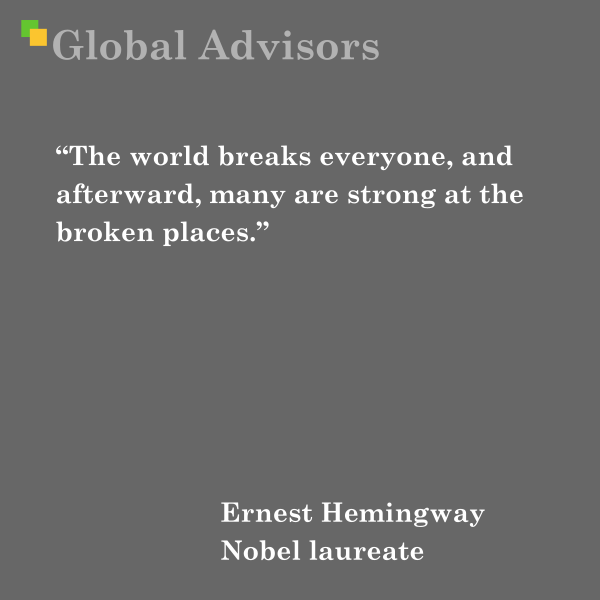
Quote: Ernest Hemingway - Nobel laureate“The world breaks everyone, and afterward, many are strong at the broken places.” - Ernest Hemingway - Nobel laureateErnest Miller Hemingway (1899–1961) was an American novelist, short-story writer, and journalist whose terse, understated prose reshaped 20th-century literature, earning him the 1954 Nobel Prize in Literature for "his mastery of the art of narrative, most recently demonstrated in The Old Man and the Sea, and for the influence that he has exerted on contemporary style." Born in Oak Park, Illinois, Hemingway began his career at 17 as a reporter for the Kansas City Star, honing a concise style that defined his work. During World War I, poor eyesight barred him from enlisting, so he volunteered as an ambulance driver for the Italian army, where shrapnel wounds and a concussion earned him the Italian Silver Medal of Valor; these experiences profoundly shaped his themes of war, loss, and resilience. Hemingway's adventurous life mirrored his fiction: he covered the Spanish Civil War, World War II (including D-Day and the liberation of Paris, for which he received a Bronze Star), and African safaris that inspired works like Green Hills of Africa (1935). Major novels such as The Sun Also Rises (1926), A Farewell to Arms (1929), and For Whom the Bell Tolls (1940) established him as a literary giant, blending personal ordeals—two near-fatal plane crashes in 1954 left him in chronic pain—with explorations of human endurance. Despite hating war ("Never think that war, no matter how necessary, nor how justified, is not a crime"), he repeatedly immersed himself in conflict as correspondent and participant. His 1952 novella The Old Man and the Sea won the Pulitzer Prize, cementing his fame before health decline led to suicide in 1961. Context of the QuoteThe quote—“The world breaks everyone, and afterward, many are strong at the broken places”—originates from Hemingway's 1929 novel A Farewell to Arms, a semi-autobiographical account of his World War I romance with nurse Agnes von Kurowsky amid the Italian front's devastation. Spoken by the protagonist Frederic Henry, it reflects Hemingway's meditation on trauma's dual edge: destruction followed by potential fortification. The novel, published shortly after Hemingway's own frontline injuries and amid the Lost Generation's post-war disillusionment, captures how catastrophe forges character, echoing his belief in life's tragic interest, as seen in his bullfighting treatise Death in the Afternoon (1932). This stoic view permeates his oeuvre, from the emasculated expatriates of The Sun Also Rises to the solitary fisherman's resolve in The Old Man and the Sea, underscoring resilience amid inevitable breakage. Leading Theorists on Resilience and Post-Traumatic GrowthHemingway's insight prefigures post-traumatic growth (PTG), a concept formalised by psychologists Richard Tedeschi and Lawrence Calhoun in the 1990s, who defined it as positive psychological change after trauma—such as strengthened relationships, new possibilities, and greater appreciation for life—arising precisely from struggle's "broken places.". Their research, building on earlier work, posits that while trauma shatters assumptions, deliberate processing rebuilds with enhanced strength, aligning with Hemingway's literary archetype.. Viktor Frankl, Holocaust survivor and founder of logotherapy, advanced related ideas in Man's Search for Meaning (1946), arguing that suffering, when met with purpose, catalyses profound growth: "What is to give light must endure burning." Frankl's experiences in Auschwitz echoed Hemingway's war scars, emphasising meaning-making as the path to resilience. Friedrich Nietzsche, whose 1888 aphorism "What does not kill me makes me stronger" (Twilight of the Idols) directly anticipates the quote, framed adversity as a forge for the Übermensch—self-overcoming through trial. Martin Seligman, father of positive psychology, integrated these in the 1990s via learned optimism and resilience factors, identifying agency, cognitive reframing, and social support as mechanisms turning breakage into strength, validated through longitudinal studies. These frameworks illuminate Hemingway's prescience: personal and collective fractures, from war to crisis, often yield adaptive power when confronted directly.
|
| |
| |
Quote: Naval Ravikant - Venture Capitalist“UI is pre-AI.” - Naval Ravikant - Venture CapitalistNaval Ravikant stands as one of Silicon Valley's most influential yet unconventional thinkers—a figure who bridges the gap between pragmatic entrepreneurship and philosophical inquiry. His observation that "UI is pre-AI" reflects a distinctive perspective on technological evolution that warrants careful examination, particularly given his track record as an early-stage investor in transformative technologies. The Architect of Modern Startup InfrastructureRavikant's influence on the technology landscape extends far beyond individual company investments. As co-founder, chairman, and former CEO of AngelList, he fundamentally altered how early-stage capital flows through the startup ecosystem. AngelList democratised access to venture funding, creating infrastructure that connected aspiring entrepreneurs with angel investors and venture capital firms on an unprecedented scale. This wasn't merely a business achievement; it represented a structural shift in how innovation gets financed globally. His investment portfolio reflects prescient timing and discerning judgement. Ravikant invested early in companies including Twitter, Uber, Foursquare, Postmates, Yammer, and Stack Overflow—investments that collectively generated over 70 exits and more than 10 unicorn companies. This track record positions him not as a lucky investor, but as someone with genuine pattern recognition capability regarding which technologies would matter most. Beyond the Venture Capital ThesisWhat distinguishes Ravikant from conventional venture capitalists is his deliberate rejection of the traditional founder mythology. He explicitly advocates against the "hustle mentality" that dominates startup culture, instead promoting a more holistic conception of wealth that encompasses time, freedom, and peace of mind alongside financial returns. This philosophy shapes how he evaluates opportunities and mentors founders—he considers not merely whether a business will scale, but whether it will scale without scaling stress. His broader intellectual contributions extend through multiple channels. With more than 2.4 million followers on Twitter (X), Ravikant regularly shares aphoristic insights blending practical wisdom with Eastern philosophical traditions. His appearances on influential podcasts, particularly the Tim Ferriss Show and Joe Rogan Experience, have introduced his thinking to audiences far beyond Silicon Valley. Most notably, his "How to Get Rich (without getting lucky)" thread has become foundational reading across technology and business communities, articulating principles around leverage through code, capital, and content. Understanding "UI is Pre-AI"The quote "UI is pre-AI" requires interpretation within Ravikant's broader intellectual framework and the contemporary technological landscape. The statement operates on multiple levels simultaneously. The Literal Interpretation: User interface design and development necessarily precedes artificial intelligence implementation in most technology products. This reflects a practical observation about product development sequencing—one must typically establish how users interact with systems before embedding intelligent automation into those interactions. In this sense, the UI is the foundational layer upon which AI capabilities are subsequently layered. The Philosophical Dimension: More provocatively, the statement suggests that how we structure human-computer interaction through interface design fundamentally shapes the possibilities for what artificial intelligence can accomplish. The interface isn't merely a presentation layer; it represents the primary contact point between human intent and computational capability. Before AI can be genuinely useful, the interface must make that utility legible and accessible to end users. The Investment Perspective: For Ravikant specifically, this observation carries investment implications. It suggests that companies solving user experience problems will likely remain valuable even as AI capabilities evolve, whereas companies that focus purely on algorithmic sophistication without considering user interaction may find their innovations trapped in laboratory conditions rather than deployed in markets. The Theoretical LineageRavikant's observation sits within a longer intellectual tradition examining the relationship between interface, interaction, and technological capability. Don Norman and Human-Centered Design: The foundational modern work on this subject emerged from Don Norman's research at the University of California, San Diego, particularly his seminal work on design of everyday things. Norman argued that excellent product design requires intimate understanding of human cognition, perception, and behaviour. Before any technological system—intelligent or otherwise—can create value, it must accommodate human limitations and leverage human strengths through thoughtful interface design. Douglas Engelbart and Augmentation Philosophy: Douglas Engelbart's mid-twentieth-century work on human-computer augmentation established that technology's primary purpose should be extending human capability rather than replacing human judgment. His thinking implied that interfaces represent the crucial bridge between human cognition and computational power. Without well-designed interfaces, the most powerful computational systems remain inert. Alan Kay and Dynabook Vision: Alan Kay's vision of personal computing—articulated through concepts like the Dynabook—emphasised that technology's democratising potential depends entirely on interface accessibility. Kay recognised that computational power matters far less than whether ordinary people can productively engage with that power through intuitive interaction models. Contemporary HCI Research: Modern human-computer interaction research builds on these foundations, examining how interface design shapes which problems users attempt to solve and how they conceptualise solutions. Researchers like Shneiderman and Plaisant have demonstrated empirically that interface design decisions have second-order effects on what users believe is possible with technology. The Contemporary ContextRavikant's statement carries particular resonance in the current artificial intelligence moment. As organisations rush to integrate large language models and other AI systems into products, many commit what might be called "technology-first" errors—embedding sophisticated algorithms into user experiences that haven't been thoughtfully designed to accommodate them. Meaningful user interface design for AI-powered systems requires addressing distinct challenges: How do users understand what an AI system can and cannot do? How is uncertainty communicated? How are edge cases handled? What happens when the AI makes errors? These questions cannot be answered through better algorithms alone; they require interface innovation. Ravikant's observation thus functions as a corrective to the current technological moment. It suggests that the companies genuinely transforming industries through artificial intelligence will likely be those that simultaneously innovate in both algorithmic capability and user interface design. The interface becomes pre-AI not merely chronologically but causally—shaping what artificial intelligence can accomplish in practice rather than merely in principle. Investment Philosophy IntegrationThis observation aligns with Ravikant's broader investment thesis emphasising leverage and scalability. An excellent user interface represents exactly this kind of leverage—it scales human attention and human decision-making without requiring proportional increases in effort or resources. Similarly, artificial intelligence scaled through well-designed interfaces amplifies this effect, allowing individual users or organisations to accomplish work that previously required teams. Ravikant's focus on investments at seed and Series A stages across media, content, cloud infrastructure, and AI reflects implicit confidence that the foundational layer of how humans interact with technology remains unsettled terrain. Rather than assuming interface design has been solved, he appears to recognise that each new technological capability—whether cloud infrastructure or artificial intelligence—creates new design challenges and opportunities. The quote ultimately encapsulates a distinctive investment perspective: that attention to human interaction, to aesthetics, to usability, represents not secondary ornamentation but primary technological strategy. In an era of intense focus on algorithmic sophistication, Ravikant reminds us that the interface through which those algorithms engage with human needs and human judgment represents the true frontier of technological value creation.
|
| |

| |
Quote: Ilya Sutskever - Safe Superintelligence“The robustness of people is really staggering.” - Ilya Sutskever - Safe SuperintelligenceThis statement, made in his November 2025 conversation with Dwarkesh Patel, comes from someone uniquely positioned to make such judgments: co-founder and Chief Scientist of Safe Superintelligence Inc., former Chief Scientist at OpenAI, and co-author of AlexNet—the 2012 paper that launched the modern deep learning era. Sutskever's claim about robustness points to something deeper than mere durability or fault tolerance. He is identifying a distinctive quality of human learning: the ability to function effectively across radically diverse contexts, to self-correct without explicit external signals, to maintain coherent purpose and judgment despite incomplete information and environmental volatility, and to do all this with sparse data and limited feedback. These capacities are not incidental features of human intelligence. They are central to what makes human learning fundamentally different from—and vastly superior to—current AI systems. Understanding what Sutskever means by robustness requires examining not just human capabilities but the specific ways in which AI systems are fragile by comparison. It requires recognising what humans possess that machines do not. And it requires understanding why this gap matters profoundly for the future of artificial intelligence. What Robustness Actually Means: Beyond Mere ReliabilityIn engineering and systems design, robustness typically refers to a system's ability to continue functioning when exposed to perturbations, noise, or unexpected conditions. A robust bridge continues standing despite wind, earthquakes, or traffic loads beyond its design specifications. A robust algorithm produces correct outputs despite noisy inputs or computational errors. But human robustness operates on an entirely different plane. It encompasses far more than mere persistence through adversity. Human robustness includes:
This multifaceted robustness is what Sutskever identifies as "staggering"—not because it is strong but because it operates across so many dimensions simultaneously whilst remaining stable, efficient, and purposeful. The Fragility of Current AI: Why Models BreakThe contrast becomes clear when examining where current AI systems are fragile. Sutskever frequently illustrates this through the "jagged behaviour" problem: models that perform superhuman on benchmarks yet fail in elementary ways during real-world deployment. A language model can score in the 88th percentile on the bar examination yet, when asked to debug code, introduces new errors whilst fixing previous ones. It cycles between mistakes even when provided clear feedback. It lacks the internal evaluative sense that tells a human programmer, "This approach is leading nowhere; I should try something different." The model lacks robust value functions—internal signals that guide learning and action. This fragility manifests across multiple dimensions:
The Value Function Hypothesis: Emotions as Robust Learning MachinerySutskever's analysis points toward a crucial hypothesis: human robustness depends fundamentally on value functions—internal mechanisms that provide continuous, robust evaluation of states and actions. In machine learning, a value function is a learned estimate of expected future reward or utility from a given state. In human neurobiology, value functions are implemented, Sutskever argues, through emotions and affective states. Fear signals danger. Confidence signals competence. Boredom signals that current activity is unproductive. Satisfaction signals that effort has succeeded. These emotional states, which evolution has refined over millions of years, serve as robust evaluative signals that guide learning and behaviour. Sutskever illustrates this with a striking neurological case: a person who suffered brain damage affecting emotional processing. Despite retaining normal IQ, puzzle-solving ability, and articulate cognition, this person became radically incapable of making even trivial decisions. Choosing which socks to wear would take hours. Financial decisions became catastrophically poor. This person could think but could not effectively decide or act—suggesting that emotions (and the value functions they implement) are not peripheral to human cognition but absolutely central to effective agency. What makes human value functions particularly robust is their simplicity and stability. They are not learned during a person's lifetime through explicit training. They are evolved, hard-coded by billions of years of biological evolution into neural structures that remain remarkably consistent across human populations and contexts. A person experiences hunger, fear, social connection, and achievement similarly whether in ancient hunter-gatherer societies or modern industrial ones—because these value functions were shaped by evolutionary pressures that remained relatively stable. This evolutionary hardcoding of value functions may be crucial to human learning robustness. Imagine trying to teach a child through explicit reward signals alone: "Do this task and receive points; optimise for points." This would be inefficient and brittle. Instead, humans learn through value functions that are deeply embedded, emotionally weighted, and robust across contexts. A child learns to speak not through external reward optimisation but through intrinsic motivation—social connection, curiosity, the inherent satisfaction of communication. These motivations persist across contexts and enable robust learning. Current AI systems largely lack this. They optimise for explicitly defined reward signals or benchmark metrics. These are fragile by comparison—vulnerable to reward hacking, overfitting, distribution shift, and the brittle transfer failures Sutskever observes. Why This Matters Now: The Transition PointSutskever's observation about human robustness arrives at a precise historical moment. As of November 2025, the AI industry is transitioning from what he terms the "age of scaling" (2020–2025) to what will be the "age of research" (2026 onward). This transition is driven by recognition that scaling alone is reaching diminishing returns. The next advances will require fundamental breakthroughs in understanding how to build systems that learn and adapt robustly—like humans do. This creates an urgent research agenda: How do you build AI systems that possess human-like robustness? This is not a question that scales with compute or data. It is a research question—requiring new architectures, learning algorithms, training procedures, and conceptual frameworks. Sutskever's identification of robustness as the key distinguishing feature of human learning sets the research direction for the next phase of AI development. The question is not "how do we make bigger models" but "how do we build systems with value functions that enable efficient, self-correcting, context-robust learning?" The Research Frontier: Leading Theorists Addressing RobustnessAntonio Damasio: The Somatic Marker HypothesisAntonio Damasio, neuroscientist at USC and authority on emotion and decision-making, has developed the somatic marker hypothesis—a framework explaining how emotions serve as rapid evaluative signals that guide decisions and learning. Damasio's work provides neuroscientific grounding for Sutskever's hypothesis that value functions (implemented as emotions) are central to effective agency. Damasio's case studies of patients with emotional processing deficits closely parallel Sutskever's neurological example—demonstrating that emotional value functions are prerequisites for robust, adaptive decision-making. Judea Pearl: Causal Models and Robust ReasoningJudea Pearl, pioneer in causal inference and probabilistic reasoning, has argued that correlation-based learning has fundamental limits and that robust generalisation requires learning causal structure—the underlying relationships between variables that remain stable across contexts. Pearl's work suggests that human robustness derives partly from learning causal models rather than mere patterns. When a human understands how something works (causally), that understanding transfers to novel contexts. Current AI systems, lacking robust causal models, fail at transfer—a key component of robustness. Karl Friston: The Free Energy PrincipleKarl Friston, neuroscientist at University College London, has developed the free energy principle—a unified framework explaining how biological systems, including humans, maintain robustness by minimising prediction error and maintaining models of their environment and themselves. The principle suggests that what makes humans robust is not fixed programming but a general learning mechanism that continuously refines internal models to reduce surprise. This framework has profound implications for building robust AI: rather than optimising for external rewards, systems should optimise for maintaining accurate models of reality, enabling principled generalisation. Stuart Russell: Learning Under Uncertainty and Value AlignmentStuart Russell, UC Berkeley's leading AI safety researcher, has emphasised that robust AI systems must remain genuinely uncertain about objectives and learn from interaction rather than operating under fixed goal specifications. Russell's work suggests that rigidity about objectives makes systems fragile—vulnerable to reward hacking and context-specific failure. Robustness requires systems that maintain epistemic humility and adapt their understanding of what matters based on continued learning. This directly parallels how human value systems are robust: they are not brittle doctrines but evolving frameworks that integrate experience. Demis Hassabis and DeepMind's Continual Learning ResearchDemis Hassabis, CEO of DeepMind, has invested substantial effort into systems that learn continuously from environmental interaction rather than through discrete offline training phases. DeepMind's research on continual reinforcement learning, meta-learning, and adaptive systems reflects the insight that robustness emerges not from static pre-training but from ongoing interaction with environments—enabling systems to refine their models and value functions continuously. This parallels human learning, which is fundamentally continual rather than episodic. Yann LeCun: Self-Supervised Learning and World ModelsYann LeCun, Meta's Chief AI Scientist, has advocated for learning approaches that enable systems to build internal models of how the world works—what he terms world models—through self-supervised learning. LeCun argues that robust generalisation requires systems that understand causal structure and dynamics, not merely correlations. His work on self-supervised learning suggests that systems trained to predict and model their environments develop more robust representations than systems optimised for specific external tasks. The Evolutionary Basis: Why Humans Have Robust Value FunctionsUnderstanding human robustness requires appreciating why evolution equipped humans with sophisticated, stable value function systems. For millions of years, humans and our ancestors faced fundamentally uncertain environments. The reward signals available—immediate sensory feedback, social acceptance, achievement, safety—needed to guide learning and behaviour across vast diversity of contexts. Evolution could not hard-code specific solutions for every possible situation. Instead, it encoded general-purpose value functions—emotions and motivational states—that would guide adaptive behaviour across contexts. Consider fear. Fear is a robust value function signal that something is dangerous. This signal evolved in environments full of predators and hazards. Yet the same fear response that protected ancestral humans from predators also keeps modern humans safe from traffic, heights, and social rejection. The value function is robust because it operates on a general principle—danger—rather than specific memorised hazards. Similarly, social connection, curiosity, achievement, and other human motivations evolved as general-purpose signals that, across millions of years, correlated with survival and reproduction. They remain remarkably stable across radically different modern contexts—different cultures, technologies, and social structures—because they operate at a level of abstraction robust to context change. Current AI systems, by contrast, lack this evolutionary heritage. They are trained from scratch, often on specific tasks, with reward signals explicitly engineered for those tasks. These reward signals are fragile by comparison—vulnerable to distribution shift, overfitting, and context-specificity. Implications for Safe AI DevelopmentSutskever's emphasis on human robustness carries profound implications for safe AI development. Robust systems are safer systems. A system with genuine value functions—robust internal signals about what matters—is less vulnerable to reward hacking, specification gaming, or deployment failures. A system that learns continuously and maintains epistemic humility is more likely to remain aligned as its capabilities increase. Conversely, current AI systems' lack of robustness is dangerous. Systems optimised for narrow metrics can fail catastrophically when deployed in novel contexts. Systems lacking robust value functions cannot self-correct or maintain appropriate caution. Systems that cannot learn from deployment feedback remain brittle. Building AI systems with human-like robustness is therefore not merely an efficiency question—though efficiency matters greatly. It is fundamentally a safety question. The development of robust value functions, continual learning capabilities, and general-purpose evaluative mechanisms is central to ensuring that advanced AI systems remain beneficial as they become more powerful. The Research Direction: From Scaling to RobustnessSutskever's observation that "the robustness of people is really staggering" reorients the entire research agenda. The question is no longer primarily "how do we scale?" but "how do we build systems with robust value functions, efficient learning, and genuine adaptability across contexts?" This requires:
Conclusion: Robustness as the FrontierWhen Sutskever identifies human robustness as "staggering," he is not offering admiration but diagnosis. He is pointing out that current AI systems fundamentally lack what makes humans effective learners: robust value functions, efficient learning from sparse feedback, genuine self-correction, and adaptive generalisation across contexts. The next era of AI research—the age of research beginning in 2026—will be defined largely by attempts to solve this problem. The organisation or research group that successfully builds AI systems with human-like robustness will not merely have achieved technical progress. They will have moved substantially closer to systems that learn efficiently, generalise reliably, and remain aligned to human values even as they become more capable. Human robustness is not incidental. It is fundamental—the quality that makes human learning efficient, adaptive, and safe. Replicating it in artificial systems represents the frontier of AI research and development.
|
| |

| |
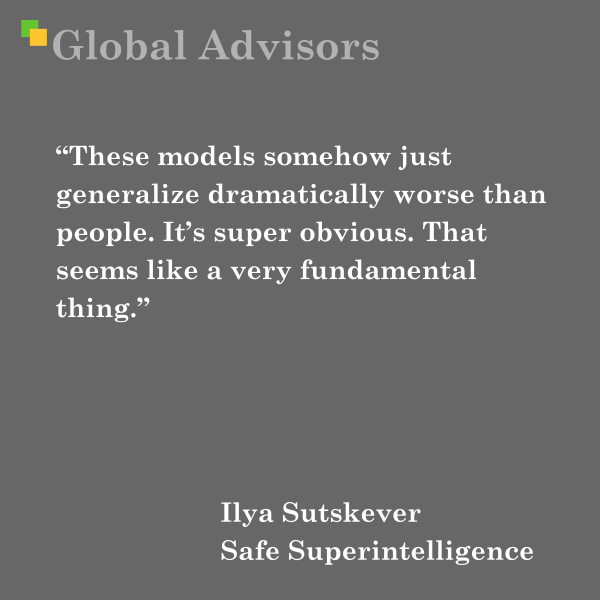
Quote: Ilya Sutskever - Safe Superintelligence“These models somehow just generalize dramatically worse than people. It’s super obvious. That seems like a very fundamental thing.” - Ilya Sutskever - Safe SuperintelligenceSutskever, as co-founder and Chief Scientist of Safe Superintelligence Inc. (SSI), has emerged as one of the most influential voices in AI strategy and research direction. His trajectory illustrates the depth of his authority: co-author of AlexNet (2012), the paper that ignited the deep learning revolution; Chief Scientist at OpenAI during the development of GPT-2 and GPT-3; and now directing a $3 billion research organisation explicitly committed to solving the generalisation problem rather than pursuing incremental scaling. His assertion about generalisation deficiency is not rhetorical flourish. It represents a fundamental diagnostic claim about why current AI systems, despite superhuman performance on benchmarks, remain brittle, unreliable, and poorly suited to robust real-world deployment. Understanding this claim requires examining what generalisation actually means, why it matters, and what the gap between human and AI learning reveals about the future of artificial intelligence. What Generalisation Means: Beyond Benchmark PerformanceGeneralisation, in machine learning, refers to the ability of a system to apply knowledge learned in one context to novel, unfamiliar contexts it has not explicitly encountered during training. A model that generalises well can transfer principles, patterns, and capabilities across domains. A model that generalises poorly becomes a brittle specialist—effective within narrow training distributions but fragile when confronted with variation, novelty, or real-world complexity. The crisis Sutskever identifies is this: contemporary large language models and frontier AI systems achieve extraordinary performance on carefully curated evaluation tasks and benchmarks. GPT-4 scores in the 88th percentile of the bar exam. O1 solves competition mathematics problems at elite levels. Yet these same systems, when deployed into unconstrained real-world workflows, exhibit what Sutskever terms "jagged" behaviour—they repeat errors, introduce new bugs whilst fixing previous ones, cycle between mistakes even with clear corrective feedback, and fail in ways that suggest fundamentally incomplete understanding rather than mere data scarcity. This paradox reveals a hidden truth: benchmark performance and deployment robustness are not tightly coupled. An AI system can memorise, pattern-match, and perform well on evaluation metrics whilst failing to develop the kind of flexible, transferable understanding that enables genuine competence. The Sample Efficiency Question: Orders of Magnitude of DifferenceUnderlying the generalisation crisis is a more specific puzzle: sample efficiency. Why does it require vastly more training data for AI systems to achieve competence in a domain than it takes humans? A human child learns to recognise objects through a few thousand exposures. Contemporary vision models require millions. A teenager learns to drive in approximately ten hours of practice; AI systems struggle to achieve equivalent robustness with orders of magnitude more training. A university student learns to code, write mathematically, and reason about abstract concepts—domains that did not exist during human evolutionary history—with remarkably few examples and little explicit feedback. This disparity points to something fundamental: humans possess not merely better priors or more specialised knowledge, but better general-purpose learning machinery. The principle underlying human learning efficiency remains largely unexpressed in mathematical or computational terms. Current AI systems lack it. Sutskever's diagnostic claim is that this gap reflects not engineering immaturity or the need for more compute, but the absence of a conceptual breakthrough—a missing principle of how to build systems that learn as efficiently as humans do. The implication is stark: you cannot scale your way out of this problem. More data and more compute, applied to existing methodologies, will not solve it. The bottleneck is epistemic, not computational. Why Current Models Fail at Generalisation: The Competitive Programming AnalogySutskever illustrates the generalisation problem through an instructive analogy. Imagine two competitive programmers: Student A dedicates 10,000 hours to competitive programming. They memorise every algorithm, every proof technique, every problem pattern. They become exceptionally skilled within competitive programming itself—one of the very best. Student B spends only 100 hours on competitive programming but develops deeper, more flexible understanding. They grasp underlying principles rather than memorising solutions. When both pursue careers in software engineering, Student B typically outperforms Student A. Why? Because Student A has optimised for a narrow domain and lacks the flexible transfer of understanding that Student B developed through lighter but more principled engagement. Current frontier AI models, in Sutskever's assessment, resemble Student A. They are trained on enormous quantities of narrowly curated data—competitive programming problems, benchmark evaluation tasks, reinforcement learning environments explicitly designed to optimise for measurable performance. They have been "over-trained" on carefully optimised domains but lack the flexible, generalised understanding that enables robust performance in novel contexts. This over-optimisation problem is compounded by a subtle but crucial factor: reinforcement learning optimisation targets. Companies designing RL training environments face substantial degrees of freedom in how to construct reward signals. Sutskever observes that there is often a systematic bias: RL environments are subtly shaped to ensure models perform well on public benchmarks at release time, creating a form of unintentional reward hacking where the system becomes highly tuned to evaluation metrics rather than genuinely robust to real-world variation. The Deeper Problem: Pre-Training's Limits and RL's InefficiencyThe generalisation crisis reflects deeper structural issues within contemporary AI training paradigms. Pre-training's opacity: Large-scale language model pre-training—trained on internet text data—provides models with an enormous foundation of patterns. Yet the way models rely on this pre-training data is poorly understood. When a model fails, it is unclear whether the failure reflects insufficient statistical support in the training distribution or whether something more fundamental is missing. Pre-training provides scale but at the cost of reasoning about what has actually been learned. RL's inefficiency: Current reinforcement learning approaches provide training signals only at the end of long trajectories. If a model spends thousands of steps reasoning about a problem and arrives at a dead end, it receives no signal until the trajectory completes. This is computationally wasteful. A more efficient learning system would provide intermediate evaluative feedback—signals that say, "this direction of reasoning is unpromising; abandon it now rather than after 1,000 more steps." Sutskever hypothesises that this intermediate feedback mechanism—what he terms a "value function" and what evolutionary biology has encoded as emotions—is crucial to sample-efficient learning. The gap between how humans and current AI systems learn suggests that human learning operates on fundamentally different principles: continuous, intermediate evaluation; robust internal models of progress and performance; the ability to self-correct and redirect effort based on internal signals rather than external reward. Generalisation as Proof of Concept: What Human Learning RevealsA critical move in Sutskever's argument is this: the fact that humans generalise vastly better than current AI systems is not merely an interesting curiosity—it is proof that better generalisation is achievable. The existence of human learners demonstrates, in principle, that a learning system can operate with orders of magnitude less data whilst maintaining superior robustness and transfer capability. This reframes the research challenge. The question is no longer whether better generalisation is possible (humans prove it is) but rather what principle or mechanism underlies it. This principle could arise from:
What matters is that Sutskever's claim shifts the research agenda from "get more compute" to "discover the missing principle." The Strategic Implications: Why This Matters NowSutskever's diagnosis, articulated in November 2025, arrives at a crucial moment. The AI industry has operated under the "age of scaling" paradigm since approximately 2020. During this period, the scaling laws discovered by OpenAI and others suggested a remarkably reliable relationship: larger models trained on more data with more compute reliably produced better performance. This created a powerful strategic imperative: invest capital in compute, acquire data, build larger systems. The approach was low-risk from a research perspective because the outcome was relatively predictable. Companies could deploy enormous resources confident they would yield measurable returns. By 2025, however, this model shows clear strain. Data is approaching finite limits. Computational resources, whilst vast, are not unlimited, and marginal returns diminish. Most importantly, the question has shifted: would 100 times more compute actually produce a qualitative transformation or merely incremental improvement? Sutskever's answer is clear: the latter. This fundamentally reorients strategic thinking. If 100x scaling yields only incremental gains, the bottleneck is not compute but ideas. The competitive advantage belongs not to whoever can purchase the most GPUs but to whoever discovers the missing principle of generalisation. Leading Theorists and Related Research ProgramsYann LeCun: World Models and Causal LearningYann LeCun, Meta's Chief AI Scientist and a pioneer of deep learning, has long emphasized that current supervised learning approaches are fundamentally limited. His work on "world models"—internal representations that capture causal structure rather than mere correlation—points toward learning mechanisms that could enable better generalisation. LeCun's argument is that humans learn causal models of how the world works, enabling robust generalisation because causal understanding is stable across contexts in a way that statistical correlation is not. Geoffrey Hinton: Neuroscience-Inspired LearningGeoffrey Hinton, recipient of the 2024 Nobel Prize in Physics for foundational deep learning work, has increasingly emphasized that neuroscience holds crucial clues for improving AI learning efficiency. His recent work on biological plausibility and learning mechanisms reflects conviction that important principles of how neural systems efficiently extract generalised understanding remain undiscovered. Hinton has expressed support for Sutskever's research agenda, recognizing that the next frontier requires fundamental conceptual breakthroughs rather than incremental scaling. Stuart Russell: Learning Under UncertaintyStuart Russell, UC Berkeley's leading AI safety researcher, has articulated that robust AI alignment requires systems that remain genuinely uncertain about objectives and learn from interaction. This aligns with Sutskever's emphasis on continual learning. Russell's work highlights that systems designed to optimise fixed objectives without capacity for ongoing learning and adjustment tend to produce brittle, misaligned outcomes—a dynamic that improves when systems maintain epistemic humility and learn continuously. Demis Hassabis and DeepMind's Continual Learning ResearchDemis Hassabis, CEO of DeepMind, has invested substantial research effort into systems that learn continually from environmental interaction rather than through discrete offline training phases. DeepMind's work on continual reinforcement learning, meta-learning, and systems that adapt to new tasks reflects recognition that learning efficiency depends on how feedback is structured and integrated over time—not merely on total data quantity. Judea Pearl: Causality and AbstractionJudea Pearl, pioneering researcher in causal inference and probabilistic reasoning, has long argued that correlation-based learning has fundamental limits and that causal reasoning is necessary for genuine understanding and generalisation. His work on causal models and graphical representation of dependencies provides theoretical foundations for why systems that learn causal structure (rather than mere patterns) achieve better generalisation across domains. The Research Agenda Going ForwardSutskever's claim that generalisation is the "very fundamental thing" reorients the entire research agenda. This shift has profound implications: From scaling to methodology: Research emphasis moves from "how do we get more compute" to "what training procedures, architectural innovations, or learning algorithms enable human-like generalisation?" From benchmarks to robustness: Evaluation shifts from benchmark performance to deployment reliability—how systems perform on novel, unconstrained tasks rather than carefully curated evaluations. From monolithic pre-training to continual learning: The training paradigm shifts from discrete offline phases (pre-train, then RL, then deploy) toward systems that learn continuously from real-world interaction. From scale as differentiator to ideas as differentiator: Competitive advantage in AI development becomes less about resource concentration and more about research insight—the organisation that discovers better generalisation principles gains asymmetric advantage. The Deeper Question: What Humans Know That AI Doesn'tBeneath Sutskever's diagnostic claim lies a profound question: What do humans actually know about learning that AI systems don't yet embody? Humans learn efficiently because they:
These capabilities do not require superhuman intelligence or extraordinary cognitive resources. A fifteen-year-old possesses them. Yet current AI systems, despite vastly larger parameter counts and more data, lack equivalent ability. This gap is not accidental. It reflects that current AI development has optimised for the wrong targets—benchmark performance rather than genuine generalisation, scale rather than efficiency, memorisation rather than principled understanding. The next breakthrough requires not more of the same but fundamentally different approaches. Conclusion: The Shift from Scaling to DiscoverySutskever's assertion that "these models somehow just generalize dramatically worse than people" is, at first glance, an observation of inadequacy. But reframed, it is actually a statement of profound optimism about what remains to be discovered. The fact that humans achieve vastly better generalisation proves that better generalisation is possible. The task ahead is not to accept poor generalisation as inevitable but to discover the principle that enables human-like learning efficiency. This diagnostic shift—from "we need more compute" to "we need better understanding of generalisation"—represents the intellectual reorientation of AI research in 2025 and beyond. The age of scaling is ending not because scaling is impossible but because it has approached its productive limits. The age of research into fundamental learning principles is beginning. What emerges from this research agenda may prove far more consequential than any previous scaling increment.
|
| |
| |
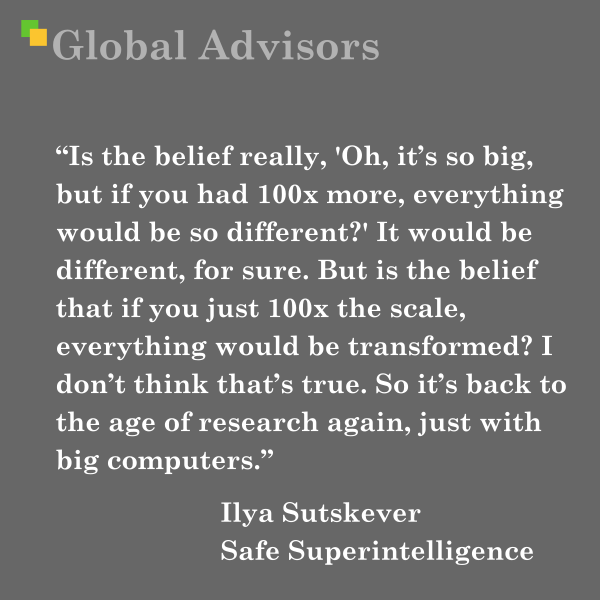
Quote: Ilya Sutskever - Safe Superintelligence“Is the belief really, 'Oh, it’s so big, but if you had 100x more, everything would be so different?' It would be different, for sure. But is the belief that if you just 100x the scale, everything would be transformed? I don’t think that’s true. So it’s back to the age of research again, just with big computers.” - Ilya Sutskever - Safe SuperintelligenceIlya Sutskever stands as one of the most influential figures in modern artificial intelligence—a scientist whose work has fundamentally shaped the trajectory of deep learning over the past decade. As co-author of the seminal 2012 AlexNet paper, he helped catalyse the deep learning revolution that transformed machine vision and launched the contemporary AI era. His influence extends through his role as Chief Scientist at OpenAI, where he played a pivotal part in developing GPT-2 and GPT-3, the models that established large-scale language model pre-training as the dominant paradigm in AI research. In late 2024, Sutskever departed OpenAI and co-founded Safe Superintelligence Inc. (SSI) alongside Daniel Gross and Daniel Levy, positioning the company as the world's "first straight-shot SSI lab"—an organisation with a single focus: developing safe superintelligence without distraction from product development or revenue generation. The company has since raised $3 billion and reached a $32 billion valuation, reflecting investor confidence in Sutskever's strategic vision and reputation. The Context: The Exhaustion of ScalingSutskever's quoted observation emerges from a moment of genuine inflection in AI development. For roughly five years—from 2020 to 2025—the AI industry operated under what he terms the "age of scaling." This era was defined by a simple, powerful insight: that scaling pre-training data, computational resources, and model parameters yielded predictable improvements in model performance. Organisations could invest capital with low perceived risk, knowing that more compute plus more data plus larger models would reliably produce measurable gains. This scaling paradigm was extraordinarily productive. It yielded GPT-3, GPT-4, and an entire generation of frontier models that demonstrated capabilities that astonished both researchers and the public. The logic was elegant: if you wanted better AI, you simply scaled the recipe. Sutskever himself was instrumental in validating this approach. The word "scaling" became conceptually magnetic, drawing resources, attention, and organisational focus toward a single axis of improvement. Yet by 2024–2025, that era began showing clear signs of exhaustion. Data is finite—the amount of high-quality training material available on the internet is not infinite, and organisations are rapidly approaching meaningful constraints on pre-training data supply. Computational resources, whilst vast, are not unlimited, and the economic marginal returns on compute investment have become less obvious. Most critically, the empirical question has shifted: if current frontier labs have access to extraordinary computational resources, would 100 times more compute actually produce a qualitative transformation in capabilities, or merely incremental improvement? Sutskever's answer is direct: incremental, not transformative. This reframing is consequential because it redefines where the bottleneck actually lies. The constraint is no longer the ability to purchase more GPUs or accumulate more data. The constraint is ideas—novel technical approaches, new training methodologies, fundamentally different recipes for building AI systems. The Jaggedness Problem: Theory Meeting RealityOne critical observation animates Sutskever's thinking: a profound disconnect between benchmark performance and real-world robustness. Current models achieve superhuman performance on carefully constructed evaluation tasks—yet in deployment, they exhibit what Sutskever calls "jagged" behaviour. They repeat errors, introduce new bugs whilst fixing old ones, and cycle between mistakes even when given clear corrective feedback. This apparent paradox suggests something deeper than mere data or compute insufficiency. It points to inadequate generalisation—the inability to transfer learning from narrow, benchmark-optimised domains into the messy complexity of real-world application. Sutskever frames this through an analogy: a competitive programmer who practises 10,000 hours on competition problems will be highly skilled within that narrow domain but often fails to transfer that knowledge flexibly to broader engineering challenges. Current models, in his assessment, resemble that hyper-specialised competitor rather than the flexible, adaptive learner. The Core Insight: Generalisation Over ScaleThe central thesis animating Sutskever's work at SSI—and implicit in his quote—is that human-like generalisation and learning efficiency represent a fundamentally different ML principle than scaling, one that has not yet been discovered or operationalised within contemporary AI systems. Humans learn with orders of magnitude less data than large models yet generalise far more robustly to novel contexts. A teenager learns to drive in roughly ten hours of practice; current AI systems struggle to acquire equivalent robustness with vastly more training data. This is not because humans possess specialised evolutionary priors for driving (a recent activity that evolution could not have optimized for); rather, it suggests humans employ a more general-purpose learning principle that contemporary AI has not yet captured. Sutskever hypothesises that this principle is connected to what he terms "value functions"—internal mechanisms akin to emotions that provide continuous, intermediate feedback on actions and states, enabling more efficient learning than end-of-trajectory reward signals alone. Evolution appears to have hard-coded robust value functions—emotional and evaluative systems—that make humans viable, adaptive agents across radically different environments. Whether an equivalent principle can be extracted purely from pre-training data, rather than built into learning architecture, remains uncertain. The Leading Theorists and Related WorkYann LeCun and Data EfficiencyYann LeCun, Meta's Chief AI Scientist and a pioneer of deep learning, has long emphasised the importance of learning efficiency and the role of what he terms "world models" in understanding how agents learn causal structure from limited data. His work highlights that human vision achieves remarkable robustness from developmental data scarcity—children recognise cars after seeing far fewer exemplars than AI systems require—suggesting that the brain employs inductive biases or learning principles that current architectures lack. Geoffrey Hinton and Neuroscience-Inspired AIGeoffrey Hinton, winner of the 2024 Nobel Prize in Physics for his work on deep learning, has articulated concerns about AI safety and expressed support for Sutskever's emphasis on fundamentally rethinking how AI systems learn and align. Hinton's career-long emphasis on biologically plausible learning mechanisms—from Boltzmann machines to capsule networks—reflects a conviction that important principles for efficient learning remain undiscovered and that neuroscience offers crucial guidance. Stuart Russell and Alignment Through UncertaintyStuart Russell, UC Berkeley's leading AI safety researcher, has emphasised that robust AI alignment requires systems that remain genuinely uncertain about human values and continue learning from interaction, rather than attempting to encode fixed objectives. This aligns with Sutskever's thesis that safe superintelligence requires continual learning in deployment rather than monolithic pre-training followed by fixed RL optimisation. Demis Hassabis and Continual LearningDemis Hassabis, CEO of DeepMind and a co-developer of AlphaGo, has invested significant research effort into systems that learn continually rather than through discrete training phases. This work recognises that biological intelligence fundamentally involves interaction with environments over time, generating diverse signals that guide learning—a principle SSI appears to be operationalising. The Paradigm Shift: From Offline to Online LearningSutskever's thinking reflects a broader intellectual shift visible across multiple frontiers of AI research. The dominant pre-training + RL framework assumes a clean separation: a model is trained offline on fixed data, then post-trained with reinforcement learning, then deployed. Increasingly, frontier researchers are questioning whether this separation reflects how learning should actually work. His articulation of "age of research" signals a return to intellectual plurality and heterodox experimentation—the opposite of the monoculture that scaling paradigm created. When everyone is racing to scale the same recipe, innovation becomes incremental. When new recipes are required, diversity of approach becomes an asset rather than liability. The Stakes and ImplicationsThis reframing carries significant strategic implications. If the bottleneck is truly ideas rather than compute, then smaller, more cognitively coherent organisations with clear intellectual direction may outpace larger organisations constrained by product commitments, legacy systems, and organisational inertia. If the key innovation is a new training methodology—one that achieves human-like generalisation through different mechanisms—then the first organisation to discover and validate it may enjoy substantial competitive advantage, not through superior resources but through superior understanding. Equally, this framing challenges the common assumption that AI capability is primarily a function of computational spend. If methodological innovation matters more than scale, the future of AI leadership becomes less a question of capital concentration and more a question of research insight—less about who can purchase the most GPUs, more about who can understand how learning actually works. Sutskever's quote thus represents not merely a rhetorical flourish but a fundamental reorientation of strategic thinking about AI development. The age of confident scaling is ending. The age of rigorous research into the principles of generalisation, sample efficiency, and robust learning has begun.
|
| |
| |
Quote: Warren Buffet - Investor“Never invest in a company without understanding its finances. The biggest losses in stocks come from companies with poor balance sheets.” - Warren Buffet - InvestorThis statement encapsulates Warren Buffett’s foundational conviction that a thorough understanding of a company's financial health is essential before any investment is made. Buffett, revered as one of the world’s most successful and influential investors, has built his career—and the fortunes of Berkshire Hathaway shareholders—by analysing company financials with forensic precision and prioritising robust balance sheets. A poor balance sheet typically signals overleveraging, weak cash flows, and vulnerability to adverse market cycles, all of which heighten the risk of capital loss. Buffett's approach can be traced directly to the principles of value investing: only purchase businesses trading below their intrinsic value, and rigorously avoid companies whose finances reveal underlying weakness. This discipline shields investors from the pitfalls of speculation and market fads. Paramount to this method is what Buffett calls a margin of safety—a buffer between a company’s market price and its real worth, aimed at mitigating downside risks, especially those stemming from fragile balance sheets. His preference for quality over quantity similarly reflects a bias towards investing larger sums in a select number of financially sound companies rather than spreading capital across numerous questionable prospects. Throughout his career, Buffett has consistently advocated for investing only in businesses that one fully understands. He famously avoids complexity and “fashionable trends,” stating that clarity and financial strength supersede cleverness or hype. His guiding mantra to “never lose money,” and the prompt reminder “never forget the first rule,” further reinforces his risk-averse methodology. Background on Warren Buffett Born in 1930 in Omaha, Nebraska, Warren Buffett demonstrated an early fascination with business and investing. He operated as a stockbroker, bought and sold pinball machines, and eventually took over Berkshire Hathaway, transforming it from a struggling textile manufacturer into a global conglomerate. His stewardship is defined not only by outsized returns, but by a consistent, rational framework for capital allocation; he eschews speculation and prizes businesses with predictable earnings, capable leadership, and resilient competitive advantages. Buffett’s investment tenets, traced back to Benjamin Graham and refined with Charlie Munger, remain the benchmark for disciplined, risk-conscious investing. Leading Theorists on Financial Analysis and Value Investing The intellectual foundation of Buffett’s philosophy rests predominantly on the work of Benjamin Graham and, subsequently, David Dodd:
Conclusion of Context Buffett’s quote is not merely a rule-of-thumb—it expresses one of the most empirically validated truths in investment history: deep analysis of company finances is indispensable to avoiding catastrophic losses. The theorists who shaped this doctrine did so by instituting rigorous standards and repeatable frameworks that continue to underpin modern investment strategy. Buffett’s risk-averse, fundamentals-rooted vision stands as a beacon of prudence in an industry rife with speculation. His enduring message—understand the finances; invest only in quality—remains the starting point for both novice and veteran investors seeking resilience and sustainable wealth.
|
| |

| |
|


| |
| |