| |
|

| |
| |
| |
|
Our selection of the top business news sources on the web. |
| |
| |
| |
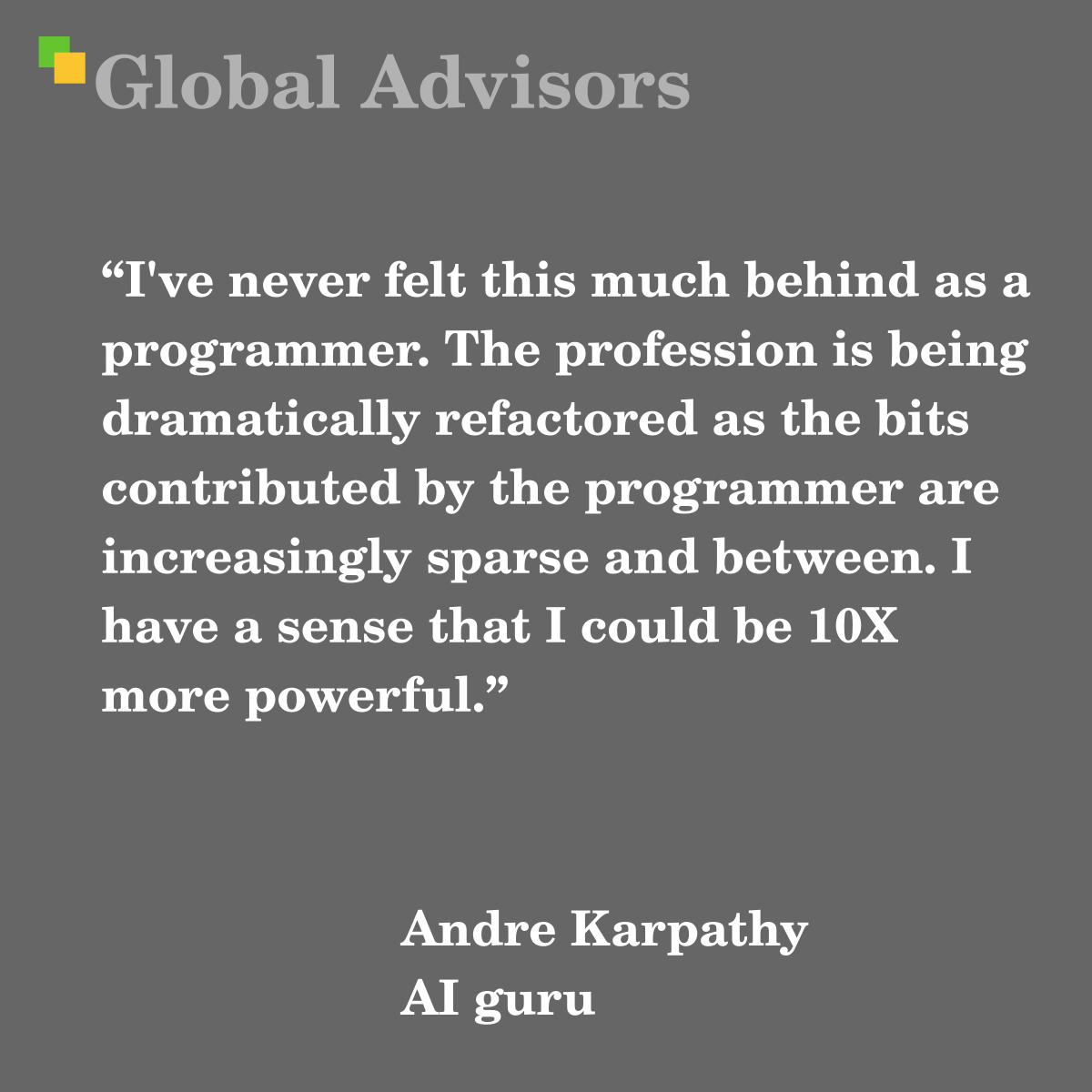
Quote: Andre Karpathy"I've never felt this much behind as a programmer. The profession is being dramatically refactored as the bits contributed by the programmer are increasingly sparse and between. I have a sense that I could be 10X more powerful." - Andre Karpathy - AI guruAndre Karpathy, a pioneering AI researcher, captures the profound disruption AI is bringing to programming in this quote: "I've never felt this much behind as a programmer. The profession is being dramatically refactored as the bits contributed by the programmer are increasingly sparse and between. I have a sense that I could be 10X more powerful."1,2 Delivered amid his reflections on AI's rapid evolution, it underscores his personal sense of urgency as tools like large language models (LLMs) redefine developers' roles from code writers to orchestrators of intelligent systems.2 Context of the QuoteKarpathy shared this introspection as part of his broader commentary on the programming profession's transformation, likely tied to his June 17, 2025, keynote at AI Startup School in San Francisco titled "Software Is Changing (Again)."4 In it, he outlined Software 3.0—a paradigm where LLMs enable natural language as the primary programming interface, allowing AI to generate code, design systems, and even self-improve with minimal human input.1,4,5 The quote reflects his firsthand experience: traditional Software 1.0 (handwritten code) and Software 2.0 (neural networks trained on data) are giving way to 3.0, where programmers contribute "sparse" high-level guidance amid AI-generated code, evoking a feeling of both lag and untapped potential.1,2 He likens developers to "virtual managers" overseeing AI collaborators, focusing on architecture, decomposition, and ethics rather than syntax.2 This shift mirrors historical leaps—like from machine code to high-level languages—but accelerates via tools like GitHub Copilot, making elite programmers those who master prompt engineering and human-AI loops.2,4 Backstory on Andre KarpathyBorn in Slovakia and raised in Canada, Andrej Karpathy earned his PhD in computer vision at Stanford University, where he architected and led CS231n, the first deep learning course there, now one of Stanford's most popular.3 A founding member of OpenAI, he advanced generative models and reinforcement learning. At Tesla (2017–2022), as Senior Director of AI, he led Autopilot vision, data labeling, neural net training, and deployment on custom inference chips, pushing toward Full Self-Driving.3,4 Briefly involved in Tesla Optimus, he left to found Eureka Labs, modernizing education with AI.3 Known as an "AI guru" for viral lectures like "The spelled-out intro to neural networks" and zero-to-hero LLM courses, Karpathy embodies the transition to Software 3.0, having deleted C++ code in favor of growing neural nets at Tesla.3,4 Leading Theorists on Software Paradigms and AI-Driven ProgrammingKarpathy's framework builds on foundational ideas from deep learning pioneers. Key figures include:
This evolution demands programmers adapt: curricula must prioritize AI collaboration over syntax, with humans excelling in judgment and oversight amid accelerating abstraction.1,2 References 1. https://inferencebysequoia.substack.com/p/andrej-karpathys-software-30-and 2. https://ytosko.dev/blog/andrej-karpathy-reflects-on-ais-impact-on-programming-profession 4. https://www.youtube.com/watch?v=LCEmiRjPEtQ
|
| |
| |
Term: Davos"Davos refers to the annual, invitation-only meeting of global political, business, academic, and civil society leaders held every January in the Swiss Alpine town of Davos-Klosters. It acts as a premier, high-profile platform for discussing pressing global economic, social, and political issues." - DavosDavos represents far more than a simple annual conference; it embodies a transformative model of global governance and problem-solving that has evolved significantly since its inception. Held each January in the Swiss Alpine resort town of Davos-Klosters, this invitation-only gathering convenes over 2,500 leaders spanning business, government, civil society, academia, and media to address humanity's most pressing challenges.1,7 The Evolution and Purpose of DavosFounded in 1971 by German engineer Klaus Schwab as the European Management Symposium, Davos emerged from a singular vision: that businesses should serve all stakeholders-employees, suppliers, communities, and the broader society-rather than shareholders alone.1 This foundational concept, known as stakeholder theory, remains central to the World Economic Forum's mission today.1 The organisation formalised this philosophy through the Davos Manifesto in 1973, which was substantially renewed in 2020 to address the challenges of the Fourth Industrial Revolution.1,3 The Forum's evolution reflects a fundamental shift in how global problems are addressed. Rather than relying solely on traditional nation-state institutions established after the Second World War-such as the International Monetary Fund, World Bank, and United Nations-Davos pioneered what scholars term a "Networked Institution."2 This model brings together independent parties from civil society, the private sector, government, and individual stakeholders who perceive shared global problems and coordinate their activities to make progress, rather than working competitively in isolation.2 Tangible Impact and Policy OutcomesDavos has demonstrated concrete influence on global affairs. In 1988, Greece and Türkiye averted armed conflict through an agreement finalised at the meeting.1 The 1990s witnessed a historic handshake that helped end apartheid in South Africa, and the platform served as the venue for announcing the UN Global Compact, calling on companies to align operations with human rights principles.1 More recently, in 2023, the United States announced a new development fund programme at Davos, and global CEOs agreed to support a free trade agreement in Africa.1 The Forum also launched Gavi, the vaccine alliance, in 2000-an initiative that now helps vaccinate nearly half the world's children and played a crucial role in delivering COVID-19 vaccines to vulnerable countries.6 The Davos Manifesto and Stakeholder CapitalismThe 2020 Davos Manifesto formally established that the World Economic Forum is guided by stakeholder capitalism, a concept positing that corporations should deliver value not only to shareholders but to all stakeholders, including employees, society, and the planet.3 This framework commits businesses to three interconnected responsibilities:
Contemporary Relevance and StructureThe World Economic Forum operates as an international not-for-profit organisation headquartered in Geneva, Switzerland, with formal institutional status granted by the Swiss government.2,3 Its mission is to improve the state of the world through public-private cooperation, guided by core values of integrity, impartiality, independence, respect, and excellence.8 The Forum addresses five interconnected global challenges: Growth, Geopolitics, Technology, People, and Planet.8 Davos functions as the touchstone event within the Forum's year-round orchestration of leaders from civil society, business, and government.2 Beyond the annual meeting, the organisation maintains continuous engagement through year-round communities spanning industries, regions, and generations, transforming ideas into action through initiatives and dialogues.4 The 2026 meeting, themed "A Spirit Of Dialogue," emphasises advancing cooperation to address global issues, exploring the impact of innovation and emerging technologies, and promoting inclusive, sustainable approaches to human capital development.7 Klaus Schwab: The Architect of DavosKlaus Schwab (born 1938) stands as the visionary founder and defining intellectual force behind Davos and the World Economic Forum. A German engineer and economist educated at the University of Bern and Harvard Business School, Schwab possessed an unusual conviction: that business leaders bore responsibility not merely to shareholders but to society writ large. This belief, radical for the early 1970s, crystallised into the founding of the European Management Symposium in 1971. Schwab's relationship with Davos transcends institutional leadership; he fundamentally shaped its philosophical architecture. His stakeholder theory challenged the prevailing shareholder primacy model that dominated Western capitalism, proposing instead that corporations exist within complex ecosystems of interdependence. This vision proved prescient, gaining mainstream acceptance only decades later as environmental concerns, social inequality, and governance failures exposed the limitations of pure shareholder capitalism. Beyond founding the Forum, Schwab authored influential works including "The Fourth Industrial Revolution" (2016), a concept he coined to describe the convergence of digital, biological, and physical technologies reshaping society.1 His intellectual contributions extended the Forum's reach from a business conference into a comprehensive platform addressing geopolitical tensions, technological disruption, and societal transformation. Schwab's personal diplomacy-his ability to convene adversaries and facilitate dialogue-became embedded in Davos's culture, establishing it as a neutral space where competitors and rivals could engage constructively. Schwab's legacy reflects a particular European sensibility: the belief that enlightened capitalism, properly structured around stakeholder interests, could serve as a force for global stability and progress. Whether one views this as visionary or naïve, his influence on contemporary governance models and corporate responsibility frameworks remains substantial. The expansion of Davos from a modest gathering of European executives to a global institution addressing humanity's most complex challenges represents perhaps the most tangible measure of Schwab's impact on twenty-first-century global affairs. References 1. https://www.weforum.org/stories/2024/12/davos-annual-meeting-everything-you-need-to-know/ 2. https://www.weforum.org/stories/2016/01/the-meaning-of-davos/ 4. https://www.weforum.org/about/who-we-are/ 5. https://en.wikipedia.org/wiki/World_Economic_Forum 7. https://www.oliverwyman.com/our-expertise/events/world-economic-forum-davos.html 8. https://www.weforum.org/about/world-economic-forum/
|
| |
| | ||||||||||||||||
Term: Language Processing Unit (LPU)"A Language Processing Unit (LPU) is a specialized processor designed specifically to accelerate tasks related to natural language processing (NLP) and the inference of large language models (LLMs). It is a purpose-built chip engineered to handle the unique demands of language tasks." - Language Processing Unit (LPU)A Language Processing Unit (LPU) is a specialised processor purpose-built to accelerate natural language processing (NLP) tasks, particularly the inference phase of large language models (LLMs), by optimising sequential data handling and memory bandwidth utilisation.1,2,3,4 Core Definition and PurposeLPUs address the unique computational demands of language-based AI workloads, which involve sequential processing of text data—such as tokenisation, attention mechanisms, sequence modelling, and context handling—rather than the parallel computations suited to graphics processing units (GPUs).1,4,6 Unlike general-purpose CPUs (flexible but slow for deep learning) or GPUs (excellent for matrix operations and training but inefficient for NLP inference), LPUs prioritise low-latency, high-throughput inference for pre-trained LLMs, achieving up to 10x greater energy efficiency and substantially faster speeds.3,6 Key differentiators include:
Architectural FeaturesLPUs typically employ a Tensor Streaming Processor (TSP) architecture, featuring software-controlled data pipelines that stream instructions and operands like an assembly line.1,3,7 Notable components include:
Proprietary implementations, such as those in inference engines, maximise bandwidth utilisation (up to 90%) for high-speed text generation.1,2,3 Best Related Strategy Theorist: Jonathan RossThe foremost theorist linked to the LPU is Jonathan Ross, founder and CEO of Groq, the pioneering company that invented and commercialised the LPU as a new processor category in 2016.1,3,4 Ross's strategic vision reframed AI hardware strategy around deterministic, assembly-line architectures tailored to LLM inference bottlenecks—compute density and memory bandwidth—shifting from GPU dominance to purpose-built sequential processing.3,5,7 Biography and Relationship to LPUBorn in the United States, Ross earned a PhD in Applied Physics from Stanford University, where he specialised in machine learning acceleration and novel compute architectures. Early in his career, he co-founded Google Brain (now part of Google DeepMind) in 2011, leading hardware innovations like the Google Tensor Processing Unit (TPU)—the first ASIC for ML inference, which influenced hyperscale AI by prioritising efficiency over versatility.[3 implied via Groq context] In 2016, Ross left Google to establish Groq (initially named Rebellious Computing, rebranded in 2017), driven by the insight that GPUs were suboptimal for the emerging era of LLMs requiring ultra-low-latency inference.3,7 He strategically positioned the LPU as a "new class of processor," introducing the TSP in 2023 via GroqCloud™, which powers real-time AI applications at speeds unattainable by GPUs.1,3 Ross's backstory reflects a theorist-practitioner approach: his TPU experience exposed GPU limitations in sequential workloads, leading to LPU's conveyor-belt determinism and scalability—core to Groq's market disruption, including partnerships for embedded AI.2,3 Under his leadership, Groq raised over $1 billion in funding by 2025, validating LPU as a strategic pivot in AI infrastructure.3,4 Ross continues to advocate LPU's role in democratising fast, cost-effective inference, authoring key publications and demos that benchmark its superiority.3,7 References 1. https://datanorth.ai/blog/gpu-lpu-npu-architectures 2. https://arxiv.org/html/2408.07326v1 3. https://groq.com/blog/the-groq-lpu-explained 4. https://www.purestorage.com/knowledge/what-is-lpu.html 5. https://www.turingpost.com/p/fod41 6. https://www.geeksforgeeks.org/nlp/what-are-language-processing-units-lpus/ 7. https://blog.codingconfessions.com/p/groq-lpu-design
|
||||||||||||||||
| |

| |
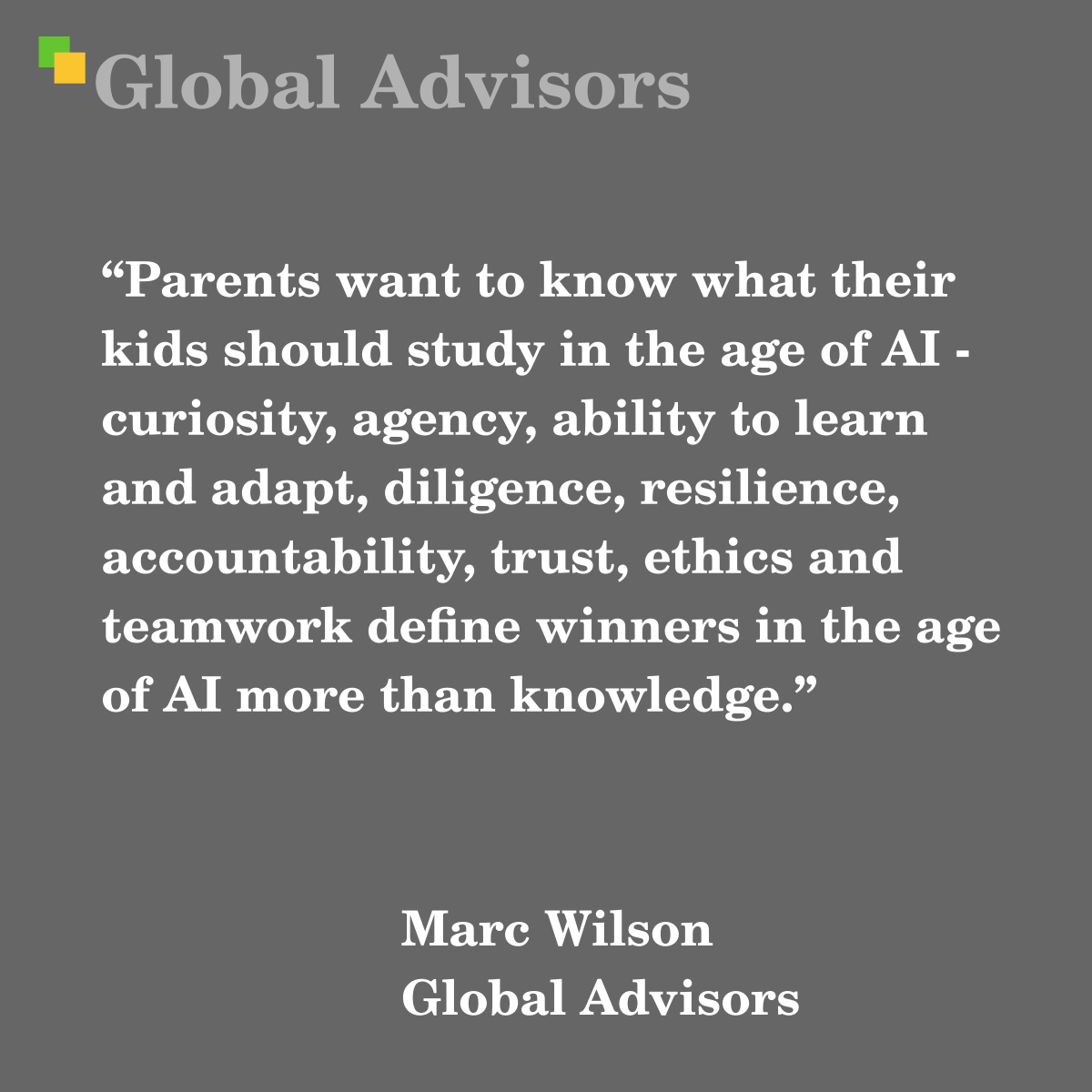
Quote: Marc Wilson - Global Advisors"Parents want to know what their kids should study in the age of AI - curiosity, agency, ability to learn and adapt, diligence, resilience, accountability, trust, ethics and teamwork define winners in the age of AI more than knowledge." - Marc Wilson - Global AdvisorsOver the last few years, I have spent thousands of hours inside AI systems - not as a spectator, but as someone trying to make them do real work. Not toy demos. Not slideware. I’m talking about actual consulting workflows: research, synthesis, modeling, data extraction, and client delivery. What that experience strips away is the illusion that the future belongs to people who simply “know how to use AI.” Every week there is a new tool, a new model, a new framework. What looked like a hard-won advantage six months ago is now either automated or irrelevant. Prompt engineering and tool-specific workflows are being collapsed into the models themselves. These are transitory skills. They matter in the moment, but they do not compound. What does compound is agency. Agency is the ability to look at a messy, underspecified problem and decide it will not beat you. It is the instinct to decompose a system, to experiment, and to push past failure when there is no clear map. AI does not remove the need for that; it amplifies it. The people who get the most from these systems are not the ones who know the "right" prompts - they are the ones who iterate until the system produces the required outcome. In practice, that looks different from what most people imagine. The most effective practitioners don't ask, “What prompt should I use?” They ask, “How do I get this result?” They iterate. They swap tools. They reframe the problem. They are not embarrassed by trial-and-error or a hallucination because they aren't outsourcing responsibility to the machine. They own the output. Parents ask what their children should study for the "age of AI." The question is understandable, but it misses the mark. Knowledge has never been more abundant. The marginal value of knowing one more thing is collapsing. What is becoming scarce is the ability to turn knowledge into action. That is the core of agency:
These qualities are not "soft." They are decisive. Machines can write, code and reason at superhuman speed - the differentiator is not who has the most information - it is who takes responsibility for the outcome. AI will reward the people who show up, take ownership and find a way through uncertainty. Everything else - including today’s fashionable technical skills - will be rewritten.
|
| |
| |
Quote: Demis Hassabis- DeepMind co-founder, CEO"Actually, I think [China is] closer to the US frontier models than maybe we thought one or two years ago. Maybe they're only a matter of months behind at this point." - Demis Hassabis - DeepMind co-founder, CEOContext of the QuoteIn a CNBC Original podcast, The Tech Download, aired on 6 January 2026, Demis Hassabis, co-founder and CEO of Google DeepMind, offered a candid assessment of China's AI capabilities. He stated that Chinese AI models are now just a matter of months behind leading US frontier models, a significant narrowing from perceptions one or two years prior1,3,5. Hassabis highlighted models from Chinese firms like DeepSeek, Alibaba, and Zhipu AI, which have delivered strong benchmark performances despite US chip export restrictions1,3,5. However, he tempered optimism by questioning China's capacity for true innovation, noting they have yet to produce breakthroughs like the transformer architecture that powers modern generative AI. 'Inventing something is 100 times harder than replicating it,' he emphasised, pointing to cultural and mindset challenges in fostering exploratory research1,4,5. This interview underscores ongoing US-China AI competition amid geopolitical tensions, including bans on advanced Nvidia chips, though approvals for models like the H200 offer limited relief2,5. Who is Demis Hassabis?Demis Hassabis is a British AI researcher, entrepreneur, and neuroscientist whose career bridges neuroscience, gaming, and artificial intelligence. Born in 1976 in London to a Greek Cypriot father and Chinese Singaporean mother, he displayed prodigious talent early, winning the Eurovision Young Musicians contest at age 13 and becoming a chess master by 131,4. Hassabis co-founded DeepMind in 2010 with the audacious goal of achieving artificial general intelligence (AGI). His breakthrough came with AlphaGo in 2016, which defeated world Go champion Lee Sedol, demonstrating deep reinforcement learning's power1,4. Google acquired DeepMind in 2014 for £400 million, and Hassabis now leads as CEO, overseeing models like Gemini, which recently topped AI benchmarks3,4. In 2024, he shared the Nobel Prize in Chemistry with John Jumper and David Baker for AlphaFold2, which predicts protein structures with unprecedented accuracy, revolutionising biology1,4. Hassabis predicts AGI within 5-10 years, down from his initial 20-year estimate, and regrets Google's slower commercialisation of innovations like the transformer and AlphaGo despite inventing '90% of the technology everyone uses today'1,4. DeepMind operates like a 'modern-day Bell Labs,' prioritising fundamental research5. Leading Theorists and the Subject Matter: The AI Frontier and Innovation RaceThe quote touches on frontier AI models - state-of-the-art large language models (LLMs) pushing performance limits - and the distinction between replication and invention. Key theorists shaping this field include:
China's progress, via firms like DeepSeek (cost-efficient models on lesser chips) and giants Alibaba/Baidu/Tencent, shows engineering prowess but lags in paradigm shifts2,3,5. US leads in compute (Nvidia GPUs) and innovation ecosystems, though restrictions may spur domestic chips like Huawei's2,3. Hassabis' view challenges US underestimation, aligning with Nvidia's Jensen Huang: America is 'not far ahead'5. This backdrop highlights AI's dual nature: rapid catch-up via scaling compute/data, versus elusive invention requiring bold theory1,2. References 2. https://intellectia.ai/news/stock/google-deepmind-ceo-claims-chinas-ai-is-just-months-behind 4. https://biz.chosun.com/en/en-it/2026/01/16/IQH4RV54VVGJVGTSYHWSARHOEU/ 6. https://brief.bismarckanalysis.com/s/ai-2026
|
| |
!["Actually, I think [China is] closer to the US frontier models than maybe we thought one or two years ago. Maybe they’re only a matter of months behind at this point." - Quote: Demis Hassabis](https://globaladvisors.biz/wp-content/uploads/2026/01/20260119_05h01_GlobalAdvisors_Marketing_Quote_DemisHassabis_MW.png)
| |
Term: GPU"A Graphics Processing Unit (GPU) is a specialised processor designed for parallel computing tasks, excelling at handling thousands of threads simultaneously, unlike CPUs which prioritise sequential processing. It is widely used for AI." - GPUA Graphics Processing Unit (GPU) is a specialised electronic circuit designed to accelerate graphics rendering, image processing, and parallel mathematical computations by executing thousands of simpler operations simultaneously across numerous cores.1,2,4,6 Core Characteristics and ArchitectureGPUs excel at parallel processing, dividing tasks into subsets handled concurrently by hundreds or thousands of smaller, specialised cores, in contrast to CPUs which prioritise sequential execution with fewer, more versatile cores.1,3,5,7 This architecture includes dedicated high-bandwidth memory (e.g., GDDR6) for rapid data access, enabling efficient handling of compute-intensive workloads like matrix multiplications essential for 3D graphics, video editing, and scientific simulations.2,5 Originally developed for rendering realistic 3D scenes in games and films, GPUs have evolved into programmable devices supporting general-purpose computing (GPGPU), where they process vector operations far faster than CPUs for suitable applications.1,6 Historical Evolution and Key ApplicationsThe modern GPU emerged in the 1990s, with Nvidia's GeForce 256 in 1999 marking the first chip branded as a GPU, transforming fixed-function graphics hardware into flexible processors capable of shaders and custom computations.1,6 Today, GPUs power:
Unlike neural processing units (NPUs), which optimise for low-latency AI with brain-like efficiency, GPUs prioritise raw parallel throughput for graphics and broad compute tasks.1 Best Related Strategy Theorist: Jensen HuangJensen Huang, co-founder, president, and CEO of Nvidia Corporation, is the preeminent figure linking GPUs to strategic technological dominance, having pioneered their shift from graphics to AI infrastructure.1 Biography: Born in 1963 in Taiwan, Huang immigrated to the US as a child, earning a BS in electrical engineering from Oregon State University (1984) and an MS from Stanford (1992). In 1993, at age 30, he co-founded Nvidia with Chris Malachowsky and Curtis Priem using $40,000, initially targeting 3D graphics acceleration amid the PC gaming boom. Under his leadership, Nvidia released the GeForce 256 in 1999—the first GPU—revolutionising real-time rendering and establishing market leadership.1,6 Huang's strategic foresight extended GPUs beyond gaming via CUDA (2006), a platform enabling GPGPU for general computing, unlocking AI applications like deep learning.2,6 By 2026, Nvidia's GPUs dominate AI training (e.g., via H100/H200 chips), propelling its market cap beyond $3 trillion and Huang's net worth over $100 billion, making him the world's richest person at times. His "all-in" bets—pivoting to AI during crypto winters and data centre shifts—exemplify visionary strategy, blending hardware innovation with ecosystem control (e.g., cuDNN libraries).1,5 Huang's relationship to GPUs is foundational: as Nvidia's architect, he defined their parallel architecture, foreseeing AI utility decades ahead, positioning GPUs as the "new CPU" for the AI era.3 References 1. https://www.ibm.com/think/topics/gpu 2. https://aws.amazon.com/what-is/gpu/ 3. https://kempnerinstitute.harvard.edu/news/graphics-processing-units-and-artificial-intelligence/ 4. https://www.arm.com/glossary/gpus 5. https://www.min.io/learn/graphics-processing-units 6. https://en.wikipedia.org/wiki/Graphics_processing_unit 7. https://www.supermicro.com/en/glossary/gpu 8. https://www.intel.com/content/www/us/en/products/docs/processors/what-is-a-gpu.html
|
| |
| |
Quote: Nate B Jones - AI News & Strategy Daily"Execution capacity isn't scarce anymore. Ten days, four people, and [Anthropic are] shipping 60 to 100 releases daily. Execution capacity is not the problem." - Nate B Jones - AI News & Strategy DailyNate B Jones, a prominent voice in AI news and strategy, made this striking observation on 15 January 2026, highlighting how execution speed at leading AI firms like Anthropic has rendered traditional capacity constraints obsolete. Context of the QuoteThe quote originates from a discussion in AI News & Strategy Daily, capturing the blistering pace of development at Anthropic, the creators of the Claude AI models. Jones points to a specific instance where just four people, over ten days, facilitated 60 to 100 daily releases. This underscores a paradigm shift: in AI labs, small teams leveraging advanced tools now achieve output volumes that once required vast resources. The statement challenges the notion that scaling human execution remains a barrier, positioning it instead as a solved problem amid accelerating AI capabilities.1,4 Backstory on Nate B JonesNate B Jones is a key commentator on AI developments, known for his daily newsletter AI News & Strategy Daily. His insights dissect breakthroughs, timelines, and strategic implications in artificial intelligence. Jones frequently analyses outputs from major players like Anthropic, OpenAI, and others, providing data-driven commentary on progress towards artificial general intelligence (AGI). His work emphasises empirical evidence from releases, funding rounds, and capability benchmarks, making him a go-to source for professionals tracking the AI race. This quote, delivered via a YouTube discussion, exemplifies his focus on how AI is redefining productivity in software engineering and research. Anthropic's Blazing Execution PaceAnthropic, founded in 2021 by former OpenAI executives including CEO Dario Amodei, has emerged as a frontrunner in safe AI systems. Backed by over $23 billion in funding-including major investments from Microsoft and Nvidia-the firm achieved a $5 billion revenue run rate by August 2025 and is projected to hit $9 billion annualised by year-end. Speculation surrounds a potential IPO as early as 2026, with valuations soaring to $300-350 billion amid a massive funding round.2 Internally, Anthropic's engineers report transformative AI integration. A August 2025 survey of 132 staff revealed Claude enabling complex tasks with fewer human interventions: tool calls per transcript rose 116% to 21.2 consecutive actions, while human turns dropped 33% to 4.1 on average. This aligns directly with Jones's claim of hyper-efficient shipping, where AI handles code generation, edits, and commands autonomously.4 Broader metrics from Anthropic's January 2026 Economic Index show explosive Claude usage growth, with rapid diffusion despite uneven global adoption tied to GDP levels.5 Predictions from CEO Dario Amodei include AI writing 90% of code by mid-2025 (partially realised) and nearly all by March 2026, fuelling daily release cadences.1 Leading Theorists on AI Execution and Speed
These theorists converge on a narrative of exponential acceleration: AI is not merely assisting but supplanting human bottlenecks in execution, code, and innovation. Jones's quote encapsulates this consensus, signalling that in 2026, the real frontiers lie beyond mere deployment speed. References 1. https://blog.redwoodresearch.org/p/whats-up-with-anthropic-predicting 2. https://forgeglobal.com/insights/anthropic-upcoming-ipo-news/ 3. https://jakobnielsenphd.substack.com/p/2026-predictions 4. https://www.anthropic.com/research/how-ai-is-transforming-work-at-anthropic 5. https://www.anthropic.com/research/anthropic-economic-index-january-2026-report 6. https://kalshi.com/markets/kxclaude5/claude-5-released/kxclaude5-27
|
| |
!["Execution capacity isn’t scarce anymore. Ten days, four people, and [Anthropic are] shipping 60 to 100 releases daily. Execution capacity is not the problem." - Quote: Nate B Jones](https://globaladvisors.biz/wp-content/uploads/2026/01/20260115_18h00_GlobalAdvisors_Marketing_Quote_NateBJones_GAQ.png)
| |
Term: K-shaped economy"A "K-shaped economy" describes a recovery or economic state where different segments of the population, industries, or wealth levels diverge drastically, resembling the letter 'K' on a graph: one part shoots up (wealthy, tech, capital owners), while another stagnates." - K-shaped economy -A K-shaped economy describes an uneven economic recovery or state following a downturn, where different segments—such as high-income earners, tech sectors, large corporations, and asset owners—experience strong growth (the upward arm of the 'K'), while low-income groups, small businesses, low-skilled workers, younger generations, and debt-burdened households stagnate or decline (the downward arm).1,2,3,4 Key CharacteristicsThis divergence manifests across multiple dimensions:
The pattern, prominent after the COVID-19 recession, contrasts with V-shaped (swift, even rebound) or U-shaped (gradual) recoveries, complicating stimulus efforts.2,4 Historical Context and Examples
Best Related Strategy Theorist: Joseph SchumpeterThe most apt theorist linked to the K-shaped economy is Joseph Schumpeter (1883–1950), whose concept of creative destruction directly underpins one key mechanism: recessions enable new industries and technologies to supplant outdated ones, fostering divergent recoveries.2 BiographyBorn in Triesch, Moravia (now Czech Republic), Schumpeter studied law and economics in Vienna, earning a doctorate in 1906. He taught at universities in Czernowitz, Graz, and Bonn, becoming Austria's finance minister briefly in 1919 amid post-World War I turmoil. Exiled after the Nazis annexed Austria, he joined Harvard University in 1932, where he wrote seminal works until retiring in 1949. A polymath influenced by Marx, Walras, and Weber, Schumpeter predicted capitalism's self-undermining tendencies through innovation and bureaucracy.2 Relationship to the TermSchumpeter argued that capitalism thrives via creative destruction—the "perennial gale" where entrepreneurs innovate, destroying old structures (e.g., tourism during COVID) and birthing new ones (e.g., video conferencing, AI).2 In a K-shaped context, this explains why tech and capital-intensive sectors surge while legacy industries falter, amplified by policies favouring winners. Unlike uniform recoveries, his framework predicts inherent bifurcation, as seen post-2008 and pandemics, where asset markets outpace labour markets—echoing modern analyses of uneven growth.2,5 Schumpeter's prescience positions him as the foundational strategist for navigating such divides through innovation policy. References 2. https://corporatefinanceinstitute.com/resources/economics/k-shaped-recovery/ 3. https://am.vontobel.com/en/insights/k-shaped-economy-presents-challenges-for-the-federal-reserve 4. https://finance-commerce.com/2025/12/k-shaped-economy-inequality-us/ 7. https://www.mellon.com/insights/insights-articles/the-k-shaped-drift.html 8. https://www.morganstanley.com/insights/articles/k-shaped-economy-investor-guide-2025
|
| |
| | ||||||||
Quote: Nate B Jones - AI News & Strategy Daily"Suddenly your risk is timidity. Your risk is lack of courage. The danger isn't necessarily building the wrong thing, because you've got 50 shots [a year] to build the right thing. The danger is not building enough things toward a larger vision that is really transformative for the customer." - Nate B Jones - AI News & Strategy DailyThis provocative statement emerged from Nate B. Jones's AI News & Strategy Daily on 15 January 2026, amid accelerating AI advancements reshaping software development and business strategy. Jones challenges conventional risk management in an era where AI tools like Cursor enable engineers to ship code twice as fast, and product managers double productivity through prompt engineering. Execution has become 'cheaper', but Jones warns that speed alone breeds quality nightmares - security holes, probabilistic outputs demanding sustained QA, and technical debt from rapid prototyping.1,2 The quote reframes failure: with rapid iteration (50+ attempts yearly), building suboptimal products is survivable. True peril lies in hesitation - failing to generate volume towards a bold, customer-transforming vision. This aligns with Jones's emphasis on 'AI native' approaches, transcending mere acceleration to orchestration, coordination, and human-AI symbiosis for compounding gains.3 Backstory on Nate B. JonesNate B. Jones is a leading AI strategist, content creator, and independent analyst whose platforms - including his Substack newsletter, personal site (natebjones.com), and YouTube channel AI News & Strategy Daily (127K subscribers) - deliver 'deep analysis, actionable frameworks, zero hype'.2,7 He dissects real-world AI implementation, from prompt stacks enhancing workflows to predictions on 2026 breakthroughs like memory advances, agent UIs, continual learning, and recursive self-improvement.5,6 Jones's work spotlights execution dynamics: automation avalanches make work cheaper, yet spawn trust deficits from 'dirty' AI code and jailbreaking needs.1 He advocates team 'film review' loops using AI rubrics for decision docs, specs, and risk articulation - turning human skills into scalable drills.3 Videos like 'The AI Trick That Finally Made Me Better at My Job' and 'Debunking AI Myths' showcase his practical ethos, proving AI's innovative edge via breakthroughs like AlphaDev's faster algorithms and AlphaFold's protein atlas.3,4 Positioned as 'the most cogent, sensible, and insightful AI resource', Jones guides ventures towards genuine AI nativity, urging leaders to escape terminal-bound agents for task queues and human-AI coordination.2 Leading Theorists on AI Execution, Speed, and Transformative VisionJones's ideas echo foundational thinkers in AI strategy and rapid iteration:
These theorists collectively underpin Jones's thesis: in AI's 'automation avalanche', courageously shipping volume towards transformative goals outpaces timid perfectionism.1 Implications for Leaders
Jones's insight demands a paradigm shift: harness AI for fearless experimentation, sustained quality, and visionary scale. References 1. https://natesnewsletter.substack.com/p/2026-sneak-peek-the-first-job-by-9ac 3. https://www.youtube.com/watch?v=Td_q0sHm6HU 4. https://www.youtube.com/watch?v=isuzSmJkYlc 5. https://www.youtube.com/watch?v=pOb0pjXpn6Q 6. https://natesnewsletter.substack.com/p/my-prompt-stack-for-work-16-prompts 7. https://www.youtube.com/@NateBJones
|
||||||||
| |
!["Suddenly your risk is timidity. Your risk is lack of courage. The danger isn’t necessarily building the wrong thing, because you’ve got 50 shots [a year] to build the right thing. The danger is not building enough things toward a larger vision that is really transformative for the customer." - Quote: Nate B Jones](https://globaladvisors.biz/wp-content/uploads/2026/01/20260115_18h01_GlobalAdvisors_Marketing_Quote_NateBJones_GAQ.png)
| |
Term: Strategy"Strategy is the art of radical selection, where you identify the "vital few" forces - the 20% of activities, products, or customers that generate 80% of your value - and anchor them in a unique and valuable position that is difficult for rivals to imitate." - StrategyStrategy is the art of radical selection, entailing the identification and prioritisation of the "vital few" forces—typically the 20% of activities, products, or customers that deliver 80% of value—and embedding them within a unique, valuable position that rivals struggle to replicate. This definition draws on the Pareto principle (or 80/20 rule), which posits that a minority of inputs generates the majority of outputs, applied strategically to focus resources for competitive advantage. Radical selection demands ruthless prioritisation, rejecting marginal efforts to create imitable barriers such as proprietary processes, network effects, or brand loyalty. In practice, it involves auditing operations to isolate high-impact elements, then aligning the organisation around them—eschewing diversification for concentrated excellence. For instance, firms might discontinue underperforming product lines or customer segments to double down on core strengths, fostering sustainable differentiation amid competition.3,5 Key Elements of Radical Selection
Best Related Strategy Theorist: Richard KochRichard Koch, a pre-eminent proponent of the 80/20 principle in strategy, provides the foundational intellectual backbone for this concept of radical selection. His seminal work, The 80/20 Principle: The Secret to Achieving More with Less (1997, updated editions since), explicitly frames strategy as exploiting the "vital few"—the disproportionate 20% of factors yielding 80% of results—to achieve outsized success. Biography and BackstoryBorn in 1950 in London, Koch graduated from Oxford University with a degree in Philosophy, Politics, and Economics, later earning an MBA from Harvard Business School. He began his career at Bain & Company (1978–1980), rising swiftly in management consulting, then co-founded L.E.K. Consulting in 1983, where he specialised in corporate strategy and turnarounds. Koch advised blue-chip firms on radical pruning—divesting non-core assets to focus on high-yield segments—drawing early insights into Pareto imbalances from client data showing most profits stemmed from few products or customers. In the 1990s, as an independent investor and author, Koch applied these lessons to his own ventures, achieving billionaire status through stakes in firms like Filofax (which he revitalised via 80/20 focus) and Betfair (early investor). His 80/20 philosophy evolved from Vilfredo Pareto's 1896 observation of wealth distribution (80% owned by 20%) and Joseph Juran's quality management adaptations, but Koch radicalised it for strategy. He argued that businesses thrive by systematically ignoring the trivial many, selecting "star" activities for exponential growth—a direct precursor to the query's definition. Koch's relationship to radical selection is intimate: he popularised it as a strategic art form, blending empirical analysis with bold choice. In Living the 80/20 Way (2004) and The 80/20 Manager (2007), he extends it to personal and corporate realms, warning against "spread-thin" mediocrity. Critics note its simplicity risks oversimplification, yet its prescience aligns with modern lean strategies; Koch remains active, mentoring via Koch Education.3,5 References 1. https://direct.mit.edu/artm/article/10/3/8/109489/What-is-Radical 3. https://www.timreview.ca/article/1425 4. https://selvajournal.org/article/ideology-strategy-aesthetics/ 7. https://art21.org/read/radical-art-in-a-conservative-school/ 8. https://parsejournal.com/article/radical-softness/
|
| |
| |
|


| |
| |