| |
|

| |
| |
| |
|
Our selection of the top business news sources on the web. |
| |
| |
| |
Quote: Winston Churchill"We make a living by what we get, but we make a life by what we give." - Winston Churchill - British StatesmanThis aphorism, attributed to Sir Winston Churchill, encapsulates a fundamental philosophical distinction between two modes of human existence: the transactional and the transcendent. Churchill, the British statesman who led the United Kingdom through its darkest hour during the Second World War, articulated a principle that extends far beyond economics into the realm of human meaning and purpose. The quote presents a deliberate contrast. To "make a living" suggests the practical necessity of acquiring resources-income, sustenance, security. To "make a life," by contrast, implies the construction of something far more substantial: a legacy, a character, a contribution to the world. Churchill's formulation suggests that whilst earning is inevitable and necessary, it is fundamentally insufficient as a measure of a life well-lived. Winston Churchill: The Man Behind the WordsLeonard Spencer Churchill (1874-1965) was born into the aristocratic Marlborough family, yet his path to prominence was neither predetermined nor straightforward. His early years were marked by academic struggle and a sense of alienation from his emotionally distant parents. This outsider status, paradoxically, may have cultivated in him a distinctive perspective on human value and contribution. Churchill's career spanned multiple domains: military officer, war correspondent, politician, author, and painter. He served as Prime Minister during two separate periods (1940-1945 and 1951-1955), with the first tenure coinciding with Britain's existential struggle against Nazi Germany. His leadership during this period was characterised not merely by strategic acumen but by an unwavering commitment to principles he believed transcended personal gain or national advantage. Beyond politics, Churchill was a prolific writer and Nobel Prize laureate in Literature (1953). His literary output-including his six-volume history of the Second World War-represented a deliberate attempt to shape historical understanding and moral consciousness. This dual commitment to action and reflection, to immediate necessity and enduring meaning, informed his philosophical outlook. Churchill's personal life was marked by significant financial struggles despite his aristocratic background. He wrote prolifically partly out of genuine intellectual conviction, but also from financial necessity. This tension between material need and intellectual purpose may have sharpened his understanding of the distinction between making a living and making a life. Philosophical Foundations: The TheoristsAristotle and EudaimoniaThe intellectual genealogy of Churchill's aphorism traces back to ancient philosophy, particularly Aristotle's concept of eudaimonia-often translated as "flourishing" or "living well." Aristotle distinguished between mere existence (biological functioning) and the actualisation of human potential through virtue and meaningful activity. The distinction between making a living and making a life echoes this ancient dichotomy between subsistence and flourishing. For Aristotle, human beings possess a distinctive function (ergon): the exercise of reason in accordance with virtue. A life devoted solely to acquisition-what modern economists might call utility maximisation-falls short of this distinctive human calling. True flourishing requires the development of character, the cultivation of wisdom, and contribution to the common good. Immanuel Kant and DignityThe German philosopher Immanuel Kant (1724-1804) provided another crucial theoretical foundation. Kant's categorical imperative-the principle that one should act only according to maxims one could will as universal laws-establishes a framework wherein human dignity transcends instrumental value. People are not merely means to economic ends; they possess intrinsic worth. Kant's distinction between acting from duty and acting from inclination parallels Churchill's distinction between making a living and making a life. A life of mere acquisition treats oneself and others instrumentally. A life of genuine moral agency involves recognising and honouring the dignity of all persons, which necessarily involves contribution beyond self-interest. John Stuart Mill and the Quality of LifeThe nineteenth-century utilitarian philosopher John Stuart Mill (1806-1873) argued for a qualitative distinction between different types of pleasure and fulfilment. His famous assertion-"It is better to be Socrates dissatisfied than a fool satisfied"-suggests that not all forms of satisfaction are equivalent. A life devoted to intellectual and moral development, even if materially modest, possesses greater value than a life of mere comfort and consumption. Mill's harm principle and his emphasis on individual development and self-cultivation provided intellectual scaffolding for the idea that a meaningful life involves more than material acquisition. The pursuit of knowledge, the exercise of faculties, and contribution to human progress constitute essential components of human flourishing. Viktor Frankl and MeaningMore contemporaneously, Viktor Frankl (1905-1997), the Austrian psychiatrist and Holocaust survivor, developed a comprehensive philosophy centred on the human search for meaning. In his seminal work Man's Search for Meaning, Frankl argued that the primary human motivation is not pleasure or power, but the discovery and pursuit of meaning. Frankl identified three primary pathways to meaning: creative work (contributing something of value to the world), experiencing something or someone (love, beauty, nature), and the attitude one adopts toward unavoidable suffering. Notably, none of these pathways is fundamentally about acquisition or material gain. Frankl's framework provides psychological and existential depth to Churchill's aphorism: we make a life through meaningful engagement, not through accumulation. Contemporary Virtue EthicsModern virtue ethicists, building on Aristotelian foundations, have emphasised that human flourishing involves the development and exercise of character virtues-generosity, courage, wisdom, justice, and compassion. Philosophers such as Alasdair MacIntyre and Rosalind Hursthouse have argued that contemporary consumer capitalism often undermines the conditions necessary for virtue development and genuine flourishing. The distinction between making a living and making a life aligns with virtue ethics' critique of purely instrumental rationality. A life structured entirely around economic maximisation may actually impede the development of the virtues and relationships that constitute genuine human flourishing. The Broader Intellectual ContextChurchill's aphorism emerged from a particular historical moment. The mid-twentieth century witnessed unprecedented material prosperity in Western nations, yet also profound existential anxiety. The Second World War had demonstrated both humanity's capacity for destruction and the possibility of sacrifice for transcendent principles. The post-war period saw growing concern about consumerism, conformity, and the adequacy of material progress as a measure of civilisational health. Thinkers across the political spectrum-from conservative critics of mass society to socialist theorists of alienation-questioned whether modern industrial capitalism adequately addressed fundamental human needs for meaning, community, and purpose. Churchill's formulation provided a pithy articulation of this concern, accessible to broad audiences whilst grounded in serious philosophical tradition. The Psychology of GenerosityContemporary psychological research has validated the intuition embedded in Churchill's aphorism. Studies consistently demonstrate that generosity, altruism, and contribution to causes beyond oneself correlate strongly with subjective wellbeing, life satisfaction, and psychological resilience. Conversely, individuals oriented primarily toward material acquisition and status display higher rates of anxiety, depression, and existential dissatisfaction. The neuroscience of giving reveals that acts of generosity activate reward centres in the brain, producing what researchers term the "helper's high." This suggests that human beings are neurologically structured to find meaning and satisfaction through contribution-that giving is not merely a moral imperative imposed from without, but an expression of our deepest nature. Enduring RelevanceChurchill's distinction between making a living and making a life remains profoundly relevant in contemporary contexts. In an era of economic precarity, where many struggle to secure basic material needs, the aphorism might seem to privilege the privileged. Yet it can equally be read as a challenge to systems that reduce human beings to economic units, that measure worth by consumption, and that defer meaning to some indefinite future moment of sufficient affluence. The quote invites reflection on a fundamental question: What constitutes a life well-lived? Is it the accumulation of possessions and status, or the cultivation of character, relationships, and contribution? Churchill's answer-grounded in classical philosophy, tested through extraordinary historical circumstances, and validated by contemporary psychology-suggests that genuine human flourishing emerges not from what we acquire, but from what we give. References 1. https://www.goodreads.com/quotes/857718-we-make-a-living-by-what-we-get-but-we 2. https://www.lifecoach-directory.org.uk/articles/we-make-a-life-by-what-we-give 3. https://www.passiton.com/inspirational-quotes/7240-we-make-a-living-by-what-we-get-we-make-a-life
|
| |

| |
Quote: Clem Sunter - Scenario planner"The essence of thinking the future is to understand the pattern of forces propelling the present into the future and to see where those forces can lead." - Clem Sunter - Scenario plannerThis observation encapsulates the philosophical foundation of scenario planning-a discipline that has transformed how organisations navigate uncertainty and prepare for multiple possible futures. The quote reflects a deceptively simple yet profoundly sophisticated approach to strategic thinking: rather than attempting to predict the future with false certainty, one must identify the underlying currents and momentum that are already reshaping our world. The Context of the QuoteClem Sunter offered this reflection during his 2022 analysis, a moment when the world was grappling with cascading crises-pandemic aftershocks, geopolitical tensions, economic volatility, and technological acceleration. In such turbulent times, his words carried particular resonance. The quote distils decades of professional experience into a single principle: foresight is not prophecy, but pattern recognition.1,3 Sunter's formulation distinguishes between two fundamentally different approaches to the future. The first-prediction-assumes we can determine what will happen. The second-understanding forces-acknowledges that whilst we cannot know the precise outcome, we can comprehend the dynamics at play. This distinction has profound implications for strategy, risk management, and organisational resilience. Clem Sunter: The Architect of Strategic ForesightBorn in Suffolk, England on 8 August 1944, Clem Sunter was educated at Winchester College before reading Politics, Philosophy and Economics at Oxford University.3 His trajectory from academic training to corporate strategist was neither accidental nor predetermined-it reflected an early aptitude for systems thinking and pattern analysis. In 1966, Sunter joined Charter Consolidated as a management trainee, beginning a career that would span five decades and fundamentally influence how South African institutions approached strategic planning.3 In 1971, he moved to Lusaka, Zambia, to work for Anglo American Corporation Central Africa, and was subsequently transferred to Johannesburg in 1973, where he would spend most of his career in the Gold and Uranium Division.3 By 1990, he had risen to serve as Chairman and CEO of this division-at that time the largest gold producer in the world-a position he held until 1996.1,3 Yet Sunter's most enduring legacy would not emerge from his executive roles, but from his pioneering work in scenario planning. In the early 1980s, he established a scenario planning function at Anglo American with teams based in London and Johannesburg.1,3 Crucially, he recruited two exceptional consultants: Pierre Wack and Ted Newland, both of whom had previously headed the scenario planning department at Royal Dutch Shell.1,3 This infusion of Shell's methodological expertise proved transformative. The High Road and Low Road: South Africa's Pivotal MomentUsing material developed by his teams, Sunter synthesised a presentation entitled The World and South Africa in the 1990s, which became extraordinarily influential across South African society in the mid-1980s.1,3 The presentation's power lay in its clarity and its refusal to offer false comfort. Rather than predicting a single future, Sunter presented two contrasting scenarios for South Africa's trajectory. The first scenario-the High Road-depicted a path of negotiation and political settlement, leading to democratic transition and inclusive governance.1,3 The second-the Low Road-portrayed a trajectory of confrontation, escalating violence, and ultimately civil war and societal wasteland.1,3 Sunter did not claim to know which path South Africa would follow. Instead, he illuminated the forces that would determine the outcome, and the consequences of each direction. The impact was profound. Two highlights of this period exemplified the quote's practical significance: in 1986, Sunter presented these scenarios to President F.W. de Klerk and the Cabinet.1,3 Shortly thereafter, he visited Nelson Mandela in prison to discuss the nation's future, just before Mandela's release.1,3 These conversations were not academic exercises-they were interventions in history. By making visible the patterns and forces at work, Sunter's scenarios helped shape the very decisions that would determine South Africa's future. The nation chose the High Road. The Intellectual Foundations: Scenario Planning's Theoretical LineageTo understand Sunter's contribution, one must recognise the intellectual tradition from which scenario planning emerged. The discipline has roots in military strategy, systems theory, and organisational psychology, but its modern form crystallised at Royal Dutch Shell during the 1970s. Pierre Wack, whom Sunter recruited as a consultant, was one of the principal architects of Shell's scenario planning methodology.1,3 Wack's innovation was to recognise that scenarios were not predictions but rather disciplined imagination-structured explorations of how different combinations of forces might unfold. His work at Shell proved prescient: Shell's scenario planners had anticipated the 1973 oil crisis and its implications, positioning the company to navigate the shock more effectively than competitors who had assumed continuity. Wack's theoretical contribution emphasised that effective scenarios must be plausible (grounded in real forces), internally consistent (logically coherent), and challenging (forcing organisations to question assumptions). This framework directly informed Sunter's High Road/Low Road scenarios, which were neither optimistic fantasies nor pessimistic catastrophes, but rather rigorous explorations of how identifiable forces-political pressure, economic inequality, international pressure, and institutional capacity-could lead to fundamentally different outcomes. Ted Newland, Sunter's other key consultant, brought complementary expertise in organisational change and strategic implementation.1,3 Newland's contribution emphasised that scenarios were only valuable if they influenced actual decision-making. This principle became central to Sunter's philosophy: foresight without action is merely intellectual exercise. Beyond Shell's pioneers, Sunter's work drew on broader intellectual currents. The systems thinking tradition-particularly the work of Jay Forrester and the Club of Rome-had demonstrated that complex systems often behave counterintuitively, and that understanding feedback loops and delays is essential to grasping how present actions shape future outcomes. Sunter's emphasis on identifying forces rather than predicting events reflects this systems perspective. Additionally, Sunter's approach incorporated insights from cognitive psychology regarding how humans process uncertainty. Research by Daniel Kahneman and Amos Tversky had revealed systematic biases in human judgment-anchoring, availability bias, overconfidence-that lead organisations to underestimate uncertainty and overestimate their ability to predict. Scenarios, by presenting multiple futures with equal seriousness, counteract these biases by forcing decision-makers to consider possibilities they might otherwise dismiss. The Evolution of Sunter's ThoughtFollowing his corporate career, Sunter became a prolific author and global speaker. Since 1987, he has authored or co-authored more than 17 books, many of which became bestsellers.1,4,5 Notably, he collaborated with fellow scenario strategist Chantell Ilbury on the Fox Trilogy, which applied scenario thinking to contemporary challenges.5 One of his most celebrated works, The Mind of a Fox, demonstrated the prescience of scenario thinking by anticipating the dynamics that would lead to the terrorist attacks of 11 September 2001.1,3 Rather than claiming to have predicted the specific event, Sunter had identified the underlying forces-geopolitical tensions, ideological conflict, technological capability, and organisational determination-that made such an attack plausible. This exemplified his core principle: understanding forces allows one to anticipate categories of possibility, even if specific events remain uncertain. Throughout his career, Sunter has lectured at Harvard Business School and the Central Party School in Beijing, bringing scenario planning methodology to some of the world's most influential institutions.3,4 His work has extended beyond corporate strategy to encompass social challenges, particularly his efforts to mobilise the private sector in combating HIV/AIDS in South Africa.1,4 Recognition and LegacyIn 2004, the University of Cape Town awarded Sunter an Honorary Doctorate for his work in scenario planning, recognising the discipline's intellectual rigour and practical significance.6 He was also voted by leading South African CEOs as the speaker who had made the most significant contribution to best practice and business in the country.1,2,3 These accolades reflect a broader recognition: that Sunter had not merely applied an existing methodology, but had adapted, refined, and championed scenario planning in a context where it proved transformative. His work demonstrated that strategic foresight, grounded in rigorous analysis of underlying forces, could influence the trajectory of nations and organisations. The Enduring Relevance of Pattern RecognitionSunter's 2022 reflection on thinking the future remains profoundly relevant. In an era of accelerating change-artificial intelligence, climate disruption, geopolitical realignment, pandemic risk-the temptation to seek certainty is overwhelming. Yet his principle offers a more realistic and actionable alternative: identify the forces at work, understand their momentum and interactions, and explore where they might lead. This approach acknowledges human limitations whilst leveraging human strengths. We cannot predict the future with certainty, but we can develop the mental discipline to recognise patterns, trace causal chains, and imagine plausible alternatives. In doing so, we move from passive reaction to active anticipation-from being surprised by the future to being prepared for it. The quote's elegance lies in its compression of this sophisticated philosophy into a single sentence. The essence of thinking the future is not mystical foresight or mathematical prediction, but rather understanding the pattern of forces and seeing where those forces can lead. This is a discipline available to any organisation willing to invest the intellectual effort-to step back from immediate pressures, to identify the currents beneath the surface, and to imagine the multiple shores toward which those currents might carry us. References 1. https://www.clemsunter.co.za 2. https://www.famousfaces.co.za/artists/clem-sunter/ 3. https://mariegreyspeakers.com/speaker/clem-sunter/ 4. https://www.londonspeakerbureauasia.com/speakers/clem-sunter/ 5. http://www.terrapinn.com/conference/the-turkey-eurasia-mining-show/speaker-clem-SUNTER.stm 6. https://omalley.nelsonmandela.org/index.php/site/q/03lv02424/04lv02426/05lv02666.htm 7. https://ipa-sa.org.za/public/scenarios-a-useful-tool-for-strategy-development-in-philanthropy/
|
| |
| |
Term: Scaling hypothesis"The scaling hypothesis in artificial intelligence is the theory that the cognitive ability and performance of general learning algorithms will reliably improve, or even unlock new, more complex capabilities, as computational resources, model size, and the amount of training data are increased." - Scaling hypothesisThe **scaling hypothesis** in artificial intelligence posits that the cognitive ability and performance of general learning algorithms, particularly deep neural networks, will reliably improve-or even unlock entirely new, more complex capabilities-as computational resources, model size (number of parameters), and training data volume are increased.1,5 This principle suggests predictable, power-law improvements in model performance, often manifesting as emergent behaviours such as enhanced reasoning, general problem-solving, and meta-learning without architectural changes.2,3,5 For instance, larger models like GPT-3 demonstrated abilities in arithmetic and novel tasks not explicitly trained, supporting the idea that intelligence arises from simple units applied at vast scale.2,4 Key Components
Empirical evidence from models like GPT-3, BERT, and Vision Transformers shows consistent gains across language, vision, and reinforcement learning tasks, challenging the need for specialised architectures.1,4,5 Historical Context and EvidenceRooted in early connectionism, the hypothesis gained prominence in the late 2010s with large-scale models like GPT-3 (2020), where scaling alone outperformed complex alternatives.1,5 Proponents argue it charts a path to artificial general intelligence (AGI), potentially requiring millions of times current compute for human-level performance.2 Best Related Strategy Theorist: Gwern BranwenGwern Branwen stands as the foremost theorist formalising the **scaling hypothesis**, authoring the seminal 2020 essay The Scaling Hypothesis that synthesised empirical trends into a radical paradigm for AGI.5 His work posits that neural networks, when scaled massively, generalise better, become more Bayesian, and exhibit emergent sophistication as the optimal solution to diverse tasks-echoing brain-like universal learning.5 Biography: Gwern Branwen (born c. 1984) is an independent researcher, writer, and programmer based in the USA, known for his prolific contributions to AI, psychology, statistics, and effective altruism under the pseudonym 'Gwern'. A self-taught polymath, he dropped out of university to pursue independent scholarship, funding his work through Patreon and commissions. Branwen maintains gwern.net, a vast archive of over 1,000 essays blending rigorous analysis with original experiments, such as modafinil self-trials and AI scaling forecasts. His relationship to the scaling hypothesis stems from deep dives into deep learning papers, predicting in 2019-2020 that 'blessings of scale'-predictable performance gains-would dominate AI progress. Influencing OpenAI's strategy, Branwen's calculations extrapolated GPT-3 results, estimating 2.2 million times more compute for human parity, reinforcing bets on transformers and massive scaling.2,5 A critic of architectural over-engineering, he advocates simple algorithms at unreachable scales as the AGI secret, impacting labs like OpenAI and Anthropic. Implications and CritiquesWhile driving breakthroughs, concerns include resource concentration enabling unchecked AGI development, diminishing interpretability, and potential misalignment without safety innovations.4 Interpretations range from weak (error reduction as power law) to strong (novel abilities emerge).6 References 1. https://www.envisioning.com/vocab/scaling-hypothesis 2. https://johanneshage.substack.com/p/scaling-hypothesis-the-path-to-artificial 3. https://drnealaggarwal.info/what-is-scaling-in-relation-to-ai/ 4. https://www.species.gg/blog/the-scaling-hypothesis-made-simple 5. https://gwern.net/scaling-hypothesis 6. https://philsci-archive.pitt.edu/23622/1/psa_scaling_hypothesis_manuscript.pdf 7. https://lastweekin.ai/p/the-ai-scaling-hypothesis
|
| |
| | |||||||||||||||
Quote: Clayton M Christensen"I don't feel that this concept of disruptive technology is the solution for everybody. But I think it's very important for innovators to understand what we've learned about established companies' motivation to target obvious profitable markets - and about their inability to find emerging ones." - Clayton M Christensen - Author, academicClayton M. Christensen, the renowned Harvard Business School professor and author, developed the theory of disruptive innovation, which explains why established companies often fail to capitalize on emerging markets despite their resources and expertise.2,4,5 In the quoted statement, Christensen cautions that disruptive technology is not a universal fix but a critical lesson for innovators: incumbents prioritize obvious profitable markets due to their business models, blinding them to emerging ones that disruptors exploit.1,2,3 Context of the QuoteThis insight stems from Christensen's seminal 1997 book The Innovator’s Dilemma, where he analyzed why leading firms in industries like disk drives collapsed under simpler, cheaper innovations targeting overlooked customer segments.2,5,6 The quote underscores a core tenet: disruption begins at the market's low end or in new applications—offering less performance on attributes valued by mainstream customers but more accessibility, affordability, and convenience—allowing it to improve rapidly and invade established markets.2,3,4 Christensen emphasized that incumbents' value networks—their focus on sustaining innovations for high-end customers—create a rational aversion to "unprofitable" opportunities, enabling startups to dominate.2,5 Real-world examples include successive disk-drive sizes (14-inch to 2.5-inch) that upended predecessors between 1975 and 1990.6 Backstory on Clayton M. ChristensenBorn in 1952 in Salt Lake City, Utah, Christensen earned a DBA from Harvard Business School in 1992 after studying economics at Brigham Young University and Oxford as a Rhodes Scholar.2 His disk-drive research for his dissertation revealed patterns of failure among market leaders, birthing disruptive innovation theory in his 1995 article "Disruptive Technologies: Catching the Wave" (co-authored with Joseph Bower) and the bestselling The Innovator’s Dilemma.2,8 The theory exploded in popularity, influencing leaders from Silicon Valley to Wall Street, though Christensen later clarified misuses—like labeling every breakthrough as "disruptive."4,5 He co-founded Innosight consulting firm with Mark W. Johnson and taught at Harvard until his death in 2020 from leukemia, leaving a legacy in books like How Will You Measure Your Life? and applications to education, health care, and marketing (e.g., "Positionless Marketing" democratizing tools for all marketers).1,3,6 Leading Theorists Related to Disruptive InnovationChristensen built on and influenced key thinkers in innovation and economics. Their ideas form the intellectual foundation for understanding why markets shift unpredictably.
These theorists highlight that disruption rejects the "technology mudslide hypothesis"—firms don't fail from tech lag alone but from misaligned priorities in value networks.2 Christensen differentiated sustaining innovations (incremental improvements for top customers) from disruptors (simple, affordable entries for emerging markets).3,4 His framework remains a predictive tool: only 6% of sustaining entrants succeed standalone, per disk-drive data.5 References 2. https://en.wikipedia.org/wiki/Disruptive_innovation 3. https://sloanreview.mit.edu/article/an-interview-with-clayton-m-christensen/ 4. https://www.christenseninstitute.org/theory/disruptive-innovation/ 5. https://hbr.org/2015/12/what-is-disruptive-innovation 6. https://www.harvardmagazine.com/2014/06/disruptive-genius 7. https://www.youtube.com/watch?v=rpkoCZ4vBSI 8. https://www.hbs.edu/faculty/Pages/item.aspx?num=46
|
|||||||||||||||
| |
| |
Quote: Rev. Jesse Jackson - American civil rights activist"If my mind can conceive it, if my heart can believe it, I know I can achieve it because I am somebody!" - Rev. Jesse Jackson - American civil rights activistThis powerful affirmation encapsulates the philosophy that has guided one of America's most influential civil rights leaders throughout a career spanning over five decades. The statement reflects not merely personal optimism, but a carefully developed worldview rooted in both spiritual conviction and practical activism-one that has inspired millions to challenge systemic inequality and claim their own agency in the face of institutional barriers. The Man Behind the MessageRev. Jesse Louis Jackson Sr. emerged as a towering figure in the American civil rights movement during a transformative era when the nation grappled with the legacy of segregation and systemic racism.1,2 Beginning his career as a protégé of Dr. Martin Luther King Jr., Jackson quickly rose to prominence as one of the nation's most prominent and influential civil rights leaders.3 His trajectory from student activist to international negotiator demonstrates the very principle embedded in his famous declaration: the power of conviction to reshape reality. Jackson's early activism began whilst a student at North Carolina Agricultural & Technical College in 1963, when he led protests to desegregate theatres and restaurants in Greensboro.2 Following the pivotal "Bloody Sunday" in Selma, Alabama in 1965, Jackson joined the Southern Christian Leadership Conference (SCLC) and met Dr. King directly, becoming instrumental in the movement's most critical campaigns.2 By 1966, he had become head of the Chicago Chapter of SCLC's Operation Breadbasket, and a year later was appointed national director of the programme.2 This rapid ascent reflected not merely ambition, but an unshakeable belief in the possibility of transformative change-the very conviction his famous quote articulates. From Personal Conviction to Institutional ChangeThe philosophy expressed in Jackson's statement-that conception, belief, and identity form the foundation for achievement-became the operational principle of his most significant organisational initiatives. In 1971, three years after Dr. King's assassination, Jackson founded Operation PUSH (People United to Serve Humanity), a social justice organisation dedicated to improving the economic conditions of Black communities across the United States.3 The organisation's very name reflected Jackson's conviction that collective human agency could overcome entrenched economic discrimination. Operation PUSH's methodology proved remarkably effective. The organisation orchestrated economic boycotts of major corporations that discriminated against Black workers and was successful in compelling major corporations to adopt affirmative action policies benefiting Black employees.2,3 This represented a crucial translation of Jackson's philosophical principle into concrete institutional reform: if one could conceive of economic justice and believe in the possibility of corporate accountability, one could achieve systemic change through organised pressure and negotiation. Jackson's conviction in human potential extended beyond economic justice. In 1984, he founded the National Rainbow Coalition, a social justice organisation devoted to political empowerment, education and changing public policy.4 The very concept of a "rainbow" coalition-bringing together diverse peoples across racial, ethnic, and class lines-reflected Jackson's belief that human beings could transcend the divisions that typically fragmented political movements. In 1996, Jackson merged the Rainbow Coalition with Operation PUSH to form the Rainbow/PUSH Coalition, which he led until 2023.3 The Intellectual Foundations: Key Theorists and MovementsJackson's philosophy did not emerge in isolation. It synthesised several intellectual and spiritual traditions that had shaped African-American thought and activism throughout the twentieth century. Martin Luther King Jr. and Nonviolent Direct Action: Jackson's most immediate intellectual influence was Dr. King, whose philosophy of nonviolent resistance provided both moral framework and tactical methodology. King's famous assertion that "the arc of the moral universe is long, but it bends toward justice" complemented Jackson's conviction that belief could manifest as achievement. Jackson was present at the March on Washington in 1963 when King delivered his "I Have a Dream" speech, and was with King when the civil rights leader was fatally shot at the Lorraine Motel in Memphis, Tennessee, on 4 April 1968.3 This proximity to King's vision and sacrifice profoundly shaped Jackson's subsequent activism. Black Economic Nationalism and Self-Determination: Jackson's emphasis on economic empowerment drew from the tradition of Black economic nationalism articulated by figures such as Marcus Garvey and later developed by the Nation of Islam and Black Power advocates. The focus on "People United to Serve Humanity" reflected a conviction that Black communities possessed the collective capacity to build independent economic institutions and negotiate from positions of strength with corporate America. This represented a crucial evolution from purely political rights advocacy to economic self-determination. The Social Gospel and Religious Activism: Jackson's ordination as a Baptist minister in June 1968, two months after King's death, grounded his activism in theological conviction.2 The social gospel tradition-which emphasised Christianity's mandate to address poverty, injustice, and inequality-provided spiritual legitimacy for his economic and political campaigns. His famous assertion that "I am somebody" carried profound theological weight, affirming the inherent dignity and worth of every human being regardless of social status or economic circumstance. Participatory Democracy and Grassroots Mobilisation: Jackson's approach to political empowerment reflected the participatory democracy tradition that had animated the civil rights movement itself. His emphasis on voter registration and get-out-the-vote campaigns, which he spearheaded through major organising tours across Appalachia, Mississippi, California and Georgia, embodied the conviction that ordinary citizens possessed the power to reshape political outcomes through collective action.4 This reflected the influence of democratic theorists who emphasised the transformative potential of mass political participation. The Presidential Campaigns and Political VisionJackson's two campaigns for the Democratic presidential nomination-in 1984 and 1988-represented perhaps the most visible manifestation of his philosophy that conviction could achieve seemingly impossible outcomes.3 His 1984 campaign placed third for the party's nomination, whilst his 1988 campaign achieved even greater success, placing second and at one point taking the lead in popular votes and delegates.2 These campaigns marked the most successful presidential runs of any Black candidate prior to Barack Obama's two decades later.3 The significance of these campaigns extended beyond electoral mathematics. They brought race and economic justice to the forefront of American political discourse at a moment when these issues had been marginalised by the Reagan administration. Jackson's campaigns demonstrated that a candidate explicitly centred on Black empowerment and economic justice could mobilise millions of voters and reshape the terms of national political debate. This vindicated his fundamental conviction: that if one could conceive of a different political reality and believe in its possibility, one could achieve meaningful change. International Diplomacy and Hostage NegotiationJackson's career extended beyond domestic American politics into international diplomacy, where his conviction in human agency and negotiation proved equally transformative. He used his gifts as a persuasive speaker to gain the freedom of Navy Pilot Robert Goodman in 1984 from captivity in Lebanon after his plane was shot down.2,3 In 1991, he secured the release of hundreds held in Kuwait by Saddam Hussein, and in 1999 he negotiated the freedom of three American prisoners of war held by Yugoslav President Slobodan Milosevic.2,3 These diplomatic achievements reflected Jackson's conviction that dialogue, moral persuasion, and belief in the possibility of negotiated resolution could overcome seemingly intractable conflicts. They demonstrated that the philosophy articulated in his famous quote-that belief could achieve outcomes-extended to the highest levels of international relations. The Legacy of "I Am Somebody"Jackson's assertion that "I am somebody" carried particular resonance within the context of American racial history. For centuries, Black Americans had been systematically denied recognition of their fundamental humanity and worth. Slavery, segregation, and systemic discrimination all rested upon the denial of Black personhood. Jackson's affirmation-rooted in both Christian theology and Black nationalist tradition-asserted the non-negotiable dignity of every human being, particularly those whom society had marginalised and devalued. This assertion of selfhood formed the psychological and spiritual foundation for all subsequent claims to economic justice, political power, and equal treatment. One could not demand voting rights, economic opportunity, or political representation without first asserting one's fundamental status as a person worthy of dignity and respect. Jackson understood that systemic change required not merely institutional reform, but a transformation in how people understood themselves and their capacity for agency. Recognition and HonourJackson's lifetime of activism earned him numerous accolades. In 2000, President Bill Clinton awarded Jackson the Presidential Medal of Freedom, the nation's highest civilian honour, in recognition of his decades of social activism.3 Clinton observed at the ceremony: "It's hard to imagine how we could have come as far as we have without the creative power, the keen intellect, the loving heart, and the relentless passion of Jesse Louis Jackson."3 Jackson received more than 40 honorary doctorate degrees throughout his lifetime and was the recipient of numerous other awards, including the NAACP President's Award and France's highest order of merit, the Commander of the Legion of Honour, which he received in 2021.3,4 The NAACP, in honouring Jackson's legacy, noted that "his leadership in advancing voting rights, economic justice, and educational opportunity strengthened the very pillars of our community" and that "he reminded our movement that hope is both a strategy and a responsibility."1 This assessment captures the essence of Jackson's contribution: he transformed hope from mere sentiment into a strategic principle and a moral obligation. The Enduring PhilosophyJackson's famous declaration-"If my mind can conceive it, if my heart can believe it, I know I can achieve it because I am somebody!"-represents far more than personal motivation. It articulates a comprehensive philosophy of human agency, dignity, and possibility that has animated the struggle for racial and economic justice throughout the modern era. It asserts that the barriers to human achievement are not primarily material or structural, but psychological and spiritual: they reside in the failure of imagination and belief. Yet Jackson's career demonstrates that this philosophy of personal conviction must be coupled with institutional organisation, strategic negotiation, and sustained collective action. The achievement of voting rights, economic opportunity, and political representation required not merely individual belief, but organised movements capable of challenging entrenched power. Jackson's genius lay in understanding that personal conviction and institutional change were inseparable-that one must believe in the possibility of transformation whilst simultaneously building the organisations and strategies necessary to realise that vision. In an era of renewed challenges to voting rights, persistent economic inequality, and ongoing racial injustice, Jackson's philosophy remains profoundly relevant. It offers both inspiration and instruction: the conviction that change is possible, coupled with the understanding that achieving that change requires sustained organising, strategic intelligence, and unwavering commitment to the dignity and agency of all people. References 1. https://naacp.org/articles/naacp-honors-life-and-legacy-reverend-jesse-l-jackson-sr-son-movement 2. https://www.nps.gov/features/malu/feat0002/wof/Jesse_Jackson.htm 3. https://abcnews.com/Politics/rev-jesse-jackson-civil-rights-icon-dies-aged/story?id=130225140 4. https://commencement.morgan.edu/speakers/jesse-jackson/ 5. https://www.latimes.com/obituaries/story/2026-02-17/jesse-jackson-dead-obituary 6. https://mississippitoday.org/2026/02/17/jesse-jackson-died-civil-rights/
|
| |

| |
Quote: Emily Bronte - Wuthering Heights"She burned too bright for this world." - Emily Bronte - Wuthering HeightsThis evocative line, often paraphrased as "She burned too bright for this world," captures the essence of Catherine Earnshaw's untamed vitality in Emily Brontë's masterpiece Wuthering Heights. In truth, the full passage from the novel reads: "A wild, wicked slip she was - but she had the bonniest eye, the sweetest smile, and lightest foot in the parish." It is spoken by the housekeeper Nelly Dean, reflecting on Catherine after her death, underscoring how her fierce, unrestrained spirit proved too intense for mortal confines1,3,5. This sentiment resonates deeply, symbolising lives consumed by passion, a theme central to Brontë's narrative of love, revenge, and the clash between nature and society. The Context Within Wuthering HeightsPublished in 1847, Wuthering Heights unfolds on the wild Yorkshire moors, where the Earnshaw family adopts the orphaned Heathcliff. Catherine, Mr Earnshaw's daughter, forms an inseparable bond with Heathcliff, their love mirroring the tempestuous landscape. Yet, societal pressures compel Catherine to marry the refined Edgar Linton for status and security, declaring, "It would degrade me to marry Heathcliff now." Her choice fractures their souls, leading to her decline and early death in childbirth. Nelly's words mourn not just Catherine's passing but her unbridled essence - wild, passionate, and defiant - that could not be tamed by Victorian conventions1,5. The novel's nested narratives, told through Nelly and Lockwood, amplify this intensity, portraying Catherine as a force of nature whose light extinguishes prematurely. Emily Brontë: A Life of Solitude and GeniusBorn in 1818 in Thornton, Yorkshire, Emily Jane Brontë was the fifth of six children to Irish clergyman Patrick Brontë and his Cornish wife Maria. After their mother's death in 1821, the family moved to Haworth Parsonage, where the moors inspired Emily's imagination. Alongside sisters Charlotte and Anne, and brother Branwell, she crafted intricate fantasy worlds in childhood 'books'. Emily's formal education was brief; she attended Clergy Daughters' School but returned home due to harsh conditions. She worked briefly as a teacher and governess but preferred isolation, tending the parsonage and her father's church5. Wuthering Heights, her sole novel, was self-published under the pseudonym Ellis Bell after rejections under her real name, amid gender biases doubting women's literary prowess. Released alongside Charlotte's Jane Eyre and Anne's Agnes Grey, it puzzled critics with its raw power. Emily died of tuberculosis in 1848, aged 30, just a year after publication, believing her work a failure. Posthumously, it gained acclaim as a Gothic masterpiece5. The Brontë Sisters: Pioneers of Passionate RealismEmily's genius emerged from the Brontë siblings' collaborative creativity. Charlotte (1816-1855), author of Jane Eyre, championed strong female protagonists, drawing from personal governess experiences. Anne (1820-1849), with The Tenant of Wildfell Hall, tackled alcoholism and abuse boldly. Branwell's decline influenced Heathcliff's darkness. The sisters' pseudonyms - Currer, Ellis, and Acton Bell - masked their identities in a male-dominated literary world. Their works challenged Victorian norms, portraying women with agency, anger, and desire, subverting passive heroines of the era5. Emily's moors-infused vision set her apart, blending Romanticism with psychological depth. Leading Theorists and the Novel's Intellectual LegacyWuthering Heights has inspired profound literary analysis. Early critics like Matthew Arnold dismissed it as 'wild' but later scholars elevated it. Sandra Gilbert and Susan Gubar, in The Madwoman in the Attic (1979), viewed Catherine as a feminist rebel against patriarchal 'angel in the house' ideals, her 'burning' symbolising suppressed female rage. Postcolonial theorists, including Edward Said's influence, interpret Heathcliff as a racial outsider, his 'dark' origins fuelling vengeful fury amid imperial Britain. Psychoanalytic readings by Jacques Lacan highlight the characters' impossible desires, with Catherine's soul transcending the body in ghostly returns. Ecocritics emphasise the moors as a character, embodying primal forces against civilised restraint. These lenses affirm the quote's universality: a meditation on lives too vivid for conformity5. Enduring ResonanceThe paraphrased line endures in popular culture, adorning art and tattoos, evoking those whose intensity defies mundanity2. It encapsulates Brontë's vision of passion as both gift and curse, inviting reflection on what it means to live - and burn - brightly in a dimming world. References 1. https://www.goodreads.com/quotes/173247-she-burned-too-bright-for-this-world 2. https://www.etsy.com/ca/listing/454694030/she-burned-too-bright-for-this-world 4. https://www.azquotes.com/quote/388369 5. https://thefemispherecom.wordpress.com/2020/05/29/wuthering-heights-by-emily-bronte/ 6. https://taylerparker.wordpress.com
|
| |

| |
Term: Kalshi - Prediction market"Kalshi is the first regulated U.S. exchange dedicated to trading event contracts, allowing users to buy and sell positions on the outcome of real-world events such as economic indicators, political, weather, and sports outcomes. Regulated by the CFTC, it operates as an exchange rather than a sportsbook, offering, for example 'Yes' or 'No' contracts." - Kalshi - Prediction marketKalshi represents the first fully regulated U.S. exchange dedicated to trading event contracts, enabling users to buy and sell positions on the outcomes of real-world events including economic indicators, political developments, weather patterns, and sports results. Regulated by the Commodity Futures Trading Commission (CFTC), it functions as a true exchange rather than a sportsbook, offering binary 'Yes' or 'No' contracts priced between 1 cent and 99 cents, where the price mirrors the market's collective probability assessment of the event occurring.3,5,7 Unlike traditional sportsbooks where users bet against the house with bookmaker-set odds incorporating a 'vig' margin, Kalshi employs a peer-to-peer central limit order book (CLOB) model akin to stock exchanges. Traders place limit or market orders that match based on price and time priority, with supply and demand driving real-time prices; for instance, a 'Yes' contract at 30 cents implies a 30% perceived likelihood, paying $1 upon resolution if correct.2,3,4,5 The platform's event contracts demand objectively verifiable outcomes, with predefined resolution criteria and data sources to mitigate manipulation. Categories span economics (e.g., Federal Reserve rates, inflation, GDP), finance (e.g., S&P 500 movements), politics, climate, sports, and entertainment, featuring combo markets and leaderboards for enhanced engagement.4,5,6 Kalshi requires collateral akin to a brokerage, employing portfolio margining to optimise requirements across positions, and pays interest on idle cash. Customer funds reside in segregated, FDIC-insured accounts with futures-style protections, distinguishing it from offshore platforms like Polymarket by providing legal recourse and no need for VPNs or tokens.3 Studies indicate prediction markets like Kalshi often surpass traditional polls in forecasting accuracy, as seen in the 2024 election where its institutional markets tracked macro outcomes closely.3 Key Theorist: Robin Hanson and the Intellectual Foundations of Prediction MarketsRobin Hanson, an economist and futurist, stands as the preeminent theorist behind prediction markets, having formalised their efficacy as superior information aggregation mechanisms. Born in 1959, Hanson earned a PhD in social science from the California Institute of Technology in 1998 after prior degrees in physics and philosophy, blending interdisciplinary insights into his work. A research associate at the Future of Humanity Institute and professor of economics at George Mason University, Hanson's seminal contributions include his 1990s advocacy for 'logarithmic market scoring rules' (LMSR), a market maker algorithm ensuring liquidity and truthful revelation of beliefs. He popularised the notion of prediction markets as 'truth serums' in his 2002 paper 'Combinatorial Information Market Design' and book The Age of Em (2016), arguing they harness collective intelligence better than polls or experts by incentivising accurate forecasting through financial stakes. Hanson's relationship to platforms like Kalshi stems from his long-standing push for regulated, government-approved prediction markets. In the early 2000s, he proposed the 'Policy Analysis Market' (PAM) for the Pentagon to trade on geopolitical events, highlighting their predictive power despite controversy leading to its cancellation. He testified before U.S. Congress on legalising event markets, critiquing bans under the Commodity Futures Modernization Act. Kalshi's CFTC-regulated model directly realises Hanson's vision, transforming his theoretical frameworks from academic grey zones into practical, compliant exchanges that democratise forecasting on real-world events.3,5 References 1. https://dailycitizen.focusonthefamily.com/kalshi-prediction-markets-kids-gamble-online/ 3. https://www.ledger.com/academy/topics/economics-and-regulation/what-is-kalshi-prediction-market 4. https://news.kalshi.com/p/how-prediction-markets-work 5. https://news.kalshi.com/p/what-is-kalshi-f573 6. https://help.kalshi.com/kalshi-101/what-are-prediction-markets 8. https://www.netsetsoftware.com/insights/build-prediction-market-platform-like-kalshi/
|
| |

| |
Quote: Joe Beutler - OpenAI"The question is whether you want to be valued as a company that optimised expenses [using AI], or as one that fundamentally changed its growth trajectory." - Joe Beutler - OpenAIJoe Beutler, an AI builder and Solutions Engineering Manager at OpenAI, challenges business leaders to rethink their AI strategies in a landscape dominated by short-term gains. His provocative statement underscores a pivotal choice: deploy artificial intelligence merely to trim expenses, or harness it to redefine a company's growth path and unlock enduring enterprise value.1 Who is Joe Beutler?Joe Beutler serves as a Solutions Engineering Manager at OpenAI, where he specialises in transforming conceptual 'what-ifs' into production-ready generative AI products. Based on his professional profile, Beutler combines technical expertise in AI development with a passion for practical application, evident in his role bridging innovative ideas and scalable solutions. His LinkedIn article, 'Cost Cutting Is the Lazy AI Strategy. Growth Is the Game,' published on 13 February 2026, articulates a vision for AI that prioritises strategic expansion over operational efficiencies.1[SOURCE] Beutler's perspective emerges at a time when OpenAI's advancements, such as GPT-5 powering autonomous labs with 40% benchmark improvements in biotech, highlight AI's potential to accelerate R&D and compress timelines.2 As part of OpenAI, he contributes to technologies reshaping industries, from infrastructure to scientific discovery. Context of the QuoteThe quote originates from Beutler's LinkedIn post, which critiques the prevalent 'lazy' approach of using AI for cost cutting - automating routine tasks to reduce headcount or expenses. Instead, he advocates for AI as a catalyst for 'fundamentally changed' growth trajectories, such as novel product development, market expansion, or revenue innovation. This aligns with broader debates in AI strategy, where firms like Microsoft and Amazon invest billions in OpenAI and Anthropic to dominate AI infrastructure and applications.4 In the current environment, as of early 2026, enterprises face pressure to adopt AI amid hype around models like GPT-5 and Claude. Yet Beutler warns that optimisation-focused strategies risk commoditisation, yielding temporary savings but no competitive edge. True value lies in AI-driven growth, enhancing enterprise valuation through scalable, transformative applications.[SOURCE] Leading Theorists on AI Strategy, Growth, and Enterprise ValueThe discourse on AI's role in business strategy draws from key thinkers who differentiate efficiency from growth.
These theorists collectively reinforce Beutler's thesis: AI strategies must target holistic value creation. Historical patterns show digitalisation amplifies incumbents, with AI investments favouring giants like Microsoft (US$13 billion in OpenAI).4 Firms ignoring growth risks obsolescence in an AI oligopoly. Implications for Enterprise StrategyBeutler's insight compels leaders to audit AI initiatives: do they merely optimise expenses, or propel growth? Examples include Ginkgo Bioworks' GPT-5 lab achieving 40% gains, demonstrating revenue acceleration over cuts.2 As AI evolves, with concerns over misalignment,3,5 strategic deployment - informed by theorists like Lee - will distinguish market leaders from laggards. References 2. https://www.stocktitan.net/news/2026-02-05/ 5. https://arxiv.org/html/2511.18397v1
|
| |
!["The question is whether you want to be valued as a company that optimised expenses [using AI], or as one that fundamentally changed its growth trajectory." - Quote: Joe Beutler - OpenAI](https://globaladvisors.biz/wp-content/uploads/2026/02/20260214_12h15_GlobalAdvisors_Marketing_Quote_JoeBeutler_GAQ.png)
| |
Quote: Michael E Porter"The underlying principles of strategy are enduring, regardless of technology or the pace of change." - Michael E Porter - Harvard ProfessorMichael E. Porter on Enduring Strategic PrinciplesMichael E. Porter's assertion that underlying strategic principles remain constant despite technological disruption and market acceleration reflects his foundational belief that competitive advantage is rooted in timeless economic logic rather than operational trends1,3,5. The Quote's Foundation and ContextPorter developed this perspective across decades of research at Harvard Business School, culminating in frameworks that have become the intellectual foundation of business strategy globally1. The quote encapsulates a critical distinction Porter makes: while the methods and pace of business change dramatically with technological innovation, the fundamental logic of how organizations compete does not3,5. This assertion emerges from Porter's core definition of strategy itself: a plan to achieve sustainable superior performance in the face of competition5. Superior performance, Porter argues, derives from two immutable sources—either commanding premium prices or establishing lower cost structures than rivals—regardless of whether a company operates in a factory, a digital platform, or an emerging metaverse5. The underlying principle remains unchanged; only the execution vehicle evolves1. Porter's Revolutionary Framework: Three Decades of InfluenceIn the early 1980s, Porter proposed what would become one of business's most enduring intellectual contributions: Porter's Generic Strategies1. Rather than suggesting companies could succeed through luck or serendipity, Porter identified three distinct competitive postures—cost leadership, differentiation, and focus (later refined to four strategies when focus was subdivided)1,2. What made Porter's framework revolutionary was not merely its categorization but its insistence on commitment: a company must select one strategy and execute it exclusively1. This directly contradicted decades of conventional wisdom that suggested businesses should excel simultaneously at being cheap, unique, and specialized. Porter argued this "Middle of the Road" approach was inherently unstable and would result in competitive mediocrity1. The principle underlying this strategic requirement transcends any particular era: focus and coherence create competitive strength; diffusion creates vulnerability1. This principle applied equally in 1982 (when Walmart exemplified cost leadership) and today, when digital-native companies must still choose whether to compete primarily on price or differentiation1,2. The Deeper Logic: Value Chains and Competitive ForcesPorter's subsequent work expanded this foundational insight through additional frameworks that reveal why strategic principles endure. His concept of the value chain—the sequence of activities through which companies create and deliver value—operates on a principle that transcends technology: every business must perform certain functions (sourcing materials, manufacturing, marketing, distribution, service) and can gain advantage by performing them better or more cost-effectively than rivals7. When automation, digitalization, or artificial intelligence emerges, companies still must navigate this basic reality. Technology may transform how value chain activities are performed, but the principle that competitive advantage flows from superior execution of value-creating activities persists3,7. Similarly, Porter's Five Forces framework—analyzing competitive intensity through suppliers, buyers, substitutes, new entrants, and rivalry—identifies structural forces that shape industry profitability3,7. These forces remain economically relevant whether an industry faces disruption or stability. A startup entering a market still faces the fundamental dynamics of supplier bargaining power and threat of substitutes; technology changes the specifics, not the underlying logic3. The Strategic Imperative: Trade-Offs and DistinctivenessCentral to Porter's philosophy is the concept of strategic trade-offs—the recognition that choosing one competitive path necessarily means sacrificing others5. A company pursuing cost leadership must accept lower margins per unit and simplified offerings; a differentiation strategist must accept higher costs to fund innovation and premium positioning1,2,5. This principle, too, transcends eras. The trade-off principle operated when Henry Ford chose standardized mass production over customization, and it operates today when Netflix chose streaming breadth over theatrical release control. Technology may change what trade-offs are possible, but the necessity of making meaningful choices endures5. Porter identifies five tests for a compelling strategy, the most fundamental being a distinctive value proposition—a clear answer to why a customer would choose you5. This requirement is utterly independent of technological context. Whether a business operates in retail, software, healthcare, or education (sectors to which Porter has successfully applied his frameworks), the strategic imperative remains: articulate a unique, defensible reason for your existence and organize all activities around that clarity1,5. Leading Theorists and the Strategic LineagePorter's frameworks emerged from and contributed to a broader evolution in strategic thought. His work built upon earlier organizational theory while simultaneously reframing how practitioners understood competition1,3. His insistence on the primacy of industry structure and competitive positioning (rather than internal resources alone) shaped subsequent schools of strategic thought. Later scholars would develop the resource-based view of strategy, emphasizing unique capabilities, which Porter's concept of competitive advantage already implicitly contained5. The intellectual rigor of Porter's approach—grounding strategy in economic logic rather than management fashion—has made his frameworks remarkably resistant to obsolescence1. When business theory cycled through emphases on quality management, reengineering, benchmarking, and digital transformation, Porter's fundamental frameworks remained relevant because they address the eternal question: In the face of competition, how does a company create value that customers will pay for?3,4,5 Why This Quote Matters TodayPorter's assertion that underlying principles endure addresses a specific anxiety of contemporary leadership: the fear that digital disruption, AI, and accelerating change have invalidated established wisdom. His quote offers intellectual reassurance grounded in rigorous analysis—the reassurance that while execution methods must evolve, the strategic logic remains constant3,5. A company in 2026 deploying AI must still answer the questions Porter posed in 1980: What is our distinctive competitive position? Are we competing primarily on cost or differentiation? Have we organized our entire value chain to reinforce that choice? Are we creating barriers that prevent rivals from copying our approach?1,5 The technology changes; the strategic imperative does not. This constancy of principle amidst technological change represents Porter's most enduring intellectual contribution—not because his frameworks are perfect (they have rightful critics), but because they are grounded in the persistent economic realities that define business competition1,3. References 1. https://www.ebsco.com/research-starters/marketing/porters-generic-strategies 2. https://miro.com/strategic-planning/what-are-porters-four-strategies/ 3. https://www.isc.hbs.edu/strategy/Pages/strategy-explained.aspx 4. https://cs.furman.edu/~pbatchelor/mis/Slides/Porter%20Strategy%20Article.pdf 5. https://www.sachinrekhi.com/michael-porter-on-developing-a-compelling-strategy 6. https://hbr.org/1996/11/what-is-strategy 7. https://hbsp.harvard.edu/product/10303-HBK-ENG 8. https://www.hbs.edu/ris/download.aspx?name=20170524+Strategy+Keynote_+v4_full_final.pdf
|
| |
| |
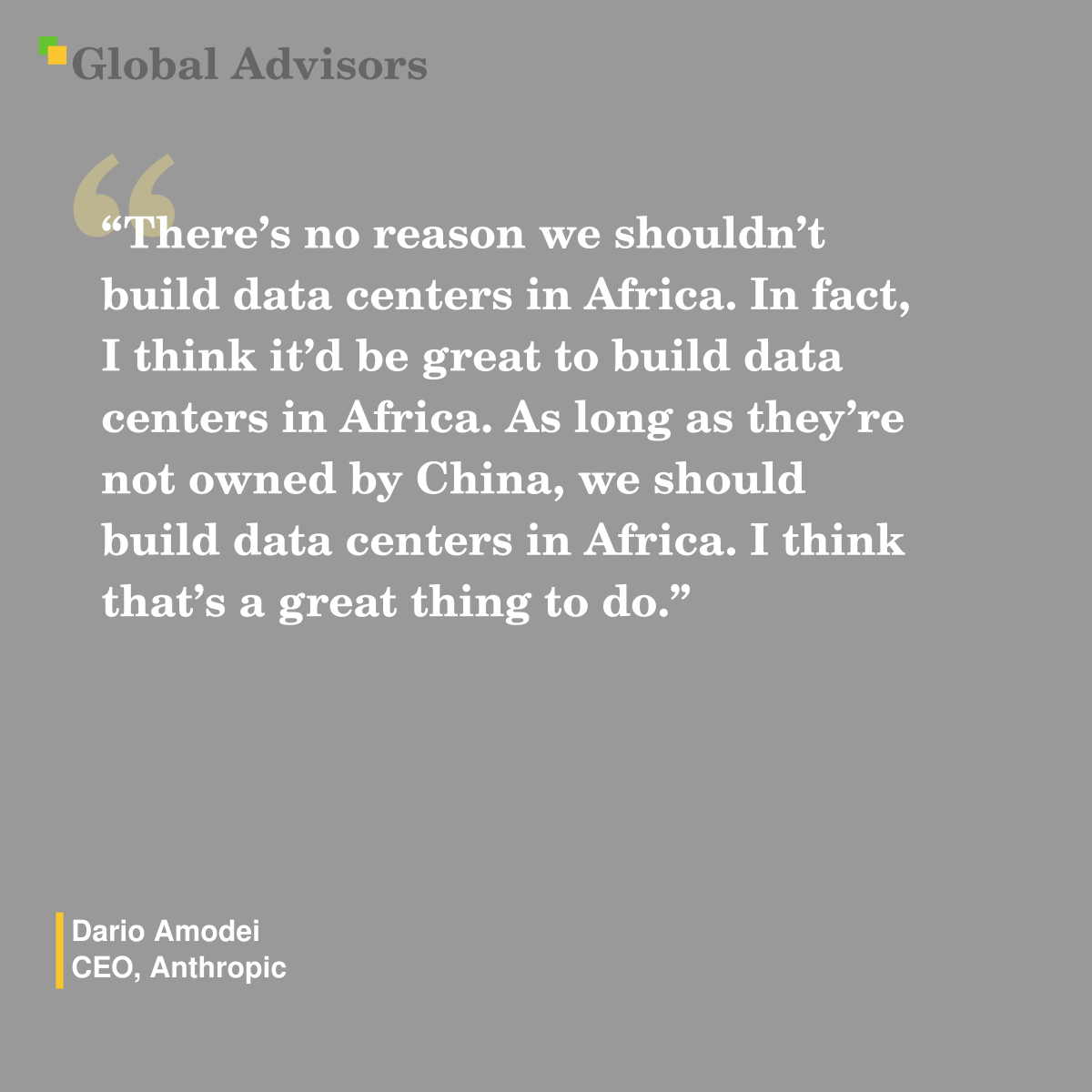
Quote: Dario Amodei - CEO, Anthropic"There's no reason we shouldn't build data centers in Africa. In fact, I think it'd be great to build data centers in Africa. As long as they're not owned by China, we should build data centers in Africa. I think that's a great thing to do." - Dario Amodei - CEO, AnthropicIn a candid interview with Dwarkesh Patel on 13 February 2026, Dario Amodei, CEO and co-founder of Anthropic, articulated a bold vision for expanding AI infrastructure into Africa. This statement underscores his broader concerns about securing AI leadership against geopolitical rivals, particularly China, while harnessing untapped opportunities in emerging markets.1,3,5 Who is Dario Amodei?Dario Amodei is a leading figure in artificial intelligence, serving as CEO and co-founder of Anthropic, a public benefit corporation focused on developing reliable, interpretable, and steerable AI systems. Prior to Anthropic, Amodei was Vice President of Research at OpenAI, where he contributed to the development of seminal models like GPT-2 and GPT-3. Before that, he worked as a senior research scientist at Google Brain. His departure from OpenAI in 2021 stemmed from a commitment to prioritise safety and responsible development, which he felt was not being adequately addressed there.3 Amodei is renowned for his 'doomer' perspective on AI risks, likening advanced systems to 'a country of geniuses in a data centre'-vast networks of superhuman intelligence capable of outperforming humans in tasks like software design, cyber operations, and even relationship building.3,4,5 This metaphor recurs in his writings, such as the essay 'Machines of Loving Grace,' where he balances enthusiasm for AI's potential abundance with warnings of existential dangers if not managed properly.6 Under Amodei's leadership, Anthropic has pioneered initiatives like mechanistic interpretability research-to peer inside AI models and understand their decision-making-and a Responsible Scaling Policy (RSP). The RSP, inspired by biosafety levels, mandates escalating security measures as model capabilities grow, positioning Anthropic as a leader in AI safety.3 The Context of the QuoteAmodei's remark emerged amid discussions on AI's infrastructure demands and geopolitical strategy. He has repeatedly stressed the need for the US and its allies to build data centres aggressively to maintain primacy in AI, warning that delays could prove 'ruinous.'1 In the same interview and related forums, he advocated cutting chip supplies to China and constructing facilities in friendly nations to prevent adversaries from commandeering infrastructure.3 This aligns with his recent essay 'The Adolescence of Technology,' a 19,000-word manifesto outlining AI as a 'serious civilisational challenge.' There, Amodei calls for progressive taxation to distribute AI-generated wealth, AI transparency laws, and proactive policies to avert public backlash-warning tech leaders, 'You're going to get a mob coming for you if you don't do this in the right way.'2 He dismisses some public fears, like data centres' water usage, as overstated, pivoting instead to long-term abundance.2 The Africa focus counters narratives of exclusionary AI growth. Amodei argues against sidelining developing nations, proposing data centres there as a win-win: boosting local economies while diluting China's influence in critical infrastructure.7 Leading Theorists on AI Infrastructure, Geopolitics, and DevelopmentAmodei's views build on foundational thinkers in AI safety and geopolitics:
These theorists collectively shape the discourse on AI as both an economic boon and a strategic vulnerability, with infrastructure as the linchpin.1,2,3 Implications for Global AI StrategyAmodei's advocacy highlights Africa's potential in the AI race: abundant renewable energy, growing digital economies, and strategic neutrality. Yet challenges persist, including energy demands, regulatory hurdles, and security risks. His vision promotes inclusive growth, ensuring AI benefits extend beyond superpowers while safeguarding against authoritarian capture.7 References 3. https://www.cfr.org/event/ceo-speaker-series-dario-amodei-anthropic 4. https://www.euronews.com/next/2026/01/28/humanity-needs-to-wake-up-to-ai-threats-anthropic-ceo-says 5. https://www.dwarkesh.com/p/dario-amodei-2 6. https://www.darioamodei.com/essay/machines-of-loving-grace 8. https://time.com/7372694/ai-anthropic-market-energy-impact/
|
| |
| |
|


| |
| |