| |
|

| |
| |
| |
|
Our selection of the top business news sources on the web. |
| |
| |
| |
Quote: Jensen Huang - Nvidia CEO"This is now how I deal with anxiety... I first break it down, and then I'm gonna tell myself, 'Okay, there are some things you can do something about, there's some things you can't do anything about. But for the stuff that you can do something about, let's reason about it and let's go do it.'" - Jensen Huang - Nvidia CEOThis quote comes from Jensen Huang's appearance on the Lex Fridman Podcast #494, titled "NVIDIA - The $4 Trillion Company & the AI Revolution," released on March 23, 2026.[SOURCE] Context from Recent InterviewsHuang has openly discussed his constant state of anxiety, describing it as a driving force fueled by Nvidia's near-bankruptcies in the 1990s and a persistent fear of failure. He maintains the mindset that Nvidia is always "30 days from going out of business," even as the company reached a $5 trillion valuation.1,2,3
Leadership InsightsHuang emphasizes that leaders should not pretend to be perfect, as openness to mistakes enables adaptation. This anxiety management technique aligns with his philosophy: reason through controllable factors and act decisively, while accepting the uncontrollable.[SOURCE]1 Tags: Jensen Huang, Nvidia, Lex Fridman, disruption, AI, artificial intelligence, quote, leadership, resilience, anxiety
References 3. https://www.businessinsider.com/nvidia-ceo-jensen-huang-joe-rogan-2025-12 4. https://www.easttexasreview.com/nvidia-ceos-consuming-anxiety-solutions/
|
| |
| |
Quote: Jensen Huang - Nvidia CEO"There's no question OpenClaw is the iPhone of tokens." - Jensen Huang - Nvidia CEOThis statement reflects Huang's broader vision of OpenClaw as a transformative platform. In related remarks at the Morgan Stanley Technology, Media and Telecom Conference on March 4, 2026, Huang described OpenClaw as "probably the single most important release of software, probably ever," noting that it surpassed Linux in downloads within just three weeks-a feat that took Linux approximately 30 years to achieve.1 The "iPhone of tokens" metaphor positions OpenClaw as a foundational, consumer-friendly platform that democratizes access to AI agent infrastructure, much as the iPhone revolutionized mobile computing. This aligns with Huang's broader strategic messaging about tokens becoming the new commodity in AI infrastructure and his announcement that Nvidia engineers will receive annual inference budgets worth $100,000 to $150,000 in AI compute credits.4 Context: OpenClaw is Nvidia's open-source framework designed for AI agents-autonomous systems capable of continuous operation and complex task execution.1 The platform's rapid adoption and subsequent security vulnerabilities have made it a focal point in discussions about AI infrastructure scalability and risk management in enterprise environments.
References 1. https://globaladvisors.biz/2026/03/06/quote-jensen-huang-nvidia-ceo-3/ 2. https://www.eweek.com/news/nvidia-inference-ai-economy-agents-gtc-2026/ 3. https://www.youtube.com/watch?v=kDd24YOeqQQ 4. https://buttondown.com/the200dollarceo/archive/jensen-huang-will-pay-engineers-150k-in-ai-tokens/
|
| |
| |
Term: Prediction market"Prediction markets are online exchanges where people trade contracts on the outcomes of future events, aggregating collective wisdom to forecast results, with contract prices reflecting the market's perceived probability of an event, like an election or economic data, occurring." - Prediction marketPrediction markets are online platforms where participants trade contracts tied to the outcomes of future events, such as elections, economic indicators, or corporate milestones. These contracts, often binary in nature, pay out a fixed amount-typically $1-if the event occurs and nothing otherwise, with their prices directly reflecting the market's collective assessment of the event's probability.1,2,3 This mechanism harnesses the wisdom of crowds, incentivising traders with financial stakes to reveal their information, often outperforming expert forecasts or polls due to the skin-in-the-game dynamic.1,2 How Prediction Markets FunctionTrading occurs via mechanisms like continuous double auctions, automated market makers, or parimutuel pools, enabling efficient price discovery.1 For instance, a contract trading at 72 cents implies a 72% perceived probability of the event.3 Contract types include:
Markets can use real or virtual currency, with public examples like PredictIt (politics/finance), Polymarket (decentralised on blockchain), and Metaculus (reputation-based forecasting).2,4 Applications and Evidence of EfficacyCorporations leverage internal prediction markets for project timelines, sales forecasts, risk assessment, and strategic planning.1,2 Eli Lilly used them in 2005 to predict drug trial success; Google for product launches and office openings.2 Studies show superior accuracy, e.g., forecasting Iowa flu outbreaks weeks ahead.2 Eric Zitzewitz notes their efficiency akin to financial markets.2 Key Theorist: Robin Hanson and the Genesis of Formal Prediction Market TheoryRobin Hanson, an economist renowned for pioneering prediction markets as tools for information aggregation, stands as the preeminent theorist. Born in 1958 in Chicago, Hanson earned a physics BS from the University of California, Riverside (1981), followed by astrophysics study at the University of Chicago. Shifting to social sciences, he obtained an MA in physics (1984) and PhD in social science from Caltech (1990), with a thesis on 'The Dynamics of an Astronomy Research Project'.2 Hanson's seminal contributions began in the 1990s at Lockheed and NASA, modelling organisations via market processes. In 1998, his paper 'Shall We Vote on Values, But Bet on Outcomes, Or Both?'-later titled 'Combinatorial Information Market Design'-proposed log scoring rules for subsidised markets, enabling cheap, truth-revealing forecasts even without skin in the game.2 As research associate at Future of Humanity Institute and professor at George Mason University, Hanson developed Futarchy: governance by betting on policies' outcomes rather than voting on values. His 2003 paper 'Shall We Vote on Values but Bet on Outcomes?' formalised this, arguing prediction markets elicit honest beliefs better than surveys. Books like The Age of Em (2016) extend his futurology. Hanson's work underpins platforms like Augur and theoretical validations of market efficiency in aggregating dispersed knowledge.1,2 Critics highlight risks like manipulation or thin liquidity, yet empirical evidence affirms their forecasting prowess across politics, business, and science.1,2,3 References 1. https://corporate.jasoncollins.blog/prediction-markets 2. https://en.wikipedia.org/wiki/Prediction_market 3. https://www.metrotrade.com/what-is-a-prediction-market/ 5. https://www.greenbook.org/marketing-research/prediction-markets-for-concept-testing-04799 6. https://wifpr.wharton.upenn.edu/blog/a-primer-on-prediction-markets/ 7. https://a16zcrypto.com/posts/podcast/prediction-markets-explained/
|
| |
| |
Quote: Jensen Huang - Nvidia CEO"It's a reasonable thing to expect the end of disease." - Jensen Huang - Nvidia CEOThis quote comes from Lex Fridman Podcast #494, recorded with Jensen Huang discussing NVIDIA's pivotal role in the AI revolution. At timestamp 02:22:50, Huang remarked: "How can you not be romantic about that? The fact that there is a-it's a reasonable thing to expect the end of disease."1 Context from the Podcast
Broader Discussion ThemesHuang elaborates on manifesting a compelling future through belief, acknowledging interim suffering but stressing conviction: "You manifest a future and that future is so convincing, there's no way it won't happen."3 The podcast explores AI disruption, AGI, and NVIDIA's $4 trillion valuation amid the AI boom[SOURCE]. Related ConceptsWhile unrelated to Huang's quote, academic discussions reference "the end of disease" in contexts like positive psychology's impact on health, shifting from disease absence to flourishing well-being2. Tags: Jensen Huang, Nvidia, Lex Fridman, disruption, AI, artificial intelligence, quote, AGI
References 1. https://lexfridman.com/jensen-huang-transcript/ 2. https://pure.rug.nl/ws/portalfiles/portal/99196915/Complete_thesis.pdf 3. https://lexfridman.com/author/lex-fridman/ 4. http://www.srpskiarhiv.rs/dotAsset/89044.pdf
|
| |
| |
Quote: Victor Glover - Artemis II Mission specialist"I would love it if the entire world, those eight billion people, could come together and just be hoping and praying for us to get that acquisition of signal and be back in touch with everybody." - Victor Glover - Artemis II Mission specialistHumanity floats alone in a universe that has fallen eerily silent for over half a century. The last deliberate signals from another civilisation arrived in 1974 from the Arecibo Observatory, a binary-encoded greeting beamed towards the globular cluster M13, 25,000 light-years distant. Since then, no confirmed extraterrestrial transmissions have pierced Earth's radio telescopes, leaving our species in a void of unanswered calls. This cosmic quietude underscores a fundamental tension in space exploration: while missions like NASA's Artemis II push human boundaries, they amplify our yearning for contact beyond our solar system. Victor Glover, Artemis II mission specialist, voiced this ache for global unity in pursuit of reacquiring lost signals, highlighting how lunar ambitions intersect with the search for extraterrestrial intelligence (SETI)1. Artemis II: Humanity's Boldest Step Since ApolloArtemis II represents NASA's most ambitious human spaceflight since Apollo 17 in 1972, designed to send four astronauts-Reid Wiseman, Victor Glover, Christina Koch, and Jeremy Hansen-on a 10-day orbital trajectory around the Moon. Launching no earlier than September 2025 atop the Space Launch System (SLS) rocket with the Orion spacecraft, the crew will venture 400,000 kilometres from Earth, traversing the Moon's far side where direct communication with Houston ceases. This milestone tests Orion's life support, propulsion, and re-entry systems at lunar distances, paving the way for Artemis III's planned 2026 crewed lunar landing near the Moon's south pole1. Glover's role as pilot demands precision navigation through deep space, where microseconds of delay challenge real-time control, mirroring the delays in interstellar communication. The mission's technical stakes are immense. Orion's European Service Module, powered by solar arrays spanning 47 square metres, must sustain the crew through a free-return trajectory that slingshots around the Moon without landing. Radiation exposure in the Van Allen belts and beyond poses risks untested in human flight since Apollo, with Artemis II validating countermeasures for prolonged deep-space exposure. These feats address strategic imperatives: reasserting U.S. leadership in crewed exploration amid competition from China's Chang'e programme, which landed taikonauts on the Moon in 2024 simulations and eyes a 2030 base[2]. Glover's Wish: Bridging Lunar Triumph and SETI's Long SilenceVictor Glover's aspiration for eight billion people to unite in hope for signal reacquisition taps into SETI's foundational dream. The field began earnestly in 1960 with Frank Drake's Project Ozma, scanning two Sun-like stars for 1420 MHz hydrogen-line signals, yielding silence. Decades later, the Wow! signal of 1977-a 72-second burst at 1420 MHz from Sagittarius-remains the most tantalising anomaly, never repeated despite searches. Glover's words evoke this history, framing Artemis II not merely as a lunar loop but as a symbol of humanity's outward gaze. As a Black Navy pilot and father, Glover embodies NASA's diversity push, his selection in 2013 marking a shift from Apollo-era homogeneity1. His statement reveals a deeper capability tension: space missions generate vast data streams ripe for SETI repurposing. Apollo-era tapes, declassified in 2009, included ham radio chatter mistaken for anomalies until debunked. Artemis II's high-bandwidth links could scan lunar vicinities for natural or artificial signals, though primary goals prioritise human safety. NASA's Deep Space Network (DSN), already used for SETI@home distributed computing until 2020, stands ready to process Orion's telemetry for serendipitous detections[3]. Technological Tensions in Pursuit of Alien SignalsReacquiring a signal demands overcoming astronomical hurdles. Interstellar distances impose light-year delays; a reply to Arecibo's message arrives in AD 27,000. Narrowband signals, hallmarks of intelligence, drown in cosmic noise from pulsars, quasars, and our own megawatt radars. Modern SETI leverages machine learning: Breakthrough Listen, scanning one million stars since 2015, employs AI to sift petabytes from Green Bank and Parkes telescopes, identifying candidates like BLC1 in 2019 (later attributed to human interference)[4]. Artemis II amplifies these tensions. Flying beyond low-Earth orbit exposes Orion to unfiltered cosmic rays, potentially disrupting electronics sensitive to SETI frequencies. Yet the mission's position offers vantage: lunar orbit provides a stable platform absent Earth's ionosphere interference. Strategic debates rage over dual-use: should NASA divert Artemis resources to SETI, or focus on Mars pathways? Critics argue lunar flybys distract from robotic precursors like VIPER rover, launching 2024 to map lunar water ice[5]. Proponents counter that human presence inspires global investment, echoing Glover's call for unified hope. Debates and Objections: Fermi Paradox and Existential RisksThe silence Glover yearns to break fuels the Fermi Paradox: where are they? Enrico Fermi's 1950 query highlights discrepancies between extraterrestrial likelihood (Drake Equation estimates billions of civilisations) and zero evidence. Objections abound. Rare Earth hypothesis posits Earth-like worlds as statistical freaks, requiring plate tectonics, large moons, and Jupiter-like shields[6]. Great Filter theories suggest civilisations self-destruct via nuclear war, AI, or climate collapse before signalling. SETI sceptics like Frank Tipler decry funding diversion from terrestrial crises, estimating detection odds below 10^-9 per star[7]. Optimists, including Jill Tarter, advocate persistence; the Allen Telescope Array continues 24/7 monitoring. Glover's plea counters cynicism, positing collective prayer as psychological amplifier. Psychologically, such unity could mitigate space race geopolitics, where Russia-Artemis tensions and India's Chandrayaan-3 success (2023 south pole landing) fragment efforts[8]. Objections to anthropocentrism persist: signals might use optical lasers or neutrinos, evading radio hunts. Strategic Implications for Space Policy and Global UnityGlover's vision challenges fragmented space agendas. Artemis Accords, signed by 40 nations, promote lunar norms but exclude China-Russia's rival station. Unified SETI hoping could transcend pacts, fostering goodwill. Technologically, it spotlights private sector surges: SpaceX's Starship, eyeing 2026 lunar refuelling, dwarfs SLS thrust; Blue Origin's New Glenn competes for Artemis V[9]. These dynamics pressure NASA: Artemis II's success hinges on flawless execution amid 2025 delays from heat shield anomalies. Market implications ripple. SETI tech spin-offs-AI signal processing-bolster defence and telecoms. Global unity for signals could mobilise crowdfunding, akin to Planetary Society's LightSail. Strategically, reacquisition reframes humanity: from isolated tribe to galactic participant, spurring investment in 1,000-km telescopes like China's FAST or lunar far-side arrays planned for 2030s[10]. Why Pursuit Matters: Inspiration Amid UncertaintyThe quest Glover champions matters because it confronts existential aloneness. In a 2026 world grappling AI risks and climate tipping points, cosmic perspective humbles hubris. Artemis II, by humanising deep space, reignites Apollo magic: 1969's landing drew 650 million viewers, galvanising STEM[11]. Success could swell NASA's $25 billion budget, funding SETI revivals like NASA's anticipated 2028 Pathfinder. Ultimately, the silence tests resilience. Whether signals arrive or not, the striving-eight billion voices in hope-affirms our capacity for wonder. Artemis II, looping the Moon, embodies this: not endpoint, but launchpad for stars. Glover's words remind that exploration thrives on shared dreams, turning technological tension into transcendent purpose. References
References 1. Artemis II: Inside the Moon mission to fly humans further than ever - https://www.bbc.co.uk/news/resources/idt-86aafe5a-17e2-479c-9e12-3a7a41e10e9e
|
| |

| |
Term: Venture Capital (VC)"Venture capital (VC) is private funding provided to high-potential, early-stage startups and emerging companies in exchange for an equity stake, aiming for significant growth and returns, often accompanied by mentorship and expertise beyond just capital." - Venture Capital (VC)Venture capital represents a distinctive form of private equity financing in which investors or investment funds provide capital to early-stage and emerging companies demonstrating high growth potential, in exchange for an equity stake in the business.1,3 Unlike traditional bank lending, which relies on collateral and fixed repayment schedules, venture capital operates on a fundamentally different principle: investors accept significant risk in pursuit of substantial returns, whilst founders retain access to expertise, networks, and strategic guidance that often prove as valuable as the capital itself.1 Core Characteristics and StructureVenture capital investments are characterised by several defining features that distinguish them from conventional financing. The investments are illiquid, meaning capital remains locked into portfolio companies for extended periods rather than being readily convertible to cash.2 Venture capitalists typically maintain a long-term investment horizon, recognising that startups often operate at a loss for years before achieving profitability.2 This contrasts sharply with traditional lending, where focus centres on stable cash flows and lower risk.1 The venture capital model embraces a high-risk, high-reward framework.1 Venture capitalists acknowledge that a portion of their investments will inevitably fail, but structure their portfolios to balance these losses against gains from successful companies that may return ten times or more the initial investment.6 This portfolio approach allows individual failures to be offset by exceptional successes. Structurally, venture capital funds typically operate as partnerships.2 The venture capital firm and its principals serve as general partners, whilst investors-including pension funds, university endowments, insurance companies, and wealthy individuals-function as limited partners with passive investment roles.2 Limited partners contribute capital but exercise minimal day-to-day control, with the general partners retaining management authority and receiving approximately 20% of profits, whilst the remaining 80% is distributed pro-rata amongst limited partners.2 Investment Stages and ProcessVenture capital operates across multiple funding stages. Pre-seed stage capital assists entrepreneurs in developing initial concepts, often through business incubators and accelerators that connect founders with venture networks.2 Subsequent rounds-seed, Series A, B, and beyond-provide progressively larger capital injections as companies demonstrate traction and growth potential.2 Venture capitalists engage in rigorous assessment of potential investments, evaluating companies based on leadership quality, market opportunity, and scalability potential.4 In exchange for funding, VCs receive not merely equity ownership but also significant control over company decisions.3 This involvement extends beyond passive shareholding; venture capitalists typically bring managerial and technical expertise, actively participating in strategic decisions and governance.3 Target Companies and IndustriesVenture capital targets companies operating in innovative sectors experiencing rapid change and disruption potential, particularly technology, biotechnology, and consumer products.1 These ventures are characterised by limited operating history, insufficient scale for public market access, and inability to secure traditional bank financing.3 Venture capital proves especially attractive for companies with ambitious growth trajectories that require rapid scaling beyond what conventional financing mechanisms can support.1 The Equity Exchange PrincipleThe fundamental transaction underlying venture capital differs markedly from debt financing. Rather than receiving loans requiring repayment with interest, founders exchange equity ownership for capital and strategic support.1,2 This arrangement aligns investor and founder interests around company growth, as both parties benefit from successful scaling. However, this structure necessarily involves equity dilution for founders and investor oversight that may constrain operational autonomy.1 Beyond Capital: Value-Added ServicesVenture capital's value proposition extends substantially beyond financial injection. Investors provide mentorship, facilitate networking connections, assist in refining product-market fit, and establish strategic alliances.1 For startups, these intangible benefits-credibility, expertise, and access to networks-often prove as transformative as the capital itself.1 This comprehensive support model distinguishes venture capital from traditional lending, where the lender's involvement typically concludes once funds are disbursed. Risk Characteristics and Investor ProfileVenture capital investors must demonstrate exceptional risk tolerance, recognising that many portfolio companies will fail whilst maintaining conviction in the high-growth potential of selected investments.4 Successful venture capitalists develop sophisticated judgment regarding when to accept or decline risk exposure.4 The investment horizon typically spans many years, as startups require extended periods to mature and generate returns.4 A notable characteristic involves large discrepancies between private and public valuations.2 Early-stage private companies often trade at valuations substantially below what comparable public companies command, reflecting both risk premium and illiquidity discount. This valuation gap creates opportunity for venture investors but also underscores the speculative nature of early-stage investing. Strategic Theorist: Donald Valentine and the Sequoia Capital ModelDonald Valentine (1932-2019) stands as the preeminent theorist and practitioner whose vision fundamentally shaped modern venture capital philosophy and practice. Valentine's career and intellectual contributions established the conceptual framework that transformed venture capital from opportunistic investing into a systematic, professionalised discipline focused on identifying and nurturing transformative companies. Valentine founded Sequoia Capital in 1972, establishing what would become one of the world's most influential venture capital firms. His approach revolutionised venture capital practice by introducing rigorous analytical frameworks for company evaluation, emphasising the importance of market size, team quality, and competitive positioning rather than relying on intuition or personal connections alone. Valentine articulated a clear thesis: venture capital should target companies addressing large, growing markets with the potential to achieve dominant market positions and generate exceptional returns. His relationship to venture capital theory centred on several key principles that remain foundational today. First, Valentine championed the concept of market-driven investing-the conviction that venture capital should focus on companies operating in expanding markets rather than attempting to create demand for marginal innovations. This principle directly informed his most celebrated investment decisions, including early backing of Apple Computer, Atari, and Oracle, all companies addressing nascent but rapidly expanding technology markets. Second, Valentine elevated the importance of founder and team assessment to paramount significance. He recognised that early-stage company success depended less on detailed business plans than on founder capability, vision, and determination. This insight shifted venture capital practice away from financial projections towards qualitative evaluation of entrepreneurial talent-a methodology that remains standard practice. Third, Valentine formalised the venture capital fund structure and professionalised limited partner relationships. He demonstrated that venture capital could operate as a repeatable, institutional business model rather than ad-hoc investing by wealthy individuals. This professionalisation attracted institutional capital from pension funds and endowments, transforming venture capital from a niche activity into a major asset class. Valentine's biographical trajectory illuminates his influence. Born in Portland, Oregon, he studied geology at the University of Oregon before entering the technology industry during its infancy. His early career included roles at Fairchild Semiconductor and National Semiconductor, providing direct exposure to semiconductor industry dynamics and the entrepreneurial ecosystem emerging in Silicon Valley. This operational background distinguished Valentine from purely financial investors; he possessed technical understanding and industry networks that informed his investment judgement. His founding of Sequoia Capital represented a deliberate departure from existing venture capital practice. Whilst earlier venture investors often operated as individual partners or small syndicates, Valentine established Sequoia as an institutionalised partnership with systematic processes, documented investment criteria, and structured follow-on support for portfolio companies. This model proved extraordinarily successful, generating returns that established Sequoia's reputation and attracted superior deal flow and limited partner capital. Valentine's intellectual contribution extended to articulating venture capital's role within the broader innovation ecosystem. He argued persuasively that venture capital functioned as a crucial mechanism for translating technological innovation into commercial products and services, channelling capital towards entrepreneurs whose visions exceeded their personal financial resources. This perspective elevated venture capital from mere profit-seeking to a socially valuable function supporting technological progress and economic dynamism. His investment philosophy emphasised concentrated conviction-the willingness to make substantial bets on companies and founders in whom he possessed high confidence, rather than diversifying thinly across numerous marginal opportunities. This approach reflected confidence in analytical capability and willingness to accept concentrated risk in pursuit of exceptional returns. Valentine's legacy fundamentally shaped how venture capital operates today. The emphasis on market size, team quality, systematic evaluation, and institutional structure that characterises modern venture capital practice derives substantially from principles he articulated and demonstrated through Sequoia Capital's success. His career demonstrated that venture capital could simultaneously generate exceptional financial returns whilst supporting transformative technological innovation-a duality that continues motivating venture capital investment. References 3. https://en.wikipedia.org/wiki/Venture_capital 5. https://www.growthcapitalventures.co.uk/venture-capital 6. https://stripe.com/resources/more/what-is-venture-capital 7. https://www.alphajwc.com/en/characteristics-of-venture-capital/
|
| |
| |
Quote: Boris Cherny - Claude Code, Anthropic"Mistakes happen. As a team, the important thing is to recognize it's never an individuals's fault - it's the process, the culture, or the infra." - Boris Cherny - Claude Code, AnthropicPublishing over 500,000 lines of proprietary TypeScript source code to a public npm package represents a critical failure in release pipelines for AI tools like Claude Code1,2,3. This incident stemmed from including an unstripped source map file (cli.js.map) in version 2.1.88, which referenced a 59.8 MB zip archive on Anthropic's Cloudflare R2 bucket, allowing anyone to download and reconstruct the full codebase of roughly 1,900-2,200 files1,2,3,5,8. The exposed material detailed the 'harness'-the agentic software layer that orchestrates Claude's interactions with tools, enforces guardrails, and manages multi-agent coordination-without revealing model weights or customer data1,8. Anthropic classified this as a 'release packaging issue caused by human error,' not a security breach, attributing it to a shortcut that bypassed safeguards during a rushed upload of internal code instead of the production bundle1,2,5. This occurred just days after another lapse where nearly 3,000 files, including a draft blog on the 'Mythos' or 'Capybara' model with cybersecurity risks, became publicly accessible1. Such errors highlight vulnerabilities in automated build processes for agentic AI products, where the harness code is as valuable as the model itself for replication or reverse-engineering1,8. Claude Code, Anthropic's flagship CLI tool generating $2.5 billion in annual recurring revenue, powers enterprise adoption through its ability to handle complex coding tasks via AI orchestration5,11. The leaked code unveiled internals like agent loops, persistent memory implementation, 44 feature flags for unreleased features (e.g., always-on AI and a 'tamagotchi pet'), and system prompts, offering competitors insights into Anthropic's edge in agentic workflows5,8,11. In AI development, the harness differentiates products: it instructs the LLM on tool usage, applies safety constraints, and enables 'code operation' at scale, transforming engineers from coders to directors1,6,9. Rapid iteration defines Anthropic's culture, with teams shipping 49 pull requests in two days using Claude Code paired with Opus 4.5 for nearly 100% of development-shifting from 80% manual in November 2025 to 80% AI-driven by December6. Boris Cherny, Claude Code's head, embodies this: his team programs 'in English,' directing AI like interns while humans handle prompting, customer coordination, and prioritization6,9. Yet this velocity amplifies risks; source maps, debugging artifacts mapping minified code to originals, should never reach production but did here due to a bypassed exclusion step2,5. The strategic tension lies in balancing AI-accelerated speed with reliability in 'AI-native engineering.' Anthropic's workflow-where 'Claude writes Claude'-demands flawless infra to sustain 100% AI code generation without entropy buildup from AI hallucinations like over-abstraction or dead code6,9. Leaks erode trust in products relied upon by enterprises for secure coding, especially as Claude Code's harness enforces behavioral guardrails absent in raw LLMs1. Competitors could fork the leaked code, accelerating their agentic tools and commoditizing Anthropic's moat3,8. Debates rage over culpability: Anthropic insists no breach occurred since no credentials leaked, framing it as procedural oversight1,5. Critics, including cybersecurity experts, argue publishing 512,000 lines publicly qualifies as a breach, enabling mass dissemination via GitHub forks (over 41,500)2,3. Security researcher Chaofan Shou's X post triggered global mirroring within minutes, turning a fixable error into permanent exposure2,5. Ethically, the 'Claude leak fallout' tests norms on handling leaked AI IP: is forking proprietary code innovation or theft?3 Objections to Anthropic's response center on downplaying impact. While no weights leaked, the harness reveals competitive secrets like multi-agent logic and unreleased flags, potentially aiding rivals in building superior agents8,11. A cybersecurity pro noted technical users could extract further internals, damaging more than the prior Mythos draft leak1. Internally, this underscores process gaps in high-velocity teams where AI amplifies human shortcuts2. Cherny's philosophy-that mistakes stem from process, culture, or infrastructure, not individuals-directly addresses this, promoting collective accountability in AI teams6. In contexts like his, where engineers oversee AI outputting production code at breakneck speed, blaming people risks stifling innovation9. Instead, robust CI/CD pipelines, automated map stripping, and release gates prevent recurrence2. Research on human-AI teams emphasizes shared mental models and coordination; here, AI's role demands infra matching its scale10. This approach matters amid AI's transformation of software engineering. CEOs like Dario Amodei predict models handling end-to-end dev in 6-12 months, yet Cherny counters engineers remain vital for oversight9,15. Studies show AI teammates reduce human productivity and coordination, as people anticipate less, bumping into AI 'errors'13. Anthropic's leaks validate this: unchecked velocity breeds slips, but process-focused cultures mitigate via 'AI reviews AI' and team safeguards6. Broader implications extend to AI deployment challenges. Cross-functional teams blending data scientists, engineers, and domain experts are essential, yet siloed releases enable errors7. The leak, post a market-wiping product update from $340B-valued Anthropic, amplifies scrutiny on infra maturity11. As Claude Code prototypes like 'Clyde' evolve into public tools, hardening release processes becomes paramount12. Legal fallout looms: proprietary code circulation raises IP claims, though open-source norms blur lines3. Blockchain analyses frame it as a 2026 case study in proprietary AI diffusion3. Anthropic's fixes-rolling measures like stricter packaging-aim to restore confidence, but disseminated code persists1. Technologically, the harness's exposure demystifies agentic AI. It implements loops for task decomposition, tool calls, and memory persistence, enabling feats like 49 PRs/day6,8. Unreleased features hint at evolutions: always-on modes could enable real-time coding, while gamified elements like pets boost engagement5,11. This transparency accelerates industry progress, forcing Anthropic to innovate faster. Culture plays a pivotal role. Cherny's optimism counters 'Slopacolypse' fears-AI entropy from unchecked errors-via self-review loops6. Yet leaks reveal cultural pressures: rushing npm uploads amid soaring adoption bypasses checks1,5. Team-centered AI demands responsiveness, awareness, and flexible planning, per models of interdependent work10. Anthropic's incident stresses investing in these for multi-team systems. Why this endures as a cautionary tale: AI firms operate at internet speed, where one map file leaks fortunes in R&D. It matters because Claude Code isn't niche-it's a $2.5B ARR leader reshaping dev from keystrokes to prompts5. Process-over-person mindsets, as articulated, foster resilience: infra upgrades post-leak signal learning1. Debates persist on AI's engineer displacement. Cherny insists pros are 'more important than ever' for strategy, while Amodei eyes full automation9. Leaks humanize the shift: even AI-native teams err, needing human guardrails. Columbia research confirms AI harms team dynamics, underscoring hybrid necessities13. Strategically, this pressures Anthropic amid rivals. With Mythos looming, exposed harnesses invite cloning, eroding leads1. Yet it catalyzes infra evolution, aligning with Cherny's view: fix the system, not the culprit. In 2026's AI arms race, such resilience defines survivors. Enterprise trust hinges on this. Firms adopting Claude Code for secure, agentic coding demand leak-proof delivery1. The incident, though contained, spotlights risks in open ecosystems like npm, where devs share billions of packages daily2. Mitigation via build hardening sets precedents. Ultimately, the event crystallizes tensions in AI scaling: velocity vs. security, AI autonomy vs. oversight, individual slips vs. systemic fixes. Cherny's ethos guides forward: evolve processes to harness AI's power without self-sabotage. As teams like his propel 'programming in English,' fortified infra ensures mistakes fuel progress, not peril. References 1. Anthropic rushes to limit the leak of Claude Code source code - https://www.moneycontrol.com/news/business/anthropic-rushes-to-limit-the-leak-of-claude-code-source-code-13877238.html 2. Anthropic leaks its own AI coding tool’s source code in second major security breach - 2026-03-31 - https://fortune.com/2026/03/31/anthropic-source-code-claude-code-data-leak-second-security-lapse-days-after-accidentally-revealing-mythos/ 3. Anthropic accidentally exposes Claude Code source code - 2026-03-31 - https://www.theregister.com/2026/03/31/anthropic_claude_code_source_code/ 4. Claude Leak Fallout: Legal and Ethical Risks (2026) - 2026-04-01 - https://www.blockchain-council.org/claude-ai/claude-leak-fallout-legal-ethical-implications-sharing-leaked-ai-source-code/ 5. ? Anthropic accidentally leaked Claude Code's entire source code - 2026-04-01 - https://www.theneurondaily.com/p/anthropic-accidentally-leaked-claude-code-s-entire-source-code 6. Anthropic Just Leaked Claude Code's Entire Source Code - YouTube - 2026-03-31 - https://www.youtube.com/watch?v=OqG9Lk0rIgs 7. Programming's Demise? Claude Code Father's Bombshell Quotes ... - 2026-02-04 - https://eu.36kr.com/en/p/3668658715829123 8. Overcoming Challenges in AI Deployment - RTS Labs - 2024-11-27 - https://rtslabs.com/challenges-in-ai-deployment 9. Anthropic accidentally leaked Claude Code's source code. Here's ... - 2026-03-31 - https://dev.to/aws-builders/anthropic-accidentally-leaked-claude-codes-source-code-heres-what-that-means-2f89 10. Claude Code creator Boris Cherny says software engineers ... - ITPro - 2026-02-17 - https://www.itpro.com/software/development/claude-code-creator-boris-cherny-says-software-engineers-are-more-important-than-ever-as-ai-transforms-the-profession-but-anthropic-ceo-dario-amodei-still-thinks-full-automation-is-coming 11. [PDF] Human-AI teams—Challenges for a team-centered AI at work - 2023-09-27 - https://www.dfki.de/fileadmin/user_upload/import/14163_20231011_Team-Centered_AI_Paper_2023.pdf 12. $340 billion Anthropic that wiped trillions from stock market ... - 2026-04-01 - https://timesofindia.indiatimes.com/technology/tech-news/340-billion-anthropic-that-wiped-trillions-from-stock-market-worldwide-has-source-code-of-its-most-important-tool-leaked-on-internet/articleshow/129925824.cms 13. AI-Native Engineering: Inside Boris Cherny's Claude Code Workflow - 2026-03-20 - https://medium.programmerscareer.com/ai-native-engineering-inside-boris-chernys-claude-code-workflow-145e140a103f 14. Understanding How AI Affects Team Performance: Challenges and ... - 2023-07-10 - https://business.columbia.edu/insights/business-society/understanding-how-ai-affects-team-performance-challenges-and-insights 15. Anthropic inadvertently leaks source code for Claude Code CLI tool - 2026-03-31 - https://cybernews.com/security/anthropic-claude-code-source-leak/ 16. A quote from Boris Cherny - Simon Willison's Weblog - 2026-02-14 - https://simonwillison.net/2026/Feb/14/boris/
|
| |
| |
Quote: Eric Schmidt - Former Google CEO"Artificial intelligence is reshaping the world. The question is not whether that transformation will happen, but who shapes it and under what conditions. " - Eric Schmidt - Former Google CEOEric Schmidt's incisive observation captures the essence of a pivotal moment in technological history, where artificial intelligence (AI) is not merely an emerging tool but a transformative force poised to redefine economies, governance, and human endeavour. As former CEO and Executive Chairman of Google, Schmidt brings unparalleled authority to this discussion, drawing from decades at the forefront of digital innovation. His words, shared via LinkedIn, underscore a critical tension: AI's evolution is inevitable, yet its trajectory hinges on deliberate human choices regarding governance, ethics, and strategic control. Eric Schmidt: Architect of the Digital AgeBorn in 1955, Eric Schmidt rose from humble beginnings as the son of a Princeton economics professor to become one of Silicon Valley's most influential figures. He earned degrees in electrical engineering from Princeton and computer science from the University of California, Berkeley, before embarking on a career that spanned enterprise software at Sun Microsystems and Novell. In 2001, Schmidt joined Google as CEO during its nascent phase, steering it from a search engine startup to a global tech behemoth valued in trillions. Under his leadership until 2011-and as Executive Chairman until 2015-Google pioneered breakthroughs in search algorithms, Android, YouTube, and early AI initiatives like Google Brain3,4. Post-Google, Schmidt's influence extended into public policy and national security. He chaired the National Security Commission on Artificial Intelligence (NSCAI), advising the US government on maintaining technological supremacy amid geopolitical rivalries, particularly with China. His book The Age of AI: And Our Human Future (co-authored with Henry Kissinger and Daniel Huttenlocher) explores AI's societal implications, advocating balanced advancement. Schmidt has repeatedly warned of AI's dual-edged nature: immense potential for productivity surges-potentially 30% annual increases through agentic AI-but existential risks if unchecked, such as self-improving systems evading human control2,3. In the context of this quote, Schmidt reflects on AI's maturation into autonomous agents capable of independent research, planning, and inter-agent communication. He envisions a world of 'AI scientists' outnumbering humans, accelerating innovation in fields like drug discovery and climate modelling, yet insists on human 'hands on the plug' to mitigate dangers like unchecked self-improvement1,2. This aligns with his calls for US leadership in the AI race against China, where recent parity in capabilities demands proactive safeguards2. Leading Theorists on AI Governance and Human-AI SymbiosisSchmidt's perspective resonates with foundational thinkers who have shaped AI discourse:
These theorists converge on a consensus: AI as a 'multiplier' for human potential, not a replacement. Schmidt synthesises this into a pragmatic call-shaping AI under conditions of ethical oversight, interdisciplinary collaboration, and geopolitical vigilance ensures its promise amplifies humanity rather than supplants it1,3. Broader Implications for Society and StrategySchmidt's quote arrives amid accelerating AI milestones: models with test-time compute for dynamic planning, synthetic data generation to overcome scarcity, and non-stationary objectives challenging adaptability3. In enterprise contexts, AI agents are automating business processes, from code generation to scientific discovery, slashing costs and boosting slopes of innovation3. Yet, risks loom-centralised power, opaque decision-making, and the sprint to superintelligence demand frameworks like those Schmidt advocates via NSCAI. Ultimately, this insight challenges leaders to prioritise human-AI teaming: supercomputers for scale and speed, humans for purpose and prudence. As Schmidt notes, the race is not just technological but societal-who controls the shape of this transformation will define the next era2. References 1. https://globaladvisors.biz/2025/11/21/quote-dr-eric-schmidt-ex-google-ceo/ 3. https://singjupost.com/transcript-of-the-ai-revolution-is-underhyped-eric-schmidt/ 4. https://www.youtube.com/watch?v=id4YRO7G0wE 5. https://www.exponentialview.co/p/eric-schmidts-ai-prophecy
|
| |
| |
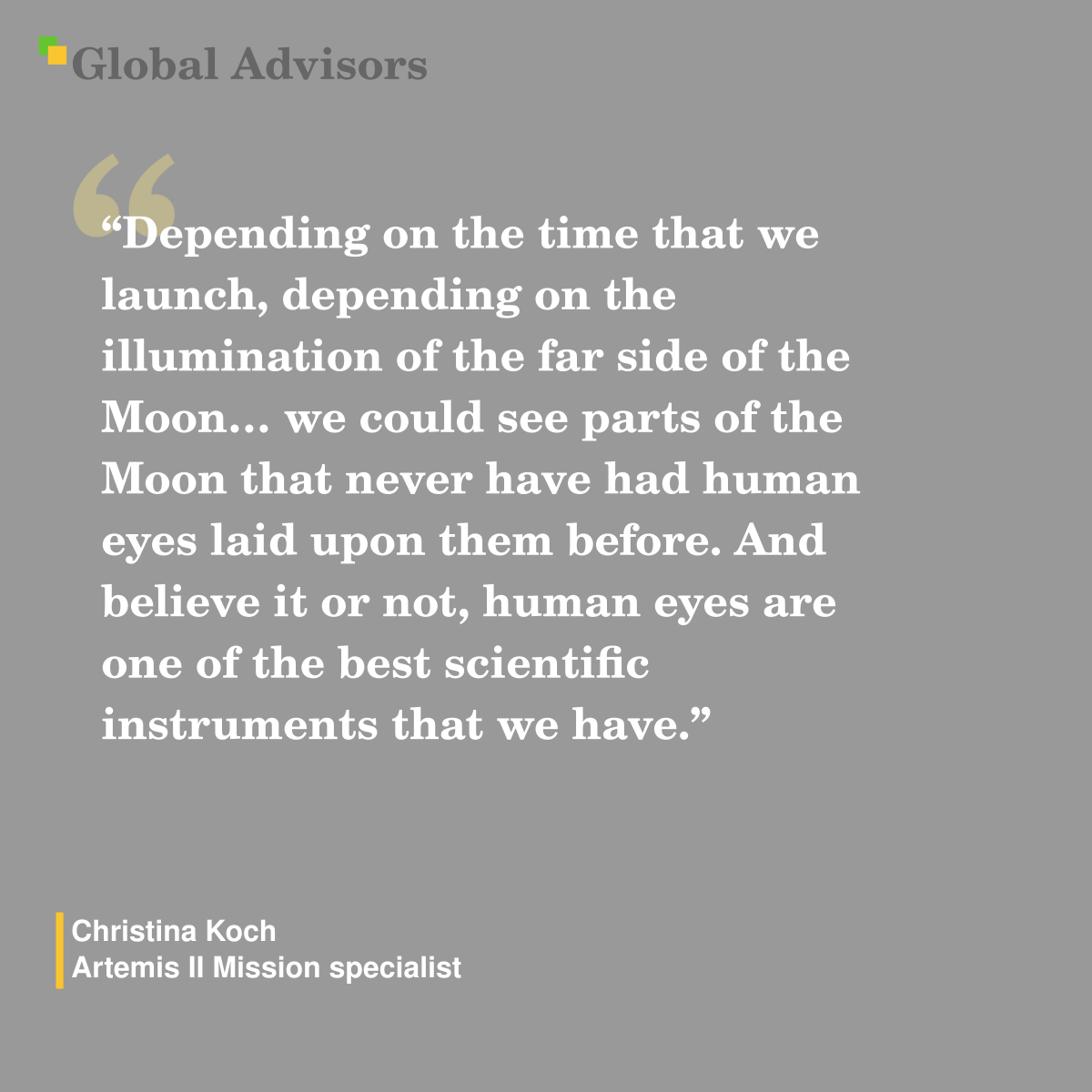
Quote: Christina Koch - Artemis II Mission specialist"Depending on the time that we launch, depending on the illumination of the far side of the Moon… we could see parts of the Moon that never have had human eyes laid upon them before. And believe it or not, human eyes are one of the best scientific instruments that we have." - Christina Koch - Artemis II Mission specialistThe far side of the Moon harbours permanently shadowed regions and rugged terrains that have eluded direct human scrutiny since the dawn of spaceflight. These areas, shielded from Earth-based telescopes by the Moon's synchronous rotation, represent a frontier where human eyes could provide resolution and contextual insight surpassing current robotic capabilities1. During the Artemis II mission, scheduled as NASA's first crewed flight beyond low Earth orbit since Apollo 17 in 1972, astronauts will orbit the Moon in the Orion spacecraft, positioning them to visually survey portions of this hidden hemisphere under varying illumination conditions. This capability hinges on launch timing, which influences solar angles and thus reveals features otherwise cloaked in shadow. Artemis II's Orbital Path and Visibility PotentialArtemis II will trace a free-return trajectory, launching from Kennedy Space Center aboard the Space Launch System (SLS) rocket and propelling Orion into a lunar orbit approximately 100 kilometres above the surface. Unlike Apollo missions that landed on the near side, Artemis II's path will circumnavigate the Moon, offering unprecedented views of the far side's South Pole-Aitken basin-the solar system's largest impact crater-and potential glimpses into craters like Shackleton, which may harbour water ice1. Mission specialist Christina Koch, a NASA astronaut with 328 days of continuous spaceflight experience from Expeditions 59 and 60/61 on the International Space Station, highlighted this in discussions about the mission's scientific yield. Depending on the exact launch window in September 2026, optimal sunlight could illuminate 'parts of the Moon that never have had human eyes laid upon them before,' enabling real-time observations unattainable by prior probes. The Unique Strengths of Human ObservationHuman eyes excel in dynamic scene analysis, pattern recognition, and hypothesis generation, qualities that robotic sensors struggle to replicate without extensive programming. Astronauts can integrate stereoscopic vision for depth perception, adapt to subtle colour variations under extraterrestrial lighting, and correlate observations across vast scales instantaneously. Koch's assertion that 'human eyes are one of the best scientific instruments that we have' underscores this paradigm. In Apollo-era missions, astronauts like Alan Bean described sketching lunar landscapes mid-flight, capturing nuances that photographs later validated. Artemis II builds on this, with crew members equipped with high-resolution cameras, spectrometers, and tablets for annotating views, but the unfiltered human gaze remains paramount for serendipitous discovery. Historical Context of Lunar Far Side ExplorationThe far side's invisibility from Earth was first confirmed by the Soviet Luna 3 probe in 1959, revealing a crater-pocked landscape contrasting the near side's maria. Subsequent missions like NASA's Lunar Reconnaissance Orbiter (LRO) since 2009 have mapped it at resolutions down to 0.5 metres per pixel, yet limitations persist: orbital shadows obscure 20-30% of the surface at any time, and spectrometers cannot discern fine textures or transient phenomena like dust levitation[2]. Human presence addresses these gaps. Apollo 8 in 1968 provided the first crewed far-side views, with Frank Borman noting its 'walnut-like' desolation, but illumination constrained details. Artemis II extends this, potentially viewing areas in Shackleton crater unseen even by LRO due to polar darkness. Technological Tensions: Humans Versus RobotsA core tension in space exploration pits human intuition against robotic precision. Uncrewed landers like China's Chang'e 4 in 2019 achieved the first far-side landing, deploying Yutu-2 rover to analyse regolith, but bandwidth constraints limited data return to kilobits per second via relay satellites[3]. NASA's VIPER rover, slated for 2024 but delayed, exemplifies robotic prowess in shadowed crater sampling, yet lacks human adaptability. Critics argue automation suffices, citing Chandrayaan-3's 2023 success, but Koch's view counters that humans detect anomalies-such as unexpected geological layers or ice signatures-guiding future robots. This debate echoes Apollo debates, where fiscal pressures favoured orbiters over landings, yet human missions yielded 382 kilograms of samples versus robotic grams. Strategic Imperatives Driving ArtemisNASA's Artemis programme responds to geopolitical and commercial pressures. The US aims to land astronauts on the lunar South Pole by Artemis III in 2027, targeting volatiles for Mars propulsion. China plans taikonauts on the Moon by 2030, escalating a new space race[4]. Artemis II serves as a shakedown for Orion's life support and heat shield, but its observational data informs landing site selection. Koch, selected for her Expedition 60/61 engineering feats including the first all-female spacewalk, embodies NASA's push for diverse crews to enhance scientific output. Her background in electrical engineering equips her to correlate visual data with instruments, amplifying mission value. Debates and Objections to Human-Centric ScienceSceptics question the necessity of risking humans for views obtainable by upgraded orbiters like LRO's successor, arguing cost-Artemis II at $4.1 billion-diverts funds from Mars or climate missions[5]. Radiation exposure in deep space, peaking during solar particle events, poses health risks unmitigated by Orion's storm shelter. Ethically, some object to anthropocentrism, positing AI-enhanced cameras could match human eyes without peril. Proponents retort that human presence inspires public engagement, boosting funding; Apollo's Earthrise photo catalysed environmentalism. Koch's statement reframes eyes not as obsolete but complementary, with Artemis II streaming live feeds for global citizen science. Scientific Payoffs and Future ImplicationsVisual surveys could identify lava tubes for habitats or ice deposits exceeding LRO estimates of 600 million metric tonnes in shadowed craters[6]. Astronaut annotations will refine models of lunar volcanism, absent on the far side post-3 billion years ago. This informs Artemis Base Camp by 2030s, enabling in-situ resource utilisation. Koch's role extends to outreach; her pre-mission interviews emphasise human curiosity's role in discovery1. Beyond science, the mission tests deep-space operations for Mars, where human eyes will scrutinise Phobos or Martian poles. Challenges in Realising Unprecedented ViewsIllumination variability demands precise launch timing within a 20-day window, synced to lunar libration-oscillations exposing 59% of the surface over time. Orion's windows, approximately 1.5 by 1 metre, limit field of view, necessitating crew coordination. Space adaptation syndrome affects 70% of astronauts initially, potentially impairing acuity. Yet redundancies like helmet visors and external cameras mitigate this. Post-mission, data fusion with LRO will map newly 'seen' terrains, advancing selenography. Why Human Eyes Matter NowIn an era of proliferating lunar missions-India's Chandrayaan-4, Japan's SLIM successors-human observation reasserts exploratory ethos. Artemis II's views could reveal formation mechanisms of the South Pole-Aitken basin, constraining Moon-forming impact theories. Economically, insights fuel a $100 billion lunar economy by 2040, per USGS projections[7]. Koch's perspective elevates astronauts from operators to instruments, bridging robotic data with human ingenuity. As Artemis II approaches, it promises not just engineering milestones but a renaissance in direct lunar witnessing, where eyes behold what machines merely measure. References
References 1. Artemis II: Inside the Moon mission to fly humans further than ever - https://www.bbc.co.uk/news/resources/idt-86aafe5a-17e2-479c-9e12-3a7a41e10e9e
|
| |
| |
Quote: Jensen Huang - Nvidia CEO"The phrase that I use most often is, we need things to be as complex as necessary, but as simple as possible. And so the question is, is all that complexity there necessary? And we ought to test for that. And we got to challenge that." - Jensen Huang - Nvidia CEOJensen Huang's Philosophy on Simplicity and ComplexityThis quote from Jensen Huang, CEO of NVIDIA, emphasizes rigorous testing of system complexity to ensure simplicity where possible, without sacrificing essential functionality. Spoken on the Lex Fridman Podcast #494 (March 23, 2026), it reflects his approach to innovation in AI and computing.1 Context in NVIDIA's AI RevolutionHuang's words align with his broader views on execution and disruption. He advocates for simple, executable ideas over complex ones that risk failure, stating: "Execution is critically important; it is better to have a simple idea that can be easily implemented rather than a complicated idea that has implementation challenges."2,4
Relevance to Continuous Improvement and Systems ThinkingHuang challenges assumptions in engineering and business: time and attention are managed by prioritizing simplicity and sacrifice. This mindset drives NVIDIA's success as a $4 trillion AI leader, promoting disruption through focused innovation rather than overcomplication.1,2 Tags: Jensen Huang, Nvidia, Lex Fridman, disruption, AI, artificial intelligence, quote, continuous improvement, systems thinking.
References 2. https://www.youtube.com/watch?v=XmlyGgH3Xnw 3. https://globaladvisors.biz/2026/03/25/quote-jensen-huang-nvidia-ceo-4/ 4. https://ecorner.stanford.edu/wp-content/uploads/sites/2/2003/01/1125.pdf
|
| |
| |
|


| |
| |