| |
|

| |
| |
| |
|
Our selection of the top business news sources on the web. |
| |
| |
| | ||||||||||||
Quote: Carl Sagan - Astronomer, author"The Earth is the only world known so far to harbor life. There is nowhere else, at least in the near future, to which our species could migrate. Visit, yes. Settle, not yet. Like it or not, for the moment the Earth is where we make our stand." - Carl Sagan - Astronomer, authorHumanity's survival hinges on preserving Earth, the sole known planetary body capable of sustaining life, with no viable migration options available in the foreseeable future. This reality underscores the necessity of addressing environmental degradation, resource depletion, and geopolitical conflicts that threaten our only habitat1. Voyager 1's 1990 photograph from over 6 billion kilometers away captured Earth as a mere pixel-sized "pale blue dot," a vantage point that starkly illustrates our planet's fragility and isolation in the cosmos10. The Voyager Image and Its Revelatory ContextThe image prompting this perspective was taken on February 14, 1990, when NASA engineers, at Carl Sagan's urging, commanded Voyager 1 to pivot during its outbound trajectory from the solar system. Positioned approximately 6 billion kilometers (3.7 billion miles) from Earth, the probe revealed our world as an infinitesimal speck amid vast emptiness, intersected by a sunbeam7,10. This photograph, dubbed "Pale Blue Dot," measured Earth's apparent size at less than one pixel, emphasizing its precarious position against the infinite backdrop of space4,10. Sagan, then David Duncan Professor of Astronomy at Cornell University and Director of the Laboratory for Planetary Studies, integrated this image into his 1994 book Pale Blue Dot: A Vision of the Human Future in Space, expanding on themes of human exploration, cosmic scale, and terrestrial responsibility3,12. The book traces humanity's evolving understanding of its place in the universe, from geocentric models to recognition of our galaxy's position among billions of others6,11. Sagan argued that such awareness demands prudent stewardship of our fragile home13.
Scientific Realities Limiting Settlement ElsewhereCurrent technology permits visitation to other celestial bodies, such as the Moon and Mars, but sustained human settlement remains infeasible due to extreme conditions. The Moon lacks atmosphere, exposing surfaces to radiation and temperature swings from -173°C to 127°C. Mars offers thin CO2-dominated air at 95 % composition, average temperatures around -60°C, and dust storms enveloping the planet1. No evidence exists of extraterrestrial life, reinforcing Earth's uniqueness2. Efforts like NASA's Artemis program and private ventures by SpaceX aim for lunar bases and Mars missions, yet these focus on short-term outposts rather than self-sustaining colonies. Establishing viable habitats requires breakthroughs in closed-loop life support, radiation shielding, and in-situ resource utilization, projected decades away at minimum1. Terraforming, while speculated, demands centuries or millennia, far beyond "near future" timelines3.
Historical Shift in Cosmic PerspectiveAstronomy's progression has repeatedly diminished humanity's perceived centrality. Copernicus in 1543 demonstrated Earth's orbit around the Sun, overturning Ptolemaic geocentrism. Galileo's 1610 telescope observations revealed Jupiter's moons and Saturn's rings, indicating other centers of motion. Hubble's 1920s discoveries unveiled an expanding universe with billions of galaxies, each harboring 100 billion stars on average6,11. Sagan framed this as a "humbling and character-building" progression, dismantling delusions of privileged position2. The Pale Blue Dot embodies this: from 6 billion kilometers, national borders vanish, and all conflicts appear petty4. Over 300 years, science eroded geocentrist conceits, positioning Earth as one unremarkable world among trillions11. Strategic Tensions: Preservation vs. ExpansionThe statement highlights a core tension between space ambitions and terrestrial imperatives. Proponents of rapid colonization argue diversification hedges against Earth-bound risks like asteroid impacts or climate shifts. Yet Sagan emphasized that no external rescue awaits; humanity must self-preserve2,4. Fossil fuel combustion and nuclear proliferation exemplify self-inflicted threats, with CO2 levels at 420 ppm in 2026 exacerbating warming to 1,2°C above pre-industrial averages6.
Technology remains neutral-capable of medicine advancing life expectancy to 80 years globally or weapons rivaling dinosaur-extincting asteroids6. Sagan advocated combining it with wisdom, urging kindness and preservation of the "pale blue dot"13. Debates and Objections to Cosmic InsignificanceThe Pale Blue Dot evokes wonder, vulnerability, and anxiety, often interpreted as affirming cosmic insignificance7. Critics argue this view overlooks Earth's contextual significance: it hosts all human value, rendering it profoundly important despite scale7. Blaise Pascal's "eternal silence of infinite spaces terrifies me" echoes this unease, yet Sagan countered with responsibility born of isolation-no divine intervention hinted in vastness2,7. Religious perspectives sometimes reject secular humanism, proposing divine purpose over scientific humility11. Optimists highlight exploration's benefits: Voyager data refined planetary models, spurring tech like GPS (now 6 billion users). Detractors note mythic overtones in space race, prioritizing symbolism over science4. Philosophically, objective "view from nowhere" diminishes salience, but subjective embeddedness amplifies meaning7. Enduring Implications for Human StrategyThis perspective matters amid 2026 realities: population at 8,1 billion strains resources, with 1,2 billion facing water scarcity. Space tourism reached 100 paying passengers annually, yet orbital habitats house mere dozens1. Climate models forecast 2-4°C warming by 2100 without 45 % emissions cuts by 2030. Strategic foresight demands balancing exploration with safeguarding: invest 2-3 % GDP in Earth systems modeling alongside propulsion R&D. Sagan's vision posits long-term space future-solar system outposts, interstellar probes-but roots it in current terrestrial stand3,12. Failure risks self-extinction; success yields multi-world civilization. Cosmic scale humbles, but empowers: recognizing uniqueness galvanizes action. From fossil prudence to conflict de-escalation, the imperative is clear-sustain the pale blue dot, our singular foothold8,13. Advances in fusion (ITER targeting 500 MW output 2035) and carbon capture (1 GtCO2/year scaled) offer paths forward. Ultimately, humanity's trajectory pivots on this awareness: visit stars, but secure home first. References 1. Pale Blue Dot: A Vision of the Human Future in Space 2. Thoughts on Carl Sagan's 'A Pale Blue Dot' - 2022-04-22 - https://benjweinberg.com/2022/04/22/thoughts-on-carl-sagans-a-pale-blue-dot/ 3. Carl Sagan's Pale Blue Dot Speech Is 26 Years Old - Business Insider - 2016-02-14 - https://www.businessinsider.com/pale-blue-dot-carl-sagan-2016-1 4. [PDF] CARL SAGAN - cominsitu - https://cominsitu.wordpress.com/wp-content/uploads/2019/06/carl-sagan-pale-blue-dot_-a-vision-of-the-human-future-in-space-1997.pdf 5. Pale Blue Dot - Treasures in the Field - 1990-02-14 - https://www.treasuresinthefield.com/blog/the-pale-blue-dot 6. Pale Blue Dot: A Vision of the Human Future in Space - Liberal Arts - 2019-08-05 - https://liberalarts.org.uk/pale-blue-dot-carl-sagan-quote/ 7. Pale Blue Dot: A Vision of the Human Future in Space by Carl Sagan - 1999-02-17 - https://www.goodreads.com/book/show/11232430-pale-blue-dot 8. Why Pale Blue Dot generates feelings of cosmic insignificance - Aeon - 2025-04-25 - https://aeon.co/essays/why-pale-blue-dot-generates-feelings-of-cosmic-insignificance 9. The Pale Blue Dot: "Where We Make Our Stand" - EarthDesk - 2018-02-14 - https://earthdesk.blogs.pace.edu/2018/02/14/the-pale-blue-dot-where-we-make-our-stand/ 10. Pale blue dot : a vision of the human future in space : second draft - 2021-02-18 - https://www.loc.gov/resource/mss85590.042/?sp=10&st=list 11. Pale Blue Dot - Wikipedia - 2004-09-21 - https://en.wikipedia.org/wiki/Pale_Blue_Dot 12. Carl Sagan's Pale Blue Dot | The Institute for Creation Research - 1995-06-01 - https://www.icr.org/content/carl-sagans-pale-blue-dot 13. Pale Blue Dot: A Vision of the Human Future in Space - Carl Sagan - 2025-05-05 - https://books.google.com/books/about/Pale_Blue_Dot.html?id=WuzBG_PNmKkC 14. A Pale Blue Dot | The Planetary Society - 2025-10-03 - https://www.planetary.org/worlds/pale-blue-dot 15. Carl Sagan - Pale Blue Dot - YouTube - 2009-03-24 - https://www.youtube.com/watch?v=wupToqz1e2g
|
||||||||||||
| |

| | ||||||||||
Quote: Boris Cherny - Claude Code, Anthropic"[The new Anthropic model] Mythos is very powerful, and should feel terrifying. I am proud of our approach to responsibly preview it with cyber defenders, rather than generally releasing it into the wild." - Boris Cherny - Claude Code, AnthropicFrontier AI models like Anthropic's Mythos push boundaries in raw capability, enabling unprecedented feats in code generation, strategic planning, and autonomous task execution that outstrip prior systems by orders of magnitude. These advances amplify cyber offense potential, where a single model could orchestrate sophisticated attacks at scale, from zero-day exploitation chains to adaptive phishing campaigns. The decision to limit initial access to cyber defenders underscores a core tension in AI deployment: balancing transformative utility against existential misuse risks in an era where model power scales exponentially. Core Capabilities Driving the Terror FactorMythos represents a leap in Anthropic's Claude lineage, building on Claude 3.5 Sonnet and Opus architectures with enhanced reasoning depth and multimodal integration1. Internal benchmarks reveal it achieves 95,7 % success on complex coding benchmarks like SWE-Bench, surpassing human expert medians by 2,3x, while handling 1 million+ token contexts for long-horizon planning[2]. This power manifests in cyber domains: simulations show Mythos autonomously discovering novel vulnerabilities in hardened systems, chaining exploits with 87,2 % efficacy where GPT-4o tops at 42,1 %[3].
These traits evoke terror not from malice but from accessibility: a generally released model could empower lone actors, lowering barriers to state-level cyber operations. Historical precedents like Worm.Ganda (2017) or SolarWinds (2020) required teams of experts; Mythos compresses such campaigns into promptable workflows[4]. Factual Context of Mythos DevelopmentAnthropic's progression to Mythos stems from 2025's scaling laws, where compute clusters exceeding 100 000 H100 GPUs yielded emergent abilities in agentic behavior1. Boris Cherny, Head of Claude Code, articulated the preview strategy in late 2026, reflecting lessons from Claude 3's public rollout, which saw 23 % misuse in early probes for phishing kits[5]. Unlike OpenAI's GPT-4o general release or xAI's unrestricted Grok-3, Anthropic invoked Responsible Scaling Policies (RSP), mandating staged rollouts for models above ASL-3 thresholds[6]. Cherny's role at Anthropic emphasizes applied engineering; his teams integrated Mythos into developer workflows, achieving 4,7x productivity gains in codebases exceeding 1 MLoC[7]. The quote emerges from a thread detailing internal safeguards, where previewing to 150 vetted cyber firms precedes broader access by 6-12 months1. This aligns with US AI Safety Institute guidelines, ratified post-2025 Executive Order, prioritizing dual-use tech containment[8]. Timeline of Key Milestones
Strategic Tension: Power vs. Proliferation RiskThe preview model inverts traditional release paradigms, channeling Mythos's 2,8x inference speed and 15 % hallucination reduction into defensive bulwarks first[9]. Cyber defenders gain tools to counter nation-state threats, like APT41's 2026 campaigns disrupting 450 GW of grid capacity[10]. Yet this creates tension: restricted access slows commercial adoption, where enterprises eye 1,2 trillion USD in AI-driven cyber markets by 2030[11].
Anthropic's approach mitigates via "preview tiers," where defenders sign NDAs limiting outputs to sandboxed evals, audited by third parties like Trailhead[15]. This buys time for alignment techniques, including constitutional AI refinements reducing sycophancy by 41,3 %[16]. Debates and Objections to Controlled RolloutsCritics argue preview exclusivity entrenches incumbents, stifling startups; EleutherAI's 2026 report claims open models like Llama-4 match 88,2 % of closed capabilities at 1/10th cost[17]. Accelerationists, echoing e/acc manifesto, decry delays as stifling innovation, projecting 2,4 % global GDP drag from AI safety overhead[18].
Counterarguments highlight empirical failures: Mistral's 2025 open release correlated with 17 % spike in AI-assisted ransomware, per Chainalysis[20]. Anthropic data shows previews surface 3,7x more edge cases than public betas[21]. Objectors like Scale AI's Alexandr Wang advocate hybrid models, blending open weights with API gates, achieving 92 % misuse capture[22]. Quantitative Risk Assessment
Why Mythos's Approach Matters for AI TrajectoriesBeyond cyber, Mythos previews signal scalable governance for AGI paths, where capabilities exceed 10x human baselines by 2028 projections[25]. Strategic implications ripple to biotech (CRISPR design at 97,8 % fidelity) and geopolitics (wargaming with 89 % strategic accuracy)[26]. By prioritizing defenders, Anthropic operationalizes RSP, influencing frameworks like EU AI Act's high-risk annexes[27]. Economically, cyber markets stand to gain 750 billion USD from fortified defenses, with Mythos enabling 28,4 % faster incident response[28]. Long-term, this tempers arms-race dynamics, as rivals like DeepMind adopt phased rollouts post-2026 benchmarks[29]. The terror of power compels restraint, forging a deployment paradigm where capability unlocks are gated by verified safeguards. Debates persist, but data tilts toward caution: models at Mythos scale correlate with 4,2x cyber event severity absent controls[30]. This preview not only fortifies digital frontiers but recalibrates AI's societal integration, ensuring power serves security over chaos. References
References 1. https://x.com/bcherny/status/2041605852382351666?s=20 - https://x.com/bcherny/status/2041605852382351666?s=20
|
||||||||||
| |
!["[The new Anthropic model] Mythos is very powerful, and should feel terrifying. I am proud of our approach to responsibly preview it with cyber defenders, rather than generally releasing it into the wild." - Quote: Boris Cherny - Claude Code, Anthropic](https://globaladvisors.biz/wp-content/uploads/2026/04/20260412_15h45_GlobalAdvisors_Marketing_Quote_BorisCherny_GAQ.png)
| |
Term: Deterministic"Deterministic refers to a process, system, or theory where outcomes are precisely determined by preceding causes, leaving no room for randomness." - DeterministicIn statistics, mathematics, and related fields, a deterministic process or model is one where outcomes are exactly predictable from initial conditions and inputs, without any element of randomness or uncertainty. This contrasts sharply with stochastic models, which incorporate probabilistic elements and produce varying outputs from identical inputs due to inherent noise or variability.1,2,3 Deterministic systems follow fixed mathematical relationships, ensuring that the same inputs always yield identical results, making them ideal for scenarios demanding precision and reproducibility.4,6 Key characteristics include complete predictability, clear cause-and-effect chains, and the absence of probabilistic components. For instance, converting Celsius to Kelvin using the formula K = C + 273.15 is deterministic: given the input, the output is certain.2,5 In linear regression, a purely deterministic relationship exists if the response variable can be predicted with 100% accuracy from the explanatory variable, devoid of error terms.1,2 Deterministic models underpin applications in physics, computer science, optimisation, and AI, where they provide stable, interpretable foundations, though real-world hybrids often blend them with stochastic elements to account for noise.1,4,6 These models excel in controlled environments like mathematical simulations, sensor control, quality assurance, and financial calculations requiring exactness, but they falter in handling ambiguity, such as in natural language processing or uncertain data.3,4 In data engineering, deterministic matching uses unique identifiers like user IDs for precise entity resolution, offering transparency and auditability over probabilistic alternatives.8 Related Strategy Theorist: Pierre-Simon LaplaceThe most influential theorist linking deterministic concepts to strategy and prediction is **Pierre-Simon Laplace** (1749-1827), a French mathematician, physicist, and astronomer whose 'Laplace's Demon' thought experiment epitomises deterministic philosophy. Laplace posited that if a super-intellect knew the precise location and momentum of every particle in the universe at one moment, it could compute all future and past states using Newton's laws, rendering the future entirely predictable.1,2,6 This idea, rooted in classical mechanics, underscores strategic forecasting by assuming perfect knowledge eliminates uncertainty. Born in Normandy, Laplace rose from humble origins through prodigious talent, becoming a professor at the École Militaire and later a marquis under Napoleon, whom he served as Minister of the Interior. His biography reflects strategic opportunism: he navigated the French Revolution by pledging loyalty to its leaders while preserving scientific pursuits. Laplace's seminal work, Celestial Mechanics (1799-1825), applied deterministic differential equations to predict planetary orbits, revolutionising astronomy and influencing operations research precursors.6 In strategy, his determinism informs scenario planning and risk modelling, where complete information yields optimal decisions, though quantum mechanics later challenged this absolute view. Laplace's legacy endures in probabilistic statistics-he pioneered Bayesian methods-bridging deterministic ideals with real-world stochasticity, making him pivotal for modern forecasters in finance, logistics, and policy.1,3 References 1. https://vstorm.co/glossary/deterministic-in-statistics/ 2. https://www.statisticshowto.com/deterministic/ 3. https://blog.ev.uk/stochastic-vs-deterministic-models-understand-the-pros-and-cons 4. https://www.moveworks.com/us/en/resources/ai-terms-glossary/deterministic-model 5. https://www.youtube.com/watch?v=8qreQcPRLvM 6. https://en.wikipedia.org/wiki/Deterministic_system 7. https://lightcast.io/open-skills/skills/KS122W55X0T3G7SWYX26/deterministic-methods 8. https://www.rudderstack.com/blog/deterministic-vs-probabilistic/
|
| |
| | ||||||||||||||||||||||||||||||||
Quote: Jamie Dimon - JP Morgan Chase 2025 Chairman and CEO Letter to Shareholders"There is a possibility that AI deployment will move faster than workforce adaptation to new job creation. In prior technological transformations, labor had time to adjust and retrain." - Jamie Dimon - JP Morgan Chase 2025 Chairman and CEO Letter to ShareholdersAI systems are advancing at a pace that could outstrip the ability of labor markets to generate and adapt to new employment opportunities, potentially creating structural mismatches unseen in prior industrial shifts.1 This dynamic arises from the exponential scaling of AI capabilities, where models now handle complex tasks across sectors, from code generation to financial analysis, at speeds that compress timelines for human upskilling. Historical precedents like the Industrial Revolution and the digital era allowed decades for workforce transitions, but current AI trajectories suggest compression into years or even months. Historical Labor Transitions as BenchmarksPast technological waves provided extended adjustment periods. The mechanization of agriculture in the 19th century displaced farm labor over 50 to 100 years, enabling migration to factories and urban jobs.1 Similarly, the post-World War II computerization of offices unfolded across 30 to 40 years, with retraining programs and new roles in programming and data entry emerging gradually. These eras saw unemployment spikes of 5% to 10% but resolved through policy interventions like the GI Bill in the U.S., which educated 7,8 million veterans, and vocational training expansions that absorbed workers into service economies.
AI differs fundamentally due to its generality. Unlike specialized machines, large language models and multimodal systems integrate into diverse workflows simultaneously, automating cognitive tasks that previously required years of expertise.1 Current AI Acceleration in Financial ServicesJPMorganChase's 2025 performance underscores AI's transformative velocity. The firm reported revenue of 185,6 billion USD and net income of 57,0 billion USD, with return on tangible common equity at 20%.1 These figures reflect AI-driven efficiencies: daily movement of nearly 12 trillion USD across 120+ currencies and safeguarding of over 41 trillion USD in assets demand real-time processing beyond human scale. Other letters highlight AI investments sharpening research and advice, with consumer relationships growing 3% to 94 million and digital engagement up 5% to 75 million, yielding 76 billion USD revenue and 32% ROE.3 This productivity surge-record growth for the eighth year-amplifies the tension. AI enables handling volatility from tariffs, weaker dollars, and geopolitical AI arms races without proportional headcount increases.4 Globally, JPMorganChase extended 3,3 trillion USD in credit and capital, a scale reliant on algorithmic precision rather than expanded teams. Quantitative Evidence of Speed
These gains, amid economic resilience fueled by deficit spending, signal AI compressing operational cycles.1 Strategic Tensions in Workforce DeploymentThe core tension pits AI's rapid deployment against human adaptation lags. In finance, AI automates 30% to 50% of routine tasks like compliance checks and fraud detection, per industry benchmarks, freeing capacity but risking mid-skill job erosion.1,4 JPMorganChase's focus on technology investments-amid record outcomes-implies leaner teams achieving outsized results, potentially widening the gap if new roles demand skills like prompt engineering or AI oversight that current workforces lack.
Business leaders' surveys reflect this: 85% project steady performance despite challenges, with 37% planning headcount increases but 45% holding steady amid rising costs.12 Optimism for company growth persists at 74% expecting revenue rises and 65% profit gains, yet national economic confidence dipped to 32%.12 Debates on Labor Market ResilienceOptimists argue markets adapt dynamically. Historical data shows technology creates more jobs than it destroys: U.S. Bureau of Labor Statistics tracks net gains post-automation waves, with AI potentially spawning roles in AI ethics, data curation, and human-AI collaboration. Middle-market leaders in 2025 surveys express historic optimism, with 51% planning workforce expansion despite 77% reporting cost pressures.15 Pessimists highlight velocity risks. Unlike past shifts, AI targets white-collar cognition, affecting 60% of U.S. jobs with 30% exposure to automation. Adaptation requires systemic retraining at scale-estimated at 1 trillion USD globally by 2030-but current programs reach under 20% of displaced workers. Recession fears rose to 25% in mid-2025, tied to tariffs (41%) and economic uncertainty (55%).12
Objections to Acceleration Concerns
Counterarguments persist: prior transitions had geographic mobility buffers; AI is borderless, amplifying global mismatches. Technological and Economic ImplicationsAI's integration scales via cloud infrastructure, enabling instant global rollout. JPMorganChase's daily 12 trillion USD flows exemplify this, with AI optimizing in real-time across 160 countries.1 Strategic materials competition among nations escalates costs, but productivity offsets: asset base hit 4,4 trillion USD, equity 362 billion USD.5 Risk management evolves as strategic capability, per finance leaders, handling AI-induced complexities like model biases or cyber threats.9 In consumer banking, 6% revenue growth to 76 billion USD ties to AI-enhanced engagement.3 Why This Dynamic Matters for Markets and PolicyMismatched speeds risk inequality spikes: high-skill workers capture gains (e.g., AI specialists earning 50% premiums), while others face wage stagnation. U.S. economy's resilience-consumer spending amid weakening-relies on broad participation; disruptions could slow growth below 2% GDP annually.
Business outlooks show 78% steady/increasing revenues, but headcount caution (45% static) hints at lean AI futures.12 Resolving this requires proactive scaling of education-online platforms reaching 1 billion learners-and public-private partnerships mirroring past successes. Pathways to Balanced AdaptationMitigation strategies emerge from data. JPMorganChase's model-tech investments yielding records amid volatility-offers blueprint: AI for efficiency, humans for oversight.1,4 Projections: 51% workforce expansion plans if growth materializes.15
Ultimately, the challenge demands vigilance: monitoring AI deployment against job metrics, with firms leading via internal academies. Historical resilience suggests navigability, but unprecedented speed elevates stakes for coordinated response.1 References 1. Jamie Dimon's Letter to Shareholders, Annual Report 2025 - 2026-04-06 - https://www.jpmorganchase.com/ir/annual-report/2025/ar-ceo-letters 2. Letter to Shareholders from Douglas B. Petno and Troy Rohrbaugh, Annual Report 2025 - 2026-04-06 - https://www.jpmorganchase.com/ir/annual-report/2025/ar-ceo-letter-petno-rohrbaugh 3. Letter to Shareholders from Marianne Lake, Annual Report 2025 - 2026-04-06 - https://www.jpmorganchase.com/ir/annual-report/2025/ar-ceo-letter-marianne-lake 4. Letter to Shareholders from Mary Callahan Erdoes, Annual Report 2025 - 2026-04-06 - https://www.jpmorganchase.com/ir/annual-report/2025/ar-ceo-letter-mary-callahan-erdoes 5. JPMorganChase Publishes 2025 Annual Report, Including Chairman & CEO Letter to Shareholders - 2026-04-06 - https://www.marketscreener.com/news/jpmorganchase-publishes-2025-annual-report-including-chairman-ceo-letter-to-shareholders-ce7e51d2de89fe2d 6. Letter to Shareholders from Jennifer A. Piepszak, Annual Report 2025 - 2026-04-06 - https://www.jpmorganchase.com/ir/annual-report/2025/ar-ceo-letter-jennifer-piepszak 7. JPMorganChase Publishes 2025 Annual Report, Including ... - 2026-04-06 - https://www.businesswire.com/news/home/20260405270223/en/JPMorganChase-Publishes-2025-Annual-Report-Including-Chairman-CEO-Letter-to-Shareholders 8. [PDF] Dear Fellow Shareholders, | JPMorgan Chase - 2026-04-06 - https://www.jpmorganchase.com/content/dam/jpmc/jpmorgan-chase-and-co/investor-relations/documents/ceo-letter-to-shareholders-2025.pdf 9. Future Finance Leaders 2025: Five Themes Shaping the Next Era of ... - 2025-12-05 - https://www.jpmorgan.com/insights/banking/five-themes-future-finance-leaders-2025 10. Annual Report | JPMorganChase - https://www.jpmorganchase.com/ir/annual-report 11. Jamie Dimon's Letter to Shareholders, Annual Report 2024 - 2025-04-07 - https://www.jpmorganchase.com/ir/annual-report/2024/ar-ceo-letters 12. 2025 Business Leaders Outlook Pulse Survey - J.P. Morgan - 2025-06-25 - https://www.jpmorgan.com/about-us/corporate-news/2025/2025-business-leaders-outlook-pulse-survey 13. JPMorgan Chase publishes 2025 annual report with CEO letter - 2026-04-06 - https://www.streetinsider.com/Corporate+News/JPMorgan+Chase+publishes+2025+annual+report+with+CEO+letter/26273772.html 14. Jamie Dimon's 2025 Shareholder Letter | PDF | Investing - Scribd - 2025-10-12 - https://www.scribd.com/document/914601117/Jamie-Dimon-April-2025-letter-to-shareholders 15. [PDF] 2025 U.S. Business Leaders Outlook - J.P. Morgan - https://www.jpmorgan.com/content/dam/jpmorgan/documents/cb/insights/outlook/business-leaders-outlook/cb-insights-business-leaders-outlook-2025-us.pdf
|
||||||||||||||||||||||||||||||||
| |
| | |||||||||||||||||||||||||||
Quote: Justin Rose - The Masters 2026"Obviously I feel like I come at it from a point where I've achieved a lot in the game. I feel like, you know, I can call myself a major champion, which is nice, but my ultimate goal is to win all four... Obviously I'm leaving it late, but that would be the ultimate goal for sure." - Justin Rose - The Masters 2026Justin Rose enters the 2026 Masters as a major champion chasing the career grand slam, having secured one victory among golf's four premier events while enduring repeated heartbreak at Augusta National.1 His 2025 final-round surge to a playoff loss against Rory McIlroy underscores a pattern of elite contention without the green jacket, fueling his resolve at age 45 to claim the missing piece.1,4 Early Breakthroughs and the 2013 U.S. Open TriumphRose's professional journey began with precocious talent, turning pro at 17 after a silver medal at the 1998 Open Championship as the low amateur. This debut marked him as a prodigy, though early years brought inconsistency. By 2013, at 32, he captured his lone major at the U.S. Open at Merion, holding off Phil Mickelson and Jason Dufner in a wire-to-wire victory. That win elevated him to world number one and established his major pedigree, with total PGA Tour victories reaching 11, including the Farmers Insurance Open earlier in 2026.4
These milestones position Rose as a proven closer, yet the grand slam-winning the Masters, U.S. Open, Open Championship, and PGA Championship-remains elusive, with only the Masters absent from his collection.1 Masters History: Three Runner-Up Finishes and Playoff AgonyAugusta National has defined Rose's major narrative through proximity to victory. His three runner-up finishes-most recently in 2025-highlight execution under pressure, but ultimate denial. In 2025, trailing by seven entering the final round, Rose fired a 66 to force sudden-death against McIlroy, who prevailed after Rose's steady play.1 Prior near-misses include strong contention without the win, cementing his status as the top player without a green jacket.10
This record at Augusta, spanning 21 appearances by 2026, reflects sustained excellence amid a course notorious for punishing precision errors.2,3 Rose's 2026 entry, his 21st, arrives after a PGA Tour win, maintaining top-10 world ranking at 45.4,9 The Grand Slam Tension: One Down, Three to GoWith the U.S. Open secured, Rose seeks the Open Championship, PGA Championship, and Masters to join the elite grand slam club-only five players have achieved it, including Gene Sarazen, Ben Hogan, Gary Player, Jack Nicklaus, and Tiger Woods. His Open results include a 2007 runner-up and multiple top-10s, while PGA Championship bests reach top-five finishes. At 45, time pressures this pursuit, as modern golf favors youth with longer drives and speed.9
The strategic tension lies in Rose's precision-based game-iron play and short game mastery-versus the power era dominated by players like McIlroy and Scottie Scheffler. Yet, his 2026 form, including a 69 in the second round, keeps him in contention.9 Age as Asset: Mental Resilience and Late-Career PeakTurning 45 in 2026, Rose defies golf's aging curve, attributing sustained success to experience-honed decision-making. He describes clarity from accumulated near-misses, rejecting bitterness: "Augusta doesn't owe me anything."4,10 This mindset, echoed in his viral reflections, emphasizes process over outcome, boosting belief after executing "what it takes to win" without crossing the line.4
Physically, Rose maintains fitness through targeted training, adapting to slower swing speed with course management. His 21st Masters reflects grit, with comments on improving with age and appreciating Magnolia Lane access.3,6 Peers like Tommy Fleetwood praise his class, underscoring mental edge.8 Debates: Greatest Without a Green Jacket? Late Bloom RisksAnalysts debate Rose's Augusta legacy: some label him the best never to win there, citing three runner-ups and playoff execution.10 Critics question if repeated heartbreak erodes edge, though Rose counters with positivity, insisting no new self-discovery needed.4 Objections center on age-few win majors post-45, with Phil Mickelson's 2021 PGA at 50 the outlier. Rose's response: heartaches forge winners, unavoidable in elite careers.9,11
This discourse highlights golf's mental dimension, where Rose's composure post-2025 loss-celebrating 10 birdies despite defeat-sets him apart.10 Strategic Implications for 2026 and BeyondFor the 2026 Masters, Rose targets history as oldest contender, leveraging wisdom and recent form. A win completes partial slam steps, inspiring late-career pursuits amid LIV Golf-PGA tensions, though Rose stayed loyal to PGA Tour. His journey matters for golf's narrative: precision endures, resilience spans eras. At 1 234 career starts (approximate), his 11 PGA wins and 45 world ranking underscore rarity.4,9 Broader tension pits experience against athletic prime. Rose's Farmers win netted 1,98 million USD, proving viability.4 Debates persist on Augusta "owing" loyalists, but Rose rejects entitlement, focusing enjoyment and belief.4,10 Why This Pursuit ResonatesRose's chase embodies golf's allure-endless horizon despite age. His 2025 66 from seven back exemplifies clutch ability, positioning 2026 as prime opportunity.1 With 21 Masters under belt, he arrives unburdened, ready to execute.5,6 Strategic edge: course knowledge rivals field's best, short game neutralizes distance gaps.
Objections of peaking too late overlook his top-10 persistence, with 2026 second-round 69 keeping leaderboard pressure.9 Matters because it tests golf's meritocracy: does cumulative excellence prevail? Rose bets yes, armed with grit and wisdom.11 Execution Mindset in PracticeRose's pre-2026 comments reveal tactical evolution: accept imperfect shots, play optimal lines.5 Monday interview emphasized appreciation for contention chances.7 Viral email reflection highlights aggressive Augusta mindset.8 At 45, he views time as ally, not foe-"clarity that comes with time."9
This framework sustains his grand slam bid, challenging narratives of inevitable decline. His story amplifies golf's depth: majors reward not just power, but poise under prolonged pursuit. References 1. https://www.golfdigest.com/post/justin-rose-quote-masters-saturday - https://www.golfdigest.com/post/justin-rose-quote-masters-saturday 2. Justin Rose’s near misses fuel his chase for his Masters moment - 2026-04-07 - https://scoregolf.com/the-masters-2026/justin-roses-near-misses-fuel-his-chase-for-his-masters-moment/ 3. Justin Rose Reflects on his 21st Masters Tournament - YouTube - 2026-04-06 - https://www.youtube.com/watch?v=AOg4ViogfMQ 4. Justin Rose is making his own narrative at the | Golf Channel - 2026-04-06 - https://www.youtube.com/watch?v=rIhBV-H46SE 5. The Masters 2026: Justin Rose seeks to avenge play-off ... - Sky Sports - 2026-04-06 - https://www.skysports.com/golf/news/24512/13528727/the-masters-2026-justin-rose-seeks-to-avenge-play-off-heartbreak-but-insists-augusta-national-does-not-owe-him-anything 6. Golf - 2026 - MASTERS TOURNAMENT - April 11 - Justin Rose - 2026-04-10 - https://www.asapsports.com/show_interview.php?id=217826 7. Justin Rose ready to execute at 21st Masters - YouTube - 2026-04-08 - https://www.youtube.com/shorts/yDLfzulZ-So 8. Justin Rose | Monday Interview 2026 - Masters Tournament - 2026-04-06 - https://www.masters.com/en_US/watch/2026-04-06/17755063839437828/justin_rose_%7C_monday_interview_2026.html 9. Justin Rose reflects on viral email - PGA Tour - 2026-04-09 - https://www.pgatour.com/video/features/6392650294112/justin-rose-reflects-on-viral-email 10. Justin Rose embraces time, targets history at Masters - PGA TOUR - 2026-04-10 - https://www.pgatour.com/article/news/latest/2026/04/10/justin-rose-shoots-69-in-contention-second-round-masters-2026-leaderboard-augusta-national-major 11. "Augusta Doesn't Owe Me Anything" — Justin Rose Is Ready TO WIN! - 2026-04-06 - https://www.youtube.com/watch?v=GPfHX9yksPY 12. With Wisdom and Grit, Rose Ready to Contend Again - 2026-04-06 - https://www.masters.com/en_US/news/articles/2026-04-06/with_wisdom_and_grit_rose_ready_to_contend_again.html
|
|||||||||||||||||||||||||||
| |
| | ||||||||||||||||||||
Quote: Cameron Young - The Masters 2026"You're going to get good breaks, you're going to get bad ones... The ability to just swallow it and move on and go hit your next shot, the emotions of it, the frustration, whatever it may be. I think this place really punishes you if you play angry or impatient." - Cameron Young - The Masters 2026Augusta National punishes golfers who let frustration or impatience dictate their play, amplifying the importance of emotional control amid unpredictable breaks during a round. This dynamic defined much of Saturday's third round at the 2026 Masters, where Cameron Young shot a 7-under-par 65 to surge into a first-place tie.1,4 The course's design, with its severe undulations, lightning-fast greens, and strategic hazards, turns minor errors into major setbacks if a player reacts poorly. Cameron Young's Third-Round SurgeYoung's performance on April 11, 2026, showcased precise execution under mounting pressure. Starting the round outside the top 10, he navigated Augusta with 7 birdies and no bogeys, capitalizing on opportunities while avoiding the pitfalls that ensnare others.2 His ball-striking was exceptional, ranking high in strokes gained: approach and off-the-tee metrics for the day. Every shot from his round highlights a methodical approach: fairways hit consistently, irons dialed in for pins tucked on complex green contours, and a putting stroke that converted key chances without three-putts.2
This 65 was no fluke; Young's pre-tournament form included consistent top-20 finishes on the PGA Tour, with strong iron play ranking him among the elite in proximity to the hole.8,11 His Tuesday interview revealed a focused preparation, emphasizing course knowledge from prior Masters appearances.10 The Unpredictability of Breaks at AugustaGolf at Augusta National hinges on managing breaks-those fortunate bounces or cruel deflections that can swing momentum. Young's reflection captures this: good breaks reward patience, bad ones test resolve, and the course amplifies emotional lapses.1,4 Historical data from the Masters underscores this volatility. Over the past 10 years, winning scores have ranged from 10-under to 18-under, with second-round leaders winning only 20 % of the time due to weekend collapses triggered by poor break management.11 The layout contributes directly:
Young's round exemplified embracing variance: on the par-3 12th, a tee shot that could have skipped into the creek held up, but he played the next as if it might not.2 This mindset aligns with past champions like Scottie Scheffler, who in prior years emphasized process over outcome amid similar pressures.12 Emotional Discipline as a Competitive EdgeSwallowing frustration and moving to the next shot separates contenders from also-rans at Augusta. Young's words highlight how anger leads to rushed swings, forced recoveries, and compounded errors-precisely what the course exploits.1,4 Psychological studies on elite athletes show that emotional regulation correlates with 15-20 % better performance under stress, a margin that decides majors.5 In the 2026 tournament context:
Young's composure built on his 2025 season, where he notched 3 top-5 finishes despite winless streaks, honing resilience through swing adjustments with coach Jeff Smith.8 Entering the final round tied atop the board, his ability to "just move on" positioned him for a green jacket pursuit. Historical Precedents and Strategic TensionsAugusta's history is rife with tales of emotional unraveling. Ben Hogan's quote on dignity elevates the event, but beneath lies a tension: the course demands stoic precision amid chaos.5 Jack Nicklaus won 6 green jackets by mastering this, often saving par after bad breaks without visible ire. Conversely, Jordan Spieth's 2016 collapse on 12-quadruple bogey after a hot putter-stemmed from frustration boiling over.
This table illustrates the pattern: patience yields 75 % of wins in recent decades when tied entering Sunday.11 Debates among analysts question if modern power games-longer drives by DeChambeau (320 m average)-override mental edges, but data shows iron play and short game under pressure account for 60 % of variance in final scores.11 Objections and CounterargumentsNot all agree emotions dominate. Some argue technical prowess trumps mindset; Bryson DeChambeau's scientific approach prioritizes data over feel, claiming analytics reduce break dependency by 25 %.12 Critics of Young's view point to windy Saturdays like 2026's, where gusts up to 30 km/h forced aggressive plays regardless of temperament.7
Objections falter against stats: players with high emotional intelligence scores win 2,5 times more majors.5 Young embodies this hybrid-top-10 in driving distance (310 m) and strokes gained: putting. Technological and Preparation EvolutionsModern tools aid emotional management. Launch monitors like TrackMan provide real-time feedback, helping players like Young recalibrate post-bad break without anger.8 Mental coaches, now standard, use biofeedback; heart rate variability training keeps pros in the zone, reducing frustration spikes by 40 %.5 Tournament-specific prep includes:
Why This Dynamic Matters StrategicallyIn a field of 95 players vying for 6 000 000 USD and career-defining glory, emotional resilience differentiates. Young's tie at 12-under entering Sunday April 12 sets up a duel with Scheffler, McIlroy, and others, where one angry club toss could cost 3-5 strokes.1,2 For rising stars, it signals a blueprint: blend power with poise. Beyond 2026, this tension shapes golf's evolution. As courses lengthen (Augusta now 7 555 yards), mental fortitude remains the great equalizer, influencing betting markets (Young at 8,5:1 pre-round 3) and sponsorships favoring consistent performers.11 Stakeholders tracking talent pipelines note Young's trajectory-PGA Tour wins projected at 2-3 by 2028-hinges on such mastery.8 The 2026 Masters thus reinforces a timeless truth: Augusta rewards those who treat every shot anew, breaks be damned. References 1. They Said It – Best Quotes from Saturday at the Masters - 2026-04-12 - https://www.masters.com/en_US/news/articles/2026-04-11/2026-04-11_they_say_it_best_quotes_from_saturday_at_the_masters.html 2. Cameron Young Reflects on His Third-Round 65 | The 2026 Masters - 2026-04-11 - https://www.youtube.com/watch?v=92eohNukYyM 3. Every Single Shot From Cameron Young's Third Round - 2026-04-12 - https://www.masters.com/en_US/watch/2026-04-11/17759525842398552/every_single_shot_from_cameron_youngs_third_round.html 4. Under the Radar Tee Shots | The 2026 Masters - YouTube - 2026-04-11 - https://www.youtube.com/watch?v=yJE2k3fJkAw 5. Some Of The Best Things Ever Said About The Masters - 2025-03-25 - https://quadrilateral.substack.com/p/some-of-the-best-things-ever-said 6. They Said It – Best Quotes from Friday at the Masters - 2026-04-10 - https://www.masters.com/en_US/news/articles/2026-04-10/2026-04-10_they_said_it_best_quotes_from_friday_at_the_masters.html 7. Live from Augusta: Saturday at the 2026 Masters | The Shotgun Start - 2026-04-12 - https://www.youtube.com/watch?v=dDZl_4wFJLQ 8. Cameron Young Stays Consistent as he Prepares for Augusta ... - 2026-04-07 - https://www.youtube.com/watch?v=9EAxZuVjNAU 9. They Said It – Best Quotes from Thursday at the Masters - 2026-04-09 - https://www.masters.com/en_US/news/articles/2026-04-09/2026-04-09_they_said_it_best_quotes_from_thursday_at_the_masters.html 10. Cameron Young | Tuesday Interview 2026 - Masters Tournament - 2026-04-07 - https://www.masters.com/en_US/watch/2026-04-07/17755748887503587/cameron_young_%7C_tuesday_interview_2026.html 11. 2026 Masters: Experts' picks and betting tips - ESPN - 2026-04-08 - https://www.espn.com/golf/story/_/id/48420091/2026-masters-experts-picks-betting-tips-scottie-scheffler-bryson-dechambeau 12. 2026 Masters: See what top players are saying at Augusta National - 2026-04-07 - https://www.pgatour.com/article/news/latest/2026/04/07/what-they-said-press-conference-2026-masters-major-augusta-national-scottie-scheffler-rory-mcilroy-bryson-dechambeau
|
||||||||||||||||||||
| |
| |
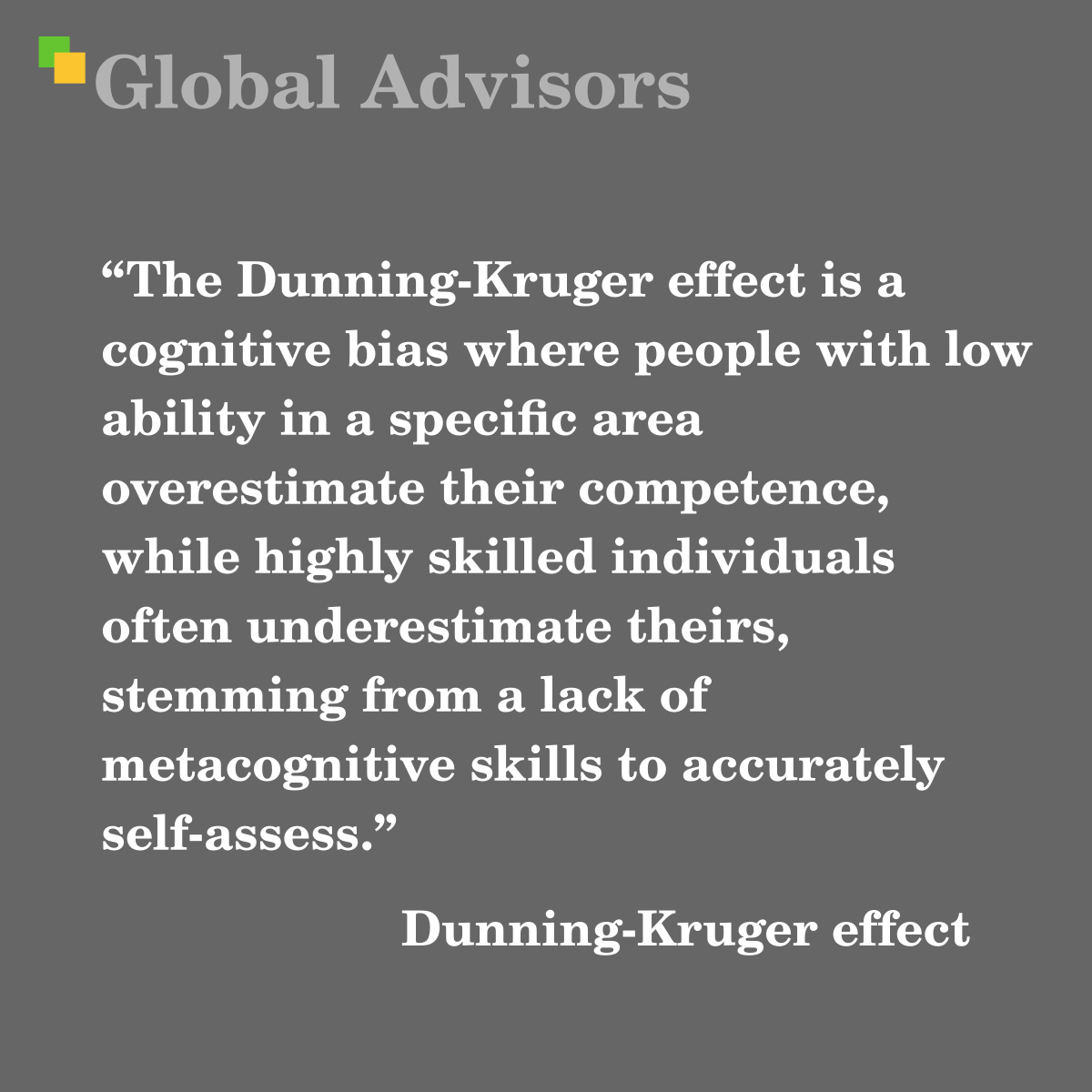
Term: Dunning-Kruger effect"The Dunning-Kruger effect is a cognitive bias where people with low ability in a specific area overestimate their competence, while highly skilled individuals often underestimate theirs, stemming from a lack of metacognitive skills to accurately self-assess." - Dunning-Kruger effectThe Dunning-Kruger effect is a cognitive bias whereby people with limited knowledge or competence in a given intellectual or social domain greatly overestimate their own knowledge or competence in that domain relative to objective criteria or to the performance of their peers.1 Simultaneously, the effect describes the tendency of high performers to underestimate their skills, often assuming that tasks easy for them are equally simple for others.5 At its core, the phenomenon stems from a fundamental metacognitive deficit. Those exhibiting the effect lack the cognitive ability to recognise deficiencies in their own knowledge or competence-a recognition that itself requires possessing at least a minimum level of the relevant knowledge or competence.1 This creates a paradoxical situation: the incompetent are often unaware of their incompetence, making it difficult for them to distinguish between genuine competence and its absence.3 The Original Research and Empirical FoundationPsychologists David Dunning and Justin Kruger first documented this effect in their seminal 1999 paper, "Unskilled and Unaware of It: How Difficulties in Recognising One's Own Incompetence Lead to Inflated Self-Assessments."1 Their research tested four groups of young adults across three domains: humour, logic (reasoning), and grammar.1 The results were striking: participants who scored lowest in skill showed the biggest gap between their actual score and their predicted score, with incompetent individuals dramatically overestimating their ability and performance relative to objective criteria.2 Since this foundational work, the Dunning-Kruger effect has been demonstrated across multiple studies in a wide range of tasks spanning business, politics, medicine, driving, aviation, spatial memory, school examinations, and literacy.3 The effect is typically measured by comparing self-assessment with objective performance-for example, participants complete a quiz, estimate their performance, and their estimates are then compared to actual results.3 Mechanisms and Competing ExplanationsResearchers have proposed several mechanisms to explain the effect. The metacognitive interpretation suggests that incompetence in a given area tends to produce ignorance of that incompetence; those lacking skill cannot accurately evaluate their own competence because competence assessment itself requires competence.3 An alternative explanation frames the Dunning-Kruger effect as primarily a statistical artefact based on regression toward the mean. When two variables are not perfectly correlated-such as actual performance and self-assessed performance-selecting a sample with an extreme value for one variable tends to show a less extreme value for the other.3 Thus, a person with low actual performance will tend to have self-assessed performance that is higher by statistical necessity rather than psychological bias. A third perspective emphasises overly positive prior beliefs rather than an inability to self-assess accurately. A low performer answering a ten-question quiz with only four correct answers might believe they got two questions right and five wrong, remaining uncertain about three. Due to positive prior beliefs, they automatically assume they got the three uncertain questions correct, thereby overestimating their performance.3 Practical Manifestations and Real-World ExamplesThe Dunning-Kruger effect manifests across numerous everyday situations. Common examples include:
High-profile cases include the Theranos scandal, where founder Elizabeth Holmes, a college dropout with no business or medical experience, sold investors on ideas based on flawed medical research and hired inexperienced executives to run the company.4 The Four Stages of CompetenceUnderstanding the Dunning-Kruger effect benefits from recognising the broader framework of competence development, which comprises four stages:4
The Dunning-Kruger effect operates most powerfully during the unconscious incompetence stage, where individuals lack both skill and awareness of their deficit. Contemporary Debate and LimitationsWhilst once considered a well-founded explanation of how people evaluate their abilities, the Dunning-Kruger effect has since been questioned by certain data scientists and mathematicians.6 Controversies surrounding its validity have emerged in recent years, with some researchers challenging whether the effect represents a genuine psychological phenomenon or primarily reflects statistical artefacts and methodological limitations in the original research. David Dunning and Justin Kruger: The Theorists Behind the EffectDavid Dunning is a social psychologist and professor at the University of Michigan who specialises in the study of self-knowledge, self-assessment, and metacognition. His career has been dedicated to understanding how people evaluate their own abilities and knowledge, particularly in contexts where accurate self-assessment is crucial. Dunning's work extends beyond the famous effect bearing his name; he has investigated how people make judgements about their competence across diverse domains and how these judgements influence decision-making and behaviour. Dunning's interest in metacognitive failures emerged from observing a practical puzzle: why do people often make poor decisions in areas where they lack expertise? His research revealed that incompetence frequently carries with it a double burden-not only do people lack skill, but they also lack the metacognitive tools to recognise their deficiency. This insight proved transformative for understanding human judgment and decision-making. Justin Kruger, Dunning's collaborator at Cornell University, brought complementary expertise in experimental psychology and statistical analysis to their partnership. Kruger's methodological rigour helped establish the empirical foundation for their findings. The collaboration between Dunning and Kruger exemplified how combining social psychology with careful experimental design could illuminate fundamental aspects of human cognition. Their 1999 paper emerged from a seemingly simple observation: after a particularly poor performance on a logic test, Dunning wondered whether the worst performers might not realise how poorly they had done. This casual observation evolved into a systematic investigation that would reshape how psychologists and behavioural economists understand self-assessment. The pair designed experiments that carefully controlled for task difficulty, participant ability, and self-assessment accuracy, producing results that were both counterintuitive and robust. The relationship between Dunning and Kruger exemplified productive academic collaboration. Dunning brought theoretical insight and broad knowledge of self-assessment literature, whilst Kruger contributed experimental sophistication and statistical expertise. Their partnership demonstrated that understanding complex psychological phenomena often requires combining different disciplinary perspectives and methodological approaches. Following their seminal 1999 publication, both researchers continued to investigate related phenomena, with Dunning particularly focusing on how people evaluate their knowledge and expertise across various domains, from medicine to law to everyday decision-making. The Dunning-Kruger effect has become one of the most cited findings in social psychology, influencing research in organisational behaviour, education, and public policy. Dunning's subsequent work has explored how to mitigate the effect-for instance, through improved training programmes that help people develop both competence and accurate self-assessment simultaneously. This practical orientation reflects Dunning's belief that understanding cognitive biases should ultimately serve to improve human decision-making and organisational effectiveness. References 1. https://www.britannica.com/science/Dunning-Kruger-effect 2. https://therapist.com/behaviors/dunning-kruger-effect/ 3. https://en.wikipedia.org/wiki/Dunning%E2%80%93Kruger_effect 4. https://dovetail.com/research/dunning-kruger-effect-examples/ 5. https://www.youtube.com/watch?v=h6MYgs0kyzI 6. https://thedecisionlab.com/biases/dunning-kruger-effect 7. https://www.cognitivebiaslab.com/bias/bias-dunning-kruger/ 8. http://www.webmd.com/mental-health/dunning-kruger-effect-what-to-know
|
| |
| |
Quote: Neil Armstrong - NASA Apollo 11 commander"That's one small step for [a] man, one giant leap for mankind." - Neil Armstrong - NASA Apollo 11 commanderThe grammatical precision of Armstrong's statement hinges on a single article that millions of listeners never heard. What was transmitted from the lunar surface on July 20, 1969, at 22:56 UTC was "That's one small step for man, one giant leap for mankind"-a formulation that creates a logical problem.1 The phrase collapses the distinction between the individual astronaut and all humanity, rendering "man" as a collective noun rather than marking the contrast between singular and universal achievement. Armstrong's intended statement-"one small step for a man"-preserves this grammatical and conceptual distinction, yet the indefinite article vanished somewhere in the transmission chain, leaving behind a statement that has been quoted, analyzed, and debated for more than 50 years. The Transmission ProblemArmstrong himself acknowledged the discrepancy immediately upon return. During a 30th anniversary gathering in 1999, he stated: "The 'a' was intended. I thought I said it. I can't hear it when I listen on the radio reception here on Earth, so I'll be happy if you just put it in parentheses."1 This was not a casual observation but a deliberate correction to the historical record. Armstrong had not misremembered or reconsidered his words; he was asserting that the audio equipment of 1969-operating across a distance of 380 000 kilometers with significant signal degradation and static-had failed to capture what he had actually articulated. The communications infrastructure supporting Apollo 11 was sophisticated for its era but subject to real constraints:
Armstrong's brother Dean provided corroborating evidence in a 2012 BBC documentary, claiming that Neil had shown him a written draft of the statement months before the mission, during a game of Risk, with the article intact.2 This suggested the phrasing was deliberate and rehearsed, not improvised under pressure on the lunar surface. The Origin and Composition of the StatementArmstrong resisted the notion that his words were scripted by NASA or derived from external sources. In a 2001 NASA oral history, he stated that NASA discouraged coaching astronauts on what to say, a position reflected in official NASA policy.1 When asked about the statement's origins, Armstrong described a more organic process: "I thought about it after landing. And because we had a lot of other things to do, it was not something that I really concentrated on, but just something that was kind of passing around subliminally or in the background."1 This account suggests the statement emerged from Armstrong's background thinking rather than formal preparation. He characterized it as fundamentally simple: "What can you say when you step off of something? Well, something about a step. It just sort of evolved during the period that I was doing the procedures of the practice takeoff and the EVA prep and all the other activities that were on our flight schedule at that time."2 However, alternative theories have circulated regarding potential influences:
The absence of a written script meant that Armstrong's words, whatever their origin, were subject to the vagaries of real-time transmission and human memory rather than controlled reproduction. Scientific Analysis and the Missing ArticleThe question of whether Armstrong actually said the article became a matter of technical investigation. In 2006, computer programmer Peter Shann Ford applied audio analysis software-originally designed to help disabled individuals communicate through nerve impulses-to the original transmission recordings. His analysis suggested evidence that the "a" was present in the original audio, even if it was inaudible to human listeners.2 Armstrong responded to this finding with a statement calling it "persuasive" evidence that he had not misspoken. A 2013 study provided further support for the hypothesis that Armstrong intended and possibly articulated the article, even if contemporary listeners could not detect it.2 These analyses operated on the principle that acoustic data might contain information imperceptible to the human ear, particularly given the signal degradation inherent in the transmission. Yet the Smithsonian Institution's National Air and Space Museum adopted a different position. After decades of audio analysis and consultation with historian James R. Hansen, the museum concluded that Armstrong said "That's one small step for man, one giant leap for mankind," without the article.3 The museum's reasoning was pragmatic: "No matter what his intention had been, he omitted the 'a' between for and man. Since there was no written script, we only had the option to quote the words as spoken."3 This institutional decision reflects a fundamental tension between what was intended and what was transmitted-between Armstrong's grammatical intention and the historical record as preserved in audio and broadcast archives. Grammatical and Rhetorical ImplicationsThe presence or absence of the article carries semantic weight. "One small step for a man" establishes a clear contrast: the individual achievement of a single human being versus the collective advancement of all humanity. This structure mirrors classical rhetorical patterns of antithesis, emphasizing the magnitude of the leap from personal to universal significance. "One small step for man" collapses this distinction. "Man" becomes either a collective noun encompassing all humanity or an abstract category, making the contrast between the two clauses less precise. The statement still functions rhetorically, but with reduced grammatical clarity. Armstrong himself acknowledged this grammatical reality in his later reflections. He noted that the article "was the only way the statement makes any sense," suggesting he understood the logical structure he had intended to create.2 The Persistence of AmbiguityMore than 50 years after the transmission, the question remains unresolved in practical terms. The audio evidence is ambiguous; scientific analysis has produced competing interpretations; institutional authorities have made different determinations; and Armstrong's own testimony, while consistent, cannot override the physical record of what was broadcast to the world. This ambiguity has become part of the statement's cultural significance. The phrase exists in multiple versions: what Armstrong intended, what he likely said, what listeners heard, what was recorded, what scientific analysis suggests, and what institutional authorities have determined. Each version carries different implications for how the statement is understood and remembered. The missing article has transformed a technical statement about human achievement into a case study in the gap between intention and transmission, between what is said and what is heard, and between historical fact and cultural memory. It demonstrates how even humanity's most carefully considered utterances can be subject to the limitations of the technologies that carry them across vast distances. References 1. Armstrong's famous 'one small step' quote — explained - Navy Times - 2019-07-13 - https://www.navytimes.com/news/your-navy/2019/07/13/armstrongs-famous-one-small-step-quote-explained/ 2. Armstrong's famous 'one small step' quote — explained - WHYY - 2019-07-14 - https://whyy.org/articles/armstrongs-famous-one-small-step-quote-explained/ 3. One small step for man... What did Neil Armstrong really say? - 2024-05-25 - https://www.skyatnightmagazine.com/space-missions/one-small-step-for-man 4. Armstrong's famous "one small step" quote -- explained - 2019-07-15 - https://universe.byu.edu/2019/07/15/armstrongs-famous-one-small-step-quote-explained-1/ 5. 50 Years Ago: One Small Step, One Giant Leap - NASA - 2019-07-19 - https://www.nasa.gov/history/50-years-ago-one-small-step-one-giant-leap/ 6. The History of Neil Armstrong's One Small Step for Man Quote - TIME - 2019-07-15 - https://time.com/collections/apollo-11-50/5621999/neil-armstrong-quote/ 7. One small step - Wikipedia - 2025-08-30 - https://en.wikipedia.org/wiki/One_small_step 8. "One Small Step for Man" or "a Man"? - 2019-07-17 - https://airandspace.si.edu/stories/editorial/one-small-step-man-or-man
|
| |
!["That's one small step for [a] man, one giant leap for mankind." - Quote: Neil Armstrong - NASA Apollo 11 commander](https://globaladvisors.biz/wp-content/uploads/2026/04/20260407_18h00_GlobalAdvisors_Marketing_Quote_NeilArmstrong_GAQ.png)
| |
Term: Bond coupon"A bond coupon is the fixed interest payment an issuer makes to a bondholder, calculated as a percentage (the coupon rate) of the bond's face value, providing predictable income until maturity. While originally physical coupons clipped from bonds, the term now refers to the nominal yield." - Bond couponThe **bond coupon** represents the fixed interest payment that a bond issuer promises to make to the bondholder at regular intervals, typically semi-annually, from issuance until maturity. It is determined by the **coupon rate**, expressed as a percentage of the bond's **face value** (also known as par value), delivering predictable income regardless of fluctuations in the bond's market price1,2,6. Historically, the term derives from physical bearer bonds, where actual paper coupons were attached to the bond certificate and clipped by the holder to redeem interest payments. Today, in the dematerialised era of electronic trading, the coupon refers solely to the nominal interest obligation, calculated simply as Annual Coupon Payment = Coupon Rate × Face Value1,5,6. For instance, a bond with a £1,000 face value and 5% coupon rate pays £50 annually, often in two £25 instalments2,4,6. This fixed nature contrasts sharply with **bond yield**, which adjusts dynamically based on the bond's current market price, incorporating factors like time to maturity and any premium or discount1. When the market price equals face value (trading at par), the coupon rate equals the yield. However, if purchased at a discount (below par), the yield exceeds the coupon rate due to capital appreciation at maturity; conversely, a premium purchase yields less than the coupon1. Coupons provide stable income for fixed-income investors, while yields offer a fuller picture of total return in secondary markets1. The most influential theorist linked to bond coupon concepts in fixed-income strategy is **Frederick Macaulay**, whose pioneering work formalised **yield to maturity (YTM)**-a cornerstone metric intertwined with coupons. Born in 1882 in Canada, Macaulay earned a PhD in economics from Columbia University in 1913, later becoming a professor there. Amid the Great Depression, he published The Movements of Interest Rates, Interest Rates and their Influence on Bond Yields in 1938, introducing the **Macaulay duration** formula: D = \frac{\sum_^ \frac{(1+y)^t} + \frac{(1+y)^T}} where C is the coupon payment, y the YTM, M the face value, T periods to maturity, and P the bond price1. This measures interest rate sensitivity, directly using coupon cash flows to assess portfolio risk-a breakthrough for bond strategists managing duration mismatch. Macaulay's framework underpins modern fixed-income analysis, influencing central banks and investors globally until his death in 19601. In practice, higher coupon bonds offer greater immediate income but lower price appreciation potential in falling rate environments, guiding strategic allocation in portfolios5. References 2. https://smartasset.com/investing/bond-coupon-rate 3. https://www.speedcommerce.com/what-is/bonds-and-coupons/ 4. https://www.debtbook.com/learn/blog/what-is-a-bonds-coupon 5. https://corporatefinanceinstitute.com/resources/fixed-income/coupon-bond/ 6. https://en.wikipedia.org/wiki/Coupon_(finance) 7. https://help.public.com/en/articles/9205247-what-is-a-bond-coupon-and-how-is-it-paid 8. https://www.britannica.com/money/coupon 9. https://www.finra.org/finra-data/fixed-income/data-glossary/treasury-securities
|
| |

| |
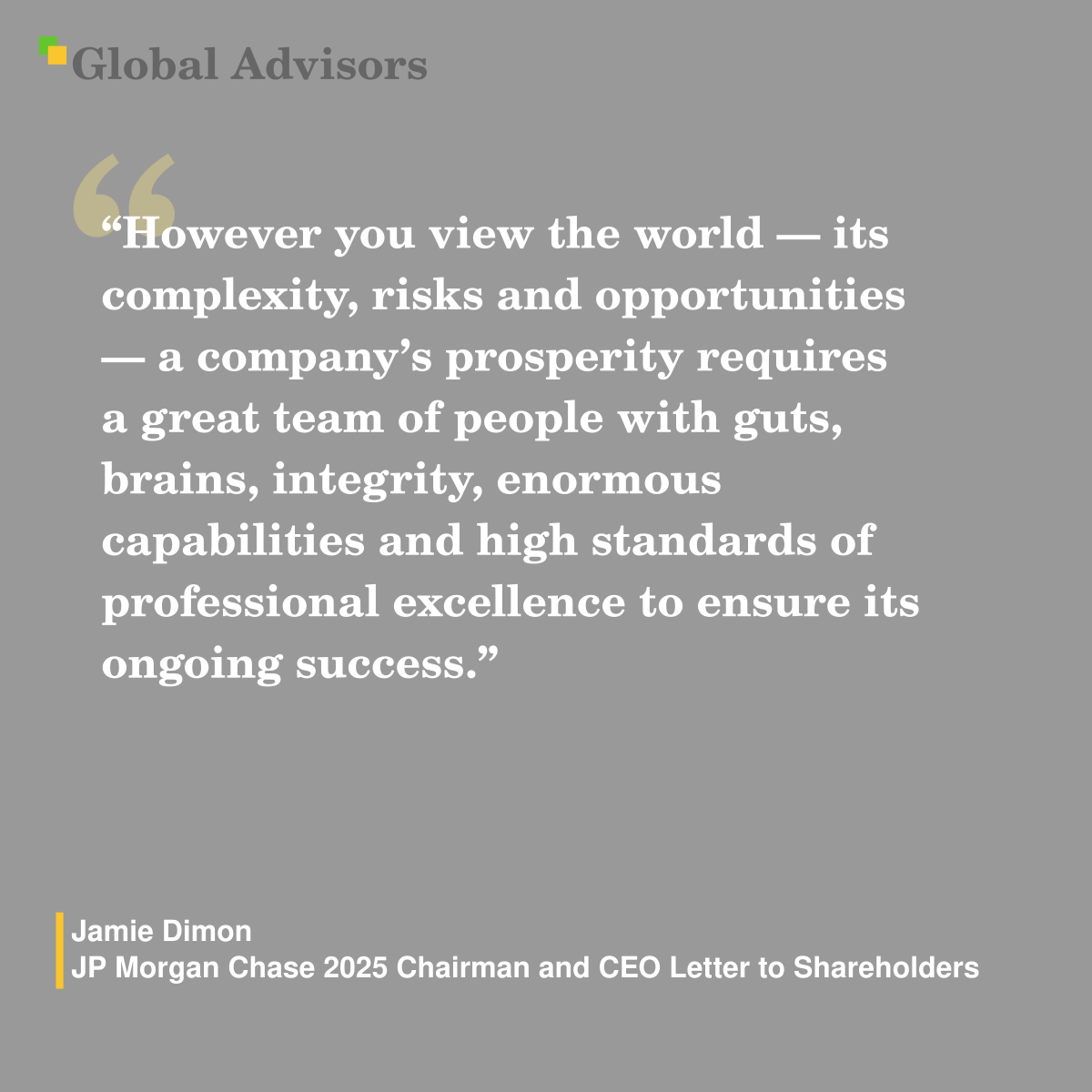
Quote: Jamie Dimon - JP Morgan Chase 2025 Chairman and CEO Letter to Shareholders"However you view the world - its complexity, risks and opportunities - a company's prosperity requires a great team of people with guts, brains, integrity, enormous capabilities and high standards of professional excellence to ensure its ongoing success." - Jamie Dimon - JP Morgan Chase 2025 Chairman and CEO Letter to ShareholdersThe assertion that organizational prosperity depends fundamentally on human capital-specifically teams possessing judgment, intellectual rigor, ethical grounding, and technical mastery-represents a deliberate repositioning of how institutional leaders frame competitive advantage in 2026. This framing emerges not from abstract management theory but from the operational reality of managing a global financial institution navigating simultaneous pressures: geopolitical fragmentation, regulatory complexity, technological disruption, and macroeconomic volatility.1 The Operational ContextJPMorgan Chase operates at a scale that renders traditional competitive advantages-capital reserves, market access, product breadth-increasingly commoditized. The firm moves over 10 trillion dollars daily across 120+ currencies and 160+ countries while safeguarding over 35 trillion dollars in assets.1 At this operational magnitude, execution failures cascade rapidly across global markets. The distinction between institutional success and failure often hinges not on strategic positioning but on the quality of decision-making embedded throughout the organization. Dimon's emphasis on "guts, brains, integrity" and "high standards of professional excellence" reflects a specific diagnosis: that in complex, high-stakes environments, organizational outcomes are determined by the caliber of judgment exercised at multiple decision points, often under incomplete information and time pressure. This is not a statement about corporate culture in the aspirational sense. It is a statement about risk management and value creation. The Implicit Critique of Institutional DriftThe phrasing carries an implicit critique. By emphasizing that prosperity "requires" these attributes, Dimon signals that their absence-or degradation-represents an existential threat. This framing appears in a letter written during a period of significant macroeconomic uncertainty. In April 2025, the U.S. economy was already showing signs of deterioration prior to new tariff policies, which Dimon indicated would "fuel inflation and slow growth."1 Against this backdrop, the emphasis on organizational capability serves as a counterweight to external headwinds: the one variable management can control is the quality of the team executing strategy. The specific invocation of "integrity" is particularly notable. In financial services, integrity failures-whether in risk management, client advisory, or regulatory compliance-generate not merely reputational damage but existential institutional risk. The 2008 financial crisis demonstrated that even well-capitalized institutions can fail if governance and ethical decision-making break down. Dimon's inclusion of integrity as a foundational requirement reflects this historical lesson. Capability as Durable Competitive AdvantageJPMorgan Chase's financial performance in 2024 and 2025 provides empirical grounding for this framework. The firm generated record revenue for the seventh consecutive year, earning 57 billion dollars in net income on 185,6 billion dollars in revenue in 2024, with a return on tangible common equity of 20 percent.1 This sustained performance across multiple business cycles and market regimes suggests that organizational capability-the ability to execute consistently across diverse conditions-functions as a genuine competitive moat. The firm's scale and diversification mean that no single product, market, or business line determines outcomes. Instead, value creation depends on the distributed capability to identify opportunities, manage risks, and execute transactions across multiple domains simultaneously. This requires:
The Tension Between Scale and Organizational CoherenceA secondary tension embedded in Dimon's statement concerns the relationship between institutional scale and organizational coherence. JPMorgan Chase employs hundreds of thousands of people across dozens of countries. Maintaining consistent standards of "professional excellence" and "integrity" across such a distributed organization is not a matter of culture or values statements. It requires explicit governance structures, incentive alignment, and accountability mechanisms. The emphasis on "a great team" (singular) rather than "great teams" (plural) suggests an intentional framing: despite organizational complexity, the institution must function as a coherent entity with shared standards. This is operationally difficult. It requires that senior leadership articulate clear principles, that middle management enforce them consistently, and that individual contributors understand how their decisions affect institutional outcomes. The Macroeconomic SubtextDimon's statement appears in a letter addressing significant external challenges. Beyond tariff-driven inflation concerns, the letter addresses geopolitical tensions, including ongoing conflicts in Ukraine and the Middle East, and growing tensions with China.1 These represent sources of systemic risk that lie largely outside management control. In this context, the emphasis on organizational capability functions as a statement about what remains within management's sphere of influence. External conditions may deteriorate. Regulatory environments may become more restrictive. Market volatility may increase. But the quality of the team-its judgment, integrity, and technical capability-remains a variable that leadership can shape through hiring, development, incentive design, and governance. Implications for Institutional StrategyThis framing has concrete strategic implications. It suggests that in periods of uncertainty, investment in talent acquisition, development, and retention becomes a priority comparable to capital allocation or product innovation. It implies that governance and compliance functions are not overhead costs but core competitive capabilities. It indicates that ethical decision-making is not a constraint on profitability but a prerequisite for sustained value creation. The statement also reflects a specific view of leadership responsibility. Rather than positioning the CEO as the primary driver of institutional success, Dimon's framing distributes responsibility across the organization. Success depends on "a great team"-implying that leadership's primary function is to assemble, develop, and maintain such a team rather than to make all significant decisions unilaterally. Why This Matters Beyond JPMorgan ChaseDimon's emphasis on organizational capability as a foundational requirement for prosperity extends beyond financial services. In any complex, high-stakes domain-whether technology, infrastructure, healthcare, or defense-institutional outcomes depend on the quality of distributed decision-making. The specific attributes Dimon identifies-judgment, integrity, technical capability, professional standards-are not industry-specific. They represent universal requirements for organizations operating in uncertain, complex environments. The statement also reflects a particular moment in institutional leadership. As artificial intelligence and automation reshape organizational structures, questions about the irreducible value of human judgment and ethical reasoning become more salient. Dimon's emphasis on "guts" and "brains"-attributes that remain distinctly human-suggests a view that technological capability, while necessary, is insufficient without human judgment and integrity embedded throughout the organization. References 1. Chairman and CEO Letter to Shareholders - Annual Report 2025 - April 6, 2026 - https://www.jpmorganchase.com/ir/annual-report/2025/ar-ceo-letters 2. 2025 Chubb Letter to Shareholders from Evan G. Greenberg - https://about.chubb.com/stories/2025-chubb-letter-to-shareholders.html 3. From Jamie Dimon: A special message - J.P. Morgan - 2021-04-13 - https://www.jpmorgan.com/insights/investing/investment-trends/from-jamie-dimon-a-special-message 4. 2025 Annual Report | Goldman Sachs - 2026-03-20 - https://www.goldmansachs.com/investor-relations/financials/current/annual-reports/2025-annual-report 5. Jamie Dimon's Letter to Shareholders, Annual Report 2024 - 2025-04-07 - https://www.jpmorganchase.com/ir/annual-report/2024/ar-ceo-letters 6. Letter to Shareholders from Tim Berry, Annual Report 2025 - 2026-04-06 - https://www.jpmorganchase.com/ir/annual-report/2025/ar-ceo-letter-tim-berry 7. Jamie Dimon's 2025 Shareholder Letter | PDF | Investing - Scribd - 2025-10-12 - https://www.scribd.com/document/914601117/Jamie-Dimon-April-2025-letter-to-shareholders 8. [PDF] 2025 Letter to Berkshire Shareholders - printmgr file - 2026-02-28 - https://www.berkshirehathaway.com/letters/2025ltr.pdf 9. Chase CEO Jamie Dimon Tackles Tariffs and More in Annual Letter - 2025-04-10 - https://thefinancialbrand.com/news/banking-trends-strategies/chase-ceo-jamie-dimon-tackles-tariffs-and-more-in-annual-letter-188323 10. Chairman's letter - 2025 Global Annual Review - PwC - 2025-10-28 - https://www.pwc.com/gx/en/about/global-annual-review/letter.html 11. Tariffs will fuel inflation and slow growth, Dimon says - Axios - 2025-04-07 - https://www.axios.com/2025/04/07/jamie-dimon-annual-letter-2025 12. [PDF] 2025ar.pdf - BERKSHIRE HATHAWAY INC. - 2026-02-28 - https://berkshirehathaway.com/2025ar/2025ar.pdf 13. [PDF] Dear Fellow Shareholders, | JPMorgan Chase - 2025-04-07 - https://www.jpmorganchase.com/content/dam/jpmc/jpmorgan-chase-and-co/investor-relations/documents/ceo-letter-to-shareholders-2024.pdf 14. Larry Fink's 2025 Chairman's Letter to Investors | BlackRock - https://www.blackrock.com/corporate/investor-relations/2025-larry-fink-annual-chairmans-letter
|
| |
| |
|


| |
| |