| |
|

| |
| |
| |
|
Our selection of the top business news sources on the web. |
| |
| |
| |
Quote: Dwight D. Eisenhower“A people that values its privileges above its principles soon loses both.” - Dwight D. Eisenhower, US President — January 20, 1953 inaugural address The quote from Dwight D. Eisenhower's inaugural address on January 20, 1953, encapsulates a profound warning about the relationship between values, principles, and the health of a democratic society. Eisenhower, the 34th President of the United States (1953-1961), was a five-star general during World War II and played a pivotal role in the Allied victory in Europe before transitioning to a political career. In this statement, Eisenhower emphasizes the importance of principles over privileges. He suggests that when a society prioritizes its privileges—such as wealth, power, or status—over its foundational principles—such as justice, equality, and integrity—it risks losing both. This idea reflects a deep understanding of the moral and ethical underpinnings necessary for a healthy democracy. Eisenhower's warning can be interpreted as a critique of self-interest and materialism, which can lead to a neglect of civic responsibility and ethical governance. He implies that a focus on individual or group privileges can erode the collective values that bind a society together, ultimately undermining the very foundations of democracy. In this context, principles serve as the guiding framework for a just society, while privileges can become a source of division and conflict if not balanced by a commitment to the common good. The quote also resonates with the political climate of the early 1950s, a time marked by the Cold War, civil rights movements, and significant social change in the United States. Eisenhower's presidency would confront issues of national security, economic prosperity, and social justice, all of which required a careful balance between individual rights and collective responsibilities. Eisenhower's message remains relevant today, as societies continue to grapple with the tension between personal interests and the greater good. His call to value principles over privileges serves as a reminder of the importance of ethical leadership, civic engagement, and the need for citizens to prioritize the common welfare in order to sustain democracy and social cohesion. By advocating for a principled approach to governance and citizenship, Eisenhower encourages individuals and leaders alike to reflect on their values and the impact of their choices on society as a whole.
|
| |
| |
Quote: Jack Clark"The most surprising part of DeepSeek-R1 is that it only takes ~800k samples of 'good' RL reasoning to convert other models into RL-reasoners. Now that DeepSeek-R1 is available people will be able to refine samples out of it to convert any other model into an RL reasoner." - Jack Clark, Anthropic Jack Clark, Co-founder of Anthropic, co-chair of the AI Index at Stanford University, co-chair of OECD working group on AI & Compute, shed light on the significance of DeepSeek-R1, a revolutionary AI reasoning model developed by China's DeepSeek team. In an article posted in his newsletter on the 27th January 2025, Clark highlighted that it only takes approximately 800k samples of "good" RL (Reinforcement Learning) reasoning to convert other models into RL-reasoners. The Power of Fine-Tuning DeepSeek-R1 is not just a powerful AI model; it also provides a framework for fine-tuning existing models to enhance their reasoning capabilities. By leveraging the 800k samples curated with DeepSeek-R1, researchers can refine any other model into an RL reasoner. This approach has been demonstrated by fine-tuning open-source models like Qwen and Llama using the same dataset. Implications for AI Policy The release of DeepSeek-R1 has significant implications for AI policy and control. As Clark notes, if you need fewer than a million samples to convert any model into a "thinker," it becomes much harder to control AI systems. This is because the valuable data, including chains of thought from reasoning models, can be leaked or shared openly. A New Era in AI Development The availability of DeepSeek-R1 and its associated techniques has created a new era in AI development. With an open weight model floating around the internet, researchers can now bootstrap any other sufficiently powerful base model into being an AI reasoner. This has the potential to accelerate AI progress worldwide. Key Takeaways:
Conclusion DeepSeek-R1 has marked a significant milestone in AI development, showcasing the power of fine-tuning and open-source collaboration. As researchers continue to build upon this work, we can expect to see even more advanced AI models emerge, with far-reaching implications for various industries and applications.
|
| |
| |
Quote: Harry Truman“A man who uses the weapon of the "big lie" is not a good man. He should be rejected by all good citizens, regardless of party. Partisan feeling often runs high in election campaigns. That is understandable. But it should not lead us to permit the use of this dangerous Communist technique in American politics.” - Harry Truman, US President — Address Before the National Conference on Citizenship on September 17th, 1952 The quote from Harry S. Truman's address before the National Conference on Citizenship on September 17, 1952, reflects his strong condemnation of dishonesty and manipulation in political discourse. Truman, who served as the 33rd President of the United States from 1945 to 1953, was known for his straightforwardness and commitment to integrity in governance. In this statement, Truman specifically refers to the "big lie," a term that suggests the deliberate use of falsehoods on a grand scale to mislead the public. He asserts that anyone who resorts to such tactics is not a "good man" and should be rejected by all citizens, regardless of their political affiliation. This call for integrity transcends partisan lines, emphasizing that ethical behavior should be a universal expectation for all public figures. Truman's reference to the "dangerous Communist technique" highlights the context of the Cold War era, during which anti-communist sentiment was pervasive in American society. He was concerned that the tactics used by totalitarian regimes, including the spread of propaganda and misinformation, could infiltrate American politics and undermine democratic values. By associating the "big lie" with communism, Truman warns against the erosion of truth in political discourse, which he viewed as a threat to democracy itself. The quote also acknowledges the heightened emotions that often accompany election campaigns, recognizing that partisan feelings can lead to divisive rhetoric. However, Truman insists that such feelings should not justify the acceptance of dishonest tactics. His emphasis on rejecting the "big lie" serves as a call to uphold the principles of honesty and accountability in political life. This message remains relevant in contemporary political discourse, where misinformation and divisive rhetoric can significantly impact public opinion and democratic processes. Truman's insistence on the importance of truth-telling and ethical conduct in politics serves as a reminder of the responsibility that citizens and leaders alike have to foster a political culture grounded in integrity and respect for the truth. His words encourage vigilance against the manipulation of information and the necessity of maintaining high ethical standards in public service.
|
| |
| |
Quote: Marc Andreessen"DeepSeek-R1 is AI’s Sputnik moment." - Marc Andreessen, Andreesen Horowitz In a 27th January 2025 X statement that sent shockwaves through the tech community, venture capitalist Marc Andreessen declared that DeepSeek's R1 AI reasoning model is "AI's Sputnik moment." This analogy draws parallels between China's breakthrough in artificial intelligence and the Soviet Union's historic achievement of launching the first satellite into orbit in 1957. The Rise of DeepSeek-R1 DeepSeek, a Chinese AI lab, has made headlines with its open-source release of R1, a revolutionary AI reasoning model that is not only more cost-efficient but also poses a significant threat to the dominance of Western tech giants. The model's ability to reduce compute requirements by half without sacrificing accuracy has sent shockwaves through the industry. A New Era in AI The release of DeepSeek-R1 marks a turning point in the AI arms race, as it challenges the long-held assumption that only a select few companies can compete in this space. By making its research open-source, DeepSeek is empowering anyone to build their own version of R1 and tailor it to their needs. Implications for Megacap Stocks The success of DeepSeek-R1 has significant implications for megacap stocks like Microsoft, Alphabet, and Amazon, which have long relied on proprietary AI models to maintain their technological advantage. The pen-source nature of R1 threatens to wipe out this advantage, potentially disrupting the business models of these tech giants. Nvidia's Nightmare The news comes as a blow to Nvidia CEO Jensen Huang, who is ramping up production of his Blackwell microchip, a more advanced version of his industry-leading Hopper series H100s. The chip controls 90% of the AI semiconductor market, but R1's ability to reduce compute requirements may render these chips less essential. A New Era of Innovation Perplexity AI founder Aravind Srinivas praised DeepSeek's team for catching up to the West by employing clever solutions, including switching from binary encoding to floating point 8. This innovation not only reduces costs but also demonstrates that China is no longer just a copycat, but a leader in AI innovation.
|
| |
| |
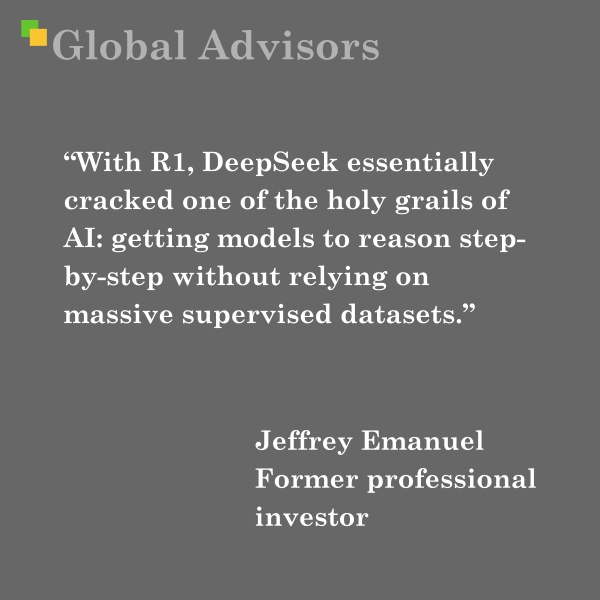
Quote: Jeffrey Emanuel"With R1, DeepSeek essentially cracked one of the holy grails of AI: getting models to reason step-by-step without relying on massive supervised datasets." - Jeffrey Emanuel Jeffrey Emanuel's statement ("The Short Case for Nvidia Stock" - 25th January 2025) highlights a groundbreaking achievement in AI with DeepSeek's R1 model, which has made significant strides in enabling step-by-step reasoning without the traditional reliance on vast supervised datasets:
In essence, DeepSeek's R1 model represents a significant leap in AI efficiency and accessibility, offering profound implications for various industries by reducing data dependency and enhancing reasoning capabilities.
|
| |
| |
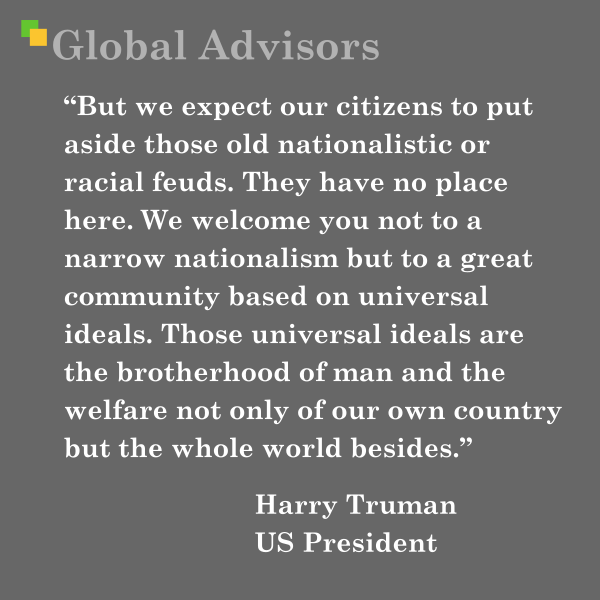
Quote: Harry Truman“But we expect our citizens to put aside those old nationalistic or racial feuds. They have no place here. We welcome you not to a narrow nationalism but to a great community based on universal ideals. Those universal ideals are the brotherhood of man and the welfare not only of our own country but the whole world besides.” - Harry Truman, US President — Address Before the National Conference on Citizenship on September 17th, 1952 Harry S. Truman, the 33rd President of the United States (1945-1953), is known for his decisive leadership during the final stages of World War II and the early years of the Cold War. His presidency was marked by significant events such as the implementation of the Marshall Plan, the establishment of NATO, and the recognition of Israel. Truman's commitment to civil rights and international cooperation also shaped his legacy. The quote comes from Truman's address before the National Conference on Citizenship on September 17, 1952. In this statement, Truman calls for a collective effort among citizens to transcend old nationalistic and racial divisions, emphasizing the importance of unity and shared ideals. His message reflects the post-World War II context, where the world was grappling with the consequences of conflict, colonialism, and the emerging tensions of the Cold War. Truman's assertion that "those old nationalistic or racial feuds" have no place in the community he envisions speaks to his belief in the necessity of inclusivity and cooperation among diverse groups. He advocates for a "great community based on universal ideals," which suggests a vision of society that prioritizes common humanity over divisive identities. The "brotherhood of man" he refers to underscores the idea that all people share fundamental rights and responsibilities, regardless of their national or racial backgrounds. Moreover, Truman's emphasis on the "welfare not only of our own country but the whole world besides" reflects a commitment to global citizenship and the interconnectedness of nations. This perspective aligns with the post-war vision of international cooperation, where nations would work together to address common challenges such as poverty, conflict, and human rights. Truman's call for unity and universal ideals resonates with contemporary discussions about diversity, inclusion, and global responsibility. His message serves as a reminder of the importance of fostering understanding and cooperation among different communities, particularly in an increasingly interconnected world. By advocating for a collective commitment to the welfare of all humanity, Truman's words encourage citizens to embrace their roles as active participants in building a more just and equitable society.
|
| |
| |
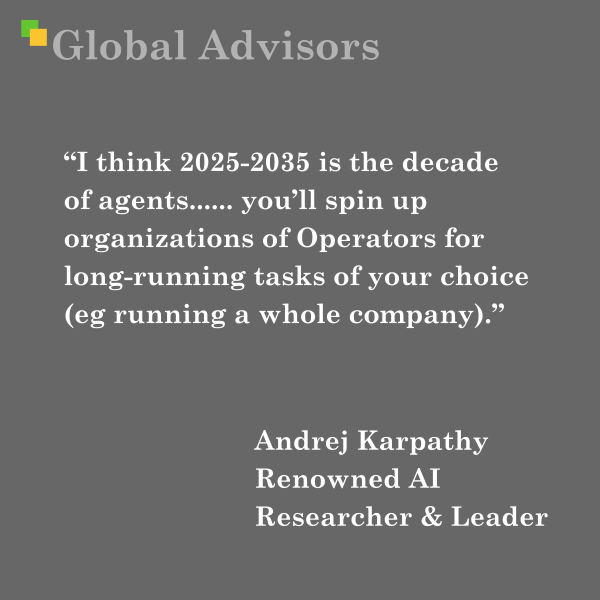
Quote: Andrej Karpathy"I think 2025-2035 is the decade of agents...... you’ll spin up organizations of Operators for long-running tasks of your choice (eg running a whole company)." - Andrej Karpathy, renowned AI Researcher & Leader The concept of agents, as described by Andrej Karpathy on X on the 23rd January 2025, is a revolutionary idea that has been gaining traction in the field of artificial intelligence (AI). An agent refers to an AI-enabled software system that can perform tasks autonomously, making decisions and taking actions on its own. This technology has the potential to transform various aspects of our lives, from personal assistance to complex organizational management. The Digital World: A Precedent for Agent-Based AutomationKarpathy draws an analogy between digital agents and humanoid robots in the physical world. Just as a humanoid robot can perform tasks autonomously using its sensors and actuators, a digital agent can interact with its environment through interfaces such as keyboards, mice, or even voice commands. This gradual shift towards autonomy will lead to a mixed-world scenario where humans serve as high-level supervisors, monitoring and guiding low-level automation. The Role of OpenAI's OperatorOpenAI's Operator project is a pioneering effort in developing digital agents that can perform complex tasks. By integrating multimodal interfaces (images, video, audio) with large language models (LLMs), Operator has demonstrated the potential for agents to assist humans in various domains, such as ordering food or checking hotel information. Challenges and OpportunitiesHowever, Karpathy emphasizes that significant challenges remain before agents can become a reality. These include:
Despite these challenges, Karpathy believes that the decade of 2025-2035 will be marked by significant advancements in agent technology. He envisions a future where humans can spin up organizations of operators to manage complex tasks, such as running an entire company. This would enable CEOs to focus on high-level strategy and oversight, while agents handle day-to-day operations. Implications and Future DirectionsThe emergence of agents has far-reaching implications for various industries, including:
As Karpathy notes, the market size and opportunity for agent-based automation are substantial, particularly in the physical world. However, the digital world is likely to see faster adoption due to the relative ease of flipping bits compared to moving atoms. In conclusion, the concept of agents has the potential to transform various aspects of our lives, from personal assistance to complex organizational management. While significant challenges remain, Karpathy's vision for a future where humans and agents collaborate to achieve remarkable outcomes is an exciting prospect that warrants continued research and development. |
| |
| |
Quote: T.S. Elliot"This is the way the world ends, not with a bang but a whimper." - From the poem "The Hollow Men" - T.S. Elliot "The Hollow Men" is a poem that explores themes of despair, disillusionment, and the search for meaning in a fragmented world. The poem is divided into five sections and employs a variety of literary allusions, imagery, and symbols. It depicts a sense of emptiness and spiritual barrenness, reflecting the anxieties of the post-World War I era. The "hollow men" are portrayed as individuals who lack substance and purpose, caught in a state of paralysis and unable to act decisively. The quote "This is the way the world ends, not with a bang but a whimper" appears in the final section of the poem and serves as a powerful conclusion to its themes. It suggests that the end of the world—or the end of an era—may not come with dramatic events or cataclysmic violence (the "bang") but rather through a quiet, gradual decline (the "whimper"). This reflects a sense of resignation and futility, emphasizing the idea that the greatest tragedies may occur not through grand gestures but through apathy and inaction. In the context of the poem, this line encapsulates the existential despair of the hollow men, who are unable to find meaning or purpose in their lives. It speaks to the broader human condition, suggesting that the loss of hope and vitality can lead to a silent, unnoticed demise. The imagery evokes a world that has lost its way, where individuals are disconnected from each other and from their own sense of agency. Overall, the quote serves as a poignant reminder of the fragility of existence and the importance of confronting the deeper issues of identity, purpose, and connection in a world that often feels empty and devoid of meaning.
|
| |

| |
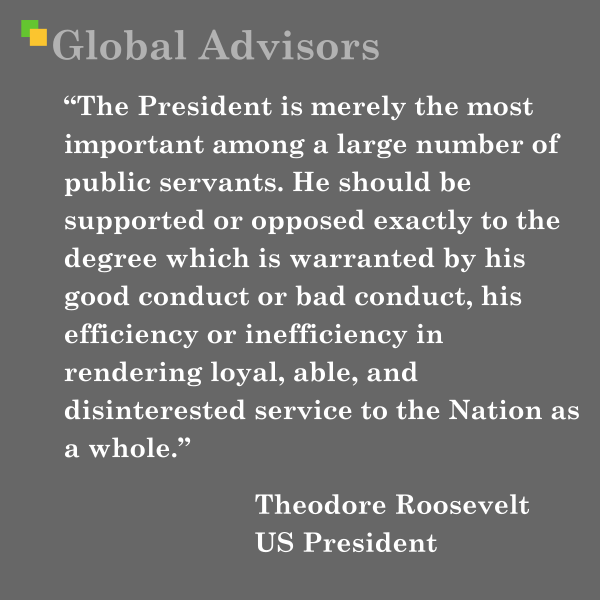
Quote: Theodore Roosevelt“The President is merely the most important among a large number of public servants. He should be supported or opposed exactly to the degree which is warranted by his good conduct or bad conduct, his efficiency or inefficiency in rendering loyal, able, and disinterested service to the Nation as a whole. Therefore it is absolutely necessary that there should be full liberty to tell the truth about his acts, and this means that it is exactly necessary to blame him when he does wrong as to praise him when he does right. Any other attitude in an American citizen is both base and servile. To announce that there must be no criticism of the President, or that we are to stand by the President, right or wrong, is not only unpatriotic and servile, but is morally treasonable to the American public. Nothing but the truth should be spoken about him or any one else. But it is even more important to tell the truth, pleasant or unpleasant, about him than about any one else.” - Theodore Roosevelt, US President — May 7, 1918 editorial in the Kansas City Star Theodore Roosevelt, the 26th President of the United States (1901-1909), is known for his progressive policies, vigorous leadership style, and commitment to reform. He championed issues such as trust-busting, conservation, and social justice, and he was a key figure in expanding the role of the federal government in regulating the economy and protecting the environment. The quote from an editorial Roosevelt wrote for the Kansas City Star on May 7, 1918. In this statement, Roosevelt articulates a fundamental principle of democratic governance: the necessity of accountability for public officials, particularly the President. He emphasizes that the President is not above scrutiny; rather, he is "merely the most important among a large number of public servants." This perspective underscores the idea that all public officials, including the highest officeholder, must be held to the same standards of conduct and performance. Roosevelt's assertion that citizens should support or oppose the President based on his "good conduct or bad conduct" reflects his belief in the importance of civic engagement and responsibility. He argues that it is essential for citizens to have the freedom to express their opinions about the President's actions, whether those opinions are critical or supportive. This freedom of expression is a cornerstone of democracy, allowing for open discourse and debate about the actions of government leaders. The phrase "unpatriotic and servile" captures Roosevelt's disdain for blind loyalty to authority figures. He warns against the dangers of a culture that discourages criticism of the President, suggesting that such an attitude undermines the very principles of democracy and accountability. By labeling the refusal to criticize the President as "morally treasonable," Roosevelt emphasizes the ethical obligation of citizens to speak the truth about their leaders, regardless of the political climate.
|
| |
| |
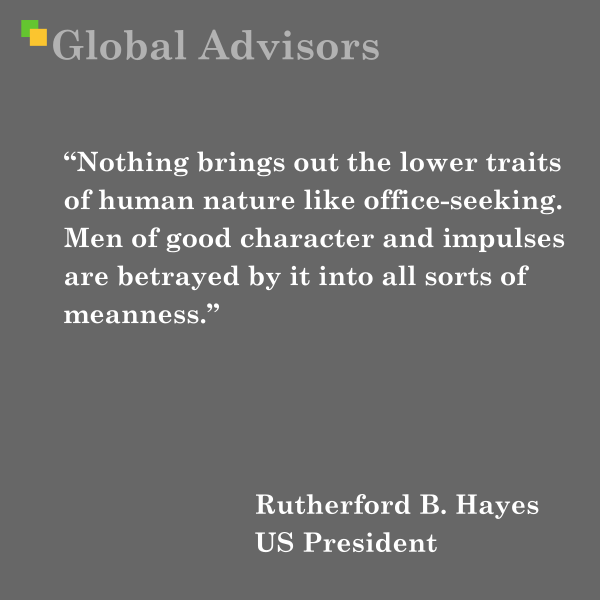
Quote: Rutherford B. Hayes“Nothing brings out the lower traits of human nature like office-seeking. Men of good character and impulses are betrayed by it into all sorts of meanness.” - Rutherford B. Hayes, US President — From the Diary and Letters of Rutherford B. Hayes, August 9, 1878 Rutherford B. Hayes, the 19th President of the United States (1877-1881), is often remembered for his efforts to reform the civil service and his commitment to ending the post-Civil War era of Reconstruction. Before his presidency, Hayes had a distinguished career as a lawyer and a Union general during the Civil War. His administration is noted for its attempts to address corruption in government and to promote integrity in public service. The quote from Hayes's diary on August 9, 1878, reflects his critical perspective on the nature of political ambition and the pursuit of office. In this statement, Hayes suggests that the quest for political power can corrupt individuals, even those with good character and noble intentions. He implies that the competitive and often ruthless nature of office-seeking can lead people to compromise their values and engage in unethical behavior. Hayes's observation speaks to a broader concern about the impact of political culture on human behavior. He recognized that the desire for power can elicit "the lower traits of human nature," such as greed, deceit, and manipulation. This insight is particularly relevant in the context of the Gilded Age, a period marked by significant political corruption, patronage, and the influence of money in politics. By highlighting the potential for moral degradation in the pursuit of office, Hayes advocates for a political culture that prioritizes integrity and ethical conduct. His commitment to civil service reform was a response to the very issues he describes in this quote. He believed that a merit-based system, rather than one based on patronage and favoritism, could help mitigate the corrupting influences of office-seeking.
|
| |
| |
|


| |
| |