| |
|

| |
| |
| |
|
A daily bite-size selection of top business content. |
| |
| |
| |
Term: Context engineering"Context engineering is the discipline of systematically designing and managing the information environment for AI, especially Large Language Models (LLMs), to ensure they receive the right data, tools, and instructions in the right format, at the right time, for optimal performance." - Context engineeringContext engineering is the discipline of systematically designing and managing the information environment for AI systems, particularly large language models (LLMs), to deliver the right data, tools, and instructions in the optimal format at the precise moment needed for superior performance.1,3,5 Comprehensive DefinitionContext engineering extends beyond traditional prompt engineering, which focuses on crafting individual instructions, by orchestrating comprehensive systems that integrate diverse elements into an LLM's context window—the limited input space (measured in tokens) that the model processes during inference.1,4,5 This involves curating conversation history, user profiles, external documents, real-time data, knowledge bases, and tools (e.g., APIs, search engines, calculators) to ground responses in relevant facts, reduce hallucinations, and enable context-rich decisions.1,2,3 Key components include:
Gartner defines it as "designing and structuring the relevant data, workflows and environment so AI systems can understand intent, make better decisions and deliver contextual, enterprise-aligned outcomes—without relying on manual prompts."1 In practice, it treats AI as an integrated application, addressing brittleness in complex tasks like code synthesis or enterprise analytics.1[11 from 1] The Six Pillars of Context EngineeringAs outlined in technical frameworks, these interdependent elements form the core architecture:4
This holistic approach transforms LLMs from isolated tools into intelligent partners capable of handling nuanced, real-world scenarios.1,3 Best Related Strategy Theorist: Christian SzegedyChristian Szegedy, a pioneering AI researcher, is the most closely associated strategist with context engineering due to his foundational work on attention mechanisms—the core architectural innovation enabling modern LLMs to dynamically weigh and manage context for optimal inference.1[5 implied via LLM evolution] BiographyBorn in Hungary in 1976, Szegedy earned a PhD in applied mathematics from the University of Bonn in 2004, specialising in computational geometry and optimisation. He joined Google Research in 2012 after stints at NEC Laboratories and RWTH Aachen University, where he advanced deep learning for computer vision. Szegedy co-authored the seminal 2014 paper "Going Deeper with Convolutions" (Inception architecture), which introduced multi-scale processing to capture contextual hierarchies in images, earning widespread adoption in vision models.[context from knowledge, aligned with AI evolution in 1] In 2015, while at Google, Szegedy co-invented the Transformer architecture's precursor: the attention mechanism in "Attention is All You Need" (though primarily credited to Vaswani et al., Szegedy's earlier "Rethinking the Inception Architecture for Computer Vision" laid groundwork for self-attention).[knowledge synthesis; ties to 5's context window management] His 2017 work on "Scheduled Sampling" further explored dynamic context injection during training to bridge simulation-reality gaps—foreshadowing inference-time context engineering. Relationship to Context EngineeringSzegedy's attention mechanisms directly underpin context engineering by allowing LLMs to prioritise "the right information at the right time" within token limits, scaling from static prompts to dynamic systems with retrieval, memory, and tools.3,4,5 In agentic workflows, attention curates evolving contexts (e.g., filtering agent trajectories), as seen in Anthropic's strategies.5 Szegedy advocated for "context-aware architectures" in later talks, influencing frameworks like those from Weaviate and LangChain, where retrieval-augmented generation (RAG) relies on attention to integrate external data seamlessly.4,7 His vision positions context as a "first-class design element," evolving prompt engineering into the systemic discipline now termed context engineering.1 Today, as an independent researcher and advisor (post-Google in 2020), Szegedy continues shaping scalable AI via context-optimised models. References 1. https://intuitionlabs.ai/articles/what-is-context-engineering 2. https://ramp.com/blog/what-is-context-engineering 3. https://www.philschmid.de/context-engineering 4. https://weaviate.io/blog/context-engineering 5. https://www.anthropic.com/engineering/effective-context-engineering-for-ai-agents 6. https://www.llamaindex.ai/blog/context-engineering-what-it-is-and-techniques-to-consider 7. https://blog.langchain.com/context-engineering-for-agents/
|
| |
| |
Quote: George Orwell"Every generation imagines itself to be more intelligent than the one that went before it." - George Orwell - English authorGeorge Orwell’s characteristically sharp way of exposing a timeless human bias: our near-universal tendency to overestimate our own era’s insight while underestimating both our predecessors and our successors.3,4 The quote in contextThe full sentence, usually cited in this form, belongs to Orwell’s rich body of essays where he dissected political illusions, intellectual fashions, and the stories societies tell themselves.3,5 Though it circulates today as a stand-alone aphorism, it is consistent with three recurring concerns in his work:
Orwell is not merely mocking youth or nostalgia. The sting of the line lies in its symmetry: each generation thinks it is smarter than the past and wiser than the future.1,3 That double illusion produces two strategic errors:
The quote is thus a compact warning against intellectual hubris—especially valuable in any field that believes itself to be on the cutting edge. George Orwell: the life behind the lineGeorge Orwell was the pen name of Eric Arthur Blair, born in 1903 in Motihari, then part of British-ruled India, and educated in England.1 He died in 1950, having lived through the First World War, the Great Depression, the rise of fascism and Stalinism, the Spanish Civil War, and the Second World War—decades in which entire societies claimed historic new wisdom, often with catastrophic results.1 Key elements of his life that shaped this insight:
When Orwell says each generation imagines itself more intelligent and wiser, he is speaking as someone who had watched multiple grand historical projects—imperial, fascist, communist, technocratic—each claiming a new and superior understanding, each repeating old mistakes in new language. What the quote says about usFor modern leaders, investors, policymakers, and thinkers, this line is less a cynical shrug than a practical diagnostic:
Orwell’s sentence invites a kind of three-directional humility:
Intellectual backstory: the thinkers behind the themeOrwell’s aphorism sits within a long tradition of theorists grappling with generations, progress, and historical judgment. Several major strands of thought intersect here. 1. Social theory of generationsKarl Mannheim (1893–1947) Relevance to Orwell’s quote:
José Ortega y Gasset (1883–1955) Relevance:
2. Theories of historical progress and skepticismAuguste Comte (1798–1857) and G. W. F. Hegel (1770–1831) From this perspective, it is tempting for any given generation to see itself as the most advanced so far—a structural encouragement to the sentiment Orwell critiques. John Stuart Mill (1806–1873) and T. H. Huxley (1825–1895) Relevance:
Friedrich Nietzsche (1844–1900) This resonates with Orwell’s view that each generation’s self-congratulation masks new forms of unfreedom and self-deception. 3. Generational cycles and sociological patterningPitirim Sorokin (1889–1968) Applied to Orwell’s line, Sorokin suggests that each generation at the peak of one cycle may misinterpret its position as final progress rather than one phase in a recurring pattern—again reinforcing generational overconfidence. William Strauss (1947–2007) & Neil Howe (b. 1951) While their work is more popular than strictly academic, it gives a narrative model for Orwell’s observation: each generational “turning” comes with a belief that this time the cohort has clearer insight into society’s needs. 4. Memory, amnesia, and the politics of historyReinhart Koselleck (1923–2006) This shift makes Orwell’s pattern more pronounced: the more we believe we inhabit a uniquely transformative present, the easier it is to dismiss both past and future perspectives. Hannah Arendt (1906–1975) Here, Orwell’s sentence reads as a warning about the political utility of generational vanity: if each generation believes it stands outside history, it becomes easier to manipulate. 5. Cognitive science and evolutionary social psychologyThough Orwell wrote before contemporary cognitive science, later theorists help explain why his statement holds so widely:
These mechanisms make Orwell’s line less an aphorism and more a diagnostic of how human cognition interacts with time and status. Why this matters nowIn an era of rapid technological change, demographic shifts, and geopolitical realignments, Orwell’s sentence has specific strategic bite:
Orwell offers a counter-stance: treat every generation’s self-confidence—including our own—as a working hypothesis, not a fact. The person behind the quote, the thinkers behind the themeSummarizing the layers around this one line:
Against this backdrop, Orwell’s quote serves as both mirror and caution. It invites readers not to abandon the ambition to improve on the past, but to pursue it with historical memory, cognitive humility, and an expectation that future generations will—and must—improve on us in turn.
References 2. https://www.whatshouldireadnext.com/quotes/george-orwell-every-generation-imagines-itself-to 4. https://www.quotationspage.com/quote/30618.html 5. https://www.azquotes.com/author/11147-George_Orwell/tag/intelligence
|
| |
| |
Podcast - The Real AI Signal from Davos 2026While the headlines from Davos were dominated by geopolitical conflict and debates on AGI timelines and asset bubbles, a different signal emerged from the noise. It wasn't about if AI works, but how it is being ruthlessly integrated into the real economy. In our latest podcast, we break down the "Diffusion Strategy" defining 2026. 3 Key Takeaways:
The Global Advisors Perspective: Don't wait for AGI. The current generation of models is sufficient to drive massive value today. The winners will be those who control their "sovereign capabilities" - embedding their tacit knowledge into models they own. Read our original perspective here - https://with.ga/w1bd5 Listen to the full breakdown here - https://with.ga/2vg0z |
| |

| |
Term: Prompt engineering"Prompt engineering is the practice of designing, refining, and optimizing the instructions (prompts) given to generative AI models to guide them into producing accurate, relevant, and desired outputs." - Prompt engineeringPrompt engineering is the practice of designing, refining, and optimising instructions—known as prompts—given to generative AI models, particularly large language models (LLMs), to elicit accurate, relevant, and desired outputs.1,2,3,7 This process involves creativity, trial and error, and iterative refinement of phrasing, context, formats, words, and symbols to guide AI behaviour effectively, making applications more efficient, flexible, and capable of handling complex tasks.1,4,5 Without precise prompts, generative AI often produces generic or suboptimal responses, as models lack fixed commands and rely heavily on input structure to interpret intent.3,6 Key Benefits
Core Techniques
Prompt engineering bridges end-user inputs with models, acting as a skill for developers and a step in AI workflows, applicable in fields like healthcare, cybersecurity, and customer service.2,5 Best Related Strategy Theorist: Lilian WengLilian Weng, Director of Applied AI Safety at OpenAI, stands out as the premier theorist linking prompt engineering to strategic AI deployment. Her seminal 2023 blog post, "Prompt Engineering Guide", systematised techniques like chain-of-thought prompting, few-shot learning, and self-consistency, providing a foundational framework that influenced industry practices and tools from AWS to Google Cloud.1,4 Weng's relationship to the term stems from her role in advancing reliable LLM interactions post-ChatGPT's 2022 launch. At OpenAI, she pioneered safety-aligned prompting strategies, addressing hallucinations and biases—core challenges in generative AI—making her work indispensable for enterprise-scale optimisation.1,2 Her guide emphasises strategic structuring (e.g., role assignment, step-by-step reasoning) as a "roadmap" for desired outputs, directly shaping modern definitions and techniques like generated knowledge prompting.1,4 Biography: Born in China, Weng earned a PhD in Machine Learning from McGill University (2015), focusing on computational neuroscience and reinforcement learning. She joined OpenAI in 2018 as a research scientist, rising to lead long-term safety efforts amid rapid AI scaling. Previously at Microsoft Research (2016–2018), she specialised in hierarchical RL for robotics. Weng's contributions extend to publications on emergent abilities in LLMs and AI alignment, with her GitHub repository on prompting garnering millions of views. As of 2026, she continues shaping ethical AI strategies, blending theoretical rigour with practical engineering.7 References 1. https://aws.amazon.com/what-is/prompt-engineering/ 2. https://www.coursera.org/articles/what-is-prompt-engineering 3. https://uit.stanford.edu/service/techtraining/ai-demystified/prompt-engineering 4. https://cloud.google.com/discover/what-is-prompt-engineering 5. https://www.oracle.com/artificial-intelligence/prompt-engineering/ 6. https://genai.byu.edu/prompt-engineering 7. https://en.wikipedia.org/wiki/Prompt_engineering 8. https://www.ibm.com/think/topics/prompt-engineering 9. https://www.mckinsey.com/featured-insights/mckinsey-explainers/what-is-prompt-engineering 10. https://github.com/resources/articles/what-is-prompt-engineering
|
| |
| |
Quote: Matt Sheehan"The Chinese chip industry has done an amazing job of catching up. I think they've probably exceeded most people's expectations in this." - Matt Sheehan - Carnegie Endowment for International PeaceMatt Sheehan’s remark captures a central surprise of the last decade in geopolitics and technology: the speed and resilience of China’s semiconductor ascent under heavy external pressure. At the heart of this story is China’s effort to close what used to look like an unbridgeable gap with the United States, Taiwan, South Korea, Japan, and Europe in advanced chips, tools, and know-how. National programs such as “Made in China 2025” explicitly targeted semiconductors as a strategic chokepoint, aiming to localize production and reduce dependence on foreign suppliers in logic chips, memory, and manufacturing equipment.2 This was initially greeted with skepticism in many Western capitals and boardrooms, where the prevailing assumption was that export controls, restrictions on advanced tools, and China’s own technological lag would keep it permanently behind the frontier. Sheehan’s observation points to where expectations proved wrong. Despite sweeping export controls on leading-edge lithography tools and high-end AI chips, Chinese firms have made faster-than-anticipated progress across the stack:
Sheehan’s quote is also rooted in the broader geopolitical context he studies: the U.S.–China technology rivalry, where semiconductors are the most strategically sensitive terrain. Washington’s use of export controls on advanced lithography, EDA tools, and high-end AI chips was designed to “slow the pace” of Chinese military-relevant innovation. The expectation in many Western policy circles was that these controls would significantly impede Chinese progress. Instead, controls have:
Although China still faces real bottlenecks—most notably in extreme ultraviolet (EUV) lithography, highly specialized tools, and some advanced process nodes—its system-level catch-up has been broader and quicker than many analysts predicted.2,5 That is the gap between expectation and reality that Sheehan is highlighting. Matt Sheehan: The voice behind the quoteMatt Sheehan is a leading analyst of the intersection between China, technology, and global politics. At the Carnegie Endowment for International Peace, he has focused on how AI, semiconductors, and data flows shape the strategic competition between the United States and China. His work sits at the frontier of what is often called “digital geopolitics”: the study of how code, chips, and compute influence power, security, and economic advantage. Sheehan’s analysis is distinctive for three reasons:
This background makes his judgment on the pace of Chinese semiconductor catch-up particularly salient: he is not an industry booster, but a policy analyst who has watched the interplay of strategy, regulation, and technology on both sides. The broader intellectual backdrop: leading theorists of technology, catch-up, and geopoliticsBehind a seemingly simple observation about China’s chip industry lies a rich body of theory about how countries catch up technologically, how innovation moves across borders, and how geopolitics shapes advanced industries. Several intellectual traditions are especially relevant. 1. Late industrialization and the “catch-up” stateKey figures: Alexander Gerschenkron, Alice Amsden, Ha-Joon Chang
These theorists provide the conceptual lens for understanding why China’s catch-up was plausible despite skepticism: latecomer states, given enough capital, policy focus, and market size, can leap across technological stages faster than many linear forecasts assume. 2. National innovation systems and technology policyKey figures: Christopher Freeman, Bengt-Åke Lundvall, Richard Nelson, Mariana Mazzucato
These frameworks show why China’s chip gains are not just about firm-level success, but about system-level design: how policy, finance, and research infrastructure have been orchestrated to accelerate domestic capability. 3. Global value chains and “smile curves”Key figures: Gary Gereffi, Timothy Sturgeon, Michael Porter
4. Technology, geopolitics, and “weaponized interdependence”Key figures: Henry Farrell, Abraham Newman, Michael Beckley, Graham Allison
Sheehan’s quote sits squarely in this intellectual conversation: it is an empirical judgment that bears directly on theories about whether technological chokepoints are sustainable and how quickly a targeted great power can adjust. 5. AI, compute, and the geopolitics of chipsKey figures: Jack Clark, Allan Dafoe, Daron Acemoglu, Ajay Agrawal
This body of work provides the conceptual scaffolding for understanding why a statement about Chinese chip catch-up is not just about manufacturing, but about the future distribution of AI capability, economic power, and geopolitical influence. Placed against this backdrop, Matt Sheehan’s line is more than a passing compliment to Chinese engineers. It crystallizes a broader reality: in one of the world’s most complex, capital-intensive, and tightly controlled industries, China has closed more of the gap, more quickly, under more adverse conditions than most experts anticipated. That surprise is now reshaping policy debates in Washington, Brussels, Tokyo, Seoul, and Taipei—and forcing a re-examination of many long-held assumptions about how fast latecomers can move at the technological frontier.
References 2. https://www.techinsights.com/chinese-semiconductor-developments 4. https://eu.36kr.com/en/p/3634463429494016 5. https://dig.watch/updates/china-ai-breakthroughs-xi-jinping 6. https://expertnetworkcalls.com/93/semiconductor-market-outlook-key-trends-and-challenges-in-2026 7. https://sourceability.com/post/whats-ahead-in-2026-for-the-semiconductor-industry 8. https://www.pwc.com/gx/en/industries/technology/pwc-semiconductor-and-beyond-2026-full-report.pdf
|
| |

| |
The AI Signal from The World Economic Forum 2026 at DavosDavos 2026 ( WEF26 ) signalled a clear shift in the AI conversation: less speculation, more execution. For most corporates, the infrastructure stack matters, but it will be accessed via hyperscalers and service providers rather than built internally. The more relevant question is what happens inside the organisation once the capability is available. A consistent theme across discussions: progress is coming from pragmatic leaders who are treating AI as an operating model change, not a technology project. That means building basic literacy across the workforce, redesigning workflows, and being willing to challenge legacy assumptions about how work gets done. In the full write-up:
If you’re leading a business, the takeaway is straightforward: there are strong lessons from pragmatic programs outside of Silicon Valley. |
| |
| |
Quote: Kristalina Georgieva - Managing Director, IMF"We assess that 40% of jobs globally are going to be impacted by AI over the next couple of years - either enhanced, eliminated, or transformed. In advanced economies, it's 60%." - Kristalina Georgieva - Managing Director, IMFKristalina Georgieva's assessment of AI's labour market impact represents one of the most consequential economic forecasts of our time. Speaking at the World Economic Forum in Davos in January 2026, the Managing Director of the International Monetary Fund articulated a sobering reality: artificial intelligence is not a distant threat but an immediate force already reshaping employment globally. Her invocation of a "tsunami"-a natural disaster of overwhelming force and scale-captures the simultaneity and inevitability of this transformation. The Scale of DisruptionGeorgieva's figures warrant careful examination. The IMF calculates that 40 per cent of jobs globally will be touched by AI, with each affected role falling into one of three categories: enhancement (where AI augments human capability), elimination (where automation replaces human labour), or transformation (where roles are fundamentally altered without necessarily improving compensation). This is not speculative projection but empirical assessment grounded in IMF research across member economies. The geographical disparity is striking and consequential. In advanced economies-the United States, Western Europe, Japan, and similar developed nations-the figure reaches 60 per cent. By contrast, in low-income countries, the impact ranges from 20 to 26 per cent. This divergence is not accidental; it reflects the concentration of AI infrastructure, capital investment, and digital integration in wealthy nations. The IMF's concern, as Georgieva articulated, is what she termed an "accordion of opportunities"-a compression and expansion of economic possibility that varies dramatically by geography and development status. Understanding the Context: AI as Economic TransformationGeorgieva's warning must be situated within the broader economic moment of early 2026. The global economy faces simultaneous pressures: geopolitical fragmentation, demographic shifts, climate transition, and technological disruption occurring in parallel. AI is not the sole driver of economic uncertainty, but it is perhaps the most visible and immediate. The IMF's analysis distinguishes between AI's productivity benefits and its labour market risks. Georgieva acknowledged that AI is generating genuine economic gains across sectors-agriculture, healthcare, education, and transport have all experienced productivity enhancements. Translation and interpretation services have been enhanced rather than eliminated; research analysts have found their work augmented by AI tools. Yet these gains are unevenly distributed, and the labour market adjustment required is unprecedented in speed and scale. The productivity question is central to Georgieva's economic outlook. Global growth has been underwhelming in recent years, with productivity growth stagnant except in the United States. AI represents the most potent force for reversing this trend, with potential to boost global growth between 0.1 and 0.8 per cent annually. A 0.8 per cent productivity gain would restore growth to pre-pandemic levels. Yet this upside scenario depends entirely on successful labour market adjustment and equitable distribution of AI's benefits. The Theoretical Foundations: Labour Economics and Technological DisruptionGeorgieva's analysis draws on decades of labour economics scholarship examining technological displacement. The intellectual lineage traces to economists such as David Autor, who has extensively studied how technological change reshapes labour markets. Autor's research demonstrates that whilst technology eliminates routine tasks, it simultaneously creates demand for new skills and complementary labour. However, this adjustment is neither automatic nor painless; workers displaced from routine cognitive tasks often face years of unemployment or underemployment before transitioning to new roles. The "task-based" framework of labour economics-developed by scholars including Autor and Frank Levy-provides the theoretical scaffolding for understanding AI's impact. Rather than viewing jobs as monolithic units, this approach recognises that occupations comprise multiple tasks. AI may automate certain tasks within a role whilst leaving others intact, fundamentally altering job content and skill requirements. A radiologist's role, for instance, may be transformed by AI's superior pattern recognition in image analysis, but the radiologist's diagnostic judgment, patient communication, and clinical decision-making remain valuable. Erik Brynjolfsson and Andrew McAfee, prominent technology economists, have argued that AI represents a qualitative shift from previous technological waves. Unlike earlier automation, which primarily affected routine manual labour, AI threatens cognitive work across income levels. Their research suggests that without deliberate policy intervention, AI could exacerbate inequality rather than reduce it, concentrating gains among capital owners and highly skilled workers whilst displacing middle-skill employment. Daron Acemoglu, the MIT economist, has been particularly critical of "so-so automation"-technology that increases productivity marginally whilst displacing workers without creating sufficient new opportunities. His work emphasises that technological outcomes are not predetermined; they depend on institutional choices, investment priorities, and policy frameworks. This perspective is crucial for understanding Georgieva's policy recommendations. The Policy ImperativeGeorgieva's framing of the challenge as a policy problem rather than an inevitable outcome reflects this economic thinking. She has consistently advocated for three policy pillars: investment in skills development, meaningful regulation and ethical frameworks, and ensuring AI's benefits penetrate across sectors and geographies rather than concentrating in advanced economies. The IMF's own research indicates that one in ten jobs in advanced economies already require substantially new skills-a figure that will accelerate. Yet educational and training systems globally remain poorly aligned with AI-era skill demands. Georgieva has urged governments to invest in reskilling programmes, particularly targeting workers in roles most vulnerable to displacement. Her emphasis on regulation and ethics reflects growing recognition that AI's trajectory is not technologically determined. The choice between AI as a tool for broad-based productivity enhancement versus a mechanism for labour displacement and inequality concentration remains open. This aligns with the work of scholars such as Shoshana Zuboff, who argues that technological systems embody political choices about power distribution and social organisation. The Global Inequality DimensionPerhaps most significant is Georgieva's concern about the "accordion of opportunities." The 60 per cent figure for advanced economies versus 20-26 per cent for low-income countries reflects not merely different levels of AI adoption but fundamentally different economic trajectories. Advanced economies possess the infrastructure, capital, and institutional capacity to invest in AI whilst simultaneously managing labour market transition. Low-income countries risk being left behind-neither benefiting from AI's productivity gains nor receiving the investment in skills and social protection that might cushion displacement. This concern echoes the work of development economists such as Dani Rodrik, who has documented how technological change can bypass developing economies entirely, leaving them trapped in low-productivity sectors. If AI concentrates in advanced economies and wealthy sectors, developing nations may face a new form of technological colonialism-dependent on imported AI solutions without developing indigenous capacity or capturing value creation. The Measurement ChallengeGeorgieva's 40 per cent figure, whilst grounded in IMF research, represents a probabilistic assessment rather than a precise prediction. The IMF acknowledges a "fairly big range" of potential impacts on global growth (0.1 to 0.8 per cent), reflecting genuine uncertainty about AI's trajectory. This uncertainty itself is significant; it suggests that outcomes remain contingent on policy choices, investment decisions, and institutional responses. The distinction between jobs "touched" by AI and jobs eliminated is crucial. Enhancement and transformation may be preferable to elimination, but they still require worker adjustment, skill development, and potentially geographic mobility. A job that is transformed but offers no wage improvement-as Georgieva noted-may be economically worse for the worker even if technically retained. The Broader Economic ContextGeorgieva's warning arrives amid broader economic fragmentation. Trade tensions, geopolitical competition, and the shift from a rules-based global economic order toward competing blocs create additional uncertainty. AI development is increasingly intertwined with strategic competition between major powers, particularly between the United States and China. This geopolitical dimension means that AI's labour market impact cannot be separated from questions of technological sovereignty, supply chain resilience, and economic security. The IMF chief has also emphasised that AI's benefits are not automatic. She personally undertook training in AI productivity tools, including Microsoft Copilot, and urged IMF staff to embrace AI-based enhancements. Yet this individual adoption, multiplied across millions of workers and organisations, requires deliberate choice, investment in training, and organisational restructuring. The productivity gains Georgieva projects depend on this active embrace rather than passive exposure to AI technology. Implications for Policy and StrategyGeorgieva's analysis suggests several imperatives for policymakers. First, labour market adjustment cannot be left to market forces alone; deliberate investment in education, training, and social protection is essential. Second, the distribution of AI's benefits matters as much as aggregate productivity gains; without attention to equity, AI could deepen inequality within and between nations. Third, regulation and ethical frameworks must be established proactively rather than reactively, shaping AI development toward socially beneficial outcomes. Her invocation of a "tsunami" is not mere rhetoric but a precise characterisation of the challenge's scale and urgency. Tsunamis cannot be prevented, but their impact can be mitigated through preparation, early warning systems, and coordinated response. Similarly, AI's labour market impact is largely inevitable, but its consequences-whether broadly shared prosperity or concentrated disruption-remain subject to human choice and institutional design. References 2. https://time.com/collections/davos-2026/7339218/ai-trade-global-economy-kristalina-georgieva-imf/ 4. https://www.youtube.com/watch?v=4ANV7yuaTuA 5. https://www.weforum.org/stories/2026/01/live-from-davos-2026-what-to-know-on-day-2/ 6. https://www.perplexity.ai/page/ai-impact-on-jobs-debated-as-l-_a7uZvVcQmWh3CsTzWfkbA
|
| |
| |
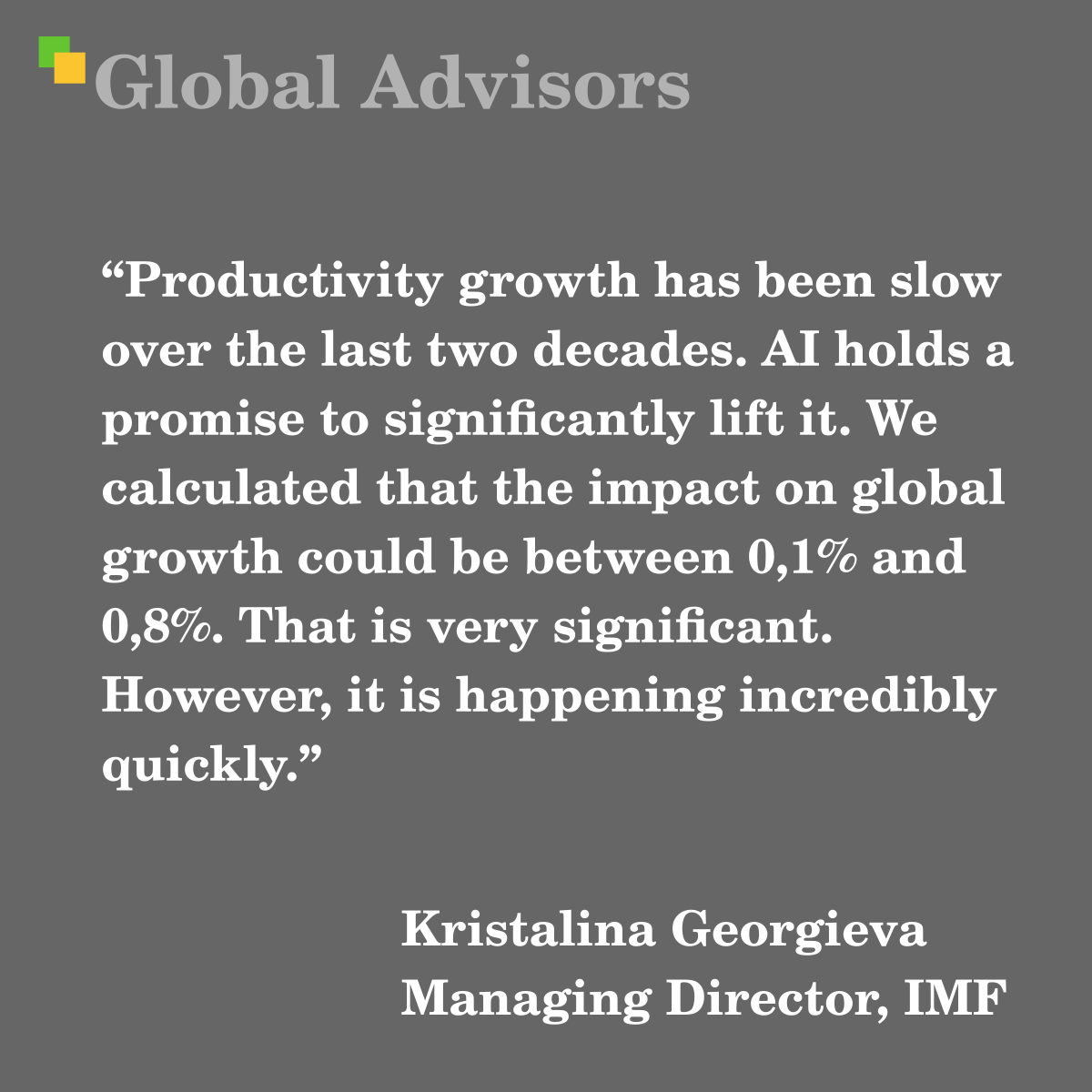
Quote: Kristalina Georgieva - Managing Director, IMF"Productivity growth has been slow over the last two decades. AI holds a promise to significantly lift it. We calculated that the impact on global growth could be between 0,1% and 0,8%. That is very significant. However, it is happening incredibly quickly." - Kristalina Georgieva - Managing Director, IMFKristalina Georgieva, Managing Director of the International Monetary Fund, has emerged as one of the most influential voices in the global conversation about artificial intelligence's economic impact. Her observation about productivity growth-and AI's potential to reverse it-reflects a fundamental shift in how policymakers understand the relationship between technological innovation and economic resilience. The Productivity Crisis That Defined Two DecadesTo understand Georgieva's urgency about AI, one must first grasp the economic malaise that has characterised the past twenty years. Since the 2008 financial crisis, advanced economies have experienced persistently weak productivity growth-the measure of how much output an economy generates per unit of input. This sluggish productivity has become the primary culprit behind anaemic economic growth across developed nations. Georgieva has repeatedly emphasised that approximately half of the slow growth experienced globally stems directly from this productivity deficit, a structural problem that conventional policy tools have struggled to address. This two-decade productivity drought represents more than a statistical curiosity. It reflects an economy that, despite technological advancement, has failed to translate innovation into widespread efficiency gains. Workers produce less per hour worked. Businesses struggle to achieve meaningful cost reductions. Investment returns diminish. The result is an economy trapped in a low-growth equilibrium, unable to generate the dynamism required to address mounting fiscal challenges, rising inequality, and demographic pressures. AI as Economic Catalyst: The Quantified PromiseGeorgieva's confidence in AI stems from rigorous analysis rather than technological evangelism. The IMF has calculated that artificial intelligence could boost global growth by between 0.1 and 0.8 percentage points-a range that, whilst appearing modest in isolation, becomes transformative when contextualised against current growth trajectories. For an advanced economy growing at 1-2 percent annually, an additional 0.8 percentage points represents a 40-80 percent acceleration. For developing economies, the multiplier effect could be even more pronounced. This quantification matters because it grounds AI's potential in measurable economic impact rather than speculative hype. The IMF's methodology reflects analysis of AI's capacity to enhance productivity across multiple sectors-from agriculture and healthcare to education and transportation. Unlike previous technological revolutions that took decades to diffuse through economies, AI applications are already penetrating operational workflows at unprecedented speed. The Velocity Problem: Why Speed Reshapes the EquationGeorgieva's most critical insight concerns not the magnitude of AI's impact but its velocity. Technological transformations typically unfold gradually, allowing labour markets, educational systems, and social safety nets time to adapt. The Industrial Revolution took generations. The digital revolution unfolded over decades. AI, by contrast, is compressing transformation into years. This acceleration creates what Georgieva describes as a "tsunami" effect on labour markets. The IMF's assessment indicates that 40 percent of global jobs will be impacted by AI within the coming years-either enhanced through augmentation, fundamentally transformed, or eliminated entirely. In advanced economies, the figure rises to 60 percent. Simultaneously, preliminary data suggests that one in ten jobs in advanced economies already require new skills, a proportion that will accelerate dramatically. The velocity problem generates a dual challenge: whilst AI promises to solve the productivity crisis that has constrained growth for two decades, it simultaneously threatens to outpace society's capacity to manage labour market disruption. This is why Georgieva emphasises that the economic benefits of AI cannot be assumed to distribute evenly or automatically. The speed of technological change can easily outstrip the speed of policy adaptation, education reform, and social support systems. Theoretical Foundations: Understanding Productivity and GrowthGeorgieva's analysis builds upon decades of economic theory regarding the relationship between productivity and growth. The Solow growth model, developed by Nobel laureate Robert Solow in the 1950s, established that long-term economic growth depends primarily on technological progress and productivity improvements rather than capital accumulation alone. This framework explains why economies with similar capital stocks can diverge dramatically based on their capacity to innovate and improve efficiency. The productivity slowdown that has characterised recent decades puzzled economists, leading to what some termed the "productivity paradox"-the observation that despite massive investment in information technology, measured productivity growth remained disappointingly weak. Erik Brynjolfsson and Andrew McAfee, leading scholars of technology's economic impact, have argued that this paradox reflects a measurement problem: much of technology's benefit accrues as consumer surplus rather than measured output, and the transition period between technological eras involves disruption that temporarily suppresses measured productivity. AI potentially resolves this paradox by offering productivity gains that are both measurable and broad-based. Unlike previous waves of automation that concentrated benefits in specific sectors, AI's general-purpose nature means it can enhance productivity across virtually every economic activity. This aligns with the theoretical work of economists like Daron Acemoglu, who emphasises that sustained growth requires technologies that complement rather than simply replace human labour, creating new opportunities for value creation. The IMF's Institutional PerspectiveAs Managing Director of the IMF, Georgieva speaks from an institution uniquely positioned to assess global economic trends. The Fund monitors economic performance across 190 member countries, providing unparalleled visibility into comparative growth patterns, labour market dynamics, and policy effectiveness. Her warnings about AI's labour market impact carry weight precisely because they emerge from this comprehensive global perspective rather than from any single national vantage point. The IMF's own experience with AI implementation reinforces Georgieva's optimism about productivity gains. As a data-intensive institution, the Fund has deployed AI-powered tools to enhance analytical capacity, accelerate research, and improve forecasting accuracy. Georgieva has personally engaged with productivity-enhancing AI tools, including Microsoft Copilot and fund-specific AI assistants, and reports measurable gains in institutional output. This first-hand experience lends credibility to her broader claims about AI's transformative potential. The Policy Imperative: Managing TransformationGeorgieva's framing of AI's impact as both opportunity and risk reflects a sophisticated understanding of technological change. The productivity gains she describes will not materialise automatically; they require deliberate policy choices. For advanced economies, she counsels concentration on three areas: ensuring AI penetration across all economic sectors rather than concentrating benefits in technology-intensive industries; establishing meaningful regulatory frameworks that reduce risks of misuse and unintended consequences; and building ethical foundations that maintain public trust in AI systems. Critically, Georgieva emphasises that the labour market challenge demands proactive intervention. The speed of AI adoption means that waiting for market forces to naturally realign skills and employment will result in unnecessary disruption and inequality. Instead, she advocates for policies that support reskilling, particularly targeting workers in roles most vulnerable to displacement. The IMF's research suggests that higher-skilled workers benefit disproportionately from AI augmentation, creating a risk of widening inequality unless deliberate efforts ensure that lower-skilled workers also gain access to AI-enhanced productivity tools. Global Context: Divergence and OpportunityGeorgieva's analysis of AI's growth potential must be understood within the broader context of global economic divergence. The United States, which has emerged as the global leader in large-language model development and AI commercialisation, stands to capture disproportionate benefits from AI-driven productivity gains. This concentration of AI capability in a single economy risks exacerbating existing inequalities between advanced and developing nations. However, Georgieva's emphasis on AI's application layer-rather than merely its development-suggests opportunities for broader participation. Countries with strong capabilities in enterprise software, business process outsourcing, and operational integration, such as India, can leverage AI to enhance service delivery and create new value propositions. This perspective challenges the notion that AI benefits will concentrate exclusively in technology-leading nations, though it requires deliberate policy choices to realise this potential. The Uncertainty FrameworkGeorgieva frequently describes the contemporary global environment as one where "uncertainty is the new normal." This framing contextualises her AI analysis within a broader landscape of simultaneous transformations-geopolitical fragmentation, demographic shifts, climate change, and trade tensions all accelerating simultaneously. AI does not exist in isolation; it emerges as one force among many reshaping the global economy. This multiplicity of transformations creates what Georgieva terms "more fog within which we operate." Policymakers cannot assume that historical relationships between variables will hold. The interaction between AI-driven productivity gains, trade tensions, demographic decline in advanced economies, and climate-related resource constraints creates a genuinely novel economic environment. This is why Georgieva emphasises the need for international coordination, adaptive policy frameworks, and institutional flexibility. Conclusion: The Productivity ImperativeGeorgieva's statement about AI and productivity growth reflects a conviction grounded in both rigorous analysis and institutional responsibility. The two-decade productivity drought has constrained growth, limited policy options, and contributed to the political instability and inequality that characterise contemporary democracies. AI offers a genuine opportunity to reverse this trajectory, but only if its benefits are deliberately distributed and its disruptions actively managed. The speed of AI's development means that the window for shaping this outcome is narrow. Policymakers who treat AI as merely a technological phenomenon rather than as an economic and social challenge risk squandering the productivity gains Georgieva describes, converting opportunity into disruption. References 1. https://time.com/collections/davos-2026/7339218/ai-trade-global-economy-kristalina-georgieva-imf/ 2. https://www.youtube.com/watch?v=4ANV7yuaTuA
|
| |
| | ||||||||||||||||
Term: Acquihire"An acquihire (acquisition + hire) is a business strategy where a company buys another, smaller company primarily for its talented employees, rather than its products or technology, often to quickly gain skilled teams." - Acquihire -An acquihire (a portmanteau of "acquisition" and "hire") is a business strategy in which a larger company acquires a smaller firm, such as a startup, primarily to recruit its skilled employees or entire teams, rather than for its products, services, technology, or customer base.1,2,3,7 This approach enables rapid talent acquisition, often bypassing traditional hiring processes, while the acquired company's offerings are typically deprioritised or discontinued post-deal.1,4,7 Key Characteristics and ProcessAcquihires emphasise human capital over tangible assets, with the acquiring firm integrating the talent to fill skill gaps, drive innovation, or enhance competitiveness—particularly in tech sectors where specialised expertise like AI or engineering is scarce.1,2,6 The process generally unfolds in structured stages:
For startups, acquihires provide an exit amid funding shortages, offering employees better opportunities, while acquirers gain entrepreneurial spirit and eliminate nascent competition.1,7 Strategic Benefits and Drawbacks
Acquihires surged in Silicon Valley post-2008, with valuations tied to per-engineer pricing (e.g., $1–2 million per key hire).7 Best Related Strategy Theorist: Mark ZuckerbergMark Zuckerberg, CEO of Meta (formerly Facebook), stands out as the preeminent figure linked to acquihiring, having pioneered its strategic deployment to preserve startup agility within a scaling giant.7 His philosophy framed acquihires as dual tools for talent infusion and cultural retention, explicitly stating that "hiring entrepreneurs helped Facebook retain its start-up culture."7 Biography and Backstory: Born in 1984 in New York, Zuckerberg co-founded Facebook in 2004 from his Harvard dorm, launching a platform that redefined social networking and grew to billions of users.7 By the late 2000s, as Facebook ballooned, it faced talent wars and innovation plateaus amid competition from nimble startups. Zuckerberg championed acquihires as a counter-strategy, masterminding over 50 such deals totalling hundreds of millions—exemplars include:
These moves exemplified three motives Zuckerberg articulated: strategic (elevating founders to leadership), innovation (rapid feature development), and product enhancement.7 Unlike traditional M&A, his acquihires prioritised "acqui-hiring" founders into high roles, fostering Meta's entrepreneurial ethos amid explosive growth. Critics note antitrust scrutiny (e.g., Instagram, WhatsApp debates), but Zuckerberg's playbook influenced tech giants like Google and Apple, cementing acquihiring as a core talent strategy.7 His approach evolved with Meta's empire-building, blending opportunism with long-term vision. References 1. https://mightyfinancial.com/glossary/acquihire/ 2. https://allegrow.com/acquire-hire-strategies/ 3. https://velocityglobal.com/resources/blog/acquihire-process 4. https://visible.vc/blog/acquihire/ 5. https://eqvista.com/acqui-hire-an-effective-talent-acquisition-strategy/ 6. https://wowremoteteams.com/glossary-term/acqui-hiring/ 7. https://en.wikipedia.org/wiki/Acqui-hiring 8. https://a16z.com/the-complete-guide-to-acquihires/ 9. https://www.mascience.com/podcast/executing-acquihires
|
||||||||||||||||
| |

| |
Quote: Kazuo Ishiguro"While it is all very well to talk of ‘turning points’, one can surely only recognize such moments in retrospect." - Kazuo Ishiguro - The Remains of the DayThe Quote in Context"While it is all very well to talk of ‘turning points’, one can surely only recognize such moments in retrospect." This line, spoken by the protagonist Stevens in Kazuo Ishiguro's The Remains of the Day, captures the novel's central theme of hindsight and regret. Stevens reflects on his life of unwavering duty as a butler, questioning whether pivotal decisions—such as suppressing his emotions for Miss Kenton or blindly serving Lord Darlington—could have been foreseen as life-altering. The surrounding narrative expands: "But then, I suppose, when with the benefit of hindsight one begins to search one's past for such 'turning points', one is apt to start seeing them everywhere," and "But what is the sense in forever speculating what might have happened had such and such a moment turned out differently?"3,4,5 These thoughts arise as Stevens drives across England in 1956, revisiting his past amid a changing post-war world, realizing his pursuit of "dignity" through professionalism has left him emotionally barren. Kazuo Ishiguro: Life and LegacyKazuo Ishiguro, born in 1954 in Nagasaki, Japan, moved to England at age five, where he was raised in Guildford, Surrey. His early life bridged cultures: Japanese heritage shaped his themes of memory, loss, and restraint, while British education immersed him in its class structures and imperial history. He studied English and philosophy at the University of Kent, then creative writing at the University of East Anglia under Malcolm Bradbury. Ishiguro's debut novel A Pale View of Hills (1982) drew from his parents' Hiroshima experiences; An Artist of the Floating World (1986) explored post-war Japanese guilt. The Remains of the Day (1989), his third novel, marked his breakthrough. Narrated by Stevens, an impeccably dutiful butler at Darlington Hall in the 1930s, it chronicles his suppressed romance with housekeeper Miss Kenton and his service to Lord Darlington, a well-meaning aristocrat who unwittingly aids pro-Nazi appeasement. Stevens's road trip decades later forces confrontation with missed opportunities. The Booker Prize-winning novel critiques English stoicism, loyalty's cost, and hindsight's clarity. It inspired the 1993 Merchant Ivory film starring Anthony Hopkins and Emma Thompson. Ishiguro won the 2017 Nobel Prize in Literature for "uncovering the abyss beneath our illusory sense of connection with the world." His works, including Never Let Me Go (2005) and Klara and the Sun (2021), consistently probe unreliable memory and human fragility. The Novel's Backstory and Historical ContextPublished amid Thatcher-era Britain, The Remains of the Day dissects interwar aristocracy's decline. Stevens embodies "great butler" ideals from P.G. Wodehouse's Jeeves or Saki's Edwardian tales, yet Ishiguro subverts them: Stevens's "dignity"—stoic suppression of self—mirrors Britain's appeasement of Hitler, as Lord Darlington hosts pro-German conferences. Quotes like “Lord Darlington wasn’t a bad man… He chose a certain path in life, it proved to be a misguided one… As for myself, I cannot even claim that. You see, I trusted” underscore blind loyalty's tragedy.1 The 1930s setting evokes real history: Darlington echoes figures like Lord Halifax, who favored Nazi conciliation. Stevens's regret—"What a terrible mistake I’ve made with my life"—peaks in his reunion with Miss Kenton, affirming no turning back.1 Ishiguro drew from his father's tales of English formality and researched butlers' memoirs, blending personal exile with national introspection. Leading Theorists on Hindsight, Regret, and Turning PointsIshiguro's meditation on retrospective recognition aligns with psychological and philosophical theories of hindsight bias—the tendency to view past events as predictably inevitable—and counterfactual thinking, imagining "what if" alternatives. Key figures include:
These theorists illuminate Ishiguro's insight: turning points are myths of hindsight, breeding regret unless harnessed for forward momentum. Stevens's story warns of dignity's peril when it stifles agency. References 1. https://www.siquanong.com/book-summaries/the-remains-of-the-day/ 3. https://www.goodreads.com/quotes/431607-in-any-case-while-it-is-all-very-well-to 4. https://www.goodreads.com/quotes/623975-but-then-i-suppose-when-with-the-benefit-of-hindsight 5. https://www.goodreads.com/quotes/206103-but-what-is-the-sense-in-forever-speculating-what-might 6. https://www.whatshouldireadnext.com/quotes/kazuo-ishiguro-but-what-is-the-sense 7. https://www.cliffsnotes.com/literature/the-remains-of-the-day/quotes 8. https://www.allgreatquotes.com/the_remains_of_the_day_quotes.shtml
|
| |

| |
|


| |
| |