| |
|

| |
| |
| |
|
A daily bite-size selection of top business content. |
| |
| |
| |
Quote: Jensen Huang - CEO, Nvidia"The U.S. led the software era, but AI is software that you don't 'write'-you teach it. Europe can fuse its industrial capability with AI to lead in Physical AI and robotics. This is a once-in-a-generation opportunity." - Jensen Huang - CEO, NvidiaIn a compelling dialogue at the World Economic Forum Annual Meeting 2026 in Davos, Switzerland, Nvidia CEO Jensen Huang articulated a transformative vision for artificial intelligence, distinguishing it from traditional software paradigms and spotlighting Europe's unique position to lead in Physical AI and robotics.1,2,4 Speaking with World Economic Forum interim co-chair Larry Fink of BlackRock, Huang emphasised AI's evolution into a foundational infrastructure, driving the largest build-out in human history across energy, chips, cloud, models, and applications.2,3,4 This session, themed around 'The Spirit of Dialogue,' addressed AI's potential to reshape productivity, labour, and global economies while countering fears of job displacement with evidence of massive investments creating opportunities worldwide.2,3 The Context of the QuoteHuang's statement emerged amid discussions on AI as a platform shift akin to the internet and mobile cloud, but uniquely capable of processing unstructured data in real time.2 He described AI not as code to be written, but as intelligence to be taught, leveraging local language and culture as a 'fundamental natural resource.'2,4 Turning to Europe, Huang highlighted its enduring industrial and manufacturing prowess - from skilled trades to advanced production - as a counterbalance to the US's dominance in the software era.4 By integrating AI with physical systems, Europe could pioneer 'Physical AI,' where machines learn to interact with the real world through robotics, automation, and embodied intelligence, presenting a rare strategic opening.4,1 This perspective aligns with Huang's broader advocacy for nations to develop sovereign AI ecosystems, treating it as critical infrastructure like electricity or roads.4 He noted record venture capital inflows - over $100 billion in 2025 alone - into AI-native startups in manufacturing, healthcare, and finance, underscoring the urgency for industrial regions like Europe to invest in this infrastructure to capture economic benefits and avoid being sidelined.2,4 Jensen Huang: Architect of the AI RevolutionBorn in Taiwan in 1963, Jensen Huang co-founded Nvidia in 1993 with a vision to revolutionise graphics processing, initially targeting gaming and visualisation.4 Under his leadership, Nvidia pivoted decisively to AI and accelerated computing, with its GPUs becoming indispensable for training large language models and deep learning.1,2 Today, as president and CEO, Huang oversees a company valued in trillions, powering the AI boom through innovations like the Blackwell architecture and CUDA software ecosystem. His prescient bets - from CUDA's democratisation of GPU programming to Omniverse for digital twins - have positioned Nvidia at the heart of Physical AI, robotics, and industrial applications.4 Huang's philosophy, blending engineering rigour with geopolitical insight, has made him a sought-after voice at forums like Davos, where he champions inclusive AI growth.2,3 Leading Theorists in Physical AI and RoboticsThe concepts underpinning Huang's vision trace to pioneering theorists who bridged AI with physical embodiment. Norbert Wiener, father of cybernetics in the 1940s, laid foundational ideas on feedback loops and control systems essential for robotic autonomy, influencing early industrial automation.4 Rodney Brooks, co-founder of iRobot and Rethink Robotics, advanced 'embodied AI' in the 1980s-90s through subsumption architecture, arguing intelligence emerges from sensorimotor interactions rather than abstract reasoning - a direct precursor to Physical AI.4
Huang synthesises these threads, amplified by Nvidia's platforms like Isaac for robot simulation and Jetson for edge AI, enabling scalable Physical AI deployment.4 Europe's theorists and firms, from DeepMind's reinforcement learning to Germany's Industry 4.0 initiatives, are well-placed to lead by combining theoretical depth with industrial scale. Implications for Industrial StrategyHuang's call resonates with Europe's strengths: a €2.5 trillion manufacturing sector, leadership in automotive robotics (e.g., Volkswagen, ABB), and regulatory frameworks like the EU AI Act fostering trustworthy AI.4 By prioritising Physical AI - robots that learn from human demonstration, adapt to factories, and optimise supply chains - Europe can reclaim technological sovereignty, boost productivity, and generate high-skill jobs amid the AI infrastructure surge.2,3,4 References 1. https://singjupost.com/nvidia-ceo-jensen-huangs-interview-wef-davos-2026-transcript/ 2. https://www.weforum.org/stories/2026/01/nvidia-ceo-jensen-huang-on-the-future-of-ai/ 4. https://blogs.nvidia.com/blog/davos-wef-blackrock-ceo-larry-fink-jensen-huang/ 5. https://www.youtube.com/watch?v=__IaQ-d7nFk 6. https://www.youtube.com/watch?v=RvjRuiTLAM8 7. https://www.youtube.com/watch?v=hoDYYCyxMuE 9. https://www.youtube.com/watch?v=bzC55pN9c1g
|
| |
| | ||||||||||||||||||
Term: European option"A European option is a financial contract giving the holder the right, but not the obligation, to buy (call) or sell (put) an underlying asset at a predetermined strike price, but only on the contract's expiration date, unlike American options that allow exercise anytime before expiry. " - European optionCore definition and structureA European option has the following defining features:1,2,3,4
The holder's payoff at expiration depends on the relationship between the underlying price and the strike price.1,3,4 Payoff profiles at expiryFor a European option, exercise can occur only at maturity, so the payoff is assessed solely on that date.1,2,4,7 Let S_T denote the underlying price at expiration, and K the strike price. The canonical payoff functions are:
Because there is only a single possible exercise date, the payoff is simpler to model than for American options, which involve an optimal early-exercise decision.4,6,7 Key characteristics and economic roleRight but not obligationThe buyer of a European option has a right, not an obligation, to transact; the seller has the obligation to fulfil the contract terms if the buyer chooses to exercise.1,2,3,4 If the option is out-of-the-money on the expiration date, the buyer simply allows it to expire worthless, losing only the paid premium.2,3,4 Exercise style vs geographyThe term European refers solely to the exercise style, not to the market in which the option is traded or the domicile of the underlying asset.2,4,6,7 European-style options can be traded anywhere in the world, and many options traded on European exchanges are in fact American style.6,7 Uses: hedging, speculation and income
Typical markets and settlementIn practice, European options are especially common for:4,5,6
European options are often cheaper, in premium terms, than otherwise identical American options because the holder sacrifices the flexibility of early exercise.2,4,5,6 European vs American options
Determinants of European option valueThe price (premium) of a European option depends on several key variables:2,4,5
For European options, these effects are most famously captured in the Black-Scholes-Merton option pricing framework, which provides closed-form solutions for the fair values of European calls and puts on non-dividend-paying stocks or indices under specific assumptions.4 Valuation insight: put-call parityA central theoretical relation for European options on non-dividend-paying assets is put-call parity. At any time before expiration, under no-arbitrage conditions, the prices of European calls and puts with the same strike K and maturity T on the same underlying must satisfy: C - P = S_0 - K e^ where:
This relation is exact for European options under idealised assumptions and is widely used for pricing, synthetic replication and arbitrage strategies. It holds precisely because European options share an identical single exercise date, whereas American options complicate parity relations due to early exercise possibilities. Limitations and risks
Best related strategy theorist: Fischer Black (with Scholes and Merton)The strategy theorist most closely associated with the European option is Fischer Black, whose work with Myron Scholes and later generalised by Robert C. Merton provided the foundational pricing theory for European-style options. Fischer Black's relationship to European optionsIn the early 1970s, Black and Scholes developed a groundbreaking model for valuing European options on non-dividend-paying stocks, culminating in their 1973 paper introducing what is now known as the Black-Scholes option pricing model.4 Merton independently extended and generalised the framework in a companion paper the same year, leading to the common label Black-Scholes-Merton. The Black-Scholes-Merton model provides a closed-form formula for the fair value of European calls and, via put-call parity, European puts under assumptions such as geometric Brownian motion for the underlying price, continuous trading, no arbitrage and constant volatility and interest rates. This model fundamentally changed how markets think about the pricing and hedging of European options, making them central instruments in modern derivatives strategy and risk management.4 Strategically, the Black-Scholes-Merton framework introduced the concept of dynamic delta hedging, showing how writers of European options can continuously adjust positions in the underlying and risk-free asset to replicate and hedge option payoffs. This insight underpins many trading, risk management and structured product strategies involving European options. Biography of Fischer Black
Through the Black-Scholes-Merton model and the associated hedging concepts, Fischer Black's work provided the essential strategic and analytical toolkit for pricing, hedging and structuring European options across global derivatives markets. References 1. https://www.learnsignal.com/blog/european-options/ 2. https://cbonds.com/glossary/european-option/ 3. https://www.angelone.in/knowledge-center/futures-and-options/european-option 4. https://corporatefinanceinstitute.com/resources/derivatives/european-option/ 5. https://www.sofi.com/learn/content/american-vs-european-options/ 7. https://en.wikipedia.org/wiki/Option_style
|
||||||||||||||||||
| |

| |
Quote: Nate B. Jones - On "Second Brains""For the first time in human history, we have access to systems that do not just passively store information, but actively work against that information we give it while we sleep and do other things-systems that can classify, route, summarize, surface, or nudge." - Nate B. Jones - On "Second Brains"Context of the QuoteThis striking observation comes from Nate B. Jones in his video Why 2026 Is the Year to Build a Second Brain (And Why You NEED One), where he argues that human brains were never designed for storage but for thinking.1 Jones highlights the cognitive tax of forcing memory onto our minds, which leads to forgotten details in relationships and missed opportunities.1 Traditional systems demand effort at inopportune moments-like tagging notes during a meeting or drive-forcing users to handle classification, routing, and organisation in real time.1 Jones contrasts this with AI-powered second brains: frictionless systems where capturing a thought takes seconds, after which AI classifiers and routers automatically sort it into buckets like people, projects, ideas, or tasks-without user intervention.1 These systems include bouncers to filter junk, ensuring trust and preventing the 'junk drawer' effect that kills most note-taking apps.1 The result is an 'AI loop' that works tirelessly, extracting details, writing summaries, and maintaining a clean memory layer even when the user sleeps or focuses elsewhere.1 Who is Nate B. Jones?Nate B. Jones is a prominent voice in AI strategy and productivity, running the YouTube channel AI News & Strategy Daily with over 122,000 subscribers.1 He produces content on leveraging AI for career enhancement, building no-code apps, and creating personal knowledge systems.4,5 Jones shares practical guides, such as his Bridge the Implementation Gap: Build Your AI Second Brain, which outlines step-by-step setups using tools like Notion, Obsidian, and Mem.3 His work targets knowledge workers and teams, addressing pitfalls like perfectionism and tool overload.3 In another video, How I Built a Second Brain with AI (The 4 Meta-Skills), he demonstrates offloading cognitive load through AI-driven reflection, identity debugging, and frameworks that enable clearer thinking and execution.2 Jones exemplifies rapid AI application, such as building a professional-looking travel app in ChatGPT in 25 minutes without code.4 His philosophy: AI second brains create compounding assets that reduce information chaos, boost decision-making, and free humans for deep work.3 Backstory of 'Second Brains'The concept of a second brain builds on decades of personal knowledge management (PKM). It gained traction with Tiago Forte, whose 2022 book Building a Second Brain popularised the CODE framework: Capture, Organise, Distil, Express. Forte's system emphasises turning notes into actionable insights, but relies heavily on user-driven organisation-prone to failure due to taxonomy decisions at capture time.1 Pre-AI tools like Evernote and Roam Research introduced linking and search, yet still demanded active sorting.3 Jones evolves this into AI-native systems, where machine learning handles the heavy lifting: classifiers decide buckets, summarisers extract essence, and nudges surface relevance.1,3 This aligns with 2026's projected AI maturity, making frictionless capture (under 5 seconds) viable and consistent.1 Leading Theorists in AI-Augmented Cognition
These theorists converge on offloading storage to amplify thinking. Jones synthesises their insights with AI, creating systems that not only store but work-classifying, nudging, and evolving autonomously.1,2,3 References 1. https://www.youtube.com/watch?v=0TpON5T-Sw4 2. https://www.youtube.com/watch?v=0k6IznDODPA 3. https://www.natebjones.com/prompts-and-guides/products/second-brain 4. https://natesnewsletter.substack.com/p/i-built-a-10k-looking-ai-app-in-chatgpt 5. https://www.youtube.com/watch?v=UhyxDdHuM0A
|
| |
| |
Quote: Ashwini Vaishnaw - Minister of Electronics and IT, India"ROI doesn't come from creating a very large model; 95% of work can happen with models of 20 or 50 billion parameters." - Ashwini Vaishnaw - Minister of Electronics and IT, IndiaDelivered at the World Economic Forum (WEF) in Davos 2026, this statement by Ashwini Vaishnaw, India's Minister of Electronics and Information Technology, encapsulates a pragmatic approach to artificial intelligence deployment amid global discussions on technology sovereignty and economic impact1,2. Speaking under the theme 'A Spirit of Dialogue' from 19 to 23 January 2026, Vaishnaw positioned India not merely as a consumer of foreign AI but as a co-creator, emphasising efficiency over scale in model development1. The quote emerged during his rebuttal to IMF Managing Director Kristalina Georgieva's characterisation of India as a 'second-tier' AI power, with Vaishnaw citing Stanford University's AI Index to affirm India's third-place ranking in AI preparedness and second in AI talent2. Ashwini Vaishnaw: Architect of India's Digital AmbitionAshwini Vaishnaw, a chartered accountant and IAS officer of the 1994 batch (Muslim-Rajasthan cadre), has risen to become a pivotal figure in India's technological transformation1. Appointed Minister of Electronics and Information Technology in 2021, alongside portfolios in Railways, Communications, and Information & Broadcasting, Vaishnaw has spearheaded initiatives like the India Semiconductor Mission and the push for sovereign AI1. His tenure has attracted major investments, including Google's $15 billion gigawatt-scale AI data centre in Visakhapatnam and partnerships with Meta on AI safety and IBM on advanced chip technology (7nm and 2nm nodes)1. At Davos 2026, he outlined India's appeal as a 'bright spot' for global investors, citing stable democracy, policy continuity, and projected 6-8% real GDP growth1. Vaishnaw's vision extends to hosting the India AI Impact Summit in New Delhi on 19-20 February 2026, showcasing a 'People-Planet-Progress' framework for AI safety and global standards1,3. Context: India's Five-Layer Sovereign AI StackVaishnaw framed the quote within India's comprehensive 'Sovereign AI Stack', a methodical strategy across five layers to achieve technological independence within a year1,2,4. This includes:
This approach counters the resource-intensive race for trillion-parameter models, focusing on widespread adoption in emerging markets like India, where efficiency drives economic returns2,5. Leading Theorists on Small Language Models and AI EfficiencyThe emphasis on smaller models aligns with pioneering research challenging the 'scale-is-all-you-need' paradigm. Andrej Karpathy, former OpenAI and Tesla AI director, has advocated for 'emergent abilities' in models as small as 1-10 billion parameters, arguing that targeted training yields high ROI for specific tasks1,2. Noam Shazeer of Character.AI and Google co-inventor of Transformer architectures, demonstrated with models like Chinchilla (70 billion parameters) that optimal compute allocation outperforms sheer size, influencing efficient scaling laws1. Tim Dettmers, researcher behind the influential 'llm-arxiv-daily' repository, quantified in his 'BitsAndBytes' work how quantisation enables 4-bit inference on 70B models with minimal performance loss, democratising access for resource-constrained environments2. Further, Sasha Rush (Cornell) and collaborators' 'Scaling Laws for Neural Language Models' (2020) revealed diminishing returns beyond certain sizes, bolstering the case for 20-50B models1. In industry, Meta's Llama series (7B-70B) and Mistral AI's Mixtral 8x7B (effectively 46B active parameters) exemplify mixture-of-experts (MoE) architectures achieving near-frontier performance with lower costs, as validated in benchmarks like MMLU2. These theorists underscore Vaishnaw's point: true power lies in diffusion and application, not model magnitude, particularly for emerging markets pursuing technology strategy5. Vaishnaw's insight at Davos 2026 thus resonates globally, signalling a shift towards sustainable, ROI-focused AI that empowers nations like India to lead through strategic efficiency rather than brute scale1,2. References 3. https://www.youtube.com/watch?v=3S04vbuukmE 4. https://www.youtube.com/watch?v=VNGmVGzr4RA 5. https://www.weforum.org/stories/2026/01/live-from-davos-2026-what-to-know-on-day-2/
|
| |
| |
Term: Mercantilism"Mercantilism is an economic theory and policy from the 16th-18th centuries where governments heavily regulated trade to build national wealth and power by maximizing exports, minimizing imports, and accumulating precious metals like gold and silver." - MercantilismMercantilism is an early, modern economic theory and statecraft practice (c. 16th–18th centuries) in which governments heavily regulate trade and production to increase national wealth and power by maximising exports, minimising imports, and accumulating bullion (gold and silver).3,4,2 Comprehensive definitionMercantilism is an economic doctrine and policy regime that treats wealth as finite and international trade as a zero-sum game, so that one state’s gain is understood to be another’s loss.3,6 Under this view, the purpose of economic activity is not individual welfare but the augmentation of state power, especially in competition with rival nations.3,6 Core features include:
As an overarching logic, mercantilism can be summarised as “economic nationalism for the purpose of building a wealthy and powerful state”.6 Mercantilism in historical context
Critiques and legacyClassical and later economists criticised mercantilism for:
Although mercantilism is usually considered a superseded doctrine, many contemporary protectionist or “neo-mercantilist” policies—such as aggressive export promotion, managed exchange rates, and strategic trade restrictions—are often described as mercantilist in spirit.2,5 The key strategy theorist: Adam Smith and his relationship to mercantilismThe most important strategic thinker associated with mercantilism—precisely because he dismantled it and re-framed strategy—is Adam Smith (1723–1790), the Scottish moral philosopher and political economist often called the founder of modern economics.2,3,4,6 Although Smith was not a mercantilist, his work provides the definitive critique and strategic re-orientation away from mercantilism, and he is the thinker who named and systematised the concept. Smith’s engagement with mercantilism
In strategic terms, Smith redefined economic statecraft: instead of seeking power through hoarding bullion and favouring particular firms, he proposed that long-run national strength is best served by efficient markets, specialisation and limited government interference. Biographical sketch and intellectual formation
Smith died in 1790 in Edinburgh, but his analysis of mercantilism reshaped both economic theory and state strategy. Governments gradually moved—unevenly and often incompletely—from mercantilist controls toward liberal, market-oriented trade regimes, making Smith the key intellectual bridge between mercantilist economic nationalism and modern strategic thinking about trade, growth and state power.
References 1. https://legal-resources.uslegalforms.com/m/mercantilism 2. https://corporatefinanceinstitute.com/resources/economics/mercantilism/ 3. https://www.britannica.com/money/mercantilism 4. https://www.ebsco.com/research-starters/diplomacy-and-international-relations/mercantilism 5. https://www.economicshelp.org/blog/17553/trade/mercantilism-theory-and-examples/ 6. https://www.econlib.org/library/Enc/Mercantilism.html 7. https://dictionary.cambridge.org/us/dictionary/english/mercantilism
|
| |
| |
Quote: J.P. Morgan - On resources"We believe the clean technology transition is igniting a new supercycle in critical commodities, with natural resource companies emerging as winners." - J.P. Morgan - On resourcesWhen J.P. Morgan Asset Management framed the clean technology transition in these terms, it captured a profound shift underway at the intersection of climate policy, industrial strategy and global capital allocation.1,5 The quote stands at the heart of their analysis of how decarbonisation is reshaping demand for metals, minerals and energy, and why this is likely to support elevated commodity prices for years rather than months.1 The immediate context is the rapid acceleration of the energy transition. Governments have committed to net zero pathways, corporates face growing regulatory and investor pressure to decarbonise, and consumers are adopting electric vehicles and clean technologies at scale. J.P. Morgan argues that this is not merely an environmental story, but an economic retooling comparable in scale to previous industrial revolutions.1,4 Their research highlights two linked dynamics. First, the decarbonised economy is less fuel-intensive but far more materials-intensive. Replacing fossil fuel power with renewables requires vast quantities of copper, aluminium, nickel, lithium, cobalt, manganese and graphite to build solar and wind farms, grids and storage systems.1 Second, the speed of this transition matters as much as its direction. Even under conservative scenarios, J.P. Morgan estimates substantial increases in demand for critical minerals by 2030; under more ambitious net zero pathways, demand could rise by around 110% over that period, on top of the 50% increase already seen in the previous decade.1 In this framing, natural resource companies - particularly miners and producers of critical minerals - shift from being perceived purely as part of the old carbon-heavy economy to being central enablers of clean technologies. J.P. Morgan points out that while fossil fuel demand will decline over time, the scale of required investment in metals and minerals, as well as transmission infrastructure, effectively re-ranks many resource businesses as strategic assets for the low-carbon future.1 Valuations that once reflected cyclical, late-stage industries may therefore underestimate the structural demand embedded in net zero commitments. The quote also reflects J.P. Morgan's broader thinking on commodity and energy supercycles. Their research on energy markets describes a supercycle as a sustained period of elevated prices driven by structural forces that can last for a decade or more.3,4 In previous eras, those forces included post-war reconstruction and the rise of China as the world's industrial powerhouse. Today, they see the combination of chronic underinvestment in supply, intensifying climate policy, and rising demand for both traditional and clean energy as setting the stage for a new, complex supercycle.2,3,4 Within the firm, analysts have argued that higher-for-longer interest rates raise the cost of debt and equity for energy producers, reinforcing supply discipline and pushing up the marginal cost of production.3 At the same time, the rapid build-out of renewables is constrained by supply chain, infrastructure and key materials bottlenecks, meaning that legacy fuels still play a significant role even as capital increasingly flows towards clean technologies.3 This dual dynamic - structural demand for critical minerals on the one hand and a constrained, more disciplined fossil fuel sector on the other - underpins the conviction that a supercycle is forming across parts of the commodity complex. The idea of commodity supercycles predates the current climate transition and has been shaped by several generations of theorists and empirical researchers. In the mid-20th century, economists such as Raúl Prebisch and Hans Singer first highlighted the long-term terms-of-trade challenges faced by commodity exporters, noting that prices for primary products tended to fall relative to manufactured goods over time. Their work prompted an early focus on structural forces in commodity markets, although it emphasised long-run decline rather than extended booms. Later, analysts began to examine multi-decade patterns of rising and falling prices. Structural models of commodity prices observed that at major stages of economic development - such as the agricultural and industrial revolutions - commodity intensity tends to increase markedly, creating conditions for supercycles.4 These models distinguish between business cycles of a few years, investment cycles spanning roughly a decade, and longer supercycle components that can extend beyond 20 years.4 The supercycle lens gained prominence as researchers studied the commodity surge associated with China's breakneck urbanisation and industrialisation from the late 1990s to the late 2000s. That China-driven episode became the archetype of a modern commodity supercycle: a powerful, sustained demand shock focused on energy, metals and bulk materials, amplified by long supply lead times and capital expenditure cycles. J.P. Morgan and other institutions have documented how this supercycle drove a 12-year uptrend in prices, culminating before the global financial crisis, followed by a comparably long down-cycle as supply eventually caught up and Chinese growth shifted to a less resource-intensive model.2,4 Academic and market theorists have since refined the concept. They argue that supercycles emerge when three elements coincide. First, there must be a structural, synchronised increase in demand, often tied to a global development episode or technological shift. Second, supply in key commodities must be constrained by geology, capital discipline, regulation or long project lead times. Third, macro-financial conditions - including real interest rates, inflation expectations and currency trends - must align to support investment flows into real assets. The question for today's transition is whether decarbonisation meets these criteria. On the demand side, the clean tech revolution clearly resembles previous development stages in its resource intensity. J.P. Morgan notes that electric vehicles require significantly more minerals than internal combustion engine cars - roughly six times as much in aggregate when accounting for lithium, nickel, cobalt, manganese and graphite.1 Similarly, building solar and wind capacity, and the vast grid infrastructure to connect them, calls for much more copper and aluminium per unit of capacity than conventional power systems.1 The International Energy Agency's projections, which J.P. Morgan draws on, indicate that even under modest policy assumptions, renewable electricity capacity is set to increase by around 50% by 2030, with more ambitious net zero scenarios implying far steeper growth.1 Supply, however, has been shaped by a decade of caution. After the last supercycle ended, many mining and energy companies cut back capital expenditure, streamlined balance sheets and prioritised shareholder returns. Regulatory processes for new mines lengthened, environmental permitting became more stringent, and social expectations around land use and community impacts increased. The result is that bringing new supplies of copper, nickel or lithium online can take many years and substantial capital, creating a lag between price signals and physical supply. Theorists of the investment cycle - often identified with work on 8 to 20-year intermediate commodity cycles - argue that such periods of underinvestment sow the seeds for the next up-cycle.4 When demand resurges due to a structural driver, constrained supply leads to persistent price pressures until investment, technology and substitution can rebalance the market. In the case of the energy transition, the requirement for large amounts of specific minerals, combined with concentrated supply in a small number of countries, intensifies this effect and introduces geopolitical considerations. Another important strand of thought concerns the evolution of energy systems themselves. Analysts focusing on energy supercycles emphasise that transitions historically unfold over multiple decades and rarely proceed smoothly.3,4 Even as clean energy capacity expands rapidly, global energy demand continues to grow, and existing systems must meet rising consumption while new infrastructure is built. J.P. Morgan's energy research describes this as a multi-decade process of "generating and distributing the joules" required to both satisfy demand and progressively decarbonise.3 During this period, traditional energy sources often remain critical, creating complex price dynamics across oil, gas, coal and renewables-linked commodities. Within this broader theoretical frame, the clean technology transition can be seen as a distinctive supercycle candidate. Unlike the China wave, which centred on industrialisation and urbanisation within one country, the net zero agenda is globally coordinated and policy-driven. It spans power generation, transport, buildings, industry and agriculture, and requires both new physical assets and digital infrastructure. Structural models referenced by J.P. Morgan note that such system-wide investment programmes have historically been associated with sustained periods of elevated commodity intensity.4 At the same time, there is active debate among economists and market strategists about the durability and breadth of any new supercycle. Some caution that efficiency gains, recycling and substitution could cap demand growth in certain minerals over time. Others point to innovation in battery chemistries, alternative materials and manufacturing methods that may reduce reliance on some critical inputs. Still others argue that policy uncertainty and potential fragmentation in global trade could disrupt smooth investment and demand trajectories. Theorists of supercycles emphasise that these are not immutable laws but emergent patterns that can be shaped by technology, politics and finance. J.P. Morgan's perspective in the quoted insight acknowledges these uncertainties while underscoring the asymmetry in the coming decade. Even in conservative scenarios, their work suggests that demand for critical minerals rises substantially relative to recent history.1 Under more ambitious climate policies, the increase is far greater, and tightness in markets such as copper, nickel, cobalt and lithium appears likely, especially towards the end of the 2020s.1 Against this backdrop, natural resource companies with high-quality assets, disciplined capital allocation and credible sustainability strategies are positioned not as relics of the past, but as essential partners in delivering the energy transition. This reframing has important implications for investors and corporates alike. For investors, it suggests that the traditional division between "old" resource-heavy industries and "new" clean tech sectors is too simplistic. The hardware of decarbonisation - from EV batteries and charging networks to grid-scale storage, wind turbines and solar farms - depends on a complex upstream ecosystem of miners, processors and materials specialists. For corporates, it highlights the strategic premium on securing access to critical inputs, managing long-term supply contracts, and integrating sustainability into resource development. The quote from J.P. Morgan thus sits at the confluence of three intellectual streams: long-run theories of commodity supercycles, modern analysis of energy transition dynamics, and evolving views of how natural resource businesses fit into a low-carbon world. It encapsulates the idea that the path to net zero is not dematerialised; instead, it is anchored in physical assets, industrial capabilities and supply chains that must be financed, built and operated over many years. For those able to navigate this terrain - and for the theorists tracing its contours - the clean technology transition is not only an environmental imperative but also a defining economic narrative of the coming decades. References 2. https://www.foxbusiness.com/markets/biden-climate-change-fight-commodities-supercycle 3. https://www.jpmorgan.com/insights/global-research/commodities/energy-supercycle 6. https://www.jpmorgan.com/insights/global-research/outlook/market-outlook
|
| |

| |
Term: Moltbot (formerly Clawdbot)"Moltbot (formerly Clawdbot), a personal AI assistant, has gone viral within weeks of its launch, drawing thousands of users willing to tackle the technical setup required, even though it started as a scrappy personal project built by one developer for his own use." - Moltbot (formerly Clawdbot)Moltbot (formerly Clawdbot) is an open-source, self-hosted personal AI assistant that runs continuously on your own hardware (for example a Mac mini, Raspberry Pi, old laptop, or low-cost cloud server) and connects to everyday messaging channels such as WhatsApp, Telegram, iMessage, or similar chat apps so that you can talk to it as if it were a human teammate rather than a traditional app. Instead of living purely in the cloud like many mainstream assistants, it is designed as “an AI that actually does things”: it can execute real commands on your machine, including managing your calendar and email, browsing the web, organizing local files, and running terminal commands or scripts under your control. At its core, Moltbot is an agentic system: you choose and configure the underlying large language model (Anthropic Claude, OpenAI models, or local models), and Moltbot wraps that model with tools and permissions so that the AI can observe state on your computer, decide on a sequence of actions, and iteratively move from a current state toward a desired state, much closer to a junior digital employee than a simple chatbot. This agentic design makes it valuable for complex, multi-step workflows such as triaging inbound email, preparing briefings from documents and web sources, or orchestrating routine maintenance tasks, with the human defining objectives and guardrails while the assistant executes within those constraints. The project emphasizes a privacy-first, owner-controlled architecture: your prompts, files, and system access stay on the machine you control, with only model calls leaving the device when you opt to use a remote API, a proposition that has resonated strongly with developers and power users wary of funneling sensitive workstreams through opaque cloud ecosystems. Moltbot’s origin story reinforces this positioning: it began in late 2025 as a scrappy personal project by Austrian engineer Peter Steinberger, best known for founding PSPDFKit (later rebranded Nutrient), a PDF and document-processing SDK that grew into infrastructure used by hundreds of millions of end users before being acquired by Insight Partners. After exiting PSPDFKit and stepping away from day-to-day coding, Steinberger described a period of creative exhaustion, only to be pulled back into building when the momentum around modern AI—and especially Anthropic’s Claude models—convinced him he could turn “Claude Code into his computer,” effectively treating an AI coding environment and agent as the primary interface to his machine. The first iteration of his assistant, Clawdbot (with its mascot character “Clawd,” a playful space lobster inspired by the name Claude), was built astonishingly quickly—early prototypes reportedly took around an hour—and shared as a personal tool that showed how an AI, wired into real system capabilities, could meaningfully reduce friction in managing a digital life. Once Steinberger released the project publicly, traction was explosive: the repository rapidly attracted tens of thousands of GitHub stars (with some reports noting 50,000–60,000 stars within weeks), a fast-growing contributor base, and an active community Discord, as developers experimented with running Moltbot as a 24/7 “full-time AI employee” on cheap hardware. Media coverage highlighted its distinctive blend of autonomy and practicality—“Claude with hands” rather than just a conversational agent—and its appeal to technically sophisticated users willing to accept a more involved setup process in exchange for real, system-level leverage over their workflows. A trademark dispute over the similarity between “Clawd” and Anthropic’s “Claude” forced a rebrand to Moltbot in early 2026, but the underlying architecture, community, and “lobster soul” of the project remained intact, underscoring that the real innovation lies in the pattern of a self-hosted, action-oriented personal AI rather than in the specific name. From a strategic perspective, Moltbot represents an emergent archetype: the personal AI infrastructure or “personal operating system” where an individual deploys a modular, agentic system on their own stack, integrates it tightly with their tools, and iteratively composes new capabilities over time. This pattern shifts AI from being a generic productivity overlay to becoming part of the user’s core execution engine: instead of repeatedly solving the same problem, owners encapsulate solutions into reusable modules or “skills” that their assistant can call, turning one-off hacks into compounding leverage across research, coding, administration, and communication workflows. In practice, this means that Moltbot is less a single product than a reference architecture for what it looks like when an individual or small team runs a persistent, deeply customized AI agent alongside them as a standing capability, blurring the line between software tool, co-worker, and infrastructure. Strategy theorist: Daniel Miessler and the personal AI infrastructure thesisAmong contemporary strategic thinkers, Daniel Miessler offers one of the most closely aligned conceptual frameworks for understanding what Moltbot represents, through his work on “Personal AI Infrastructure (PAI)” and modular, agentic systems such as his own AI stack named “Kai.” Miessler approaches AI not as a single application but as an evolving strategic platform: he describes PAI as an architecture built around a simple yet powerful iterative algorithm—current state - desired state via verifiable iteration—implemented through a constellation of agents, tools, and skills that together execute work on the owner’s behalf. In his model, effective personal AI systems follow a clear hierarchy—goal - code - command-line tools - prompts - agents—so that automation is applied where it creates lasting leverage rather than superficial convenience, a philosophy that mirrors the way Moltbot encourages users first to define what they want done, then wire the assistant into concrete system actions. Miessler’s backstory helps explain why his thinking is so relevant to Moltbot’s emergence. He is a long-time security and technology practitioner and the author of a widely read blog and podcast focused on the intersection of infosec, technology, and human behavior, where he has chronicled the gradual shift from isolated tools toward integrated, self-improving AI ecosystems. Over the past several years he has documented building Kai as a unified agentic system to augment his own research and content creation, distilling a set of design principles: treat skills as modular units of domain expertise, maintain a custom history system that captures everything the system learns, and design both permanent specialist agents and dynamic agents that can be composed on demand for specific tasks. These principles closely parallel what power users now attempt with Moltbot: they create persistent agents for recurring roles (research, coding, operations), attach them to specific tools and datasets, and then spin up temporary, task-specific flows as new problems arise, all running on personal or small-team infrastructure rather than within a vendor’s closed-box SaaS product. The relationship between Miessler’s strategic ideas and Moltbot is best understood as conceptual rather than personal: Moltbot independently operationalizes many of the architectural patterns Miessler describes, turning the “personal AI infrastructure” thesis into a widely accessible, open-source implementation. Both center on the same strategic shift: from AI as an occasional assistant that helps draft text, to AI as a continuously running, modular execution layer that acts across a user’s entire digital environment under explicit human objectives and constraints. In this sense, Miessler functions as a strategy theorist of the personal AI era, articulating the logic of agentic, owner-controlled systems, while Moltbot provides a vivid, viral case study of those ideas in practice—demonstrating how a single, well-designed personal AI stack can evolve from a private experiment into a community-driven platform that meaningfully changes how individuals and small firms execute work. References 2. https://metana.io/blog/what-is-moltbot-everything-you-need-to-know-in-2026/ 3. https://dev.to/sivarampg/clawdbot-the-ai-assistant-thats-breaking-the-internet-1a47 5. https://www.youtube.com/watch?v=U8kXfk8en
|
| |

| |
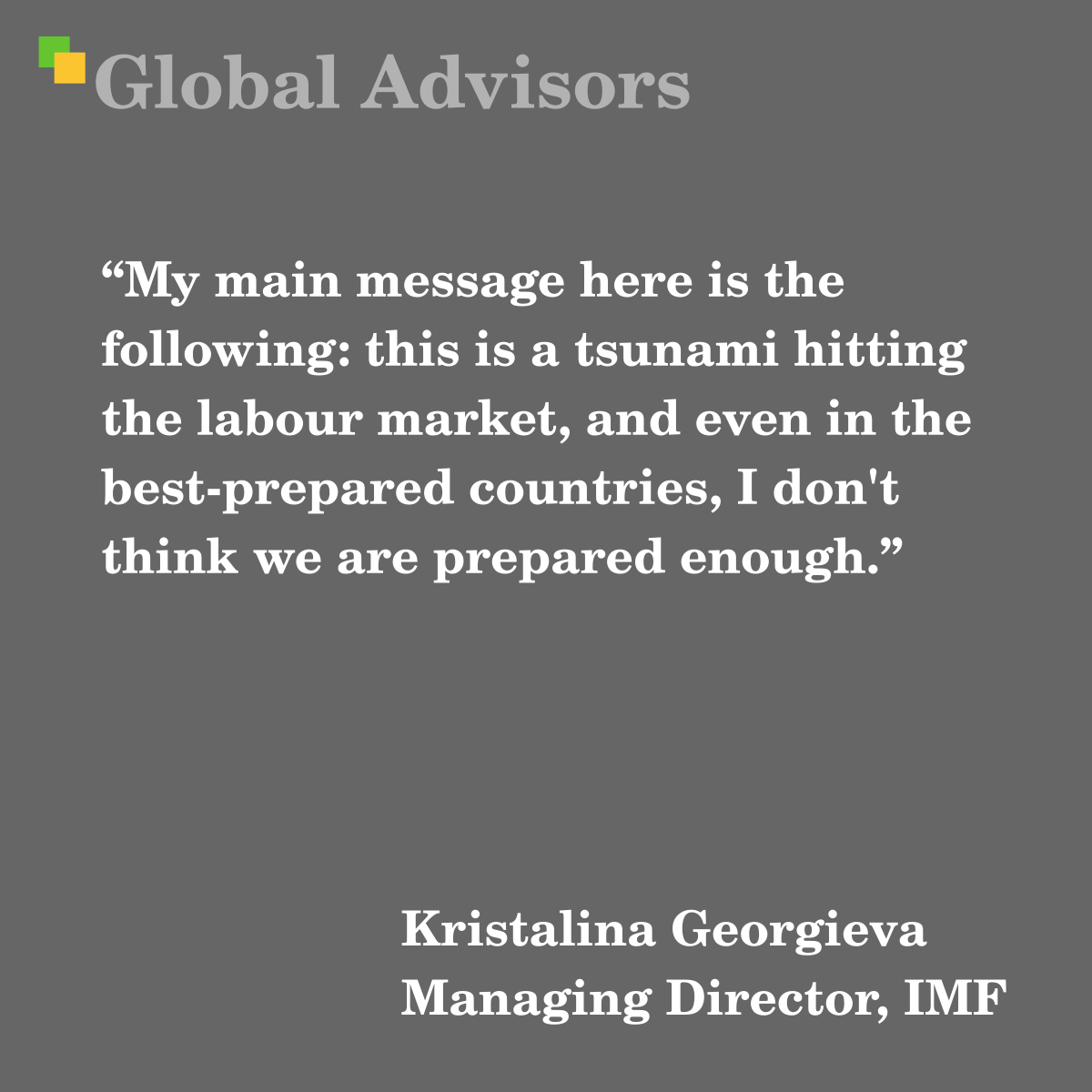
Quote: Kristalina Georgieva - Managing Director, IMF"My main message here is the following: this is a tsunami hitting the labour market, and even in the best-prepared countries, I don't think we are prepared enough." - Kristalina Georgieva - Managing Director, IMFKristalina Georgieva's invocation of a "tsunami" represents far more than rhetorical flourish. Speaking at the World Economic Forum in Davos, the Managing Director of the International Monetary Fund articulated a diagnosis grounded in rigorous empirical analysis: artificial intelligence is not a speculative future threat but an immediate force already reshaping employment across every economy on earth. The metaphor itself carries profound significance-a tsunami denotes not merely disruption but overwhelming force, simultaneity, and inevitability. Critically, Georgieva's acknowledgement that even "best-prepared countries" remain inadequately equipped reveals the unprecedented scale and speed of this transformation. The Scope of AI's Labour Market ImpactThe International Monetary Fund's assessment provides quantifiable dimensions to this disruption. Georgieva's research indicates that 40 per cent of jobs globally will be impacted by artificial intelligence, with each affected role falling into one of three categories: enhancement (where AI augments human capability), elimination (where automation replaces human labour), or transformation (where roles are fundamentally altered). In advanced economies, this figure rises to 60 per cent-a staggering proportion that underscores the concentration of AI disruption in wealthy nations with greater technological infrastructure. The distinction between jobs "touched" by AI and jobs eliminated proves crucial to understanding Georgieva's analysis. Enhancement and transformation may appear preferable to outright elimination, yet they still demand worker adjustment, skill development, and potentially geographic mobility. A job that is transformed but offers no wage improvement-as Georgieva has noted-may be economically worse for the worker even if technically retained. This nuance separates her analysis from both techno-optimist narratives and catastrophic predictions. Perhaps most concerning is the asymmetric impact across age cohorts and development levels. Georgieva has specifically warned that AI is "like a tsunami hitting the labour market" for younger people entering the workforce. Entry-level positions-historically the gateway through which workers develop skills, build experience, and establish career trajectories-are precisely those most vulnerable to automation. This threatens to disrupt the intergenerational transmission of economic opportunity that has underpinned social mobility for decades. Theoretical Foundations: The Labour Economics LineageGeorgieva's analysis draws on decades of rigorous labour economics scholarship examining technological displacement and labour market adjustment. The intellectual lineage traces to David Autor, a leading MIT economist whose research has fundamentally shaped contemporary understanding of how technological change reshapes employment. Autor's seminal work demonstrates that whilst technology eliminates routine tasks-particularly routine cognitive work-it simultaneously creates demand for new skills and complementary labour. However, this adjustment is neither automatic nor painless; workers displaced from routine cognitive tasks often face years of unemployment or underemployment before transitioning to new roles, if they transition at all. Autor's research, conducted over more than two decades, reveals a critical pattern: technological disruption creates a "hollowing out" of middle-skill employment. Routine cognitive tasks-data entry, basic accounting, straightforward analysis-have been progressively automated, whilst demand has polarised toward high-skill, high-wage positions and low-skill, low-wage service roles. This pattern, documented extensively in his work on computerisation and wage inequality, provides the empirical foundation for understanding why Georgieva emphasises that AI's impact cannot be left to market forces alone. Building on Autor's framework, contemporary labour economists have extended analysis to examine the speed and scale of technological transition. The consensus among leading researchers-including Daron Acemoglu of MIT, who has written extensively on the relationship between technology and inequality-is that rapid technological change without deliberate policy intervention tends to exacerbate inequality rather than distribute gains broadly. Acemoglu's work emphasises that technology is not destiny; rather, the distributional outcomes of technological change depend fundamentally on institutional choices, regulatory frameworks, and investment in human capital. Claudia Goldin, the 2023 Nobel Prize winner in Economics, has contributed essential research on the relationship between education, skills, and labour market outcomes across generations. Her historical analysis demonstrates that periods of rapid technological change have previously required corresponding investments in education and skills development. The gap between technological capability and educational preparedness has historically determined whether technological transitions benefit broad populations or concentrate gains among a narrow elite. Georgieva's warning about inadequate preparedness echoes Goldin's historical findings: without deliberate educational investment, technological transitions produce inequality. The Productivity Paradox and Global GrowthGeorgieva's analysis situates AI within a broader economic context of disappointing productivity growth. Global growth has remained underwhelming in recent years, with productivity growth stagnant except in the United States. This stagnation represents a fundamental economic problem: without productivity growth, living standards stagnate, and governments face fiscal pressures as tax revenues fail to grow with economic output. AI represents, in Georgieva's assessment, the most potent force for reversing this trend. The IMF calculates that AI could boost global growth between 0.1 and 0.8 per cent annually-a seemingly modest range that carries enormous consequences. A 0.8 per cent productivity gain would restore growth to pre-pandemic levels, fundamentally altering global economic trajectories. Yet this upside scenario depends entirely on successful labour market adjustment and equitable distribution of AI's benefits. If AI generates productivity gains that concentrate wealth whilst displacing workers without adequate transition support, the aggregate growth figures mask profound distributional consequences. This productivity question connects directly to Georgieva's warning about preparedness. The IMF's research indicates that one in ten jobs in advanced economies already require substantially new skills-a figure that will accelerate as AI deployment expands. Yet educational and training systems globally remain poorly aligned with AI-era skill demands. Northern European countries-particularly Finland, Sweden, and Denmark-have historically invested in continuous skills development and educational flexibility, positioning their workforces better for technological transition. Most other nations, by contrast, maintain educational systems designed for industrial-era employment patterns, where workers acquired specific skills early in their careers and applied them throughout working lives. The Global Inequality DimensionPerhaps the most consequential aspect of Georgieva's analysis concerns the "accordion of opportunities"-her term for the diverging economic trajectories between advanced and developing economies. The 60 per cent figure for advanced economies versus 20-26 per cent for low-income countries reflects not merely different levels of AI adoption but fundamentally different economic capacities and institutional frameworks. Advanced economies possess the infrastructure, capital, and institutional capacity to invest in AI whilst simultaneously managing labour market transition. They have educational systems capable of rapid adaptation, financial resources to fund reskilling programmes, and social safety nets to cushion displacement. Low-income countries risk being left behind-neither benefiting from AI's productivity gains nor receiving the investment in skills and social protection that might cushion displacement. This dynamic threatens to widen the global inequality gap that has been a persistent feature of economic development since the industrial revolution. Georgieva's concern reflects research by economists including Branko Milanovic, who has documented how technological change interacts with global inequality. Milanovic's work demonstrates that technological transitions have historically benefited capital owners and high-skill workers whilst displacing lower-skill workers. Without deliberate policy intervention-progressive taxation, investment in education, social protection-technological change tends to increase inequality both within and between nations. The Skills Gap and Educational MismatchGeorgieva's analysis reveals a critical finding: some countries have more demand for new skills than supply, whilst others have more supply than demand. This mismatch is not random; it reflects decades of educational investment decisions. Northern European countries, which have invested continuously in education and skills development, face less severe skills gaps. Emerging market and developing economies, which have often prioritised other investments, face more significant misalignment between labour supply and employer demand. The nature of required skills further complicates adjustment. Approximately half of new skills demanded are information technology related-programming, data analysis, AI system management. The remaining skills span management, specific professional qualifications, and crucially, what Georgieva terms "learning how to learn." This last category proves essential because, as she emphasises, policymakers cannot assume they know what jobs of tomorrow will be. Rather than teaching particular knowledge, educational systems must cultivate adaptability and continuous learning capacity. This pedagogical insight reflects research by Erik Brynjolfsson and Andrew McAfee, economists at MIT who have extensively studied the relationship between technological change and employment. Their research emphasises that in periods of rapid technological change, the ability to learn new skills matters more than possession of specific technical knowledge. Workers who can adapt, learn new tools, and transfer skills across domains fare better than those with deep expertise in narrow domains vulnerable to automation. The Entry-Level Jobs CrisisGeorgieva's specific warning about entry-level positions deserves particular attention. AI tends to eliminate entry-level functions-the positions through which younger workers historically entered labour markets, developed experience, and progressed to more senior roles. This threatens to disrupt a fundamental mechanism of economic mobility and skills development. The concern extends beyond immediate employment. Entry-level positions serve crucial functions beyond income generation: they provide work experience, develop professional networks, teach workplace norms and expectations, and signal to employers that workers possess basic competence. When AI eliminates these positions, younger workers face not merely reduced job availability but disrupted pathways to career development. A 25-year-old unable to secure entry-level experience faces substantially different career prospects than one who progresses through conventional career ladders. Yet Georgieva's data also offers grounds for cautious optimism. Her research indicates that a 1 per cent increase in new skills leads to 1.3 per cent increase in overall employment. This suggests that skill development creates positive spillovers-workers with new skills generate demand for complementary services and lower-skilled labour, expanding employment opportunities across the economy. The fear that AI will shrink total employment, whilst understandable, is not yet supported by empirical evidence. Rather, the challenge is reshaping employment-ensuring that displaced workers can transition to new roles and that new opportunities emerge in sufficient quantity and geographic proximity to displaced workers. Geopolitical and Strategic DimensionsGeorgieva's warning arrives amid broader economic fragmentation. Trade tensions, geopolitical competition, and the shift from a rules-based global economic order toward competing blocs create additional uncertainty. AI development is increasingly intertwined with strategic competition between major powers, particularly between the United States and China. This geopolitical dimension means that AI's labour market impact cannot be separated from questions of technological sovereignty, supply chain resilience, and economic security. The strategic competition over AI development creates perverse incentives. Nations may prioritise rapid AI deployment to maintain competitive advantage, even when labour market adjustment remains incomplete. This dynamic could accelerate job displacement without corresponding investment in worker transition support, exacerbating the preparedness gap Georgieva identifies. Policy Imperatives and the Preparedness ChallengeGeorgieva's analysis suggests several imperatives for policymakers. First, labour market adjustment cannot be left to market forces alone; deliberate investment in education, training, and social protection is essential. Second, the distribution of AI's benefits matters as much as aggregate productivity gains; without attention to equity, AI could deepen inequality within and between nations. Third, regulation and ethical frameworks must be established proactively rather than reactively, shaping AI development toward socially beneficial outcomes. The preparedness challenge Georgieva emphasises reflects a fundamental asymmetry: AI development proceeds at technological pace, whilst educational systems, labour market institutions, and policy frameworks change at institutional pace. Educational systems require years to redesign curricula, train teachers, and produce graduates with new skills. Labour market institutions-unemployment insurance systems, pension arrangements, occupational licensing frameworks-were designed for industrial-era employment patterns and adapt slowly to new realities. Policy frameworks require legislative action, which moves even more slowly. This temporal mismatch between technological change and institutional adaptation explains why even well-prepared countries remain inadequately equipped. Finland, Sweden, and Denmark-the countries Georgieva identifies as best positioned-have invested continuously in education and skills development, yet even these nations acknowledge that current preparedness remains insufficient for the scale and speed of AI-driven change. The Broader Economic ContextGeorgieva's warning must be understood within the context of her broader economic outlook. The IMF has upgraded global growth projections to 3.3 per cent for 2026 and 3.2 per cent for 2027, yet these figures fall short of pre-pandemic historical averages of 3.8 per cent. The primary constraint on growth is productivity-the output generated per unit of labour and capital. Without productivity growth, economies cannot generate sufficient income growth to fund public services, support ageing populations, or improve living standards. AI represents the most significant potential source of productivity growth available to policymakers. Yet realising this potential requires not merely deploying AI technology but managing the labour market transition it necessitates. Georgieva's warning that even best-prepared countries remain inadequately equipped reflects recognition that the challenge is not technological but institutional and political-whether societies can muster the will to invest in worker transition, education, and social protection whilst simultaneously deploying transformative technology. The stakes could hardly be higher. Successful management of AI's labour market impact could restore productivity growth, accelerate global development, and improve living standards broadly. Failure to manage this transition adequately could concentrate AI's benefits among capital owners and high-skill workers whilst displacing millions of workers without adequate transition support, deepening inequality and potentially destabilising societies. Georgieva's metaphor of a tsunami captures this duality: the same force that could lift all boats could also devastate those unprepared for its arrival. References 1. https://globaladvisors.biz/2026/01/23/quote-kristalina-georgieva-managing-director-imf/ 3. https://fortune.com/2026/01/23/imf-chief-warns-ai-tsunami-entry-level-jobs-gen-z-middle-class/
|
| |
| |
Term: Black Scholes"The Black-Scholes model (or Black-Scholes-Merton model) is a fundamental mathematical formula that calculates the theoretical fair price of European-style options, using inputs like the underlying stock price, strike price, time to expiration, risk-free interest rate and volatility." - Black ScholesBlack-Scholes Model (Black-Scholes-Merton Model)The Black-Scholes model, also known as the Black-Scholes-Merton model, is a pioneering mathematical framework for pricing European-style options, which can only be exercised at expiration. It derives a theoretical fair value for call and put options by solving a parabolic partial differential equation—the Black-Scholes equation—under risk-neutral valuation, replacing the asset's expected return with the risk-free rate to eliminate arbitrage opportunities.1,2,5 Core Formula and InputsThe model prices a European call option ( C ) as: C = S_0 N(d_1) - K e^ N(d_2) where:
A symmetric formula exists for put options. The model assumes log-normal distribution of stock prices, meaning continuously compounded returns are normally distributed: \ln S_T \sim N\left( \ln S_0 + \left( \mu - \frac{\sigma^2} \right)T, \sigma^2 T \right) where ( \mu ) is the expected return (replaced by ( r ) in risk-neutral pricing).2 Key AssumptionsThe model rests on idealised conditions for mathematical tractability:
These enable delta hedging: dynamically adjusting a portfolio of the underlying asset and riskless bond to replicate the option's payoff, making its price unique.1 Extensions and Limitations
Best Related Strategy Theorist: Myron ScholesMyron Scholes (b. 1941) is the most directly linked theorist, co-creator of the model and Nobel laureate whose work revolutionised options trading and risk management strategies. BiographyBorn in Timmins, Ontario, Canada, Scholes earned a BA (1962), MA (1964), and PhD (1969) in finance from the University of Chicago, studying under Nobel winners like Merton Miller. He taught at MIT (1968–1972, collaborating with Fischer Black and Robert Merton), Stanford (1973–1996), and later Oxford. In 1990, he co-founded Long-Term Capital Management (LTCM), a hedge fund using advanced models (including Black-Scholes variants) for fixed-income arbitrage, which amassed $4.7 billion in assets before collapsing in 1998 due to leverage and Russian debt crisis—prompting a $3.6 billion Federal Reserve bailout. Scholes received the 1997 Nobel Prize in Economics (shared with Merton; Black deceased), cementing his legacy. He now advises at Platinum Grove Asset Management and philanthropically supports education.1 Relationship to the TermScholes co-authored the seminal 1973 paper "The Pricing of Options and Corporate Liabilities" with Fischer Black (1938–1995), an economist at Arthur D. Little and later Goldman Sachs, who conceived the core hedging insight but died before the Nobel. Robert C. Merton (b. 1944, Merton's 1973 paper extended it to dividends and American options) formalised continuous-time aspects, earning co-credit. Their breakthrough—published amid nascent options markets (CBOE opened 1973)—enabled risk-neutral pricing and dynamic hedging, transforming derivatives from speculative to hedgeable instruments. Scholes' strategic insight: options prices reflect volatility alone under no-arbitrage, powering strategies like volatility trading, portfolio insurance, and structured products at banks/hedge funds. LTCM exemplified (and exposed limits of) scaling these via leverage.1,2,5
References 1. https://en.wikipedia.org/wiki/Black%E2%80%93Scholes_model 3. https://carta.com/learn/startups/equity-management/black-scholes-model/ 4. https://www.columbia.edu/~mh2078/FoundationsFE/BlackScholes.pdf 5. https://www.sofi.com/learn/content/what-is-the-black-scholes-model/ 6. https://gregorygundersen.com/blog/2024/09/28/black-scholes/ 7. https://corporatefinanceinstitute.com/resources/derivatives/black-scholes-merton-model/ 8. https://www.youtube.com/watch?v=EEM2YBzH-2U
|
| |

| |
Quote: Reid Hoffman - LinkedIn co-founder"The fastest way to change yourself is to hang out with people who are already the way you want to be." - Reid Hoffman - LinkedIn co-founderReid Hoffman, best known as the co-founder of LinkedIn, has spent his career at the intersection of technology, networks and human potential. His work is grounded in a deceptively simple observation: who you spend time with fundamentally shapes who you become. This quote, popularised through his book The Startup of You: Adapt to the Future, Invest in Yourself, and Transform Your Career, distils a central theme in his thinking - that careers and identities are not fixed paths, but evolving ventures built in relationship with others.2 Reid Hoffman: from philosopher to founderBorn in 1967 in California, Reid Hoffman studied at Stanford University, focusing on symbolic systems, a multidisciplinary programme that combines computer science, linguistics, philosophy and cognitive psychology. He later pursued a masters degree in philosophy at Oxford, with a particular interest in how individuals and societies create meaning and institutions. That philosophical grounding is visible in the way he talks about networks, trust and social systems, and in his tendency to move quickly from product features to questions of ethics and social impact. Hoffman initially imagined becoming an academic, but he concluded that entrepreneurship offered a more direct way to shape the world. After early roles at Apple and Fujitsu, he founded his first company, SocialNet, in the late 1990s. It was an ambitious attempt at an online social platform before the wider market was ready. The experience taught him, by his own account, about timing, product-market fit and the brutal realities of execution. Those lessons would later inform his investment philosophy and his advice to founders. He joined PayPal in its early days, becoming one of the core members of what later came to be known as the "PayPal Mafia". As executive vice president responsible for business development, he helped navigate the company through growth, regulatory challenges and its eventual acquisition by eBay. This period sharpened his understanding of scaling networks, managing hypergrowth and building resilient organisational cultures. It also cemented his personal network with future founders of Tesla, SpaceX, Yelp, YouTube and Palantir, among others - a living demonstration of his own quote about proximity to people who embody the future you want to be part of. In 2002, Hoffman co-founded LinkedIn, a professional networking platform that would come to dominate global online professional identity. The idea was radical at the time: that CVs could become living, networked artefacts; that careers could be navigated not just through internal company ladders but through visible webs of relationships; and that trust in business could be mediated through reputation signals and endorsements. LinkedIn grew steadily rather than explosively, reflecting Hoffmans view that durable networks are built on cumulative trust, not just viral growth. The platform embodies the logic of his quote: it is structurally designed to make it easier to find and connect with people whose careers, skills and values you aspire to emulate.2 After LinkedIn scaled and eventually sold to Microsoft, Hoffman became a partner at Greylock Partners, one of Silicon Valleys most established venture capital firms. There he focused on early-stage technology companies, particularly those with strong network effects. He also launched the podcast Masters of Scale, where he interviews founders and leaders about how they built their organisations. The show reinforces the same message: personal and organisational change rarely happens in isolation; it occurs in communities, teams and ecosystems that stretch what people believe is possible. Context of the quote: The Startup of You and career as a startupThe quote appears in the context of Hoffmans book The Startup of You, co-authored with Ben Casnocha. In the book he argues that every individual, not just entrepreneurs, should think of themselves as the CEO of their own career, applying the mindset and tools of a startup to their working life. That means:
Within that framework, the quote about hanging out with people who are already the way you want to be is not a throwaway line. It is a strategy. Hoffman argues that exposing yourself to people who embody the skills, attitudes and standards you aspire to accelerates learning in several ways:
In other words, the fastest way to change yourself is not merely to decide differently, but to embed yourself in different networks. This reflects Hoffmans broader belief that networks are not just social graphs; they are engines for personal transformation. The idea behind the quote: why people shape who we becomeThe deeper logic behind Hoffmans quote sits at the convergence of several strands of research and theory about how human beings change:
Hoffmans framing is distinctly practical. Rather than focusing on abstract self-improvement, he suggests a leverage point: choose your environment and your companions with intent. If you want to become more entrepreneurial, spend time with founders. If you want to become more disciplined, work alongside people who treat discipline as a norm. If you want a more global perspective, immerse yourself in networks that think and operate globally. This is not, in his usage, about social climbing or mimicry. It is about recognising that the most powerful behavioural technologies we have are other people, and aligning ourselves with those whose example pulls us towards our better, more ambitious selves. Related thinkers: how theory supports Hoffmans insightThough Hoffmans quote arises from his own experience in technology and entrepreneurship, the underlying idea is echoed across psychology, sociology, economics and network science. A number of leading theorists and researchers provide a rich backstory to the principle that the people around us are key drivers of personal change. 1. Social learning and modelling - Albert BanduraAlbert Bandura, one of the most influential psychologists of the 20th century, developed social learning theory and the concept of self-efficacy. He showed that people learn new behaviours by observing others, especially when those others are perceived as competent, similar or high-status. In his famous Bobo doll experiments, children who saw adults behaving aggressively towards a doll were more likely to imitate that behaviour. Bandura argued that much of human learning is vicarious. We watch, internalise and then reproduce behaviours without needing to experience all the consequences ourselves. In that light, Hoffmans advice to spend time with people who are already the way you want to be is essentially a prescription to leverage social modelling in your favour: choose role models and peer groups whose behaviour you want to absorb, because you will absorb it, consciously or not. Banduras notion of self-efficacy - the belief in ones capability to achieve goals - is also relevant. Seeing people like you succeed in domains you care about, or live in ways you aspire to, is one of the strongest sources of increased self-efficacy. It tells you, implicitly: this is possible, and it may be possible for you. 2. Social comparison and reference groups - Leon FestingerLeon Festinger, a social psychologist, introduced social comparison theory in the 1950s. He proposed that individuals evaluate their own opinions and abilities by comparing themselves with others, particularly when objective standards are absent or ambiguous. Reference groups - the people we implicitly choose as benchmarks - shape our sense of what counts as success, effort or normality. Hoffmans quote can be read as deliberate reference-group engineering. If you choose a reference group made up of people who are already living or behaving in ways you admire, then your internal comparisons will continually pull you in that direction. Your standard of "normal" shifts upward. Over time, subtle adjustments in expectations, goals and self-assessment accumulate into substantive change. 3. Social networks and contagion - Nicholas Christakis and James FowlerIn their work on social contagion, Nicholas Christakis and James Fowler used large-scale longitudinal data to show that behaviours and states - from obesity to smoking, happiness and loneliness - can spread through social networks across multiple degrees of separation. If a friend of your friend becomes obese, for instance, your own likelihood of weight gain measurably changes, even if you never meet that intermediary person. Their research suggests that networks do not merely reflect individual traits; they actively participate in shaping them. Norms, emotions and behaviours travel across the ties between people. In that sense, Hoffmans counsel is aligned with a network-science perspective: by embedding yourself in networks populated by people with the traits you seek, you are positioning yourself in the path of favourable social contagion. 4. Social capital and weak ties - Mark Granovetter and Robert PutnamMark Granovetters seminal work on "The Strength of Weak Ties" showed that weak connections - acquaintances rather than close friends - are disproportionately important for accessing new information, opportunities and perspectives. They bridge different clusters within a network and act as conduits between otherwise separated groups. Robert Putnam, in his work on social capital, differentiated between bonding capital (strong ties within a close group) and bridging capital (ties that connect us across different groups). Bridging capital is particularly valuable for innovation and change, because it exposes individuals to unfamiliar norms, skills and possibilities. Hoffmans own career illustrates these principles. His decision to join and later invest in networks of founders, technologists and global business leaders gave him an unusually rich set of weak and strong ties. When he advises people to spend time with those who already are how they want to be, he is, in effect, recommending the intentional cultivation of high-quality social capital in domains that matter for your growth. 5. Identity and habit change - James Clear, Charles Duhigg and behavioural scienceContemporary writers on habits and behaviour, such as James Clear and Charles Duhigg, synthesise research from psychology and behavioural economics to explain why environment and identity are so crucial in change. They emphasise that:
Clear, for example, argues that "the people you surround yourself with are a reflection of who you are, or who you want to be" - an idea strongly resonant with Hoffmans quote. Belonging to a group where a desired behaviour is normal lowers the friction of doing that behaviour yourself. You become the kind of person who does these things, because that is what "people like us" do. Hoffman extends this line of thought into the professional realm: if you want to be the sort of person who takes intelligent risks, builds companies or adapts well to technological change, put yourself in communities where those behaviours are routine, admired and expected. 6. Deliberate practice and expert communities - K. Anders EricssonK. Anders Ericsson, known for his work on expert performance and deliberate practice, showed that world-class performance is rarely a product of raw talent alone. It depends on structured, effortful practice over time, typically supported by coaches, mentors and high-level peer groups. Elite performers tend to train in environments where excellence is normalised and where feedback is rapid, precise and demanding. Viewed through this lens, Hoffmans quote points to the importance of expert communities for accelerating growth. Being around people who are already operating at the level you aspire to does more than inspire; it enables a more rigorous, feedback-rich form of practice. It shrinks the gap between aspiration and reality by surrounding you with tangible exemplars and high expectations. 7. Entrepreneurial ecosystems - AnnaLee Saxenian and cluster theoryResearch on regional innovation systems and entrepreneurial ecosystems, such as AnnaLee Saxenians work on Silicon Valley, illuminates how geographic and social concentration of talent drives innovation. Silicon Valley became uniquely productive not just because of capital or universities, but because it created dense networks of engineers, founders, investors and service providers who interacted constantly, shared norms and recycled experience across companies. Hoffmans career is intertwined with this ecosystem logic. His own network, forged through PayPal, LinkedIn and Greylock, reflects the power of clusters where people who already embody entrepreneurial behaviours interact daily. When he advises others to "hang out" with people who are already how they want to be, he is, in effect, recommending that individuals build their own personal micro-ecosystems of aspiration, whether or not they live in Silicon Valley. The personal strategy embedded in the quoteHoffmans quote can serve as a practical checklist for personal and professional growth:
For Hoffman, the network is not a backdrop to personal change; it is the primary medium through which change happens. His own journey - from philosopher to entrepreneur, from founder to investor and public intellectual - unfolded through successive communities of people who were already operating in the ways he wanted to learn. The quote captures that lived experience in a single, portable principle: to change yourself at speed, change who you are with. References 2. https://www.goodreads.com/quotes/11473244-the-fastest-way-to-change-yourself-is-to-hang-out 3. https://www.azquotes.com/quote/520979
|
| |

| |
|


| |
| |