| |
|

| |
| |
| |
|
A daily bite-size selection of top business content. |
| |
| |
| |
Quote: Andrew Ng - AI guru, Coursera founder"I think one of the challenges is, because AI technology is still evolving rapidly, the skills that are going to be needed in the future are not yet clear today. It depends on lifelong learning." - Andrew Ng - AI guru, Coursera founderDelivered during a session on Corporate Ladders, AI Reshuffled at the World Economic Forum in Davos in January 2026, this insight from Andrew Ng captures the essence of navigating an era where artificial intelligence advances at breakneck speed. Ng's words underscore a pivotal shift: as AI reshapes jobs and workflows, the uncertainty of future skills demands a commitment to continuous adaptation1,2. Andrew Ng: The Architect of Modern AI EducationAndrew Ng stands as one of the foremost figures in artificial intelligence, often dubbed an AI guru for his pioneering contributions to machine learning and online education. A British-born computer scientist, Ng co-founded Coursera in 2012, revolutionising access to higher education by partnering with top universities to offer massive open online courses (MOOCs). His platforms, including DeepLearning.AI and Landing AI, have democratised AI skills, training millions worldwide2,3. Ng's career trajectory is marked by landmark roles: he led the Google Brain project, which advanced deep learning at scale, and served as chief scientist at Baidu, applying AI to real-world applications in search and autonomous driving. As managing general partner at AI Fund, he invests in startups bridging AI with practical domains. At Davos 2026, Ng addressed fears of AI-driven job losses, arguing they are overstated. He broke jobs into tasks, noting AI handles only 30-40% currently, boosting productivity for those who adapt: 'A person that uses AI will be so much more productive, they will replace someone that doesn't use AI'2,3. His emphasis on coding as a 'durable skill'-not for becoming engineers, but for building personalised software to automate workflows-aligns directly with the quoted challenge of unclear future skills1. The Broader Context: AI's Impact on Jobs and Skills at Davos 2026The quote emerged amid Davos discussions on agentic AI systems-autonomous agents managing end-to-end workflows-pushing humans towards oversight, judgement, and accountability. Ng highlighted meta-cognitive agility: shifting from perishable technical skills to 'learning to learn'1. This resonates with global concerns; IMF's Kristalina Georgieva noted one in ten jobs in advanced economies already need new skills, with labour markets unprepared1. Ng urged upskilling, especially for regions like India, warning its IT services sector risks disruption without rapid AI literacy3,5. Corporate strategies are evolving: the T-shaped model promotes AI literacy across functions (breadth) paired with irreplaceable domain expertise (depth). Firms rebuild talent ladders, replacing grunt work with AI-supported apprenticeships fostering early decision-making1. Ng's optimism tempers hype; AI improves incrementally, not in dramatic leaps, yet demands proactive reskilling3. Leading Theorists Shaping AI, Skills, and Lifelong LearningNg's views build on foundational theorists in AI and labour economics:
These theorists converge on a consensus: AI disrupts routines but elevates human judgement, creativity, and adaptability-skills honed through lifelong learning, as Ng advocates. Ng's prescience positions this quote as a clarion call for individuals and organisations to embrace uncertainty through perpetual growth in an AI-driven world. References 1. https://globaladvisors.biz/2026/01/23/the-ai-signal-from-the-world-economic-forum-2026-at-davos/ 4. https://www.aicerts.ai/news/andrew-ng-open-source-ai-india-call-resonates-at-davos/
|
| |
| | |||||||||||||||
Term: Steelman argument"A steelman argument is a dialectical technique where you restate an opponent's position in its strongest, most charitable, and most convincing form, even better than they presented it, before you offer your counterargument, aiming to understand the truth and engage." - Steelman argumentThe purpose is not to score rhetorical points, but to understand the underlying truth of the issue, test your own beliefs, and engage respectfully and productively with those who disagree. In a steelman argument, a participant in a discussion:
This makes steelmanning the conceptual opposite of the straw man fallacy, where a position is caricatured or simplified to make it easier to attack. Where a straw man trades on distortion to make disagreement easier, a steelman trades on fairness and intellectual generosity to make understanding deeper. Core principles of steelmanningFour principles underpin effective steelman arguments:
Steelman vs. straw man vs. related techniques
Steelman arguments often incorporate elements of counterfactuals and thought experiments. For example, to strengthen a policy criticism, you might ask: "Suppose this policy were applied in a more extreme case - would the same concerns still hold?" You then build the best version of the concern across such scenarios before responding. Why steelmanning matters in strategy and decision-makingIn strategic analysis, investing, policy design, and complex organisational decisions, steelman arguments help to:
When used rigorously, the steelman discipline often turns a confrontational debate into a form of collaborative problem-solving, where each side helps the other refine their views and the final outcome is more robust than either starting position. Practical steps to construct a steelman argumentA practical steelmanning process in a meeting, negotiation, or analytical setting might look like this:
Best related strategy theorist: John Stuart MillAlthough the term "steelman" is modern, the deepest intellectual justification for the practice in strategy, policy, and public reasoning comes from the nineteenth-century philosopher and political economist John Stuart Mill. His work provides a powerful conceptual foundation for steelmanning, especially in high-stakes decision contexts. Mill's connection to steelmanningMill argued that you cannot truly know your own position unless you also understand, in its most persuasive form, the best arguments for the opposing side. He insisted that anyone who only hears or articulates one side of a case holds their opinion as a "prejudice" rather than a reasoned view. In modern terms, he is effectively demanding that responsible thinkers and decision-makers steelman their opponents before settling on a conclusion. In his work on liberty, representative government, and political economy, Mill repeatedly:
This method aligns closely with the steelman ethos in modern strategy work: before committing to a policy, investment, or organisational move, you owe it to yourself and your stakeholders to understand the most credible case against your intended path - not a caricature of it. Biography and intellectual contextJohn Stuart Mill (1806 - 1873) was an English philosopher, economist, and civil servant, widely regarded as one of the most influential thinkers in the liberal tradition. Educated intensively from a very young age by his father, James Mill, under the influence of Jeremy Bentham, he mastered classical languages, logic, and political economy in his childhood, but suffered a mental crisis in his early twenties that led him to broaden his outlook beyond strict utilitarianism. Mill's major works include:
As a senior official in the East India Company and later a Member of Parliament, Mill moved between theory and practice, applying his analytical methods to real-world questions of governance, representation, and reform. His insistence that truth and sound policy emerge only from confronting the strongest counter-arguments is a direct ancestor of the modern steelman method in strategic reasoning, board-level debate, and public policy design. Mill's legacy for modern strategic steelmanningFor contemporary strategists, investors, and leaders, Mill's legacy can be summarised as a disciplined demand: before acting, ensure that you could state the best good-faith case against your intention more clearly and powerfully than its own advocates. Only then is your subsequent decision genuinely informed rather than insulated by bias. In this way, John Stuart Mill stands as the key historical theorist behind the steelman argument - not for coining the term, but for articulating the intellectual and ethical duty to engage with opponents at their strongest, in pursuit of truth and resilient strategy. References 1. https://aliabdaal.com/newsletter/the-steelman-argument/ 2. https://themindcollection.com/steelmanning-how-to-discover-the-truth-by-helping-your-opponent/ 3. https://ratiochristi.org/the-anatomy-of-persuasion-the-steel-man/ 4. https://www.youtube.com/watch?v=veeGKTzbYjc 5. https://simplicable.com/en/steel-man 6. https://umbrex.com/resources/tools-for-thinking/what-is-steelmanning/
|
|||||||||||||||
| |
| |
Quote: Professor Hannah Fry - University of Cambridge"Humans are not very good at exponentials. And right now, at this moment, we are standing right on the bend of the curve. AGI is not a distant thought experiment anymore." - Professor Hannah Fry - Univeristy of CambridgeThe quote comes at the end of a wide?ranging conversation between applied mathematician and broadcaster Professor Hannah Fry and DeepMind co?founder Shane Legg, recorded for the “Google DeepMind, the podcast” series in late 2025. Fry is reflecting on Legg’s decades?long insistence that artificial general intelligence would arrive much sooner than most experts expected, and on his argument that its impact will be structurally comparable to the Industrial Revolution: a technology that reshapes work, wealth, and the basic organisation of society rather than just adding another digital tool. Her remark that “humans are not very good at exponentials” is a pointed reminder of how easily people misread compounding processes, from pandemics to technological progress, and therefore underestimate how quickly “next decade” scenarios can become “this quarter” realities.? Context of the quoteFry’s line follows a discussion in which Legg lays out a stepwise picture of AI progress: from today’s uneven but impressive systems, through “minimal AGI” that can reliably perform the full range of ordinary human cognitive tasks, to “full AGI” capable of the most exceptional creative and scientific feats, and then on to artificial superintelligence that eclipses human capability in most domains. Throughout, Legg stresses that current models already exceed humans in language coverage, encyclopaedic knowledge and some kinds of problem solving, while still failing at basic visual reasoning, continual learning, and robust commonsense. The trajectory he sketches is not a gentle slope but a sharpening curve, driven by scaling laws, data, architectures and hardware; Fry’s “bend of the curve” image captures the moment when such a curve stops looking linear to human intuition and starts to feel suddenly, uncomfortably steep.? That curve is not just about raw capability but about diffusion into the economy. Legg argues that over the next few years, AI will move from being a helpful assistant to doing a growing share of economically valuable work—starting with software engineering and other high?paid cognitive roles that can be done entirely through a laptop. He anticipates that tasks once requiring a hundred engineers might soon be done by a small team amplified by advanced AI tools, with similarly uneven but profound effects across law, finance, research, and other knowledge professions. By the time Fry delivers her closing reflection, the conversation has moved from technical definitions to questions of social contract: how to design a post?AGI economy, how to distribute the gains from machine intelligence, and how to manage the transition period in which disruption and opportunity coexist.? Hannah Fry: person and perspectiveHannah Fry is a professor in the mathematics of cities who has built a public career explaining complex systems—epidemics, finance, urban dynamics and now AI—to broad audiences. Her training in applied mathematics and complexity science has made her acutely aware of how exponential processes play out in the real world, from contagion curves during COVID?19 to the compounding effect of small percentage gains in algorithmic performance and hardware efficiency. She has repeatedly highlighted the cognitive bias that leads people to underreact when growth is slow and overreact when it becomes visibly explosive, a theme she explicitly connects in this podcast to the early days of the pandemic, when warnings about exponential infection growth were largely ignored while life carried on as normal.? In the AGI conversation, Fry positions herself as an interpreter between technical insiders and a lay audience that is already experiencing AI in everyday tools but may not yet grasp the systemic implications. Her remark that the general public may, in some sense, “get it” better than domain specialists echoes Legg’s observation that non?experts sometimes see current systems as already effectively “intelligent,” while many professionals in affected fields downplay the relevance of AI to their own work. When she says “AGI is not a distant thought experiment anymore,” she is distilling Legg’s timelines—his long?standing 50/50 prediction of minimal AGI by 2028, followed by full AGI within a decade—into a single, accessible warning that the window for slow institutional adaptation is closing.? Meaning of “not very good at exponentials”The specific phrase “humans are not very good at exponentials” draws on a familiar insight from behavioural economics and cognitive psychology: people routinely misjudge exponential growth, treating it as if it were linear. During the COVID?19 pandemic, this manifested in the gap between early warnings about exponential case growth and the public’s continued attendance at large events right up until visible crisis hit, an analogy Fry explicitly invokes in the episode. In technology, the same bias leads organisations to plan as if next year will look like this year plus a small increment, even when underlying drivers—compute, algorithmic innovation, investment, data availability—are compounding at rates that double capabilities over very short horizons.? Fry’s “bend of the curve” language marks the point where incremental improvements accumulate to the point that qualitative change becomes hard to ignore: AI systems not only answering questions but autonomously writing production code, conducting literature reviews, proposing experiments, or acting as agents in the world. At that bend, the lag between capability and governance becomes a central concern; Legg emphasises that there will not be enough time for leisurely consensus?building once AGI is fully realised, hence his call for every academic discipline and sector—law, education, medicine, city planning, economics—to begin serious scenario work now. Fry’s closing comment translates that call into a general admonition: exponential technologies demand anticipatory thinking, not reactive crisis management.? Leading theorists behind the ideasThe intellectual backdrop to Fry’s quote and Legg’s perspectives on AGI blends several strands of work in AI theory, safety and the study of technological revolutions.
Together, these theorists frame AGI as both a continuation of a long scientific project to build thinking machines and as a discontinuity in human history whose effects will compound faster than our default intuitions allow. In that context, Fry’s quote reads less as a rhetorical flourish and more as a condensed thesis: exponential dynamics in intelligence technologies are colliding with human cognitive biases and institutional inertia, and the moment to treat AGI as a practical, near?term design problem rather than a speculative future is now.? References https://eeg.cl.cam.ac.uk
|
| |
| |
Quote: Andrew Ng - AI guru, Coursera founder"There's one skill that is already emerging... it's time to get everyone to learn to code.... not just the software engineers, but the marketers, HR professionals, financial analysts, and so on - the ones that know how to code are much more productive than the ones that don't, and that gap is growing." - Andrew Ng - AI guru, Coursera founderIn a forward-looking discussion at the World Economic Forum's 2026 session on 'Corporate Ladders, AI Reshuffled', Andrew Ng passionately advocates for coding as the pivotal skill defining productivity in the AI era. Delivered in January 2026, this insight underscores how AI tools are democratising coding, enabling professionals beyond software engineering to harness technology for greater efficiency1. Ng's message aligns with his longstanding mission to make advanced technology accessible through education and practical application. Who is Andrew Ng?Andrew Ng stands as one of the foremost figures in artificial intelligence, renowned for bridging academia, industry, and education. A British-born computer scientist, he earned his PhD from the University of California, Berkeley, and has held prestigious roles including adjunct professor at Stanford University. Ng co-founded Coursera in 2012, revolutionising online learning by offering courses to millions worldwide, including his seminal 'Machine Learning' course that has educated over 4 million learners. He led Google Brain, Google's deep learning research project, from 2011 to 2014, pioneering applications that advanced AI capabilities across industries. Currently, as founder of Landing AI and DeepLearning.AI, Ng focuses on enterprise AI solutions and accessible education platforms. His influence extends to executive positions at Baidu and as a venture capitalist investing in AI startups1,2. Context of the QuoteThe quote emerges from Ng's reflections on AI's transformative impact on workflows, particularly at the WEF 2026 event addressing how AI reshuffles corporate structures. Here, Ng highlights 'vibe coding'-AI-assisted coding that lowers barriers, allowing non-engineers like marketers, HR professionals, and financial analysts to prototype ideas rapidly without traditional hand-coding. He argues this boosts productivity and creativity, warning that the divide between coders and non-coders will widen. Recent talks, such as at Snowflake's Build conference, reinforce this: 'The bar to coding is now lower than it ever has been. People that code... will really get more done'1. Ng critiques academia for lagging behind, noting unemployment among computer science graduates due to outdated curricula ignoring AI tools, and stresses industry demand for AI-savvy talent1,2. Leading Theorists and the Broader FieldNg's advocacy builds on foundational AI theories while addressing practical upskilling. Pioneers like Geoffrey Hinton, often called the 'Godfather of Deep Learning', laid groundwork through backpropagation and neural networks, influencing Ng's Google Brain work. Hinton, Ng's former advisor at Stanford, warns of AI's job displacement risks but endorses human-AI collaboration. Yann LeCun, Meta's Chief AI Scientist, complements this with convolutional neural networks essential for computer vision, emphasising open-source AI for broad adoption. Fei-Fei Li, 'Godmother of AI', advanced image recognition and co-directs Stanford's Human-Centered AI Institute, aligning with Ng's educational focus. In skills discourse, World Economic Forum's Future of Jobs Report 2025 projects technological skills, led by AI and big data, as fastest-growing in importance through 2030, alongside lifelong learning3. Microsoft CEO Satya Nadella echoes: 'AI won't replace developers, but developers who use AI will replace those who don't'3. Nvidia's Jensen Huang and Klarna's Sebastian Siemiatkowski advocate AI agents and tools like Cursor, predicting hybrid human-AI teams1. Ng's tips-take AI courses, build systems hands-on, read papers-address a talent crunch where 51% of tech leaders struggle to find AI skills2. Implications for Careers and Workflows
Ng's vision positions coding not as a technical niche but a universal lever for productivity in an AI-driven world, urging immediate action to close the growing gap. References 2. https://www.finalroundai.com/blog/andrew-ng-ai-tips-2026 4. https://www.coursera.org/in/articles/ai-skills
|
| |
| |
Term: Counterfactual"A counterfactual is a hypothetical scenario or statement that considers what would have happened if a specific event or condition had been different from what actually occurred. In simple terms, it is a 'what if' or 'if only' thought process that contradicts the established facts." - CounterfactualA counterfactual is a hypothetical scenario or statement that imagines what would have happened if a specific event, condition, or action had differed from what actually occurred. It represents a 'what if' or 'if only' thought process that directly contradicts established facts, enabling exploration of alternative possibilities for past or future events. Counterfactual thinking involves mentally simulating outcomes contrary to reality, such as 'If I had not taken that sip of hot coffee, I would not have burned my tongue.' This cognitive process is common in reflection on mistakes, regrets, or opportunities, like pondering 'If only I had caught that flight, my career might have advanced differently.'1,2,3 Key Characteristics and Types
Applications Across DisciplinesIn causal inference, counterfactuals estimate effects by comparing observed outcomes to hypothetical ones, such as 'What would the yield be if a different treatment was applied to this plot?' They underpin concepts like potential outcomes in statistics.4,7 In philosophy and logic, counterfactuals are analysed as conditionals where the antecedent is false, symbolised as A ?? C (if A were the case, C would be), contrasting with material implications.6 In machine learning, counterfactual explanations clarify model decisions, e.g., 'If feature X changed to value x, the prediction would shift.'2 Everyday examples include regretting a missed job ('If I had not been late, I would have that promotion') or entrepreneurial reflection ('If we chose a different partner, the startup might have succeeded').3 Leading Theorist: Judea PearlThe most influential modern theorist linking counterfactuals to strategy is Judea Pearl, a pioneering computer scientist and philosopher whose causal inference framework revolutionised how counterfactuals inform decision-making, policy analysis, and strategic planning. Biography: Born in 1936 in Tel Aviv, Pearl emigrated to the US in 1960 after studying electrical engineering in Israel. He earned a PhD from Rutgers University in 1965 and joined UCLA, where he is now a professor emeritus. Initially focused on AI and probabilistic reasoning, Pearl developed Bayesian networks in the 1980s, earning the Turing Award in 2011 for advancing AI through probability and causality. Relationship to Counterfactuals: Pearl's seminal work, Probabilistic Reasoning in Intelligent Systems (1988) and Causality (2000), formalised counterfactuals using structural causal models (SCMs). He defined the counterfactual query 'Y would be y had X been x' via do-interventions and potential outcomes, e.g., Y_x(u) = y denotes the value Y takes under intervention do(X=x) in unit u's background context.4 This 'ladder of causation'-from association to intervention to counterfactuals-enables strategic 'what if' analysis, such as evaluating policy impacts or business decisions by computing missing data: 'Given observed E=e, what is expected Y if X differed?'4 Pearl's framework aids strategists in risk assessment, A/B testing, and scenario planning, distinguishing correlation from causation. His do-calculus provides computable algorithms for counterfactuals, making them practical tools beyond mere speculation.4,7 References 1. https://conceptually.org/concepts/counterfactual-thinking 2. https://christophm.github.io/interpretable-ml-book/counterfactual.html 3. https://helpfulprofessor.com/counterfactual-thinking-examples/ 4. https://bayes.cs.ucla.edu/PRIMER/primer-ch4.pdf 5. https://www.merriam-webster.com/dictionary/counterfactual 6. https://plato.stanford.edu/entries/counterfactuals/ 7. https://causalwizard.app/inference/article/counterfactual
|
| |

| |
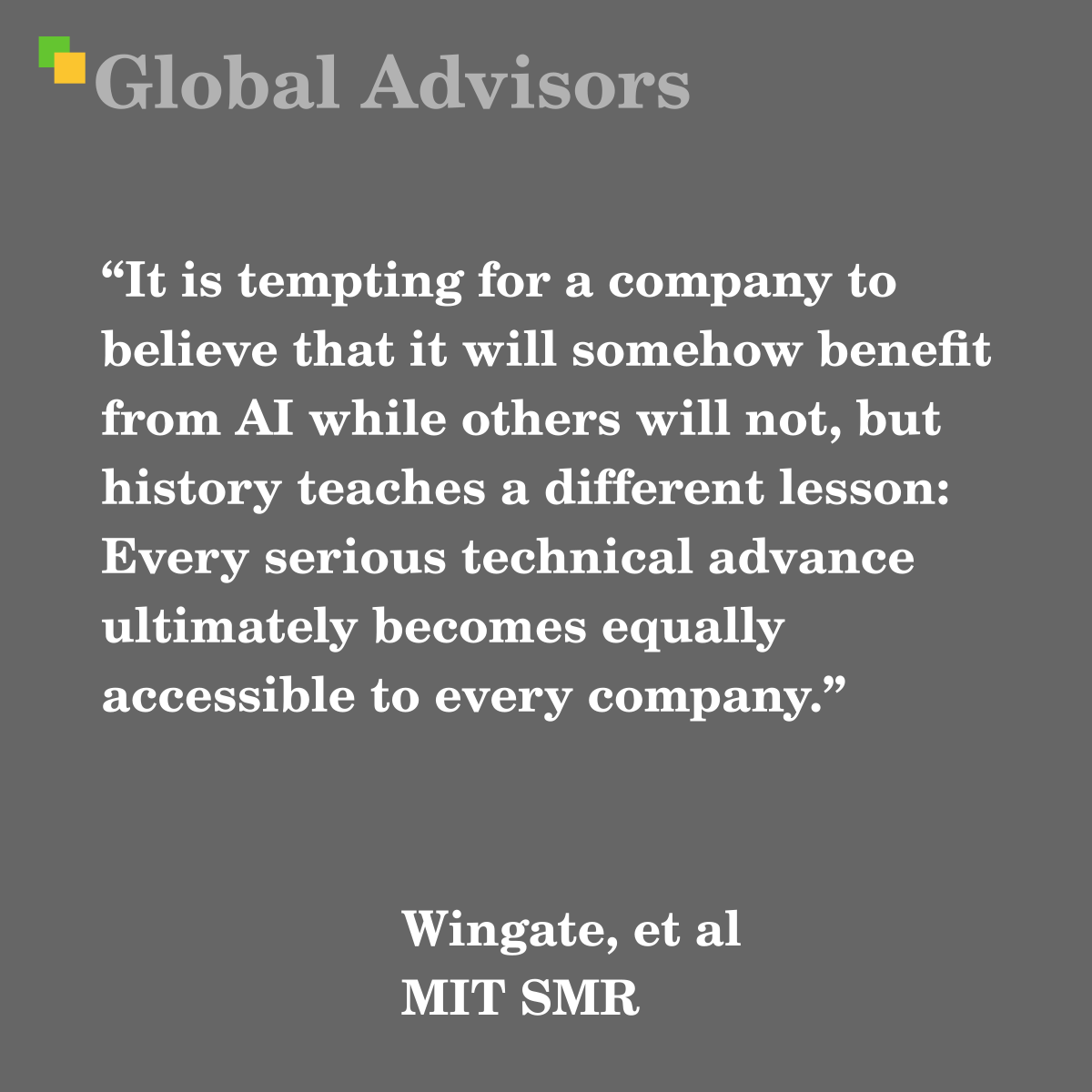
Quote: Wingate, et al - MIT SMR"It is tempting for a company to believe that it will somehow benefit from AI while others will not, but history teaches a different lesson: Every serious technical advance ultimately becomes equally accessible to every company." - Wingate, et al - MIT SMRThe Quote in ContextDavid Wingate, Barclay L. Burns, and Jay B. Barney's assertion that companies cannot sustain competitive advantage through AI alone represents a fundamental challenge to prevailing business orthodoxy. Their observation-that every serious technical advance ultimately becomes equally accessible-draws from decades of technology adoption patterns and competitive strategy theory. This insight, published in the MIT Sloan Management Review in 2025, cuts through the hype surrounding artificial intelligence to expose a harder truth: technological parity, not technological superiority, is the inevitable destination. The Authors and Their FrameworkDavid Wingate, Barclay L. Burns, and Jay B. BarneyThe three researchers who authored this influential piece bring complementary expertise to the question of sustainable competitive advantage. Their collaboration represents a convergence of strategic management theory and practical business analysis. By applying classical frameworks of competitive advantage to the contemporary AI landscape, they demonstrate that the fundamental principles governing technology adoption have not changed, even as the technology itself has become more sophisticated and transformative. Their central thesis rests on a deceptively simple observation: artificial intelligence, like the internet, semiconductors, and electricity before it, possesses a critical characteristic that distinguishes it from sources of lasting competitive advantage. Because AI is fundamentally digital, it is inherently copyable, scalable, repeatable, predictable, and uniform. This digital nature means that any advantage derived from AI adoption will inevitably diffuse across the competitive landscape. The Three Tests of Sustainable AdvantageWingate, Burns, and Barney employ a rigorous analytical framework derived from resource-based theory in strategic management. They argue that for any technology to confer sustainable competitive advantage, it must satisfy three criteria simultaneously:
Whilst AI unquestionably satisfies the first criterion-it is undeniably valuable-it fails the latter two. No organisation possesses exclusive access to AI technology, and the barriers to imitation are eroding rapidly. This analytical clarity explains why even early adopters cannot expect their advantages to persist indefinitely. Historical Precedent and Technology CommoditisationThe Pattern of Technical DiffusionThe authors' invocation of historical precedent is not merely rhetorical flourish; it reflects a well-documented pattern in technology adoption. When electricity became widely available, early industrial adopters gained temporary advantages in productivity and efficiency. Yet within a generation, electrical power became a commodity-a baseline requirement rather than a source of differentiation. The same pattern emerged with semiconductors, computing power, and internet connectivity. Each represented a genuine transformation of economic capability, yet each eventually became universally accessible. This historical lens reveals a crucial distinction between transformative technologies and sources of competitive advantage. A technology can fundamentally reshape an industry whilst simultaneously failing to provide lasting differentiation for any single competitor. The value created by the technology accrues to the market as a whole, lifting all participants, rather than concentrating advantage in the hands of early movers. The Homogenisation EffectWingate, Burns, and Barney emphasise that AI will function as a source of homogenisation rather than differentiation. As AI capabilities become standardised and widely distributed, companies using identical or near-identical AI platforms will produce increasingly similar products and services. Consider their example of multiple startups developing AI-powered digital mental health therapists: all building on comparable AI platforms, all producing therapeutically similar systems, all competing on factors beyond the underlying technology itself. This homogenisation effect has profound strategic implications. It means that competitive advantage cannot reside in the technology itself but must instead emerge from what the authors term residual heterogeneity-the ability to create something unique that extends beyond what is universally accessible. Challenging the Myths of Sustainable AI AdvantageCapital and Hardware AccessOne common belief holds that companies with superior access to capital and computing infrastructure can sustain AI advantages. Wingate, Burns, and Barney systematically dismantle this assumption. Whilst it is true that organisations with the largest GPU farms can train the most capable models, scaling laws ensure diminishing returns. Recent models like GPT-4 and Gemini represent only marginal improvements over their predecessors despite requiring massive investments in data centres and engineering talent. The cost-benefit curve flattens dramatically at the frontier of capability. Moreover, the hardware necessary for state-of-the-art AI training is becoming increasingly commoditised. Smaller models with 7 billion parameters now match the performance of yesterday's 70-billion-parameter systems. This dual pressure-from above (ever-larger models with diminishing returns) and below (increasingly capable smaller models)-ensures that hardware access cannot sustain competitive advantage for long. Proprietary Data and Algorithmic InnovationPerhaps the most compelling argument for sustainable AI advantage has centred on proprietary data. Yet even this fortress is crumbling. The authors note that almost all AI models derive their training data from the same open or licensed datasets, producing remarkably similar performance profiles. Synthetic data generation is advancing rapidly, reducing the competitive moat that proprietary datasets once provided. Furthermore, AI models are becoming increasingly generalised-capable of broad competence across diverse tasks and easily adapted to proprietary applications with minimal additional training data. The implication is stark: merely possessing large quantities of proprietary data will not provide lasting protection. As AI research advances toward greater statistical efficiency, the amount of proprietary data required to adapt general models to specific tasks will continue to diminish. The Theoretical Foundations: Strategic Management TheoryResource-Based View and Competitive AdvantageThe analytical framework employed by Wingate, Burns, and Barney draws from the resource-based view (RBV) of the firm, a dominant paradigm in strategic management theory. Developed primarily by scholars including Jay Barney himself (one of the article's authors), the RBV posits that sustainable competitive advantage derives from resources that are valuable, rare, difficult to imitate, and non-substitutable. This theoretical tradition has proven remarkably durable precisely because it captures something fundamental about competition: advantages that can be easily replicated cannot persist. The RBV framework has successfully explained why some companies maintain competitive advantages whilst others do not, across industries and time periods. By applying this established theoretical lens to AI, Wingate, Burns, and Barney demonstrate that AI does not represent an exception to these fundamental principles-it exemplifies them. The Distinction Between Transformative and Differentiating TechnologiesA critical insight emerging from their analysis is the distinction between technologies that transform industries and technologies that confer competitive advantage. These are not synonymous. Electricity transformed manufacturing; the internet transformed commerce; semiconductors transformed computing. Yet none of these technologies provided lasting competitive advantage to any single organisation once they became widely adopted. The value they created was real and substantial, but it accrued to the market collectively rather than to individual competitors exclusively. AI follows this established pattern. Its transformative potential is genuine and profound. It will reshape business processes, redefine skill requirements, unlock new analytical possibilities, and increase productivity across sectors. Yet these benefits will be available to all competitors, not reserved for the few. The strategic challenge for organisations is therefore not to seek advantage in the technology itself but to identify where advantage can still be found in an AI-saturated competitive landscape. The Concept of Residual HeterogeneityBeyond Technology: The Human ElementWingate, Burns, and Barney introduce the concept of residual heterogeneity as the key to understanding where sustainable advantage lies in an AI-dominated future. Residual heterogeneity refers to the ability of a company to create something unique that extends beyond what is accessible to everyone else. It encompasses the distinctly human elements of business: creativity, insight, passion, and strategic vision. This concept represents a return to first principles in competitive strategy. Before the AI era, before the digital revolution, before the internet, competitive advantage derived from human ingenuity, organisational culture, brand identity, customer relationships, and strategic positioning. The authors argue that these sources of advantage have not been displaced by technology; rather, they have become more important as technology itself becomes commoditised. Practical Implications for StrategyThe strategic implication is clear: companies should not invest in AI with the expectation that the technology itself will provide lasting differentiation. Instead, they should view AI as a capability enabler-a tool that allows them to execute their distinctive strategy more effectively. The sustainable advantage lies not in having AI but in what the organisation does with AI that others cannot or will not replicate. This might involve superior customer insight that informs how AI is deployed, distinctive brand positioning that AI helps reinforce, unique organisational culture that attracts talent capable of innovative AI applications, or strategic vision that identifies opportunities others overlook. In each case, the advantage derives from human creativity and strategic acumen, with AI serving as an accelerant rather than the source of differentiation. Temporary Advantage and Strategic TimingThe Value of Being FirstWhilst Wingate, Burns, and Barney emphasise that sustainable advantage cannot derive from AI, they implicitly acknowledge that temporary advantage has real strategic value. Early adopters can gain speed-to-market advantages, compress product development cycles, and accumulate learning curve advantages before competitors catch up. In fast-moving markets, a year or two of advantage can be decisive-sufficient to capture market share, build brand equity, establish customer switching costs, and create momentum that persists even after competitive parity is achieved. The authors employ a surfing metaphor that captures this dynamic perfectly: every competitor can rent the same surfboard, but only a few will catch the first big wave. That wave may not last forever, but riding it well can carry a company far ahead. The temporary advantage is real; it is simply not sustainable in the long term. Implications for Business Strategy and InnovationReorienting Strategic ThinkingThe Wingate, Burns, and Barney framework calls for a fundamental reorientation of how organisations think about AI strategy. Rather than viewing AI as a source of competitive advantage, organisations should view it as a necessary capability-a baseline requirement for competitive participation. The strategic question is not "How can we use AI to gain advantage?" but rather "How can we use AI to execute our distinctive strategy more effectively than competitors?" This reorientation has profound implications for resource allocation, talent acquisition, and strategic positioning. It suggests that organisations should invest in AI capabilities whilst simultaneously investing in the human creativity, strategic insight, and organisational culture that will ultimately determine competitive success. The technology is necessary but not sufficient. The Enduring Importance of Human CreativityPerhaps the most important implication of the authors' analysis is the reassertion of human creativity as the ultimate source of competitive advantage. In an era of technological hype, it is easy to assume that machines will increasingly determine competitive outcomes. The Wingate, Burns, and Barney analysis suggests otherwise: as technology becomes commoditised, the distinctly human capacities for creativity, insight, and strategic vision become more valuable, not less. This conclusion aligns with broader trends in strategic management theory, which have increasingly emphasised the importance of organisational culture, human capital, and strategic leadership. Technology amplifies these human capabilities; it does not replace them. The organisations that will thrive in an AI-saturated competitive landscape will be those that combine technological sophistication with distinctive human insight and creativity. Conclusion: A Sobering RealismWingate, Burns, and Barney's assertion that every serious technical advance ultimately becomes equally accessible represents a sobering but realistic assessment of competitive dynamics in the AI era. It challenges the prevailing narrative that early AI adoption will confer lasting competitive advantage. Instead, it suggests that organisations should approach AI with clear-eyed realism: as a transformative technology that will reshape industries and lift competitive baselines, but not as a source of sustainable differentiation. The strategic imperative is therefore to invest in AI capabilities whilst simultaneously cultivating the human creativity, organisational culture, and strategic insight that will ultimately determine competitive success. The technology is essential; the human element is decisive. In this sense, the AI revolution represents not a departure from established principles of competitive advantage but a reaffirmation of them: lasting advantage derives from what is distinctive, difficult to imitate, and rooted in human creativity-not from technology that is inherently copyable and universally accessible. References 1. https://www.sensenet.com/en/blog/posts/why-ai-can-provide-competitive-advantage 2. https://sloanreview.mit.edu/article/why-ai-will-not-provide-sustainable-competitive-advantage/ 3. https://grtshw.substack.com/p/beyond-ai-human-insight-as-the-advantage 4. https://informedi.org/2025/05/16/why-ai-will-not-provide-sustainable-competitive-advantage/ 5. https://shop.sloanreview.mit.edu/why-ai-will-not-provide-sustainable-competitive-advantage
|
| |
| |
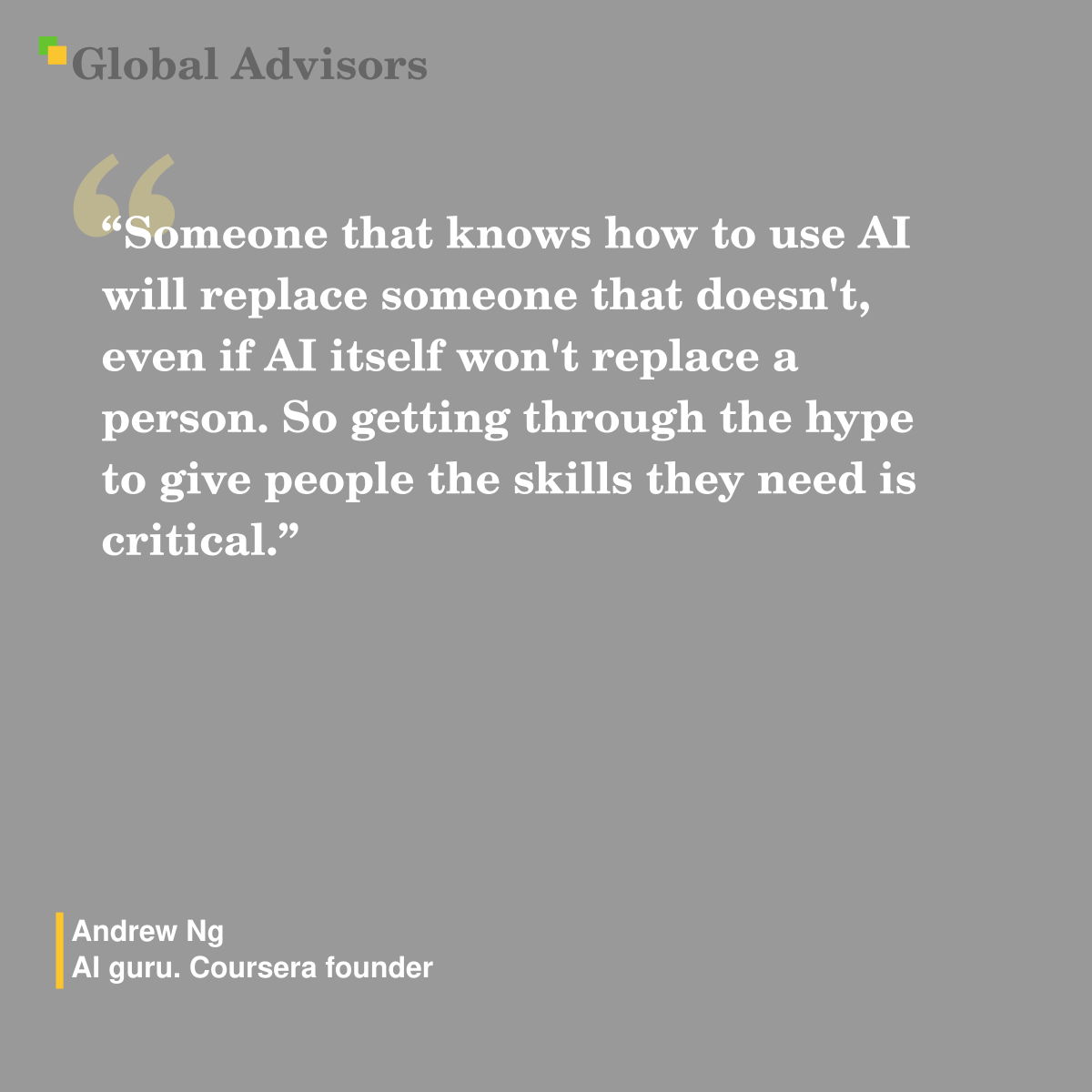
Quote: Andrew Ng - AI guru, Coursera founder"Someone that knows how to use AI will replace someone that doesn't, even if AI itself won't replace a person. So getting through the hype to give people the skills they need is critical." - Andrew Ng - AI guru, Coursera founderThe distinction Andrew Ng draws between AI replacing jobs and AI-capable workers replacing their peers represents a fundamental reorientation in how we should understand technological disruption. Rather than framing artificial intelligence as an existential threat to employment, Ng's observation-articulated at the World Economic Forum in January 2026-points to a more granular reality: the competitive advantage lies not in the technology itself, but in human mastery of it. The Context of the StatementNg made these remarks during a period of intense speculation about AI's labour market impact. Throughout 2025 and into early 2026, technology companies announced significant workforce reductions, and public discourse oscillated between utopian and apocalyptic narratives about automation. Yet Ng's position, grounded in his extensive experience building AI systems and training professionals, cuts through this polarisation with empirical observation. Speaking at Davos on 19 January 2026, Ng emphasised that "for many jobs, AI can only do 30-40 per cent of the work now and for the foreseeable future." This technical reality underpins his broader argument: the challenge is not mass technological unemployment, but rather a widening productivity gap between those who develop AI competency and those who do not. The implication is stark-in a world where AI augments rather than replaces human labour, the person wielding these tools becomes exponentially more valuable than the person without them. Understanding the Talent ShortageThe urgency behind Ng's call for skills development is rooted in concrete market dynamics. According to research cited by Ng, demand for AI skills has grown approximately 21 per cent annually since 2019. More dramatically, AI jumped from the 6th most scarce technology skill globally to the 1st in just 18 months. Fifty-one per cent of technology leaders report struggling to find candidates with adequate AI capabilities. This shortage exists not because AI expertise is inherently rare, but because structured pathways to acquiring it remain underdeveloped. Ng has observed developers reinventing foundational techniques-such as retrieval-augmented generation (RAG) document chunking or agentic AI evaluation methods-that already exist in the literature. These individuals expend weeks on problems that could be solved in days with proper foundational knowledge. The inefficiency is not a failure of intelligence but of education. The Architecture of Ng's ApproachNg's prescription comprises three interconnected elements: structured learning, practical application, and engagement with research literature. Each addresses a specific gap in how professionals currently approach AI development. Structured learning provides the conceptual scaffolding necessary to avoid reinventing existing solutions. Ng argues that taking relevant courses-whether through Coursera, his own DeepLearning.AI platform, or other institutions-establishes a foundation in proven approaches and common pitfalls. This is not about shortcuts; rather, it is about building mental models that allow practitioners to make informed decisions about when to adopt existing solutions and when innovation is genuinely warranted. Hands-on practice translates theory into capability. Ng uses the analogy of aviation: studying aerodynamics for years does not make one a pilot. Similarly, understanding AI principles requires experimentation with actual systems. Modern AI tools and frameworks lower the barrier to entry, allowing practitioners to build projects without starting from scratch. The combination of coursework and building creates a feedback loop where gaps in understanding become apparent through practical challenges. Engagement with research provides early signals about emerging standards and techniques. Reading academic papers is demanding and less immediately gratifying than building applications, yet it offers a competitive advantage by exposing practitioners to innovations before they become mainstream. The Broader Theoretical ContextNg's perspective aligns with and extends classical economic theories of technological adoption and labour market dynamics. The concept of "skill-biased technological change"-the idea that new technologies increase the relative demand for skilled workers-has been central to labour economics since the 1990s. Economists including David Autor and Frank Levy have documented how computerisation did not eliminate jobs wholesale but rather restructured labour markets, creating premium opportunities for those who could work effectively with new tools whilst displacing those who could not. What distinguishes Ng's analysis is its specificity to AI and its emphasis on the speed of adaptation required. Previous technological transitions-from mechanisation to computerisation-unfolded over decades, allowing gradual workforce adjustment. AI adoption is compressing this timeline significantly. The productivity gap Ng identifies is not merely a temporary friction but a structural feature of labour markets in the near term, creating urgent incentives for rapid upskilling. Ng's work also reflects insights from organisational learning theory, particularly the distinction between individual capability and organisational capacity. Companies can acquire AI tools readily; what remains scarce is the human expertise to deploy them effectively. This scarcity is not permanent-it reflects a lag between technological availability and educational infrastructure-but it creates a window of opportunity for those who invest in capability development now. The Nuance on Job DisplacementImportantly, Ng does not claim that AI poses no labour market risks. He acknowledges that certain roles-contact centre positions, translation work, voice acting-face sharper disruption because AI can perform a higher percentage of the requisite tasks. However, he contextualises these as minority cases rather than harbingers of economy-wide displacement. His framing rejects both technological determinism and complacency. AI will not automatically eliminate most jobs, but neither will workers remain unaffected if they fail to adapt. The outcome depends on human agency: specifically, on whether individuals and institutions invest in building the skills necessary to work alongside AI systems. Implications for Professional DevelopmentThe practical consequence of Ng's analysis is straightforward: professional development in AI is no longer optional for knowledge workers. The competitive dynamic he describes-where AI-capable workers become more productive and thus more valuable-creates a self-reinforcing cycle. Early adopters of AI skills gain productivity advantages, which translate into career advancement and higher compensation, which in turn incentivises further investment in capability development. This dynamic also has implications for organisational strategy. Companies that invest in systematic training programmes for their workforce-ensuring broad-based AI literacy rather than concentrating expertise in specialist teams-position themselves to capture productivity gains more rapidly and broadly than competitors relying on external hiring alone. The Hype-Reality GapNg's emphasis on "getting through the hype" addresses a specific problem in contemporary AI discourse. Public narratives about AI tend toward extremes: either utopian visions of abundance or dystopian scenarios of mass unemployment. Both narratives, in Ng's view, obscure the practical reality that AI is a tool requiring human expertise to deploy effectively. The hype creates two problems. First, it generates unrealistic expectations about what AI can accomplish autonomously, leading organisations to underinvest in the human expertise necessary to realise AI's potential. Second, it creates anxiety that discourages people from engaging with AI development, paradoxically worsening the talent shortage Ng identifies. By reframing the challenge as fundamentally one of skills and adaptation rather than technological inevitability, Ng provides both a more accurate assessment and a more actionable roadmap. The future is not predetermined by AI's capabilities; it will be shaped by how quickly and effectively humans develop the competencies to work with these systems. References 1. https://www.finalroundai.com/blog/andrew-ng-ai-tips-2026 4. https://m.umu.com/ask/a11122301573853762262
|
| |
| |
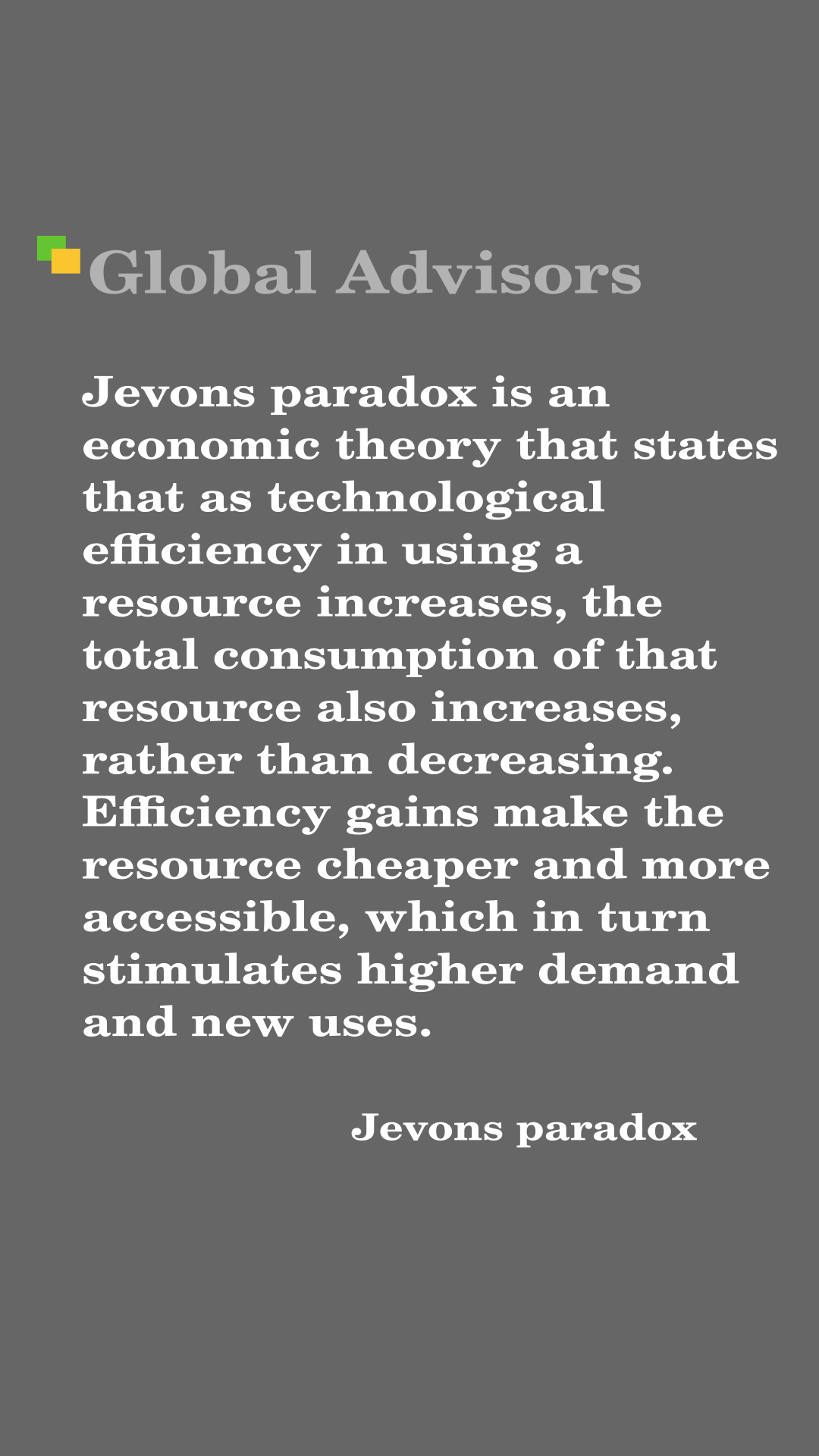
Term: Jevons paradox"Jevons paradox is an economic theory that states that as technological efficiency in using a resource increases, the total consumption of that resource also increases, rather than decreasing. Efficiency gains make the resource cheaper and more accessible, which in turn stimulates higher demand and new uses." - Jevons paradoxDefinitionThe Jevons paradox is an economic theory stating that as technological efficiency in using a resource increases, the total consumption of that resource also increases rather than decreasing. Efficiency gains make the resource cheaper and more accessible, which stimulates higher demand and enables new uses, ultimately offsetting the conservation benefits of the initial efficiency improvement. Core Mechanism: The Rebound EffectThe paradox operates through what economists call the rebound effect. When efficiency improvements reduce the cost of using a resource, consumers and businesses find it more economically attractive to use that resource more intensively. This increased affordability creates a feedback loop: lower costs lead to expanded consumption, which can completely negate or exceed the original efficiency gains. The rebound effect exists on a spectrum. A rebound effect between 0 and 100 percent-known as "take-back"-means actual consumption is reduced but not as much as expected. However, when the rebound effect exceeds 100 percent, the Jevons paradox applies: efficiency gains cause overall consumption to increase absolutely. Historical Origins and William Stanley JevonsThe paradox is named after William Stanley Jevons (1835-1882), an English economist and logician who first identified this phenomenon in 1865. Jevons observed that as steam engine efficiency improved throughout the Industrial Revolution, Britain's total coal consumption increased rather than decreased. He recognised that more efficient steam engines made coal cheaper to use-both directly and indirectly, since more efficient engines could pump water from coal mines more economically-yet simultaneously made coal more valuable by enabling profitable new applications. Jevons' insight was revolutionary: efficiency improvements paradoxically expanded the scale of coal extraction and consumption. As coal became cheaper, incomes rose across the coal-fired industrial economy, and profits were continuously reinvested to expand production further. This dynamic became the engine of industrial capitalism's growth. Contemporary ExamplesEnergy and Lighting: Modern LED bulbs consume far less electricity than incandescent bulbs, yet overall lighting energy consumption has not decreased significantly. The reduced cost per light unit has prompted widespread installation of additional lights-in homes, outdoor spaces, and seasonal displays-extending usage hours and offsetting efficiency gains. Transportation: Vehicles have become substantially more fuel-efficient, yet total fuel consumption continues to rise. When driving becomes cheaper, consumers afford to drive faster, further, or more frequently than before. A 5 percent fuel efficiency gain might reduce consumption by only 2 percent, with the missing 3 percent attributable to increased driving behaviour. Systemic Scale: Research from 2007 suggested the Jevons paradox likely exists across 18 European countries and applies not merely to isolated sectors but to entire economies. As efficiency improvements reduce production costs across multiple industries, economic growth accelerates, driving increased extraction and consumption of natural resources overall. Factors Influencing the Rebound EffectThe magnitude of the rebound effect varies significantly based on market maturity and income levels. In developed countries with already-high resource consumption, efficiency improvements produce weaker rebound effects because consumers and businesses have less capacity to increase usage further. Conversely, in developing economies or emerging markets, the same efficiency gains may trigger stronger rebound effects as newly affordable resources enable expanded consumption patterns. Income also influences the effect: higher-income populations exhibit weaker rebound effects because they already consume resources at near-saturation levels, whereas lower-income populations may dramatically increase consumption when efficiency makes resources more affordable. The Paradox Beyond EnergyThe Jevons paradox extends beyond energy and resources. The principle applies wherever efficiency improvements reduce costs and expand accessibility. Disease control advances, for instance, have enabled humans and livestock to live at higher densities, eventually creating conditions for more severe outbreaks. Similarly, technological progress in production systems-including those powering the gig economy-achieves higher operational efficiency, making exploitation of natural inputs cheaper and more manageable, yet paradoxically increasing total resource demand. Implications for SustainabilityThe Jevons paradox presents a fundamental challenge to conventional sustainability strategies that rely primarily on technological efficiency improvements. Whilst efficiency gains lower costs and enhance output, they simultaneously increase demand and overall resource consumption, potentially increasing pollution and environmental degradation rather than reducing it. Addressing the paradox requires systemic approaches beyond efficiency alone. These include transitioning towards circular economies, promoting sharing and collaborative consumption models, implementing legal limits on resource extraction, and purposefully constraining economic scale. Some theorists argue that setting deliberate limits on resource use-rather than pursuing ever-greater efficiency-may be necessary to achieve genuine sustainability. As one perspective suggests: "Efficiency makes growth. But limits make creativity." Contemporary RelevanceIn the 21st century, as environmental pressures intensify and macroeconomic conditions suggest accelerating expansion rates, the Jevons paradox has become increasingly pronounced and consequential. The principle now applies to emerging technologies including artificial intelligence, where computational efficiency improvements may paradoxically increase overall energy demand and resource consumption as new applications become economically viable. References 2. https://www.resilience.org/stories/2020-06-17/jevons-paradox/ 3. https://www.youtube.com/watch?v=MTfwhbfMnNc 4. https://lpcentre.com/articles/jevons-paradox-rethinking-sustainability 5. https://news.northeastern.edu/2025/02/07/jevons-paradox-ai-future/ 6. https://adgefficiency.com/blog/jevons-paradox/
|
| |
| |
Quote: Fei-Fei Li - Godmother of AI"Fearless is to be free. It's to get rid of the shackles that constrain your creativity, your courage, and your ability to just get s*t done." - Fei-Fei Li - Godmother of AIContext of the QuoteThis powerful statement captures Fei-Fei Li's philosophy on perseverance in research and innovation, particularly within artificial intelligence (AI). Spoken in a discussion on enduring hardship, Li emphasises how fearlessness liberates the mind in the realm of imagination and hypothesis-driven work. Unlike facing uncontrollable forces like nature, intellectual pursuits allow one to push boundaries without fatal constraints, fostering curiosity and bold experimentation1. The quote underscores her belief that true freedom in science comes from shedding self-imposed limitations to drive progress. Backstory of Fei-Fei LiFei-Fei Li, often hailed as the 'Godmother of AI', is the inaugural Sequoia Professor of Computer Science at Stanford University and a founding co-director of the Stanford Institute for Human-Centered Artificial Intelligence. Her journey began in Chengdu, China, where she was born into a family disrupted by the Cultural Revolution. Her mother, an academic whose dreams were crushed by political turmoil, instilled rebellion and resilience. At 16, Li's brave parents uprooted the family, leaving everything behind for America to offer their daughter better opportunities-far from 'tiger parenting', they encouraged independence amid poverty and cultural adjustment in New Jersey2. Li excelled despite challenges, initially drawn to physics for its audacious questions, a passion honed at Princeton University. There, she learned to ask bold queries of nature, a mindset that pivoted her to AI. Her breakthrough came with ImageNet, a vast visual database that revived computer vision and catalysed deep learning revolutions, enabling systems to recognise images like humans. Today, she champions 'human-centred AI', stressing that people create, use, and must shape AI's societal impact4,5. Li seeks 'intellectual fearlessness' in collaborators-the courage to tackle hard problems fully6. Leading Theorists in AI and FearlessnessLi's ideas echo foundational AI thinkers who embodied fearless innovation:
Li builds on these legacies, shifting focus to ethical, human-augmented AI. She critiques 'single genius' histories, crediting collaborative bravery-like her parents' and Princeton's influence1,4. In the AI age, her call to fearlessness urges scientists and entrepreneurs to embrace uncertainty for humanity's benefit3. References 1. https://www.youtube.com/watch?v=KhnNgQoEY14 2. https://www.youtube.com/watch?v=z1g1kkA1M-8 3. https://mastersofscale.com/episode/how-to-be-fearless-in-the-ai-age/ 4. https://tim.blog/2025/12/09/dr-fei-fei-li-the-godmother-of-ai/ 5. https://www.youtube.com/watch?v=Ctjiatnd6Xk 6. https://www.youtube.com/shorts/hsHbSkpOu2A 7. https://www.youtube.com/shorts/qGLJeJ1xwLI
|
| |

| |
Term: Out-of-the-money option"An out-of-the-money (OTM) option is an option contract that has no intrinsic value, meaning exercising it immediately would result in a loss, making it currently unprofitable but potentially profitable if the underlying asset's price moves favorably before expiration." - Out-of-the-money optionAn out-of-the-money (OTM) option is an options contract that has no intrinsic value at the current underlying price. Exercising it immediately would generate no economic gain and, after transaction costs, would imply a loss, although the option may still be valuable because of the possibility that the underlying price moves favourably before expiry.1,3,5,6,7 Formal definition and moneynessThe moneyness of an option describes the relationship between the option's strike price and the current spot price of the underlying asset. An option can be:
For a single underlying with spot price S and strike price K:
The intrinsic value of standard European options is defined as:
An option is therefore OTM exactly when its intrinsic value equals 0.3,4,5,6 Intrinsic value vs time valueEven though an OTM option has no intrinsic value, it typically still has a positive premium. This premium is then made up entirely of time value (also called extrinsic value):3,5,6
Thus for an OTM option, the option price C (for a call) or P (for a put) satisfies:
Examples of out-of-the-money options
OTM options at and after expiryAt expiry a standard listed option that is out of the money expires worthless. For the buyer this means: For the seller (writer):
Why OTM options still have valueDespite having no intrinsic value, OTM options are often actively traded because:
This makes OTM options attractive for speculative strategies seeking large percentage returns, as well as for hedging tail risks (for example, buying deep OTM puts as crash insurance). However, they have a higher probability of expiring worthless, so most OTM options do not end up being exercised.2,3,5 OTM options in European option valuationFor European-style options - exercisable only at expiry - the value of an OTM option is purely the discounted expected payoff under a risk-neutral measure. In continuous-time models such as Black - Scholes - Merton, even a deeply OTM option has a strictly positive value whenever the time to expiry and volatility are non-zero, because there is always some probability, however small, that the option will finish in the money. In the Black - Scholes - Merton model, the price of a European call option on a non-dividend-paying stock is C = S\,N(d_1) - K e^ N(d_2) and for a European put option P = K e^ N(-d_2) - S\,N(-d_1) where N(\cdot) is the standard normal cumulative distribution, r is the risk-free rate, T is time to maturity, and d_1, d_2 depend on S, K, r, T and volatility \sigma. For OTM options, these formulas yield a positive price driven entirely by time value. Strategic uses of OTM optionsOTM options are integral to many derivatives strategies, for example:
Key risks and considerations
Best related strategy theorists: Fischer Black, Myron Scholes and Robert C. MertonThe concept of an OTM option is fundamental to options pricing theory, and its modern analytical treatment is inseparable from the work of Fischer Black, Myron Scholes and Robert C. Merton, who together developed the Black - Scholes - Merton (BSM) model for pricing European options. Fischer Black (1938 - 1995)Fischer Black was an American economist and partner at Goldman Sachs. Trained originally in physics, he brought a quantitative, model-driven perspective to finance. In 1973 he co-authored the seminal paper "The Pricing of Options and Corporate Liabilities" with Myron Scholes, introducing the continuous-time model that now bears their names. Black's work is central to understanding OTM options because the BSM framework shows precisely how time to expiry, volatility and interest rates generate strictly positive values for options with zero intrinsic value. Within this model, the value of an OTM option is the discounted expected payoff under a lognormal distribution for the underlying asset price. The pricing formulas make clear that an OTM option's value is highly sensitive to volatility and time - a key insight for both hedging and speculative use of OTM contracts. Myron Scholes (b. 1941)Myron Scholes is a Canadian-born American economist and Nobel laureate. After academic posts at institutions such as MIT and Stanford, he became widely known for his role in developing modern options pricing theory. Scholes shared the 1997 Nobel Prize in Economic Sciences with Robert Merton for their method of determining the value of derivatives. Scholes's contribution to the understanding of OTM options lies in demonstrating, together with Black, that one can construct a dynamically hedged portfolio of the underlying asset and a risk-free bond that replicates the option's payoff. This replication argument gives rise to the risk-neutral valuation framework in which the fair value of even a deeply OTM option is derived from the probability-weighted payoffs under a no-arbitrage condition. Under this framework, the distinction between ITM, ATM and OTM options is naturally captured by their different sensitivities ("Greeks") to underlying price and volatility. Robert C. Merton (b. 1944)Robert C. Merton, an American economist and Nobel laureate, independently developed a continuous-time model for pricing options and general contingent claims around the same time as Black and Scholes. His 1973 paper "Theory of Rational Option Pricing" extended and generalised the framework, placing it within a broader stochastic calculus and intertemporal asset pricing context. Merton's work deepened the theoretical foundations underlying OTM option valuation. He formalised the idea that options are contingent claims and showed how their value can be derived from the underlying asset's dynamics and market conditions. For OTM options in particular, Merton's extensions clarified how factors such as dividends, stochastic interest rates and more complex payoff structures affect the time value and hence the price, even when intrinsic value is zero. Relationship between their theory and out-of-the-money optionsTogether, Black, Scholes and Merton transformed the treatment of OTM options from a qualitative notion - "currently unprofitable to exercise" - into a rigorously quantified object embedded in a complete market model. Their work explains:
While many other theorists have extended option pricing and trading strategy - including researchers in stochastic volatility, jumps and behavioural finance - the work of Black, Scholes and Merton remains the core reference point for understanding, valuing and deploying out-of-the-money options in both academic theory and practical derivatives markets. References 1. https://www.ig.com/en/glossary-trading-terms/out-of-the-money-definition 3. https://www.sofi.com/learn/content/in-the-money-vs-out-of-the-money/ 4. https://smartasset.com/investing/in-the-money-vs-out-of-the-money 5. https://www.avatrade.com/education/market-terms/what-is-otm 6. https://www.interactivebrokers.com/campus/glossary-terms/out-of-the-money/ 7. https://www.fidelity.com/learning-center/smart-money/what-are-options
|
| |

| |
|


| |
| |