| |
|

| |
| |
| |
|
Our selection of the top business news sources on the web. |
| |
| |
| |
Term: Persona InflationPersona inflation, as defined by Carl Jung, refers to the psychological phenomenon where an individual becomes excessively identified with their persona—the social mask or role they present to the world—leading to an inflated sense of self that is cut off from deeper, more authentic layers of the psyche. The persona is the social mask we create to meet external expectations. When we identify with it—“I am the CEO, the star, the influencer”—the ego becomes inflated, cut off from shadow and Self. Jung’s Concept of the PersonaJung introduced the concept of the persona as the mask or identity we adopt to meet the expectations and norms of society. It acts as a kind of psychological armor, allowing us to function in social roles—such as the CEO, the star, or the influencer. However, this mask is not our true self; it is a construct designed to navigate external realities. Backstory: How Persona Inflation Occurs
Symptoms and Societal Implications
Jung’s Warning and the Path to WholenessJung consistently warned about the dangers of inflation, emphasizing that it is not always consciously felt; often, its presence is best inferred from symptoms like arrogance, extreme defensiveness, or the reactions of others. The antidote lies in differentiating between the persona and the deeper Self, integrating unconscious elements, and maintaining humility. This ongoing process leads to greater psychological health and authentic living. In summary, persona inflation is the over-identification with one’s social mask, resulting in an ego that is inflated and disconnected from one’s deeper self, relationships, and authentic human experience. Jung saw this as a common but perilous condition, especially prevalent in environments that reward surface performance over genuine self-knowledge
|
| |
| |
Quote: Jeffrey E. Young - the creator of schema therapy and a transformative figure in modern psychology“You have to face the lifetrap head-on and understand it. Change also requires discipline. You have to systematically observe and change behaviors every day. Change cannot be hit-or-miss. It requires constant practice.” - Jeffrey E. Young - the creator of schema therapy and a transformative figure in modern psychologyJeffrey Young developed schema therapy in response to the limitations he observed in traditional forms of cognitive behavioral therapy, particularly with clients experiencing chronic, deeply rooted emotional difficulties. After studying at Yale University and the University of Pennsylvania—and completing postdoctoral work under Aaron Beck, the father of CBT—Young realized that many people struggle with what he called “lifetraps,” now more widely known as early maladaptive schemas.These are enduring, self-defeating emotional and cognitive patterns established in childhood, usually due to unmet core emotional needs. Young’s work led him to found the Schema Therapy Institute, where he and his colleagues developed integrative methods that blend cognitive, attachment, psychodynamic, and experiential approaches. Central to schema therapy is the insight that awareness alone isn’t enough—patients must actively and systematically challenge and change their ingrained reactions and beliefs. “Lifetraps” or schemas can’t be altered by insight alone; they demand disciplined, daily effort to observe one's thoughts and behaviors and to practice new, healthier ways of responding to life’s challenges. This quote distills Young’s belief that enduring change is a process, not a single event: it requires direct confrontation with one’s schemas, daily self-observation, disciplined practice, and persistence. The path to change, as Young outlines in both his professional texts (Schema Therapy) and his bestselling self-help book (Reinventing Your Life), is structured, intentional, and ongoing—a philosophy that has helped millions worldwide recognize and heal their deepest emotional wounds. Leading with EMS or Leading Those with EMSIn leadership and workplace settings, understanding EMS has profound implications. Leaders with unaddressed schemas may unconsciously enact patterns such as perfectionism, avoidance, mistrust, or overcompensation, which can undermine their effectiveness and harm team dynamics. For instance, a leader with an "unrelenting standards" schema might push themselves and their team too hard, causing burnout and resentment. Conversely, an "abandonment" schema might result in over-accommodation or difficulty setting boundaries, diminishing authority and clarity. Leading individuals with EMS requires attunement, clear boundaries, and consistent, compassionate communication. It is important to recognize when an employee's reactions may stem from deep-seated patterns rather than surface-level conflicts or incompetence. Effective leaders:
Leaders who are aware of EMS—in themselves and in others—can foster a work environment that supports psychological growth, resilience, and healthy relational patterns. This not only improves individual well-being but also enhances collective performance, creativity, and loyalty. Ultimately, addressing EMS in the workplace is about creating a culture where people can move beyond self-defeating patterns and realize their full potential, both individually and as part of a team About Jeffrey Young
This quote embodies the core message and method of schema therapy: change is possible, but only through purposeful, disciplined, and sustained action.
|
| |
| |
Term: Early Maladaptive SchemasEarly maladaptive schemas are deeply ingrained patterns of thinking and feeling about oneself and one’s relationships, originating in childhood or adolescence and persisting into adulthood in dysfunctional way. The concept is foundational to Schema Therapy, introduced and developed by psychologist Jeffrey Young in the 1990s. Young and colleagues defined these schemas as “broad, pervasive themes regarding oneself and one's relationship with others, developed during childhood and elaborated throughout one's lifetime, and dysfunctional to a significant degree." Backstory and Major Analysts
How This Plays Out in LifeThe effects of early maladaptive schemas permeate multiple domains: Life and Choice
Relationships
Careers and Work
Illustration with ExamplesA psychology student who experienced critical parenting may develop an unrelenting standards schema, perpetually pushing themselves out of fear they will never measure up. In relationships, a history of emotional neglect may result in a social isolation schema, prompting avoidance of social connection and reinforcing loneliness. Schema Therapy aims to identify these schemas and shift the underlying patterns, promoting healthier ways of thinking and relating to oneself and others. In summary: Early maladaptive schemas are enduring, self-defeating patterns shaped by early adversity, described and categorized by Jeffrey Young and other schema therapy analysts. They have far-reaching effects on personal choices, relationships, careers, and psychological health, underpinning many persistent emotional and behavioral problems throughout life
|
| |

| |
Term: Downward spiralThe "Downward Spiral" conveys the self-reinforcing nature of decline, where negative outcomes trigger further negative effects, creating a vicious cycle that accelerates organizational or business deterioration. Description in Strategy Context: A downward spiral (or death spiral) is a self-perpetuating cycle in which a series of negative events and poor decisions reinforce each other, leading a business or organization into deeper trouble with each iteration. Here’s how it typically unfolds:
The death spiral is not only a business phenomenon; it also appears in organizational health, team dynamics, and even sectors facing structural disruption. Examples include companies that fail to adapt to market changes, cut back on innovation, or repeatedly lose top talent—each bad outcome sets up the next. Systems thinking frames this as a “cycle of disinvestment or deterioration,” where short-term fixes and narrow thinking deplete the core strengths of the organization, making it ever harder to recover. Related Strategic Thinker: Peter Senge Senge, through his influential book The Fifth Discipline, pioneered the use of systems thinking in organizations, identifying and describing “reinforcing feedback loops”—the underlying structure of both virtuous and vicious (downward) cycles. He showed how, left unchecked, these loops could create powerful forces driving either sustained growth or relentless decline.
|
| |
| |
Term: Virtuous cycleA virtuous cycle is a self-reinforcing loop in which a series of positive actions and outcomes continually strengthen each other, leading to sustained growth and improvement over time. In business, this means one beneficial event—such as improved performance or cost savings—leads to additional positive effects, such as increased customer acquisition or higher profits. The momentum generated by these reinforcing outcomes creates an upward spiral where each gain fuels the next, resulting in exponential growth and long-term success. A classic example is Amazon’s business model: lower operating costs enable reduced prices, which attract more customers. Increased sales generate higher profits, which can then be reinvested in further efficiencies—perpetuating the cycle. Similarly, when a company reinvests profits from top-line growth into innovation or market expansion, it triggers a renewed cycle of revenue increases and competitive advantage. Key characteristics of a virtuous cycle:
The best-related strategy theorist for the virtuous cycle is Jim Collins. His influential work, particularly in the book Good to Great, describes how companies create "flywheels"—a metaphor for virtuous cycles—where small, consistent efforts build momentum and translate into extraordinary, sustained results. Collins’ articulation of the flywheel effect precisely captures the mechanics of building and maintaining a virtuous cycle within organizations.
|
| |

| |
Term: AI InferenceAI inference refers to the process in which a trained artificial intelligence (AI) or machine learning model analyzes new, unseen data to make predictions or decisions. After a model undergoes training—learning patterns, relationships, or rules from labeled datasets—it enters the inference phase, where it applies that learned knowledge to real-world situations or fresh inputs. This process typically involves the following steps:
AI inference is fundamental because it operationalizes AI, enabling it to be embedded into real-time applications such as voice assistants, autonomous vehicles, medical diagnosis tools, and fraud detection systems. Unlike the resource-intensive training phase, inference is generally optimized for speed and efficiency—especially important for tasks on edge devices or in situations requiring immediate results. As generative and agent-based AI applications mature, the demand for faster and more scalable inference is rapidly increasing, driving innovation in both software and hardware to support these real-time or high-volume use cases. A major shift in AI inference is occurring as new elements—such as test time compute (TTC), chain-of-thought reasoning, and adaptive inference—reshape how and where computational resources are allocated in AI systems. Expanded Elements in AI Inference
Impact: Shift in Compute from Training to Inference
These advancements in test time compute and reasoned inference mark a pivotal transformation in AI, moving from static, single-pass prediction to dynamic, adaptive, and resource-efficient problem-solving at the moment of inference. Related strategy theorist: Yann LeCun Yann LeCun is widely recognized as a pioneering theorist in neural networks and deep learning—the foundational technologies underlying modern AI inference. His contributions to convolutional neural networks and strategies for scalable, robust AI learning have shaped the current landscape of AI deployment and inference capabilities.
Yann LeCun is a French-American computer scientist and a foundational figure in artificial intelligence, especially in the areas of deep learning, computer vision, and neural networks. Born on July 8, 1960, in Soisy-sous-Montmorency, France, he received his Diplôme d'Ingénieur from ESIEE Paris in 1983 and earned his PhD in Computer Science from Sorbonne University (then Université Pierre et Marie Curie) in 1987. His doctoral research introduced early methods for back-propagation in neural networks, foreshadowing the architectures that would later revolutionize AI. LeCun began his research career at the Centre National de la Recherche Scientifique (CNRS) in France, focusing on computer vision and image recognition. His expertise led him to postdoctoral work at the University of Toronto, where he collaborated with other leading minds in neural networks. In 1988, he joined AT&T Bell Laboratories in New Jersey, eventually becoming head of the Image Processing Research Department. There, LeCun led the development of convolutional neural networks (CNNs), which became the backbone for modern image and speech recognition systems. His technology for handwriting and character recognition was widely adopted in banking, reading a significant share of checks in the U.S. in the early 2000s. LeCun also contributed to the creation of DjVu, a high-efficiency image compression technology, and the Lush programming language. In 2003, he became a professor at New York University (NYU), where he founded the NYU Center for Data Science, advancing interdisciplinary AI research. In 2013, LeCun became Director of AI Research at Facebook (now Meta), where he leads the Facebook AI Research (FAIR) division, focusing on both theoretical and applied AI at scale. His leadership at Meta has pushed forward advancements in self-supervised learning, agent-based systems, and the practical deployment of deep learning technologies. LeCun, along with Yoshua Bengio and Geoffrey Hinton, received the 2018 Turing Award—the highest honor in computer science—for his pioneering work in deep learning. The trio is often referred to as the "Godfathers of AI" for their collective influence on the field. Yann LeCun’s Thinking and ApproachLeCun’s intellectual focus is on building intelligent systems that can learn from data efficiently and with minimal human supervision. He strongly advocates for self-supervised and unsupervised learning as the future of AI, arguing that these approaches best mimic how humans and animals learn. He believes that for AI to reach higher forms of reasoning and perception, systems must be able to learn from raw, unlabeled data and develop internal models of the world. LeCun is also known for his practical orientation—developing architectures (like CNNs) that move beyond theory to solve real-world problems efficiently. His thinking consistently emphasizes the importance of scaling AI not just through bigger models, but through more robust, data-efficient, and energy-efficient algorithms. He has expressed skepticism about narrow, brittle AI systems that rely heavily on supervised learning and excessive human labeling. Instead, he envisions a future where AI agents can learn, reason, and plan with broader autonomy, similar to biological intelligence. This vision guides his research and strategic leadership in both academia and industry. LeCun remains a prolific scientist, educator, and spokesperson for responsible and open AI research, championing collaboration and the broad dissemination of AI knowledge.
|
| |
| |
Term: AI AgentsAI Agents are autonomous software systems that interact with their environment, perceive data, and independently make decisions and take actions to achieve specific, user-defined goals. Unlike traditional software, which follows static, explicit instructions, AI agents are guided by objective functions and have the ability to reason, learn, plan, adapt, and optimize responses based on real-time feedback and changing circumstances. Key characteristics of AI agents include:
Examples include virtual assistants that manage calendars or customer support, code-review bots in software development, self-driving cars navigating traffic, and collaborative agents that orchestrate business processes. Related Strategy Theorist - Stuart Russell As a renowned AI researcher and co-author of the seminal textbook "Artificial Intelligence: A Modern Approach," Russell has shaped foundational thinking on agent-based systems and rational decision-making. He has also been at the forefront of advocating for the alignment of agent objectives with human values, providing strategic frameworks for deploying autonomous agents safely and effectively across industries.
|
| |

| |
Term: Artificial General Intelligence (AGI)Artificial General Intelligence (AGI) is defined as a form of artificial intelligence that can understand, learn, and apply knowledge across the full spectrum of human cognitive tasks—matching or even exceeding human capabilities in any intellectual endeavor. Unlike current artificial intelligence systems, which are typically specialized (known as narrow AI) and excel only in specific domains such as language translation or image recognition, AGI would possess the versatility and adaptability of the human mind.
Alternative Name – Superintelligence: Key contrasts between AGI and (narrow) AI:
Strategy Theorist — Ilya Sutskever: Ilya Sutskever’s views on the impact of superintelligence are characterized by a blend of optimism for its transformative potential and deep caution regarding its unpredictability and risks. Sutskever believes superintelligence could revolutionize industries, particularly healthcare, and deliver unprecedented economic, social, and scientific breakthroughs within the next decade. He foresees AI as a force that can solve complex problems and dramatically extend human capabilities. For business, this implies radical shifts: automating sophisticated tasks, generating new industries, and redefining competitive advantages as organizations adapt to a new intelligence landscape. However, Sutskever consistently stresses that the rise of superintelligent AI is “extremely unpredictable and unimaginable,” warning that its self-improving nature could quickly move beyond human comprehension and control. He argues that while the rewards are immense, the risks—including loss of human oversight and the potential for misuse or harm—demand proactive, ethical, and strategic guidance. Sutskever champions the need for holistic thinking and interdisciplinary engagement, urging leaders and society to prepare for AI’s integration not with fear, but with ethical foresight, adaptation, and resilience. He has prioritized AI safety and “superalignment” as central to his strategies, both at OpenAI and through his new Safe Superintelligence venture, actively seeking mechanisms to ensure that the economic and societal gains from superintelligence do not come at unacceptable risks. Sutskever’s message for corporate leaders and policymakers is to engage deeply with AI’s trajectory, innovate responsibly, and remain vigilant about both its promise and its perils. In summary, AGI is the milestone where machines achieve general, human-equivalent intelligence, while superintelligence describes a level of machine intelligence that greatly surpasses human performance. The pursuit of AGI, championed by theorists like Ilya Sutskever, represents a profound shift in both the potential and challenges of AI in society.
|
| |

| |
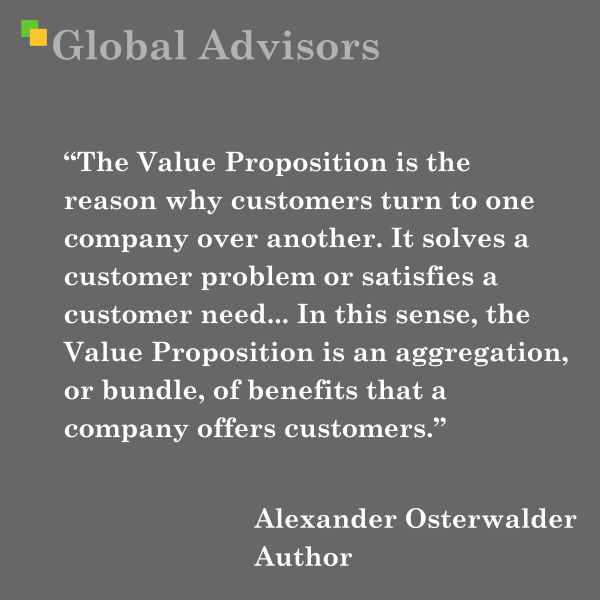
Quote: Alexander Osterwalder - Author“The Value Proposition is the reason why customers turn to one company over another. It solves a customer problem or satisfies a customer need. Each Value Proposition consists of a selected bundle of products and/or services that caters to the requirements of a specific Customer Segment. In this sense, the Value Proposition is an aggregation, or bundle, of benefits that a company offers customers.”
|
| |
| |
Term: Value PropositionValue Proposition is a foundational concept in business strategy and marketing, defined as a clear, concise statement that explains how a product or service solves customers’ problems or improves their situation, highlights the specific benefits delivered, and articulates why customers should choose it over competitors’ offerings. It communicates the unique value a company promises to deliver to its target customer segment, combining both tangible and intangible benefits, and serves as a primary differentiator in the marketplace. Related Strategy Theorist: A strong value proposition is:
It typically answers four key questions:
Developing a value proposition is central to a company’s overall business strategy, influencing marketing, product development, and customer experience. Unlike mere slogans or catchphrases, a true value proposition clearly delivers the company’s core offer and competitive advantage.
|
| |

| |
|


| |
| |