| |
|

| |
| |
| |
|
Our selection of the top business news sources on the web. |
| |
| |
| |
Quote: Fear, Kahlil Gibran - Lebanese-American writer, poet and visual artist"But there is no other way. The river cannot go back. Nobody can go back. To go back is impossible in existence. The river needs to take the risk of entering the ocean because only then will the fear disappear, because that's when the river will know it's not about disappearing into the ocean, but of becoming the ocean." - Fear, Kahlil Gibran - Lebanese-American writer, poet and visual artist The passage rests on a deceptively simple observation: certain thresholds, once crossed, cannot be uncrossed. This is not metaphorical hand-waving but a statement about the structure of existence itself. Gibran identifies a fundamental asymmetry in time and causation-the arrow that points only forward. The river cannot reverse its flow; the individual cannot unknow what has been learned; the self cannot return to its previous configuration after genuine transformation. This irreversibility is not a tragedy to be mourned but the precise mechanism by which fear loses its grip. The psychological mechanism at work here operates through a specific pathway. Fear, in Gibran's framework, derives much of its power from the illusion of reversibility. The anxious mind contemplates the unknown threshold-the ocean, the new job, the relationship, the creative commitment-and imagines that if things go wrong, one can simply retreat to the familiar territory. This fantasy of escape routes sustains the paralysis. The mind oscillates between two states: the discomfort of the present situation and the imagined safety of return. As long as both options seem available, the cost-benefit calculation remains suspended. The person remains trapped in what psychologists now call "approach-avoidance conflict," where simultaneous attraction and repulsion create immobility. Gibran's insight cuts through this paralysis by naming the actual condition: there is no return. The river has already been flowing; the mountain peaks are already behind; the forests and villages have already been traversed. The present moment is not a choice point between two equally viable futures but a recognition of a trajectory already in motion. The only genuine choice is whether to acknowledge this reality or to waste energy on the fantasy of reversal. Once this is accepted-truly accepted, not merely intellectually assented to-the fear transforms. It does not vanish instantly, but its character changes fundamentally. The Dissolution of Fear Through Acceptance of Necessity The passage distinguishes between two types of fear. The first is the fear that accompanies genuine uncertainty about outcomes: Will I survive the transition? Will I change for better or worse? Will I lose my identity? These are legitimate questions about an unknowable future. The second type of fear is the fear that arises from the fantasy of escape-the belief that one can avoid the threshold altogether. This second fear is parasitic on the first; it feeds on the illusion that the choice is between transformation and stasis, when in fact the choice is between conscious transformation and unconscious drift. Gibran's formulation-"To go back is impossible in existence"-operates as a kind of philosophical reset. It removes from consideration an entire category of options that were never actually available. This is not pessimism; it is clarity. The relief that follows this recognition is not the relief of getting what one wants, but the relief of ceasing to want what is impossible. The energy previously devoted to fantasising about escape becomes available for engagement with the actual situation. The distinction Gibran draws between "disappearing into the ocean" and "becoming the ocean" is crucial here . The fear typically imagines the first scenario: the river loses itself, its identity dissolves, it ceases to exist as a distinct entity. This is the catastrophic narrative that sustains paralysis. But Gibran proposes a different metaphysical claim. The river does not disappear; it transforms. It becomes something larger, not by ceasing to be itself but by recognising that its essential nature-flowing water-is not diminished but amplified and extended through union with the ocean. The river's identity is not erased; it is completed. This reframing addresses a specific psychological mechanism: the fear of identity loss. Many people resist necessary transitions because they have constructed a self-concept around their current circumstances. The student fears becoming a professional because "student" is their identity. The employee fears entrepreneurship because they have internalised the role of subordinate. The person in a failing relationship fears solitude because they have defined themselves through partnership. In each case, the transition is experienced as annihilation rather than evolution. Gibran's metaphor suggests that this is a misunderstanding of what identity actually is. Identity is not a fixed container that will be shattered by change; it is a process that continues and deepens through transformation. The Strategic Function of Irreversibility There is a strategic dimension to Gibran's argument that deserves explicit attention. In decision theory and game theory, irreversibility is typically treated as a cost. Options that can be reversed are more valuable than options that cannot, all else being equal. This is why real options theory assigns value to flexibility and why organisations often prefer reversible experiments to irreversible commitments. From this perspective, Gibran's insistence on irreversibility seems to be emphasising a disadvantage. But Gibran is making a different point. He is arguing that the attempt to preserve reversibility is itself the trap. The person who enters the ocean while mentally rehearsing their escape route is not actually entering the ocean; they are standing at the shore, half-committed, divided in attention and energy. The fear does not diminish because the mind is still operating in the fantasy of return. Only when the reversibility is genuinely accepted as impossible-not as a tragedy but as a liberation-does the fear lose its primary fuel. This has profound implications for how we approach transformative decisions. The conventional wisdom suggests that one should minimise risk by keeping options open, by maintaining flexibility, by ensuring that one can always go back. But Gibran suggests that this strategy is self-defeating when applied to psychological and existential transitions. The person who commits fully-who accepts the irreversibility-actually experiences less fear than the person who tries to hedge their bets. The hedging itself is the source of the anxiety. This is not an argument for recklessness. Gibran is not suggesting that one should enter the ocean without preparation or without understanding the risks. The river has already travelled from the mountains through forests and villages; it has accumulated experience and momentum. The point is that once the decision to enter has been made, the attempt to preserve an escape route is counterproductive. It divides the self and prevents the full engagement that transformation requires. The Paradox of Becoming The passage contains a subtle paradox that reveals something important about the nature of growth. Gibran suggests that fear disappears precisely when the river stops trying to preserve itself and accepts its dissolution into something larger. Yet this acceptance is not passive resignation; it is an active recognition that becoming the ocean is not a loss but a completion. The river's essence-its flowing nature, its capacity to nourish, its movement toward union-is not negated but fulfilled through the transition. This paradox resolves when we recognise that there are two different senses of "self" at work. There is the ego-self, the constructed identity that clings to familiar patterns and resists change. This self does indeed dissolve in genuine transformation. But there is also the deeper self, the essential nature or capacity that continues and evolves through all transformations. The river's essence is not "being a river" in the narrow sense of maintaining a particular form; it is the capacity to flow, to move, to connect. This capacity is not lost in the ocean; it is expanded and deepened. Gibran's insight aligns with what contemporary psychology calls "ego death" or what contemplative traditions describe as the dissolution of the separate self. The fear that accompanies this process is real and significant. But Gibran argues that the fear is based on a misunderstanding. What is being lost is not the self but a particular, limited conception of the self. What is being gained is a larger, more accurate understanding of what one actually is. The Practical Consequence The implications of this analysis extend far beyond poetic metaphor. In practical terms, Gibran is describing a specific psychological mechanism that operates in every significant life transition: career changes, relationship endings and beginnings, geographical relocations, creative commitments, spiritual awakenings, and identity shifts of all kinds. In each case, the person stands at a threshold, trembling with fear, looking back at the familiar path and forward at an ocean that seems to promise dissolution. The conventional response to this fear is to seek reassurance: guarantees that things will work out, evidence that others have succeeded, strategies to minimise risk. These responses have their place, but they do not address the core issue that Gibran identifies. The core issue is not the uncertainty of outcomes but the fantasy of reversibility. As long as the mind is divided between commitment and escape, the fear will persist. Gibran's prescription is radical in its simplicity: accept the irreversibility. Not as a defeat but as a liberation. Not as a loss but as a recognition of what is actually true. The river cannot go back. This is not a problem to be solved but a reality to be acknowledged. And in that acknowledgement, something shifts. The energy that was devoted to fantasising about escape becomes available for engagement with the actual transition. The fear does not vanish, but it transforms from a paralyzing force into a signal-a sign that something significant is happening, that the self is being asked to evolve. This is why Gibran insists that the fear will disappear only when the river enters the ocean. Not before, not through reassurance or planning or risk mitigation, but through the act of crossing the threshold itself. The fear is not overcome by avoiding the transition; it is overcome by moving through it with full awareness and acceptance of its irreversibility. The river becomes the ocean not by ceasing to flow but by flowing fully into what it was always becoming.
|
| |

| |
Term: Trade Spend - FMCG / CPG"Trade spend refers to the funds FMCG manufacturers pay to retailers, distributors, and channel partners to promote products and drive sales at the store level. It includes promotional discounts, off-invoice allowances, rebates, display fees, and slotting allowances, and often represents the second-largest expense for a consumer goods company." - Trade Spend - FMCG / CPG Competitive consumer goods markets are won or lost at the shelf. Brands fight for visibility, volume, and retailer support using financial incentives that reshape prices, margins, and shopper behaviour. The sums involved are vast: trade budgets frequently absorb 10-20 % of revenue, and for many brands this is the second-largest line on the profit and loss statement after cost of goods sold. Yet a large share of that money fails to generate profitable growth, either because it is poorly targeted, poorly measured, or structurally misaligned with retailer and shopper incentives. Understanding how these funds flow through the value chain, how they are recorded in financial statements, and how to frame them analytically is essential for any FMCG or CPG company that wants to scale without eroding margins. Trade spend is not a generic marketing cost; it is a negotiated economic architecture for the route to market, with its own metrics, risks, and optimisation challenges. Economic role of trade spend in the FMCG value chain In fast moving consumer goods, most brands do not control the final retail price, the shelf, or the in-store experience. Retailers and distributors own those levers, and they face their own constraints: category margin targets, space limitations, promotional calendars, and traffic objectives. Trade spend is the primary mechanism through which brands influence those retailer decisions. In practice, these funds pay for three broad outcomes at store level: - Access: getting listings, overcoming delisting risk, and entering new banners, regions, or channels. - Visibility: securing end-caps, secondary placements, eye-level shelf positions, and feature advertising in circulars or digital flyers. - Price and activation: funding discounts, multi-buy offers, coupons, and in-store activation that change price perception, basket size, and trial. Because these payments are negotiated customer by customer and are often embedded in complex deals spanning multiple programmes and time periods, they blur the line between structural terms (ongoing discounts or allowances) and tactical promotions (short bursts of activity). That complexity is what makes trade spend both powerful and dangerous: it can build long-term presence, but it can also entrench value leakage that becomes hard to reverse. Main forms of trade spend Although terminology varies across markets and retailers, the major forms of trade spend share a few core characteristics: they are conditional on trading relationships, linked to volume or merchandising commitments, and negotiated as part of customer terms. Key categories include: - Promotional discounts and off-invoice allowances: Price reductions granted to the retailer on a particular shipment or over a promotional period. These may be structured as a percentage off list price, a fixed amount per unit, or a lump-sum budget tied to a promotion plan. - Bill-back and scan-based promotions: Programmes where the retailer sells to consumers at a discount during a defined period and later invoices the manufacturer for the difference between base and promoted prices, often based on scanned sales data. - Rebates and growth incentives: Retroactive payments based on reaching volume, revenue, or share targets over a quarter or year. These are often tiered, creating powerful marginal incentives around thresholds. - Display, end-cap, and feature fees: Payments for premium in-store or online visibility, such as end-of-aisle displays, power wings, front-of-store placements, or inclusion in retailer media and circulars. - Slotting allowances and listing fees: Upfront or annual fees to secure shelf space or launch new products. These compensate retailers for space, risk, and resetting costs. - Joint marketing and co-op advertising: Budgets co-funded with retailers for advertising, digital media, loyalty offers, and shopper marketing, often tied to agreed activity plans. - Non-working trade and deductions: Items that consume trade budgets but do not directly influence the shopper, such as spoilage allowances, damage, compliance penalties, and administrative fees. Some organisations separate these into "working" trade spend, which directly affects consumer purchase decisions at the shelf, and "non-working" trade spend, which is necessary to maintain distribution but does not change shopper behaviour. That distinction matters in ROI analysis; two brands with similar headline trade rates can have very different commercial effectiveness if one allocates more to working activities that drive incremental volume. Financial treatment and P&L implications How trade spend is recorded has a material impact on reported revenue, gross margin, and marketing ratios. Conceptually, it helps to split trade spend into price-based and out-of-pocket components. - Price-based mechanics include discounts, allowances, and free product. These reduce the effective selling price and therefore are typically netted against gross sales to arrive at net revenue, or in some cases recorded partly in cost of goods if free product is involved. - Out-of-pocket mechanics, such as display fees, in-store demos, and co-op advertising, are cash outlays recorded in selling and marketing expenses rather than as revenue deductions. Mixing these indiscriminately can obscure true performance. A company that nets everything against revenue may appear to have lower operating expenses but also lower gross margin, while another that classifies a large share as marketing may show stronger gross margin but higher selling costs. For internal decision-making, what matters is the economic reality: how much value is being transferred to the channel, and what incremental net profit does that transfer generate. Because trade spend often sits at the intersection of sales, finance, and marketing, governance is critical. Inconsistent classification, weak accrual processes, and poor documentation of agreements with retailers can lead to surprise deductions, disputes, and restatements. Robust trade promotion management processes require clear policies on which activities qualify as trade spend, how they are booked, and what level of approval is required for new programmes and terms. Core metrics and mathematical specification The central discipline metric in trade management is the trade rate, which expresses trade spend as a share of the revenue it supports. In its simplest form, the period trade rate is: where is total trade spend over a period, and is gross revenue (before trade deductions) over the same period. Expressed as a percentage, provides a normalised measure that can be compared across time, customers, channels, or markets. Two further metrics are widely used: - Net revenue: , where denotes the component of trade spend that is treated as a reduction in revenue (price-based trade). This is the basis for assessing net price realisation. - Blended trade rate: , where includes both price-based and out-of-pocket trade components. This gives a full economic view of channel investment intensity. For programme-level analysis, the focus shifts to incremental volume, margin, and return on investment. Let be the incremental volume attributable to a specific trade activity, the contribution margin per unit at base price, and the cost of the activity (including associated trade spend). A simple promotion ROI metric is: This formulation makes explicit that profitable trade spend requires incremental contribution exceeding the cost of the investment. If is overestimated or if the promotion simply shifts purchases forward in time without growing the category or brand, then the true ROI can be sharply negative even when headline volume appears strong. More advanced models treat baseline and promoted demand separately, using time-series or panel data to estimate the lift function. For example, letting be baseline volume and promoted volume, one might model promoted demand as , where is promoted price, is merchandising support (such as display presence), and is deal depth or discount level. Estimating using regression or machine learning enables scenario analysis for deal depth, duration, and mechanics across customer segments. Planning and managing trade spend over the cycle Effective management requires a structured cycle covering planning, execution, reconciliation, and learning, typically anchored in a trade calendar that spans all key retailers and channels. Planning and budgeting. Most FMCG companies start with a top-down trade budget as a percentage of forecast revenue, informed by category norms and strategic priorities. This is then cascaded to regions, channels, and customers. A good plan connects trade allocations to explicit objectives: gaining distribution, defending share, accelerating a brand launch, or shifting mix towards higher-margin packs. Scenario planning is essential: different combinations of depth, frequency, and mechanics should be stress-tested for their impact on net revenue and margin. Programme design. At customer level, trade programmes combine tactics such as temporary price reductions, multi-buy offers, and feature/display packages. Design choices should account for elasticity, cannibalisation, stockpiling behaviour, and competitive intensity. Many brands now use guidelines derived from analytics, such as minimum ROI thresholds, preferred discount bands, or rules limiting back-to-back promotions that condition shoppers to wait for deals. Execution and compliance. Even the best-designed promotions fail if they are not executed as agreed. Compliance tracking relies on point-of-sale data, store audits, and retailer reporting to check whether mechanics, dates, and display conditions were met. For digital channels, execution metrics include search share, click-through rates, and conversion under sponsored placements and retail media buys. Reconciliation and deduction management. After execution, manufacturers must reconcile invoices, credit notes, and deductions against planned programmes. This process often surfaces discrepancies between what was agreed and what retailers claim in arrears, especially for retrospective rebates, unsaleables, and shortages. Dedicated deduction management, with clear documentation of promotions and contracts, is critical to avoid silent leakage. Post-event analysis. Finally, each major promotion or programme should be evaluated ex post. This involves isolating incremental volume versus baseline, estimating mix effects, and calculating net profit after factoring in trade costs, supply chain costs, and any halo or post-promotion dip. The results feed back into future planning, refining guidelines and customer strategies. Analytics, data, and the push for evidence-based trade Given the scale of budgets involved, trade spend has become a prime target for analytics-driven optimisation. This shift hinges on better data and more sophisticated modelling techniques. On the data side, companies are increasingly integrating: - Retailer point-of-sale and loyalty data, often at household level, enabling analysis of switching, basket composition, and repeat. - Syndicated scanner and panel data, providing category context and competitive benchmarks. - Internal sell-in, pricing, and financial data, ensuring consistency between promotional activity, revenue recognition, and margin reporting. - External variables such as store demographics, local events, and weather, which can materially affect promotion response. With these foundations, manufacturers deploy a range of techniques: promotional elasticity models, causal impact analysis, shopper segmentation, and optimisation engines that propose promotion calendars subject to constraints on budget, retailer rules, and supply capacity. Some build decision-support tools that simulate expected lift, profit, and retailer margin for each proposed promotion, enabling joint planning that is grounded in data rather than negotiation alone. However, there are limits and debates. Baseline estimation is inherently uncertain; promotions interact with each other and with competitor actions; and models estimated on historical behaviour may struggle when shopper economics shift sharply, for example during inflation spikes or major channel shifts to e-commerce. Experienced practitioners treat models as decision aids rather than oracles, combining quantitative output with commercial judgement and retailer insight. Strategic debates and tensions Trade spending is shaped by several enduring tensions that senior leaders must navigate. Investment versus subsidy. The first is whether trade budgets behave as investments that can be reallocated based on ROI, or as quasi-fixed subsidies required simply to stay listed. In categories where listing and space are heavily pay-to-play, manufacturers may find that attempts to cut low-ROI spend trigger threats to distribution. This raises questions about bargaining power, differentiation, and willingness to walk away from unprofitable relationships. Short-term volume versus long-term equity. Deep price promotions can drive impressive short-term spikes but risk conditioning shoppers to buy only on deal, eroding brand equity and base price realisation. Over time, this can compress category profitability as rivals respond with matching promotions. Balancing trade investment between price-based mechanics and value-building activities such as innovation launches or brand-building merchandising is a strategic choice, not just a financial optimisation problem. Customer-specific versus standard terms. Retailers often seek bespoke programmes and exclusive mechanics, while manufacturers aim for harmonised structures that are easier to manage and compare. Overly customised terms increase complexity and obscure true economics; overly rigid policies can damage relationships or fail to exploit high-ROI opportunities in specific banners or regions. Working versus non-working trade. As retailers introduce more fees for logistics, compliance, and retail media, trade budgets are pulled in many directions. Industry discussion increasingly distinguishes between dollars that reach the shopper and those that simply cover cost-to-serve or margin expectations. Companies that do not track this split can find their "promotion" budgets absorbed by non-discretionary charges, leaving little room for genuine growth investments. Physical versus digital shelves. The rise of e-commerce, quick-commerce, and omnichannel retail adds a new dimension. Sponsored search, digital banners, and retailer media networks are functionally similar to display and feature fees, but their performance metrics, auction mechanisms, and optimisation levers differ. Many organisations are still debating whether these belong under trade spend, consumer marketing, or a hybrid "retail media" bucket, and how to coordinate decisions across teams. Why trade spend remains central for FMCG and CPG Despite periodic calls to reduce reliance on discounts and promotional deals, trade spend is unlikely to disappear. Retailers rely on it to fund margins, drive traffic, and manage categories; consumers use promotions to manage household budgets; and brands depend on it to gain trial, defend distribution, and shape category dynamics. The question is not whether to spend, but how to turn a structurally necessary cost into a disciplined investment. This discipline has several dimensions. Commercially, it means building clear strategies by customer and channel, tied to explicit financial and strategic objectives. Financially, it means capturing the true economics in P&L reporting, with transparent trade rates, net revenue bridges, and programme-level ROI analysis. Operationally, it demands robust systems for planning, approving, executing, and reconciling promotions and terms, supported by high-quality data and cross-functional collaboration between sales, finance, revenue growth management, and supply chain. Most importantly, treating trade spend as a strategic lever rather than a legacy habit pushes organisations to confront tough questions: which customers and programmes genuinely create value; where is the brand effectively paying rent for space; and how can promotions be redesigned to build sustainable growth rather than temporary spikes. In mature FMCG and CPG markets, where organic growth is hard-won, the answers to those questions often matter more to long-run profitability than any incremental efficiency in manufacturing or overheads.
|
| |

| |
Quote: David Solomon - Goldman Sachs CEO"There's no question AI is going to disrupt the labor market, but the U.S. economy has a long track record of creating new jobs in response to disruption, and I see no reason to think it will stop now." - David Solomon - Goldman Sachs CEO Labour-market disruption is not new in the United States, but the current wave of artificial intelligence raises a more pointed question than past technology shifts: will the economy keep generating enough new, well-paid work to absorb displaced workers, or are we heading for a structurally higher level of joblessness and insecurity ? The answer matters not just for workers in exposed occupations, but for growth, inequality, social stability, and how firms like large banks allocate capital and talent. Historically, each major technological transition has destroyed specific roles while catalysing new industries and job categories. Mechanisation reduced agricultural labour, electrification reconfigured factory work, and computing hollowed out clerical roles. Yet aggregate employment recovered and expanded, helped by population growth, rising demand, and complementary tasks that machines could not perform. The current AI cycle tests whether this pattern can hold when software systems increasingly act on information, language, and decision-making tasks that used to be the preserve of white-collar professionals . Recent data on AI and employment are conflicted rather than catastrophic. In AI-exposed sectors such as computer systems design and related services, employment has fallen by around 5% since the launch of widely used generative tools, while the top 10% of AI-exposed sectors have seen roughly a 1% decline in employment. At the same time, nominal wages in those same areas have grown strongly, with one key subsector recording about 16,7% wage growth compared with roughly 7,5% nationally over a similar period . This divergence points to a reconfiguration of who is employed and at what price, rather than simple across-the-board job destruction. What is changing most rapidly is the allocation of tasks inside occupations. AI tools already handle codified knowledge work such as summarising documents, drafting marketing copy, generating code templates, and triaging customer enquiries. That can displace some entry-level roles, where the value proposition was the ability to execute routine analytical or administrative tasks at low cost. At the same time, AI enhances workers who combine domain expertise, organisational knowledge, and social skills with the capacity to orchestrate these tools effectively. This is the core of the bifurcation described by central bank researchers who find that AI substitutes for roles heavy in textbook learning but augments roles relying on tacit knowledge acquired through experience . For a firm like a global investment bank, the strategic implication is clear: fewer low-skill process roles and more high-value professionals. Senior managers at major banks have argued that AI lets them expand the firm with a higher-quality workforce rather than a larger one, effectively raising the bar for hiring and progression . When a new analyst can automate a large share of model-building and slide production, the threshold moves from "can you do the basic work" to "can you frame the problem, challenge the model, and persuade clients". That shift is less visible in raw job-count statistics but profound in how careers evolve. Evidence from the broader labour market reinforces the notion that AI is playing out unevenly across generations and skill tiers. Early-career workers in AI-exposed occupations have seen employment fall by around 16% since 2022, largely through lower hiring rather than mass layoffs . Firms automate many of the tasks that entry-level employees previously performed, then redeploy savings to retain or recruit mid-career talent, where AI acts as a force multiplier. Employers increasingly report that roles requiring five to ten years of experience are in highest demand, reflecting a premium on individuals who can translate AI outputs into business value. This generational skew raises a serious concern. Even if overall unemployment remains contained, a cohort of new graduates may find it harder to secure the first role that builds the tacit knowledge and professional networks necessary for long-term success. Macroeconomic stability can coexist with micro-level distress concentrated among young workers, particular regions, or specific industries. For policymakers and firms, that tension is central to the question of whether the economy merely flexes around AI or begins to fracture into insiders and outsiders. The corporate narrative around AI-driven layoffs further muddies interpretation of the data. High-profile firms have announced large job cuts framed as necessary to fund AI initiatives: tens of thousands of roles in technology, retail, and financial services have ostensibly been eliminated for this reason. Yet detailed analysis suggests that "AI" often functions as a rhetorical cover for broader cost-cutting or strategic restructuring. Surveys of executives show that AI is frequently cited as a justification for workforce reduction even when the direct productivity gains from deployed systems are modest . Researchers and commentators have begun describing this phenomenon as "AI washing". In 2025, AI was among the top stated reasons for workforce reduction, but a large share of firms cutting headcount also faced revenue pressures or margin compression. A striking finding from management surveys is that nearly 40% of organisations reported reducing staff "in anticipation" of AI-driven efficiencies, while only a small minority attributed large reductions to realised AI deployment . This decoupling between rhetoric and reality makes it harder to infer the true causal impact of AI from headline layoff announcements alone. Central banks and economic research institutes, which look through individual corporate moves to aggregate trends, paint a more measured picture. The unemployment rate has fluctuated only mildly as AI investment has accelerated, with recent readings hovering around the mid-4% range and some forecasts suggesting only a modest AI-related contribution to joblessness in the near term . Output growth in knowledge-intensive sectors that are heavy AI adopters, including information services, advanced manufacturing, finance, and professional services, has been robust, contributing disproportionately to overall GDP growth despite representing just over a quarter of economic output. Federal Reserve officials have explored alternative scenarios for AI adoption. In a "gradual adoption" path, AI diffuses through firms over many years, boosting productivity and spawning new products, services, and business models, much as earlier general-purpose technologies like the internet and electricity did. Employment shifts occur, but the creation of complementary roles, retraining, and rising demand for AI-enabled services offset much of the displacement . In a "jobless boom" scenario, productivity growth is strong but heavily concentrated in capital and a narrow set of high-skill workers, while many others become underemployed or leave the labour force, increasing inequality and straining social safety nets. The debate around an AI-driven jobs apocalypse often reflects confusion between these scenarios and the time scales involved. On a multi-decade horizon, automation clearly has the technical potential to perform a vast array of tasks currently done by humans. Studies from major banks and consultancies estimate that hundreds of millions of full-time equivalent roles worldwide could, in principle, be automated, and that a significant share of workers will need to change occupations by the 2030s . However, technical feasibility is only one component of labour-market outcomes. Adoption costs, regulation, organisational inertia, consumer preferences, and the discovery of new uses for human labour in an AI-rich environment all influence the realised trajectory. From a modelling perspective, one way to frame this is to consider the demand for labour as a function of output , real wage , and an automation parameter that captures the cost and capability of AI systems. A stylised relationship might be written as , where reflects direct substitution (AI performing tasks once done by labour) and captures productivity-driven growth that can raise overall labour demand. Whether aggregate employment rises or falls as increases depends on the relative magnitudes of these effects and how income gains are distributed. Empirically, the United States has so far exhibited a pattern where AI raises , compresses demand for certain types of (notably lower-experience knowledge workers), and boosts demand for complementary skills. Wage data from AI-exposed industries suggests that where workers have scarce expertise and can leverage AI, their marginal product - and thus their compensation - increases. Conversely, where tasks are routine and easily codified, workers face stronger downward pressure on both employment and bargaining power. This tilt suggests a reallocation rather than an absolute collapse of labour demand. The institutional and policy environment will heavily influence how far this reallocation becomes socially and politically sustainable. If firms and governments invest substantially in reskilling, supporting workers through transitions, and expanding sectors where human qualities such as empathy, creativity, and complex coordination remain crucial, AI could become a net positive for employment quality and economic dynamism. If not, the same forces could deepen regional and educational divides, even if headline unemployment data looks benign. Large financial institutions sit at a delicate intersection of these dynamics. They are both heavy users of AI and key intermediaries of capital to other sectors. When leaders at such firms argue that disruption does not equate to collapse, they are also signalling how they plan to operate: using AI to strip out back-office friction, compress execution times, and enhance risk management, while betting that demand for human-intensive advisory work, complex deal-making, and relationship-driven services will remain strong. That strategic stance both reflects and shapes wider market expectations. Inside these organisations, AI is already altering workflows. In investment banking, analysts use tools to screen large datasets for comparable transactions, generate first-draft pitch materials, and run scenario analyses in minutes rather than days. In sales and trading, AI helps optimise order routing, detect anomalies, and personalise client communication. In risk and compliance, models scan documents, transactions, and communications for patterns that warrant human review. The result is not an immediate disappearance of jobs, but a shift in what a "productive" banker or trader looks like. Capacity to collaborate with tools, interrogate outputs, and manage exceptions becomes central. Many of these changes are incremental rather than headline-grabbing. A team that previously needed ten analysts might now deliver similar output with eight, while the remaining analysts handle more complex mandates or cover more clients. Over time, such efficiency gains compound, allowing firms to grow revenue faster than headcount. This is precisely the pattern implicit in arguments that the economy can keep creating jobs even as AI spreads: the composition of employment shifts, and the link between revenue growth and payroll growth loosens, but aggregate job numbers can remain resilient if new activities and markets expand sufficiently. Critics challenge this optimistic interpretation on several fronts. First, they argue that the speed of AI progress and deployment could outpace the economy's capacity to generate new labour-intensive sectors. Unlike previous technologies that took decades to move from labs to widespread use, generative AI tools reached hundreds of millions of users in a matter of months. If the pace of task automation accelerates faster than skill formation and sectoral adjustment, frictional displacement could become structural. Second, they note that the distribution of gains has already been skewed towards capital and high-skill labour, and see little automatic reason for that pattern to reverse. Another concern is that many new roles created by AI are either highly specialised technical occupations, such as machine-learning engineers and AI safety specialists, or precarious gig-style work, such as data labelling and content moderation. If the bulk of new jobs fall into these categories, they may not fully substitute for the quality of lost mid-skill roles in manufacturing, clerical work, or routine professional services. Without deliberate policy and corporate choices to foster middle-earning, stable occupations in AI-augmented sectors, the labour market could bifurcate further. Supporters of a more sanguine view counter that some of the most important future jobs are not obvious ex ante. Few people in the 1990s anticipated the scale of employment in digital marketing, app development, or e-commerce logistics, which only became large employers after complementary technologies and consumer habits matured. They expect a similar pattern with AI: new forms of personalised education, healthcare navigation, creative production, and human-AI collaboration services could absorb significant labour, even if those roles are hard to specify today. From this perspective, maintaining flexible labour markets, robust entrepreneurship, and open capital access becomes as important as any single retraining programme. Over the next decade, the most plausible outcome for the United States may sit between complacent optimism and apocalyptic pessimism. AI will likely intensify competitive pressure on routine cognitive work, raising hurdles for young entrants and mid-career workers in automatable roles. At the same time, continued economic expansion in AI-augmented sectors, combined with demographic trends and policy responses, could keep overall unemployment within historical ranges. Whether that constitutes success will depend on how broadly the benefits of AI-driven productivity are shared and how effectively those facing disruption are helped to transition. For investors, policy-makers, and workers, the key is to recognise that disruption and job creation can coexist for extended periods. Tracking only job cuts or only headline employment numbers gives a distorted view. The real story lies in the churn within occupations, the evolution of wage structures, the flow of capital into new business models, and the institutional capacity to manage transitions. Artificial intelligence will unquestionably reshape the labour market; whether it does so within the pattern of creative destruction the US economy has historically managed, or pushes it into uncharted territory, depends on choices being made now in boardrooms, classrooms, and legislatures. References New York Times opinion essay by David Solomon, "I'm the C.E.O. of Goldman Sachs. The A.I. Job Apocalypse Is Overblown." Business Insider coverage of David Solomon's comments on AI, productivity, and "high-value" employees at Goldman Sachs. Investor-focused analysis pieces on the prospect of an AI jobs apocalypse and estimates from Goldman Sachs, McKinsey, OpenAI, Citi, and CEO surveys. Business leadership commentary on AI as a growth catalyst rather than a driver of mass job losses.
|
| |
| |
Term: Reverse Discounted Cash Flow (DCF)"A reverse Discounted Cash Flow (DCF) is a valuation technique that works backward from a company's current stock price to determine the market's implicit growth assumptions. Instead of forecasting future cash flows to find value (standard DCF), you use the current market cap, discount rate, and free cash flow to solve for the growth rate required." - Reverse Discounted Cash Flow (DCF) The core challenge in equity valuation lies in bridging the gap between a company's observable market price and the uncertain trajectory of its future cash flows. Markets price stocks based on collective expectations of growth, profitability, and risk, but these assumptions often remain opaque. A reverse DCF addresses this by starting from the prevailing share price and solving backwards for the growth rate-or other parameters-that must materialise to justify it. This inversion exposes whether the market anticipates aggressive expansion, steady maturity, or something in between, enabling investors to benchmark against their own forecasts. In practice, this technique proves invaluable during market dislocations, such as bubbles or crashes, where sentiment diverges sharply from fundamentals. By quantifying the implied growth, analysts can identify over-optimism, as seen in tech valuations during 2021, or undue pessimism in cyclical sectors. The method sidesteps the forecasting biases plaguing forward DCFs, where optimistic revenue ramps or conservative margins skew results. Instead, it forces confrontation with market reality: if shares trade at 50 times free cash flow, what perpetual growth must hold for that to make sense? Standard DCF Foundations To grasp the reverse approach, first consider the conventional DCF, which estimates intrinsic value by projecting free cash flows to the firm (FCFF) over an explicit forecast period, adding a terminal value, and discounting everything at the weighted average cost of capital (WACC). The enterprise value (EV) formula is the sum of discounted stage 1 cash flows plus the discounted terminal value: Here, denotes free cash flow in year , marks the explicit period's end (often 5-10 years), and terminal value captures perpetuity beyond. Equity value follows by subtracting net debt and dividing by shares outstanding to yield per-share intrinsic value. If this exceeds the market price, the stock appears undervalued. FCFF itself derives from NOPAT plus depreciation and amortisation, minus capital expenditures and changes in net working capital: The terminal value typically employs the Gordon Growth Model, assuming cash flows grow indefinitely at a stable rate , often tied to long-term GDP (2-3 %): This perpetuity formula dominates because it simplifies infinite horizons, though debates persist over 's realism-rarely does a firm grow above economy-wide rates forever without eroding returns. Inverting the Model: Mechanics of Reverse DCF Reverse DCF flips this process. Begin with market-derived inputs: current share price, shares outstanding (yielding market cap), net debt (to get EV), current FCFF, WACC, and margins. Fix all but one variable-typically the revenue or FCFF growth rate over the explicit period-and solve for the rate that equates model value to market EV. Excel's Goal Seek automates this: set the output cell (implied share price) to the actual price by changing the growth input cell. Consider an example with a firm at 600 million in equity value (10 million shares at 60 each), 20 million net debt (620 million EV), 10 % WACC, and year 1 FCFF of 50 million. Project 5 years of growth at rate , assume 3 % terminal growth, then discount. Goal Seek finds CAGR justifies the price. This reveals the market embeds 12,4 % revenue growth (assuming stable margins), far above historical 5 %-a red flag if competitors stagnate. Parameters matter intensely. WACC reflects risk: higher for volatile firms (12-15 %) lowers implied growth, as future flows discount more heavily. Margins drive FCFF from revenue; assuming expansion from 10 % to 15 % reduces required growth versus constant 10 %. Terminal amplifies sensitivity-bumping from 2 % to 3 % can halve implied rates, since it fattens . Mid-year discounting (discount factor ) slightly boosts present values, fine-tuning precision. Parameter Sensitivities and Key Assumptions Implied growth hinges on inputs, sparking debates over defaults. WACC estimation splits camps: CAPM purists use , with cost of equity . Practitioners often benchmark peers, but levered betas inflate for debt-heavy firms. Terminal draws fire: 2,5 % approximates inflation-plus-productivity, yet optimistic analysts push 4 %, inflating valuations. Forecast length balances detail against speculation-5 years suits most, but 10-year models probe deeper for high-growth names. Margin assumptions prove contentious: reverse DCFs often hold them steady to isolate growth, but markets may price improvements, understating required . Change in NWC and Capex as percentages of sales add nuance; neglecting working capital swings can distort by 20-30 %. Schools of Thought and Methodological Debates Two philosophies divide DCF practitioners. Forward modellers forecast based on history, industry trends, and management guidance, risking optimism bias-studies show analysts overestimate earnings by 10-15 % systematically. Reverse advocates, like those at New Constructs, argue markets aggregate superior information, so back-solving reveals 'priced-in' expectations without projection errors. Hybrids emerge: use reverse for bounds-checking, forward for scenarios. Terminal value methods fuel tension. Perpetuity growth () assumes stability, fitting mature firms but faltering for cyclicals. Exit multiples (e.g., 12x final-year EV/EBITDA) mirror M&A reality, yet embed circularity if multiples derive from DCFs. Reverse DCFs amplify these: perpetuity lowers implied growth versus multiples, as TV shrinks. FCF versus owner earnings divides further. GuruFocus favours rolling medians of historical CAGRs-compute over 2-10-year windows, median across periods for robustness against volatility. Formula: . This tempers outliers, unlike simple averages. Practical Applications and Case Studies In bull markets, reverse DCFs unmask euphoria. During 2020-2021, many SaaS firms implied 30-50 % perpetual growth-mathematically impossible long-term, as holds for finite firms. Post-correction, implied rates plummeted to 5-8 %, aligning with reality. Value investors deploy it for deep dives: if historical growth is 7 % but implied is 15 %, sell; converse signals buys. Portfolio managers integrate it into screens. Thresholds vary: implied > 15 % over 5 years flags speculation; < 3 % suggests value traps if below inflation. Combine with relative metrics-P/E, EV/EBITDA-for confluence. For banks or utilities, where growth stalls, focus reverse on ROIC fade or margin expansion. Limitations demand caution. It assumes rational markets, yet bubbles persist. Single-variable solves (growth only) oversimplify; full Monte Carlos vary WACC, margins, for ranges. Ignores catalysts like M&A or disruption. Best for stable cash flow generators; avoid pre-revenue startups, where DCF falters broadly. Why Reverse DCF Endures Amid flashy multiples and AI-driven algos, reverse DCF persists for its rigor. It compels explicit assumptions, fostering disciplined debate-'What must happen for this price to hold?' In an era of passive flows distorting prices, it pierces sentiment to fundamentals. As rates fluctuate (WACC sensitivity bites post-2022 hikes), it recalibrates expectations dynamically. Educators and quants champion it for teaching time value: . Professionals at funds like Baillie Gifford or Fidelity weave it into theses, often publicly via tools like Wall Street Prep calculators. With Excel ubiquity, barriers vanish; yet mastery requires judgement on inputs. Ultimately, reverse DCF matters because stocks are claims on cash flows. By revealing implied rates-say, 10 % for a 5 %-grower-it quantifies mispricing risk. In volatile 2026 markets, where AI hype meets recession fears, it equips investors to navigate, ensuring decisions rest on arithmetic, not anecdote. Whether validating conviction or sparking doubt, it sharpens the edge between speculation and investment.
|
| |
| |
Quote: George Washington - President of the United States of America"It is far better to be alone, than to be in bad company." - George Washington - President of the United States of America Moral failure is rarely a sudden collapse; it is more often the product of gradual concessions made in the presence of others who make those concessions feel normal. Human beings calibrate their behaviour against the people around them, and this social calibration can be either an anchor or a trap. The deeper issue, long before any aphorism is coined, is how far one should go in tolerating corrosive influences in order not to feel isolated. That tension between belonging and integrity sits at the heart of personal life, leadership, and politics alike. In every era, individuals face the same structural problem: reputations are fragile, but social networks are powerful. The people one spends time with shape both how one is seen and who one slowly becomes. Reputation works like a form of social credit, accumulated slowly and destroyed quickly. To protect it, there are moments when withdrawal is the only viable strategy. Yet withdrawal is psychologically and professionally costly. The difficult judgement is when the risk of staying outweighs the price of stepping back into solitude. In the eighteenth century, this tension was intensified by a culture that placed extraordinary emphasis on honour and public standing. In colonial Virginia and the broader Anglo-American world, a gentleman's standing could determine his access to land, political office, and marriage alliances. Gossip, accusations of dishonour, or the hint of disreputable associations could be devastating. Against this backdrop, the question of whom one chose as companions was not a minor matter of taste. It was a strategic decision with direct consequences for social mobility and political viability. Long before he became a general or a president, George Washington internalised this world of reputation and restraint. Born into the lesser tier of the Virginia gentry, he did not inherit a vast estate or a famous family name. His early advancement depended on establishing himself as a man of reliability, prudence, and controlled ambition. Social slip-ups, intemperate behaviour, or association with notorious characters could have closed doors that he needed to open. The discipline of guarding one's company was, for him, not vanity but survival. As a teenager, Washington painstakingly copied out a collection known as the "Rules of Civility and Decent Behaviour in Company and Conversation", adapted from a seventeenth-century French manual. Among these rules, one line links personal reputation directly to the quality of one's associates: "Associate yourself with Men of good Quality if you Esteem your own Reputation; for 'tis better to be alone than in bad Company." Here, the logic is straightforward. Reputation is not a purely individual possession; it reflects one's web of relationships. To respect oneself is therefore to curate one's circle, even at the cost of temporary isolation. Seen through this lens, the maxim is less about misanthropy and more about strategic self-governance. Washington grew up in a culture that believed character was displayed in self-control: over emotions, over speech, and over the choice of companions. He consciously fashioned an image of restraint. In his letters and diaries, one sees the struggle to master anger, manage resentment, and avoid public quarrels. Associating with people who delighted in gossip, brawling, heavy drinking, or reckless gambling would have undermined that lifelong project. To withdraw from such circles was a form of pre-emptive damage control. Washington's later life illustrates how this early sensitivity to company informed his leadership. During the American Revolutionary War, he commanded a fractious officer corps filled with conflicting ambitions. Some officers, like Benedict Arnold, combined bravery with vanity and resentment. Others pursued intrigue in Congress. Washington had to decide whom to trust, whom to distance, and when to accept loneliness rather than gratify powerful egos. His handling of Arnold is telling: he initially valued Arnold's courage, but as signs of instability and grievance mounted, Washington, though slow to condemn, did not bind his reputation to Arnold's intrigues. When Arnold defected, the blow was severe, yet Washington's own reputation for probity remained intact in part because he had not aligned himself with Arnold's grievances. In political life after the war, the stakes of association only grew. The young republic was riven by factional conflict, particularly between those broadly aligned with Alexander Hamilton and those closer to Thomas Jefferson and James Madison. Washington did not float above these divisions; he leaned towards Hamilton's financial programme and a strong federal authority. But he was acutely aware that being seen as the captive of any faction would damage the presidency and the fragile unity of the new nation. He therefore sought advisers of differing views and sometimes endured social and political isolation rather than endorse the more extreme or partisan schemes urged upon him. This willingness to stand somewhat apart, even from his own allies, can be read as a national-scale application of the personal discipline he had absorbed in youth. Better, in his view, to endure hostility and calumny than to lend the prestige of the presidency to men or movements whose passions threatened the long-term stability of the republic. Such choices are often lonely. Washington's second term was marked by harsh criticism and the erosion of his earlier near-universal acclaim. Yet he persisted in taking decisions that cut against the grain of immediate popularity, notably the neutrality policy towards the French Revolutionary Wars and the Jay Treaty with Britain. At the level of personal ethics, the underlying idea is that character is porous. People do not simply influence each other's opinions; they help normalise each other's conduct. Behaviour that initially seems shocking or dubious can become acceptable through repeated exposure in a congenial group. This social dynamic is familiar in modern psychology as conformity and peer influence. Experimental work from the twentieth century onwards has shown that individuals will often adopt a group's judgement even when it conflicts with their own perceptions, and they are far more likely to engage in unethical behaviour if they believe their peers approve or at least will not object. The underlying mechanism is not abstract: daily exposure to cynicism makes cynicism feel sophisticated; constant belittling of integrity makes integrity seem naive. For Washington's generation, this process was framed not in psychological jargon but in the language of honour and virtue. A gentleman's word was supposed to be reliable; a leader's promises were supposed to be kept. To spend prolonged time with cheats, hotheads, or flatterers was believed to dull one's sense of shame and to trivialise dishonesty. The counsel to accept solitude rather than such company was therefore a form of preventative ethics. In modern terms, it amounts to choosing environments that make it easier to do the right thing rather than constantly resisting pressure to do the wrong. This logic extends naturally into the organisational and political domain. Institutions are not immune to the character of their informal networks. In a court, a parliament, or a corporate boardroom, the pattern of alliances determines which behaviours are rewarded or punished. Washington's own experience taught him that leaders can easily become hostage to groups whose loyalty is conditional on favours and indulgence. To align oneself closely with such a group may bring short-term stability, but it corrodes independence of judgement. The alternative, distancing oneself from such company, often means fewer comfortable alliances and a higher risk of being socially or politically isolated. Leadership, in this sense, involves a continual trade-off between inclusion and integrity. On the one hand, a leader must build coalitions; effective governance requires cooperation with imperfect people. On the other, a leader who never risks solitude will eventually endorse or overlook behaviour that contradicts the very standards that justify their authority. Washington's example suggests that there are lines beyond which prudential compromise becomes complicity. When those lines are crossed, stepping back, even at great personal cost, may be the only way to preserve both self-respect and the credibility needed for future action. There is, however, a substantial tension within this stance. The counsel to avoid bad company can easily harden into an excuse for elitism or withdrawal from the messy work of improving flawed institutions. If taken rigidly, one might refuse to engage with anyone whose views or habits fall short of a high moral ideal, leading to a shrinking circle of acceptable companions and a loss of empathy. Washington himself did not live in splendid isolation. He moved within a world of imperfect men, some of whom were deeply implicated in practices we now see as morally indefensible, such as slavery and land speculation at the expense of indigenous peoples. His life illustrates both the power of personal discipline and the limits of eighteenth-century conceptions of virtue. The modern reader faces a different but related dilemma. In professional settings, for example, it is rarely possible simply to refuse contact with colleagues whose values one distrusts. People work within teams they did not choose, under leaders they did not appoint. The question then is not whether to associate, but how. One path follows the spirit of Washington's maxim: maintain clear boundaries, resist participation in unethical practices, and, if necessary, be willing to forego promotions, deals, or social advantages rather than fully throw in one's lot with corrosive subcultures. Another path pushes in the opposite direction, arguing that engagement from within offers the best chance to improve a problematic culture. This debate surfaces acutely in sectors where informal norms can drift toward corruption: politics, finance, and certain corners of corporate life. Whistleblower cases show how individuals sometimes reach a breaking point after realising that their ongoing presence has lent legitimacy to behaviour they cannot accept. In such situations, withdrawal is not only a personal liberation but a public signal. Yet critics might argue that earlier, smaller acts of resistance within the group could have steered the culture differently. The maxim offers no easy algorithm for deciding when reform from within is still possible and when departure is the only moral or strategic option. Washington's personal context offers one partial guide. For him, the key threshold was not mere disagreement or imperfection, but the likelihood that association would compromise one's fundamental obligations: to maintain integrity, to uphold the law, and to preserve the public trust. When companions demanded loyalty at the expense of these responsibilities, their company became too costly. In his Farewell Address, drafted with Hamilton's assistance, he warned against the dangers of factions that sought to "subvert the power of the people" and elevate partisan triumph over constitutional order. Such groups, he believed, could seduce even well-meaning leaders into acts that would haunt their names long after their deaths. There is also a psychological dimension to the counsel that is often overlooked: the value of being comfortable with solitude. People who fear being alone are easier to manipulate. They will endure belittlement, ethical discomfort, even illegality, rather than risk social exile. By contrast, someone who can tolerate periods of isolation has greater freedom to say no. Washington's biography reveals long stretches of relative solitude: surveying wilderness as a young man, enduring the harsh winter at Valley Forge, and spending reflective time at Mount Vernon between public roles. These experiences likely strengthened his capacity to stand apart when needed. Yet solitude is not an unqualified good. Prolonged isolation can breed rigidity, self-righteousness, or disconnect from reality. What distinguishes fruitful solitude from unhealthy withdrawal is whether it is used to clarify one's responsibilities and then re-engage, or whether it becomes a refuge from responsibility altogether. Washington repeatedly returned from periods of retirement to take on burdens he did not seek, including the presidency and, later, a potential third command during crises. The pattern suggests that he did not value aloneness for its own sake, but as a safeguard against being swept along by crowds whose aims he distrusted. As a piece of political and ethical advice, the underlying idea remains relevant because the mechanisms it addresses have not changed. Social media, corporate networks, and political alliances amplify the impact of association. Endorsing or even remaining silent in tainted circles can have reputational consequences far beyond one's immediate environment. Careers can be defined as much by the company a person keeps as by their own stated principles. In this sense, the old counsel forces a modern question: when others look at the groups to which one lends time, attention, and credibility, what will they infer about one's judgement and priorities? The answer is rarely simple. People have obligations to families, employers, and communities that constrain their freedom to disengage. They may fear that stepping away from problematic company will harm not only themselves but those who depend on them. Washington himself wrestled with such conflicts, torn between his desire to retire and the calls to return to public life. The governing consideration, for him, was duty: a sense that certain responsibilities outweighed personal preference. Once that duty was fulfilled, however, he did not cling to positions or circles for the sake of status alone. Ultimately, the maxim associated with Washington distils a pattern evident across his life: the willingness to stake one's future on long-term character rather than short-term accommodation. It does not demand harsh judgement of every flawed person, nor does it recommend permanent withdrawal from human society. Instead, it urges a demanding scrutiny of those relationships and alliances that quietly deform one's sense of right and wrong. In private life and public office alike, there comes a time when the refusal to stand alongside certain people is not arrogance but an act of loyalty to a larger responsibility. The challenge is to recognise that moment and to have the courage, as Washington often did, to accept the loneliness that may follow.
|
| |
| |
Term: Gordon Growth Model"The Gordon Growth Model (GGM) is a formula used in finance to determine the intrinsic value of a stock by summing its future dividends, assuming they grow at a constant rate indefinitely. Also known as the Constant-Growth Dividend Discount Model, it was popularized by economist Myron J. Gordon in the 1950s and 1960s." - Gordon Growth Model The fundamental tension in equity valuation lies in converting an infinite stream of future cash flows into a single present-day price. The Gordon Growth Model resolves this by imposing a powerful simplification: assume dividends grow at a constant rate forever, then apply a single discount rate to collapse that perpetuity into a closed-form solution. This elegance is also its greatest weakness. The model works precisely because it makes unrealistic assumptions, and those assumptions determine whether a valuation is defensible or dangerously misleading. At its core, the GGM expresses stock value as the present value of all future dividend payments. Rather than forecasting dividends year by year into infinity, the model assumes they grow at a steady rate g and discounts them at a constant required rate of return r . The result is a formula of striking simplicity: Here, P 0 is the intrinsic value today, D 1 is the expected dividend in the next period, r is the required rate of return (the cost of equity), and g is the perpetual dividend growth rate. The numerator is not the current dividend but the next dividend, which can be calculated as D 0 × (1 + g ) if only the most recent payout is known . This distinction matters: using the wrong dividend in the numerator is a common error that produces valuations off by the growth rate itself. The model's mathematical foundation rests on the infinite geometric series. If dividends grow at rate g , then the stream of future payouts is D 1 , D 1 (1 + g ), D 1 (1 + g ), and so on. Discounting each at rate r and summing yields the perpetuity formula above, provided r > g . This constraint is not optional: if the growth rate equals or exceeds the discount rate, the formula produces an infinite or negative value, signalling that the model is inapplicable . In practical terms, no company can grow faster than the economy indefinitely, so g should not exceed long-term nominal GDP growth, typically estimated at 5 to 8 per cent for developed economies . Practical Application and Parameter Estimation Valuing a stock using the GGM requires three inputs, each of which introduces estimation risk. The next-period dividend D 1 is often known or easily projected from recent payout history. The required rate of return r is typically estimated using the Capital Asset Pricing Model or derived from the dividend yield plus expected growth rate . The growth rate g is the most contentious parameter. Analysts may use historical dividend growth, management guidance, or an assumption tied to long-term economic growth. A company paying a $4 dividend per share with a required return of 10 per cent and expected growth of 5 per cent would be valued at $4 ÷ (0.10 ? 0.05) = $80 per share . If the stock trades above this price, the GGM suggests it is overvalued; below it, undervalued. The model also serves a diagnostic purpose: given a current market price, analysts can solve for the implied growth rate that justifies that price. If a stock trades at $100 with a $4 annual dividend and 10 per cent required return, the market is implicitly pricing in a growth rate of 6 per cent . This reverse calculation reveals whether market expectations are reasonable or whether the stock is pricing in growth that seems unsustainable. Terminal Value in Multi-Stage Discounted Cash Flow Analysis Beyond direct equity valuation, the GGM is widely used to calculate terminal value in discounted cash flow (DCF) analyses. In a typical DCF, analysts forecast free cash flows for 5 to 10 years explicitly, then estimate the value of all cash flows beyond that forecast period using a perpetuity assumption. The terminal value formula mirrors the GGM structure: where FCF n is the final year's free cash flow and g is the perpetual growth rate . Terminal value often represents 60 to 80 per cent of total enterprise value in a DCF model, making the choice of perpetual growth rate critical. A 1 percentage point change in g can swing valuation by 20 to 30 per cent, so sensitivity analysis is essential . Applicability and Constraints The GGM works best for mature, stable companies with predictable dividend policies and growth rates aligned with the broader economy. Regulated utilities are canonical examples: their growth is constrained by geography and regulation, dividends are high and stable, and leverage is predictable . Conversely, the model is unsuitable for high-growth companies, startups, and firms with irregular or no dividend payments. A technology company growing at 30 per cent annually cannot be valued using a perpetuity formula assuming 5 per cent growth; the model would either be inapplicable or require a multi-stage approach . The assumption of constant growth is the model's most restrictive feature. In reality, companies experience distinct phases: high growth when young, stable growth when mature, and potential decline when obsolete. The GGM captures only the stable phase. For companies in transition, a two-stage or three-stage model is more appropriate, with the GGM applied only to the final stable-growth phase . This hybrid approach preserves the model's mathematical elegance whilst accommodating realistic business dynamics. Another critical assumption is that the company exists in perpetuity and maintains stable leverage. The GGM implicitly assumes the firm will never be acquired, liquidated, or restructured, and that its capital structure remains constant. For companies with volatile debt levels or uncertain long-term viability, this assumption is tenuous. Additionally, the model assumes all free cash flow is paid as dividends or retained earnings are reinvested at the required rate of return. If management wastes retained earnings or invests below the cost of capital, the model overstates value . Sensitivity and Practical Pitfalls The GGM's valuation is highly sensitive to both r and g . A 1 percentage point increase in the required return reduces value by roughly 10 to 20 per cent, depending on the spread between r and g . Similarly, a 1 percentage point increase in growth rate can increase value by 20 to 50 per cent . This sensitivity means small errors in parameter estimation produce large valuation errors. In volatile markets or periods of economic uncertainty, the required return can shift sharply, causing GGM-derived valuations to swing wildly. A common pitfall is using the current dividend D 0 instead of the next dividend D 1 in the numerator. This error understates value by a factor of (1 + g ), which can be material if growth is 5 per cent or higher . Another mistake is assuming a growth rate that exceeds the long-term economic growth rate without justification. If a company is assumed to grow at 8 per cent in perpetuity but the economy grows at 3 per cent, the company would eventually exceed the size of the entire economy-a logical impossibility . The model also assumes the required rate of return is constant. In reality, risk premiums fluctuate with market conditions, interest rates, and company-specific factors. A recession might raise the cost of equity from 9 per cent to 12 per cent, causing GGM valuations to fall sharply even if dividends are unchanged. This dynamic is why the GGM is best used as a benchmark or sanity check rather than as the sole valuation method. Why the Model Endures Despite its limitations, the GGM remains central to finance education and practice. It provides a closed-form solution to an otherwise intractable problem: valuing an infinite stream of cash flows. It forces analysts to articulate assumptions about growth and required return, making implicit beliefs explicit. It offers a quick reality check: if a stock's implied growth rate (solved from the current price) seems unreasonable, the market may be mispricing it. And for genuinely stable, mature companies, the model's predictions are often reasonably accurate . The GGM also serves as the foundation for more sophisticated models. Multi-stage DDMs extend it by allowing different growth rates in different periods. The terminal value calculation in DCF analysis is a direct application. Even when analysts use more complex approaches, the GGM often appears as a component or benchmark. Ultimately, the Gordon Growth Model is a tool for disciplined thinking about valuation under uncertainty. Its simplicity is both its strength and its weakness. It works when its assumptions hold-stable growth, constant leverage, predictable dividends-and fails when they do not. Skilled practitioners use it not as a black box but as a framework for testing whether a valuation is reasonable, and when to abandon it in favour of more flexible approaches.
|
| |
| |
Quote: Jamie Dimon - JP Morgan Chase CEO"I think we'll be hiring more AI people and probably less bankers in certain categories." - Jamie Dimon - JP Morgan Chase CEO The balance between technology and human capital in large banks is shifting from incremental automation to deliberate workforce redesign, with artificial intelligence positioned not just as a tool but as a hiring thesis and an organisational blueprint . Behind the hiring plans of global institutions lies a more profound recalibration of what a bank actually does, which skills are scarce, and how risk, productivity, and social stability are managed during a potentially rapid transition. JPMorgan Chase sits at the centre of this shift. As the largest US bank by assets, with a workforce of roughly 318 000 people across retail, investment banking, markets, operations, and technology, its strategic choices are a bellwether for the sector . When its leadership describes a future in which AI specialists expand while traditional banker roles stagnate or shrink, the message is not an abstract forecast. It implies concrete changes in product design, risk management, operations, and the social contract between employer and employee in financial services. From automation to AI-native banking Banks have used software and quantitative models for decades, but earlier waves of technology largely digitised existing processes rather than redesigning them. Core banking systems replaced ledgers; online portals replicated branch interactions; spreadsheets and risk engines supported human judgement. AI, particularly machine learning and generative models, pushes the frontier further by enabling systems that: - Learn non-linear patterns from vast historical datasets, often outperforming hand-crafted rules. - Generate text, code, and documentation that previously required knowledge workers. - Optimise complex processes dynamically, from call routing to collateral allocation. In credit risk, for example, traditional scoring frameworks might rely on relatively simple relationships between variables and default outcomes. Modern machine learning models can ingest far richer behavioural and transactional data, uncovering subtle correlations and segmenting risk more finely. Operationally, AI agents are already being deployed to parse documents, respond to client queries, and triage workflow queues . This moves technology from the background to the foreground of the business model. Once AI systems begin to own entire steps in the value chain, the composition of staff required to build, validate, supervise, and integrate those systems becomes strategically important. That is the backdrop against which a shift towards hiring more AI talent and fewer traditional bankers in certain categories has to be understood. The factual context: what JPMorgan and peers are actually doing Public comments from JPMorgan's leadership across shareholder letters, interviews, and conference appearances sketch a coherent narrative. AI is expected to touch "every function" of the bank, from customer service to trading and compliance . The firm is investing heavily in data infrastructure, machine learning platforms, and in-house AI research, while signalling that overall headcount may either remain roughly stable or decline modestly, even as the bank grows globally . Rather than announcing mass layoffs, JPMorgan has emphasised managing the transition through natural attrition, retraining, and redeployment. With an annual attrition rate near 10%, roughly 25 000 to 30 000 employees leave each year in the ordinary course of business . Historically, many of those roles would be replaced like-for-like. The emerging strategy is to refill an increasing share of those seats with AI engineers, data scientists, and product roles that embed AI into workflows, while fewer are replaced with traditional bankers in affected categories. Other large banks are navigating similar terrain. Citi has indicated that headcount is likely to continue declining as automation and AI improve efficiency . Bank of America is reducing staff in operations and processing while hiring in technology and cybersecurity. Wells Fargo has already shrunk its workforce by more than 25% since mid-2020, citing automation among the drivers . Goldman Sachs is deploying AI agents into internal workflows and has explicitly linked AI to slower hiring and "targeted" job reductions, even as it insists that overall headcount may grow in the longer term . The pattern is clear: headcount growth in traditional roles is being constrained, while AI-related hiring is positioned as the primary growth area. Which banking jobs are at stake? The categories of banker roles most exposed to AI-driven change share several characteristics: highly structured workflows, heavy documentation, routine analysis, and predictable decision rules. Within large institutions, this can include: - Operations and processing: trade booking, reconciliations, settlements, KYC checks, and documentation reviews are being automated using AI-driven document understanding and workflow orchestration. - Retail and contact-centre roles: conversational agents and recommendation engines increasingly handle front-line service, basic advice, and product cross-sell. - Certain mid-office functions: standardised credit underwriting, portfolio monitoring, and risk reporting lend themselves to model-based automation. - Analyst-level tasks in investment banking and markets: drafting pitchbooks, summarising earnings calls, preliminary valuation exercises, and market commentary can be partially handled by generative models. By contrast, roles that combine complex judgement, relationship-building, and multi-dimensional negotiation are more resistant, at least in the medium term. Senior relationship managers, complex deal structuring specialists, and regulators-facing risk officers will likely see their workflows augmented by AI rather than replaced. In these areas, the critical skill becomes the ability to orchestrate and challenge AI outputs, not to perform every manual step. Why the pivot requires AI specialists Transforming a universal bank into an AI-native institution is not a matter of buying off-the-shelf software. It requires internal teams that can build, adapt, and oversee systems tailored to proprietary data, regulatory constraints, and bespoke product suites. This is where "AI people" come in: machine learning engineers, data scientists, AI product managers, data engineers, and model risk specialists. In risk and trading, for example, a modern quantitative infrastructure might model asset prices as stochastic processes, then superimpose machine learning for signal detection or scenario analysis. A standard continuous-time price process is often written as , where is the asset price, is the drift, is the volatility, and is a Brownian motion. AI specialists extend such frameworks by: - Using neural networks to approximate pricing functions when closed-form solutions are unavailable. - Training models on order-book and flow data to detect patterns in over short horizons. - Combining traditional models with machine learning forecasts in portfolio construction and hedging. Similarly, in credit risk, the probability of default for a borrower might historically be approximated via logistic regression, with . AI teams increasingly replace or augment this with non-linear models such as gradient-boosted trees or deep neural networks that learn complex interactions among variables. This requires expertise not only in modelling but in feature engineering, hyperparameter tuning, and stability assessment. None of this can be safely deployed without rigorous model risk management. Banks maintain frameworks in which each model has a documented purpose, data lineage, performance metrics, and validation history. Model risk teams interrogate assumptions, stress-test behaviour under extreme scenarios, and assess fairness and bias. As AI penetrates more decisions, the number and complexity of models increases, intensifying demand for specialised talent that can operate at this intersection of statistics, computer science, and regulation. The strategic tension: productivity versus employment AI promises to drive substantial productivity gains. If an AI-enhanced banker can handle two or three times as many clients, or a back-office team can process documents at a fraction of the previous cost, then the economic pressure to reduce headcount or slow hiring becomes powerful. For a publicly listed bank, there is a direct line from technology-enabled efficiency to return on equity and shareholder expectations. Yet large banks are also politically sensitive entities, dependent on regulators, governments, and public trust. Sudden, highly visible job cuts tied to AI could invite backlash and stricter oversight, particularly if they concentrate in certain regions or socio-economic groups. Leaders therefore stress that workforce adjustments will be managed through attrition, retraining, and redeployment rather than mass layoffs . The strategic tension is between: - Delivering cost and productivity gains demanded by investors. - Avoiding reputational damage and political risk associated with aggressive job cuts. - Maintaining morale and a sense of security among remaining employees, whose cooperation is needed to implement AI. Managing this tension explains why firms emphasise that AI will also create new jobs even as it eliminates others. The claim is plausible over longer horizons: new product lines, compliance demands, and technology platforms do generate roles that did not exist a decade earlier. But the transition path, and who bears the cost of reskilling, is where the controversy lies. The labour-market debate: speed, distribution, and preparedness One of the more nuanced points repeatedly raised by senior bank executives is that the problem is not only whether AI will create or destroy jobs, but how quickly the shift occurs relative to society's ability to adapt . If banks and other large employers pivot their hiring and automation strategies rapidly over a five to ten year period, workers in operations, junior banking, and administrative roles may find that their skills depreciate faster than they can retrain. This leads to several debates: - Retraining capacity: Can banks, governments, and educational institutions scale up high-quality retraining fast enough, and for which workers? Teaching a mid-career operations specialist to become a data engineer or AI product owner is non-trivial. - Income support: If AI-induced displacement moves faster than re-employment, should governments subsidise income or provide tax incentives to firms that retain and retrain staff, as some executives have suggested ? - Geographic concentration: AI roles cluster in major financial and tech hubs. Regions that previously housed call centres or back-office functions may see job losses without equivalent new opportunities. - Generational divides: Younger entrants may adapt more easily to AI-centric roles, while older workers face steeper learning curves just as they approach retirement age. Even within a single institution, the distribution of gains and losses is uneven. AI engineers and product managers may enjoy increased bargaining power and compensation, while routine roles see wage pressure or stagnant prospects. The long-run vision of shorter work weeks and abundant productivity sits uneasily with the short-run reality of concentrated disruption and unequal negotiating power. Technological and regulatory constraints Banks cannot simply automate every process they technically can. Regulation, model risk, and client expectations impose limits. AI-generated advice to retail customers, for example, raises questions around suitability, mis-selling, and liability. If an AI chatbot gives poor guidance on mortgage options, who is responsible when the outcome is harmful? In capital markets, algorithmic trading already operates under constraints designed to prevent disorderly markets. Extending AI agents further into decision-making requires transparent governance. If a model used for credit underwriting or trading shows instability, or if its behaviour shifts after retraining, banks must be able to detect and explain the change. This raises demand for techniques such as model explainability, robustness checks, and scenario analysis, as well as for specialists who understand them. Regulators are also scrutinising AI for fairness, privacy, and systemic risk. If many banks rely on similar models trained on overlapping datasets, correlated errors can amplify shocks. In terms of risk modelling, this concern can be framed as a probability distribution for system-wide outcomes that may underestimate tail risk if model correlations are ignored. Supervisors are likely to require stress tests that evaluate how AI-driven decision systems behave under extreme but plausible scenarios, further increasing the need for technically fluent staff inside institutions. Internal politics and cultural friction Beyond external constraints, large banks must navigate internal politics as they reallocate hiring budgets towards AI. Senior leaders may support an AI-heavy vision, but middle managers whose teams face shrinkage can be reluctant allies. Traditional bankers may feel their expertise is being devalued or replaced by "black box" systems built by technologists who do not understand clients or markets. This cultural divide has several implications: - AI initiatives that do not secure business buy-in can stall, leading to underused tools and wasted investment. - Technologists who lack domain knowledge may build models that are technically impressive but poorly aligned with real workflows. - Career paths for hybrid talent - people who understand both banking and AI - become crucial, as they can bridge the gap. Over time, the identity of a "banker" may expand to include fluency in data and AI, particularly in junior and mid-level roles. Recruitment criteria are already shifting towards candidates comfortable working alongside algorithmic tools, interpreting model outputs, and translating them into client action. Why this matters beyond JPMorgan The workforce strategies of large universal banks set benchmarks for the industry and influence the broader economy. If JPMorgan and its peers successfully demonstrate that AI can materially boost productivity while maintaining or modestly reducing headcount through attrition, they create a template for other employers in financial and professional services. Conversely, if the transition leads to visible job losses, operational failures, or regulatory backlash, it will shape how cautious or aggressive others choose to be. For policymakers, the key question is whether existing systems for education, retraining, and social insurance can cope with a scenario in which large, stable employers actively reweight their hiring away from traditional roles and towards a narrower set of high-skill, high-pay technical positions. The banking sector is a particularly salient laboratory for this experiment because it combines systemic importance, high degrees of regulation, substantial existing digital infrastructure, and a long history of absorbing technology while preserving certain professional archetypes. For workers and students, the signal is clear: the comparative advantage in finance is shifting. Numeracy and relationship skills remain valuable, but the ability to understand, supervise, and collaborate with AI systems is becoming a baseline, not a niche. Even for those who will never code a model, literacy in how AI tools work, what their limitations are, and how they interact with risk and regulation will increasingly shape careers. The rebalancing of hiring between AI talent and traditional banking roles is therefore not a narrow staffing adjustment. It is a declaration about how the industry expects value to be created, where bargaining power will lie, and how the social and regulatory fabric around finance will need to adapt. The outcome will help determine whether AI becomes a source of broadly shared prosperity in financial services, or a new layer of stratification between those who design and supervise the systems and those whose previous roles they quietly replace. References Business Insider, reporting on JPMorgan's AI strategy and leadership commentary. Banking Dive, coverage of AI's projected impact on JPMorgan's workforce and Dimon's remarks at Davos. World Economic Forum interview and related media appearances discussing AI, productivity, and work weeks. Public interviews and analysis of JPMorgan's attrition-based workforce strategy. Business Insider survey of major bank executives on AI and headcount expectations. Industry commentary on JPMorgan's plans to rebalance hiring towards AI specialists. Regional business press coverage of Dimon's views on AI, job elimination, and the need for government collaboration on retraining.
|
| |
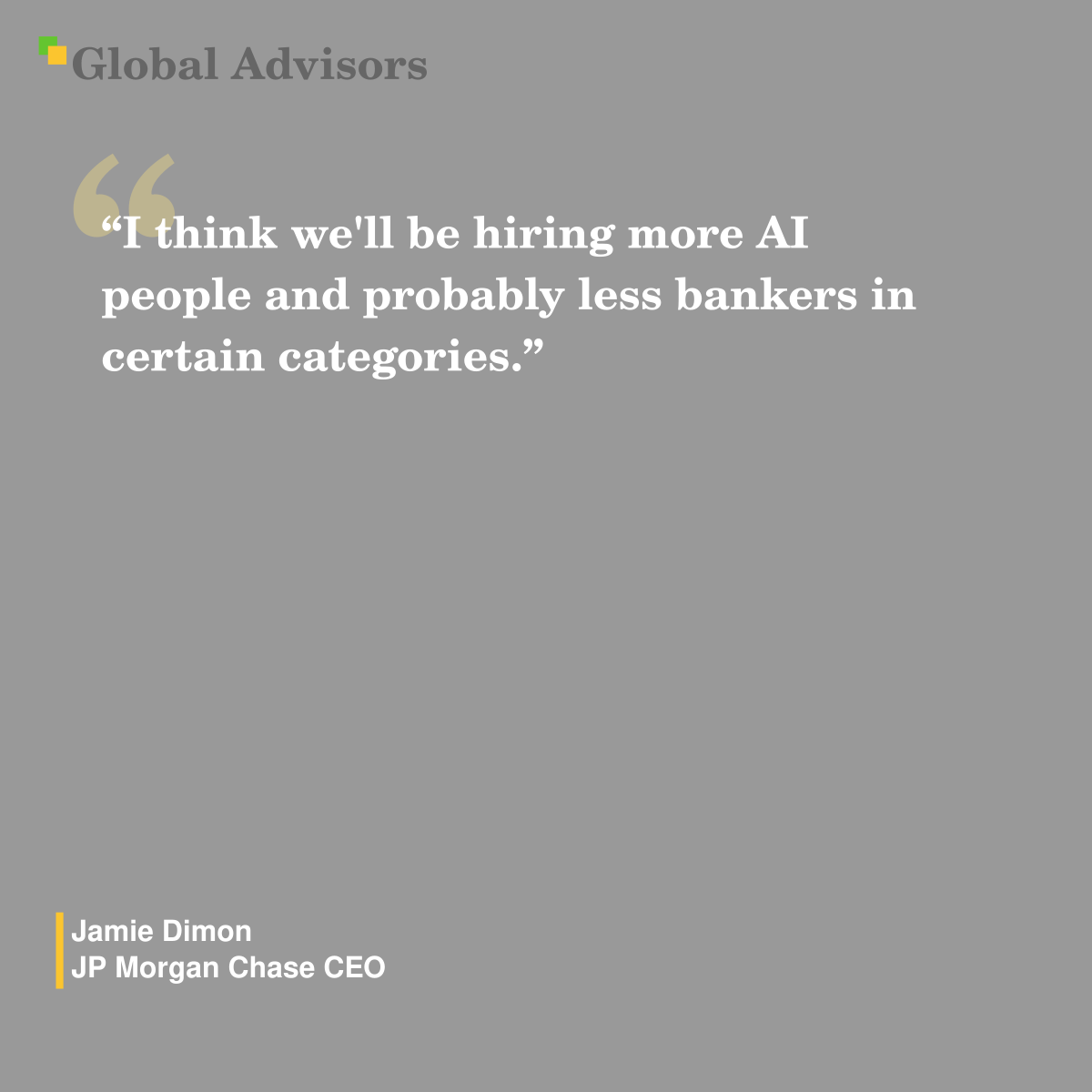
| |
Term: Contract for Difference (CFD)"A Contract for Difference (CFD) is a leveraged financial derivative that allows investors to speculate on the price movements of assets (such as stocks, indices, or commodities) without owning the underlying asset." - Contract for Difference (CFD) Leverage amplifies both gains and losses in contracts for difference, enabling traders to control large positions with minimal capital but exposing them to rapid depletion of margin if markets move adversely. This mechanism underpins the product's appeal for short-term speculation across assets like equities, forex and commodities, where a small deposit-often 3,33 % of position value-can yield outsized returns or wipe out accounts entirely. Brokers quote bid-ask spreads that track underlying prices, with settlement occurring upon position closure as the difference between entry and exit values, multiplied by contract size and quantity. Financial settlement without asset ownership distinguishes CFDs from spot trading, allowing seamless short-selling by selling high and buying low, profiting from declines without borrowing costs associated with traditional shorts. For instance, purchasing 5 CFD contracts on an index at 7 500 points, where each contract equates to 10 USD per point, generates 50 USD profit per point rise upon closure, reversing to equivalent losses on downturns. Margin requirements enforce maintenance levels; falling below triggers margin calls or automatic liquidation to prevent negative balances, a protection mandated in jurisdictions like the UK and EU. Overnight financing charges accrue for positions held beyond daily sessions, calculated as benchmark interest rates plus or minus spreads, reflecting the cost of leveraged exposure akin to borrowing for long positions or earning on shorts. These fees, alongside spreads and occasional commissions, constitute primary costs, eroding profitability in range-bound markets. Traders monitor volatility via technical indicators, deploying stop-losses-automatically closing at predefined thresholds-and trailing stops that adjust favourably to lock gains. Mathematical Foundations of CFD Pricing and Payoff The payoff of a CFD position simplifies to the price differential times notional quantity, formalised as for long positions, where denotes contract quantity, the entry price, and the exit price; shorts invert the sign to . Leverage ratio , with as full position value and margin, magnifies returns to , where is the asset's percentage change. Forex CFDs exemplify this: opening 10 000 units of GBP/USD at 1,2700 with 30:1 leverage requires 333,33 GBP margin; a 100-pip rise to 1,2800 yields 100 USD profit, equating to 30 % return on margin despite 0,79 % underlying move. Volatility scaling via position sizing mitigates risk, often targeting 1-2 % account risk per trade. Stochastic models underpin advanced pricing, approximating underlying dynamics as geometric Brownian motion , though OTC nature delegates pricing to broker models incorporating liquidity premia. Asset Classes and Practical Applications CFDs span equities, where one contract mirrors one share; indices scaled to 1 USD or 10 GBP per point; commodities in lots like 100 ounces gold; and forex in standard lots of 100 000 units. Hedging dominates institutional use-an airline securing 10 million barrels oil at fixed strike hedges consumption variance, settling on nominal quantity regardless of actual draw. Speculators exploit bull-bear symmetry, longing anticipated rallies or shorting overvaluations, with platforms enabling instant execution via market or limit orders. Retail traders, comprising most volume, leverage CFDs for diversification without capital fragmentation; 100 CFDs on a 100 GBP stock grants equivalent exposure for 3-5 GBP margin under 20:1 rules. Crypto CFDs extend access sans wallet custody, though heightened volatility prompts tighter margins. Unlike futures, CFDs lack expiry, permitting indefinite holds subject to financing drag, suiting swing strategies over intraday scalps. Regulatory Landscape and Jurisdictional Divergences Post-2008 reforms reshaped CFD oversight, with the US Commodity Futures Trading Commission banning retail CFDs to curb leverage excesses, contrasting Europe's tiered protections. The UK Financial Conduct Authority enforces 30:1 major forex leverage, descending to 2:1 cryptocurrencies, alongside mandatory 76 % retail loss disclosures-reflecting empirical trader detriment. CySEC mirrors this with negative balance guarantees, barring bonuses to deter deposit-chasing. Australia's ASIC mandates transparency on spreads, margins and loss ratios, while Singapore demands elevated broker capitalisation. These frameworks mitigate moral hazard, yet enforcement varies; offshore brokers skirt rules via non-EU entities, prompting warnings. Spread betting, a UK tax-free cousin, stakes per point versus CFD lots, incurring similar fees but exempting capital gains tax. CFDs attract CGT, offsettable against losses, tilting fiscal preference amid 28 % headline rates. Hedging Versus Speculation: Strategic Tensions Institutional hedging stabilises cash flows-exporters locking forex via CFDs avert currency shocks, mirroring forwards sans physical delivery. Speculative schools diverge: technicians deploy candlesticks and RSI for entries, fundamentals parse earnings or geopolitics, while quants model jumps via intensity Poisson processes. Tension arises in leverage's double edge; 70-80 % retail losses stem from overexposure, behavioural overconfidence and financing creep. Debates centre on utility: proponents laud democratised access, enabling 1 000 GBP accounts to rival 30 000 GBP portfolios; critics decry casino-like dynamics, with leverage fostering addiction over investment. Empirical studies affirm high attrition, yet survivors attribute edge to disciplined risk-capping drawdowns at 1 % via position sizing . Hybrid views advocate education, positioning CFDs as tools for sophisticated users. Costs, Risks and Mitigation Strategies Implicit costs compound: spreads average 0,6-1 pip forex, 0,1 % equities; overnight swaps add 2-5 basis points daily longs, inverting shorts. Slippage spikes in volatility, while gaps bypass stops. Counterparty risk looms OTC-broker insolvency imperils funds, though segregated accounts and investor compensation schemes (FSCS up to 85 000 GBP) buffer. Risk hierarchies prioritise: market (delta exposure), liquidity (wide spreads), operational (platform latency). Mitigations include diversification capping 5 % portfolio per trade, volatility-adjusted sizing, and correlation hedges. Guaranteed stops, premium-priced, eliminate gap risk. Portfolio margining aggregates exposures, optimising capital. Distinctions from Analogous Instruments Versus options, CFDs lack optionality-linear payoffs sans premium decay suit directional bets. Futures impose expiry and daily marking-to-market, contrasting CFD flexibility. Turbos or warrants embed barriers, amplifying leverage nonlinearly. ETFs grant ownership with dividends, absent in CFDs bar synthetic adjustments. Enduring Relevance Amid Evolving Markets CFDs persist as retail gateways to global markets, volumes surging post-zero commission equities via leveraged proxies. Crypto integration and AI-driven execution enhance appeal, though quantum threats to encryption loom distantly. Regulatory tightening-ESMA's 2018 caps halved prior excesses-balances innovation with prudence, sustaining 1 trillion USD annual turnover. In hedging, CFDs complement renewables support schemes, distinct from UK CfDs stabilising strike-reference differentials for generators. As volatility regimes shift-2022's 20 % VIX spikes favoured shorts-adaptability endures. Yet, persistence hinges on broker integrity and trader discipline; amid fintech disruption, CFDs remain pivotal for leveraged price exposure sans ownership encumbrance. |
| |
| |
Quote: Bill Marriott, Jr. - Chairman, Marriott International"The four most important words in business are 'What do you think?'" - Bill Marriott, Jr. - Chairman, Marriott International Modern organisations fail less often because they lack ideas than because they cannot surface, evaluate, and act on the ideas already inside the firm. Information sits latent in frontline teams, junior managers, and subject-matter specialists, while those with formal authority make decisions with only a thin slice of reality. The central challenge is not intelligence but access: how to tap the distributed insight of thousands of people without drowning in noise or eroding accountability. Within that challenge lies a core strategic choice. Some leaders default to assertion: they broadcast plans, demand compliance, and equate decisiveness with omniscience. Others cultivate inquiry: they treat decisions as hypotheses to be tested against the lived experience of colleagues and customers. The former approach can move fast but blinds itself to weak signals; the latter can feel slower but builds a richer situational picture and a culture of psychological safety. The difference often comes down to a recurring behavioural pattern that seems trivial on the surface: whether leaders routinely invite others to contribute their perspective before choices are locked. Bill Marriott built one of the world's largest lodging companies in an industry where the decisive facts rarely sit in head office. They live instead with housekeepers who notice guest irritations, reception staff who detect shifts in traveller expectations, maintenance teams who understand building vulnerabilities, and local managers who sense changes in demand before any analyst report. In such an environment, leadership is only as good as its ability to listen. Asking for others' views before deciding becomes less a courtesy and more a mechanism for harvesting operational intelligence at scale. Seen this way, a leader's habitual question to colleagues is not small talk; it is the thin edge of a philosophy about power. Where traditional hierarchical management assumes insight flows downward and compliance flows upward, a more participatory model treats insight as emergent and widely distributed. Authority still matters, but its role shifts: from being the primary source of wisdom to being the integrator of perspectives, the architect of trade-offs, and the ultimate bearer of responsibility. The act of asking colleagues what they think is the visible sign of that underlying shift. In service businesses, the stakes of getting this right are unusually high. Hospitality lives and dies on tiny, compounding improvements in guest experience: faster check-ins, fewer surprises, cleaner rooms, more intuitive digital journeys. None of these emerge reliably from boardrooms alone. They surface when frontline staff feel safe enough and valued enough to speak honestly about what is and is not working, and when leaders are curious enough to inquire before prescribing. The economics of a hotel chain make this concrete: marginal improvements in occupancy, pricing, and loyalty, repeated across thousands of properties, turn into billions in enterprise value. Listening is therefore not soft; it is a lever on hard numbers. From root beer stand to global chain: why listening mattered To understand why a simple question became so central to Marriott's leadership narrative, it helps to recall the context in which the business grew. The company began in the 1920s as a small root beer operation run by Bill Marriott's parents in Washington, DC, expanding into restaurants and then motels. When Bill Marriott took on leadership responsibilities in the 1950s and 1960s, the firm was still modest compared with the global giant it would become. Its success rested on relentless operational discipline and a family ethos captured in another principle passed down from his father: take good care of your employees and they will take care of the customers. As the company expanded into full-service hotels, airport properties, and later global management contracts, the complexity of operations exploded. Each property faced different demand patterns, labour markets, regulatory issues, and cultural norms. Headquarters could provide systems, brand standards, and capital allocation, but it could not possibly foresee every operational issue in Riyadh, São Paulo, or Shanghai. Under such conditions, rigid top-down control becomes a liability. The leader who insists on owning all the answers simply cannot keep pace with the variety of situations that arise daily across a global footprint. Bill Marriott's response was not to abdicate decision-making, but to recast it as a dialogue. Accounts from colleagues describe a leader who walked properties frequently, inspected kitchens and back-of-house areas, and put probing questions to associates at every level. The point was not theatrics; it was data gathering. By repeatedly asking others for their assessment of what was going well, what was broken, and what should change, he turned routine site visits into rolling intelligence exercises. Over decades, this became a cultural script: you are expected to have an opinion about your work and your guests' experience, and leadership is expected to listen. From a strategic perspective, such behaviour functions as a distributed sensing system. Rather than relying solely on formal reports or lagging indicators, the organisation surfaces issues early through conversation. A pattern of small concerns voiced by multiple properties can signal an emerging problem in technology, training, or product design long before it shows up in financial metrics. The leader's role is to notice these patterns and orchestrate systemic responses. Humble leadership versus narcissistic certainty Embedded in this approach is a particular stance on humility. Humility in leadership is sometimes caricatured as self-effacement or indecision. In reality, it is closer to intellectual honesty: recognition of the limits of one's knowledge and a willingness to update beliefs in the face of better information. In corporate settings, this often manifests in small but consequential behaviours: admitting when a plan is not working, inviting critique of a cherished idea, or explicitly crediting others when they spot a flaw. Academic research supports the intuition that humility can discipline more self-centred traits rather than merely oppose them. Studies from the Marriott School of Management at Brigham Young University have examined leaders with strong narcissistic dispositions - those who are ambitious, confident, and driven to leave a legacy - and found that these traits do not necessarily predict toxic leadership if they are balanced by genuine humility. When such leaders admit mistakes, recognise others' strengths, and demonstrate teachability, their teams tend to be more engaged and rate them as more effective . In other words, ego and impact need not be enemies, provided the ego is permeable to feedback. Bill Marriott's practice of inviting others' views sits squarely in this tension. As head of a vast hotel group, he occupied one of the most powerful positions in the industry. Yet his signature behaviour emphasised not proclamation but inquiry. Asking colleagues what they think does not erase authority; it contextualises it. It says: I am responsible for this decision, but I am not omniscient. That combination of ambition and openness is often more sustainable than either arrogant certainty or paralysed deference. There is also a moral dimension. Treating people as sources of insight rather than as merely labour inputs acknowledges their agency and experience. In service companies that rely heavily on relatively low-paid frontline staff, the symbolic effect is significant. When a housekeeper, chef, or receptionist experiences a senior leader genuinely wanting to understand their perspective, it challenges the usual status hierarchies of the workplace. Over time, this can help reduce the distance between corporate rhetoric about valuing people and the daily experience of work. Operationalising the question: from habit to system Of course, a single phrase, however powerful, does not create culture on its own. The real work lies in embedding the underlying practice into routines, structures, and incentives so that asking for input becomes an organisational reflex rather than a personal quirk of one leader. In Marriott's case, this has taken several forms. First, there is the modelling effect. Senior leaders who were mentored by Bill Marriott often describe adopting similar questioning techniques with their own teams. When a chief executive consistently asks direct reports for their views before sharing his own, those reports are more likely to mimic the pattern with their subordinates, and so on down the hierarchy. Over time, meetings shift from information briefings aimed at pleasing the boss to working sessions where competing perspectives are expected. Second, the company has invested heavily in systems that give employees formal channels to contribute ideas and raise concerns. Feedback tools, employee surveys, structured listening sessions, and open-door policies reinforce the informal invitation expressed in daily conversations. The message becomes self-reinforcing: both people and technology are oriented towards capturing what associates think about processes, products, and guest experiences. Third, the philosophy shapes how performance is evaluated. In organisations that truly prize listening, managers are not judged solely on financial outcomes but also on how they achieve those outcomes. Do they develop their people? Do they seek diverse opinions? Do they credit others for innovations? When promotion decisions consider these factors, the behaviour travels. Conversely, if the leaders who rise are those who dominate discussions and ignore dissent, no amount of rhetorical celebration of listening will matter. There is a subtle but important point here: inviting input does not mean abdicating speed. In fast-moving situations - a crisis at a property, a reputational incident, a sudden market shock - leaders may not have the luxury of extended deliberation. The craft lies in building habits of listening during calmer periods so that in emergencies the leader already has a rich mental map of who knows what, which ideas have been tested, and where the risks lie. Asking others what they think over months and years equips the leader to make rapid calls without flying blind. Strategic tension: inclusion versus decisiveness Despite its apparent elegance, the ask-first approach is not without tension. One common objection is that soliciting input can slow decision-making and create confusion over who ultimately owns a call. In highly competitive industries, hesitation can be costly. If a leader spends excessive time canvassing views, rivals may seize opportunities or exploit vulnerabilities. There is also the risk of performative consultation, where employees are asked for their thoughts but learn over time that the outcome is preordained, breeding cynicism instead of engagement. This is where clarity of role becomes essential. Effective leaders distinguish between decisions where they will listen and then decide, and decisions where the group genuinely deliberates and converges on a consensus. They also distinguish between questions of principle and questions of execution. Strategic moves - entering a new market, changing the brand architecture, pursuing a major acquisition - may require wide consultation but ultimately rest with a small group. By contrast, operational refinements - how best to configure check-in workflows, which local partnerships to pursue, how to fine-tune a loyalty offer for a specific segment - can be devolved more fully to those closest to the work. Bill Marriott's era at the company coincided with significant strategic bets: shifting from owning hotels to a management and franchise model, expanding internationally, and investing in technology platforms. These moves required firm conviction and the ability to make calls under uncertainty. Yet the same leader who signed off on such shifts kept returning to properties to ask very granular questions of staff. The reconciliation lies in understanding that big decisions are stronger when grounded in the reality that small decisions reveal. The more a leader has immersed themselves in operational detail through conversation, the less their strategic choices are based on abstractions. There is also a cultural risk: in organisations that valorise inclusion, people can grow hesitant to voice a clear view for fear of appearing domineering. Ironically, a culture built on asking what others think can become one where no one is willing to stake a position. Good practice therefore involves teaching people not only how to listen but how to argue: how to assemble evidence, frame trade-offs, and disagree respectfully. The question that started as an invitation must be matched with norms for how debates are conducted and closed. Technology, scale, and the future of listening As Marriott International and its peers have continued to grow, technology has reshaped the listening challenge. Digital platforms now collect vast quantities of data about guest behaviour: booking patterns, loyalty engagement, mobile interactions, online reviews. Text analytics and machine learning can synthesise themes from millions of comments, presenting leaders with dashboards that appear to capture the collective voice of customers and employees. It might be tempting to imagine that a well-designed analytics stack makes the old-fashioned question unnecessary. Yet the opposite is more plausible. Data systems are powerful for spotting correlations and aggregate patterns but weaker at revealing context, nuance, and emotional texture. An algorithm may highlight a spike in complaints about check-in times at a given property cluster. Understanding why that spike has occurred - a new staffing model, a software rollout, a design flaw in the lobby, a local event clogging access roads - still requires conversation with the people on the ground. Leaders who rely solely on dashboards without asking managers and associates what they think risk misdiagnosing problems and imposing solutions that do not fit. Moreover, the symbolic dimension of listening cannot be digitised. An employee who fills out an anonymous survey or whose comments are scraped from an internal platform may intellectually appreciate that their input is aggregated somewhere. But it does not feel the same as a leader looking them in the eye and asking their view. Human beings infer status and value from the attention of those in power. When a senior figure pauses amid a schedule of investor calls and strategic reviews to seek the thoughts of a junior colleague, it communicates priority in a way no policy statement can match. The interplay between human and technological listening becomes particularly delicate as organisations become more geographically dispersed and culturally diverse. A single formula for engagement will not fit a property in rural India, a resort in the Caribbean, and a business hotel in Northern Europe. Leaders must be curious not only about operational facts but about cultural norms: how comfortable are associates in a given context with challenging authority? What forms of invitation to speak up are respected, and which are seen as intrusive or insincere? The simple question that worked effortlessly in one culture may need adaptation elsewhere, but the underlying intent remains constant. Why this leadership posture matters beyond hospitality The implications of this approach to leadership stretch far beyond hotels. In technology firms, product decisions often hinge on the insights of engineers and designers who see technical constraints and user behaviours that executives cannot. In healthcare, clinicians and support staff hold the knowledge that determines patient outcomes, while administrators control budgets and policies. In government, public servants understand implementation realities, and citizens live with the consequences of policy experiments. In each case, leaders face the same structural problem: how to avoid governing from a distance. Inviting others' views before deciding functions as a partial antidote. It reduces the probability of catastrophic misalignment between plans and reality by giving those closest to the situation a voice. It encourages learning by making it socially acceptable to surface uncomfortable facts. It also distributes dignity, reinforcing the idea that insight is not monopolised by rank. The precise wording of the question may differ, but its logic is transferable: ask before you assume, listen before you decide. There is, finally, an ethical argument about power. Large organisations inevitably create gaps between the lived experience of the many and the choices of the few. These gaps can foster resentment, disengagement, and, in the worst cases, abuse. Leaders cannot abolish hierarchy, but they can choose how they inhabit it. A posture of inquiry acknowledges that those subject to decisions retain a kind of moral standing in the decision process. Their experiences are not mere inputs but part of the justification for action. Bill Marriott's long tenure atop a global hotel company offers a case study in how such a posture can coexist with strong commercial performance. His career spanned decades of transformation in travel, technology, and globalisation, yet colleagues repeatedly return to the same behavioural motif: a leader who kept asking for the perspectives of those around him. The service empire that emerged from a family root beer stand was shaped not only by strategic bets and capital investments but by thousands of conversations in hallways, kitchens, and lobbies. For contemporary leaders, especially in an era of volatile markets and rapid technological change, the lesson is demanding but straightforward. Expertise, vision, and drive remain indispensable. But without the humility to seek, hear, and act on the thinking of others, those qualities become brittle. The question is not whether a leader has answers; it is whether they build a culture in which answers can be discovered, challenged, and improved. The simple decision to ask colleagues what they think, and to mean it, is one of the few levers that works simultaneously on strategy, execution, culture, and ethics.
|
| |

| |
Quote: Daniel Litt - Mathematician"Another explanation is that the solution required ideas from fields that most researchers working on this [Erdos unit distance] problem were unfamiliar with... these explanations should make us uncomfortable. They suggest that the incentives toward specialisation and siloing, however understandable they may be, have deprived us of high-quality scientific work." - Daniel Litt - Mathematician The disproof of a famous geometric conjecture using algebraic number theory and a large language model is not just a curiosity of modern mathematics; it is a case study in how institutional incentives can steer entire communities away from fertile ideas . For decades, an apparently combinatorial question about distances between points in the plane resisted traditional attacks. When a solution finally emerged, the crucial tools came from a direction that many of the field's specialists had not seriously invested in. The episode crystallises a broader problem: structures that reward narrow expertise, short feedback cycles, and well-mapped research programmes can quietly suppress the kind of boundary-crossing work that transformative discoveries increasingly demand. At issue is not merely that one problem took longer to solve than it might have. It is that an entire research ecosystem can become locally optimised yet globally suboptimal. Individual researchers make rational decisions: specialise deeply, follow the literature of your own area, build on the techniques that your peers recognise and review committees understand. Collectively, however, these decisions can create blind spots where powerful methods remain underused, or entire theoretical bridges are never built. When a breakthrough comes from an unexpected junction of fields, facilitated by a tool few insiders fully understand, it becomes a mirror held up to these collective choices. The Erd?s unit distance problem provides a particularly vivid example because its formulation seems so elementary. Place points in the Euclidean plane and ask: how many pairs of points can be exactly one unit apart? Erd?s conjectured that the answer grows at most on the order of as increases . A simple lattice construction already shows that one can achieve roughly unit distances, i.e. on the order of . The challenge was to prove that no configuration can do substantially better than almost linear in . Despite intense attention, the best known upper bound stayed stuck at something like for decades, a substantial gap from the conjectured behaviour . That such a long-standing problem would eventually be resolved is not surprising. What is striking is how it was resolved. The solution combined ideas from algebraic number theory, sophisticated combinatorics, and automated reasoning using a powerful AI system . For many experts in discrete geometry, deep algebraic number theory sits outside the core toolbox they use every day. Conversely, number theorists might be only passingly familiar with the fine-grained incidence geometry and extremal combinatorics that frame unit distance questions. The fact that the argument could be assembled at all depended on a small group of mathematicians who spanned several of these areas, and on an AI model capable of exploring lemmas and calculations at scale. This is where the question of incentives becomes inescapable. The mathematical community had no shortage of talent over the decades in which the unit distance problem remained open. What it arguably lacked was a dense mesh of people at the intersections: researchers who were not only technically capable in at least two distinct subfields, but also rewarded for spending years developing that mixed expertise. In most academic systems, such profiles are harder to cultivate. Hiring committees are organised by field; journals are structured by area; funding panels ask for clear, disciplinary narratives. A young mathematician who spends substantial time learning algebraic number theory while nominally working in discrete geometry may appear unfocused or risky on paper, even if exactly that breadth is what some of the hardest problems now require. The geometry-number theory interface and hidden toolsets When a problem about distances between points in the plane calls on algebraic number theory, it is natural to ask whether this is a quirky accident or a sign of deeper structure. In modern mathematics, geometric configurations often encode arithmetic information. Classic examples include the way rational points on curves correspond to solutions of Diophantine equations, or how algebraic geometry packages systems of polynomial equations into varieties whose properties can be studied using cohomology and sheaf theory. In that sense, it is not inherently surprising that counting unit distances might eventually touch fields concerned with algebraic relations among lengths, coordinates, and symmetries. Yet, for many years, the dominant line of attack on the unit distance and distinct distance problems went through combinatorial and analytic techniques such as incidence geometry, crossing number inequalities, and polynomial partitioning . A canonical step in this tradition is to bound the number of incidences between points and curves. A generic statement might be of the form , where counts incidences between a set of points and curves , and are constants depending on the family of curves under consideration. Such inequalities are geometric-combinatorial in flavour; they say little directly about algebraic dependencies among distances expressed in number-theoretic terms. The new work essentially overlays another layer of structure. Distances between points with algebraic coordinates can live in number fields, and patterns of equal or repeated distances can reflect algebraic relations among those coordinates. One can imagine assigning to a configuration a field generated by the coordinates of all points, and then studying the action of the Galois group of on the configuration. In favourable circumstances, this action constrains which patterns of equal distances are possible, limiting the total number of unit distances. This kind of reasoning is familiar to algebraic number theorists but far less so to many geometers trained in the combinatorial tradition. If most researchers tackling the unit distance problem are steeped in incidence bounds but not in Galois theory, they may fail to see that a problem formulated with Euclidean metrics can be reinterpreted in the language of fields and automorphisms. The conceptual bridge is short in hindsight but long in foresight. It requires a mental habit of asking: can these geometric invariants be recast as algebraic invariants, and if so, do the known theorems of algebraic number theory have something to say here? That style of thought is not simply a matter of intelligence; it is cultivated by training, environment, and the tacit messages about which connections are worth exploring. AI as a catalyst and a mirror The role of AI in this story complicates the picture further. A large language model, trained on massive corpora of mathematical text and code, does not experience specialisation in the way human researchers do. While its internal representations are not literally a library of cleanly separated domains, the model effectively has access to patterns spanning algebraic number theory, combinatorics, geometry, and beyond. When prompted appropriately, it can propose lemmas, outline proof strategies, or search for counterexamples that weave together tools no single specialist has fully mastered. In the unit distance case, an internal OpenAI model contributed crucial steps that human mathematicians then verified and refined . This dynamic makes AI both a catalyst for cross-field reasoning and a mirror reflecting the human community's blind spots. The model does not know which subfield a problem is officially assigned to; it simply sees formal structures and analogies. If there is a surprising number-theoretic route to a combinatorial geometry question, the model may stumble across it more readily than a human trained inside disciplinary boundaries. But the model is not an independent agent of scientific progress. It operates within human-curated workflows: mathematicians decide which prompts to issue, which candidate arguments to examine, and which lines of reasoning to trust. Where humans have no conceptual foothold or no incentive to explore a particular direction, AI's potential contributions may never be solicited. In that sense, the successful collaboration between an AI system and human mathematicians in cracking the unit distance conjecture does not fully exonerate the existing incentive structures. One might argue that, had the incentives been better aligned toward cross-pollination, a similar synthesis of algebraic and geometric ideas could have been attempted earlier, with or without AI. Instead, AI arrived at a moment when the necessary mathematical tools already existed but were not yet assembled in the right configuration. It helped search and assemble them, but the fact that they were lying dormant highlights the cost of siloed research habits. Specialisation as both engine and constraint To understand why this situation is not easily fixed, it helps to acknowledge the genuine power of specialisation. Modern mathematics is vast, and deep progress often requires years of focused immersion in a narrow area. Specialised communities develop technical languages that allow rapid communication of complex ideas. They build collective intuitions about what works and what does not, enabling researchers to avoid re-deriving known dead ends. In this sense, incentives toward specialisation are not arbitrary; they reflect the reality that no one can be an expert in everything. The problem arises when the marginal gains from further specialisation are overvalued relative to the gains from developing a second or third competency. Consider a hypothetical young researcher choosing between two paths. On one path, they invest most of their time in mastering finer details of existing incidence geometry techniques, aiming to push a known exponent in a long-studied bound from, say, to . On the other path, they devote substantial energy to learning algebraic number theory and the theory of Galois representations, with a hazier sense of how these ideas might eventually feed back into problems like unit distances. The first path is legible to hiring committees and already established specialists; the second looks speculative and harder to evaluate. Given the short-term incentives around papers, grants, and jobs, it is unsurprising that many choose the first path. Over time, this collective bias can produce an ecosystem with very high local competence but relatively few people with the breadth to even suspect that an algebraic perspective could be decisive in a geometric question. It is not that nobody could, in principle, learn both sets of tools; it is that those who might are nudged away from doing so. The eventual breakthrough then looks like a stroke of genius or a lucky accident, but it may also be the visible tip of a submerged structure of missed opportunities. Objections: is discomfort really warranted? Some mathematicians and philosophers of science might push back on the idea that such episodes should make us uneasy. One line of argument goes like this: knowledge is path-dependent; some problems simply require a certain critical mass of tools and concepts that naturally emerge only after decades of work. The fact that the unit distance conjecture required algebraic number theory and AI-informed exploration does not imply that the community did anything wrong. It may merely indicate that the problem was genuinely hard and that the confluence of ideas needed to solve it took time to arrive. A related objection emphasises that specialisation is a rational response to complexity. If everyone tried to hedge their bets by training broadly, the community might lack the deep specialists needed to make incremental but essential progress on core theories. Moreover, the existence of AI systems that can trawl across disciplines could alleviate some of the cost of specialisation. Specialists remain in their lanes, and AI plays the role of a connective tissue, spotting analogies and suggesting cross-field borrowings when useful. On this view, the combination of specialised humans and broadly trained models could, if anything, be an optimal division of labour. These objections have force, but they are incomplete. The issue raised by the unit distance episode is not that specialisation exists but that its current incentive structure may be skewed. If the community systematically under-rewards people who build bridges and over-rewards incremental refinements within siloed areas, then even AI's connective role will be limited. After all, someone has to ask the AI the right questions, recognise which of its suggestions are promising, and craft a coherent narrative that other humans can understand and trust. That work is more easily done by researchers who themselves span multiple domains. If such people are rare or precariously positioned, the system as a whole may still underperform. Rebalancing incentives in an AI-enhanced era The arrival of general-purpose AI systems capable of non-trivial mathematical reasoning creates an opportunity to rethink research incentives rather than an excuse to ignore them. One concrete direction is to shift some evaluative weight from short-term publication counts toward demonstrable cross-field competence. Hiring and promotion committees could, for example, treat high-quality work that genuinely integrates two distinct areas as especially valuable, even if the publication record is modest compared with a pure specialist's. This would require careful judgment, but it would signal that building intellectual bridges is a recognised scholarly contribution, not a risky side project. Another lever lies in funding schemes designed explicitly to encourage interdisciplinary mathematical work that engages with AI as a collaborator rather than a black box. Grants could support teams that combine, say, a discrete geometer, an algebraic number theorist, and an AI specialist, with the explicit aim of attacking problems known to require diverse tools. Critical to such programmes is the expectation that AI's role will be documented and scrutinised, leading not just to solved problems but to new conceptual frameworks that humans can internalise. Otherwise, there is a risk of offloading too much of the reasoning to opaque systems, replicating the very siloing problem at a higher level. Graduate training is another site for change. Instead of curricula that channel students quickly into narrow tracks, departments could build structured opportunities for cross-training: seminars co-taught by experts from different fields, reading groups on problems known to have multiple conceptual incarnations, and supervised projects that explicitly mix methods. Exposure to AI tools should be folded into this, not as a replacement for learning hard theory but as a way to explore how diverse theories interact. The goal is to normalise the idea that a serious mathematician may develop fluency in seemingly disparate areas and in AI-assisted exploration, without being viewed as unfocused. Why this episode matters beyond mathematics Although the unit distance conjecture is a mathematical story, its underlying tension applies widely in science and technology. In many domains, from biology to climate modelling to economics, major breakthroughs increasingly emerge at the intersections of fields: genomics and statistics, physics and machine learning, behavioural science and network theory. As AI systems grow more capable, they are poised to act as cross-disciplinary amplifiers. However, if human institutions reward siloed expertise while relying on AI to stitch everything together, we risk creating a fragile arrangement where few humans truly understand the integrated picture. In areas with direct societal impact, such as AI safety, epidemiology, or financial stability, that fragility becomes a governance issue. Decisions may rely on chains of reasoning that no single community fully owns or scrutinises. If an AI system suggests a policy-relevant result using techniques drawn from several fields, but no one feels both qualified and incentivised to examine the full path, accountability suffers. The warning implicit in the unit distance story is that the same structural forces that delayed a mathematical breakthrough could, in other contexts, lead to misjudged risks or overlooked solutions. The discomfort that arises from recognising these patterns is therefore not a call for nostalgia or a rejection of modern research architecture. It is an invitation to re-engineer that architecture in light of what recent events reveal. Mathematics did eventually produce the tools needed to crack the unit distance problem, and AI helped assemble them. But the delay and the surprise are signals that the current balance between depth and breadth, between specialisation and synthesis, and between human and machine reasoning is not yet optimal. Taking those signals seriously is part of the responsibility that comes with wielding powerful new tools in a world where the easiest path for individuals may not be the best path for knowledge. References D. Litt, social media commentary on the Erd?s unit distance conjecture and AI-assisted proof.
|
| |
!["Another explanation is that the solution required ideas from fields that most researchers working on this [Erdos unit distance] problem were unfamiliar with... these explanations should make us uncomfortable. They suggest that the incentives toward specialization and siloing, however understandable they may be, have deprived us of high-quality scientific work." - Quote: Daniel Litt - Mathematician](https://globaladvisors.biz/wp-content/uploads/2026/05/20260521_05h01_GlobalAdvisors_Marketing_Quote_DanielLitt_MW.png)
| |
|


| |
| |