| |
|

| |
| |
| |
|
A daily bite-size selection of top business content. |
| |
| |
| |
Quote: Ilya Sutskever - Safe Superintelligence"AI will do all the things that we can do. Not just some of them, but all of them. The big question is what happens then: Those are dramatic questions... the rate of progress will become really extremely fast for some time at least, resulting in unimaginable things. And in some sense, whether you like it or not, your life is going to be affected by AI to a great extent." - Ilya Sutskever - Safe SuperintelligenceIlya Sutskever stands among the most influential figures shaping the modern landscape of artificial intelligence. Born in Russia and raised in Israel and Canada, Sutskever’s early fascination with mathematics and computer programming led him to the University of Toronto, where he studied under the legendary Geoffrey Hinton. His doctoral work broke new ground in deep learning, particularly in developing recurrent neural networks and sequence modeling—technologies that underpin much of today’s AI-driven language and translation systems. Sutskever’s career is marked by a series of transformative achievements. He co-invented AlexNet, a neural network that revolutionized computer vision and triggered the deep learning renaissance. At Google Brain, he advanced sequence-to-sequence models, laying the foundation for breakthroughs in machine translation. As a co-founder and chief scientist at OpenAI, Sutskever played a pivotal role in developing the GPT series of language models, which have redefined what machines can achieve in natural language understanding and generation. Beyond his technical contributions, Sutskever is recognized for his thought leadership on the societal implications of AI. He has consistently emphasized the unpredictable nature of advanced AI systems, particularly as they acquire reasoning capabilities that may outstrip human understanding. His recent work focuses on AI safety and alignment, co-founding Safe Superintelligence Inc. to ensure that future superintelligent systems act in ways beneficial to humanity. The quote featured today encapsulates Sutskever’s vision: a world where AI’s capabilities will extend to all domains of human endeavor, bringing about rapid and profound change. For business leaders and strategists, his words are both a warning and a call to action—highlighting the necessity of anticipating technological disruption and embracing innovation at a pace that matches AI’s accelerating trajectory.
|
| |

| |
Term: Artificial General Intelligence (AGI)Artificial General Intelligence (AGI) is defined as a form of artificial intelligence that can understand, learn, and apply knowledge across the full spectrum of human cognitive tasks—matching or even exceeding human capabilities in any intellectual endeavor. Unlike current artificial intelligence systems, which are typically specialized (known as narrow AI) and excel only in specific domains such as language translation or image recognition, AGI would possess the versatility and adaptability of the human mind.
Alternative Name – Superintelligence: Key contrasts between AGI and (narrow) AI:
Strategy Theorist — Ilya Sutskever: Ilya Sutskever’s views on the impact of superintelligence are characterized by a blend of optimism for its transformative potential and deep caution regarding its unpredictability and risks. Sutskever believes superintelligence could revolutionize industries, particularly healthcare, and deliver unprecedented economic, social, and scientific breakthroughs within the next decade. He foresees AI as a force that can solve complex problems and dramatically extend human capabilities. For business, this implies radical shifts: automating sophisticated tasks, generating new industries, and redefining competitive advantages as organizations adapt to a new intelligence landscape. However, Sutskever consistently stresses that the rise of superintelligent AI is “extremely unpredictable and unimaginable,” warning that its self-improving nature could quickly move beyond human comprehension and control. He argues that while the rewards are immense, the risks—including loss of human oversight and the potential for misuse or harm—demand proactive, ethical, and strategic guidance. Sutskever champions the need for holistic thinking and interdisciplinary engagement, urging leaders and society to prepare for AI’s integration not with fear, but with ethical foresight, adaptation, and resilience. He has prioritized AI safety and “superalignment” as central to his strategies, both at OpenAI and through his new Safe Superintelligence venture, actively seeking mechanisms to ensure that the economic and societal gains from superintelligence do not come at unacceptable risks. Sutskever’s message for corporate leaders and policymakers is to engage deeply with AI’s trajectory, innovate responsibly, and remain vigilant about both its promise and its perils. In summary, AGI is the milestone where machines achieve general, human-equivalent intelligence, while superintelligence describes a level of machine intelligence that greatly surpasses human performance. The pursuit of AGI, championed by theorists like Ilya Sutskever, represents a profound shift in both the potential and challenges of AI in society.
|
| |

| |
Quote: Alexander Osterwalder - Author“The Value Proposition is the reason why customers turn to one company over another. It solves a customer problem or satisfies a customer need. Each Value Proposition consists of a selected bundle of products and/or services that caters to the requirements of a specific Customer Segment. In this sense, the Value Proposition is an aggregation, or bundle, of benefits that a company offers customers.”
|
| |

| |
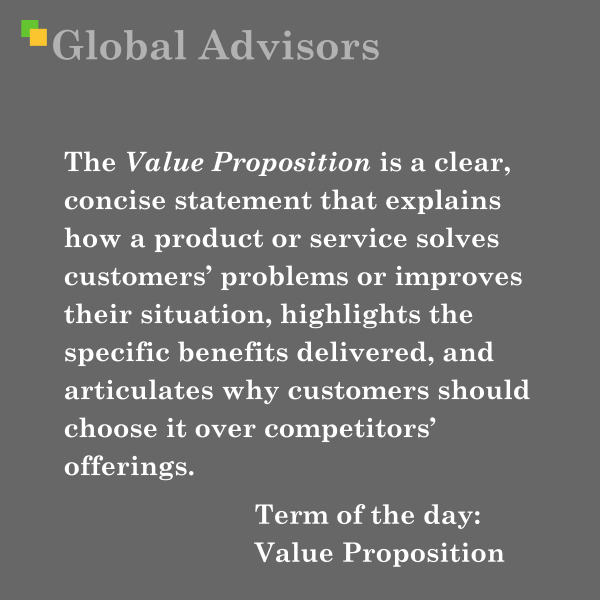
Term: Value PropositionValue Proposition is a foundational concept in business strategy and marketing, defined as a clear, concise statement that explains how a product or service solves customers’ problems or improves their situation, highlights the specific benefits delivered, and articulates why customers should choose it over competitors’ offerings. It communicates the unique value a company promises to deliver to its target customer segment, combining both tangible and intangible benefits, and serves as a primary differentiator in the marketplace. Related Strategy Theorist: A strong value proposition is:
It typically answers four key questions:
Developing a value proposition is central to a company’s overall business strategy, influencing marketing, product development, and customer experience. Unlike mere slogans or catchphrases, a true value proposition clearly delivers the company’s core offer and competitive advantage.
|
| |
| |
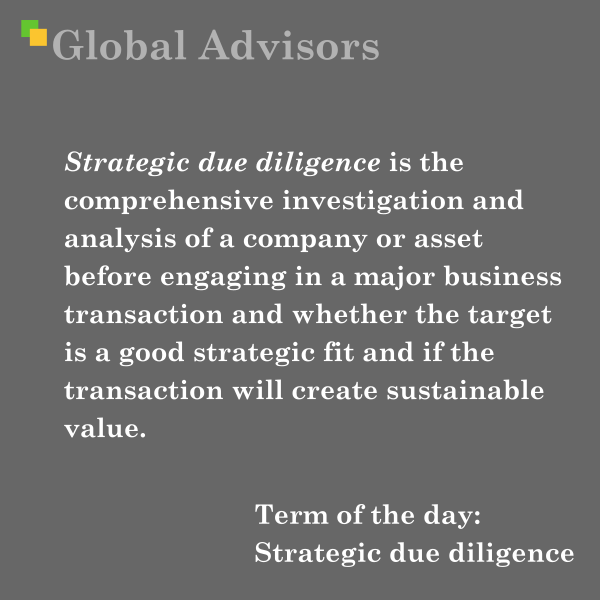
Term: Strategic Due DiligenceStrategic due diligence is the comprehensive investigation and analysis of a company or asset before engaging in a major business transaction, such as a merger, acquisition, investment, or partnership. Unlike financial or legal due diligence—which focus on verifying facts and liabilities—strategic due diligence evaluates whether the target is a good strategic fit and if the transaction will create sustainable value. Key components of strategic due diligence include:
The process is critical for:
In summary, strategic due diligence is an essential, holistic process that gives decision makers clarity on whether a business opportunity or transaction supports their overarching strategic ambitions, and what risks or synergies they must manage to achieve post-deal success. Related Strategy Theorist: David Howson A leading theorist associated with the concept of strategic due diligence is David Howson. He is frequently cited for his work on due diligence processes in mergers and acquisitions (M&A), particularly for emphasizing the multidisciplinary and strategic aspects of due diligence beyond just financials. However, it is important to note that the field draws from a broad base of strategic management literature, including concepts from Michael Porter (competitive advantage, industry analysis) and practitioners who bridge strategy with corporate finance in transactions.
|
| |
| |
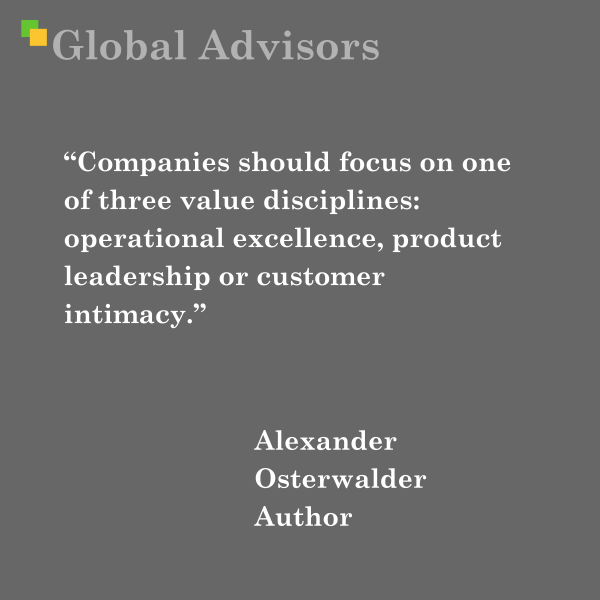
Quote: Alexander Osterwalder - Author“Companies should focus on one of three value disciplines: operational excellence, product leadership, or customer intimacy.”
|
| |
| |
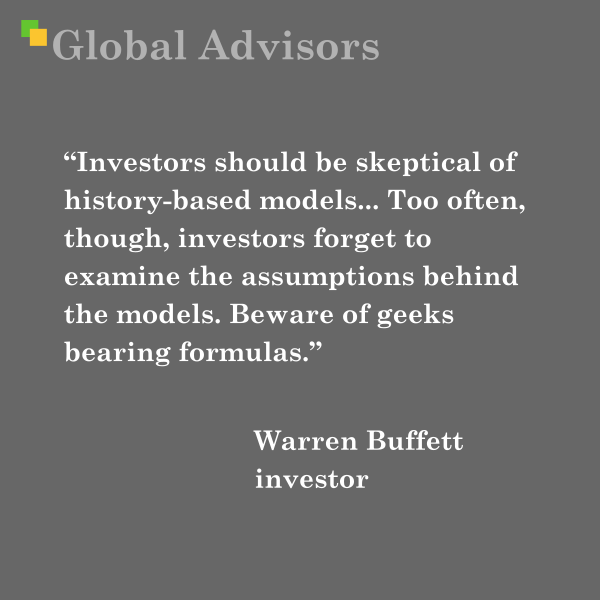
Quote: Warren Buffet - investor“Investors should be skeptical of history-based models... Too often, though, investors forget to examine the assumptions behind the models. Beware of geeks bearing formulas.”
|
| |
| |
Term: Business ModelA business model is a comprehensive framework that explains how an organization creates, delivers, and captures value within a market environment. It serves as the structural backbone for organizing the company’s relationships, resources, processes, and value propositions, tying together various elements such as:
Unlike a business strategy, which is a dynamic plan of action for achieving competitive objectives and responding to market conditions, the business model is more static and foundational: it is the platform on which strategies are executed. The business model articulates the logic of the business, while the strategy outlines how to compete and succeed using that model. Related theorist: Alexander Osterwalder Osterwalder is widely recognized for developing the Business Model Canvas, a strategic management tool that systematically lays out how a company creates, delivers, and captures value. His work, together with Yves Pigneur, has been foundational in both academic and practical discussions about business models, making him the leading authority in this area.
From a strategic perspective, the business model defines how the business system fits together—what markets to serve, what offerings to provide, and how to earn profits. Business models can evolve rapidly and require regular innovation to adapt to changing environments, emerging technologies, and shifting customer needs. In summary, the business model is a structural representation of how a company operates profitably, sustains itself, and interacts within its ecosystem, enabling effective strategy execution.
|
| |
| |
Quote: Richard Koch Author, investor, strategist“Why is growth important? Because the power of compound arithmetic is such that, in a high-growth venture, sales - and profits, when they appear - will multiply quickly. It is quite different from the great majority of firms, which grow only slowly, and where profit growth is difficult and far from automatic.” - Richard Koch - Author, investor, strategistRichard Koch is a highly regarded British management consultant, entrepreneur, and author best known for his work on business strategy and the principle of exponential growth. Educated at Oxford University and the Wharton School, Koch began his career at the Boston Consulting Group and later became a partner at Bain & Company before co-founding the influential consultancy L.E.K. Consulting. As an investor, he has played a significant role in the success of several well-known companies, including Filofax, Plymouth Gin, Betfair, FanDuel, and Auto1. Koch is also celebrated for his bestselling book, The 80/20 Principle, which has sold over a million copies worldwide and introduced a broader audience to the idea that a small proportion of efforts often lead to the majority of results. The quote—“Why is growth important? Because the power of compound arithmetic is such that, in a high-growth venture, sales - and profits, when they appear - will multiply quickly. It is quite different from the great majority of firms, which grow only slowly, and where profit growth is difficult and far from automatic.”—captures the essence of Koch’s philosophy and expertise in business strategy. Context and BackstoryKoch has spent his career examining what propels some ventures to achieve extraordinary results while others stagnate. His work consistently points to the transformational power of rapid, compounded growth—a concept drawn from mathematics but observed powerfully in business. The principle of compound growth, as illustrated by both Koch and other thought leaders, describes exponential progress where gains in one period build upon the previous, leading to an accelerating trajectory rather than linear development. Koch contrasts this with the more common fate of most businesses: slow, incremental growth where every small gain must be arduously earned, and profitability is never a guarantee. This distinction is critical for entrepreneurs and strategists. High-growth ventures harness the “snowball effect” of compounding, where early momentum can quickly escalate into market dominance and substantial profit, often outstripping competitors who rely on traditional, slower-growth models. Koch’s decades of investing and consulting—backed by his direct involvement in rapidly scaling businesses—provide real-world evidence of this principle’s power. His insights encourage business leaders to view growth not merely as an aim, but as an essential, multiplying force that can radically alter outcomes if strategically pursued. In summary, Koch’s quote encapsulates the difference between ordinary and extraordinary business outcomes, emphasizing the necessity for leaders to understand and harness compound growth in their strategies. His career and writings offer both a theoretical foundation and practical guidance for those seeking to leverage this “hidden magic” in their own ventures.
|
| |
| |
Term: Business Unit StrategyBusiness Unit Strategy, as described by Richard Koch, focuses on how a single business or division within a larger corporation achieves and sustains competitive advantage within a specific, well-defined market or "arena" (a product-market segment). This level of strategy is about winning in one particular space, rather than deciding which spaces to play in. Key Elements of Business Unit Strategy (per Koch):
Business Unit vs. Corporate Strategy (per Koch):Richard Koch asserts that the heart of any firm is the product-market segment(s) where it holds or can hold a distinctive edge, whether through cost or uniqueness, and that “strategy” at this level is about defending and growing that advantage. In summary, business unit strategy is about how to compete and win within a chosen market, whereas corporate strategy is about deciding which markets or businesses to be in and optimizing the whole portfolio for maximum value. Koch’s work draws on the importance of focusing efforts—guided by the 80/20 principle—on those few arenas where success is most likely and most valuable.
|
| |
| |
|


| |
| |