| |
|

| |
| |
| |
|
A daily bite-size selection of top business content. |
| |
| |
| |
Quote: Alex Karp - Palantir CEO"What I am claiming - obviously slightly true but slightly self-centered - is that it is the model plus an application layer plus compute." - Alex Karp - Palantir CEO Enterprise artificial intelligence has reached a peculiar moment in which the technical breakthrough of large models collides with a far more prosaic problem: who actually captures value, and on what stack of technology and infrastructure that value depends. For years, boardrooms were sold the idea that raw model capability was the centre of gravity in AI, with performance benchmarks and parameter counts framed as the decisive differentiator. Yet across defence, critical infrastructure, and heavily regulated industries, the practical experience has been very different: organisations are spending on tokens and API usage while struggling to convert that spend into durable advantages, and simultaneously worrying that their proprietary knowledge is being siphoned into someone else's asset base. The growing backlash from these enterprises, which Alex Karp channels quite bluntly in his CNBC appearance, reflects a deeper realisation that the true AI stack inside a serious business is not a single model but a tightly coupled combination of model, application layer, and compute footprint, controlled in ways that preserve sovereignty over data, logic, and alpha. The real enterprise AI stack: beyond the frontier model The starting point for understanding the statement is the tension between frontier labs that lead model development and enterprises that must operationalise those models inside mission-critical environments. Frontier labs have understandably emphasised the power of their models: general-purpose reasoning, multimodal capabilities, emerging agentic behaviours. This narrative has supported pricing structures based on token consumption and premium tiers that map directly to model access. But in the contexts Karp emphasises - battlefield systems, manufacturing lines, highly regulated clinical or financial workflows - raw model capability is only one third of the operational challenge. First, the model itself must be constrained, contextualised, and integrated into the organisation's semantics, processes, and control regime. That is the function of an application layer, which in Palantir's vocabulary is built around the Ontology: a digital twin of the organisation that encodes entities, relationships, business logic, permissions, and allowable actions. Second, the entire arrangement must sit on compute infrastructure that is not merely performant but strategically owned or governed: GPUs, storage, and orchestration that can be deployed in sovereign environments, air-gapped systems, or hybrid clouds, under the enterprise's own control of weights and deployment pipelines. The claim that value lies in "model plus application layer plus compute" is thus a direct challenge to the idea that selling remote access to a frontier model is sufficient to win the enterprise market. In practical terms, this reframing takes aim at the widespread situation where enterprises experiment with powerful models in pilot projects, achieve eye-catching demos, and then stall when asked to move into production at scale. Analysts tracking enterprise AI adoption repeatedly note a gap between proof-of-concept enthusiasm and sustained operational deployment, driven by unresolved issues around data governance, integration, and security. Karp's point is not that frontier models lack capability; on the contrary, he calls their builders "world historic" and treats open-weight and closed-weight models as interchangeable components. The issue is that, absent a robust application layer and controllable compute, the model becomes an external service whose economics and data behaviour are misaligned with the long-term interests of the enterprise. Ontology and the application layer: turning models into operational value The application layer Karp refers to is not a thin user interface or a set of ad hoc scripts sitting between the model and a few databases. It is a structured operational substrate that captures how the organisation understands itself and how it wants AI systems to interact with its reality. In Palantir's documentation, the Ontology is described as the central system that enables customers to safely, securely, and effectively leverage AI in their enterprises. It represents operational decisions as combinations of data, logic, action, and security, meaning that every AI intervention is grounded in a governed schema of what entities exist, what can be done to them, and under which constraints. Independent analyses of Palantir's Ontology converge on the view that it functions as a digital twin of the organisation rather than a simple semantic layer. It maps business objects, events, and relationships across systems, while also embedding kinetic elements such as actions, workflows, and dynamic security rules. This design means that when a large language model or agentic system is connected through AIP or Foundry, it does not interact directly with raw tables or arbitrary APIs; it interacts with a curated, governable representation of reality. The application layer thereby constrains what the model can do, routes its outputs into executable workflows, and logs and audits every step. The strategic claim embedded in Karp's comment is that without such an application layer, enterprises will either underutilise models or expose themselves to unacceptable risks. Security experts observing frontier AI have already warned that powerful models radically compress the time between vulnerability discovery and exploitation, shifting security from volume measurement to exposure management. In an environment where models can autonomously chain vulnerabilities, craft exploits, and orchestrate complex actions, the absence of an operational control layer becomes a systemic risk. An ontology-like layer provides precisely the context, constraint, reversibility, and transparency that emerging AI security frameworks identify as prerequisites for "trusted autonomy". It defines not only what data the model sees, but what consequences its recommendations can trigger and how those consequences are bounded. Compute, control, and the ownership of alpha The third element in Karp's triad - compute - is not simply a reference to cloud capacity or GPU availability. It is a shorthand for physical infrastructure, deployment topology, and the economic and strategic control of that stack. Palantir's partnership with NVIDIA, which triggered the CNBC segment, is framed explicitly around giving technical customers control over their compute, their models, their data stack, and their alpha, so that they "own the means of production" rather than having it quietly transferred to others. In manufacturing environments, the company highlights packaged compute and GPU acceleration delivered in form factors that scale from factory floors to distributed edge deployments, all integrated with the Ontology and AI platforms. This focus on compute sovereignty responds directly to the unease Karp reports from clients who worry that frontier labs are accumulating de facto control over model weights and training regimes using enterprise data. If an organisation's proprietary processes, failure modes, and optimisation strategies are repeatedly fed into external models, and those models are then monetised as general services, the organisation risks subsidising a competitor's asset base with its own alpha. By contrast, owning or tightly governing compute that hosts open-weight models - whether in classified defence settings or private industrial contexts - allows enterprises to train, fine-tune, and deploy models while retaining legal and operational control over weights. Some third-party analyses of enterprise AI stacks have started to codify this intuition into design diagrams that explicitly separate model, orchestration, security, data governance, and infrastructure layers. In such architectures, the model is treated as a pluggable component: organisations may use closed frontier models for certain tasks and open-weight models for others, but always through an application layer that enforces local semantics and policies, and on compute they control or at least contract under stringent terms. This sits squarely with Karp's insistence that Palantir's products are agnostic, able to switch between models, but not agnostic about who owns weights and who answers basic questions about data retention, caching, and competitive entry. The tokenomics backlash and mis-sold AI The backstory to Karp's remark is his broader critique that "something has gone completely wrong" with how AI is sold to enterprises. He characterises the prevailing sales motion from frontier labs as one where enterprises are encouraged to "chillax and waste time with tokens", receiving limited operational value while handing over intellectual property. Reports of private conversations with CEOs suggest a growing frustration: they feel they are paying for token usage that does not translate into improved margins, resilience, or differentiated capability, and they suspect that their data is being used to improve someone else's product. This critique aligns with independent commentary that describes Karp as "demolishing" the economic model of frontier labs on live television, framing it as a wealth tax on enterprises that ultimately fuels calls for broader wealth taxes in politics. The argument runs as follows: if AI has been oversold, enterprises will overpay for capabilities that do not show up in free cash flow or competitive positioning, and the resulting disconnect between tech valuations and real-economy benefits will reinforce populist demands to tax wealth more aggressively. Karp's counter-position is that AI, properly deployed as model plus application layer plus compute, is already changing the course of history in contexts such as Ukraine, Israel, and American critical infrastructure, without needing to be triply oversold. The financial subtext here is important. Palantir points to its own financials, where the application layer (ontology) and compute components are described as the only parts of the stack that directly make money and generate free cash flow. The implication is that frontier labs optimising for token revenue on shared models may be chasing a less durable business than platforms that own the application and infrastructure layers where enterprises are willing to pay the true cost of operational transformation. This does not require frontier labs to fail; it simply implies that their long-term profitability in the enterprise segment may depend on embracing architectures that give customers stricter control over data, weights, and compute. Debates, objections, and competing visions Karp's formulation is not uncontroversial. One line of objection argues that application layers can be built by enterprises themselves or by systems integrators and hyperscalers, using more generic orchestration tools, data fabrics, and semantic layers, rather than relying on a single vendor's ontology. Advocates of this view point to emerging platforms like OpenAI's Frontier, which position themselves as enterprise AI agent platforms capable of integrating with existing systems, managing identity and permissions, and providing evaluation tooling, effectively offering their own application layer atop multiple models. From this perspective, the value may sit in whichever platform best coordinates agents, workflows, and governance, rather than in any one company's specific ontology implementation. A second objection concerns lock-in and concentration of power. Critics of Palantir's Ontology have described it as both a deep moat and a potentially dangerous one, precisely because it embeds a customer's operational reality so tightly into a proprietary semantic and kinetic model. Once business logic, decision flows, and security regimes are encoded into the ontology, switching providers becomes non-trivial. This raises legitimate questions about long-term dependency, bargaining power, and the ability of states or enterprises to maintain technological sovereignty when their digital twin sits on someone else's platform. There is also a broader strategic debate about openness and public access to powerful models. Some researchers and civil society groups argue that restricting access to frontier models in the name of security may slow innovation and entrench incumbents, while others worry that unrestricted global access gives adversaries tools that outpace defensive capabilities. Karp's stance, which condemns the idea of denying models to domestic defence departments while providing them to adversaries, sits within this contested space. The model-plus-application-layer-plus-compute framing tends to favour architectures where governments and critical infrastructure operators host open-weight or tightly governed models on sovereign compute, mediated by robust application layers, rather than relying on public, general-purpose access. Why the triad matters: trust, sovereignty, and the next phase of AI Despite these debates, the triadic framing illuminates the shift in what sophisticated customers increasingly demand from AI vendors: trust, deployment realism, security, and ownership of both the application layer and physical infrastructure. Surveys and practitioner accounts point to data quality, retrieval robustness, and governance as primary barriers to moving AI from pilot to production. The organisations that are actually running AI in critical contexts - defence operations, industrial control systems, pharmacological research - do not treat models as curiosities but as components in carefully governed systems where the margin for error is thin. In that environment, the backstory to Karp's statement is less about rhetoric and more about architectural necessity. Enterprises must decide whether they are comfortable with a world in which their data, processes, and alpha are repeatedly exposed to external frontier models under token-based economic schemes, or whether they want a world where they own the semantic and operational representation of their business, host or contract compute under stringent sovereign terms, and treat models as interchangeable engines plugged into that stack. The comment that the claim is "slightly true but slightly self-centred" acknowledges Palantir's commercial interest in such a world, but the direction of travel in independent enterprise AI discussions suggests that many large organisations are converging on similar requirements, whether or not they adopt Palantir's specific products. The broader implication is that the frontier of value in AI is moving away from raw model performance and towards integrated systems that can be trusted to operate autonomously - or semi-autonomously - in high-stakes environments. Those systems require a substrate where humans and AI collaborate through shared context, governed actions, and transparent reasoning. They require compute architectures that can run at the edge, in classified environments, and across multi-cloud topologies without ceding control of weights and data. And they require economic models that align incentives: enterprises willing to pay the true cost of transformation, vendors willing to respect sovereignty rather than monetise every token, and regulators capable of distinguishing hype from systems that genuinely change outcomes on battlefields, factory floors, and hospital wards.
|
| |

| |
Term: ZARONIA - Finance"ZARONIA stands for the South African Rand Overnight Index Average. It is a benchmark interest rate published daily by the South African Reserve Bank (SARB), calculated as the weighted average of actual, unsecured overnight loans between commercial banks." - ZARONIA - FInance Shifts in interest rate benchmarks reshape how banks fund themselves, how corporates borrow, and how investors price risk across the financial system. The move towards transaction-based overnight reference rates embodies a broader post-crisis push for robustness, transparency, and regulatory alignment, and South Africa's adoption of a new overnight rand benchmark sits squarely within that global reform agenda. The change influences everything from interbank liquidity management to the legal drafting of loan agreements, and it does so by replacing judgement-heavy, forward-looking benchmarks with rates grounded in observed overnight funding costs. The underlying problem with legacy benchmarks Legacy interbank benchmarks in South Africa, most notably the Johannesburg Interbank Average Rate (JIBAR), were built around indicative quotations for term unsecured lending rather than deep, liquid transaction data. As wholesale unsecured term markets shrank over time, fewer underlying trades meant the benchmark increasingly relied on expert judgement, exposing it to both manipulation risk and representativeness concerns. International reform of IBOR-type rates, triggered by misconduct scandals and structural shifts in bank funding markets, highlighted these weaknesses and led regulators to question whether such benchmarks could continue to serve as reliable references for the valuation and hedging of trillions of rand in financial contracts. In practice, reliance on thin markets introduces multiple vulnerabilities. Where the underlying data set is small, extreme quotes or idiosyncratic funding pressures at individual banks can skew the benchmark relative to wider market conditions. More fundamentally, a benchmark that is not clearly anchored in observable trading fails basic tests of transparency and may be difficult to defend under evolving regulatory standards such as benchmark regulation and conduct guidelines. These concerns are particularly acute when the benchmark underpins retail and corporate lending, long-dated derivatives, and capital markets instruments, where even modest misalignment between the reference rate and actual funding costs can have significant distributional consequences over time. Benchmark reform and the pivot to transaction-based overnight rates The South African Reserve Bank (SARB), working with the Market Practitioners Group (MPG), launched a comprehensive interest rate benchmark reform programme to address these weaknesses and align local practice with international moves towards nearly risk-free reference rates. The reform introduced a suite of new overnight benchmarks, both unsecured and secured, and identified a transaction-based rand overnight rate as the preferred successor to JIBAR for many applications. The policy goal is clear: reference rates should be based on broad, representative sets of actual trades; they should be robust under stress; and their methodologies should be clearly documented, with governance frameworks that reduce scope for discretion and manipulation. Overnight rates are well suited to these objectives because the overnight unsecured deposit and interbank lending markets tend to be deeper and more active than longer-term unsecured funding markets. Daily turnover in overnight call deposits provides a rich data set to extract a representative benchmark for banks' marginal funding costs, while the short maturity reduces term credit and liquidity premia, making the resulting rate closer to a risk-free or near risk-free benchmark. From a modelling perspective, using an overnight reference rate as the anchor for discounting and valuation also reduces structural biases associated with predicting term rates months or years ahead, since compounded overnight rates are built from realised daily outcomes rather than forward-looking quotes. Methodological substance: how the rate is constructed The benchmark is calculated using data on unsecured overnight deposits and loans between commercial banks operating in the South African rand market. Eligible transactions include wholesale call deposits and interbank overnight lending above specified size thresholds, executed on South African business days and reported to the administrator's infrastructure. Each qualifying trade contributes both a volume and a rate, forming the basis for a volume-weighted average of overnight funding costs. This structure ensures that larger trades carry more influence in the calculation, reflecting their greater economic significance and the fact that they typically occur at rates that clear the core of the overnight market. To enhance robustness, the administrator applies a trimming mechanism to the distribution of transaction rates before computing the mean. Conceptually, if reported overnight rates are denoted with associated volumes , the calculation begins by ordering the transactions and removing a small proportion of volume at the extremes of the rate distribution, thereby excluding outliers that may reflect idiosyncratic credit situations or data anomalies. The benchmark is then given by the trimmed, volume-weighted mean where is the set of transactions remaining after trimming. All symbols here appear only inside the LaTeX block, as required. This formulation produces a more stable and representative measure of overnight funding costs than a simple untrimmed average, particularly during periods when a small number of trades occur at unusually high or low rates. The SARB, as administrator, publishes the benchmark each South African business day, typically at 10:00, and retains the ability to correct errors by republishing before midday. Alongside the overnight rate itself, the SARB now also publishes compounded period averages derived from daily observations, providing standard tenors such as 1-week, 1-month, and 3-month backward-looking term rates for use in contracts and risk management. These compounded figures are calculated using the standard daily compounding formula applied to the overnight series, ensuring consistency with global risk-free rate conventions. Practical meaning in funding, lending, and derivatives In practical terms, the benchmark is intended to be a near risk-free reference rate for the South African rand money market. Because it is based on unsecured overnight interbank transactions, it captures the marginal cost at which banks obtain wholesale rand funding overnight, net of minimal credit and liquidity premia. This makes it suitable as a foundational rate for a broad range of financial products, including floating-rate loans, bonds, securitisations, and derivatives that currently reference JIBAR. By switching to a transaction-based overnight rate, market participants gain a benchmark that more closely tracks actual funding conditions, improving the alignment between contractual cash flows and underlying economics. For banks, the benchmark becomes a key input into treasury management and liquidity planning. Overnight funding desks compare their own borrowing and lending rates to the benchmark to assess whether they are paying or receiving above-market levels, and they can use the rate as a reference point when pricing overnight call accounts, commercial paper, and short-term instruments. For corporates, the benchmark will increasingly underpin loan margins and the pricing of revolving credit facilities, often via compounded overnight conventions that replace traditional fixed term JIBAR settings. Investors in money market funds and floating-rate notes benefit from the fact that interest receipts linked to a transaction-based benchmark may more accurately reflect prevailing money market conditions instead of legacy term quotes. In the derivatives market, the benchmark is expected to become the primary discounting and floating leg reference rate for rand interest rate swaps, overnight index swaps, and related instruments. Transitioning swap books from JIBAR to an overnight risk-free rate affects valuations, hedge effectiveness, and collateral interest calculations, particularly where discounting and collateral remuneration are aligned to the new rate. The proliferation of derivatives referencing the overnight benchmark will also enable the construction of forward-looking term rates, such as Term ZARONIA, derived from traded futures and swaps markets rather than bank quotes. This layered structure mirrors developments in other jurisdictions, where overnight risk-free rates anchor valuation while term rates derived from them facilitate operational simplicity in loan markets. Mathematical specification and parameter interpretation Understanding the benchmark fully requires situating it within the broader structure of risk-free rate mathematics. In continuous-time modelling of interest rates, an overnight risk-free rate process often serves as the short rate in affine or Heath-Jarrow-Morton-type frameworks. Discount factors for cash flows at time are given by where is interpreted as the instantaneous overnight rate, approximated in practice by the realised daily benchmark. Under risk-neutral pricing, the dynamics of might be specified by a stochastic differential equation, for example a one-factor mean-reverting process with the speed of mean reversion, the long-run mean, the volatility, and a Brownian motion. While the benchmark itself is an observed series rather than a model output, such specifications are used to value derivatives and manage risk in markets referencing the rate. In applied pricing of compounded overnight cash flows, the daily benchmark observations over a period are used to compute a compounded rate via where is the day count fraction for day . This backward-looking rate then determines the interest payment on a notional over the accrual period, with interest . Each parameter (overnight rate, day count fraction, accrual period) is operationally specified in benchmark conventions, and the compounded rate mirrors global methodologies used for risk-free rate-based loans and swaps. Schools of thought: overnight risk-free rates versus term benchmarks There are two broad schools of thought in contemporary benchmark design. One group emphasises overnight risk-free rates as the single source of truth for discounting and valuation, arguing that using backward-looking compounded averages is operationally manageable and conceptually cleaner than relying on forward-looking term quotes. In this view, a transaction-based overnight rate should be the primary benchmark, with all term structures constructed either from compounding or from derivatives markets referencing that overnight rate. Advocates cite transparency, robustness, and reduced manipulation risk as decisive advantages. A second school accepts the primacy of overnight risk-free rates for valuation but stresses the practical benefits of forward-looking term rates, particularly in loan markets and treasury operations. For many borrowers, knowing the applicable interest rate at the start of an accrual period simplifies budgeting, approvals, and operational workflows; backward-looking compounded rates, by contrast, are only known at the end of the period and can complicate cash management. This camp therefore backs the development of forward-looking term rates derived from overnight benchmarks, such as Term ZARONIA, which seek to preserve operational convenience while anchoring the term structure in a transparent, transaction-based overnight market. The tension between these approaches plays out in contractual choices and regulatory signalling. Supervisors and central banks tend to favour overnight risk-free rates as fundamental benchmarks and caution against over-reliance on forward-looking term rates where derivatives markets are thin. Market participants, however, often push for pragmatic solutions that balance robustness with usability, especially in sectors where systems and processes are built around known-in-advance term rates. The resulting compromise typically involves a hierarchy: overnight risk-free rates for discounting and complex instruments, compounded averages for many loans and notes, and forward-looking term rates reserved for cases where derivative liquidity can support a robust benchmark. Debates around risk-free status and representativeness Despite being widely described as near risk-free, unsecured overnight interbank benchmarks are not literally free of credit and liquidity risk. Each transaction reflects the perceived credit quality of the borrowing bank, expectations about central bank policy, and temporary liquidity conditions in the money market. In stress episodes, overnight unsecured rates can rise sharply above policy rates and secured funding costs, revealing the presence of a non-trivial risk premium. Some commentators therefore argue that secured overnight funding benchmarks, such as repo-based rates, offer a purer measure of the risk-free rate. Proponents of unsecured overnight benchmarks respond that the residual credit and liquidity premia at overnight maturities are modest in normal conditions and that unsecured rates better reflect the actual marginal funding costs of banks, which is what many contracts implicitly intend to reference. They also point out that unsecured overnight markets remain central to liquidity management, whereas secured markets may be dominated by collateral and regulatory constraints that introduce their own distortions. In South Africa's case, the choice to build a key benchmark on unsecured overnight deposits reflects both market structure and a desire to capture a rate that is representative of bank funding conditions rather than purely theoretical risk-free levels. Representativeness raises a further debate: how wide must the underlying market be for a benchmark to be considered robust? Supporters of the new overnight benchmark note that the volume of overnight unsecured deposits and interbank loans in the rand market is sufficient to support a trimmed, volume-weighted average that is not unduly influenced by a handful of trades. Critics worry that, in quieter periods, the number of transactions could fall, potentially increasing sensitivity to idiosyncratic trades and making the trimming methodology more consequential. The administrator's transparency about thresholds, trimming parameters, and contingency policies is therefore central to confidence in the rate. Transition from JIBAR and contractual implications The transition away from JIBAR towards the new overnight benchmark is phased but time-bound. The SARB and MPG have confirmed that JIBAR will be permanently discontinued after its final publication on 31 December 2026, with a key interim milestone often described as the "No New JIBAR" date in 2026, after which new contracts may not reference JIBAR except in limited cases. Financial institutions are expected to stop writing new JIBAR-linked products and to begin actively transitioning existing portfolios to the new benchmark or suitable alternatives well ahead of cessation. Contractually, this transition is complex. Any agreement that references "JIBAR + margin" must either rely on pre-agreed fallback language pointing to a successor rate or be amended to replace the benchmark with the new overnight rate, potentially with an adjustment spread to address historical differences between the two. Fallback clauses vary widely; some are mechanical and designate a successor benchmark or committee decision, while others simply call for commercial renegotiation if the original rate ceases. Legal teams therefore need to identify impacted contracts, interpret their fallbacks, and engage counterparties where necessary to avoid disputes or unintended economic shifts when legacy benchmarks stop publishing. Operationally, moving from forward-looking term settings to backward-looking compounded overnight calculations requires system changes. Treasury and finance teams must adjust the timing of rate determination, approval workflows, and cash positioning so that interest amounts based on compounded overnight benchmarks can be processed without delays. Where hedges exist, they must be transitioned in a coordinated fashion with the underlying funding positions to preserve hedge effectiveness and avoid basis risk between funding and derivative legs. Regulatory guidance from the Financial Sector Conduct Authority and Prudential Authority has emphasised the need for orderly, well-governed transition programmes that avoid cliff-edge risks at JIBAR cessation. Why the benchmark still matters and strategic considerations The importance of the new overnight benchmark extends beyond technical interest rate modelling. It is a cornerstone in the credibility of South Africa's financial architecture, influencing perceptions of market integrity and regulatory competence. A transparent, transaction-based benchmark supports confidence that pricing in loans, bonds, and derivatives is grounded in actual market behaviour rather than opaque judgement. This, in turn, helps align South Africa's markets with global investors' expectations, facilitating cross-border capital flows and support for local-currency issuance. Strategically, adoption of the benchmark gives banks and corporates a clearer lens on liquidity conditions and policy transmission. Because the rate reflects the cost of overnight wholesale funds, movements relative to the policy rate and other benchmarks can reveal shifts in funding stress, risk appetite, or central bank operations. For risk managers, this makes the benchmark a valuable indicator of short-term market dynamics and a key variable in stress testing and scenario analysis. For product designers, it offers a robust building block for new instruments that can withstand scrutiny under evolving benchmark regulations. The benchmark also matters because the transition is not a one-off event; governance and methodology will continue to evolve as markets develop. Questions such as the appropriate trimming level, the future of forward-looking term rates, and the interaction between unsecured and secured benchmarks will remain live policy and market issues. As the derivatives market referencing the overnight rate deepens, the ability to construct multi-tenor term structures from it will expand, potentially changing how loans, securitisations, and structured products are designed. Market participants that understand the underlying mechanisms and debates are better positioned to influence these developments rather than simply reacting to them. Ultimately, the benchmark's durability will rest on continued representativeness, clear governance, and widespread market adoption. If transaction volumes remain healthy, methodologies stay transparent, and contractual frameworks are updated thoughtfully, the rate can serve for decades as a reliable anchor for rand-denominated finance. For practitioners across treasury, legal, risk, and product functions, engaging seriously with its substance is therefore not optional: it is a prerequisite for navigating an evolving interest rate landscape without missteps.
|
| |

| |
Term: Speculative decoding - Artificial intelligence'Speculative decoding is an AI inference optimization technique that accelerates Large Language Models (LLMs) by predicting and verifying multiple tokens at once. It solves the autoregressive bottleneck - where models typically generate text one slow token at a time - yielding up to 2× to 3× faster speeds without altering output quality." - Speculative decoding - Artificial intelligence Latency in large language model inference is dominated by the strict sequentiality of autoregressive generation, where each token depends on all previous ones and must be produced in a separate forward pass through a large network. This creates a throughput ceiling even on powerful hardware, because the model cannot fully exploit parallel compute when constrained to one-token-at-a-time decoding. Speculative decoding tackles this bottleneck by restructuring how predictions are proposed and confirmed, turning part of that inherently sequential workload into batched, parallel verification while keeping the underlying probability distribution unchanged. Autoregressive bottleneck and why it matters In an autoregressive transformer, inference proceeds in two phases: prefill, where the full input sequence is processed once, and decoding, where the model iteratively appends one token based on the growing context. Each new token requires attention over all past tokens plus recomputation of the output head, so the cost scales linearly with sequence length and cannot be parallelised across future positions. For a 70B-parameter model, each forward pass carries substantial memory bandwidth and compute cost, and even highly optimised kernels end up under-utilising hardware because they operate on a single position. Users experience this as slow response times in chat systems, sluggish code completion, and high per-request serving costs, especially for long replies. The bottleneck becomes more acute when models are offloaded across devices or storage tiers, as each token triggers repeated parameter transfers. Draft and verify: practical mechanism The core operational idea is to introduce a fast mechanism that runs ahead of the main model, proposing several candidate tokens at low cost, and then use the large model to verify these proposals in one batched step. In the classic draft-target design, a smaller drafter model, often a distilled version of the main model, generates a short sequence of speculative tokens, typically in the range of 3 to 12 positions. The large target model then processes the original context plus all speculated tokens in parallel, computing probability distributions for each new position. Tokens are accepted as long as the target model agrees with the draft at each step; once the first disagreement occurs, remaining draft tokens are discarded and the target model directly samples the next token after the last accepted position. By repeating this cycle, the system converts what would have been K sequential forward passes into a single parallel verification pass plus occasional corrective steps, reducing end-to-end latency by factors typically between 2× and 3× for language tasks. Lossless acceleration: preserving distributions An important property of modern speculative decoding schemes is that they are lossless: they guarantee that the output distribution over tokens is identical to what would be produced by standard autoregressive sampling from the target model alone. This is achieved by treating the draft output purely as a proposal and performing exact rejection sampling with respect to the target distribution. Intuitively, the drafter suggests a path through the probability space; the target model then evaluates that path and accepts the longest prefix for which the draft tokens could have been drawn from its own distribution under the chosen sampling rule. Once acceptance breaks, the target samples its own next token, rejoining the same stochastic process as vanilla decoding. Recent work has formalised this process and shown that even when drafter and target do not share a vocabulary or architecture, carefully designed algorithms can maintain distributional equivalence while delivering speedups up to 2,8×. For visual and video autoregressive models, information-theoretic coupling strategies have been introduced to stabilise drafting trajectories and achieve speedups of up to 4,2× for images and 13,6× for video without any change in output quality. Mathematical specification and acceptance dynamics From a probabilistic standpoint, speculative decoding can be seen as sampling from the target model distribution using a proposal distribution from the drafter . At each iteration, the drafter proposes a sequence , and the target evaluates the conditional probabilities for . A simple acceptance rule compares and at each position and accepts while , rejecting the first token that violates this inequality and discarding the rest. More sophisticated schemes reweight tokens to ensure exactness relative to . Performance is governed by the acceptance rate , the expected fraction of draft tokens ultimately accepted, and the speculative length , the number of tokens proposed per cycle. Empirical studies show that latency reductions and throughput gains scale almost linearly with , with practical systems often targeting and to achieve 2×-3× speedups in language applications. If drops too low, the overhead of repeatedly discarding drafts and recomputing corrections can negate any benefit, making the choice and training of the drafter a central design problem. Architectural variants: draft-target and native speculators The original and still common pattern is the dual-model draft-target architecture, where the drafter is a separate, small model trained to mimic the target on the same data distribution. This scheme is straightforward to integrate with existing LLM deployments but introduces its own trade-offs: the drafter must be fast enough that its forward passes are cheap compared with the saved target passes, and closely aligned so that its proposals enjoy high acceptance rates. More recent work has explored speculators embedded directly into the target model, adding multiple lightweight heads that predict tokens several steps ahead using intermediate hidden states. Approaches such as EAGLE operate at the feature level, extrapolating from the hidden state near the output head and using autoregressive prediction heads to generate speculative sequences without a distinct drafter network. This internal speculator design can simplify deployment, avoid cross-model synchronisation, and leverage shared training infrastructure, while still achieving substantial latency improvements. Meanwhile, alternative decoding schedules, such as big-little decoders mixing small autoregressive and large non-autoregressive passes, demonstrate that speculative-style acceleration can be achieved within broader architectural innovations. Implementation constraints and workload suitability Engineering speculative decoding into production systems raises several practical constraints around tokenisation, memory, and serving architecture. Drafter and target models typically need compatible tokenisers and similar training distributions; mismatched vocabularies historically limited adoption, although newer algorithms have removed this requirement by working at the distribution level rather than exact token matches. On the systems side, KV caches storing past key-value pairs are essential: during verification, only the speculative tokens incur new computation, while the original prefix reuses cached activations. Gains are most pronounced for workloads where many sequential tokens are predictable at low entropy, such as structured code, boilerplate text, or image and video regions with strong local regularities. In domains with highly unpredictable or adversarial inputs, acceptance rates fall and speculative decoding can even slow down inference if not carefully tuned. Offloaded and distributed setups further complicate matters, but recent work has shown that speculative schemes can help amortise parameter transfers and improve overall throughput for remote or tiered storage deployments. Debates, limitations, and evolving techniques Despite strong empirical gains, there are active debates over how broadly speculative decoding should be deployed and what constitutes an optimal implementation. One line of criticism notes that reliance on a separate drafter model increases system complexity, introduces new failure modes, and may struggle in highly domain-specific settings unless the drafter is retrained on niche data. Others point out that latency improvements are sensitive to hardware, batch size, and serving patterns; in heavily batched environments or where sequence lengths are short, the relative advantage over well-optimised standard decoding can shrink. There is also discussion over the trade-off between lossless methods, which preserve the exact target distribution, and approximate variants that allow controlled deviations to achieve higher speedups. Lossless approaches provide stronger guarantees for safety, evaluation, and reproducibility, but may require more sophisticated rejection sampling and coupling machinery. As LLMs expand beyond text into multimodal and generative media, research is exploring how speculative ideas can adapt to continuous outputs and more complex dependency structures, with early results in video suggesting substantial headroom. Strategic significance for AI deployment Speculative decoding matters because it shifts the economics and user experience of large-scale AI systems without demanding new model families or retraining from scratch. By reducing per-token latency and compute cost while preserving output quality, it enables high-parameter models to serve interactive workloads that would otherwise be impractically slow or expensive. In enterprise contexts, this translates into lower infrastructure spend per request and the ability to meet strict response-time service levels, particularly for code assistants, document summarisation, and real-time conversational agents. For researchers and platform providers, speculative decoding offers a lever to push model size and capability upward while keeping serving costs under control, effectively widening the feasible design space for foundation models. Ongoing advances in lossless algorithms, native speculators, and domain-adaptive drafter training suggest that the technique will remain central to inference optimisation, even as other acceleration strategies such as quantisation, pruning, and hardware specialisation evolve alongside it.
|
| |

| |
Global Advisors News Brief - July 6 2026Read the full brief at the link Headlines for the last 24hrs
Time window: 2026-07-05T05:00:33.058Z to 2026-07-06T05:00:33.058Z |
| |
| |
Quote: Kevin Warsh"The United States is likely to be a big winner over the medium term in [AI]. But I do not say this from a parochial perspective. The U.S. is not afraid of productivity-led economic growth, but we do not view the economics of this as zero-sum. We are not rooting for another country to fail. We are rooting for economic growth to be broad-based." - Kevin Warsh - Chair of the Board of Governors of the Federal Reserve, CNBC policy panel at the ECB Forum on Central Banking 1 July 2026 The real tension in this argument is not whether artificial intelligence can raise output, but whether a central bank should welcome a productivity surge that makes the economy larger while leaving the distribution of gains, the pace of disinflation and the policy stance deeply uncertain. Warsh's position places AI inside a classical Federal Reserve dilemma: faster productivity can support higher living standards and stronger growth, yet it can also complicate the inflation outlook, shift labour bargaining power and force policymakers to decide whether they are looking at a temporary surge, a structural break, or both at once. That matters because the Federal Reserve is not only a steward of prices; it is also a narrator of the economy's capacity. If AI raises productivity materially, then the economy's non-inflationary speed limit rises with it. In that world, the Fed can potentially tolerate more demand before inflation re-accelerates, and real incomes can grow faster without the usual trade-off tightening. But the same mechanism can destabilise policy if officials misread the timing. The central bank may be forced to act on a productivity shift before the shift is visible in the official data, which is precisely why recent Federal Reserve research has stressed the problem of real-time recognition: trend changes can look obvious in hindsight while remaining elusive as they unfold. Growth without zero-sum thinking The most important strategic claim is the rejection of a zero-sum frame. Warsh is drawing a line between relative national advantage and absolute global welfare: the United States may be best placed to capture the early gains from AI, but that does not require another economy to lose in order for the U.S. to win. That distinction matters because debates over AI have often been framed either as a race for dominance or as a social threat. His language instead treats AI as a general-purpose technology whose spillovers can lift productivity across sectors and countries, even if adoption is uneven and the initial gains are concentrated in the most advanced economies. This is a conventional but important macroeconomic argument. Productivity-led growth is usually the cleanest form of expansion because it allows output to rise without a commensurate rise in inflationary pressure. That is why several economists and market strategists have argued that AI could support a new growth phase in the United States while restraining costs. In that reading, the United States benefits not because others are excluded, but because it has a deeper capital market, stronger compute infrastructure, more flexible firms and a labour market that can reallocate resources faster than many peers. The central banking problem behind the optimism For a central banker, the attractive version of AI is straightforward: more output per worker, better margins, stronger investment and a higher equilibrium level of GDP. The difficult version is that the same productivity wave can arrive through uneven channels. Some firms may cut costs quickly while others remain stuck with legacy systems; some workers may become dramatically more productive while others see wage pressure; some sectors may experience rapid disinflation while others absorb the cost of retraining and capital replacement. That unevenness is why the policy question is not merely whether AI is good or bad, but how quickly its effects propagate. Recent empirical work suggests that productivity gains are already visible in some firms and sectors, yet the aggregate picture remains narrower than the headline enthusiasm would imply. The Kansas City Fed notes that labour productivity has risen above its pre-pandemic trend, but the pickup is not yet broadly based, with a small set of industries accounting for most of the gains. That is important because broad-based productivity growth changes the macroeconomy differently from a narrow sectoral boom: if the gains stay concentrated, the Fed sees stronger demand in some areas without a clean economy-wide supply response. Federal Reserve research has also emphasised that a change in trend productivity affects interest rates only after households and firms become convinced it is durable. In practice, that means AI can lift investment and consumption before it fully alters inflation expectations or policy settings. During that adjustment period, the economy may behave as though it has received a temporary productivity shock even if the underlying change turns out to be permanent. That is one reason Warsh's comments are strategically significant: they imply that the Fed should be thinking about AI not as a distant technological curiosity, but as a variable that may already be feeding into policy calibration. Why the inflation debate is unavoidable The most contested part of the AI-growth story is not output, but prices. If AI compresses unit labour costs, expands supply capacity and speeds up innovation, it can help offset inflation even when demand remains firm. That is the optimistic case behind the idea of productivity-based growth. Yet sceptics argue that the near-term effect may be more ambiguous: firms could spend heavily on AI infrastructure before the productivity dividend shows up, creating demand for chips, data centres, electricity and labour without an immediate matching supply response. That tension is visible in the policy debate around Warsh himself. Reuters reported that he entered the ECB Forum after taking a hawkish tone on inflation and signalling commitment to the Federal Reserve's 2% target. At the same time, market commentary and analyst notes have connected his AI remarks to the possibility of a more growth-tolerant policy regime if productivity accelerates enough to justify lower rates. The implication is not that AI automatically leads to easier money, but that it can widen the set of plausible policy outcomes. A stronger supply side may give the Fed more room to support growth without stoking prices, though only if the productivity gains are real, durable and broad enough to matter at the aggregate level. That conditionality is why many economists remain cautious. The Dallas Fed, for example, suggests a scenario in which AI boosts productivity growth by around 0,3 percentage points per year over the next decade, a meaningful but not transformative effect. The Penn Wharton Budget Model reaches a similar conclusion in level terms: AI could lift productivity and GDP over time, but the uplift is gradual, concentrated and sensitive to adoption assumptions. In other words, the best-case macro story is plausible, but the case for dramatic near-term disinflation is still unproven. Productivity gains may not be evenly shared Warsh's emphasis on broad-based growth matters because the benefits of AI are unlikely to be distributed evenly across workers, firms or regions. Research reviews and sectoral studies repeatedly show that gains are concentrated in data-intensive and cognitively routinised activities such as finance, consulting, software and parts of healthcare, while more physical or human-interaction-intensive sectors are less exposed in the short run. That does not weaken the long-run case for AI as a growth engine, but it does complicate the political economy of the transition. The labour-market concern is not simply job loss, but bargaining-power loss. If AI makes some workers much more productive while leaving others behind, wage dispersion can widen even when aggregate employment remains stable. One interpretation of the technology is that it raises the premium on complementary skills while flattening demand for mid-level routine tasks. That would fit the pattern seen in earlier technological waves, where the economy created new roles even as it displaced old ones, but not necessarily at the same speed or for the same groups. For a central banker, this is crucial because inflation dynamics are shaped not only by productivity, but by wages, expectations and the speed with which labour markets adapt. This is where the broader research base adds nuance. The Atlanta Fed's recent work finds a gap between firms' reported productivity gains from AI and the gains implied by contemporaneous revenue and employment data. That suggests companies may be experiencing early efficiency benefits before they fully show up in measured output. It also supports a common pattern in general-purpose technologies: the first wave often reveals managerial and operational gains before the macro statistics catch up. A policymaker who waits for perfect measurement may arrive late; a policymaker who reacts too early risks tightening or easing on the basis of incomplete evidence. Why the U.S. may be structurally advantaged Warsh's confidence that the United States could be a major winner over the medium term reflects more than national preference. The U.S. has a dense ecosystem of capital, research universities, hyperscale cloud providers, venture finance and firms willing to deploy capital quickly. Those institutional advantages matter because AI adoption is not just a software decision; it requires investment in infrastructure, talent, data governance and organisational redesign. The countries that can fund that stack at scale are likely to capture more of the early returns. That helps explain why much of the current debate has shifted from abstract possibility to concrete investment cycles. If the AI build-out continues, it can support real activity through capital expenditure before productivity gains broaden out into household income and margin expansion. That sequencing is important. The market may first observe stronger earnings in the firms supplying chips, cloud capacity and associated infrastructure, while the broader economy benefits later through lower costs and faster output growth. The lag between investment and diffusion is the bridge between the stock market narrative and the macroeconomic narrative. But there is also a strategic risk in assuming that early leadership guarantees durable advantage. AI diffusion can be fast once the technologies become embedded, and the gains are likely to spread across advanced economies that have the institutional capacity to adopt them. Warsh's non-zero-sum framing implicitly recognises that even if the U.S. leads, the contest is not only against rivals but against domestic inertia. If firms underinvest, if regulation slows deployment, or if labour-market frictions prevent reallocation, the productivity dividend could be smaller than expected. The market implication The market significance of this view is that it changes the range of interest-rate outcomes investors should consider. If AI materially raises trend productivity, then the neutral rate may be higher than previously assumed, real growth may surprise on the upside and corporate earnings could benefit from both stronger demand and higher margins. That would be supportive for risk assets over time, even if the transition is volatile. A stronger supply side can also reduce the odds that productivity-led growth becomes inflationary, which matters directly for bond yields and the policy path. Yet markets are vulnerable to over-interpreting the early signs. Productivity booms are often noisy in the beginning, and the statistical picture can lag lived reality by years. That means investors may oscillate between two extremes: either treating AI as an immediate macro revolution or dismissing it as a narrow capex story. The more defensible position lies between those poles. The evidence points to meaningful medium-term upside, but not a mechanical, straight-line conversion from model capability to national growth. What makes Warsh's remark especially consequential is that it places this debate inside the Fed's policy architecture. If AI boosts growth broadly, then the central bank may have more room to protect the labour market without abandoning price stability. If the gains are slower, narrower or more concentrated than hoped, the Fed will still face the old trade-offs, only with a more complex narrative attached. Either way, the issue is no longer whether AI is relevant to macro policy. It is how quickly the institution can distinguish between a genuine structural shift and a noisy burst of optimism, while markets, firms and workers are already adjusting around it.
|
| |
!["The United States is likely to be a big winner over the medium term in [AI]. But I do not say this from a parochial perspective. The U.S. is not afraid of productivity-led economic growth, but we do not view the economics of this as zero-sum. We are not rooting for another country to fail. We are rooting for economic growth to be broad-based." - Quote: Kevin Warsh - Chair of the Board of Governors of the Federal Reserve, CNBC policy panel at the ECB Forum on Central Banking 1 July 2026](https://globaladvisors.biz/wp-content/uploads/2026/07/20260701_18h15_GlobalAdvisors_Marketing_Quote_KevinWarsh_GAQ.png)
| |
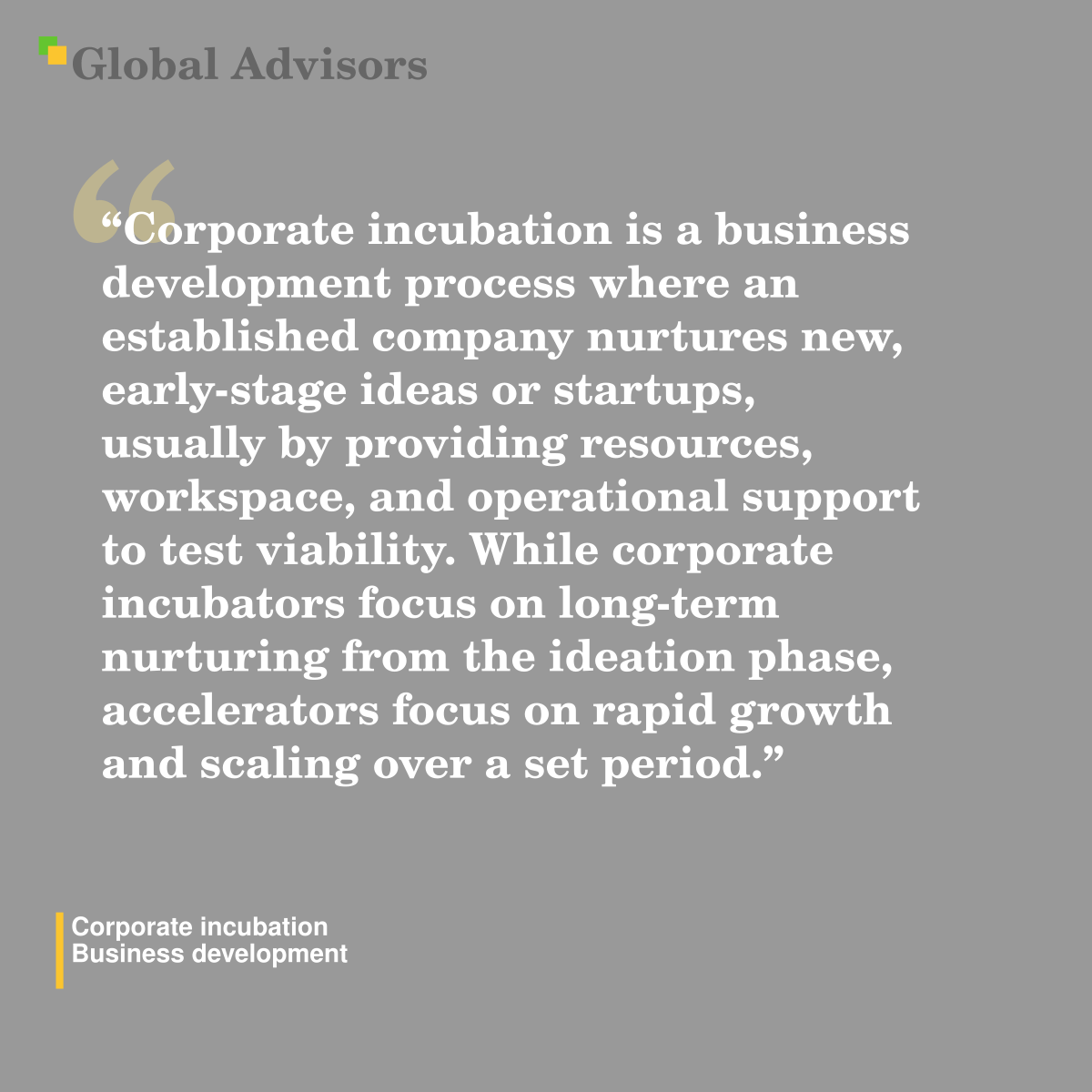
Term: Corporate incubation - Business development"Corporate incubation is a business development process where an established company nurtures new, early-stage ideas or startups, usually by providing resources, workspace, and operational support to test viability. While corporate incubators focus on long-term nurturing from the ideation phase, accelerators focus on rapid growth and scaling over a set period." - Corporate incubation - Business development Large organisations increasingly confront a structural problem: their core businesses are optimised for efficiency and predictability, while new growth depends on experimentation that is uncertain, slow and politically fragile. The tension between quarterly performance and long-horizon innovation is rarely solved by ad hoc projects or occasional hackathons; it requires a repeatable process for cultivating high-risk ideas until they can withstand the discipline of corporate investment and governance. From generic incubation to corporate incubation Business incubation broadly denotes structured support for very early-stage ventures, typically through workspace, mentoring, and shared services over an extended, flexible period . Corporate incubation adopts these mechanisms but embeds them inside, or tightly adjacent to, a specific incumbent company. Rather than serving the local entrepreneurial ecosystem in general, a corporate incubator is an independent business unit or programme that leverages the parent firm's assets to develop new ventures from concept to viable business, aligned with strategic priorities . This shift in sponsor and purpose has two practical implications. First, selection is guided by fit with corporate technologies, markets or future scenarios, not only by standalone venture attractiveness . Second, the incubator's output is judged not merely on venture survival, but on its contribution to the corporation's innovation portfolio, option value and organisational learning. Mechanics of the corporate incubation process Despite variation in design, most corporate incubators implement a recognisable process architecture similar to general business incubation, but tailored to corporate constraints . The pipeline typically begins with opportunity identification: scanning internal ideas, market shifts, and emergent technologies to generate a funnel of potential concepts. A screening phase then applies criteria such as strategic adjacency, resource leverage, technical feasibility and team quality. Accepted concepts enter an incubation phase in which they are provided with workspace, access to corporate infrastructure, mentor networks, and operational support ranging from legal and finance to procurement and data . Progress is monitored against learning milestones rather than near-term financial metrics: problem validation, solution validation, unit economics, and regulatory or technical de-risking. Graduation occurs when a venture achieves defined thresholds of viability and strategic relevance, at which point it may be spun in as a new business line, spun out as an independent entity with corporate shareholding, or terminated with lessons documented . The process is iterative rather than linear, with ideas recycled, merged or pivoted as evidence accumulates. Comparing incubators and accelerators in the corporate context The distinction between incubation and acceleration becomes particularly salient when corporations design their venturing toolbox. Incubators are optimised for ambiguous, early-stage opportunities; accelerators for ventures that already possess a product and early traction . In practical terms, incubator programmes are long-term and open-ended, often spanning 1 to 3 years, with flexible pacing and a focus on business model exploration and capability building . They usually offer shared space, mentorship and services, with limited or no direct investment, and are less equity-driven than accelerators . Accelerators, by contrast, are fixed-term, cohort-based programmes, typically 3 to 6 months, designed to compress growth via intensive mentoring, structured curricula and investor exposure, frequently in exchange for equity and seed capital . For a corporate sponsor, accelerators are suited to scaling external or internal ventures that are already formed; incubators are suited to nurturing nascent ideas and disruptive concepts where timelines are uncertain and strategic options are being explored . Some organisations explicitly treat incubation as a feeder stage into acceleration, with ventures graduating from the incubator once basic validation is achieved . Resource leverage and strategic alignment The defining characteristic of corporate incubation is the deliberate use of organisational assets to confer an unfair advantage on fragile ventures. These assets include brand credibility, customer access, distribution channels, proprietary data, manufacturing capacity, regulatory relationships and specialist talent . By embedding ventures in proximity to these resources, corporate incubators can test hypotheses that would be inaccessible to independent startups, such as pilots with major clients or experiments in highly regulated domains. However, the same proximity introduces alignment challenges. Ventures must navigate corporate procurement, compliance and risk processes that were designed for mature operations, not experiments. Effective incubators therefore negotiate modified rules of engagement: sandboxes for data and regulation, simplified approval paths, and capped budgets framed as affordable loss rather than traditional ROI commitments . The strategic lens also shapes portfolio construction. A corporate incubator is unlikely to support unrelated lifestyle businesses; instead it selects ventures mapping to defined growth domains or future bets, sometimes using formal search fields or opportunity spaces devised in corporate strategy exercises . Mathematical framing: options and portfolio dynamics While corporate incubation is primarily organisational, its economics can be expressed in optionality terms, clarifying why extended nurturing can be rational despite low immediate returns. Each incubated venture can be viewed as a real option with an initial investment cost , a stochastic future value , and an exercise decision at graduation. The corporation commits modest resources to create the option, then holds the right, but not the obligation, to scale or acquire the venture once uncertainty has partially resolved. A simplified representation might treat the venture's value as following a stochastic process , where captures expected growth driven by incubation support, the volatility of market and technology uncertainty, and a Wiener process reflecting noise. The incubator's role is to influence via capabilities and via de-risking experiments. At the portfolio level, the corporate incubator manages a set of ventures with correlated value processes, seeking a distribution of outcomes in which a small number of high-value successes offset many low-value terminations. Decision rules can be framed as threshold policies: scale a venture when its validated unit economics exceed a target and strategic fit is confirmed, abandon when further learning is unlikely to change a negative trajectory. This option-based view emphasises that corporate incubation is not about guaranteed success for every project, but about optimising the risk-return profile of the innovation portfolio. Governance, incentives and organisational tensions Corporate incubation inevitably collides with legacy governance and incentive structures. Traditional business units may perceive incubator ventures as competitors for capital or as distractions from core performance. Managers evaluated on short-term metrics can be hostile to initiatives whose payoffs lie 5 to 10 years ahead. Effective incubators mitigate these tensions through clear governance boundaries and incentive design. Structurally, they are often set up as distinct units with dedicated budgets, reporting lines and decision rights, reducing dependence on individual business unit sponsorship . They may use stage-gated committees that include both corporate and incubator leaders to approve continued funding based on learning metrics rather than revenue. Incentive-wise, incubator staff and venture teams are frequently offered variable compensation linked to portfolio outcomes, spinout valuations or strategic milestones, rather than annual profit targets. Some corporations allow internal entrepreneurs to hold equity stakes in spun-out ventures, raising questions about conflicts of interest but materially increasing motivation. Balancing openness to external ideas with protection of corporate IP requires careful contractual design, particularly where external founders participate in programmes. Schools of thought and design variations Practice and scholarship reveal several schools of thought in corporate incubation design. One view treats the incubator primarily as an internal innovation engine, focused on employee ideas and cultural transformation. Here, selection emphasises cross-functional teams and learning goals, and many ventures never leave the corporate perimeter. Another sees the incubator as a deal-flow mechanism for corporate venturing, closely integrated with corporate venture capital and M&A, sourcing and preparing external startups for possible investment or acquisition . A third approach positions the incubator as part of regional ecosystem development, co-funded with public bodies or universities, blending corporate strategic aims with wider economic development . These models differ on openness, equity policies, graduation paths and success metrics. Academic debate centres on whether incubators primarily add value through tangible services (space, funding, shared infrastructure) or intangible benefits (networks, legitimacy, knowledge) . Evidence suggests that both matter, but their relative importance depends on industry context: deep-tech ventures may value lab access and regulatory support more, digital ventures may prioritise data and distribution. Why corporate incubation remains strategically relevant Despite waves of interest in alternative innovation vehicles such as open innovation platforms, corporate venture capital and startup partnerships, corporate incubation retains distinctive relevance. It offers a structured way to explore opportunities that sit between incremental product development and outright acquisition: ideas too speculative for mainstream budgets but too strategically important to leave entirely to the external startup market. In industries with long development cycles, heavy regulation or capital intensity, external startups often struggle to access the assets needed to validate high-stakes concepts; a corporate incubator can lower this barrier while maintaining eventual strategic control . Moreover, the learning generated by incubated ventures feeds back into core strategy and capability building even when individual projects fail. Corporations gain insight into emerging customer needs, technology trajectories, and new business models such as subscription, platform or data-driven services. The incubator becomes both a venture factory and a sensing organ. The continuing debates over design, measurement and integration are not a sign of obsolescence but of adaptation: as markets, technologies and organisational forms evolve, corporate incubation provides a flexible but disciplined mechanism for reconciling exploration with exploitation in large firms.
|
| |
| |
Global Advisors News Brief - July 5 2026Read the full brief at the link Headlines for the last 24hrs
Time window: 2026-07-04T05:00:33.061Z to 2026-07-05T05:00:33.061Z |
| |
| |
Quote: Kevin Warsh"We have, at least in the United States, a dual mandate, and we have to deliver both on the employment side and on the stable price side. So we will be monitoring the speed of [artificial intelligence]. But if you wanted me to sound like a pessimist and a doomer on this, I am afraid I am not there." - Kevin Warsh - Chair of the Board of Governors of the Federal Reserve, CNBC policy panel at the ECB Forum on Central Banking 1 July 2026 Monetary policy is being forced to confront a technological shock that does not fit neatly into traditional models of inflation and employment. Artificial intelligence is simultaneously driving a boom in capital expenditure, reshaping labour demand, and promising future productivity gains, while current inflation remains above target and politically powerful constituencies demand lower interest rates. For a central bank charged with maintaining maximum employment and stable prices under a dual mandate, the timing and magnitude of the AI transition pose a direct challenge to the credibility and operational design of policy. From productivity promise to policy dilemma Kevin Warsh has argued for several years that AI is likely to be a significant disinflationary force, raising productivity and ultimately allowing interest rates to be lower than they would otherwise be. The expectation is straightforward: if AI lifts output per worker, firms can produce more at lower marginal cost, easing price pressures even in the presence of strong demand. In simplified terms, if potential output rises faster than demand, the output gap closes without sustained inflation, enabling monetary policy to operate with a lower neutral rate. Analysts summarising Warsh's case note his claim that AI-driven productivity gains would provide room for the Federal Reserve to cut rates while still delivering on its inflation target. The immediate macroeconomic environment is more complicated. AI-related investment has triggered a surge in data centre construction, specialised hardware procurement, and associated infrastructure, financed largely by cash-rich hyperscalers and equity market enthusiasm rather than cheap credit. Commentators observe that AI spending appears remarkably insensitive to current borrowing costs, driven more by fear of missing out and strategic positioning than by the level of the policy rate. This produces a near-term inflationary impulse: the expansion of capital stock requires labour, materials, and energy, adding to demand and potentially pushing up prices, even if the longer-term consequence is greater productive capacity. For a policymaker, the core dilemma is temporal. The disinflationary effects arrive only once AI has diffused into production processes and organisational routines, while the inflationary pressures from investment and transitional frictions show up in current data. That mismatch between short-run inflation prints and long-run productivity expectations forces the central bank either to lean against AI-driven demand, risking an unnecessary slowdown, or to tolerate elevated inflation in anticipation of future supply-side benefits. Warsh's public commentary reflects an attempt to balance those horizons, resisting both immediate pessimism about AI-driven disruption and over-optimistic calls for near-term rate cuts based solely on future productivity. The dual mandate under technological strain The United States Federal Reserve operates under a dual mandate: maximum employment and price stability. In practice, this involves a continuous judgement about how much weight to place on employment shortfalls versus inflation overshoots. Governors frequently describe the situation as a tightrope, noting that policy should be mildly restrictive when inflation is the more pressing concern, but not so restrictive as to cause large and persistent deviations from maximum employment. Warsh's stance since becoming chair has leaned toward prioritising inflation control, with repeated assurances that the central bank will deliver price stability and will remain independent from short-term political pressure for aggressive rate cuts. AI complicates this balancing act through three channels that researchers have begun to formalise. First, the cyclical transmission of monetary policy can be altered if AI changes how firms respond to interest rates, especially when capital spending is driven by strategic or technological imperatives rather than financing costs. Second, the structural transition associated with AI adoption can shift the estimated natural rate of unemployment and the neutral interest rate, moving the benchmarks that guide policy decisions. Third, AI may create new financial stability vulnerabilities, particularly if algorithmic trading, wealth effects, and concentrated exposures in AI-related assets deepen the feedback loop between monetary policy, asset prices, and macroeconomic risk. Formally, many central bank models still treat inflation as a function of slack and expectations, with relationships such as , where is inflation, is the output gap, and represents shocks. AI alters both and the distribution of . If productivity-enhancing technologies increase the economy's potential output, the output gap can close even when demand remains robust. But if adoption frictions and sectoral bottlenecks dominate in the short run, cost-push shocks can enter , making inflation more persistent. That structural uncertainty undermines the reliability of conventional estimates of slack and the natural rate, increasing the risk that the policy rate is either too high for too long or eased prematurely. Warsh's AI taskforces and operational reform Recognising that existing frameworks may not be adequate, Warsh has established five taskforces to re-examine core building blocks of monetary policy: communications, the balance sheet, data, productivity and jobs in an era of transformation, and inflation frameworks. The fourth taskforce, focused on productivity and jobs, explicitly centres AI and other general-purpose technologies, with a mandate to survey their pace, reach, and economic impact and to distil implications for the dual mandate. This institutional architecture is a response to the strategic tension between the need for timely policy decisions and the slow, contested process of understanding how AI is actually reshaping the economy. The taskforce on data is particularly salient for AI policy. Fed economists have begun to monitor AI adoption across sectors using complementary surveys and novel data sources, recognising that standard macro statistics may lag behind rapidly evolving technology use. If monetary policy decisions depend on mismeasured adoption rates, the central bank might either underestimate the potential productivity gain, thus keeping rates too high for too long, or overestimate the speed of diffusion, cutting prematurely and re-anchoring inflation expectations at a higher level. Warsh's emphasis on improving contemporaneous, actionable information reflects a belief that policy should respond to observable, validated changes in behaviour rather than speculative narratives. Inside the institution, the Federal Reserve System is itself deploying AI to improve operational efficiency, risk assessment, and internal analytics, while explicitly keeping AI out of the decision-making process of the Federal Open Market Committee. Speeches by other governors underline a governance principle: AI should augment human judgement, not replace it, and strong risk management must accompany experimentation. This cautious internal approach mirrors Warsh's external stance: willing to invest in AI and study its implications, but reluctant to adopt either alarmist or utopian positions that might distort policy choices. Capital expenditure boom and inflation optics On the international stage, including the ECB Forum panel, Warsh has pointed to an AI-driven boom in capital expenditure in the United States, visible first in demand for equipment, facilities, and specialist labour. He has expressed confidence that the supply side of the economy will eventually expand, reflecting the expected productivity improvement once AI systems are integrated and firms reorganise workflows. In other words, he accepts that the AI shock is currently demand-heavy but anticipates a later shift towards supply augmentation. Market-based commentators have framed this environment as a major constraint on Warsh's ability to deliver the rate cuts desired by the administration and segments of the market. AI and data centre expansion sit alongside other supply shocks, such as energy disruptions and geopolitical tensions, producing ambiguous inflation signals. Traditional central banking guidance suggests that supply shocks, which raise prices but weaken real incomes, can often be looked through if they do not feed into expectations. AI-related demand, however, is coming from sectors with strong balance sheets and equity-driven wealth effects, making them more resilient to higher rates and less likely to scale back spending quickly. Analysts at asset managers argue that the interaction between AI investment, supply constraints, and pockets of demand resilience widens the distribution of possible policy outcomes, encouraging the Fed to stay on hold for longer while it parses the underlying drivers of inflation. Futures markets have reflected that ambiguity, pricing a significant probability of rate hikes later in the year rather than cuts, even as Warsh's earlier writings suggested scope for lower rates in a high-productivity future. The optical tension between those prior arguments and the current hawkish tone is a central part of the backstory: the same policymaker who once championed AI as a disinflationary force now publicly emphasises that inflation is too high, that expectations must remain anchored, and that the Fed will bring prices down, even if that disappoints political or market actors hoping for rapid easing. Debate: AI optimism versus macro prudence Warsh's position has provoked debate among economists and policy commentators. Some critics argue that his framework places too much weight on a speculative, difficult-to-quantify productivity boom, using AI as justification for rate cuts that are not supported by current inflation data. They highlight the risk that betting on unverified productivity gains could entrench inflation above target if those gains fail to materialise as quickly as anticipated. From this perspective, AI optimism becomes a macroprudential hazard, encouraging looser policy in the face of persistent price pressures. Others contend that focusing solely on current inflation risks misinterpreting the nature of the AI shock. Research from within the Federal Reserve System points to the possibility of an AI-specific stagflation risk: adoption frictions could depress realised efficiency even as asset valuations and investment expectations soar, producing both cost-push inflation and financial fragility. In such a scenario, the standard interest rate instrument is ill-suited to addressing both dimensions simultaneously. Tightening policy to fight inflation might exacerbate fragility, while loosening to support financial stability could further unanchor prices. Advocates of this view argue for a broader toolkit, including macroprudential measures and regulatory interventions targeted at AI-driven financial exposures. A third strand of commentary stresses the distributional consequences of AI for employment. While aggregate productivity may rise, the effects on different worker groups are uneven. High-skill, AI-complementary roles may see wage gains and greater demand, whereas routine cognitive and some service jobs may face displacement. For a central bank with an employment mandate, the challenge is not only the overall unemployment rate but also the quality and stability of work, regional disparities, and the speed of labour market reallocation. Policymakers must judge whether AI-linked labour market adjustment is sufficiently smooth to be treated as normal cyclical variation, or whether it constitutes a structural break demanding a reconsideration of what "maximum employment" means. Fed independence and political expectations Overlaying the economic complexity is a political context in which the administration has repeatedly called for lower interest rates to support growth and markets. Warsh's earlier advocacy for AI-driven disinflation was politically convenient, aligning with arguments that technological progress would allow looser policy without sacrificing price stability. Since taking office, however, he has gone out of his way to stress that the Fed remains independent, will not tolerate inflation above 2%, and will bring prices down regardless of short-term political preferences. Public statements emphasising willingness to "disappoint" those expecting an accommodative pivot reinforce the message that interest rate decisions are anchored in economic assessment rather than political instruction. At the same time, Warsh has refrained from definitive predictions about specific upcoming meetings, signalling a data-dependent approach. Market reactions, including sharp moves in precious metals and the dollar following his appointment, suggest that investors view him as a credible inflation-fighter who is unlikely to sacrifice price stability for growth. This credibility is an asset when navigating AI uncertainty: anchored expectations give the Fed more scope to wait and gather evidence on the real economic impact of AI before recalibrating the stance. International dialogue and contrasting central bank positions The ECB Forum panel brings Warsh into conversation with other major central bankers, including leaders from the Bank of England, Bank of Canada, and the European Central Bank. All face versions of the same problem: AI is transforming investment, production, and financial markets globally, but its macroeconomic footprint is uneven across jurisdictions. In Europe and Canada, the scale of hyperscaler-driven investment is smaller, yet AI still influences productivity expectations and financial market narratives. The forum serves as both a stage for public signalling and a venue for behind-the-scenes exchange on how to incorporate AI into risk assessments, forecasts, and communication strategies. Differences in institutional mandates and legal frameworks matter. Some central banks prioritise price stability as a single explicit objective, with employment considered indirectly through output and financial stability. The Federal Reserve's dual mandate requires explicit consideration of both employment and prices in each decision. Warsh's remarks thus carry a distinctive nuance: he must explain how AI is being monitored for its impact on both sides of the mandate, reassure that the institution is neither complacent about inflation nor blind to potential employment disruption, and signal that policy will respond to the pace of AI's real-world impact rather than to hype cycles or doomsday narratives. Why the stance matters The way a Fed chair frames AI has practical consequences for firms, workers, and financial markets. If businesses believe that AI-driven productivity will soon justify structurally lower interest rates, they may lever up in anticipation, build capacity aggressively, and assign high valuations to AI-related assets. Conversely, if the message emphasises caution, data dependence, and the possibility of further tightening, firms may moderate borrowing, focus on self-financed investment, and price in higher discount rates for longer. Warsh's mix of long-run optimism and near-term hawkishness is an attempt to avoid both excess exuberance and unnecessary pessimism: acknowledging AI as a transformative general-purpose technology while insisting that monetary policy cannot be set on speculative projections alone. For workers, the dual mandate lens is crucial. A central bank that remains attentive to employment outcomes during an AI transition can push back against narratives that treat technological unemployment as an acceptable collateral effect of productivity gains. By monitoring how AI adoption affects job quality, participation, and wage dynamics, the Fed can incorporate labour-market side constraints into its assessment of appropriate policy stance. Warsh's decision to devote a dedicated taskforce to productivity and jobs in an era of transformation signals that employment effects are not merely a residual issue after inflation is addressed, but a central dimension of the AI challenge. Finally, the stance matters for the evolving architecture of monetary policy itself. AI is already being operationalised inside the Fed as a tool for analysis, document processing, and workflow enhancement, but not yet as a direct input into interest rate decisions. The institution must design governance frameworks that harness AI's capability while avoiding over-reliance on opaque models that might encode biases or amplify volatility. Warsh's reluctance to adopt a doomer narrative reflects a broader caution against deterministic technological fatalism: policy remains, in his framing, a domain of human judgement, constrained by mandates and informed by evidence, even in the face of what he has elsewhere described as one of the most disruptive technological moments in economic history. In that context, a chair signalling that he will monitor AI's speed, maintain the dual mandate, and resist both apocalyptic and euphoric interpretations helps to anchor expectations during a period when technology outpaces measurement and historical analogies. The backstory is a central banker attempting to construct a coherent, credible path through an AI shock that is simultaneously inflationary, deflationary, and structurally transformative, while the institutional constraints of the dual mandate and political independence leave limited room for error.
|
| |
!["We have, at least in the United States, a dual mandate, and we have to deliver both on the employment side and on the stable price side. So we will be monitoring the speed of [artificial intelligence]. But if you wanted me to sound like a pessimist and a doomer on this, I am afraid I am not there." - Quote: Kevin Warsh - Chair of the Board of Governors of the Federal Reserve, CNBC policy panel at the ECB Forum on Central Banking 1 July 2026](https://globaladvisors.biz/wp-content/uploads/2026/07/20260701_18h00_GlobalAdvisors_Marketing_Quote_KevinWarsh_GAQ.png)
| |
Quote: Alex Karp - Palantir CEO"Something has gone completely wrong. The basic view among enterprises in this country is: 'I am going to chillax and waste my time with tokens. I am going to get no value, and they are going to get my IP.'" - Alex Karp - Palantir CEO Enterprise AI adoption is colliding with a harsh reality: many large organisations feel they are paying heavily for experimental systems while surrendering control over their most valuable asset, their intellectual property, to external model providers. In the US corporate environment Alex Karp describes on CNBC, the prevailing mood among sophisticated buyers is not excitement about cutting-edge models but frustration, distrust, and a growing sense that the economic bargain being offered by frontier AI labs is structurally misaligned with enterprise interests. That dislocation between value delivered and IP risk is the underlying tension driving both the quote and the strategic repositioning now under way across the AI ecosystem. From Model Hype To Enterprise Disillusion The immediate factual context is Karp's appearance on CNBC's "Squawk Box" in July 2026, where he argues that leading AI labs have "completely" mis-sold AI to enterprises by focusing on token-based access to frontier models rather than on controlled, outcome-focused deployments. In his account, many US enterprises have trialled generative AI services priced on usage tokens, only to discover that pilots rarely progress into production systems that materially improve manufacturing, logistics, pharmacological research, or other complex operations. Instead, budgets are consumed by experimentation while the providers accumulate fine-tuning data, usage patterns, and business process know-how which can be re-embedded into their own models, effectively harvesting the clients' alpha-the distinctive decision logic and competitive edge embedded in their data and workflows. This perceived asymmetry-"no value" for the buyer, strategic data for the seller-is what Karp frames as something having gone "completely wrong". Token-based commercial models were originally marketed as democratising access: pay per token, experiment rapidly, avoid the capital expenditure of owning clusters or building internal model pipelines. Yet for complex enterprises operating in regulated environments or on the battlefield, capability without sovereignty quickly becomes a liability. They may obtain powerful generative capabilities but lack negotiated guarantees about where prompts are cached, how outputs are logged, and whether fine-tuning pipelines will internalise their proprietary domain knowledge. As concerns about model training data, reinforcement learning from human feedback, and long-term retention policies have intensified, token pricing has ceased to look like operational flexibility and instead resembles an opaque rent charged on access to infrastructure that may ultimately compete with the client. IP Sovereignty And The Fear Of "Alpha Theft" Central to the statement is a specific fear: that external labs will not only see sensitive data, but also infer and appropriate the core decision-making patterns that constitute an enterprise's alpha. In financial language, alpha denotes excess return above a benchmark; in Karp's usage, it extends to any proprietary operational edge-manufacturing recipes, logistics heuristics, risk scoring rules, or targeting doctrines-that can be implicitly reconstructed from usage data. The worry is not merely that sensitive documents or customer records might leak, but that the lab, by observing queries and feedback at scale, can build a generalised representation of how the client makes high-value decisions, then reuse or productise that representation for other customers or its own ventures. In this view, enterprise AI based on external closed models risks functioning as a one-way knowledge transfer: the client pays for tokens and experimentation, the provider quietly accumulates a distilled map of the client's decision landscape. These concerns intersect with a broader security discourse on AI systems. Research on emerging AI security risks notes that large-scale models and agentic systems introduce new attack surfaces, including prompt injection, model theft, and indirect prompt attacks that can exfiltrate or reconstruct sensitive patterns from interaction histories. When enterprises are unsure who controls the weights, where model states are stored, or how fine-tuning data is segregated, the threat is not confined to adversarial actors; it includes the legitimate provider using aggregated insights to strengthen its own competitive position. Recorded analyses of AI security risk emphasise the need for zero-trust principles and strict governance for agent identities and model access paths. Karp's intervention translates that abstract security language into a blunt commercial accusation: some labs are effectively imposing a "wealth tax"-charging high fees while appropriating data-driven alpha that rightly belongs to the enterprise. The Strategic Role Of Ontology And The Application Layer Technically, Karp positions his organisation's ontology and application layer as the antidote to this perceived mis-selling. An ontology in modern enterprise AI is a structured, machine-readable representation of the entities, relationships, and actions that define a business domain. It encodes not merely metrics but the semantic and operational logic of an organisation: what a "shipment" is, how it relates to "warehouse", "route", and "risk score", and what should happen when a shipment is delayed or a risk threshold is exceeded. Sources on ontology describe it as the central nervous system of an enterprise AI stack, integrating data, business logic, and stateful decision processes into a unified model that both humans and AI agents can query and update. Palantir's documentation explicitly frames its Ontology system as modelling decisions through the integrated representation of data, logic, action, and security. By situating the large language model behind such an ontology-driven application layer, Karp argues that enterprises can make frontier or open models "safe, useful and precise" without exposing underlying data or decision logic to uncontrolled caching or replication. The ontology constrains interactions: the model does not directly traverse raw databases or ungoverned knowledge graphs, but operates within a guardrailed semantic context where each read and write is mediated by the ontology's policies and security rules. This architecture allows enterprises to swap models-closed or open-while retaining ownership of the domain representation and controlling which signals are fed back into training pipelines. In effect, sovereignty is pushed up a layer: instead of negotiating at the level of tokens and prompts, enterprises assert control through a persistent context model that defines the vocabulary, relationships, and permissible actions of their AI systems. Independent analysis of ontologies and semantic layers reinforces this framing. Multiple sources distinguish semantic layers (which standardise metrics and calculations) from ontologies (which model domain entities and relationships to support reasoning and multi-agent workflows). In more advanced architectures, an enterprise context layer extends the ontology with policy and judgement, enabling agentic AI to act with appropriate authority while remaining grounded in governed context. This layered approach speaks directly to Karp's critique: token-based access without such context mechanisms leaves enterprises reliant on system prompts and ad hoc safeguards, whereas moderated access through an ontology enables granular control over what the model sees, what it can infer, and how its outputs propagate through operational systems. Tokens, Pricing, And The True Cost Of Enterprise AI Behind the rhetoric lies a concrete economic dispute about how AI is priced and measured. Token-based billing makes sense for consumer chatbots or simple developer experiments, but it maps poorly onto the complex cost structure of enterprise AI deployments. Detailed breakdowns of total cost of ownership for enterprise AI highlight multiple categories beyond mere inference: infrastructure, data engineering, specialised talent, model maintenance, compliance, and integration can each account for substantial portions of spend. For example, GPU clusters and multi-cloud infrastructure can run from 200 000 to well over 2 000 000 annually; data engineering and pipeline maintenance often consume 25 to 40% of the total budget; and version control, monitoring, and retraining add further overhead. Against that backdrop, token fees imposed by labs are only one component of cost, yet they are often the most visible and least justified from a business outcome perspective. Karp's point about "bad financials and growth while losing money" is that many frontier-lab-centric enterprises are stuck in a pattern where token usage rises, experimental deployments proliferate, but revenue-impacting applications fail to reach scale because clients will not pay the "true cost" for hardened systems integrated into core operations. Independent CIO analysis supports this diagnosis: most enterprise AI programmes struggle not because models are inadequate but because operating models, data governance, and decision workflows are not restructured to exploit intelligence effectively. Pilots remain isolated, metrics are vague, and AI doesn't become a "core business capability" driving measurable outcomes. In that environment, token spend looks like speculative experimentation rather than capital investment; when combined with fears about IP appropriation, the result is the disillusionment Karp reports-organisations feel they are "chillaxing" with models that burn compute and budget while shifting long-term advantage towards the providers. Trust, Governance, And Who Owns The Risk Layered through the backstory is a governance argument: enterprises are demanding clear answers to basic ownership questions that many labs have deferred or obscured. Who owns the data once it flows through prompts and logs? Where is it cached, and under what retention and deletion policies? Are fine-tuned weights shared, siloed, or reused across customers? Who is accountable if model behaviour evolves into risky territory due to accumulated training signals? Governance frameworks for AI risk increasingly emphasise cross-functional responsibility-security, legal, ethics, and operations convened in AI risk committees or similar bodies-to manage these questions systematically. Yet Karp suggests that labs have tried to bypass this institutional maturity by appealing to trust and speed, effectively asking enterprises to accept "I have never lied" narratives rather than auditable guarantees. Studies on AI accountability in enterprises show that ownership is often fragmented: surveys find that a significant share of organisations cannot identify a single C-suite executive accountable for AI-related risks. Regulatory shifts, such as US federal guidance on Chief AI Officers, are slowly pushing towards clearer responsibility structures, but many enterprises are still negotiating basic guardrails. In that milieu, labs that offer generic indemnities or vague privacy commitments are increasingly out of step with the expectations of regulated industries and national security customers. Recorded Future and other security-focused analyses argue for continuous AI governance, validation, and monitoring, moving beyond traditional detection-first security towards active control over model access, prompt engineering, and behavioural auditing. Karp's narrative fits within that emerging consensus: he channels the frustration of enterprises that feel their governance questions are brushed aside in favour of token counters and marketing demos. Open Models, Compute Control, And The Battle Over Means Of Production A key strategic pivot Karp advocates is towards open-weight models, owned compute, and internal control over the "means of production" in AI. Rather than relying on external frontier labs to provide both models and infrastructure, he argues that sophisticated enterprises-and especially defence customers-should own their GPUs, run open-source or internal models, and maintain direct control over weights. Analysts observing his CNBC interview note that he positions this as an AI sovereignty agenda: enterprises should not depend on consensus views in Silicon Valley to run battlefields or critical infrastructure. This resonates with broader trends: open models from US, European, and Chinese providers, as well as model ecosystems associated with major hardware vendors, are increasingly attractive because they allow weight-level control and deployment into sovereign environments. The partnership he describes with NVIDIA is emblematic of this shift. Rather than simply consuming NVIDIA's hardware indirectly through cloud platforms, the arrangement is framed as a way to build custom AI systems where enterprises own their compute, models, data stack, and alpha. Industry commentary highlights that technical customers now ask first-order questions about whether they can switch models, retain weights, and localise training within their own security perimeter. Open-weight models, combined with ontology-driven application layers, offer a pathway: enterprises can assemble model-plus-context stacks where the underlying infrastructure is under their control, and external labs become optional rather than central. Karp's blunt criticism of "deploy-co" structures-entities that merely deploy tokens while transferring alpha to third parties-captures his belief that the old model of centralised AI provision is being superseded by a more federated, sovereign architecture. The Political And Geopolitical Dimension Although the quote focuses on enterprise sentiment, it sits within a broader political and geopolitical frame. Karp warns that overselling AI to enterprises while refusing secure, controllable deployments for departments of defence or war is "effing insane" from a national security standpoint. He juxtaposes the willingness of labs to release powerful models to global adversaries with their reluctance to provide weight control and data sovereignty to allied governments, calling into question the alignment between commercial AI strategies and Western security priorities. Geopolitical analysis identifies America, China, and Israel as the key tech centres in this domain, with China acting as a peer adversary and building its own AI ecosystems without the same internal political and cultural frictions. In that context, he argues that Western debates about restricting AI for domestic governments while leaking capability to adversaries are strategically incoherent. This geopolitical lens reinforces the enterprise IP concerns. If frontier labs spread powerful models widely, train them on cross-enterprise data, and retain unilateral control over their evolution, they accumulate a transnational reservoir of operational knowledge that may be difficult to govern or align with any particular state's interests. Policy analysts increasingly call for AI sovereignty: nations and major enterprises should maintain clear lines of control over critical models, training data, and deployment pipelines. Ontology-based architectures and sovereign compute fit this agenda, providing mechanisms to confine sensitive decision logic and operational knowledge within national or organisational boundaries while still exploiting shared model innovation where appropriate. Karp's argument surfaces the uncomfortable possibility that without such measures, enterprises are unwittingly contributing to a shared AI commons dominated by private labs whose strategic aims diverge from their own. Debates, Objections, And Why It Matters There are, of course, objections to Karp's framing. Supporters of frontier labs argue that token-based models enable rapid innovation, allow smaller firms to access capabilities they could never build themselves, and that strict privacy and data segregation policies prevent the kind of alpha appropriation he describes. They point out that most labs publish privacy guarantees, offer enterprise-grade instances, and in some cases commit not to train core models on customer data without explicit consent. Furthermore, independent commentators note that Karp is simultaneously warning about mis-selling and promoting his own stack as the solution, raising the question of how much of his critique is principled and how much is commercial positioning. Yet even critics acknowledge that his intervention crystallises real anxieties in the market. CIO surveys repeatedly show that enterprise AI programmes struggle to progress beyond pilots, and that business stakeholders demand clearer ownership, risk management, and measurable outcomes. Security analysts document new attack vectors and emphasise the need for specialised AI governance rather than generic cybersecurity controls. Ontology and context-layer specialists underline that without a structured domain model, large language models will remain brittle, hallucination-prone, and difficult to integrate safely into mission-critical systems. In that sense, Karp's colourful language functions as a signal: the easy phase of model hype and token experimentation is ending, replaced by a more demanding era where enterprises insist on value, sovereignty, and trustable architecture. Why it matters is straightforward. If large organisations continue to see AI as a high-cost, low-trust experiment, adoption will stall, and the transformative potential of integrated AI decision systems will be realised only in pockets-by those who build sovereign stacks with strong ontologies and controlled models. The competitive gap between enterprises that own their alpha and those that bleed it into shared clouds will widen. National security doctrines will be shaped by whether governments can deploy agentic AI that respects classified boundaries while reasoning effectively. And the structure of the AI industry itself will be determined largely by how this dispute over tokens, IP, and ownership is resolved: either frontier labs maintain a centralised, rent-extracting role, or the ecosystem rebalances towards open-weight, ontology-driven, sovereign architectures where labs are important but not dominant. Karp's remark is a snapshot of that inflection point, capturing a moment when the market is re-evaluating what it is willing to pay for-and what it is no longer willing to give away.
|
| |

| |
Term: Compute - Artificial intelligence"AI compute refers to the raw processing power, hardware (like GPUs or TPUs), and computational resources required to build, train, and run machine learning models. It is the physical and electrical engine that makes artificial intelligence possible." - Compute - Artificial intelligence The limiting factor in modern artificial intelligence is increasingly neither algorithms nor data, but the availability, efficiency, and governance of the underlying computational power that drives every training run and inference call . This constraint shapes which models can realistically be built, who can build them, and how they can be deployed in practice, turning technical capacity into a strategic economic and geopolitical resource . As models grow larger and more capable, the marginal gains from better architectures are often gated by access to sufficiently dense and affordable processing, memory, and interconnect, making the structure of computational resources central to the future trajectory of AI . From abstract computations to physical infrastructure Discussions of computational requirements for AI often blur three distinct but related layers: the number of mathematical operations needed to train or run a model, the performance of the hardware capable of executing those operations, and the physical infrastructure that supplies power, cooling, and connectivity . At the most abstract level, one can speak of the total number of floating point operations needed to complete a task such as training a large language model; this is a property of the model architecture, dataset size, and optimisation schedule . At the performance level, the relevant quantity is how many such operations a chip or cluster can execute per second, typically expressed as floating point operations per second, or FLOP/s, and scaled to tera-, peta-, or exa-levels for modern accelerators . Finally, the physical realisation includes racks of GPUs, TPUs, or other accelerators, backed by power distribution, cooling, networking, and storage, all of which determine whether theoretical performance can be sustained in practice . This layered view matters because it separates the algorithmic compute demand from the hardware supply and the infrastructure that binds them. A model that mathematically requires floating point operations to train might in principle run on any hardware, but in practice only facilities with sufficiently many accelerators, reliable power, and high-bandwidth interconnect will complete the job within useful time and cost constraints . Conversely, a highly capable data centre with petascale compute capacity may be underutilised if software is poorly optimised or if algorithms do not parallelise efficiently across its architecture . This interplay between the abstract workload and its physical instantiation is where many of the practical and policy debates about AI compute now reside . Substantive meaning: what compute encompasses In operational terms, AI compute encompasses the processors, memory, storage, and interconnect needed to execute the numerical linear algebra at the core of contemporary machine learning . Processors include general-purpose CPUs and, increasingly, specialised accelerators such as GPUs, TPUs, NPUs, LPUs, and other AI-specific chips that are optimised for dense matrix multiplications and tensor operations . Memory covers both fast on-chip resources used to hold activations and parameters during computation, and off-chip system memory required for larger models and datasets . Storage and networking ensure that training data and model checkpoints can be moved, retrieved, and synchronised across nodes at sufficient speed to avoid idle accelerators . This combination forms a stack in which hardware, software frameworks, and data centre infrastructure jointly determine the effective compute available for AI workloads . At the hardware level, GPUs and TPUs provide massively parallel arithmetic units; at the software level, frameworks such as TensorFlow, PyTorch, and JAX map high-level model descriptions into efficient kernels and collective operations; at the infrastructure level, orchestration systems schedule jobs, allocate accelerators, and manage contention and failures . When practitioners talk about scaling compute, they typically mean increasing one or more of these layers: adding more accelerators, improving software kernels and compilation strategies, or deploying in larger or more specialised data centres . Training versus inference: distinct compute regimes AI workloads impose very different computational profiles depending on whether the system is being trained or used for inference. Training deep models involves repeated forward and backward passes over large datasets, requiring extremely high aggregate throughput, long uninterrupted training runs, and careful coordination of parameter updates across many devices . This regime favours clusters of accelerators with high-bandwidth interconnects, large memory, and sophisticated parallelism strategies such as data, tensor, and pipeline parallelism to distribute the compute load . Inference, by contrast, typically operates on single inputs or small batches but may need to respond within milliseconds at large scale, so latency and cost per query become the binding constraints . For many applications, the objective is to deliver acceptable quality with minimal compute per request, which drives interest in model compression, quantisation, distillation, and specialised inference chips . This divergence explains why training clusters may use general-purpose GPUs or TPUs capable of handling diverse operations, while inference at scale increasingly relies on highly specialised accelerators like LPUs optimised for deterministic, low-latency execution of large language models . Quantifying AI compute: FLOPs and FLOP/s To reason rigorously about computational requirements, AI research and policy communities have converged on two related quantities: the total number of floating point operations required by a workload, and the rate at which hardware can execute them . The total work for a training run can be represented as , where is an estimate of operations per example (a function of the model architecture), is the number of examples, and is the number of training epochs. This describes the abstract compute demand independent of any particular hardware implementation . Hardware capability is characterised by its peak or sustained floating point operations per second, often written as for a given chip or cluster. In simplified terms, the minimum wall-clock time to complete a workload with total operations on a system with effective performance is , ignoring parallelisation overheads and communication costs . In practice, the realised is significantly lower than the theoretical peak due to memory bottlenecks, load imbalance, and suboptimal kernel use . Hence, much of the art of large-scale AI engineering lies in closing this gap through software optimisation, mixed-precision arithmetic, efficient batch sizing, and distributed training strategies that maintain high utilisation of available compute . Key hardware paradigms: GPU, TPU, LPU and beyond Modern AI compute is dominated by accelerator classes designed around the patterns of matrix multiplication and vector operations that underpin neural networks. GPUs began as graphics processors but evolved into highly parallel general-purpose accelerators capable of executing thousands of concurrent threads, making them the default platform for training and many inference workloads . Their strength lies in flexibility: they support a wide range of workloads, frameworks, and numerical precisions, and can be deployed in consumer devices, edge systems, on-premises clusters, and hyperscale cloud environments . TPUs represent a more specialised design, using systolic arrays and custom data paths to accelerate dense tensor operations for deep learning, particularly in large-scale data centre deployments . By sacrificing some generality in favour of fixed-function matrix units and tightly integrated memory hierarchies, TPUs can deliver higher performance-per-watt on well-matched workloads, though they are closely tied to specific software ecosystems and cloud platforms . LPUs, as emerging accelerators targeted at language model inference, push specialisation further: architectures such as Groq's chip use deterministic, compiler-scheduled pipelines with thousands of arithmetic units and explicit dataflow to guarantee predictable latency and maximise throughput for sequential token generation . Alongside these, NPUs, IPUs, and other AI-specific processors explore different trade-offs in programmability, sparsity support, and on-chip memory to better align hardware with the computational structure of modern models . Compute as a stack: hardware, software, and infrastructure Thinking of AI compute as a stack highlights that raw processing units are only one component of a larger system that must be jointly engineered. At the base are the chips themselves, which embed microarchitectural choices about arithmetic precision, memory bandwidth, and interconnect topology . Above this sits the systems software layer, including device drivers, runtime libraries, compilers, and distributed training frameworks that translate model graphs into high-performance kernels and collective operations across many devices . At the top lies the infrastructure of data centres, including servers, racks, power delivery, cooling systems, and wide-area networking that enable reliable operation at scale . A change at any layer can materially alter effective compute. Introducing more efficient kernel implementations or mixed-precision routines can reduce the total operations needed for a given level of model quality, effectively lowering in the workload equation . Upgrading interconnect from standard Ethernet to specialised fabrics can increase the fraction of peak FLOP/s that distributed training sustains by reducing communication overheads, thereby increasing realised . Investing in denser racks and advanced cooling allows more accelerators per square metre and per unit of power, expanding physical compute capacity without new algorithms or chips . This interdependence explains why companies and research institutions consider the full stack when planning AI investments, not just the nominal teraFLOP rating of individual accelerators . Resource allocation, scheduling, and virtualisation Because accelerator resources are scarce and expensive, managing their allocation across teams and workloads is a central operational concern. In large environments, compute is abstracted into schedulable units that can be requested and assigned to jobs, often via Kubernetes-based orchestration and higher-level platforms . Templates or profiles describe combinations of GPU count, type, memory allocation, and associated CPU and storage resources so that practitioners can submit workloads without micromanaging individual devices . The scheduler then matches these requests to available nodes, attempting to maximise utilisation while honouring constraints on memory, isolation, and performance . Techniques such as GPU fractioning, where a single physical accelerator is partitioned among multiple workloads, further complicate the picture by enabling more granular sharing at the cost of potential interference and reduced per-job performance . Virtualisation and containerisation provide environment isolation, but also add layers that must be tuned to avoid bottlenecks in data loading or kernel launch overhead . As a result, the effective compute seen by an individual project depends not only on the data centre's headline capacity but also on organisational policies, queueing disciplines, and the sophistication of resource management tooling . Schools of thought: compute-centric versus algorithm-centric views Within the AI community, one can distinguish several positions on the role of compute in driving progress. A compute-centric view emphasises empirical scaling laws suggesting that model performance improves predictably with increased model size, dataset size, and computational budget, provided algorithms are reasonably well-chosen . On this view, access to ever larger compute budgets is a primary determinant of frontier capability, and thus controlling, forecasting, and prioritising compute becomes central to strategy and governance . Proponents often argue that even modest algorithmic innovations are amplified when combined with orders-of-magnitude increases in compute, as seen in the evolution of large language models and multimodal systems . An algorithm-centric perspective stresses that improvements in architectures, optimisation methods, and data curation can yield substantial performance gains without proportional increases in compute. Advocates point to advances such as more efficient attention mechanisms, sparsity exploitation, or better training curricula that reduce the total operations needed for a given level of performance, effectively moving workloads to a lower for the same outcome . A third, more integrated stance treats compute, algorithms, and data as jointly constraining factors, where progress depends on simultaneously optimising all three. Under this hybrid view, investments in compute must be matched by research into more efficient methods and by strategies for high-quality dataset construction, else returns on additional FLOPs diminish . Strategic and geopolitical dimensions As training runs for state-of-the-art models require vast compute budgets, often aggregated in specialised AI supercomputers composed of thousands of accelerators, computational power acquires properties of a strategic resource . Such capacity is scarce, capital-intensive, and geographically concentrated in a small number of cloud providers and research labs, leading to concerns about market power, dependency, and unequal access . Governments and international organisations increasingly view domestic AI compute capacity as analogous to critical infrastructure, similar in strategic significance to energy supplies or advanced manufacturing bases . This strategic lens raises questions about export controls on advanced chips, incentives for domestic data centre construction, and international coordination on the environmental and security implications of large compute clusters . Nations with limited access to leading-edge hardware may face barriers not only to competing at the frontier of AI capabilities, but also to deploying models tailored to local languages and contexts, potentially exacerbating digital divides . Conversely, concentration of compute in a few jurisdictions and firms creates levers for regulatory oversight, as controlling access to large-scale compute can act as an instrument for managing the pace and direction of powerful AI development . Environmental and physical constraints The physicality of AI compute carries environmental and infrastructure implications that are no longer peripheral. High-density accelerator clusters demand substantial electrical power, often measured in tens of megawatts for a single facility, and sophisticated cooling systems to keep chips within safe operating temperatures . As models and training runs scale, the cumulative energy consumption and associated carbon emissions of AI workloads have prompted scrutiny from regulators, researchers, and the public, particularly where power generation mixes are carbon-intensive . Data centre operators respond with more efficient cooling designs, such as liquid cooling and hot-aisle containment, and with workload scheduling that shifts some computation to periods of lower grid stress or higher renewable availability . Hardware designers contribute by introducing more energy-efficient architectures, lowering the joules per FLOP for both training and inference . Nonetheless, because algorithmic and scale ambitions tend to expand to fill available capacity, there is an ongoing tension between efficiency gains and overall growth in compute demand, making governance of AI compute an environmental as well as a technological issue . Why AI compute still matters and how it is evolving Despite periodic claims that algorithmic breakthroughs might decouple progress from brute-force computation, current trends indicate that access to large-scale compute remains a central determinant of who can build and deploy advanced AI systems . Emerging modalities such as large multimodal models, long-context language models, and agentic systems often require significantly greater training and inference budgets than their predecessors, even when architectures are more efficient on a per-parameter basis . At the same time, edge deployments in mobile devices, vehicles, and industrial sensors demand increasingly capable inference under tight power and latency constraints, pushing innovation in specialised low-power accelerators and on-device optimisation techniques . Looking ahead, the concept of AI compute is likely to become even more nuanced. Architecturally, heterogeneous systems combining different accelerator types may become standard, matching workloads to the most suitable chips within a single cluster . At the software level, advances in compilers, auto-parallelisation, and neural architecture search could make the mapping from high-level models to hardware more automated and efficient, narrowing the gap between theoretical and effective FLOP/s . At the governance level, discussions of responsible AI are steadily incorporating compute audits, reporting of training budgets, and assessments of energy and security implications, embedding computational power into broader frameworks for AI oversight . Far from being a background technical detail, AI compute has become a central lens through which the capabilities, risks, and opportunities of artificial intelligence are understood and contested.
|
| |

| |
|


| |
| |