Select Page

Global Advisors | Quantified Strategy Consulting

Link from bio
Quote: Dara Khosrowshahi – CEO, Uber

Quote: Dara Khosrowshahi – CEO, Uber

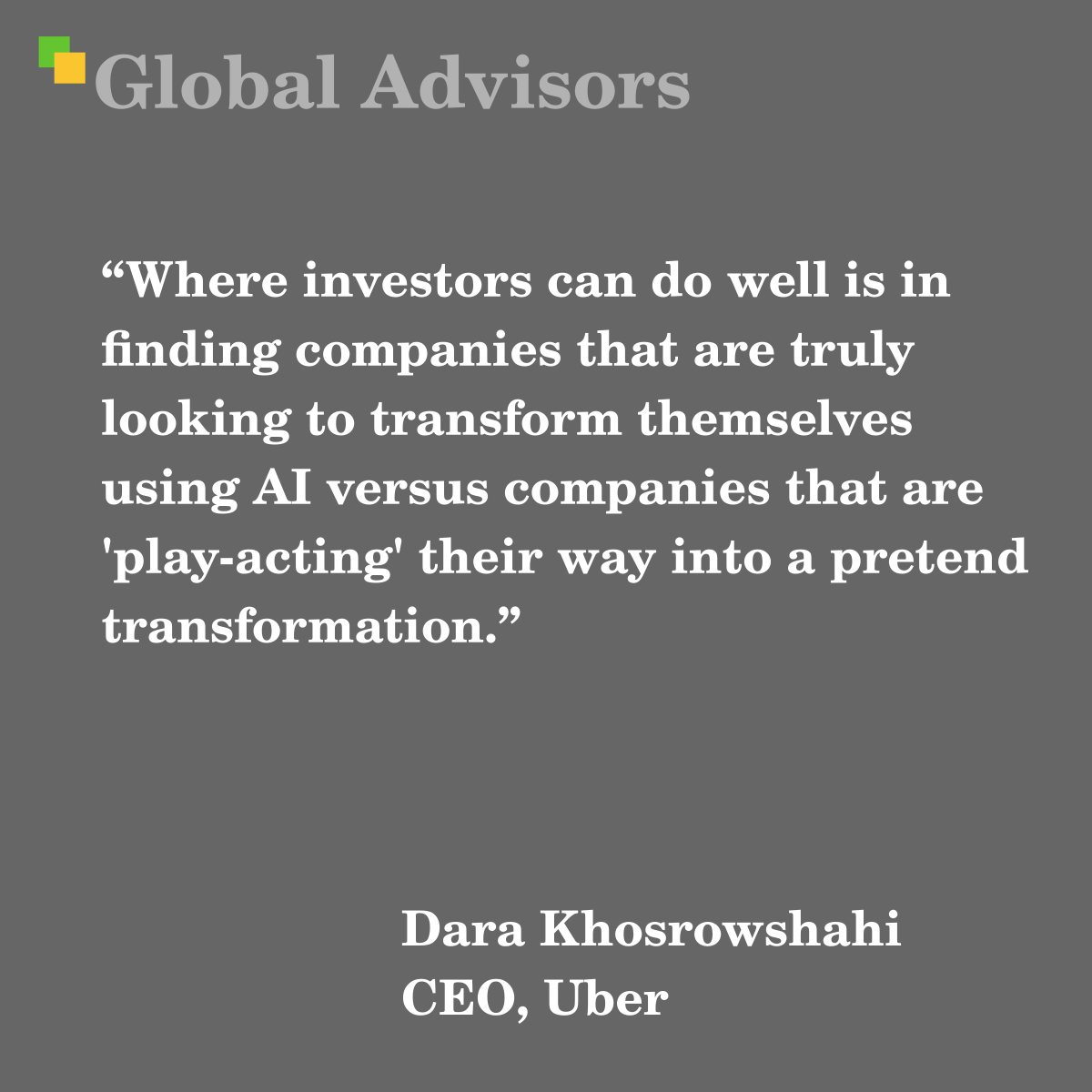
“Where investors can do well is in finding companies that are truly looking to transform themselves using AI versus companies that are ‘play-acting’ their way into a pretend transformation.” – Dara Khosrowshahi – CEO, Uber

Dara Khosrowshahi, CEO of Uber, delivered this pointed observation during a session at the World Economic Forum (WEF) Annual Meeting 2026 in Davos, titled An Honest Conversation on the Hopes and Anxieties of the (New) Economy. Speaking amid discussions on AI’s role in reshaping industries, he highlighted the gap between superficial AI initiatives and profound operational overhauls.1,5

Who is Dara Khosrowshahi?

Born in 1969 in Tehran, Iran, Dara Khosrowshahi fled the Iranian Revolution with his family at age nine, settling in the United States. He graduated from Brown University with a double major in electrical engineering and computer science. Khosrowshahi began his career at Credit Suisse First Boston before joining IAC/InterActiveCorp in 1998, where he rose to lead Expedia as CEO from 2005 to 2017, transforming it into a travel industry powerhouse amid the digital shift.1 Appointed Uber’s CEO in 2017, he navigated the company through scandals, regulatory battles, and the COVID-19 pandemic, achieving profitability in 2023 and expanding into autonomous vehicles, delivery, and freight. Under his leadership, Uber has aggressively integrated AI, using tools like Anthropic’s Claude and Anysphere’s Cursor to rebuild processes such as customer service from rigid policy adherence to goal-oriented AI reasoning.1,2

Context of the Quote at Davos 2026

The quote emerged from Khosrowshahi’s Davos remarks on genuine versus performative AI adoption. He critiqued companies for ‘saying the right words’ and applying an ‘AI veneer’ – tasks like summarising pitches that offer no competitive edge. True transformation demands discarding legacy policies, which he likened to a company’s essence, and rebuilding workflows around AI agents with clear objectives, such as enhancing customer satisfaction.1,2,3 Uber’s breakthrough came in customer service: initial AI efforts followed old rules with modest gains, but a ground-up redesign enabled AI to reason dynamically, yielding superior results. Khosrowshahi warned of ‘car crashes’ – internal failures – en route to success, echoing broader WEF themes of productivity promises versus organisational disruption.1,2

At Davos, discussions contrasted marginal AI tweaks (e.g., speeding loan approvals by minutes) with radical redesigns compressing cycles from days to minutes via agentic workflows, where humans oversee exceptions.2 IMF Managing Director Kristalina Georgieva noted labour markets’ unreadiness, with one in ten advanced-economy jobs needing new skills, advocating ‘T-shaped’ talent: broad AI literacy plus deep expertise.2

Leading Theorists on AI-Driven Corporate Transformation

Erik Brynjolfsson, Director of Stanford’s Digital Economy Lab, pioneered research on AI’s productivity impacts. His work with MIT’s Andrew McAfee in The Second Machine Age (2014) argued digital technologies enable exponential growth but demand complementary innovations like process redesign. Brynjolfsson’s recent studies quantify ‘AI plus’ effects: firms redesigning workflows see 2-3x productivity gains over mere tool adoption, aligning with Khosrowshahi’s call to ‘throw away old policies’.2

Carl Benedikt Frey and Michael Osborne (2013 Oxford study) quantified automation risks but evolved to emphasise reskilling. Frey’s later research stresses ‘augmentation’ over replacement, advocating workflow redesign for human-AI symbiosis – humans for judgement, AI for execution – mirroring Uber’s agentic shift.2

Thomas Davenport, analytics expert and author of The AI Advantage (2018), distinguishes ‘cognitive’ AI pilots from enterprise-scale integration. He identifies top performers as those pursuing ‘top-down workflow redesign’, measuring success by cycle-time reductions and throughput, not tool usage metrics – precisely Khosrowshahi’s differentiator between ‘play-acting’ and transformation.2

McKinsey Global Institute theorists, including James Manyika, model AI’s $13 trillion GDP boost by 2030 via diffusion into operations, not isolated projects. Their frameworks highlight ‘organisational capital’ – redesigned roles and governance – as the binding constraint, urging firms to rebuild talent ladders around oversight and innovation.2

Implications for Investors and Strategy

Khosrowshahi’s insight guides investors to probe beyond AI announcements: seek evidence of workflow rewiring, policy discards, and measurable outcomes like decision speed. Success stories include Tech Mahindra’s multilingual AI handling 3.8 million queries at 92% accuracy, and Uber’s service agents.2 Challenges persist: 90% of firms plan AI spend increases, yet many face hype disillusionment and skill erosion.1 Forward-thinking strategies include agentic systems as ‘co-workers’, redesigned apprenticeships for judgement, and metrics focused on automation depth.2

References

1. https://www.businessinsider.com/uber-ceo-ai-adoption-productivity-break-rules-dara-khosrowshahi-davos-2026-1

2. https://globaladvisors.biz/2026/01/23/the-ai-signal-from-the-world-economic-forum-2026-at-davos/

3. https://africa.businessinsider.com/news/uber-ceo-on-the-most-promising-way-to-succeed-with-ai-throw-out-the-old-policies/vz5srk9

4. https://www.aol.com/news/uber-ceo-most-promising-way-161507362.html
5. https://www.weforum.org/meetings/world-economic-forum-annual-meeting-2026/sessions/an-honest-conversation-on-the-hopes-and-anxieties-of-the-new-economy/

"Where investors can do well is in finding companies that are truly looking to transform themselves using AI versus companies that are 'play-acting' their way into a pretend transformation." - Quote: Dara Khosrowshahi - CEO, Uber

read more
Term: REPL (Read-Eval-Print Loop)

Term: REPL (Read-Eval-Print Loop)

“REPL (Read-Eval-Print Loop) acts as an external, interactive programming environment-specifically Python-that allows an AI model to manage, inspect, and manipulate massive, complex input contexts that exceed its native token window.” – REPL (Read-Eval-Print Loop)

A Read-Eval-Print Loop (REPL) is a simple interactive computer programming environment that takes single user inputs, executes them, and returns the result to the user, with a program written in a REPL environment executed piecewise. The term usually refers to programming interfaces similar to the classic Lisp machine interactive environment or to Common Lisp with the SLIME development environment.

How REPL Works

The REPL cycle consists of four fundamental stages:

  • Read: The REPL environment reads the user’s input, which can be a single line of code or a multi-line statement.
  • Evaluate: It evaluates the code, executes the statement or expression, and calculates its result.
  • Print: This function prints the evaluation result to the console. If the code doesn’t produce an output, like an assignment statement, it doesn’t print anything.
  • Loop: The REPL loops back to the start, ready for the next line of input.

The name derives from the names of the Lisp primitive functions which implement this functionality. In Common Lisp, a minimal definition is expressed as:

(loop (print (eval (read))))

where read waits for user input, eval evaluates it, print prints the result, and loop loops indefinitely.

Key Characteristics and Advantages

REPLs facilitate exploratory programming and debugging because the programmer can inspect the printed result before deciding what expression to provide for the next read. The read-eval-print loop involves the programmer more frequently than the classic edit-compile-run-debug cycle, enabling rapid iteration and immediate feedback.

Because the print function outputs in the same textual format that the read function uses for input, most results are printed in a form that could be copied and pasted back into the REPL. However, when necessary to print representations of elements that cannot sensibly be read back in-such as a socket handle or a complex class instance-special syntax is employed. In Python, this is the <__module__.class instance> notation, and in Common Lisp, the #<whatever> form.

Primary Uses

REPL environments serve multiple purposes:

  • Interactive prototyping and algorithm exploration
  • Mathematical calculation and data manipulation
  • Creating documents that integrate scientific analysis (such as IPython)
  • Interactive software maintenance and debugging
  • Benchmarking and performance testing
  • Test-driven development (TDD) workflows

REPLs are particularly characteristic of scripting languages, though their characteristics can vary greatly across programming ecosystems. Common examples include command-line shells and similar environments for programming languages such as Python, Ruby, JavaScript, and various implementations of Java.

State Management and Development Workflow

In REPL environments, state management is dynamic and interactive. Variables retain their values throughout the session, allowing developers to build and modify the state incrementally. This makes it convenient for experimenting with data structures, algorithms, or any code that involves mutable state. However, the state is confined to the REPL session and does not persist beyond its runtime.

The process of writing a new function, compiling it, and testing it on the REPL is very fast. The cycle of writing, compiling, and testing is notably short and interactive, allowing developers to preserve application state during development. It is only when developers choose to do so that they run or compile the entire application from scratch.

Advanced REPL Features

Many modern REPL implementations offer sophisticated capabilities:

  • Levels of REPLs: In many Lisp systems, if an error occurs during reading, evaluation, or printing, the system starts a new REPL one level deeper in the error context, allowing inspection and potential fixes without restarting the entire program.
  • Interactive debugging: Common Lisp REPLs open an interactive debugger when certain errors occur, allowing inspection of the call stack, jumping to buggy functions, recompilation, and resumption of execution.
  • Input editing and context-specific completion over symbols, pathnames, and class names
  • Help and documentation for commands
  • Variables to control reader and printer behaviour

Historical Context and Key Theorist: John McCarthy

John McCarthy (1927-2011), the pioneering computer scientist and artificial intelligence researcher, is fundamentally associated with the development of REPL concepts through his creation of Lisp in 1958. McCarthy’s work established the theoretical and practical foundations upon which modern REPL environments are built.

McCarthy’s relationship to REPL emerged from his revolutionary approach to programming language design. Lisp, which McCarthy developed at MIT, was the first language to embody the principles that would later be formalised as the read-eval-print loop. The language’s homoiconicity-the property that code and data share the same representation-made interactive evaluation a natural and elegant feature. McCarthy recognised that programming could be fundamentally transformed by enabling programmers to interact directly with a running interpreter, rather than following the rigid edit-compile-run cycle that dominated earlier computing paradigms.

McCarthy’s biography reflects a career dedicated to advancing both theoretical computer science and artificial intelligence. Born in Boston, he studied mathematics at Caltech before earning his doctorate from Princeton University. His academic career spanned MIT, Stanford University, and other leading institutions. Beyond Lisp, McCarthy made seminal contributions to artificial intelligence, including pioneering work on symbolic reasoning, the concept of time-sharing in computing, and foundational theories of computation. He was awarded the Turing Award in 1971, the highest honour in computer science, recognising his profound influence on the field.

McCarthy’s vision of interactive programming through Lisp’s REPL fundamentally shaped how developers approach problem-solving. His insistence that programming should be a dialogue between human and machine-rather than a monologue of compiled instructions-anticipated modern interactive development practices by decades. The REPL concept, emerging directly from McCarthy’s Lisp design philosophy, remains central to contemporary programming education, exploratory data analysis, and rapid prototyping across numerous languages and platforms.

McCarthy’s legacy extends beyond the technical implementation of REPL; he established the philosophical principle that programming environments should support human cognition and iterative refinement. This principle continues to influence the design of modern development tools, interactive notebooks, and AI-assisted coding environments that prioritise immediate feedback and exploratory interaction.

References

1. https://en.wikipedia.org/wiki/Read%E2%80%93eval%E2%80%93print_loop

2. https://www.datacamp.com/tutorial/python-repl

3. https://www.digitalocean.com/community/tutorials/what-is-repl

4. https://www.lenovo.com/us/en/glossary/repl/

5. https://dev.to/rijultp/let-the-ai-run-code-inside-the-repl-loop-26p

6. https://www.cerbos.dev/features-benefits-and-use-cases/read-eval-print-loop-repl

7. https://realpython.com/ref/glossary/repl/

8. https://codeinstitute.net/global/blog/python-repl/

"REPL (Read-Eval-Print Loop) acts as an external, interactive programming environment—specifically Python—that allows an AI model to manage, inspect, and manipulate massive, complex input contexts that exceed its native token window." - Term: REPL (Read-Eval-Print Loop)

read more
Quote: Bertrand Russell – Analytical philosopher

Quote: Bertrand Russell – Analytical philosopher

“Do not fear to be eccentric in opinion, for every opinion now accepted was once eccentric.” – Bertrand Russell – Analytical philosopher

Bertrand Russell’s exhortation captures the essence of intellectual progress, reminding us that groundbreaking ideas often begin as outliers dismissed by the mainstream. This perspective stems from his own revolutionary contributions to philosophy and mathematics, where he fearlessly challenged established doctrines to forge new paths in human thought1,4.

The Man Behind the Quote: Bertrand Russell’s Extraordinary Life

Born on 18 May 1872 at Ravenscroft, a countryside estate in Trellech, Monmouthshire, Bertrand Arthur William Russell hailed from an aristocratic British family renowned for its progressive values and political involvement. Despite his privileged origins, his childhood was shadowed by profound emotional isolation following the early deaths of his parents. Raised by stern grandparents, young Bertrand grappled with loneliness and even contemplated suicide during his teenage years. Mathematics and the natural world became his refuge, providing solace and direction amid personal turmoil4.

Russell’s academic brilliance secured him a scholarship to Trinity College, Cambridge, in 1890, where he studied the Mathematical Tripos under Robert Rumsey Webb. This period honed his analytical prowess and ignited his lifelong quest to unify mathematics with logic. His career spanned authorship, activism, and academia, marked by bold stances on pacifism during the First World War – which cost him his Trinity fellowship – and later campaigns against nuclear weapons. In 1950, he received the Nobel Prize in Literature for his defence of humanitarian ideals and freedom of thought. Russell died on 2 February 1970 at age 97, his ashes scattered in the Welsh mountains per his secular wishes4.

Context of the Quote: A Liberal Decalogue for Free Thinkers

The quote originates from Russell’s A Liberal Decalogue, a set of ten commandments for liberals published in 1951. It encapsulates his belief in the value of independent thought, urging readers not to shy away from unconventional views. In an era of ideological conformity, Russell drew from his experiences rejecting idealism and embracing logical rigour. The full decalogue promotes virtues like originality and scepticism, reflecting his view that societal advancement hinges on tolerating – and encouraging – eccentricity5.

Russell embodied this principle: his work On Denoting (1905) revolutionised philosophical analysis, while his pacifism and critiques of totalitarianism often positioned him as an intellectual maverick. The quote underscores a historical truth – from heliocentrism to evolution, paradigm shifts begin with ‘eccentric’ ideas that gain acceptance through evidence and debate2,3.

Leading Theorists and the Rise of Analytic Philosophy

Russell was a founding architect of **analytic philosophy**, a tradition emphasising clarity, logic, and language analysis over metaphysics. This movement transformed Western philosophy in the early twentieth century, rejecting vague idealism for precision4.

Key figures include:

  • Gottlob Frege (1848-1925): German logician and mathematician whose Begriffsschrift (1879) invented modern predicate logic, providing tools Russell used to dissect meaning and reference.
  • G. E. Moore (1873-1958): Russell’s Cambridge contemporary who, alongside him, led the revolt against British idealism. Moore’s Principia Ethica (1903) prioritised common-sense realism and ethical non-naturalism.
  • Alfred North Whitehead (1861-1947): Russell’s collaborator on Principia Mathematica (1910-1913), a Herculean effort to derive all mathematics from logical axioms, influencing foundational studies despite Godel’s later incompleteness theorems.
  • Ludwig Wittgenstein (1889-1951): Russell’s student whose Tractatus Logico-Philosophicus (1921) built on Russell’s ideas, shifting focus to language’s limits, though he later critiqued early analytic positivism.

These thinkers formed an intellectual lineage that prioritised verifiable truth over speculation, aligning with Russell’s quote by validating once-eccentric notions like logical atomism through rigorous scrutiny4.

Enduring Relevance: Eccentricity as the Engine of Progress

Russell’s words resonate in fields from science to social reform, where dissent drives innovation. His legacy – over 40 books, Nobel acclaim, and activism – affirms that fearing eccentricity stifles discovery. As he navigated personal and political storms, Russell proved that accepted truths emerge from bold, once-marginalised opinions1,3,4.

References

1. https://www.quotationspage.com/quote/32865.html

2. https://www.whatshouldireadnext.com/quotes/bertrand-russell-do-not-fear-to-be

3. https://www.goodreads.com/quotes/367-do-not-fear-to-be-eccentric-in-opinion-for-every

4. https://economictimes.com/magazines/panache/quote-of-the-day-by-bertrand-russell-do-not-fear-to-be-eccentric-in-opinion-for-every-opinion-now-accepted-was-once-eccentric/articleshow/127252875.cms

5. https://yahooeysblog.wordpress.com/2014/05/18/quote-of-the-day-1274/bertrand-russell-eccentricity/

6. http://dev1a.dailysource.org/daily_quotes/show/788

7. https://simanaitissays.com/tag/do-not-fear-to-be-eccentric-bertrand-russell/

"Do not fear to be eccentric in opinion, for every opinion now accepted was once eccentric." - Quote: Bertrand Russell

read more
Term: Tool calling

Term: Tool calling

“Tool calling (often called function calling) is a technical capability in modern AI systems-specifically Large Language Models (LLMs)-that allows the model to interact with external tools, APIs, or databases to perform tasks beyond its own training data.” – Tool calling

Tool calling, also known as function calling, is a technical capability that enables Large Language Models (LLMs) to intelligently request and utilise external tools, APIs, databases, and services during conversations or processing tasks.1,2 Rather than relying solely on information contained within their training data, LLMs equipped with tool calling can dynamically access real-time information, perform actions, and interact with external systems to provide more accurate, current, and actionable responses.3,4

How Tool Calling Works

The tool calling process follows a structured flow that bridges the gap between language models and external systems:2

  1. A user submits a prompt or query to the LLM that may require external data or functionality
  2. The model analyses the request and determines whether a tool is needed to fulfil it
  3. If necessary, the model outputs structured data specifying which tool to call and what parameters to use
  4. The application executes the requested tool with the provided parameters
  5. The tool returns results to the model
  6. The model incorporates this information into its final response to the user

Critically, the model itself does not execute the functions or interact directly with external systems. Instead, it generates structured parameters for potential function calls, allowing your application to maintain full control over whether to invoke the suggested function or take alternative actions.8

Defining Tools and Functions

Tools are defined using JSON Schema format, which informs the model about available capabilities.3 Each tool definition requires three essential components:

  • Name: A function identifier using alphanumeric characters, underscores, or dashes (maximum 64 characters)
  • Description: A clear explanation of what the function does, which the model uses to decide when to call it
  • Parameters: A JSON Schema object describing the function’s input arguments and their types

For example, a weather function might be defined with the name get_weather, a description explaining it retrieves current weather conditions, and parameters specifying that it requires a location argument.2

Types of Tool Calling

Tool calling implementations vary in complexity depending on application requirements:1

  • Simple: One function triggered by a single user prompt, ideal for basic utilities
  • Multiple: Several functions available, with the model selecting the most appropriate one based on user intent
  • Parallel: The same function called multiple times simultaneously for complex requests
  • Parallel Multiple: Multiple different functions executed in parallel within a single request
  • Multi-Step: Sequential function calling within one conversation turn for data processing workflows
  • Multi-Turn: Conversational context combined with function calling, enabling AI agents to interact with humans in iterative loops

Primary Use Cases

Tool calling enables two fundamental categories of functionality:4

Fetching Data: Retrieving up-to-date information for model responses, such as current weather conditions, currency conversion rates, or specific data from knowledge bases and APIs. This approach is particularly valuable for Retrieval-Augmented Generation (RAG) systems that require access to external knowledge sources.4

Taking Action: Performing external operations such as submitting forms, updating application state, scheduling appointments, controlling smart home devices, or orchestrating agentic workflows including conversation handoffs.4,5

Practical Applications

Tool calling transforms LLMs from passive information providers into active agents capable of real-world interaction. Common implementations include:5

  • Conversational agents that answer questions by accessing current data
  • Voice AI bots that check weather, look up stock prices, or query databases
  • Automated systems that schedule appointments or control connected devices
  • Agentic AI workflows that perform complex multi-step tasks

Key Distinction: Tools vs Functions

Whilst the terms are often used interchangeably, a subtle distinction exists. A function is a specific kind of tool defined by a JSON schema, allowing the model to pass structured data to your application. A tool is the broader concept encompassing any external capability or resource-including functions, custom tools with free-form text inputs and outputs, and built-in tools such as web search, code execution, and Model Context Protocol (MCP) server functionality.2,8

Related Strategy Theorist: Andrew Ng

Andrew Ng (born 1976) is a pioneering computer scientist and AI researcher whose work has profoundly influenced how modern AI systems are designed and deployed, including the development of tool-augmented AI architectures. As a co-founder of Coursera, Chief Scientist at Baidu, and founder of Landing AI, Ng has consistently advocated for practical, production-oriented approaches to artificial intelligence that extend model capabilities beyond their training data.

Ng’s relationship to tool calling stems from his broader philosophy that effective AI systems must be grounded in real-world applications. Rather than viewing LLMs as isolated systems, Ng has championed the integration of language models with external tools, databases, and domain-specific systems-an approach that directly parallels modern tool calling implementations. His work on machine learning systems design emphasises the importance of connecting AI models to actionable data and external services, enabling them to operate effectively in production environments.

In his influential writings and lectures, particularly through his “AI for Everyone” initiative and subsequent work on AI transformation, Ng has stressed that the future of AI lies not in larger models alone, but in intelligent systems that can leverage external resources and tools to solve real problems. This perspective aligns precisely with tool calling’s core principle: extending LLM capabilities by enabling structured interaction with external systems.

Ng’s background includes a PhD in Computer Science from UC Berkeley, where he conducted research in machine learning and robotics. He served as Director of the Stanford Artificial Intelligence Laboratory and has held leadership positions at major technology companies. His contributions to deep learning, transfer learning, and practical AI deployment have shaped industry standards for building intelligent systems that operate beyond their training data-making him a foundational figure in the theoretical and practical development of tool-augmented AI systems like those enabled by tool calling.

References

1. https://docs.together.ai/docs/function-calling

2. https://platform.openai.com/docs/guides/function-calling

3. https://docs.fireworks.ai/guides/function-calling

4. https://docs.cloud.google.com/vertex-ai/generative-ai/docs/multimodal/function-calling

5. https://docs.pipecat.ai/guides/learn/function-calling

6. https://budibase.com/blog/ai-agents/tool-calling/

7. https://www.promptingguide.ai/applications/function_calling

8. https://cobusgreyling.substack.com/p/whats-the-difference-between-tools

"Tool calling (often called function calling) is a technical capability in modern AI systems—specifically Large Language Models (LLMs)—that allows the model to interact with external tools, APIs, or databases to perform tasks beyond its own training data." - Term: Tool calling

read more
Quote: Rudyard Kipling – English writer

Quote: Rudyard Kipling – English writer

“If you can keep your head when all about you are losing theirs and blaming it on you…” – Rudyard Kipling – English writer

This iconic opening line from Rudyard Kipling’s poem If-, first published in 1910, encapsulates a timeless blueprint for navigating life’s tempests with composure and integrity.1,3 Written as a paternal exhortation, the poem distils hard-won virtues into a series of conditional challenges, urging the reader – ostensibly Kipling’s son John – to cultivate self-mastery amid chaos, doubt, and reversal.2,5

Rudyard Kipling: The Man Behind the Verse

Joseph Rudyard Kipling (1865-1936), born in Bombay during the British Raj, was a prolific English writer whose works vividly captured imperial India and the human spirit’s indomitable core.1 Educated in England but returning to India as a journalist, Kipling rose to fame with Plain Tales from the Hills (1888) and The Jungle Book (1894), earning the Nobel Prize in Literature in 1907 – the first English-language recipient.3 His life, however, was shadowed by tragedy: the death of his daughter Josephine in 1899 and his son John in 1915 during the First World War, events that infused his later poetry with poignant depth.5 If- emerged from this crucible, reportedly inspired by Leander Starr Jameson, leader of the failed Jameson Raid (1895-1896), a botched incursion into the Transvaal that symbolised British imperial overreach and personal fortitude under scrutiny.1,7

The Context of ‘If-‘: A Poem for Perilous Times

Published in Kipling’s collection Rewards and Fairies, If- appeared amid Edwardian Britain’s fading imperial certainties and the looming Great War.1 Framed as ‘Brother Square-Toes’, it retells the life of George Washington through a father’s voice, blending historical homage with universal counsel.1 The poem addresses adversity head-on: maintaining poise when blamed unjustly, balancing self-trust with humility, enduring lies and hatred without reciprocation, and treating triumph and disaster as ‘impostors’.3,5 It culminates in a vision of mastery – ‘Yours is the Earth and everything that’s in it, / And – which is more – you’ll be a Man, my son!’ – championing willpower, humility, and relentless effort over sixty seconds of an ‘unforgiving minute’.4

Core Themes: Virtues for the Stoic Soul

Kipling’s verse extols:

  • Composure and Self-Reliance: Retain clarity amid panic and false accusation.1,2
  • Balance in Extremes: Dream without enslavement, think without obsession, and equate success with failure.3,5
  • Resilience and Sacrifice: Rebuild from ruins, risk all without complaint, and persevere through exhaustion via sheer will.4
  • Humility and Integrity: Engage crowds and kings without losing virtue or common touch; value all but depend on none.7

Educators often parse it as paternal wisdom, emphasising patience, honesty, self-belief, and stoic endurance.2

Leading Theorists on Stoicism and Resilience

Kipling’s precepts echo ancient Stoicism, the philosophical school founded by Zeno of Citium (c. 334-262 BCE), which teaches virtue as the sole good and equanimity amid externals.5 Key figures include:

  • Marcus Aurelius (121-180 CE): Roman Emperor and author of Meditations, who advocated treating fortune’s reversals with indifference: ‘You have power over your mind – not outside events’. His emphasis on rational self-control mirrors Kipling’s call to ‘keep your head’.5
  • Epictetus (c. 50-135 CE): Former slave turned philosopher, whose Enchiridion insists: ‘It’s not what happens to you, but how you react to it that matters’. This aligns with trusting oneself amid doubt and rebuilding with ‘worn-out tools’.5
  • Seneca (c. 4 BCE-65 CE): Statesman and tragedian, who in Letters to Lucilius praised enduring hardship silently, much like Kipling’s stoic gambler who loses all yet starts anew without murmur.5

Modern interpreters, such as C.S. Lewis in his concept of ‘men without chests’ from The Abolition of Man (1943), reinforce Kipling’s virtues of courage and principled action against emotional excess – virtues Kipling deemed essential for manhood.5

Over a century on, If- resonates in boardrooms, sports arenas, and crises, its counsel a lodestar for leaders facing volatility with grace.7

References

1. https://www.poetryfoundation.org/poems/46473/if—

2. https://www.saintwilfrids.wigan.sch.uk/serve_file/5746798

3. https://poets.org/poem/if

4. https://www.yourdailypoem.com/listpoem.jsp?poem_id=4000

5. https://apathlesstravelled.com/if-poem-by-rudyard-kipling/

6. https://resources.corwin.com/sites/default/files/handout_14.1.pdf

7. https://newideal.aynrand.org/a-poem-for-trying-times-rudyard-kiplings-if/

8. https://www.poetrybyheart.org.uk/poems/if/

"If you can keep your head when all about you are losing theirs and blaming it on you..." - Quote: Rudyard Kipling

read more
Quote: Helima Croft – RBC Capital Markets

Quote: Helima Croft – RBC Capital Markets

“We’re now facing what looks like the biggest energy crisis since the oil embargo in the 1970s.” – Helima Croft – RBC Capital Markets

The comparison to the 1970s oil embargo carries profound weight in energy markets, and understanding why requires examining both historical precedent and the distinctive characteristics of the current crisis.

The 1973 Oil Embargo: Historical Context

The 1973 Arab oil embargo, triggered by the Yom Kippur War, fundamentally reshaped global energy markets and geopolitics. The Organisation of Arab Petroleum Exporting Countries (OAPEC) imposed an embargo on oil shipments to nations supporting Israel, reducing global oil supplies by approximately 7% and causing crude prices to quadruple from $3 to $12 per barrel within months. The embargo lasted five months but exposed the vulnerability of Western economies to supply disruptions orchestrated through deliberate political action. Beyond the immediate price shock, the embargo triggered stagflation, fuel rationing, long queues at petrol stations, and a fundamental reassessment of energy security across industrialised nations. It demonstrated that energy markets were not merely economic systems but critical infrastructure vulnerable to geopolitical weaponisation.

The Current Crisis: Physical Disruption and Strategic Vulnerability

What distinguishes the current situation is that rather than a deliberate embargo imposed by suppliers, the disruption stems from active military conflict directly targeting energy infrastructure and choking critical shipping routes. The Strait of Hormuz, through which approximately 21% of global petroleum and 25% of liquefied natural gas (LNG) passes, has become what one analyst described as an “effective parking lot with very few tankers going through.” This represents not a policy decision but a physical blockade created by military operations and the resulting insurance and security risks that make transit prohibitively dangerous or expensive.

The targeting of energy facilities compounds the supply shock. Qatar’s LNG operations-critical to global gas supplies, particularly for Europe and Asia-have been directly targeted. The United Kingdom, which has weaned itself from Russian gas supplies, is heavily dependent on Qatari LNG imports, creating a two-fold vulnerability: the loss of Russian supplies combined with disruption to alternative sources. Europe faces what analysts describe as a “significant energy shock” precisely because it has systematically eliminated Russian energy dependence without securing alternative, stable sources.

Why This May Exceed the 1970s Crisis

Several factors suggest the current disruption could prove more severe than the 1973 embargo. First, the 1970s embargo was time-limited and politically negotiable; the current conflict has no clear endpoint and depends on military outcomes rather than diplomatic resolution. Second, the 1970s crisis affected primarily crude oil; the current crisis simultaneously disrupts both oil and natural gas markets, with LNG prices reflecting substantially higher risk premiums than crude oil. Third, alternative export routes are extremely limited. Whilst the 1973 embargo could theoretically be lifted through negotiation, producers such as Kuwait and southern Iraq lack viable alternative export routes if the Strait remains closed. These become, in the terminology of contemporary analysis, “stranded assets”-resources that cannot reach markets regardless of price.

The duration question remains critical. The 1973 embargo lasted five months; current assessments suggest this disruption could persist far longer, depending on military developments and the timeline that policymakers in Washington define as “success.” Extended disruption would create cascading effects: shipping companies and insurers withdrawing from the region, alternative routes becoming congested, and prices remaining elevated not because of scarcity alone but because of the structural inability to move supplies through traditional channels.

Helima Croft and the Analysis of Energy Geopolitics

Helima Croft, Managing Director and Head of Global Commodity Strategy and Middle East and North Africa (MENA) Research at RBC Capital Markets, occupies a distinctive position in contemporary energy analysis. Her role encompasses not merely market forecasting but strategic assessment of how geopolitical events translate into energy market outcomes. As a member of the National Petroleum Council-a select advisory body that informs the U.S. Secretary of Energy on matters relating to oil and natural gas-Croft operates at the intersection of market analysis, policy influence, and strategic intelligence.

Her assessment that current conditions mirror the 1970s crisis reflects her expertise in recognising structural similarities across different historical periods. However, her analysis also emphasises what distinguishes the current moment: the role of drone and missile capabilities, the vulnerability of alternative export routes, and the question of whether security escorts through the Strait or political risk insurance will prove sufficient to incentivise shipping companies to resume normal operations. These are not merely economic questions but strategic ones about the credibility of security guarantees and the risk tolerance of commercial actors operating in conflict zones.

The Theoretical Framework: Energy Security and Geopolitical Risk

The analysis of energy disruption as a geopolitical weapon draws on several theoretical traditions. The concept of “energy security” emerged as a distinct field of study following the 1973 embargo, with scholars examining how nations could reduce vulnerability to supply shocks. Theorists such as Daniel Yergin, whose work on energy history and geopolitics has shaped policy thinking for decades, emphasised that energy markets are inherently political-that supply, pricing, and access reflect power relationships rather than purely economic forces.

More recent scholarship on “critical infrastructure” and “systemic risk” provides additional analytical frameworks. The Strait of Hormuz represents what security theorists call a “chokepoint”-a geographic location whose disruption creates disproportionate systemic effects. The concentration of global energy flows through a narrow maritime passage creates what economists term “tail risk”: low-probability but catastrophic outcomes. The current situation represents the actualisation of this theoretical risk.

Contemporary analysis also draws on game theory and strategic studies, examining how military actors calculate the costs and benefits of targeting energy infrastructure. The targeting of Qatar’s LNG facilities suggests a deliberate strategy to maximise economic disruption beyond immediate military objectives. This reflects what strategists call “economic coercion through infrastructure targeting”-using energy disruption as a tool of strategic pressure.

Market Implications and the Question of Price Responsiveness

Notably, Croft has observed that despite physical supply disruptions, the price reaction has been “pretty muted” relative to the risk involved. This apparent paradox reflects several dynamics. First, markets may be pricing in expectations of policy intervention-announcements of strategic petroleum reserve releases or diplomatic efforts to secure alternative routes. Second, the market may be discounting the probability of extended disruption, assuming that either military resolution or negotiated settlement will restore flows within a defined timeframe. Third, different commodities show different risk premiums: European natural gas prices, which reflect the region’s acute vulnerability, have risen 4-6%, a more accurate reflection of systemic risk than crude oil prices alone.

The question of whether security escorts or political risk insurance will prove sufficient to restore shipping through the Strait remains unresolved. This is not merely a technical question but a strategic one: will commercial actors trust security guarantees in an active conflict zone? The answer will determine whether the current disruption proves temporary or structural.

Conclusion: Historical Echoes and Contemporary Distinctiveness

The comparison to the 1970s oil embargo serves as a useful historical reference point, but the current crisis possesses distinctive characteristics that may render it more severe and more difficult to resolve. The 1973 embargo was a deliberate policy instrument that could be negotiated; the current disruption stems from active military conflict with no clear resolution mechanism. The 1970s crisis affected primarily crude oil; the current crisis simultaneously disrupts oil and natural gas markets. And whilst the 1973 embargo lasted five months, current assessments suggest this disruption could persist far longer, creating structural changes in energy markets, shipping patterns, and geopolitical alignments that will persist long after military operations cease.

References

1. https://www.youtube.com/watch?v=Q9_bP9XNRHc

2. https://www.youtube.com/watch?v=ZJyS2qaNx5Q

3. https://www.trilateral.org/people/helima-croft/

4. https://smartermarkets.media/special-episode-iranian-conflict-helima-croft/

5. https://www.rbccm.com/en/insights/2026/03/middle-east-energy-crisis-stranded-assets

6. https://www.rbccm.com/en/insights/2026/02/intelligence-insights-energy-in-a-changing-world

7. https://www.rbccm.com/en/insights/real-time-geopolitics

"We're now facing what looks like the biggest energy crisis since the oil embargo in the 1970s." - Quote: Helima Croft - RBC Capital Markets

read more
Term: Diffusion models

Term: Diffusion models

“Diffusion models are a class of generative artificial intelligence (AI) models that create new data instances by learning to reverse a gradual, step-by-step process of adding noise to training data.” – Diffusion models

Diffusion models are a class of generative artificial intelligence models that create new data instances by learning to reverse a gradual, step-by-step process of adding noise to training data. They represent one of the most significant advances in machine learning, emerging as the dominant generative approach since the introduction of Generative Adversarial Networks in 2014.

Core Mechanism

Diffusion models operate through a dual-phase process inspired by non-equilibrium thermodynamics in physics. The mechanism mirrors the natural diffusion phenomenon, where molecules move from areas of high concentration to low concentration. In machine learning, this principle is inverted to generate high-quality synthetic data.

The process consists of two complementary components:

  • Forward diffusion process: Training data is progressively corrupted by adding Gaussian noise through a series of small, incremental steps. Each step introduces controlled complexity via a Markov chain, gradually transforming structured data into pure noise.
  • Reverse diffusion process: The model learns to reverse this noise-addition procedure, starting from random noise and iteratively removing it to reconstruct data that matches the original training distribution.

During training, the model learns to predict the noise added at each step of the forward process by minimising a loss function that measures the difference between predicted and actual noise. Once trained, the model can generate entirely new data by passing randomly sampled noise through the learned denoising process.

Key Components and Architecture

Three essential elements enable diffusion models to function effectively:

  • Forward diffusion process: Adds noise to data in successive small steps, with each iteration increasing randomness until the data resembles pure noise.
  • Reverse diffusion process: The neural network learns to iteratively remove noise, generating data that closely resembles training examples.
  • Score function: Estimates the gradient of the data distribution with respect to noise, guiding the reverse diffusion process to produce realistic samples.

A notable architectural advancement is the Latent Diffusion Model (LDM), which runs the diffusion process in latent space rather than pixel space. This approach significantly reduces training costs and accelerates inference speed by first compressing data with an autoencoder, then performing the diffusion process on learned semantic representations.

Advantages Over Alternative Approaches

Diffusion models offer several compelling advantages compared to competing generative models such as GANs and Variational Autoencoders (VAEs):

  • Superior image quality: They generate highly realistic images that closely match the distribution of real data, outperforming GANs through their distinct mechanisms for precise replication of real-world imagery.
  • Stable training: Unlike GANs, diffusion models avoid mode collapse and unstable training dynamics, providing a more reliable learning process.
  • Flexibility: They can model complex data distributions without requiring explicit likelihood estimation.
  • Theoretical foundations: Based on well-understood principles from stochastic processes and statistical mechanics, providing strong mathematical grounding.
  • Simple loss functions: Training employs straightforward and efficient loss functions that are easier to optimise.

Applications and Impact

Diffusion models have revolutionised digital content creation across multiple domains. Notable applications include:

  • Text-to-image generation (Stable Diffusion, Google Imagen)
  • Text-to-video synthesis (OpenAI SORA)
  • Medical imaging and diagnostic applications
  • Autonomous vehicle development
  • Audio and sound generation
  • Personalised AI assistants

Mathematical Foundation

Diffusion models are formally classified as latent variable generative models that map to latent space using a fixed Markov chain. The forward process gradually adds noise to obtain the approximate posterior:

q(x_{1:T}|x_0)

where x_1, \ldots, x_T are latent variables with the same dimensionality as the original data x_0. The reverse process learns to invert this transformation, generating new samples from pure noise through iterative denoising steps.

Theoretical Lineage: Yoshua Bengio and Deep Learning Foundations

Whilst diffusion models represent a relatively recent innovation, their theoretical foundations are deeply rooted in the work of Yoshua Bengio, a pioneering figure in deep learning and artificial intelligence. Bengio’s contributions to understanding neural networks, representation learning, and generative models have profoundly influenced the development of modern AI systems, including diffusion models.

Bengio, born in 1964 in Paris and now based in Canada, is widely recognised as one of the three “godfathers of AI” alongside Yann LeCun and Geoffrey Hinton. His career has been marked by fundamental contributions to machine learning theory and practice. In the 1990s and 2000s, Bengio conducted groundbreaking research on neural networks, including work on the vanishing gradient problem and the development of techniques for training deep architectures. His research on representation learning established that neural networks learn hierarchical representations of data, a principle central to understanding how diffusion models capture complex patterns.

Bengio’s work on energy-based models and probabilistic approaches to learning directly informed the theoretical framework underlying diffusion models. His emphasis on understanding the statistical principles governing generative processes provided crucial insights into how models can learn to reverse noising processes. Furthermore, Bengio’s advocacy for interpretability and theoretical understanding in deep learning has influenced the rigorous mathematical treatment of diffusion models, distinguishing them from more empirically-driven approaches.

In recent years, Bengio has become increasingly focused on AI safety and the societal implications of advanced AI systems. His recognition of diffusion models’ potential-both for beneficial applications and potential risks-reflects his broader commitment to ensuring that powerful generative technologies are developed responsibly. Bengio’s continued influence on the field ensures that diffusion models are developed with attention to both theoretical rigour and ethical considerations.

The connection between Bengio’s foundational work on deep learning and the emergence of diffusion models exemplifies how theoretical advances in understanding neural networks eventually enable practical breakthroughs in generative modelling. Diffusion models represent a maturation of principles Bengio helped establish: the power of hierarchical representations, the importance of probabilistic frameworks, and the value of learning from data through carefully designed loss functions.

References

1. https://www.superannotate.com/blog/diffusion-models

2. https://www.geeksforgeeks.org/artificial-intelligence/what-are-diffusion-models/

3. https://en.wikipedia.org/wiki/Diffusion_model

4. https://www.coursera.org/articles/diffusion-models

5. https://www.assemblyai.com/blog/diffusion-models-for-machine-learning-introduction

6. https://www.splunk.com/en_us/blog/learn/diffusion-models.html

7. https://lilianweng.github.io/posts/2021-07-11-diffusion-models/

"Diffusion models are a class of generative artificial intelligence (AI) models that create new data instances by learning to reverse a gradual, step-by-step process of adding noise to training data." - Term: Diffusion models

read more
Quote: Norman Maclean – A River Runs Through It

Quote: Norman Maclean – A River Runs Through It

“Eventually, all things merge into one, and a river runs through it. The river was cut by the world’s great flood and runs over rocks from the basement of time. On some of the rocks are timeless raindrops. Under the rocks are the words, and some of the words are theirs.” – Norman Maclean – A River Runs Through It

This passage represents one of the most profound meditations in American literature on the relationship between human existence, natural forces, and the passage of time. Maclean’s closing reflection transforms a simple narrative about fly fishing and family into a philosophical statement about how all human experience ultimately flows together, much like tributaries merging into a single river. The image of rocks worn smooth by geological epochs, bearing both the physical marks of time and the invisible imprint of human stories, encapsulates Maclean’s central artistic vision: that individual lives, no matter how seemingly insignificant, are part of an immense continuum stretching back to creation itself.

Norman Maclean: The Man Behind the Meditation

Norman Maclean (1902-1990) was an unlikely literary figure. For most of his life, he was known primarily as a respected English professor at the University of Chicago, a scholar of medieval literature and rhetoric rather than a novelist. A River Runs Through It and Other Stories was not published until 1976, when Maclean was 74 years old, making it a work of his later years-a retrospective meditation on his youth in early twentieth-century Montana.3 This temporal distance proved crucial to the work’s philosophical depth. Maclean was writing not as a young man recounting adventure, but as an elderly scholar reflecting on loss, mortality, and the search for meaning in a world fundamentally transformed since his childhood.

Born in Clarinda, Iowa, Maclean grew up in Missoula, Montana, where his father was a Scottish Presbyterian minister.2 This biographical detail proves essential to understanding the quote’s spiritual resonance. The fusion of Calvinist theology with the natural world-what Maclean himself described as the absence of “a clear line between religion and fly fishing” in his family-created a unique philosophical framework.5 For the Maclean household, spiritual truth was not confined to the pulpit but discovered through engagement with the physical world, particularly through the disciplined art of fly fishing on Montana’s rivers.

Maclean’s career as an academic shaped his literary voice profoundly. His training in rhetoric and classical literature meant that when he finally turned to creative writing, he brought scholarly precision to emotional and philosophical questions. The passage in question demonstrates this synthesis: it reads simultaneously as lyrical poetry, geological observation, theological reflection, and personal elegy. This multivalent quality-the ability to operate on several levels of meaning simultaneously-distinguishes Maclean’s work from conventional memoir or nature writing.

The Context of A River Runs Through It

A River Runs Through It and Other Stories comprises three interconnected narratives set in western Montana during the early decades of the twentieth century.1,6 The title novella focuses on the relationship between the narrator (Norman) and his younger brother Paul, two brothers shaped by their father’s teachings in fly fishing and Presbyterian faith, yet diverging dramatically in temperament and life choices. Norman becomes the studious, cautious academic; Paul becomes the brilliant, reckless risk-taker drawn to drinking, gambling, and dangerous pursuits.2

The quoted passage appears near the conclusion of the title novella, following a final fishing expedition that brings together the aging father, the two adult brothers, and Norman’s brother-in-law Neal-a man whom neither brother respects. This outing represents both a moment of grace and an acknowledgement of impending loss. The river becomes the setting for a meditation on time itself: the geological time represented by rocks worn smooth over millennia, the historical time of human settlement and change in Montana, and the personal time of a family’s evolution and dissolution.

The philosophical weight of this closing reflection emerges from what precedes it: the failure of fishing to “fix everything,” the inability of familial love to prevent tragedy, and the recognition that some human suffering cannot be resolved through even the most profound natural experiences.1 Yet rather than descending into despair, Maclean’s conclusion suggests a different kind of resolution-not the solving of problems, but their absorption into something larger and more enduring.

Philosophical Foundations: The Theorists Behind Maclean’s Vision

To understand the intellectual architecture supporting Maclean’s meditation, one must recognise the philosophical traditions informing his work. Several major thinkers and movements shaped the sensibility evident in this passage.

Scottish Calvinist Theology and the Natural World: Maclean’s father’s Presbyterian faith provided the foundational spiritual framework. Scottish Calvinism, particularly in its nineteenth-century American manifestations, emphasised divine sovereignty, human limitation, and the inscrutability of God’s purposes. Yet Scottish Presbyterian tradition also possessed a robust appreciation for the natural world as a manifestation of divine order. The rocks, the water, the geological processes-these were not mere backdrop but evidence of God’s creative power operating across incomprehensible timescales. Maclean’s image of “rocks from the basement of time” reflects this theological sensibility: the natural world as palimpsest, bearing witness to forces and purposes beyond human comprehension.

American Transcendentalism and Nature Philosophy: Though Maclean wrote in the mid-twentieth century, his work resonates with nineteenth-century American Transcendentalist thought, particularly as articulated by Ralph Waldo Emerson and Henry David Thoreau. The Transcendentalist conviction that nature provides access to spiritual truth, that individual human experience participates in universal patterns, and that solitude in wild places offers wisdom unavailable in civilised society-all these themes permeate Maclean’s narrative. The river, in Transcendentalist terms, becomes a symbol of the flowing unity underlying apparent diversity, the “Over-Soul” that connects all beings.

Modernist Literature and Fragmentation: Maclean’s generation of writers-he was a contemporary of figures like William Faulkner and Ernest Hemingway-grappled with the fragmentation of modern experience. The early twentieth century witnessed unprecedented social, technological, and spiritual upheaval. Maclean’s narrative technique, with its layering of personal memory, geological history, and philosophical reflection, reflects Modernist strategies for representing consciousness and meaning-making in a fractured world. The passage’s image of disparate elements merging into one river suggests a Modernist attempt to recover unity and coherence from fragmentation.

Phenomenology and Embodied Experience: Maclean’s emphasis on fly fishing as a disciplined physical practice reflects phenomenological philosophy’s interest in how human consciousness emerges through bodily engagement with the world. The fly fisherman does not merely observe the river; he enters into intimate relationship with it, learning its currents, understanding the insects that live within it, positioning his body in precise ways. This embodied knowledge-what later theorists would call “tacit knowledge”-becomes a path to understanding that transcends purely intellectual analysis. The passage’s reference to “words” under the rocks suggests that meaning is not merely linguistic or abstract but embedded in material reality itself.

Deep Time and Geological Consciousness: The quoted passage’s reference to “the basement of time” and rocks shaped by “the world’s great flood” reflects a distinctly modern consciousness of deep geological time. The nineteenth and twentieth centuries witnessed the emergence of geology as a science, fundamentally altering human understanding of Earth’s age and the vast timescales of natural processes. Maclean, writing in the 1970s, could draw on this expanded temporal consciousness. His juxtaposition of human lifespans against geological epochs creates a vertiginous perspective: individual human dramas, however emotionally significant, occur within an almost incomprehensibly vast temporal framework. This perspective offers both humility and a strange comfort-our suffering is real, yet it participates in patterns and processes far larger than ourselves.

The Architecture of the Passage: Language, Water, and Meaning

The quoted passage demonstrates remarkable structural sophistication. It moves through several distinct registers, each building on the previous one. It begins with a statement of convergence (“all things merge into one”), then grounds this abstraction in specific geological imagery (the river, the rocks, the flood). It then introduces the crucial element of language (“the words”), suggesting that human meaning-making is not separate from natural processes but embedded within them.

The passage’s treatment of language proves particularly significant. Maclean suggests that words exist “under the rocks,” implying that language is not a human invention imposed upon nature but rather something discovered within nature itself. This reflects a philosophical position sometimes called “linguistic realism”-the conviction that language participates in the structure of reality rather than merely describing an external world. The phrase “some of the words are theirs” introduces a poignant ambiguity: whose words? The words of the dead? Of previous generations? Of the natural world itself? This deliberate ambiguity prevents the passage from collapsing into sentimentality or easy resolution.

The final sentence-“I am haunted by waters”-shifts from philosophical statement to personal confession. The word “haunted” suggests both the persistence of memory and a kind of spiritual possession. Waters haunt the narrator because they carry within them the accumulated weight of personal and historical experience. The rivers of Montana are not merely geographical features but repositories of meaning, loss, and connection.

Historical Context: Montana in Transition

To fully appreciate Maclean’s meditation, one must understand the historical moment he was documenting and the moment in which he was writing. The narrative portions of A River Runs Through It are set in the early twentieth century, when Montana still retained characteristics of a frontier society. Logging, mining, and fishing were primary economic activities. The landscape remained relatively undeveloped, and the rivers ran wild and free.1 Yet by the time Maclean was writing in the 1970s, this world had largely vanished. Dams had been constructed, forests had been clearcut, and industrial development had transformed the landscape.

Maclean’s meditation on time and permanence thus carries an elegiac quality. He is writing about a world that no longer exists, attempting to preserve it in language even as he acknowledges that preservation is ultimately impossible. The rocks endure, the river continues to flow, but the human world that once engaged with these natural features in particular ways has been swept away. This historical consciousness informs the passage’s philosophical depth: the meditation on time is not merely abstract but rooted in the concrete experience of witnessing cultural and environmental transformation.

The Influence of Maclean’s Scholarship

Maclean’s decades as a university professor studying medieval literature and classical rhetoric directly shaped his literary voice. Medieval literature, particularly works like Dante’s Divine Comedy, demonstrated how personal experience could be transformed into universal philosophical statement through careful attention to language and structure. Classical rhetoric taught him how to construct arguments that operate simultaneously on multiple levels-the logical, the emotional, and the spiritual.

This scholarly background explains why Maclean’s prose, despite its lyrical qualities, never descends into mere sentimentality. Every image carries philosophical weight; every sentence has been carefully constructed. The passage about the river and the rocks is not spontaneous emotional outpouring but the product of deliberate artistic craft applied to genuine feeling.

Legacy and Continuing Resonance

Since its publication, A River Runs Through It has become recognised as an American classic, establishing itself as “one of the most moving stories of our time.”3 The work’s influence extends far beyond literary circles. It has shaped how Americans think about fly fishing, about the relationship between spirituality and nature, and about the possibility of finding meaning through engagement with the natural world. The 1992 film adaptation, whilst necessarily simplifying Maclean’s philosophical complexity, introduced the work to an even broader audience.

The passage quoted here-with its meditation on convergence, time, language, and haunting-represents the culmination of Maclean’s artistic vision. It suggests that human life, despite its apparent fragmentation and tragedy, participates in patterns and processes of profound beauty and significance. The river that runs through Montana also runs through human consciousness, connecting us to geological time, to previous generations, to the natural world, and to each other. In an era of increasing fragmentation and alienation, Maclean’s vision of convergence and connection continues to resonate with readers seeking meaning and wholeness.

References

1. https://www.goodreads.com/book/show/30043.A_River_Runs_Through_It_and_Other_Stories

2. https://bobsbeenreading.com/2024/10/27/a-river-runs-through-it-by-norman-maclean/

3. https://press.uchicago.edu/ucp/books/book/chicago/R/bo3643831.html

4. https://studsterkel.wfmt.com/programs/norman-maclean-reads-and-discusses-his-book-river-runs-through-it

5. https://www.bookie.de/de/book/a-river-runs-through-it/9780226500607

6. https://www.kulturkaufhaus.de/de/detail/ISBN-9780226472065/Maclean-Norman/A-River-Runs-through-It-and-Other-Stories

7. https://www.routledge.com/Norman-Macleans-A-River-Runs-through-It-The-Search-for-Beauty/Jensen-SkuratHarris/p/book/9781032806983

"Eventually, all things merge into one, and a river runs through it. The river was cut by the world's great flood and runs over rocks from the basement of time. On some of the rocks are timeless raindrops. Under the rocks are the words, and some of the words are theirs. - Quote: Norman Maclean

read more
Quote: Kevin Book – Clearview Energy Partners

Quote: Kevin Book – Clearview Energy Partners

“When analysts have looked at the things that could go wrong in global oil markets, [the Strait of Hormuz blockade] is about as wrong as things could go at any single point of failure.” – Kevin Book – Clearview Energy Partners

Kevin Book’s stark assessment captures the gravity of the Strait of Hormuz closure, a chokepoint through which approximately 20% of global crude oil and natural gas flows, now halted by an unprecedented insurance-driven shutdown triggered by the ongoing Iran war.1 This event, unfolding since early 2026, has plunged world energy markets into turmoil, evoking memories of the 1970s oil embargo and threatening the most severe supply disruption at a single vulnerability point.1

Who is Kevin Book?

Kevin Book serves as co-founder and managing partner of Clearview Energy Partners, a Washington, D.C.-based research firm specialising in energy markets, commodities, and geopolitical risk analysis.1,2 With decades of experience, Book is a recognised authority frequently consulted by media outlets including NPR, Fox News, and industry podcasts for his insights on oil price volatility and supply chain disruptions.1,2,3 His commentary on Fox News and YouTube discussions has highlighted the potential for Iranian retaliation to spike global oil prices through Hormuz interference, positioning him as a leading voice in navigating the intersection of warfare and energy economics.2,3

Context of the Quote: The Iran War and Hormuz Shutdown

The quote arises from coverage of the Iran war’s escalation, where drone strikes near the Strait of Hormuz prompted insurers to deem the narrow waterway uninsurable, effectively drying up tanker traffic without a formal blockade.1 Typically, 20 million barrels of oil transit daily, but the closure has forced producers like Iraq to curtail output due to storage constraints, while attacks on infrastructure in Saudi Arabia, Qatar, and the UAE complicate rerouting efforts.1 President Trump’s response includes U.S. naval escorts and political risk insurance via the Development Finance Corporation (DFC), yet experts doubt its sufficiency given legal limits, finite budgets, and persistent risks to ships and crews.1

Helima Croft of RBC Capital Markets describes this as the largest energy crisis since the 1970s, driven not by mines or missiles-as in the 1980s Tanker War-but by economical drone tactics that spooked commercial operators.1 Shipping executives like Stamatis Tsantanis emphasise seafarer safety and environmental hazards in the strait’s S-curve, underscoring why traffic remains stalled despite U.S. interventions.1

Historical Backstory: The Strait of Hormuz as Global Oil’s Achilles Heel

The Strait of Hormuz, a 33-kilometre-wide passage between Iran and Oman, has long been flagged as the world’s most critical oil chokepoint by bodies like the U.S. Energy Information Administration (EIA). Iran has repeatedly threatened closure during tensions, but the 2026 war marks the first effective halt, amplifying fears realised in war games and risk models.1

Precedents include the 1980s Iran-Iraq War’s Tanker War, where attacks sank over 500 vessels, prompting U.S. reflagging and escorts of 2,500 tankers. That era saw oil prices double amid uncertainty, though global recessions tempered impacts. Earlier, the 1973 Arab oil embargo quadrupled prices via production cuts, not transit blocks, teaching lessons in strategic reserves now strained by current shortfalls.1

Leading Theorists and Analysts on Oil Geopolitics

  • Helima Croft (RBC Capital Markets): Global head of commodity strategy, Croft pioneered analysis of insurance-driven disruptions, predicting Hormuz risks from asymmetric threats like drones over conventional blockades.1
  • William Henagan (Council on Foreign Relations): Expert on maritime security, Henagan critiques DFC insurance limits in war zones, stressing financial and legal barriers to resuming trade.1
  • Daniel Yergin: Pulitzer-winning author of The Prize and vice chairman at S&P Global, Yergin theorised ‘chokepoint vulnerabilities’ in works like The New Map, forecasting Hormuz as a flashpoint where minimal action yields maximal disruption-a prophecy validated in 2026.1
  • Amy Myers Jaffe: Energy geopolitics professor at NYU, Jaffe’s research on Middle East supply shocks emphasises alternate routes’ inadequacies, aligning with current Gulf infrastructure hits.1

These theorists collectively warn that Hormuz represents a ‘single point of failure’ in asymmetric warfare, where low-cost Iranian tactics exploit commercial risk aversion, outpacing military countermeasures and reshaping global energy security doctrines.1

References

1. https://www.wncw.org/2026-03-04/watch-how-traffic-dried-up-in-the-strait-of-hormuz-since-the-iran-war-began

2. https://www.foxnews.com/video/6390194958112

3. https://www.youtube.com/watch?v=zW1AA3evUT0

"When analysts have looked at the things that could go wrong in global oil markets, [the Strait of Hormuz blockade] is about as wrong as things could go at any single point of failure." - Quote: Kevin Book - Clearview Energy Partners

read more
Term: Model density

Term: Model density

“Model density” in AI, particularly regarding LLMs, is a performance-efficiency metric defined as the ratio of a model’s effective capability (performance) to its total parameter size.” – Model density

Model density represents a fundamental shift in how we measure artificial intelligence performance, moving beyond raw computational power to assess how effectively a model utilises its parameters. Rather than simply counting the number of parameters in a neural network, model density quantifies the ratio of effective capability to total parameter count, revealing how intelligently a model has been trained and architected.3

The Core Concept

At its essence, model density answers a critical question: how much useful intelligence does each parameter contribute? This metric emerged from the recognition that newer models achieve superior performance with fewer parameters than their predecessors, suggesting that progress in large language models stems not merely from scaling size, but from improving architecture, training data quality, and algorithmic efficiency.3

The concept can be understood through what researchers call capability density, formally defined as the ratio of a model’s effective parameter count to its actual parameter count.3 The effective parameter count is estimated by fitting scaling laws to existing models and determining how large a reference model would need to be to match current performance. When this ratio exceeds 1.0, it indicates that a model performs better than expected for its size-a hallmark of efficient design.

Information Compression and the “Great Squeeze”

Model density becomes particularly illuminating when examined through the lens of information compression. Modern large language models achieve remarkable density through what has been termed “the Great Squeeze”-the process of compressing vast training datasets into mathematical representations.1

Consider the Llama 3 family as a concrete example. During training, the model encountered approximately 15 trillion tokens of information. If stored in a traditional database, this would require 15 to 20 terabytes of raw data. The resulting Llama 3 70B model, however, contains only 70 billion parameters with a final weight of roughly 140 gigabytes-representing a 100:1 reduction in physical size.1 This translates to a squeeze ratio where each parameter has “seen” over 200 different tokens of information during training.1

The smaller Llama 3 8B model demonstrates even more extreme density, compressing 15 trillion tokens into 8 billion parameters-a ratio of nearly 1,875 tokens per parameter.1 This extreme over-training paradoxically enables superior reasoning capabilities, as the higher density of learned experience per parameter allows the model to extract more nuanced patterns from its training data.

Semantic Density and Output Reliability

Beyond parameter efficiency, model density extends to the quality and consistency of outputs. Semantic density measures the confidence level of an LLM’s response by analysing how probable and semantically consistent the generated answer is.2 This metric evaluates how well each answer aligns with alternative responses and the query’s overall context, functioning as a post-processing step that requires no retraining or fine-tuning.2

High semantic density indicates strong understanding of a topic and internal consistency, resulting in more reliable outputs.2 This proves particularly valuable given that LLMs lack built-in confidence measures and can produce outputs that sound authoritative even when incorrect or misleading.5 By generating multiple responses and computing confidence scores between 0 and 1, semantic density identifies responses located in denser regions of output semantic space-and therefore more trustworthy.5

Intelligence Density in Practical Application

Beyond parameter ratios, practitioners increasingly focus on intelligence density as the amount of useful intelligence produced per unit of time or computational resource.4 This reframing acknowledges that once models achieve sufficient peak intelligence for their intended tasks, the primary constraint shifts from maximum capability to the density of intelligence they can produce.4 In customer support and similar domains, this means optimising the quantity of intelligence produced per second becomes more valuable than pursuing ever-higher peak performance.4

This principle reveals that high-enough peak intelligence is necessary but not sufficient; once achieved, value creation moves towards latency and density optimisation, where significant opportunities for differentiation remain under-explored and are cheaper to capture.4

The Exponential Progress Trend

Research indicates that the best-performing models at each time point show rising capability density, with newer models achieving given performance levels with fewer parameters than older models.3 This trend appears approximately exponential over time, suggesting that progress in large language models is fundamentally about improving efficiency rather than simply scaling up.3 This observation underscores that tracking parameter efficiency is essential for understanding future directions in natural language processing and machine learning.

Related Theorist: Ilya Sutskever and Scaling Laws

The theoretical foundations of model density connect deeply to the work of Ilya Sutskever, Chief Scientist at OpenAI and a pioneering researcher in understanding how neural networks scale. Sutskever’s research on scaling laws-particularly his work demonstrating predictable relationships between model size, data size, and performance-provided the mathematical framework upon which modern density metrics rest.

Born in 1986 in Yegoryevsk, Russia, Sutskever emigrated to Canada as a child and developed an early passion for artificial intelligence. He completed his PhD at the University of Toronto under Geoffrey Hinton, one of the founding figures of deep learning, where he focused on understanding the principles governing neural network training and optimisation.

Sutskever’s seminal work on scaling laws, conducted whilst at OpenAI alongside researchers including Jared Kaplan, revealed that model performance follows predictable power-law relationships with respect to compute, data, and model size.3 These discoveries fundamentally changed how the field approaches model development. Rather than viewing larger models as inherently better, Sutskever’s work demonstrated that the efficiency with which a model uses its parameters matters profoundly.

His research established that progress in AI is not merely about building bigger models, but about understanding and optimising the relationship between parameters and capability-the very essence of model density. Sutskever’s theoretical contributions directly enabled the concept of capability density, as researchers could now quantify how much “effective” capacity a model possessed relative to its actual parameter count. His work demonstrated that architectural innovations, superior training algorithms, and higher-quality data could yield models that achieve better performance with fewer parameters, validating the principle that density-not size-drives progress.

Sutskever’s influence extends beyond scaling laws to shaping how the entire field conceptualises model efficiency. His emphasis on understanding the mathematical principles underlying neural network training rather than pursuing brute-force scaling has become increasingly relevant as computational costs and environmental concerns make parameter efficiency paramount. In this sense, model density represents the practical realisation of Sutskever’s theoretical insights: the recognition that intelligent design and efficient parameter utilisation outweigh raw computational scale.

References

1. https://dentro.de/ai/blog/2025/12/20/the-great-squeeze—understanding-llm-information-density/

2. https://www.geekytech.co.uk/semantic-density-and-its-impact-on-llm-ranking/

3. https://research.aimultiple.com/llm-scaling-laws/

4. https://fin.ai/research/we-dont-need-higher-peak-intelligence-only-more-intelligence-density/

5. https://www.cognizant.com/us/en/ai-lab/blog/semantic-density-demo

6. https://www.educationdynamics.com/ai-density-in-search-marketing/

7. https://pub.towardsai.net/the-generative-ai-model-map-fff0b6490f77

"Model density" in AI, particularly regarding LLMs, is a performance-efficiency metric defined as the ratio of a model's effective capability (performance) to its total parameter size." - Term: Model density

read more
Quote: Larry Page – Google co-founder

Quote: Larry Page – Google co-founder

“Sometimes it is important to wake up and stop dreaming.” – Larry Page – Google co-founder

This deceptively simple observation emerged from one of the most consequential moments in technology history. In 2009, speaking at his alma mater’s commencement ceremony, Larry Page shared the origin story of Google-a company that would fundamentally reshape how humanity accesses information. The quote encapsulates a philosophy that has defined not only Page’s career but also influenced an entire generation of entrepreneurs and innovators: the critical distinction between idle dreaming and purposeful action.

The Midnight Revelation

Page’s reflection was rooted in a specific, transformative experience. At age 23, whilst a doctoral student at Stanford University, he awoke in the middle of the night with a vivid idea: what if one could download the entire web, extract and preserve only the hyperlinks, and use that structure to understand information relationships? 4 Rather than allowing this vision to fade-as most midnight inspirations do-Page immediately grabbed a pen and began writing down the details, spending the remainder of that night scribbling out technical specifications and convincing himself the concept would actually work. 4

This moment crystallises the essence of his message. The dream itself was merely the starting point. What transformed it into Google was the immediate, deliberate action: the pencil, the paper, the rigorous thinking, and ultimately, the decision to pursue what seemed at the time like an audacious, even foolish, ambition.

The Philosophy Behind the Words

Page’s philosophy rests on a paradox that challenges conventional wisdom about dreaming and aspiration. Whilst motivational culture often celebrates the importance of dreaming big, Page argues for something more nuanced: dreams are valuable only insofar as they catalyse action. The act of “waking up and stopping dreaming” is not a rejection of ambition but rather a call to transition from imagination to implementation.

This perspective is intimately connected to another of Page’s core beliefs: that “mega-ambitious dreams” are often easier to pursue than incremental improvements. 5 His reasoning is counterintuitive but compelling-when one pursues truly revolutionary goals, competition is minimal because few people possess both the audacity and the capability to attempt them. 5 The barrier to entry is not market saturation but rather the psychological courage required to commit to something genuinely transformative.

Formative Influences: The Leadershape Programme

Page’s approach to turning dreams into reality was significantly shaped by his participation in Leadershape, a summer programme at the University of Michigan that he attended during his undergraduate years. 4 The programme’s central philosophy-to maintain a “healthy disregard for the impossible”-became a guiding principle throughout his career. 4 This concept proved instrumental in Page’s willingness to pursue Google despite the significant risk of abandoning his doctoral studies at Stanford, a decision he and co-founder Sergey Brin initially hesitated to make.

The Leadershape ethos represents a deliberate cultivation of what might be called “productive audacity”-the ability to envision solutions to major problems without being paralysed by conventional limitations or established market structures. For Page, this was not mere motivational rhetoric but a practical framework for identifying where leverage exists in the world, allowing one to accomplish more with less effort.

The Broader Context: Pragmatism Meets Vision

Page’s philosophy sits at the intersection of two seemingly opposed traditions in American thought: the visionary idealism of entrepreneurship and the pragmatic engineering mindset. His father, Carl Victor Page Sr., was a computer scientist and artificial intelligence pioneer; his mother, Gloria, was a programmer. 4 This intellectual heritage meant that Page was raised in an environment where ambitious thinking was paired with rigorous technical problem-solving.

The quote also reflects a distinctly Silicon Valley perspective that emerged in the 1990s and early 2000s-the belief that technological progress requires not incremental refinement but revolutionary reimagining. Page has stated explicitly: “Especially in technology, we need revolutionary change, not incremental change.” 1 This conviction shaped Google’s approach to search, which fundamentally departed from existing search engine methodologies by leveraging the link structure of the web itself.

The Tension Between Dreaming and Doing

What makes Page’s observation particularly insightful is its acknowledgement of a genuine psychological tension. Dreams are ephemeral; they dissolve upon waking unless captured and acted upon immediately. 4 Yet dreams are also essential-they provide the imaginative substrate from which genuine innovation emerges. The challenge is not to choose between dreaming and doing but to recognise that the transition between them must be swift and decisive.

This philosophy stands in contrast to certain strands of motivational thinking that emphasise visualisation and positive thinking as ends in themselves. For Page, these are merely preliminary steps. The real work begins when one “wakes up”-when the dream encounters reality and must be tested, refined, and implemented through sustained effort and technical rigour.

Legacy and Contemporary Relevance

Page’s perspective has proven remarkably durable. In an era of increasing technological disruption, his insistence on the importance of “mega-ambitious dreams” combined with immediate, purposeful action remains profoundly relevant. The quote speaks to entrepreneurs, innovators, and anyone confronting the gap between aspiration and achievement.

The statement also carries an implicit warning: in a world saturated with motivational content and self-help rhetoric, the ability to distinguish between genuine vision and mere fantasy-and more importantly, the discipline to act decisively when a truly significant opportunity emerges-remains rare and valuable. Page’s life and work suggest that this rarity is precisely what creates competitive advantage.

Ultimately, the quote represents Page’s mature reflection on a principle that guided the creation of one of history’s most consequential companies: that the space between dreaming and doing is not a chasm but a threshold, and that crossing it requires both the courage to recognise a genuinely transformative idea and the discipline to act upon it immediately and relentlessly.

References

1. https://addicted2success.com/quotes/20-inspirational-larry-page-quotes/

2. https://www.azquotes.com/quote/592530

3. https://citaty.net/citaty/1891414-larry-page-sometimes-its-important-to-wake-up-and-stop-dream/

4. https://lanredahunsi.com/larry-pages-2009-university-of-michigan-commencement-speech/

5. https://www.azquotes.com/author/11238-Larry_Page?p=2

6. https://www.quotescosmos.com/people/Larry-Page.html

"Sometimes it is important to wake up and stop dreaming." - Quote: Larry Page

read more
Term: Model weights

Term: Model weights

“Model weights are the crucial numerical parameters learned during training that define a model’s internal knowledge, dictating how input data is transformed into outputs and enabling it to recognise patterns and make predictions.” – Model weights

Model weights represent the learnable numerical parameters within a neural network that determine how input data is processed to generate predictions, functioning similarly to synaptic strengths in a biological brain.1,2,4 These values control the influence of specific features on the output, such as edges in images or tokens in language models, through operations like matrix multiplications, convolutions, or weighted sums across layers.1,2,3 Initially randomised, weights are optimised during training via algorithms like gradient descent, which iteratively adjust them to minimise a loss function measuring the difference between predictions and actual targets.1,2,5

In practice, for a simple linear regression model expressed as y = wx + b, the weight w scales the input x to predict y, while b is the bias term.2 In complex architectures like convolutional neural networks (CNNs) or large language models (LLMs), weights include filters detecting textures and fully connected layers combining features, often numbering in billions.1,2,5 This enables tasks from image classification to real-time translation, with pre-trained weights facilitating transfer learning on custom datasets.1

Weights are distinct from biases, which add normalisation and extra characteristics to the weighted sum before activation functions, aiding forward and backward propagation.3,6 Protecting these parameters is vital, as they encode the model’s performance, robustness, and decision logic; unauthorised changes can lead to malfunction.5 In LLMs, weights boost emphasis on words or associations, shaping generative outputs.3

Key Theorist: Geoffrey Hinton

The preeminent theorist linked to model weights is **Geoffrey Hinton**, often called the ‘Godfather of Deep Learning’ for pioneering backpropagation and neural network training techniques that optimise these parameters.1,2 Hinton’s seminal 1986 paper with David Rumelhart and Ronald Williams popularised backpropagation, the cornerstone algorithm for adjusting weights layer-by-layer based on error gradients, revolutionising machine learning.2,4

Born in 1947 in Wimbledon, London, Hinton descends from a lineage of scientists: his great-great-grandfather George Boole invented Boolean logic, his grandfather Charles Howard Hinton coined ‘hyperspace’, and his great-uncle was logician Bertrand Russell. Initially studying experimental psychology at Cambridge (BA 1970), Hinton earned a PhD in AI from Edinburgh in 1978, focusing on Boltzmann machines-early stochastic neural networks with learnable weights. Disillusioned with symbolic AI, he championed connectionism, simulating brain-like learning via weights.

In the 1980s, amid the first AI winter, Hinton persisted at Carnegie Mellon and Toronto, developing restricted Boltzmann machines for unsupervised pre-training of weights, addressing vanishing gradients. His 2006 breakthrough with Alex Krizhevsky and Ilya Sutskever-training deep belief networks on ImageNet-proved deep nets with billions of weights could excel, sparking the deep learning revolution.1 At Google Brain (2013-2023), he advanced capsule networks and transformers indirectly influencing LLMs. Hinton quit Google in 2023, warning of AI risks, and won the 2018 Turing Award with Yann LeCun and Yoshua Bengio. His work directly underpins how modern models, including LLMs, learn weights to recognise patterns and predict outcomes.3,5

References

1. https://www.ultralytics.com/glossary/model-weights

2. https://www.tencentcloud.com/techpedia/132448

3. https://blog.metaphysic.ai/weights-in-machine-learning/

4. https://tedai-sanfrancisco.ted.com/glossary/weights/

5. https://alliancefortrustinai.org/how-model-weights-can-be-used-to-fine-tune-ai-models/

6. https://h2o.ai/wiki/weights-and-biases/

"Model weights are the crucial numerical parameters learned during training that define a model's internal knowledge, dictating how input data is transformed into outputs and enabling it to recognise patterns and make predictions." - Term: Model weights

read more
Quote: Abraham Lincoln – American president

Quote: Abraham Lincoln – American president

“I’m a success today because I had a friend who believed in me and I didn’t have the heart to let him down” – Abraham Lincoln – American president

Abraham Lincoln’s reflection on success reveals a fundamentally relational understanding of achievement-one that stands in stark contrast to the individualistic narratives that often dominate discussions of personal accomplishment. By attributing his success not to his own talents or efforts, but to a friend’s belief in him, Lincoln articulates a philosophy that places human connection and moral accountability at the centre of meaningful achievement.1

The Context of Lincoln’s Philosophy

Lincoln’s words carry particular weight when considered against the trajectory of his own life. Born on 12 February 1809 in a log cabin in Kentucky, he emerged from profound poverty with minimal formal education.1 His early years were marked by repeated failures and setbacks-experiences that might have extinguished ambition in lesser individuals. Yet Lincoln persisted, working as a postmaster, surveyor, shopkeeper, and eventually lawyer, roles that kept him intimately connected to ordinary people and their struggles.1 This grounding in common experience proved formative to his character and his understanding of what success truly meant.

When Lincoln rose to the presidency in 1861, he inherited a nation fractured by the slavery question and on the precipice of civil war. The crucible of the American Civil War would test his definition of success in the most severe manner imaginable. In this context, success could not be measured by personal acclaim or political victory alone. Instead, it demanded the preservation of the Union, the abolition of slavery, and the maintenance of democratic principles-objectives that required extraordinary moral courage and an unwavering commitment to principles despite immense personal and political cost.1

The Philosophy Behind the Quote

Lincoln’s statement reveals several interconnected philosophical commitments. First, it emphasises the role of encouragement and moral support in sustaining perseverance through hardship.1 The friend who believed in him functioned not merely as a cheerleader, but as a source of validation that made continued effort possible when circumstances might otherwise have counselled surrender.

Second, the phrase “I didn’t have the heart to let him down” points to something deeper than mere gratitude. It speaks to accountability, loyalty, and character as the true drivers of achievement.1 For Lincoln, success was not primarily about personal gain or self-realisation; it was about honouring the trust that others had placed in him. This transforms success from an individual metric into a shared responsibility-a covenant between the person striving and those who have invested belief in their potential.

Third, Lincoln’s formulation suggests that success is fundamentally a shared journey, built on belief, responsibility, and the strength drawn from knowing someone stood by you when it mattered most.1 This perspective inverts the typical hierarchy of achievement. Rather than the successful individual standing alone at the summit, Lincoln positions himself as part of a web of mutual obligation and interdependence.

Intellectual Foundations and Related Thought

Lincoln’s philosophy of relational success anticipated themes that would become central to later philosophical and psychological inquiry. His emphasis on the role of belief and encouragement in human development prefigures contemporary research in social psychology and developmental theory, which has consistently demonstrated that external validation and social support are crucial factors in determining whether individuals persist through challenges or abandon their aspirations.

The concept of accountability to others as a motivating force also resonates with virtue ethics traditions, which emphasise character development through relationships and community. Rather than viewing morality and achievement as matters of individual will or rational calculation, virtue ethics-rooted in Aristotelian philosophy-understands human flourishing as inherently social, developed through habituation within communities of practice and mutual accountability.

Lincoln’s thinking also aligns with what later thinkers would call the “relational self”-the understanding that identity and capability are not fixed, autonomous properties but are continually constituted through relationships with others. This stands in contrast to the Enlightenment emphasis on the autonomous, rational individual that dominated much nineteenth-century thought.

The Broader Context of Lincoln’s Thought on Character

This quote sits within a larger body of Lincoln’s reflections on character, responsibility, and human nature. His statement that “Character is like a tree and reputation its shadow” suggests a similar philosophy: what matters is the inner reality of one’s character, not the external appearance of success.6 His observation that “Nearly all men can stand adversity, but if you want to test a man’s character, give him power” reveals his conviction that true character is revealed not in comfortable circumstances but in how one exercises authority and influence.4

Lincoln’s emphasis on the moral dimensions of success also appears in his assertion that “You cannot escape the responsibility of tomorrow by evading it today.”4 This captures his understanding that success requires not merely present effort but a sustained commitment to future obligations-a temporal extension of the accountability he emphasises in the quote about his friend.

The Enduring Relevance

Lincoln’s philosophy of success remains profoundly relevant in contemporary contexts that often celebrate individual achievement and self-made narratives. His insistence that success is relational-that it depends fundamentally on the belief and support of others-offers a corrective to narratives that obscure the social foundations of individual accomplishment. In doing so, it invites reflection on the networks of support, privilege, and mutual obligation that enable any individual’s rise, and on the reciprocal responsibilities that success entails.

The quote also speaks to the question of motivation and meaning. In a culture that often measures success by external markers-wealth, status, power-Lincoln’s definition redirects attention to internal measures: the integrity of honouring trust, the dignity of loyalty, and the satisfaction of living up to the belief others have placed in you. This reframing suggests that the deepest forms of success are those that align personal achievement with relational responsibility.

References

1. https://economictimes.com/us/news/quote-of-the-day-by-abraham-lincoln-im-a-success-today-because-i-had-a-friend-who-believed-in-me-and-i-didnt-have-the-heart-to-let-him-down/articleshow/126639131.cms

2. https://quotefancy.com/quote/2126/Abraham-Lincoln-I-m-a-success-today-because-I-had-a-friend-who-believed-in-me-and-I-didn

3. https://www.goodreads.com/quotes/28587-i-m-a-success-today-because-i-had-a-friend-who

4. https://quotes.lifehack.org/quotes/abraham_lincoln_58626

5. https://mitchmatthews.com/take-a-lesson-from-abraham-lincoln-and-help-someone-else-to-dream-big-and-achieve-more/

6. https://www.nextlevel.coach/blog/abraham-lincoln-quotes-on-leadership

"I'm a success today because I had a friend who believed in me and I didn't have the heart to let him down" - Quote: Abraham Lincoln

read more
Term: Recursive Language Model (RLM)

Term: Recursive Language Model (RLM)

“A Recursive Language Model (RLM) is an AI inference strategy where a large language model (LLM) is granted the ability to programmatically interact with and recursively call itself or smaller helper models to solve complex tasks and process extremely long inputs.” – Recursive Language Model (RLM)

A **Recursive Language Model (RLM)** is an innovative inference strategy that empowers large language models (LLMs) to treat input contexts not as static strings but as dynamic environments they can actively explore, decompose, and recursively process.1,3,4 This approach fundamentally shifts AI from passive text processing to active problem-solving, enabling the handling of extremely long inputs, complex reasoning tasks, and structured outputs without being constrained by traditional context window limits.1,6

At its core, an RLM operates within a Python Read-Eval-Print Loop (REPL) environment where the input context is stored as a programmable variable.1,2,3 The model begins with exploration and inspection, using tools like string slicing, regular expressions, and keyword searches to scan and understand the data structure actively rather than passively reading it.1 It then performs task decomposition, breaking the problem into smaller subtasks that fit within standard context windows, with the model deciding the splits based on its discoveries.1,3

The hallmark is recursive self-calls, where the model invokes itself (or smaller helper models) on each subtask, forming a tree of reasoning that aggregates partial results into variables within the REPL.1,4 This is followed by aggregation and synthesis, combining outputs programmatically into lists, tables, or documents, and verification and self-checking through re-runs or cross-checks for reliability.1 Unlike traditional LLMs that process a single forward pass on tokenised input, RLMs grant the model ‘hands and eyes’ to query itself programmatically, such as result = rlm_query(sub_prompt), transforming context from ‘input’ to ‘environment’.1,3

RLMs address key limitations like ‘context rot’-degradation in long-context performance-and scale to effectively unlimited lengths (over 10 million tokens tested), outperforming baselines by up to 114% on benchmarks without fine-tuning, via prompt engineering alone.3,6,2 They differ from agentic systems by decomposing context adaptively rather than predefined tasks, and from reasoning models by scaling through recursive decomposition.6

Key Theorist: Alex L. Zhang and the MIT Origins

The primary theorist behind RLMs is **Alex L. Zhang**, a researcher affiliated with MIT, who co-authored the seminal work proposing RLMs as a general inference framework.3,4,8 In his detailed blog and the arXiv paper ‘Recursive Language Models’ (published around late 2025), Zhang articulates the vision: enabling LLMs to ‘recursively call themselves or other LLMs’ to process unbounded contexts and mitigate degradation.3,4 His implementation uses GPT-5 or GPT-5-mini in a Python REPL, allowing adaptive chunking and recursion at test time.3

Alex L. Zhang’s biography reflects a deep expertise in AI scaling and inference innovations. Active in 2025 through platforms like his GitHub blog (alexzhang13.github.io), he focuses on practical advancements in language model capabilities, particularly long-context handling.3 While specific early career details are sparse in available sources, his work builds on MIT’s disruptive ethos-echoed in proposals like ‘why not let the model read itself?’-positioning him as a key figure in the 2026 paradigm shift towards recursive AI architectures.1,8 Zhang’s contributions emphasise test-time compute scaling, distinguishing RLMs from mere architectural changes by framing them as a ‘thin wrapper’ around standard LLMs that reframes them as stateful programmes.5

Experimental validations in Zhang’s framework demonstrate RLMs’ superiority, such as dramatically improved accuracy on pairwise comparison tasks (from near-zero to over 58%) and spam classification in massive prompts.2,4 His ideas have sparked widespread discussion, with sources hailing RLMs as ‘the ultimate evolution of AI’ and a ‘game-changer for 2026’.1,2,7

References

1. https://gaodalie.substack.com/p/rlm-the-ultimate-evolution-of-ai

2. https://www.oreateai.com/blog/the-rise-of-recursive-language-models-a-game-changer-for-2026/0fee0de5cdd99689fca9e499f6333681

3. https://alexzhang13.github.io/blog/2025/rlm/

4. https://arxiv.org/html/2512.24601v1

5. https://datasciencedojo.com/blog/what-are-recursive-language-models/

6. https://www.getmaxim.ai/blog/breaking-the-context-window-how-recursive-language-models-handle-infinite-input/

7. https://www.primeintellect.ai/blog/rlm

8. https://www.theneuron.ai/explainer-articles/recursive-language-models-rlms-the-clever-hack-that-gives-ai-infinite-memory

"A Recursive Language Model (RLM) is an AI inference strategy where a large language model (LLM) is granted the ability to programmatically interact with and recursively call itself or smaller helper models to solve complex tasks and process extremely long inputs." - Term: Recursive Language Model (RLM)

read more
Quote: George Bernard Shaw

Quote: George Bernard Shaw

“The reasonable man adapts himself to the world; the unreasonable one persists in trying to adapt the world to himself. Therefore, all progress depends on the unreasonable man.” – George Bernard Shaw – Irish playwright

George Bernard Shaw (1856–1950), the Irish playwright, critic, and Nobel laureate, originated this quote in his 1903 play Man and Superman, specifically in the section “Maxims for Revolutionists.”1,3 Shaw, born in Dublin to a Protestant family amid economic hardship, moved to London in 1876, where he became a leading figure in the Fabian Society—a socialist group advocating gradual reform over revolution—and penned over 60 plays blending wit, philosophy, and social critique.3

Context of the Quote

The line appears in Man and Superman, a philosophical comedy subtitled “A Comedy and a Philosophy,” which explores themes of human evolution, will, and societal progress through the character of John Tanner, a revolutionary dreamer pursuing (and fleeing) the spirited Ann Whitefield.1 In “Maxims for Revolutionists,” Shaw distills provocative ideas on human nature, arguing that progress requires challenging the status quo rather than conforming to it. The “reasonable man” accepts the world as is, ensuring stability but stagnation; the “unreasonable man” imposes his vision, driving innovation despite resistance.1,2,3 Shaw, a Fabian socialist who favored incremental change via education and agitation, used the maxim to celebrate disruptive persistence as essential to societal advancement, echoing his belief in remolding the world “nearer to the heart’s desire.”4

This idea resonated widely: it inspired sales leaders viewing “unreasonableness” as bold action against excuses2; marketers urging challenge over compromise amid populism4; and even Hacker News debates contrasting revolution with evolution5. It also titled John Elkington and Pamela Hartigan’s 2008 book The Power of Unreasonable People, profiling social and environmental entrepreneurs who create markets for change.6

Shaw’s Backstory

Shaw rejected conventional jobs, surviving as a music and theater critic under pseudonyms like “Corno di Bassetto” while writing novels that flopped. His breakthrough came with plays like Mrs. Warren’s Profession (1893), censored for exposing prostitution’s economic roots, and Pygmalion (1913), later adapted into My Fair Lady. A vegetarian, teetotaler, and spelling reformer, Shaw won the 1925 Nobel Prize in Literature but donated the money for translations of August Strindberg. Politically, he supported women’s suffrage, Irish Home Rule, and eugenics (later controversial), and endorsed Soviet experiments while critiquing capitalism. At 94, he broke his hip falling from a ladder while pruning a tree, dying soon after. His works, blending Shavian wit with Nietzschean vitality, remain staples for dissecting power, class, and human drive.3,4

Leading Theorists on Unreasonableness, Progress, and Adaptation

Shaw’s maxim draws from and influenced thinkers on innovation, disruption, and social change. Key figures include:

  • Fabian Society Influentials (Shaw’s Circle): Shaw co-founded this gradualist socialist group in 1884, named after Roman general Quintus Fabius Maximus Verrucosus (the “Delayer”), who used attrition over direct battle. Sidney and Beatrice Webb advanced “permeation”—infiltrating elites for reform—while Annie Besant agitated for labor rights. Their motto, “educate, agitate, organize,” embodied reasoned persistence against orthodoxy, mirroring Shaw’s “unreasonable” drive within structured evolution.4

  • Friedrich Nietzsche (1844–1900): The German philosopher’s concepts of the Übermensch (overman) and will to power prefigure Shaw’s rebel, urging transcendence of herd morality. In Thus Spoke Zarathustra (1883–1885), Nietzsche celebrates creators who affirm life against nihilistic conformity, influencing Shaw’s evolutionary Superman.3 (Inferred link via shared themes in Shaw’s play.)

  • Social Entrepreneurs (Modern Applications): Elkington and Hartigan highlight “unreasonable” innovators like Muhammad Yunus (Grameen Bank microfinance) and Wendy Kopp (Teach For America), who built markets defying poverty and education norms. Their 2008 book frames Shaw’s idea as a blueprint for systemic change via audacious markets.6

  • Critics and Counter-Theorists: Hacker News commenter “vph” argues the quote overstates revolution, crediting evolution—incremental, “reasonable” adaptation—for true progress, citing Darwinian biology over rupture.5 Jim Carroll contrasts it with Fabian delay tactics, warning prudence yields modest fruit while unreasonableness risks chaos.4

Shaw’s maxim endures as a rallying cry for visionaries, underscoring that all progress depends on the unreasonable man by forcing adaptation on a resistant world.1,2

References

1. https://www.goodreads.com/quotes/536961-the-reasonable-man-adapts-himself-to-the-world-the-unreasonable

2. https://thesalesmaster.wordpress.com/the-unreasonable-man/

3. https://www.quotationspage.com/quote/692.html

4. https://www.jimcarrollsblog.com/blog/2017/1/4/all-progress-depends-on-the-unreasonable-man-george-bernard-shaws-lessons-on-change

5. https://news.ycombinator.com/item?id=5071748

6. https://en.wikipedia.org/wiki/The_Power_of_Unreasonable_People

"The reasonable man adapts himself to the world; the unreasonable one persists in trying to adapt the world to himself. Therefore, all progress depends on the unreasonable man." - Quote: George Bernard Shaw

read more
Quote: Jensen Huang – Nvidia CEO

Quote: Jensen Huang – Nvidia CEO

“OpenClaw is probably the single most important release of software, probably ever. If you look at… the adoption of it, Linux took some 30 years to reach this level. OpenClaw has now surpassed Linux. It is now the single most downloaded open source software in history, and it took 3 weeks.” – Jensen Huang – Nvidia CEO

In a striking declaration at the Morgan Stanley Technology, Media and Telecom Conference in San Francisco, Nvidia CEO Jensen Huang positioned OpenClaw as a revolutionary force in open source software, outpacing even the legendary Linux kernel in adoption speed and scale.5 This remark underscores Huang’s vision for AI agents – autonomous systems capable of continuous operation and complex tasks – as the next frontier in artificial intelligence, with OpenClaw serving as their foundational framework.5

Context of the Quote

Delivered on 4 March 2026, Huang’s comments came amid discussions on Nvidia’s strategic investments in AI leaders like OpenAI and Anthropic, where he noted that recent deals, including a $30 billion stake in OpenAI, might represent the company’s final major private investments before these firms pursue initial public offerings.1,2,3,5,6 Amid this, Huang pivoted to OpenClaw’s meteoric rise, contrasting its three-week dominance in downloads against Linux’s three-decade journey to similar prominence.5 He highlighted its ‘vertical’ growth on semi-log charts, attributing this to the insatiable demand for AI agents that process a million times more tokens and run perpetually in enterprise environments.5

Who is Jensen Huang?

Jensen Huang co-founded Nvidia in 1993 alongside Chris Malachowsky and Curtis Priem, initially focusing on graphics processing units (GPUs) for gaming and visualisation.4 Under his leadership, Nvidia pivoted decisively to AI and high-performance computing, with breakthroughs like CUDA – a parallel computing platform that locks in developers through its ecosystem of software, interconnects like NVLink, and rack-scale systems.4 Huang’s prescience in positioning GPUs as indispensable for AI training and inference has propelled Nvidia to a market leader, with hyperscalers committing over $660 billion in AI spending for 2026 alone.4 His conference appearances, including this one, blend investment insights with technological evangelism, reinforcing Nvidia’s moat in the AI stack.1,3,4,5

What is OpenClaw?

OpenClaw emerges as Nvidia’s open source initiative tailored for AI agents – intelligent, persistent programmes that autonomously handle tasks such as software development, tool creation, and data processing.5 Unlike traditional software, these agents operate continuously, consuming vast token volumes (a measure of computational language processing) and integrating seamlessly into workflows.5 Huang’s team deploys numerous OpenClaw instances internally, automating coding and innovation, which explains the explosive download figures: surpassing Linux – the cornerstone of servers, supercomputers, and embedded systems – in just three weeks.5 This positions OpenClaw not merely as code, but as infrastructure for the agentic AI era, where autonomy scales intelligence.

Backstory: Linux’s Enduring Legacy

To grasp OpenClaw’s feat, consider Linux’s trajectory. Initiated in 1991 by Linus Torvalds as a hobby project, Linux evolved into the world’s most ubiquitous operating system kernel, powering 96% of the top supercomputers, most cloud infrastructure, and Android devices.5 Its adoption spanned three decades, driven by open source principles, community contributions, and enterprise embrace from IBM to Google. Yet, as Huang noted, even this benchmark took 30 years to cement Linux as a download and deployment juggernaut.5 OpenClaw’s subversion of this timeline signals a paradigm shift: AI-driven tools now accelerate adoption via immediate utility in high-stakes domains like enterprise AI.

Leading Theorists in AI Agents and Open Source AI

  • Linus Torvalds: Architect of Linux, Torvalds pioneered collaborative open source development via Git, influencing every major software ecosystem. His ‘benevolent dictator’ governance model ensured Linux’s stability and growth, principles echoed in modern AI repositories.5
  • Ilya Sutskever: Co-founder of OpenAI and key figure in transformer models (the backbone of agents), Sutskever’s work on scaling laws demonstrated how compute and data yield emergent intelligence, paving the way for agentic systems like those powered by OpenClaw.
  • Andrej Karpathy: Former OpenAI and Tesla AI director, Karpathy advanced accessible AI through nanoGPT and LLM training tutorials, theorising agent swarms – multi-agent collaborations – that align with Huang’s vision of continuous, token-hungry OpenClaw deployments.
  • Yohei Nakajima: Creator of BabyAGI, an early agent framework, Nakajima theorised task decomposition and self-improvement loops, concepts central to OpenClaw’s real-world utility in software engineering and beyond.
  • Sam Altman: OpenAI CEO, Altman champions ‘agentic AI’ as the post-ChatGPT phase, where models act independently. Despite tensions in Nvidia partnerships, his firm’s trajectory validates Huang’s infrastructure bets.1,2,3

Huang’s endorsement frames OpenClaw as the synthesis of these ideas: open source velocity meets agentic scale, challenging developers to harness AI’s full potential.

Implications for AI and Open Source

OpenClaw’s ascent heralds a compression of innovation cycles, where AI agents bootstrap their own ecosystems faster than human-led projects like Linux.5 For investors and technologists, it reinforces Nvidia’s centrality: not just in hardware, but in software that cements lock-in.4 As agents proliferate – writing code, optimising systems, and driving revenue – Huang’s words invite scrutiny of whether this marks the true democratisation of AI, or Nvidia’s deepening dominance in the field.1,4,5

References

1. https://www.mexc.com/news/855185

2. https://finviz.com/news/330373/jensen-huang-says-nvidias-30-billion-openai-investment-might-be-the-last-before-ipo

3. https://techcrunch.com/2026/03/04/jensen-huang-says-nvidia-is-pulling-back-from-openai-and-anthropic-but-his-explanation-raises-more-questions-than-it-answers/

4. https://www.thestreet.com/investing/morgan-stanley-changes-its-nvidia-position-for-the-rest-of-2026

5. https://ng.investing.com/news/transcripts/nvidia-at-morgan-stanley-conference-ai-leadership-and-strategic-growth-93CH-2375443

6. https://ppam.com.au/nvidia-ceo-huang-says-30-billion-openai-investment-might-be-the-last/

7. https://www.tmtbreakout.com/p/ms-tmt-conf-nvidias-jensen-nvda-microsofts

"OpenClaw is probably the single most important release of software, probably ever. If you look at... the adoption of it,  Linux took some 30 years to reach this level. OpenClaw has now surpassed Linux. It is now the single most downloaded open source software in history, and it took 3 weeks." - Quote: Jensen Huang - Nvidia CEO

read more
Term: Mixture of Experts (MoE)

Term: Mixture of Experts (MoE)

“Mixture of Experts (MoE) is an efficient neural network architecture that uses multiple specialised sub-models (experts) and a gating network (router) to dynamically select and activate only the most relevant experts for a given input.” – Mixture of Experts (MoE)

This architectural approach divides a large artificial intelligence model into separate sub-networks, each specialising in processing specific types of input data. Rather than activating the entire network for every task, MoE models employ a gating mechanism-often called a router-that intelligently selects which experts should process each input. This selective activation introduces sparsity into the network, meaning only a fraction of the model’s total parameters are used for any given computation.1,3

Core Architecture and Components

The fundamental structure of MoE consists of two essential elements:4

  • Expert networks: Multiple specialised sub-networks, typically implemented as feed-forward neural networks (FFNs), each with its own set of learnable parameters. These experts become skilled at handling specific patterns or types of data during training.1
  • Gating network (router): A trainable mechanism that evaluates each input and determines which expert or combination of experts is best suited to process it. This routing function is computationally efficient, enabling the model to make rapid decisions about expert selection.1,3

In practical implementations, such as the Mixtral 8x7B language model, each layer contains multiple experts-for instance, eight separate feedforward blocks with 7 billion parameters each. For every token processed, the router selects only a subset of these experts (in Mixtral’s case, two out of eight) to perform the computation, then combines their outputs before passing the result to the next layer.3

How MoE Achieves Efficiency

MoE models leverage conditional computation to reduce computational burden without sacrificing model capacity.3 This approach enables several efficiency gains:

  • Models can scale to billions of parameters whilst maintaining manageable inference costs, since not all parameters are activated for every input.1,3
  • Training can occur with significantly less compute, allowing researchers to either reduce training time or expand model and dataset sizes.4
  • Experts can be distributed across multiple devices through expert parallelism, enabling efficient large-scale deployments.1

The gating mechanism ensures that frequently selected experts receive continuous updates during training, improving their performance, whilst load balancing mechanisms attempt to distribute computational work evenly across experts to prevent bottlenecks.1

Historical Development and Key Theorist: Noam Shazeer

Noam Shazeer stands as the primary architect of modern MoE systems in deep learning. In 2017, Shazeer and colleagues-including the legendary Geoffrey Hinton and Google’s Jeff Dean-introduced the Sparsely-Gated Mixture-of-Experts Layer for recurrent neural language models.1,4 This seminal work fundamentally transformed how researchers approached scaling neural networks.

Shazeer’s contribution was revolutionary because it reintroduced the mixture of experts concept, which had existed in earlier machine learning literature, into the deep learning era. His team scaled this architecture to a 137-billion-parameter LSTM model, demonstrating that sparsity could maintain very fast inference even at massive scale.4 Although this initial work focused on machine translation and encountered challenges such as high communication costs and training instabilities, it established the theoretical and practical foundation for all subsequent MoE research.4

Shazeer’s background as a researcher at Google positioned him at the intersection of theoretical machine learning and practical systems engineering. His work exemplified a crucial insight: that not all parameters in a neural network need to be active simultaneously. This principle has since become foundational to modern large language model design, influencing architectures used by leading AI organisations worldwide. The Sparsely-Gated Mixture-of-Experts Layer introduced the trainable gating network concept that remains central to MoE implementations today, enabling conditional computation that balances model expressiveness with computational efficiency.1

Applications and Performance

MoE architectures have demonstrated faster training and comparable or superior performance to dense language models on many benchmarks, particularly in multi-domain tasks where different experts can specialise in different knowledge areas.1 Applications span natural language processing, computer vision, and recommendation systems.2

Challenges and Considerations

Despite their advantages, MoE systems present implementation challenges. Load balancing remains critical-when experts are distributed across multiple devices, uneven expert selection can create memory and computational bottlenecks, with some experts handling significantly more tokens than others.1 Additionally, distributed training complexity and the need for careful tuning to maintain stability and efficiency require sophisticated engineering approaches.1

References

1. https://neptune.ai/blog/mixture-of-experts-llms

2. https://www.datacamp.com/blog/mixture-of-experts-moe

3. https://www.ibm.com/think/topics/mixture-of-experts

4. https://huggingface.co/blog/moe

5. https://newsletter.maartengrootendorst.com/p/a-visual-guide-to-mixture-of-experts

6. https://www.youtube.com/watch?v=sYDlVVyJYn4

7. https://arxiv.org/html/2503.07137v1

8. https://cameronrwolfe.substack.com/p/moe-llms

"Mixture of Experts (MoE) is an efficient neural network architecture that uses multiple specialised sub-models (experts) and a gating network (router) to dynamically select and activate only the most relevant experts for a given input." - Term: Mixture of Experts (MoE)

read more
Term: AI harness

Term: AI harness

“A harness (often called an agent harness or agentic harness) is an external software framework that wraps around a Large Language Model (LLM) to make it functional, durable, and capable of taking actions in the real world.” – AI harness

An AI harness is the external software framework that wraps around a Large Language Model (LLM) to extend its capabilities beyond text generation, enabling it to function as a persistent, tool-using agent capable of taking real-world actions. Without a harness, an LLM operates in isolation-processing a single prompt and generating a response with no memory of previous interactions and no ability to interact with external systems. The harness solves this fundamental limitation by providing the infrastructure necessary for autonomous, multi-step reasoning and execution.

Core Functions and Architecture

An AI harness performs several critical functions that transform a static language model into a dynamic agent. Memory management addresses one of the most significant constraints of raw LLMs: their fixed context windows and lack of persistent memory. Standard language models begin each session with no recollection of previous interactions, forcing them to operate without historical context. The harness implements memory systems-including persistent context logs, summaries, and external knowledge stores-that carry information across sessions, enabling the agent to learn from past experiences and maintain continuity across multiple interactions.

Tool execution and external action represents another essential function. Language models alone can only produce text; they cannot browse the web, execute code, query databases, or generate images. The harness monitors the model’s output for special tool-call commands and executes those operations on the model’s behalf. When a tool call is detected, the harness pauses text generation, executes the requested operation in the external environment (such as performing a web search or running code in a sandbox), and feeds the results back into the model’s context. This mechanism effectively gives the model “hands and eyes,” transforming textual intentions into tangible real-world actions.

Context management and orchestration ensure that information flows efficiently between the model and its environment. The harness determines what information is provided to the model at each step, managing the transient prompt whilst maintaining a persistent task log separate from the model’s immediate context. This separation is crucial for long-running projects: even if an AI agent instance stops and a new one begins later with no memory in the raw LLM, the project itself retains memory through files and logs maintained by the harness.

Modular Design and Components

Contemporary harness architectures increasingly adopt modular designs that decompose agent functionality into interchangeable components. Research from ICML 2025 on “General Modular Harness for LLM Agents in Multi-Turn Gaming Environments” demonstrates this approach through three core modules: perception, which processes both low-resolution grid environments and visually complex images; memory, which stores recent trajectories and synthesises self-reflection signals enabling agents to critique past moves and adjust future plans; and reasoning, which integrates perceptual embeddings and memory traces to produce sequential decisions. This modular structure allows developers to toggle components on and off, systematically analysing each module’s contribution to overall performance.

Performance Impact and Practical Benefits

The empirical benefits of harness implementation are substantial. Models operating within a harness achieve significantly higher task success rates compared to un-harnessed baselines. In gaming environments, an AI with a memory and perception harness wins more games than the same AI without one. In coding tasks, an AI with a harness that runs and debugs its own code completes programming tasks that a standalone LLM would fail due to runtime errors. The harness essentially compensates for the model’s inherent weaknesses-lack of persistence, inability to access external knowledge, and propensity for errors-resulting in markedly improved real-world performance.

Perhaps most significantly, harnesses extend what an AI can accomplish without requiring model retraining. Want an LLM to handle images? Integrate a vision module or image captioning API into the harness. Need mathematical reasoning or complex logic? Add the appropriate tool or module. This extensibility makes harnesses economically valuable: two products using identical underlying LLMs can deliver vastly different user experiences based on the quality and sophistication of their respective harnesses.

Evolution and Strategic Importance

As AI capabilities have advanced, harness design has become increasingly critical to product success. The harness landscape is dynamic and evolving: popular agents like Manus have undergone five complete re-architectures since March 2024, and even Anthropic continuously refines Claude Code’s agent harness as underlying models improve. This reflects a fundamental principle: as models become more capable, harnesses must be continually simplified, stripping away scaffolding and crutches that are no longer necessary.

The distinction between orchestration and harness is worth noting. Orchestration serves as the “brain” of an AI system-determining the overall workflow and decision logic-whilst the harness functions as the “hands and infrastructure,” executing those decisions and managing the technical details. Both are critical for complex AI agents, and improvements in either dimension can dramatically enhance real-world performance.

Related Theorist: Allen Newell and Cognitive Architecture

Allen Newell (1927-1992) was an American cognitive scientist and computer scientist whose theoretical framework profoundly influences contemporary harness design. Newell’s “Unified Theories of Cognition” (UTC), published in 1990, proposed that human cognition operates through integrated systems of perception, memory, and reasoning-three faculties that work in concert to enable intelligent behaviour. This theoretical foundation directly inspired the modular harness architectures now prevalent in AI research.

Newell’s career spanned the emergence of cognitive science as a discipline. Working initially at the RAND Corporation and later at Carnegie Mellon University, he collaborated with Herbert Simon to develop the “Physical Symbol System Hypothesis,” which posited that physical symbol systems (such as computers) could exhibit intelligent behaviour through the manipulation of symbols according to rules. This work earned Newell and Simon the Turing Award in 1975, recognising their foundational contributions to artificial intelligence.

Newell’s UTC represented his mature synthesis of decades of research into human problem-solving, learning, and memory. Rather than treating perception, memory, and reasoning as separate cognitive modules, Newell argued they must be understood as deeply integrated systems operating within a unified cognitive architecture. This insight proved prescient: modern AI harnesses implement precisely this integration, with perception modules processing environmental information, memory modules storing and retrieving relevant context, and reasoning modules synthesising these inputs into coherent action sequences.

The connection between Newell’s theoretical work and contemporary harness design is not merely coincidental. Researchers explicitly cite Newell’s framework when justifying modular harness architectures, recognising that his cognitive science insights provide a principled foundation for engineering AI systems. In this sense, Newell’s work from the 1980s and early 1990s anticipated the architectural requirements that AI engineers would discover empirically decades later when attempting to build capable, persistent, tool-using agents.

References

1. https://parallel.ai/articles/what-is-an-agent-harness

2. https://developer.harness.io/docs/platform/harness-aida/aida-overview

3. https://arxiv.org/html/2507.11633v1

4. https://hugobowne.substack.com/p/ai-agent-harness-3-principles-for

5. https://dxwand.com/boost-business-ai-harness-llms-nlp-nlu/

6. https://www.anthropic.com/engineering/effective-harnesses-for-long-running-agents

"A harness (often called an agent harness or agentic harness) is an external software framework that wraps around a Large Language Model (LLM) to make it functional, durable, and capable of taking actions in the real world." - Term: AI harness

read more
Quote: Clayton Christensen

Quote: Clayton Christensen

“When I have my interview with God, our conversation will focus on the individuals whose self-esteem I was able to strengthen, whose faith I was able to reinforce, and whose discomfort I was able to assuage – a doer of good, regardless of what assignment I had. These are the metrics that matter in measuring my life.” – Clayton Christensen – Author

Clayton M. Christensen, the renowned Harvard Business School professor and author, encapsulated a lifetime of reflection in this poignant reflection on true success. Drawn from his seminal book How Will You Measure Your Life?, published in 2012, the quote emerges from Christensen’s classroom exercise where he challenged students to confront life’s deepest questions: How can I ensure happiness in my career? How can I nurture enduring family relationships? And how can I avoid moral pitfalls that lead to downfall?1,2,3

Christensen’s Life and Intellectual Journey

Born in 1952 in Salt Lake City, Utah, Christensen rose from humble roots to become one of the most influential management thinkers of his generation. A devout member of The Church of Jesus Christ of Latter-day Saints, he infused his work with ethical considerations, often drawing parallels between business strategy and personal integrity. He earned a DBA from Harvard Business School in 1992, where he later became the Kim B. Clark Professor of Business Administration.3,7

Christensen’s breakthrough came with The Innovator’s Dilemma (1997), which introduced the theory of disruptive innovation – the idea that established companies often fail by focusing on high-margin customers while upstarts target overlooked markets, eventually upending incumbents. This concept, praised by Steve Jobs as deeply influential, transformed how leaders view competition and change.2 His ideas permeated industries, from technology to healthcare, earning him accolades like the Economist Innovation Award.

Tragedy struck in 2010 when Christensen was diagnosed with leukemia, prompting deeper introspection. Amid treatments, he expanded his final HBS class into How Will You Measure Your Life?, co-authored with James Allworth and Karen Dillon. The book applies rigorous business theories – like marginal cost analysis and resource allocation – to life’s choices, warning against ‘just this once’ compromises that erode integrity over time.3,7 Christensen passed away in 2020, but his emphasis on relationships over achievements endures.

Context of the Quote in ‘How Will You Measure Your Life?’

The quote anchors the book’s core thesis: conventional metrics like wealth or status pale against the impact on others’ lives. Christensen recounted posing these questions to ambitious MBAs, urging them to invest deliberately in relationships, as career peaks fade but personal bonds provide lasting happiness.1,4 He illustrated pitfalls through cases like Nick Leeson, whose minor ethical lapse at Barings Bank spiralled into fraud and ruin, underscoring that 100% adherence to principles is easier than 98%.3

In sections on career and relationships, Christensen advised balancing ambition with family time, using ‘jobs to be done’ theory: people ‘hire’ you for specific roles, like parents modelling values or partners providing support. At life’s end, he argued, success lies in friends who console you, children embodying your values, and a resilient marriage – not accolades.4,5

Leading Theorists on Life Priorities and Fulfilment

Christensen built on a lineage of thinkers prioritising inner metrics over external gains:

  • Viktor Frankl, Holocaust survivor and author of Man’s Search for Meaning (1946), posited that fulfilment stems from purpose and love, not pleasure – influencing Christensen’s focus on meaningful impact.3
  • Abraham Maslow‘s hierarchy of needs culminates in self-actualisation, where self-esteem and relationships foster peak experiences, aligning with Christensen’s relational emphasis.4
  • Martin Seligman, father of positive psychology, advocated measuring life via PERMA (Positive Emotion, Engagement, Relationships, Meaning, Accomplishment), reinforcing that relationships yield the highest wellbeing.2
  • Daniel Kahneman, Nobel laureate, distinguished ‘experiencing self’ (daily highs) from ‘remembering self’ (enduring memories), cautioning that peak achievements matter less retrospectively than sustained bonds.3

These theorists converge on a truth Christensen championed: true leadership – in business or life – measures by upliftment of others, not personal ascent. His framework equips readers to audit priorities, ensuring actions align with eternal metrics of good.1,7

References

1. https://www.ricklindquist.com/notes/how-will-you-measure-your-life

2. https://www.porchlightbooks.com/products/how-will-you-measure-your-life-clayton-m-christensen-9780062102416

3. https://www.library.hbs.edu/working-knowledge/clayton-christensens-how-will-you-measure-your-life

4. https://www.youtube.com/watch?v=qCX6vAvglAI

5. https://chools.in/wp-content/uploads/2021/03/HOW-WILL-YOU-MEASURE-YOUR-LIFE.pdf

6. https://www.deseretbook.com/product/5083635.html

7. https://hbr.org/2010/07/how-will-you-measure-your-life

8. https://www.barnesandnoble.com/w/how-will-you-measure-your-life-clayton-m-christensen/1111558923

“When I have my interview with God, our conversation will focus on the individuals whose self-esteem I was able to strengthen, whose faith I was able to reinforce, and whose discomfort I was able to assuage - a doer of good, regardless of what assignment I had. These are the metrics that matter in measuring my life.” - Quote: Clayton Christensen

read more
Term: Loss function

Term: Loss function

“A loss function, also known as a cost function, is a mathematical function that quantifies the difference between a model’s predicted output and the actual ‘ground truth’ value for a given input.” – Loss function

A loss function is a mathematical function that quantifies the discrepancy between a model’s predicted output and the actual ground truth value for a given input. Also referred to as an error function or cost function, it serves as the objective function that machine learning and artificial intelligence algorithms seek to optimize during training efforts.

Core Purpose and Function

The loss function operates as a feedback mechanism within machine learning systems. When a model makes a prediction, the loss function calculates a numerical value representing the prediction error-the gap between what the model predicted and what actually occurred. This error quantification is fundamental to the learning process. During training, algorithms such as backpropagation use the gradient of the loss function with respect to the model’s parameters to iteratively adjust weights and biases, progressively reducing the loss and improving predictive accuracy.

The relationship between loss function and cost function warrants clarification: whilst these terms are often used interchangeably, a loss function technically applies to a single training example, whereas a cost function typically represents the average loss across an entire dataset or batch. Both, however, serve the same essential purpose of guiding model optimization.

Key Roles in Machine Learning

Loss functions fulfil several critical functions within machine learning systems:

  • Performance measurement: Loss functions provide a quantitative metric to evaluate how well a model’s predictions align with actual results, enabling objective assessment of model effectiveness.
  • Optimization guidance: By calculating prediction error, loss functions direct the learning algorithm to adjust parameters iteratively, creating a clear path toward improved predictions.
  • Bias-variance balance: Effective loss functions help balance model bias (oversimplification) and variance (overfitting), essential for generalisation to new, unseen data.
  • Training signal: The gradient of the loss function provides the signal by which learning algorithms update model weights during backpropagation.

Common Loss Function Types

Different machine learning tasks require different loss functions. For regression problems involving continuous numerical predictions, Mean Squared Error (MSE) and Mean Absolute Error (MAE) are widely employed. The MAE formula is:

\text{MAE} = \frac{1}{n} \sum_{i=1}^{n} \left| y_i - \hat{y}_i \right|

For classification tasks dealing with categorical data, Binary Cross-Entropy (also called Log Loss) is commonly used for binary classification problems. The formula is:

L(y, f(x)) = -[y \cdot \log(f(x)) + (1 - y) \cdot \log(1 - f(x))]

where y represents the true binary label (0 or 1) and f(x) is the predicted probability of the positive class.

For multi-class classification, Categorical Cross-Entropy extends this concept. Additionally, Hinge Loss is particularly useful in binary classification where clear separation between classes is desired:

L(y, f(x)) = \max(0, 1 - y \cdot f(x))

The Huber Loss function provides robustness to outliers by combining quadratic and linear components, switching between them based on a threshold parameter delta (?).

Related Strategy Theorist: Vladimir Vapnik

Vladimir Naumovich Vapnik (born 1935) stands as a foundational figure in the theoretical underpinnings of loss functions and machine learning optimisation. A Soviet and later American computer scientist, Vapnik’s work on Statistical Learning Theory and Support Vector Machines (SVMs) fundamentally shaped how the machine learning community understands loss functions and their role in model generalisation.

Vapnik’s most significant contribution to loss function theory came through his development of Support Vector Machines in the 1990s, where he introduced the concept of the hinge loss function-a loss function specifically designed to maximise the margin between classification boundaries. This represented a paradigm shift in thinking about loss functions: rather than simply minimising prediction error, Vapnik’s approach emphasised confidence and margin, ensuring models were not merely correct but confidently correct by a specified distance.

Born in the Soviet Union, Vapnik studied mathematics at the University of Uzbekistan before joining the Institute of Control Sciences in Moscow, where he conducted groundbreaking research on learning theory. His theoretical framework, Vapnik-Chervonenkis (VC) theory, provided mathematical foundations for understanding how models generalise from training data to unseen examples-a concept intimately connected to loss function design and selection.

Vapnik’s insight that different loss functions encode different assumptions about what constitutes “good” model behaviour proved revolutionary. His work demonstrated that the choice of loss function directly influences not just training efficiency but the model’s ability to generalise. This principle remains central to modern machine learning: data scientists select loss functions strategically to encode domain knowledge and desired model properties, whether robustness to outliers, confidence in predictions, or balanced handling of imbalanced datasets.

Vapnik’s career spanned decades of innovation, including his later work on transductive learning and learning using privileged information. His theoretical contributions earned him numerous accolades and established him as one of the most influential figures in machine learning science. His emphasis on understanding the mathematical foundations of learning-particularly through the lens of loss functions and generalisation bounds-continues to guide contemporary research in deep learning and artificial intelligence.

Practical Significance

The selection of an appropriate loss function significantly impacts model performance and training efficiency. Data scientists carefully consider different loss functions to achieve specific objectives: reducing sensitivity to outliers, better handling noisy data, minimising overfitting, or improving performance on imbalanced datasets. The loss function thus represents not merely a technical component but a strategic choice that encodes domain expertise and learning objectives into the machine learning system itself.

References

1. https://www.datacamp.com/tutorial/loss-function-in-machine-learning

2. https://h2o.ai/wiki/loss-function/

3. https://c3.ai/introduction-what-is-machine-learning/loss-functions/

4. https://www.geeksforgeeks.org/machine-learning/ml-common-loss-functions/

5. https://arxiv.org/html/2504.04242v1

6. https://www.youtube.com/watch?v=v_ueBW_5dLg

7. https://www.ibm.com/think/topics/loss-function

8. https://en.wikipedia.org/wiki/Loss_function

9. https://www.datarobot.com/blog/introduction-to-loss-functions/

"A loss function, also known as a cost function, is a mathematical function that quantifies the difference between a model's predicted output and the actual 'ground truth' value for a given input." - Term: Loss function

read more

Download brochure

Introduction brochure

What we do, case studies and profiles of some of our amazing team.

Download

Our latest podcasts on Spotify

Sign up for our newsletters - free

Global Advisors | Quantified Strategy Consulting