Select Page

Global Advisors | Quantified Strategy Consulting

Carl Jung
Quote: Carl Jung – pioneering figure in psychology

Quote: Carl Jung – pioneering figure in psychology

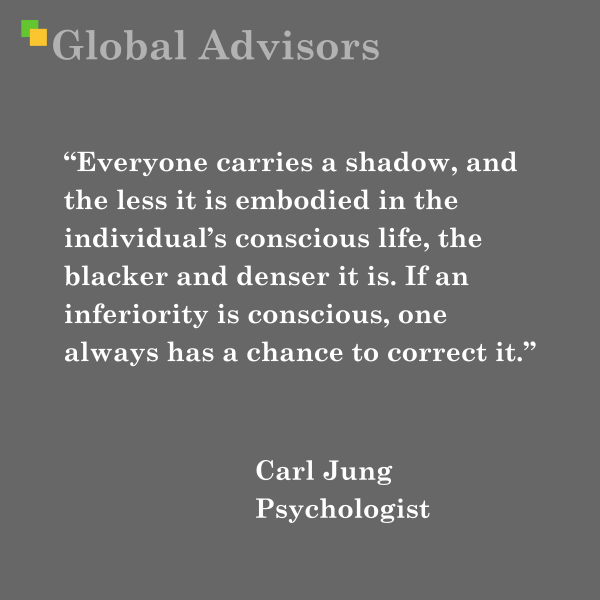
“Everyone carries a shadow, and the less it is embodied in the individual’s conscious life, the blacker and denser it is. If an inferiority is conscious, one always has a chance to correct it… But if it is repressed and isolated from consciousness, it never gets corrected, and is liable to burst forth suddenly in a moment of unawareness.” – Carl Jung – pioneering figure in psychology

Jung described the shadow as the unconscious part of the personality that consists of repressed ideas, weaknesses, desires, instincts, and shortcomings—essentially the darker, hidden side of ourselves that the conscious ego does not identify with or wishes to deny. It is a “cognitive blind spot” within the psyche, representing aspects of the self that one is unaware of or rejects because they don’t fit with the socially acceptable or conscious self-image.

The quote explains that when these shadow aspects remain unconscious and repressed, they become “blacker and denser,” meaning they grow more intense and potentially destructive. Conscious awareness or acknowledgment of these inferiority feelings or shadow elements gives one the chance to address and integrate them, promoting psychological growth and balance.

Importance of Shadow Integration

Jung emphasized that the path to self-knowledge and individuation—the process of becoming a whole person—requires confronting and embracing the shadow. This is often painful and challenging because it involves recognizing traits, desires, or impulses we typically deny. However, doing so prevents these shadow elements from erupting uncontrollably or damagingly, as they might if suppressed too long.

Jung wrote that the shadow is not solely negative but contains valuable qualities such as instincts, emotional energy, creativity, and realistic insights, which can be reclaimed through awareness. If left unrecognized, the shadow keeps a person psychologically impoverished and disconnected.

Carl Jung’s Background

Carl Gustav Jung (1875–1961) was a pioneering figure in psychology who diverged from Freud to develop his own theories about the unconscious mind. He introduced terms such as archetypes, the collective unconscious, and the personal unconscious, with the shadow being a central archetype representing the hidden dimension of personality.

His work has deeply influenced not only psychology but also philosophy, literature, and spirituality. Jung’s exploration of the shadow was part of his broader interest in the balance of conscious and unconscious parts of the self, aiming for personal wholeness.

In Summary

  • The shadow represents the unconscious, repressed, often undesirable parts of ourselves.
  • If these parts are conscious, one can work on and correct them.
  • If they are repressed, they become more intense and may suddenly emerge in uncontrolled ways.
  • Jung saw acknowledging and integrating the shadow as essential to psychological health and self-realization.
  • The quote reflects Jung’s belief in the necessity of self-awareness and honesty to prevent the shadow from overwhelming the individual.

This quote encapsulates a key psychological insight from Jung’s analytical psychology, highlighting the importance of self-consciousness in managing the darker sides of human nature and achieving personal growth.
read more
Term: Persona Inflation

Term: Persona Inflation

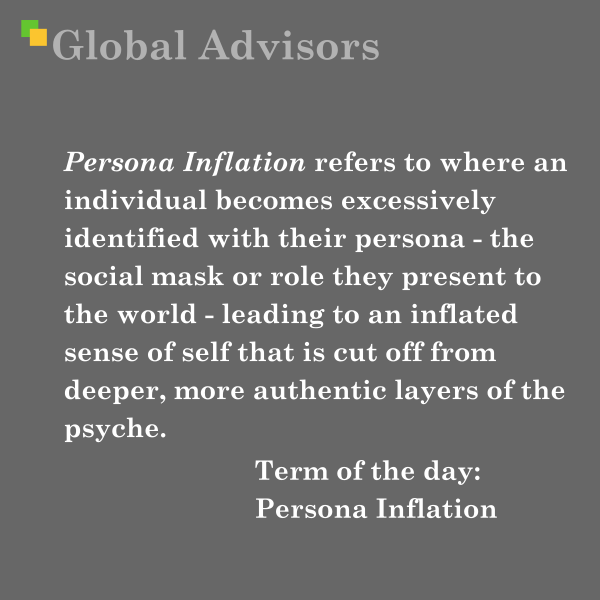
Persona inflation, as defined by Carl Jung, refers to the psychological phenomenon where an individual becomes excessively identified with their persona—the social mask or role they present to the world—leading to an inflated sense of self that is cut off from deeper, more authentic layers of the psyche. The persona is the social mask we create to meet external expectations. When we identify with it—“I am the CEO, the star, the influencer”—the ego becomes inflated, cut off from shadow and Self.

Jung’s Concept of the Persona

Jung introduced the concept of the persona as the mask or identity we adopt to meet the expectations and norms of society. It acts as a kind of psychological armor, allowing us to function in social roles—such as the CEO, the star, or the influencer. However, this mask is not our true self; it is a construct designed to navigate external realities.

Backstory: How Persona Inflation Occurs

  • Identification with the Role: Over time, individuals may become so attached to their persona that they genuinely believe they are the role they play—confusing the mask with their essence. For example, someone who endlessly introduces themselves and behaves as “the visionary CEO” may start to believe this role encompasses their entire identity.
  • Ego Inflation: Jung described inflation as a state where the ego’s sense of self-importance grows disproportionately, disconnected from the rest of the psyche—including the shadow (our hidden, unacknowledged aspects) and the Self (a more integrated, whole identity). This happens when the ego merges with the persona or even with powerful archetypes, losing any humility or self-critique.
  • Blind Spots and Disconnection: An inflated persona blinds individuals to their own limitations, fallibility, and deeper needs. Jung noted such a person becomes egocentric and “conscious of nothing but its own existence,” unable to see their blind spots or relate authentically to others.
 

Symptoms and Societal Implications

  • Lack of Authentic Relationships: When the ego is wedded to its persona and inflated, it becomes difficult to form genuine connections, as interactions are filtered through the mask rather than the true self.
  • Vulnerability and Fragility: Like an overblown balloon, persona inflation is impressive but fragile; it is easily punctured by criticism, failure, or loss of status.
  • Denial of Humanness: This state serves as a defense against confronting one’s limitations, mistakes, or need for change—resulting in denial of one’s own humanity and incompleteness.
  • Societal Trends: In the modern era, pressure to project success and cultivate an idealized image—amplified by social media—makes persona inflation a widespread risk.

Jung’s Warning and the Path to Wholeness

Jung consistently warned about the dangers of inflation, emphasizing that it is not always consciously felt; often, its presence is best inferred from symptoms like arrogance, extreme defensiveness, or the reactions of others. The antidote lies in differentiating between the persona and the deeper Self, integrating unconscious elements, and maintaining humility. This ongoing process leads to greater psychological health and authentic living.

In summary, persona inflation is the over-identification with one’s social mask, resulting in an ego that is inflated and disconnected from one’s deeper self, relationships, and authentic human experience. Jung saw this as a common but perilous condition, especially prevalent in environments that reward surface performance over genuine self-knowledge

read more

Download brochure

Introduction brochure

What we do, case studies and profiles of some of our amazing team.

Download

Our latest podcasts on Spotify

Sign up for our newsletters - free

Global Advisors | Quantified Strategy Consulting