Select Page

Global Advisors | Quantified Strategy Consulting

Davos
Podcast – The Real AI Signal from Davos 2026

Podcast – The Real AI Signal from Davos 2026

While the headlines from Davos were dominated by geopolitical conflict and debates on AGI timelines and asset bubbles, a different signal emerged from the noise. It wasn’t about if AI works, but how it is being ruthlessly integrated into the real economy.

In our latest podcast, we break down the “Diffusion Strategy” defining 2026.

3 Key Takeaways:

  1. China and the “Global South” are trying to leapfrog: While the West debates regulation, emerging economies are treating AI as essential infrastructure.
    • China has set a goal for 70% AI diffusion by 2027.
    • The UAE has mandated AI literacy in public schools from K-12.
    • Rwanda is using AI to quadruple its healthcare workforce.
  2. The Rise of the “Agentic Self”: We aren’t just using chatbots anymore; we are employing agents. Entrepreneur Steven Bartlett revealed he has established a “Head of Experimentation and Failure” to use AI to disrupt his own business before competitors do. Musician will.i.am argued that in an age of predictive machines, humans must cultivate their “agentic self” to handle the predictable, while remaining unpredictable themselves.
  3. Rewiring the Core: Uber’s CEO Dara Khosrowshahi noted the difference between an “AI veneer” and a fundamental rewire. It’s no longer about summarising meetings; it’s about autonomous agents resolving customer issues without scripts.

The Global Advisors Perspective: Don’t wait for AGI. The current generation of models is sufficient to drive massive value today. The winners will be those who control their “sovereign capabilities” – embedding their tacit knowledge into models they own.

Read our original perspective here – https://with.ga/w1bd5

Listen to the full breakdown here – https://with.ga/2vg0z

While the headlines from Davos were dominated by geopolitical conflict and debates on AGI timelines and asset bubbles, a different signal emerged from the noise. It wasn't about if AI works, but how it is being ruthlessly integrated into the real economy.

read more
The AI Signal from The World Economic Forum 2026 at Davos

The AI Signal from The World Economic Forum 2026 at Davos

Davos 2026 ( WEF26 ) signalled a clear shift in the AI conversation: less speculation, more execution. For most corporates, the infrastructure stack matters, but it will be accessed via hyperscalers and service providers rather than built internally. The more relevant question is what happens inside the organisation once the capability is available.

A consistent theme across discussions: progress is coming from pragmatic leaders who are treating AI as an operating model change, not a technology project. That means building basic literacy across the workforce, redesigning workflows, and being willing to challenge legacy assumptions about how work gets done.

In the full write-up:

  • The shift from “AI theatre” to ROI and deployment reality
  • The five-layer AI stack (and why corporates mostly consume it via partners)
  • The emerging sixth layer: user readiness — and why it is becoming decisive
  • Energy and infrastructure constraints as real-world brakes on scale
  • Corporate pragmatism: moving beyond an “AI veneer” to process redesign and agentic workflows
  • Labour market implications: skills shifts, entry-level hollowing, and what employers must do now
  • The Global South dimension: barriers, pathways to competitiveness, and practical adoption strategies
  • Second-order risks: cyber exposure, mental health, and cognitive atrophy as governance issues

If you’re leading a business, the takeaway is straightforward: there are strong lessons from pragmatic programs outside of Silicon Valley.

read more
Quote: Mark Carney

Quote: Mark Carney

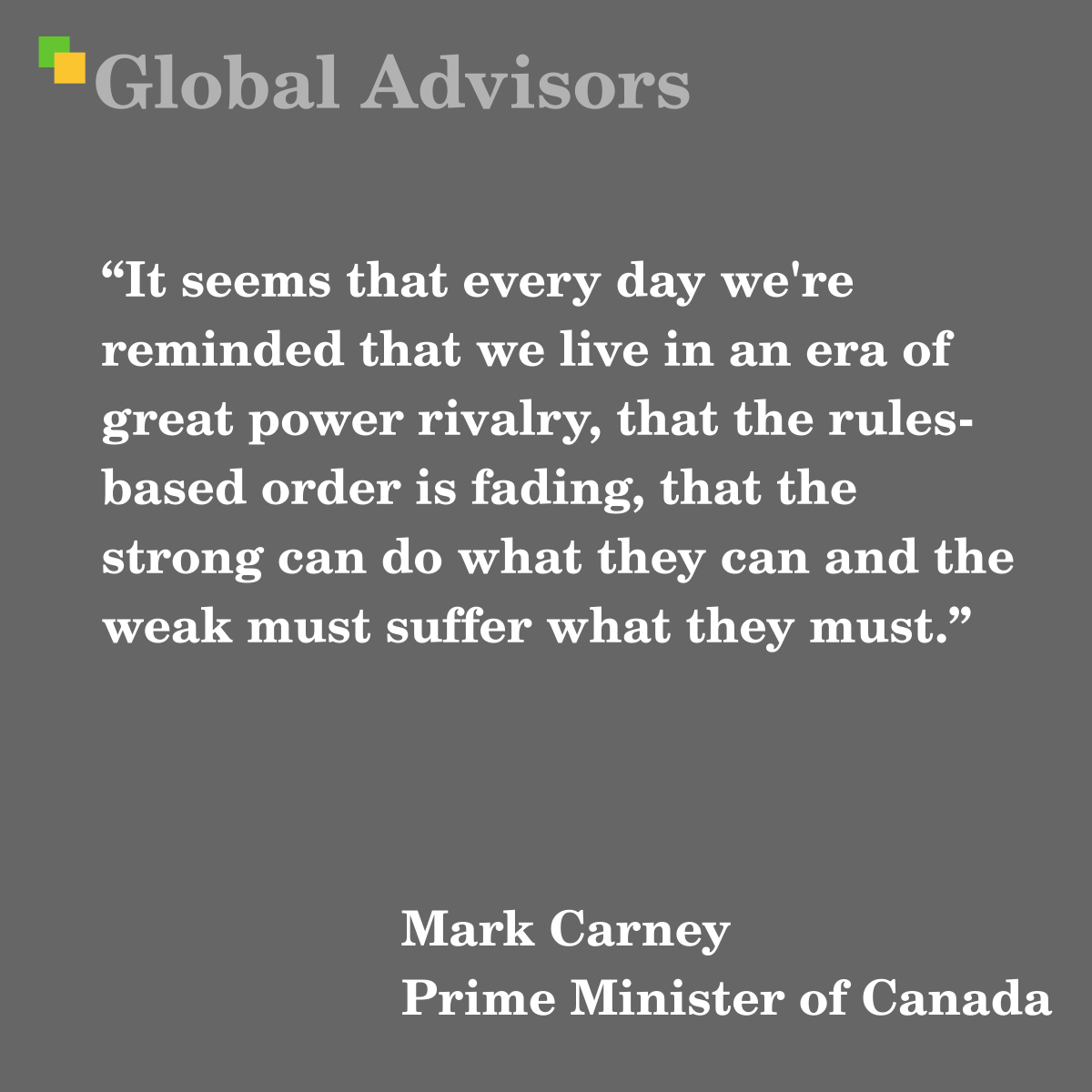
“It seems that every day we’re reminded that we live in an era of great power rivalry, that the rules-based order is fading, that the strong can do what they can and the weak must suffer what they must.” – Mark Carney – Prime Minister of Canada

Mark Carney’s invocation of Thucydides at the World Economic Forum represents far more than rhetorical flourish-it signals a fundamental recalibration of how middle powers must navigate an era of renewed great power competition. Delivered at Davos on 20 January 2026, the Canadian Prime Minister’s address articulates a doctrine of “value-based realism” that acknowledges the erosion of the post-Cold War international architecture whilst refusing to accept the fatalism such erosion might imply.

The Context: A World in Transition

Carney’s speech arrives at a pivotal moment in international affairs. The rules-based order that underpinned global stability since 1945-and particularly since the Cold War’s conclusion-faces unprecedented strain from great power rivalry, economic fragmentation, and the weaponisation of interdependence. The Canadian Prime Minister’s diagnosis is unflinching: the comfortable assumptions that geography and alliance membership automatically confer prosperity and security are no longer valid.1 This is not mere academic observation; it reflects lived experience across the Western alliance as traditional frameworks prove inadequate to contemporary challenges.

The quote itself draws directly from Thucydides’ account of the Melian Dialogue, wherein the Athenian envoys declare that “the strong do what they can and the weak suffer what they must.” By invoking this ancient formulation, Carney grounds contemporary geopolitical anxiety in historical precedent, suggesting that the current moment represents not an aberration but a return to a more primal logic of international relations-one temporarily obscured by the post-1989 liberal consensus.

The Intellectual Foundations: Realism and Its Evolution

Carney’s framework draws upon several strands of international relations theory, most notably classical realism and its contemporary variants. The concept of “value-based realism,” which Carney attributes to Alexander Stubb, President of Finland, represents an attempt to synthesise realist analysis of power distribution with liberal commitments to human rights, sovereignty, and territorial integrity.1 This is a deliberate intellectual move-rejecting both naive multilateralism and amoral power politics in favour of a pragmatic middle path.

Classical realism, articulated most influentially by Hans Morgenthau in the mid-twentieth century, posits that states are rational actors pursuing power within an anarchic international system. Morgenthau’s seminal work Politics Among Nations established that national interest, defined in terms of power, constitutes the objective of statecraft. Yet Morgenthau himself recognised that power encompasses more than military capacity-it includes economic strength, technological capability, and moral authority. Carney’s approach resurrects this more nuanced understanding, arguing that middle powers possess distinct forms of leverage beyond military might.

The realist tradition has evolved considerably since Morgenthau. Kenneth Waltz’s structural realism emphasised the anarchic nature of the international system and the security dilemma it generates, wherein defensive measures by one state appear threatening to others, creating spirals of mistrust. This framework helps explain contemporary great power competition: as American hegemony faces challenge from rising powers, each actor rationally pursues security through military buildups and alliance formation, inadvertently triggering the very insecurity it seeks to prevent. Carney’s diagnosis aligns with this logic-the “end of the rules-based order” reflects not malice but the structural pressures inherent in multipolarity.

More recent theorists have grappled with how middle powers navigate such environments. Scholars such as Andrew Pratt and Fen Osler Hampton have examined “middle power diplomacy,” arguing that states lacking superpower status can exercise disproportionate influence through coalition-building, norm entrepreneurship, and strategic positioning. This intellectual tradition directly informs Carney’s prescription: middle powers must act together, creating what he terms “a dense web of connections across trade, investment, culture” upon which they can draw for future challenges.1

The Diagnosis: Structural Transformation

Carney’s analysis identifies three interconnected phenomena reshaping the international landscape. First, the erosion of the rules-based order reflects genuine shifts in material power distribution. The post-Cold War moment, characterised by American unipolarity and the apparent triumph of liberal democracy, has given way to multipolarity and ideological contestation. Great powers-whether the United States, China, or Russia-increasingly view international institutions and agreements as constraints on their freedom of action rather than frameworks for mutual benefit.

Second, economic interdependence, once theorised as a force for peace, has become weaponised. Sanctions regimes, technology restrictions, and supply chain manipulation now constitute standard instruments of statecraft. This transformation reflects what scholars term the “securitisation” of economics-the process whereby economic relationships become framed through security logics. Carney explicitly warns against this: middle powers must resist the temptation to accept “economic intimidation” from one direction whilst remaining silent about it from another, lest they signal weakness and invite further coercion.1

Third, the traditional alliance structures that provided security guarantees to middle powers have become less reliable. NATO’s continued existence notwithstanding, the United States under various administrations has questioned its commitment to collective defence, whilst simultaneously pursuing unilateral policies (such as tariff regimes) that undermine allied interests. This creates what Carney identifies as a fundamental strategic problem: bilateral negotiation between a middle power and a hegemon occurs from a position of weakness, forcing accommodation and competitive deference.1

The Intellectual Lineage: From Thucydides to Contemporary Geopolitics

Carney’s invocation of Thucydides connects to a broader contemporary discourse on great power competition. Graham Allison’s “Thucydides Trap” thesis-the proposition that conflict between a rising power and a declining hegemon is structurally likely-has become influential in policy circles. Allison argues that of sixteen historical cases where a rising power challenged a ruling one, twelve ended in war. This framework, whilst contested by scholars who emphasise contingency and agency, captures genuine anxieties about Sino-American relations and broader multipolarity.

Yet Carney’s deployment of Thucydides differs subtly from Allison’s. Rather than accepting the Trap as inevitable, Carney uses the ancient formulation to establish a baseline-the world as it actually is, stripped of comforting illusions-from which alternative paths become possible. This reflects what might be termed “tragic realism”: an acknowledgment of structural constraints coupled with insistence on human agency and moral choice.

Contemporary theorists of middle power strategy have developed frameworks relevant to Carney’s prescription. Scholars such as Amitav Acharya have examined how middle powers can exercise “agency” within structural constraints through what he terms “norm localisation”-adapting global norms to regional contexts and thereby shaping international discourse. Similarly, theorists of “minilateral” cooperation-agreements among smaller groups of like-minded states-provide intellectual scaffolding for Carney’s vision of issue-specific coalitions rather than universal institutions.

The Prescription: Strategic Autonomy and Collective Action

Carney’s response to this diagnosis comprises several elements. First, building domestic strength: Canada is cutting taxes, removing interprovincial trade barriers, investing a trillion dollars in energy, artificial intelligence, and critical minerals, and doubling defence spending by decade’s end.1 This reflects a classical realist insight-that international influence ultimately rests upon domestic capacity. A state cannot punch above its weight indefinitely; sustainable influence requires genuine economic and military capability.

Second, strategic autonomy: rather than accepting subordination to any hegemon, middle powers must calibrate relationships so their depth reflects shared values.1 This requires what Carney terms “honesty about the world as it is”-recognising that some relationships will be transactional, others deeper, depending on alignment of interests and values. It also requires consistency: applying the same standards to allies and rivals, thereby avoiding the appearance of weakness or double standards that invites further coercion.

Third, coalition-building: Carney proposes plurilateral arrangements-bridging the Trans-Pacific Partnership and European Union to create a trading bloc of 1.5 billion people, forming buyers’ clubs for critical minerals anchored in the G7, cooperating with democracies on artificial intelligence governance.1 These initiatives reflect what might be termed “competitive multilateralism”-creating alternative institutional frameworks that function as described, rather than relying on existing institutions that have become gridlocked or captured by great powers.

This approach draws upon theoretical work on institutional design and coalition formation. Scholars such as Barbara Koremenos have examined how states choose institutional forms-examining when they prefer bilateral arrangements, multilateral institutions, or minilateral coalitions. Carney’s framework suggests that in an era of great power rivalry, minilateral coalitions organised around specific issues prove more effective than universal institutions, precisely because they exclude actors whose interests diverge fundamentally.

The Philosophical Underpinning: Beyond Nostalgia

Carney’s most provocative claim may be his insistence that “nostalgia is not a strategy.”1 This rejects a tempting response to the erosion of the post-Cold War order: attempting to restore it through diplomatic pressure or institutional reform. Instead, Carney argues, middle powers must accept that “the old order is not coming back” and focus on building “something bigger, better, stronger, more just” from the fracture.1

This reflects a philosophical stance sometimes termed “constructive realism”-accepting structural constraints whilst refusing to accept that they determine outcomes. It echoes the existentialist insight that humans are “condemned to be free,” forced to choose even within constraining circumstances. For middle powers, this means accepting that great power rivalry is real and structural, yet refusing to accept that this reality precludes agency, moral choice, or the possibility of building alternative arrangements.

The intellectual roots of this position extend to theorists of social construction in international relations, particularly Alexander Wendt’s argument that “anarchy is what states make of it.” Whilst the anarchic structure of the international system is given, the meaning states attribute to it-whether it necessitates conflict or permits cooperation-remains contestable. Carney’s vision assumes that middle powers, acting together, can construct a different meaning of multipolarity: not a return to Hobbesian warfare but a framework of genuine cooperation among states that share sufficient common ground.

Contemporary Relevance: The Middle Power Moment

Carney’s address arrives at a moment when middle power agency has become increasingly salient. The traditional Cold War binary-alignment with either superpower-has dissolved, creating space for states to pursue more autonomous strategies. Countries such as India, Brazil, Indonesia, and the European Union member states increasingly resist pressure to choose sides in great power competition, instead pursuing what scholars term “strategic autonomy” or “non-alignment 2.0.”

Yet Carney’s formulation differs from classical non-alignment. Rather than attempting to remain neutral between competing blocs, he proposes active coalition-building among states that share values-democracy, human rights, rule of law-whilst remaining pragmatic about interests. This reflects what might be termed “values-based coalition-building,” distinguishing it both from amoral realpolitik and from idealistic universalism.

The stakes Carney identifies are genuine. In a world of great power fortresses-blocs organised around competing powers with limited cross-bloc exchange-middle powers face subordination or marginalisation. Conversely, in a world of genuine cooperation among willing partners, middle powers can exercise disproportionate influence through coalition-building and norm entrepreneurship. Carney’s challenge to middle powers is thus existential: act together or accept subordination.

This framing resonates with contemporary scholarship on the future of international order. Scholars such as Hal Brands and Michael Beckley have examined whether the liberal international order can be reformed or whether it will fragment into competing blocs. Carney’s implicit answer is that the outcome remains undetermined-it depends on choices made by middle powers in the coming years. This is neither optimistic nor pessimistic but genuinely open-ended, contingent upon agency.

The Broader Implications

Carney’s Davos address represents more than Canadian foreign policy positioning. It articulates a vision of international order that acknowledges structural realities-great power rivalry, the erosion of universal institutions, the weaponisation of economic interdependence-whilst refusing to accept that these realities preclude alternatives to hegemonic subordination or great power conflict. For middle powers, this vision offers both diagnosis and prescription: the world has changed fundamentally, but middle powers retain agency if they act together with strategic clarity and moral consistency.

The intellectual traditions informing this vision-classical and structural realism, middle power diplomacy theory, constructivist international relations scholarship-converge on a common insight: international order is not simply imposed by the powerful but constructed through the choices and actions of all states. In an era of multipolarity and great power rivalry, this construction becomes more difficult but also more consequential. The question Carney poses to middle powers is whether they will accept the role assigned to them by great power competition or whether they will actively construct an alternative.

References

1. https://www.weforum.org/stories/2026/01/davos-2026-special-address-by-mark-carney-prime-minister-of-canada/

2. https://www.youtube.com/watch?v=miM4ur5WH3Y

3. https://www.youtube.com/watch?v=btqHDhO4h10

4. https://www.youtube.com/watch?v=NjpjEoJkUes

5. https://www.youtube.com/watch?v=vxXsXXT1Dto

read more
Quote: Mark Carney – Prime Minister of Canada

Quote: Mark Carney – Prime Minister of Canada

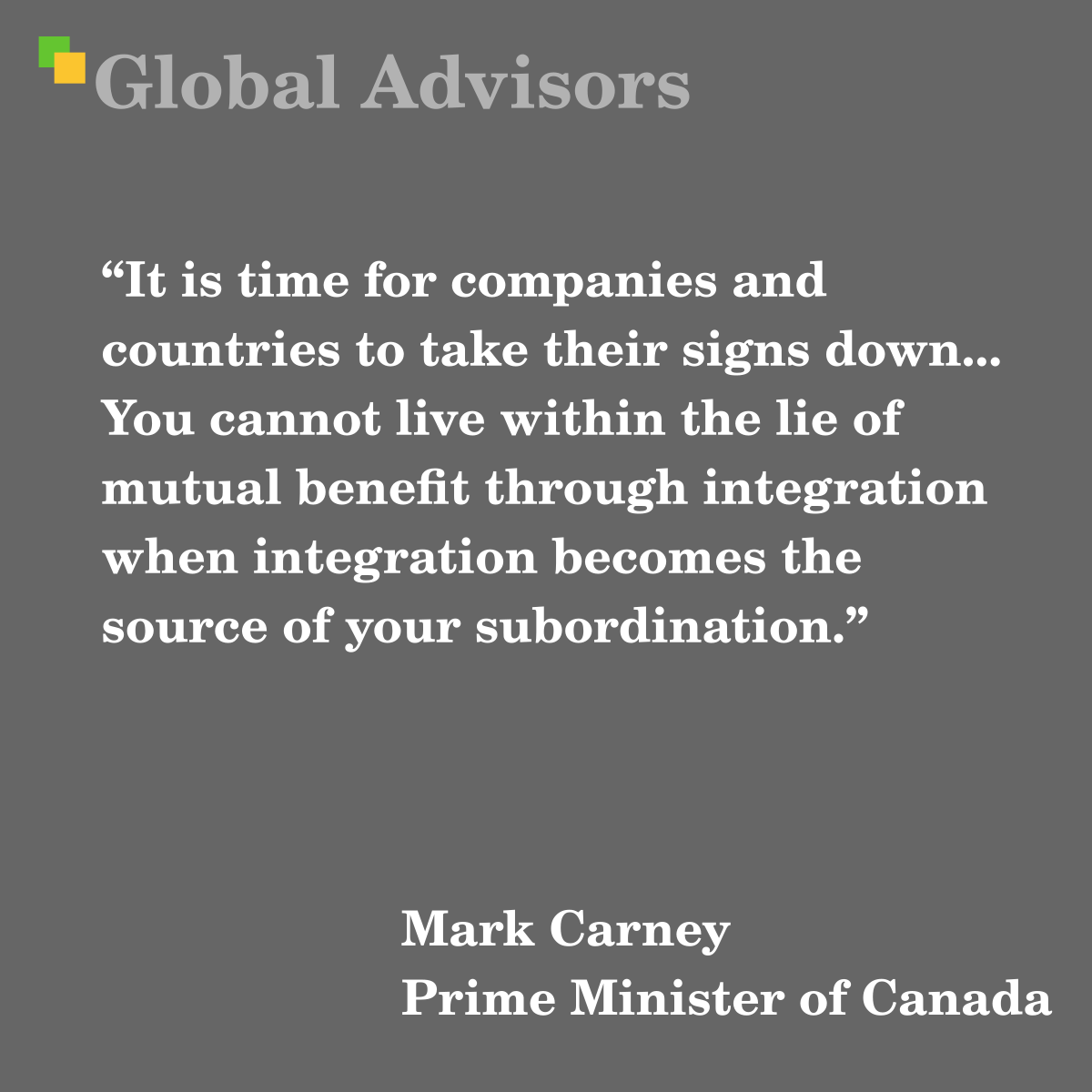
“It is time for companies and countries to take their signs down… You cannot live within the lie of mutual benefit through integration when integration becomes the source of your subordination.” – Mark Carney – Prime Minister of Canada

In his special address at the World Economic Forum’s Annual Meeting 2026 in Davos, delivered on 20 January 2026, Canada’s Prime Minister Mark Carney issued a stark warning about the collapse of the rules-based international order. The quote captures Carney’s pivot towards ‘value-based realism,’ urging nations to abandon naive assumptions of automatic prosperity through globalisation and instead prioritise strategic autonomy, domestic strength, and recalibrated alliances.3,5

Mark Carney: From Central Banker to Prime Minister

Mark Joseph Carney, born on 16 March 1965, is a Canadian economist and politician serving as Canada’s 24th Prime Minister since March 2025. Elected leader of the Liberal Party with over 85.9% of the vote on 9 March 2025, Carney was sworn in as Prime Minister on 14 March without prior elected office, a first in Canadian history. He represents Nepean in Parliament and led the Liberals to a minority government in the subsequent election.1,2

Carney’s career trajectory is marked by high-profile roles in global finance. He served as Governor of the Bank of Canada from 2008 to 2013 and then as Governor of the Bank of England from 2013 to 2020, becoming the first non-Briton in that position. Post-governorship, he advised Canadian Prime Minister Justin Trudeau on COVID-19 economic responses and chaired the Liberal Party’s Task Force on Economic Growth in 2024. Ideologically a centrist technocrat and ‘Blue Grit Liberal,’ Carney’s premiership has focused on economic resilience amid geopolitical tensions.2

Since taking office, Carney has enacted transformative policies: repealing the federal consumer carbon tax, passing the One Canadian Economy Act to eliminate interprovincial trade barriers, fast-tracking a trillion dollars in investments in energy, AI, critical minerals, and infrastructure, and doubling defence spending by decade’s end. His government has recognised the State of Palestine, improved ties with China-including a January 2026 visit yielding tariff reductions on canola and electric vehicles-and sustained support for Ukraine.2,3,4

Context of the Quote: Davos 2026 and Canada’s Strategic Shift

Carney’s address came amid an escalating trade war with the United States and the erosion of post-Cold War globalisation. He declared the end of comfortable assumptions that geography and alliances guaranteed security and prosperity, advocating engagement ‘with open eyes’ and relationships calibrated to shared values. Canada, he noted, was among the first to heed this ‘wake-up call,’ shifting to build strength at home while inviting middle powers to join in ‘value-based realism’-a term borrowed from Finland’s President Alexander Stubb.3

The speech highlighted domestic actions like tax cuts on incomes, capital gains, and business investment, alongside broad engagement to maximise influence in a fluid world. Carney received a standing ovation, underscoring the resonance of his message on naming ‘reality’ and acting decisively.2,3

Leading Theorists on Globalisation, Integration, and Subordination

Carney’s critique echoes longstanding debates in international relations and economics on the limits of globalisation. Key theorists provide intellectual foundations for his views:

  • Joseph Nye and Robert Keohane (Regime Theory): In Power and Interdependence (1977), they argued that complex interdependence fosters mutual benefits through institutions, but power asymmetries can lead to subordination. Carney’s call to ‘take down signs’ of mutual benefit aligns with their recognition that regimes falter when great powers exploit them.2
  • Graham Allison (Thucydides Trap): Allison’s 2017 book warns of inevitable conflict when a rising power (e.g., China) threatens a ruling one (e.g., US), fracturing integration. Carney’s emphasis on strategic autonomy mirrors Allison’s advice for middle powers to hedge amid US-China rivalry.3
  • Dani Rodrik (Trilemma of Global Economy): Rodrik posits governments cannot simultaneously pursue hyper-globalisation, national sovereignty, and democracy. Carney’s policies-relaxing regulations, boosting defence, and diversifying trade-reflect choosing sovereignty over unchecked integration.2
  • John Mearsheimer (Offensive Realism): In The Tragedy of Great Power Politics (2001), Mearsheimer contends states maximise power in anarchy, rendering mutual benefit illusory when subordination looms. Carney’s ‘honesty about the world as it is’ evokes this realist turn from liberal optimism.3
  • Alexander Stubb (Value-Based Realism): As Finland’s President, Stubb popularised the term Carney invokes, blending realism with values like human rights. This framework guides Carney’s calibrated engagements, such as the China partnership focused on trade without ideological naivety.3

These thinkers collectively underscore Carney’s thesis: integration’s promise of mutual benefit dissolves when it enables dominance, necessitating realism over idealism in trade and alliances.

References

1. https://www.pm.gc.ca/en/about

2. https://en.wikipedia.org/wiki/Mark_Carney

3. https://www.weforum.org/stories/2026/01/davos-2026-special-address-by-mark-carney-prime-minister-of-canada/

4. https://www.pm.gc.ca/en/news/news-releases/2026/01/16/prime-minister-carney-forges-new-strategic-partnership-peoples

5. https://www.youtube.com/watch?v=miM4ur5WH3Y

6. https://www.youtube.com/watch?v=7qIUrFANCvU

7. https://www.youtube.com/watch?v=01QBT5fR-DY

read more
Quote: Mark Carney – Prime Minister of Canada

Quote: Mark Carney – Prime Minister of Canada

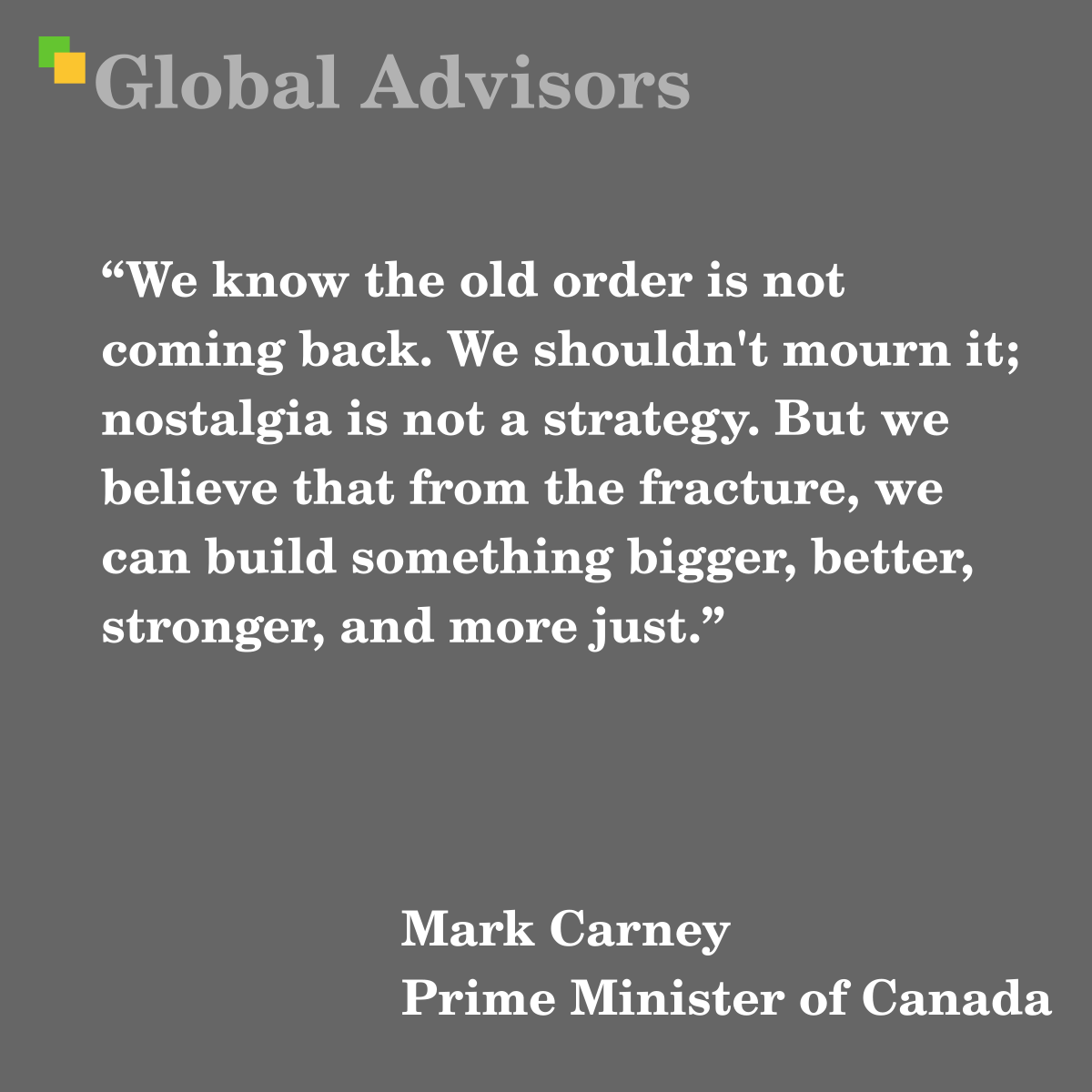
“We know the old order is not coming back. We shouldn’t mourn it; nostalgia is not a strategy. But we believe that from the fracture, we can build something bigger, better, stronger, and more just.” – Mark Carney – Prime Minister of Canada

Mark Carney’s address at the World Economic Forum in Davos on 20 January 2026 articulated a philosophical pivot that extends far beyond Canadian policy. His assertion that “the old order is not coming back” represents a candid acknowledgement of the structural transformation reshaping international relations-a transformation that demands not nostalgic resistance but strategic innovation. The quote encapsulates a broader intellectual movement among contemporary policymakers who recognise that the post-Cold War consensus, built on rules-based multilateralism and assumed Western dominance, has fundamentally fractured.

The Context of Carney’s Intervention

Carney delivered this address as Canada’s 24th Prime Minister, having assumed office in March 2025 following his election as Liberal Party leader with an unprecedented 85.9% of the vote on the first ballot. His ascension marked a significant departure in Canadian political history: he became the first Canadian Prime Minister never to have held elected office before assuming the premiership. This unconventional trajectory-from central banking to the highest political office-reflects the technocratic orientation increasingly evident in responses to complex geopolitical challenges.

The timing of Carney’s Davos intervention proved strategically significant. His address came mere days after a high-profile visit to Beijing, where he met with Chinese President Xi Jinping and negotiated a “new strategic partnership” that substantially reduced tariffs on Canadian canola oil (from 85% to 15%) and Chinese electric vehicles (from 100% to 6.1%). This diplomatic manoeuvre exemplified the very philosophy he articulated at Davos: rather than lamenting the erosion of Western-led institutional frameworks, Canada was actively recalibrating its relationships to reflect contemporary geopolitical realities.

The Intellectual Architecture: Value-Based Realism

Carney’s formulation draws explicitly on what he termed “value-based realism,” a concept articulated by Alexander Stubb, President of Finland. This framework represents a deliberate synthesis of two traditionally opposed analytical traditions: the idealist commitment to universal values (human rights, sovereignty, democratic governance) and the realist acknowledgement of power dynamics and national interest. Rather than treating these as contradictory, value-based realism posits that nations can maintain principled commitments whilst simultaneously engaging pragmatically with the world as it exists rather than as they wish it to be.

This intellectual positioning reflects broader currents in contemporary international relations theory. The concept challenges what scholars term “liberal internationalism”-the post-1945 consensus that institutionalised rules, multilateral organisations, and shared norms could transcend power politics. Carney’s acknowledgement that “the old comfortable assumptions that our geography and alliance memberships automatically conferred prosperity and security” no longer hold valid represents a significant concession to structural realist arguments that have long emphasised the primacy of material capabilities and strategic positioning over institutional arrangements.

Leading Theorists and Intellectual Foundations

Structural Realism and the Multipolar Transition: Carney’s analysis aligns substantially with structural realist scholarship, particularly the work of scholars examining the transition from unipolarity to multipolarity. Theorists such as John Mearsheimer have long argued that the post-Cold War unipolar moment was inherently unstable and that the rise of peer competitors (particularly China) would inevitably erode the institutional frameworks built during American hegemony. Carney’s acknowledgement that “the powerful have their power” whilst Canada must “build our strength at home” reflects this realist recognition that material capabilities ultimately determine strategic options.

Strategic Autonomy and Middle Power Theory: Carney explicitly positioned Canada as a “middle power” capable of exercising disproportionate influence through strategic positioning. This concept draws on middle power theory, developed by scholars including Andrew Cooper and Evan Potter, which argues that states occupying the intermediate tier of the international system can leverage their geographic position, institutional expertise, and coalition-building capacity to exercise influence beyond their material weight. Carney’s emphasis on “building strategic autonomy whilst maintaining values” reflects this theoretical framework-middle powers must avoid dependency on great power patrons whilst retaining the principled commitments that differentiate them from purely transactional actors.

The Fracture Metaphor and Institutional Decay: Carney’s use of “fracture” rather than “collapse” or “transformation” carries theoretical significance. This language echoes the work of scholars examining institutional erosion, particularly those studying the decline of post-war multilateral organisations. Theorists including Dani Rodrik have documented how globalisation and geopolitical competition have strained the institutional consensus that underpinned the Bretton Woods system and its successors. The fracture metaphor suggests not apocalyptic breakdown but rather the splintering of previously unified frameworks into competing regional and bilateral arrangements.

Constructivist Approaches to Order-Building: Carney’s assertion that “from the fracture, we can build something bigger, better, stronger, and more just” reflects constructivist international relations theory, which emphasises that international orders are socially constructed rather than determined by material forces alone. Scholars including Alexander Wendt have argued that actors can reshape international structures through strategic communication and norm entrepreneurship. Carney’s framing positions Canada not as a passive victim of systemic change but as an active participant in constructing new institutional arrangements-a distinctly constructivist orientation.

The Rejection of Nostalgia as Strategic Doctrine

Carney’s explicit rejection of nostalgia as a strategic framework warrants particular attention. This formulation directly challenges what scholars term “nostalgic nationalism”-the tendency of declining powers to seek restoration of previous hierarchies rather than adaptation to new circumstances. The statement “nostalgia is not a strategy” functions as both intellectual critique and practical warning. It implicitly critiques both American efforts to reassert unilateral dominance and European attempts to preserve Cold War alliance structures unchanged.

This positioning reflects contemporary debates within strategic studies about how established powers should respond to relative decline. Scholars including Hal Brands have examined whether declining powers typically pursue accommodation or confrontation; Carney’s framework suggests a third path: strategic recalibration that preserves core values whilst abandoning outdated institutional assumptions.

Domestic Foundations: Building Strength at Home

Carney’s emphasis on building “strength at home” through tax reductions, removal of interprovincial trade barriers, and a trillion-dollar investment programme in energy, artificial intelligence, and critical minerals reflects economic nationalism tempered by liberal institutional commitments. This approach synthesises elements of developmental state theory (the strategic deployment of state capacity to build competitive advantage) with market-liberal principles. The doubling of defence spending by decade’s end, coupled with investments in domestic industrial capacity, reflects what scholars term “strategic decoupling”-the deliberate reduction of dependency on potentially unreliable partners through domestic capability development.

This domestic orientation also reflects recognition of what political economists call the “trilemma of globalisation”: the impossibility of simultaneously maintaining democratic sovereignty, deep economic integration, and fixed exchange rates. By prioritising sovereignty and strategic autonomy, Carney’s government implicitly accepts reduced integration with some partners whilst deepening selective relationships (notably with China) where mutual benefit is demonstrable.

The Broader Geopolitical Significance

Carney’s Davos address arrived at a moment of acute geopolitical tension. The ongoing trade conflict with the United States, the continuation of Russian aggression in Ukraine, and the intensifying competition for technological and resource dominance between Western and Chinese-led blocs have created what scholars term a “multiplex world order”-one characterised by simultaneous cooperation and competition across multiple domains rather than simple bipolarity or unipolarity.

His reception-described as earning “a rare standing ovation” at Davos-suggests that his articulation of value-based realism resonated with an international audience of business and political leaders grappling with similar strategic dilemmas. The framework offers intellectual legitimacy for the pragmatic recalibration that many middle and smaller powers have already undertaken, whilst maintaining rhetorical commitment to universal principles.

Implications for International Order-Building

Carney’s vision of building “something bigger, better, stronger, and more just” from the fracture of the old order represents an optimistic but contingent proposition. It assumes that the emerging multipolar system need not replicate the zero-sum competition that characterised earlier multipolar eras, and that institutional innovation can accommodate both great power competition and cooperative problem-solving on transnational challenges.

This optimism reflects what scholars call “liberal institutionalism”-the belief that even in anarchic international systems, institutions can facilitate cooperation and reduce transaction costs. Yet Carney’s framework differs from earlier liberal institutionalism in its explicit acknowledgement that such institutions must reflect contemporary power distributions rather than attempting to preserve outdated hierarchies. The Canada-China strategic partnership, with its focus on trade, energy, and technology, exemplifies this approach: cooperation structured around mutual benefit rather than ideological alignment or institutional obligation.

The intellectual coherence of Carney’s position lies in its rejection of false dichotomies. It refuses the choice between principled commitment and pragmatic engagement, between national interest and international cooperation, between acknowledging systemic change and working to shape its trajectory. Whether this framework can sustain itself amid intensifying great power competition remains an open question-one that will substantially determine the character of the emerging international order.

References

1. https://www.weforum.org/stories/2026/01/davos-2026-special-address-by-mark-carney-prime-minister-of-canada/

2. https://www.pm.gc.ca/en/about

3. https://en.wikipedia.org/wiki/Mark_Carney

4. https://www.pm.gc.ca/en/news/news-releases/2026/01/16/prime-minister-carney-forges-new-strategic-partnership-peoples

5. https://www.youtube.com/watch?v=miM4ur5WH3Y

6. https://www.youtube.com/watch?v=7qIUrFANCvU

7. https://www.youtube.com/watch?v=01QBT5fR-DY

read more
Term: Davos

Term: Davos

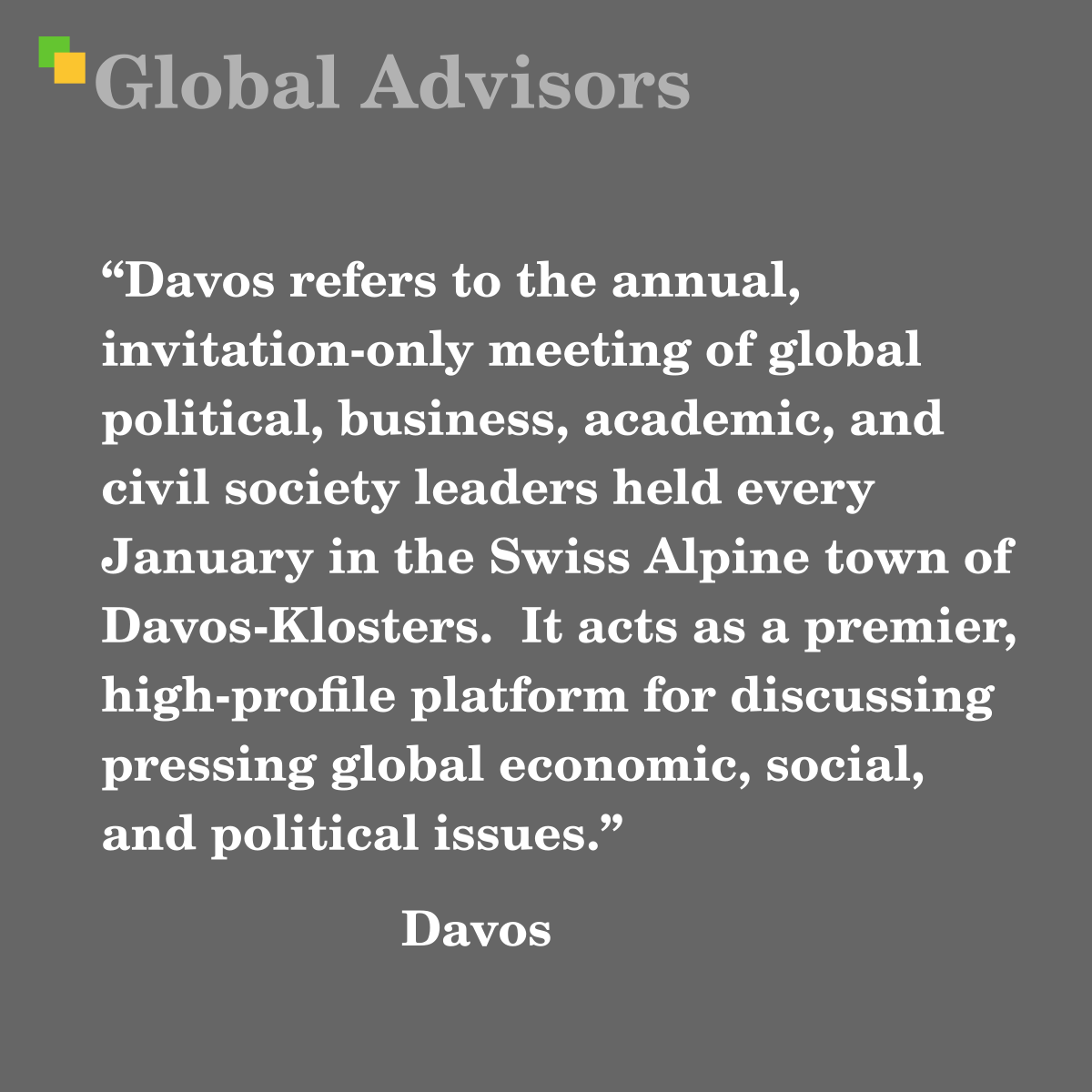
“Davos refers to the annual, invitation-only meeting of global political, business, academic, and civil society leaders held every January in the Swiss Alpine town of Davos-Klosters. It acts as a premier, high-profile platform for discussing pressing global economic, social, and political issues.” – Davos

Davos represents far more than a simple annual conference; it embodies a transformative model of global governance and problem-solving that has evolved significantly since its inception. Held each January in the Swiss Alpine resort town of Davos-Klosters, this invitation-only gathering convenes over 2,500 leaders spanning business, government, civil society, academia, and media to address humanity’s most pressing challenges.1,7

The Evolution and Purpose of Davos

Founded in 1971 by German engineer Klaus Schwab as the European Management Symposium, Davos emerged from a singular vision: that businesses should serve all stakeholders-employees, suppliers, communities, and the broader society-rather than shareholders alone.1 This foundational concept, known as stakeholder theory, remains central to the World Economic Forum’s mission today.1 The organisation formalised this philosophy through the Davos Manifesto in 1973, which was substantially renewed in 2020 to address the challenges of the Fourth Industrial Revolution.1,3

The Forum’s evolution reflects a fundamental shift in how global problems are addressed. Rather than relying solely on traditional nation-state institutions established after the Second World War-such as the International Monetary Fund, World Bank, and United Nations-Davos pioneered what scholars term a “Networked Institution.”2 This model brings together independent parties from civil society, the private sector, government, and individual stakeholders who perceive shared global problems and coordinate their activities to make progress, rather than working competitively in isolation.2

Tangible Impact and Policy Outcomes

Davos has demonstrated concrete influence on global affairs. In 1988, Greece and Türkiye averted armed conflict through an agreement finalised at the meeting.1 The 1990s witnessed a historic handshake that helped end apartheid in South Africa, and the platform served as the venue for announcing the UN Global Compact, calling on companies to align operations with human rights principles.1 More recently, in 2023, the United States announced a new development fund programme at Davos, and global CEOs agreed to support a free trade agreement in Africa.1 The Forum also launched Gavi, the vaccine alliance, in 2000-an initiative that now helps vaccinate nearly half the world’s children and played a crucial role in delivering COVID-19 vaccines to vulnerable countries.6

The Davos Manifesto and Stakeholder Capitalism

The 2020 Davos Manifesto formally established that the World Economic Forum is guided by stakeholder capitalism, a concept positing that corporations should deliver value not only to shareholders but to all stakeholders, including employees, society, and the planet.3 This framework commits businesses to three interconnected responsibilities:

  • Acting as stewards of the environmental and material universe for future generations, protecting the biosphere and championing a circular, shared, and regenerative economy5
  • Responsibly managing near-term, medium-term, and long-term value creation in pursuit of sustainable shareholder returns that do not sacrifice the future for the present5
  • Fulfilling human and societal aspirations as part of the broader social system, measuring performance not only on shareholder returns but also on environmental, social, and governance objectives5

Contemporary Relevance and Structure

The World Economic Forum operates as an international not-for-profit organisation headquartered in Geneva, Switzerland, with formal institutional status granted by the Swiss government.2,3 Its mission is to improve the state of the world through public-private cooperation, guided by core values of integrity, impartiality, independence, respect, and excellence.8 The Forum addresses five interconnected global challenges: Growth, Geopolitics, Technology, People, and Planet.8

Davos functions as the touchstone event within the Forum’s year-round orchestration of leaders from civil society, business, and government.2 Beyond the annual meeting, the organisation maintains continuous engagement through year-round communities spanning industries, regions, and generations, transforming ideas into action through initiatives and dialogues.4 The 2026 meeting, themed “A Spirit Of Dialogue,” emphasises advancing cooperation to address global issues, exploring the impact of innovation and emerging technologies, and promoting inclusive, sustainable approaches to human capital development.7

Klaus Schwab: The Architect of Davos

Klaus Schwab (born 1938) stands as the visionary founder and defining intellectual force behind Davos and the World Economic Forum. A German engineer and economist educated at the University of Bern and Harvard Business School, Schwab possessed an unusual conviction: that business leaders bore responsibility not merely to shareholders but to society writ large. This belief, radical for the early 1970s, crystallised into the founding of the European Management Symposium in 1971.

Schwab’s relationship with Davos transcends institutional leadership; he fundamentally shaped its philosophical architecture. His stakeholder theory challenged the prevailing shareholder primacy model that dominated Western capitalism, proposing instead that corporations exist within complex ecosystems of interdependence. This vision proved prescient, gaining mainstream acceptance only decades later as environmental concerns, social inequality, and governance failures exposed the limitations of pure shareholder capitalism.

Beyond founding the Forum, Schwab authored influential works including “The Fourth Industrial Revolution” (2016), a concept he coined to describe the convergence of digital, biological, and physical technologies reshaping society.1 His intellectual contributions extended the Forum’s reach from a business conference into a comprehensive platform addressing geopolitical tensions, technological disruption, and societal transformation. Schwab’s personal diplomacy-his ability to convene adversaries and facilitate dialogue-became embedded in Davos’s culture, establishing it as a neutral space where competitors and rivals could engage constructively.

Schwab’s legacy reflects a particular European sensibility: the belief that enlightened capitalism, properly structured around stakeholder interests, could serve as a force for global stability and progress. Whether one views this as visionary or naïve, his influence on contemporary governance models and corporate responsibility frameworks remains substantial. The expansion of Davos from a modest gathering of European executives to a global institution addressing humanity’s most complex challenges represents perhaps the most tangible measure of Schwab’s impact on twenty-first-century global affairs.

References

1. https://www.weforum.org/stories/2024/12/davos-annual-meeting-everything-you-need-to-know/

2. https://www.weforum.org/stories/2016/01/the-meaning-of-davos/

3. https://www.mckinsey.com/featured-insights/mckinsey-explainers/what-is-davos-and-the-world-economic-forum

4. https://www.weforum.org/about/who-we-are/

5. https://en.wikipedia.org/wiki/World_Economic_Forum

6. https://www.zurich.com/media/magazine/2022/what-is-davos-your-guide-to-the-world-economic-forums-annual-meeting

7. https://www.oliverwyman.com/our-expertise/events/world-economic-forum-davos.html

8. https://www.weforum.org/about/world-economic-forum/

read more

Download brochure

Introduction brochure

What we do, case studies and profiles of some of our amazing team.

Download

Our latest podcasts on Spotify

Sign up for our newsletters - free

Global Advisors | Quantified Strategy Consulting