Select Page

Global Advisors | Quantified Strategy Consulting

due diligence
Quote: Warren Buffet – Investor

Quote: Warren Buffet – Investor

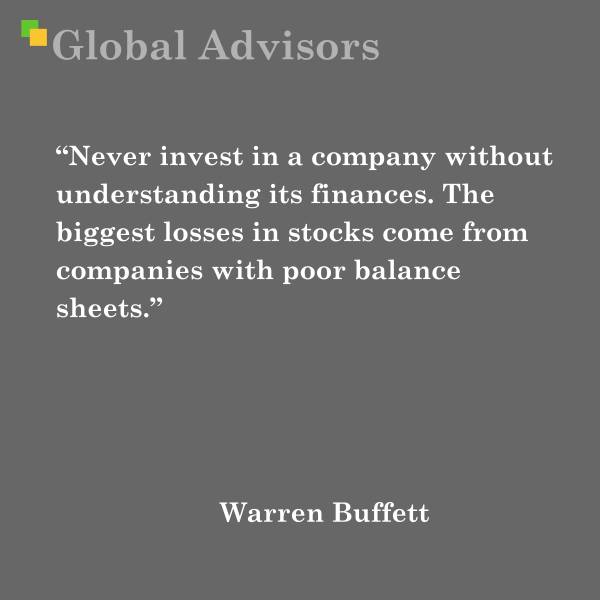
“Never invest in a company without understanding its finances. The biggest losses in stocks come from companies with poor balance sheets.” – Warren Buffet – Investor

This statement encapsulates Warren Buffett’s foundational conviction that a thorough understanding of a company’s financial health is essential before any investment is made. Buffett, revered as one of the world’s most successful and influential investors, has built his career—and the fortunes of Berkshire Hathaway shareholders—by analysing company financials with forensic precision and prioritising robust balance sheets. A poor balance sheet typically signals overleveraging, weak cash flows, and vulnerability to adverse market cycles, all of which heighten the risk of capital loss.

Buffett’s approach can be traced directly to the principles of value investing: only purchase businesses trading below their intrinsic value, and rigorously avoid companies whose finances reveal underlying weakness. This discipline shields investors from the pitfalls of speculation and market fads. Paramount to this method is what Buffett calls a margin of safety—a buffer between a company’s market price and its real worth, aimed at mitigating downside risks, especially those stemming from fragile balance sheets. His preference for quality over quantity similarly reflects a bias towards investing larger sums in a select number of financially sound companies rather than spreading capital across numerous questionable prospects.

Throughout his career, Buffett has consistently advocated for investing only in businesses that one fully understands. He famously avoids complexity and “fashionable trends,” stating that clarity and financial strength supersede cleverness or hype. His guiding mantra to “never lose money,” and the prompt reminder “never forget the first rule,” further reinforces his risk-averse methodology.

Background on Warren Buffett

Born in 1930 in Omaha, Nebraska, Warren Buffett demonstrated an early fascination with business and investing. He operated as a stockbroker, bought and sold pinball machines, and eventually took over Berkshire Hathaway, transforming it from a struggling textile manufacturer into a global conglomerate. His stewardship is defined not only by outsized returns, but by a consistent, rational framework for capital allocation; he eschews speculation and prizes businesses with predictable earnings, capable leadership, and resilient competitive advantages. Buffett’s investment tenets, traced back to Benjamin Graham and refined with Charlie Munger, remain the benchmark for disciplined, risk-conscious investing.

Leading Theorists on Financial Analysis and Value Investing

The intellectual foundation of Buffett’s philosophy rests predominantly on the work of Benjamin Graham and, subsequently, David Dodd:

  • Benjamin Graham
    Often characterised as the “father of value investing,” Graham developed a rigorous framework for asset selection based on demonstrable financial solidity. His landmark work, The Intelligent Investor (1949), formalised the notion of intrinsic value, margin of safety, and the critical analysis of financial statements. Graham’s empirical, rules-based approach sought to remove emotion from investment decision-making, placing systematic, intensive financial review at the forefront.
  • David Dodd
    Co-author of Security Analysis with Graham, Dodd expanded and codified approaches for in-depth business valuation, championing comprehensive audit of balance sheets, income statements, and cash flow reports. The Graham-Dodd method remains the global standard for security analysis.
  • Charlie Munger
    Buffett’s long-time business partner, Charlie Munger, is credited with shaping the evolution from mere statistical bargains (“cigar butt” investing) towards businesses with enduring competitive advantage. Munger advocates a broadened mental toolkit (“worldly wisdom”) integrating qualitative insights—on management, culture, and durability—with rigorous financial vetting.
  • Peter Lynch
    Known for managing the Magellan Fund at Fidelity, Lynch famously encouraged investors to “know what you own,” reinforcing the necessity of understanding a business’s financial fibre before participation. He also stressed that the gravest investing errors stem from neglecting financial fundamentals, echoing Buffett’s caution on poor balance sheets.
  • John Bogle
    As the founder of Vanguard and inventor of the index fund, Bogle’s influence stems from his advocacy of broad diversification—but he also warned sharply against investing in companies without sound financial disclosure, because broad market risks are magnified in the presence of individual corporate failure.

Conclusion of Context

Buffett’s quote is not merely a rule-of-thumb—it expresses one of the most empirically validated truths in investment history: deep analysis of company finances is indispensable to avoiding catastrophic losses. The theorists who shaped this doctrine did so by instituting rigorous standards and repeatable frameworks that continue to underpin modern investment strategy. Buffett’s risk-averse, fundamentals-rooted vision stands as a beacon of prudence in an industry rife with speculation. His enduring message—understand the finances; invest only in quality—remains the starting point for both novice and veteran investors seeking resilience and sustainable wealth.
read more
Term: Strategic Due Diligence

Term: Strategic Due Diligence

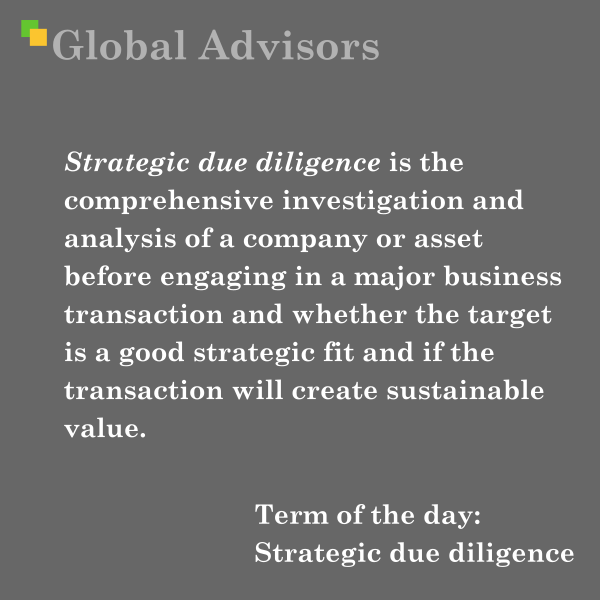
Strategic due diligence is the comprehensive investigation and analysis of a company or asset before engaging in a major business transaction, such as a merger, acquisition, investment, or partnership. Unlike financial or legal due diligence—which focus on verifying facts and liabilities—strategic due diligence evaluates whether the target is a good strategic fit and if the transaction will create sustainable value.

Key components of strategic due diligence include:

  • Assessing strategic fit: Analysis of how well the target aligns with the acquirer’s long-term business strategy and objectives, including cultural and operational compatibility.
  • Market and competitive analysis: Evaluation of the industry’s trends, the target’s position within the market, growth opportunities, and threats, as well as potential synergies and competitive advantages.
  • Value creation and deal thesis validation: Examination of whether the underlying assumptions for the deal’s value are realistic and attainable, including whether the deal’s objectives can be met in practice.
  • Risk identification: Uncovering potential risks, liabilities, and integration challenges that could impede the realization of expected benefits.

The process is critical for:

  • Avoiding unforeseen risks and liabilities (such as undisclosed debts or contracts).
  • Informing negotiation strategies and post-deal integration plans.
  • Ensuring that the transaction enhances—not detracts from—the buyer’s strategic goals and competitive position.

In summary, strategic due diligence is an essential, holistic process that gives decision makers clarity on whether a business opportunity or transaction supports their overarching strategic ambitions, and what risks or synergies they must manage to achieve post-deal success.

Related Strategy Theorist: David Howson

A leading theorist associated with the concept of strategic due diligence is David Howson. He is frequently cited for his work on due diligence processes in mergers and acquisitions (M&A), particularly for emphasizing the multidisciplinary and strategic aspects of due diligence beyond just financials. However, it is important to note that the field draws from a broad base of strategic management literature, including concepts from Michael Porter (competitive advantage, industry analysis) and practitioners who bridge strategy with corporate finance in transactions.

read more
Quote: Warren Buffet – investor

Quote: Warren Buffet – investor

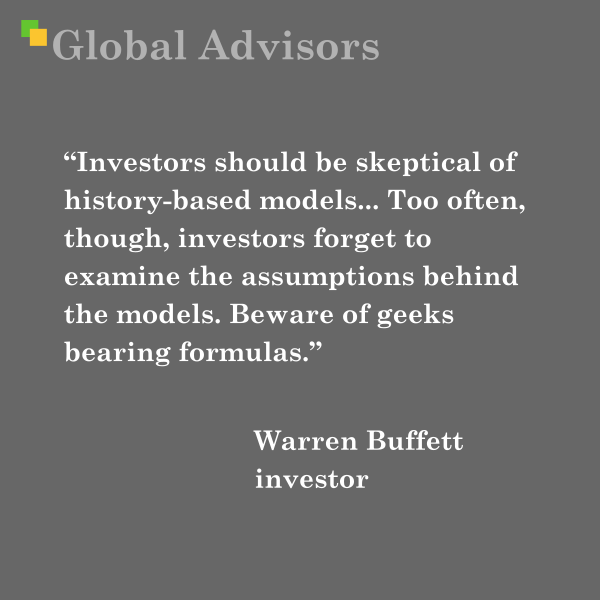
Investors should be skeptical of history-based models… Too often, though, investors forget to examine the assumptions behind the models. Beware of geeks bearing formulas.
– Warren Buffet, Investor

The quote reflects Warren Buffett’s deeply pragmatic and experience-driven approach to investing. Buffett, widely regarded as one of the most successful investors of all time, has built his reputation on a disciplined method that values understanding businesses fundamentally over relying on complex quantitative models.

Buffett’s skepticism toward “history-based models” stems from his belief that numerical formulas—no matter how sophisticated—are only as good as the assumptions underlying them. These models often use statistical terms like beta, gamma, and sigma, which sound impressive but can obscure critical factors affecting a company’s future performance. He warns investors not to be seduced by formulas crafted by what he calls a “nerdy-sounding priesthood,” emphasizing the importance of knowing the meaning and context behind every symbol or number in an equation rather than blindly trusting them.

This perspective is rooted in Buffett’s longstanding investment philosophy: that success comes from investing in businesses with durable competitive advantages, competent management, and predictable long-term prospects—not from placing faith in past data or overengineered predictive tools. He advocates for disciplined fundamental analysis and warns against overreliance on models that assume the future will closely mirror the past—a dangerous assumption in markets characterized by uncertainty and change.

Buffett’s approach also embodies patience and common sense. His advice to “buy into a company because you want to own it, not because you want the stock to go up,” and to “draw a circle around businesses you understand,” reiterates his preference for simplicity and clarity over complexity and guesswork. By highlighting the risk of blindly trusting “geeks bearing formulas,” Buffett cautions investors to balance quantitative analysis with qualitative insight and critical thinking.

In essence, this quote is a timeless reminder that investing is as much an art as it is a science. While quantitative tools can provide useful information, they should never replace thorough, skeptical evaluation of a company’s true business fundamentals. Buffett’s wisdom encourages investors to question assumptions, understand what lies beneath the numbers, and prioritize sound judgment over flashy formulas.

Warren Buffett’s career and success amplify this message. As chairman and CEO of Berkshire Hathaway, he has famously rejected fads and complex financial engineering in favor of straightforward value investing principles. His practical, grounded approach has guided generations of investors to see beyond surface metrics and embrace a thoughtful, long-term view of investing.

read more
PODCAST: Your Due Diligence is Most Likely Wrong

PODCAST: Your Due Diligence is Most Likely Wrong

Our Spotify podcast explores why most mergers and acquisitions fail to create value and provides a practical guide to performing a strategic due diligence process.

The hosts The hosts highlight common pitfalls like overpaying for acquisitions, failing to understand the true value of a deal, and neglecting to account for future uncertainties. They emphasize that a successful deal depends on a clear strategic rationale, a thorough understanding of the target’s competitive position, and a comprehensive assessment of potential risks. They then present a four-stage approach to strategic due diligence that incorporates scenario planning and probabilistic simulations to quantify uncertainty and guide decision-making. Finally, they discuss how to navigate deal-making during economic downturns and stress the importance of securing existing businesses, revisiting return measures, prioritizing potential targets, and factoring in potential delays.

Read more from the original article.

read more
Your due diligence is most likely wrong

Your due diligence is most likely wrong

As many as 70 – 90% of deals fail to create value for acquirers. The majority of these deals were the subject of commercial or strategic due diligences (DDs). Many DDs are rubber stamps – designed to motivate an investment to shareholders. Yet the requirements for a value-adding DD go beyond this.

Strategic due diligence must test investees against uncertainty via a variety of methods that include scenarios, probabilised forecasts and stress tests to ensure that investees are value accretive.

Firms that invest during downturns outperform those who don’t. DDs undertaken during downturns have a particularly difficult task – how to assess the future prospects of an investee when the future is so uncertain.

There is clearly an integrated approach to successful due diligence – despite the challenges posed by uncertainty.

Read more…

read more

Download brochure

Introduction brochure

What we do, case studies and profiles of some of our amazing team.

Download

Our latest podcasts on Spotify

Sign up for our newsletters - free

Global Advisors | Quantified Strategy Consulting